Private Aviation AI Search Strategy
Private Aviation AI Search Guide
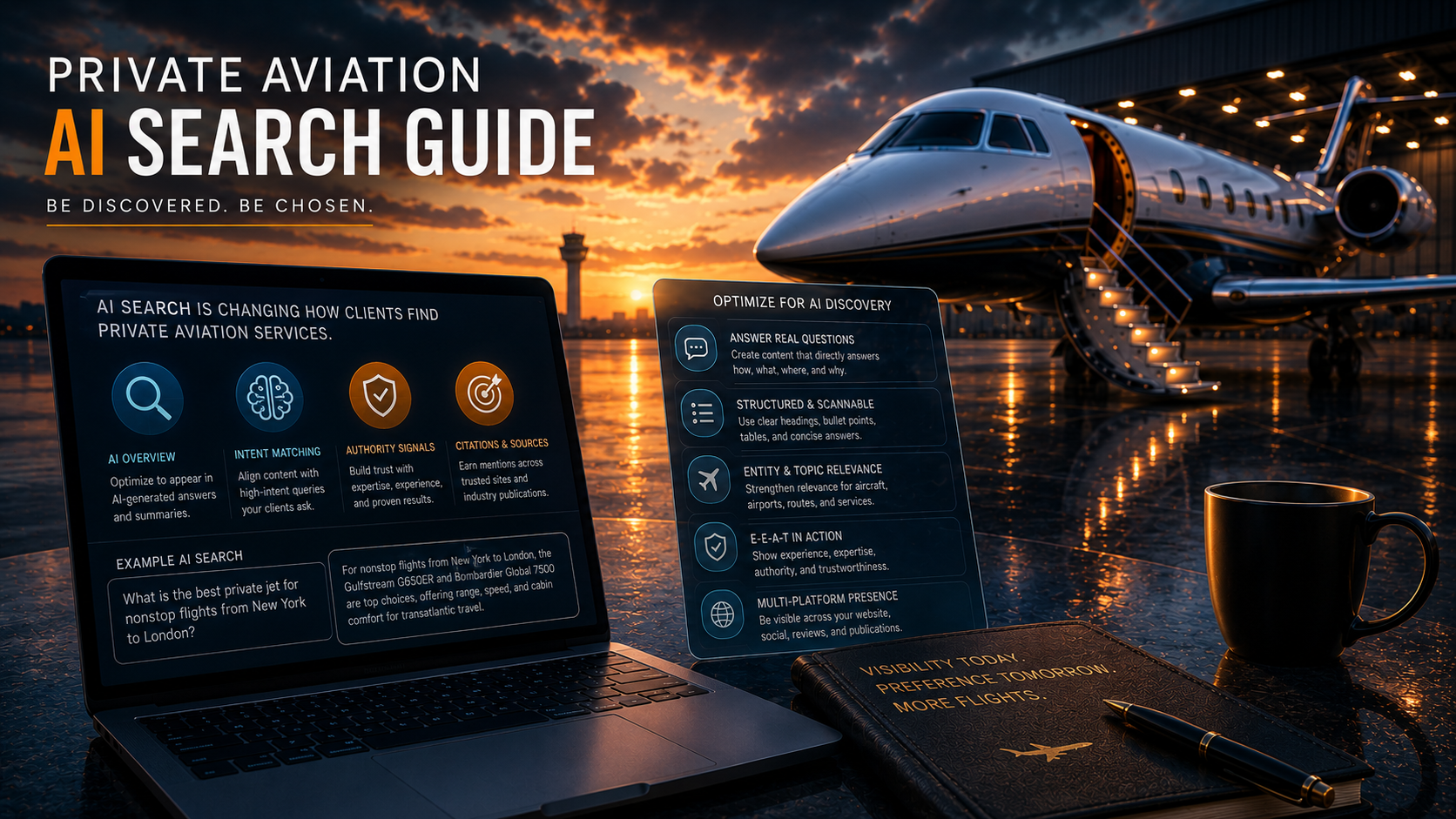
A private aviation AI search strategy helps charter companies, brokers, aircraft management firms, and aviation brands appear in answer engines when buyers ask about routes, aircraft, airports, privacy, time savings, luggage, pets, and provider selection.
Private aviation buyers no longer rely only on traditional search results. Instead, they increasingly use AI tools, AI Overviews, answer engines, and conversational search to compare aircraft, plan routes, evaluate providers, and understand private flight options. Therefore, aviation companies need content that both humans and AI systems can understand clearly.
Additionally, AI search rewards structured answers, strong entities, schema, internal links, topical authority, and clear page intent. Consequently, aviation brands need more than broad service pages. They need a complete AI-search-ready authority system.
At Infinite Media Resources, we build private aviation AI search systems that connect GEO, SEO, route pages, aircraft pages, buyer psychology, paid ads, conversion pages, schema, and CRM tracking into one owned acquisition engine.
Private Aviation AI Search Requires Structured Authority
Direct Answer: Private aviation AI search works best when a website gives answer engines clear, structured, entity-rich content about routes, aircraft, airports, buyer questions, privacy, time savings, and provider selection. Therefore, aviation companies should build GEO-ready pages that answer specific buyer questions before competitors do.
Traditional SEO still matters. However, AI search changes how buyers discover providers. Instead of scanning ten blue links, buyers may receive a direct AI-generated summary. As a result, aviation companies must become easy for AI systems to understand, summarize, and trust.
Consequently, the strongest private aviation AI search strategy combines SEO, GEO, schema, direct answers, verified internal links, topical clusters, and conversion-focused next steps.
What AI Search Means for Private Aviation
Direct Answer: AI search means buyers can ask conversational questions and receive summarized answers about private aviation routes, aircraft, airports, charter planning, and provider options.
A buyer may ask an AI system which jet can fly a specific route, which airport works best, how much luggage fits, whether pets can travel, or why private aviation saves time. Therefore, aviation content must answer those questions directly.
Additionally, AI systems often combine information from multiple sources. Consequently, pages that lack structure, specificity, and authority may get ignored even when they look premium.
Strong AI-search-ready content should include:
- direct-answer sections
- clear H2 and H3 structure
- route-specific information
- aircraft-specific explanations
- airport and local context
- FAQ sections
- HowTo schema
- internal links to related pages
- conversion-focused CTAs
Why AI Search Matters for Private Aviation Companies
Direct Answer: AI search matters because high-value private aviation buyers increasingly research complex questions before they contact a provider.
Private aviation decisions usually involve trust, privacy, aircraft fit, range, luggage, timing, airport access, and cost expectations. Therefore, buyers often research deeply before submitting a form.
Additionally, AI search compresses the research process. A buyer can ask a single question and receive a summarized answer. Consequently, private aviation companies need content that AI systems can confidently use.
AI search can influence:
- route discovery
- aircraft comparison
- provider selection
- airport planning
- privacy evaluation
- executive travel decisions
- family office research
- lead quality
Private Aviation Buyer Questions AI Systems Need to Answer
Direct Answer: Private aviation AI search content should answer the exact questions UHNW buyers, assistants, family offices, and travel teams ask before they inquire.
Strong questions include:
- Can a Bombardier Global 8000 fly London to the Maldives with 12 passengers?
- What is the true luggage cubic footage for a Challenger 3500 vs. Gulfstream G280?
- Which ultra-long-range jet works best for Aspen?
- How many golf bags fit in a Phenom 300E?
- What is the G650ER range against a headwind?
- Which operators allow large dogs in the cabin internationally?
- Which aircraft has the best sleep configuration?
- How much time does private aviation save versus first class?
- Why do UHNW clients value privacy?
- How do private jet buyers search online?
Therefore, each valuable question should become a dedicated page when the answer supports buyer intent. Additionally, each page should include a concise direct answer, deeper explanation, FAQs, schema, and internal links.
GEO for Private Aviation
Direct Answer: GEO, or Generative Engine Optimization, helps private aviation companies structure content so AI systems can understand, summarize, and potentially cite their pages.
SEO helps websites rank in search engines. However, GEO helps answer engines understand the best answer. Therefore, the two strategies should work together.
Private aviation GEO should include:
- direct answers near the top of pages
- clear entity relationships
- route and aircraft context
- FAQPage schema
- HowTo schema
- Service schema
- BreadcrumbList schema
- verified internal links
- clear conversion paths
As a result, a private aviation company becomes easier for AI systems to evaluate across complex buyer questions.
Entity Authority in Private Aviation AI Search
Direct Answer: Entity authority helps AI systems understand the relationship between your brand, services, aircraft, airports, routes, buyer questions, and private aviation expertise.
AI systems do not only read keywords. Instead, they evaluate concepts and relationships. Therefore, a strong private aviation site should consistently connect entities such as:
- private aviation marketing
- private jet charter SEO
- GEO
- AI search optimization
- Teterboro
- Van Nuys
- Scottsdale
- Miami
- London to Dubai
- Gulfstream G650
- Challenger 350
- Phenom 300
- privacy
- time savings
- UHNW buyers
Additionally, internal links reinforce those relationships. Consequently, AI systems can understand the site as a connected private aviation authority cluster.
Route-Based AI Search Content
Direct Answer: Route-based AI search content helps aviation companies appear when buyers ask about specific private flight corridors.
Route intent is highly valuable because the buyer already knows a mission. Therefore, route pages should answer practical questions about time, aircraft fit, luggage, airport convenience, seasonal demand, privacy, and next steps.
Strong route AI content includes:
- route overview
- buyer intent
- aircraft-fit guidance
- airport context
- time savings
- privacy considerations
- FAQ section
- route review CTA
Consequently, route pages can support SEO, AI search, Google Ads, retargeting, and qualified lead generation.
Aircraft AI Search Content
Direct Answer: Aircraft AI search content helps answer engines understand which jets fit which missions, routes, passengers, luggage needs, and buyer scenarios.
Private aviation buyers often ask aircraft questions before they inquire. However, many aircraft pages only list specs. Instead, strong pages should translate aircraft data into buyer outcomes.
Aircraft AI pages should cover:
- range use cases
- passenger scenarios
- luggage and golf bag concerns
- sleep configuration
- cabin comfort
- executive productivity
- route fit
- buyer decision points
As a result, aircraft pages become useful for both human readers and AI systems.
Airport and Local AI Search Content
Direct Answer: Airport and local AI search content helps aviation companies appear when buyers ask about private aviation access in specific markets.
Buyers often ask about airports before they ask about providers. Therefore, airport pages should explain market demand, common routes, buyer profiles, convenience, local events, and private aviation use cases.
Strong airport pages include:
- airport market overview
- buyer intent
- common routes
- aircraft-fit topics
- event or seasonal demand
- privacy and convenience messaging
- local SEO structure
- internal links to related route pages
Additionally, local pages help AI systems connect the aviation company to specific private flight markets.
Question-Led Answer Pages
Direct Answer: Question-led answer pages are one of the strongest AI search assets because they match how people ask AI systems for private aviation advice.
Each major buyer question should have one dedicated page. Therefore, the page can answer directly, provide supporting context, and guide the buyer toward the next step.
Strong question-led pages should include:
- question-based H1
- 40-60 word direct answer
- practical explanation
- aircraft or route context
- trust-building notes
- FAQ section
- full schema stack
- internal links to related authority pages
Consequently, these pages can rank in Google, support AI answers, and strengthen topical authority.
Schema Strategy for Private Aviation AI Search
Direct Answer: Schema helps search engines and AI systems understand the page type, provider, service, questions, process, breadcrumbs, and speakable content.
Every major private aviation page should include a complete schema stack. Therefore, AI systems receive clearer signals about page meaning and entity relationships.
Core schema types include:
- Organization
- WebSite
- ProfessionalService
- Service
- WebPage
- FAQPage
- HowTo
- BreadcrumbList
- SpeakableSpecification
Additionally, schema must match the visible page content. As a result, the structured data supports trust instead of creating confusion.
Internal Linking Strategy for AI Search
Direct Answer: Internal links help AI systems understand how private aviation topics connect across services, routes, aircraft, airports, buyer questions, and conversion pages.
Strong internal linking creates a knowledge graph inside the site. Therefore, every page should connect to related verified pages.
Internal links should connect:
- AI search pages to GEO pages
- GEO pages to route pages
- route pages to aircraft pages
- airport pages to route pages
- buyer psychology pages to conversion pages
- service pages to lead generation pages
- SEO pages to AI search pages
However, internal links should never be invented. As a result, the cluster stays clean, accurate, and trustworthy.
AI Search Conversion Strategy
Direct Answer: AI search visibility only creates business value when the page converts visitors into qualified conversations.
AI search can help buyers find answers faster. However, the page still needs to move them toward action. Therefore, every AI-search-ready page should include a clear next step.
Strong conversion elements include:
- direct answer above the fold
- buyer-specific explanation
- trust-building sections
- privacy language
- time savings language
- FAQ section
- fast-response expectations
- value-based CTA
- CRM-backed tracking
Consequently, the page turns answer visibility into qualified inquiry potential.
Private Aviation AI Search Framework
Direct Answer: A complete private aviation AI search framework connects GEO, SEO, entities, schema, route content, aircraft pages, internal links, and conversion strategy.
| AI Search Asset | Purpose | Buyer Value |
|---|---|---|
| GEO Pages | Structure answer-engine content | Clearer answers |
| Route Pages | Answer mission-specific questions | Better route confidence |
| Aircraft Pages | Explain aircraft fit | Stronger decision support |
| Airport Pages | Build local entity relevance | More convenient planning |
| Question Pages | Match AI prompts | Fast direct answers |
| Schema | Clarify structure | Better machine understanding |
| Internal Links | Connect authority clusters | More useful navigation |
| Conversion CTAs | Turn interest into action | Clear next step |
Recommended Private Aviation AI Search Build Order
Direct Answer: The best private aviation AI search build order starts with core strategy pages, then expands into GEO pages, route pages, aircraft pages, airport pages, and buyer-question pages.
- Build core SEO and AI search strategy guides.
- Build GEO service pages.
- Build route demand pages.
- Build aircraft authority pages.
- Build airport and local AI search pages.
- Build question-led buyer pages.
- Build privacy and time psychology pages.
- Add full schema to every major page.
- Connect verified internal links.
- Track conversions through CRM workflows.
Additionally, every new page should answer one real buyer question or support one commercial intent. Consequently, the site grows as a connected authority system.
How IMR Builds Private Aviation AI Search Systems
Direct Answer: IMR builds private aviation AI search systems by connecting GEO, SEO, structured content, route authority, aircraft content, schema, internal links, conversion pages, and CRM tracking.
First, we map the questions buyers ask. Next, we build content that answers those questions clearly. Then, we connect the pages with internal links, schema, CTAs, and CRM workflows.
Additionally, we structure pages for both traditional search and AI search. Therefore, your aviation company can build visibility across Google, AI Overviews, ChatGPT-style tools, Gemini-style tools, and Perplexity-style answer engines.
Finally, we optimize around qualified conversations. As a result, AI search visibility supports business growth instead of becoming another vanity metric.
Proof and Validation
Direct Answer: AI search performs best when visibility, conversion, and lead handling operate together.
One IMR lead generation campaign produced 415 leads in 30 days. Additionally, a seven-day optimization phase generated 123 leads at approximately $57.86 per lead. While private aviation follows a different sales cycle, the same principle applies. Better structure creates stronger lead quality, clearer tracking, and better conversion performance.
Frequently Asked Questions
What is private aviation AI search?
Private aviation AI search is the strategy of making aviation content easier for AI systems to understand, summarize, and use when buyers ask private flight questions.
How is AI search different from SEO?
SEO focuses on search engine rankings, while AI search focuses on answer visibility, direct responses, entity clarity, and machine-readable authority.
What is GEO for private aviation?
GEO helps private aviation companies structure content so generative AI systems can understand, summarize, and potentially cite their pages.
What pages help private aviation AI search?
Route pages, aircraft pages, airport pages, question-led pages, GEO pages, SEO guides, and buyer psychology pages all help AI search visibility.
Does schema matter for AI search?
Yes. Schema helps clarify page type, service details, FAQs, process steps, breadcrumbs, and speakable content.
Should aviation companies create question-led pages?
Yes. Question-led pages match how buyers ask AI systems for answers and can support both SEO and AI visibility.
Can AI search generate better private aviation leads?
Yes, when AI visibility connects to useful pages, strong CTAs, CRM tracking, and fast follow-up systems.
What is the best next step?
The best next step is a Private Aviation AI Search Review so IMR can evaluate your GEO structure, schema, content gaps, internal links, and conversion path.
Build Your Private Aviation AI Search System
Direct Answer: The next step is to evaluate your AI search visibility, GEO structure, route content, aircraft pages, question-led content, schema, internal links, landing pages, and CRM tracking.
If your aviation company wants stronger answer-engine visibility, better qualified inquiries, and a scalable authority system your team can own, IMR can help build the full private aviation AI search engine.