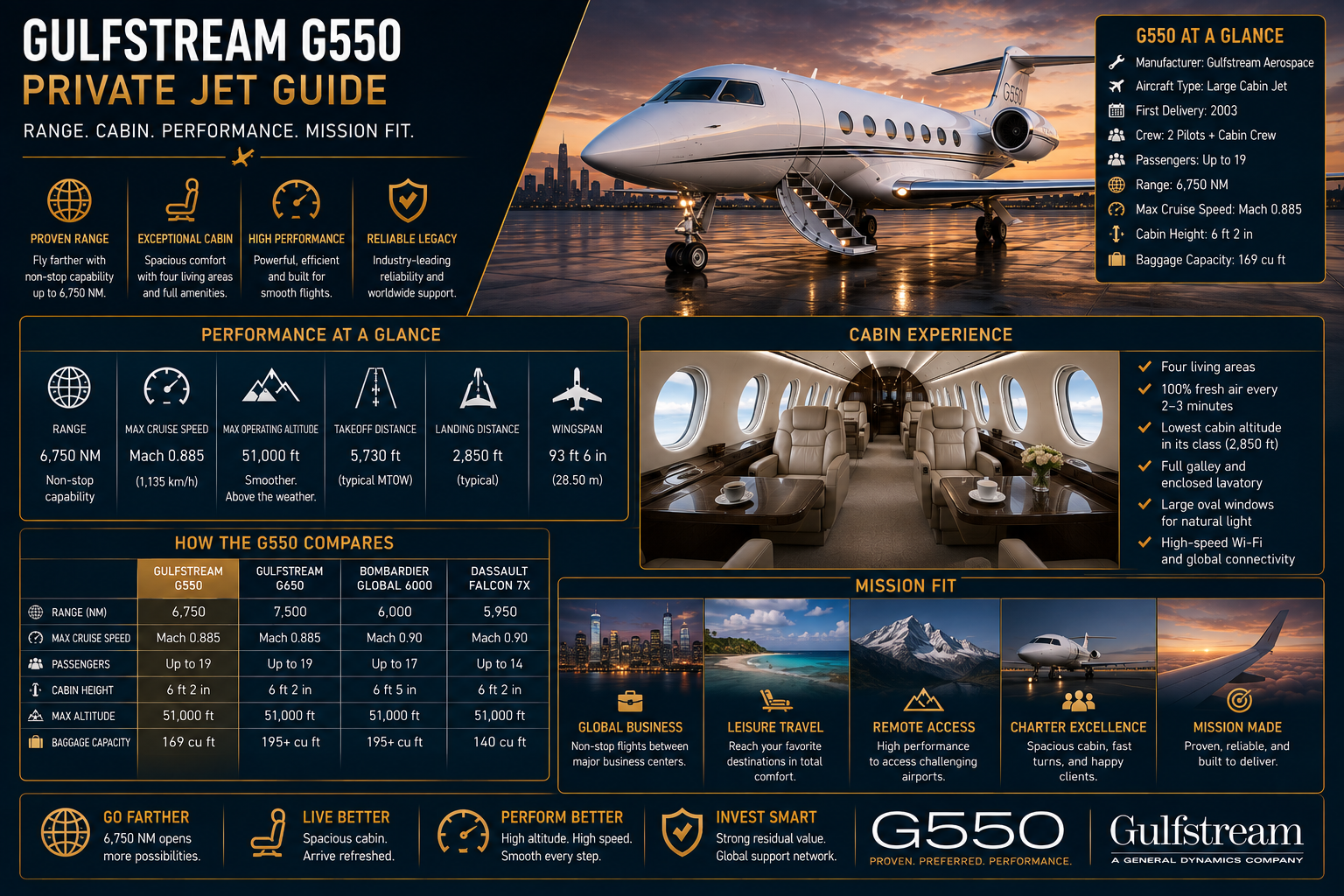
Long-Range Large-Cabin Private Jet Guide
Gulfstream G550 Private Jet Guide: Range, Cabin, Performance & Mission Fit
The Gulfstream G550 is a proven long-range large-cabin business jet designed for intercontinental executive, family-office and private travel. Historical Gulfstream specifications list approximately 6,750 nautical miles of theoretical NBAA IFR range at Mach 0.80, Mach 0.885 maximum operating speed, a 51,000-foot maximum cruise altitude and a cabin capable of accommodating as many as 18 passengers in typical configurations.
The Gulfstream G550 occupies an important place in modern business aviation.
It is no longer Gulfstream’s newest aircraft.
However, that does not make it irrelevant.
Instead, the G550 has moved from a new-production decision into an established operating-fleet, charter, corporate-flight-department and pre-owned ownership decision.
Therefore, travelers should evaluate the aircraft differently from a new Gulfstream G700 or G800.
The G550’s strongest advantage is proven long-range capability.
Historical Gulfstream specifications list approximately 6,750 nautical miles of theoretical NBAA IFR range at Mach 0.80 with eight passengers, four crew and reserves.
Therefore, the aircraft can support substantial intercontinental missions when payload, winds, routing and airport conditions permit.
That places the G550 well beyond a typical domestic business jet.
A transatlantic mission fits naturally into its operating profile.
Longer international missions can fit as well.
Additionally, many U.S.-to-Middle-East, Europe-to-U.S. and other global business routes can fall within the broader G550 mission envelope depending on conditions.
However, published range does not guarantee a particular city pair.
Actual range changes with winds.
Passenger and baggage weight matter.
Routing matters.
Airport elevation matters.
Additionally, required fuel reserves remain part of every professional flight plan.
Therefore, the 6,750-nautical-mile figure should be treated as a capability benchmark rather than a guaranteed nonstop radius.
The aircraft also allows a speed-versus-range decision.
Long-range cruise is approximately Mach 0.80.
Meanwhile, higher-speed cruise can reach approximately Mach 0.87.
Additionally, the aircraft’s maximum operating Mach number is approximately Mach 0.885.
Therefore, travelers can prioritize greater range or greater speed depending on the mission.
That distinction becomes meaningful on long flights.
An executive may value a shorter block time.
A family office may prioritize maximum nonstop margin.
Another traveler may prefer the operating strategy that best balances both.
Consequently, the G550 should not be understood from one range number or one speed number alone.
Instead, aircraft performance changes with how the airplane is operated.
The G550 can cruise as high as approximately 51,000 feet.
Therefore, it can operate above much of conventional airline traffic when aircraft weight, air traffic control and weather permit.
However, the aircraft does not necessarily climb directly to maximum altitude after takeoff.
A heavily fueled aircraft can initially cruise lower.
Then, as fuel burns and aircraft weight decreases, the crew may climb higher.
Consequently, the long-range flight profile can evolve during the mission.
Two Rolls-Royce BR710 C4-11 engines power the aircraft.
Each historically carries approximately 15,385 pounds of rated takeoff thrust.
Therefore, the G550 combines substantial power with an airframe designed around long-range efficiency.
The engine family also matters to ownership.
Maintenance program status matters.
Engine hours matter.
Future shop-visit exposure matters.
Additionally, support and maintenance history can materially affect the value of a specific pre-owned aircraft.
Consequently, G550 buyers should evaluate the engines as carefully as the cabin.
The aircraft has a maximum takeoff weight of approximately 91,000 pounds.
Therefore, it remains a substantial large-cabin business jet.
That weight matters at the airport.
Historical Gulfstream specifications list approximately 5,910 feet of takeoff distance at sea level, standard atmospheric conditions and maximum takeoff weight.
However, that figure should not be interpreted as a universal runway requirement.
A hot airport changes performance.
A high-elevation airport changes it further.
Wind changes it.
Runway condition changes it.
Additionally, aircraft weight changes it dramatically.
Therefore, an operator calculates performance for every actual departure.
This matters especially on international trips.
A G550 departing with a large fuel load can be close to its highest operating weights.
However, after several hours in the air, the same aircraft arrives substantially lighter.
Therefore, departure and arrival performance can differ significantly.
Consequently, an airport that works comfortably for landing can still require more analysis for a heavily fueled return departure.
The G550’s cabin remains one of the aircraft’s important strengths.
Historical Gulfstream specifications place cabin length at approximately 43 feet 11 inches excluding the baggage compartment.
Cabin width is approximately 7 feet 4 inches.
Meanwhile, cabin height is approximately 6 feet 2 inches.
Therefore, the aircraft provides a true stand-up large-cabin environment.
That matters because the G550 can remain airborne for many hours.
Passengers need more than comfortable chairs.
They may need to work.
They may dine.
They may sleep.
Additionally, different passengers may need different cabin environments at the same time.
Consequently, cabin layout becomes a major part of G550 mission fit.
Traditional G550 interiors commonly provide several distinct seating areas.
Therefore, an aircraft can support a forward seating zone, conference or dining group, additional lounge space and a rear seating or sleeping area depending on the exact configuration.
However, interiors vary substantially.
One owner may prioritize 14 passengers.
Another may configure for 16.
Another aircraft may accommodate as many as 18 passengers.
Additionally, divans, individual club seats and cabin partitions can differ.
Therefore, charter travelers should review the exact tail number rather than assuming every G550 provides an identical cabin.
This becomes particularly important for overnight travel.
A G550 may seat a large passenger group.
However, seating capacity and sleeping capacity are not the same thing.
Some seats can convert into berths.
Divans can create additional sleeping positions.
However, actual arrangements depend on the aircraft.
Consequently, travelers should confirm how many passengers can sleep comfortably before booking a long overnight mission.
Cabin altitude is another important G550 characteristic.
Historical Gulfstream material promoted a maximum cabin altitude of approximately 6,000 feet while the aircraft operated at 51,000 feet.
Therefore, passengers experience a substantially lower equivalent altitude than the airplane’s actual cruise altitude.
That can become increasingly important on long-duration missions.
A three-hour flight creates one exposure period.
A ten-hour flight creates another.
Consequently, cabin environmental quality becomes more relevant as range increases.
The G550 also uses 100% fresh cabin air.
Therefore, its long-range cabin concept includes more than physical space.
Air exchange matters.
Cabin pressure matters.
Temperature zones matter.
Noise matters.
Additionally, lighting and window design influence the passenger experience.
Historical Gulfstream cabin material highlights 14 signature oval windows.
Therefore, natural light reaches multiple areas of the long cabin.
That characteristic also connects the G550 visually with the broader Gulfstream family.
However, cabin age matters today.
The G550 fleet spans many production years.
Therefore, one aircraft may have a recently redesigned interior.
Another may retain an older cabin.
Connectivity can vary enormously.
Entertainment systems can vary.
Seats can vary.
Additionally, materials and lighting systems can differ.
Consequently, today’s G550 passenger experience depends heavily on the exact aircraft.
A refurbished G550 can remain extremely competitive as a long-range charter cabin.
Therefore, model age should not automatically determine passenger quality.
Instead, travelers should evaluate airframe condition and interior condition separately.
The same principle applies to ownership.
A lower acquisition price than a newer flagship aircraft can be attractive.
However, purchase price alone does not determine value.
Maintenance history matters.
Engine condition matters.
Inspection timing matters.
Avionics upgrades matter.
Cabin refurbishment matters.
Additionally, future maintenance exposure can materially change lifecycle cost.
Therefore, a G550 should be purchased by condition and mission fit rather than simply because the acquisition number looks compelling.
The aircraft’s production status reinforces that approach.
The G550 is no longer part of Gulfstream’s current civil production fleet.
Current Gulfstream models have moved into newer aircraft generations.
However, Gulfstream continues to support existing operators.
Additionally, the G550 platform remains relevant within special-mission aviation.
Therefore, production ending should not be confused with the end of aircraft support or operational usefulness.
Many business jets remain useful for decades.
The G550 has a particularly significant installed fleet.
Therefore, aircraft remain active in private, corporate, governmental and specialized operations around the world.
Consequently, the platform can continue to appear in charter markets and pre-owned acquisitions for years.
The G550 also occupies an interesting point in the Gulfstream family.
The G650 moved beyond it in speed, range and cabin width.
The G700 moved farther still in cabin length, technology and current-generation architecture.
Meanwhile, newer Gulfstream models such as the G600 provide another path into current-generation long-range travel.
Therefore, the G550 should not be compared simply by asking whether newer Gulfstreams have better specifications.
They do in several areas.
The better question is whether the passenger actually needs those additional capabilities.
A six-hour mission may not need 7,750 nautical miles of range.
A 10-passenger group may not need five living areas.
Additionally, a charter market may have a well-positioned G550 available at much stronger economics than a newer flagship.
Consequently, the older aircraft can still produce the better trip.
The G550 versus G650 comparison illustrates that principle.
The G650 provides approximately 250 additional nautical miles of theoretical published maximum range over the G550 when comparing 7,000 nm with 6,750 nm.
However, the differences extend far beyond 250 nautical miles.
The G650 is faster.
Its cabin is wider.
Its cabin is taller.
Additionally, its airframe represents a newer design generation.
Therefore, the G650 can create meaningful advantages for some passengers.
However, the G550 can remain highly capable on missions that do not need those improvements.
Consequently, the G550 can offer a compelling combination of range, cabin capability and operating-fleet economics.
The G700 comparison is even more distinct.
The G700 provides a much longer cabin.
It provides up to five living areas.
It offers 7,750 nautical miles of theoretical range.
Additionally, it belongs to Gulfstream’s current production generation.
Therefore, the G700 represents a fundamentally newer flagship strategy.
However, using the G700 on a mission the G550 solves comfortably can mean buying substantially more aircraft capability than necessary.
Consequently, travelers should compare the mission before comparing prestige.
The G550 can also compete with other long-range operating-fleet aircraft.
Bombardier Global models provide alternatives.
Dassault Falcon aircraft provide another approach.
Additionally, large-cabin Challenger aircraft can solve some shorter missions with different economics.
Therefore, aircraft selection should begin with requirements rather than manufacturer loyalty.
How many passengers are traveling?
How much baggage are they bringing?
How far is the route?
Which airports provide the strongest door-to-door geography?
Will passengers need to sleep?
How much cabin separation is required?
Additionally, how much range margin does the mission need?
Those questions determine whether the G550 fits.
The aircraft’s baggage capability also contributes to its long-range value.
Historical Gulfstream cabin literature lists up to approximately 226 cubic feet of baggage volume, although specific published references and aircraft configurations can differ in how baggage capacity is represented.
Therefore, travelers should verify the exact aircraft’s usable baggage arrangement rather than relying only on one historical volume figure.
That becomes especially important for charter.
Golf bags matter.
Ski bags matter.
Production equipment matters.
Extended-stay luggage matters.
Additionally, large family groups can create substantial baggage weight.
Consequently, the G550’s baggage capability should be evaluated with the actual load.
The aircraft can carry a maximum payload of approximately 6,200 pounds under historical standard-outfitting assumptions.
However, payload with maximum fuel is far lower.
Therefore, maximum fuel and maximum payload are not simultaneous assumptions.
That distinction matters on near-maximum-range missions.
A large group plus heavy baggage can reduce the fuel available.
Alternatively, a very long mission can reduce the payload available.
Consequently, operators balance passengers, baggage and fuel around the actual trip.
Airport access creates another major part of the decision.
A 6,750-nautical-mile airplane provides little passenger value if the preferred airport cannot support the mission.
Therefore, runway length should be evaluated alongside field elevation, temperature and departure weight.
Teterboro provides a useful example.
The airport supports substantial large-cabin business aviation and offers strong access to the New York market.
Therefore, it can pair naturally with G550 executive missions.
However, runway performance and current operating conditions still matter.
Van Nuys provides another example.
The airport is deeply integrated into Los Angeles business aviation.
Therefore, it can provide excellent geography for many private travelers.
However, a heavily fueled long-range departure still requires mission-specific calculations.
Dallas Love Field also provides a strong large-cabin environment.
Its substantial runway infrastructure combines with close access to central Dallas.
Therefore, it can be a useful G550 airport for executives and family offices.
Harry Reid International creates a different operating profile.
Runways are long.
Therefore, the airport can provide substantial performance margin.
However, Las Vegas summer heat remains important.
Additionally, Formula 1, major conventions and sporting events can create ramp-demand and parking problems.
Consequently, runway capability does not eliminate ground-side planning.
Centennial Airport provides another useful contrast.
Its main runway is approximately 10,001 feet.
Therefore, runway length appears extremely favorable.
However, Centennial sits at high elevation.
Consequently, hot-day density altitude can materially affect aircraft performance.
Therefore, elevation and temperature must be considered with runway length.
Aspen creates an even more specialized case.
Mountain terrain matters.
Elevation matters.
Weather matters.
Additionally, aircraft weight matters.
Therefore, travelers should never assume G550 suitability from published range or runway figures alone.
The operator should evaluate the exact mission.
That airport logic applies globally.
Some airports provide long runways but difficult slot access.
Others provide excellent geographic access but more constrained runways.
Some international airports provide straightforward customs infrastructure.
Others require additional coordination.
Therefore, the strongest G550 itinerary balances aircraft performance with the passenger’s final destination.
That is particularly important because the G550’s primary purpose is not to win a specification contest.
It is to move passengers efficiently across long distances.
A CEO can use the cabin as a working environment.
A family office can separate principals from staff.
A group can dine during the flight.
Passengers can sleep during an overnight mission.
Additionally, substantial baggage can move with the group.
Consequently, the aircraft can replace portions of both the office and the hotel during long-distance travel.
That is where the G550 continues to provide value despite its age.
The aircraft is proven.
Its mission capability remains substantial.
Its operating fleet remains meaningful.
Additionally, the pre-owned and charter markets can produce economics that differ significantly from newer-generation flagship jets.
Therefore, the G550 should not be dismissed because newer Gulfstreams exist.
Instead, it should be evaluated against the specific mission.
If the passenger needs a nearly 57-foot cabin, the G700 provides a stronger answer.
If the mission repeatedly needs more speed, cabin width and newer-generation capability, the G650 or newer Gulfstream aircraft may pull ahead.
However, when approximately 6,750-nautical-mile-class range, a true large cabin and proven operating capability already solve the trip, the G550 can remain a very serious private aviation option.
This guide evaluates that decision completely.
It examines range.
It examines speed.
It examines cabin.
It examines passenger capacity.
It examines sleeping capability.
It examines baggage.
Additionally, it examines runway performance, airport access, charter, ownership and direct aircraft comparisons.
Most importantly, it answers the question that should determine every aircraft decision:
Does the Gulfstream G550 solve this mission without forcing the passenger to pay for capability they do not need?
Direct G550 Answer
Is the Gulfstream G550 Still a Good Private Jet?
Direct Answer: Yes. The Gulfstream G550 remains a highly capable long-range large-cabin business jet, with approximately 6,750 nautical miles of historical published theoretical range, Mach 0.885 maximum operating speed, a 51,000-foot maximum cruise altitude and a cabin capable of supporting major international executive, family-office and private missions.
The G550 is older than Gulfstream’s current flagship aircraft.
However, aircraft age and mission capability are not the same thing.
The platform can still solve demanding long-range trips.
Therefore, the more useful question is whether its capabilities fit the passenger.
6,750 NM
Published Maximum Range
Historical Gulfstream specifications list approximately 6,750 nautical miles of theoretical NBAA IFR range at Mach 0.80.
Mach 0.885
Maximum Operating Mach
The G550 provides substantial high-speed business aviation capability while remaining optimized around long-range travel.
51,000 FT
Maximum Cruise Altitude
The aircraft can operate at exceptionally high altitudes when weight and operating conditions permit.
43 FT 11 IN
Cabin Length
A substantial stand-up large cabin supports several passenger zones and long-duration travel.
Up to 18
Typical Passenger Capacity
Historical Gulfstream specifications list typical outfitting for as many as 18 passengers.
Proven Fleet
Established Operating Platform
The G550 remains relevant through private ownership, charter, corporate aviation and specialized operations.
What Is the Gulfstream G550’s Biggest Strength?
Its strongest advantage is proven long-range capability combined with a substantial cabin.
Therefore, the aircraft can complete many demanding international missions without requiring newer flagship economics.
The operating fleet also creates meaningful market depth.
Consequently, charter and pre-owned buyers can find G550 aircraft across multiple regions.
What Is the G550’s Biggest Limitation?
Newer aircraft provide more.
The G650 provides greater speed and a significantly wider cabin.
The G700 provides much more cabin length and a newer technology generation.
Additionally, newer aircraft can provide lower cabin-altitude environments and newer cabin systems.
Therefore, G550 travelers must decide whether those improvements create enough practical value to justify moving up.
Who Benefits Most From a G550?
Executives traveling internationally can benefit.
Family offices can benefit.
Corporate flight departments can benefit.
Additionally, charter travelers who want a proven long-range large-cabin aircraft without automatically moving into newer flagship categories can benefit.
Therefore, the aircraft remains especially relevant when mission capability matters more than operating the newest model.
The G550 remains compelling when the mission needs serious international range and a true large cabin but does not require the additional speed, width or next-generation cabin of newer Gulfstreams.
Mission fit matters more than model age.
G550 Production Status
Is the Gulfstream G550 Still in Production?
Direct Answer: The Gulfstream G550 is no longer part of Gulfstream’s current-production civil aircraft lineup. However, Gulfstream continues to support existing operators, and G550 airframes remain active across private, corporate, governmental and specialized aviation. Therefore, the aircraft should now be evaluated primarily as an operating-fleet, charter and pre-owned platform.
Production status changes the acquisition decision.
However, it does not erase aircraft capability.
Therefore, travelers should separate the two.
A charter passenger does not need a factory production slot.
They need a safe, professionally operated aircraft with the correct cabin and mission capability.
Consequently, a well-maintained G550 can remain a strong charter option.
What Does Production Ending Mean for a G550 Buyer?
The buyer is evaluating existing aircraft.
Therefore, maintenance history becomes critical.
Engine history becomes critical.
Inspection timing matters.
Cabin condition matters.
Additionally, avionics and connectivity upgrades can materially influence aircraft value.
Consequently, the exact tail number becomes more important than it would in a generic model comparison.
Does Gulfstream Still Support the G550?
Gulfstream maintains customer-support resources for existing Gulfstream owners and operators.
Therefore, production ending should not be interpreted as Gulfstream abandoning the installed fleet.
Additionally, the G550 remains included within Gulfstream’s broader operator-support ecosystem.
Why Does the G550 Still Appear in Special-Mission Aviation?
The platform offers range, altitude, cabin volume and proven operating capability.
Therefore, G550-derived aircraft can serve applications beyond conventional executive transportation.
That continued specialized use demonstrates the underlying platform’s operational relevance even after civil production has ended.
The G550 is no longer a new-production buying decision. It is a condition, mission and operating-fleet decision.
That makes aircraft history and exact configuration increasingly important.
Gulfstream G550 Specifications
What Are the Gulfstream G550’s Main Specifications?
Direct Answer: Historical Gulfstream specifications place the G550 at approximately 6,750 nautical miles of theoretical maximum range at Mach 0.80, Mach 0.885 maximum operating speed, 51,000 feet of maximum cruise altitude, 91,000 pounds of maximum takeoff weight and a cabin approximately 43 feet 11 inches long, 7 feet 4 inches wide and 6 feet 2 inches high.
| Specification | Gulfstream G550 | Mission Meaning |
|---|---|---|
| Aircraft Category | Long-range large-cabin business jet | Designed for substantial domestic and intercontinental private aviation |
| Maximum Published Range | Approximately 6,750 nautical miles at Mach 0.80 | Supports major international nonstop missions under suitable conditions |
| Long-Range Cruise | Mach 0.80 | Prioritizes maximum range and fuel efficiency |
| High-Speed Cruise | Approximately Mach 0.87 | Allows faster missions when maximum range is unnecessary |
| Maximum Operating Mach | Mach 0.885 | Provides substantial high-speed business aviation capability |
| Takeoff Distance | Approximately 5,910 feet at sea level, ISA and MTOW | Reference benchmark only; actual runway requirements vary by mission |
| Landing Distance | Approximately 2,770 feet at sea level, ISA and maximum landing weight | Provides historical comparison context rather than a universal operational requirement |
| Initial Cruise Altitude | Approximately 41,000 feet | Supports rapid access to high-altitude cruise under appropriate conditions |
| Maximum Cruise Altitude | 51,000 feet | Provides high-altitude operating flexibility |
| Maximum Takeoff Weight | Approximately 91,000 pounds | Makes aircraft weight important for runway and payload planning |
| Maximum Landing Weight | Approximately 75,300 pounds | Relevant to arrival, diversion and fuel planning |
| Maximum Payload | Approximately 6,200 pounds | Provides substantial passenger and baggage capability under historical reference outfitting |
| Maximum Payload With Full Fuel | Approximately 1,800 pounds | Demonstrates the payload-versus-range tradeoff on maximum-fuel missions |
| Maximum Fuel | Approximately 41,300 pounds | Supports the aircraft’s long-range mission capability |
| Engines | Two Rolls-Royce BR710 C4-11 turbofans | Provide the power and efficiency required for long-range large-cabin travel |
| Rated Takeoff Thrust | Approximately 15,385 pounds per engine | Supports a 91,000-pound maximum-takeoff-weight platform |
| Cabin Length | Approximately 43 ft 11 in excluding baggage | Supports multiple passenger seating and functional zones |
| Cabin Width | Approximately 7 ft 4 in | Provides a substantial large-cabin seating environment |
| Cabin Height | Approximately 6 ft 2 in | Provides true stand-up cabin capability for many passengers |
| Total Interior Length | Approximately 50 ft 1 in | Includes the broader interior footprint beyond the passenger cabin measurement |
| Cabin Volume | Approximately 1,669 cubic feet | Provides substantial usable interior volume for long-range missions |
| Typical Passenger Capacity | Up to approximately 18 depending on outfitting | Actual comfortable capacity depends on layout and mission duration |
| Aircraft Length | Approximately 96 ft 5 in | Important for ramp, towing and hangar planning |
| Wingspan | Approximately 93 ft 6 in | Important for airport and hangar compatibility |
Which G550 Specification Matters Most?
The mission decides.
Long-range travelers can prioritize 6,750-nautical-mile-class capability.
An executive team can prioritize the cabin.
A traveler using demanding airports can prioritize runway performance.
Additionally, an owner can place more emphasis on payload and operating economics.
Therefore, no single specification should determine the aircraft decision.
Why Does Full-Fuel Payload Matter?
Maximum fuel weighs more than 41,000 pounds.
Therefore, carrying maximum fuel limits how much additional payload the aircraft can carry while remaining inside its maximum takeoff weight.
Consequently, passengers cannot assume maximum range and maximum payload occur simultaneously.
That principle becomes especially important near the aircraft’s range limit.
Why Should Historical Specifications Be Verified for the Exact Aircraft?
Individual aircraft have different outfitting weights.
Upgrades can add or remove weight.
Additionally, operating data and approved performance calculations belong to the operator.
Therefore, historical specifications provide research context while the exact aircraft determines the operational answer.
The G550 remains impressive because range, cabin volume, payload and high-altitude capability coexist inside a proven large-cabin platform.
However, the actual aircraft and mission determine how much of that capability can be used.
G550 Long-Range Capability
How Far Can a Gulfstream G550 Fly?
Direct Answer: Historical Gulfstream specifications list approximately 6,750 nautical miles of theoretical NBAA IFR range for the G550 at Mach 0.80 with eight passengers, four crew and reserves. Actual nonstop capability depends on passenger and baggage weight, winds, routing, weather, airport conditions and the exact aircraft’s outfitting.
Six thousand seven hundred fifty nautical miles gives the G550 genuine intercontinental capability.
Therefore, the aircraft can connect many major business markets without an intermediate fuel stop.
However, the value of that range depends on the route.
A New York-to-London mission uses only part of the aircraft’s capability.
A substantially longer mission begins to use more of it.
Consequently, the G550 becomes increasingly valuable as stage length grows.
Why Was 6,750 Nautical Miles Important for the G550?
It created access to long intercontinental city pairs in an established large-cabin platform.
Therefore, corporate flight departments could connect distant business markets without moving into an airline-style operating model.
Additionally, private owners could build global itineraries around one aircraft.
Consequently, range became one of the G550’s defining characteristics.
Does a G550 Always Fly 6,750 Nautical Miles?
No.
The published figure uses defined assumptions.
Therefore, real missions can produce different results.
Headwinds can reduce practical range.
Heavy baggage can reduce margin.
Additional passengers matter.
Additionally, hot or high-elevation departures can affect usable fuel and payload.
Consequently, the operator determines actual nonstop capability for every mission.
When Is the G550’s Range More Than Enough?
Many transatlantic missions fall comfortably within its broader capability.
Numerous U.S. domestic routes require only a fraction of it.
Additionally, shorter international routes may not use the aircraft’s full range.
Therefore, travelers should decide whether a smaller aircraft can solve the same mission more efficiently.
The G550’s 6,750-nautical-mile benchmark remains serious global range, but useful range is the range the passenger actually needs.
Do not pay for intercontinental endurance when the mission never uses it.
Speed vs. Range
How Does Flying Faster Affect Gulfstream G550 Range?
Direct Answer: Flying the G550 faster generally reduces maximum range. Historical Gulfstream planning data placed maximum range near 6,750 nautical miles at Mach 0.80, while higher cruise speeds reduce that theoretical distance. Therefore, the aircraft allows crews to trade some range for time when the route does not require maximum endurance.
Speed and range compete for fuel.
Therefore, the aircraft cannot maximize both simultaneously.
Historical planning references illustrate the relationship.
Maximum-range cruise centers around Mach 0.80.
Meanwhile, higher-speed cruise can approach Mach 0.85 to Mach 0.87 depending on mission strategy.
Consequently, passengers can choose more speed when the route remains comfortably inside the aircraft’s reduced high-speed range.
Why Would a Passenger Choose Higher-Speed Cruise?
Time.
A CEO can value a shorter flight substantially.
A passenger arriving for a time-sensitive event can value it as well.
Additionally, reducing block time can make long travel days more manageable.
Therefore, speed can create real economic value when range margin remains adequate.
Why Would a Passenger Choose Mach 0.80 Instead?
Range.
The aircraft achieves its historical 6,750-nautical-mile theoretical benchmark around long-range cruise.
Therefore, missions approaching the aircraft’s practical limits can require a more efficient speed strategy.
Consequently, the crew can protect nonstop capability rather than maximizing cruise speed.
Does the Passenger Choose the Cruise Speed?
The operator and flight crew ultimately manage aircraft operation.
However, mission priorities can influence planning.
Therefore, a time-sensitive charter mission with substantial range margin can be planned differently from a near-maximum-range flight.
Consequently, speed becomes part of mission optimization rather than a fixed passenger setting.
The G550 can trade range for speed, which means the best cruise strategy depends on whether the harder problem is distance or time.
Maximum-range and maximum-speed thinking should not be confused.
Practical G550 Range
Can the Gulfstream G550 Really Fly 6,750 Nautical Miles Nonstop?
Direct Answer: Yes. The G550 was historically published with approximately 6,750 nautical miles of theoretical NBAA IFR range at Mach 0.80 under defined reference assumptions. However, a real mission near that distance depends heavily on payload, winds, routing, airport conditions and reserves, so the figure should be treated as a capability benchmark rather than a guaranteed nonstop radius.
A real G550 does not fly inside a brochure.
It flies through weather.
It carries real passengers.
It uses real airways.
Therefore, actual range changes.
Wind
Strong headwinds can increase fuel burn and materially reduce practical nonstop margin.
Passengers
Additional passenger weight affects total payload and fuel planning.
Baggage
Heavy luggage adds payload and can influence flights near the practical range limit.
Routing
ATC routing, weather avoidance and restricted airspace can increase actual flight distance.
Departure Airport
Heat, elevation and runway length can affect how heavily the aircraft can depart.
Cruise Speed
Higher-speed cruise reduces the range available compared with long-range cruise.
Why Can the Same Route Have a Different Answer in the Opposite Direction?
Winds.
Long-range routes can experience substantial prevailing wind differences.
Therefore, a flight may have comfortable margin in one direction and become significantly more demanding in the other.
Consequently, outbound and return legs require separate planning.
What Happens When a Route Is Too Long?
The aircraft can make a fuel stop.
The operator can reduce payload when appropriate.
Another aircraft can be used.
Additionally, the routing or departure airport can sometimes be optimized.
Therefore, practical range limitations create planning choices rather than making the broader trip impossible.
When Should Travelers Move Up to a G650 or Newer Aircraft?
When the G550 repeatedly operates near its practical range boundary.
When additional speed matters.
When passengers need a wider or more advanced cabin.
Additionally, when the owner wants a newer aircraft generation.
Therefore, moving up should solve a recurring limitation rather than simply replace an older model number.
The G550 can genuinely perform ultra-long-distance missions, but 6,750 nautical miles is a reference capability—not a promise for every payload, wind and airport combination.
The real mission determines the real range.
G550 Speed
How Fast Is the Gulfstream G550?
Direct Answer: The Gulfstream G550 historically uses approximately Mach 0.80 for long-range cruise, can cruise at higher speeds around Mach 0.85 to Mach 0.87, and has a maximum operating Mach number of approximately Mach 0.885. Therefore, the aircraft provides substantial speed while allowing operators to trade some range for reduced flight time.
The G550 is not as fast as newer Gulfstream flagship aircraft.
However, it remains a fast long-range business jet.
Therefore, travelers should evaluate speed in context.
A G650 can fly faster.
A G700 can fly faster.
However, the question is whether that speed difference materially changes the passenger’s itinerary.
When Does the Speed Difference Matter?
Long flights magnify it.
A small cruise-speed difference can compound over many hours.
Therefore, executives flying hundreds of hours annually can place greater economic value on faster aircraft.
Consequently, speed becomes more important as annual utilization and stage length rise.
When Does G550 Speed Remain More Than Adequate?
When the route comfortably fits the aircraft and arrival time does not justify moving into a more expensive aircraft solely for incremental speed.
Therefore, many international missions remain well suited to G550 performance.
Additionally, airport geography can save more time than a modest cruise-speed advantage.
Can the G550 Still Produce a Faster Door-to-Door Trip Than a Newer Aircraft?
Potentially.
If the G550 is positioned nearby and can use the preferred airport efficiently, it can eliminate repositioning and ground travel.
Therefore, total trip time can favor the older aircraft.
Consequently, private aviation should optimize the complete itinerary rather than maximum Mach alone.
The G550 is slower than newer Gulfstream flagships, but door-to-door time—not maximum Mach—determines whether that difference actually matters to the passenger.
Speed should earn its cost.
Rolls-Royce BR710 Power
Which Engines Power the Gulfstream G550?
Direct Answer: The Gulfstream G550 uses two Rolls-Royce BR710 C4-11 turbofan engines, each historically rated at approximately 15,385 pounds of takeoff thrust. The BR710 supports the aircraft’s combination of 91,000-pound maximum takeoff weight, high-altitude cruise and approximately 6,750-nautical-mile theoretical maximum range.
Engine capability is central to G550 performance.
However, engine condition becomes equally important as the fleet ages.
Therefore, charter travelers and buyers should think about engines differently.
The charter traveler needs a professionally maintained aircraft operated under the appropriate regulatory framework.
The owner needs to understand lifecycle exposure.
Consequently, engine program status becomes much more important for acquisition.
Why Does BR710 Maintenance Matter to a G550 Buyer?
Engine events can represent substantial expenses.
Therefore, time since shop visit matters.
Program enrollment matters.
Maintenance records matter.
Additionally, upcoming scheduled work can materially affect aircraft value.
Consequently, engine analysis should be part of pre-purchase diligence.
Does G550 Production Ending Mean Engine Support Ended?
No.
The BR710 powers an established operating fleet.
Therefore, engine support continues beyond the aircraft’s production period.
However, owners should still evaluate the support status and maintenance history of the exact engines installed on the aircraft being considered.
Does 15,385 Pounds of Thrust Make Runway Performance Simple?
No.
The aircraft can weigh up to approximately 91,000 pounds at takeoff.
Therefore, temperature, altitude, runway and fuel load still matter.
Consequently, strong engine performance does not remove the need for mission-specific runway calculations.
The BR710 engines helped make the G550 a serious global aircraft, while their maintenance status now plays an increasingly important role in pre-owned aircraft value.
Performance and lifecycle economics should be evaluated together.
G550 Airport Performance
How Much Runway Does a Gulfstream G550 Need?
Direct Answer: Historical Gulfstream specifications list approximately 5,910 feet of takeoff distance for the G550 at sea level, standard temperature and maximum takeoff weight. However, actual runway requirements change with aircraft weight, temperature, elevation, wind, runway condition and obstacles, so the operator must calculate performance for every specific mission.
The 5,910-foot figure provides comparison context.
It does not provide universal airport approval.
Therefore, travelers should avoid matching runway length to that number and assuming the aircraft fits.
A departure at 91,000 pounds creates one performance requirement.
A substantially lighter departure creates another.
A cold sea-level airport creates one environment.
Meanwhile, a hot high-elevation airport creates another.
Consequently, real runway requirements can differ dramatically from the reference benchmark.
Aircraft Weight
Fuel, passengers and baggage determine the weight the aircraft must accelerate and climb with.
Temperature
Higher temperatures reduce air density and can increase takeoff-distance requirements.
Elevation
High-elevation airports can materially reduce takeoff and climb performance.
Wind
Headwind and tailwind components influence runway-performance calculations.
Runway Condition
Wet, contaminated or otherwise degraded pavement can change allowable performance.
Terrain & Obstacles
The climb path after takeoff can matter in addition to physical runway length.
Why Can a G550 Land Somewhere but Have Trouble Leaving Fully Fueled?
The aircraft burns fuel before landing.
Therefore, landing weight can be much lower than departure weight.
However, a subsequent long-range flight may require a large fuel load.
Consequently, the heavy departure can require substantially more runway and climb capability.
Can Changing Airports Improve G550 Range?
Potentially.
A longer runway or lower-elevation departure can allow the operator to carry a more useful fuel load under certain conditions.
Therefore, airport selection and practical range can become connected.
Consequently, the best departure airport may not always be the geographically closest one.
Should Charter Travelers Care About Takeoff Performance?
Yes, because it can change the itinerary.
An operator may recommend a different airport.
A fuel stop may become necessary.
Additionally, another aircraft can become the stronger choice.
Therefore, aircraft performance directly affects passenger logistics.
The G550’s 5,910-foot historical takeoff benchmark is a comparison number—not a universal runway requirement.
The real airport, aircraft weight and weather determine the real departure.
High-Elevation G550 Performance
How Do High-Elevation Airports Affect a Gulfstream G550?
Direct Answer: High-elevation airports reduce air density and can increase the runway required by a Gulfstream G550 while also reducing climb performance. Therefore, aircraft weight, fuel, temperature, terrain and runway length become especially important at airports such as Centennial and Aspen.
Elevation changes the atmosphere the aircraft operates in.
Therefore, a runway cannot be evaluated by length alone.
Ten thousand feet of pavement at high elevation does not produce the same aircraft performance as ten thousand feet at sea level.
Additionally, summer heat further reduces air density.
Consequently, hot-and-high departures deserve additional planning.
Why Does Centennial Require Density-Altitude Planning?
Centennial provides a 10,001-foot primary runway.
However, the airport sits approximately 5,885 feet above sea level.
Therefore, air density can materially affect a heavily loaded G550.
Hot weather can increase the effect further.
Consequently, long runway length does not remove performance considerations.
Travelers can review the Centennial Airport Private Jet Guide for airport-specific research.
Why Is Aspen Even More Specialized?
Aspen adds mountain terrain to elevation and weather.
Therefore, the mission involves more than runway length.
Aircraft weight matters.
Temperature matters.
Operational requirements matter.
Additionally, weather can change quickly.
Consequently, travelers should never assume G550 suitability from aircraft category alone.
Review the Aspen Airport Private Jet Guide when evaluating ASE.
Can Fuel Load Be Reduced to Improve Performance?
Potentially.
Less fuel reduces aircraft weight.
Therefore, the operator can sometimes improve takeoff performance by carrying less fuel and adding a fuel stop later.
However, that changes the passenger itinerary.
Consequently, nonstop range and airport performance must sometimes be balanced.
At high-elevation airports, the right question is not whether a G550 can use the runway in theory. It is whether this G550 can complete this mission at this weight in these conditions.
Mission-specific performance controls the answer.
G550 Airport Compatibility
Which Airports Can a Gulfstream G550 Use?
Direct Answer: The Gulfstream G550 can use many major international and business aviation airports worldwide, although suitability remains mission specific. Runway length, aircraft weight, elevation, temperature, terrain, ramp space, FBO capability and local procedures all influence whether a particular airport provides the best G550 itinerary.
Long range creates an enormous destination network.
However, airport compatibility remains local.
Therefore, every G550 mission has both a global and local problem to solve.
| Airport Environment | Typical G550 Fit | Primary Issue |
|---|---|---|
| Major International Airport | Generally strong | Traffic, slots, handling and passenger geography |
| Major Business Aviation Airport | Often strong | Runway, parking, FBO capability and local restrictions |
| Shorter Executive Airport | Mission dependent | Aircraft weight and runway performance |
| High-Elevation Airport | Mission dependent | Density altitude and fuel load |
| Mountain Airport | Specialized planning required | Elevation, terrain, weather and performance |
| Major Event Airport | Potentially strong | Ramp capacity and parking may become limiting factors |
Can a Gulfstream G550 Use Teterboro?
Teterboro supports substantial large-cabin business aviation.
Therefore, it can be a strong New York-area G550 airport when current aircraft weight and operating conditions support the mission.
Travelers can review the Teterboro Airport Private Jet Guide.
Can a G550 Use Van Nuys?
Van Nuys provides significant business aviation infrastructure and strong Los Angeles geography.
Therefore, it can pair well with a G550 when the actual mission fits the airport’s performance requirements.
Review the Van Nuys Airport Private Jet Guide.
Can a G550 Use Dallas Love Field?
Yes, mission conditions permitting.
Dallas Love Field provides substantial runway capability and close access to central Dallas.
Therefore, it can be a strong executive and corporate G550 gateway.
Review the Dallas Love Field Private Jet Guide.
Can a G550 Use Harry Reid International Airport?
Harry Reid provides extensive runway capability.
Therefore, runway length can be favorable for heavier G550 operations.
However, Las Vegas heat remains important.
Additionally, major events can create aircraft-parking constraints.
Review the Harry Reid International Airport Private Jet Guide.
Can a G550 Use Centennial Airport?
Centennial’s 10,001-foot main runway provides substantial pavement.
However, high field elevation affects aircraft performance.
Therefore, temperature, fuel load and passenger weight remain important.
Review the Centennial Airport Private Jet Guide.
Can a Gulfstream G550 Use Aspen?
Aspen requires specialized aircraft and operator analysis.
Elevation matters.
Terrain matters.
Weather matters.
Additionally, aircraft weight and current conditions matter.
Therefore, travelers should not assume suitability simply because the G550 is a long-range large-cabin aircraft.
Review the Aspen Airport Private Jet Guide.
The G550’s global range is only useful when the departure and destination airports also fit the aircraft.
Airport selection should preserve the passenger’s door-to-door advantage while protecting aircraft performance.
G550 Large-Cabin Experience
How Large Is the Gulfstream G550 Cabin?
Direct Answer: Historical Gulfstream specifications place the G550 passenger cabin at approximately 43 feet 11 inches long excluding baggage, 7 feet 4 inches wide and 6 feet 2 inches high. The large stand-up cabin can support several seating and functional areas for work, dining, relaxation and sleeping depending on the exact aircraft configuration.
The G550 cabin explains much of the aircraft’s continued relevance.
The airplane can remain airborne for many hours.
Therefore, passengers need a cabin that supports more than transportation.
Several seating areas can provide different uses.
A forward zone can support passengers close to the galley.
A conference group can support meetings or dining.
Another seating area can provide a quieter workspace.
Additionally, rear seating or divans can support relaxation and sleeping.
Consequently, one cabin can change function throughout the flight.
43 FT 11 IN
Passenger Cabin Length
The cabin provides substantial length for multiple functional seating areas.
7 FT 4 IN
Cabin Width
The width supports a true large-cabin seating environment, although newer Gulfstreams provide wider cabins.
6 FT 2 IN
Cabin Height
Many passengers can stand upright and move more naturally during long missions.
14
Signature Oval Windows
Historical Gulfstream cabin configurations use 14 signature oval windows to bring natural light through the aircraft.
Multiple Zones
Work + Dining + Rest
Different seating groups can support several passenger activities during one flight.
Aircraft Specific
Interior Configuration
Seats, divans, partitions, galley location, connectivity and refurbishment vary by individual aircraft.
Is the G550 Cabin Smaller Than the G650?
Yes.
The G650 cabin is wider, taller and longer.
Therefore, passengers can gain more physical space by moving into the newer aircraft.
However, that does not mean the G550 cabin is small.
It remains a substantial large-cabin environment capable of supporting demanding international travel.
Consequently, travelers should decide whether the G650’s additional cabin size creates enough practical value for the specific trip.
Is the G550 Cabin Much Smaller Than the G700?
Yes.
The G700 represents an entirely newer cabin concept and provides significantly greater cabin length.
Therefore, it can support as many as five living areas depending on configuration.
However, a passenger who does not need that additional space may find the G550 completely adequate.
Consequently, cabin comparison should follow passenger requirements.
Does Every G550 Have the Same Interior?
No.
This is especially important today.
The G550 fleet includes aircraft built across many years.
Some have undergone major redesigns.
Others retain older interiors.
Connectivity varies.
Entertainment varies.
Additionally, sleeping layouts vary.
Therefore, charter travelers should review current photographs and the exact cabin floor plan before confirming the aircraft.
The G550 cabin remains highly capable, but the exact aircraft matters more today than the model brochure.
A well-refurbished G550 can provide a dramatically different passenger experience from another aircraft of the same model.
G550 Research Accuracy
Where Should Gulfstream G550 Information Be Verified Today?
The G550 is no longer included within Gulfstream’s current civil production lineup.
Therefore, travelers and buyers should distinguish historical manufacturer specifications from current Gulfstream aircraft offerings.
Gulfstream continues to provide owner and operator support across its installed fleet.
Therefore, current support information can be reviewed through the Gulfstream Customer Support network.
Existing owners and operators can also access technical information through MyGulfstream.
Meanwhile, Gulfstream continues to highlight proven aircraft platforms within its Special Missions program.
For travelers comparing the G550 with aircraft Gulfstream currently produces, review the current Gulfstream aircraft lineup.
Historical performance figures remain useful for aircraft research.
However, actual range, payload, runway performance and airport suitability must always be calculated by the operator for the exact aircraft and mission.
Likewise, cabin configurations vary significantly across the operating G550 fleet.
Therefore, charter passengers should verify the exact tail number, current floor plan, sleeping arrangement, connectivity and baggage capability rather than assuming every aircraft matches its original factory configuration.
G550 Passenger Capacity
How Many Passengers Can a Gulfstream G550 Carry?
Direct Answer: Gulfstream G550 aircraft can be configured for as many as approximately 18 passengers, although many executive configurations seat fewer people. The best passenger count depends on the exact cabin layout, flight duration, sleeping requirements, baggage and how much personal space passengers need during the mission.
Maximum passenger capacity answers a certification and configuration question.
However, it does not necessarily describe the best way to use the aircraft.
Therefore, travelers should distinguish between how many people can be seated and how many people can use the cabin comfortably for a particular trip.
A short domestic flight creates one requirement.
A 10-hour international mission creates another.
Additionally, an overnight flight creates a third.
Consequently, practical passenger capacity changes with mission duration.
Up to 18
Maximum Seating
Selected G550 configurations can accommodate approximately 18 passengers, although actual seating varies by aircraft.
Long-Range
Practical Comfort
Fewer passengers can create more usable workspace, privacy and sleeping flexibility on long international missions.
Aircraft Specific
Floor Plan
Individual G550 aircraft can have different combinations of club seats, conference groups, divans and cabin partitions.
Is 18 Passengers the Normal G550 Charter Configuration?
Not necessarily.
Many G550 interiors prioritize executive comfort rather than maximum seating density.
Therefore, an aircraft may have fewer certified passenger seats while providing a more useful long-range cabin.
A conference grouping can consume cabin space.
A large divan can do the same.
Additionally, expanded galley or entertainment areas can influence the layout.
Consequently, charter travelers should confirm the actual passenger capacity of the aircraft being offered.
How Many Passengers Are Comfortable on a Long G550 Flight?
That depends on how the group plans to use the cabin.
Eight passengers can create substantial personal space.
Ten or twelve passengers can still fit naturally in many configurations.
However, as the cabin approaches its maximum seating capacity, privacy and sleeping flexibility can decrease.
Therefore, maximum passenger count should not automatically become the planning target.
Why Does Passenger Count Affect Range?
Passengers add payload.
Their baggage adds more.
Therefore, increasing passenger count can reduce the amount of fuel available before the aircraft reaches maximum takeoff weight.
That may not matter on a shorter flight.
However, it can matter significantly near the G550’s practical range boundary.
Consequently, passenger count becomes both a cabin and performance variable.
The G550 can carry a large group, but the best passenger count is the number that preserves the cabin experience and mission performance the trip actually requires.
Certified seating and practical long-range comfort are different questions.
Overnight G550 Travel
How Many People Can Sleep on a Gulfstream G550?
Direct Answer: Sleeping capacity on a Gulfstream G550 depends on the exact interior. Club seats may convert into berths, while divans can provide additional sleeping positions. Therefore, travelers should verify the actual aircraft floor plan and practical sleeping arrangement rather than assuming that maximum passenger seating equals sleeping capacity.
Sleeping becomes increasingly important as flight duration grows.
A daytime transcontinental flight may require little dedicated sleep planning.
However, an overnight transatlantic or intercontinental mission can make sleeping capability central to aircraft selection.
Therefore, the same G550 can be excellent for one passenger group and poorly configured for another.
Why Does the Exact G550 Interior Matter for Sleeping?
Seats differ.
Divans differ.
Cabin partitions differ.
Additionally, some aircraft have undergone major interior refurbishments.
Therefore, two G550s can produce very different overnight experiences.
Consequently, travelers should request the current floor plan before booking.
Can Club Seats Become Beds?
Depending on the installed seating system, opposing seats can often be arranged into sleeping surfaces.
However, the exact conversion method and usable berth dimensions vary.
Therefore, travelers should confirm practical sleeping positions with the operator.
Why Can a Divan Be Valuable?
A divan can create a larger resting surface than an individual seat.
Therefore, it can materially improve overnight usability.
However, using a divan for sleeping can remove daytime seating capacity from that area.
Consequently, cabin configuration should reflect both the daytime and overnight portions of the mission.
Should Every Passenger Expect a Bed?
No.
A G550 may carry substantially more passengers than it can comfortably sleep.
Therefore, a large overnight group should define sleeping requirements before selecting the aircraft.
This is especially important for principals, executives or family members who need to arrive rested.
For overnight G550 travel, ask how many passengers can actually sleep comfortably—not how many seats appear on the aircraft specification sheet.
Sleeping capacity is configuration specific.
G550 Baggage Planning
How Much Baggage Can a Gulfstream G550 Carry?
Direct Answer: Historical Gulfstream material has listed substantial baggage capacity for the G550, with references around 226 cubic feet depending on how storage volume is defined. However, practical baggage capability depends on the exact aircraft, item dimensions, total weight, passenger payload and fuel required for the mission.
Baggage volume is useful.
However, volume alone does not answer the loading question.
A suitcase is compact.
A ski bag is long.
Golf clubs have an unusual shape.
Production equipment can be dense and heavy.
Therefore, the actual items matter.
Standard Luggage
The G550 can support substantial luggage for executive, family and extended international travel.
Golf Equipment
Golf bags can generally be accommodated when their dimensions and total trip payload fit the aircraft.
Ski Equipment
Skis and related winter equipment require dimension-specific planning despite the aircraft’s substantial storage capability.
Extended Trips
The large-cabin mission profile makes the aircraft well suited to travelers carrying luggage for longer stays.
Special Equipment
Entertainment, medical, security or professional equipment should be disclosed before aircraft selection.
Payload Planning
Heavy baggage can reduce fuel flexibility on missions approaching the aircraft’s maximum practical range.
Can Passengers Access G550 Baggage During Flight?
The G550’s internal baggage arrangement can allow inflight access depending on the aircraft configuration and operating conditions.
Therefore, passengers may be able to retrieve items without waiting until landing.
That can be useful on long missions.
However, travelers should confirm accessibility with the operator before relying on it.
Why Should Travelers Provide Baggage Details Before Booking?
Because the operator can evaluate both dimensions and weight.
Therefore, oversized items can be identified before departure.
Additionally, baggage information can be included in payload planning.
Consequently, early disclosure reduces the chance of departure-day problems.
Does a Large Baggage Compartment Mean Weight Does Not Matter?
No.
Physical space and allowable payload are separate limits.
Therefore, the compartment can theoretically have space remaining while the aircraft is already constrained by weight.
This becomes more relevant when large passenger groups combine with maximum-range fuel requirements.
Consequently, both volume and weight must be considered.
The G550 provides substantial baggage capability, but the best planning uses an actual item list rather than a cubic-foot number.
Dimensions, weight, passengers and fuel all belong in the same calculation.
G550 Cabin Environment
What Is the Gulfstream G550 Cabin Altitude?
Direct Answer: Historical Gulfstream information describes the G550 as maintaining a cabin altitude of approximately 6,000 feet while the aircraft flies at 51,000 feet. Cabin altitude varies with actual aircraft altitude, but the pressurization system is designed to create a substantially lower equivalent altitude for passengers than the aircraft’s true flight level.
Cabin altitude becomes more relevant as flight duration increases.
Therefore, it belongs in long-range aircraft comparisons.
Passengers may spend eight, ten or more hours aboard the aircraft.
Consequently, the cabin environment affects more of the travel day.
What Does 6,000-Foot Cabin Altitude Mean?
It does not mean the aircraft is physically flying at 6,000 feet.
Instead, the cabin is pressurized so the internal environment corresponds approximately to that atmospheric pressure while the aircraft can be flying much higher.
Therefore, passengers experience a much lower equivalent altitude than the airplane.
Is the G550 Cabin Altitude as Low as Newer Gulfstreams?
No.
Newer Gulfstream aircraft can provide substantially lower cabin-altitude environments.
Therefore, passengers who fly extremely long missions frequently may consider that improvement meaningful.
However, the G550’s cabin environment was itself a major long-range business aviation capability.
Consequently, the comparison should focus on whether the newer cabin produces enough passenger value for the mission.
Does Cabin Altitude Determine How a Passenger Will Feel?
Not by itself.
Sleep quality matters.
Hydration matters.
Cabin noise matters.
Individual physiology matters.
Additionally, trip duration and time-zone changes matter.
Therefore, cabin altitude should be considered as one part of the total passenger environment rather than a guarantee of how someone will feel after landing.
Cabin altitude matters most when flight duration is long enough for small environmental differences to compound across many hours.
That is why it belongs in serious long-range aircraft comparisons.
Natural Light
How Many Windows Does the Gulfstream G550 Have?
Direct Answer: Traditional Gulfstream G550 cabin configurations feature 14 signature Gulfstream oval windows. Their large shape distributes natural light across the long passenger cabin and contributes to the recognizable Gulfstream cabin environment.
Windows can appear secondary to range and speed.
However, cabin design becomes important during long flights.
Therefore, natural light has practical passenger value.
The oval windows distribute daylight through several seating areas.
Consequently, the cabin can feel more open despite being inside a long-range aircraft fuselage.
Why Are Gulfstream Windows So Recognizable?
Their large oval shape became a major Gulfstream design characteristic.
Therefore, the windows contribute both to passenger visibility and brand identity.
However, their value is not purely visual.
Natural light can support a more pleasant cabin environment during long daytime flights.
Can Window Management Matter on Overnight Flights?
Yes.
Long-range passengers can cross several time zones.
Therefore, light exposure can be managed around sleep and destination timing.
Window shades, cabin lighting and sleeping schedules can work together.
Consequently, cabin light management becomes part of the broader overnight travel strategy.
The G550’s 14 oval windows help a long cabin feel brighter and more open during extended missions.
Cabin design becomes more valuable as flight time increases.
Cabin Air System
Does the Gulfstream G550 Use Fresh Cabin Air?
Direct Answer: Gulfstream has historically described the G550 cabin as using a 100% fresh-air system rather than relying on recirculated cabin air. Therefore, the cabin air supply is continuously replenished during flight as part of the aircraft’s environmental-control system.
Air quality becomes more meaningful on long missions.
Therefore, the G550’s fresh-air design complements its long-range role.
Passengers can remain aboard for many hours.
Consequently, environmental systems become part of the aircraft’s mission capability rather than simply a comfort feature.
Does Fresh Air Mean Outside Air Enters the Cabin Directly?
No.
Outside air at cruise altitude cannot simply enter an occupied cabin.
Instead, the aircraft’s environmental systems manage and condition air before it reaches passengers.
Therefore, “fresh air” describes the air-supply strategy rather than an open connection to the outside atmosphere.
Why Does Cabin Air Matter More on a G550 Than on a Short-Range Jet?
Duration.
Passengers may remain aboard the G550 for an entire working day or overnight period.
Therefore, temperature, airflow, pressure and overall cabin environment have more time to influence comfort.
Consequently, long-range aircraft should be compared by more than seats and range.
A long-range cabin is an environment passengers occupy for hours, so air, pressure, light, noise and seating should be evaluated together.
The G550 was designed around that long-duration mission.
Using the G550 Cabin
How Can the Gulfstream G550 Cabin Be Divided Into Different Living Areas?
Direct Answer: G550 interiors commonly use multiple seating groups and cabin partitions to create separate areas for conversation, individual work, meetings, dining, entertainment and rest. However, the exact arrangement varies by aircraft, so travelers should review the current floor plan before selecting a G550 for a complex passenger mission.
Cabin zoning creates functional value.
Therefore, a larger cabin does more than provide additional square footage.
One group can work.
Another can rest.
A principal can hold a private conversation.
Additionally, passengers can dine without converting the entire cabin.
Consequently, the aircraft can support several activities during one long flight.
| Possible Cabin Area | Typical Use | Why It Matters |
|---|---|---|
| Forward Club Seating | Individual work or conversation | Creates flexible seating close to forward cabin services |
| Conference Group | Meetings and dining | Allows several passengers to work or eat together |
| Secondary Club Area | Work, conversation or relaxation | Creates separation between passenger groups |
| Divan Area | Relaxation or sleeping | Can improve overnight mission flexibility |
| Rear Cabin | Private seating or rest | Can provide greater separation from forward activity |
Can the G550 Function as a Flying Office?
Yes.
Conference seating can support group discussions.
Individual seats can support focused work.
Additionally, modernized aircraft can offer substantial inflight connectivity.
Therefore, executives can use travel time productively.
However, connectivity quality varies substantially across the G550 fleet.
Consequently, business travelers should verify the exact installed system.
Can the Cabin Support Work and Sleep at the Same Time?
Depending on configuration, yes.
Cabin partitions can create separation.
Therefore, passengers in one area can continue working while another area is prepared for rest.
That becomes particularly useful on overnight executive and family-office missions.
Why Does Refurbishment Matter So Much?
The G550 fleet spans a wide age range.
Therefore, some aircraft have interiors and technology significantly newer than their airframe year suggests.
A modern refurbishment can update seating.
It can update lighting.
It can update connectivity.
Additionally, it can update entertainment and cabin materials.
Consequently, aircraft age alone provides an incomplete picture of passenger quality.
On today’s G550 market, cabin condition and configuration can matter almost as much as the model itself.
Review the actual interior rather than assuming all G550s deliver the same experience.
Executive Aviation
Is the Gulfstream G550 Good for Executive Travel?
Direct Answer: Yes. The Gulfstream G550 remains highly capable for executive travel because it combines intercontinental range, a multi-zone large cabin, meeting and dining capability, sleeping flexibility, substantial baggage capacity and access to business aviation airports. Its value is strongest when those capabilities improve an executive’s complete door-to-door schedule.
Executive aviation is fundamentally about time.
Therefore, the aircraft should be evaluated by what happens before, during and after the flight.
A nonstop route can remove a fuel stop.
A business aviation airport can reduce ground travel.
The cabin can preserve productive time.
Additionally, sleeping capability can improve an overnight itinerary.
Consequently, several smaller advantages can combine into substantial schedule value.
Nonstop Range
The G550 can connect many distant business markets without an intermediate technical stop under suitable conditions.
Meeting Space
Conference-style seating can support meetings and collaborative work during the flight.
Private Work Areas
Multiple seating zones can separate focused work from group conversation.
Overnight Capability
Convertible seating and divans can support rest during long international missions.
Business Airport Access
The aircraft can use many major executive airports when mission performance permits.
Established Fleet
The operating G550 fleet can provide charter and ownership options across important private aviation markets.
When Can a G550 Save More Time Than a Faster Aircraft?
When airport access or positioning favors the G550.
A faster aircraft located several hours away may require repositioning.
Meanwhile, a nearby G550 may already be ready for the trip.
Additionally, the G550 may use an airport closer to the executive’s destination.
Therefore, door-to-door time can favor the theoretically slower aircraft.
Why Can Cabin Separation Matter to Executives?
Not every conversation belongs in front of every passenger.
Therefore, separate cabin zones can create privacy for leadership discussions.
Meanwhile, staff can work elsewhere.
Consequently, cabin layout can have practical organizational value.
When Should an Executive Move Up From the G550?
When the aircraft repeatedly creates a limitation.
Additional range may be needed.
More speed may be economically valuable.
A wider cabin may matter.
Additionally, a lower cabin-altitude environment or newer connectivity architecture may become important.
Therefore, moving into a newer aircraft should solve a recurring operational or passenger problem.
For executive travel, the G550 should be judged by productive hours preserved and schedule friction removed—not by its position in Gulfstream’s model history.
The complete itinerary determines its value.
Family-Office Aviation
Is the Gulfstream G550 Good for Family Offices?
Direct Answer: Yes. The G550 can be a strong family-office aircraft because it combines international range, multiple cabin areas, meaningful passenger capacity, substantial baggage capability and an established pre-owned fleet. It can work especially well when principals, family members, staff and security need to travel together without requiring the much larger cabin of a newer flagship.
Family-office missions can be more complicated than ordinary business travel.
The principal may travel.
Family members may travel.
Staff may travel.
Security may travel.
Additionally, pets and substantial baggage can become part of the mission.
Therefore, cabin flexibility matters.
Why Can Multiple Cabin Areas Help a Family Office?
Different passengers can have different needs.
Children may want entertainment.
Staff may need to work.
A principal may require privacy.
Additionally, another passenger may need to sleep.
Therefore, a multi-zone cabin can support several activities simultaneously.
Why Does Baggage Matter More for Family Travel?
Family trips can involve more luggage per passenger.
Long stays increase it further.
Seasonal travel can add skis or golf clubs.
Additionally, infant equipment or specialized personal items can increase volume.
Consequently, baggage should be considered early in the aircraft decision.
Can a G550 Work for Multi-Generational Travel?
Yes.
The large stand-up cabin and multiple seating areas can support different passenger groups.
However, exact seating, accessibility and sleeping needs should be reviewed.
Therefore, the specific interior matters more than the model designation alone.
Why Can a Pre-Owned G550 Be Interesting to a Family Office?
Acquisition economics can differ substantially from newer Gulfstream flagships.
Therefore, a family office whose missions fit comfortably inside G550 capability may avoid purchasing unused range or cabin.
However, maintenance exposure and aircraft condition must be considered carefully.
Consequently, lower acquisition cost should be evaluated against total lifecycle economics.
The G550 can be especially compelling when a family office needs global capability and a true large cabin but does not repeatedly use the additional space or performance of newer flagship aircraft.
The recurring family mission should determine the aircraft.
Global G550 Missions
Is the Gulfstream G550 Good for International Travel?
Direct Answer: Yes. International travel is one of the Gulfstream G550’s core strengths. Its approximately 6,750-nautical-mile historical theoretical range, large cabin, substantial baggage capability and high-altitude cruise allow it to support many transatlantic and intercontinental missions when payload, weather, routing and airport conditions permit.
The G550 was built around long-distance travel.
Therefore, international missions use more of its design capability than short regional trips.
Range matters.
Cabin comfort matters.
Baggage matters.
Additionally, sleeping capability matters.
Consequently, the aircraft becomes more valuable as the trip becomes longer and more complex.
Can a G550 Fly Transatlantic?
Yes.
Many transatlantic city pairs sit comfortably within the aircraft’s broad range capability under normal operating conditions.
Therefore, routes between the eastern United States and Western Europe are natural G550 missions.
However, weather and routing still affect every flight.
Can the G550 Fly Much Farther Than Europe?
Yes.
The aircraft’s published range allows many substantially longer city pairs.
Therefore, selected U.S.-to-Middle-East, Europe-to-Asia and other intercontinental missions can fall within its broad capability.
However, routes approaching maximum range require more careful payload and wind analysis.
Why Do Customs and Immigration Matter to Airport Selection?
International private flights require appropriate entry procedures.
Therefore, the most convenient domestic airport may not always provide the required customs services at the needed time.
Additionally, permits, slots or prior arrangements can apply depending on destination.
Consequently, international airport selection must combine passenger geography with regulatory capability.
Why Can International G550 Trips Require Additional Crew Planning?
Long missions can exceed normal crew-duty strategies.
Therefore, augmented crew arrangements may be used depending on the operation and flight duration.
Crew rest can also influence cabin configuration.
Consequently, long-range planning includes both passengers and the professionals operating the aircraft.
Does International Range Eliminate Fuel Stops?
Not always.
A technical stop can still be required because of winds, payload, airport performance, routing or unusually long distance.
Therefore, nonstop capability should be confirmed for the specific day and mission.
Consequently, the strongest planning compares nonstop value with the operational flexibility of a fuel stop.
International travel is where the G550’s range, cabin and baggage capability work together most naturally.
However, global capability still requires route-specific operational planning.
Flying With Pets
Can Pets Fly on a Gulfstream G550?
Direct Answer: Pets can often travel in the passenger cabin on privately operated or chartered Gulfstream G550 aircraft when the operator permits them. However, operator policies vary, and international trips can require health certificates, vaccinations, microchips, permits or other destination-specific documentation.
Private aviation can simplify pet travel.
Therefore, a dog may be able to remain with its owner rather than travel through an airline cargo process.
However, private aviation does not eliminate government entry requirements.
Consequently, international pet documentation should be handled early.
Should the Operator Be Told About a Pet Before Booking?
Yes.
The operator may have specific cabin policies.
Cleaning requirements can apply.
Additionally, aircraft-owner restrictions can differ.
Therefore, pets should be disclosed before the aircraft is confirmed.
Can Large Dogs Fit Comfortably in a G550?
The G550 provides a substantial cabin.
Therefore, larger dogs can have considerably more room than they would in conventional airline travel.
However, passenger count and cabin layout still matter.
Consequently, the pet should be included in the cabin-planning discussion.
Do International Pet Rules Change by Country?
Yes.
Requirements can differ substantially.
Therefore, vaccination records, microchip standards, health certificates, quarantine rules and import permits should be checked for the destination.
Consequently, private aircraft access does not override animal-entry law.
The G550 can make pet travel much easier, but operator approval and destination documentation should be confirmed before departure.
Treat the pet as part of the mission from the beginning.
Golf Travel
Can a Gulfstream G550 Carry Golf Clubs?
Direct Answer: Yes. A Gulfstream G550 can generally accommodate golf clubs along with normal passenger luggage when the bags fit the aircraft’s storage dimensions and total payload remains within mission limits. Travelers should provide the number and approximate size of golf bags before booking, especially when a large group is traveling.
Golf equipment creates a dimensional problem more than a simple suitcase-count problem.
Therefore, operators should know how many golf bags are coming.
A group of two golfers creates one load.
Eight golfers create another.
Additionally, hard travel cases can consume more volume than soft bags.
Consequently, exact baggage planning becomes increasingly important as group size grows.
Can a G550 Carry Golf Clubs for a Large Group?
Potentially.
The aircraft provides substantial baggage capability.
However, golf bags can occupy considerable space.
Therefore, a large golf group should provide a complete baggage estimate.
Consequently, the operator can verify the load before the aircraft is committed.
Do Golf Clubs Affect Range?
Their weight contributes to payload.
Therefore, several golf bags plus passenger luggage can reduce range margin on extremely long missions.
However, the effect may be negligible on shorter routes.
Consequently, baggage becomes most important when the mission already approaches aircraft limits.
Golf clubs are a natural G550 mission item, but a large golf group should disclose every bag before aircraft selection.
Long items should be planned by dimensions as well as weight.
Winter Aviation
Can a Gulfstream G550 Carry Skis?
Direct Answer: A Gulfstream G550 can generally carry skis and other winter equipment when the items fit the exact aircraft’s baggage arrangement and total payload remains within limits. However, ski missions often combine oversized baggage with mountain airports, so baggage planning and airport-performance planning should occur together.
A ski trip creates two separate aviation questions.
Can the equipment fit?
Can the aircraft use the preferred mountain airport under current conditions?
Therefore, baggage capacity alone does not determine the mission.
Why Should Ski Length Be Provided?
Because long items can create loading constraints even when total baggage volume appears adequate.
Therefore, travelers should provide approximate ski-bag dimensions.
Snowboards should be included as well.
Additionally, boot bags and winter luggage can add substantial volume.
Consequently, the operator can evaluate the real load rather than an estimated suitcase count.
Can a G550 Fly Directly to Aspen?
Potentially, depending on the specific mission and operating conditions.
However, Aspen is a high-elevation mountain airport with terrain, weather and aircraft-performance considerations.
Therefore, travelers should not assume that an aircraft capable of flying thousands of nautical miles can automatically complete every Aspen mission at every weight.
The Aspen Airport Private Jet Guide provides additional airport-specific context.
Can a Fuel Stop Make a Mountain Departure Easier?
Potentially.
Reducing departure fuel reduces aircraft weight.
Therefore, the aircraft can sometimes depart with improved performance and refuel at a lower-elevation airport.
However, that introduces another stop.
Consequently, travelers should compare nonstop convenience with the performance advantages of a technical stop.
For G550 ski travel, plan the equipment and mountain airport as one mission.
The airplane must fit both the baggage and the runway-performance requirement.
Where the G550 Fits Best
Which Missions Use the Gulfstream G550 Most Effectively?
Direct Answer: The Gulfstream G550 is strongest on long domestic and international missions where passengers benefit from a large stand-up cabin, multiple seating zones, sleeping flexibility, substantial baggage capacity and approximately 6,750-nautical-mile-class theoretical range. It becomes less compelling when a shorter-range aircraft can solve the same trip without sacrificing passenger requirements.
The G550 should solve a mission.
Therefore, its value increases when several capabilities are used together.
| Mission | G550 Fit | Why |
|---|---|---|
| U.S. Transcontinental | Excellent capability, although often more aircraft than required | Large cabin and abundant range create comfort but may exceed mission needs |
| Transatlantic | Excellent | Range and cabin are naturally aligned with the mission |
| Long Intercontinental | Strong | 6,750-nm-class theoretical range supports many global city pairs |
| Executive Team Travel | Excellent | Multiple cabin areas support meetings, individual work and rest |
| Family-Office Travel | Excellent | Cabin flexibility and baggage capability support complex passenger groups |
| Overnight International | Strong | Convertible seating and multi-zone interiors can support sleeping |
| Large Golf or Ski Group | Strong when baggage is verified | Substantial storage supports equipment-heavy trips |
| Mountain Airport Mission | Mission dependent | Weight, elevation, temperature, terrain and runway performance can become limiting |
| Short Regional Trip | Usually excessive | A smaller aircraft can often solve the mission more efficiently |
| Maximum-Range Mission With Heavy Payload | Requires careful analysis | Maximum payload and maximum fuel cannot be carried simultaneously |
When Is the G550 Better Than a Smaller Aircraft?
When passengers use its range.
When they use its cabin.
When they need meaningful baggage capacity.
Additionally, when multiple cabin functions are required.
Therefore, the G550 becomes easier to justify as mission complexity rises.
When Is a Smaller Aircraft Better?
When the route is short.
When passenger count is small.
When baggage is light.
Additionally, when the group does not need several cabin zones.
Therefore, moving down in aircraft size can improve charter economics without materially reducing passenger value.
When Is a Newer Ultra-Long-Range Aircraft Better?
When the G550 repeatedly runs out of practical range.
When higher speed produces meaningful schedule value.
When passengers need a wider or larger cabin.
Additionally, when newer cabin technology and environmental performance are priorities.
Therefore, the G650, G700 or other newer long-range aircraft should solve a specific G550 limitation.
The G550 remains most valuable when the mission is long enough, complex enough and passenger-intensive enough to use the aircraft’s real strengths.
That is the point where a proven large-cabin aircraft can still outperform a newer but poorly matched alternative.
Passenger Planning Framework
What Should Passengers Ask Before Choosing a Gulfstream G550?
Direct Answer: Passengers should ask whether the exact G550 has the seating, sleeping layout, baggage capacity, connectivity, cabin condition and range needed for the trip. They should also verify that the departure and destination airports support the planned aircraft weight and mission conditions.
The model name provides a starting point.
However, the exact aircraft completes the decision.
Therefore, travelers should move through the mission systematically.
| Question | Why It Matters |
|---|---|
| How many passengers are traveling? | Determines seating requirements and contributes to payload |
| How long is the flight? | Changes the importance of cabin space, sleeping and environmental comfort |
| Who needs to sleep? | Determines whether the exact interior has enough practical berths |
| How much baggage is coming? | Influences storage, payload and long-range fuel planning |
| Are pets traveling? | Requires operator approval and potentially international documentation |
| Are golf clubs or skis traveling? | Oversized baggage requires dimension-specific planning |
| Will passengers work? | Connectivity and cabin zoning can become critical |
| Is privacy required? | Cabin partitions and seating groups influence confidential work |
| Which airports are preferred? | Runway performance and passenger geography affect the complete itinerary |
| Is the aircraft recently refurbished? | Cabin quality can vary dramatically across the G550 fleet |
| Where is the aircraft positioned? | Positioning can materially affect charter economics and schedule |
| Does the mission actually need a G550? | Prevents paying for range and cabin capability that will remain unused |
What Should Be Requested Before Confirming a Charter G550?
Request current cabin photographs.
Request the floor plan.
Confirm the tail number.
Confirm seating capacity.
Confirm sleeping positions.
Additionally, confirm connectivity and baggage.
Therefore, the traveler evaluates the actual aircraft rather than a generic model description.
Why Is This Especially Important for the G550?
Because the operating fleet includes aircraft of different ages and refurbishment histories.
Therefore, interiors can vary substantially.
One G550 may feel highly modern.
Another can feel considerably older.
Consequently, model-level specifications alone do not describe today’s passenger experience.
For a G550 charter, verify the tail number, cabin and mission—not just the model.
The aircraft’s condition and configuration determine much of the passenger value.
From Passenger Fit to Aircraft Economics
How Does Passenger Fit Lead Into the G550 Charter or Ownership Decision?
Direct Answer: Once the G550 is confirmed as a good passenger and mission fit, the next decision is how to access the aircraft. Occasional travelers can compare charter availability and positioning, while frequent users can evaluate ownership, pre-owned acquisition, annual utilization, maintenance exposure and whether a newer Gulfstream produces enough additional value to justify its economics.
The G550 can be the right aircraft without ownership being the right access model.
Therefore, mission fit and financial structure should remain separate decisions.
Charter can provide flexibility.
Ownership can provide control.
Meanwhile, the pre-owned G550 market creates acquisition opportunities that do not exist in exactly the same way for a new-production aircraft.
However, maintenance condition becomes increasingly important.
Consequently, the next stage of G550 analysis must connect charter economics, ownership strategy, pre-owned aircraft diligence and direct comparison with newer Gulfstream models.
First determine whether the G550 solves the trip. Then determine whether charter, ownership or another aircraft solves the economics.
Those are related decisions, but they are not the same decision.
G550 Charter Strategy
What Should Travelers Know About Gulfstream G550 Charter?
Direct Answer: Gulfstream G550 charter can be a strong fit for long-range missions where passengers need a large cabin, multiple seating zones, sleeping flexibility and substantial baggage capability without automatically moving into newer flagship aircraft. Because the G550 fleet spans many years and refurbishment histories, travelers should verify the exact tail number, cabin, connectivity, maintenance status, operator and aircraft position before booking.
Chartering a G550 is different from chartering a newer aircraft model.
The core airframe may be the same.
However, the passenger experience can vary substantially.
Therefore, the exact aircraft matters more than the model name alone.
One G550 may have a recently redesigned cabin.
Another may retain an older interior.
One may have modern high-speed connectivity.
Another may have more limited inflight internet.
Additionally, sleeping arrangements can differ.
Consequently, travelers should compare aircraft-specific details rather than assuming every G550 offers an identical product.
When Does G550 Charter Make the Most Sense?
Long transatlantic missions can be a strong fit.
Intercontinental trips can be a strong fit.
Executive teams can benefit.
Family offices can benefit.
Additionally, travelers who need a true large cabin without requiring the additional size and pricing of a G700 can find strong value.
Therefore, the G550 becomes compelling when its range and cabin are both useful.
When Can a G550 Be Better Than a Newer Aircraft?
When it is positioned closer to the passenger.
When its cabin is recently refurbished.
When its range already solves the route.
Additionally, when charter economics are materially stronger.
Therefore, a well-positioned G550 can provide a better complete trip than a newer aircraft requiring substantial repositioning.
Why Does Positioning Matter So Much?
Private jets often travel empty before or after a charter trip.
Therefore, the aircraft’s starting location affects economics.
A G550 located at the departure airport can eliminate an inbound repositioning flight.
Meanwhile, a newer G650 or G700 several states away may carry substantially more deadhead cost.
Consequently, charter selection should compare real aircraft availability rather than theoretical model capability.
Should Travelers Ask for Current Cabin Photos?
Yes.
The G550 fleet includes aircraft from different production years and refurbishment cycles.
Therefore, current photographs can reveal much more than generic manufacturer images.
Additionally, the operator should confirm the floor plan.
Consequently, passengers can determine whether the exact interior matches the trip.
For G550 charter, the right question is not simply “Is a G550 available?” It is “Which G550 is available, where is it, and how is it configured?”
The tail number can materially change the passenger value.
G550 Ownership Strategy
What Should Buyers Know About Gulfstream G550 Ownership?
Direct Answer: G550 ownership should be evaluated around recurring mission fit, aircraft condition, engine status, maintenance history, upcoming inspections, avionics, connectivity, cabin refurbishment, annual utilization and total lifecycle cost. Because the G550 is no longer in production, the exact pre-owned aircraft matters more than the model’s original brochure specifications.
Buying a G550 means buying a specific aircraft history.
Therefore, two aircraft with the same model designation can have very different ownership economics.
One may have recently completed significant maintenance.
Another may be approaching expensive inspections.
One may have modern connectivity and a recent interior.
Another may require a major cabin update.
Consequently, acquisition price alone provides an incomplete picture.
Airframe History
Total time, cycles, operating environment and maintenance records help define the aircraft’s underlying condition.
Engine Status
BR710 engine hours, shop-visit history and program enrollment can materially affect lifecycle economics.
Inspection Timing
Upcoming major inspections can create significant near-term maintenance exposure.
Cabin Condition
A recently refurbished interior can materially increase passenger value and reduce near-term upgrade needs.
Avionics & Connectivity
Modernized systems can improve operational usefulness and passenger productivity.
Annual Utilization
Frequent long-range use can support ownership economics more strongly than occasional missions.
Why Is Maintenance History So Important?
The G550 is an established fleet.
Therefore, aircraft can have very different maintenance histories.
A clean record with recent major work can support strong ownership value.
Meanwhile, deferred or approaching maintenance can create substantial future cost.
Consequently, technical diligence should be a central part of acquisition.
Why Do Engines Matter So Much?
Engine work can be expensive.
Therefore, remaining engine life and support-program status matter.
A lower-priced aircraft with significant engine exposure can become more expensive over time than a higher-priced aircraft with stronger engine status.
Consequently, buyers should compare lifecycle cost rather than acquisition price alone.
Should Cabin Refurbishment Be Included in the Purchase Model?
Yes.
A cabin update can represent a substantial investment.
Therefore, buyers should evaluate whether the current interior meets their needs.
Seats matter.
Lighting matters.
Connectivity matters.
Additionally, entertainment and materials matter.
Consequently, refurbishment requirements should be included in total acquisition planning.
A pre-owned G550 should be bought by aircraft condition, maintenance position and recurring mission fit—not simply by purchase price.
The cheapest acquisition can become the most expensive ownership experience.
Pre-Owned Aircraft Decision
Is a Pre-Owned Gulfstream G550 Worth Considering?
Direct Answer: Yes. A well-maintained pre-owned G550 can offer substantial long-range capability and a true large cabin at acquisition economics that can differ significantly from newer Gulfstream aircraft. However, the value depends heavily on maintenance status, engine condition, cabin refurbishment, avionics, records, inspection timing and whether the owner’s recurring missions fit the aircraft.
The G550 can be attractive because the airframe still provides serious capability.
Therefore, buyers can potentially access long-range large-cabin aviation without buying a current-generation flagship.
However, older aircraft require more technical analysis.
Consequently, pre-owned value comes from the condition of the specific aircraft.
What Makes a Strong Pre-Owned G550?
Complete records matter.
Recent major maintenance can matter.
Strong engine status matters.
A modern cabin can matter.
Additionally, current avionics and connectivity can improve usefulness.
Therefore, buyers should evaluate the aircraft as an integrated package.
What Can Make a Low-Priced G550 Expensive?
Upcoming inspections.
Engine work.
Cabin refurbishment.
Avionics upgrades.
Paint.
Additionally, deferred discrepancies can increase cost.
Therefore, acquisition price should be combined with expected near-term capital requirements.
Why Can Older Aircraft Still Make Sense for High-End Owners?
Because mission capability remains useful.
If the aircraft safely and efficiently solves recurring routes, newer technology may not create enough incremental value to justify significantly higher acquisition cost.
Therefore, a disciplined buyer can prioritize capability over model year.
Consequently, an older but strong-condition G550 can remain a serious ownership option.
A strong pre-owned G550 can be a value play in large-cabin aviation, but only when the buyer understands the maintenance and upgrade exposure behind the purchase price.
Condition determines value.
Gulfstream Model Comparison
Gulfstream G550 vs. G650: Which Aircraft Fits Better?
Direct Answer: The Gulfstream G650 is faster, wider, taller and built around a newer airframe generation than the G550, while the G550 can still provide approximately 6,750-nautical-mile-class theoretical range, a substantial large cabin and potentially stronger charter or pre-owned economics. The better aircraft depends on whether the mission genuinely uses the G650’s additional performance and cabin capability.
The G650 improved the Gulfstream long-range formula materially.
Therefore, it should outperform the G550 in several headline categories.
However, that does not automatically make it the stronger economic choice.
| Decision Factor | Gulfstream G550 | Gulfstream G650 |
|---|---|---|
| Aircraft Generation | Established previous-generation large-cabin platform | Newer ultra-long-range Gulfstream generation |
| Historical Published Maximum Range | Approximately 6,750 nautical miles | Approximately 7,000 nautical miles |
| Maximum Operating Mach | Approximately Mach 0.885 | Approximately Mach 0.925 |
| Cabin Width | Approximately 7 ft 4 in | Approximately 8 ft 6 in |
| Cabin Height | Approximately 6 ft 2 in | Approximately 6 ft 5 in |
| Cabin Length | Approximately 43 ft 11 in excluding baggage | Approximately 46 ft 10 in excluding baggage |
| Production Status | Discontinued | Production completed |
| Ownership Market | Established pre-owned market | Higher-value pre-owned market |
| Charter Availability | Established operating fleet | Established ultra-long-range charter fleet |
| Best Fit | Travelers who need long range and a large cabin without requiring G650 speed or width | Travelers who value more speed, cabin space and newer-generation performance |
What Is the Biggest G650 Advantage?
Cabin width is one of the most noticeable differences.
Therefore, passengers gain a substantially wider environment.
The G650 is also faster.
Additionally, its airframe belongs to a newer design generation.
Consequently, frequent long-range travelers can find meaningful value in the upgrade.
What Is the Biggest G550 Advantage?
Economics can be materially different.
A G550 may also be positioned closer in the charter market.
Additionally, a recently refurbished G550 can still provide a very strong passenger experience.
Therefore, the older aircraft can remain the better practical answer when its capability already solves the route.
Is the 250-Nautical-Mile Range Difference the Main Issue?
No.
The comparison is about more than maximum published range.
Speed differs.
Cabin dimensions differ.
Technology differs.
Additionally, ownership economics differ.
Therefore, buyers and charter travelers should compare the complete mission rather than a single range figure.
Move from the G550 to the G650 when the additional speed, cabin width and newer-generation performance create recurring value—not simply because the G650 is newer.
The mission should pay for the upgrade.
Established vs. Current Generation
Gulfstream G550 vs. G700: How Different Are They?
Direct Answer: The Gulfstream G700 represents a fundamentally newer and larger aircraft generation than the G550. It offers substantially more cabin length, up to five living areas, greater published maximum range, higher cruise speed and current-production technology. The G550 can still be the stronger value when the mission does not require those additional capabilities.
The difference between the G550 and G700 is not incremental.
It is generational.
Therefore, the comparison should begin with mission requirements.
| Decision Factor | Gulfstream G550 | Gulfstream G700 |
|---|---|---|
| Aircraft Position | Established operating-fleet platform | Current-generation Gulfstream flagship |
| Published Maximum Range | Approximately 6,750 nautical miles | Approximately 7,750 nautical miles |
| Long-Range Cruise | Approximately Mach 0.80 | Mach 0.85 |
| High-Speed Cruise | Approximately Mach 0.85–0.87 depending on mission | Mach 0.90 |
| Maximum Operating Mach | Approximately Mach 0.885 | Mach 0.935 |
| Cabin Length | Approximately 43 ft 11 in excluding baggage | Approximately 56 ft 11 in excluding baggage |
| Living Areas | Multiple seating zones depending on layout | Up to five living areas |
| Cabin Altitude | Historical maximum around 6,000 ft at 51,000 ft | Approximately 2,840 ft at 41,000 ft |
| Production Status | Discontinued | Current production |
| Ownership Strategy | Pre-owned condition and lifecycle analysis | New-production and emerging pre-owned strategy |
When Is the G700 Clearly Better?
When the mission requires more cabin.
When up to five living areas create real value.
When additional range matters.
When higher cruise speed matters.
Additionally, when the buyer wants a current-generation Gulfstream platform.
Therefore, the G700 becomes stronger as mission complexity and performance requirements increase.
When Can the G550 Still Be Better?
When the mission fits comfortably inside 6,750-nautical-mile-class capability.
When the group does not need the G700’s much larger cabin.
When charter availability favors the G550.
Additionally, when pre-owned ownership economics matter.
Therefore, the G550 can remain the more efficient answer.
Is the G700 Always More Comfortable?
It provides a larger and newer cabin environment.
Therefore, it has clear structural advantages.
However, comfort still depends on the exact aircraft, seating, passenger count and mission.
A refurbished G550 with eight passengers may feel exceptionally comfortable.
Consequently, actual passenger use matters alongside cabin dimensions.
The G700 offers far more capability, but that capability creates value only when the mission uses it.
A G550 can remain the smarter aircraft when the extra range, speed and cabin would otherwise sit unused.
Alternative Aircraft
Which Newer Aircraft Should Be Compared With the Gulfstream G550?
Direct Answer: Travelers and buyers comparing a G550 should also evaluate newer Gulfstream aircraft, Gulfstream G650-family aircraft, Bombardier Global models and Dassault Falcon large-cabin aircraft when those platforms fit the route. The best alternative depends on range, cabin size, airport access, speed, availability and ownership or charter economics.
The G550 does not operate in isolation.
Therefore, aircraft selection should begin with the mission rather than with one brand.
Why Compare Newer Gulfstreams?
They can provide lower cabin altitude.
They can provide newer avionics.
Some provide wider or longer cabins.
Additionally, several provide higher cruise speeds.
Therefore, frequent long-range travelers may value the newer generation.
Why Compare Bombardier Global Aircraft?
Global-family aircraft compete directly in long-range and ultra-long-range private aviation.
Therefore, cabin layout, route capability and market availability can make them strong alternatives.
Consequently, travelers should compare the actual aircraft available for the mission.
Why Compare Dassault Falcon Aircraft?
Falcon models can provide different combinations of airport performance, cabin layout and efficiency.
Therefore, certain missions may favor a Falcon even when the G550 provides more theoretical range.
Consequently, brand should not override airport and route fit.
Should Aircraft Age Decide the Comparison?
No.
Condition matters more.
A refurbished G550 can provide an excellent passenger environment.
Meanwhile, a newer aircraft may still be poorly positioned for the trip.
Therefore, travelers should compare mission performance and actual aircraft quality rather than model year alone.
The G550 should be compared against every aircraft capable of solving the trip—not only against newer Gulfstreams.
Mission fit is the competitive set.
G550 Route Examples
Which Routes Can a Gulfstream G550 Potentially Fly Nonstop?
Direct Answer: The G550’s approximately 6,750-nautical-mile historical theoretical range can support many major domestic, transatlantic and intercontinental city pairs when payload, winds, routing and airport conditions permit. However, route examples are planning references rather than guarantees because real-world nonstop capability changes by day and direction.
Route examples make the aircraft easier to understand.
However, they should not replace flight planning.
Therefore, every real mission requires operator verification.
New York → London
A natural transatlantic G550 mission that sits comfortably inside the aircraft’s broad capability under suitable conditions.
New York → Paris
Another core transatlantic route where the G550 can provide substantial range margin.
Miami → London
A strong long-range executive and family-office mission that uses the aircraft more meaningfully than shorter domestic travel.
Los Angeles → London
A substantially longer route where winds, payload and cruise strategy become more important.
New York → Dubai
A demanding intercontinental mission near the upper end of practical planning where day-specific conditions become critical.
Dallas → Europe
A natural corporate and executive mission well aligned with the G550’s long-range profile.
Why Can New York-to-London Be Easier Than London-to-New York?
Prevailing winds often differ by direction.
Therefore, eastbound and westbound flight times can vary materially.
Consequently, a route with comfortable margin in one direction can become more demanding in the other.
Why Is New York-to-Dubai More Demanding?
The stage length is much greater.
Therefore, payload, winds and routing matter more.
Additionally, airspace restrictions can alter actual flight distance.
Consequently, the operator should determine whether nonstop service is practical for the specific day.
Can a Fuel Stop Still Be the Better Trip?
Sometimes.
A technical stop can preserve payload.
It can improve departure performance.
Additionally, it can provide more weather or range margin.
Therefore, nonstop is not automatically superior when it forces operational compromises.
The G550 can connect major global markets, but the best route is the one that balances nonstop capability, payload, weather and passenger priorities.
A map cannot replace flight planning.
G550 Airport Strategy
How Should Travelers Pair the Gulfstream G550 With the Right Airports?
Direct Answer: G550 airport selection should balance runway performance, airport elevation, temperature, ramp capability, customs, FBO support and the passenger’s final ground destination. Because long-range departures can require heavy fuel loads, the closest airport is not always the strongest airport for the mission.
Private aviation works best when airport choice improves the complete itinerary.
Therefore, ground geography and aircraft performance should be evaluated together.
Why Can Teterboro Be Strong for a G550?
Teterboro provides exceptional access to the New York business aviation market.
Therefore, it can pair naturally with G550 executive travel when runway and operational conditions support the mission.
Review the Teterboro Airport Private Jet Guide.
Why Can Van Nuys Be Strong for a G550?
Van Nuys offers business aviation-focused access to Los Angeles.
Therefore, it can reduce ground travel for passengers whose destination is nearby.
Review the Van Nuys Airport Private Jet Guide.
Why Can Dallas Love Field Be Strong?
Dallas Love Field combines meaningful runway capability with central Dallas access.
Therefore, it can support many corporate and international G550 missions.
Review the Dallas Love Field Private Jet Guide.
Why Can Las Vegas Require More Than Runway Planning?
Harry Reid International has long runways.
However, extreme summer temperatures can affect aircraft performance.
Additionally, major events can create parking and ramp restrictions.
Therefore, ground-side availability can become the limiting factor.
Review the Las Vegas Private Jet Airport Guide.
Why Does Centennial Need Special Attention?
The airport has substantial runway length.
However, high field elevation changes aircraft performance.
Therefore, hot-day heavy departures require more analysis.
Review the Centennial Airport Private Jet Guide.
Why Is Aspen Highly Mission Specific?
Aspen combines high elevation, terrain, weather and a specialized operating environment.
Therefore, the G550 cannot be assumed to fit every mission simply because it is a powerful long-range aircraft.
Review the Aspen Airport Private Jet Guide.
The best G550 airport is the one that preserves both aircraft performance and passenger convenience.
Neither runway length nor ground proximity should be evaluated alone.
Established Fleet Advantage
Why Does the G550’s Established Operating Fleet Still Matter?
Direct Answer: The G550’s established operating fleet matters because it can provide charter availability, operator familiarity, maintenance infrastructure, parts support and a mature pre-owned market. Therefore, the aircraft’s value comes partly from being a proven platform rather than only from its original performance specifications.
New aircraft offer new technology.
However, mature aircraft fleets can provide different advantages.
Therefore, an established platform can remain valuable.
Operators know the aircraft.
Maintenance organizations have experience with it.
Parts networks exist.
Additionally, buyers can compare multiple pre-owned examples.
Consequently, market depth can offset some disadvantages of an older design.
Why Can a Mature Fleet Help Charter Travelers?
More aircraft can increase the chance of finding a suitable tail number.
Therefore, positioning can improve.
Additionally, operators may already have substantial experience with the model.
Consequently, fleet maturity can support practical availability.
Why Can a Mature Fleet Help Buyers?
Buyers can compare aircraft with different ages, interiors, maintenance positions and price points.
Therefore, they have more ability to target the exact acquisition strategy.
However, more variation also requires stronger diligence.
Consequently, market depth creates both opportunity and complexity.
Does an Established Fleet Mean Every G550 Is Similar?
No.
The opposite can be true.
Older fleets develop more variation over time.
Therefore, maintenance, refurbishment and avionics can differ materially.
Consequently, aircraft-specific evaluation becomes increasingly important.
The G550’s age creates variation, but its mature operating fleet also creates availability, market depth and proven support.
Those factors remain part of its value proposition.
Final G550 Mission Decision
When Should Travelers Choose a Gulfstream G550?
Direct Answer: Travelers should choose a Gulfstream G550 when they need serious long-range capability, a true large cabin, multiple seating zones, meaningful baggage capacity and proven global operating capability but do not require the additional speed, width, range or current-generation features of newer flagship aircraft.
The G550 remains a mission tool.
Therefore, it should be chosen when the mission fits its strengths.
| Mission Requirement | G550 Fit |
|---|---|
| Transatlantic Travel | Excellent |
| Long Intercontinental Travel | Strong when payload and conditions support the route |
| Executive Team Travel | Excellent |
| Family-Office Travel | Excellent |
| Overnight Travel | Strong when the exact cabin provides enough sleeping positions |
| Large Baggage Requirement | Strong with aircraft-specific verification |
| Short Regional Mission | Often excessive |
| Maximum-Speed Priority | Compare newer Gulfstream aircraft |
| Maximum Cabin Width Priority | Compare G650-family or newer aircraft |
| Current-Production Ownership | Not applicable; compare newer Gulfstream models |
| Pre-Owned Large-Cabin Ownership | Potentially compelling |
| Mountain Airport Mission | Highly mission specific |
What Is the Best Reason to Choose a G550 Today?
It still solves serious missions.
Therefore, passengers can access global range and a true large cabin without automatically moving into the newest aircraft category.
Additionally, the established fleet can create favorable charter or pre-owned opportunities.
Consequently, the G550 can remain highly rational when the mission fits.
What Is the Best Reason Not to Choose It?
A newer aircraft solves a recurring limitation.
The passenger may need more speed.
They may need a wider cabin.
They may need more range.
Additionally, they may prioritize a lower cabin altitude or newer technology.
Therefore, moving up makes sense when the improvement creates practical value.
G550 or G650?
Choose the G550 when its range and cabin already solve the mission and the economics are stronger.
Choose the G650 when speed, cabin width and newer-generation performance create enough value to justify the step up.
G550 or G700?
Choose the G550 when the mission does not need the G700’s much larger cabin, additional range or current-generation capability.
Choose the G700 when those features become central to the trip.
The G550 remains the right aircraft when it solves the mission completely without forcing the traveler to buy capability they will not use.
That is the strongest reason this older Gulfstream remains relevant.
Complete G550 Planning
How Should a Complete Gulfstream G550 Mission Be Planned?
Direct Answer: A complete G550 mission should connect route distance, passenger count, baggage, sleeping requirements, exact cabin configuration, aircraft condition, departure and arrival airport performance, international requirements, crew planning, positioning and ground transportation. Because G550 aircraft can vary significantly by age and refurbishment, exact-aircraft verification is especially important.
The strongest G550 mission begins with the trip.
Therefore, travelers should build the aircraft decision around real requirements.
| Planning Step | Question to Answer |
|---|---|
| 1. Route | How far is the trip, and does the G550 provide comfortable practical range? |
| 2. Passengers | How many people are traveling, and how much personal space do they need? |
| 3. Sleeping | Who needs to sleep, and how many real berths does the aircraft provide? |
| 4. Baggage | How much luggage and oversized equipment will travel? |
| 5. Cabin Condition | Is the exact aircraft refurbished and configured appropriately? |
| 6. Connectivity | Does the installed system meet the passenger’s business requirements? |
| 7. Airport Pair | Do the preferred airports support the planned aircraft weight and conditions? |
| 8. International Requirements | Are customs, permits, slots or overflight approvals required? |
| 9. Crew | Does the mission duration require augmented crew planning? |
| 10. Positioning | Where is the aircraft before passenger departure? |
| 11. Ownership Condition | For buyers, what maintenance, engine and inspection exposure exists? |
| 12. Ground Logistics | Does the selected airport minimize the passenger’s total door-to-door trip? |
What Should Charter Travelers Verify First?
The tail number.
The current cabin.
The operator.
The aircraft location.
Additionally, the practical route capability.
Therefore, the passenger can compare the actual aircraft instead of a generic model.
What Should Buyers Verify First?
Maintenance history.
Engine status.
Inspection timing.
Records.
Cabin condition.
Additionally, mission fit.
Therefore, the buyer understands both the technical and operational reality of the aircraft.
What Should Never Be Assumed About a G550?
Do not assume every cabin is identical.
Do not assume every aircraft has modern connectivity.
Do not assume maximum range is available with maximum payload.
Do not assume an older aircraft is automatically poor.
Additionally, do not assume a low acquisition price equals low ownership cost.
Consequently, the exact aircraft controls much of the decision.
The G550 rewards detailed aircraft selection because the platform is proven, but the individual airplanes can differ substantially.
Mission fit and aircraft condition should be evaluated together.
G550 Decision Summary
Is the Gulfstream G550 Still a Good Private Jet?
Direct Answer: Yes. The Gulfstream G550 remains a highly capable large-cabin private jet for travelers who need long-range performance, multiple cabin zones, substantial baggage capacity and an established global operating platform. Although newer aircraft exceed it in speed, cabin size and technology, a well-maintained and appropriately configured G550 can still be an excellent charter or ownership choice.
Aircraft relevance should be measured by mission capability rather than model age alone.
Therefore, the G550 remains useful because the missions it was designed to perform still exist.
Executives still need transatlantic transportation.
Family offices still need multi-zone cabins.
International travelers still value nonstop range.
Additionally, owners still need aircraft capable of combining passengers, baggage and long-distance travel.
Consequently, the G550 remains relevant even though Gulfstream has moved into newer aircraft generations.
Who Should Seriously Consider the G550?
Travelers regularly flying long domestic or international missions should consider it.
Executive teams can benefit from the cabin.
Family offices can benefit from the space and baggage capability.
Additionally, pre-owned buyers seeking substantial long-range capability without purchasing a current-generation flagship may find the G550 compelling.
Therefore, the aircraft remains strongest when passengers actually use its major capabilities.
Who Should Consider a Smaller Aircraft?
Travelers primarily flying shorter regional missions should compare smaller aircraft.
A G550 can certainly fly those routes.
However, capability does not automatically equal efficiency.
Therefore, a smaller jet may deliver the required passenger experience with lower total trip economics.
Who Should Consider a Newer Ultra-Long-Range Aircraft?
Travelers who repeatedly push beyond the G550’s practical mission envelope should compare newer aircraft.
Additional range can matter.
Higher cruise speed can matter.
A wider cabin can matter.
Additionally, newer environmental systems and connectivity can matter.
Consequently, moving into a newer aircraft makes the most sense when those improvements solve recurring problems.
The Gulfstream G550 does not need to outperform every newer aircraft to remain valuable. It only needs to solve the passenger’s mission better than the available alternatives.
That mission-first approach is the most useful way to evaluate any private aircraft.
Access Strategy
Should You Charter or Own a Gulfstream G550?
Direct Answer: Charter generally provides greater flexibility for travelers whose flight requirements change or whose annual utilization does not justify dedicated aircraft ownership. Ownership can become more attractive when frequent use, scheduling control, aircraft consistency, privacy and customization create enough value to justify the fixed and variable costs of maintaining a dedicated G550.
Charter and ownership solve different problems.
Therefore, the decision should not begin with aircraft purchase price.
Instead, it should begin with utilization and control.
| Decision Factor | Charter | Ownership |
|---|---|---|
| Aircraft Access | Dependent on fleet availability | Dedicated aircraft availability subject to maintenance and operations |
| Cabin Consistency | Can vary by tail number | Consistent aircraft and configuration |
| Capital Commitment | No aircraft acquisition required | Requires aircraft acquisition and ongoing capital |
| Maintenance Exposure | Primarily borne by aircraft owner/operator | Owner carries direct maintenance and lifecycle exposure |
| Mission Flexibility | Can select different aircraft for different trips | Primary aircraft remains fixed |
| Customization | Limited | Cabin, connectivity and equipment can be tailored to owner requirements |
| Scheduling Control | Depends on charter availability | Greater control, subject to crew, maintenance and regulatory constraints |
| Aircraft Condition | Must be verified for each charter | Known and directly managed by the owner |
Why Can Charter Be Especially Useful With the G550?
Charter allows travelers to access G550 capability only when needed.
Therefore, a passenger can use a smaller aircraft for regional trips and move into a G550 for long-range missions.
Additionally, charter removes direct exposure to aircraft maintenance and residual-value risk.
Consequently, it can provide substantial flexibility.
Why Can Ownership Still Be Attractive?
Ownership provides control.
The cabin can be configured around the principal.
Crew relationships can remain consistent.
Aircraft supplies can remain onboard.
Additionally, scheduling becomes less dependent on third-party fleet availability.
Therefore, ownership can create operational value that is difficult to capture through hourly comparisons alone.
Charter buys flexibility. Ownership buys control. The better G550 access model depends on which advantage creates more value for the travel program.
Annual flight hours alone should not make the entire decision.
Frequently Asked Questions
Gulfstream G550 Frequently Asked Questions
Direct Answer: The Gulfstream G550 is a discontinued but still widely operated large-cabin business jet known for approximately 6,750 nautical miles of historical published maximum range, intercontinental capability, multiple cabin zones and an established charter and pre-owned market. Actual performance and passenger experience depend on the specific aircraft and mission.
What is the Gulfstream G550 range?
Direct Answer: The Gulfstream G550 has a historical published maximum range of approximately 6,750 nautical miles under specified manufacturer conditions. However, actual range varies with passenger and baggage payload, winds, routing, temperature, airport elevation, weather, required reserves and operating conditions.
How many passengers can a Gulfstream G550 carry?
Direct Answer: A Gulfstream G550 can be configured for up to approximately 18 passengers. However, many executive layouts seat fewer passengers because they prioritize conference areas, divans, individual seating, privacy and sleeping flexibility.
How fast is a Gulfstream G550?
Direct Answer: The G550 has a maximum operating speed of approximately Mach 0.885, while actual cruise speed depends on mission requirements, range strategy, weather and operating conditions.
Can a Gulfstream G550 fly from New York to London nonstop?
Direct Answer: Yes. New York-to-London is comfortably within the broad capability of a G550 under suitable operating conditions. However, every actual flight still depends on payload, weather, winds, routing and airport conditions.
Can a Gulfstream G550 fly from New York to Dubai nonstop?
Direct Answer: A G550 can potentially operate very long intercontinental missions such as New York-to-Dubai under suitable conditions. However, this type of route requires aircraft-specific flight planning because payload, winds, routing and required reserves can determine whether a fuel stop is necessary.
How much baggage can a Gulfstream G550 carry?
Direct Answer: Historical G550 references describe substantial baggage capacity, commonly around 226 cubic feet depending on how storage volume is defined. However, practical loading depends on item dimensions, baggage weight, passenger payload and fuel requirements.
Can a Gulfstream G550 carry golf clubs?
Direct Answer: Yes. Golf clubs can generally be carried when they fit the exact aircraft’s baggage arrangement and the total load remains within mission limits. Large golf groups should provide bag counts and dimensions before the aircraft is confirmed.
Can a Gulfstream G550 carry skis?
Direct Answer: Yes. Skis and snowboards can generally be accommodated when their dimensions fit the aircraft’s storage arrangement. However, ski trips can also involve high-elevation airports, so baggage and airport performance should be evaluated together.
Can pets travel on a Gulfstream G550?
Direct Answer: Pets can often travel in the passenger cabin when the operator and aircraft owner permit them. International trips may also require health certificates, vaccinations, microchips, import permits or other destination-specific documentation.
Is the Gulfstream G550 still in production?
Direct Answer: No. Gulfstream ended G550 production after a long production run. However, a substantial operating fleet remains active in private, corporate and charter aviation.
Is the Gulfstream G550 still a good aircraft?
Direct Answer: Yes. A well-maintained G550 remains a highly capable long-range business jet. Its approximately 6,750-nautical-mile-class historical range, large cabin and established support ecosystem can still make it attractive for charter and pre-owned ownership.
What is the difference between a Gulfstream G550 and G650?
Direct Answer: The G650 is a newer-generation aircraft with a wider and taller cabin, higher maximum speed and approximately 7,000 nautical miles of historical published maximum range. The G550 can remain attractive when its existing capability solves the mission and its charter or pre-owned economics are more favorable.
What is the difference between a Gulfstream G550 and G700?
Direct Answer: The G700 is a much newer and larger Gulfstream with up to five living areas, approximately 7,750 nautical miles of published maximum range and a maximum operating speed of Mach 0.935. The G550 is smaller and older but can provide substantially more capability than many missions actually require.
Should I charter a G550 or a newer private jet?
Direct Answer: Choose based on the exact mission. A well-positioned and refurbished G550 can be an excellent charter option when its range, cabin and baggage capability meet the trip. A newer aircraft becomes more valuable when additional speed, range, cabin space or newer cabin technology materially improves the itinerary.
What should I check before chartering a Gulfstream G550?
Direct Answer: Confirm the tail number, current cabin photographs, seating layout, sleeping arrangement, baggage capability, connectivity, operator, aircraft position and route feasibility. Because G550 interiors vary significantly, travelers should evaluate the actual aircraft rather than relying only on generic model specifications.
What should a buyer check before purchasing a Gulfstream G550?
Direct Answer: Buyers should evaluate maintenance records, engine status, inspection timing, program enrollment, airframe history, avionics, connectivity, cabin condition and expected refurbishment requirements. A comprehensive pre-purchase technical evaluation is essential because lifecycle exposure can materially change the economics of a pre-owned G550.
Private Aviation Research
Compare the Gulfstream G550 With Your Complete Mission
Direct Answer: The best private aircraft is determined by the complete trip: passengers, route, baggage, airports, schedule, cabin requirements and economics. Use the G550’s specifications as a starting point, then compare the actual aircraft available for the mission.
The G550 remains an important benchmark in long-range business aviation.
However, aircraft selection should never stop at the model name.
Therefore, compare its capability against the route.
Compare the cabin against the passengers.
Compare the airports against the aircraft.
Additionally, compare charter or ownership economics against the frequency of use.
Consequently, the strongest decision emerges from the entire travel system rather than one specification.
Compare Aircraft
Research private aircraft by range, cabin, passenger capacity and mission fit.
Compare Airports
Research executive airports, runway considerations and private aviation access.
Compare the G650
See where additional speed, cabin width and range change the mission decision.