Ultra-Long-Range Private Jet Guide
Gulfstream G650 Private Jet Guide: Range, Cabin, Performance & Mission Fit
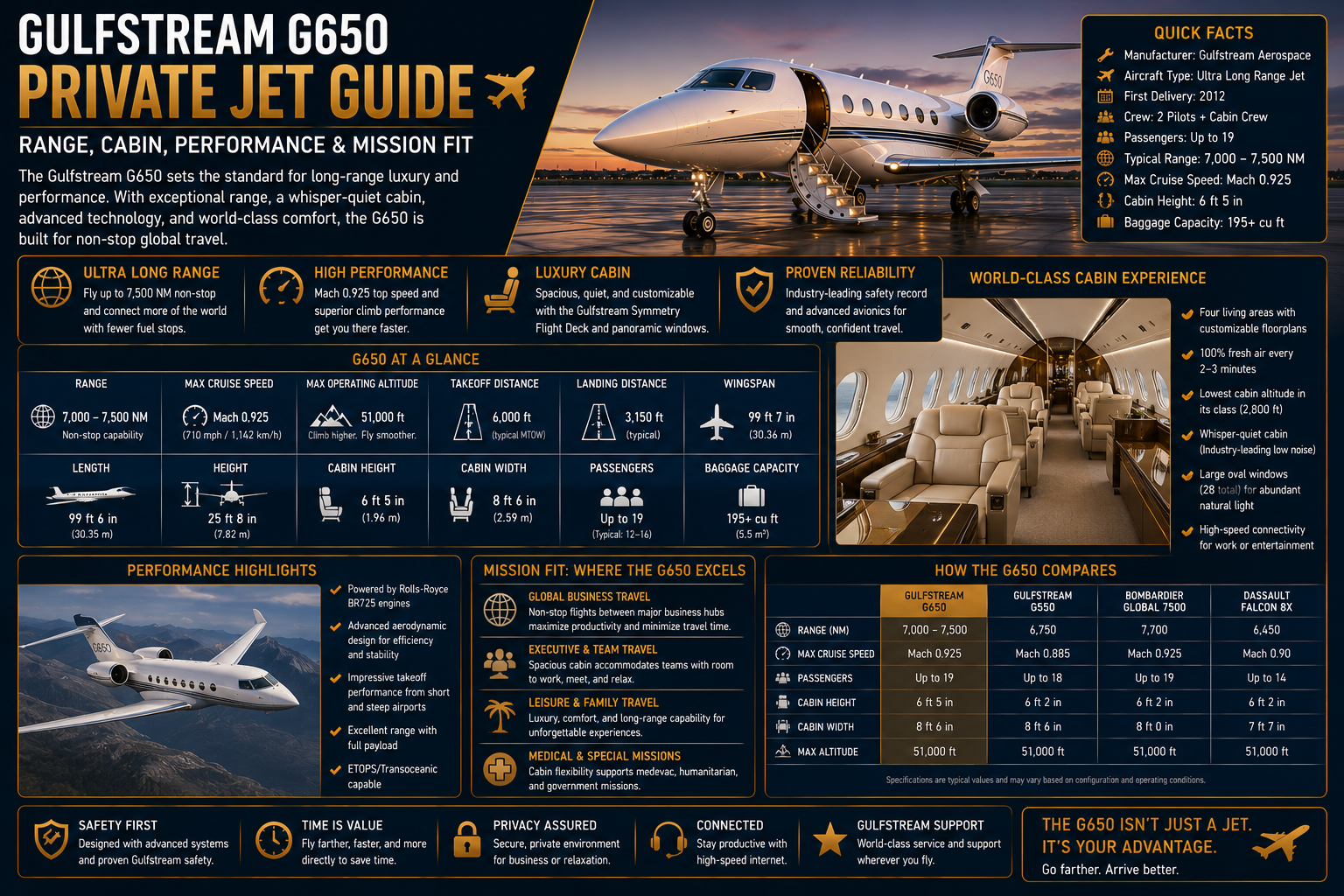
The Gulfstream G650 is an ultra-long-range business jet designed for fast intercontinental travel, substantial passenger comfort and major global missions. The original G650 offers approximately 7,000 nautical miles of published theoretical range at Mach 0.85, while the G650ER extends that benchmark to approximately 7,500 nautical miles. However, the best G650 mission depends on passengers, baggage, weather, runway performance, airport access and whether its large-cabin capability creates real value.
The Gulfstream G650 changed the modern ultra-long-range private jet market.
It combined exceptional speed with intercontinental range.
It added a substantially larger cabin than earlier Gulfstream generations.
Additionally, it introduced a highly capable fly-by-wire aircraft platform powered by Rolls-Royce BR725 engines.
Therefore, the G650 became one of the defining business jets of its generation.
However, private travelers should not choose the G650 simply because of its reputation.
The aircraft solves a specific class of mission.
Long flights create one strong use case.
Larger executive or family groups create another.
Substantial baggage requirements can create another.
Additionally, travelers who need to work, dine, rest and sleep during intercontinental missions can use the aircraft’s cabin capability more fully.
Consequently, the G650 is most valuable when passengers actually use its range and cabin.
A short domestic flight creates a different analysis.
The G650 can complete it easily.
However, a super-midsize or smaller large-cabin jet may provide everything the passenger needs with less aircraft.
Therefore, mission fit should always come before prestige.
The original Gulfstream G650 carries a published maximum theoretical range of approximately 7,000 nautical miles at Mach 0.85 under Gulfstream’s historical reference assumptions.
Those assumptions include eight passengers, four crew and NBAA IFR reserves.
Meanwhile, the G650ER extends the corresponding published range benchmark to approximately 7,500 nautical miles.
Therefore, the ER version adds meaningful range margin for the longest missions.
That distinction matters because the G650 and G650ER share much of the same passenger experience.
The cabin is fundamentally similar.
The aircraft architecture is closely related.
However, the G650ER carries additional fuel capability and higher weight limits that support greater range.
Consequently, the strongest version depends primarily on the route network.
A traveler who repeatedly pushes beyond the original G650’s comfortable range can gain substantial value from the G650ER.
Meanwhile, a traveler whose missions remain comfortably inside the G650 envelope may receive little practical benefit from the additional ER capability.
Therefore, G650 vs. G650ER should be treated as a mission-range question rather than a prestige hierarchy.
The original G650’s published high-speed cruise benchmark is Mach 0.90.
Its maximum operating Mach number reaches Mach 0.925.
Therefore, the aircraft combines long-range capability with unusually high business-jet speed.
That pairing matters.
Some aircraft can optimize range.
Others can emphasize speed.
The G650 was designed to provide both at an unusually high level.
Consequently, executives flying long missions can potentially reduce block time while preserving substantial nonstop capability.
However, maximum operating speed does not mean the aircraft cruises at Mach 0.925 throughout every trip.
Long-range missions normally use a more efficient cruise strategy.
Therefore, travelers should distinguish maximum operating Mach, high-speed cruise and long-range cruise.
That difference can materially affect practical range.
Flying faster generally consumes more fuel.
Consequently, passengers may trade some range for speed when the mission allows it.
The aircraft’s ceiling reaches approximately 51,000 feet.
Therefore, the G650 can cruise above much of the airline traffic system under appropriate conditions.
Higher cruise capability can create operational advantages.
It can provide more route flexibility.
It can also place the aircraft above some weather systems.
However, actual altitude depends on aircraft weight, air traffic control and flight conditions.
Consequently, maximum altitude should be viewed as aircraft capability rather than a guaranteed cruise level on every mission.
The G650 uses two Rolls-Royce BR725 engines.
Each engine provides approximately 16,900 pounds of rated takeoff thrust.
Therefore, the aircraft has substantial power available for a nearly 100,000-pound maximum-takeoff-weight platform.
The BR725 was specifically developed for the G650 program.
Additionally, Rolls-Royce continues to support the engine family.
Therefore, engine support remains an important part of long-term G650 ownership and operation.
That matters because G650 production status has changed.
Gulfstream’s current-production aircraft lineup now centers on newer platforms including the G700 and G800 rather than the G650 family.
Therefore, the G650 should be understood differently in 2026 than it was when new factory deliveries were still the primary acquisition path.
The aircraft remains highly relevant.
However, relevance now comes through the operating fleet.
Charter aircraft remain available.
Privately owned aircraft remain active.
Corporate flight departments continue to operate the platform.
Additionally, pre-owned acquisition creates an important ownership market.
Consequently, production ending does not make the G650 obsolete.
Instead, it changes the acquisition comparison.
A buyer comparing a G650 today should evaluate aircraft age.
Maintenance status matters.
Engine coverage matters.
Cabin refurbishment matters.
Inspection history matters.
Additionally, pre-owned pricing and future maintenance exposure become more important than factory-slot availability.
Therefore, the current G650 ownership decision differs substantially from a new G700 or G800 acquisition.
The charter decision is different again.
A charter passenger does not need to care whether the aircraft remains in production if the specific jet is professionally maintained and properly operated.
Therefore, a high-quality G650 can remain an outstanding charter aircraft.
The cabin provides substantial space.
The range remains exceptional.
The aircraft is fast.
Additionally, the worldwide operating fleet creates meaningful charter relevance.
Consequently, travelers should separate aircraft-generation questions from actual mission quality.
The G650 cabin measures approximately 46 feet 10 inches in usable cabin length excluding the baggage compartment.
Published cabin width is approximately 8 feet 6 inches.
Published cabin height is approximately 6 feet 5 inches.
Therefore, the aircraft provides a true stand-up large-cabin environment.
That matters on long flights.
Passengers can move more naturally.
Multiple seating zones can be created.
Dining and work areas can be separated.
Additionally, sleeping arrangements can be incorporated depending on the exact interior.
Consequently, the cabin becomes much more than seating.
It becomes a usable living and working environment.
Individual G650 interiors vary.
One aircraft may prioritize conference seating.
Another may emphasize lounge space.
Another may provide more sleeping capability.
Additionally, refurbishment history can materially change the passenger experience.
Therefore, charter travelers should evaluate the exact aircraft rather than assume every G650 cabin is identical.
This becomes particularly important on overnight missions.
A seating configuration that works well for a daytime corporate flight may provide fewer ideal sleeping positions.
Therefore, sleeping needs should be identified before booking.
Baggage capability is another major strength.
The G650 provides approximately 195 cubic feet of usable baggage volume in published specifications.
Therefore, the aircraft can support substantial passenger luggage.
That can be valuable for extended international travel.
Family-office missions can benefit.
Entertainment travel can benefit.
Additionally, longer stays can create baggage loads that overwhelm smaller aircraft.
However, volume is not the only limitation.
Weight still matters.
Fuel still matters.
Passenger load matters.
Therefore, even a large baggage compartment must be evaluated within the aircraft’s complete payload calculation.
The original G650 has a maximum takeoff weight of approximately 99,600 pounds.
Therefore, the aircraft can depart as a substantial business jet.
However, weight changes performance.
A lightly fueled short domestic departure creates one runway requirement.
A long-range departure near maximum takeoff weight creates another.
Consequently, runway suitability should be evaluated around the actual mission rather than the aircraft model alone.
Historical Gulfstream specifications list a sea-level, standard-day takeoff distance of approximately 5,858 feet at maximum takeoff weight for the original G650.
That figure provides useful comparison context.
However, it should never be treated as the runway required on every mission.
Temperature changes performance.
Airport elevation changes performance.
Wind changes performance.
Runway condition changes performance.
Additionally, aircraft weight changes performance.
Therefore, the actual operator calculates takeoff requirements for the specific flight.
The G650ER further illustrates that principle.
Its additional fuel and weight capability supports more range.
However, the extra maximum takeoff weight can increase runway requirements.
Therefore, more range does not come without operating tradeoffs.
Consequently, travelers choosing between a G650 and G650ER should evaluate both the desired nonstop mission and the airport pair.
Airport geography can materially change the G650 value proposition.
Teterboro can create a strong New York-area G650 mission.
Van Nuys can support long-range Los Angeles private aviation.
Dallas Love Field can support large-cabin missions into central Dallas.
Harry Reid International can provide exceptional runway capability for Las Vegas.
Additionally, many international business aviation airports can support G650 operations.
However, not every private airport fits the aircraft equally well.
Aspen creates a more specialized operating environment.
High elevation matters.
Mountain terrain matters.
Temperature matters.
Additionally, aircraft weight and weather matter.
Therefore, a G650 mission into a demanding mountain airport can require substantial operating analysis.
The aircraft may be capable.
However, capability can change with payload and season.
Consequently, travelers should never assume that ultra-long range automatically equals universal airport access.
The G650’s size can also influence parking and hangar logistics.
The aircraft measures nearly 100 feet long.
Its wingspan is also approximately 100 feet.
Therefore, hangar dimensions matter.
Ramp space matters.
FBO capacity can matter.
Additionally, busy event airports can create parking limitations.
Consequently, ground infrastructure should be considered alongside runway capability.
Las Vegas during Formula 1 provides one example.
The runway can easily support substantial aircraft.
However, event-driven ramp demand can become the harder problem.
Similarly, major sporting events can create parking constraints at airports otherwise capable of handling the G650.
Therefore, aircraft size affects more than flight performance.
The G650 also works naturally within global executive travel.
A CEO can use the cabin as workspace.
A family office can create separate principal and staff zones.
Entertainment travelers can use the baggage and cabin capability.
Additionally, professional athletes and other high-profile travelers can benefit from a large controlled environment for long-distance travel.
Consequently, the aircraft can support multiple high-end passenger profiles.
However, the same cabin can be excessive for a small short-haul mission.
Therefore, the G650 should be selected when its capability creates measurable value.
Range can create that value.
Cabin can create it.
Baggage can create it.
Speed can create it.
Additionally, nonstop capability can create it.
The G650 becomes especially powerful when several of those benefits matter at the same time.
A New York-to-Europe executive mission provides one example.
A U.S.-to-Middle-East mission can provide another.
A transpacific mission can push the range analysis even further.
Consequently, the G650 belongs within true global business aviation.
However, not every published city pair should be treated as guaranteed.
Real-world winds can change the mission.
Routing can change it.
Passenger weight can change it.
Weather can change it.
Additionally, reserve requirements remain part of professional flight planning.
Therefore, the operator determines the real nonstop capability for each trip.
This distinction becomes particularly important on westbound long-range missions.
Strong winds can reduce range margin.
Therefore, a route that works comfortably in one direction can become more demanding in the other.
Consequently, travelers should evaluate both legs rather than relying on one theoretical distance.
The G650’s high-speed capability creates another decision.
A passenger may prioritize maximum range.
Another may prioritize shorter block time.
Therefore, cruise strategy can change between missions.
A G650 operating near long-range cruise can preserve more range.
A higher-speed strategy can trade fuel efficiency for time.
Consequently, the same aircraft can be optimized differently based on passenger priorities.
Cabin comfort becomes increasingly important as flight time rises.
The G650’s width and height create useful space.
However, the passenger experience also depends on interior design.
Seat quality matters.
Sleeping configuration matters.
Connectivity matters.
Lighting matters.
Sound levels matter.
Additionally, maintenance and refurbishment quality matter.
Therefore, travelers should avoid treating all G650s as interchangeable.
A newly refurbished aircraft can feel materially different from one with an older cabin.
Consequently, the exact tail number matters for premium charter decisions.
The G650 also belongs within a larger Gulfstream comparison.
The G550 represents the prior large-cabin generation.
The G700 provides a newer and larger cabin concept.
The G800 pushes current Gulfstream range capability farther.
Therefore, the G650 sits at an important transition point.
It remains more capable than many large-cabin aircraft.
However, it no longer represents Gulfstream’s newest production generation.
Consequently, its strongest advantages increasingly center on proven capability, existing fleet depth and potential pre-owned economics.
The aircraft also competes with Bombardier’s Global family.
The Global 7500 provides another ultra-long-range solution.
Therefore, travelers can compare cabin philosophy, range, speed and availability.
Dassault’s Falcon family creates another alternative.
Consequently, G650 selection should emerge from a broader aircraft comparison rather than from brand loyalty alone.
The individual mission remains the best filter.
How many passengers are traveling?
How much baggage will they carry?
How long is the route?
Which airports provide the strongest passenger geography?
Does the passenger need to sleep?
Does the trip require multiple living zones?
Is nonstop capability essential?
Additionally, does the G650 create enough extra value to justify using a large ultra-long-range aircraft?
When those answers point toward substantial range and cabin capability, the G650 can remain one of the most compelling aircraft in private aviation.
Direct G650 Answer
Is the Gulfstream G650 a Good Private Jet?
Direct Answer: Yes. The Gulfstream G650 remains one of the most capable ultra-long-range business jets in service, combining approximately 7,000 nautical miles of published theoretical range, Mach 0.925 maximum operating speed, a large stand-up cabin and substantial baggage capacity. It is strongest for long-range missions where nonstop capability, speed and cabin space create meaningful passenger value.
The G650 is not simply a large private jet.
It is a purpose-built global business aircraft.
Therefore, its strongest missions involve more than moving passengers between nearby cities.
The aircraft becomes most valuable when travelers use its combination of range, speed and cabin.
7,000 NM
Published G650 Range
The original G650 carries a historical published theoretical NBAA IFR range of approximately 7,000 nautical miles at Mach 0.85.
7,500 NM
G650ER Range
The G650ER extends the family to approximately 7,500 nautical miles under corresponding reference assumptions.
Mach 0.925
Maximum Operating Speed
The G650 combines ultra-long-range capability with exceptional high-speed business aviation performance.
51,000 FT
Maximum Cruise Altitude
The aircraft can operate at altitudes above much of conventional airline traffic when conditions permit.
195 CU FT
Baggage Capacity
Substantial baggage volume supports international, family-office and extended-stay missions.
Large Cabin
Global Passenger Environment
A stand-up cabin with significant width and length supports work, dining, relaxation and sleeping configurations.
What Is the G650’s Biggest Strength?
Its greatest strength is balance.
Some aircraft provide large cabins.
Some provide long range.
Others provide high speed.
The G650 combines all three at a very high level.
Therefore, it can move passengers across continents without forcing them into a compromised cabin.
What Is the G650’s Biggest Limitation?
It is a large aircraft.
Therefore, cost increases.
Parking requirements increase.
Hangar requirements increase.
Additionally, airport performance deserves more analysis than it would with a smaller aircraft.
Consequently, the G650 can be excessive when the mission does not need its capability.
Who Benefits Most From a G650?
Global executives can benefit.
Family offices can benefit.
Entertainment and sports travelers can benefit.
Additionally, passengers who repeatedly fly long missions with substantial luggage or cabin requirements can use the aircraft effectively.
Therefore, G650 value rises as route length and passenger requirements become more demanding.
The Gulfstream G650 remains exceptional when the passenger needs global range, high speed and a true large-cabin environment at the same time.
For short simple missions, however, smaller aircraft can provide better total value.
G650 Family Comparison
What Is the Difference Between the Gulfstream G650 and G650ER?
Direct Answer: The primary difference is range. The original G650 carries a published theoretical maximum range of approximately 7,000 nautical miles at Mach 0.85, while the G650ER extends that benchmark to approximately 7,500 nautical miles through additional fuel and weight capability. Their cabin dimensions and core passenger experience remain closely related.
The G650ER did not reinvent the G650 cabin.
Instead, Gulfstream extended the aircraft’s mission.
Therefore, the ER should be viewed primarily as a range evolution.
| Decision Factor | Gulfstream G650 | Gulfstream G650ER |
|---|---|---|
| Published Maximum Range | Approximately 7,000 nautical miles | Approximately 7,500 nautical miles |
| Primary Advantage | Ultra-long-range capability with slightly lower maximum operating weight | Additional nonstop range and mission margin |
| Cabin | Large-cabin G650 family interior | Closely related G650-family cabin |
| Maximum Operating Mach | Mach 0.925 | Mach 0.925 |
| Engine Family | Rolls-Royce BR725 | Rolls-Royce BR725 |
| Takeoff Consideration | Lower maximum weight than ER | Higher fuel and weight capability can increase runway requirements |
| Best Use Case | Global missions comfortably within G650 range | Travelers who repeatedly need additional long-range margin |
When Is the G650ER Worth Choosing?
When additional range prevents a fuel stop.
When westbound winds make a long route more demanding.
When repeated global missions approach the original G650’s practical envelope.
Therefore, the ER creates the most value when range margin solves a recurring problem.
When Can the Original G650 Be the Better Choice?
When the mission does not require the extra range.
Charter availability can also favor the original aircraft.
Pre-owned economics may favor it.
Additionally, lower maximum operating weight can affect certain performance comparisons.
Therefore, the original G650 remains extremely capable rather than becoming automatically inferior.
Do Passengers Get a Completely Different Cabin in the ER?
No.
The fundamental cabin platform remains closely related.
Therefore, interior configuration and refurbishment can matter more to the passenger than the ER designation itself.
Consequently, charter travelers should examine the exact aircraft rather than assume the G650ER automatically has the better cabin.
Choose the G650ER when its extra range solves a real mission. Choose the G650 when 7,000-nautical-mile-class capability already gives the trip enough margin.
The ER designation is primarily about extending the mission rather than transforming the cabin.
G650 Production Status
Is the Gulfstream G650 Still in Production?
Direct Answer: No. The G650 family is no longer part of Gulfstream’s current-production aircraft lineup. However, a substantial operating fleet remains active worldwide, so the G650 and G650ER continue to matter for charter, corporate aviation, aircraft management and pre-owned ownership even as newer Gulfstream models occupy the current factory lineup.
Production status can confuse aircraft buyers.
A model can leave production without losing operational value.
Therefore, the G650 should not be treated like obsolete technology simply because Gulfstream now sells newer platforms.
Many successful business aircraft operate for decades.
The G650 belongs within that pattern.
Why Did Gulfstream Move Beyond the G650?
Aircraft manufacturers evolve their fleets.
New cabin concepts emerge.
Range improves.
Flight decks evolve.
Additionally, manufacturers streamline production around new programs.
Therefore, the current Gulfstream lineup has shifted toward newer aircraft including the G700 and G800.
Does Production Ending Make G650 Charter Less Attractive?
No.
Charter passengers care primarily about the actual aircraft.
Maintenance quality matters.
Cabin condition matters.
Operator quality matters.
Crew quality matters.
Therefore, production status alone does not determine passenger experience.
Does Production Ending Matter More to Buyers?
Yes.
A buyer is acquiring a used aircraft rather than a new factory slot.
Therefore, maintenance history becomes more important.
Remaining inspection life matters.
Engine program status matters.
Cabin refurbishment matters.
Additionally, pre-purchase inspection quality becomes critical.
Consequently, ownership analysis changes even though mission capability remains strong.
The G650 has moved from a new-production decision to an operating-fleet and pre-owned decision.
That changes how buyers evaluate the aircraft, but it does not erase its exceptional mission capability.
Gulfstream G650 Specifications
What Are the Gulfstream G650’s Main Specifications?
Direct Answer: The original Gulfstream G650 combines approximately 7,000 nautical miles of published theoretical range, Mach 0.925 maximum operating speed, a 51,000-foot maximum cruise altitude, a 99,600-pound maximum takeoff weight, approximately 195 cubic feet of baggage capacity and a stand-up large cabin approximately 46 feet 10 inches long.
| Specification | Gulfstream G650 | Mission Meaning |
|---|---|---|
| Aircraft Category | Ultra-long-range large-cabin business jet | Designed for demanding domestic and intercontinental private aviation |
| Published Maximum Range | Approximately 7,000 nautical miles | Supports major intercontinental nonstop missions under suitable conditions |
| Long-Range Cruise | Mach 0.85 | Balances speed with maximum-range efficiency |
| High-Speed Cruise | Mach 0.90 | Allows passengers to trade some range for faster travel |
| Maximum Operating Mach | Mach 0.925 | Places the G650 among the fastest business aircraft of its generation |
| Maximum Cruise Altitude | 51,000 feet | Provides high-altitude operating flexibility |
| Takeoff Distance | Approximately 5,858 feet at sea level, ISA and MTOW | Provides a baseline only; actual missions require specific calculations |
| Maximum Takeoff Weight | Approximately 99,600 pounds | Shows the substantial operating weight of the aircraft |
| Engines | Two Rolls-Royce BR725 engines | Provide approximately 16,900 pounds of rated takeoff thrust each |
| Cabin Length | Approximately 46 ft 10 in excluding baggage | Supports multiple passenger areas depending on configuration |
| Cabin Width | Approximately 8 ft 6 in | Creates substantial seating and aisle space |
| Cabin Height | Approximately 6 ft 5 in | Provides a true stand-up large-cabin environment |
| Usable Baggage Volume | Approximately 195 cubic feet | Supports extended trips, large luggage loads and specialty equipment |
| Aircraft Length | Approximately 99 ft 9 in | Influences parking, towing and hangar requirements |
| Wingspan | Approximately 99 ft 7 in | Important for ramp and hangar compatibility |
Why Should These Specifications Not Be Used as Guarantees?
They describe aircraft capability under defined assumptions.
Real missions differ.
Passenger weight changes.
Baggage changes.
Temperature changes.
Additionally, weather and routing change.
Therefore, the operator calculates the actual mission before flight.
Which Specification Matters Most?
The answer depends on the passenger.
A global traveler can prioritize range.
A larger group can prioritize cabin.
A traveler using challenging airports can prioritize runway performance.
Additionally, a family carrying substantial luggage can prioritize baggage capacity.
Therefore, the mission determines which specification has the most value.
The G650’s specifications are impressive because they work together.
Range, speed, cabin and payload create the aircraft’s value as a complete global platform rather than as isolated numbers.
G650 Long-Range Capability
How Far Can a Gulfstream G650 Fly?
Direct Answer: The original Gulfstream G650 carries a published theoretical maximum range of approximately 7,000 nautical miles at Mach 0.85 with eight passengers, four crew and NBAA IFR reserves under reference conditions. The G650ER extends the corresponding range benchmark to approximately 7,500 nautical miles, although real-world nonstop capability varies by mission.
Seven thousand nautical miles places the G650 firmly within true ultra-long-range aviation.
Therefore, the aircraft can connect major international markets without intermediate fuel stops when conditions support the mission.
However, a range number does not tell the entire story.
Wind can change practical capability.
Payload can change it.
Routing can change it.
Additionally, airport performance can affect fuel carried at departure.
Consequently, route feasibility should be evaluated leg by leg.
Why Is 7,000 Nautical Miles Significant?
It opens major intercontinental city pairs.
Therefore, executives can eliminate technical stops on routes that smaller aircraft cannot complete comfortably.
That saves time.
It also avoids another takeoff and landing.
Additionally, passengers can remain inside one controlled cabin environment.
Consequently, nonstop capability can materially improve long global travel.
Does the G650 Always Fly 7,000 Nautical Miles Nonstop?
No.
The figure comes from defined theoretical assumptions.
Therefore, real operations vary.
A heavily loaded aircraft can produce a different result.
Strong headwinds can reduce margin.
Additionally, high-elevation or hot-weather departures can affect fuel and payload.
Consequently, the operator determines whether a specific mission can operate nonstop.
When Does the G650ER’s Additional 500 Nautical Miles Matter Most?
Long missions near the G650 limit create the strongest use case.
Westbound flights can benefit from additional margin.
Repeated transpacific or exceptionally long international missions can benefit as well.
Therefore, the ER creates value when that extra range removes a real operating compromise.
The G650’s 7,000-nautical-mile benchmark makes global nonstop travel possible, but practical range is always a mission calculation rather than a brochure promise.
The G650ER adds additional margin when the route regularly pushes farther.
Practical G650 Range
Can the Gulfstream G650 Really Fly 7,000 Nautical Miles Nonstop?
Direct Answer: Yes, the G650 was designed around a published 7,000-nautical-mile theoretical NBAA IFR range at Mach 0.85 under defined assumptions. However, an actual 7,000-nautical-mile mission may require favorable payload, weather, routing and departure conditions. Therefore, travelers should treat 7,000 nautical miles as a capability benchmark rather than a guaranteed nonstop radius.
Real-world range changes every day.
Therefore, operators do not simply compare route distance with brochure range.
They calculate the mission.
Headwinds
Strong winds can increase fuel burn and reduce practical nonstop range.
Passengers
Additional people add payload and can influence fuel planning.
Baggage
Heavy luggage adds to the aircraft’s operating weight.
Routing
Air traffic routes can increase actual distance compared with a straight-line map.
Departure Airport
Elevation, heat and runway length can affect how much fuel the aircraft can depart with.
Cruise Strategy
Higher-speed cruise can trade some range for reduced flight time.
Why Can the Same Route Work One Day and Need More Margin Another Day?
Atmospheric conditions change.
Therefore, the aircraft’s fuel requirement changes.
Passenger and baggage loads can also differ.
Consequently, route planning must use current data.
Why Should Travelers Care About Direction?
Winds differ by direction.
Therefore, a route can be easier eastbound and harder westbound.
That means the outbound and return legs should be evaluated independently.
Consequently, a traveler should not assume that because the G650 completed the first leg nonstop, the reverse mission automatically has identical range margin.
What Happens If the Mission Exceeds Practical Range?
Several options exist.
The operator can use a G650ER.
A fuel stop can be added.
Another aircraft can be selected.
Additionally, payload or departure timing can sometimes change.
Therefore, range limits create planning decisions rather than ending the mission.
Real G650 range depends on the mission the aircraft is flying today.
Published capability establishes the benchmark; winds, weight, airports and reserves determine the actual nonstop answer.
G650 High-Speed Performance
How Fast Is the Gulfstream G650?
Direct Answer: The Gulfstream G650 has a published long-range cruise speed of approximately Mach 0.85, high-speed cruise around Mach 0.90 and a maximum operating Mach number of Mach 0.925. This combination allows travelers to balance extraordinary range with high-speed flight depending on route length, fuel requirements and schedule priorities.
The G650 was notable because it combined speed and range.
Therefore, travelers do not need to view the aircraft as only an endurance platform.
It can also operate very quickly.
Does the G650 Cruise at Mach 0.925 All the Time?
No.
Mach 0.925 represents the maximum operating limit.
Therefore, normal cruise strategies use lower speeds.
Long-range cruise prioritizes efficiency.
High-speed cruise prioritizes time.
Consequently, the flight crew can optimize the aircraft differently depending on the mission.
When Does G650 Speed Create the Most Value?
Long missions.
A small speed advantage compounds over several hours.
Therefore, global executives who fly frequently can accumulate meaningful annual time savings.
Consequently, speed becomes more valuable as both stage length and annual utilization increase.
Can a Slower Aircraft Still Produce a Faster Door-to-Door Trip?
Yes.
Airport geography can dominate the mission.
Therefore, a smaller aircraft capable of using a substantially closer airport can occasionally beat the G650 door to door.
Consequently, cruise speed should never replace airport analysis.
The G650 is valuable because passengers can combine high speed with genuine intercontinental range.
However, the best cruise strategy depends on whether the mission values maximum range or minimum block time more.
Rolls-Royce BR725 Power
Which Engines Power the Gulfstream G650?
Direct Answer: The Gulfstream G650 and G650ER use two Rolls-Royce BR725 turbofan engines. Each provides approximately 16,900 pounds of maximum rated takeoff thrust. The BR725 was developed specifically for the G650 program and supports the aircraft’s combination of high-speed cruise, 51,000-foot operating altitude and ultra-long-range performance.
The engine is central to the G650 mission.
The aircraft needs significant thrust.
However, long-range travel also rewards efficiency.
Therefore, Rolls-Royce developed the BR725 around both performance and lifecycle requirements.
Why Does Engine Support Matter to G650 Owners?
Engines represent one of the largest maintenance exposures on a business jet.
Therefore, engine condition and program status can materially affect aircraft value.
A pre-owned buyer should understand maintenance history.
Future shop-visit exposure matters.
Additionally, coverage arrangements matter.
Consequently, engine analysis belongs inside aircraft acquisition due diligence.
Does the End of G650 Production Mean BR725 Support Has Ended?
No.
Rolls-Royce continues to support the BR725 engine family.
Therefore, operating G650 aircraft remain within an established engine-support ecosystem.
However, owners should evaluate the exact engine serials and maintenance history of a specific aircraft.
Why Does 16,900 Pounds of Thrust Matter?
The G650 can weigh nearly 100,000 pounds at maximum takeoff weight.
Therefore, substantial engine output supports takeoff and climb performance.
However, runway requirements still change with atmospheric and aircraft conditions.
Consequently, engine power works with the airframe rather than eliminating performance constraints.
The Rolls-Royce BR725 is a core part of the G650 value proposition.
Its performance supports the aircraft’s unusually strong combination of speed, altitude and intercontinental range.
G650 Airport Performance
How Much Runway Does a Gulfstream G650 Need?
Direct Answer: Historical Gulfstream specifications list approximately 5,858 feet of takeoff distance for the original G650 at sea level, standard temperature and maximum takeoff weight. However, actual runway requirements vary with aircraft weight, temperature, elevation, wind, runway condition and obstacles, so operators calculate the specific takeoff and landing performance for every mission.
Runway numbers require context.
Therefore, 5,858 feet should not be used as a universal minimum.
That number describes one reference condition.
Real airports differ.
Aircraft Weight
More fuel, passengers and baggage can increase takeoff distance.
Temperature
Hotter conditions can reduce performance and increase runway requirements.
Elevation
High-elevation airports can substantially change takeoff performance.
Wind
Wind direction and speed influence runway-performance calculations.
Runway Condition
Wet, contaminated or otherwise degraded runway conditions can change requirements.
Obstacles
Departure-path requirements can affect usable aircraft performance beyond runway length alone.
Why Can a G650 Land Somewhere but Not Depart With the Same Flexibility?
Fuel burn reduces aircraft weight during flight.
Therefore, the aircraft can arrive substantially lighter than it departed.
However, the next long-range leg may require a large fuel load.
Consequently, departure performance can become more demanding.
Does the G650ER Need More Runway?
It can at its higher maximum operating weight.
Therefore, the ER’s added range capability can create additional runway consideration when fully fueled and heavily loaded.
Consequently, airport suitability should be evaluated separately from range capability.
Why Is This Important for Charter Travelers?
A traveler may request a specific aircraft because the route fits its range.
However, the chosen airport may create a performance problem.
Therefore, the operator can recommend another airport, reduce fuel or use another aircraft.
Consequently, aircraft and airport selection should happen together.
The G650’s approximately 5,858-foot published takeoff benchmark is useful for comparison, not permission.
The actual aircraft, airport and weather determine the runway answer for each departure.
G650 Airport Compatibility
Which Airports Can a Gulfstream G650 Use?
Direct Answer: The Gulfstream G650 can operate at many major business aviation and international airports worldwide, including numerous executive airports with suitable runway and infrastructure. However, airport access remains mission specific because runway length, elevation, temperature, aircraft weight, terrain, parking and local operating requirements can affect whether a particular G650 flight is practical.
The G650 is a global aircraft.
Therefore, it can use an extensive international airport network.
However, global range should not be confused with unlimited airport access.
Some airports create straightforward missions.
Others require greater performance analysis.
| Airport Type | Typical G650 Fit | Primary Consideration |
|---|---|---|
| Long-Runway International Airport | Generally strong | Parking, handling and traffic can matter more than runway capability |
| Major Business Aviation Airport | Often strong | Confirm runway, ramp and FBO requirements |
| Shorter Executive Airport | Mission dependent | Aircraft weight, fuel and atmospheric conditions become more important |
| High-Elevation Airport | Mission dependent | Density altitude can materially affect performance |
| Mountain Airport | Specialized analysis required | Terrain, weather, elevation and runway performance all matter |
| High-Demand Event Airport | Runway may be suitable | Parking and ramp capacity can become the limiting factor |
Is Teterboro a Strong G650 Airport?
Teterboro is a major New York-area business aviation airport.
Therefore, it can form a natural G650 pairing for long-range private missions when current operating conditions support the aircraft.
Travelers can review IMR’s Teterboro Airport Private Jet Guide for airport-specific planning.
Can a G650 Use Van Nuys?
Van Nuys supports substantial large-cabin business aviation activity.
Therefore, it can be an important Los Angeles G650 gateway depending on aircraft weight and mission conditions.
Travelers can review the Van Nuys Airport Private Jet Guide.
Can a G650 Use Harry Reid International Airport?
Harry Reid provides extensive runway capability.
Therefore, runway length can be highly favorable for large and long-range business aircraft.
However, Las Vegas heat and major-event parking still matter.
Travelers can review the Harry Reid International Airport Private Jet Guide.
Can a G650 Use Centennial Airport?
Centennial has a 10,001-foot primary runway.
However, its approximately 5,885-foot elevation makes density-altitude performance important.
Therefore, a G650 mission from APA should be evaluated around temperature, weight and fuel.
Travelers can review the Centennial Airport Private Jet Guide.
Can a G650 Use Aspen?
Aspen requires specialized analysis.
High elevation matters.
Mountain terrain matters.
Weather matters.
Additionally, aircraft weight and current operating requirements matter.
Therefore, travelers should never assume G650 suitability from aircraft category alone.
Review the Aspen Airport Private Jet Guide when evaluating ASE.
The G650 can reach the world, but the best G650 mission still begins with airport compatibility.
The strongest aircraft loses value if it forces the passenger away from the airport that best serves the destination.
G650 Cabin Experience
How Large Is the Gulfstream G650 Cabin?
Direct Answer: The Gulfstream G650 provides approximately 46 feet 10 inches of usable cabin length excluding baggage, about 8 feet 6 inches of cabin width and approximately 6 feet 5 inches of cabin height. Those dimensions create a true stand-up large-cabin environment capable of supporting multiple seating, work, dining and sleeping areas depending on configuration.
The cabin is central to G650 value.
Seven thousand nautical miles of range can keep passengers onboard for many hours.
Therefore, the aircraft needs more than seats.
It needs usable living space.
The G650 provides that space through substantial width.
It provides stand-up height.
Additionally, its long cabin allows distinct functional zones.
Consequently, passengers can use different areas for different purposes during the same mission.
Why Does Cabin Width Matter?
Width affects seat placement.
It affects aisle space.
It also affects how open the cabin feels.
Therefore, the G650’s approximately 8-foot-6-inch width contributes significantly to the large-cabin experience.
Why Does Cabin Height Matter?
Passengers can stand and move naturally.
That becomes increasingly valuable as flight time increases.
Therefore, a 6-foot-5-inch cabin can materially improve long-duration comfort compared with smaller aircraft.
Does Every G650 Have the Same Interior?
No.
Owners configure aircraft differently.
Some emphasize conference space.
Others emphasize lounge seating.
Sleeping layouts can vary.
Additionally, refurbishment programs can change materials, technology and cabin design over time.
Therefore, charter travelers should inspect or review the exact aircraft being offered.
The G650 cabin is valuable because its dimensions can be turned into multiple usable environments during one long flight.
The exact interior determines how effectively each aircraft uses that space.
G650 Specification Accuracy
Where Should Gulfstream G650 Specifications and Support Information Be Verified?
The Gulfstream G650 remains an active operating aircraft even though the family is no longer listed within Gulfstream’s current-production fleet.
Therefore, buyers, owners and operators should distinguish historical manufacturer specifications from current factory aircraft offerings.
For Gulfstream’s current aircraft lineup and manufacturer information, review the official Gulfstream Aerospace aircraft website.
For current Gulfstream customer and fleet support resources, review Gulfstream Customer Support.
The G650 is powered by Rolls-Royce BR725 engines.
Therefore, current engine information and support can also be reviewed through Rolls-Royce BR725 information.
Published aircraft range and runway figures remain comparison references rather than guarantees.
Actual range, takeoff performance, payload and airport suitability should always be calculated by the operator for the exact aircraft, route and conditions.
G650 Passenger Capacity
How Many Passengers Can a Gulfstream G650 Carry?
Direct Answer: Gulfstream G650 seating varies by interior configuration, while many aircraft are arranged for roughly 14 to 18 passengers and the platform can accommodate up to 19 in certain configurations. However, the best passenger count depends on flight duration, baggage, seating layout and whether passengers need dedicated work, dining or sleeping areas.
Maximum seating does not always equal ideal seating.
That distinction becomes especially important on an ultra-long-range aircraft.
A G650 may have enough certified seats for a relatively large group.
However, passengers flying for 10 or 12 hours need more than a place to sit.
They may need room to work.
They may want to dine.
Additionally, they may need to sleep.
Therefore, practical passenger capacity should reflect how the cabin will actually be used.
| Mission Type | Passenger Consideration | Why It Matters |
|---|---|---|
| Short Domestic Flight | Higher seating density can remain comfortable | Passengers spend less time onboard and may not need sleeping arrangements |
| Transcontinental Flight | Cabin zones become more valuable | Passengers may work, dine and relax during the same mission |
| Overnight International Flight | Sleeping positions become important | Maximum seating may matter less than usable berth capacity |
| Executive Team | Conference and work areas can matter | The cabin may function as an airborne office |
| Family Travel | Separation between activity and rest areas can help | Different passengers can use the cabin differently during long flights |
| Principal + Staff | Multiple cabin zones can create separation | Principals can work or rest while staff use another section |
Is a 19-Passenger G650 Automatically Better?
No.
More seats increase flexibility.
However, a higher-density interior can reduce open cabin space.
Therefore, travelers should evaluate the actual layout rather than choose an aircraft from passenger count alone.
For example, a 12-passenger mission may benefit more from a lower-density G650 with generous lounge and sleeping space than from an aircraft optimized around maximum seating.
Consequently, passenger count should be matched to the trip.
How Many Passengers Are Ideal for Long G650 Flights?
There is no universal number.
However, the ideal group is usually smaller than the maximum seating capacity when passengers expect to sleep comfortably.
Therefore, long-range travelers should identify both the number of passengers and the number who need proper sleeping positions.
That second number can change the aircraft decision.
Why Should Charter Travelers Ask for the Seating Diagram?
Because two G650 aircraft can carry the same model designation while providing different passenger experiences.
One may include a conference group.
Another may provide additional club seats.
Another may emphasize divans.
Additionally, refurbished aircraft can have substantially different cabin technology and finishes.
Therefore, the seating diagram provides more useful information than the aircraft name alone.
For a long G650 mission, ask two questions: How many people can sit comfortably, and how many can sleep comfortably?
Those answers are often different.
Overnight G650 Travel
How Many People Can Sleep on a Gulfstream G650?
Direct Answer: Sleeping capacity varies by the exact Gulfstream G650 interior. Club seats can convert into sleeping positions on some aircraft, while divans can provide additional berths. Therefore, travelers should never assume sleeping capacity from maximum passenger seating and should confirm the exact bed or berth arrangement before an overnight flight.
Sleeping capacity becomes one of the most important G650 variables on overnight missions.
A daytime seating layout can look excellent.
However, the same cabin may not provide enough suitable sleeping positions for every passenger.
Therefore, the charter decision should account for the overnight configuration before departure.
Club Seats
Opposing seats can sometimes convert into sleeping surfaces depending on the aircraft’s interior design.
Divans
A divan can provide useful lounge seating during the day and additional sleeping capability at night.
Private Rest Area
Some configurations allow passengers to create a more separated sleeping environment toward one end of the cabin.
Why Does Sleeping Configuration Matter More Than Passenger Capacity?
Consider a group of eight passengers.
The G650 can easily seat them.
However, eight people may not have eight equivalent sleeping positions.
Therefore, the aircraft can be comfortably sized for the passenger count while still being poorly configured for the overnight mission.
Consequently, the cabin layout matters as much as aircraft size.
Should Every Passenger Expect a Full Bed?
No.
Business jets use convertible seating and divans rather than hotel-style bedrooms in most configurations.
Therefore, travelers should ask what each sleeping position actually looks like.
Some positions can be substantially more comfortable than others.
Additionally, privacy can vary by cabin layout.
Who Should Prioritize the Best Sleeping Position?
That depends on the mission.
A CEO traveling directly into meetings may need protected rest.
A principal may need a private sleeping area.
An athlete may prioritize recovery.
Additionally, families may want children separated from adult work or rest areas.
Therefore, sleeping arrangements should reflect what happens after landing.
On an overnight G650 mission, cabin planning should begin with sleep rather than seats.
The aircraft’s value rises when passengers can arrive ready for what happens next.
G650 Baggage Capacity
How Much Baggage Can a Gulfstream G650 Carry?
Direct Answer: The Gulfstream G650 provides approximately 195 cubic feet of usable baggage volume, giving the aircraft substantial luggage capability for long international trips. However, travelers should still disclose the number, dimensions and approximate weight of bags because payload limits, fuel requirements and unusually large items can affect what the aircraft can carry on a specific mission.
Baggage volume is one of the G650’s practical strengths.
Long trips often create large luggage loads.
Therefore, a global aircraft needs baggage capacity that matches its range.
The G650 provides substantial volume.
However, cubic feet only describe available space.
Weight remains important.
Shape matters.
Additionally, access dimensions can matter for unusual items.
Therefore, passengers should provide more detail than simply saying they have “a lot of luggage.”
| Baggage Type | G650 Planning Consideration |
|---|---|
| Standard Suitcases | Generally well suited to the aircraft’s substantial baggage volume |
| Extended-Stay Luggage | One of the stronger use cases for the G650 baggage compartment |
| Golf Clubs | Usually practical, but exact quantity should be confirmed |
| Ski Equipment | Length and bag dimensions should be disclosed before booking |
| Strollers | Folded dimensions should be provided for family missions |
| Pet Equipment | Carriers, bedding and supplies add to the total baggage requirement |
| Production Equipment | Entertainment and media travelers should disclose case dimensions and weight |
| Oversized Cases | Dimensions can matter even when total baggage volume appears sufficient |
Can the G650 Carry More Baggage Than Most Smaller Private Jets?
Yes.
Its approximately 195-cubic-foot baggage volume substantially exceeds what many smaller aircraft provide.
Therefore, the G650 can be especially useful for extended international travel.
However, more baggage also means more weight.
Consequently, a heavily loaded aircraft may require additional fuel and performance analysis.
Can Passengers Access G650 Baggage During Flight?
The G650’s baggage compartment is internally accessible under appropriate operating conditions.
Therefore, passengers can potentially reach items during flight rather than waiting until landing.
That can be valuable on long missions.
However, crew instructions and safety requirements always govern access.
What Baggage Information Should Be Provided Before Charter?
Provide the number of bags.
Provide approximate dimensions.
Identify unusually heavy items.
Additionally, disclose golf clubs, skis, strollers, pet carriers and production cases separately.
Therefore, the operator can determine whether the baggage fits before the aircraft arrives.
The G650 provides substantial baggage space, but volume does not eliminate payload limits.
Tell the operator what passengers are actually bringing before final aircraft approval.
Long-Range Cabin Comfort
What Is the Gulfstream G650 Cabin Experience Like?
Direct Answer: The Gulfstream G650 was designed around long-duration passenger comfort, combining a large stand-up cabin, low cabin altitude, quiet interior, large windows and multiple cabin zones. Gulfstream has historically published a cabin altitude of approximately 4,100 feet while cruising at 51,000 feet, helping create a more comfortable environment during long intercontinental flights.
Long-range aircraft should be evaluated differently from short-range jets.
A passenger may spend 10 hours or more inside the cabin.
Therefore, small comfort differences can compound across the flight.
Cabin altitude is one of those differences.
What Does Cabin Altitude Mean?
The aircraft may physically fly above 40,000 feet.
However, the pressurized cabin creates an environment that feels like a much lower altitude.
Therefore, passengers are not exposed to the outside atmospheric pressure.
A lower cabin altitude generally creates a more comfortable pressure environment.
Consequently, Gulfstream engineered the G650 around a relatively low cabin-altitude target.
Why Does Cabin Altitude Matter on a 10-Hour Flight?
Duration magnifies the passenger experience.
Therefore, environmental quality matters more as the mission gets longer.
Cabin pressure works alongside humidity, noise, lighting, seating and sleep quality.
Consequently, travelers should evaluate the complete cabin rather than one comfort specification alone.
Why Are G650 Windows Important?
The G650 uses large panoramic windows.
Therefore, the cabin receives substantial natural light.
That can make the interior feel more open.
Additionally, window placement can influence how passengers experience different cabin zones.
Does Cabin Comfort Depend on the Exact Aircraft?
Yes.
Seat condition matters.
Interior age matters.
Cabin technology matters.
Connectivity matters.
Additionally, refurbishment quality can materially change the experience.
Therefore, a newer or recently refurbished G650 may feel substantially different from an older aircraft even though the fundamental airframe is the same.
G650 cabin comfort matters because the aircraft is capable of keeping passengers onboard for exceptionally long periods.
Range creates the mission. The cabin determines how passengers experience it.
Executive Aviation
Is the Gulfstream G650 Good for Executive Travel?
Direct Answer: Yes. The Gulfstream G650 is particularly well suited to executive travel because it combines intercontinental range, high cruise speed, multiple cabin zones and substantial workspace. Executives can hold meetings, work privately, dine and rest while moving between major global business markets, allowing the aircraft to function as productive travel infrastructure rather than simply transportation.
Executive travel provides one of the clearest G650 use cases.
Time has economic value.
Therefore, an aircraft that removes stops and preserves productive hours can create value beyond transportation.
Consider an executive traveling between New York and Europe.
The passenger can work after departure.
They can dine.
Then they can sleep.
After arrival, they can continue directly into the ground itinerary.
Therefore, the aircraft can convert travel time into useful time.
Private Workspace
Multiple cabin zones can allow a principal to work separately from other passengers.
Team Meetings
Conference seating can allow executives to continue discussions during flight.
Overnight Rest
Convertible seating can help executives arrive more prepared for meetings after long flights.
Nonstop Capability
Long range can eliminate intermediate fuel stops on many global missions.
High-Speed Cruise
The G650 can prioritize faster block times when mission range allows it.
Schedule Control
Private aviation allows departure timing to follow the executive’s itinerary rather than an airline schedule.
When Does a G650 Create the Most Executive Value?
When the traveler crosses long distances frequently.
When several executives travel together.
When confidentiality matters.
Additionally, when the passengers need to arrive ready to work.
Therefore, the aircraft becomes increasingly valuable as the economic cost of travel time rises.
Is the G650 Necessary for Domestic Executive Travel?
Usually not.
It can perform domestic missions easily.
However, smaller aircraft may solve those trips more efficiently.
Therefore, executives using charter can select aircraft by mission rather than flying a G650 everywhere.
Can the Cabin Function Like an Office?
Yes.
However, the exact capability depends on the interior.
Conference groups can support meetings.
Individual seats can support focused work.
Connectivity can support communication.
Additionally, multiple zones can separate working passengers from resting passengers.
Therefore, exact cabin configuration should be reviewed before booking.
For executives, the G650’s value is not simply how fast it flies. It is how much useful time the aircraft can preserve.
The strongest mission combines nonstop range, productive cabin time and favorable airport access.
Family Office Aviation
Is the Gulfstream G650 Good for Family Offices?
Direct Answer: Yes. The G650 can be a strong family-office aircraft because its range, large cabin, substantial baggage volume and flexible interior can support principals, family members, staff and extended international travel. However, family offices should evaluate recurring mission patterns because the aircraft provides the greatest value when long-range capability is used frequently.
Family-office aviation often differs from traditional corporate travel.
The passenger group can change.
Children may travel.
Staff may travel.
Pets may travel.
Additionally, luggage requirements can become substantial.
Therefore, flexibility becomes especially important.
The G650 provides that flexibility through cabin and baggage capability.
Why Does the Cabin Work Well for Families?
Different passengers can use different zones.
Children can watch entertainment.
Adults can work.
Another passenger can rest.
Therefore, the cabin can support several activities at the same time.
That becomes particularly valuable during long international missions.
Why Does Baggage Matter More for Family Offices?
Family travel can involve extended stays.
Seasonal residences can create longer trips.
Additionally, children, pets and staff can increase luggage requirements.
Therefore, the G650’s large baggage compartment can provide practical value beyond simple luxury.
Should a Family Office Own a G650?
Not automatically.
Annual utilization matters.
Recurring routes matter.
Aircraft availability requirements matter.
Additionally, capital and operating economics matter.
Therefore, some family offices can benefit from ownership while others gain more flexibility through charter, jet cards, fractional programs or managed access.
Why Can Charter Be Particularly Useful for Family Offices?
Different missions can use different aircraft.
A short regional trip may use a smaller jet.
A transcontinental mission may use a super-midsize aircraft.
An intercontinental family trip may justify the G650.
Therefore, charter allows the aircraft to change with the mission.
The G650 becomes especially compelling for family offices when global range, changing passenger groups and substantial baggage requirements repeatedly overlap.
If those needs occur only occasionally, flexible aircraft access can be more efficient than dedicating one aircraft to every mission.
Global G650 Missions
Is the Gulfstream G650 Good for International Travel?
Direct Answer: Yes. International travel is one of the G650’s strongest mission profiles. Its approximately 7,000-nautical-mile published theoretical range, large cabin, high-speed capability and substantial baggage volume can support long intercontinental trips while reducing the need for fuel stops. However, customs, permits, overflight requirements, airport slots and ground handling still require advance coordination.
The G650 was built around global travel.
Therefore, international missions use more of the aircraft’s capability than short domestic flights.
However, aircraft range solves only the airborne portion of the trip.
International private aviation also requires regulatory planning.
Customs must be coordinated.
Immigration matters.
Permits can matter.
Slots can matter.
Additionally, some destinations require specialized handling.
Therefore, international mission quality depends on both aircraft capability and operational planning.
| International Factor | Why It Matters |
|---|---|
| Passport and Entry Requirements | Passengers must meet destination immigration requirements |
| Customs | International arrivals must use approved procedures and facilities |
| Overflight Permits | Some countries require authorization before crossing their airspace |
| Landing Permits | Some destinations require advance aircraft approval |
| Airport Slots | High-demand airports can restrict arrival and departure timing |
| Parking | The G650’s size makes ramp availability important at constrained airports |
| Ground Handling | Fuel, catering, transportation and passenger processing require coordination |
| Crew Duty | Very long missions can require augmented crews and rest planning |
Why Is Nonstop Capability So Valuable Internationally?
Every fuel stop adds another airport.
That adds time.
It adds handling.
It can add customs or permit complexity.
Additionally, it interrupts the passenger’s cabin environment.
Therefore, eliminating a stop can create value beyond the minutes saved in flight.
Does a G650 Make International Customs Automatic?
No.
The aircraft’s capability does not replace border procedures.
Therefore, passengers and operators must follow the requirements of the departure, arrival and transit countries.
Consequently, international planning should begin well before departure when permits or special procedures are involved.
Why Can the G650ER Be More Valuable Internationally?
Its additional range creates more margin.
Therefore, exceptionally long missions can become more practical.
Westbound headwinds can be easier to accommodate.
Additionally, the ER can reduce the likelihood that a marginal route requires a fuel stop.
Consequently, frequent global travelers can receive more value from the ER than passengers whose missions remain comfortably within the original G650 envelope.
The G650 solves the distance problem. Strong international trip planning solves everything around it.
The best global mission combines aircraft range with customs, permits, handling, crew planning and ground transportation.
Pet-Friendly Private Aviation
Can Pets Fly on a Gulfstream G650?
Direct Answer: Many G650 charter and private operators allow pets to travel in the passenger cabin, although policies depend on the aircraft owner and operator. International pet travel can also require health certificates, vaccinations, microchips, permits or quarantine procedures, so passengers should disclose every pet and destination before confirming the flight.
Private aviation can make pet travel substantially easier.
Pets can often remain with their owners.
Therefore, they may avoid the cargo-hold experience associated with some airline travel.
The G650’s large cabin also provides substantial passenger space.
However, aircraft size does not eliminate pet policies.
The operator must approve the animal.
The aircraft owner may impose additional restrictions.
Additionally, destination regulations still apply.
What Should Travelers Tell the Operator About a Pet?
Provide the species.
Provide breed and approximate weight.
Identify the number of animals.
Additionally, disclose carriers or other equipment.
For international travel, provide the destination early.
Therefore, the operator can identify potential documentation requirements.
Can a Large Dog Travel in the G650 Cabin?
Potentially, yes.
The cabin provides far more space than a typical airline seat environment.
However, the operator and aircraft owner determine whether the animal is accepted.
Therefore, travelers should obtain approval before booking rather than assuming the aircraft model guarantees pet access.
Why Is International Pet Travel More Complicated?
Countries set their own animal-entry rules.
Therefore, requirements can include vaccination records, veterinary certificates, microchips, import permits or other documentation.
Some destinations can impose quarantine requirements.
Consequently, pet planning should begin well before the aircraft departs.
The G650 can provide an excellent cabin environment for pet travel, but operator approval and destination rules still control the mission.
Disclose pets before selecting the aircraft.
Golf Travel
Can a Gulfstream G650 Carry Golf Clubs?
Direct Answer: Yes. The Gulfstream G650’s approximately 195-cubic-foot baggage compartment can generally accommodate golf bags along with substantial passenger luggage. However, groups carrying multiple sets should disclose the exact number of golf bags, travel cases and suitcases because total dimensions and payload still matter.
Golf travel can expose baggage limitations quickly.
A standard suitcase is compact.
A golf travel case is not.
Therefore, passengers should identify golf equipment separately from ordinary luggage.
The G650 provides significant capacity.
Consequently, it can work particularly well for larger groups traveling to golf destinations.
How Many Golf Bags Fit in a G650?
There is no responsible universal number.
Bag dimensions vary.
Travel cases vary.
Passenger luggage varies.
Additionally, the aircraft’s payload changes by mission.
Therefore, the operator should evaluate the complete baggage load.
Why Is the G650 Useful for International Golf Trips?
Long range and large baggage capacity work together.
Therefore, passengers can carry substantial equipment while traveling long distances.
Additionally, the large cabin supports comfortable travel before and after demanding golf itineraries.
Consequently, destination golf can be a strong G650 mission when the route justifies the aircraft.
Should Golfers Use a G650 for a Short Domestic Trip?
Not solely because they have golf clubs.
Many smaller private aircraft can carry golf equipment.
Therefore, the G650 becomes more compelling when the mission also needs its range, passenger capacity or cabin.
Golf clubs fit the G650 mission well, but sports equipment should always be counted separately from standard baggage.
Exact case dimensions allow the operator to plan the load before departure.
Mountain Travel
Can a Gulfstream G650 Carry Skis?
Direct Answer: Yes. A Gulfstream G650 can accommodate ski equipment when the bags fit the aircraft’s baggage-loading requirements and the total passenger, luggage and fuel load remains within operating limits. However, ski trips also make destination-airport performance important because mountain airports can combine elevation, terrain, weather and winter runway conditions.
Ski travel creates two separate aircraft questions.
Can the baggage fit?
Can the aircraft use the destination airport effectively?
Therefore, travelers should not solve only the luggage problem.
The G650 provides substantial baggage volume.
Consequently, skis, boots and winter luggage can often be accommodated.
However, mountain airport performance can become the more important variable.
Why Do Ski Trips Create Large Baggage Loads?
Ski bags are long.
Boot bags add volume.
Winter clothing can require larger suitcases.
Additionally, family groups can multiply the equipment quickly.
Therefore, passengers should provide the number and dimensions of ski bags before booking.
Can a G650 Fly to Aspen?
A G650 mission involving Aspen requires aircraft-specific and condition-specific performance planning.
Aspen/Pitkin County Airport combines high elevation with mountain terrain and changing weather.
Therefore, the operator must evaluate the actual aircraft weight, temperature, runway conditions and mission.
Travelers can review IMR’s Aspen Airport Private Jet Guide for the airport side of the decision.
Could a Smaller Aircraft Be Better for a Ski Trip?
Yes.
A smaller aircraft can sometimes provide better mountain-airport flexibility.
Therefore, a traveler should not automatically select the G650 simply because the departure point is far away.
One strategy can involve using a suitable long-range aircraft to a larger regional airport.
Another can use a different aircraft capable of serving the mountain destination more efficiently.
Consequently, total trip design matters more than aircraft prestige.
The G650 can carry the skis. The harder question can be whether the G650 is the best aircraft for the mountain airport.
Evaluate baggage, range and airport performance together.
Inside the G650
How Should Travelers Evaluate a Specific Gulfstream G650 Cabin?
Direct Answer: Evaluate a specific G650 by looking beyond the aircraft model and reviewing its seating diagram, sleeping positions, cabin zones, galley, lavatories, connectivity, entertainment, refurbishment date and baggage arrangement. Because owners configure and update aircraft differently, two G650s can provide materially different passenger experiences on the same route.
Aircraft type narrows the search.
Tail number completes it.
Therefore, premium charter travelers should evaluate the actual aircraft before final confirmation whenever possible.
| Cabin Detail | Question to Ask |
|---|---|
| Seating | How many individual seats and divan positions are available? |
| Sleeping | How many practical sleeping positions can the cabin create? |
| Cabin Zones | Can work, dining and rest activities occur separately? |
| Conference Area | Is there a useful meeting or dining group? |
| Galley | What meal and catering capability does the exact aircraft provide? |
| Lavatory | How is the lavatory arranged for long-duration travel? |
| Connectivity | What internet system is installed and where does it provide coverage? |
| Entertainment | What displays, audio and passenger-control systems are available? |
| Interior Age | When was the cabin last refurbished? |
| Baggage | Will the actual luggage load fit the aircraft? |
Why Does Refurbishment Date Matter?
The G650 fleet spans multiple production years.
Therefore, interiors can vary substantially in age.
A professionally refurbished older aircraft can provide an excellent modern cabin.
Meanwhile, another aircraft may retain earlier-generation connectivity or cabin technology.
Consequently, airframe age alone does not determine passenger experience.
Why Is Connectivity Important on a G650?
The aircraft is designed for long missions.
Therefore, executives can spend many productive hours onboard.
However, connectivity systems vary by aircraft and region.
Consequently, passengers who require continuous high-speed internet should confirm the exact installed system and expected coverage before departure.
Why Does the Tail Number Matter More on Long Flights?
Small differences become larger over time.
Seat comfort matters more after eight hours.
Internet quality matters more.
Sleeping layout matters more.
Additionally, galley capability matters more.
Therefore, the longer the mission, the more valuable exact-aircraft due diligence becomes.
Do not charter a G650 only by model name when the cabin experience matters.
For premium long-range missions, compare the exact aircraft, interior and installed equipment.
G650 Mission Profile
Which Trips Use the Gulfstream G650 Most Effectively?
Direct Answer: The G650 works most effectively on long domestic and international missions where passengers benefit from several capabilities at once: nonstop range, high speed, a large stand-up cabin, sleeping arrangements and substantial baggage capacity. Its value is strongest when avoiding a fuel stop or preserving productive passenger time materially improves the trip.
The G650 does not need to fly 7,000 nautical miles to create value.
However, its advantages become easier to justify as missions become more demanding.
| Mission | G650 Fit | Reason |
|---|---|---|
| Short Regional Flight | Usually excessive | Smaller aircraft can often solve the mission more efficiently |
| 2–4 Hour Domestic Flight | Capable but often more aircraft than required | Cabin preference or group size would need to justify it |
| U.S. Transcontinental | Excellent capability | Provides large-cabin comfort and high-speed performance with substantial reserve capability |
| U.S.–Europe | Excellent | Uses the aircraft’s nonstop range and overnight cabin capability effectively |
| Long Intercontinental | Core mission | Range, sleeping, baggage and cabin zones work together |
| Near-Maximum-Range Mission | Mission dependent | G650ER or another ultra-long-range aircraft may provide stronger margin |
| Mountain Airport Mission | Requires detailed analysis | Elevation, terrain, temperature and weight can change suitability |
| Large Executive Team | Strong | Multiple cabin zones support work and rest |
| Family Office International Travel | Strong | Cabin flexibility and baggage capacity support complex passenger needs |
What Is the Clearest Sign That a G650 Is the Right Aircraft?
The mission uses several G650 advantages simultaneously.
For example, passengers need long range.
They also need to sleep.
They have substantial luggage.
Additionally, schedule value makes a fuel stop undesirable.
Therefore, the G650 solves several problems with one aircraft.
What Is the Clearest Sign That the G650 Is Too Much Aircraft?
The trip is short.
The group is small.
Baggage is light.
Additionally, a smaller aircraft can use the same airports comfortably.
Therefore, the G650 may add capability without improving the passenger’s actual trip.
Should Charter Travelers Use the Same Aircraft for Every Mission?
No.
Aircraft flexibility is one of charter’s strongest advantages.
Therefore, a traveler can use a Phenom 300 for one mission, a Challenger-class aircraft for another and a G650 when global range becomes valuable.
Consequently, the aircraft should change when the mission changes.
The best G650 mission is not simply a long flight. It is a demanding flight where range, speed, cabin, baggage and passenger productivity all create value together.
That is where the aircraft’s complete capability becomes difficult for smaller platforms to replicate.
G650 Charter Strategy
What Should Travelers Know About Gulfstream G650 Charter?
Direct Answer: Gulfstream G650 charter is best suited to long-range missions where passengers use the aircraft’s speed, cabin, baggage and nonstop capability. Charter travelers should compare the exact tail number, operator, interior, sleeping layout, internet system, positioning cost and whether the mission truly requires a G650 rather than a smaller aircraft.
Chartering a G650 provides access to one of business aviation’s most capable operating platforms without requiring ownership.
Therefore, passengers can use the aircraft only when the mission justifies it.
That flexibility is valuable.
A traveler may use a light jet for a short regional mission.
A super-midsize aircraft can solve a longer domestic trip.
Then, the G650 can be reserved for an international or ultra-long-range mission.
Consequently, charter allows the aircraft category to change with the trip.
When Does G650 Charter Make the Most Sense?
Long missions create the strongest use case.
Large passenger groups can create another.
Overnight travel can create another.
Additionally, high-value executive schedules can make nonstop capability especially important.
Therefore, G650 charter becomes easier to justify when several of those variables overlap.
What Should Travelers Compare Beyond the Model Name?
The exact aircraft matters.
Its interior matters.
The operator matters.
Crew experience matters.
Additionally, connectivity, sleeping configuration and refurbishment history can matter.
Therefore, chartering “a G650” without reviewing the specific aircraft can leave important passenger differences hidden.
Why Does Positioning Affect G650 Charter Cost?
The aircraft may not be located near the departure airport.
Therefore, it may need to reposition before picking up passengers.
That creates additional aircraft time and expense.
Consequently, a G650 already positioned close to the departure point can provide a stronger charter value than another identical aircraft located much farther away.
Can a G650 Be Too Much Aircraft for Charter?
Yes.
A short mission with a small passenger group may not use the aircraft’s long-range capability or large cabin.
Therefore, a smaller aircraft can provide comparable passenger value with better economics.
Consequently, travelers should choose the G650 because the mission needs it rather than because the aircraft has a stronger brand image.
G650 charter is strongest when the aircraft’s range, speed, cabin and baggage all solve real mission requirements.
For simpler trips, charter flexibility allows travelers to use less aircraft.
G650 Ownership Strategy
What Should Buyers Know About Gulfstream G650 Ownership?
Direct Answer: G650 ownership should be evaluated around recurring long-range utilization, aircraft condition, engine coverage, inspection status, cabin refurbishment, crew requirements, hangar availability and future maintenance exposure. Because the G650 is now a pre-owned acquisition rather than a current-production factory order, individual aircraft history matters more than the model name alone.
Ownership changes the entire decision.
A charter traveler evaluates one trip.
An owner evaluates years of use.
Therefore, acquisition price is only the beginning.
Maintenance matters.
Crew costs matter.
Hangar costs matter.
Insurance matters.
Training matters.
Additionally, scheduled inspections and engine exposure can materially affect lifecycle economics.
Acquisition Price
The purchase price establishes the capital commitment but does not capture total ownership cost.
Maintenance Status
Upcoming inspections can materially affect near-term ownership economics.
Engine Coverage
BR725 maintenance programs and engine history can influence both risk and aircraft value.
Cabin Condition
Interior age and refurbishment quality can materially change the passenger experience and future capital needs.
Crew
Pilot staffing, training and scheduling become recurring operating requirements.
Hangar
The G650’s size requires appropriate home-airport infrastructure and storage planning.
Why Does Pre-Purchase Inspection Matter So Much?
A used ultra-long-range aircraft represents substantial capital.
Therefore, hidden maintenance exposure can be expensive.
A thorough pre-purchase inspection helps buyers understand aircraft condition.
It can also identify future work.
Consequently, acquisition diligence should go far beyond cosmetic appearance.
Why Does Annual Utilization Matter?
The aircraft creates fixed costs whether it flies often or rarely.
Therefore, low utilization can make ownership economics less attractive.
Conversely, high recurring usage can increase the value of schedule control and aircraft availability.
Consequently, the buyer should evaluate actual annual mission demand before acquiring a G650.
Should a Buyer Purchase a G650 for One Rare Long Trip?
Usually not.
If most missions are shorter, owning such a large aircraft can create unnecessary cost.
Therefore, a smaller owned aircraft combined with occasional charter of an ultra-long-range platform may be more efficient.
Consequently, ownership should optimize the recurring mission rather than the rarest possible trip.
Buy a G650 when the recurring mission uses its capability often enough to justify the aircraft—not because one annual trip might need 7,000-nautical-mile range.
Ownership economics reward mission consistency.
Pre-Owned G650 Market
Is a Pre-Owned Gulfstream G650 Still Worth Considering?
Direct Answer: Yes. A well-maintained pre-owned G650 can remain a highly capable ultra-long-range aircraft because the platform still offers exceptional speed, cabin size and global mission capability. However, buyers should focus on maintenance history, engine status, inspection timing, cabin condition and total ownership economics because individual aircraft quality now matters more than factory-production status.
Production ending changes the ownership market.
It does not erase the aircraft’s capability.
Therefore, pre-owned G650s can remain highly relevant.
The key is aircraft quality.
Two aircraft of the same model year can have different maintenance histories.
They can have different engine exposure.
They can have different cabin conditions.
Additionally, they can have different upcoming inspection requirements.
Consequently, the tail number matters significantly.
What Makes a Strong Pre-Owned G650 Candidate?
Complete maintenance records matter.
Strong engine coverage matters.
A recently refurbished cabin can add value.
Additionally, major inspections already completed can reduce near-term capital exposure.
Therefore, buyers should evaluate lifecycle condition rather than only asking price.
Why Can an Older G650 Still Compete With Newer Aircraft?
Its core capability remains strong.
The aircraft is fast.
Its range remains substantial.
The cabin remains large.
Therefore, a well-maintained G650 can still solve global missions extremely well.
Consequently, age alone should not eliminate the aircraft from consideration.
When Might a Newer Aircraft Be Better?
A buyer may want factory warranty.
They may want current-generation cabin systems.
Newer avionics and support structures can matter.
Additionally, acquisition strategy may favor a current-production platform.
Therefore, the G650 should be compared with newer Gulfstream and Bombardier aircraft as part of a broader ownership analysis.
A pre-owned G650 should be bought by condition and mission fit, not by reputation alone.
The right aircraft can remain exceptional. The wrong aircraft can carry substantial maintenance exposure.
Gulfstream Generation Comparison
Gulfstream G650 vs. G700: Which Is Better?
Direct Answer: The G700 is the newer-generation Gulfstream with a larger cabin concept, greater published range than the original G650 and up to five living areas depending on configuration. The G650 remains compelling because it still provides ultra-long-range capability, exceptional speed and a large operating fleet that can offer strong charter and pre-owned availability.
The G650 and G700 solve similar top-tier missions.
However, they represent different generations.
Therefore, the comparison should focus on what changed and whether those changes matter to the passenger.
| Decision Factor | Gulfstream G650 | Gulfstream G700 |
|---|---|---|
| Generation | Previous ultra-long-range Gulfstream generation | Newer current-generation platform |
| Published Maximum Range | Approximately 7,000 nautical miles | Greater published maximum range |
| Cabin Concept | Large stand-up cabin with multiple usable zones | Larger cabin with up to five living areas depending on configuration |
| Production Status | Production completed | Current-generation production platform |
| Charter Relevance | Strong operating-fleet availability | Growing availability as more aircraft enter service |
| Ownership Position | Pre-owned acquisition | Current-production acquisition |
| Best Fit | Travelers who value proven capability and operating-fleet depth | Travelers prioritizing next-generation cabin and current-production status |
When Can the G650 Be the Better Charter Choice?
Availability can favor it.
Pricing can favor it.
The exact route may not need the G700’s additional cabin or range.
Therefore, the G650 can provide outstanding mission value without sacrificing meaningful capability.
When Does the G700 Become More Compelling?
Passengers can benefit from more cabin zones.
Longer routes can benefit from greater published range.
Additionally, buyers may prefer current-generation acquisition and support.
Therefore, the G700 becomes stronger when those advantages are actually used.
Does the G700 Make the G650 Obsolete?
No.
Aircraft generations overlap for years.
The G650 remains highly capable.
Therefore, charter and pre-owned buyers should evaluate both based on mission and economics.
The G700 advances the Gulfstream formula, but the G650 remains highly competitive when its existing capability already solves the mission.
Newer is not automatically more valuable for every trip.
Ultra-Long-Range Comparison
Gulfstream G650 vs. Global 7500: Which Aircraft Fits Better?
Direct Answer: The G650 and Bombardier Global 7500 both serve demanding ultra-long-range missions, but they emphasize different cabin and performance philosophies. The G650 remains exceptionally fast and proven throughout the operating fleet, while the Global 7500 offers a newer large-cabin platform with substantial range. The better aircraft depends on route, cabin preference, availability and economics.
Both aircraft belong in the top tier of business aviation.
Therefore, neither should be treated as universally superior.
The mission determines the stronger option.
| Decision Factor | Gulfstream G650 | Bombardier Global 7500 |
|---|---|---|
| Mission Class | Ultra-long-range | Ultra-long-range |
| Core Strength | Speed, range and proven global fleet | Long range and large multi-zone cabin |
| Cabin Decision | Wide large-cabin Gulfstream environment | Large long-range Bombardier cabin concept |
| Charter Decision | Availability can be strong due to established fleet | Availability depends on local operating inventory |
| Ownership Decision | Pre-owned acquisition | Current-generation acquisition options |
| Best Comparison Rule | Compare the exact route, exact interior, airport pair and total economics | |
Which Aircraft Has the Better Cabin?
That depends on passenger preference.
Some travelers prefer Gulfstream’s cabin environment.
Others may prefer Bombardier’s interior layout.
Therefore, the better answer comes from reviewing the exact aircraft rather than relying on brand assumptions.
Which Aircraft Is Better for Charter?
Availability matters heavily.
A G650 already positioned nearby can produce better economics than a Global 7500 requiring a long reposition.
The opposite can also be true.
Therefore, charter travelers should compare the actual market rather than choosing by specification alone.
Which Aircraft Is Better for Ownership?
The analysis becomes more complex.
Acquisition age matters.
Warranty matters.
Maintenance status matters.
Support matters.
Additionally, capital strategy matters.
Therefore, ownership should be evaluated with a complete lifecycle model rather than a simple spec sheet.
G650 vs. Global 7500 is a mission, cabin and market decision.
Both can solve extraordinary global trips; the stronger aircraft is the one that fits the specific passenger and operating environment better.
Gulfstream Family Comparison
Gulfstream G650 vs. G550: What Is the Difference?
Direct Answer: The G650 represents a newer, faster and more capable ultra-long-range generation than the G550, with a larger cabin and substantially greater range. The G550 remains relevant because it can still provide excellent long-range large-cabin travel, while acquisition and operating economics can make it attractive when the G650’s extra capability is unnecessary.
The G550 and G650 do not solve identical missions.
Therefore, the better aircraft depends on whether the additional range, speed and cabin create meaningful value.
| Decision Factor | Gulfstream G550 | Gulfstream G650 |
|---|---|---|
| Generation | Earlier large-cabin Gulfstream generation | Newer ultra-long-range generation |
| Mission Position | Long-range large-cabin | Ultra-long-range large-cabin |
| Cabin | Smaller Gulfstream large-cabin environment | Larger and wider passenger cabin |
| Speed | Strong long-range business jet performance | Substantially higher maximum operating Mach |
| Range | Lower than G650 | Approximately 7,000 nautical miles published benchmark |
| Ownership Position | Pre-owned market | Pre-owned market |
| Best Use | Long-range missions that do not require G650 capability | More demanding global missions where range, speed and cabin matter together |
When Can the G550 Be the Better Choice?
The route may not require G650 range.
The passenger group may not require the larger cabin.
Additionally, acquisition economics can favor the G550.
Therefore, using less aircraft can create better ownership value.
When Does the G650 Clearly Pull Ahead?
Longer missions create the strongest case.
Higher-speed travel can matter.
A larger cabin can matter.
Additionally, larger baggage or sleeping requirements can strengthen the G650 case.
Consequently, the G650 becomes more compelling as mission complexity increases.
The G550 remains a capable long-range aircraft, while the G650 adds the range, speed and cabin required for more demanding global missions.
The better aircraft depends on whether those additional capabilities are actually needed.
G650 Route Examples
Which Long-Range Routes Can the Gulfstream G650 Potentially Fly?
Direct Answer: The G650 can support many major intercontinental city pairs when passengers, winds, fuel, routing and airport conditions remain within operating limits. Routes between North America, Europe, the Middle East and parts of Asia can fall within the aircraft’s mission profile, while the longest sectors require operator-specific analysis and can favor the G650ER.
Route examples help translate range into real travel.
However, they should not be treated as guarantees.
Therefore, every mission still requires current flight planning.
New York → London
A core long-range business aviation mission well within the G650’s general capability under suitable conditions.
New York → Dubai
A much longer intercontinental mission where winds, payload and exact routing become more important.
Los Angeles → London
A major transatlantic mission that uses the aircraft’s long-range capability meaningfully.
Los Angeles → Tokyo
A demanding transpacific mission where conditions and version can materially affect nonstop margin.
Miami → Europe
A strong international mission profile for large-cabin private travel.
Dallas → Europe
Another long-range executive mission where cabin and nonstop capability can create significant value.
Why Should Travelers Avoid Treating Route Examples as Promises?
Winds change.
Payload changes.
Routing changes.
Airport conditions change.
Therefore, the same city pair can have different operational answers on different days.
Consequently, route examples should be used for research rather than final dispatch decisions.
When Does the G650ER Become More Attractive?
The longest routes create the clearest advantage.
More range margin can reduce the risk of a fuel stop.
Therefore, passengers regularly flying near the original G650 range limit can gain practical value from the ER.
The G650 can connect many of the world’s major business markets nonstop, but the exact route still belongs to the operator’s real-world performance calculation.
The longest missions should be evaluated with additional range margin.
G650 Airport Pair Strategy
How Should Travelers Pair the G650 With the Right Airports?
Direct Answer: Travelers should pair the G650 with airports that support the aircraft’s runway, parking, handling and passenger-ground requirements while also minimizing total ground travel. A long-range jet only creates maximum value when the departure and arrival airports preserve the passenger’s door-to-door advantage.
The aircraft should not dictate the entire itinerary.
Instead, the aircraft and airports should be selected together.
A strong G650 mission uses a capable airport near the passenger.
Therefore, airport geography remains part of aircraft strategy.
Why Can Teterboro Pair Well With the G650?
Teterboro is a major business aviation airport serving the New York market.
Therefore, it can create a strong origin for long-range executive missions when operational conditions fit.
Review IMR’s Teterboro Airport Private Jet Guide for airport-specific details.
Why Can Van Nuys Pair Well With the G650?
Van Nuys provides major business aviation infrastructure for Los Angeles.
Therefore, it can support long-range private travel while preserving favorable geography for many Westside and Valley passengers.
Review IMR’s Van Nuys Airport Private Jet Guide.
Why Can Harry Reid Work Well?
Harry Reid provides exceptional runway capability.
Therefore, heavy long-range departures can benefit from substantial pavement.
However, Las Vegas heat and event parking remain important.
Review IMR’s Harry Reid International Airport Private Jet Guide.
Why Does Aspen Require a Different Analysis?
Aspen combines high elevation, mountain terrain and specialized operating conditions.
Therefore, large-aircraft capability becomes more mission dependent.
Review IMR’s Aspen Airport Private Jet Guide before treating ASE as a routine G650 destination.
The G650 should preserve private aviation’s airport advantage—not force the passenger away from it.
Long-range capability is most valuable when the airport pair remains operationally and geographically strong.
Final G650 Mission Decision
When Should Travelers Choose a Gulfstream G650?
Direct Answer: Travelers should choose a G650 when the mission benefits from ultra-long-range capability, high cruise speed, a large stand-up cabin, substantial baggage space and multiple work or sleeping zones. The aircraft is strongest on demanding long-range trips where a smaller jet would create a fuel stop, cabin compromise or passenger-productivity loss.
The G650 is a specialized high-capability tool.
Therefore, it should solve a specialized problem.
The aircraft becomes compelling when several requirements overlap.
The route is long.
The passenger group needs space.
The baggage load is substantial.
Sleeping matters.
Additionally, time value makes intermediate stops undesirable.
That combination creates a strong G650 mission.
| Mission Requirement | G650 Fit |
|---|---|
| Ultra-Long-Range Nonstop Travel | Excellent fit |
| Large Executive Team | Strong fit |
| Overnight International Travel | Strong fit when cabin configuration provides suitable sleeping positions |
| Substantial Baggage | Strong fit |
| Family Office Global Travel | Strong fit when long-range missions occur regularly |
| Short Regional Travel | Usually more aircraft than required |
| Mountain Airport Mission | Mission specific and performance dependent |
| Rare Long Trip With Mostly Short Annual Usage | Charter can be more logical than ownership |
| Frequent Long-Range Ownership | Potentially strong ownership fit |
What Is the Best Reason to Choose the G650?
The aircraft removes several compromises at once.
It can remove a fuel stop.
It can provide enough cabin for work and sleep.
It can carry substantial baggage.
Additionally, it can travel very quickly.
Therefore, its value rises when those advantages compound.
What Is the Best Reason Not to Choose It?
The mission does not need that capability.
A smaller aircraft may already solve the route, passengers, baggage and airports.
Therefore, the G650 can add cost without improving the actual trip.
G650 or G650ER?
Choose the original G650 when its range already provides comfortable margin.
Choose the G650ER when the additional 500-nautical-mile-class published capability repeatedly removes a fuel stop or protects long-range mission flexibility.
Consequently, the version should follow the route network.
G650 or G700?
Choose the G650 when proven operating-fleet depth, availability or pre-owned economics create stronger value.
Choose the G700 when next-generation cabin and current-production advantages matter.
Therefore, generation alone should not determine the answer.
Choose the G650 when its combination of range, speed, cabin and baggage solves a mission smaller aircraft cannot solve as well.
That is where the aircraft earns its place in the itinerary.
Complete G650 Planning
How Should a Complete Gulfstream G650 Mission Be Planned?
Direct Answer: A complete G650 mission should connect route distance, passenger count, baggage, airport performance, cabin layout, sleeping requirements, fuel strategy, international procedures, aircraft positioning and ground transportation. Because the G650 is a large ultra-long-range aircraft, the best mission coordinates both airborne capability and ground logistics before the aircraft is booked.
The G650 solves complex missions.
Therefore, the planning process should be equally disciplined.
| Planning Step | Question to Answer |
|---|---|
| 1. Route | How far is the flight and is nonstop capability essential? |
| 2. G650 or G650ER | Does the mission require the additional ER range margin? |
| 3. Passengers | How many people are flying and how will they use the cabin? |
| 4. Sleeping | How many passengers need practical sleeping positions? |
| 5. Baggage | What standard and oversized luggage will the group bring? |
| 6. Airport Pair | Can the aircraft comfortably use the best airports for the passenger? |
| 7. Performance | How do temperature, elevation, runway and aircraft weight affect the mission? |
| 8. Tail Number | Does the exact cabin provide the desired interior, internet and sleeping arrangement? |
| 9. International Procedures | Are customs, permits, slots or handling arrangements required? |
| 10. Ground Logistics | Are parking, hangar, vehicles and return-flight arrangements confirmed? |
What Should Be Confirmed Before Paying for the Aircraft?
Confirm the exact model.
Confirm whether it is a G650 or G650ER.
Confirm the tail number.
Review the interior.
Confirm sleeping positions.
Additionally, confirm baggage and route feasibility.
Therefore, the passenger understands exactly what aircraft is solving the mission.
What Should Never Be Assumed?
Do not assume 7,000 nautical miles is guaranteed.
Do not assume every G650 cabin is identical.
Do not assume every executive airport fits a heavily fueled G650.
Do not assume the aircraft will remain parked for the return flight.
Additionally, do not assume the G650ER automatically provides the better passenger cabin.
Consequently, mission-specific confirmation remains essential.
The G650 performs best when the aircraft, airport, route and cabin are planned as one system.
Its capability is extraordinary, but the mission still determines how much of that capability can actually be used.
Final G650 Decision
What Is the Best Way to Decide Whether a Gulfstream G650 Fits the Mission?
Direct Answer: Decide whether the G650 fits by testing the mission against five core questions: Does the route benefit from ultra-long-range capability? Does the group need a large stand-up cabin? Will substantial baggage or sleeping requirements matter? Can the aircraft use the preferred airports comfortably? Finally, does the G650 create enough added value to justify using a large ultra-long-range aircraft?
The G650 should earn its place in the mission.
Therefore, travelers should not select it simply because it sits near the top of the private aviation market.
The aircraft becomes compelling when several demanding requirements overlap.
Long range matters.
Cabin space matters.
Baggage matters.
Sleeping matters.
Additionally, airport compatibility matters.
When those needs align, the G650 can become difficult for smaller aircraft to match.
Range
Does Nonstop Capability Matter?
The G650 becomes more valuable when it can eliminate a technical stop on a long intercontinental mission.
Cabin
Will Passengers Use the Space?
Multiple cabin zones create greater value when passengers work, dine, relax and sleep during long flights.
Baggage
Is the Group Carrying Substantial Luggage?
The aircraft’s large baggage compartment can support extended stays, sports equipment and family-office travel.
Airports
Can the Aircraft Use the Best Airport Pair?
The preferred departure and destination airports should support the aircraft without eliminating the passenger’s geographic advantage.
Speed
Does Time Savings Matter?
High-speed capability becomes more valuable on longer missions and for travelers with expensive time.
Economics
Is This Too Much Aircraft?
If a smaller jet solves the route, passengers, baggage and airports comfortably, the G650 may add unnecessary cost without improving the trip.
When Is the G650 an Easy Yes?
A long intercontinental route creates one strong case.
An executive team that needs to work and sleep creates another.
A family office traveling globally with significant baggage creates another.
Additionally, a mission where a fuel stop would materially reduce schedule value can strongly favor the aircraft.
Therefore, the G650 becomes easiest to justify when several of its core strengths are used at once.
When Is the G650 an Easy No?
A short regional trip with two passengers creates a weak use case.
So does a mission where the passenger will not use the cabin.
Additionally, the aircraft can become less attractive when a preferred airport creates unnecessary performance restrictions.
Therefore, the G650 should not be treated as a default premium option for every private flight.
The G650 is strongest when it removes multiple mission compromises at the same time.
If the aircraft’s range, speed, cabin and baggage are not being used, a smaller platform can often create better total value.
G650 Access Strategy
Should Travelers Charter or Own a Gulfstream G650?
Direct Answer: Charter can be stronger for travelers who need G650 capability only occasionally, while ownership can make more sense for high-utilization users who repeatedly need long-range availability, schedule control and the same cabin. The decision should reflect annual flight hours, route frequency, capital strategy, maintenance exposure and whether one aircraft can efficiently handle the owner’s normal mission mix.
Charter and ownership solve different problems.
Therefore, the better structure depends on how frequently the G650’s full capability is needed.
| Decision Factor | Charter | Ownership |
|---|---|---|
| Mission Variety | Strong flexibility across aircraft categories | One primary aircraft must solve most recurring trips |
| Aircraft Availability | Depends on market inventory | Greater control when aircraft and crew are available |
| Capital Requirement | No aircraft acquisition | Significant acquisition and operating commitment |
| Maintenance Exposure | Handled by the operator | Owner carries maintenance and lifecycle risk |
| Interior Consistency | Can vary by charter aircraft | Owner controls the cabin configuration |
| Short Missions | Traveler can choose a smaller aircraft | Owner may operate more aircraft than the mission requires |
| Best Fit | Occasional ultra-long-range need | Frequent recurring long-range utilization |
Why Can Charter Be Better for Mission Diversity?
A traveler can select a different aircraft for each trip.
Therefore, a light jet can solve a short regional mission.
A super-midsize aircraft can solve a transcontinental trip.
Then, the G650 can be used only when intercontinental range and large-cabin capability matter.
Consequently, charter can reduce the need to operate more aircraft than necessary.
Why Can Ownership Be Better for Frequent Global Travelers?
Availability becomes more predictable.
The passenger controls the cabin.
Crew procedures can become standardized.
Additionally, the aircraft can be configured around recurring passenger preferences.
Therefore, high utilization can make ownership value extend beyond flight-hour economics alone.
What Should Buyers Model Before Acquiring a G650?
Annual flight hours.
Expected route mix.
Maintenance events.
Engine status.
Crew cost.
Hangar requirements.
Insurance.
Additionally, residual value and potential replacement timing should be modeled.
Therefore, ownership should be evaluated across the entire lifecycle rather than from purchase price alone.
Charter the G650 when the mission needs it occasionally. Own it when the recurring travel pattern uses its capability often enough to justify the full lifecycle commitment.
Access structure should follow mission frequency.
G650 Route Strategy
How Should the Gulfstream G650 Be Matched to Specific Routes?
Direct Answer: Match the G650 to routes where its long-range capability, high speed and cabin can materially improve the passenger itinerary. The aircraft is especially strong on intercontinental and long domestic missions, while shorter routes can often be completed more efficiently by smaller jets. Each direction should still be evaluated separately because winds, payload and airport conditions change the practical range.
Aircraft range becomes useful only when attached to a route.
Therefore, route analysis should convert the G650’s specifications into a real mission decision.
New York → London
A strong G650 mission where nonstop range, overnight cabin comfort and business productivity can all create value.
Los Angeles → Europe
A longer international mission where the G650’s range and cabin become substantially more valuable.
New York → Dubai
A demanding long-range mission where version, winds, payload and routing deserve detailed analysis.
Dallas → Europe
A strong executive use case where nonstop capability can preserve substantial schedule value.
Miami → Europe
A natural long-range mission for family-office, executive and leisure travel.
Short Domestic Routes
The G650 can complete them easily, but smaller aircraft often provide better economics and adequate cabin capability.
Why Should Both Directions Be Evaluated?
Wind patterns can differ significantly.
Therefore, a city pair that provides comfortable eastbound range margin may create a more demanding westbound return.
Consequently, operators evaluate each leg separately.
Why Can the G650ER Matter More on Certain Routes?
Its additional range can create more margin.
Therefore, extremely long missions or routes exposed to stronger headwinds can become more practical.
Consequently, the ER provides value when its additional fuel capability removes a recurring operating compromise.
Does a Fuel Stop Automatically Make the G650 the Wrong Aircraft?
No.
Sometimes the trip economics or aircraft availability still favor it.
However, eliminating stops is one of the strongest reasons to use an ultra-long-range aircraft.
Therefore, travelers should understand whether the specific flight is expected to operate nonstop before accepting the final aircraft.
A G650 route should be judged by the real itinerary, not by whether the straight-line map distance falls inside 7,000 nautical miles.
Winds, payload, routing and airport conditions determine practical nonstop capability.
G650 Airport Strategy
Why Should Airport Selection Be Part of Every G650 Decision?
Direct Answer: Airport selection matters because the G650 is a large, heavy ultra-long-range aircraft whose performance changes with runway length, elevation, temperature, aircraft weight and terrain. The best G650 itinerary therefore balances aircraft capability with passenger geography so the jet can use an airport that is both operationally suitable and convenient for the traveler.
Private aviation creates value through airport choice.
Therefore, a long-range aircraft should not erase that advantage.
The ideal airport must work for the aircraft.
It should also work for the passenger.
| Airport Consideration | Why It Matters to the G650 |
|---|---|
| Runway Length | Heavy long-range departures can require substantial takeoff distance |
| Field Elevation | Higher elevation can reduce takeoff and climb performance |
| Temperature | Hot weather can increase density altitude and runway requirements |
| Terrain | Mountain airports can create additional operational requirements |
| Ramp Space | The aircraft’s nearly 100-foot dimensions require appropriate parking capacity |
| Hangar Space | Not every business aviation hangar can accommodate a G650 |
| FBO Capability | Fuel, towing, ground power, catering and passenger handling should support a large-cabin aircraft |
| Passenger Geography | The airport should preserve the door-to-door time advantage of private aviation |
When Can a Smaller Aircraft Create a Better Airport Strategy?
When the preferred airport is operationally demanding for the G650.
A smaller aircraft may use the airport with greater margin.
Therefore, the passenger can land closer to the destination.
Consequently, smaller aircraft can occasionally outperform the G650 in complete trip efficiency even though they offer less range and cabin.
When Is a Major Airport Better for the G650?
When the mission requires heavy fuel loads.
When runway length becomes important.
When international infrastructure or customs is easier there.
Additionally, large-ramp and handling capability can favor a major airport.
Therefore, a larger airport can become the stronger choice even when a smaller executive airport sits closer to the destination.
Why Should Parking Be Confirmed Before Event Travel?
The G650 consumes significant ramp space.
Therefore, Formula 1, major sporting events, holidays or other high-demand periods can create parking constraints.
Consequently, aircraft handling and parking should be coordinated before the passenger’s itinerary is finalized.
The G650 can reach extraordinary destinations, but the best mission still begins with the right airport pair.
Aircraft performance and passenger geography should support the same itinerary.
Frequently Asked Questions
Gulfstream G650 Private Jet FAQs
Is the Gulfstream G650 still a good private jet?
Direct Answer: Yes. The G650 remains one of the most capable ultra-long-range business jets in service, combining exceptional speed, long range, a large cabin and substantial baggage capacity.
Is the Gulfstream G650 still in production?
Direct Answer: No. G650-family production has ended, although the aircraft remains highly active throughout the operating, charter, corporate and pre-owned business aviation fleet.
How far can a Gulfstream G650 fly?
Direct Answer: The original G650 carries a published theoretical maximum range of approximately 7,000 nautical miles at Mach 0.85 under Gulfstream reference conditions.
How far can a Gulfstream G650ER fly?
Direct Answer: The G650ER extends the family to approximately 7,500 nautical miles of published theoretical range under corresponding reference conditions.
What is the difference between the G650 and G650ER?
Direct Answer: The primary difference is range. The G650ER adds fuel and higher-weight capability that extend the published maximum range by approximately 500 nautical miles, while the cabin and core passenger experience remain closely related.
How fast is the Gulfstream G650?
Direct Answer: The G650 has a published long-range cruise speed around Mach 0.85, high-speed cruise around Mach 0.90 and maximum operating Mach number of Mach 0.925.
How high can a Gulfstream G650 fly?
Direct Answer: The G650 has a published maximum operating altitude of approximately 51,000 feet, although actual cruise altitude depends on weight, air traffic control and operating conditions.
Which engines power the Gulfstream G650?
Direct Answer: The G650 and G650ER use two Rolls-Royce BR725 turbofan engines, each producing approximately 16,900 pounds of rated takeoff thrust.
How much runway does a Gulfstream G650 need?
Direct Answer: Historical Gulfstream specifications list approximately 5,858 feet of takeoff distance at sea level, standard temperature and maximum takeoff weight for the original G650, but actual runway requirements vary by mission and conditions.
How many passengers can a Gulfstream G650 carry?
Direct Answer: G650 interiors vary, while many aircraft are configured for roughly 14 to 18 passengers and certain configurations can accommodate up to 19. Comfortable capacity depends on the mission and cabin layout.
How many people can sleep on a Gulfstream G650?
Direct Answer: Sleeping capacity depends on the exact interior because club seats and divans can convert differently. Travelers should confirm practical sleeping positions rather than infer them from maximum passenger seating.
How large is the Gulfstream G650 cabin?
Direct Answer: The G650 provides approximately 46 feet 10 inches of cabin length excluding baggage, about 8 feet 6 inches of width and approximately 6 feet 5 inches of cabin height.
How much baggage can a G650 carry?
Direct Answer: The G650 provides approximately 195 cubic feet of usable baggage volume, although total payload, fuel and unusual item dimensions still affect what can be carried on a specific flight.
Can passengers access G650 baggage during flight?
Direct Answer: The G650 provides internal baggage access, although crew instructions and safe operating conditions govern when passengers can reach the compartment during flight.
Can pets fly in the cabin on a Gulfstream G650?
Direct Answer: Many G650 operators permit pets in the cabin, although operator and aircraft-owner policies vary. International animal-entry requirements must also be satisfied when applicable.
Can a Gulfstream G650 carry golf clubs?
Direct Answer: Yes. The G650’s large baggage compartment can generally accommodate golf equipment, although the number and dimensions of golf bags should be disclosed before booking.
Can a Gulfstream G650 carry skis?
Direct Answer: Yes, when the ski bags fit the aircraft’s baggage-loading requirements and the total payload remains within limits. Mountain-airport performance should be evaluated separately.
Can a Gulfstream G650 fly to Aspen?
Direct Answer: A G650 mission involving Aspen requires aircraft-specific and condition-specific analysis because elevation, terrain, weather, runway conditions and aircraft weight can materially affect suitability.
Is the G650 good for executive travel?
Direct Answer: Yes. The G650 can support executive meetings, private work, dining and rest while connecting major global business markets nonstop under suitable conditions.
Is the G650 good for family-office travel?
Direct Answer: Yes. The aircraft can support principals, family members, staff, pets and substantial luggage, particularly when long international missions make the large cabin and baggage capacity valuable.
Is a pre-owned Gulfstream G650 worth considering?
Direct Answer: Yes. A well-maintained G650 can remain highly capable, but buyers should closely evaluate maintenance history, engine status, inspection timing, cabin condition and future lifecycle costs.
Gulfstream G650 or G700: which is better?
Direct Answer: The G700 offers a newer-generation cabin and current-production positioning, while the G650 remains highly capable and can provide strong charter and pre-owned value. The better aircraft depends on route, cabin requirements, availability and economics.
Gulfstream G650 or Global 7500: which is better?
Direct Answer: Both are top-tier ultra-long-range aircraft. The stronger choice depends on the exact cabin, route, operator availability, airport pair and ownership or charter economics.
Gulfstream G650 or G550: which is better?
Direct Answer: The G650 provides more range, speed and cabin capability, while the G550 can remain a strong long-range option when the G650’s additional capability is unnecessary.
What is the biggest advantage of the Gulfstream G650?
Direct Answer: Its biggest advantage is the combination of ultra-long-range capability, exceptional speed, substantial baggage capacity and a true large-cabin environment designed for long-duration global travel.
Gulfstream G650 Bottom Line
The Bottom Line on the Gulfstream G650
The Gulfstream G650 remains one of the defining ultra-long-range business jets of the modern private aviation era.
Its approximately 7,000-nautical-mile published range benchmark provides true intercontinental capability.
The G650ER extends that envelope further.
Additionally, Mach 0.925 maximum operating speed gives the aircraft exceptional performance for a platform designed around long-range travel.
However, the G650’s value extends beyond range.
The cabin matters.
Its approximately 6-foot-5-inch height provides a true stand-up environment.
Its width and length support multiple usable zones.
Additionally, approximately 195 cubic feet of baggage capacity supports extended international missions.
Therefore, the aircraft can function as an office, lounge, dining room and sleeping environment during one flight.
That capability becomes most valuable when passengers actually use it.
A global executive can use the cabin for work and rest.
A family office can use separate zones for principals, family and staff.
Entertainment and sports travelers can benefit from significant baggage capacity.
Additionally, passengers can avoid intermediate fuel stops on many demanding international routes.
Consequently, the G650 can save time both in the air and throughout the larger itinerary.
However, it is not automatically the right private jet.
Short domestic missions rarely require the aircraft’s full capability.
Smaller groups can often use a super-midsize or smaller large-cabin jet more efficiently.
Additionally, certain airports can favor lighter aircraft.
Therefore, G650 selection should remain mission driven.
Production ending does not change that mission capability.
Instead, it changes how buyers evaluate the aircraft.
The G650 now lives primarily in the operating, charter and pre-owned markets.
Therefore, exact aircraft condition matters more.
Engine coverage matters more.
Maintenance history matters more.
Cabin refurbishment matters more.
Additionally, pre-purchase due diligence becomes essential.
Charter travelers face a different decision.
They should evaluate the exact tail number, operator, cabin, internet system and sleeping arrangement.
Therefore, the model name should begin the aircraft review rather than finish it.
Most importantly, travelers should select the G650 when its complete capability creates measurable value.
Range should matter.
Speed should matter.
Cabin should matter.
Baggage should matter.
Additionally, the airport pair should work.
When those conditions align, the G650 remains one of the strongest ultra-long-range private aviation platforms available.
The Gulfstream G650 earns its value when the mission needs global range, high speed, substantial cabin space and serious baggage capability at the same time.
When the mission is simpler, use less aircraft. When the mission is demanding, the G650 remains an exceptional tool.