Free Renewable Energy Marketing SOP Guide
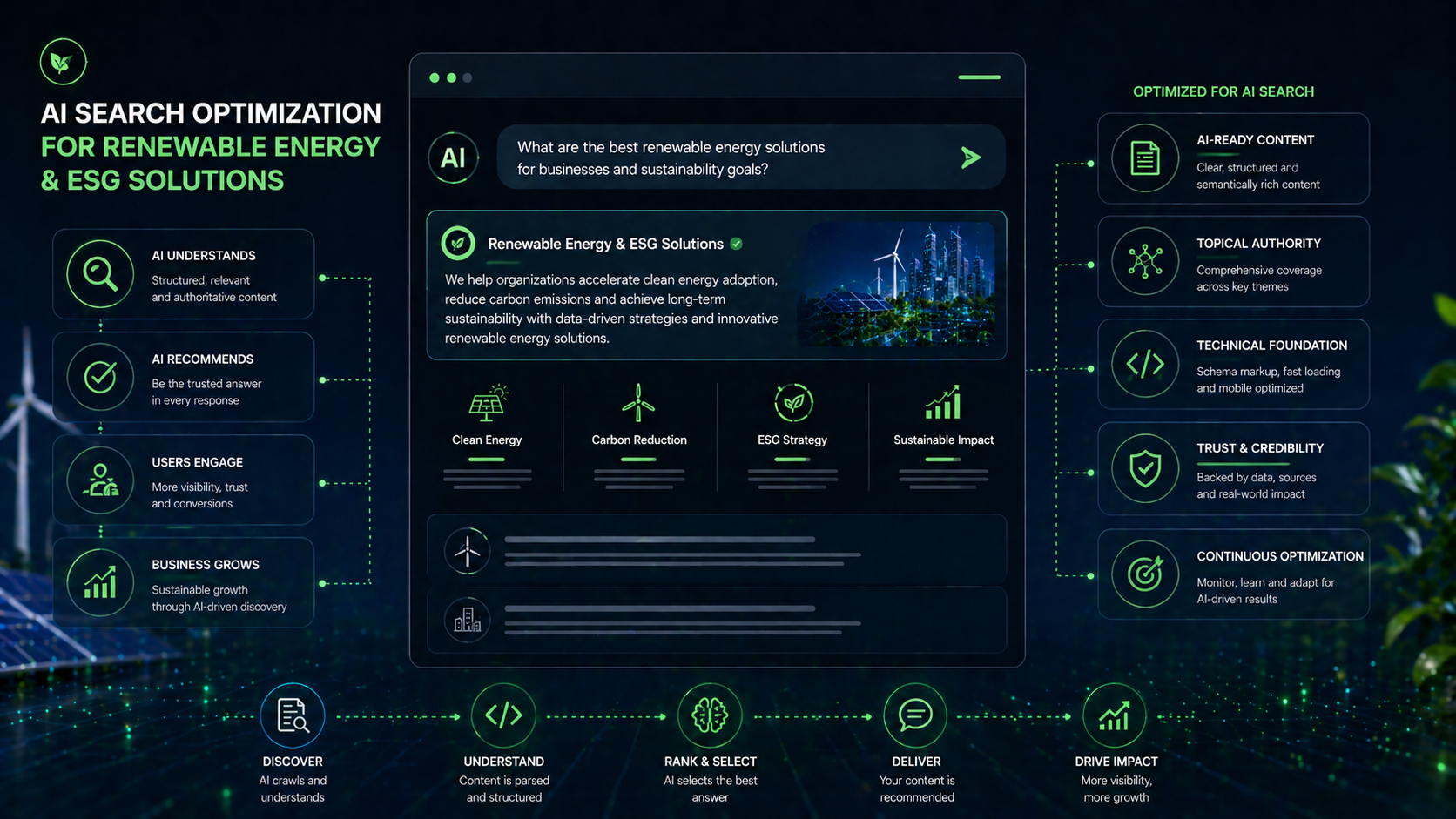
AI Search Optimization For Renewable Energy & ESG Solutions
AI Search Optimization For Renewable Energy & ESG Solutions helps solar companies, battery storage providers, EV charging firms, ESG consultants, carbon accounting platforms, energy efficiency providers, and sustainability advisors structure content so AI systems can understand, summarize, cite, and recommend their expertise more accurately.
AI Search Optimization For Renewable Energy & ESG Solutions starts with one major shift. Buyers no longer search only with short keywords. Instead, they ask full questions inside AI tools, search engines, and answer engines. Therefore, content must answer clearly, define topics quickly, and connect related pages logically.
Renewable energy and ESG buyers ask complex questions. For example, they compare tax credits, payback, Scope 3 reporting, battery storage, EV charging, and vendor risk. Consequently, AI-ready content must organize technical, financial, local, and compliance topics in a clean structure.
Renewable Energy AI Search Strategy
AI search does not reward vague sustainability language. Instead, it favors clear answers, trustworthy structure, entity clarity, useful summaries, and connected topic depth. Therefore, every page should explain what the service is, who it helps, how it works, and why it matters.
Because clean energy and ESG topics involve money, regulations, reporting, infrastructure, and long-term trust, AI systems need strong context. As a result, service pages, hubs, city pages, incentive guides, FAQs, and schema must work together. Moreover, each page should support human readers first.
What AI Search Optimization Means
Direct Answer: AI Search Optimization For Renewable Energy & ESG Solutions means structuring content so AI systems can understand services, technologies, incentives, compliance topics, locations, buyer questions, and trust signals clearly.
AI search optimization is not only about ranking. Instead, it helps content become easier to extract, summarize, and trust. Therefore, the page must answer questions directly and organize related ideas clearly.
For renewable energy brands, this means explaining services like solar, battery storage, EV charging, and energy efficiency in simple language. In addition, it means connecting those services to cost, incentives, process, and local relevance.
For ESG brands, this means explaining reporting, carbon accounting, emissions scopes, data quality, and compliance workflows clearly. Consequently, AI systems can better understand what the company does and why it matters.
As a result, AI search optimization becomes part of the full website strategy. It connects keyword research, service pages, hubs, city pages, schema, E-E-A-T, and conversion paths into one authority system.
Why AI Search Optimization Matters
Direct Answer: AI Search Optimization matters because clean energy and ESG buyers increasingly use AI tools to compare options, understand incentives, evaluate vendors, and simplify complex decisions before contacting a provider.
Buyers Ask More Detailed Questions
Many buyers no longer search only solar company near me. Instead, they ask whether commercial solar is worth it, how storage affects demand charges, or how Scope 3 reporting works. Therefore, content must answer real questions.
AI Summaries Shape Early Research
AI systems can summarize options before users visit a website. Consequently, brands need clear, structured, and trustworthy content. Otherwise, AI systems may overlook or misunderstand their expertise.
Complex Topics Need Clear Explanation
Renewable energy and ESG topics can feel technical. Therefore, pages should define terms and explain steps. In addition, they should avoid vague marketing claims.
AI Visibility Supports SEO And GEO
AI-ready content also improves standard SEO and generative engine optimization. As a result, pages become easier for humans, search engines, and answer engines to understand.
Trust Matters More In High-Stakes Markets
Clean energy and ESG buyers often make expensive or compliance-sensitive decisions. Therefore, AI visibility must be supported by proof, process, and authority signals.
How Renewable Energy And ESG Buyers Use AI Search
Direct Answer: Renewable energy and ESG buyers use AI search to ask full questions about cost, savings, tax credits, implementation, reporting, compliance, vendor selection, and technology fit.
Solar Buyer Questions
- Is commercial solar worth it for my business?
- How long does solar payback take?
- What incentives apply to commercial solar?
- What makes a roof suitable for solar?
Battery Storage Buyer Questions
- How does battery storage reduce demand charges?
- Should a business use battery storage or a generator?
- How does solar plus storage work?
- What size battery system does a facility need?
EV Charging Buyer Questions
- How much does EV charging installation cost?
- What is the difference between Level 2 and DC fast charging?
- How do fleets plan EV charging infrastructure?
- What incentives apply to EV chargers?
ESG And Carbon Buyer Questions
- What is ESG reporting?
- How does carbon accounting work?
- What are Scope 1, Scope 2, and Scope 3 emissions?
- Should we use ESG software or a consultant?
Because these questions are specific, one broad page cannot answer everything. Therefore, the site needs focused spokes, hubs, FAQs, and service pages. Moreover, each page should answer one main intent clearly.
Answer Engine Content Structure
Direct Answer: Answer engine content structure uses clear headings, direct answers, concise summaries, definitions, internal links, FAQs, and schema so AI systems can interpret the page accurately.
Use One Clear Page Topic
Every page should have one main job. For example, a commercial solar payback page should focus on payback. Therefore, it should not become a full solar installation page.
Answer Before Expanding
Each major section should answer the question first. Then, it should explain details. As a result, users and AI systems can understand the point faster.
Use Predictable Section Order
AI systems understand pages better when the structure is predictable. Therefore, pages should move from summary, to context, to details, to FAQs, to next steps.
Link Related Topics Clearly
Internal links help AI systems understand relationships. Consequently, service pages, hubs, city pages, incentive pages, and FAQs should connect naturally.
Use Schema To Reinforce Meaning
Schema should match visible content. Therefore, FAQ schema should support real FAQs, and HowTo schema should support real step-by-step guidance.
Direct Answer Sections
Direct Answer: Direct answer sections improve AI search visibility by giving answer engines a concise, extractable response at the start of each major section.
Why Direct Answers Work
AI systems often look for clear answers. Therefore, each section should start with a sentence or paragraph that answers the heading directly. After that, the section can add detail.
How To Write Direct Answers
A direct answer should be short, specific, and useful. For example, it should explain what something means, why it matters, or how to do it. Consequently, the section becomes easier to summarize.
Where To Use Direct Answers
Use direct answers under H2 sections, FAQs, and important H3 sections. In addition, use them in service pages, city pages, hub pages, and spoke pages.
Direct Answer Example
Example: Commercial solar payback depends on system cost, incentives, energy rates, usage patterns, financing, and site conditions. Therefore, buyers should review payback with a project-specific analysis.
Summary Snippets
Direct Answer: Summary snippets give users and AI systems a fast explanation of what the page covers, who it helps, and what decision it supports.
What A Summary Snippet Should Include
- The main topic
- The target buyer
- The problem solved
- The outcome supported
- The related service or decision
Why Summaries Matter
AI systems need clear context quickly. Therefore, the first summary should explain the page without fluff. Moreover, users benefit because they can confirm relevance immediately.
Where Summaries Should Appear
Summaries should appear near the top of every service page, hub, spoke, city page, and FAQ guide. Consequently, each page becomes easier to understand from the first screen.
Summary Snippet Example
Example: This guide helps commercial property owners understand battery storage, demand charge reduction, backup power, solar pairing, incentives, and project planning.
Entity Clarity For Clean Energy Brands
Direct Answer: Entity clarity helps AI systems understand who the company is, what services it provides, what markets it serves, and what topics it has authority around.
Define The Company Clearly
The site should state what the company does in consistent language. Therefore, the About page, service pages, schema, and footer should reinforce the same identity.
Define Services Consistently
Service names should stay stable. For example, use Commercial Solar Installation consistently if that is the main offer. Consequently, AI systems can connect related pages more easily.
Define Markets Clearly
City pages and service-area pages should clarify where the company operates. In addition, they should connect local pages to the right services.
Define Topic Authority
Hubs and spokes should show depth around key topics. Therefore, the site becomes associated with commercial solar, ESG reporting, battery storage, or EV charging in a clear way.
Topic Clusters For AI Visibility
Direct Answer: Topic clusters improve AI visibility by connecting broad hub pages with focused spoke pages that answer specific buyer questions.
Commercial Solar Cluster
A commercial solar cluster can include spokes on payback, tax credits, roof suitability, financing, and maintenance. Therefore, the hub becomes stronger and more useful.
Battery Storage Cluster
A battery storage cluster can explain demand charge reduction, backup power, peak shaving, storage sizing, and solar pairing. Consequently, buyers can understand storage use cases faster.
EV Charging Cluster
An EV charging cluster can cover workplace charging, fleet charging, multifamily charging, incentives, and charger types. As a result, each buyer type gets clearer guidance.
ESG Reporting Cluster
An ESG reporting cluster can cover frameworks, data quality, software, consulting, and compliance preparation. Therefore, sustainability and finance teams get better support.
Carbon Accounting Cluster
A carbon accounting cluster can cover emissions scopes, data collection, reporting workflows, software, and consultant comparisons. Moreover, it can link to ESG service pages.
Service Page AI Optimization
Direct Answer: Service page AI optimization helps answer engines understand the offer, buyer fit, process, value, proof, FAQs, and next steps for each clean energy or ESG service.
Service Definition
Every service page should define the service early. Therefore, users and AI systems do not need to infer what the page means.
Buyer Fit
Service pages should explain who needs the service. For example, commercial solar may fit manufacturers, schools, warehouses, and office buildings. Consequently, buyers can self-identify.
Process Clarity
AI systems and users both benefit from clear process sections. Therefore, each page should explain discovery, assessment, proposal, implementation, and support.
Proof And Trust
Service pages should include certifications, partner details, project examples, methodology, or process proof. However, they should never invent claims. Instead, they should show real credibility.
FAQs And Next Steps
FAQs help answer common buyer questions. In addition, clear CTAs help users move forward. As a result, the page supports both AI search and conversion.
Local AI Search Optimization
Direct Answer: Local AI Search Optimization connects services to cities, states, utility areas, incentives, and local buyer needs so answer engines understand where the company is relevant.
Use Real Local Context
City pages should include market-specific context. Therefore, they should mention useful local factors, such as utility context, building types, incentives, or buyer needs.
Connect Local Pages To Services
Every city page should link to the related service page. Consequently, users and AI systems can connect the location to the service.
Use State And Incentive Pages
Some local intent belongs on state pages. For example, state solar incentives may deserve their own guide. Therefore, not every local query needs a city page.
Use Consistent Location Language
Location names should stay consistent in titles, headings, breadcrumbs, and schema. As a result, local entity relationships become clearer.
Incentive And Tax Credit AI Content
Direct Answer: Incentive and tax credit content helps AI systems answer buyer questions about financial programs, eligibility topics, project timing, and next steps.
Why Incentive Content Matters
Incentives can influence whether a project moves forward. Therefore, buyers often research them before contacting a provider. In addition, AI systems frequently summarize incentive topics.
How To Structure Incentive Pages
Each incentive page should explain what the incentive is, who may qualify, what project types it may affect, and what users should verify. Consequently, the page becomes useful and responsible.
How To Avoid Risk
Incentive pages should avoid tax or legal advice. Instead, they should encourage buyers to confirm details with qualified advisors. Therefore, the content stays helpful without overstepping.
How Incentive Pages Should Link
Incentive guides should link to related service pages. For example, a battery storage tax credit page should link to battery storage services. As a result, research can become action.
ESG And Carbon AI Content
Direct Answer: ESG and carbon AI content should explain reporting, emissions scopes, data quality, software, consulting, frameworks, and implementation in clear, structured language.
Define ESG Terms Clearly
Many users search basic ESG terms. Therefore, pages should define ESG reporting, carbon accounting, emissions scopes, and data governance early.
Explain Workflows
ESG buyers need process clarity. Consequently, content should explain data collection, validation, reporting, stakeholder review, and improvement steps.
Compare Options Fairly
Buyers often compare software and consulting. Therefore, comparison pages should explain strengths, limits, and best-fit scenarios. As a result, the brand earns trust.
Support Multiple Stakeholders
ESG content often serves finance, legal, sustainability, procurement, and leadership teams. Therefore, pages should explain business value and reporting needs together.
Schema For AI Search
Direct Answer: Schema helps AI search by reinforcing page identity, organization details, breadcrumbs, FAQs, how-to steps, article structure, and speakable answer sections.
Recommended Schema Types
- Organization
- WebSite
- ProfessionalService
- WebPage
- Article
- FAQPage
- HowTo
- BreadcrumbList
- SpeakableSpecification
Schema Must Match Visible Content
Schema should never claim invisible content. Therefore, FAQ schema should match visible FAQs. Likewise, HowTo schema should match visible steps.
Breadcrumbs Matter
Breadcrumbs show hierarchy. Consequently, they help AI systems understand how hubs, spokes, services, and city pages fit together.
Speakable Sections Matter
Speakable markup should target strong summaries and direct answers. As a result, the most useful parts of the page become easier to identify.
Trust, E-E-A-T, And AI Visibility
Direct Answer: Trust and E-E-A-T improve AI visibility by showing that the content comes from a credible company with clear expertise, real services, and useful explanations.
Experience Signals
Experience appears through practical process details, real project considerations, and use-case explanations. Therefore, pages should show how the service works in the real world.
Expertise Signals
Expertise appears through accurate definitions, detailed FAQs, methodology, and clear explanations. Consequently, vague claims should be replaced with useful specifics.
Authority Signals
Authority grows when a site covers a topic deeply. Therefore, hubs, spokes, service pages, and local pages should reinforce one another.
Trust Signals
Trust appears through contact clarity, leadership, process, proof, disclaimers, and honest claims. In addition, pages should link to trusted external sources where helpful.
AI-Ready Content Formatting
Direct Answer: AI-ready content formatting uses short sections, clear headings, direct answers, lists, FAQs, internal links, and schema so complex topics are easier to understand.
Use Clear Headings
Headings should describe the section directly. Therefore, avoid vague headlines that sound clever but hide the topic.
Use Lists For Complex Topics
Lists help users compare factors quickly. In addition, AI systems can parse lists more easily. Therefore, use lists for steps, benefits, factors, and examples.
Use Short Paragraphs
Short paragraphs reduce friction. Consequently, technical topics become easier to scan. Moreover, short sections help keep users engaged.
Define Technical Terms
Renewable energy and ESG pages often include technical terms. Therefore, define terms before using them heavily. As a result, readers trust the page more.
How To Measure AI Search Progress
Direct Answer: AI search progress can be measured through branded AI mentions, citation visibility, question rankings, organic impressions, assisted conversions, and qualified lead quality.
Track Question Visibility
Monitor which question-led pages gain impressions and clicks. Therefore, teams can see which buyer questions create demand.
Track AI Mentions And Citations
AI visibility may show up as brand mentions, citations, or answer inclusion. Consequently, brands should monitor key questions manually and through available tools.
Track Cluster Performance
Measure hubs and spokes together. As a result, teams can see whether the whole topic cluster supports traffic, engagement, and conversions.
Track Lead Quality
AI-ready content should support better conversations. Therefore, CRM feedback matters. In addition, sales teams should report which pages create educated prospects.
Mistakes To Avoid
Direct Answer: The biggest AI search mistakes include vague content, weak summaries, missing direct answers, thin FAQs, poor internal links, unsupported schema, and unclear service definitions.
Using Vague Sustainability Claims
AI systems need specific meaning. Therefore, broad claims about impact, innovation, or sustainability are not enough. Instead, pages should explain the actual service and outcome.
Skipping Direct Answers
If pages delay the answer, users and AI systems work harder. Consequently, every major section should begin with a direct answer.
Publishing Disconnected Pages
Pages should not stand alone. Therefore, service pages, hubs, city pages, and spokes should link together. As a result, the site builds clearer authority.
Using Schema As A Shortcut
Schema cannot fix weak content. Therefore, structured data should reinforce visible value, not replace it.
Ignoring Buyer Intent
AI users ask specific questions. Therefore, pages should match specific intent. Otherwise, the content may feel too broad.
Implementation Template
Direct Answer: Use this template to improve AI Search Optimization For Renewable Energy & ESG Solutions across services, hubs, city pages, incentive guides, FAQs, and comparison pages.
Step 1: Audit Existing Pages
First, review service pages, hubs, city pages, FAQs, and incentive pages. Then, identify missing summaries, direct answers, definitions, and internal links.
Step 2: Add Direct Answers
Next, add direct answers to each major section. Therefore, every page becomes easier to read and summarize.
Step 3: Strengthen Topic Clusters
Then, connect hubs and spokes. In addition, link service pages to relevant guides. Consequently, the site becomes more coherent.
Step 4: Improve Schema
After the content is strong, add accurate schema. Therefore, structured data supports the visible page correctly.
Step 5: Measure And Expand
Finally, track impressions, AI mentions, leads, and CRM quality. Then, expand into new questions and clusters. As a result, the AI-search system improves over time.
FAQs
What is AI Search Optimization For Renewable Energy & ESG Solutions?
Direct Answer: It is the process of structuring clean energy and ESG content so AI systems can understand, summarize, cite, and recommend the company’s expertise more accurately.
Why does AI search matter for renewable energy companies?
Direct Answer: It matters because buyers ask AI tools detailed questions about solar, storage, EV charging, incentives, payback, installation, and provider options.
Why does AI search matter for ESG companies?
Direct Answer: It matters because ESG buyers ask AI tools about reporting, carbon accounting, emissions scopes, compliance, software, consulting, and data quality.
What makes a page AI-search ready?
Direct Answer: A page becomes AI-search ready when it uses clear summaries, direct answers, structured sections, internal links, FAQs, schema, and trustworthy explanations.
Do direct answers help AI visibility?
Direct Answer: Yes. Direct answers make content easier for AI systems to extract, summarize, and match to user questions.
Does schema guarantee AI visibility?
Direct Answer: No. Schema helps reinforce meaning, but the visible content must still be clear, useful, accurate, and trustworthy.
How do topic clusters support AI search?
Direct Answer: Topic clusters support AI search by connecting broad hubs to focused spokes, which helps answer engines understand depth and relationships.
What should clean energy brands optimize first?
Direct Answer: They should optimize core service pages, buyer questions, incentive guides, city pages, topic hubs, FAQs, and schema first.
Hub & Spoke Links
Direct Answer: This spoke supports the Renewable Energy & ESG Solutions SOP hub and connects AI search optimization to keyword research, service architecture, content clusters, city pages, schema, paid traffic, and the 1000-page model.
Main SOP Hub
Related Spokes
- Keyword Research For Renewable Energy & ESG Solutions
- Service Page Architecture For Renewable Energy & ESG Solutions
- Hub And Spoke Content For Renewable Energy & ESG Solutions
- City Page Strategy For Renewable Energy & ESG Solutions
- Schema And E-E-A-T For Renewable Energy & ESG Solutions
- Google Ads For Renewable Energy & ESG Solutions
- Facebook / Meta Ads For Renewable Energy & ESG Solutions
- The 1000 Page Model For Renewable Energy & ESG Solutions