Free Renewable Energy Marketing SOP Guide
Schema And E-E-A-T For Renewable Energy & ESG Solutions
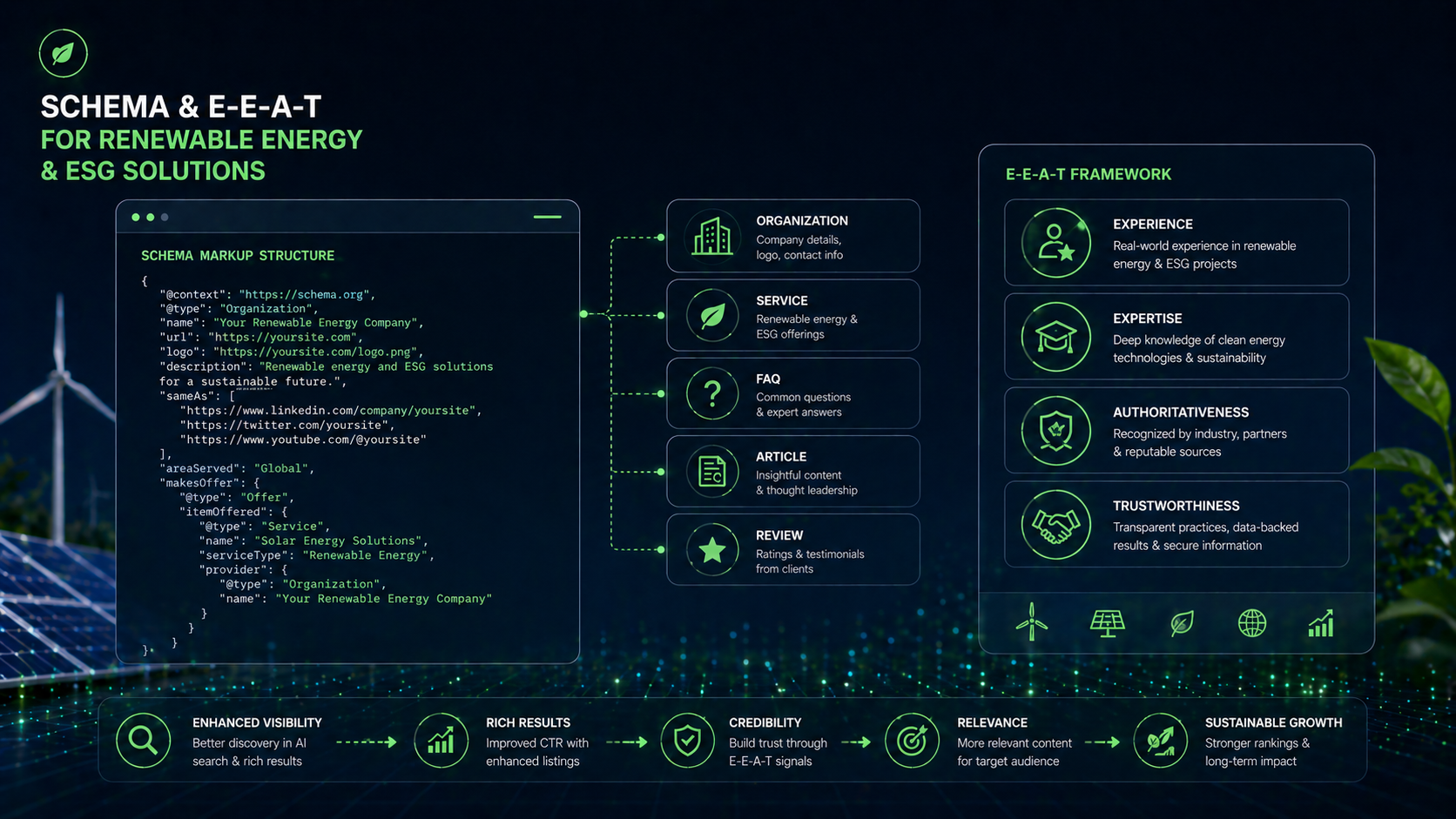
Schema And E-E-A-T For Renewable Energy & ESG Solutions helps solar companies, battery storage providers, EV charging firms, ESG consultants, carbon accounting platforms, energy efficiency providers, and sustainability advisors build stronger trust signals, clearer entity structure, better SEO, stronger GEO visibility, and more reliable AI-search interpretation.
Schema And E-E-A-T For Renewable Energy & ESG Solutions starts with one core truth. Buyers in this market need proof before action. They compare cost, incentives, compliance, payback, data quality, risk, process, and provider credibility. Therefore, clean energy and ESG websites must show trust clearly.
However, trust does not come from schema alone. Instead, schema should reinforce strong visible content. First, the page must explain the service clearly. Next, it must prove relevance and expertise. Then, structured data can help search engines and AI systems understand the page. As a result, trust becomes easier to verify.
Renewable Energy Trust Architecture
Renewable energy and ESG buyers often make high-stakes decisions. For example, a commercial solar buyer may need board approval. Meanwhile, an ESG buyer may need audit-ready data. Consequently, every page should explain experience, expertise, authority, and trust in practical ways.
Because this industry involves money, infrastructure, compliance, and long-term responsibility, vague claims fall short. Therefore, the website should show process, certifications, methodology, leadership, FAQs, citations, and clear page relationships. Moreover, schema should connect those signals cleanly.
What Schema And E-E-A-T Means
Direct Answer: Schema And E-E-A-T For Renewable Energy & ESG Solutions means combining visible trust signals with structured data so users, search engines, and AI systems can understand the company’s expertise, services, credibility, and authority.
E-E-A-T stands for experience, expertise, authoritativeness, and trust. In practice, it means the page must prove that the company understands the buyer’s problem. It also means the content must show credible service knowledge. Therefore, E-E-A-T starts with visible content.
Schema is structured data. It helps search engines understand the page, business, hierarchy, FAQs, steps, and relationships. However, schema does not create trust by itself. Instead, it reinforces the trust that appears on the page.
For renewable energy companies, this includes service clarity, incentive context, installation process, certifications, warranties, and project considerations. Meanwhile, for ESG companies, this includes methodology, reporting workflows, data quality, emissions scopes, and stakeholder value.
Consequently, the strongest strategy combines both layers. First, build useful content. Then, support that content with accurate schema. As a result, the website becomes easier to rank, cite, summarize, and trust.
Why Schema And E-E-A-T Matter
Direct Answer: Schema and E-E-A-T matter because renewable energy and ESG buyers often evaluate financial risk, technical complexity, compliance exposure, and provider credibility before they contact a company.
They Build Human Trust
Buyers want to know whether the company understands their needs. Therefore, pages should explain process, value, risks, and fit clearly. In addition, the site should make expertise easy to verify.
They Improve Search Understanding
Search engines need clear page meaning. Consequently, schema helps define page type, organization identity, breadcrumbs, FAQs, and steps. As a result, the site becomes easier to interpret.
They Support AI Search
AI systems summarize content from structured and unstructured signals. Therefore, clear content and accurate schema work together. Moreover, strong E-E-A-T helps AI systems understand why the brand deserves trust.
They Reduce Buyer Friction
Clean energy and ESG buyers often need internal approval. Therefore, trust content can help them explain the decision to others. In turn, better pages support stronger sales conversations.
They Protect Against Vague Marketing
This industry has many vague claims. However, buyers need specific proof. Therefore, E-E-A-T helps replace broad sustainability language with clear expertise and useful evidence.
The E-E-A-T Foundation
Direct Answer: The E-E-A-T foundation for renewable energy and ESG websites should show real experience, practical expertise, topical authority, and trust through page content, process details, and proof signals.
Experience
Experience shows that the company understands real projects and buyer concerns. For example, solar pages should discuss assessments, roof fit, incentives, and installation steps. Therefore, content should reflect real-world decisions.
Expertise
Expertise shows that the company understands technical and strategic details. For example, ESG content should explain reporting scopes, data quality, and frameworks. Consequently, the page becomes more credible.
Authoritativeness
Authority grows when the site covers a topic deeply. Therefore, service pages, hubs, spokes, city pages, and FAQs should reinforce one another. As a result, the site becomes more complete.
Trust
Trust comes from accuracy, clarity, transparency, and proof. Therefore, pages should avoid inflated claims. Instead, they should explain what buyers can verify and what they should confirm with specialists.
Experience Signals
Direct Answer: Experience signals show that the company understands real renewable energy and ESG implementation challenges, not just broad marketing concepts.
Project Process Details
Process details show experience. For example, solar pages should explain assessment, design, permitting, installation, and monitoring. Consequently, buyers understand what happens next.
Use-Case Specific Content
Use-case pages show practical understanding. For example, EV charging for fleets differs from EV charging for apartments. Therefore, each use case should have specific content.
Common Buyer Challenges
Pages should mention real obstacles. These may include utility coordination, data collection, roof condition, reporting scope, or incentive timing. As a result, the content feels grounded.
Implementation Examples
Examples help users connect the service to real decisions. However, examples should never pretend to be case studies. Instead, they should explain practical scenarios honestly.
Expertise Signals
Direct Answer: Expertise signals show that the company can explain complex energy, sustainability, reporting, and infrastructure topics clearly and accurately.
Clear Definitions
Technical topics need simple definitions. Therefore, pages should define battery storage, demand charges, Scope 3 emissions, ESG reporting, carbon accounting, and tax credit concepts early.
Methodology Sections
Methodology builds confidence. For example, ESG pages should explain data collection, validation, reporting, and stakeholder review. Consequently, the buyer sees how the work happens.
Detailed FAQs
FAQs show expertise when they answer real buyer questions. Therefore, FAQs should include cost, process, incentives, compliance, risk, timelines, and implementation details.
Accurate External References
Trusted external references support expertise. For example, pages may link to Google, DOE, EPA, or SEC resources. As a result, users can verify important context.
Trust Signals
Direct Answer: Trust signals help buyers verify that the company is credible, transparent, and capable of supporting clean energy or ESG decisions responsibly.
Business Identity
The website should make the company identity clear. Therefore, contact details, service areas, leadership information, and business descriptions should stay consistent.
Certifications And Partnerships
Certifications, partner details, and platform relationships can support trust. However, they should only appear when true. Consequently, the page avoids unsupported claims.
Transparent Process
Buyers trust clear steps. Therefore, pages should explain discovery, assessment, proposal, implementation, reporting, and support. In addition, they should clarify what the buyer needs to provide.
Responsible Claims
Clean energy pages should avoid guaranteed savings unless verified. Likewise, ESG pages should avoid legal or audit guarantees unless appropriate. Therefore, careful language protects trust.
Helpful Disclaimers
Incentive and compliance content should guide users responsibly. Therefore, pages should encourage users to confirm tax, legal, and regulatory details with qualified advisors.
The Schema Foundation
Direct Answer: The schema foundation should define the organization, website, service role, page type, article content, FAQs, how-to steps, breadcrumbs, and speakable answer areas.
Schema helps search engines understand page meaning. However, it should always reflect visible content. Therefore, the page should include real FAQs before FAQPage schema appears.
Schema also helps connect entities. For example, Organization schema defines the company. BreadcrumbList schema explains the page hierarchy. Meanwhile, WebPage and Article schema explain the page itself.
As a result, schema becomes a technical trust layer. It does not replace good content. Instead, it helps machines interpret good content faster.
Therefore, every major renewable energy and ESG page should include a complete schema stack. In addition, schema should stay consistent across the site.
Recommended Schema Types
Direct Answer: Renewable energy and ESG pages should usually use Organization, WebSite, ProfessionalService, WebPage, Article, FAQPage, HowTo, BreadcrumbList, and SpeakableSpecification schema when supported by visible content.
Organization
Organization schema identifies the business. Therefore, it should include consistent name, URL, contact details, and address when available.
WebSite
WebSite schema defines the site itself. Consequently, it helps connect the domain to the organization.
ProfessionalService
ProfessionalService schema can define the company’s service role. Therefore, it works well for marketing service pages and consulting-style pages.
WebPage And Article
WebPage schema defines the page. Article schema supports guide-style educational content. As a result, the page purpose becomes clearer.
FAQPage And HowTo
FAQPage schema supports visible FAQ sections. Meanwhile, HowTo schema supports visible step-by-step instructions. Therefore, both should match the content exactly.
BreadcrumbList And SpeakableSpecification
BreadcrumbList explains hierarchy. SpeakableSpecification points to strong summaries and direct answers. Consequently, both support AI-ready structure.
Service Page Schema
Direct Answer: Service page schema should help search engines and AI systems understand the service, provider, page purpose, FAQs, process steps, and website hierarchy.
Best Schema For Service Pages
- Organization
- WebSite
- ProfessionalService
- WebPage
- FAQPage
- HowTo
- BreadcrumbList
- SpeakableSpecification
What Service Pages Need Visibly
Service pages should include a clear summary, buyer-fit section, process, proof, FAQs, and next steps. Then, schema can reinforce those parts. Therefore, structure and content work together.
Service Page Example
A commercial solar installation page can include process steps for assessment, design, proposal, installation, and monitoring. Consequently, HowTo schema can support those visible steps.
Hub And Spoke Schema
Direct Answer: Hub and spoke schema should reinforce the relationship between broad guide pages and focused answer pages through breadcrumbs, article structure, FAQs, and internal links.
Hub Page Schema
Hub pages usually need WebPage, Article, FAQPage, BreadcrumbList, and SpeakableSpecification schema. In addition, they should include internal links to all major spokes.
Spoke Page Schema
Spoke pages should focus on one question or topic. Therefore, their schema should support that narrow purpose. As a result, answer engines can understand the page faster.
Why Internal Links Matter
Schema does not replace internal links. Instead, links show real relationships. Consequently, every spoke should link back to its parent hub.
City Page Schema
Direct Answer: City page schema should clarify the page location, service relevance, provider identity, page hierarchy, FAQs, and local content purpose.
City Page Schema Stack
- Organization
- WebSite
- ProfessionalService
- WebPage
- Article
- FAQPage
- BreadcrumbList
- SpeakableSpecification
Local Content Still Comes First
Schema cannot make a weak city page valuable. Therefore, the page should include real local context, service explanation, buyer-fit content, FAQs, and internal links.
Local Entity Clarity
City pages should use consistent location names in the title, H1, breadcrumbs, schema, and body. Consequently, the local entity becomes easier to interpret.
FAQ And HowTo Schema
Direct Answer: FAQ and HowTo schema help reinforce visible questions and visible step-by-step instructions so search engines and AI systems can interpret the content accurately.
FAQ Schema Rules
FAQ schema should match visible FAQ content. Therefore, do not add questions to schema that users cannot see. In addition, answers should stay concise and accurate.
HowTo Schema Rules
HowTo schema should match visible process steps. For example, an ESG reporting page may show discovery, data review, scope definition, reporting setup, and optimization. Consequently, the schema supports real guidance.
Why These Types Matter
FAQs and steps help users make decisions. Therefore, these schema types are useful when the content genuinely answers questions and explains process.
Speakable Schema
Direct Answer: Speakable schema should point to the strongest summary and direct-answer sections so AI systems can identify the most concise explanation on the page.
What Speakable Should Target
Speakable markup should target the page summary and the first direct answer. Therefore, the selected content should be clear, accurate, and useful.
Why Summary Quality Matters
If the summary is vague, speakable markup adds little value. Consequently, every summary should explain the page topic, audience, and outcome clearly.
How To Use It Responsibly
Speakable schema should not target promotional fluff. Instead, it should target helpful answer content. As a result, the page becomes more AI-ready.
Renewable Energy Proof Signals
Direct Answer: Renewable energy proof signals help buyers trust solar, storage, EV charging, and efficiency pages by showing process, standards, project logic, and practical expertise.
Solar Proof Signals
- Assessment process
- Roof or site-fit factors
- Incentive guidance
- Equipment details
- Warranty information
- Installation steps
Battery Storage Proof Signals
- Demand charge explanation
- Backup power use cases
- System sizing factors
- Solar pairing logic
- Monitoring and support details
EV Charging Proof Signals
- Use-case sections
- Power-capacity planning
- Installation process
- Incentive context
- Property-type guidance
Why Proof Must Stay Honest
Proof should never be invented. Instead, the page should explain real process and useful decision factors. Therefore, buyers can trust the content.
ESG And Carbon Proof Signals
Direct Answer: ESG and carbon proof signals help buyers trust reporting, carbon accounting, sustainability consulting, and emissions data services through methodology, workflow clarity, and responsible claims.
ESG Reporting Proof Signals
- Reporting workflow
- Data-source review
- Framework explanations
- Stakeholder reporting examples
- Documentation process
Carbon Accounting Proof Signals
- Scope 1, 2, and 3 definitions
- Data collection process
- Emissions methodology
- Software or consulting comparison
- Report preparation steps
Why ESG Proof Matters
ESG buyers often answer to leadership, investors, procurement teams, or regulators. Therefore, content should explain process and accountability clearly. In addition, it should avoid empty impact claims.
AI Search Trust Signals
Direct Answer: AI search trust signals help answer engines understand that the company’s content is specific, helpful, structured, internally connected, and supported by credible references.
Direct Answers
Direct answers help AI systems extract meaning quickly. Therefore, every major section should open with a clear answer.
Connected Pages
Internal links show topic relationships. Consequently, AI systems can understand how services, hubs, city pages, and FAQs support one another.
Consistent Entities
Company names, service names, and location names should stay consistent. As a result, entity clarity improves across the site.
Trusted References
External authority links support credibility. Therefore, pages should reference helpful sources where they support the topic.
Structured Schema
Schema reinforces page meaning. However, it must match visible content. Therefore, schema should be accurate and restrained.
Mistakes To Avoid
Direct Answer: The biggest mistakes include using schema without strong content, making unsupported claims, skipping proof, publishing vague pages, and failing to connect pages into one authority system.
Using Schema As A Shortcut
Schema cannot fix weak content. Therefore, build helpful visible content first. Then, add structured data that supports it.
Making Unsupported Claims
Clean energy and ESG pages should avoid guaranteed outcomes without proof. Consequently, pages should explain factors, ranges, and verification steps responsibly.
Skipping Process Details
Process builds trust. Therefore, every major service page should explain what happens after the buyer contacts the company.
Publishing Thin FAQs
Thin FAQs do not prove expertise. Instead, FAQs should answer real buyer questions. As a result, they support SEO, AI search, and conversions.
Ignoring Internal Links
Pages need relationships. Therefore, service pages, hubs, city pages, incentive guides, and FAQs should link together naturally.
Implementation Template
Direct Answer: Use this template to improve Schema And E-E-A-T For Renewable Energy & ESG Solutions across service pages, hubs, city pages, FAQs, incentive guides, and comparison pages.
Step 1: Audit Visible Trust Signals
First, review each page for process details, proof, clear definitions, FAQs, and next steps. Therefore, the team can find weak trust areas quickly.
Step 2: Strengthen E-E-A-T Content
Next, add experience, expertise, authority, and trust signals where needed. In addition, remove vague claims that do not help the buyer.
Step 3: Improve Internal Links
Then, connect service pages, hubs, spokes, city pages, incentive guides, and FAQs. Consequently, the site becomes easier to navigate and understand.
Step 4: Add Accurate Schema
After content is strong, add schema that matches visible sections. Therefore, structured data reinforces real value.
Step 5: Measure Trust And Conversion Impact
Finally, track rankings, impressions, AI mentions, qualified leads, and CRM outcomes. As a result, the team can improve pages based on actual performance.
FAQs
What is Schema And E-E-A-T For Renewable Energy & ESG Solutions?
Direct Answer: It is the combination of visible trust signals and structured data that helps users, search engines, and AI systems understand clean energy and ESG expertise.
Why does E-E-A-T matter for renewable energy companies?
Direct Answer: It matters because buyers evaluate cost, incentives, installation risk, technical fit, warranties, process, and provider credibility before they inquire.
Why does E-E-A-T matter for ESG companies?
Direct Answer: It matters because ESG buyers need reliable guidance on reporting, data quality, carbon accounting, compliance, stakeholder needs, and audit readiness.
Does schema improve rankings by itself?
Direct Answer: No. Schema helps search engines understand content, but strong visible content, trust, relevance, and internal structure still matter most.
What schema types should these pages use?
Direct Answer: These pages should usually use Organization, WebSite, ProfessionalService, WebPage, Article, FAQPage, HowTo, BreadcrumbList, and SpeakableSpecification schema.
Should FAQ schema match visible FAQs?
Direct Answer: Yes. FAQ schema should only include questions and answers that users can see on the page.
How does schema support AI search?
Direct Answer: Schema supports AI search by reinforcing page identity, hierarchy, FAQs, steps, entities, and summary sections.
What is the biggest schema mistake?
Direct Answer: The biggest mistake is using schema to imply trust or content that the visible page does not actually provide.
Hub & Spoke Links
Direct Answer: This spoke supports the Renewable Energy & ESG Solutions SOP hub and connects schema and E-E-A-T to keyword research, service architecture, content clusters, city pages, AI search, paid traffic, and the 1000-page model.
Main SOP Hub
Related Spokes
- Keyword Research For Renewable Energy & ESG Solutions
- Service Page Architecture For Renewable Energy & ESG Solutions
- Hub And Spoke Content For Renewable Energy & ESG Solutions
- City Page Strategy For Renewable Energy & ESG Solutions
- AI Search Optimization For Renewable Energy & ESG Solutions
- Google Ads For Renewable Energy & ESG Solutions
- Facebook / Meta Ads For Renewable Energy & ESG Solutions
- The 1000 Page Model For Renewable Energy & ESG Solutions