
Free Renewable Energy Marketing SOP Guide
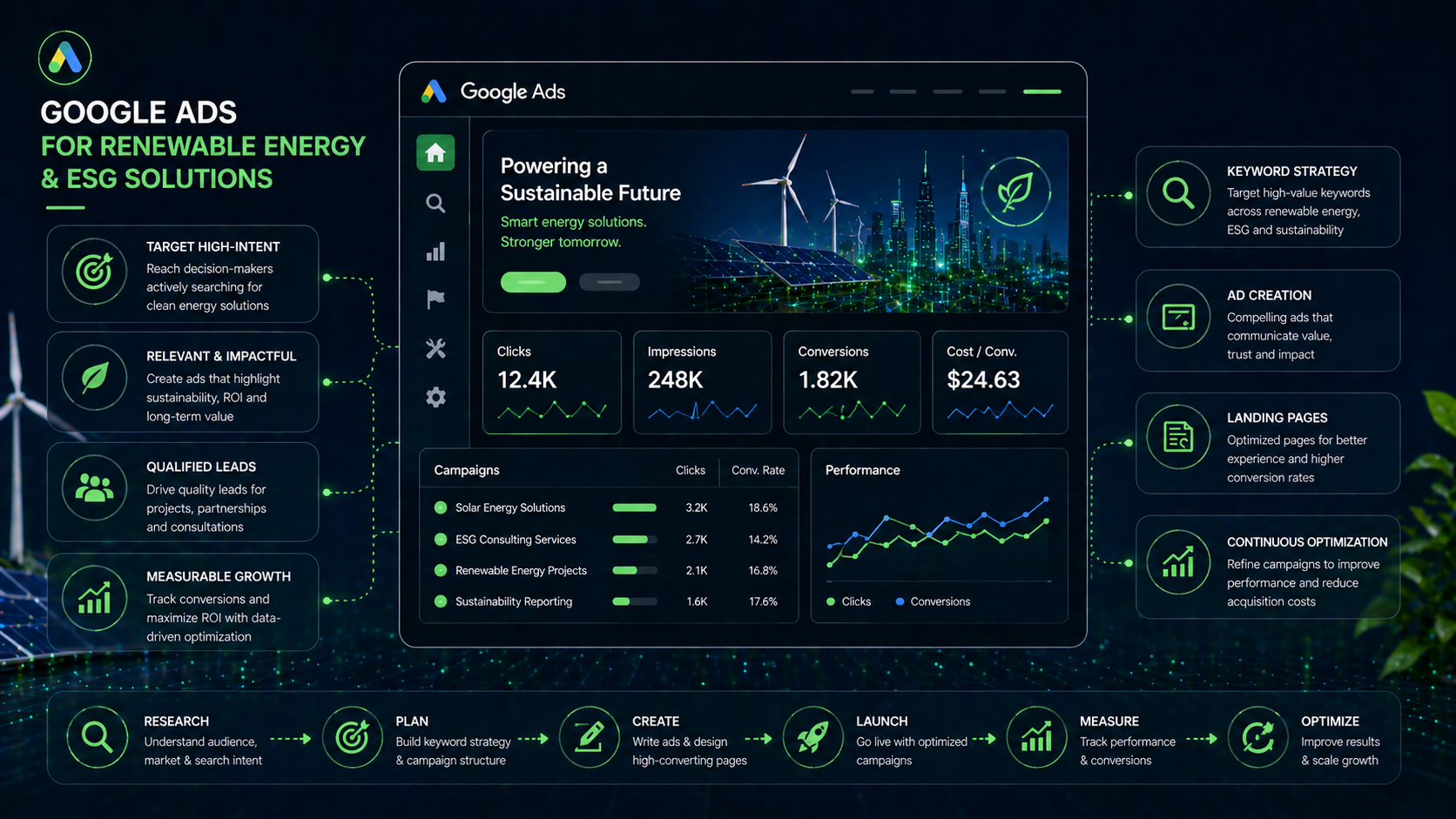
Google Ads For Renewable Energy & ESG Solutions
Google Ads For Renewable Energy & ESG Solutions helps solar companies, battery storage providers, EV charging firms, energy efficiency providers, ESG consultants, carbon accounting platforms, and sustainability advisors capture high-intent demand, improve landing-page relevance, reduce wasted spend, and generate stronger qualified leads.
Google Ads For Renewable Energy & ESG Solutions starts with one important truth. Clean energy and ESG buyers often search when they feel a real need. They may compare incentives, cost, payback, reporting risk, compliance, vendors, or local service options. Therefore, paid search must match intent very closely.
However, Google Ads cannot fix weak strategy. Instead, strong campaigns need clear keyword groups, dedicated landing pages, negative keywords, conversion tracking, and CRM feedback. As a result, the account can optimize for qualified opportunities, not cheap form fills.
Renewable Energy Paid Search Strategy
Renewable energy and ESG paid search works best when every campaign has one clear job. For example, commercial solar campaigns should not mix with residential solar campaigns. Likewise, ESG reporting campaigns should not mix with broad sustainability education. Consequently, structure becomes the foundation.
Because this market includes technical, financial, local, and compliance intent, campaign relevance matters. Therefore, each ad group should connect to a focused page. In addition, each page should answer the exact question behind the search. Otherwise, the click cost rises while lead quality falls.
What Google Ads For Renewable Energy & ESG Solutions Means
Direct Answer: Google Ads For Renewable Energy & ESG Solutions means using paid search campaigns to capture buyers who are actively researching solar, storage, EV charging, energy efficiency, ESG reporting, carbon accounting, incentives, and related providers.
Google Ads works differently from organic SEO. Instead of waiting for rankings, the company can appear when a buyer searches. However, speed does not guarantee profit. Therefore, campaign structure and landing-page quality matter deeply.
For renewable energy brands, Google Ads may capture searches around solar installation, commercial solar, battery storage, EV chargers, or incentives. Meanwhile, ESG brands may capture searches around ESG software, carbon accounting, reporting services, or compliance needs. Consequently, each service line needs its own paid-search logic.
Paid search should not run in isolation. Instead, it should connect to keyword research, service pages, city pages, hub content, schema, and CRM tracking. As a result, Google Ads becomes part of the full digital authority system.
Why Google Ads Matter
Direct Answer: Google Ads matters because renewable energy and ESG buyers often search when they have active demand, urgent questions, budget pressure, incentive deadlines, or reporting needs.
They Capture Active Demand
Search users often have a clear need. Therefore, Google Ads can reach buyers when they are already evaluating solutions. In addition, paid search can support markets where organic rankings are still growing.
They Test Commercial Keywords Quickly
SEO takes time. However, Google Ads can test keyword value faster. Consequently, paid search can reveal which terms create real conversations before large content investments scale.
They Support Local Growth
Local service searches can be competitive. Therefore, Google Ads can help renewable energy companies appear for high-value city and state terms. As a result, local pages and ads can work together.
They Improve Messaging
Ad performance shows which benefits matter. For example, savings, incentives, resilience, reporting clarity, or compliance may drive clicks. Therefore, ad data can improve service pages and organic content.
They Require Lead Quality Discipline
Cheap leads can waste time. Consequently, Google Ads should optimize toward qualified opportunities. In addition, CRM data should shape campaign decisions.
Paid Search Buyer Intent
Direct Answer: Paid search buyer intent should be organized by commercial value, service need, location, incentive interest, comparison behavior, and readiness to contact a provider.
High-Intent Service Searches
High-intent searches include terms like commercial solar installation, EV charging station installation, or carbon accounting services. Therefore, these terms should usually receive strong landing pages and dedicated budgets.
Incentive And Tax Credit Searches
Incentive searches show financial evaluation. For example, buyers may search commercial solar tax credit or EV charging incentives. Consequently, these terms can support both educational pages and consultation CTAs.
Comparison Searches
Comparison searches show active evaluation. Users may compare solar lease vs PPA, battery storage vs generator, or ESG software vs consultant. Therefore, comparison landing pages can work well.
Local Searches
Local searches show service-area interest. Therefore, city or state landing pages may be useful. However, each page must include real local value.
Low-Intent Searches
Some searches are too broad or informational. For example, free solar panels or DIY solar may waste budget. Therefore, negative keywords and match-type controls matter.
Campaign Structure
Direct Answer: Campaign structure should separate each service, buyer type, location, and funnel stage so budgets, ads, landing pages, and conversion data stay clean.
Recommended Campaign Groups
- Residential solar campaigns
- Commercial solar campaigns
- Battery storage campaigns
- EV charging campaigns
- Energy efficiency campaigns
- ESG reporting campaigns
- Carbon accounting campaigns
- Local service campaigns
- Incentive and tax credit campaigns
- Remarketing campaigns
Why Separation Matters
Different services have different economics. Therefore, they need separate budgets and reporting. In addition, each campaign should measure the true value of its leads.
Ad Group Rules
Each ad group should target one tight keyword theme. For example, commercial solar installation should not share an ad group with residential solar cost. Consequently, ad relevance improves.
Landing Page Rules
Every ad group should map to the most relevant landing page. Therefore, users land on content that matches their search. As a result, conversion rates can improve.
Keyword Strategy
Direct Answer: Google Ads keyword strategy should prioritize high-intent service terms, local terms, incentive terms, comparison terms, and buyer-specific terms that connect to qualified revenue.
Primary Keyword Categories
- Service keywords
- Location keywords
- Incentive keywords
- Cost and ROI keywords
- Comparison keywords
- Buyer-role keywords
- Compliance keywords
- Vendor-selection keywords
Match Type Discipline
Broad match can find new terms. However, it can also waste spend. Therefore, accounts should use strong negatives, conversion data, and search-term reviews before scaling broad match.
Keyword Intent Over Volume
High volume does not always mean high value. Consequently, keywords should be judged by lead quality and sales fit. In addition, CRM outcomes should shape future bidding.
Paid And Organic Keyword Sharing
Google Ads can reveal strong organic opportunities. Therefore, winning paid keywords should feed SEO and GEO content planning. As a result, paid search supports long-term authority.
Negative Keyword Strategy
Direct Answer: Negative keyword strategy protects renewable energy and ESG ad budgets by blocking job seekers, DIY searches, freebie searches, students, low-fit traffic, and irrelevant product searches.
Common Negative Keyword Categories
- jobs
- salary
- training
- school
- DIY
- free
- used
- template
- definition-only terms
Why Negative Keywords Matter
Clean energy keywords can attract mixed intent. Therefore, search-term reports need regular review. Moreover, every wasted click reduces the budget for qualified buyers.
Service-Specific Negatives
Solar campaigns may need different negatives than ESG campaigns. For example, ESG software campaigns may block academic, template, or free-report searches. Consequently, negative lists should be tailored by campaign.
Ongoing Maintenance
Negative keywords are not a one-time setup. Instead, they should be reviewed weekly early on. Then, they can be reviewed regularly as the account matures.
Solar Google Ads Campaigns
Direct Answer: Solar Google Ads campaigns should separate residential solar, commercial solar, incentives, financing, local service areas, and quote-ready searches.
Residential Solar Campaigns
Residential solar campaigns should focus on homeowners. Therefore, they should use simple language around savings, incentives, installation, and assessments. In addition, they should avoid commercial-only messaging.
Commercial Solar Campaigns
Commercial solar campaigns should focus on business value. Consequently, ads should mention operating costs, tax credits, project planning, and long-term energy strategy.
Solar Landing Pages
Residential and commercial traffic should not land on the same generic page. Instead, each campaign needs a focused landing page. As a result, users see content that matches their intent.
Solar Conversion Actions
- Request a solar quote
- Schedule a site assessment
- Book a consultation
- Call the solar team
- Download an incentive guide
Battery Storage Campaigns
Direct Answer: Battery storage campaigns should target demand charge reduction, backup power, solar-plus-storage, resilience, commercial storage, and energy management intent.
Commercial Storage Intent
Commercial storage buyers often care about cost control and reliability. Therefore, ad copy should explain demand charge management, backup power, and operational resilience.
Solar-Plus-Storage Intent
Some users search for solar and storage together. Consequently, campaigns should connect storage to solar pages when relevant. In addition, landing pages should explain how the systems work together.
Storage Landing Pages
Storage pages should define use cases clearly. Therefore, they should explain peak shaving, backup power, incentives, sizing, and assessment steps.
Storage Conversion Actions
- Request a storage assessment
- Book an energy consultation
- Submit facility usage details
- Call a storage specialist
- Review a solar-plus-storage guide
EV Charging Campaigns
Direct Answer: EV charging campaigns should separate workplace charging, fleet charging, multifamily charging, retail charging, incentives, charger types, and installation intent.
Workplace Charging Campaigns
Workplace campaigns should speak to employers and property owners. Therefore, ads should focus on employee needs, property value, and installation planning.
Fleet Charging Campaigns
Fleet campaigns need operational language. Consequently, ads should mention power planning, charging schedules, infrastructure, and long-term fleet readiness.
Multifamily Charging Campaigns
Multifamily campaigns should address tenants, parking layouts, ownership models, and property upgrades. Therefore, landing pages should answer property-owner questions clearly.
EV Charging Conversion Actions
- Schedule an EV charging consultation
- Request a site review
- Ask about incentives
- Call an EV infrastructure specialist
- Download a planning checklist
ESG And Carbon Campaigns
Direct Answer: ESG and carbon campaigns should target reporting software, ESG consulting, carbon accounting, emissions scopes, compliance support, data quality, and vendor-selection intent.
ESG Reporting Campaigns
ESG reporting campaigns should target buyers who need reporting systems or consulting. Therefore, landing pages should explain workflows, data sources, stakeholder reporting, and next steps.
Carbon Accounting Campaigns
Carbon accounting campaigns should target emissions tracking, Scope 1, Scope 2, Scope 3, and carbon footprint reporting. Consequently, pages should define terms and explain process.
Software Versus Consulting Campaigns
Some buyers compare tools and advisors. Therefore, comparison pages can work well. In addition, they can help users choose the right engagement type.
ESG Conversion Actions
- Request a demo
- Book an ESG consultation
- Schedule a reporting review
- Start a carbon accounting assessment
- Download a reporting checklist
Local And City Campaigns
Direct Answer: Local and city campaigns should target high-value markets where location affects service availability, incentives, utility context, permitting, or buyer trust.
When Local Campaigns Work
Local campaigns work well for solar, EV charging, and energy efficiency services. Therefore, city pages can support ad relevance. In addition, they can increase user confidence.
State-Level Campaigns
Some searches are better at the state level. For example, state solar incentives may not need city campaigns. Consequently, state incentive pages can be better landing pages.
Geo-Targeting Rules
Geo-targeting should match real service areas. Therefore, campaigns should not target locations the company cannot serve. Otherwise, lead quality can fall.
Local Ad Copy Rules
Local ad copy should mention the service and region naturally. However, it should not overclaim local proof. Instead, it should connect users to a relevant local page.
Landing Page Strategy
Direct Answer: Landing pages should match the exact keyword intent, explain the service quickly, answer buyer questions, show proof, and guide users toward the right conversion path.
Landing Page Requirements
- Clear H1 that matches the offer
- Short direct-answer summary
- Buyer-fit section
- Problem and solution explanation
- Financial or compliance value
- Process section
- Trust and proof signals
- FAQs
- Clear CTA
Why Message Match Matters
If the ad mentions commercial solar, the landing page should focus on commercial solar. Therefore, generic pages can reduce conversions. Moreover, poor message match can hurt quality.
Landing Pages For Incentives
Incentive traffic often needs education before conversion. Consequently, incentive pages should explain eligibility factors and link to services. In addition, they should avoid tax advice claims.
Landing Pages For ESG
ESG landing pages should explain data, reporting workflows, compliance support, and stakeholder value. Therefore, they should feel practical and trustworthy.
Ad Copy Strategy
Direct Answer: Ad copy should match search intent, state the service clearly, use practical benefits, avoid hype, and lead buyers to the right landing page.
Ad Copy For Solar
Solar ad copy can focus on assessments, incentives, savings potential, and project planning. However, it should avoid guaranteed savings unless verified. Therefore, careful language matters.
Ad Copy For Storage
Storage ad copy can focus on resilience, demand charge reduction, and energy planning. Consequently, it should speak to operational and financial pain.
Ad Copy For EV Charging
EV charging ad copy should mention installation, workplace charging, fleet planning, or multifamily charging. Therefore, use-case specificity improves relevance.
Ad Copy For ESG
ESG ad copy should focus on reporting clarity, data quality, stakeholder needs, and carbon accounting. In addition, it should sound credible, not vague.
Callout And Sitelink Extensions
Extensions should reinforce value. For example, sitelinks can point to incentives, FAQs, process pages, and service pages. As a result, users get more choices before clicking.
Conversion Tracking
Direct Answer: Conversion tracking should separate calls, forms, quote requests, demos, consultations, downloads, and qualified meetings so the account can optimize toward real business value.
Primary Conversions
- Quote requests
- Consultation bookings
- Phone calls
- Demo requests
- Assessment requests
- Proposal requests
Secondary Conversions
- Guide downloads
- Checklist downloads
- FAQ engagement
- Video views
- High-intent page visits
Why Conversion Quality Matters
Not every conversion has equal value. Therefore, primary and secondary actions should not be treated the same. In addition, CRM-qualified outcomes should guide optimization.
Offline Conversion Tracking
Offline conversion tracking can connect ad clicks to qualified opportunities. Consequently, the account can optimize for real pipeline, not just form submissions.
CRM And Lead Quality
Direct Answer: CRM tracking helps renewable energy and ESG Google Ads campaigns measure which keywords, ads, and landing pages create qualified leads, proposals, demos, and revenue opportunities.
Fields To Capture
- Source campaign
- Keyword theme
- Landing page
- Service interest
- Location
- Buyer type
- Project size
- Lead quality status
Why CRM Feedback Matters
Google Ads may show conversions. However, the CRM shows quality. Therefore, sales feedback should influence budgets, keywords, ad copy, and landing pages.
Lead Scoring
Lead scoring helps prioritize follow-up. For example, a commercial solar assessment may score higher than a general guide download. Consequently, reporting becomes more useful.
Speed To Lead
Fast response improves conversion odds. Therefore, renewable energy and ESG companies should connect forms to CRM workflows. In addition, call tracking should route leads quickly.
Budget And Bidding Rules
Direct Answer: Budget and bidding should prioritize high-intent campaigns first, then scale only after conversion tracking and lead-quality feedback confirm real business value.
Start With Focus
Do not launch every service at once. Instead, start with the strongest commercial opportunity. Therefore, data becomes cleaner and easier to interpret.
Use Budget By Service Value
Some services have higher revenue value. Consequently, they can support higher cost per lead. In addition, budget should reflect close rates and deal size.
Bid With Enough Data
Automated bidding can work well. However, it needs conversion data. Therefore, accounts should build clean tracking before relying fully on automation.
Scale With Quality Signals
Spend should increase when campaigns create qualified leads. As a result, the account grows around business value instead of surface metrics.
Remarketing Support
Direct Answer: Remarketing helps renewable energy and ESG companies bring back visitors who researched services, incentives, guides, FAQs, or comparison pages but did not convert yet.
Remarketing Audiences
- Service page visitors
- Incentive guide readers
- Comparison page visitors
- City page visitors
- Demo page visitors
- Quote page visitors
Why Remarketing Matters
Clean energy decisions often take time. Therefore, remarketing can keep the brand visible while buyers compare options. Moreover, it can promote helpful next steps.
Remarketing Message Ideas
Remarketing can highlight incentives, assessment offers, guides, demos, and process explanations. Consequently, users receive more context after the first visit.
Remarketing And Meta Ads
Google Ads and Meta retargeting can work together. Therefore, search visitors can receive educational follow-up across channels. As a result, the full paid system becomes stronger.
SEO, GEO, And AI Search Connections
Direct Answer: Google Ads should connect to SEO, GEO, and AI search because paid-search data reveals keyword value, buyer questions, landing-page gaps, and content opportunities.
Paid Search Feeds SEO
Winning search terms can become service pages, spokes, or FAQs. Therefore, Google Ads can guide organic content decisions. In addition, high-cost keywords may deserve strong SEO pages.
Paid Search Feeds GEO
Questions from search terms can become direct-answer content. Consequently, the site becomes stronger for generative engine optimization.
Paid Search Feeds AI Search
Search-term reports reveal natural language and objections. Therefore, those terms should shape AI-ready summaries, FAQs, and comparison pages.
Organic Pages Improve Paid Ads
Strong service pages can become better landing pages. As a result, paid campaigns may improve conversion quality. Moreover, users see a more credible brand ecosystem.
Mistakes To Avoid
Direct Answer: The biggest Google Ads mistakes include mixing intent, sending traffic to generic pages, skipping negatives, tracking weak conversions, ignoring CRM quality, and scaling before the account has clean data.
Mixing Residential And Commercial Traffic
Residential and commercial buyers need different messaging. Therefore, they should usually have separate campaigns and landing pages.
Sending Clicks To The Homepage
The homepage rarely matches specific search intent. Consequently, traffic should go to focused service, local, incentive, or comparison pages.
Ignoring Negative Keywords
Without negatives, spend can drift into weak traffic. Therefore, search-term reviews are essential.
Optimizing For Cheap Leads
Cheap leads can create poor pipeline. Instead, campaigns should optimize for qualified opportunities. As a result, CRM feedback matters more than CPL alone.
Scaling Too Fast
Scaling before tracking is clean can waste budget. Therefore, campaigns should prove lead quality first. Then, the team can expand safely.
Implementation Template
Direct Answer: Use this template to build Google Ads For Renewable Energy & ESG Solutions in a way that supports search intent, lead quality, landing-page relevance, and CRM-based optimization.
Step 1: Choose Priority Services
First, choose the services with the strongest sales value. Therefore, the account starts with commercial focus.
Step 2: Build Keyword Groups
Next, group keywords by service, buyer type, location, incentive, and comparison intent. Consequently, campaign structure becomes cleaner.
Step 3: Create Focused Landing Pages
Then, map every ad group to a focused page. As a result, users land on content that matches their search.
Step 4: Add Tracking And CRM Feedback
After that, track primary conversions and qualified outcomes. Therefore, the account can optimize toward real pipeline.
Step 5: Review And Expand
Finally, review search terms, lead quality, and conversion paths. Then, expand only after performance supports the next move.
FAQs
What is Google Ads For Renewable Energy & ESG Solutions?
Direct Answer: It is the use of paid search campaigns to capture high-intent buyers searching for clean energy, ESG, carbon, incentive, local, and vendor solutions.
Do Google Ads work for renewable energy companies?
Direct Answer: Yes. They can work well when campaigns separate services, match buyer intent, use strong landing pages, and track qualified leads.
Do Google Ads work for ESG companies?
Direct Answer: Yes. They can work when campaigns target reporting, carbon accounting, software, consulting, compliance, and vendor-selection intent.
What campaigns should renewable energy companies run first?
Direct Answer: They should usually start with high-value service campaigns, local campaigns, incentive campaigns, and quote-ready search terms.
What landing pages should Google Ads use?
Direct Answer: Ads should use focused service, city, incentive, comparison, or demo pages that match the keyword intent closely.
Why are negative keywords important?
Direct Answer: Negative keywords prevent wasted spend from jobs, DIY searches, freebie terms, students, low-fit traffic, and irrelevant product searches.
How should lead quality be measured?
Direct Answer: Lead quality should be measured through CRM outcomes, qualified meetings, proposals, project value, and sales feedback.
How do Google Ads support SEO and GEO?
Direct Answer: Google Ads reveal valuable keywords, buyer questions, landing-page gaps, and content ideas that can strengthen SEO, GEO, and AI-search pages.
Hub & Spoke Links
Direct Answer: This spoke supports the Renewable Energy & ESG Solutions SOP hub and connects Google Ads to keyword research, service architecture, content clusters, city pages, AI search, schema, Meta Ads, and the 1000-page model.
Main SOP Hub
Related Spokes
- Keyword Research For Renewable Energy & ESG Solutions
- Service Page Architecture For Renewable Energy & ESG Solutions
- Hub And Spoke Content For Renewable Energy & ESG Solutions
- City Page Strategy For Renewable Energy & ESG Solutions
- AI Search Optimization For Renewable Energy & ESG Solutions
- Schema And E-E-A-T For Renewable Energy & ESG Solutions
- Facebook / Meta Ads For Renewable Energy & ESG Solutions
- The 1000 Page Model For Renewable Energy & ESG Solutions