Free Renewable Energy Marketing SOP Guide
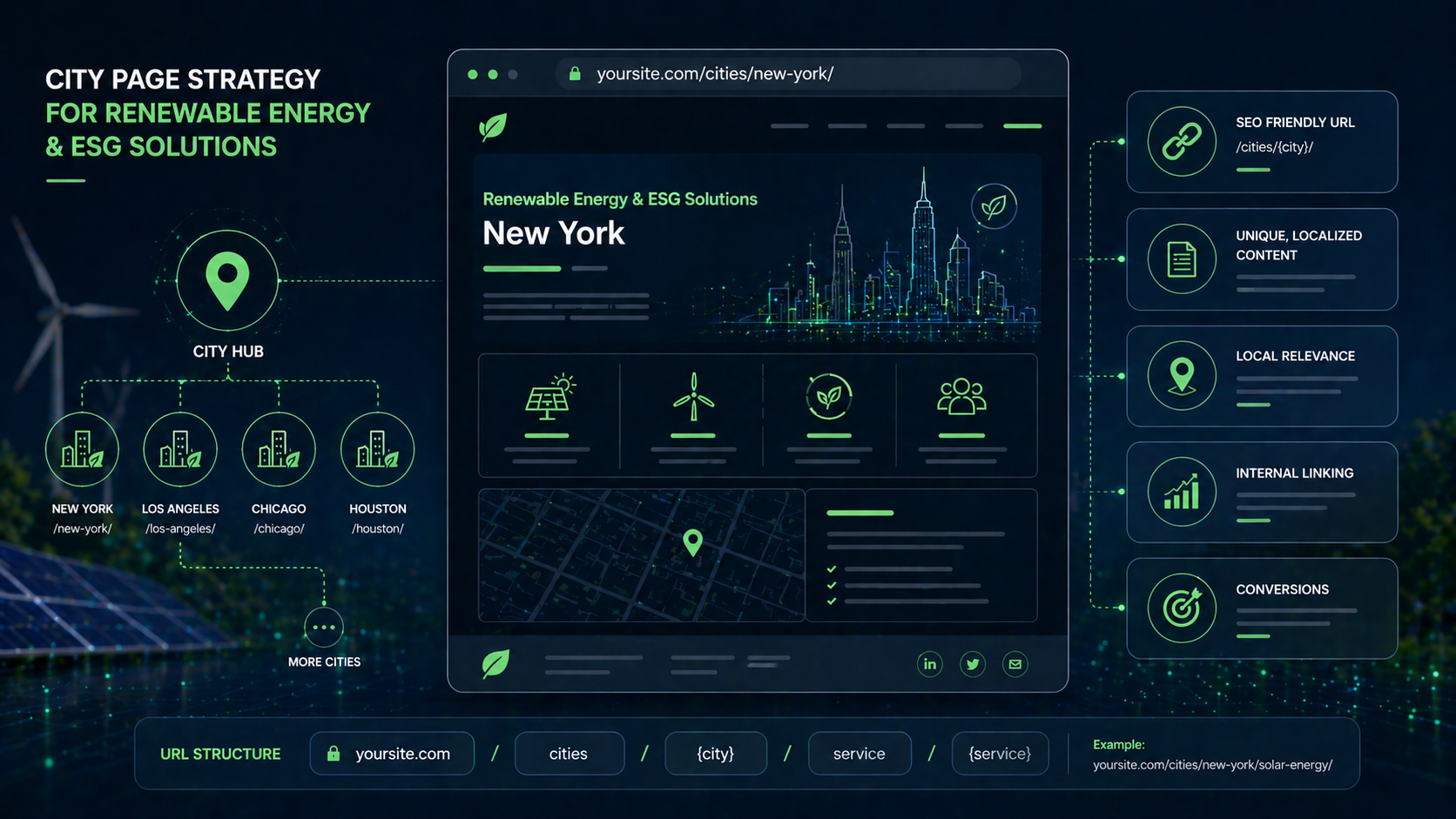
City Page Strategy For Renewable Energy & ESG Solutions
City Page Strategy For Renewable Energy & ESG Solutions helps solar companies, battery storage providers, EV charging firms, ESG consultants, carbon accounting platforms, energy efficiency providers, and sustainability advisors build local pages that improve SEO, GEO, AI-search visibility, buyer trust, and qualified lead generation.
City Page Strategy For Renewable Energy & ESG Solutions starts with one major truth. Local context matters in clean energy. Buyers care about utility programs, incentives, permitting, service areas, climate, building types, and provider trust. Therefore, city pages must do more than swap a city name into generic copy.
Instead, strong city pages should explain why the service matters in that market. First, they should match local search intent. Next, they should explain local buyer needs. Then, they should connect the city page to related service, incentive, hub, and FAQ pages. As a result, the page supports both visibility and conversion.
Renewable Energy Local SEO Strategy
Renewable energy and ESG buyers often search with local modifiers because incentives and implementation can vary by market. For example, a commercial solar buyer may care about state tax credits. Meanwhile, an EV charging buyer may care about utility capacity and local permitting. Therefore, local pages need real context.
Because this industry involves finance, infrastructure, compliance, and long-term trust, local content must feel useful. Consequently, every city page should answer practical questions, reduce buyer uncertainty, and guide users toward the right service page. Moreover, each page should support AI-search understanding through clear structure.
What City Page Strategy Means
Direct Answer: City Page Strategy For Renewable Energy & ESG Solutions means building location-specific pages that explain local service relevance, buyer needs, incentive context, market fit, and next steps for clean energy and sustainability buyers.
A city page should not be a copy of another city page. Instead, it should help buyers understand how a service applies in their area. Therefore, the page must include useful local context.
For example, a solar city page should explain local solar demand, commercial building fit, incentives, and service availability. Meanwhile, an EV charging city page may explain workplace charging, multifamily charging, fleet needs, and utility planning. Consequently, the page must match the market.
City pages also help search engines and AI systems understand service coverage. However, they only help when the content is clear and useful. Therefore, each page should include direct answers, specific service links, local proof, and structured schema.
As a result, city page strategy becomes part of the larger authority system. It supports local SEO, GEO, AI search, paid landing pages, and sales conversations together.
Why City Pages Matter For Renewable Energy And ESG
Direct Answer: City pages matter because renewable energy and ESG buyers often evaluate local availability, local incentives, local building conditions, utility context, permitting, and provider trust before they contact a company.
They Capture Local Demand
Many buyers search with city, state, or near-me modifiers. Therefore, city pages help companies show up for local demand. In addition, they help users confirm service availability quickly.
They Explain Local Relevance
Clean energy solutions can vary by location. For example, incentives, utility rates, climate, roof conditions, and local regulations may affect the project. Consequently, local pages should explain these factors clearly.
They Build Trust Faster
Buyers trust companies that understand their market. Therefore, city pages should feel grounded and specific. Moreover, local details can reduce uncertainty before the first call.
They Support Paid Campaigns
Google Ads often perform better with relevant landing pages. Therefore, city pages can support local paid campaigns. As a result, users see a page that matches their search and location.
They Improve AI Search Context
AI systems need clear relationships between services and locations. Therefore, city pages help define where services apply. In addition, they connect service pages to local demand.
When City Pages Make Sense
Direct Answer: City pages make sense when location affects demand, incentives, permitting, utility programs, service delivery, buyer expectations, or competitive visibility.
Solar Providers
Solar providers often benefit from city pages because local demand matters. Moreover, incentives, roof types, utility programs, and permitting can vary. Therefore, city pages can help buyers understand local project considerations.
Battery Storage Providers
Battery storage city pages make sense when local businesses face resilience needs, demand charges, or grid concerns. Consequently, storage pages should explain local use cases and connect to commercial storage services.
EV Charging Providers
EV charging city pages can serve workplaces, fleets, multifamily properties, retail centers, and municipalities. Therefore, local pages should explain charging demand and infrastructure planning in that market.
Energy Efficiency Providers
Energy efficiency city pages can help commercial property owners reduce utility costs. In addition, they can support local building types and usage patterns. Therefore, these pages should feel practical.
ESG And Sustainability Firms
ESG firms may need city pages when they serve local business hubs. However, some ESG services may work better as national service pages. Therefore, city pages should match actual buyer behavior.
When City Pages Do Not Make Sense
Direct Answer: City pages do not make sense when the company cannot provide real local value, when buyers search nationally, or when the page would become thin and repetitive.
National Software Offers
Some ESG software companies serve buyers nationally. Therefore, city pages may not always help. Instead, industry pages, buyer-role pages, and compliance pages may fit better.
No Real Local Differentiation
If every city page says the same thing, the page likely lacks value. Consequently, the company should avoid mass-producing thin local pages. Instead, it should build fewer, better pages.
Weak Service Coverage
A city page should match real service capability. Therefore, companies should not create pages for locations they cannot serve well. Otherwise, the page may create poor lead quality.
Better Page Type Available
Some searches need state pages, incentive pages, or utility pages instead. Therefore, city pages should not replace better search-intent matches. As a result, the site stays cleaner.
Local Intent Types
Direct Answer: Local intent in renewable energy and ESG can include city-service searches, near-me searches, state incentive searches, utility-program searches, and local buyer-role searches.
City-Service Intent
City-service searches combine a solution with a location. For example, users may search commercial solar installation Cleveland. Therefore, these terms usually need local service pages.
Near-Me Intent
Near-me searches show local need and urgency. However, they may still require strong service pages and location signals. Consequently, contact details and service-area clarity matter.
State-Incentive Intent
State incentive searches often need state-level pages. For example, solar incentives Ohio may not need a city page. Therefore, the page type should match the search scope.
Utility-Program Intent
Some buyers search by utility program or provider. Consequently, utility-focused pages may help when programs affect project economics. However, those pages must stay accurate.
Local Buyer-Role Intent
Some local searches include buyer roles. For example, property owners may search EV charging for apartments in Columbus. Therefore, city pages can support use-case intent.
Ideal City Page Flow
Direct Answer: The ideal city page flow starts with local relevance, then explains service fit, buyer types, local considerations, related services, FAQs, and conversion paths.
Recommended City Page Order
- H1 with service and location.
- Short local summary.
- Intro with city-specific relevance.
- Buyer-fit section.
- Local service explanation.
- Local incentives or utility context.
- Process section.
- Related service links.
- FAQ section.
- Clear next-step section.
Why This Flow Works
Buyers need to know whether the provider fits their location. Therefore, the page should answer that quickly. Then, it should explain why the service matters locally.
How To Keep It Useful
Each section should add real value. In addition, the page should avoid repeating generic company claims. As a result, the city page feels built for that market.
Above-The-Fold City Page Structure
Direct Answer: The above-the-fold section should confirm the service, location, buyer type, local relevance, and next step within the first few seconds.
What The Top Section Needs
- Clear H1 with the city and service.
- Short direct-answer summary.
- Local relevance paragraph.
- Service-fit paragraph.
- Optional CTA or form nearby.
Example Summary Pattern
A good summary should say who the page helps, where the service applies, and what outcome it supports. Therefore, the user understands the page instantly.
Why Generic Openings Fail
Generic openings waste the user’s attention. Instead, the first section should prove location relevance. Consequently, buyers feel that the company understands their market.
Local Proof And Market Context
Direct Answer: Local proof and market context help city pages feel trustworthy by showing real understanding of local energy needs, business conditions, property types, and buyer priorities.
Useful Local Context
- Utility considerations
- Local building types
- Commercial districts
- Climate or weather patterns
- Permitting considerations
- State or local incentives
- Business and property trends
How To Use Local Proof
Local proof should help the buyer make a decision. Therefore, do not add random landmarks only for SEO. Instead, explain why local conditions matter to the service.
Proof Without Fake Claims
Not every company has local case studies yet. However, the page can still explain local considerations honestly. Therefore, never invent projects or results.
Service Area Architecture
Direct Answer: Service area architecture organizes city pages, state pages, local service pages, and incentive pages so buyers and search engines understand where services apply.
Recommended URL Pattern
/state/city/service-name//state/service-name//state/incentive-topic//service-name/locations/
Why Structure Matters
Clean structure helps users navigate. In addition, it helps search engines understand location relationships. Therefore, service-area URLs should stay consistent.
How To Avoid Sprawl
Do not build every city at once. Instead, start with high-value markets. Then, expand based on search demand, service fit, and lead quality. Consequently, growth stays useful.
Solar City Page Strategy
Direct Answer: Solar city pages should explain local solar demand, buyer fit, incentives, property considerations, installation process, and links to residential or commercial solar services.
Residential Solar City Pages
Residential solar pages should explain homeowner savings, roof suitability, incentives, and installation steps. Therefore, they should stay simple and practical. In addition, they should answer common cost questions.
Commercial Solar City Pages
Commercial solar pages should explain operating-cost reduction, tax credits, project planning, roof or land use, and long-term value. Consequently, they should speak to owners, CFOs, and facility leaders.
Solar City Page Sections
- Local solar service summary
- Residential or commercial fit
- Incentive context
- Roof or property considerations
- Installation process
- FAQs
- Consultation CTA
Why Solar Local Pages Convert
Solar buyers often need local validation before they inquire. Therefore, local pages can build confidence. Moreover, they can connect cost questions to next-step assessments.
Battery Storage City Page Strategy
Direct Answer: Battery storage city pages should explain local resilience needs, demand charge management, solar pairing, business continuity, incentives, and energy planning.
Commercial Storage Intent
Commercial buyers may search for backup power or demand charge reduction. Therefore, city pages should explain these use cases clearly. In addition, they should link to battery storage service pages.
Local Resilience Context
Some markets face grid concerns, outages, or high peak-demand costs. Consequently, storage pages should discuss resilience and cost-control needs carefully. However, they should avoid exaggerated claims.
Storage City Page Sections
- Local battery storage summary
- Business-use cases
- Solar-plus-storage context
- Demand charge explanation
- Incentive or tax credit notes
- Process and assessment steps
EV Charging City Page Strategy
Direct Answer: EV charging city pages should explain local charging demand, property-use cases, fleet needs, installation planning, incentives, and power-capacity considerations.
Workplace Charging
Workplace charging pages should explain employee charging needs, property value, and installation planning. Therefore, they should speak to employers and property managers.
Fleet Charging
Fleet charging pages should explain power capacity, charging schedules, vehicle routes, and infrastructure planning. Consequently, these pages should feel operational, not generic.
Multifamily Charging
Multifamily charging pages should explain tenant demand, parking layout, ownership models, and future-readiness. In addition, they should answer common property-owner concerns.
EV Charging City Page Sections
- Local EV charging summary
- Use-case sections
- Power and planning overview
- Incentive context
- Installation process
- FAQs
ESG And Sustainability City Page Strategy
Direct Answer: ESG and sustainability city pages should only be used when local business markets, industry concentration, stakeholder pressure, or service delivery justify location-specific content.
When ESG City Pages Work
ESG city pages can work in major business hubs. For example, finance, manufacturing, healthcare, real estate, and logistics markets may create local demand. Therefore, local ESG content should reflect industry context.
When ESG City Pages Should Be Replaced
Some ESG services do not need city pages. Instead, national service pages, industry pages, and compliance pages may perform better. Consequently, page selection should follow search intent.
ESG Local Page Sections
- Local business context
- Relevant industry needs
- Reporting or compliance challenges
- Carbon accounting relevance
- Stakeholder communication needs
- Consultation path
Why Specificity Matters
ESG content can become vague quickly. Therefore, local pages should explain specific buyer needs. Moreover, they should connect to reporting, carbon accounting, and sustainability service pages.
Incentive And Utility Local Pages
Direct Answer: Incentive and utility local pages help buyers understand financial programs, eligibility topics, and service decisions when incentives affect project timing or ROI.
State Incentive Pages
State pages may work better than city pages for tax credits or rebates. Therefore, companies should build state-level incentive guides when search demand supports them.
Utility Program Pages
Utility program pages can help when programs affect project planning. However, they must stay accurate and updated. Consequently, these pages require careful maintenance.
How Incentive Pages Support City Pages
City pages can link to state incentive guides. In turn, incentive guides can link back to service pages. As a result, users can move from financial research to action.
Compliance Reminder
Incentive content should avoid acting as tax or legal advice. Instead, it should explain general considerations. Therefore, buyers should be encouraged to confirm details with qualified advisors.
Internal Linking Rules
Direct Answer: City pages should link to relevant service pages, incentive guides, topic hubs, FAQ pages, and nearby local pages so users can continue their decision journey.
City Page To Service Page Links
Every city page should link to the matching service page. Therefore, users can move from local relevance to detailed service information.
City Page To Incentive Links
If incentives matter locally, city pages should link to state or incentive guides. Consequently, financial research can support conversion.
City Page To Hub Links
City pages should link to broad topic hubs when users need education. For example, a battery storage city page can link to a battery storage guide.
City Page To FAQ Links
FAQ pages answer objections. Therefore, city pages should link to useful FAQs where relevant. As a result, users can resolve concerns before contacting sales.
Nearby City Links
Nearby city links can help when service areas overlap. However, they should not be excessive. Instead, use them when they help users navigate.
SEO, GEO, And AI Search Rules
Direct Answer: City pages perform better for SEO, GEO, and AI search when they include clear location language, direct answers, useful local context, internal links, schema, and service-specific explanations.
SEO Rules
Use the service and city naturally in the title, H1, summary, and key headings. However, avoid keyword stuffing. Instead, write for clarity and buyer trust.
GEO Rules
Generative engines need clean entity relationships. Therefore, city pages should clearly connect the service, location, provider, and related topics. As a result, AI systems can understand local relevance.
AI Search Rules
AI systems prefer direct answers and structured sections. Therefore, every major section should open with a concise answer. In addition, technical terms should be defined clearly.
Schema Rules
Use WebPage, Article, FAQPage, HowTo, BreadcrumbList, and SpeakableSpecification when the visible content supports them. Consequently, schema reinforces real page value.
Conversion Architecture
Direct Answer: City page conversion architecture should guide local buyers toward quotes, consultations, assessments, demos, audits, or helpful guides based on their readiness.
High-Intent Local CTAs
- Request a local solar quote
- Schedule an energy assessment
- Book an EV charging consultation
- Request a battery storage review
- Schedule an ESG reporting consultation
Mid-Funnel CTAs
- Read the incentive guide
- Compare service options
- Review the implementation process
- Explore FAQs
- Download a checklist
Why Multiple CTAs Matter
Not every local buyer is ready now. Therefore, city pages should support different readiness levels. Moreover, retargeting can bring educated visitors back later.
Mistakes To Avoid
Direct Answer: The biggest city page mistakes include thin local copy, fake local proof, repeated templates, weak internal links, missing incentive context, and poor service-area clarity.
Using City Name Swaps
City name swaps create weak pages. Therefore, each page should include real local context. Otherwise, the page adds little value.
Inventing Local Projects
Never invent project examples or local results. Instead, use honest context, process clarity, and service-area information. Consequently, trust stays intact.
Ignoring Incentives
Incentives often influence clean energy decisions. Therefore, local pages should link to incentive guides when relevant. In addition, they should explain general financial factors carefully.
Overbuilding Cities Too Fast
Too many thin pages can weaken the site. Therefore, build priority cities first. Then, expand with data and quality controls.
Forgetting Service Fit
A city page should still explain the service. Otherwise, users may not know what to do next. Therefore, service clarity must remain central.
Implementation Template
Direct Answer: Use this template to build city pages for renewable energy and ESG solutions that support local rankings, buyer trust, AI search, and qualified lead generation.
Step 1: Choose Priority Markets
First, choose cities with real service demand, sales value, and delivery capability. Therefore, the build starts with business fit.
Step 2: Match Each City To A Service
Next, connect each city to a clear service page. For example, pair Cleveland with commercial solar or Columbus with EV charging. Consequently, the page stays focused.
Step 3: Add Local Context
Then, add useful local details. Include market context, buyer needs, utility considerations, or incentive links. As a result, the page feels specific.
Step 4: Add Internal Links
After that, link to related services, hubs, FAQs, incentive guides, and nearby pages. Therefore, the page becomes part of the authority system.
Step 5: Add Schema And Tracking
Finally, add schema and track form submissions, calls, quote requests, demos, and qualified CRM outcomes. Consequently, performance improves with real data.
FAQs
What is City Page Strategy For Renewable Energy & ESG Solutions?
Direct Answer: It is the process of building local pages that explain service availability, market relevance, incentives, buyer needs, and next steps for clean energy and ESG buyers.
Why do renewable energy companies need city pages?
Direct Answer: They need city pages because buyers often search by location, service area, incentive availability, utility context, and local provider trust.
Should ESG companies build city pages?
Direct Answer: Sometimes. ESG companies should build city pages only when local business markets, service delivery, or search demand justify location-specific content.
What should a renewable energy city page include?
Direct Answer: It should include a local summary, service explanation, buyer-fit section, incentive links, process details, FAQs, internal links, and a clear CTA.
Should city pages mention incentives?
Direct Answer: Yes, when incentives affect buyer decisions. However, incentive details should stay accurate and avoid legal or tax advice claims.
How do city pages support AI search?
Direct Answer: They help AI search by connecting services, locations, buyer questions, local context, and structured answers in one clear page.
What is the biggest city page mistake?
Direct Answer: The biggest mistake is publishing thin city pages that only swap location names without adding real local value.
How many city pages should a company build first?
Direct Answer: Companies should start with the highest-value service markets first, then expand after performance and lead quality confirm demand.
Hub & Spoke Links
Direct Answer: This spoke supports the Renewable Energy & ESG Solutions SOP hub and connects local strategy to keyword research, service architecture, content clusters, AI search, schema, paid traffic, and the 1000-page model.
Main SOP Hub
Related Spokes
- Keyword Research For Renewable Energy & ESG Solutions
- Service Page Architecture For Renewable Energy & ESG Solutions
- Hub And Spoke Content For Renewable Energy & ESG Solutions
- AI Search Optimization For Renewable Energy & ESG Solutions
- Schema And E-E-A-T For Renewable Energy & ESG Solutions
- Google Ads For Renewable Energy & ESG Solutions
- Facebook / Meta Ads For Renewable Energy & ESG Solutions
- The 1000 Page Model For Renewable Energy & ESG Solutions