Free Renewable Energy Marketing SOP Guide
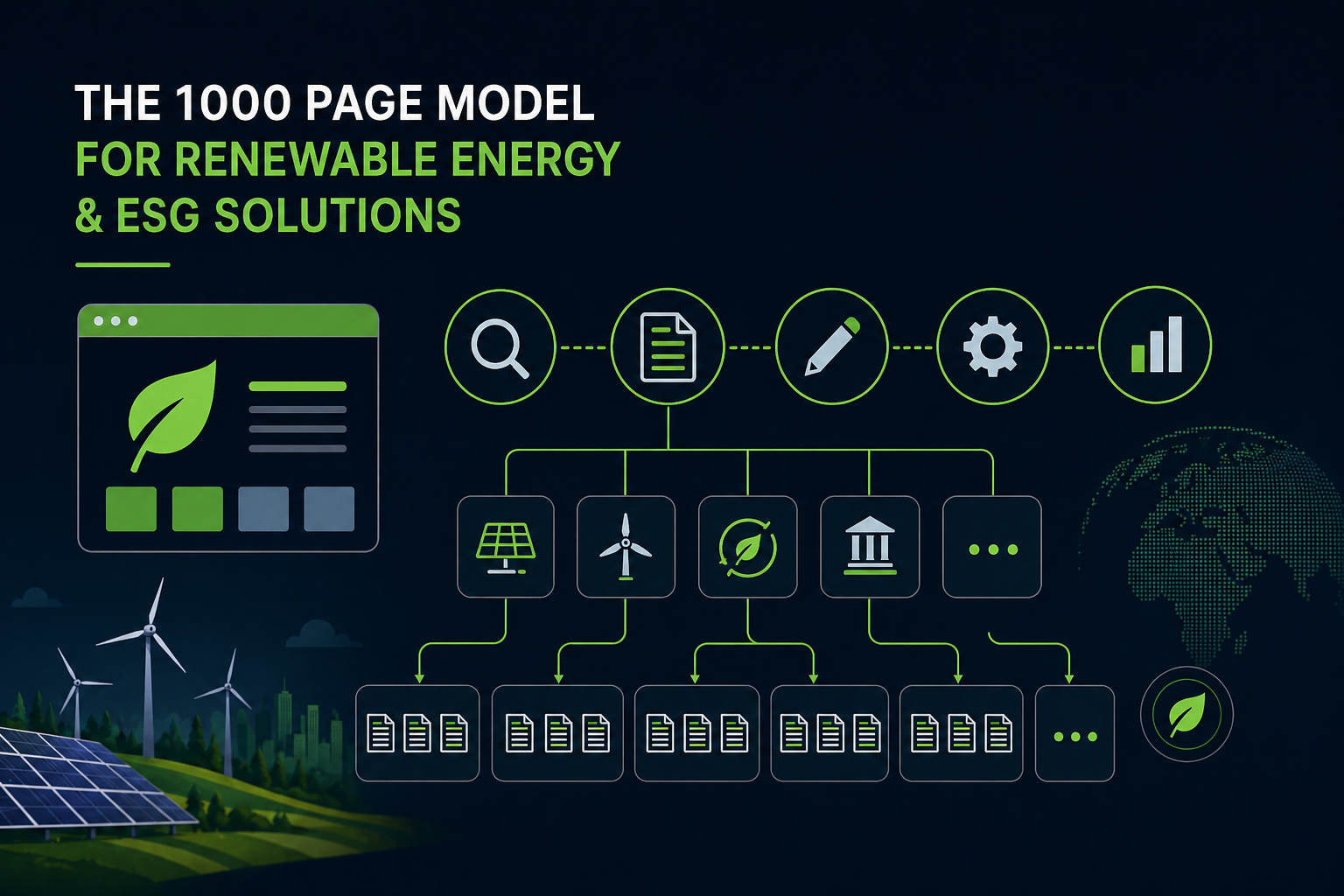
The 1000 Page Model For Renewable Energy & ESG Solutions
The 1000 Page Model For Renewable Energy & ESG Solutions helps solar companies, battery storage providers, EV charging firms, energy efficiency providers, ESG consultants, carbon accounting platforms, and sustainability advisors scale service pages, city pages, incentive guides, hubs, spokes, FAQs, comparison pages, and trust assets into one long-term digital authority system.
The 1000 Page Model For Renewable Energy & ESG Solutions starts with one core truth. Clean energy buyers do not make simple decisions. Instead, they compare cost, incentives, payback, compliance, infrastructure, risk, reporting, and provider trust. Therefore, a small website cannot answer the whole buying journey.
However, this model is not about publishing random pages. Instead, it creates a structured digital real estate system. First, each service gets a clear commercial page. Next, each market gets useful local coverage. Then, each question becomes a focused spoke. As a result, the website builds compounding authority.
Renewable Energy Digital Real Estate Strategy
Renewable energy and ESG buyers often need several touchpoints before they inquire. For example, a business owner may research commercial solar payback, battery storage, tax credits, EV charging, and financing. Consequently, the website must guide users through each step.
Because this industry includes technical, financial, local, and compliance layers, page depth matters. Therefore, the 1000-page model should organize services, locations, incentives, buyer questions, comparison searches, and proof signals. Moreover, every page should support SEO, GEO, AI search, and lead quality together.
What The 1000 Page Model Means
Direct Answer: The 1000 Page Model For Renewable Energy & ESG Solutions means building a large, structured website around services, locations, incentives, buyer questions, technology topics, compliance needs, comparisons, and trust signals.
The model does not mean publishing 1000 weak pages. Instead, it means building a complete authority system. Therefore, every page must have a clear purpose.
Some pages capture direct commercial searches. For example, commercial solar installation or ESG reporting services needs a service page. However, other pages support research. For example, solar tax credit questions may need an incentive guide.
As a result, the model creates many entry points. A buyer may enter through a city page, service page, incentive page, FAQ, comparison page, or hub. Then, internal links guide that buyer toward the next useful page.
Consequently, the site becomes more than a brochure. It becomes an owned digital real estate asset. Moreover, it helps search engines and AI systems understand the company’s full expertise.
Why The 1000 Page Model Matters
Direct Answer: The 1000-page model matters because renewable energy and ESG buyers research many financial, technical, local, and compliance questions before they trust a provider.
It Matches Complex Decisions
Clean energy buyers rarely ask one question. Instead, they compare savings, incentives, installation, financing, and provider fit. Therefore, the website must answer many connected questions.
It Builds Search Authority
Search engines reward useful topical depth. Consequently, connected page families help a site show stronger expertise. In addition, service pages gain support from hubs, FAQs, and local pages.
It Supports AI Search
AI systems need clear topic relationships. Therefore, the model helps answer engines connect services, locations, incentives, buyer questions, and trust signals. As a result, AI visibility can improve.
It Improves Lead Quality
Educated buyers usually become better leads. Therefore, a deeper website can answer objections before contact. Moreover, sales teams can have stronger conversations.
It Creates A Long-Term Asset
Paid ads stop when spend stops. However, strong pages can keep producing value. Therefore, the model creates owned authority that can compound over time.
How Buyers Move Through The Model
Direct Answer: Buyers move through the 1000-page model by entering through one question or need, then exploring related service, location, incentive, comparison, FAQ, and proof pages.
Early Research
At first, buyers may ask broad questions. For example, they may search how commercial solar works or what ESG reporting means. Therefore, hubs and beginner spokes matter.
Financial Evaluation
Next, buyers often ask about cost, payback, incentives, and ROI. Consequently, incentive pages, calculators, and cost guides can support the next stage.
Technical Evaluation
Then, buyers may compare technologies. For example, they may compare battery storage, EV charger types, or carbon accounting workflows. Therefore, comparison pages become useful.
Local Evaluation
Many buyers also need local context. Therefore, city pages, state pages, and utility-focused guides can help. In addition, local pages confirm service availability.
Vendor Selection
Finally, buyers evaluate providers. Therefore, service pages, proof pages, process pages, FAQs, and CTAs must work together. As a result, the site supports conversion.
Core Page Families
Direct Answer: The 1000 Page Model For Renewable Energy & ESG Solutions should include service pages, city pages, incentive pages, hubs, spokes, FAQs, comparisons, buyer-role pages, industry pages, and trust pages.
Main Page Families
- Core service pages
- Local city pages
- State and incentive pages
- Utility program pages
- Hub pages
- Question-led spoke pages
- FAQ pages
- Comparison pages
- Buyer-role pages
- Industry-specific pages
- Trust and proof pages
- Process pages
Why Page Families Matter
Each page family has one job. Therefore, the site stays organized. In addition, users can find the exact information they need.
How Page Families Work Together
Service pages convert. Hubs educate. City pages localize. Incentive pages explain financial context. FAQs remove friction. Consequently, each family supports the others.
Service Page Layer
Direct Answer: The service page layer anchors the 1000-page model because it explains the company’s core offers and gives every related page a commercial destination.
Core Renewable Energy Service Pages
- Residential Solar Installation
- Commercial Solar Installation
- Battery Energy Storage Systems
- EV Charging Infrastructure
- Energy Efficiency Consulting
- Renewable Energy Consulting
Core ESG Service Pages
- ESG Reporting Services
- ESG Reporting Software
- Carbon Accounting Services
- Scope 1, 2, And 3 Emissions Reporting
- Sustainability Consulting
- Climate Risk Reporting
Why This Layer Comes First
Service pages are the commercial foundation. Therefore, they should be built before most supporting pages. Moreover, every hub, city page, and FAQ should link toward relevant services.
How Service Pages Should Work
Each service page should define the offer, explain buyer fit, show value, explain process, answer FAQs, and present the next step. As a result, traffic can become qualified leads.
City And Local Page Layer
Direct Answer: The city and local page layer helps clean energy brands capture local demand when service availability, incentives, utility context, permitting, or local trust affects the buyer’s decision.
Local Page Types
- City service pages
- State service pages
- Regional market pages
- Utility-area pages
- Local incentive pages
- Nearby service-area pages
When Local Pages Matter
Local pages work well for solar, EV charging, energy efficiency, and some battery storage offers. Therefore, companies should build them in high-value markets first.
When Local Pages Should Be Limited
Some ESG or software offers may not need city pages. Instead, industry pages or buyer-role pages may fit better. Consequently, the model should follow real search intent.
Local Page Quality Rules
City pages should include real local context. Therefore, they should never be simple city-name swaps. In addition, they should link to services, hubs, and incentive guides.
Incentive And Tax Credit Page Layer
Direct Answer: Incentive and tax credit pages help buyers understand financial programs, project timing, eligibility factors, and next steps before they request a quote or consultation.
Incentive Page Ideas
- Commercial Solar Tax Credit Guide
- Residential Solar Tax Credit Guide
- Battery Storage Tax Credit Guide
- EV Charging Incentives Guide
- State Solar Incentives
- Utility Rebate Program Guides
Why Incentive Pages Matter
Incentives often affect project economics. Therefore, buyers research them before contacting providers. Consequently, these pages can attract motivated users.
How Incentive Pages Should Convert
Incentive pages should explain general factors. Then, they should link to service pages and consultations. However, they should not replace tax or legal advice.
Maintenance Requirements
Incentive pages may need updates. Therefore, companies should review them regularly. In addition, pages should avoid claims that may become outdated quickly.
Hub And Spoke Layer
Direct Answer: The hub and spoke layer builds topical authority by pairing broad guides with focused answer pages that support SEO, GEO, AI search, and buyer education.
Recommended Hubs
- Commercial Solar Guide
- Battery Storage Guide
- EV Charging Infrastructure Guide
- ESG Reporting Guide
- Carbon Accounting Guide
- Renewable Energy Incentives Guide
Recommended Spokes
- How long does commercial solar payback take?
- What is battery storage for demand charge reduction?
- Level 2 vs DC fast charging
- What is ESG reporting?
- Scope 1 vs Scope 2 vs Scope 3 emissions
- Solar lease vs PPA vs purchase
Why This Layer Compounds
Each spoke supports the hub. Meanwhile, each hub supports service pages. Therefore, authority grows across the whole site.
How To Avoid Cluster Sprawl
Build one cluster well before expanding. Consequently, the site grows with quality. Moreover, internal links stay easier to manage.
FAQ And Comparison Page Layer
Direct Answer: FAQ and comparison pages capture high-intent questions and help buyers evaluate tradeoffs before they contact a clean energy or ESG provider.
FAQ Page Ideas
- How much does commercial solar cost?
- How long does solar installation take?
- How does battery storage work?
- How much does EV charging installation cost?
- What is carbon accounting?
- How does ESG reporting work?
Comparison Page Ideas
- Solar lease vs PPA vs purchase
- Battery storage vs generator
- ESG software vs ESG consultant
- Level 2 vs DC fast charging
- Commercial solar vs community solar
Why This Layer Converts
Comparison users are often closer to action. Therefore, these pages can become strong conversion bridges. In addition, they support retargeting audiences.
How To Write Comparisons
Comparison pages should explain both options fairly. Then, they should show best-fit scenarios. As a result, the page builds trust.
Industry And Buyer Role Layer
Direct Answer: Industry and buyer-role pages help renewable energy and ESG brands match content to specific decision-makers, facilities, sectors, and operational needs.
Buyer Role Pages
- Solar For CFOs
- Battery Storage For Facility Managers
- EV Charging For Fleet Operators
- ESG Reporting For Finance Teams
- Carbon Accounting For Sustainability Leaders
Industry Pages
- Solar For Manufacturing Facilities
- EV Charging For Multifamily Properties
- Battery Storage For Warehouses
- ESG Reporting For Real Estate Firms
- Carbon Accounting For Logistics Companies
Why This Layer Matters
Different buyers care about different outcomes. Therefore, buyer-role pages can speak more directly. Moreover, they often improve lead quality.
How These Pages Should Link
Buyer-role pages should link to service pages, hubs, FAQs, and comparison pages. Consequently, the visitor can continue learning without friction.
Trust And Proof Layer
Direct Answer: The trust and proof layer helps buyers verify credibility through process pages, methodology pages, leadership pages, certification pages, FAQs, and transparent explanations.
Trust Page Ideas
- Our Process
- Commercial Solar Assessment Process
- ESG Reporting Methodology
- Carbon Accounting Data Process
- Battery Storage Feasibility Review
- EV Charging Site Planning Process
Proof Signals
- Certifications
- Partner details
- Project examples
- Leadership experience
- Methodology explanations
- Responsible disclaimers
Why Trust Pages Matter
Clean energy and ESG buyers often need internal approval. Therefore, trust pages help them explain the decision. In addition, they reduce perceived risk.
Proof Without Fabrication
Never invent case studies or results. Instead, explain process, standards, methodology, and real service details. Consequently, trust stays durable.
Solar Page System
Direct Answer: A solar page system should include residential solar, commercial solar, local solar pages, incentive guides, financing pages, payback FAQs, maintenance pages, and comparison content.
Core Solar Pages
- Residential Solar Installation
- Commercial Solar Installation
- Solar Panel Installation By City
- Commercial Solar Tax Credit Guide
- Solar Financing Guide
- Solar Payback Period Guide
Solar Spoke Pages
- How long does solar payback take?
- What roof types work for solar?
- Solar lease vs PPA vs purchase
- How do solar incentives work?
- What maintenance do solar panels need?
Why Solar Needs Depth
Solar buyers compare cost, savings, incentives, financing, and roof fit. Therefore, one page cannot answer everything. As a result, a page system works better.
Battery Storage Page System
Direct Answer: A battery storage page system should explain commercial storage, backup power, demand charge reduction, solar-plus-storage, incentives, sizing, and resilience.
Core Storage Pages
- Battery Energy Storage Systems
- Commercial Battery Storage
- Solar Plus Storage
- Backup Power For Businesses
- Demand Charge Reduction
- Battery Storage Incentives
Storage Spoke Pages
- What is peak shaving?
- How does battery storage reduce demand charges?
- Battery storage vs generator
- How do you size a battery system?
- What businesses benefit from storage?
Why Storage Needs Education
Many buyers understand solar better than storage. Therefore, pages must explain use cases simply. Moreover, examples should connect storage to business value.
EV Charging Page System
Direct Answer: An EV charging page system should include workplace charging, fleet charging, multifamily charging, public charging, incentives, charger types, and local installation pages.
Core EV Charging Pages
- EV Charging Station Installation
- Commercial EV Charging Stations
- Workplace EV Charging
- Fleet EV Charging Infrastructure
- Multifamily EV Charging
- EV Charging Incentives
EV Charging Spoke Pages
- Level 2 vs DC fast charging
- How much does EV charging installation cost?
- How do fleets plan charging infrastructure?
- What incentives apply to EV charging?
- How much power do EV chargers need?
Why EV Charging Needs Segmentation
EV charging buyers vary widely. Therefore, a fleet page should not sound like a multifamily page. Consequently, use-case pages improve clarity.
ESG And Carbon Page System
Direct Answer: An ESG and carbon page system should include ESG reporting, carbon accounting, emissions scopes, data quality, software, consulting, compliance, and stakeholder communication pages.
Core ESG Pages
- ESG Reporting Services
- ESG Reporting Software
- ESG Consulting Services
- Sustainability Consulting
- Climate Risk Reporting
Core Carbon Pages
- Carbon Accounting Services
- Carbon Accounting Software
- Scope 1, 2, And 3 Emissions Reporting
- Carbon Footprint Reporting
- GHG Reporting Consultant
ESG And Carbon Spokes
- What is ESG reporting?
- How does carbon accounting work?
- Scope 1 vs Scope 2 vs Scope 3 emissions
- ESG software vs consultant
- How do companies improve ESG data quality?
Why ESG Pages Need Clarity
ESG content can become vague quickly. Therefore, pages should explain methods, data, workflows, and outcomes. As a result, trust improves.
Recommended Page Mix
Direct Answer: The 1000 Page Model For Renewable Energy & ESG Solutions should balance commercial pages, local pages, incentive pages, hubs, spokes, FAQs, comparisons, buyer pages, and trust pages.
Suggested Distribution
- 18% service and solution pages
- 16% city and state pages
- 14% incentive and rebate pages
- 14% hub and spoke educational pages
- 12% FAQ and comparison pages
- 10% industry and buyer-role pages
- 8% trust and process pages
- 8% project-support and proof pages
Why This Mix Works
This mix supports the full buyer journey. Therefore, the site can capture direct demand and early research. In addition, it supports AI-search understanding.
How To Adjust The Mix
Solar installers may need more city pages. Meanwhile, ESG platforms may need more buyer-role and compliance pages. Therefore, the mix should reflect real business priorities.
Phased Build Plan
Direct Answer: The 1000-page model should be built in phases, starting with commercial service pages, then expanding into local pages, incentives, hubs, spokes, FAQs, comparisons, and trust assets.
Phase 1: Commercial Foundation
First, build the highest-value service pages. Therefore, the site gains conversion destinations before supporting content scales.
Phase 2: Local And Incentive Foundation
Next, build priority city, state, and incentive pages. Consequently, local demand and financial research get useful landing pages.
Phase 3: Hub And Spoke Expansion
Then, build authority hubs and focused spokes. As a result, the site covers more questions and improves topical depth.
Phase 4: Comparison And FAQ Expansion
After that, build comparison pages and FAQs. Therefore, evaluation-stage buyers get better support.
Phase 5: Trust And Buyer-Role Expansion
Finally, build process, methodology, buyer-role, and proof pages. Consequently, the site becomes stronger for internal stakeholder review.
SEO, GEO, And AI Search Rules
Direct Answer: The 1000-page model supports SEO, GEO, and AI search when each page uses clear intent, direct answers, short sections, internal links, schema, and useful topic depth.
SEO Rules
Each page should target one primary search intent. Therefore, pages should not compete with each other. In addition, titles and headings should stay clear.
GEO Rules
Generative engine optimization needs clean answers and strong topic relationships. Consequently, hubs, spokes, service pages, and city pages should connect naturally.
AI Search Rules
AI systems need clear definitions, direct answers, and trustworthy structure. Therefore, every major page should use summaries, FAQs, and schema.
Schema Rules
Schema should match visible content. As a result, structured data reinforces real value. Moreover, every major page should include the full schema stack when appropriate.
Paid Media Connection
Direct Answer: The 1000-page model improves paid media by giving Google Ads and Meta Ads better landing pages, stronger retargeting audiences, and more accurate buyer-intent data.
Google Ads Connection
Google Ads needs relevant landing pages. Therefore, service pages, city pages, incentive pages, and comparison pages can improve message match.
Meta Ads Connection
Meta Ads can promote guides, checklists, incentives, and retargeting offers. Consequently, the 1000-page model gives Meta more useful content to amplify.
Retargeting Connection
Every page can build an audience. As a result, visitors to solar, ESG, storage, or EV pages can receive relevant follow-up ads.
CRM Feedback Connection
CRM data should show which pages create qualified leads. Therefore, page expansion should follow actual pipeline quality.
Governance And Quality Control
Direct Answer: Governance and quality control keep the 1000-page model from becoming thin content by enforcing page roles, unique value, internal links, schema accuracy, and regular updates.
Page Role Rules
Every page should have one clear purpose. Therefore, service pages should convert, hubs should educate, and city pages should localize.
Unique Value Rules
Each page must add something useful. Consequently, city pages need local context, and spokes need specific answers. Otherwise, the page should not be built.
Internal Link Rules
Every page should connect to related pages. Therefore, no page should sit alone. In addition, anchors should describe the linked topic clearly.
Schema Accuracy Rules
Schema should support visible content only. Therefore, FAQ and HowTo schema must match the page. As a result, trust remains intact.
Update Rules
Incentives, tax credits, and compliance topics may change. Therefore, these pages should be reviewed regularly. Moreover, outdated claims should be removed quickly.
Mistakes To Avoid
Direct Answer: The biggest 1000-page model mistakes include chasing page count, publishing thin city pages, duplicating intent, ignoring internal links, skipping proof, and failing to connect content to revenue.
Chasing Page Count
The goal is not 1000 pages alone. Instead, the goal is 1000 useful assets. Therefore, quality controls matter.
Publishing Thin Local Pages
City-name swaps do not build authority. Consequently, local pages need real market context, service relevance, and useful links.
Duplicating Search Intent
Two pages should not target the same exact intent. Therefore, keyword maps should prevent cannibalization.
Ignoring Incentive Maintenance
Incentive pages can become outdated. Therefore, teams must review them. In addition, pages should avoid overconfident claims.
Forgetting Conversion Paths
Education should support business outcomes. Consequently, pages should guide users toward services, demos, quotes, or consultations.
Skipping CRM Feedback
Traffic is not the final goal. Therefore, CRM outcomes should guide future page expansion. As a result, the model grows around lead quality.
Implementation Template
Direct Answer: Use this implementation template to build The 1000 Page Model For Renewable Energy & ESG Solutions in a structured, useful, and revenue-focused way.
Step 1: Define Core Services
First, list every high-value service. Then, identify buyer type, location fit, and revenue potential. Therefore, the model starts with commercial clarity.
Step 2: Build The Keyword Map
Next, group keywords by service, location, incentive, buyer, comparison, and question intent. Consequently, page planning becomes easier.
Step 3: Build Service Pages First
Then, create strong service pages with summaries, process, proof, FAQs, and CTAs. As a result, supporting pages have conversion destinations.
Step 4: Add Local And Incentive Pages
After that, build high-value city, state, utility, and incentive pages. Therefore, local and financial intent receive clear answers.
Step 5: Build Hubs And Spokes
Next, create authority clusters around solar, storage, EV charging, ESG, carbon, and incentives. Consequently, the site gains depth.
Step 6: Add Comparisons, FAQs, And Trust Pages
Then, build pages that remove objections and prove credibility. Therefore, evaluation-stage buyers receive better support.
Step 7: Connect Paid Media And CRM
Finally, use Google Ads, Meta Ads, retargeting, and CRM tracking. As a result, the model improves from real performance data.
FAQs
What is The 1000 Page Model For Renewable Energy & ESG Solutions?
Direct Answer: It is a structured website growth system that scales service pages, local pages, incentive guides, hubs, spokes, FAQs, comparisons, and trust pages.
Does a clean energy company really need 1000 pages?
Direct Answer: Not immediately. The number represents a scalable authority model, and each page should support real buyer intent.
Which pages should be built first?
Direct Answer: Companies should build high-value service pages first, then priority city pages, incentive guides, hubs, spokes, FAQs, and comparison pages.
How does the model help SEO?
Direct Answer: It helps SEO by creating deep topic coverage, stronger internal links, more search-intent matches, and better service-page support.
How does the model help AI search?
Direct Answer: It helps AI search by creating clear answers, structured topic clusters, entity relationships, FAQs, schema, and trustworthy content depth.
How does the model help paid ads?
Direct Answer: It gives Google Ads and Meta Ads stronger landing pages, better retargeting audiences, and more buyer-intent data.
What is the biggest risk with the 1000-page model?
Direct Answer: The biggest risk is publishing thin or repetitive pages instead of useful pages with clear intent, trust, and internal links.
How should success be measured?
Direct Answer: Success should be measured through rankings, impressions, AI visibility, engagement, qualified leads, proposals, demos, and CRM revenue quality.
Hub & Spoke Links
Direct Answer: This spoke supports the Renewable Energy & ESG Solutions SOP hub and connects the 1000-page model to keyword research, service architecture, content clusters, city pages, AI search, schema, Google Ads, and Meta Ads.
Main SOP Hub
Related Spokes
- Keyword Research For Renewable Energy & ESG Solutions
- Service Page Architecture For Renewable Energy & ESG Solutions
- Hub And Spoke Content For Renewable Energy & ESG Solutions
- City Page Strategy For Renewable Energy & ESG Solutions
- AI Search Optimization For Renewable Energy & ESG Solutions
- Schema And E-E-A-T For Renewable Energy & ESG Solutions
- Google Ads For Renewable Energy & ESG Solutions
- Facebook / Meta Ads For Renewable Energy & ESG Solutions