Free Renewable Energy Marketing SOP Guide
Facebook / Meta Ads For Renewable Energy & ESG Solutions
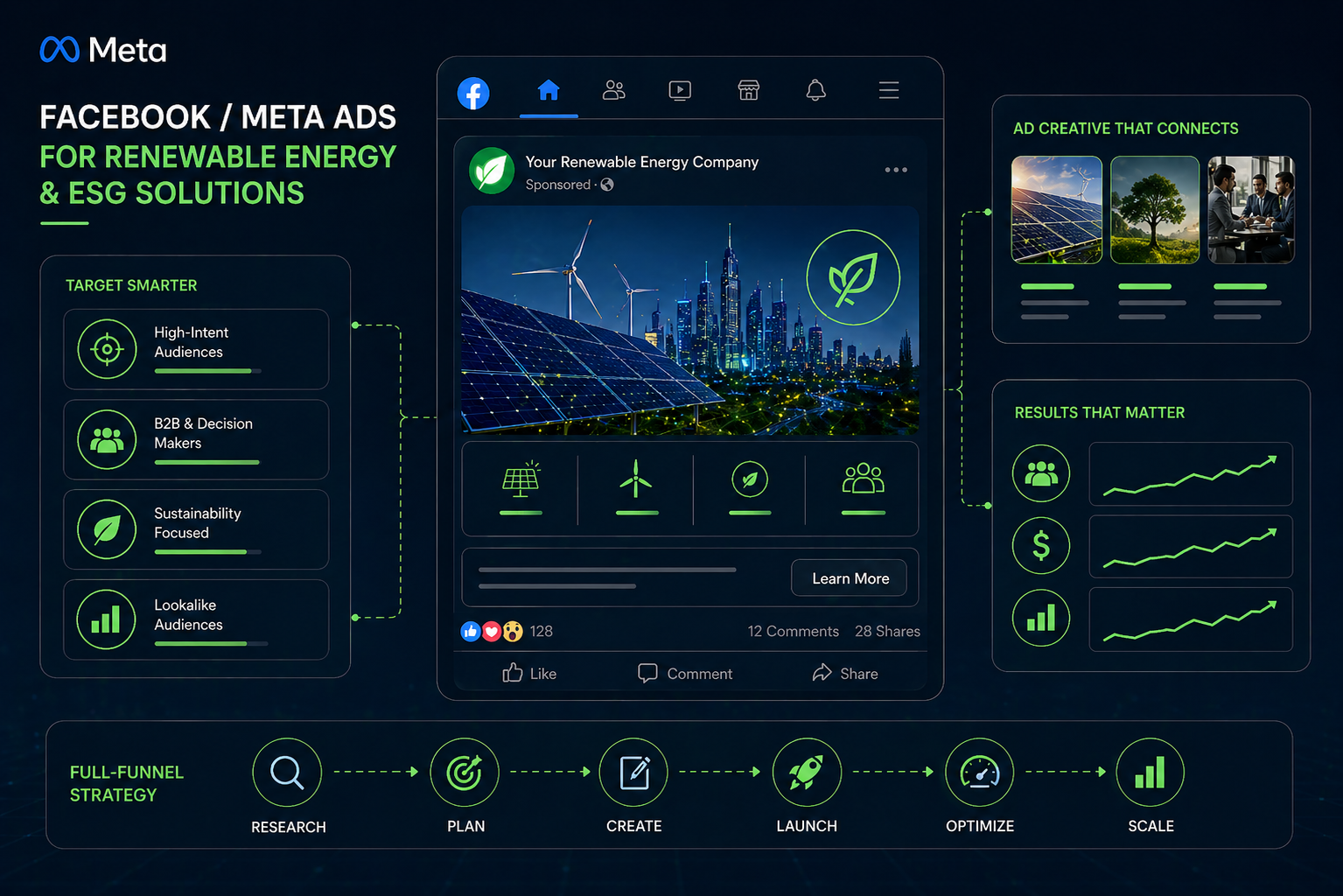
Facebook / Meta Ads For Renewable Energy & ESG Solutions helps solar companies, battery storage providers, EV charging firms, ESG consultants, carbon accounting platforms, sustainability advisors, and clean technology brands build awareness, educate buyers, retarget warm traffic, and generate stronger qualified leads.
Facebook / Meta Ads For Renewable Energy & ESG Solutions starts with one key truth. Most buyers do not open Meta with direct search intent. However, they still notice useful ideas, clear education, local proof, incentive reminders, and retargeting messages. Therefore, Meta Ads can support demand before buyers search directly.
Instead of treating Meta as a cheap lead source only, renewable energy and ESG brands should use it as a trust-building system. First, Meta can introduce the problem. Next, it can educate the buyer. Then, it can retarget engaged users with stronger offers. As a result, Meta supports the full marketing ecosystem.
Renewable Energy Paid Social Strategy
Paid social works best when the message matches the buyer stage. For example, a homeowner may need a simple solar savings message. Meanwhile, a facility manager may need battery storage education. Likewise, an ESG leader may need reporting clarity. Therefore, creative must speak to specific concerns.
Because clean energy and ESG decisions involve cost, risk, trust, compliance, and timing, one generic ad rarely works. Consequently, campaigns should separate audiences, offers, creative themes, and landing pages. Moreover, CRM feedback should guide future budgets and targeting.
What Facebook / Meta Ads For Renewable Energy & ESG Solutions Mean
Direct Answer: Facebook / Meta Ads For Renewable Energy & ESG Solutions means using paid social campaigns to create awareness, educate buyers, retarget website visitors, and guide clean energy or ESG prospects toward stronger next steps.
Meta Ads can reach buyers before they actively search on Google. Therefore, the platform works well for education, awareness, retargeting, and offer testing. However, it must be structured carefully.
For renewable energy companies, Meta Ads can explain solar savings, battery resilience, EV charging value, incentives, and local project fit. Meanwhile, ESG companies can use Meta Ads to explain reporting pressure, data quality, carbon accounting, and compliance readiness.
As a result, Meta Ads should not operate as a disconnected campaign. Instead, it should connect to service pages, city pages, hubs, incentive guides, FAQs, Google Ads, and CRM tracking. Consequently, every ad supports the larger digital authority system.
Why Meta Ads Matter
Direct Answer: Meta Ads matter because renewable energy and ESG buyers often need education, repeated exposure, and trust before they request a quote, demo, consultation, or assessment.
They Create Early Demand
Many buyers do not search until they understand the problem. Therefore, Meta can introduce savings, incentives, resilience, reporting risk, or sustainability goals early. In addition, it can shape buyer awareness before Google search begins.
They Support Longer Sales Cycles
Clean energy and ESG decisions can take time. Consequently, Meta retargeting keeps the brand visible while buyers compare options. Moreover, it can bring users back to helpful pages.
They Explain Complex Ideas Visually
Some topics feel complicated in search ads alone. However, Meta creative can show simple visuals, short videos, project examples, and problem-solution stories. Therefore, complex topics become easier to understand.
They Improve Full-Funnel Coverage
Google Ads captures active demand. Meanwhile, Meta Ads can create and nurture demand. As a result, both channels work better together.
They Support Retargeting From SEO And GEO
Organic visitors often leave before converting. Therefore, Meta retargeting can re-engage users who read service pages, incentive guides, city pages, or hubs. Consequently, content traffic becomes more valuable.
How Clean Energy And ESG Buyers Move Through Meta
Direct Answer: Clean energy and ESG buyers usually move from awareness to education, then to comparison, retargeting, and finally to a quote, demo, assessment, or consultation.
Awareness Stage
At first, buyers may not know the best solution. Therefore, ads should highlight problems they already feel. For example, rising utility costs, reporting pressure, fleet electrification, or resilience concerns can create attention.
Education Stage
Next, buyers need clarity. Consequently, ads should promote guides, explainers, checklists, videos, and FAQs. In addition, content should reduce confusion before asking for a sales call.
Comparison Stage
After education, buyers compare options. For example, they may compare solar lease versus purchase or ESG software versus consulting. Therefore, Meta can promote comparison pages and buyer guides.
Retargeting Stage
Warm visitors need timely follow-up. As a result, retargeting should match what they already viewed. For example, a battery storage page visitor should see storage-focused follow-up.
Conversion Stage
Finally, qualified users need a clear next step. Therefore, conversion ads should offer quotes, demos, assessments, consultations, or planning reviews. Moreover, lead forms should qualify intent.
Campaign Structure
Direct Answer: Meta Ads campaign structure should separate awareness, education, retargeting, conversion, service type, buyer type, and local market so each campaign has one clear job.
Recommended Campaign Groups
- Awareness campaigns
- Education campaigns
- Retargeting campaigns
- Lead generation campaigns
- Website conversion campaigns
- Local market campaigns
- Service-specific campaigns
- Buyer-role campaigns
Why Separation Matters
Different audiences need different messages. Therefore, cold awareness ads should not use the same copy as warm retargeting ads. In addition, residential and commercial buyers should usually remain separate.
Service-Level Structure
Solar, battery storage, EV charging, ESG reporting, and carbon accounting should each have distinct creative and landing paths. Consequently, performance data becomes easier to understand.
Objective Selection
Campaign objectives should match the goal. For example, awareness campaigns can use reach or video views. Meanwhile, quote campaigns may use leads or conversions. Therefore, objective selection should follow funnel stage.
Audience Strategy
Direct Answer: Meta Ads audience strategy should separate homeowners, commercial property owners, facility managers, fleet operators, executives, sustainability leaders, and retargeting audiences.
Residential Audiences
Residential solar audiences may respond to savings, incentives, financing, and battery backup. Therefore, messaging should stay simple and benefit-focused.
Commercial Audiences
Commercial audiences need business value. Consequently, ads should focus on operating costs, incentives, resilience, facility planning, and long-term ROI.
EV Charging Audiences
EV charging audiences should separate fleets, workplaces, multifamily properties, retail centers, and municipalities. Therefore, creative should match the use case.
ESG And Carbon Audiences
ESG audiences may include sustainability leaders, finance teams, operations teams, and executives. As a result, ads should address reporting pressure, data quality, and stakeholder expectations.
Retargeting Audiences
Retargeting should separate service-page visitors, guide readers, incentive visitors, quote-page visitors, and video viewers. Therefore, follow-up can match past behavior.
Creative Strategy
Direct Answer: Creative strategy should make clean energy and ESG value clear through specific problems, practical benefits, simple visuals, proof signals, and buyer-focused messages.
Problem-Led Creative
Problem-led ads can highlight rising energy costs, reporting pressure, charging demand, power resilience, or compliance confusion. Therefore, they create relevance quickly.
Education-Led Creative
Education-led ads can explain tax credits, payback, battery storage, EV charging, carbon accounting, or ESG reporting. Consequently, they attract users who need clarity before conversion.
Proof-Led Creative
Proof-led ads can show process, certifications, project types, or methodology. However, claims must be true. Therefore, creative should avoid fake results or unsupported guarantees.
Local Creative
Local ads can mention service areas, local incentives, or city-specific needs. In addition, they should send users to relevant local pages. As a result, trust improves.
Creative Format Mix
- Short video explainers
- Static educational graphics
- Carousel problem-solution ads
- Retargeting testimonial ads
- Checklist promotion ads
- Offer-focused lead ads
Offer Strategy
Direct Answer: Meta Ads offers should match buyer readiness by using educational guides for cold users, comparison tools for mid-funnel users, and quotes, demos, or assessments for warm users.
Cold Audience Offers
- Solar savings guide
- Commercial solar payback checklist
- Battery storage explainer
- EV charging planning guide
- ESG reporting readiness checklist
Warm Audience Offers
- Request a quote
- Schedule an energy assessment
- Book an EV charging consultation
- Request an ESG demo
- Start a carbon accounting review
Why Offer Match Matters
Cold users often need education first. Therefore, asking for a quote too soon can reduce response quality. However, warm retargeted users may be ready for a direct offer.
How To Qualify Offers
Forms should ask enough questions to identify fit. Consequently, the sales team can prioritize stronger opportunities. Moreover, campaign learning improves over time.
Solar Meta Ads Campaigns
Direct Answer: Solar Meta Ads campaigns should separate residential solar, commercial solar, incentives, financing, battery backup, and local market messages.
Residential Solar Creative
Residential creative should focus on savings, incentives, financing, roof fit, and backup power. Therefore, copy should be simple and practical. In addition, visuals should feel trustworthy.
Commercial Solar Creative
Commercial creative should focus on operating costs, tax credits, roof or land use, and long-term energy strategy. Consequently, ads should speak to owners, CFOs, and facility leaders.
Solar Retargeting
Solar retargeting should match page behavior. For example, incentive-guide readers can see quote or assessment offers. As a result, education moves toward action.
Solar Offer Ideas
- Free solar savings assessment
- Commercial solar ROI review
- Solar incentive guide
- Solar-plus-storage consultation
- Local solar quote request
Battery Storage Campaigns
Direct Answer: Battery storage Meta Ads should explain backup power, demand charge reduction, resilience, solar pairing, peak shaving, and energy management in simple terms.
Storage Awareness Ads
Many buyers do not understand battery storage yet. Therefore, awareness ads should explain the use case first. In addition, they should avoid overly technical language.
Commercial Storage Ads
Commercial storage ads should focus on demand charges, uptime, resilience, and energy planning. Consequently, they should speak to facility and finance leaders.
Solar-Plus-Storage Ads
Solar-plus-storage ads can explain how storage supports solar value. Therefore, they can target users who already showed solar interest.
Storage Offer Ideas
- Battery storage feasibility review
- Demand charge reduction consultation
- Solar-plus-storage planning guide
- Backup power assessment
- Commercial storage consultation
EV Charging Campaigns
Direct Answer: EV charging Meta Ads should separate workplace, fleet, multifamily, retail, public, and incentive-driven campaigns because each buyer has different needs.
Workplace Charging Ads
Workplace charging ads should focus on employee demand, property value, and future readiness. Therefore, they should target employers and commercial property managers.
Fleet Charging Ads
Fleet charging ads should focus on charging schedules, electrical capacity, infrastructure planning, and long-term fleet transition. Consequently, they need operational language.
Multifamily Charging Ads
Multifamily charging ads should address tenant demand, parking access, and property upgrades. In addition, they should reduce owner concerns about complexity.
EV Charging Offer Ideas
- EV charging site review
- Fleet charging infrastructure plan
- Workplace charging consultation
- Multifamily EV charging checklist
- EV charging incentive guide
ESG And Carbon Campaigns
Direct Answer: ESG and carbon Meta Ads should educate buyers on reporting pressure, data quality, emissions scopes, carbon accounting, software, consulting, and stakeholder communication.
ESG Reporting Ads
ESG reporting ads should focus on clarity, workflow, stakeholder confidence, and documentation. Therefore, they should sound practical, not vague.
Carbon Accounting Ads
Carbon accounting ads should explain Scope 1, Scope 2, Scope 3, data collection, and reporting outputs. Consequently, they can attract users who need education and support.
Software And Consulting Ads
Some buyers need software. Others need advisory support. Therefore, ads can promote comparison pages that help users choose the right path.
ESG Offer Ideas
- ESG reporting readiness checklist
- Carbon accounting consultation
- Scope 3 reporting guide
- ESG software demo
- Reporting workflow review
Local And City Campaigns
Direct Answer: Local Meta campaigns should target markets where service availability, incentives, utility context, local demand, or buyer trust makes city-specific messaging useful.
When Local Meta Works
Local Meta works well for solar, EV charging, energy efficiency, and some battery storage offers. Therefore, campaigns can support city pages and local service areas.
City-Specific Creative
City creative should mention local relevance without sounding forced. In addition, it should link to a useful city page. Consequently, the user sees a stronger match.
State Incentive Messaging
Sometimes state-level messaging works better than city messaging. For example, solar incentives may apply statewide. Therefore, state guides can support broader campaigns.
Local Lead Quality
Geo-targeting should match real service coverage. Otherwise, campaigns can create low-fit leads. Therefore, location settings need regular review.
Retargeting Strategy
Direct Answer: Retargeting helps renewable energy and ESG companies bring back users who visited service pages, city pages, incentive guides, hubs, comparison pages, or quote pages.
Retargeting Audiences
- Service page visitors
- City page visitors
- Incentive guide readers
- Hub and spoke readers
- Comparison page visitors
- Quote page visitors
- Video viewers
- Lead form openers
Retargeting Message Match
Retargeting should match user behavior. Therefore, a carbon accounting page visitor should not see a generic solar ad. Instead, the follow-up should continue the same topic.
Retargeting Funnel
First, retarget visitors with education. Then, show proof or process. Finally, offer a quote, demo, assessment, or consultation. As a result, the message sequence feels natural.
Why Retargeting Improves ROI
Warm visitors already showed interest. Consequently, retargeting can convert traffic that SEO, GEO, Google Ads, or social content already attracted. Moreover, it increases the value of existing website traffic.
Landing Page Strategy
Direct Answer: Meta landing pages should match the ad message, explain the offer quickly, answer buyer questions, build trust, and guide users toward the correct next step.
Landing Page Types
- Service pages
- City pages
- Incentive guides
- Comparison pages
- Checklist pages
- Demo pages
- Assessment pages
Why Message Match Matters
If the ad promotes an EV charging checklist, the landing page should deliver that topic clearly. Therefore, generic homepages usually weaken results.
Landing Page Structure
Each page should include a direct summary, buyer-fit section, problem-solution framing, proof, FAQs, and a clear CTA. As a result, visitors can evaluate the offer quickly.
Mobile Experience
Most Meta traffic is mobile. Therefore, landing pages must load fast, scan easily, and keep forms simple. In addition, paragraphs should stay short.
Lead Form Strategy
Direct Answer: Meta lead forms should balance conversion volume with lead quality by asking enough questions to identify buyer fit, service need, location, and urgency.
When Lead Forms Work
Lead forms work when the offer is clear and the audience is relevant. Therefore, they can perform well for assessments, consultations, demos, and guide downloads.
Qualifying Questions
- What service are you interested in?
- Are you a homeowner or business?
- What city or service area are you in?
- When are you looking to start?
- What problem are you trying to solve?
- What is your property or company type?
Why Qualification Matters
Short forms can increase volume. However, they can also reduce lead quality. Therefore, higher-value services often need more qualifying questions.
Lead Form Follow-Up
Fast follow-up matters. Consequently, forms should connect to CRM workflows, email alerts, SMS follow-up, or call teams. As a result, strong leads do not go cold.
CRM Tracking And Lead Quality
Direct Answer: CRM tracking helps Meta campaigns improve by showing which ads, audiences, offers, and landing pages create qualified opportunities instead of low-value leads.
Fields To Capture
- Campaign name
- Ad set audience
- Creative theme
- Offer type
- Landing page
- Service interest
- Location
- Lead quality status
Why CRM Data Matters
Meta may optimize for form fills. However, the business needs qualified opportunities. Therefore, CRM feedback should guide campaign decisions.
Lead Scoring
Lead scoring should separate guide downloads, consultations, assessments, demos, and quote requests. Consequently, reporting becomes more accurate.
Sales Feedback Loop
Sales teams should flag low-quality patterns. Then, marketing can adjust audiences, creative, offers, and forms. As a result, campaigns improve faster.
Budget And Testing Rules
Direct Answer: Meta budgets should start with focused tests, then scale only after the account proves audience fit, creative fit, offer fit, and lead quality.
Start With Controlled Tests
Do not test every service at once. Instead, start with one or two high-value offers. Therefore, results stay easier to understand.
Test One Variable At A Time
Testing works better when variables stay clear. For example, test creative first, then offer, then audience. Consequently, the team knows what caused the result.
Use Learning Periods Carefully
Meta campaigns need enough data. However, poor leads should not be ignored during learning. Therefore, early CRM review remains important.
Scale With Quality
Budget should increase when leads become qualified opportunities. As a result, the account scales around business value, not surface-level CPL.
SEO, GEO, And AI Search Connections
Direct Answer: Meta Ads support SEO, GEO, and AI search by promoting educational pages, retargeting organic visitors, testing buyer messages, and increasing engagement with authority content.
Meta Supports SEO
Meta can send traffic to service pages, hubs, city pages, and guides. Therefore, it helps more users engage with organic assets. In addition, it can reveal which topics attract attention.
Meta Supports GEO
Generative engine optimization needs clear authority content. Consequently, Meta can promote direct-answer guides and buyer education pages. As a result, useful pages receive more engagement.
Meta Supports AI Search Strategy
Ad comments, questions, and engagement can reveal buyer language. Therefore, those insights can improve FAQs, summaries, and spoke pages.
SEO And GEO Support Meta
Strong content improves Meta landing pages. Moreover, retargeting audiences grow when organic traffic grows. Therefore, the channels strengthen each other.
Mistakes To Avoid
Direct Answer: The biggest Meta Ads mistakes include using generic green messaging, chasing cheap leads, skipping retargeting, sending traffic to weak pages, mixing audiences, and ignoring CRM lead quality.
Using Generic Sustainability Messaging
Generic green claims do not create strong intent. Therefore, ads should focus on specific problems, benefits, and buyer outcomes.
Chasing Cheap Leads
Low CPL can look good. However, low-quality leads can waste sales time. Consequently, campaigns should optimize toward qualified outcomes.
Skipping Retargeting
Many buyers need several touches. Therefore, brands that skip retargeting often lose warm traffic. In addition, they miss value from organic visitors.
Using One Creative For Every Audience
Homeowners, CFOs, facility managers, and sustainability leaders need different messages. Therefore, creative should match the audience.
Sending Traffic To Weak Pages
Strong ads cannot save weak pages. Consequently, every campaign needs a matching landing page or lead form.
Ignoring Follow-Up Speed
Leads cool quickly. Therefore, CRM automation and fast response matter. As a result, campaign performance improves beyond the ad account.
Implementation Template
Direct Answer: Use this template to build Facebook / Meta Ads For Renewable Energy & ESG Solutions in a way that supports awareness, education, retargeting, lead quality, and qualified pipeline.
Step 1: Choose The Priority Offer
First, choose one high-value offer. For example, use a solar assessment, EV charging consultation, ESG demo, or carbon accounting review. Therefore, the campaign starts with focus.
Step 2: Define The Audience
Next, define the buyer type, location, service need, and funnel stage. Consequently, the message can match the person seeing it.
Step 3: Build Creative Themes
Then, create problem-led, education-led, proof-led, and offer-led creative. As a result, the campaign can test different angles.
Step 4: Match The Landing Path
After that, connect each ad to a relevant landing page or lead form. Therefore, the user gets a consistent experience.
Step 5: Track CRM Quality
Finally, measure lead quality, sales outcomes, and follow-up speed. Then, scale only what creates qualified opportunities.
FAQs
What are Facebook / Meta Ads For Renewable Energy & ESG Solutions?
Direct Answer: They are paid social campaigns used to build awareness, educate buyers, retarget warm users, and generate qualified clean energy or ESG leads.
Do Meta Ads work for renewable energy companies?
Direct Answer: Yes. They work when campaigns use specific audiences, clear offers, strong creative, useful landing pages, and CRM lead-quality tracking.
Do Meta Ads work for ESG companies?
Direct Answer: Yes. They can educate buyers about reporting, carbon accounting, data quality, compliance, software, and consulting before sales contact.
What campaigns should clean energy brands run first?
Direct Answer: They should usually start with retargeting, one high-value offer, and one service-specific awareness or education campaign.
Should Meta Ads use lead forms or landing pages?
Direct Answer: Both can work. Lead forms reduce friction, while landing pages build more trust and context before conversion.
Why is retargeting important?
Direct Answer: Retargeting matters because clean energy and ESG buyers often need several touches before they request a quote, demo, consultation, or assessment.
How should Meta Ads lead quality be measured?
Direct Answer: Lead quality should be measured through CRM outcomes, qualified conversations, booked appointments, proposals, demos, and actual sales value.
How do Meta Ads support SEO and GEO?
Direct Answer: Meta Ads support SEO and GEO by promoting authority content, retargeting organic visitors, and revealing buyer questions that can improve content.
Hub & Spoke Links
Direct Answer: This spoke supports the Renewable Energy & ESG Solutions SOP hub and connects Meta Ads to keyword research, service architecture, content clusters, city pages, AI search, schema, Google Ads, and the 1000-page model.
Main SOP Hub
Related Spokes
- Keyword Research For Renewable Energy & ESG Solutions
- Service Page Architecture For Renewable Energy & ESG Solutions
- Hub And Spoke Content For Renewable Energy & ESG Solutions
- City Page Strategy For Renewable Energy & ESG Solutions
- AI Search Optimization For Renewable Energy & ESG Solutions
- Schema And E-E-A-T For Renewable Energy & ESG Solutions
- Google Ads For Renewable Energy & ESG Solutions
- The 1000 Page Model For Renewable Energy & ESG Solutions