Free Renewable Energy Marketing SOP Guide
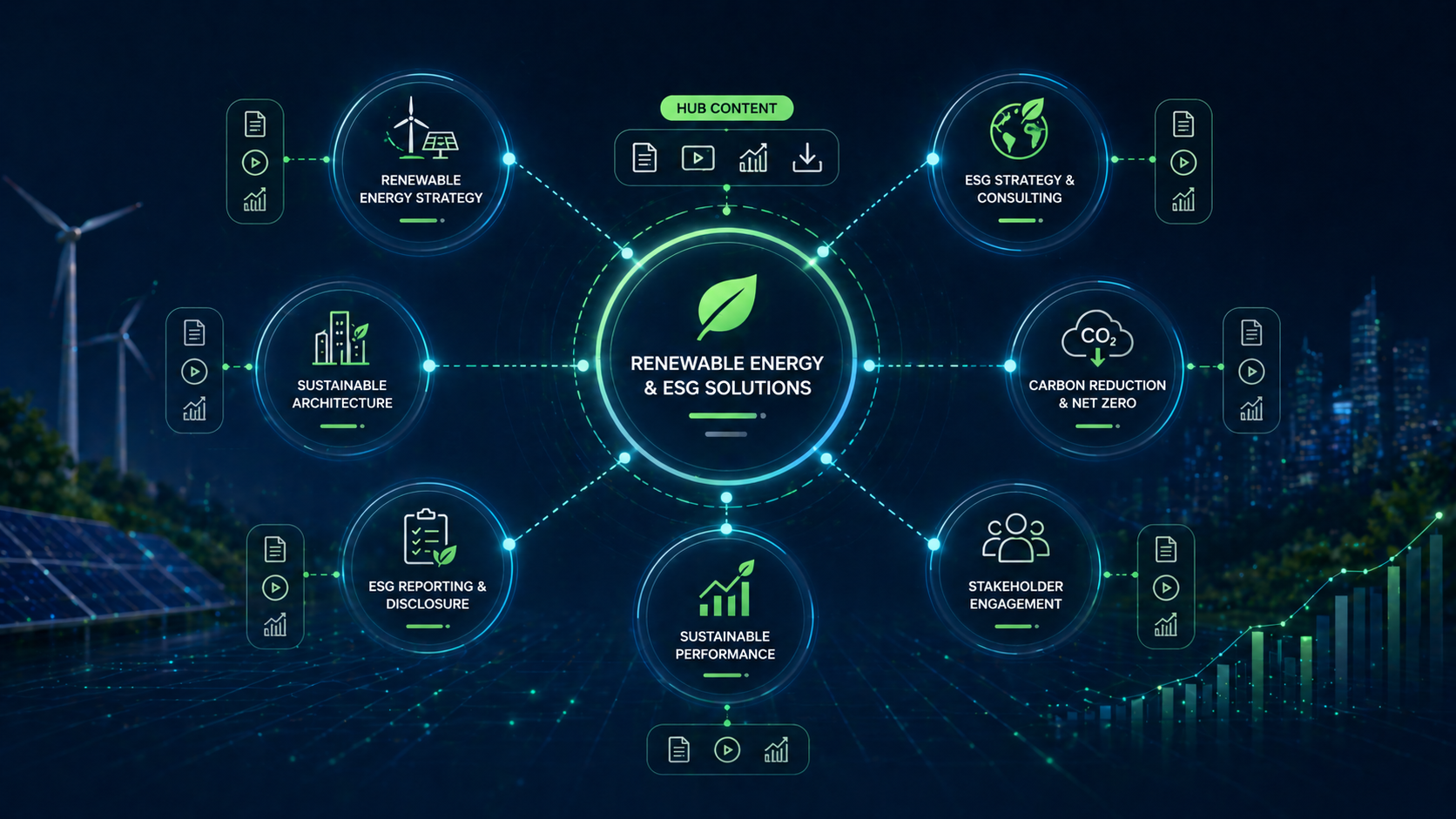
Hub And Spoke Content For Renewable Energy & ESG Solutions
Hub And Spoke Content For Renewable Energy & ESG Solutions helps solar companies, battery storage providers, EV infrastructure firms, ESG consultants, carbon accounting platforms, sustainability advisors, and clean technology brands build connected topic clusters that improve SEO, GEO, AI visibility, buyer education, and qualified lead generation.
Hub And Spoke Content For Renewable Energy & ESG Solutions starts with one key truth. Buyers rarely understand the full solution from one page. Instead, they compare incentives, savings, compliance, reporting, technology, risk, and vendors. Therefore, clean energy websites need connected content systems.
A hub gives buyers the big picture. Then, spokes answer the detailed questions behind that topic. As a result, users can move from education into evaluation without leaving the site. Moreover, search engines and AI systems can understand the company’s expertise more clearly.
Renewable Energy Content Cluster Strategy
Renewable energy and ESG topics often need layered education. For example, a commercial solar buyer may need pages on payback, incentives, financing, maintenance, storage, and utility rates. Consequently, one service page cannot answer everything well.
Because ESG and clean energy decisions involve finance, compliance, operations, and trust, hub and spoke content becomes essential. Therefore, each major topic should have a hub. In addition, each hub should link to focused spokes that answer real buyer questions.
What Hub And Spoke Content Means
Direct Answer: Hub And Spoke Content For Renewable Energy & ESG Solutions means building a broad authority page for a major topic, then supporting it with focused spoke pages that answer specific buyer questions.
A hub page covers the main subject. For example, a Commercial Solar Guide can explain savings, incentives, financing, installation, and maintenance. However, it should not answer every subtopic in full detail. Instead, it should link to focused pages that go deeper.
A spoke page answers one specific question or topic. For example, a spoke may explain commercial solar payback. Another spoke may explain solar tax credits. Consequently, the hub becomes the central guide, while spokes create depth.
As a result, the website becomes easier to use. Buyers can start broad, then move into the exact question they care about. Moreover, search engines can see the relationship between related pages.
Therefore, hub and spoke content is not just a blog strategy. It is a site architecture strategy. It supports SEO, GEO, AI search, internal linking, and lead generation together.
Why Hub And Spoke Content Matters
Direct Answer: Hub and spoke content matters because renewable energy and ESG buyers need layered education before they trust a provider or request a consultation.
It Matches Complex Buyer Journeys
Clean energy buyers often research several questions before they act. Therefore, one service page rarely supports the whole decision. Instead, clusters help users learn in stages.
It Builds Topical Authority
Search engines need evidence that a site covers a topic deeply. Consequently, a hub with strong spokes can show broader expertise. In addition, it can support more keyword opportunities.
It Supports AI Search
AI systems need clear topic relationships. Therefore, hubs and spokes help answer engines understand which pages explain broad concepts and which pages answer specific questions.
It Improves Lead Quality
Educated buyers ask better questions. As a result, sales calls become more focused. Moreover, prospects can self-qualify before they contact the team.
How Renewable Energy And ESG Buyers Use Content Clusters
Direct Answer: Buyers use content clusters by starting with a broad topic, then moving into specific questions about cost, incentives, technology, compliance, implementation, and vendor fit.
Early-Stage Research
Early-stage users may search broad terms. For example, they may look for commercial solar guide or ESG reporting guide. Therefore, hub pages should explain the full topic clearly.
Mid-Stage Evaluation
Mid-stage users ask more specific questions. They may compare battery storage options or EV charging incentives. Consequently, spokes should answer those questions with useful detail.
Late-Stage Vendor Selection
Late-stage users need confidence. They may review service pages, local pages, process pages, or consultation paths. Therefore, clusters should link toward commercial next steps naturally.
Internal Stakeholder Review
Many renewable energy and ESG decisions involve teams. For example, finance, operations, legal, and sustainability teams may all review content. As a result, clusters should support multiple stakeholder concerns.
The Role Of Hub Pages
Direct Answer: Hub pages organize broad topics, introduce major subtopics, link to deeper spokes, and help users understand the whole decision landscape.
What A Hub Page Should Include
- Clear topic summary
- Direct answer near the top
- Overview of the main decision factors
- Links to focused spokes
- Related service links
- FAQ section
- Schema and speakable structure
Why Hubs Should Not Be Thin
A hub should have enough depth to stand alone. However, it should still link to deeper pages. Therefore, it must balance summary and navigation.
How Hubs Support Commercial Pages
Hubs often educate buyers before they reach a service page. Consequently, hub pages should link to relevant services. In addition, service pages should link back to useful hubs.
The Role Of Spoke Pages
Direct Answer: Spoke pages answer focused buyer questions, capture long-tail searches, support AI visibility, and strengthen the parent hub through internal links.
What A Spoke Page Should Do
A spoke should answer one clear question or topic. Therefore, it should avoid covering too much. Instead, it should go deeper on one buyer concern.
Strong Spoke Formats
- Question-led pages
- Comparison pages
- Checklist pages
- Process explainers
- Incentive explainers
- Technology explainers
- Buyer-specific guides
Why Spokes Improve AI Search
AI users often ask full questions. Therefore, spoke pages can match those questions directly. As a result, answer engines can summarize the content more easily.
Best Cluster Types For Renewable Energy And ESG
Direct Answer: The best clusters for renewable energy and ESG brands usually focus on commercial solar, battery storage, EV charging, ESG reporting, carbon accounting, incentives, and buyer-specific decision topics.
Primary Cluster Categories
- Commercial solar clusters
- Residential solar clusters
- Battery storage clusters
- EV charging clusters
- Energy efficiency clusters
- ESG reporting clusters
- Carbon accounting clusters
- Renewable energy incentive clusters
- Industry-specific buyer clusters
How To Choose The First Cluster
Start with the service that has the strongest revenue value. Then, check keyword demand and sales fit. Consequently, the first cluster supports both visibility and pipeline.
How To Avoid Cluster Sprawl
Do not build every possible topic at once. Instead, build one strong cluster fully. Then, expand into the next cluster. Therefore, quality stays high.
Commercial Solar Content Cluster
Direct Answer: A commercial solar cluster should help business buyers understand ROI, incentives, installation, financing, roof suitability, maintenance, and project risk.
Recommended Hub
The main hub could be Commercial Solar Guide. It should explain the full decision process. In addition, it should link to deeper spokes.
Recommended Spokes
- How long does commercial solar payback take?
- What tax credits apply to commercial solar?
- How does commercial solar financing work?
- Is my roof suitable for commercial solar?
- What maintenance does commercial solar need?
- Commercial solar lease vs PPA vs purchase
- How solar affects business operating costs
Why This Cluster Converts
Commercial solar buyers need financial clarity. Therefore, spokes should answer cost, payback, tax, and risk questions. As a result, service-page conversions become stronger.
Battery Storage Content Cluster
Direct Answer: A battery storage cluster should explain resilience, demand charge reduction, solar pairing, backup power, system sizing, incentives, and energy management.
Recommended Hub
The main hub could be Battery Energy Storage Guide. It should explain key use cases, buyer types, and value drivers. Then, it should link to detailed spokes.
Recommended Spokes
- What is battery storage for demand charge reduction?
- How does solar plus storage work?
- Battery storage vs generator for businesses
- How do you size a commercial battery system?
- What incentives apply to battery storage?
- What is peak shaving with battery storage?
- How battery storage supports energy resilience
Why This Cluster Matters
Storage is often less familiar than solar. Therefore, education matters. Moreover, strong spokes help buyers understand use cases before requesting a proposal.
EV Charging Content Cluster
Direct Answer: An EV charging cluster should explain installation, incentives, workplace charging, fleet charging, multifamily charging, public charging, and infrastructure planning.
Recommended Hub
The main hub could be EV Charging Infrastructure Guide. It should cover use cases, charger types, installation steps, and incentive considerations.
Recommended Spokes
- Level 2 vs DC fast charging
- How much does EV charging installation cost?
- What incentives apply to EV charging?
- Workplace EV charging guide
- Fleet EV charging infrastructure planning
- Multifamily EV charging requirements
- How to plan power capacity for EV chargers
Why This Cluster Works
EV charging buyers vary widely. Therefore, spokes should address each use case separately. As a result, the website can support property owners, fleets, employers, and developers.
ESG Reporting Content Cluster
Direct Answer: An ESG reporting cluster should help companies understand reporting requirements, frameworks, data workflows, stakeholder expectations, software options, and compliance readiness.
Recommended Hub
The main hub could be ESG Reporting Guide. It should explain what ESG reporting is, why it matters, and how companies build reporting systems.
Recommended Spokes
- What is ESG reporting?
- What data do companies need for ESG reporting?
- ESG software vs ESG consultant
- How to prepare for ESG reporting
- What are common ESG reporting frameworks?
- How ESG reporting supports procurement trust
- How to improve ESG data quality
Why This Cluster Builds Trust
ESG buyers need confidence and clarity. Therefore, content should avoid vague sustainability claims. Instead, it should explain workflows, data, roles, and decision requirements.
Carbon Accounting Content Cluster
Direct Answer: A carbon accounting cluster should explain emissions scopes, data collection, software, consulting, reporting workflows, methodology, and stakeholder use.
Recommended Hub
The main hub could be Carbon Accounting Guide. It should explain carbon accounting basics, emissions categories, use cases, and implementation steps.
Recommended Spokes
- What is carbon accounting?
- Scope 1 vs Scope 2 vs Scope 3 emissions
- How does carbon accounting software work?
- Carbon accounting software vs consultant
- How to collect emissions data
- How to prepare a carbon footprint report
- How carbon accounting supports ESG reporting
Why This Cluster Matters
Carbon accounting can feel technical. Therefore, the cluster should simplify complex ideas. Moreover, it should guide users toward software, consulting, or reporting support.
Incentive And Tax Credit Content Cluster
Direct Answer: An incentive and tax credit cluster should help buyers understand federal, state, utility, and project-specific financial opportunities without replacing professional tax advice.
Recommended Hub
The main hub could be Renewable Energy Incentives Guide. It should explain how incentives work and which project types may qualify.
Recommended Spokes
- Commercial solar tax credit explained
- Battery storage tax credit explained
- EV charging incentives explained
- Solar rebates by state
- How incentives affect solar payback
- What businesses should ask tax advisors
- How utility programs affect project value
Why Incentive Clusters Convert
Financial incentives often drive project timing. Therefore, incentive pages can capture motivated buyers. In addition, they can link naturally to service and consultation pages.
Internal Linking Rules
Direct Answer: Internal linking should connect each hub to its spokes, each spoke back to its hub, and each cluster to related service, local, incentive, and conversion pages.
Hub-To-Spoke Links
Every hub should link to all major spokes. Therefore, users can move from broad education to specific questions easily.
Spoke-To-Hub Links
Every spoke should link back to the parent hub. Consequently, search engines understand the cluster relationship more clearly.
Spoke-To-Service Links
When a spoke has commercial relevance, it should link to the matching service page. For example, a solar payback spoke should link to commercial solar installation. As a result, education can support conversion.
Cross-Cluster Links
Some topics overlap. For example, battery storage may support commercial solar. Therefore, related clusters should link naturally when it helps the reader.
SEO, GEO, And AI Search Rules
Direct Answer: Hub and spoke clusters support SEO, GEO, and AI search by creating clear topic coverage, direct answers, internal relationships, and extractable page structures.
SEO Rules
Each hub should target a broad parent topic. Meanwhile, each spoke should target one focused question or subtopic. Therefore, pages avoid competing with each other.
GEO Rules
Generative engines need clear topic relationships. Consequently, hubs and spokes should define terms, answer questions, and link logically. As a result, citation readiness improves.
AI Search Rules
AI systems prefer concise answers and clear structure. Therefore, each major section should open with a direct answer. In addition, technical terms should be defined early.
Schema Rules
Use WebPage, Article, FAQPage, HowTo, BreadcrumbList, and SpeakableSpecification when the visible content supports them. Therefore, schema reinforces real page value.
Conversion Strategy For Clusters
Direct Answer: Hub and spoke clusters should convert by guiding users from education into relevant service pages, demos, consultations, assessments, quote requests, or downloadable resources.
Hub Conversions
Hub pages often support mid-funnel users. Therefore, they can offer guides, assessments, consultations, or service links. In addition, they should help users choose the next topic.
Spoke Conversions
Spoke pages can convert when the question has commercial intent. For example, an incentive page may lead to a quote request. Consequently, each spoke should include a relevant next step.
Retargeting Value
Cluster visitors often show strong interest. Therefore, Meta and Google remarketing can bring those users back. As a result, educational content supports paid follow-up.
CRM Tracking
Each conversion should capture source and page path. Consequently, the team can see which clusters create real pipeline. Moreover, future content can follow proven demand.
Mistakes To Avoid
Direct Answer: The biggest hub and spoke mistakes include building thin hubs, publishing disconnected spokes, skipping internal links, targeting duplicate keywords, and creating content without commercial direction.
Building Thin Hubs
A hub should not be only a list of links. Instead, it should explain the topic well. Therefore, thin hubs weaken authority and user trust.
Publishing Random Spokes
Spokes should support a parent topic. Otherwise, the site becomes scattered. Consequently, every spoke should belong to a clear cluster.
Skipping Internal Links
Without internal links, a cluster is not really a cluster. Therefore, every hub and spoke should connect intentionally.
Targeting Duplicate Intent
Two pages should not compete for the same exact search intent. Instead, each page should have a clear role. As a result, rankings become easier to manage.
Ignoring Conversion Paths
Educational content still needs business purpose. Therefore, hubs and spokes should guide users toward useful next steps.
Implementation Template
Direct Answer: Use this template to build hub and spoke content for renewable energy and ESG solutions in a way that supports search, AI visibility, buyer education, and lead generation.
Step 1: Choose The Parent Topic
First, choose a broad topic with commercial value. For example, commercial solar, ESG reporting, or battery storage can become strong hubs.
Step 2: List Buyer Questions
Next, collect questions from keyword research, sales calls, CRM notes, and paid-search data. Consequently, spokes reflect real demand.
Step 3: Build The Hub
Then, create a hub that explains the topic clearly and introduces each major subtopic. Therefore, the hub becomes a useful guide.
Step 4: Build The Spokes
After that, build focused spokes around one question each. In addition, link each spoke back to the hub.
Step 5: Connect Commercial Pages
Finally, connect the cluster to service pages, local pages, and conversion paths. As a result, education supports revenue.
FAQs
What is Hub And Spoke Content For Renewable Energy & ESG Solutions?
Direct Answer: It is a content structure where a broad hub page covers a major topic, while focused spoke pages answer specific buyer questions around that topic.
Why do renewable energy companies need hub and spoke content?
Direct Answer: They need it because buyers research many technical, financial, incentive, and trust questions before they request a quote.
Why do ESG companies need topic clusters?
Direct Answer: ESG companies need clusters because buyers compare reporting, compliance, data quality, frameworks, software, and consulting options before they choose a provider.
What should a renewable energy hub page include?
Direct Answer: A hub page should include a direct summary, major subtopics, internal links to spokes, service links, FAQs, and structured schema.
What should a spoke page include?
Direct Answer: A spoke page should answer one focused question, link back to the hub, link to related pages, and guide users toward the next step.
How do hubs and spokes help AI search?
Direct Answer: They help AI search by creating clear topic relationships, direct answers, structured sections, and stronger content depth around buyer questions.
Should every blog become a spoke?
Direct Answer: No. A spoke should support a clear parent hub and answer a useful buyer question, not exist as random content.
How should hubs and spokes convert leads?
Direct Answer: They should guide users to relevant service pages, local pages, consultations, demos, quote requests, assessments, or helpful downloadable resources.
Hub & Spoke Links
Direct Answer: This spoke supports the Renewable Energy & ESG Solutions SOP hub and connects content clusters to keyword research, service architecture, local pages, AI search, schema, paid traffic, and the 1000-page model.
Main SOP Hub
Related Spokes
- Keyword Research For Renewable Energy & ESG Solutions
- Service Page Architecture For Renewable Energy & ESG Solutions
- City Page Strategy For Renewable Energy & ESG Solutions
- AI Search Optimization For Renewable Energy & ESG Solutions
- Schema And E-E-A-T For Renewable Energy & ESG Solutions
- Google Ads For Renewable Energy & ESG Solutions
- Facebook / Meta Ads For Renewable Energy & ESG Solutions
- The 1000 Page Model For Renewable Energy & ESG Solutions