Jackson Hole Private Aviation Destination Guide
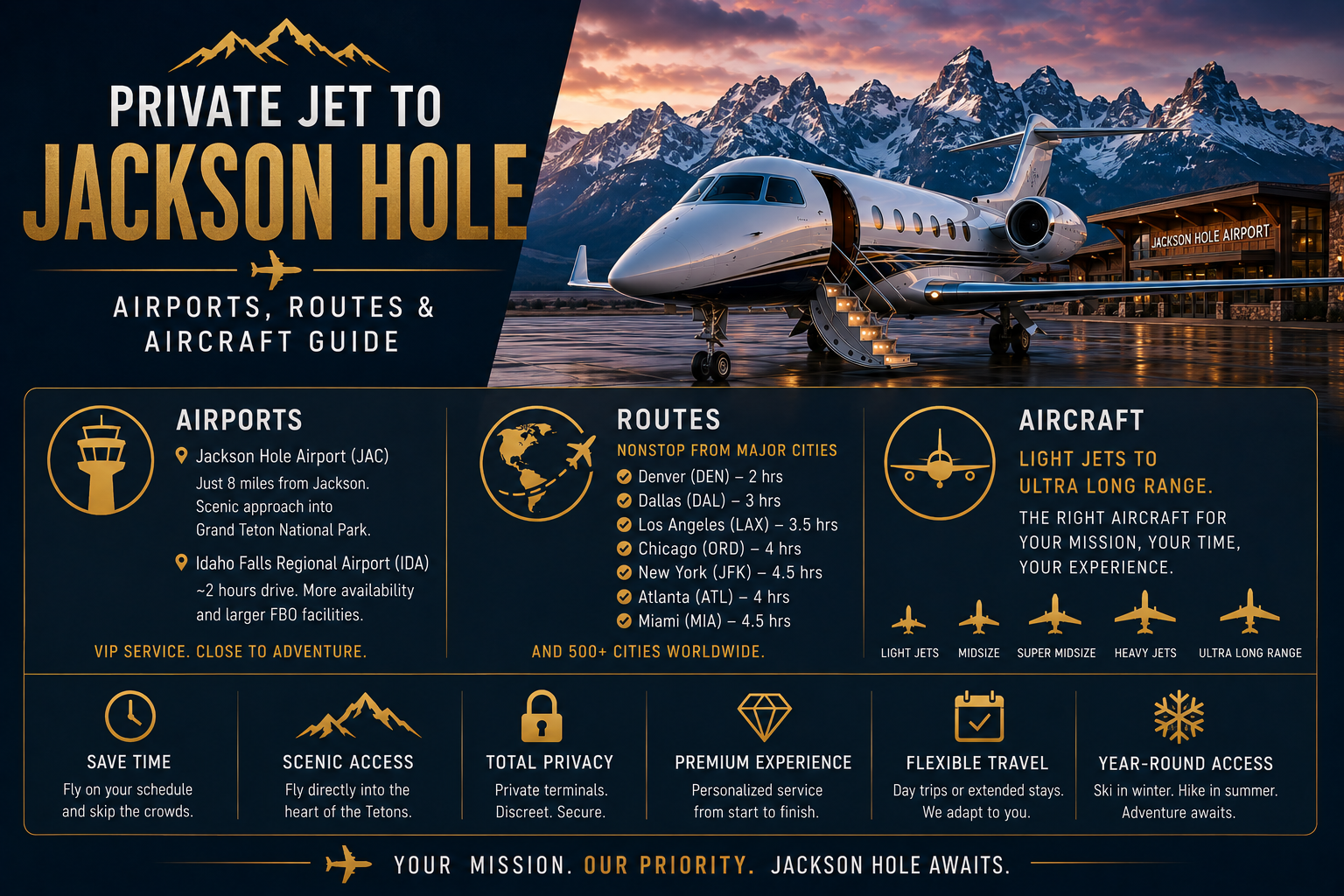
Private Jet to Jackson Hole: Airports, Routes and Aircraft Guide
Flying by private jet to Jackson Hole requires more than selecting an aircraft. Instead, the strongest plan connects the departure market, passengers, skis, luggage, mountain weather, airport performance, limited aircraft parking, wildlife-related procedures, ground transportation, seasonal demand, and the traveler’s final destination across the Jackson Hole valley.
Jackson Hole is one of the most distinctive private aviation destinations in the American West. In particular, the market attracts property owners, family offices, executives, investors, skiers, outdoor travelers, ranch owners, wedding guests, wellness travelers, athletes, entertainers, photographers, and families.
Most private travelers begin by considering Jackson Hole Airport, commonly identified as JAC and KJAC. Because the airport sits north of Jackson, it can provide direct access to the town of Jackson, Teton Village, Wilson, private residences, luxury resorts, ranches, Grand Teton National Park, and surrounding communities.
However, Jackson Hole Airport presents a more demanding operating environment than many metropolitan airports. Its high elevation, single runway, mountainous terrain, changing weather, winter conditions, noise procedures, wildlife considerations, and limited ramp capacity can all affect the mission.
Additionally, Jackson Hole Airport is located entirely within Grand Teton National Park. Therefore, the airport operates within an environmentally sensitive setting that places greater importance on noise reduction, wildlife protection, responsible ground operations, and careful pilot preparation.
Consequently, travelers should not assume that every aircraft, passenger load, flight schedule, or overnight parking request will work automatically. Instead, the operator must review aircraft performance, weather, fuel, runway conditions, passenger weight, baggage, skis, parking, FBO reservations, crew duty, and alternate-airport planning.
When Jackson Hole Airport does not support the preferred mission, the flight team may compare Idaho Falls Regional Airport, Pocatello Regional Airport, Bozeman Yellowstone International Airport, Salt Lake City International Airport, or another suitable regional option.
Therefore, this guide connects Jackson Hole destination demand with airport operations, aircraft selection, mountain weather, winter travel, summer recreation, popular routes, skis, luggage, wildlife-conscious operations, privacy, ground transportation, and related buyer resources.
Is Jackson Hole a Major Private Jet Destination?
Direct Answer: Yes. Jackson Hole is a major private jet destination because it combines skiing, luxury residences, ranches, national parks, outdoor recreation, weddings, family travel, executive retreats, and year-round mountain demand. Jackson Hole Airport provides the most direct access, although elevation, terrain, weather, parking, aircraft performance, and environmental procedures require careful planning.
A private jet to Jackson Hole may support a ski trip, ranch visit, extended family stay, property transaction, executive retreat, wedding, outdoor itinerary, summer residence, wellness trip, photography expedition, or connection between several seasonal markets.
Moreover, Jackson Hole Airport provides significantly closer access to the valley than many regional alternatives. Therefore, a successful arrival can reduce the long ground journey that would follow landing in Idaho Falls, Bozeman, Salt Lake City, or another distant airport.
However, direct access comes with operational complexity. Jackson Hole Airport sits at a runway elevation of approximately 6,451 feet within a mountainous and environmentally sensitive setting. As a result, aircraft performance, weather, wind, runway conditions, payload, climb capability, crew preparation, and alternate planning require closer review.
Additionally, the airport operates with one runway measuring approximately 6,300 feet. Therefore, the specific aircraft, fuel load, passengers, skis, baggage, temperature, runway condition, and departure route can influence whether the mission remains practical.
The airport’s official pilot information describes Jackson Hole as a challenging operating environment and emphasizes preparation before pilots operate at the facility. Consequently, travelers should expect conservative recommendations when weather, payload, parking, or aircraft performance reduces the available margin.
Furthermore, private aircraft parking can become limited. Jackson Hole Flight Services advises operators that overnight stays require a prior-permission reservation because ramp space is constrained.
Therefore, travelers should provide accurate mission details early. Passenger count, skis, snowboards, luggage, pets, equipment, departure airport, preferred timing, final address, return schedule, and alternate-airport preferences can all influence the final recommendation.
Travelers and aviation professionals can review current information through the official Jackson Hole Airport website, its pilot information resource, and the FAA Terminal Procedures publication.
Jackson Hole Airport provides exceptional destination access, yet that access depends on disciplined mountain-mission planning.
The strongest recommendation balances aircraft performance, elevation, weather, runway conditions, passengers, skis, baggage, parking, FBO reservations, environmental procedures, ground transportation, and the return itinerary.
Why Do Travelers Fly by Private Jet to Jackson Hole?
Direct Answer: Travelers fly by private jet to Jackson Hole to reach the valley directly, avoid commercial connections, control departure times, carry skis and extended-stay luggage, travel with children or pets, protect privacy, coordinate ranch or resort access, and connect Jackson Hole with other seasonal wealth markets.
Jackson Hole presents a destination where airport selection can change the entire journey. Landing at a distant regional airport may add several hours of driving through mountain terrain, winter weather, wildlife corridors, or changing road conditions.
Therefore, direct access to Jackson Hole Airport can protect valuable time while also simplifying luggage, vehicle, resort, ranch, and property coordination.
Reach the Valley Directly
Jackson Hole Airport can provide practical access to Jackson, Teton Village, Wilson, luxury resorts, private residences, ranches, and nearby communities.
Avoid Commercial Connections
Private aviation may connect smaller executive airports and seasonal markets with Jackson Hole without routing every passenger through a commercial hub.
Control the Departure Schedule
Travelers can coordinate the flight around work, school, skiing, property access, weddings, outdoor activities, weather windows, and family needs.
Carry Seasonal Equipment
Skis, snowboards, boots, helmets, outdoor gear, fishing equipment, golf clubs, pet supplies, and extended-stay luggage may require careful aircraft selection.
Travel With Family and Pets
A private cabin can simplify travel with children, grandparents, household staff, pets, caregivers, special food, medical supplies, and several generations.
Protect Passenger Privacy
Private-terminal handling, limited passenger lists, coordinated vehicles, controlled property access, and reduced public exposure may support discretion.
Nevertheless, private aviation does not eliminate mountain weather, wildlife-related procedures, runway limitations, parking constraints, crew duty, or aircraft-performance requirements.
Consequently, its greatest value comes from providing more control over the full journey. The operator may adjust the departure time, choose another aircraft, arrange a fuel stop, reserve parking early, use an alternate airport, or reposition the aircraft when conditions require another plan.
What Creates Private Aviation Demand in Jackson Hole?
Direct Answer: Jackson Hole private aviation demand comes from skiing, luxury residences, ranch ownership, national-park travel, outdoor recreation, weddings, executive retreats, family stays, real estate, wellness, summer events, photography, wildlife tourism, and frequent movement between Wyoming and other seasonal wealth markets.
Jackson Hole combines several travel markets within one valley. It functions as a ski destination, national-park gateway, luxury residential market, ranching region, outdoor recreation center, wedding destination, family retreat, and private-event market.
Therefore, demand changes throughout the year rather than disappearing outside the winter season.
Ski and Holiday Travel
Winter demand includes skiing, snowboarding, school breaks, holiday stays, family gatherings, private residences, resort travel, and extended mountain visits.
National Parks and Recreation
Summer attracts hikers, anglers, cyclists, climbers, photographers, families, wedding guests, ranch visitors, and national-park travelers.
Property and Ranch Ownership
Owners, buyers, developers, architects, brokers, managers, advisors, and family offices may travel for acquisitions, projects, maintenance, and extended stays.
Executive Retreats and Meetings
Founders, boards, investors, advisors, family offices, and leadership teams may visit for strategy sessions, private gatherings, and relationship development.
Destination Celebrations
Families, planners, entertainers, photographers, guests, vendors, and security teams may create several coordinated private aviation missions.
Multi-Generational Travel
Families may travel with children, grandparents, household staff, pets, skis, outdoor gear, food, medical items, and extended-stay luggage.
Privacy and Mountain Retreats
Travelers may visit for recovery, wellness, personal retreats, training, outdoor activity, private care, or extended time away from major cities.
Connected Wealth Markets
Jackson Hole connects frequently with Los Angeles, Scottsdale, Dallas, New York, Miami, Palm Beach, Chicago, San Francisco, Aspen, and Vail.
Additionally, demand may compress around holidays, ski weekends, summer weddings, private events, school breaks, and concentrated seasonal arrivals.
As a result, aircraft availability, overnight parking, FBO reservations, catering, rental vehicles, drivers, lodging, and preferred arrival times may tighten simultaneously.
Therefore, travelers should begin planning earlier when they require a specific aircraft category, overnight parking, extensive baggage capacity, several vehicles, special catering, pet accommodations, or a narrow arrival window.
Who Typically Flies Privately to Jackson Hole?
Direct Answer: Travelers flying privately to Jackson Hole include property owners, ranch owners, families, executives, family offices, investors, skiers, athletes, entertainers, wedding parties, outdoor travelers, photographers, international visitors, and leisure passengers who value direct access, privacy, schedule control, and equipment flexibility.
The person researching a private jet to Jackson Hole may not be the passenger. Executive assistants, family office staff, travel managers, property managers, ranch staff, household teams, security professionals, wedding planners, resort concierges, and guides often organize the mission.
Therefore, the aircraft and airport recommendation should answer both passenger-experience and operational questions.
Seasonal and Extended-Stay Travelers
Property owners may travel with family members, household staff, pets, food, gifts, outdoor gear, personal items, and several weeks of luggage.
Land, Livestock and Property Travel
Ranch owners, managers, advisors, veterinarians, investors, guests, and family members may require recurring regional or long-range missions.
Multi-Generational Groups
Families may include infants, young children, grandparents, caregivers, staff, pets, strollers, child seats, skis, and medical requirements.
Leaders and Corporate Teams
Executives may travel for retreats, private meetings, investor gatherings, property visits, nonprofit events, client entertainment, and personal stays.
Principals, Advisors and Staff
Family-office missions may involve several residences, ranches, staff members, security, aircraft, vehicles, property access, and connected destinations.
Skiing, Fishing and Exploration
Travelers may bring skis, snowboards, fishing equipment, bicycles, climbing gear, photography equipment, hunting gear, or other specialized items.
Families, Guests and Vendors
Wedding travel may include hosts, guests, planners, entertainers, photographers, production teams, security, luggage, and several coordinated arrivals.
Global Visitors
International travelers may connect through a larger U.S. gateway before continuing privately to Jackson Hole or another suitable regional airport.
Why Does the Passenger Profile Affect Aircraft Selection?
A small group may still require a midsize, super-midsize, or large-cabin aircraft because skis, fishing equipment, photography cases, pets, staff, and extended-stay luggage consume significant space.
Conversely, a larger group traveling lightly may fit another aircraft category. Therefore, maximum seat count cannot identify the best aircraft by itself.
Moreover, every passenger and bag contributes to aircraft weight. At a high-elevation mountain airport, that total may affect runway performance, climb capability, fuel, nonstop range, and departure timing.
What Should Travelers Know About Jackson Hole Airport?
Direct Answer: Jackson Hole Airport is the primary airport for private travel to Jackson, Teton Village, Wilson, nearby resorts, residences, ranches, and Grand Teton National Park. However, its high elevation, 6,300-foot runway, mountain weather, limited parking, wildlife-sensitive setting, and operating procedures require detailed mission planning.
Jackson Hole Airport, identified as JAC and KJAC, sits approximately seven miles north of the town of Jackson. Therefore, it generally provides the shortest airport transfer to the valley’s primary residential, resort, recreation, and hospitality destinations.
However, its location makes the airport operationally unique. Jackson Hole Airport is the only commercial airport in the United States located completely within a national park.
Additionally, its runway sits at an elevation of approximately 6,451 feet. Because higher elevation reduces air density, operators must carefully review takeoff distance, landing distance, climb capability, fuel, passenger weight, baggage, temperature, and weather.
The airport operates one paved runway measuring approximately 6,300 feet. Therefore, aircraft that perform comfortably at longer, lower-elevation airports may face different payload, fuel, or timing considerations at Jackson Hole.
Direct Valley Access
JAC provides practical access to Jackson, Teton Village, Wilson, luxury resorts, private residences, ranches, Grand Teton National Park, and nearby communities.
High-Altitude Performance
The airport’s elevation reduces air density. Therefore, aircraft performance, payload, fuel, temperature, climb, and runway conditions require close review.
One 6,300-Foot Runway
A single runway supports airline and general aviation traffic. Consequently, weather, snow removal, runway condition, traffic, and operating procedures affect the mission.
Mountain Operating Environment
Surrounding terrain, winds, visibility, weather, routing, missed-approach planning, and crew preparation increase the importance of conservative decisions.
Limited Overnight Ramp Space
Private aircraft may require advance reservations for overnight stays. Therefore, drop-and-go or repositioning strategies may become necessary.
National-Park Operations
Noise reduction, wildlife protection, responsible ground operations, and environmental stewardship remain important parts of airport activity.
Why Is Jackson Hole Airport Usually Preferred?
JAC generally creates the shortest ground journey to Jackson and Teton Village. Additionally, it avoids the much longer regional drive that follows an arrival in Idaho Falls, Bozeman, Salt Lake City, or another distant airport.
However, convenience should not override operational suitability. Weather, runway condition, aircraft performance, parking, passenger load, crew duty, or airport procedures may make another airport more reliable for the specific mission.
Therefore, the operator should compare the direct-airport advantage against the full operational margin.
Can Every Private Jet Use Jackson Hole Airport?
No. Although many private aircraft operate at JAC, the operator must evaluate the exact aircraft, weight, runway performance, temperature, wind, weather, fuel, passengers, skis, baggage, climb requirements, parking, crew procedures, and current airport information.
Furthermore, arrival suitability does not guarantee departure suitability. The aircraft may arrive carrying less fuel, yet the return route may require more fuel and create a different payload or takeoff calculation.
Therefore, the flight team may recommend an earlier departure, reduced baggage, different aircraft, planned fuel stop, repositioning strategy, or alternate airport.
Jackson Hole Airport offers the strongest geographic access, but only when the aircraft, weather, runway, payload, parking, and crew support the mission.
The airport should be selected because it creates the best complete journey—not simply because it sits closest to the passenger’s destination.
What Private Aviation Services Are Available at Jackson Hole Airport?
Direct Answer: Jackson Hole private aviation services may include aircraft fueling, passenger handling, luggage assistance, ground transportation, catering coordination, crew facilities, deicing, aircraft parking, flight support, and private-terminal services. However, limited ramp capacity makes advance reservations especially important for overnight stays and peak periods.
Jackson Hole Flight Services operates as the airport’s fixed-base operator for the general aviation community. Therefore, private operators, aircraft owners, charter companies, management companies, crews, and passengers can coordinate essential arrival, departure, and aircraft services.
However, the FBO specifically advises operators that ramp space is limited. Consequently, aircraft planning an overnight stay must obtain prior permission and a reservation before arrival.
This parking constraint matters because Jackson Hole demand may rise sharply during ski holidays, summer weekends, weddings, major events, and seasonal-resident travel.
Passenger Handling
Private-terminal support may include passenger reception, lounges, baggage coordination, vehicle access, refreshments, and communication with the flight crew.
Aircraft Fueling
The FBO can coordinate fuel, although the operator should confirm uplift requirements, timing, pricing, departure needs, and peak-period demand.
Ground Transportation
Vehicles may be staged for Jackson, Teton Village, Wilson, private residences, ranches, resorts, wedding venues, and outdoor destinations.
Aircraft Parking
Overnight ramp space requires advance coordination. Therefore, aircraft may need to reposition or complete a passenger drop-and-go mission.
Winter Support
Deicing, snow removal, ramp conditions, passenger timing, weather, aircraft preparation, and crew duty may affect winter departures.
Crew Services
Crew support may include lounges, transportation, lodging coordination, weather information, flight planning, and local operational assistance.
Why Should Parking Be Confirmed Before the Aircraft Is Booked?
An aircraft may be fully capable of landing at Jackson Hole while lacking approved overnight parking. Therefore, the operator may need to drop the passengers, reposition the aircraft, and return before the planned departure.
That repositioning strategy can affect cost, crew planning, weather exposure, passenger schedule, and the ability to depart early or immediately after an event.
Consequently, travelers should understand whether the aircraft will remain at JAC, reposition elsewhere, or return as a replacement aircraft before approving the mission.
Current reservation and service information is available through the official Jackson Hole Flight Services website.
At Jackson Hole, aircraft parking is part of the mission—not an afterthought.
Confirming ramp access, repositioning, crew plans, weather exposure, return timing, and passenger communication early can prevent major changes after the aircraft has been selected.
Why Is Jackson Hole Airport Operationally Unique?
Direct Answer: Jackson Hole Airport is operationally unique because it sits entirely within Grand Teton National Park at high elevation within mountainous terrain. Therefore, pilots must account for changing weather, terrain, wildlife, noise sensitivity, environmental procedures, runway performance, and limited parking before operating at JAC.
Most private aviation airports sit within cities, industrial districts, suburban business centers, or dedicated airport zones. Jackson Hole Airport operates in a dramatically different setting.
Because the airport lies entirely inside Grand Teton National Park, aviation activity exists beside wildlife habitat, mountain scenery, visitor recreation, protected land, and environmentally sensitive resources.
Therefore, airport operations must balance regional access with environmental stewardship and community expectations.
A Protected Operating Setting
The airport operates inside Grand Teton National Park. Consequently, environmental responsibility remains central to development, operations, and community relationships.
Active Habitat Considerations
Wildlife presence may affect runway monitoring, airport operations, passenger awareness, vehicle movement, and environmental-management procedures.
Community-Sensitive Operations
Pilots and operators should follow applicable noise-abatement practices, procedures, and airport guidance whenever safely and operationally appropriate.
Rapid Mountain Changes
Snow, wind, visibility, clouds, icing, turbulence, and temperature can change quickly within the surrounding mountain environment.
Careful Pilot Preparation
Surrounding mountains affect routing, approaches, departures, wind, missed approaches, climb planning, and overall operating margins.
Limited Airport Footprint
The protected setting limits how the airport can expand. Therefore, ramp space, parking, construction, and airport improvements require deliberate planning.
What Does This Mean for Passengers?
Passengers may notice greater emphasis on aircraft parking reservations, operating procedures, noise awareness, wildlife safety, ground movement, and advance planning.
Additionally, weather or wildlife activity may occasionally affect airport operations. Therefore, travelers should maintain flexibility rather than treating every schedule change as a service failure.
Moreover, responsible private aviation operations can help protect the long-term airport access that travelers, residents, businesses, emergency services, and the wider community depend on.
Jackson Hole Airport is not simply an airport near a national park—it operates inside one.
That setting makes direct private aviation access especially valuable while also making environmental responsibility, pilot preparation, and disciplined mission planning especially important.
How Do Elevation and Payload Affect a Private Jet to Jackson Hole?
Direct Answer: Jackson Hole’s high elevation, mountain terrain, runway length, temperature, wind, passengers, skis, baggage, fuel, and runway conditions can affect takeoff, landing, climb, payload, and nonstop range. Therefore, the operator must evaluate the specific aircraft and complete mission before confirming the flight.
Aircraft performance changes as airport elevation increases. Because the air becomes less dense, aircraft may require more runway, generate less climb performance, and carry less practical payload than they would at a lower-elevation airport.
Therefore, published seating and range figures cannot confirm whether a specific private jet can complete a Jackson Hole mission. Instead, the operator must calculate performance using the actual aircraft, runway, temperature, wind, fuel, passengers, baggage, and expected airport conditions.
Additionally, arrival and departure performance may differ significantly. An aircraft may arrive with less fuel after completing the inbound flight. However, the return mission may require more fuel, more baggage, different winds, or a warmer departure time.
Thinner Air Changes Performance
Higher elevation reduces air density. Consequently, aircraft acceleration, lift, engine output, climb capability, and practical payload may differ from lower-altitude operations.
Passengers and Equipment Add Weight
Every passenger, ski bag, snowboard, pet carrier, suitcase, food item, and piece of outdoor equipment affects total aircraft weight.
Warm Weather Reduces Margin
Higher temperatures further reduce air density. Therefore, summer departures may require additional performance review even when skies remain clear.
Longer Routes Require Tradeoffs
More fuel supports longer range. However, additional fuel also increases aircraft weight and may reduce the practical passenger or baggage load.
Conditions Matter
Snow, slush, standing water, ice, braking reports, wind, and runway availability may change landing and departure calculations.
Terrain Increases the Importance of Margin
Mountain terrain makes climb capability and departure planning especially important. Consequently, operators may recommend conservative payload or timing decisions.
Can the Same Aircraft Perform Differently in Summer and Winter?
Yes. During winter, cold air may improve some aircraft-performance characteristics. However, snow, ice, braking conditions, deicing, reduced visibility, and contaminated runways may create other limitations.
Conversely, summer often provides dry runway conditions, yet warmer temperatures can reduce takeoff and climb performance.
Therefore, travelers should not assume that one season always creates an easier mission. Instead, each season produces different operational considerations.
Can Baggage Create a Fuel Stop?
Yes. A group carrying skis, outdoor equipment, pets, several weeks of luggage, and a full passenger load may reduce the amount of fuel the aircraft can carry while remaining within performance limits.
Consequently, the operator may recommend a fuel stop after departure. Although that stop adds time, it may allow the aircraft to depart Jackson Hole with a more practical weight and stronger operating margin.
Maximum range does not equal practical Jackson Hole range.
The real mission depends on elevation, temperature, runway conditions, passengers, skis, luggage, fuel, winds, alternate requirements, and the exact aircraft.
How Does Mountain Weather Affect Private Flights to Jackson Hole?
Direct Answer: Mountain weather can affect visibility, wind, turbulence, icing, runway conditions, aircraft performance, routing, airport availability, and the passenger’s ground journey. Therefore, Jackson Hole missions require active weather monitoring, practical alternate airports, schedule flexibility, and clear communication.
Mountain weather can change quickly. A forecast that appears favorable several days before the trip may evolve as snow systems, winds, cloud layers, temperature changes, and local terrain interact.
Therefore, professional flight crews review current airport observations, forecasts, radar, winds aloft, runway information, alternate airports, route weather, and aircraft limitations before approving the mission.
Low Visibility
Snow, clouds, fog, precipitation, or blowing snow may reduce visibility and affect approach, landing, departure, or alternate-airport requirements.
Mountain Winds
Wind direction, gusts, mountain waves, downdrafts, crosswinds, and turbulence may affect routing, approach stability, climb, and passenger comfort.
Icing
Clouds, precipitation, temperature, and moisture may create icing concerns before, during, or after the flight.
Snowfall
Snow may affect runway treatment, ramp operations, aircraft preparation, baggage handling, visibility, road conditions, and vehicle timing.
Temperature
Cold and warm temperatures create different aircraft-performance, deicing, runway, passenger, and ground-handling considerations.
Alternate Airports
A practical alternate should support the aircraft, weather, passengers, vehicles, luggage, and final ground journey rather than existing only as a flight-planning requirement.
Should Travelers Expect Schedule Flexibility?
Yes. The operator may recommend an earlier departure, delayed arrival, different aircraft, fuel stop, alternate airport, overnight stay, or revised ground plan when conditions change.
Therefore, passengers should avoid building an itinerary that leaves no room for weather-related adjustments. Tight wedding schedules, late property access, immediate ski lessons, or same-day events may require larger buffers.
Moreover, the ground team should receive weather updates because an airport change can significantly alter the vehicle route and arrival time.
A weather change should trigger a prepared alternative—not a rushed decision.
The strongest Jackson Hole plan identifies the alternate airport, vehicles, lodging, property contacts, luggage process, and passenger communication before the flight departs.
How Do Winter Conditions Affect a Private Jet to Jackson Hole?
Direct Answer: Winter Jackson Hole travel requires earlier planning for snow, deicing, runway conditions, visibility, skis, baggage, limited aircraft parking, winter vehicles, road conditions, alternate airports, crew duty, holiday demand, and possible itinerary changes.
Winter creates some of Jackson Hole’s strongest private aviation demand. At the same time, it introduces the greatest concentration of weather, runway, parking, baggage, vehicle, and scheduling considerations.
Therefore, the aircraft, airport, skis, luggage, vehicles, alternate airport, property access, and return flight should be planned as one mission.
Runway and Ramp Conditions
Snow accumulation, plowing, runway treatment, braking reports, ramp access, and aircraft movement may affect arrival and departure timing.
Aircraft Preparation
Aircraft may require deicing or anti-icing before departure. Consequently, passenger timing, weather, crew duty, and aircraft readiness matter.
Limited Ramp Capacity
Peak winter periods may tighten overnight parking. Therefore, the aircraft may need advance approval, repositioning, or a drop-and-go plan.
Skis and Winter Equipment
Ski bags, snowboards, boots, helmets, coats, strollers, pet supplies, and extended-stay luggage may require a larger aircraft and several vehicles.
Winter Ground Conditions
Snow, ice, traffic, accidents, wildlife, reduced visibility, and road closures may affect transfers to Jackson, Teton Village, Wilson, or private residences.
Holiday Compression
Christmas, New Year’s, school breaks, ski weekends, and major winter periods may tighten aircraft, FBO services, catering, vehicles, lodging, and preferred times.
How Early Should Winter Travelers Begin Planning?
Travelers should begin planning as soon as the dates become reasonably clear. However, holiday periods, large families, preferred aircraft, pets, extensive baggage, security, and overnight parking often justify earlier coordination.
Additionally, early planning provides more time to verify ski dimensions, compare baggage compartments, reserve winter-capable vehicles, coordinate property staff, confirm parking, and establish an alternate-airport strategy.
What Should Remain Accessible During the Flight?
Medication, identification, child supplies, pet necessities, warm clothing, electronics, important documents, food, and other essential items should remain accessible.
Therefore, passengers can continue safely and comfortably if the flight diverts, the ground transfer becomes longer, or checked baggage travels separately.
- Provide accurate ski and snowboard dimensions.
- Confirm the number of boot bags and standard bags.
- Reserve winter-capable vehicles.
- Confirm overnight aircraft parking or repositioning.
- Prepare a practical alternate-airport plan.
- Build flexibility around winter weather.
- Coordinate property or resort access.
- Keep essential items accessible.
- Review crew duty for late departures.
- Confirm the return mission separately.
Which Alternate Airports Serve Jackson Hole?
Direct Answer: Jackson Hole alternate airports may include Idaho Falls Regional Airport, Pocatello Regional Airport, Bozeman Yellowstone International Airport, Salt Lake City International Airport, and other regional facilities. However, the best alternative depends on aircraft capability, weather, parking, runway conditions, road access, vehicles, passenger priorities, and the final destination.
An alternate airport should solve the complete travel problem. Therefore, the operator should not select an alternate based only on runway length or geographic distance.
Instead, the team should compare weather, aircraft suitability, fuel, parking, airport services, winter roads, vehicle availability, passenger needs, baggage, and total ground time.
Jackson Hole Airport
JAC generally provides the shortest ground journey to Jackson, Teton Village, Wilson, resorts, residences, ranches, and Grand Teton National Park.
Idaho Falls Regional Airport
Idaho Falls may provide a practical western alternate depending on weather, road conditions, aircraft capability, parking, and vehicle availability.
Pocatello Regional Airport
Pocatello may support selected missions when runway, parking, fuel, weather, or regional operating conditions make it useful.
Bozeman Yellowstone International Airport
Bozeman may fit certain multi-destination, Yellowstone, Montana, airline-connection, large-aircraft, or operational itineraries.
Salt Lake City International Airport
Salt Lake City may provide major-airport infrastructure, airline connectivity, international support, parking, or operational flexibility despite a much longer ground journey.
Additional Regional Airports
The operator may recommend another airport based on weather, runway availability, aircraft size, parking, fuel, passenger needs, or the broader itinerary.
Why Does the Ground Drive Matter So Much?
A diversion can replace a short transfer from JAC with a substantially longer mountain drive. Therefore, the alternate plan should include winter-capable vehicles, realistic timing, passenger comfort, luggage capacity, food, medication, child needs, pet needs, and overnight options.
Additionally, road conditions may make one alternate more practical than another even when the airports appear similar on a map.
Consequently, the operator and passenger representative should identify the preferred alternate before departure rather than debating the options after weather prevents arrival at Jackson Hole.
A useful alternate airport includes a realistic ground plan.
The alternate should support the aircraft and also provide workable vehicles, road access, passenger comfort, baggage capacity, lodging, and communication with the final destination.
How Should Travelers Compare Jackson Hole and Regional Airports?
Direct Answer: Travelers should compare Jackson Hole and regional airports by reviewing aircraft performance, weather, runway conditions, parking, fuel, airport services, final address, ground time, winter roads, passenger needs, baggage, airline connections, and the return itinerary.
Jackson Hole Airport usually provides the strongest geographic access. However, the airport that sits closest to the destination may not create the most reliable mission under every condition.
Therefore, travelers should compare direct access against operational margin, parking, weather, aircraft requirements, crew duty, and the ground transfer from a regional alternative.
| Airport | Potential Advantage | Primary Consideration | Best Planning Question |
|---|---|---|---|
| Jackson Hole Airport | Shortest access to Jackson and Teton Village | Elevation, terrain, weather, runway, and limited parking | Can the specific aircraft and mission operate with sufficient margin? |
| Idaho Falls Regional Airport | Practical regional alternative for selected missions | Longer ground journey and winter-road exposure | Do weather and roads support a reliable transfer? |
| Pocatello Regional Airport | Additional runway and parking flexibility | Extended drive and mission-specific service needs | Does the airport improve aircraft reliability enough to justify the drive? |
| Bozeman Yellowstone International Airport | Regional infrastructure and northern access | Long distance from Jackson Hole | Does the broader itinerary include Yellowstone, Montana, or airline connections? |
| Salt Lake City International Airport | Major-airport infrastructure and airline connectivity | Longest practical ground journey among common options | Does the mission require large-airport capability or onward airline travel? |
What Should Be Confirmed Before Selecting the Airport?
- The exact Jackson Hole destination
- The aircraft model and operating weight
- Passengers, skis, luggage, pets, and equipment
- Runway, weather, wind, and temperature
- Overnight parking or repositioning requirements
- Fuel and alternate-airport requirements
- Winter-road conditions and vehicle availability
- Ground-transfer timing and passenger comfort
- Airline connections or international requirements
- The return-flight schedule and baggage load
Ultimately, the traveler should receive one recommended airport with a clear explanation of the tradeoffs. A list of possible airports does not replace a complete mission decision.
How Should Ground Transportation Be Planned for Jackson Hole?
Direct Answer: Jackson Hole ground transportation should account for the arrival airport, final address, passengers, skis, luggage, pets, child seats, winter conditions, wildlife, property access, resort procedures, driver experience, alternate airports, and possible weather changes. The vehicle plan should be confirmed before departure.
Ground transportation may appear simple when the aircraft lands at JAC. However, Jackson Hole includes the town of Jackson, Teton Village, Wilson, private communities, ranches, resorts, national-park areas, and remote properties.
Therefore, the driver should receive the exact destination rather than a general instruction to travel to Jackson Hole.
Jackson
Travelers headed to the town should confirm the hotel, residence, private entrance, luggage plan, and expected traffic before landing.
Teton Village
Ski travelers should coordinate resort access, equipment, child seats, luggage, property management, and winter-road conditions.
Wilson and Private Communities
Private residences may require gate access, property contacts, security coordination, snow removal, and detailed driver instructions.
Ranches and Remote Properties
Rural destinations may require experienced drivers, four-wheel-drive vehicles, local knowledge, property access, and additional travel time.
Alternate-Airport Transfers
A diversion may create a much longer drive. Therefore, the transportation team should understand the preferred regional alternatives.
Wildlife and Roads
Wildlife, darkness, snow, ice, limited visibility, and rural roads may affect speed, safety, routing, and estimated arrival time.
What Should the Ground Team Confirm?
- The exact airport and FBO
- The final residence, ranch, resort, or venue
- The passenger, staff, and security count
- The number of ski bags, suitcases, and oversized items
- Pets, child seats, mobility devices, or medical needs
- Winter tires, four-wheel drive, and driver experience
- Property gates, resort entrances, and contact information
- Current road, snow, wildlife, and visibility conditions
- Alternate-airport vehicle arrangements
- A communication plan for delays or airport changes
Additionally, the ground fleet should provide enough cargo capacity for the complete group. A large family, ski group, wedding party, ranch visit, or production team may require several SUVs or a separate luggage vehicle.
The aircraft saves time only when the ground plan protects that advantage.
An unsuitable vehicle, missing ski capacity, incorrect property entrance, unprepared alternate-airport transfer, or inexperienced winter driver can quickly erase the benefits of direct private aviation access.
Which Aircraft Work Best for a Private Jet to Jackson Hole?
Direct Answer: Jackson Hole missions may use turboprops, light jets, midsize jets, super-midsize aircraft, large-cabin jets, or ultra-long-range aircraft. However, the correct choice depends on route distance, passengers, skis, luggage, pets, elevation, runway performance, weather, fuel, parking, and the return itinerary.
Jackson Hole Airport supports a broad range of private aircraft. Nevertheless, the strongest option depends on the complete mission rather than the aircraft’s maximum seating or advertised range.
For example, a short regional trip from Salt Lake City may fit a turboprop or light jet. Meanwhile, a family traveling from New York with skis, pets, household staff, and several weeks of luggage may require a larger cabin and more baggage capacity.
Additionally, a larger aircraft does not automatically create the best solution. Greater cabin size may also introduce different runway, parking, fuel, wingspan, and operating considerations.
King Air 350
The King Air 350 may support regional Jackson Hole missions for smaller groups that value practical cabin space, flexible short-range travel, and efficient western-market access.
Pilatus PC-24
The Pilatus PC-24 may appeal to travelers who value useful baggage access, cabin flexibility, regional capability, and practical performance across varied missions.
Phenom 300E
The Phenom 300E may support selected western and shorter domestic routes for smaller groups with moderate ski, luggage, and passenger requirements.
Citation Latitude
The Citation Latitude may fit domestic family, executive, leisure, and property missions where passengers value a stand-up cabin and practical baggage capacity.
Challenger 3500
The Challenger 3500 may support transcontinental travel, executive groups, family offices, ski trips, property owners, and substantial baggage.
Praetor 600
The Praetor 600 may suit longer domestic and selected international missions where range, cabin comfort, skis, luggage, and efficiency matter.
Citation X
The Citation X may support longer domestic routes where speed matters. However, baggage fit, runway performance, fuel, parking, and mountain conditions still require review.
Gulfstream G550
The Gulfstream G550 may support larger groups, international travel, working cabins, sleeping arrangements, extended baggage, and high-security missions.
Gulfstream G650
The Gulfstream G650 may support high-speed domestic and international travel, although the specific aircraft, load, runway, parking, and weather remain mission-specific.
What Aircraft Factors Matter Most?
- Departure city and route distance
- Passenger, staff, and security counts
- Skis, snowboards, boots, and outdoor equipment
- Standard and extended-stay luggage
- Pets, children, and accessibility requirements
- Airport elevation and runway performance
- Weather, temperature, wind, and runway condition
- Fuel, reserves, and alternate-airport requirements
- Cabin, working, dining, sleeping, and privacy needs
- Aircraft parking and return-flight timing
The return mission should receive a separate review. Passengers may add purchases, property items, outdoor equipment, gifts, or another traveler during the stay.
Moreover, the departure may require more fuel than the arrival. Therefore, an aircraft that fits the inbound trip may require a fuel stop, different departure time, payload adjustment, or alternate airport on the return.
The correct Jackson Hole aircraft fits the route, passengers, equipment, elevation, runway, parking, weather, and return mission together.
Published range and seating provide useful context, yet only a mission-specific performance review can confirm whether the exact aircraft fits the trip.
What Are the Most Popular Routes for a Private Jet to Jackson Hole?
Direct Answer: Popular Jackson Hole private jet routes connect Wyoming with Los Angeles, Scottsdale, Dallas, New York, Miami, Palm Beach, Chicago, San Francisco, Aspen, and Vail. However, each route requires aircraft, baggage, skis, weather, fuel, runway, parking, and ground-transportation review.
Jackson Hole route demand follows seasonal residences, skiing, ranch ownership, family travel, real estate, outdoor recreation, weddings, executive retreats, and summer events.
Therefore, route patterns change by season. Winter often increases travel from warmer markets, while summer expands demand across family, recreation, property, wedding, and outdoor-travel segments.
Los Angeles to Jackson Hole
This western route may serve entertainment, executives, athletes, families, property owners, wedding guests, and seasonal travelers.
Scottsdale to Jackson Hole
This corridor connects desert residences, golf communities, family offices, seasonal residents, and outdoor travelers with Wyoming.
Dallas to Jackson Hole
Dallas travelers may include executives, investors, families, ranch owners, ski groups, property owners, and corporate retreat participants.
New York to Jackson Hole
This transcontinental route may require larger aircraft, substantial luggage, skis, family travel, business schedules, and careful payload planning.
Miami to Jackson Hole
This longer corridor may serve seasonal residents, family offices, ski travelers, property owners, executives, and extended-stay families.
Palm Beach to Jackson Hole
Palm Beach-to-Jackson Hole travel may serve property owners, family offices, investors, executives, families, and seasonal travelers.
Chicago to Jackson Hole
This route supports families, executives, property owners, ranch travelers, ski groups, wedding guests, and corporate retreats.
San Francisco to Jackson Hole
This western corridor may serve technology executives, investors, families, outdoor travelers, property owners, and private-event guests.
Aspen and Vail to Jackson Hole
These mountain-market routes may connect seasonal residents, property owners, skiers, family offices, events, and multi-destination western travel.
Why Should Each Direction Have Its Own Route Guide?
The outbound and return missions may involve different winds, fuel, baggage, skis, passengers, airport conditions, parking, and departure timing.
Therefore, New York-to-Jackson Hole and Jackson Hole-to-New York can answer different planning questions even though the same destinations remain involved.
Moreover, the aircraft may arrive with less fuel yet require a larger fuel load for departure. Consequently, the return route may require a different aircraft, fuel stop, or departure window.
How Does Private Aviation Support Ski Travel to Jackson Hole?
Direct Answer: Private aviation supports Jackson Hole ski travel by helping families, groups, property owners, executives, and seasonal residents reach the valley directly, carry skis and winter luggage, coordinate resort access, travel with children or pets, and avoid commercial connections.
Ski travel often involves more baggage than an ordinary leisure trip. Skis, snowboards, boots, helmets, coats, winter clothing, strollers, child seats, pet supplies, and extended-stay luggage can quickly exceed the practical capacity of a smaller aircraft.
Therefore, the aircraft should be selected around the full equipment profile rather than the passenger count alone.
Measure Skis and Snowboards
Long ski and snowboard bags may not fit through every baggage door. Therefore, quantities, lengths, case types, and dimensions should be provided early.
Coordinate Teton Village Arrival
Drivers, resorts, private residences, property managers, and luggage teams should know the arrival window and equipment requirements.
Plan for Family Logistics
Families may require child seats, strollers, food, medication, warm clothing, ski-school timing, and several vehicles.
Prepare Cabin and Ground Needs
Pet policies, carriers, food, water, health needs, winter exposure, property access, and vehicles should be confirmed before travel.
Build Schedule Flexibility
Snow, deicing, visibility, runway conditions, alternate airports, and winter roads may alter the original itinerary.
Expect the Load to Change
Passengers may add purchases, gifts, equipment, or another traveler during the stay. Therefore, the departure load should receive a new review.
Should Travelers Rent Skis Locally?
Renting skis or snowboards locally may reduce aircraft and vehicle requirements. However, many experienced travelers prefer personal equipment and should plan the mission around it.
Therefore, the decision should reflect the traveler’s equipment preference, aircraft capacity, group size, resort availability, and ground logistics.
What Should Ski Travelers Keep Accessible?
Medication, identification, gloves, coats, child supplies, pet items, chargers, food, and other essentials should remain accessible rather than buried within checked luggage.
Consequently, passengers can remain comfortable if weather creates an alternate-airport transfer, longer ground journey, or overnight delay.
Why Do Travelers Fly Privately to Jackson Hole in Summer?
Direct Answer: Summer travelers fly privately to Jackson Hole for Grand Teton and Yellowstone access, ranch stays, hiking, fishing, cycling, climbing, photography, weddings, family visits, executive retreats, real estate, outdoor recreation, and cooler mountain weather.
Jackson Hole remains highly active outside the ski season. In fact, summer may create even broader demand because the valley attracts national-park visitors, ranch guests, wedding parties, families, outdoor athletes, photographers, property owners, investors, and executive groups.
Therefore, travelers should not treat Jackson Hole as a winter-only private aviation market.
National-Park Access
Private aviation may support trips involving Grand Teton National Park, Yellowstone, guided wildlife experiences, photography, and family recreation.
Fishing and Outdoor Gear
Fishing rods, waders, boots, bicycles, climbing equipment, golf clubs, photography cases, and luggage may affect aircraft and vehicle selection.
Ranch Stays
Ranch guests may require remote-property access, local drivers, outdoor equipment, food, horses, guides, and detailed ground coordination.
Weddings and Events
Summer weddings, private gatherings, nonprofit events, festivals, and corporate retreats may compress aircraft parking, hotels, vehicles, and preferred times.
Warm-Weather Performance
Higher temperatures may reduce aircraft performance at elevation. Therefore, earlier departures or payload adjustments may become useful.
Extended Family Stays
Families may travel with pets, staff, work materials, outdoor gear, children, food, and several weeks of luggage.
How Does Summer Affect Aircraft Performance?
Warm temperatures reduce air density at an already high-elevation airport. Consequently, takeoff, climb, payload, fuel, and nonstop-range calculations may differ from cooler seasons.
Therefore, the operator may recommend an earlier departure, another aircraft, lower payload, planned fuel stop, or alternate airport when conditions reduce the available margin.
Why Should Summer Ground Transportation Be Planned Early?
Wedding weekends, national-park traffic, construction, wildlife, limited parking, resort activity, and remote-property access can affect the final ground journey.
Additionally, bicycles, fishing gear, photography cases, golf clubs, and outdoor equipment may require larger or additional vehicles.
How Do Events and Weddings Affect Jackson Hole Private Aviation?
Direct Answer: Jackson Hole weddings and events can compress aircraft arrivals, overnight parking, FBO services, lodging, vehicles, catering, photographers, security, vendors, and departure windows. Therefore, event travelers should coordinate the aircraft, airport, parking, ground transportation, property access, and return mission earlier than ordinary leisure travel.
Jackson Hole attracts destination weddings, executive retreats, nonprofit events, family gatherings, private celebrations, cultural events, and corporate programs throughout the year.
Therefore, one event may involve several aircraft carrying hosts, families, guests, entertainers, planners, executives, photographers, security teams, and vendors.
Coordinate the Core Family or Group
Hosts may require early property access, household staff, event planners, security, luggage, supplies, and several connected flights.
Manage Several Arrival Windows
Guests may arrive from different cities, airports, aircraft, and schedules. Therefore, ground transportation should not rely on one universal pickup plan.
Move Specialists and Equipment
Photographers, entertainers, production teams, planners, chefs, florists, security, and technical personnel may travel with specialized equipment.
Reserve Aircraft Space
Limited overnight parking may require early approval, repositioning, remote parking, or coordinated drop-and-go schedules.
Confirm Remote Property Access
Ranches, lodges, residences, and outdoor venues may require precise directions, gate access, local drivers, and weather planning.
Plan the Post-Event Mission
Events may run late. Therefore, passenger readiness, road conditions, crew duty, aircraft return, and overnight alternatives should be reviewed early.
Why Should the Departure Be Planned Before the Event?
Passengers may need to return to a residence or resort, collect luggage, travel through rural or winter roads, reach the FBO, and board before crew-duty or airport limitations become relevant.
Therefore, the travel team should establish the preferred departure, latest practical departure, overnight option, alternate airport, and communication plan before the event begins.
The event schedule should shape the aviation plan from the beginning.
Aircraft parking, vehicle staging, property access, vendor equipment, road conditions, passenger readiness, and the return mission should all be coordinated around the real event timeline.
How Do Property and Ranch Owners Use Private Aviation in Jackson Hole?
Direct Answer: Property and ranch owners use private aviation to connect Jackson Hole with other residences, business markets, family members, advisors, staff, veterinarians, architects, brokers, managers, and guests while carrying pets, equipment, food, documents, supplies, and extended-stay luggage.
Jackson Hole includes luxury residences, working ranches, recreational properties, remote homes, family compounds, and seasonal estates.
Therefore, private aviation often supports recurring residential and operational travel rather than a one-time vacation.
Connect Several Residences
Owners may travel between Jackson Hole and Scottsdale, Palm Beach, Miami, New York, Dallas, Los Angeles, Aspen, Vail, or another seasonal market.
Move Advisors and Specialists
Managers, veterinarians, attorneys, accountants, consultants, investors, contractors, and guests may require recurring access.
Coordinate Construction and Improvements
Architects, designers, developers, contractors, engineers, lenders, and owners may travel for site visits, meetings, inspections, and decisions.
Carry More Than Passengers
Pets, food, gifts, equipment, household supplies, sporting gear, medical items, staff, and personal belongings may increase aircraft requirements.
Reach Remote Properties
Rural residences may require local drivers, four-wheel-drive vehicles, gate access, property contacts, snow removal, and detailed directions.
Protect the Residential Pattern
Recurring travel may require limited itinerary sharing, discreet vehicles, consistent staff communication, and controlled property access.
Why Should Recurring Travelers Build a Passenger Profile?
Recurring passengers often use similar routes, vehicles, catering, pet arrangements, staff, properties, and baggage patterns.
Therefore, documenting those preferences can make future missions easier to plan. However, the operator should still review every flight independently because weather, elevation, passengers, baggage, parking, and fuel requirements change.
What Should Families Know Before Booking a Private Jet to Jackson Hole?
Direct Answer: Families should provide accurate information about adults, children, infants, pets, household staff, skis, luggage, food, medical needs, child seats, accessibility, vehicles, property access, and alternate-airport preferences before selecting a private jet to Jackson Hole.
Family travel may include several generations, pets, household staff, caregivers, strollers, car seats, medication, special food, skis, outdoor gear, and extended-stay baggage.
Therefore, the aircraft may provide enough seats while still lacking the practical baggage, cabin, or payload capacity required for the trip.
Family Mission Questions
- How many adults, children, infants, and staff will travel?
- Will any passenger require accessibility or medical support?
- Will pets travel inside the cabin?
- How many skis, snowboards, bags, and equipment cases are included?
- Are strollers, child seats, wheelchairs, or medical items required?
- Does the family need special food, refrigeration, or medication storage?
- Which residence, ranch, resort, or venue is the final destination?
- What alternate airport is acceptable?
- Can the ground vehicles carry the entire group and baggage?
- Will the group travel internationally or continue elsewhere?
Why Accurate Information Matters
Every passenger, pet carrier, ski bag, suitcase, stroller, and medical item contributes to aircraft weight and storage demand.
Therefore, incomplete information may produce an aircraft recommendation that no longer works when the full group arrives.
Additionally, an alternate-airport diversion may create a long ground transfer. Consequently, families should keep food, medication, warm clothing, child supplies, and pet essentials accessible.
Can Pets Travel in the Cabin?
Many private aviation arrangements allow pets inside the cabin. However, operator policy, aircraft size, pet behavior, passenger allergies, documentation, health concerns, altitude, weather, and ground transportation should be reviewed before travel.
Moreover, pet owners should consider cold-weather exposure, long alternate-airport drives, rural property access, wildlife, and veterinary needs.
How Do Skis and Equipment Affect a Private Jet to Jackson Hole?
Direct Answer: Skis, snowboards, fishing gear, bicycles, photography equipment, pet carriers, strollers, medical supplies, gifts, and extended-stay luggage can significantly affect aircraft and vehicle selection. Therefore, travelers should provide accurate quantities, dimensions, photos, and approximate weights before confirming the aircraft.
Jackson Hole travelers frequently carry long, rigid, fragile, or oversized equipment. Therefore, total baggage volume cannot confirm whether everything will fit.
Instead, the operator should verify baggage-door dimensions, compartment length, loading angle, weight, equipment shape, fragility, and the number of standard bags traveling with the group.
Compartment Dimensions
Long skis, snowboards, rods, bicycles, and hard cases may not fit through every baggage door even when the aircraft offers significant total storage volume.
Weight and Balance
Passengers, equipment, luggage, pets, food, supplies, and fuel must remain within the aircraft’s weight and balance limitations.
Fragile Equipment
Cameras, lenses, instruments, medical supplies, optics, and other sensitive items may require special packing or cabin storage.
Cabin Storage
Some items may travel inside the cabin when permitted. However, everything must remain secured and cannot block exits or create hazards.
Vehicle Capacity
The ground fleet must carry the same passengers, bags, skis, pets, outdoor equipment, child seats, and supplies after landing.
Return-Flight Changes
Purchases, gifts, property items, rented equipment, food, or additional passengers may increase the departure load.
What Equipment Information Should Travelers Provide?
- Number and length of ski bags
- Snowboards, boots, helmets, and winter equipment
- Fishing rods, waders, and gear cases
- Bicycles, golf clubs, or climbing equipment
- Photography cases, lenses, tripods, and electronics
- Pet carriers, strollers, and child seats
- Medical or accessibility equipment
- Fragile, refrigerated, or high-value items
- Approximate dimensions, weights, and photographs
- Expected additional return-flight baggage
Photos and measurements can prevent a late aircraft or vehicle change.
When baggage is unusual, the operator should verify the equipment, compartment, loading process, weight, aircraft fit, and ground-transfer plan before the mission begins.
How Does Jackson Hole Airport Protect Wildlife and the Environment?
Direct Answer: Jackson Hole Airport operates within Grand Teton National Park and uses wildlife management, environmental planning, noise-awareness practices, responsible ground operations, and infrastructure controls to balance aviation access with the surrounding protected landscape.
The airport’s national-park location creates responsibilities that extend beyond traditional flight operations.
Therefore, wildlife protection, habitat awareness, noise reduction, environmental stewardship, water quality, ground movement, construction planning, and community relationships remain important parts of airport management.
Monitor Active Habitat
Airport teams monitor wildlife activity and use management practices designed to reduce risk while respecting the surrounding habitat.
Reduce Unnecessary Impact
Pilots and operators should follow applicable airport procedures and noise-awareness practices whenever safely and operationally appropriate.
Use the Ramp Responsibly
Aircraft movement, vehicles, fueling, baggage handling, waste, and ground support should follow airport and FBO procedures.
Plan Within a Limited Footprint
The protected setting limits expansion. Therefore, infrastructure, parking, construction, and airport improvements require careful review.
Respect the Setting
Travelers should follow airport instructions, remain aware of wildlife, use designated areas, and avoid unnecessary disruption.
Protect the Airport’s Future
Responsible operations help preserve valuable regional access for residents, travelers, businesses, emergency services, and the broader community.
Private aviation travelers benefit directly from the airport’s extraordinary location. Therefore, operators and passengers share an interest in protecting the access, environment, and community relationships that make the airport possible.
Responsible operations protect both the environment and long-term private aviation access.
Noise awareness, wildlife respect, disciplined ground activity, parking coordination, and compliance with airport procedures help preserve the value of Jackson Hole Airport.
How Can a Private Jet to Jackson Hole Support Privacy?
Direct Answer: A private jet to Jackson Hole can support privacy through controlled passenger lists, private-terminal handling, limited itinerary distribution, discreet vehicles, coordinated property access, reduced public exposure, security teams, and direct communication among the operator, passenger representative, driver, resort, or residence.
Jackson Hole attracts public figures, executives, investors, entertainers, athletes, family offices, property owners, and passengers involved in sensitive personal or business matters.
Therefore, privacy may influence the airport, aircraft parking, FBO handling, arrival time, vehicle route, residence access, resort entrance, security staffing, and communication process.
Limit Itinerary Distribution
Passenger names, aircraft information, flight times, residences, ranches, vehicles, events, and contact details should remain limited to necessary personnel.
Control the Arrival
Driver identification, baggage transfer, FBO pickup, property access, resort entrances, and passenger movement should be confirmed before landing.
Understand Aircraft Positioning
Aircraft repositioning may affect flight tracking, crew logistics, departure timing, replacement aircraft, and passenger communication.
Prepare the Final Property
Property managers, household staff, ranch teams, resorts, and security personnel may need arrival details without receiving unnecessary flight information.
Reduce Predictable Exposure
Weddings, nonprofit gatherings, festivals, holidays, and high-demand weekends may increase crowds, media attention, and public visibility.
Plan for the Passenger Profile
Security teams may require airport access, route planning, local support, property coordination, vehicle staging, and alternate-airport procedures.
However, private aviation does not guarantee anonymity. Regulated flight operations, passenger identification, airport access, customs, and authorized records remain part of the mission.
Consequently, travelers with elevated security needs should coordinate with qualified aviation, legal, security, and risk-management professionals.
How Should Travelers Plan a Private Jet to Jackson Hole?
Direct Answer: Travelers should plan a private jet to Jackson Hole by defining the itinerary, passengers, skis, baggage, pets, aircraft needs, weather flexibility, Jackson Hole Airport suitability, parking, alternate airports, vehicles, property access, privacy, and return-flight requirements before comparing aircraft.
1. Define the Complete Itinerary
Confirm the departure city, dates, preferred times, final residence or resort, return plan, event schedule, onward travel, and additional cities.
2. Confirm the Passenger Profile
List adults, children, infants, staff, security personnel, pets, accessibility needs, food preferences, medical needs, and special requests.
3. Measure Skis and Equipment
Provide quantities, photos, dimensions, estimated weights, ski bags, snowboards, outdoor gear, pet carriers, strollers, and oversized items.
4. Evaluate the Aircraft
Compare cabin layout, baggage capacity, route range, elevation performance, weather, fuel, passenger comfort, airport fit, and return-flight needs.
5. Confirm Jackson Hole Airport
Review whether JAC supports the exact aircraft, payload, weather, parking, runway conditions, schedule, crew, and expected operating environment.
6. Reserve Parking and FBO Services
Confirm ramp access, overnight parking, repositioning, fuel, catering, baggage assistance, deicing, crew support, and peak-period availability.
7. Coordinate Ground Transportation
Arrange winter-capable vehicles, ski capacity, child seats, pet accommodations, local drivers, property access, security, and alternate-airport transfers.
8. Prepare for Operational Changes
Weather, wildlife, runway conditions, parking, crew duty, passenger delays, road conditions, baggage changes, and alternate airports may alter the plan.
Why Should the Return Mission Be Reviewed Early?
The departure may involve different weather, fuel, passengers, baggage, parking, crew duty, temperature, and runway conditions.
Additionally, travelers may add property items, gifts, outdoor equipment, purchases, or another passenger. Therefore, the return load should be reviewed before the inbound aircraft is confirmed.
Better early information creates a more reliable Jackson Hole mission.
Accurate passengers, skis, baggage, pets, timing, parking, vehicle needs, alternate airports, property access, and return details help the operator recommend the right aircraft and avoid preventable changes.
Frequently Asked Questions About Booking a Private Jet to Jackson Hole
Direct Answer: The best private jet to Jackson Hole depends on the departure city, passengers, skis, baggage, pets, airport elevation, runway performance, mountain weather, aircraft parking, alternate airports, ground transportation, and the return itinerary. Therefore, travelers should evaluate the complete mission rather than selecting an aircraft from seating or published range alone.
What airport do private jets use for Jackson Hole?
Most private travelers use Jackson Hole Airport because it provides the most direct access to Jackson, Teton Village, Wilson, private residences, ranches, resorts, and Grand Teton National Park. However, elevation, terrain, weather, runway conditions, parking, and aircraft performance may make another regional airport more practical.
How far is Jackson Hole Airport from the town of Jackson?
Jackson Hole Airport sits approximately seven miles north of the town of Jackson. However, actual ground time depends on weather, traffic, road conditions, wildlife, construction, the selected vehicle, and the traveler’s exact destination.
Is Jackson Hole Airport located inside Grand Teton National Park?
Yes. Jackson Hole Airport is located entirely within Grand Teton National Park. Therefore, environmental stewardship, wildlife awareness, noise reduction, responsible ground operations, and careful airport planning remain important parts of the operating environment.
Can all private jets use Jackson Hole Airport?
No airport should be assumed suitable for every aircraft under every condition. The operator must evaluate runway performance, elevation, temperature, wind, weather, fuel, passengers, skis, baggage, climb requirements, parking, crew procedures, and current airport conditions before confirming the mission.
How long is the runway at Jackson Hole Airport?
Jackson Hole Airport operates one paved runway measuring approximately 6,300 feet. However, runway length alone does not determine aircraft suitability because elevation, temperature, runway condition, wind, weight, fuel, terrain, and climb performance also matter.
Why does airport elevation matter at Jackson Hole?
Higher elevation reduces air density. Consequently, aircraft may require more runway, generate less climb performance, and carry less practical payload than they would at a lower-elevation airport. Warm temperatures can reduce the available performance margin further.
Can a light jet fly into Jackson Hole?
Some light jets may support selected regional and domestic Jackson Hole missions. However, route distance, passengers, skis, baggage, fuel, weather, temperature, runway condition, climb requirements, and the specific aircraft determine whether the mission remains practical.
Can a Gulfstream G650 fly into Jackson Hole Airport?
A Gulfstream G650 may support certain Jackson Hole missions. However, the exact aircraft, operating weight, temperature, runway condition, fuel, passengers, baggage, parking, crew procedures, weather, and required safety margins determine whether the flight remains suitable.
Can a private jet fly nonstop from New York to Jackson Hole?
Many super-midsize and large-cabin aircraft may support a nonstop New York-to-Jackson Hole mission under suitable conditions. Nevertheless, winds, passengers, skis, baggage, fuel reserves, temperature, departure airport, weather, and the exact aircraft may affect nonstop feasibility.
Can a private jet fly nonstop from Miami to Jackson Hole?
Some super-midsize and large-cabin aircraft may support the route under suitable conditions. However, winds, payload, fuel, skis, luggage, weather, airport elevation, runway performance, alternate requirements, and aircraft availability influence the final recommendation.
Can passengers bring skis and snowboards on a private jet to Jackson Hole?
Yes. Many private aircraft can carry skis and snowboards. However, travelers should provide the quantity, length, dimensions, case type, and approximate weight because baggage-door dimensions and compartment shape may affect aircraft selection.
Can passengers bring fishing gear or bicycles?
Many aircraft can carry fishing rods, waders, bicycles, photography equipment, climbing gear, and other outdoor items. Nevertheless, travelers should provide accurate dimensions, photos, quantities, and weights so the operator can confirm aircraft and vehicle capacity.
Can pets travel in the cabin on a private jet to Jackson Hole?
Many private aviation arrangements allow pets inside the cabin. However, operator policy, aircraft size, pet behavior, passenger allergies, documentation, altitude, weather, ground transportation, wildlife, and veterinary considerations should be reviewed before travel.
Does Jackson Hole Airport allow overnight private aircraft parking?
Overnight parking may be available only with advance approval and reservation because ramp space is limited. Therefore, the operator may need to arrange a drop-and-go mission, reposition the aircraft, or return with another aircraft before departure.
What happens if the aircraft cannot land at Jackson Hole?
The crew may delay, divert, hold, return, or use a planned alternate airport. Therefore, travelers should confirm the alternate airport, vehicles, estimated drive, lodging, property communication, luggage plan, child needs, pet needs, and overnight options before departure.
What is the best alternate airport for Jackson Hole?
The best alternate depends on the aircraft, weather, runway conditions, parking, road access, passenger priorities, and final destination. Idaho Falls, Pocatello, Bozeman, Salt Lake City, or another regional airport may fit different missions.
How early should travelers book a private jet to Jackson Hole?
Travelers should begin planning when the schedule becomes reasonably clear. However, winter holidays, summer weddings, large families, extensive equipment, preferred aircraft, pets, security, and overnight parking often justify earlier coordination.
Does flying privately always save time when traveling to Jackson Hole?
Private aviation can reduce commercial connections, terminal delays, baggage waits, and long drives from distant airports. However, weather, runway conditions, parking, a diversion, deicing, road delays, or poor ground planning may reduce part of that advantage.
Turn Jackson Hole Destination Demand Into a Compounding Digital Asset
Direct Answer: IMR builds private aviation authority systems that connect destinations, airports, routes, aircraft, buyer questions, SEO, GEO, AI search, paid media, conversion paths, and CRM tracking into one owned Digital Real Estate platform designed to attract and qualify demand over time.
This Jackson Hole destination guide demonstrates how one mountain market can support an interconnected cluster of airport pages, aircraft resources, directional routes, ski guides, summer travel content, ranch and property pages, wildlife resources, family travel guides, privacy content, and buyer questions.
Therefore, the opportunity extends beyond ranking one page for “private jet to Jackson Hole.” Instead, a complete authority system can meet travelers while they compare airports, evaluate aircraft, plan skis and equipment, review mountain weather, arrange vehicles, and prepare alternate-airport options.
Moreover, every connected page strengthens the broader private aviation ecosystem. As the network expands, search engines and AI systems receive clearer relationships between Jackson Hole, JAC, regional airports, routes, aircraft, seasonal demand, passenger profiles, wildlife-conscious operations, and buyer intent.
IMR can build the system from the first destination cluster through a complete 100-, 500-, or 1,000-page Digital Real Estate platform designed around the destinations, airports, aircraft, routes, services, and clients a private aviation company wants to attract.