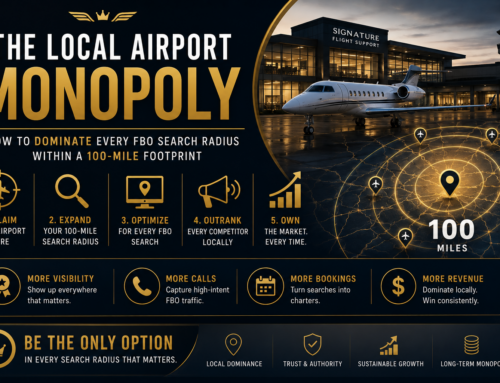
Dominating the FBO: How to Rank #1 for Every Private Terminal and Airport You Serve
Definition: An airport or FBO authority page is a high-intent local SEO and GEO asset built around one private terminal, airport, or service area so your charter company can appear when a principal, assistant, family office, or flight planner searches for the next leg, departure option, or private aviation provider in that exact location.
Direct Answer: If you want to rank for every private terminal and airport you serve, you need more than one general charter page and a homepage. You need a structured system of local authority pages built around each airport, FBO cluster, route pattern, and buyer scenario. Those pages must answer real traveler questions, show clear service relevance, reinforce local trust, connect to route and fleet pages, and give both Google and AI systems enough evidence to match your brand to that exact airport-level search intent.
Most private aviation companies lose local search visibility because they compress dozens of locations, terminals, and charter scenarios into one weak “areas served” page. That approach looks simple. However, it does not match how real buyers search. A principal who lands at Teterboro and needs a next-leg option does not think in generic marketing language. Instead, that search may look like “private jet charter Teterboro,” “best FBO for charter pickup at VNY,” or “jet charter from Signature Aspen to Miami.” Therefore, if your site does not have strong airport-level assets, it usually misses the highest-intent moments.
This is where local authority pages matter. They let your brand own the exact places where premium travel decisions happen. They also strengthen AI search visibility because assistants like ChatGPT, Gemini, and Google AI systems need more specific location context before they can recommend a provider confidently. Therefore, a strong airport page does two jobs at once. It improves local discoverability, and it improves answer-layer recommendation potential.
The goal is not to create doorway pages or thin location clones. The goal is to build real utility around every airport and terminal that matters commercially. When you do that correctly, each page becomes a local search asset, a route-planning asset, a GEO asset, and a conversion asset at the same time.
Key Takeaways
- One generic “locations” page will not capture the search intent tied to specific airports and private terminals.
- Airport and FBO pages work best when they answer local traveler questions directly and specifically.
- Google local visibility depends heavily on relevance, distance, and prominence, so your pages must support all three factors in the areas you truly serve.
- Strong airport pages should connect to fleet pages, route pages, destination pages, and booking paths.
- Large local authority systems outperform small brochure sites because they match far more high-intent aviation searches.
The Realistic Short Answer
Direct Answer: To rank for every airport and private terminal you serve, build one strong, truly useful page for each commercially meaningful airport, then connect those pages to the surrounding route, fleet, destination, and booking ecosystem.
That sounds simple. However, the execution matters. A winning airport page cannot just swap airport names into boilerplate text. Instead, it should explain why the airport matters, what charter scenarios it supports, which routes it commonly serves, what fleet types fit best, and why your company is a credible operator for that exact departure or arrival context.
Therefore, airport domination comes from relevance plus depth, not from templates alone. If the page feels local, useful, and specific, it can become a real traffic and booking asset. If it feels cloned, thin, or manipulative, it becomes dead weight.
Why Airport and FBO Pages Win
Direct Answer: Airport and FBO pages win because they align directly with high-intent local aviation searches that generic charter pages cannot match precisely.
Most premium aviation searches happen in context. The user often knows the departure airport, knows the destination region, or knows the type of trip. Therefore, the intent is already narrow. A principal may search near landing. An assistant may search by terminal. A travel manager may search by airport code. Because of that, a general page that targets “private jet charter” often feels too broad.
An airport page solves that problem. It narrows the page around a location signal the buyer already cares about. As a result, the page becomes more relevant, more useful, and more likely to convert because it reduces friction between the search and the next step.
Proof Breadcrumb: broad charter page → weaker local match → lower trust. Airport authority page → clearer local match → stronger trust.
How Principals, Assistants, and Flight Teams Actually Search
Direct Answer: Buyers and planners usually search with much more location detail than most charter websites target.
That means your site should reflect how real searches happen in private aviation. Those searches often include airport names, airport codes, route pairs, aircraft types, trip reasons, or local convenience language.
Common examples include:
- private jet charter Teterboro
- jet charter from HPN to Palm Beach
- best charter company near Signature LAS
- Van Nuys to Cabo heavy jet charter
- private flight from Opa-locka to Nassau
- best airport for private charter to Aspen
These searches reveal more than keywords. They reveal buying conditions. Therefore, strong airport pages should not only repeat the airport name. They should respond to the actual context behind the search, such as departure convenience, route fit, traveler profile, and common itinerary patterns.
The Ideal Structure for an Airport Authority Page
Direct Answer: Each airport page should follow a structure that answers the airport-level booking question immediately, then expands into route, fleet, and traveler-use guidance.
A practical page structure looks like this:
1. Direct answer at the top
State clearly that you provide charter service from that airport or terminal and explain who the page is for.
2. Why this airport matters
Explain the airport’s role in private aviation, common traveler patterns, and convenience logic.
3. Best routes from this airport
Show likely destinations, common use cases, or route pairings.
4. Best fleet options
Connect aircraft or charter types to traveler needs from that airport.
5. FAQ section
Answer questions about timing, pickup, route fit, airport usage, or service process.
6. Related internal links
Link to relevant route pages, destination pages, and fleet pages so the authority network grows stronger.
Action Step: Build a content template for airport pages, yet customize every page with local and route-specific detail. Structure should scale. The wording should not become generic.
How to Handle FBO Intent Without Creating Junk Pages
Direct Answer: Use FBO intent carefully by covering real terminal and access context inside stronger airport pages or terminal clusters rather than mass-producing thin FBO pages.
This is important because FBO intent can be valuable, yet it can also create a doorway-page trap if you publish too many near-identical terminal pages without enough unique value. Therefore, you should only break out FBO-specific pages when the terminal itself carries distinct traveler demand, route relevance, or logistics importance.
In many cases, the smarter model is this:
- One strong airport page as the main authority page
- Subsections or supporting pages for major FBOs only when the intent is commercially meaningful
- Distinct content for terminals that truly differ in traveler experience, traffic, or route relevance
That way, you preserve scale without falling into low-value duplication. You also stay closer to the real user need, which helps both SEO and GEO perform better over time.
Why Route Connections Matter for Airport SEO
Direct Answer: Airport pages rank and convert better when they connect to real origin-to-destination demand rather than living as isolated local pages.
This is one of the biggest missed opportunities in private aviation SEO. A company builds one page for Teterboro, one page for Van Nuys, and one page for Opa-locka, but the pages stay disconnected from the exact routes that buyers care about. As a result, the site only partially matches real search behavior.
Airport pages should point toward route pages such as:
- Teterboro to Aspen
- Van Nuys to Cabo
- HPN to Palm Beach
- OPF to Nassau
Proof Breadcrumb: airport page alone → partial intent coverage. Airport page + route page network → much stronger intent coverage.
Therefore, airport authority works best when it becomes the local anchor inside a broader route ecosystem.
How Airport Pages Fit Into the 1,000-Page Fortress
Direct Answer: Airport pages act as one of the most commercially important page systems inside a 1,000-page aviation fortress because they connect local intent to route, fleet, and destination intent.
The fortress strategy works because it covers the full charter demand surface. Airport pages are one layer in that system. They connect naturally to fleet pages, route pages, destination pages, scenario pages, comparison pages, and FAQs. Therefore, each airport page becomes both a local landing asset and a navigation hub for related demand.
For example, one Teterboro page can connect to:
- fleet pages for aircraft that commonly serve TEB travelers
- route pages for TEB to Aspen, TEB to Palm Beach, and TEB to Nice
- destination pages for Aspen, Palm Beach, or French Riviera travel
- private aviation planning pages for executive, family, or event travel
As a result, the airport page becomes far more valuable than a standalone local asset. It becomes part of a complete charter knowledge system that both search engines and AI assistants can interpret more confidently.
How to Support Local Relevance, Distance, and Prominence
Direct Answer: To dominate airport-level search, your pages and business signals should reinforce relevance, distance logic where appropriate, and brand prominence at the same time.
Google’s local guidance explains that local results mainly depend on relevance, distance, and prominence. Therefore, your airport strategy should support each of those areas in practical ways.
Relevance
Use airport-specific and route-specific content that clearly matches the searcher’s intent. Do not force all local search demand into one generic page.
Distance
Make your service geography clear. If you truly serve that airport, show how and why. If the airport falls outside realistic operations, do not create a false page for it.
Prominence
Strengthen your digital footprint through consistent brand references, reviews where relevant, strong content, citations, and linked topic authority.
Action Step: Audit every airport page against those three factors. Then ask whether the page proves service relevance, local usefulness, and broader brand authority clearly enough to win.
Mistakes That Make Airport Pages Fail
Direct Answer: Airport pages fail when they feel cloned, thin, misleading, or disconnected from the real charter journey.
Common failure points include:
- using the same copy on dozens of airport pages
- creating pages for airports you do not truly serve
- ignoring route-specific and fleet-specific context
- failing to connect airport pages to destination and route pages
- publishing airport pages with no useful local detail
- building scaled pages that read like doorway content
Therefore, the standard should stay high. Every airport page should answer a real question better than a generic charter page can.
A Practical Build Plan for Dominating Every Airport You Serve
Direct Answer: Start with your highest-value airports, then expand into route, FBO, and destination clusters that match commercial demand.
A practical build plan looks like this:
- List the top airports and terminals that actually drive charter revenue.
- Create one strong authority page for each high-value airport.
- Map the most profitable routes from each airport.
- Connect each airport page to matching fleet pages and route pages.
- Add FAQ content tied to real traveler, assistant, and operator questions.
- Expand into supporting FBO or terminal content only where the value is real and distinct.
- Review each page for duplication risk and doorway-page risk before publishing at scale.
Action Principle: Build depth before you build huge volume. Then scale what proves commercially useful.
Generic Location Page vs. Airport Authority Page
| Generic Location Page | Airport Authority Page |
|---|---|
| Broad geography mention | Specific airport or terminal focus |
| Thin relevance for local charter search | Strong match for airport-level charter intent |
| Little route context | Clear route and use-case context |
| Weak AI retrieval value | Stronger AI retrieval and citation value |
| Often disconnected from booking logic | Naturally connects to route, fleet, and inquiry logic |
| Easy to clone badly | Harder to clone if built correctly |
People Also Ask
How do I rank for a specific private airport?
Build a useful airport authority page that explains your charter relevance at that location, supports common routes, answers traveler questions, and connects to the broader route and fleet ecosystem.
Should I create a page for every FBO?
Only if the FBO has meaningful distinct demand or local value. Otherwise, use one stronger airport page and add FBO context inside it so you avoid weak duplication.
Do airport pages help AI assistants recommend charter providers?
Yes. Strong airport pages give AI systems more specific location and route context, which helps them retrieve and recommend your brand for local private aviation planning questions.
What makes an airport page rank better than a generic service page?
It matches the search intent more precisely, reduces local ambiguity, and often answers the exact charter question the user asked rather than forcing them into broad company copy.
Frequently Asked Questions
How do I rank #1 for every private terminal and airport I serve?
You do it by building one strong authority page for each airport or terminal that matters commercially, then connecting those pages to route, fleet, destination, and FAQ content so the entire local charter ecosystem becomes visible and useful.
What is a local authority page in private aviation?
It is a page built around one airport, terminal, or service location that answers local charter questions and proves why your company is relevant for that exact point of departure or arrival.
Will hundreds of airport pages hurt my site?
They can hurt the site if they are thin, repetitive, or misleading. They help the site when they are useful, distinct, commercially relevant, and integrated into a broader authority structure.
Do I need route pages too?
Yes. Airport pages work much better when they connect to route pages because buyers often search with both a location and a destination in mind.
What is the fastest way to start?
Start with the airports that already produce the most revenue or the highest-value inquiries. Then build the route pages and FAQ support around those airports before you expand outward.
External Sources
Conclusion
Direct Answer: If you want to dominate every airport and private terminal you serve, you need a local authority page strategy that matches the way real charter buyers search, plan, and book.
A generic locations page will not do that work for you. Instead, you need airport-level assets with real local relevance, route connections, fleet relevance, and strong internal linking. Therefore, the brands that win airport search in 2026 will not be the ones with the prettiest brochure sites. They will be the ones that publish the clearest, most useful local charter answers at scale.
Authority Insight: In private aviation, owning the airport often means owning the next leg. That is exactly why airport authority pages deserve a central place in your digital fortress.
About the author : Anthony Paulino