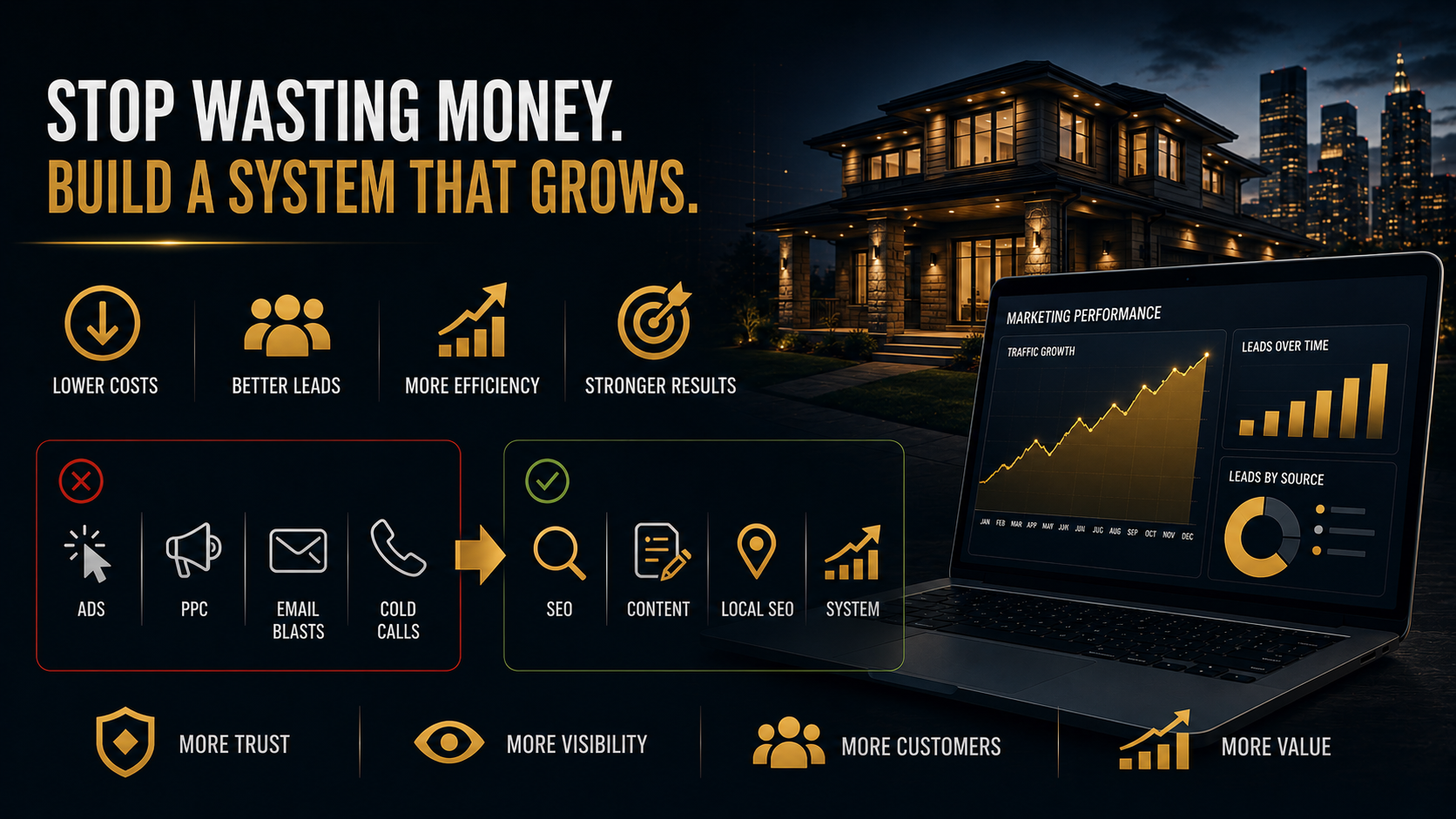
Why Most Home Improvement Companies Waste Money on Marketing
Every year, home improvement companies invest thousands—and sometimes hundreds of thousands—of dollars into marketing. Yet despite those investments, many owners still struggle with inconsistent lead flow, unpredictable revenue, and rising customer acquisition costs.
The problem usually isn’t a lack of effort. Instead, it’s that many businesses invest in individual marketing tactics instead of building one complete marketing system.
One month they launch Google Ads. A few months later they hire an SEO company. Then they purchase leads, redesign their website, or start running Facebook campaigns. Each tactic may produce some results, yet very few of them work together. Consequently, every marketing dollar becomes less effective than it could have been.
Meanwhile, competitors with integrated marketing systems continue building authority, increasing search visibility, lowering acquisition costs, and generating qualified leads month after month.
That difference is why some contractors experience steady growth while others constantly search for the next marketing solution.
Direct Answer
Most home improvement companies waste money on marketing because they buy individual services instead of building a complete digital marketing system. As a result, every campaign starts over from scratch, advertising costs continue increasing, and lead generation becomes inconsistent. Businesses that invest in long-term digital assets create marketing that compounds, generates qualified leads for years, and becomes more valuable over time.
Marketing Isn’t the Problem—The Strategy Is
Ask ten contractors why their marketing isn’t producing better results, and you’ll likely hear ten different answers.
Some blame Google.
Others blame Facebook.
Many blame the marketing agency they hired.
Some assume their market has become too competitive.
However, those explanations rarely identify the real problem.
Successful marketing doesn’t come from finding one magical tactic. Instead, it comes from creating a system where every marketing activity supports every other activity.
Think about how a successful home improvement project works.
An architect creates a plan before construction begins. Every contractor understands their role, each trade builds upon the previous one, and the finished project becomes stronger because every component works together.
Marketing should function the same way.
Your website should support your SEO strategy.
Your SEO strategy should strengthen your Google Business Profile.
Your content should answer homeowner questions before they contact your business.
Your paid advertising should amplify content that already converts.
Your reviews should reinforce every sales conversation.
Your case studies should eliminate buyer objections before estimates begin.
When these pieces operate independently, marketing becomes expensive.
When they operate together, marketing becomes predictable.
Why So Many Contractors Feel Like They’re Starting Over Every Year
One of the biggest frustrations among home improvement business owners is feeling like marketing never gains momentum.
That’s because much of the marketing they purchase disappears the moment they stop paying for it.
If they pause advertising, leads stop.
If they cancel a lead service, opportunities disappear.
If they reduce their ad budget, traffic declines almost immediately.
Every month begins exactly where the previous month ended.
Nothing carries forward.
Nothing compounds.
Nothing becomes a lasting business asset.
Now compare that to companies investing in digital authority.
Every optimized service page becomes another opportunity to rank in search results.
Every educational blog answers additional homeowner questions.
Every location page expands visibility into another community.
Every completed project adds another case study.
Every customer review strengthens trust.
Every backlink increases authority.
Over time, these improvements create a marketing engine that becomes stronger every month instead of restarting every month.
Temporary Marketing vs. Permanent Marketing Assets
Not every marketing investment creates long-term value.
Understanding this distinction is one of the biggest advantages growing contractors have over their competitors.
| Marketing Investment | Works Immediately | Continues Producing Value | Builds Business Equity |
|---|---|---|---|
| Google Ads | ✔ | ✖ | ✖ |
| Facebook Ads | ✔ | ✖ | ✖ |
| Purchased Leads | ✔ | ✖ | ✖ |
| Direct Mail | Sometimes | ✖ | ✖ |
| Radio Advertising | Sometimes | ✖ | ✖ |
| Educational Content | ✔ | ✔ | ✔ |
| SEO Service Pages | ✔ | ✔ | ✔ |
| Authority Website | ✔ | ✔ | ✔ |
| Digital Marketing System | ✔ | ✔ | ✔ |
Many contractors unknowingly spend most of their budgets on temporary visibility while investing very little in assets that continue generating leads years later.
As a result, their marketing costs never decrease because they continue renting attention instead of owning it.
The Hidden Cost of Cheap Marketing
Choosing the lowest-priced marketing option often feels like the safest financial decision.
Ironically, it frequently becomes the most expensive one.
Cheap marketing providers usually focus on generating activity rather than measurable business growth.
They report impressions instead of booked estimates.
They celebrate clicks instead of completed projects.
They highlight website traffic instead of revenue.
Those numbers may look impressive on monthly reports, but they rarely answer the question every contractor actually cares about:
Did this marketing generate profitable jobs?
That single question should determine whether every marketing investment remains in your budget.
Unfortunately, many agencies never answer it.
Instead, they focus on vanity metrics that sound impressive while avoiding the measurements that directly affect profitability.
The most successful home improvement companies evaluate marketing differently.
Rather than asking how many clicks they received, they measure:
- Qualified leads generated
- Booked estimates
- Sales conversion rate
- Average project value
- Customer acquisition cost
- Marketing return on investment
- Revenue generated per marketing dollar
Those numbers reveal whether marketing is building a stronger company—or simply creating attractive monthly reports.
The Referral Trap That Prevents Sustainable Growth
Ask many successful contractors where most of their work comes from, and they’ll proudly answer, “Referrals.”
Referrals are one of the best lead sources any business can have. They typically convert at higher rates, require less selling, and often result in larger projects. However, relying on referrals as your primary growth strategy creates a serious limitation.
You don’t control when someone recommends your business.
One month you may receive dozens of referrals. The next month those recommendations may slow dramatically, even though your company continues delivering excellent work.
Meanwhile, your payroll, equipment payments, insurance premiums, and operating expenses remain exactly the same.
That unpredictability makes hiring, expansion, and revenue forecasting much more difficult.
The strongest home improvement companies still encourage referrals, but they don’t depend on them.
Instead, they build multiple lead sources that work together.
| Lead Source | Business Controls It? | Scalable? | Long-Term Value |
|---|---|---|---|
| Customer Referrals | Limited | Limited | High |
| Google Organic Search | Yes | Excellent | Excellent |
| Google Business Profile | Yes | Excellent | Excellent |
| Educational Content | Yes | Excellent | Excellent |
| Paid Advertising | Yes | Good | Temporary |
| Email Marketing | Yes | Excellent | Excellent |
| Retargeting Campaigns | Yes | Excellent | Supports Other Channels |
When multiple lead sources work together, your business becomes far less dependent on any single channel. Consequently, revenue becomes more predictable and growth becomes easier to sustain.
Most Marketing Agencies Sell Services. Very Few Build Systems.
This is one of the biggest differences between average agencies and agencies focused on long-term business growth.
Most agencies specialize in one service.
- SEO
- Google Ads
- Facebook Ads
- Website Design
- Video Production
- Social Media
Each service has value. However, none of them should exist in isolation.
Imagine hiring six specialists who never communicate with one another. Although each may produce quality work, the overall marketing strategy becomes fragmented.
Instead, every component should support the others.
For example:
- Your blogs should strengthen your service pages.
- Your service pages should improve organic rankings.
- Your rankings should reduce paid advertising costs.
- Your paid advertising should remarket visitors who discovered your business organically.
- Your case studies should improve conversion rates.
- Your reviews should reinforce trust throughout the buying journey.
- Your AI optimization should increase visibility in emerging search platforms.
That’s the difference between buying marketing services and building a marketing system.
Homeowners Don’t Buy the First Company They Find Anymore
The customer journey has changed dramatically over the last decade.
Today’s homeowners rarely click the first advertisement they see and immediately schedule a project.
Instead, they research.
They compare companies.
They read reviews.
They ask AI search engines questions.
They watch videos.
They browse project galleries.
They visit multiple websites before requesting estimates.
Every one of those interactions influences whether your company earns the opportunity to provide a quote.
If your competitors consistently answer more homeowner questions than you do, they naturally become more visible throughout the buying process.
That visibility builds familiarity.
Familiarity builds trust.
Trust increases conversion rates.
This is why educational marketing consistently outperforms purely promotional marketing over the long term.
Marketing Should Become More Efficient Every Year
Many contractors accept rising advertising costs as an unavoidable part of doing business.
However, an effective marketing system should become more efficient over time.
As your authority grows, your website earns more organic traffic.
As organic traffic grows, you become less dependent on paid advertising.
As your content library expands, you answer more homeowner questions.
As more questions are answered, qualified prospects arrive further along in the buying process.
As your reviews increase, trust improves.
As trust improves, conversion rates increase.
Each improvement strengthens every other marketing channel.
Eventually, your marketing begins generating momentum rather than requiring constant replacement.
The 1,000-Page Advantage
Many contractors think of their website as a digital brochure.
High-growth companies think of it differently.
They view every page as another opportunity to attract qualified homeowners.
Every service page targets another search.
Every city page expands local visibility.
Every blog answers another homeowner question.
Every case study builds credibility.
Every FAQ captures another search intent.
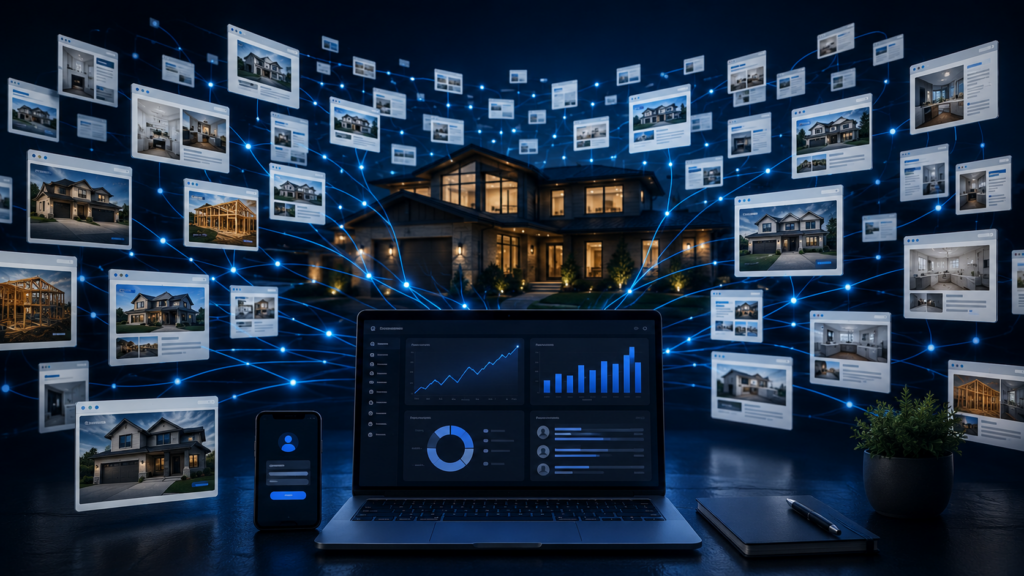
Instead of creating ten pages and hoping they rank, they build hundreds—or even thousands—of highly relevant pages over time.
Each page becomes another digital asset capable of producing leads long after it is published.
Although no single page changes a business overnight, hundreds of optimized pages working together create a powerful competitive advantage.
That is why businesses investing in digital real estate continue widening the gap between themselves and competitors relying solely on advertising.
What Smart Home Improvement Companies Measure Instead
Marketing success shouldn’t be determined by impressions, likes, or website traffic alone.
Instead, successful contractors focus on the numbers that directly affect profitability.
| Vanity Metric | Business Metric That Actually Matters |
|---|---|
| Clicks | Booked Estimates |
| Website Visitors | Qualified Leads |
| Social Followers | Sales Opportunities |
| Page Views | Projects Sold |
| Impressions | Revenue Generated |
| CTR | Customer Acquisition Cost |
| Traffic Growth | Marketing ROI |
Traffic is important.
Visibility matters.
Brand awareness has value.
However, none of those metrics pay employees or grow your business unless they ultimately produce profitable projects.
Stop Renting Your Marketing. Start Owning It.
Advertising will always have an important place in home improvement marketing.
However, advertising should accelerate an already strong marketing system—not replace one.
The companies that consistently outperform their competitors understand a simple principle.
Every marketing investment should either generate immediate revenue, build a long-term digital asset, or ideally accomplish both.
When your website grows stronger every month, your authority increases every year, and your content continuously answers homeowner questions, marketing stops feeling like an expense.
Instead, it becomes one of the most valuable assets your business owns.
That shift changes everything.
Frequently Asked Questions
Why do so many home improvement companies struggle with marketing?
Many companies struggle because they focus on individual marketing tactics instead of building a complete marketing system. They purchase Google Ads, Facebook Ads, websites, or SEO separately without creating a strategy that allows every marketing channel to support the others. As a result, lead generation remains inconsistent and marketing costs continue rising.
Is paid advertising a waste of money?
No. Paid advertising can generate qualified leads quickly when managed correctly. However, relying entirely on paid advertising means your lead flow often stops the moment your budget stops. The strongest marketing strategies combine paid advertising with long-term digital assets that continue generating traffic and leads.
What is the biggest marketing mistake contractors make?
The biggest mistake is treating marketing as a monthly expense instead of a long-term business investment. Companies that continuously build authority through educational content, service pages, local SEO, reviews, and case studies create marketing systems that become more valuable every year.
How can contractors reduce their customer acquisition costs?
Customer acquisition costs typically decrease when businesses improve their organic visibility, strengthen local SEO, publish helpful content, build authority, and generate more qualified traffic without relying exclusively on paid advertising.
Why is SEO important for home improvement companies?
SEO helps contractors appear when homeowners actively search for services. Unlike paid advertising, well-optimized pages can continue generating qualified traffic for years, making SEO one of the highest long-term ROI marketing investments for many home improvement businesses.
How many website pages should a contractor have?
There is no perfect number. However, companies that consistently publish high-quality service pages, location pages, educational blogs, FAQs, comparison pages, and case studies generally create more opportunities to appear in search results than companies with only a handful of pages.
Final Thoughts
Most home improvement companies don’t fail because they refuse to invest in marketing.
Instead, they fail because they invest in marketing that disappears.
Every month they purchase visibility without creating lasting business value.
Consequently, they remain dependent on advertising platforms, shared lead providers, and constantly increasing acquisition costs.
The companies that consistently outperform their competitors take a different approach.
They build marketing systems instead of isolated campaigns.
They invest in digital assets instead of temporary exposure.
They publish helpful content instead of chasing quick wins.
They strengthen their authority every month instead of restarting every year.
Most importantly, they understand that marketing should become more valuable over time—not more expensive.
That’s how predictable growth is built.
Ready to Build a Marketing System Instead of Buying More Marketing?
If your company is tired of unpredictable lead flow, rising advertising costs, and marketing that disappears every month, it’s time to build something that compounds.
At Infinite Media Resources, we help home improvement companies create complete digital marketing systems designed to generate qualified leads today while building long-term business value for years to come.
Instead of focusing on one tactic, we develop integrated strategies that combine SEO, AI search optimization, high-converting websites, educational content, local authority, paid advertising, and automation into one scalable growth system.
Because every business is different, every strategy is built around your goals, your market, and your long-term vision.
Ready to stop renting your marketing and start owning it?
Contact Infinite Media Resources to learn how a complete digital marketing system can help your home improvement company generate more qualified leads, lower acquisition costs, and create lasting competitive advantages.
About the author : Anthony Paulino