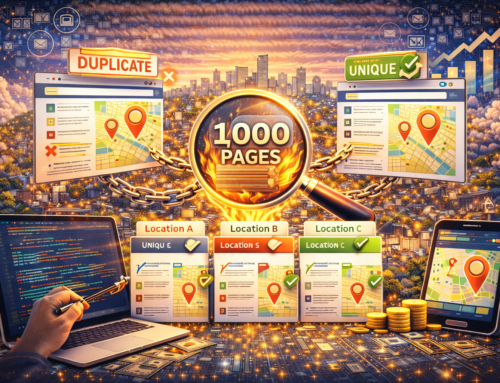
The Role of Internal Linking in a 1,000-Page Local SEO Strategy
Direct answer: The role of internal linking in a 1,000-page local SEO strategy is to control relevance, distribute authority, and prevent keyword cannibalization while helping search engines and AI systems understand page relationships at scale.
Scaling local SEO sounds simple. However, scale without structure collapses quickly. Pages compete, signals blur, and rankings stall. As a result, many enterprises publish hundreds of pages yet fail to see meaningful growth.
Internal linking fixes that problem. Because links act as guidance systems, they tell search engines which pages matter, how topics connect, and where authority should flow. Consequently, a strong internal linking framework becomes the backbone of any large local SEO or GEO deployment.
This guide explains the role of internal linking in practical terms. Additionally, each section shows how to apply these concepts inside a 1,000-page environment. If you want IMR to build the full system for you, explore:
1000 Page Local Authority Lockdown.
Table of Contents
- Why internal linking matters more at scale
- How search engines interpret internal links
- Building a hierarchy that prevents cannibalization
- How authority flows through a 1,000-page site
- Anchor text rules for large local systems
- Internal linking between geo-pages
- Using blogs and resources to reinforce local pages
- Technical safeguards for internal linking
- Why internal linking matters for AI search and GEO
- KPIs that reveal internal linking performance
- A phased internal linking rollout plan
- FAQs
- Next steps
Why internal linking matters more at scale
Direct answer: Internal linking matters more at scale because it prevents pages from competing against each other for the same intent.
Small sites survive with loose structure. However, large sites collapse without discipline. Because hundreds of pages target related queries, overlap becomes inevitable. Consequently, search engines struggle to decide which page deserves visibility.
Internal links solve that confusion. By pointing authority and relevance intentionally, you guide algorithms toward the correct destination. Therefore, the role of internal linking expands as page count grows.
How search engines interpret internal links
Direct answer: Search engines treat internal links as signals that describe page importance, topical relationships, and site structure.
Links act like roads. When many roads lead to one page, that page looks important. Conversely, pages with few links appear secondary. Because crawlers follow links to discover and evaluate content, structure shapes understanding.
Google explains this clearly:
Google Internal Linking Documentation.
Internal links also reinforce topical clusters. As a result, pages grouped correctly gain stronger contextual relevance.
Building a hierarchy that prevents cannibalization
Direct answer: A clear hierarchy assigns one role to each page, which stops keyword cannibalization before it begins.
Without hierarchy, pages fight. However, hierarchy creates order. Because each level serves a different purpose, overlap disappears.
A safe hierarchy for a 1,000-page local SEO system includes:
- Core service hubs defining what you offer.
- Regional or state hubs setting geographic context.
- City-level geo-pages capturing transactional intent.
- Supporting blogs answering questions and objections.
Internal links should always reinforce this structure. Therefore, hubs link downward, while child pages link upward.
How authority flows through a 1,000-page site
Direct answer: Authority flows from high-level pages to lower-level pages through intentional internal links.
Authority does not spread evenly. Instead, it follows paths. Because homepage and hub pages usually attract the most backlinks, they become distribution points.
To control authority flow:
- Link from high-authority hubs to priority geo-pages.
- Limit excessive lateral linking between sibling pages.
- Use consistent linking patterns across sections.
When authority flows correctly, geo-pages rank faster and more consistently.
Anchor text rules for large local systems
Direct answer: Anchor text must signal relevance without creating over-optimization risk.
Anchor text acts like a label. Therefore, it should describe the destination naturally. Because repetition triggers spam signals, variation matters.
Use these anchor text rules:
- Mix exact, partial, and contextual phrases.
- Avoid repeating the same anchor across many pages.
- Match anchor intent to page purpose.
This balance supports relevance while protecting rankings.
Internal linking between geo-pages
Direct answer: Geo-pages should link sparingly to each other, and only when buyer comparison makes sense.
Over-linking geo-pages creates confusion. However, strategic linking improves navigation. Because users sometimes compare nearby markets, selective links help.
Good geo-page linking examples include:
- Neighboring cities with shared service areas.
- Suburbs connected to a primary metro hub.
- Service-area boundary explanations.
Every geo-page should also link back to its primary service hub.
Using blogs and resources to reinforce local pages
Direct answer: Supporting content strengthens geo-pages by answering questions and feeding authority through internal links.
Blogs often attract broader informational traffic. Therefore, they act as authority feeders. When you link from a strong blog into a geo-page, relevance transfers.
Effective supporting content includes:
- FAQs tied to local objections.
- Process explanations.
- Industry education.
IMR aligns these systems through:
Generative Engine Optimization
and
Full Service Digital Marketing.
Technical safeguards for internal linking
Direct answer: Technical safeguards ensure internal links remain crawlable, consistent, and scalable.
Broken links erode trust. Therefore, enterprises must enforce technical hygiene. Because errors multiply at scale, automation becomes essential.
Critical safeguards include:
- Automated link audits.
- Consistent navigation rules.
- Controlled pagination.
- XML sitemap alignment.
These controls keep internal linking effective over time.
Why internal linking matters for AI search and GEO
Direct answer: Internal linking helps AI systems understand relationships, hierarchy, and topical authority.
AI search systems summarize content based on structure. Because links reveal relationships, strong internal linking improves extractability.
Clear linking also supports entity recognition. As a result, AI-generated answers reference your content more confidently.
KPIs that reveal internal linking performance
Direct answer: Specific KPIs show whether internal linking works or fails.
Track these indicators:
- Indexation depth by section.
- Ranking stability across similar pages.
- Click distribution by hub.
- Internal cannibalization reports.
Early detection prevents long-term damage.
A phased internal linking rollout plan
Direct answer: Phased rollout reduces risk while validating structure.
Phase 1: Define hierarchy and linking rules.
Phase 2: Implement links on pilot sections.
Phase 3: Expand system-wide with QA checks.
This approach balances speed and safety.
FAQs
Can internal linking replace backlinks?
Direct answer: Internal linking cannot replace backlinks, yet it maximizes the value of existing authority.
How many internal links should a page have?
Direct answer: Enough to guide relevance clearly without overwhelming the page.
Does internal linking affect AI Overviews?
Direct answer: Yes, because AI systems rely on structure to understand context.
Next steps
Direct answer: To scale local SEO safely, define hierarchy, enforce linking rules, and monitor performance continuously.
Internal linking is not decoration. Instead, it acts as the nervous system of a 1,000-page local SEO strategy. When built correctly, it transforms chaos into predictable growth.
If you want IMR to implement the full system for you, start here:
1000 Page Local Authority Lockdown.
About the author : Anthony Paulino