SEO vs. PPC: Which Delivers a Higher ROI in the Long Term?
Definition: SEO improves unpaid visibility in search over time, while PPC buys immediate visibility through paid ads that stop when the spend stops.
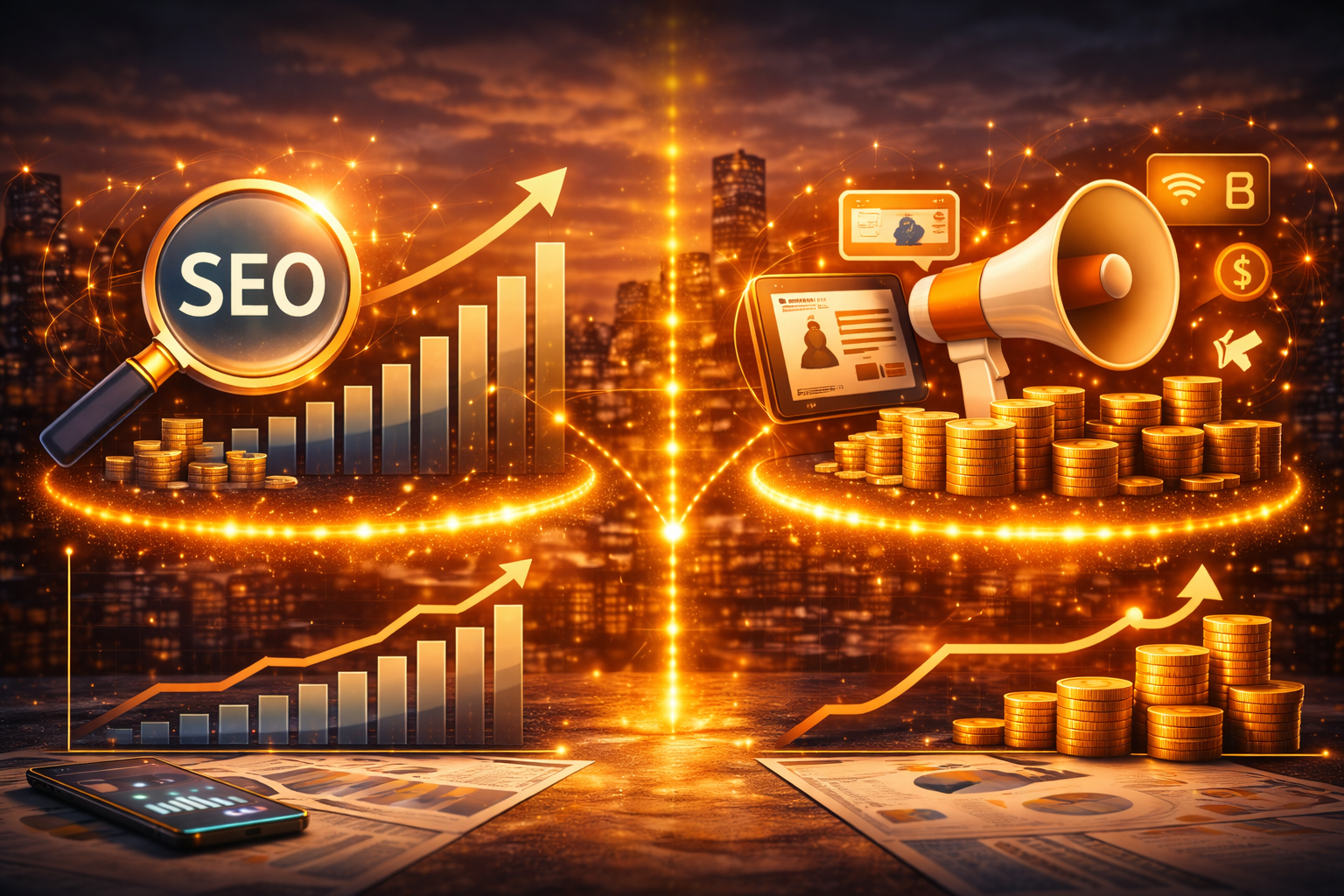
Direct Answer: In the long term, SEO usually delivers a higher ROI than PPC because strong organic visibility can keep producing traffic, leads, and authority long after the initial work is done. PPC usually wins on speed and control, but SEO often wins on efficiency, compounding value, and cost stability over time.
That does not mean PPC is weaker. In fact, PPC is often the faster path to leads, testing, and bottom-funnel traffic. However, if the question is strictly about long-term ROI, SEO usually has the edge because it builds an asset. PPC, by contrast, behaves more like rented attention. Once the spend pauses, the traffic usually disappears with it.
This matters because many companies waste time trying to “pick a side” when the real answer depends on timeline, competition, sales cycle, and budget maturity. Still, if leadership wants to know which channel tends to create more durable returns over the long haul, the answer is usually SEO.
Key Takeaways
- SEO usually delivers stronger long-term ROI because traffic can continue after the upfront investment.
- PPC usually delivers faster results because ads can go live immediately.
- PPC costs are easier to predict at the start, but they can rise fast in competitive markets.
- SEO takes longer to mature, but it often becomes more efficient as rankings, content depth, and authority improve.
- The strongest search strategy for many businesses is not SEO or PPC. It is SEO and PPC working together.
What SEO and PPC Are Really Optimizing For
Direct Answer: SEO is usually optimizing for durable visibility and lower marginal acquisition cost over time, while PPC is usually optimizing for speed, targeting, and immediate lead flow.
SEO works by improving a site’s visibility in organic search through content quality, technical health, internal linking, topical depth, and search relevance. Google’s SEO Starter Guide makes it clear that useful content and clear site structure help search engines understand pages and surface them for relevant searches. That means SEO builds value slowly, but it can keep paying off after the work is published and indexed.
PPC works differently. It gives a business the ability to buy placement for high-intent searches right away. That is powerful because it creates immediate traffic, immediate testing opportunities, and immediate visibility for offers that may not yet rank organically. So, PPC is excellent when speed matters.
The real difference is that SEO tends to create an owned asset, while PPC tends to create a paid access point. That difference alone explains why long-term ROI often favors SEO.
Speed vs. Compounding Returns
Direct Answer: PPC usually wins in the short term, but SEO usually wins in the long term because its returns can compound instead of resetting every month.
PPC can be launched fast. A company can create campaigns, target keywords, turn on ads, and start collecting clicks almost immediately. That makes it ideal for promotions, new service launches, geographic testing, and high-intent demand capture.
SEO moves more slowly. Pages need to be created, optimized, crawled, indexed, and trusted before strong results show up. That delay frustrates some businesses. However, once a page ranks well, it can continue producing visits and leads without charging the business for every click.
This is the core reason long-term ROI usually leans toward SEO. PPC is powerful, but it often resets every billing cycle. SEO takes longer, yet it can keep generating value from work done months earlier. So, while PPC is faster, SEO is often more durable.
How the Cost Structure Is Different
Direct Answer: SEO usually has a heavier upfront build cost, while PPC usually has a clearer ongoing media cost that never truly goes away.
With SEO, companies usually invest in strategy, technical fixes, service pages, blogs, internal linking, schema, content hubs, and ongoing updates. That means the cost is front-loaded and operational. Once those assets are built, they can continue working with less direct traffic cost.
With PPC, the spending model is simpler but more relentless. You pay for traffic as it comes in. That creates predictability, but it also creates dependency. If CPCs rise, competition increases, or conversion rates fall, the economics can change quickly.
That is why leadership teams should not evaluate SEO and PPC with the same lens. One is partly an asset-building model. The other is partly a media-buying model. Both matter, but they behave differently over time.
What PPC Benchmarks Tell Us About ROI Pressure
Direct Answer: Current PPC benchmark data shows why paid search can get expensive fast and why long-term ROI pressure often increases as competition rises.
WordStream’s 2025 PPC benchmarks analyzed more than 16,000 U.S.-based campaigns and found the following overall averages:
- Average click-through rate: 6.66%
- Average cost per click: $5.26
- Average conversion rate: 7.52%
- Average cost per lead: $70.11
Proof Breadcrumb: 2025 PPC benchmark math means 100 paid leads at the average CPL would cost about $7,011 in media alone before management, landing page work, creative, or CRM costs are added.
Those numbers do not mean PPC is inefficient. They mean PPC needs disciplined economics. If a business knows its close rate, lifetime value, and profit margin, PPC can be a strong ROI driver. But when leadership ignores those numbers, paid search can turn into a very expensive traffic source.
This is exactly where SEO often gains its long-term edge. Strong organic rankings can keep sending traffic without billing the company for each additional visit.
Why SEO Usually Wins the Long-Term ROI Argument
Direct Answer: SEO usually delivers better long-term ROI because it compounds, lowers dependence on paid clicks, strengthens brand visibility, and improves acquisition efficiency over time.
There are four main reasons for this.
1. SEO creates reusable assets
A strong service page, guide, comparison article, or local landing page can continue ranking and converting long after it is published. That means the initial investment may keep paying back for months or even years.
2. SEO reduces marginal traffic cost
After content begins ranking, the business is not paying a platform for every click. The site still needs maintenance and updates, but the click itself is not billed like PPC traffic is.
3. SEO supports authority and trust
Strong organic visibility helps buyers see the company as established and credible. That matters because many users trust organic results differently than ads, especially for research-heavy decisions.
4. SEO supports AI citation and visibility
Well-structured content, direct answers, FAQ sections, and schema can improve how search engines and AI systems understand a page. That gives SEO-driven content even more long-term value in modern search environments.
HubSpot’s 2025 marketing data also noted that blog posts were among the top five highest-ROI content formats according to marketers. That is not identical to SEO ROI, but it strongly supports the idea that search-oriented content still produces long-lived marketing value.
When PPC Can Still Deliver Better ROI
Direct Answer: PPC can deliver better ROI when speed matters, rankings are weak, the offer is highly optimized, or the business needs immediate bottom-funnel demand.
There are several situations where PPC may beat SEO in practical ROI terms.
- A new company has no organic footprint yet.
- A business is launching a time-sensitive offer or promotion.
- The keyword has immediate purchase intent and strong conversion economics.
- The company wants to test messaging, markets, or landing pages quickly.
- The category is so competitive organically that paid search becomes the faster entry point.
In those cases, PPC can be the better investment because the opportunity cost of waiting on SEO is too high. So, even though SEO often wins the long game, PPC can absolutely win the right moments.
The Best Long-Term Strategy Is Usually Both
Direct Answer: The strongest long-term ROI usually comes from using PPC for speed and SEO for compounding growth rather than forcing one channel to do everything.
HubSpot’s guidance on SEO and PPC makes this point clearly: these are two sides of the same search traffic coin. PPC can drive immediate demand, while SEO builds a stronger base that reduces long-term dependence on paid traffic.
That combined strategy often looks like this:
- Use PPC to test keyword intent, offers, and landing pages.
- Use SEO to build lasting pages around proven search demand.
- Use PPC retargeting to recover visitors from organic traffic.
- Use organic content to lower future acquisition costs and build authority.
This is usually the smartest answer for serious growth. It also avoids the trap of treating SEO and PPC like enemies when they often work best together.
Comparison Table
Direct Answer: SEO usually wins on long-term efficiency, while PPC usually wins on speed and control.
| Factor | SEO | PPC |
|---|---|---|
| Speed to traffic | Slow to moderate | Fast |
| Long-term ROI | Usually stronger | Usually weaker than SEO over time |
| Upfront control | Lower | High |
| Cost per click | No direct click charge | Paid every click |
| Compounding value | Strong | Limited |
| Best use case | Authority, evergreen traffic, long-term growth | Immediate leads, testing, promotions, bottom-funnel demand |
Why This Matters
Direct Answer: This matters because companies that misunderstand the SEO vs. PPC decision often overspend on short-term traffic or underinvest in long-term search assets.
If leadership expects immediate results, PPC is usually the more honest answer. If leadership wants a channel that can keep producing value after the initial work is done, SEO usually deserves more investment. The strongest companies understand both truths at once. That is what allows them to build short-term pipeline without sacrificing long-term efficiency.
People Also Ask
Is SEO better than PPC for ROI?
In the long term, SEO usually delivers better ROI because it can continue generating traffic without charging for each click.
Does PPC work faster than SEO?
Yes. PPC usually works faster because ads can launch immediately, while SEO takes time to build rankings and trust.
Should small businesses do SEO or PPC first?
That depends on urgency. If leads are needed now, PPC may come first. If the goal is lower long-term acquisition cost, SEO should be built as early as possible.
Can SEO and PPC work together?
Yes. In many cases, the highest total ROI comes from combining PPC speed with SEO compounding value.
Frequently Asked Questions
SEO vs. PPC: which delivers a higher ROI in the long term?
SEO usually delivers a higher long-term ROI because it creates lasting visibility and does not charge for each click once pages rank.
Why does PPC still matter if SEO has higher long-term ROI?
PPC still matters because it produces immediate traffic, captures bottom-funnel intent, and helps businesses test offers and keywords quickly.
What makes PPC more expensive over time?
Paid search stays dependent on media spend. If CPCs rise or conversion rates weaken, the economics can become harder to sustain.
How long does SEO usually take to show ROI?
It varies by competition and site strength, but SEO usually takes longer than PPC because content must be indexed, trusted, and ranked before it compounds.
What is the smartest way to use both channels?
Use PPC for speed, testing, and demand capture, then build SEO around the terms and pages that prove commercial value over time.
External Sources
Conclusion
Direct Answer: If the question is about long-term ROI, SEO usually wins. If the question is about speed, control, and immediate lead flow, PPC usually wins.
The real mistake is thinking one channel makes the other unnecessary. SEO is usually the stronger long-term investment because it compounds, builds authority, and keeps working after the original spend. PPC is usually the stronger short-term engine because it creates immediate visibility and faster testing.
Authority Insight: The companies that usually outperform their market do not choose SEO or PPC in isolation. They use PPC to accelerate learning and revenue now, then use SEO to build the lasting search assets that improve ROI year after year.
About the author : Anthony Paulino