Transforming National Reach into Local Revenue: The Enterprise Guide
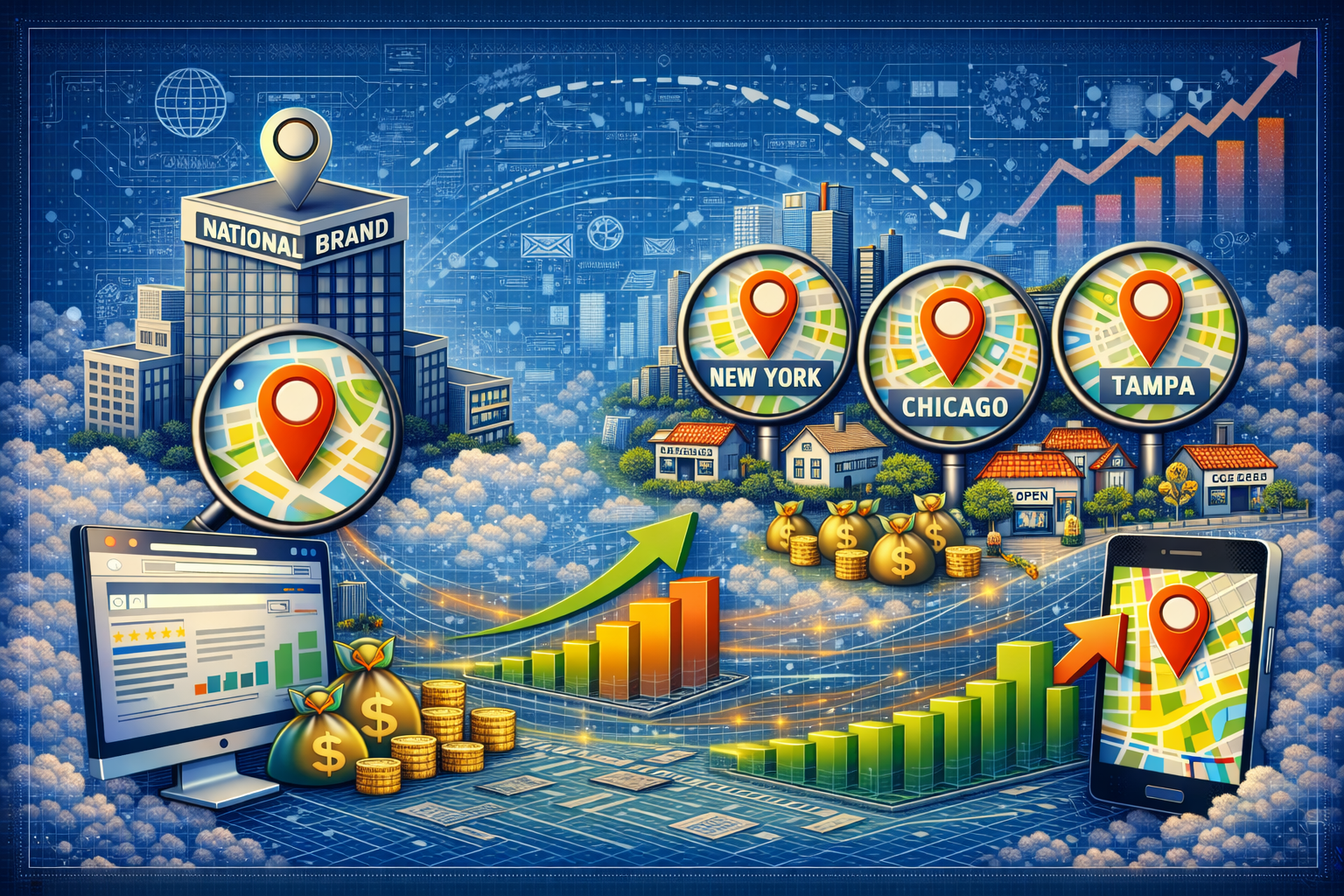
Direct answer: Enterprises convert national reach into local revenue by aligning services with city-level intent using structured content, internal linking, and scalable SEO and GEO systems that match how people actually search.
National visibility looks impressive on reports. However, visibility alone rarely produces consistent revenue growth. Buyers still search locally, so value leaks away when enterprise sites fail to meet city-level intent. As a result, smaller competitors often capture high-intent leads despite weaker brand recognition.
Search behavior continues to evolve quickly. Google still ranks links, yet AI-generated answers increasingly shape decisions earlier in the funnel. Because of this shift, enterprises must prove relevance at the local level instead of relying on brand authority alone. Otherwise, traffic grows while conversions remain stagnant.
This guide explains how enterprise organizations close that gap using practical systems. Additionally, each section outlines steps your team can apply immediately. If you prefer a fully built solution, explore the program here:
1000 Page Local Authority Lockdown.
Table of Contents
- Why national reach fails to convert locally
- How local intent drives real revenue
- The enterprise architecture that unlocks local revenue
- How to build local pages that convert
- How internal linking multiplies local impact
- Why schema improves trust for AI and search
- How enterprises scale without losing control
- KPIs that prove local ROI
- A practical rollout plan
- Next steps
- FAQs
Why national reach fails to convert locally
Direct answer: National reach fails when enterprise sites do not align content with city-level buying intent.
Broad authority attracts impressions. Nevertheless, impressions alone do not convert customers. Most buyers refine searches with cities or service areas, so generic pages miss high-intent queries. Consequently, traffic numbers rise while revenue performance stays flat.
Local relevance also signals urgency. When someone includes a city in a search, intent typically shifts from research to action. Without localized experiences, visitors bounce quickly. Therefore, national brands must pair authority with proximity to stay competitive.
Google reinforces this behavior. Local ranking factors emphasize relevance, distance, and prominence.
Google: Improve Your Local Ranking
details how these signals influence visibility.
How local intent drives real revenue
Direct answer: Local intent converts better because it reflects readiness to act, not curiosity.
Search queries reveal mindset clearly. A broad query often signals early research, while a city-modified query usually signals purchase intent. Because of this difference, localized pages convert at higher rates.
For example:
- “Managed IT services” often suggests exploration.
- “Managed IT services Akron” often suggests immediate need.
Local intent also filters low-quality traffic. As a result, sales teams spend less time qualifying leads and more time closing deals. Revenue efficiency improves even without dramatic traffic increases.
The enterprise architecture that unlocks local revenue
Direct answer: Enterprises unlock local revenue through a structured hierarchy that maps services to regions and cities.
Many organizations publish local pages without a framework. That approach creates overlap, confusion, and keyword cannibalization. Instead, a defined architecture assigns each page a clear role.
A proven structure includes:
- Service hubs explaining offerings and use cases.
- Regional or state hubs providing geographic context.
- City-service pages capturing transactional intent.
- Support content answering objections and reinforcing trust.
This hierarchy also aligns paid media. For instance, city pages can support localized ad groups, which reduces wasted spend. When SEO and paid campaigns align, Quality Scores often improve. IMR supports this alignment through:
PPC Management.
How to build local pages that convert
Direct answer: High-converting local pages combine service clarity, local context therefore building trust signals.
Templates do not ruin local pages. Poor execution causes that problem. Strong templates enforce differentiation, so each page delivers unique value.
Effective local pages typically include:
- Clear explanations of services.
- City-specific needs or constraints.
- Defined service-area boundaries.
- Transparent processes.
- FAQs based on real sales conversations.
AI-driven answers favor clarity and structure. Because of that, begin each major section with a direct answer and keep explanations concise. This approach improves both human conversion and AI extractability.
How internal linking multiplies local impact
Direct answer: Internal linking spreads authority from national pages to local revenue pages.
Disconnected pages compete with each other while connected pages work together. Search engines learn relationships through links, so a strong internal network amplifies visibility.
Use these rules:
- Link service hubs to priority city pages.
- Next Link city pages back to their service hubs.
- Connect related cities where buyers compare options.
Anchor text should remain natural while signaling relevance. For example, “local authority strategy” reads cleanly and still supports context. IMR builds these systems through:
Local Authority Services.
Why schema improves trust for AI and search
Direct answer: Schema markup clarifies business identity, services, and relationships for machines.
Structured data reduces ambiguity. Consequently, AI systems and search engines extract information with greater confidence. Schema also supports richer results and improves citation potential.
Enterprise local systems should include:
- Organization details.
- ProfessionalService definitions.
- WebPage and BlogPosting entities.
- Breadcrumb hierarchy.
- FAQPage markup.
Google explains structured data benefits here:
Google Structured Data Overview.
How enterprises scale without losing control
Direct answer: Governance prevents duplication, cannibalization, and quality decay.
Scaling fails when teams improvise therefore governance fixes this risk by defining rules before expansion begins.
Effective governance includes:
- Keyword-to-URL mapping.
- Required local differentiation blocks.
- Internal linking standards.
- Schema consistency.
- Editorial review cycles.
A done-for-you framework reduces internal friction. IMR embeds governance directly into:
1000 Page Local Authority Lockdown.
KPIs that prove local ROI
Direct answer: City-level metrics reveal revenue impact faster than national averages.
Enterprise dashboards often hide local progress while Market-level reporting fixes that blind spot.
- Indexed city pages.
- Impressions by city.
- Clicks by market.
- Leads by location.
- Conversion rates by city.
Markets that convert well deserve faster expansion. Meanwhile, underperforming locations signal messaging gaps.
A practical rollout plan
Direct answer: A phased rollout validates systems while limiting risk.
Days 1–15: Map priority markets and finalize templates.
Days 16–30: Publish pilot cities and validate performance.
Days 31–45: Expand into secondary markets.
Internal teams can execute this plan. However, IMR accelerates deployment using proven systems.
Next steps
Direct answer: Align services with cities, reinforce with links and schema, and measure performance by market.
National reach becomes profitable when local intent receives equal attention because structure protects quality, while systems protect scale.
To deploy the full system quickly, start here:
1000 Page Local Authority Lockdown.
FAQs
Does local revenue matter for national brands?
Direct answer: Local revenue often drives the majority of enterprise conversions.
Can this strategy work without paid ads?
Direct answer: Yes, although paid media accelerates testing and validation.
Does AI search change local strategy?
Direct answer: AI increases the importance of clarity, structure, and entity trust.
About the author : Anthony Paulino