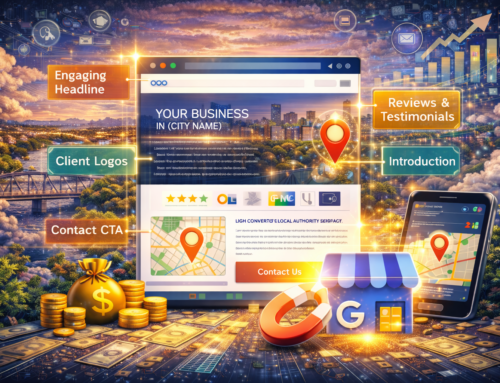
Why “Near Me” Searches Require a Dedicated Local Authority Lockdown
Direct answer: “Near Me” Searches require a dedicated Local Authority Lockdown because Google evaluates local intent using relevance, proximity signals, and trust at the page and entity level, so a scalable system of location-backed pages, internal linking, and consistent business identity wins more often than single-page “local SEO” tactics.
Near-me intent creates the most valuable local traffic. However, most businesses still treat it like a basic keyword problem. Because of that mindset, they optimize a Google Business Profile, publish one “service area” page, and hope the Map Pack carries the rest. As a result, they win sporadically, yet they lose consistency across cities, neighborhoods, and micro-queries.
Local search also shifts quickly. Google still ranks pages, yet AI systems influence choices earlier than before. Therefore, your site must prove local relevance in a way that machines can trust and people can understand fast. Consequently, near-me performance depends on structure, coverage, and consistency, not on one clever trick.
This guide explains how to build a system that wins near-me searches repeatedly. Additionally, it gives you a practical blueprint you can implement now. If you want IMR to build the entire rollout for you, start here:
1000 Page Local Authority Lockdown.
Table of Contents
- What do “Near Me” Searches really mean?
- Why do Near Me Searches feel harder to win?
- Which signals decide Near Me Searches?
- Why does a dedicated Local Authority Lockdown work?
- What page architecture supports Near Me Searches?
- How do you write pages that convert near-me intent?
- How does internal linking boost near-me coverage?
- How does schema improve near-me clarity for AI and search?
- How do you scale without thin content or cannibalization?
- A 30-day rollout plan for Near Me Searches
- FAQs
- Next steps
What do “Near Me” Searches really mean?
Direct answer: “Near Me” Searches signal immediate local intent, so Google tries to deliver the most relevant nearby option with strong trust signals and clear service-location alignment.
Near-me searches do not behave like normal SEO queries. Instead, they behave like “I need this now” requests. Because urgency drives the query, Google prioritizes local relevance and confidence signals. As a result, your site must support your local presence, not just your rankings.
In other words, “near me” acts like a shortcut. The searcher does not type a city, yet they still want a local result. Therefore, Google uses the searcher’s location and your business signals to decide who deserves that click. Consequently, your local authority system must prove you serve the area, you satisfy the need, and you deserve trust there.
For official guidance on local ranking factors, use:
Google: Improve your local ranking.
Why do Near Me Searches feel harder to win?
Direct answer: Near Me Searches feel harder because Google blends proximity with relevance and prominence, while it also changes the results by neighborhood, device, and real-time context.
Near-me results shift more than city-name results. For example, two people in the same city can see different Map Pack options because they stand in different neighborhoods. Additionally, Google adjusts results based on perceived intent, category fit, and trust signals. Because of this complexity, “one local page” rarely covers the full demand curve.
Competition also escalates fast. Local providers optimize their profiles daily, and large brands push broader authority from corporate sites. Therefore, you need a system that supports both visibility and conversion. Consequently, a dedicated Local Authority Lockdown becomes the difference between occasional wins and predictable wins.
Helpful content still matters, even for local queries. Google outlines that direction here:
Google: Creating helpful, reliable, people-first content.
Which signals decide Near Me Searches?
Direct answer: Near Me Searches depend on stacked evidence, including category relevance, on-site location coverage, internal linking, business identity consistency, and real-world trust signals.
Google rarely trusts one signal alone. Instead, it stacks evidence until the result looks safe for the user. Therefore, your strategy must combine multiple supporting layers. As a result, a Local Authority Lockdown focuses on building “proof density” across your site.
Here are the most important signal groups:
How does relevance influence Near Me Searches?
Direct answer: Relevance increases when your pages clearly map specific services to specific locations using consistent language, structured content, and strong internal connections.
- Service-location page alignment: a page exists for the service and the market intent.
- Clear on-page answers: sections start with direct answers that match the query.
- Entity clarity: your business identity stays consistent across the site.
How does proximity affect Near Me Searches?
Direct answer: Proximity changes based on the searcher’s location, yet your coverage pages help Google trust that you truly serve the area around the searcher.
You cannot move your office for every searcher. However, you can publish strong service-area and market coverage that supports relevance for surrounding locations. Because of that support, your site becomes more than a brochure. Consequently, your site becomes an evidence library for where you operate.
How does prominence shape Near Me Searches?
Direct answer: Prominence grows when Google sees consistent brand signals, clear service authority, and connected content that demonstrates expertise across markets.
Prominence includes reviews and brand mentions, yet your website still plays a big role. Therefore, internal linking, topical depth, and structured data help reinforce prominence. As a result, a Local Authority Lockdown treats your site like a network that distributes authority.
Internal linking guidance lives here:
Google: Internal links.
Why does a dedicated Local Authority Lockdown work?
Direct answer: A dedicated Local Authority Lockdown works because it creates consistent, scalable proof that you serve specific areas for specific services, while it also prevents overlap and thin content through governance and linking rules.
Most businesses treat near-me like a surface-level tactic. However, near-me behaves like a system problem. Because Google cross-checks many signals, you need a framework that strengthens those signals together. Consequently, a Lockdown strategy focuses on architecture first, then content, then linking, and finally schema.
A strong Lockdown also reduces wasted work. Instead of rewriting the same “about our company” text across pages, you build a structured library of useful answers. Therefore, each page earns its place. As a result, you scale without quality collapse.
If you want IMR to deploy this system at scale, use:
1000 Page Local Authority Lockdown.
What page architecture supports Near Me Searches?
Direct answer: Near Me Searches perform best when your site uses a hub-and-market structure that connects service hubs to geo-pages and service-area coverage pages.
Architecture removes confusion for users and crawlers. Therefore, you should organize pages so each URL has one job. Because one job per page prevents cannibalization, you avoid internal competition. Consequently, you build a clean system that grows predictably.
Use this baseline model:
- Service hub pages: explain the service, the process, and the outcomes.
- Market hub pages: group regions, states, or multi-city clusters.
- Service + city pages: capture the highest-intent localized searches.
- Neighborhood or micro-area pages: capture dense demand pockets when justified.
- Support content: handle objections, explain pricing, and educate buyers.
Each component supports near-me intent differently. For example, city pages support “service + city” and strengthen coverage for nearby searches. Meanwhile, hubs distribute authority and guide internal linking. Therefore, the system reinforces itself.
If you want a unified approach across channels, you can also connect this framework to your broader marketing through:
Full Service Digital Marketing.
How do you write pages that convert near-me intent?
Direct answer: Pages convert near-me intent when they confirm local fit immediately, explain the process simply, prove trust fast, and guide the visitor to one clear next step.
Near-me visitors arrive impatient. Therefore, your page must remove uncertainty quickly. Because clarity reduces friction, you should start with a direct answer, then explain what happens next. Consequently, you earn the call or the form fill instead of a bounce.
What should the opener include?
Direct answer: The opener should state the service, confirm local coverage, and promise a practical outcome in plain language.
- Confirm the match: “We provide X in Y and surrounding areas.”
- State the outcome: “You get a clear plan and next steps.”
- Reduce risk: “Transparent scope, documented process.”
What local proof should you include?
Direct answer: Include proof that shows you understand local constraints, local expectations, and local timelines without forcing fake specifics.
Use locally relevant blocks that do not rely on invented claims. For example, reference scheduling realities, service boundaries, and common buyer concerns. Additionally, clarify who the service fits best. As a result, the visitor feels understood.
Which objections should your page answer?
Direct answer: Answer timing, pricing expectations, service boundaries, and “what happens next” because these issues block local conversions most often.
Objections exist whether you address them or not. Therefore, you should include a short FAQ that reduces friction. Because near-me intent signals urgency, visitors appreciate clear answers fast. Consequently, your page earns trust.
If you want your near-me system to also support AI citation readiness, IMR can align your content with AI-readable structure through:
Generative Engine Optimization (GEO).
How does internal linking boost near-me coverage?
Direct answer: Internal linking boosts near-me coverage by distributing authority to the pages that represent specific markets, while also helping Google crawl and understand your service-location map.
Links teach relationships. Therefore, your internal linking should show Google how your services connect to your markets. Because connected pages behave like a network, your site becomes easier to interpret. Consequently, you reduce “orphan pages” that never win.
Use these linking rules for Near Me Searches:
- Link every market page back to its service hub.
- Link every service hub to priority markets.
- Link related markets together when demand overlaps.
- Link support content to the revenue pages it strengthens.
Anchor text should sound natural. However, it should still communicate meaning. Therefore, vary anchors while keeping them accurate. As a result, you support relevance without over-optimization.
If you run paid search, you can also align these pages to ad groups. Consequently, you reduce waste and improve landing page match. IMR supports that alignment through:
PPC Management.
How does schema improve near-me clarity for AI and search?
Direct answer: Schema improves near-me clarity by making your business identity, services, and page relationships machine-readable, which reduces ambiguity and supports stronger interpretation.
Schema does not replace content. Instead, schema clarifies content. Therefore, AI systems and search engines can extract facts faster and with more confidence. Consequently, schema supports both visibility and citation readiness.
Use these schema components across your near-me system:
- Organization: consistent phone, email, and address.
- WebSite: publisher identity and site entity anchors.
- ProfessionalService: service types and provider clarity.
- WebPage + BlogPosting: content identity and context.
- BreadcrumbList: hierarchy signals for large sites.
- FAQPage: extractable answers that remove objections.
- SpeakableSpecification: voice-ready excerpts for AI usage.
Google’s structured data overview helps here:
Google: Structured data overview.
Schema.org guidance lives here:
Schema.org: Getting started.
How do you scale without thin content or cannibalization?
Direct answer: You scale safely by mapping one intent per URL, enforcing required uniqueness blocks, and running QA checks on structure, links, and schema consistency.
Scale breaks when teams improvise. Therefore, you need governance before you publish. Because governance prevents duplication, you protect rankings and conversions. Consequently, a Lockdown approach treats content production like a system, not an art project.
Use this governance checklist:
- Keyword map: assign one primary intent per URL.
- Required uniqueness: include local blocks that cannot repeat.
- Internal linking rules: require hub-to-market and market-to-hub links.
- Schema identity rules: keep phone, email, and address consistent.
- QA workflow: verify direct answers, clarity, and conversions.
When you implement these controls, you scale with confidence. As a result, Near Me Searches stop feeling random, and they start behaving predictably.
A 30-day rollout plan for Near Me Searches
Direct answer: Start with a pilot set of markets, validate visibility and conversions, then expand coverage using the same page rules and linking system.
Week 1: Choose priority services and markets based on revenue and capacity. Next, map “service + city” targets and near-me support pages.
Week 2: Build templates with required local blocks, FAQ prompts, and internal linking rules. Also standardize schema identity across every page.
Week 3: Publish a pilot batch across mixed market sizes. Then connect each page into hubs and related markets through internal links.
Week 4: Track indexation, impressions, clicks, calls, and conversion rates by market. After that, expand into the next set of cities and service areas.
This plan keeps quality high while it builds momentum. Consequently, you grow coverage without “thin page” risk.
FAQs
Do Near Me Searches require a city page for every city?
Direct answer: Near Me Searches benefit from city coverage, yet you should prioritize pages for real demand markets first and then scale using a governance system.
Can GBP optimization alone win Near Me Searches?
Direct answer: GBP optimization helps, yet a dedicated on-site Local Authority system strengthens relevance and prominence signals that GBP cannot carry alone.
How fast can we see results from a Local Authority Lockdown?
Direct answer: Many businesses see early visibility signals after indexation, while stronger conversion results follow as coverage, links, and trust signals compound.
Does schema help Near Me Searches?
Direct answer: Schema helps Near Me Searches by reducing ambiguity about your business identity, services, and page hierarchy, which supports clearer machine interpretation.
Next steps
Direct answer: To win Near Me Searches consistently, build a dedicated Local Authority Lockdown with clear service-location pages, strong internal linking, consistent schema identity, and a scalable governance process.
Near-me intent creates high-value opportunities. However, it punishes weak systems. Therefore, treat near-me as a coverage and trust problem, not as a single keyword problem. Because the strongest brands win with structure, you should build a system that proves local relevance in every market you serve.
If you want IMR to build the full framework, the internal linking, and the complete rollout, start here:
1000 Page Local Authority Lockdown.
Author
Infinite Media Resources Strategy Team builds scalable local authority systems that win local intent across markets. Our team combines content architecture, internal linking, and structured data so businesses capture demand from Near Me Searches and service-area queries without sacrificing quality. For a complete done-for-you deployment, explore:
1000 Page Local Authority Lockdown.
About the author : Anthony Paulino