The Anatomy of a High-Converting Local Authority Page
Direct answer: A High-Converting Local Authority Page wins because it matches local intent, proves trust fast, guides the visitor to one clear next step, and supports everything with internal linking and structured data.
Most local pages fail for one simple reason. They exist to “rank,” yet they do not exist to help. However, buyers do not search to admire your page. Instead, they search to solve a problem quickly. Therefore, your page must answer the question, build confidence, and push the visitor toward action without friction.
Local search also shifts fast. Google still ranks pages, yet AI-generated answers now shape trust earlier in the journey. Because of that shift, your local authority pages must read clearly for humans while they also communicate clearly to machines. Consequently, structure matters more than ever.
This guide shows the exact anatomy of a High-Converting Local Authority Page in plain language. Additionally, each section gives you steps your team can apply immediately. If you want IMR to build this entire system at scale, start here:
1000 Page Local Authority Lockdown.
Table of Contents
- What is a High-Converting Local Authority Page?
- What local intent must your page match?
- What structure makes a local authority page convert?
- How do you write an above-the-fold section that converts?
- Which trust signals raise conversions fastest?
- How do you present an offer without sounding salesy?
- How does internal linking build local authority?
- What schema markup should every local authority page use?
- How do you keep pages unique at scale?
- What mistakes destroy conversions on local pages?
- A copy-and-paste checklist for your next build
- FAQs
- Next steps
What is a High-Converting Local Authority Page?
Direct answer: A High-Converting Local Authority Page is a location-targeted page that ranks for local intent and turns that traffic into calls, forms, and booked appointments.
Many businesses publish local pages that look “fine.” However, fine does not convert. A winning page does three jobs at once. First, it matches what the searcher typed. Next, it proves you fit the buyer’s situation. Then, it removes doubt so the buyer takes the next step.
Local authority pages also work as a system, not as isolated pages. Therefore, internal linking, page hierarchy, and consistent business identity all matter. When you connect those pieces, your pages stop competing with each other and start supporting each other instead.
If you want a done-for-you build that includes the system, governance, and scale, IMR offers:
Local Authority Services
and the full enterprise rollout through:
1000 Page Local Authority Lockdown.
What local intent must your page match?
Direct answer: Your page must match “service + location” intent, while it also supports “near me” and service-area intent patterns that signal readiness to act.
Local buyers search like buyers, not like marketers. They type what they need, and then they add where they need it. As a result, location language usually signals higher urgency and higher conversion potential.
For example:
- Research intent: “commercial roofing”
- Action intent: “commercial roofing Cleveland”
- Immediate intent: “commercial roofing near me”
Because intent changes with location, your page must confirm relevance quickly. Otherwise, the visitor bounces, and Google sees weak engagement signals. Consequently, the page loses momentum even if it ranks for a while.
Google also emphasizes relevance and prominence in local results. You can read the official explanation here:
Google: Improve your local ranking.
That guidance supports the same principle: match the query, prove the fit, and build trust.
What structure makes a local authority page convert?
Direct answer: A converting structure starts with clarity, then builds proof, then removes objections, and finally drives one focused action.
Structure creates speed. When the visitor understands the page quickly, they trust you sooner. Therefore, a High-Converting Local Authority Page uses predictable blocks that feel easy to scan.
Use this structure as your baseline:
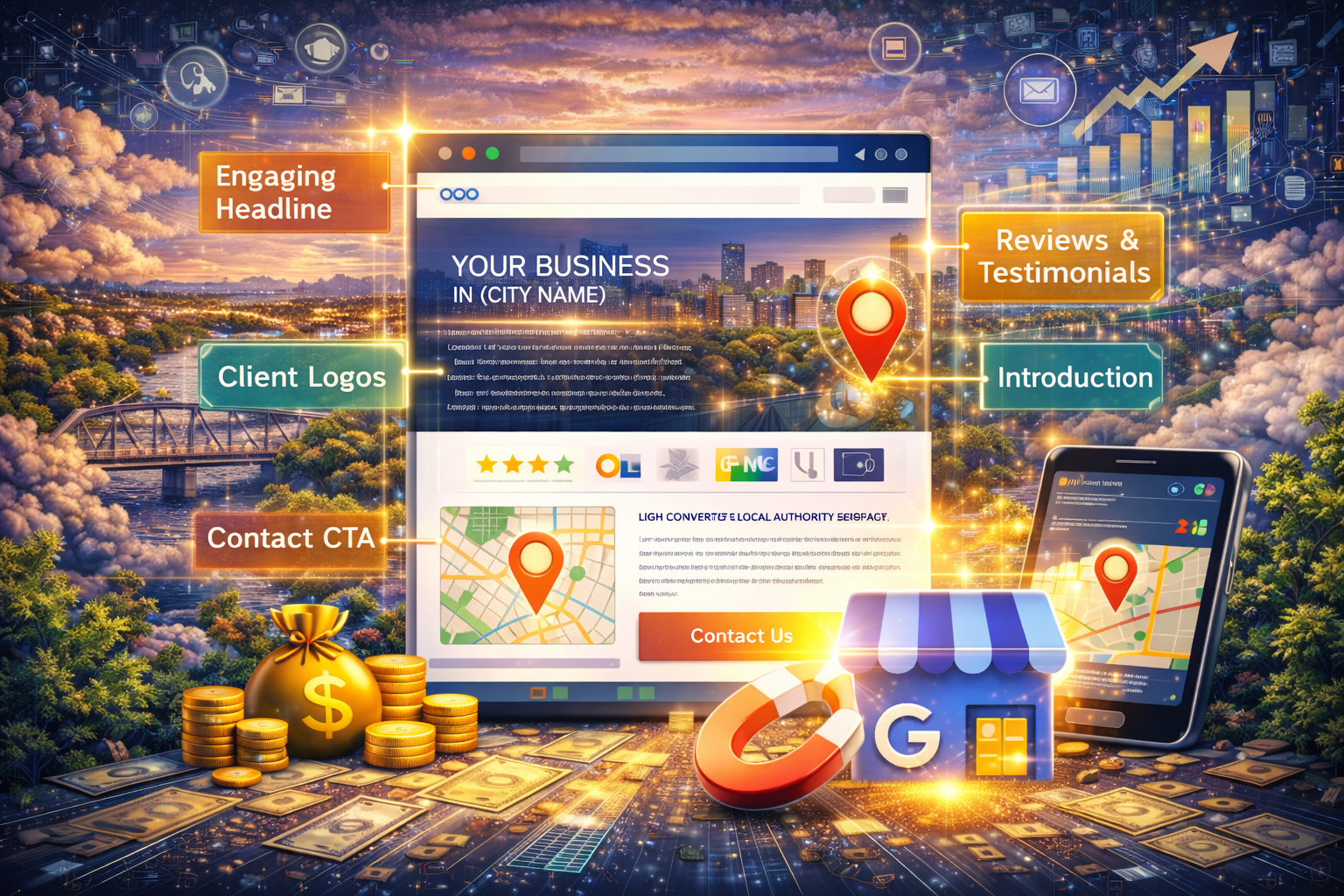
- Above-the-fold clarity (what you do, where you do it, and why it matters)
- Local problem framing (what goes wrong if they wait)
- Process explanation (how it works in simple steps)
- Proof and trust (credentials, guarantees, standards)
- Service-area boundaries (who you help and where you go)
- Objection-handling FAQ (answers that remove hesitation)
- Conversion path (one next step, not five)
AI systems also prefer extractable answers and consistent headings. Because of that, start each section with a direct answer like you see in this article. Google supports this “helpful content” direction here:
Google: Creating helpful, reliable, people-first content.
How do you write an above-the-fold section that converts?
Direct answer: Write an above-the-fold section that states the service, the location, and the outcome, while it also makes the next step feel simple and low-risk.
Visitors decide fast. Therefore, your opener must remove confusion immediately. Instead of “Welcome to our website,” lead with a direct promise that matches local intent.
What is the simplest above-the-fold formula?
Direct answer: Use “Service + Location + Outcome” followed by “Why trust us” and “What happens next.”
Here is a clean formula you can adapt:
- Headline: “(Service) in (City) that solves (pain) fast.”
- One-sentence proof: “Licensed, proven process, clear timelines.”
- One next step: “Book a call” or “Get a quote,” not both plus three extras.
Because you want action, avoid vague claims. Additionally, avoid stuffing keywords into every line. Instead, use clear language that a buyer trusts.
Which micro-proof lines boost conversions quickly?
Direct answer: Micro-proof works best when it mentions outcomes, standards, and what the buyer can expect next.
Use short micro-proof bullets like these:
- Response time: “Fast scheduling, clear next steps.”
- Process: “Simple plan, documented work, predictable results.”
- Trust: “Transparent pricing and clear scope.”
These lines convert because they reduce uncertainty. Consequently, the visitor feels safe taking the next step.
Which trust signals raise conversions fastest?
Direct answer: The fastest conversion lifts come from trust signals that reduce risk, prove competence, and confirm real-world reliability.
Buyers fear wasted time and wasted money. Therefore, your page must reduce risk. While reviews matter, other proof signals often matter just as much, especially for high-ticket services.
Add these trust signals to your High-Converting Local Authority Page:
- Clear process: show steps so the buyer knows what happens next.
- Service boundaries: explain what you do and what you do not do.
- Quality standards: explain how you ensure consistent outcomes.
- Guarantees or policies: show what protects the buyer.
- Real objections answered: handle “price,” “timing,” and “fit.”
Trust also improves when your site communicates clearly to search engines. Therefore, you should pair your content with structured data. Google explains the role of structured data here:
Google: Structured data overview.
How do you present an offer without sounding salesy?
Direct answer: Present your offer as a clear next step that helps the buyer, while you also explain what they get and how fast they get it.
Local authority pages convert when the offer feels like the obvious move. Therefore, avoid hype. Instead, explain outcomes, steps, and timelines in plain language.
Use this offer clarity pattern:
- What you get: “A clear plan and a clear scope.”
- How it works: “We review, we recommend, we execute.”
- What happens next: “You get a call, then you get a plan.”
For enterprise scale, you also need a system that does not collapse under volume. That is exactly why IMR built the:
1000 Page Local Authority Lockdown.
Additionally, if you want AI-ready visibility alongside local coverage, IMR also offers:
Generative Engine Optimization (GEO).
How does internal linking build local authority?
Direct answer: Internal linking builds local authority by connecting your services, locations, and supporting content into a crawlable system that distributes relevance and trust.
Pages do not rank alone. They rank inside a site ecosystem. Therefore, your internal links must guide Google and visitors through a logical path. When the system flows, your authority spreads across markets. Consequently, you earn stronger visibility without publishing random pages.
Google confirms the value of internal links here:
Google: Internal links.
What internal linking rules should you follow?
Direct answer: Link from hubs to markets, link from markets to hubs, and link from supporting content to the pages that drive revenue.
Use these rules:
- Service hub → local pages: link to priority markets that drive revenue.
- Local pages → service hub: reinforce the main service relationship.
- Related markets → related markets: connect nearby cities when intent overlaps.
- Blogs → local pages: support conversions by answering objections and explaining process.
Internal links also improve paid landing experiences. Therefore, your SEO and PPC can reinforce each other when you connect the system. If you want aligned paid strategy, IMR supports:
PPC Management.
Additionally, if you want one coordinated growth plan, IMR offers:
Full Service Digital Marketing.
What schema markup should every local authority page use?
Direct answer: Every local authority page should use Organization, WebSite, ProfessionalService, WebPage, and FAQPage schema, while also adding BreadcrumbList and SpeakableSpecification for stronger AI readiness.
Schema helps machines read your site with less ambiguity. Therefore, it supports clearer interpretation for both search and AI systems. Schema.org explains the foundation here:
Schema.org: Getting started.
At minimum, a High-Converting Local Authority Page benefits from:
- Organization (name, phone, email, address)
- WebSite (publisher identity)
- ProfessionalService (service types)
- WebPage (page entity)
- FAQPage (extractable answers)
- BreadcrumbList (hierarchy clarity)
- SpeakableSpecification (voice-ready excerpts)
Because you want local authority at scale, you should keep organization identity consistent everywhere. That consistency builds trust across hundreds of pages instead of resetting trust each time.
How do you keep pages unique at scale?
Direct answer: Keep pages unique by forcing local differentiation blocks that cannot repeat, while you also assign one clear intent per URL to prevent cannibalization.
Templates do not ruin scale. Weak differentiation ruins scale. Therefore, build a template that requires uniqueness instead of allowing lazy swaps.
Use these uniqueness blocks on every High-Converting Local Authority Page:
- Local constraints: seasonality, scheduling patterns, access, or compliance concerns.
- Service-area boundaries: where you serve and where you do not serve.
- Local buyer concerns: what questions buyers ask in that market.
- Local proof signals: process details that fit that geography.
Because quality drives conversions, your uniqueness should help the buyer, not just help the algorithm. Consequently, your pages become defensible assets instead of thin pages that fade after a short ranking spike.
What mistakes destroy conversions on local pages?
Direct answer: The biggest conversion killers include vague openers, weak proof, unclear next steps, thin pages, and internal linking that leaves pages isolated.
Most failures show up in predictable patterns. Therefore, you can avoid them with a simple QA pass.
Watch for these issues:
- Soft openers: the page never confirms service + location fast.
- Too many CTAs: the visitor feels pulled in five directions.
- No process clarity: the buyer cannot picture how it works.
- No objection handling: price, timing, and fit stay unanswered.
- Weak internal linking: the page has no authority path.
- Inconsistent business identity: phone, email, or address varies.
Additionally, avoid writing that exists only to rank. Google’s helpful content guidance supports this approach:
Google: Helpful content guidance.
A copy-and-paste checklist for your next build
Direct answer: Use this checklist to build a High-Converting Local Authority Page that ranks, converts, and supports AI-ready visibility.
| Section | What to include | Why it matters |
|---|---|---|
| Above the fold | Service + location + outcome, micro-proof, one next step | Reduces confusion and boosts action |
| Local problem | What goes wrong, what improves, who it helps | Matches real buyer intent |
| Process | 3–5 simple steps with timelines | Builds trust and clarity |
| Proof | Standards, guarantees, credentials, expectations | Reduces perceived risk |
| Service area | Coverage boundaries and “who this fits” | Improves lead quality |
| FAQ | Price, timing, fit, what happens next | Removes objections before contact |
| Internal linking | Hub links, related market links, supporting resource links | Builds authority flow |
| Schema | Organization, ProfessionalService, WebPage, FAQ, Breadcrumbs, Speakable | Improves machine clarity |
When you apply this checklist consistently, your results become predictable. Consequently, you stop guessing and start scaling with control.
FAQs
Do local authority pages still work if we already optimize GBP?
Direct answer: Yes, because local authority pages support the same relevance and trust signals while they also capture service + city searches that GBP cannot cover alone.
Should we build one local page or many local pages?
Direct answer: Build enough pages to match real demand in the markets you serve, while you keep one clear intent per URL to avoid overlap.
Does schema actually increase conversions?
Direct answer: Schema improves machine understanding and visibility, which supports better traffic quality, and better traffic quality often increases conversions.
What is the fastest way to scale local authority pages without losing quality?
Direct answer: Use a governance-based template with enforced uniqueness blocks, strict internal linking rules, and consistent schema identity.
Next steps
Direct answer: Start by building one High-Converting Local Authority Page using the checklist, validate conversions, and then scale market coverage using the same system.
Local authority becomes a moat when you build it like a system. Therefore, do not publish random pages and hope for the best. Instead, publish pages with clear intent, strong proof, and internal link support. Additionally, keep schema consistent so machines trust your identity as you scale.
If you want IMR to build the entire structure, the linking system, and the full rollout, start here:
1000 Page Local Authority Lockdown.
Author
Infinite Media Resources Strategy Team designs and builds scalable local authority systems that convert. Our team combines structure, internal linking, and schema to help businesses win city-level demand and stay AI-ready. For a full done-for-you rollout, explore:
1000 Page Local Authority Lockdown.
About the author : Anthony Paulino