How to Build an “Unshakable” Local Search Presence for Large Brands
Direct answer: An “unshakable” Local Search Presence comes from a repeatable system that maps every service to every market, connects pages through internal linking, and reinforces trust with consistent schema so search engines and AI systems confidently recommend you.
Big brands often dominate national visibility. However, national visibility does not automatically create local revenue. Buyers still search with city names, neighborhoods, and “near me” language, so value leaks away when your site fails to match local intent. As a result, smaller competitors can win calls in markets you should own.
Search also evolves fast. Google still ranks links, yet AI-generated answers increasingly influence decisions before the click. Because of that shift, an unshakable Local Search Presence must do more than “rank a page.” Instead, it must prove relevance, clarity, and trust across every location you serve.
This guide stays practical, so you can apply it immediately. Additionally, if you want IMR to build the system for you, start here:
1000 Page Local Authority Lockdown.
Table of Contents
- What does “Local Search Presence” mean for large brands?
- Why large brands lose local leads (even with strong domain authority)
- How to map city-level intent the right way
- What site structure makes Local Search Presence unshakable?
- The city-service page blueprint that converts
- How internal linking stabilizes Local Search Presence across markets
- How schema markup strengthens Local Search Presence for AI citation
- How to scale without duplicates, chaos, or cannibalization
- KPIs that prove your Local Search Presence is growing
- A 30-day rollout plan you can start now
- Next steps
- FAQs
What does “Local Search Presence” mean for large brands?
Direct answer: Local Search Presence means you consistently appear, earn clicks, and generate leads across city-level searches because your site proves local relevance and trust in each market.
Many teams treat local search like a checkbox. However, large brands need local search to behave like an operating system. Therefore, “presence” must include coverage, clarity, and credibility, not only rankings. In other words, you win when your site behaves like a well-organized library of local answers.
Google also explains local visibility through relevance, distance, and prominence. Because those signals matter, your content must clearly connect services to the locations you serve.
Google: Improve Your Local Ranking
breaks down those core factors.
Why large brands lose local leads (even with strong domain authority)
Direct answer: Large brands lose local leads when their pages fail to match city-level intent, so search engines and buyers choose more locally aligned competitors.
Authority helps, yet intent alignment closes deals. Consequently, a national “services” page can rank for broad queries while still missing the buyer who searches “service + city.” Additionally, many enterprise sites bury local relevance inside PDFs, store locators, or thin location pages, so the message stays unclear.
Several problems show up again and again:
- One page tries to rank for everything, so it matches nothing perfectly.
- Location pages lack substance, so they feel generic and interchangeable.
- Internal linking stays inconsistent, so crawlers struggle to discover priority pages.
- Business identity signals vary, so trust drops across platforms and pages.
Meanwhile, smaller businesses often publish focused city pages, earn local engagement, and collect local reviews. As a result, they look “more relevant” for local queries, even when your brand looks bigger overall.
How to map city-level intent the right way
Direct answer: City-level intent mapping works when you assign one primary intent per page, then expand coverage by service and market without overlap.
Start by listing your core services. Next, list your priority markets based on revenue, margins, and capacity. Then, pair them into “service + city” targets that reflect how people actually search. Because mapping drives everything else, this step prevents chaos later.
Use this simple intent map framework:
- Define the service set: pick the services that drive profit, not only volume.
- Define the market set: pick cities you serve and can support operationally.
- Assign one primary query theme per URL: keep overlap low on purpose.
- Layer support queries: add “near me,” neighborhoods, and problem-based modifiers.
For example, a single city can support multiple intents without cannibalization when you separate purpose clearly. One page can target “service + city” while another blog targets a local “how much does it cost” question and links back to the service page.
Additionally, you should align the map with your sales reality. Therefore, prioritize cities where you can respond fast, because speed often increases conversion rates.
What site structure makes Local Search Presence unshakable?
Direct answer: An unshakable Local Search Presence uses a clear hierarchy of hubs and city pages that makes relevance obvious to crawlers, humans, and AI systems.
Structure comes before scale. Otherwise, you publish hundreds of pages and create a cleanup project. Consequently, the best approach uses a repeatable hierarchy that assigns every URL a role.
Use this proven hierarchy:
- Service hubs that explain the offering, outcomes, and proof.
- Market hubs that group states, regions, or major metros.
- City-service pages that capture high-intent transactional searches.
- Support content that answers objections and pre-qualifies buyers.
Internal linking makes this hierarchy work. Therefore, you must connect hubs and cities intentionally.
Google Search Central: Internal links
explains how internal links support discovery and understanding.
If you want IMR to deploy this hierarchy at scale, the system lives inside:
1000 Page Local Authority Lockdown.
If you want the broader framework, use:
Local Authority Services.
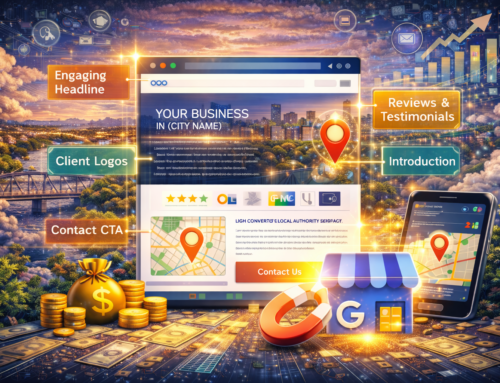
The city-service page blueprint that converts
Direct answer: A converting city-service page delivers a direct answer fast, adds local context that feels real, and guides the buyer to the next action with clarity.
Templates do not ruin city pages. Poor differentiation ruins city pages. Therefore, your template must force uniqueness, even when you publish at scale. Additionally, each section should start with a clear answer, because both humans and AI systems prefer quotable clarity.
Use this page blueprint for each city-service page:
- Local intent opener: explain the buyer problem in that city and why it matters.
- What you do: describe the service in simple steps, not marketing fluff.
- Local expectations: address timing, seasonality, access, or constraints.
- Service boundaries: define coverage honestly to build trust.
- Proof signals: process steps, standards, guarantees, and credibility cues.
- FAQ section: answer real questions your sales team hears locally.
Also, keep the content genuinely helpful. Because Google rewards people-first writing, your pages should solve real problems, not only chase rankings.
Google: Creating helpful, reliable, people-first content
supports that direction clearly.
Finally, avoid copy-paste city blurbs. Instead, include market-specific details that make the page feel “written for us.” For example, mention common buyer constraints, typical scheduling windows, and service-area boundaries that reflect real operations.
How internal linking stabilizes Local Search Presence across markets
Direct answer: Internal linking stabilizes Local Search Presence by distributing authority, improving crawl paths, and reinforcing topical relationships across your city network.
Links create pathways. Consequently, a connected site ranks and converts more consistently than an island-based site. Additionally, internal links help you guide both crawlers and buyers through the exact journey you want.
Use these internal linking rules for large brands:
- Hubs to cities: link service hubs to priority city pages.
- Cities to hubs: link every city page back to the parent service hub.
- City to city: connect nearby markets where buyers compare options.
- Blogs to money pages: link support content to relevant city pages and hubs.
Anchor text should stay natural. However, it should still signal relevance. Therefore, use readable phrases like “local authority strategy” and “city-level coverage system” instead of awkward keyword strings.
If your brand also runs paid search, you can reuse the same city-intent mapping for landing pages. As a result, you reduce waste while improving relevance. IMR supports that alignment through:
PPC Management.
Additionally, a unified strategy across channels often performs best, so this offer helps tie it together:
Full Service Digital Marketing.
How schema markup strengthens Local Search Presence for AI citation
Direct answer: Schema strengthens Local Search Presence by clarifying your entity identity, services, and page structure so AI and search engines extract and trust your information faster.
Schema does not replace good content. Instead, structured data reduces ambiguity. Because AI summaries rely on fast interpretation, schema improves the odds that systems interpret your business consistently across your site.
Use these schema types for a scalable local program:
- Organization for consistent business identity (name, phone, email, address)
- WebSite to connect publisher signals and entity identity
- ProfessionalService to define your services and service area
- WebPage to define the page entity
- BlogPosting to define the article entity
- BreadcrumbList to clarify hierarchy
- FAQPage to provide extractable answers
- SpeakableSpecification to highlight voice-ready excerpts
Google explains structured data here:
Google: Intro to structured data.
Schema vocabulary lives here:
Schema.org: Getting started.
If you want an AI-ready optimization layer on top of local scale, explore:
Generative Engine Optimization (GEO).
How to scale without duplicates, chaos, or cannibalization
Direct answer: You prevent duplicates and cannibalization by locking page standards, mapping one intent per URL, and enforcing quality checks before publishing at scale.
Scale magnifies mistakes. Therefore, governance must start early. Additionally, governance should stay simple, because complex rules rarely survive real teams.
Use this governance checklist:
- Intent map: assign one primary keyword theme per URL.
- Required unique blocks: force local differentiation in every city.
- Link rules: enforce hub-to-city and city-to-hub links.
- Schema consistency: keep business identity uniform across pages.
- Editorial QA: check direct answers, usefulness, and local detail.
- Refresh cadence: update priority markets routinely.
Because internal teams often struggle to maintain this at volume, many brands choose a done-for-you framework. IMR builds governance directly into:
1000 Page Local Authority Lockdown.
KPIs that prove your Local Search Presence is growing
Direct answer: The best proof of a growing Local Search Presence is city-level indexing, impressions, clicks, and conversions that rise across markets, not only in one “hero” city.
Enterprise reporting often hides local progress. However, market-level tracking reveals momentum faster. Therefore, segment performance by city and service.
Track these KPIs by market:
- Index coverage: how many city pages index successfully
- Impressions by city: visibility growth in each market
- Clicks by city: demand capture by location
- Leads by city: calls, forms, and booked meetings
- Conversion rate by city: message match and lead quality
- Query mix: the “service + city” phrases that drive wins
Then, use those insights to expand strategically. For example, a high-converting city deserves more supporting content and deeper page coverage. Meanwhile, a city that ranks but fails to convert usually needs stronger local differentiation and clearer next steps.
A 30-day rollout plan you can start now
Direct answer: You can build measurable Local Search Presence in 30 days by mapping intent, publishing a pilot set, and expanding only after you validate quality and conversion signals.
Week 1: Map markets and services. Choose priority cities based on revenue and capacity. Then assign one primary intent per service-city pair.
Week 2: Lock templates and standards. Build required unique blocks, define internal linking rules, and standardize schema. Next, set your QA checklist so pages stay consistent.
Week 3: Publish a pilot batch. Launch pages across multiple market types, such as a metro, a mid-size city, and a suburban market. After that, monitor indexation and early engagement.
Week 4: Expand with feedback. Scale into the next tier of cities while you keep the same quality guardrails. Meanwhile, connect new pages into the internal link network immediately.
If you want the fastest path without internal chaos, the done-for-you rollout lives here:
1000 Page Local Authority Lockdown.
Next steps
Direct answer: To build an unshakable Local Search Presence, start with structure, publish city-intent pages with real differentiation, and reinforce the system with internal linking and schema.
Large brands win locally when they treat each city like a real market. Consequently, the brand that maps intent clearly and scales consistently usually takes market share over time. Additionally, the brand that supports pages with trust signals earns more citations in AI-driven results.
If you want IMR to build the entire system for you, start here:
1000 Page Local Authority Lockdown.
FAQs
Does a Local Search Presence strategy only work for local businesses?
Direct answer: No, because large brands often benefit more since they serve many cities and can compound results across markets.
Will Google Business Profile optimization replace city-intent pages?
Direct answer: No, because GBP supports local trust while city-intent pages capture city-level demand on your website.
How many pages do we need for a strong Local Search Presence?
Direct answer: You need enough pages to match real demand across the markets you serve, which often means scaling by service and city.
Does schema markup help with AI citation and local visibility?
Direct answer: Yes, because schema clarifies identity and structure, which helps machines interpret and summarize your business with more confidence.
Author
Infinite Media Resources Strategy Team builds enterprise-scale Local Authority SEO and GEO systems that help brands win city-level intent across hundreds to thousands of markets. Our team designs structured page ecosystems, internal linking networks, and schema-first implementations that strengthen rankings, conversions, and AI citation potential. If you want a done-for-you build, explore the 1000 Page Local Authority Lockdown.
About the author : Anthony Paulino