
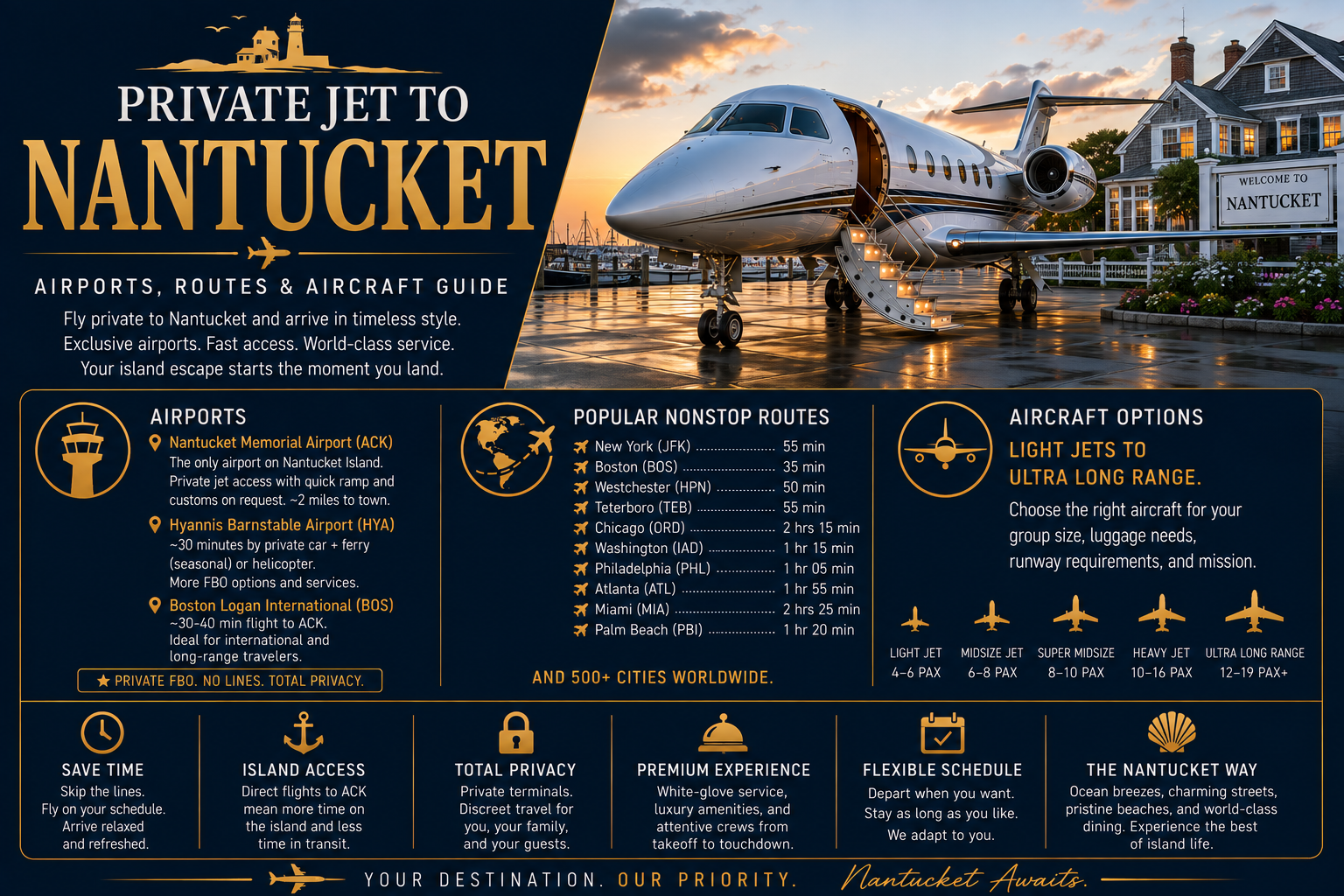
Nantucket Private Aviation Destination Guide
Private Jet to Nantucket: Airports, Routes and Aircraft Guide
Flying by private jet to Nantucket requires more than selecting an aircraft and departure time. Instead, the strongest plan connects the passengers, luggage, pets, aircraft category, Nantucket Memorial Airport performance, coastal weather, seasonal parking, island transportation, residence access, ferry alternatives, and the return mission before the aircraft leaves its origin.
Nantucket is one of the most concentrated seasonal private aviation destinations in New England. In particular, the island attracts property owners, family offices, executives, investors, entertainers, artists, yacht owners, wedding guests, families, seasonal residents, event attendees, and affluent leisure travelers.
Most fixed-wing private aviation travelers use Nantucket Memorial Airport, identified as ACK and KACK. The airport sits approximately three miles southeast of Nantucket’s central business district and provides direct island access without requiring a ferry from Cape Cod.
Therefore, a suitable arrival can significantly reduce the uncertainty associated with Cape traffic, ferry schedules, vehicle boarding, commercial airline connections, and weather-related marine travel.
However, Nantucket remains an island airport with a runway and operating environment that requires mission-specific planning.
Nantucket Memorial Airport’s primary runway, 6/24, measures approximately 6,303 feet. Meanwhile, Runway 15/33 measures approximately 4,500 feet.
Consequently, aircraft type, operating weight, fuel, passengers, luggage, temperature, wind, fog, rain, runway conditions, alternate-airport requirements, parking, and the return route determine whether the mission fits.
Many turboprops, light jets, midsize aircraft, super-midsize jets, and selected larger aircraft may serve Nantucket under suitable conditions. Nevertheless, published range and seating do not confirm that a specific aircraft can complete the actual trip.
For example, a smaller aircraft may fit a short regional route from Teterboro, White Plains, Boston, Bedford, Providence, or Martha’s Vineyard. However, a family traveling from Palm Beach, Miami, Chicago, Dallas, Scottsdale, Los Angeles, or Europe may require more range, baggage capacity, fuel, cabin space, and operational margin.
Additionally, a larger aircraft may provide the preferred cabin yet create different runway, parking, weight, fuel, and alternate-airport considerations at ACK.
Martha’s Vineyard Airport may support selected regional alternatives, multi-island itineraries, aircraft repositioning, or passenger plans that connect Nantucket with another island destination.
Meanwhile, Cape Cod Gateway Airport in Hyannis may provide a mainland alternative with private aviation services, commercial connections, rental vehicles, ferries, and access to Cape Cod.
However, neither Martha’s Vineyard nor Hyannis places the traveler directly on Nantucket. Therefore, an alternate-airport plan may require another aircraft, ferry, helicopter, boat, lodging arrangement, or revised itinerary.
Coastal weather creates another important planning factor. Fog, low clouds, wind, rain, thunderstorms, visibility changes, and rapidly shifting marine conditions may affect the airport, approaches, aircraft scheduling, ferry service, and island transportation differently.
Consequently, a backup plan should account for both aviation and marine travel rather than assuming that a ferry automatically remains available when flying conditions deteriorate.
Seasonal demand also changes dramatically. Summer weekends, holiday periods, weddings, private events, regattas, yacht activity, family gatherings, and concentrated Friday arrivals can place pressure on aircraft availability, airport parking, fuel, passenger services, rental vehicles, professional drivers, and preferred departure windows.
Meanwhile, Sunday and Monday departures may create strong return demand toward New York, Boston, Washington, Chicago, Palm Beach, Miami, the Hamptons, and other seasonal markets.
Therefore, the closest available aircraft does not automatically create the strongest complete journey. Instead, the operator should compare aircraft capability, passengers, luggage, pets, runway performance, weather, parking, airport services, island transportation, final address, ferry options, crew duty, and the departure plan.
This guide connects Nantucket destination demand with Nantucket Memorial Airport, Martha’s Vineyard Airport, Cape Cod Gateway Airport, aircraft selection, directional routes, coastal weather, seasonal travel, weddings, yachting, residences, families, pets, luggage, privacy, ferries, and island transportation.
Direct Nantucket Travel Answer
Is Nantucket a Major Private Jet Destination?
Direct Answer: Yes. Nantucket is a major seasonal private jet destination because it combines luxury residences, family offices, beaches, yachting, weddings, private events, dining, historic communities, and island access. Nantucket Memorial Airport provides direct fixed-wing access, although runway performance, coastal weather, parking, luggage, and return planning require careful review.
A private jet to Nantucket may support a seasonal residence, weekend retreat, family-office itinerary, wedding, private event, yacht departure, property transaction, executive gathering, family visit, regatta, holiday stay, or multi-destination New England itinerary.
Moreover, flying directly to Nantucket eliminates the need to complete the entire journey by road and ferry from the mainland.
Therefore, private aviation may protect substantial time during summer traffic, holiday periods, ferry congestion, and narrow event schedules.
However, the value depends on whether the aircraft and airport plan fit the actual mission.
Nantucket Memorial Airport’s approximately 6,303-foot primary runway supports a broad range of private aviation activity. Nevertheless, aircraft suitability depends on the exact model, operating weight, fuel, passengers, luggage, wind, weather, runway condition, alternate requirements, and departure route.
Additionally, Nantucket’s island location increases the importance of alternate-airport planning. If weather affects ACK, the operator may consider Martha’s Vineyard, Hyannis, Providence, Boston, Bedford, or another suitable airport based on the aircraft and passenger itinerary.
However, landing elsewhere may place passengers off the island. Consequently, the travel team may need another aircraft, ferry, boat, hotel, ground transfer, or delayed arrival plan.
Seasonal parking also matters. Summer weekends may bring private aircraft, scheduled airline flights, regional air taxis, families, event guests, yacht travelers, and property owners into the airport during similar windows.
As a result, aircraft parking, fuel, passenger handling, crew lodging, rental vehicles, professional drivers, baggage support, and preferred departure times may tighten simultaneously.
Therefore, travelers should provide accurate information early. Passenger count, luggage, pets, bicycles, golf clubs, beach equipment, event materials, destination address, arrival window, return schedule, airport preferences, security needs, and acceptable alternatives can all influence the recommendation.
Travelers and aviation professionals can review public airport planning information through the official Nantucket Memorial Airport Master Plan. Additionally, crews can review current charts and procedures through the Federal Aviation Administration.
Nantucket provides direct island access only when the aircraft, runway, weather, parking, passengers, luggage, and return mission fit together.
The strongest recommendation protects the flight while also preparing a realistic mainland or neighboring-island alternative if ACK becomes unsuitable.
Direct Island Access and Schedule Control
Why Do Travelers Fly by Private Jet to Nantucket?
Direct Answer: Travelers fly by private jet to Nantucket to reach the island directly, avoid Cape traffic and ferry dependence, control weekend schedules, carry families and pets, coordinate yachts and events, protect privacy, transport seasonal luggage, and connect Nantucket with New York, Boston, Florida, the Hamptons, and other wealth markets.
Nantucket creates a travel challenge that private aviation can solve particularly well. The island sits relatively close to major northeastern cities, yet completing the journey by road and ferry may require several separate travel stages.
Therefore, landing directly at ACK can simplify the trip while reducing exposure to highway congestion, ferry check-in requirements, marine schedules, and luggage transfers.
Reach Nantucket Directly
Passengers can arrive on the island without completing the full journey through Cape Cod traffic, ferry terminals, vehicle boarding, and marine transfers.
Control Weekend Timing
Travelers can coordinate departures around work, school, weddings, yacht schedules, property access, weather, dinners, and family needs.
Avoid Commercial Connections
Private aviation can connect executive airports and seasonal wealth markets with Nantucket without relying on limited scheduled-airline itineraries.
Travel With Families and Pets
A private cabin can simplify travel with children, grandparents, caregivers, household staff, pets, medication, food, and substantial luggage.
Support Events and Yachts
Aircraft arrivals may coordinate with weddings, regattas, private dinners, charity events, marinas, vessel departures, and family gatherings.
Protect Passenger Privacy
Controlled passenger lists, private aviation handling, discreet vehicles, limited itinerary sharing, and coordinated residence access may reduce exposure.
Nevertheless, private aviation does not eliminate fog, wind, thunderstorms, runway limitations, airport parking, ferry disruptions, island-vehicle constraints, crew duty, or passenger delays.
Consequently, the greatest value comes from controlling the complete journey. The operator may adjust the departure, select another aircraft, change the fuel plan, prepare Martha’s Vineyard or Hyannis, stage backup transportation, or revise the return around the passenger’s priorities.
A Concentrated Island Aviation Market
What Creates Private Aviation Demand in Nantucket?
Direct Answer: Nantucket private aviation demand comes from seasonal residences, family offices, finance, luxury real estate, weddings, private events, yachting, regattas, beaches, dining, historic tourism, family gatherings, and frequent movement between the island and major business or residential markets.
Nantucket combines several high-value travel categories within one island destination. It functions as a luxury residential market, summer retreat, wedding destination, yacht gateway, family destination, historic community, event market, and seasonal business environment.
Therefore, private aviation demand extends well beyond ordinary leisure travel.
Summer Property Travel
Owners and families may travel repeatedly between Nantucket and New York, Boston, Washington, Chicago, Palm Beach, Miami, the Hamptons, or other residences.
Principals, Advisors and Staff
Family-office travel may involve principals, executives, advisors, household staff, security, pets, vehicles, luggage, and several connected properties.
Destination Celebrations
Hosts, families, planners, photographers, entertainers, vendors, security, and guests may create several coordinated aviation missions.
Owners, Guests and Crew
Aircraft travel may connect passengers with marinas, yacht departures, regattas, charters, crew movements, private events, and coastal itineraries.
Owners, Buyers and Advisors
Owners, buyers, brokers, architects, designers, attorneys, contractors, lenders, and property managers may travel for acquisitions and projects.
Compressed Arrival Windows
Friday arrivals and Sunday departures may create sharp demand for aircraft, airport parking, vehicles, baggage support, and preferred times.
Private and Community Programs
Charity events, dinners, festivals, art programs, regattas, family gatherings, and private celebrations can concentrate travel demand.
Beaches, Dining and Island Recreation
Beaches, boating, fishing, cycling, golf, dining, shopping, wellness, and family activities support seasonal and shoulder-season travel.
Additionally, demand may compress around Memorial Day, Independence Day, Labor Day, holiday weekends, weddings, regattas, charity programs, private gatherings, and concentrated Friday afternoon arrivals.
As a result, aircraft availability, ACK parking, fuel, passenger services, rental vehicles, professional drivers, catering, crew lodging, household staff, and preferred departure windows may tighten simultaneously.
Therefore, travelers should begin planning earlier when they require a specific aircraft category, overnight parking, narrow timing, several vehicles, security, pets, bicycles, substantial luggage, or complex event logistics.
Passenger and Buyer Profiles
Who Typically Flies Privately to Nantucket?
Direct Answer: Travelers flying privately to Nantucket include property owners, families, executives, family offices, investors, entertainers, artists, yacht owners, wedding parties, event guests, international visitors, and leisure passengers who value direct island access, privacy, schedule control, and baggage flexibility.
The person researching a private jet to Nantucket may not be the passenger. Executive assistants, family-office staff, travel managers, household teams, property managers, security professionals, wedding planners, yacht managers, event coordinators, and concierges often organize the mission.
Therefore, the aircraft and airport recommendation should answer passenger-experience questions while also resolving runway, weather, parking, luggage, transportation, residence, event, privacy, and return-flight requirements.
Seasonal and Weekend Travelers
Property owners may travel with family members, household staff, pets, food, gifts, bicycles, beach items, work materials, and extended-stay luggage.
Multi-Generational Groups
Families may include children, infants, grandparents, caregivers, staff, pets, strollers, child seats, medication, food, and substantial baggage.
Leaders and Business Teams
Executives may travel for private meetings, dinners, property visits, family gatherings, weddings, events, and weekend stays.
Principals, Advisors and Staff
Family-office missions may involve multiple residences, household staff, advisors, security, vehicles, pets, luggage, and connected destinations.
Owners, Guests and Crew
Yacht-related missions may connect aircraft arrivals with marinas, vessel schedules, regattas, charters, provisions, security, and crew changes.
Hosts, Families and Guests
Wedding travel may include hosts, relatives, planners, photographers, entertainers, vendors, security, equipment, and several aircraft.
Global Property and Leisure Travelers
International passengers may require customs, permits, documentation, pets, security, baggage planning, and coordinated onward travel.
Island and Coastal Travelers
Travelers may combine Nantucket with Martha’s Vineyard, Cape Cod, the Hamptons, Newport, Boston, New York, or another coastal destination.
Why Does the Passenger Profile Affect Aircraft Selection?
A small passenger group may still require a midsize, super-midsize, or larger aircraft because pets, bicycles, golf clubs, household supplies, wedding attire, event materials, staff, and extended-stay luggage consume significant capacity.
Conversely, a larger group traveling lightly may fit another aircraft category. Therefore, installed seating alone cannot identify the correct aircraft.
Moreover, moving to a larger aircraft may create different ACK runway, parking, fuel, and alternate-airport requirements.
Primary Nantucket Private Aviation Gateway
What Should Travelers Know About Nantucket Memorial Airport?
Direct Answer: Nantucket Memorial Airport is the primary fixed-wing gateway for Nantucket Island. Its approximately 6,303-foot primary runway supports many private aircraft missions. However, aircraft weight, fuel, passengers, luggage, coastal weather, runway conditions, seasonal parking, airport services, alternates, and the return flight make every mission aircraft-specific.
Nantucket Memorial Airport, identified as ACK and KACK, sits southeast of Nantucket’s central business district and provides direct access to the island’s residences, hotels, beaches, marinas, clubs, restaurants, event venues, and historic communities.
Therefore, ACK normally provides the strongest destination access for travelers whose final destination lies on Nantucket.
The airport’s primary runway, 6/24, measures approximately 6,303 feet. Meanwhile, Runway 15/33 measures approximately 4,500 feet.
Consequently, the airport can support many turboprop, light-jet, midsize, super-midsize, airline, and selected larger-aircraft missions.
However, runway length alone cannot confirm suitability. The operator must evaluate the exact aircraft, actual operating weight, fuel, passengers, baggage, temperature, wind, visibility, runway conditions, alternate requirements, parking, and the return route.
Direct Island Access
ACK places passengers on Nantucket without requiring the complete Cape Cod road and ferry journey.
Approximately 6,303 Feet
The primary runway supports many regional, domestic, charter, airline, and private aviation missions under suitable conditions.
Approximately 4,500 Feet
The second paved runway provides additional operational flexibility. However, its suitability remains aircraft and condition specific.
Summer Activity Increases
Private aviation, scheduled airlines, air taxis, families, weddings, and property travel may concentrate within narrow periods.
Coastal Conditions Matter
Fog, low clouds, wind, thunderstorms, rain, visibility, and rapidly changing conditions may affect airport availability.
Prepare Mainland and Island Options
Martha’s Vineyard, Hyannis, Providence, Boston, Bedford, or another suitable airport may support a revised itinerary.
Why Is Nantucket Memorial Airport Usually Preferred?
ACK places passengers directly on the island. Therefore, a suitable arrival can avoid additional road travel, ferry check-in, vessel schedules, luggage transfers, and marine-weather exposure.
Additionally, the airport simplifies access to Nantucket Town, Siasconset, Madaket, Wauwinet, Surfside, Cisco, Monomoy, Pocomo, Dionis, Cliff, Shimmo, and surrounding areas.
However, direct island access should not override aircraft performance, weather, parking, fuel, alternate-airport, or departure requirements.
Can Every Private Jet Use Nantucket Memorial Airport?
No. Although ACK accommodates a broad range of private and commercial aircraft, the operator must evaluate the exact aircraft and complete mission.
For example, a larger aircraft may fit the runway under favorable conditions yet face different limitations with a full passenger load, extensive luggage, higher temperature, wet runway, additional fuel, or a long return route.
Therefore, arrival capability does not automatically confirm departure capability. The outbound mission requires an independent performance and operating review.
Nantucket Memorial Airport provides exceptional island access only when the aircraft, runway, weather, parking, passengers, luggage, alternates, and return mission support the trip.
The airport should be selected because it creates the strongest complete journey—not merely because it is the only major fixed-wing airport on the island.
Passenger, Aircraft and Island Support
What Private Aviation Services Are Available at Nantucket Memorial Airport?
Direct Answer: Nantucket Memorial Airport services may include aircraft fueling, private aviation handling, passenger facilities, aircraft parking, baggage assistance, rental vehicles, professional transportation, catering coordination, crew support, flight planning, and scheduled-airline services. Availability should be confirmed for the actual travel date.
Nantucket Memorial Airport supports private aviation, commercial airlines, regional air taxis, charter operations, aircraft owners, corporate flight departments, crews, island residents, families, and seasonal visitors.
Therefore, passengers and operators can coordinate a broad range of aircraft, terminal, baggage, transportation, and crew services.
However, service availability may tighten during summer weekends, holidays, weddings, private events, yacht activity, regattas, and concentrated arrival periods.
Consequently, aircraft parking, fuel, passenger handling, rental vehicles, professional drivers, baggage support, catering, crew arrangements, and the return schedule should be coordinated early.
Passenger Handling
Support may include passenger reception, waiting areas, baggage coordination, vehicle access, and communication with the crew.
Aircraft Fueling
Operators should confirm fuel availability, uplift timing, departure requirements, pricing, peak demand, and aircraft-specific needs.
Island Transportation
Rental vehicles, professional drivers, taxis, property vehicles, and coordinated pickups may serve residences, hotels, marinas, beaches, and events.
Aircraft Parking
Peak travel periods may require advance parking coordination, repositioning, drop-and-go planning, or revised arrival and departure windows.
Baggage Coordination
Bicycles, golf clubs, pet carriers, wedding attire, beach equipment, food, event materials, and extended-stay luggage may require advance planning.
Crew Support
Crew planning may include transportation, lodging, weather, flight planning, duty limits, repositioning, and mainland alternatives.
Why Should Parking and Transportation Be Confirmed Early?
A concentrated summer weekend may bring private aircraft, scheduled airline flights, air taxis, property owners, wedding guests, and yacht travelers into ACK during similar arrival windows.
Therefore, the operator should confirm parking, fuel, handling, baggage support, crew plans, and departure timing as early as practical.
Meanwhile, the passenger representative should reserve suitable transportation, verify luggage capacity, coordinate property access, arrange security when required, confirm wedding or marina schedules, and prepare a mainland or neighboring-island backup.
Nantucket provides direct island access, yet peak seasonal travel still rewards early coordination.
Aircraft parking, fuel, passenger handling, luggage, transportation, property access, crew planning, alternates, and the return mission should function as one itinerary.
Mission-Specific Nantucket Airport Suitability
When Does Nantucket Memorial Airport Fit the Mission Best?
Direct Answer: Nantucket Memorial Airport fits best when the aircraft can use its runway system with suitable performance margin, parking and services remain available, coastal weather supports the flight, and direct island access materially improves the passenger journey. Otherwise, a mainland or neighboring-island alternative may provide greater reliability.
ACK creates its greatest value when direct island access saves meaningful time without introducing excessive aircraft, runway, weather, parking, fuel, or departure limitations.
Therefore, the operator should evaluate the complete round trip before confirming the airport rather than approving the inbound flight and solving the return later.
The Exact Mission Fits
The aircraft, operating weight, fuel, passengers, luggage, temperature, wind, runway conditions, and required margins must support the operation.
Direct Arrival Creates Value
The airport eliminates the need to complete the entire Nantucket journey through mainland traffic and ferry service.
Space Supports the Itinerary
Aircraft parking, fuel, handling, crew requirements, and the departure window should remain available.
Coastal Conditions Remain Suitable
Fog, low clouds, wind, rain, thunderstorms, visibility, and runway conditions must support the aircraft and crew.
The Departure Also Works
The outbound mission may require more fuel, luggage, passengers, or runway margin. Therefore, departure suitability requires another review.
Mainland and Island Alternatives Remain Ready
Passengers, vehicles, ferries, accommodations, and property teams should understand how the itinerary changes if ACK becomes unsuitable.
When Might a Mainland Airport Provide the Better Solution?
Hyannis, Providence, Boston, Bedford, or another mainland airport may provide the stronger choice when the preferred aircraft needs more operating flexibility, coastal weather affects ACK, parking becomes limited, the passenger itinerary includes Cape Cod, or airline connections shape the mission.
However, a mainland arrival requires another step before the passenger reaches Nantucket.
Therefore, the travel team should compare a delayed or revised ACK arrival against a ferry, another aircraft, helicopter, boat, lodging, or later island transfer.
The best Nantucket plan protects the aircraft operation while preserving realistic island access.
ACK creates exceptional convenience when the mission fits. However, a prepared mainland or neighboring-island alternative may produce the stronger outcome when weather, runway performance, parking, or reliability matters more.
Aircraft Performance and Island Operations
How Does Nantucket’s Runway Affect Aircraft Selection?
Direct Answer: Nantucket’s approximately 6,303-foot primary runway supports many private aircraft missions. However, aircraft weight, fuel, passengers, luggage, temperature, wind, wet-runway conditions, required reserves, alternate-airport requirements, and the return route determine whether a specific aircraft can operate with suitable margin.
Nantucket Memorial Airport serves a broad mix of private aircraft, charter flights, regional air taxis, and scheduled commercial services. Nevertheless, previous aircraft activity does not guarantee that the same aircraft category will fit every future mission.
Instead, the operator must calculate the actual trip using the specific aircraft, passenger count, baggage profile, fuel requirements, weather, runway condition, destination, and operating rules.
For example, an aircraft may comfortably arrive from Boston with a smaller passenger group and moderate luggage. However, the same aircraft may require a different plan when departing for Palm Beach with more fuel, additional passengers, bicycles, golf clubs, pets, and several weeks of luggage.
Approximately 6,303 Feet
The primary runway supports many turboprop, light-jet, midsize, super-midsize, charter, and commercial-aircraft missions under suitable conditions.
Passengers and Fuel Matter
Every passenger, suitcase, pet carrier, bicycle, catering item, and pound of fuel contributes to the aircraft’s operating weight.
Summer Heat Can Reduce Margin
Higher temperatures may increase runway requirements while reducing practical payload or nonstop capability for selected aircraft.
Direction and Speed Affect Performance
Headwinds, tailwinds, crosswinds, gusts, and changing coastal conditions may affect runway selection and operating margin.
Rain Changes the Calculation
Wet pavement, standing water, braking reports, visibility, heavy rain, and temporary runway conditions may affect aircraft suitability.
Island Planning May Add Weight
Coastal weather and limited nearby options may require additional reserve or alternate fuel, which can affect payload and runway performance.
Can an Aircraft Land at Nantucket but Depart From Another Airport?
Yes. A suitable aircraft may arrive at Nantucket after burning part of its fuel. However, the return mission may require a heavier fuel load, longer route, additional baggage, another passenger, or stronger runway capability.
Therefore, the aircraft may reposition to Hyannis, Providence, Boston, Bedford, or another suitable mainland airport before completing the longer departure.
Alternatively, passengers may leave Nantucket through ACK while the aircraft completes a fuel stop after departure. Nevertheless, every repositioning or fuel-stop strategy affects passenger time, crew duty, weather exposure, cost, and operational complexity.
Can Luggage Change the Airport or Aircraft Plan?
Yes. Bicycles, golf clubs, pet carriers, wedding attire, household items, artwork, beach equipment, food, and extended-stay luggage may materially increase weight and storage requirements.
Consequently, the operator may recommend a larger aircraft, reduced fuel, a fuel stop, separate baggage movement, another departure airport, or a different passenger schedule.
Nantucket runway suitability depends on the complete mission—not merely the aircraft model.
The exact aircraft, operating weight, fuel, weather, passengers, luggage, runway conditions, alternates, and return route determine whether ACK remains the strongest option.
Neighboring-Island Aviation Alternative
When Does Martha’s Vineyard Airport Fit a Nantucket Itinerary?
Direct Answer: Martha’s Vineyard Airport may fit travelers combining both islands, aircraft repositioning, regional charter itineraries, or backup planning when Nantucket becomes unsuitable. However, passengers still need another flight, ferry, boat, or revised itinerary before reaching Nantucket.
Martha’s Vineyard Airport provides a neighboring-island aviation option within the regional New England network.
Therefore, it may support multi-island travel, regional charter operations, aircraft repositioning, crew planning, or selected weather and parking alternatives.
However, Martha’s Vineyard and Nantucket remain separate islands. Consequently, landing at Martha’s Vineyard does not place the passenger within a practical ground drive of Nantucket.
Instead, the travel team must coordinate another aircraft segment, marine transportation, lodging, or a delayed arrival once conditions improve.
Connect Nantucket and Martha’s Vineyard
The airport may support travelers combining residences, events, yachts, weddings, family visits, or leisure itineraries across both islands.
Support Short Aircraft Segments
Regional turboprops, light aircraft, air taxis, and selected charter operations may connect the islands under suitable conditions.
Conditions May Differ by Island
Fog, wind, visibility, rain, and approach conditions may affect Nantucket and Martha’s Vineyard differently.
Create Another Positioning Option
The airport may support selected aircraft parking, crew, fuel, staging, or repositioning needs when Nantucket activity increases.
Another Step Remains Required
Passengers may require a boat, ferry, charter vessel, or another aircraft before reaching Nantucket.
Review the Complete Island Sequence
The itinerary should account for passenger timing, baggage, weather, vehicles, vessel schedules, and the final departure airport.
Can Travelers Fly Between Martha’s Vineyard and Nantucket?
Regional operators may support selected flights between the islands, depending on aircraft availability, operating schedules, weather, passenger count, baggage, and airport conditions.
However, travelers should not assume that an immediate connecting aircraft will remain available after an unexpected diversion.
Therefore, a neighboring-island backup should include realistic options for transportation, lodging, baggage handling, passenger communication, and the next attempt to reach Nantucket.
Martha’s Vineyard can support the regional aviation plan, yet it does not replace direct Nantucket access.
The strongest use cases involve planned multi-island travel, aircraft positioning, regional operations, or a carefully coordinated backup itinerary.
Primary Mainland Nantucket Alternative
When Should Travelers Use Cape Cod Gateway Airport?
Direct Answer: Cape Cod Gateway Airport in Hyannis may fit travelers who need a mainland alternative, ferry access, Cape Cod connections, commercial service, aircraft parking, rental vehicles, or another operating option when Nantucket weather or airport availability affects the direct mission.
Cape Cod Gateway Airport provides one of the most practical mainland alternatives for Nantucket travel because Hyannis connects directly with Cape Cod transportation and ferry infrastructure.
Therefore, travelers may use Hyannis when ACK becomes unsuitable, the passenger itinerary includes Cape Cod, the aircraft requires a mainland operating environment, or commercial and private travel need to connect.
However, landing at Hyannis leaves the passenger on the mainland. Consequently, the journey may continue by ferry, another aircraft, helicopter, private boat, or delayed island transfer.
Connect Aviation and Ferry Travel
Hyannis may support passengers who need ferry terminals, Cape transportation, rental vehicles, lodging, and broader mainland services.
Support Private and Commercial Travel
The airport may provide aircraft services, passenger facilities, commercial connections, rentals, parking, and regional transportation.
Remain Off the Island
Hyannis may remain available when Nantucket fog, wind, visibility, runway conditions, or parking affect the direct arrival.
Serve Multi-Destination Itineraries
The airport may fit travelers combining Nantucket with Cape Cod residences, events, beaches, medical facilities, or family destinations.
Confirm Availability Before Landing
Ferry schedules, passenger capacity, vehicle reservations, baggage, pets, weather, check-in requirements, and terminal transportation require advance review.
Avoid an Unplanned Mainland Stranding
Travelers should understand lodging, vehicle, luggage, meal, communication, and onward-transportation options before using Hyannis as the backup.
Does Hyannis Always Provide a Reliable Ferry Backup?
No. Marine weather, passenger demand, vehicle capacity, mechanical issues, seasonal schedules, cancellations, and check-in deadlines can affect ferry availability.
Moreover, aviation weather and marine weather may disrupt both systems during the same period.
Therefore, the operator and passenger representative should confirm the ferry plan before relying on Hyannis as the final solution.
When Does Hyannis Create the Better Complete Journey?
Hyannis may create the stronger itinerary when ACK weather remains uncertain, the passenger can use a confirmed ferry, the group also needs Cape Cod access, or the aircraft benefits from mainland parking and services.
Nevertheless, passengers should compare the additional transfers against waiting for Nantucket conditions to improve.
Hyannis works best when aviation, ferry, vehicles, baggage, and island arrival are coordinated before the aircraft lands.
A mainland diversion without confirmed onward transportation may produce more uncertainty than a revised Nantucket departure.
Connecting Private Aviation and Marine Travel
Can Travelers Combine a Private Jet With a Nantucket Ferry?
Direct Answer: Yes. Travelers may fly privately to Hyannis or another mainland airport and continue to Nantucket by ferry. However, schedules, weather, vehicle reservations, passenger capacity, baggage, pets, terminal transfers, ferry check-in, and island transportation must be coordinated before selecting the itinerary.
A private jet and ferry itinerary may provide useful flexibility when the aircraft cannot use ACK, Nantucket weather remains uncertain, the traveler also needs Cape Cod access, or a larger aircraft benefits from a mainland airport.
However, the journey introduces several transfers. Passengers must move from the aircraft to a vehicle, from the vehicle to the ferry terminal, through the boarding process, across the water, and from the Nantucket terminal to the final residence or destination.
Therefore, the travel team should compare the total journey rather than treating the ferry as a simple replacement for the final flight segment.
Passenger Ferry
A passenger-only ferry may provide a faster marine crossing while requiring separate luggage, pet, terminal, and island-vehicle planning.
Vehicle Ferry
A vehicle ferry may simplify mainland-car access. However, reservations, check-in deadlines, availability, weather, and seasonal demand require advance coordination.
Terminal Transfer
The ground team should confirm the airport, ferry terminal, vehicle, baggage capacity, check-in time, tickets, and passenger-contact process.
Pets and Families
Children, infants, pets, caregivers, strollers, medication, food, and accessibility needs may affect which ferry and vehicle arrangement works best.
Weather
Fog, wind, heavy rain, thunderstorms, rough seas, and marine advisories may affect ferry comfort, delays, or cancellations.
Island Transportation
A separate vehicle may still be required after arrival in Nantucket Town to reach the residence, hotel, marina, beach, or event.
Should Luggage Travel With the Passengers?
Whenever practical, essential luggage should remain with the passengers. Nevertheless, bicycles, extensive household items, event materials, artwork, golf clubs, and substantial seasonal baggage may require separate transportation.
Therefore, the travel team should identify which items remain immediately accessible and which items can arrive later.
Medication, passports, chargers, pet supplies, wedding attire, child items, valuables, and overnight essentials should not depend on a separate delivery without a confirmed plan.
Is Waiting for Better Flying Weather Sometimes Faster?
Yes. A delayed departure into ACK may occasionally produce a shorter total journey than diverting to Hyannis, arranging vehicles, meeting ferry check-in, crossing the water, and completing another island transfer.
Consequently, travelers should compare realistic timelines rather than assuming immediate movement always creates the earliest arrival.
A ferry backup becomes useful only when every transfer has been confirmed.
The aircraft, mainland vehicle, ferry schedule, baggage, pets, island transportation, property access, weather, and return itinerary should function as one coordinated journey.
Coastal Weather and Island Aviation
How Does Coastal Weather Affect Private Flights to Nantucket?
Direct Answer: Nantucket weather can affect fog, low clouds, visibility, coastal wind, thunderstorms, heavy rain, turbulence, runway conditions, airport availability, ferry service, aircraft parking, and island transportation. Therefore, travelers need schedule flexibility, approved alternates, ferry backups, lodging options, and clear communication.
Nantucket’s island location places the airport within a rapidly changing coastal weather environment.
Therefore, fog, low clouds, shifting winds, heavy rain, thunderstorms, marine layers, visibility changes, and coastal systems may affect ACK even when mainland conditions remain acceptable.
Likewise, Nantucket may remain suitable while Hyannis, Martha’s Vineyard, Boston, or regional airspace faces different conditions.
Consequently, operators monitor airport observations, forecasts, radar, winds, visibility, runway reports, alternate airports, airspace delays, and aircraft limitations throughout the mission.
Fog and Low Clouds
Coastal fog may reduce visibility, affect approach requirements, delay departures, and change the suitability of smaller or less-equipped aircraft.
Coastal Wind
Wind direction, gusts, crosswinds, sea breezes, and rapidly changing conditions may affect runway selection and passenger comfort.
Thunderstorms
Lightning, turbulence, heavy rain, reroutes, ramp restrictions, and regional airspace congestion may delay the aircraft or ground handling.
Wet Runways
Rain, standing water, braking reports, visibility, and runway conditions may increase required landing or takeoff distance.
Ferry Disruptions
Marine conditions may affect ferries at the same time aviation weather limits ACK. Therefore, travelers should not assume the marine backup remains available.
Alternate Airports
Martha’s Vineyard, Hyannis, Providence, Boston, Bedford, or another airport may support a revised itinerary depending on the aircraft and passengers.
Should Travelers Build Time Around Nantucket Weather?
Yes. Passengers should avoid placing a wedding ceremony, yacht departure, private dinner, medical appointment, family event, or important meeting immediately after the planned landing.
Additionally, the driver, property manager, wedding planner, marina, household team, and security staff should receive updates if the airport or arrival time changes.
An ACK delay may affect only the final flight segment. However, a mainland diversion may change vehicles, ferry reservations, lodging, baggage handling, and the entire passenger timeline.
Can Weather Affect the Return More Than the Arrival?
Yes. The return mission may face different fog, winds, thunderstorms, runway conditions, alternate requirements, passenger timing, fuel needs, and destination weather.
Therefore, operators reassess the flight before departure rather than assuming the inbound plan remains valid.
A Nantucket weather change should activate a prepared aviation, ferry, lodging, and transportation plan.
The strongest itinerary identifies acceptable airports, confirmed transportation options, essential luggage, passenger needs, property communication, and realistic island-arrival alternatives before departure.
Peak Summer Island Travel
How Does Summer Demand Affect Private Aviation in Nantucket?
Direct Answer: Summer demand can tighten Nantucket aircraft availability, ACK parking, fuel, passenger handling, rental vehicles, professional drivers, catering, crew lodging, residences, ferries, wedding transportation, and preferred arrival or departure times. Therefore, travelers should coordinate earlier for weekends, holidays, events, and narrow schedules.
Nantucket experiences a highly concentrated seasonal travel pattern.
In particular, Friday arrivals, Sunday departures, holiday weekends, weddings, private events, regattas, yacht activity, family gatherings, and property travel can compress demand into narrow windows.
Therefore, aircraft, airport parking, fuel, passenger handling, rentals, drivers, catering, ferries, crew lodging, household teams, and event transportation may tighten simultaneously.
Preferred Aircraft Tighten
Specific cabins, baggage profiles, pet policies, operators, routes, and departure times may become harder to secure.
Ramp Space Requires Planning
Overnight parking, staging, fuel, handling, and aircraft repositioning may require early coordination during peak periods.
Transportation Becomes Limited
Rental vehicles, professional drivers, larger SUVs, child seats, pet accommodations, and luggage vehicles may tighten.
Mainland Backups Also Tighten
Passenger and vehicle ferry capacity may become limited during the same high-demand periods affecting private aviation.
Duty and Lodging Affect Availability
Crew rest, hotels, transportation, repositioning, weather delays, and extended stays may influence aircraft scheduling.
Return Demand Concentrates
Sunday afternoon, evening, and Monday morning departures may create strong demand toward New York, Boston, and other markets.
How Early Should Travelers Begin Planning?
Travelers should begin planning when the dates become reasonably clear. However, holiday weekends, weddings, large families, pets, bicycles, preferred aircraft, overnight parking, narrow arrival windows, and complex ground needs often justify earlier coordination.
Additionally, recurring travelers should maintain accurate profiles for passengers, pets, residences, drivers, luggage, catering, airport preferences, and acceptable mainland alternatives.
Nevertheless, every mission still requires a fresh review because aircraft availability, ACK parking, weather, passenger loads, luggage, ferry capacity, and return timing change.
Peak Nantucket travel rewards passengers who coordinate the aircraft, airport, parking, island vehicle, property, and return mission early.
Waiting until the final days may reduce aircraft choice, ACK availability, preferred timing, ferry backups, transportation quality, and the ability to absorb coastal-weather changes.
Nantucket Airport Decision Framework
How Should Travelers Compare Nantucket-Area Private Aviation Airports?
Direct Answer: Travelers should compare Nantucket-area airports by reviewing aircraft performance, runway requirements, direct island access, weather, parking, passenger services, alternate fuel, luggage, ferry availability, mainland transportation, crew duty, and the return mission.
Nantucket Memorial Airport usually provides the strongest destination access because it places passengers directly on the island.
However, Martha’s Vineyard, Hyannis, Providence, Boston, Bedford, or another airport may become relevant when ACK weather, parking, runway performance, aircraft requirements, commercial connections, or broader travel plans affect the mission.
Therefore, travelers should receive one preferred airport, one operational alternate, and a realistic passenger plan for reaching Nantucket if the aircraft lands elsewhere.
| Airport | Potential Advantage | Primary Consideration | Best Planning Question |
|---|---|---|---|
| Nantucket Memorial Airport | Direct fixed-wing access to Nantucket Island | Coastal weather, runway performance, parking, luggage, and alternate requirements | Can the exact aircraft and complete round trip operate with suitable margin? |
| Martha’s Vineyard Airport | Neighboring-island access, multi-island itineraries, and regional operations | Another aircraft or marine transfer remains necessary | Does Martha’s Vineyard support a planned island itinerary or practical backup? |
| Cape Cod Gateway Airport | Mainland airport, ferry access, rentals, lodging, and Cape Cod connections | The passenger must still reach Nantucket by ferry, aircraft, helicopter, or boat | Is onward island transportation confirmed before landing? |
| Providence, Boston or Bedford | Broader aircraft capability, airline access, parking, and mainland services | Substantial additional travel remains before reaching Nantucket | Does the operational advantage justify the longer passenger journey? |
What Should Be Confirmed Before Selecting the Airport?
- The exact Nantucket residence, hotel, marina, beach, club, or event destination
- The aircraft model and runway-performance requirements
- Passengers, household staff, pets, luggage, bicycles, and event materials
- Fuel, route distance, alternate requirements, and departure needs
- Coastal weather, visibility, wind, rain, and runway conditions
- Aircraft parking, fueling, passenger handling, and crew arrangements
- Ferry schedules, capacity, vehicle reservations, and marine weather
- Ground transportation at both the mainland and Nantucket endpoints
- Property, event, marina, and security access
- The return-flight schedule, passenger load, baggage, and destination
Ultimately, the best airport should support the aircraft while also protecting the passenger’s ability to reach Nantucket reliably.
Therefore, the recommendation should explain not only where the aircraft can land, but also how the passengers, luggage, pets, and essential items will complete the journey.
The Final Nantucket Island Transfer
How Should Ground Transportation Be Planned in Nantucket?
Direct Answer: Nantucket transportation should account for the arrival airport, exact residence or venue, passenger count, luggage, pets, bicycles, wedding materials, child seats, property access, seasonal congestion, rental availability, ferry arrivals, and possible mainland diversions.
Nantucket includes historic streets, village neighborhoods, oceanfront residences, private roads, beaches, marinas, hotels, event venues, and seasonal properties distributed across the island.
Therefore, the driver or property representative should receive the exact arrival time, passenger count, baggage profile, destination address, airport pickup instructions, property contact, event schedule, and access details before landing.
Nantucket Town
Drivers should confirm historic-district access, hotel entrances, residence locations, luggage needs, pedestrian activity, traffic, and parking restrictions.
Siasconset
Travelers should coordinate the longer island transfer, exact residence, property contact, luggage, weather, and late-night access.
Madaket and Western Nantucket
Drivers should confirm road conditions, destination details, beach access, property instructions, bicycles, household supplies, and return timing.
Wauwinet and Eastern Properties
Remote or private destinations may require exact directions, property access, suitable vehicles, luggage space, and advance communication.
Marinas and Yachts
Vehicle timing should align with marina access, tenders, vessel schedules, luggage, provisions, security, crew, and weather.
Weddings and Events
Transportation teams should understand venue entrances, guest groups, credentials, equipment, late-night pickups, property access, and return schedules.
What Should the Island Transportation Team Confirm?
- The exact airport pickup area or ferry terminal
- The final residence, hotel, marina, beach, club, restaurant, or event venue
- The passenger, assistant, household staff, wedding, and security count
- The number of bags, bicycles, golf clubs, pet carriers, and oversized items
- Child seats, mobility devices, medical needs, or refrigerated items
- Private-road, historic-district, property, marina, and venue access
- Traffic, road conditions, weather, events, and seasonal congestion
- Late-night pickup, driver availability, and return scheduling
- Transportation changes following a mainland diversion
- A communication plan for delays, ferry changes, or airport substitutions
Additionally, the transportation plan should carry the entire passenger group and luggage without requiring an unplanned second transfer.
Therefore, a large family, wedding group, yacht party, household team, or extended-stay traveler may require several SUVs, a passenger van, property vehicles, or a separate luggage transfer.
Should Travelers Rent a Vehicle?
A rental vehicle may provide flexibility for a longer Nantucket stay. However, seasonal availability, passenger count, child seats, luggage, bicycles, pet requirements, parking, property access, and driver preferences should be considered.
Meanwhile, professional transportation may provide a simpler solution for shorter stays, weddings, dinners, yacht transfers, older passengers, public figures, or groups unfamiliar with the island.
The aircraft saves time only when the island transportation plan protects that advantage.
An unsuitable vehicle, missing luggage space, incorrect property entrance, unavailable rental, marina delay, or unprepared mainland diversion can erase the benefit of flying directly to Nantucket.
Matching the Aircraft to the Island Mission
Which Aircraft Work Best for Private Jet Flights to Nantucket?
Direct Answer: The best aircraft for a private jet to Nantucket depends on the route, passenger count, baggage, pets, runway performance, weather, and return mission. Turboprops, light jets, midsize jets, super-midsize aircraft, and selected heavy jets may all fit different Nantucket missions when operating conditions allow.
Many travelers assume aircraft selection begins with cabin size. However, successful Nantucket planning starts with the complete mission.
Passenger count, luggage, bicycles, golf clubs, pet carriers, weather, runway performance, alternate airports, parking, and return routing often influence the recommendation more than luxury amenities.
Consequently, the aircraft should satisfy operational requirements before comparing interior finishes or cabin features.
Turboprops
Aircraft such as the King Air 350 or Pilatus PC-12 may support shorter New England routes while offering generous baggage flexibility and excellent short-field capability.
Efficient Regional Travel
Aircraft including the Phenom 300E and Citation CJ4 may fit business travelers, couples, and smaller families traveling from nearby metropolitan markets.
Additional Cabin Comfort
Midsize aircraft provide greater cabin space, improved baggage capacity, and longer nonstop capability while remaining practical for many Nantucket missions.
Longer Domestic Routes
Aircraft such as the Challenger 3500 or Praetor 600 may connect Nantucket with Florida, Texas, or western destinations under suitable operating conditions.
International Capability
Selected Gulfstream and Global aircraft may support international or transcontinental itineraries, although every Nantucket operation requires individual performance analysis.
Does a Larger Aircraft Always Create a Better Experience?
No. A larger aircraft provides additional cabin volume and baggage capacity, yet it may also introduce different runway, parking, payload, and operational considerations at Nantucket Memorial Airport.
Therefore, the strongest recommendation balances passenger comfort with airport suitability and overall operational flexibility.
How Should Travelers Think About Cabin Size?
Cabin size should support the journey rather than define it. A family traveling with bicycles, beach equipment, pets, and several weeks of luggage may require a larger aircraft than a business group with more passengers but minimal baggage.
Accordingly, every itinerary deserves an aircraft recommendation built around the complete travel profile instead of installed seating alone.
The best aircraft is the one that completes the entire Nantucket mission with appropriate performance, comfort, flexibility, and safety margin.
Aircraft recommendations should always reflect the complete itinerary—not simply passenger count or advertised range.
High-Demand Private Aviation Markets
Which Private Jet Routes Connect With Nantucket?
Direct Answer: Nantucket connects with major private aviation markets including New York, Boston, Washington, Palm Beach, Miami, Chicago, Dallas, the Hamptons, Los Angeles, and other luxury residential and business destinations. The optimal aircraft depends on distance, passenger count, baggage, weather, and runway performance.
New York ↔ Nantucket
One of the busiest seasonal business and leisure markets connecting executives, property owners, and weekend travelers.
Boston ↔ Nantucket
Frequent short regional missions for business, healthcare, family travel, and seasonal residences.
Palm Beach ↔ Nantucket
A classic seasonal migration connecting two major luxury residential markets.
Miami ↔ Nantucket
Private aviation frequently supports executives, families, and second-home owners moving between South Florida and New England.
Chicago ↔ Nantucket
Corporate travelers, investors, and leisure passengers often connect these two important wealth markets.
The Hamptons ↔ Nantucket
Summer travelers frequently combine both destinations within a single seasonal itinerary.
Although these routes remain common, aircraft recommendations still depend upon weather, airport selection, runway performance, passengers, baggage, and the return itinerary.
The Largest Seasonal Market
How Does Private Aviation Connect New York and Nantucket?
Direct Answer: New York remains one of Nantucket’s largest private aviation markets. Executives, families, investors, property owners, and seasonal residents frequently use private aircraft to maximize weekend time while avoiding commercial connections and lengthy ground transportation.
Private aviation allows passengers to depart from executive airports across the New York metropolitan area and arrive directly on Nantucket when operating conditions support the mission.
Consequently, travelers often preserve valuable time that would otherwise be spent navigating airports, highways, ferry terminals, and seasonal congestion.
New York and Nantucket remain one of the strongest recurring seasonal private aviation markets in the United States.
Weekend travel, second homes, finance, family offices, and luxury leisure all contribute to sustained demand throughout the season.
Regional New England Connectivity
How Does Private Aviation Connect Boston and Nantucket?
Direct Answer: Boston provides one of the shortest and most active private aviation routes into Nantucket. Business executives, healthcare professionals, families, property owners, and leisure travelers frequently use private aircraft for flexible same-day travel.
Boston’s proximity allows a wide range of aircraft categories to support Nantucket operations under suitable conditions.
Additionally, Boston frequently serves as an alternate planning point for passengers connecting from international arrivals or larger domestic aircraft.
Boston functions as both an origin city and an important operational hub for Nantucket private aviation.
Its combination of executive airports, airline connectivity, and regional access makes it one of the strongest supporting markets.
Luxury Coastal Travel
How Does Private Aviation Connect Nantucket and the Hamptons?
Direct Answer: Many affluent travelers include both Nantucket and the Hamptons within a single seasonal itinerary. Private aviation allows flexible scheduling between these luxury coastal destinations while supporting yachts, residences, weddings, family events, and extended summer travel.
Rather than treating the two destinations independently, many passengers coordinate them as part of one broader East Coast luxury travel strategy.
Therefore, aircraft selection should consider the complete itinerary rather than each flight individually.
Many seasonal travelers view Nantucket and the Hamptons as complementary destinations rather than separate vacations.
Planning both together often creates a more efficient aircraft and scheduling strategy.
How Does Private Aviation Support Yacht Travel in Nantucket?
Direct Answer: Private aviation supports Nantucket yacht travel by connecting owners, guests, family offices, brokers, captains, managers, crew, and service teams with marinas, vessel departures, regattas, charters, private events, crew changes, provisions, and multi-destination coastal itineraries.
Nantucket Harbor and the surrounding coastal region support yacht ownership, charter activity, regattas, fishing, marina operations, private events, crew travel, and seasonal vessel movements.
Therefore, a private jet to Nantucket may become one part of a larger aircraft-to-vehicle-to-marina-to-vessel itinerary.
However, each transfer creates timing, baggage, security, weather, and communication requirements. Consequently, the aviation and marine plans should operate as one coordinated movement.
Connect Aircraft and Vessel Schedules
Arrival timing should align with marina access, vessel readiness, tender schedules, guest boarding, luggage, provisions, weather, and departure windows.
Coordinate Multiple Travelers
Captains, engineers, chefs, deck crew, interior staff, specialists, and relief personnel may arrive from different domestic or international markets.
Plan Around Event Schedules
Practice sessions, starts, finishes, sponsor events, social programs, weather, and vessel movements may affect aircraft timing.
Move Supplies and Personal Items
Food, luggage, equipment, documents, valuables, event materials, and specialized provisions may affect aircraft and vehicle planning.
Control the Complete Transfer
Travel teams may coordinate airport access, vehicle staging, marina entry, luggage movement, passenger routes, security, and vessel boarding.
Align Aviation and Marine Conditions
Aircraft weather and marine weather may affect different parts of the itinerary. Therefore, both schedules require active monitoring.
Why Should the Marina Be Confirmed Before Finalizing the Flight?
The exact marina, mooring, launch point, tender schedule, vessel location, and passenger boarding plan may affect the airport arrival time and ground transportation.
Additionally, the passengers may need to move directly from the airport to the vessel without visiting a residence or hotel.
Therefore, the aircraft, driver, marina, vessel, crew, baggage, and security teams should receive one coordinated itinerary.
A Nantucket yacht itinerary should connect the aircraft, airport, vehicle, marina, crew, and vessel as one movement.
When those elements are planned separately, small delays can create missed departures, extended dock time, baggage problems, or unnecessary passenger exposure.
How Do Nantucket Property Owners Use Private Aviation?
Direct Answer: Nantucket property owners use private aviation to connect seasonal residences, business markets, families, staff, advisors, architects, brokers, contractors, marinas, clubs, and guests while carrying pets, bicycles, artwork, household items, documents, food, equipment, and extended-stay luggage.
Nantucket includes historic homes, waterfront estates, village residences, compounds, cottages, farms, and seasonal properties throughout the island.
Therefore, private aviation often supports recurring residential movement rather than a single vacation.
Connect Seasonal Residences
Owners may travel between Nantucket and New York, Boston, Washington, Chicago, Palm Beach, Miami, Naples, the Hamptons, Los Angeles, or Europe.
Coordinate the Residence
Property managers, household staff, security, drivers, landscapers, contractors, and service teams may require accurate arrival information.
Support Construction and Design
Architects, designers, engineers, attorneys, contractors, brokers, lenders, advisors, and owners may travel for projects, inspections, and decisions.
Move More Than Passengers
Pets, food, artwork, gifts, bicycles, beach items, documents, staff, and personal belongings may increase aircraft requirements.
Prepare Mainland Alternatives
Owners may use ACK for direct island access while maintaining Hyannis, Martha’s Vineyard, Providence, Boston, or Bedford as alternatives.
Protect the Residential Pattern
Recurring travel may require limited itinerary sharing, discreet vehicles, consistent staff communication, security, and controlled property access.
Why Should Recurring Travelers Build a Passenger Profile?
Recurring passengers often use similar routes, aircraft categories, drivers, catering, pets, residences, staff, luggage patterns, and airport preferences.
Therefore, documenting those preferences can improve future planning. However, every flight still requires a new operational review because weather, parking, passengers, baggage, runway performance, alternate requirements, and return timing change.
How Do Weddings and Events Affect Nantucket Private Aviation?
Direct Answer: Nantucket weddings and private events can compress aircraft arrivals, ACK parking, fuel, rental vehicles, professional drivers, lodging, ferries, vendors, residences, venues, and departure windows. Therefore, aviation planning should begin alongside the guest, event, property, ferry, and transportation plan.
Nantucket hosts destination weddings, private celebrations, family gatherings, charity events, regattas, dinners, festivals, corporate programs, and estate events throughout the season.
Therefore, one event may involve several aircraft carrying hosts, families, executives, entertainers, photographers, planners, vendors, security personnel, and guests from different cities.
Coordinate the Core Family
Hosts may require early arrival, property access, household staff, planners, attire, gifts, supplies, security, and several connected flights.
Manage Multiple Arrival Windows
Guests may arrive on separate aircraft, scheduled airlines, regional flights, ferries, yachts, or different travel dates.
Move Specialists and Equipment
Photographers, entertainers, chefs, planners, designers, production teams, and security personnel may carry specialized equipment.
Confirm Property and Event Access
Private estates, farms, hotels, beaches, clubs, marinas, and event venues may require credentials, private roads, and precise timing.
Protect the Event Schedule
Fog, wind, thunderstorms, ferry cancellations, airport changes, and transportation shortages may affect guest and vendor arrivals.
Plan the Post-Event Mission
Events may run late. Therefore, passenger readiness, vehicles, crew duty, ACK parking, weather, ferry options, and lodging require review.
Should Every Guest Use the Same Arrival Method?
No. Different aircraft, passenger destinations, schedules, luggage, budgets, weather tolerance, and preferences may make private aircraft, scheduled flights, ferries, yachts, or mainland airports appropriate for different groups.
Therefore, the event transportation plan should identify each passenger group, airport or terminal, arrival window, driver, luggage requirement, ferry status, and venue-access process.
The Nantucket event plan and aviation plan should be built together.
Aircraft, airports, ferries, vehicles, guests, vendors, residences, venues, luggage, weather backups, and departure timing should function as one coordinated system.
What Should Families Know Before Booking a Private Jet to Nantucket?
Direct Answer: Families should provide accurate information about adults, children, infants, pets, caregivers, household staff, luggage, bicycles, food, medication, child seats, accessibility, island vehicles, property access, airport preferences, and acceptable mainland alternatives before selecting a private jet to Nantucket.
Family travel may include several generations, pets, household staff, caregivers, strollers, child seats, medication, special food, bicycles, beach equipment, and extended-stay baggage.
Therefore, an aircraft may provide enough passenger seats while still lacking the practical cabin, baggage, payload, or runway performance required for the complete mission.
Family Mission Questions
- How many adults, children, infants, caregivers, and staff will travel?
- Will any passenger require accessibility or medical support?
- Will pets travel inside the cabin?
- How many suitcases, bicycles, strollers, and oversized items are included?
- Are child seats, mobility devices, medical items, or refrigerated supplies required?
- Does the family need special food, medication storage, or private catering?
- Which residence, hotel, marina, beach, or event is the final destination?
- Can the island vehicles carry the complete group and luggage?
- Which alternate airports are acceptable?
- What happens if the passengers must continue by ferry?
Why Accurate Information Matters
Every passenger, pet carrier, suitcase, stroller, bicycle, food container, beach item, and medical device contributes to aircraft weight and storage demand.
Therefore, incomplete information may produce an aircraft recommendation that no longer works when the complete family arrives.
Additionally, a mainland diversion may introduce vehicles, ferries, terminal transfers, and lodging. Consequently, families should keep food, medication, child supplies, pet essentials, chargers, identification, and important documents accessible.
Can Pets Travel in the Cabin?
Many private aviation arrangements allow pets inside the cabin. However, operator policy, aircraft size, pet behavior, documentation, passenger allergies, property rules, ferry policies, and ground transportation should be confirmed.
Moreover, pet owners should prepare food, water, medication, cleaning supplies, carriers when required, and a suitable vehicle after landing.
How Do Luggage and Equipment Affect a Private Jet to Nantucket?
Direct Answer: Bicycles, golf clubs, beach equipment, pet carriers, strollers, artwork, wedding materials, food, household supplies, production cases, and extended-stay luggage can significantly affect aircraft and transportation selection. Therefore, travelers should provide accurate quantities, dimensions, photographs, and approximate weights before confirming the mission.
Nantucket travelers frequently carry more than standard suitcases. Seasonal residents may bring several weeks of clothing, bicycles, beach items, household goods, artwork, food, pet supplies, wedding attire, and event materials.
Therefore, total baggage volume alone cannot confirm whether every item will fit.
Instead, the operator should verify baggage-door dimensions, compartment length, loading angle, equipment shape, total weight, fragility, security needs, and the number of standard bags traveling with the group.
Compartment Dimensions
Bicycles, golf bags, hard cases, strollers, pet carriers, artwork, and event equipment may not fit through every baggage door.
Weight and Balance
Passengers, luggage, pets, food, supplies, event equipment, household items, and fuel must remain within the aircraft’s operating limitations.
ACK Runway Performance
A larger baggage requirement may increase operating weight, fuel tradeoffs, runway requirements, or the need for another aircraft.
Fragile and Valuable Items
Artwork, jewelry, documents, electronics, instruments, wedding attire, and valuables may require special packing, security, or cabin storage.
Vehicle and Ferry Capacity
The transportation plan must carry the same passengers, luggage, pets, bicycles, equipment, and supplies after landing or diversion.
Return-Flight Changes
Purchases, artwork, gifts, household items, event materials, food, or additional passengers may increase the departure load.
What Equipment Information Should Travelers Provide?
- Number and approximate size of standard suitcases
- Bicycles, golf clubs, beach equipment, and hard cases
- Pet carriers, strollers, child seats, and mobility devices
- Artwork, instruments, electronics, and high-value items
- Wedding materials, event supplies, and production equipment
- Food, gifts, household supplies, and personal belongings
- Fragile, controlled, refrigerated, or declared items
- Approximate dimensions, weights, and photographs
- Aircraft, vehicle, ferry, security, and property requirements
- Expected additional return-flight baggage
Photos and measurements can prevent a late aircraft, baggage, ferry, or vehicle change.
When luggage is unusual, the operator should verify the equipment, compartment, loading process, weight, runway implications, island transportation, and alternate-airport plan before departure.
How Can a Private Jet to Nantucket Support Privacy?
Direct Answer: A private jet to Nantucket can support privacy through controlled passenger lists, private aviation handling, limited itinerary distribution, discreet vehicles, coordinated residence or marina access, reduced public exposure, security teams, and direct communication among the operator, passenger representative, driver, property, event, or yacht.
Nantucket attracts executives, investors, family offices, entertainers, artists, property owners, public figures, and passengers involved in sensitive personal or business matters.
Therefore, privacy may influence the arrival time, aircraft parking, vehicle route, residence entrance, event access, marina, ferry backup, security staffing, and communication process.
Limit Itinerary Distribution
Passenger names, aircraft information, flight times, residences, events, vehicles, marinas, and contact details should remain limited to necessary personnel.
Control the Arrival
Driver identification, baggage transfer, airport pickup, residence access, venue entry, marina access, and passenger movement should be confirmed before landing.
Select the Best Privacy Environment
Airport exposure, parking, vehicle staging, passenger destination, weather, alternate airports, and traveler preferences may affect the choice.
Prepare the Final Property
Property managers, household staff, event teams, yacht personnel, and security may need arrival details without unnecessary flight information.
Reduce Predictable Exposure
Weddings, charity events, regattas, dinners, festivals, and holiday weekends may increase public attention and transportation activity.
Plan the Complete Route
Security professionals may require airport coordination, vehicle screening, route planning, property access, alternate airports, ferry contingencies, and local support.
However, private aviation does not guarantee anonymity. Regulated flight operations, passenger identification, airport access, customs, security procedures, and authorized records remain part of the mission.
Consequently, travelers with elevated privacy or security needs should coordinate with qualified aviation, legal, security, and risk-management professionals.
How Should Travelers Plan a Private Jet to Nantucket?
Direct Answer: Travelers should plan a private jet to Nantucket by defining the itinerary, passengers, luggage, pets, aircraft needs, ACK performance, parking, weather, alternate airports, ferries, island transportation, property access, privacy, event requirements, and return-flight details before comparing aircraft.
1. Define the Complete Itinerary
Confirm the departure city, dates, preferred times, Nantucket residence, marina, hotel, event, return plan, and additional destinations.
2. Confirm the Passenger Profile
List adults, children, infants, staff, caregivers, security personnel, pets, accessibility needs, food preferences, and special requests.
3. Document Luggage and Equipment
Provide quantities, photographs, dimensions, weights, bicycles, golf clubs, pet carriers, strollers, artwork, wedding materials, and oversized items.
4. Evaluate the Aircraft
Compare cabin layout, baggage capacity, route range, passenger comfort, ACK runway performance, weather, parking, alternates, and return needs.
5. Compare Airport and Ferry Alternatives
Review Nantucket, Martha’s Vineyard, Hyannis, Providence, Boston, Bedford, ferry options, and other alternatives against the complete mission.
6. Confirm Airport Services
Coordinate fuel, passenger handling, aircraft parking, crew support, baggage assistance, island transportation, and peak-period availability.
7. Coordinate the Final Transfer
Arrange suitable vehicles, luggage capacity, child seats, pet accommodations, property access, marina timing, event credentials, and diversion backups.
8. Prepare for Operational Changes
Fog, wind, thunderstorms, parking, passenger delays, ferry cancellations, crew duty, baggage changes, and airport substitutions may alter the plan.
Why Should the Return Mission Be Reviewed Early?
The departure may involve different passengers, luggage, fuel, runway performance, weather, parking, crew duty, alternate requirements, and onward travel.
Additionally, travelers may add artwork, gifts, household items, bicycles, event materials, food, purchases, or another passenger. Therefore, the return aircraft and airport strategy should be reviewed before the inbound mission is finalized.
Better early information creates a more reliable Nantucket mission.
Accurate passengers, luggage, pets, aircraft needs, vehicles, property access, ferry options, alternates, security requirements, and return details help the operator avoid preventable changes.
Frequently Asked Questions About Booking a Private Jet to Nantucket
Direct Answer: The best private jet to Nantucket depends on the route, passengers, luggage, pets, aircraft performance, ACK parking, weather, alternates, ferries, island transportation, and the return mission. Therefore, travelers should compare the complete journey rather than selecting an aircraft from passenger count or advertised range alone.
Which airport do private jets use for Nantucket?
Most private aviation travelers use Nantucket Memorial Airport because it provides direct fixed-wing access to Nantucket Island. However, Martha’s Vineyard, Hyannis, Providence, Boston, Bedford, or another airport may support selected alternate or multi-destination itineraries.
What is the airport code for Nantucket Memorial Airport?
Nantucket Memorial Airport uses the IATA code ACK and the ICAO code KACK.
What is the longest runway at Nantucket Memorial Airport?
Nantucket Memorial Airport’s primary runway measures approximately 6,303 feet. However, aircraft suitability also depends on operating weight, fuel, weather, temperature, runway conditions, passengers, luggage, and required margins.
Can every private jet use Nantucket Memorial Airport?
No. Although ACK supports a broad range of private and commercial aircraft, the operator must evaluate the exact aircraft, weight, fuel, passengers, luggage, weather, runway conditions, parking, alternate requirements, and return route.
Can passengers fly nonstop from New York to Nantucket?
Many turboprop, light-jet, midsize, and larger aircraft may support nonstop New York-to-Nantucket travel under suitable conditions. The departure airport, passengers, luggage, weather, fuel, and aircraft availability affect the recommendation.
Can passengers fly nonstop from Palm Beach to Nantucket?
Many midsize, super-midsize, and selected larger aircraft may support nonstop Palm Beach-to-Nantucket travel. However, winds, passengers, luggage, fuel, ACK runway performance, weather, alternates, and the exact aircraft determine feasibility.
Can passengers fly between the Hamptons and Nantucket?
Yes. Private aviation can connect the Hamptons and Nantucket under suitable aircraft, weather, runway, and airport conditions. The selected East End airport, passengers, luggage, and return itinerary affect the final plan.
Can Martha’s Vineyard Airport serve as a Nantucket alternate?
Martha’s Vineyard Airport may support selected regional, multi-island, positioning, or alternate plans. However, passengers still need another aircraft, boat, ferry, lodging arrangement, or revised itinerary before reaching Nantucket.
Can travelers fly to Hyannis and take a ferry?
Yes. Travelers may fly privately to Cape Cod Gateway Airport in Hyannis and continue by ferry. However, ferry schedules, weather, capacity, check-in, vehicles, luggage, pets, and island transportation should be confirmed before departure.
Does a ferry always work as a weather backup?
No. Fog, wind, thunderstorms, rough seas, mechanical issues, passenger demand, vehicle capacity, and seasonal schedules may affect ferry service. Therefore, the ferry should be confirmed rather than assumed.
Can passengers bring bicycles on a private jet to Nantucket?
Many private aircraft can carry bicycles. However, travelers should provide the number, dimensions, packaging, approximate weight, and standard luggage count because bicycles may exceed the practical baggage dimensions of smaller aircraft.
Can pets travel in the cabin?
Many private aviation arrangements allow pets inside the cabin. However, operator policies, pet behavior, documentation, passenger allergies, aircraft size, ferry rules, property requirements, and ground transportation should be confirmed.
How does summer demand affect Nantucket private aviation?
Summer demand may tighten aircraft availability, ACK parking, fuel, passenger handling, rental vehicles, professional drivers, crew lodging, ferries, and preferred departure times. Therefore, earlier planning often provides greater flexibility.
How does fog affect private flights to Nantucket?
Fog may reduce visibility, affect approach requirements, delay arrivals or departures, and make ACK unsuitable for selected aircraft or crews. Operators may delay, divert, or use another airport when conditions require.
What happens if Nantucket Memorial Airport becomes unavailable?
The operator may delay, divert, reposition, or use Martha’s Vineyard, Hyannis, Providence, Boston, Bedford, or another suitable airport. Passengers may then require another flight, ferry, boat, lodging, or revised island transportation.
Can aircraft remain parked overnight at Nantucket?
Overnight parking depends on aircraft size, airport availability, seasonal demand, local procedures, handling requirements, and the travel date. Operators should confirm parking before finalizing the mission.
Does flying privately always save time when traveling to Nantucket?
Private aviation can reduce airline connections, highway traffic, ferry dependence, baggage transfers, terminal delays, and schedule restrictions. However, fog, parking, runway performance, diversions, ferries, and poor transportation planning may reduce part of that advantage.
Turn Nantucket Destination Demand Into a Compounding Digital Asset
Direct Answer: IMR builds private aviation authority systems that connect destinations, airports, routes, aircraft, buyer questions, SEO, GEO, AI search, paid media, conversion paths, and CRM tracking into one owned Digital Real Estate platform designed to attract and qualify demand over time.
This Nantucket destination guide demonstrates how one high-value island market can support an interconnected cluster of airport pages, directional routes, aircraft resources, ferry content, weather guides, wedding pages, yacht-travel resources, family-office content, privacy pages, and buyer questions.
Therefore, the opportunity extends beyond ranking one page for “private jet to Nantucket.” Instead, a complete authority system can meet travelers while they compare ACK and Hyannis, evaluate aircraft, plan bicycles and seasonal luggage, coordinate ferries, protect privacy, prepare weather alternatives, and organize the return mission.
Moreover, every connected page strengthens the broader private aviation ecosystem. As the network expands, search engines and AI systems receive clearer relationships between Nantucket, ACK, Martha’s Vineyard, Hyannis, the Hamptons, aircraft categories, directional routes, weather, ferries, yachting, weddings, and affluent buyer intent.
IMR can build the system from the first destination cluster through a complete 100-, 500-, or 1,000-page Digital Real Estate platform designed around the destinations, airports, routes, aircraft, services, and clients a private aviation company wants to attract.