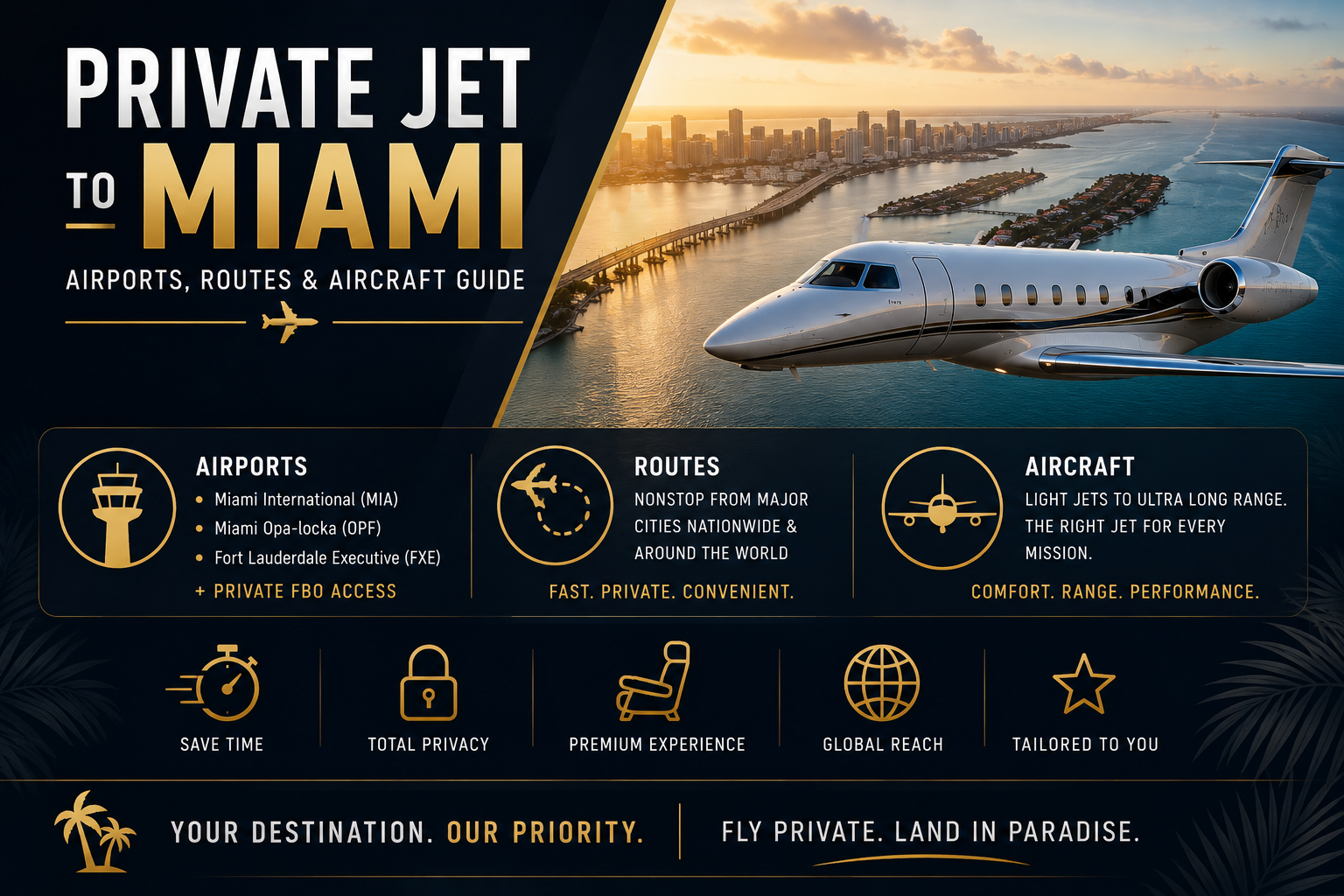
Miami Private Aviation Destination Guide
Private Jet to Miami: Airports, Routes and Aircraft Guide
Flying by private jet to Miami requires more than selecting an aircraft. The best plan connects the departure market, passenger profile, luggage, route, international requirements, arrival airport, ground transfer, event schedule, privacy needs, and final South Florida destination.
Miami is one of the most connected private aviation markets in the United States. It serves finance, real estate, family offices, yacht travel, entertainment, professional sports, major events, seasonal residences, Latin America, the Caribbean, and year-round leisure demand.
However, “Miami” does not describe one airport or one type of mission. Instead, travelers may compare Miami-Opa Locka Executive Airport, Miami International Airport, Miami Executive Airport, Fort Lauderdale Executive Airport, Fort Lauderdale-Hollywood International Airport, Palm Beach International Airport, and other South Florida options.
Therefore, the right airport depends on where the traveler actually needs to go. Miami Beach, Brickell, Coral Gables, Coconut Grove, Key Biscayne, Bal Harbour, Aventura, Fort Lauderdale, Boca Raton, and Palm Beach can each favor a different arrival strategy.
Additionally, Miami frequently serves as a gateway rather than the final stop. Travelers may continue by private jet, helicopter, yacht, vehicle, or commercial connection to the Bahamas, Turks and Caicos, St. Barts, the Cayman Islands, Puerto Rico, Latin America, Europe, or another South Florida community.
Consequently, this guide connects Miami destination demand with its airports, aircraft, routes, event calendars, international requirements, buyer questions, ground logistics, and related private aviation resources.
Is Miami a Major Private Jet Destination?
Direct Answer: Yes. Miami is a major private jet destination because it connects South Florida wealth markets, international business, luxury real estate, major events, yacht travel, seasonal residences, Latin America, and the Caribbean. However, the right airport and aircraft depend on the route, passengers, luggage, customs, timing, and final ground destination.
A private jet to Miami may support a short island connection, a same-day business meeting, an extended family stay, an international arrival, a major event, or a transcontinental mission. Therefore, no single aircraft category or airport fits every trip.
Moreover, Miami supports substantial general aviation infrastructure. Miami International Airport operates a General Aviation Center for private flights, while Miami-Opa Locka Executive Airport serves as a reliever airport for MIA and supports business aviation, Caribbean cargo activity, and large-aircraft maintenance.
Travelers and aviation professionals can verify current airport and operational information through the official Miami International Airport General Aviation Center, the Miami-Opa Locka Executive Airport resource, and the FAA Miami-Opa Locka airport page.
However, published airport information does not replace mission-specific operational review. Aircraft availability, airport conditions, notices, weather, customs, runway requirements, parking, crew limitations, and passenger details must still be confirmed for the actual flight.
Miami is a regional aviation system, not a single-airport destination.
The strongest private aviation plan compares the entire South Florida airport network against the passenger’s final address, aircraft requirements, international status, schedule, privacy needs, and onward travel.
Time, Access and Control
Why Do Travelers Fly by Private Jet to Miami?
Direct Answer: Travelers fly by private jet to Miami to gain schedule control, reduce airport friction, protect privacy, reach convenient executive airports, carry specialized luggage, travel with pets or family, work during the flight, and connect efficiently with South Florida, Latin America, and Caribbean destinations.
Miami attracts many travelers who cannot organize the trip around a fixed airline schedule. Executives may need to leave after a meeting. Families may travel with children, pets, staff, and several weeks of luggage. Meanwhile, yacht travelers may need to align an aircraft arrival with a vessel, marina, crew, weather window, or island connection.
Therefore, the most valuable benefit often comes from control rather than visible luxury. The traveler can choose a practical departure airport, select an arrival point near the final destination, coordinate vehicles directly with the FBO, and adjust the schedule around the real mission.
Recover More of the Travel Day
Private aviation can reduce commercial check-in requirements, long security queues, connections, boarding delays, baggage waits, and transfers from airports selected for airline networks rather than the traveler’s final destination.
Select a Better Airport
Instead of defaulting to one major terminal, travelers can compare several Miami-area and South Florida airports. Consequently, the chosen airport may reduce ground time and improve the arrival experience.
Control the Passenger Environment
Private cabins can support confidential conversations, family routines, pet travel, specialized food, work, rest, and a passenger experience designed around the group.
Carry Mission-Specific Baggage
Golf clubs, fishing equipment, diving gear, yacht luggage, strollers, medical items, production equipment, and extended-stay bags may require more careful aircraft matching.
Connect Beyond Miami
Miami provides convenient positioning for onward flights to Caribbean islands, Latin America, South Florida communities, and international destinations.
Protect Privacy
Private terminals, controlled passenger lists, coordinated vehicles, limited public exposure, and selective itinerary communication can support travelers who require discretion.
Nevertheless, private aviation still requires realistic planning. Weather, runway suitability, aircraft payload, customs, crew duty, airport congestion, parking, and passenger documentation may affect the mission.
As a result, a strong private jet to Miami plan balances convenience with operational reality. It does not promise that every requested aircraft, airport, or schedule will work under every condition.
A Year-Round Aviation Market
What Creates Private Aviation Demand in Miami?
Direct Answer: Miami private aviation demand comes from finance, luxury real estate, family offices, hospitality, healthcare, yacht activity, entertainment, professional sports, international business, seasonal residences, major events, Caribbean travel, and movement between South Florida and northeastern wealth markets.
Miami combines several types of demand that many destinations experience separately. It operates as a business center, international gateway, leisure market, yacht center, event destination, seasonal residential market, and launch point for regional flights.
Consequently, private aviation activity does not depend on one annual event or one traveler profile. Instead, demand shifts throughout the year as executives, families, investors, yacht travelers, performers, athletes, international visitors, and property owners move through the region.
Capital and Family Offices
Private equity, wealth management, investment firms, family offices, banks, and transaction teams create confidential and schedule-sensitive travel.
Properties and Development
Buyers, owners, developers, investors, architects, lenders, brokers, and advisors travel for projects, closings, site reviews, and portfolio management.
Yachts and Waterfront Travel
Owners, guests, brokers, builders, crews, marine businesses, and luxury hospitality providers connect air travel with South Florida’s marine infrastructure.
Latin America and Caribbean Access
Miami connects businesses and families with homes, investments, offices, partners, schools, resorts, and relationships throughout the region.
Art, Sports and Entertainment
Art week, Formula 1, tennis, boat shows, concerts, games, festivals, conferences, and private events compress demand into specific travel windows.
Seasonal Property Movement
Travelers frequently connect Miami with New York, Palm Beach, Naples, Nantucket, Aspen, Los Angeles, Chicago, and other seasonal markets.
Medical and Executive Travel
Patients, families, physicians, investors, healthcare executives, and support teams may require privacy, accessibility, flexibility, or specialized coordination.
Hospitality and Regional Escapes
Travelers use Miami for beaches, hotels, private residences, dining, shopping, cruises, yacht departures, and onward Caribbean flights.
Additionally, Miami International Airport remains a major global gateway. Therefore, some private aviation missions begin or end with an airline connection, diplomatic arrival, cargo need, or international passenger transfer.
For travelers who require current information about private flight processing at MIA, the official airport publishes details through its General Aviation Center resource. Furthermore, the airport’s Protocol and International Affairs Division explains its role in official missions, delegations, special events, and high-profile diplomatic arrivals.
Passenger and Buyer Profiles
Who Typically Flies Privately to Miami?
Direct Answer: Travelers flying privately to Miami include executives, family offices, investors, property owners, yacht travelers, athletes, entertainers, medical travelers, corporate teams, international families, event guests, and leisure passengers who value time, privacy, flexibility, or direct regional access.
Each passenger profile creates different aircraft and airport requirements. For example, an executive team may prioritize connectivity and proximity to Brickell. Meanwhile, a family staying for several weeks may require larger baggage capacity, pet accommodations, child seating, and direct access to a private residence.
Therefore, an aircraft should never be selected from passenger count alone. The planner must understand why the passengers are traveling, what they are carrying, where they are going after landing, and whether they will continue to another country or island.
Principals, Families and Advisors
Family office itineraries may include principals, children, staff, security, advisors, guests, several residences, and connected aircraft or yacht movements.
Business and Transaction Teams
Executives may require same-day flexibility, multiple meetings, private discussion space, Wi-Fi, ground coordination, and a practical business-district airport.
Seasonal and Second-Home Travel
Property owners may move frequently between Miami and other residences while carrying pets, staff, food, gifts, equipment, and extended-stay luggage.
Owners, Guests and Marine Teams
Yacht-related missions may require marina coordination, oversized baggage, provisions, flexible timing, crew communication, and onward island travel.
Artists and Production Personnel
Performers, executives, media teams, and production personnel may require unusual schedules, privacy, equipment handling, and multi-city routing.
Athletes, Owners and Representatives
Athletes and sports professionals may travel for games, training, negotiations, appearances, medical care, events, or personal trips.
Cross-Border Residential Travel
International families may connect Miami with homes, schools, businesses, relatives, investments, resorts, and other destinations across the Americas.
Resort, Event and Holiday Guests
Leisure passengers often prioritize convenient terminals, hotel proximity, luggage space, pet travel, schedule flexibility, and smooth ground transfers.
Moreover, the person researching the mission may not be the passenger. Executive assistants, family office staff, travel managers, security professionals, advisors, yacht crews, and concierge teams often compare airports and aircraft on behalf of the traveler.
Consequently, the page must answer both high-level buyer questions and detailed planning questions. That approach helps more stakeholders understand the mission before they request availability.
Miami Airport Strategy
What Are the Best Airports for a Private Jet to Miami?
Direct Answer: The best airport for a private jet to Miami depends on the final address, aircraft, runway requirements, customs, FBO preference, parking, traffic, schedule, and privacy needs. Miami-Opa Locka Executive often fits business aviation, while MIA, Miami Executive, Fort Lauderdale, Palm Beach, and other airports may better serve specific missions.
Miami-area airport selection should begin with the passenger’s final destination rather than a generic city label. For example, a traveler headed to Aventura may make a different decision than a passenger traveling to Brickell, Coral Gables, Key Biscayne, Fort Lauderdale, or Palm Beach.
Furthermore, the aircraft may narrow the available choices. Runway needs, weight, wingspan, handling, parking, fuel, international processing, and operating restrictions may eliminate an otherwise convenient airport.
Therefore, the airport decision should compare both ground convenience and flight operations. A shorter drive cannot justify an unsuitable airport, while a technically capable airport may still create an unnecessarily long ground transfer.
| Airport | Common Mission Fit | Potential Advantage | Primary Planning Question |
|---|---|---|---|
| Miami-Opa Locka Executive Airport | Business aviation, charter, private aircraft, northern Miami and Miami Beach access | Executive-airport environment and substantial general aviation capability | Does it provide the best balance of aircraft suitability and ground access? |
| Miami International Airport | International operations, large aircraft, airline connections, specialized handling | Major-airport infrastructure and on-site international processing capabilities | Do MIA’s capabilities outweigh commercial congestion and ground complexity? |
| Miami Executive Airport | Southwest Miami-Dade, business aviation, international arrivals, regional access | General aviation access serving southern and western Miami-area destinations | Is the final destination better served from southwest Miami-Dade? |
| Fort Lauderdale Executive Airport | Fort Lauderdale, Broward County, yacht activity, northern South Florida | Executive airport access near many Broward County destinations | Will it reduce the complete ground journey compared with a Miami airport? |
| Fort Lauderdale-Hollywood International Airport | International operations, airline connections, Broward County and coastal travel | Major-airport capability near Fort Lauderdale and marine destinations | Does the mission require its infrastructure or connectivity? |
| Palm Beach International Airport | Palm Beach, West Palm Beach, seasonal residences, family offices | Strong access to Palm Beach County wealth markets | Is Miami truly the final destination, or is the passenger traveling farther north? |
| Boca Raton Airport | Boca Raton, private communities, local business and residential travel | Convenient positioning for southern Palm Beach County | Can the airport support the aircraft and mission requirements? |
For official airport information, travelers and planners should consult the Miami-Dade Aviation Department, airport operators, FAA publications, current notices, the selected FBO, and the flight operator. The FAA Terminal Procedures and Airport Diagrams resource provides current aeronautical procedure materials, while the FAA also maintains regularly updated chart and airport publications.
Primary Executive Airport
Why Do Travelers Use Miami-Opa Locka Executive Airport?
Direct Answer: Miami-Opa Locka Executive Airport often fits a private jet to Miami because it provides a business-aviation-focused environment, long-runway capability, established FBO services, international-arrival support, and practical access to Miami Beach, Bal Harbour, Aventura, North Miami, and other northern Miami-Dade destinations.
Miami-Opa Locka Executive Airport, commonly identified by the airport code OPF, serves as one of South Florida’s most important general aviation airports. Therefore, private charter operators, corporate flight departments, aircraft owners, management companies, maintenance providers, and international travelers frequently use the airport.
According to the official Miami-Dade Aviation Department overview of Miami-Opa Locka Executive Airport, OPF operates as a reliever airport for Miami International Airport. Additionally, its runway infrastructure can support a broad range of business aircraft.
Nevertheless, Opa Locka should not automatically replace every other Miami-area airport. Instead, the planner should compare aircraft suitability, FBO preference, international processing, parking, expected traffic, arrival time, and the final ground address.
Executive Aviation Environment
OPF centers heavily on general and business aviation. Consequently, passengers can often use private terminal facilities designed around charter, corporate, owner-operated, and managed aircraft missions.
Large-Aircraft Capability
The airport’s runway system can support many large business aircraft. However, the operator must still review aircraft weight, runway conditions, weather, performance, parking, and current operating information.
Northern Miami-Dade Access
Opa Locka may provide practical access to Aventura, Bal Harbour, North Miami, Miami Gardens, Miami Beach, marinas, sporting venues, and northern residential communities.
International Mission Support
International arrivals may use the airport when customs, scheduling, documentation, and operating requirements align. Therefore, the flight team should confirm current procedures before departure.
FBO and Ground Services
FBO providers may coordinate passenger handling, fueling, catering, vehicles, lounges, baggage, crew support, and related services. However, availability varies by provider and travel date.
Aviation Business Infrastructure
The airport supports charter activity, aircraft management, maintenance, aviation services, cargo operations, and other businesses that strengthen its role within the South Florida market.
Which Miami Destinations May Work Well From Opa Locka?
Opa Locka may work well for travelers whose final destinations sit in northern or central Miami-Dade County. For example, passengers headed to Aventura, Bal Harbour, North Miami Beach, Miami Gardens, Sunny Isles Beach, or northern sections of Miami Beach may find OPF practical.
However, travel time can change significantly with congestion. Therefore, a traveler headed to Brickell, Key Biscayne, Coral Gables, Coconut Grove, or southern Miami-Dade should compare Opa Locka with Miami International Airport, Miami Executive Airport, or another suitable option.
Do not choose OPF based only on its reputation as a private aviation airport.
Instead, compare the planned arrival time, exact final address, aircraft requirements, customs needs, FBO preference, event traffic, security plan, and ground transportation before confirming the mission.
For current airport information, pilots and flight departments should consult official airport publications, FAA resources, applicable notices, weather reports, and the selected service provider. The FAA information page for Miami-Opa Locka Executive Airport provides an additional official starting point for airport-related resources.
Major International Gateway
When Should a Private Jet to Miami Use Miami International Airport?
Direct Answer: Miami International Airport may fit a private jet to Miami when the mission requires major-airport infrastructure, airline connections, international processing, large-aircraft services, diplomatic coordination, specialized handling, or direct access to central Miami. However, commercial congestion may make another airport more convenient.
Miami International Airport, commonly identified as MIA, is South Florida’s primary international airline gateway. Nevertheless, it also supports private, charter, cargo, government, and special-purpose aircraft through its general aviation infrastructure.
The official Miami International Airport General Aviation Center explains that the facility supports private aircraft activity and houses federal processing functions for certain international arrivals. Therefore, MIA may serve missions that require capabilities unavailable or less practical at another regional airport.
However, those advantages come with tradeoffs. Commercial airline activity can increase surface congestion, taxi time, ramp complexity, security procedures, and ground-transportation friction. Consequently, a private traveler should use MIA because the mission benefits from its capabilities, not simply because the final destination is Miami.
Global Arrival Infrastructure
MIA may support complex international missions involving customs, passenger transfers, diplomatic handling, specialized coordination, or connections with scheduled airline service.
Broad Airport Capability
The airport can support many aircraft categories and specialized services. However, operators must still confirm handling, parking, runway performance, and mission-specific requirements.
Private-to-Airline Transfers
MIA may fit travelers who need to connect between private aviation and commercial international or domestic flights within the same airport system.
Brickell and Downtown Travel
Depending on traffic, MIA may provide practical access to Brickell, downtown Miami, Coral Gables, Coconut Grove, healthcare centers, and western Miami-Dade.
Diplomatic and Official Arrivals
Government, diplomatic, delegation, and high-profile missions may require protocols or capabilities that favor Miami International Airport.
Commercial Airport Complexity
Taxi delays, terminal activity, security, commercial traffic, and ramp congestion may make MIA less convenient for a straightforward domestic charter mission.
Who May Benefit From Using MIA?
International passengers connecting with airline service may benefit from MIA. Likewise, missions involving diplomatic delegations, unusual aircraft requirements, specialized cargo, maintenance, or major-airport services may favor the airport.
Additionally, some travelers headed to Brickell, Coral Gables, Coconut Grove, downtown Miami, or western Miami-Dade may find the ground journey practical. Nevertheless, traffic changes quickly, so the travel team should compare realistic drive times for the planned arrival.
When May Another Airport Work Better?
A straightforward domestic charter, owner flight, or business aviation mission may receive a more private and efficient experience at Opa Locka or another executive airport. Therefore, travelers should compare the total journey rather than assuming that Miami International provides the best answer because of its name.
The comparison should include:
- Aircraft size and runway requirements
- International or domestic status
- Customs and immigration needs
- Airline or private-flight connections
- Parking and handling availability
- Expected taxi and ramp congestion
- Passenger privacy requirements
- Final South Florida ground destination
- Arrival time and expected road traffic
- Security, diplomatic, or special handling needs
For current official guidance, travelers and flight teams should consult the Miami International Airport website, the selected handling provider, U.S. Customs and Border Protection when applicable, FAA publications, and the flight operator.
Southwest Miami-Dade Access
When Does Miami Executive Airport Fit a Private Jet to Miami?
Direct Answer: Miami Executive Airport may fit a private jet to Miami when passengers need access to southwest Miami-Dade, Kendall, Pinecrest, southern business districts, nearby residential communities, or regional aviation services. However, the aircraft, runway needs, customs, traffic, and final address must support the choice.
Miami Executive Airport, commonly identified by the airport code TMB, provides another general aviation option within Miami-Dade County. Therefore, travelers should consider it when their final destination lies farther south or west than the areas commonly served from Opa Locka.
The official Miami Executive Airport page from the Miami-Dade Aviation Department describes the airport’s role in the regional aviation system. Nevertheless, official airport capability alone does not determine whether it fits an individual charter or owner mission.
Southern Miami-Dade Access
The airport may provide practical access to Kendall, Pinecrest, Palmetto Bay, Homestead-area travel, western communities, and businesses located away from Miami Beach.
General Aviation Environment
Miami Executive serves flight training, private aircraft, charter, business aviation, maintenance, helicopter activity, and other aviation operations.
International Potential
Some international missions may use the airport when customs and operating arrangements align. Therefore, current procedures should be verified before departure.
Miami Executive may not be the best choice for passengers headed to Bal Harbour, Aventura, northern Miami Beach, or Fort Lauderdale. Conversely, it may reduce ground time for travelers going to southern Miami-Dade communities or nearby business locations.
Therefore, the planner should compare TMB against MIA, OPF, and other suitable airports using the actual final address and anticipated traffic period.
The Miami airport decision begins after the flight lands.
An airport that looks farther away on a regional map may still produce a better total journey when traffic patterns, destination location, terminal access, and aircraft operations are considered together.
Broward County and Marine Access
Should Travelers Flying Privately to Miami Consider Fort Lauderdale Airports?
Direct Answer: Yes. Fort Lauderdale airports may fit travelers whose final destination is in Broward County, Aventura, Hollywood, Fort Lauderdale, nearby marinas, yacht facilities, or northern South Florida. However, they may create unnecessary ground time for Brickell, Coral Gables, Key Biscayne, or southern Miami destinations.
The phrase “private jet to Miami” often describes travel into the wider South Florida market. Therefore, Fort Lauderdale Executive Airport and Fort Lauderdale-Hollywood International Airport should remain part of the airport comparison.
Fort Lauderdale attracts yacht owners, marine businesses, property owners, executives, leisure travelers, and international passengers. Additionally, the region includes major marinas, repair facilities, private communities, resorts, and business centers.
Fort Lauderdale Executive Airport
Fort Lauderdale Executive Airport may fit private aviation missions serving Broward County, local businesses, residential communities, yacht facilities, and northern South Florida. Additionally, its executive-airport environment may reduce some commercial-airport friction.
Fort Lauderdale-Hollywood International Airport
Fort Lauderdale-Hollywood International Airport may support international missions, airline connections, large-aircraft needs, and travel centered closer to coastal Broward County. However, commercial traffic may add complexity.
When Does Fort Lauderdale Create More Convenience?
Travelers headed to Fort Lauderdale, Hollywood, Dania Beach, Lauderdale-by-the-Sea, many Broward County marinas, or northern residential communities may reduce ground time by arriving in Fort Lauderdale rather than farther south.
Additionally, yacht travelers should compare the vessel’s exact marina or service location. A yacht associated with the broader Miami market may actually sit closer to Fort Lauderdale or another Broward County facility.
When Does Fort Lauderdale Create More Friction?
Passengers traveling to Brickell, downtown Miami, Key Biscayne, Coral Gables, Coconut Grove, southern Miami Beach, or southwest Miami-Dade may face a longer transfer. Therefore, the flight planner should not use Fort Lauderdale only because aircraft availability appears attractive.
Instead, the quote and mission review should include realistic vehicle time, passenger priorities, arrival schedule, luggage, event traffic, and the possibility of delays along the coastal corridor.
Official airport information is available through the Fort Lauderdale Executive Airport website and the Broward County Fort Lauderdale-Hollywood International Airport resource.
The Wider South Florida Network
Which Other Airports May Support a Miami-Area Private Jet Mission?
Direct Answer: Palm Beach International Airport, Boca Raton Airport, Naples Airport, Homestead-area options, and other regional airports may support Miami-related private aviation when the traveler’s actual destination lies outside central Miami or when aircraft availability, weather, parking, or operational needs favor an alternative.
South Florida private aviation does not stop at the Miami-Dade or Broward County boundary. Seasonal residents, family offices, property owners, executives, and leisure travelers move throughout Palm Beach County, Naples, the Florida Keys, and other nearby markets.
Therefore, the destination request should identify the exact residence, hotel, marina, event, office, medical center, or onward connection before the airport is selected.
Palm Beach International Airport
PBI may fit Palm Beach, West Palm Beach, seasonal residences, family office travel, finance, equestrian activity, yacht travel, and northern South Florida missions.
Boca Raton Airport
Boca Raton Airport may support travel into local private communities, businesses, resorts, and southern Palm Beach County when the aircraft and mission fit its capabilities.
Naples Airport
Naples Airport may fit travelers whose true destination is southwest Florida rather than Miami. Therefore, a direct arrival may avoid a long cross-state ground transfer.
Additionally, weather disruptions, runway conditions, parking restrictions, major events, and aircraft repositioning may cause the operator to consider an alternate airport. However, the passenger should understand how that change affects the total journey.
Consequently, the airport selection process should remain flexible without becoming careless. Alternatives should still satisfy aircraft performance, passenger convenience, international processing, security, and ground transportation requirements.
Miami Airport Decision Framework
How Should Travelers Compare Airports for a Private Jet to Miami?
Direct Answer: Travelers should compare Miami-area airports by evaluating the exact final address, ground traffic, runway suitability, aircraft size, customs, FBO service, parking, operating hours, weather, privacy, airline connections, security, and whether another South Florida airport shortens the complete journey.
The airport comparison should begin before the aircraft is selected because some airports may affect the available fleet. Likewise, aircraft availability should not force the traveler into an airport that creates unnecessary ground time or operational risk.
Therefore, the best decision balances airside and ground-side value.
Where Is the Passenger Going?
Miami Beach, Brickell, Coral Gables, Coconut Grove, Key Biscayne, Aventura, Fort Lauderdale, Boca Raton, and Palm Beach may each favor a different airport.
Can the Airport Support the Mission?
Runway length, pavement, weight, wingspan, fuel, weather, performance, parking, and handling requirements may narrow the available options.
Is the Flight International?
Customs availability, advance notification, passenger documentation, pets, agricultural declarations, and operating schedules may affect airport selection.
When Will the Passenger Land?
Rush hour, bridges, construction, sporting events, concerts, weather, and road closures can change the best airport for the same destination.
How Controlled Must the Arrival Be?
Private terminal access, vehicle positioning, security teams, media attention, passenger identity, and public exposure may influence the decision.
What Happens After Miami?
Commercial flights, helicopters, yachts, island transfers, cruise departures, medical appointments, and additional private flights may change the preferred airport.
| Traveler Priority | Questions to Ask | Potential Airport Direction |
|---|---|---|
| Executive airport experience | Does the passenger value private terminal handling and reduced commercial activity? | Compare Opa Locka, Miami Executive, Fort Lauderdale Executive, and other general aviation airports. |
| International infrastructure | Does the mission require customs, airline connections, diplomatic handling, or specialized services? | Compare MIA, FLL, OPF, TMB, and other approved international-arrival options. |
| Miami Beach or northern Miami-Dade | Which airport creates the most reliable ground transfer at the arrival time? | Opa Locka may become a leading option, although traffic and exact location still matter. |
| Brickell, downtown, Coral Gables or Coconut Grove | Will MIA or another airport reduce the ground journey without creating excessive airside friction? | Compare MIA, OPF, and TMB against realistic traffic conditions. |
| Fort Lauderdale or yacht facilities | Is the vessel, marina, hotel, or residence actually in Broward County? | Compare FXE and FLL before defaulting to a Miami-Dade airport. |
| Palm Beach or Boca Raton | Is Miami only being used as a broad regional label? | Consider PBI or BCT when the true destination lies farther north. |
Ultimately, the traveler should receive a reasoned airport recommendation rather than a list of codes. That recommendation should explain both the advantages and the tradeoffs of the selected arrival point.
The Final Ground Segment
How Does Ground Transportation Affect a Private Jet to Miami?
Direct Answer: Ground transportation can determine whether a private jet to Miami actually saves time. Therefore, the plan should account for traffic, bridges, event closures, airport vehicle access, final-address security, passenger count, luggage, pets, child seats, marina location, and the possibility that the flight schedule changes.
Private aviation may eliminate many commercial-airport delays. However, an inefficient ground plan can return those hours to the road. Consequently, ground transportation should become part of airport selection rather than an afterthought.
Miami’s geography adds complexity because waterways, causeways, bridges, coastal development, and concentrated business districts can create bottlenecks. Moreover, major events and severe weather may alter normal traffic patterns.
Miami Beach and Barrier-Island Access
Travelers should review bridge routes, event traffic, hotel or residence access, vehicle staging, and expected congestion at the planned arrival time.
Brickell and Downtown Miami
Business travelers may prioritize reliable access to offices, hotels, meeting locations, private residences, and financial districts over the airport’s prestige.
Coral Gables and Coconut Grove
Travelers headed south of downtown should compare airport options against realistic traffic rather than general regional assumptions.
Aventura and Bal Harbour
Northern coastal destinations may favor Opa Locka or Fort Lauderdale options, depending on traffic, the exact address, and the aircraft mission.
Marinas and Yacht Transfers
The transfer should align with the vessel’s actual location, marina access, crew communication, luggage movement, weather, and departure schedule.
Security and Private Residences
Gated communities, security checkpoints, building access, staff coordination, and vehicle identification may require advance communication.
What Should the Ground Team Confirm?
- The exact passenger destination rather than only “Miami”
- The preferred and alternate airport
- The estimated aircraft arrival window
- The selected FBO and vehicle-access instructions
- The number of passengers, staff, and security personnel
- The number and size of all bags
- Pet carriers, child seats, wheelchairs, or accessibility needs
- Marina, hotel, residence, medical facility, or venue access
- Event closures, construction, traffic, and bridge conditions
- A communication process for delays or airport changes
Additionally, vehicles should provide enough capacity for the group and baggage without creating a second transfer. For example, a large family, extended-stay traveler, production team, or yacht party may require several SUVs or a dedicated baggage vehicle.
Therefore, the aircraft and ground transportation should be planned together. The best cabin experience loses value when passengers wait for luggage, split into unsuitable vehicles, or discover that the selected airport creates an avoidable drive.
High-Value Miami Corridors
What Are the Most Popular Routes for a Private Jet to Miami?
Direct Answer: Popular routes for a private jet to Miami connect South Florida with New York, Palm Beach, Aspen, Los Angeles, Dallas, Chicago, London, the Bahamas, Turks and Caicos, and Latin American markets. However, the best airport and aircraft depend on distance, passengers, luggage, weather, customs, and nonstop requirements.
Miami sits at the center of several private aviation travel patterns. First, seasonal residents frequently move between South Florida and the Northeast. Meanwhile, families and yacht travelers often continue toward Caribbean islands. Additionally, executives connect Miami with major U.S. financial, energy, technology, and entertainment markets.
Therefore, route demand changes according to season, passenger profile, event calendars, and the final airport. A winter flight from Teterboro to Miami may involve different baggage, airport, and scheduling needs than a short regional trip from Miami to the Bahamas.
Likewise, an international mission from London or South America introduces customs, permits, crew duty, range, and arrival-processing requirements that do not apply to a domestic flight.
Teterboro to Miami
This high-value corridor supports finance, family office travel, seasonal residences, luxury real estate, events, and frequent movement between New York and South Florida.
Miami to Teterboro
The northbound route becomes especially valuable when travelers need schedule control, private terminal access, larger baggage capacity, or convenient New York-area ground access.
Miami to the Bahamas
This regional mission may support resort travel, private residences, yacht access, fishing trips, family vacations, and island-to-island connections.
Miami to Turks and Caicos
Travelers often prioritize customs, resort transfers, luggage, pets, villa access, and family comfort when planning this Caribbean route.
Miami to Aspen
This seasonal route requires additional attention to elevation, runway performance, winter weather, passenger load, ski equipment, and alternate-airport planning.
Miami to Los Angeles
This transcontinental mission serves entertainment, finance, sports, production, real estate, family travel, and executive schedules.
Miami to Dallas
Business travelers may use this route for finance, energy, technology, real estate, healthcare, private equity, and multi-city executive travel.
Miami to Chicago
This route supports seasonal travel, corporate meetings, finance, legal work, family visits, sports, entertainment, and property movement.
Miami to London
This international corridor favors large-cabin and ultra-long-range aircraft, while winds, slots, customs, crew duty, and sleeping requirements require careful review.
Why Should Each Direction Have Its Own Route Page?
Although two cities remain the same, the outbound and return missions may involve different airports, weather, winds, departure windows, passenger schedules, baggage loads, and ground destinations. Therefore, Teterboro-to-Miami and Miami-to-Teterboro can serve different search intent and planning needs.
Additionally, seasonal patterns may affect one direction more heavily. For example, a southbound holiday arrival may face different airport congestion than a northbound weekday business departure.
Consequently, dedicated directional route pages can answer more specific questions without forcing one page to cover every possible variation.
Aircraft Matching
Which Aircraft Work Best for a Private Jet to Miami?
Direct Answer: A private jet to Miami may use a turboprop, light jet, midsize jet, super-midsize aircraft, large-cabin jet, or ultra-long-range aircraft. The correct choice depends on route distance, passengers, luggage, pets, cabin needs, airport compatibility, weather, payload, and whether the mission requires nonstop range.
Miami supports one of the broadest aircraft mixes in private aviation. For example, a short regional trip from the Bahamas may work well with a turboprop or light jet. Meanwhile, a nonstop transatlantic mission may require a large-cabin or ultra-long-range aircraft.
Therefore, travelers should not select an aircraft only by maximum passenger capacity or cabin appearance. Instead, the aircraft should support the actual mission with enough space, range, runway performance, baggage volume, comfort, and operational margin.
King Air 350
The King Air 350 may support regional business travel, island flights, family missions, and trips where airport flexibility matters more than maximum jet speed.
Pilatus PC-24
The Pilatus PC-24 may suit missions requiring a flexible cabin, accessible baggage, regional performance, and broader airport options.
Phenom 300E
The Phenom 300E may support efficient regional and shorter domestic missions for smaller groups with moderate baggage requirements.
Citation Latitude
The Citation Latitude may support domestic business and leisure missions where passengers value a stand-up cabin, luggage space, and practical operating flexibility.
Challenger 3500
The Challenger 3500 may fit transcontinental, Northeast, Caribbean, and executive missions that require a larger cabin and stronger baggage capacity.
Praetor 600
The Praetor 600 may support longer domestic and selected international missions where range, cabin comfort, and efficient travel matter.
Gulfstream G550
The Gulfstream G550 may support long-range international travel, larger groups, working cabins, sleeping arrangements, and extended baggage needs.
Gulfstream G650
The Gulfstream G650 may support high-speed, long-range travel between Miami, Europe, South America, the Middle East, and other global destinations.
Bombardier Global 7500
The Global 7500 may fit missions requiring exceptional range, several cabin zones, sleeping space, working areas, and long-duration passenger comfort.
What Aircraft Factors Matter Most?
- Route distance and expected winds
- Passenger count and seating layout
- Baggage volume and compartment dimensions
- Pets, child seats, and accessibility needs
- Runway performance and airport compatibility
- Nonstop range and fuel-stop risk
- Weather and reserve requirements
- Working, dining, sleeping, or privacy needs
An aircraft may advertise enough seats for the group, yet it may not provide enough practical space for passengers and baggage. Likewise, a jet may advertise sufficient maximum range, yet weather, winds, payload, airport conditions, and required reserves may affect nonstop feasibility.
Therefore, the operator must evaluate the actual aircraft, not only the model’s marketing specifications.
The best private jet to Miami is the one that fits the complete mission.
A larger aircraft may provide more comfort, yet it may introduce higher operating costs, different parking needs, or reduced airport flexibility. Conversely, a smaller aircraft may appear efficient but fail to support the required range, luggage, pets, passengers, or weather margin.
Miami Seasonality
When Is Demand Highest for a Private Jet to Miami?
Direct Answer: Demand for a private jet to Miami often increases during winter, holidays, Art Basel and Miami Art Week, Formula 1, yacht events, the Miami Open, major sporting events, spring travel, and weekends when seasonal residents move between South Florida, the Northeast, mountain destinations, and the Caribbean.
Miami remains active throughout the year. Nevertheless, demand changes according to weather, events, international travel patterns, yacht activity, business calendars, school schedules, and seasonal residences.
Therefore, compressed periods may affect aircraft availability, airport parking, FBO capacity, departure times, hotel rooms, vehicles, catering, and crew schedules.
Winter
Winter often brings seasonal residents, holiday travelers, yacht activity, international visitors, business events, and movement from colder northeastern markets.
Spring
Spring demand may follow Formula 1 planning, the Miami Open, spring break periods, corporate events, yacht activity, and Caribbean travel.
Summer
Summer may shift demand toward international families, Latin American travel, yacht connections, business movement, and departures toward northern seasonal markets.
Fall
Fall demand builds around business activity, sports, real estate, holidays, art events, and the return of seasonal residents to South Florida.
How Early Should Travelers Begin Planning?
Travelers should begin planning when the schedule becomes reasonably clear. However, major events, holidays, international travel, large groups, preferred aircraft categories, and high-demand weekends often justify earlier coordination.
Moreover, early planning gives the traveler more opportunity to choose the correct aircraft instead of selecting from whatever remains available. It also provides more time to confirm parking, FBO services, vehicles, customs, pet documents, catering, and security arrangements.
- Plan earlier for event and holiday travel.
- Provide accurate passenger and baggage information.
- Confirm pets and international documentation early.
- Review preferred and alternate airports.
- Coordinate airport parking and FBO services.
- Reserve suitable ground transportation.
- Build flexibility around weather and traffic.
- Maintain a clear communication process for changes.
Major Event Travel
Which Miami Events Increase Private Aviation Demand?
Direct Answer: Miami private aviation demand often increases around Art Basel and Miami Art Week, Formula 1, the Miami Open, international boat shows, major sports events, concerts, festivals, business conferences, private social gatherings, and holiday weekends.
Major events compress private aviation demand into narrow arrival and departure periods. Therefore, travelers may face pressure not only on aircraft availability, but also on airport parking, FBO capacity, hotel rooms, security teams, catering, and ground transportation.
Additionally, events attract public figures, sponsors, athletes, executives, collectors, entertainers, production teams, and international travelers. Consequently, privacy and handling may become as important as flight time.
Art Basel and Miami Art Week
Miami Art Week attracts collectors, galleries, advisors, artists, investors, luxury brands, media organizations, sponsors, and international guests.
Formula 1 Miami
Formula 1 travel may include team leaders, sponsors, drivers, executives, entertainers, guests, media, and international visitors.
Miami Open
The Miami Open can generate travel from players, coaches, sponsors, families, representatives, executives, media, and high-value spectators.
Boat Shows and Yacht Events
Marine events attract owners, buyers, builders, brokers, designers, crew, family offices, hospitality groups, and luxury service providers.
Games, Playoffs and Championships
Football, basketball, baseball, soccer, combat sports, and international competitions may generate last-minute, sponsor, ownership, and group travel.
Concerts and Private Events
Artists, producers, executives, sponsors, guests, and media teams may require irregular schedules, discreet handling, and equipment coordination.
Why Does Departure Planning Matter as Much as Arrival?
Many travelers focus on arriving before the event. However, the most compressed private aviation demand may occur immediately after the event ends.
Therefore, the travel team should coordinate passenger readiness, vehicles, luggage, catering, crew duty, weather, FBO access, and expected airport congestion before the event begins.
Moreover, a flexible departure window may reduce unnecessary waiting when several aircraft request similar times. Nevertheless, any flexibility must still respect the passenger’s schedule, crew limitations, airport operations, and onward travel.
Executive and Corporate Travel
How Does a Private Jet to Miami Support Business Travel?
Direct Answer: A private jet to Miami can support business travel by helping executives reach meetings, properties, investors, healthcare systems, financial institutions, development projects, international partners, and multiple South Florida markets with greater schedule control, confidentiality, productivity, and multi-city flexibility.
Miami has become a significant center for finance, private equity, wealth management, real estate, technology, healthcare, hospitality, law, media, international trade, and family office activity.
Therefore, private aviation demand extends far beyond leisure travel. Executives may use the cabin to prepare for meetings, hold confidential discussions, review documents, rest between cities, or coordinate with colleagues before arrival.
Financial Services
Private equity firms, investment managers, banks, family offices, wealth advisors, and transaction teams often require confidential and time-sensitive travel.
Real Estate and Development
Developers, investors, architects, brokers, lenders, buyers, and advisors may travel for site visits, closings, planning meetings, and portfolio oversight.
International Business
Miami connects U.S. companies with clients, offices, assets, suppliers, investors, and partners throughout Latin America, the Caribbean, and Europe.
Healthcare
Executives, physicians, investors, patients, families, and medical teams may require specialized timing, accessibility, privacy, or ground coordination.
Marine and Hospitality
Hotel groups, yacht companies, investors, owners, operators, developers, and service providers move frequently through South Florida.
Multi-City Itineraries
Private aviation may connect Miami with Palm Beach, Naples, Orlando, Atlanta, Dallas, Houston, New York, and international markets within one itinerary.
How Should Businesses Evaluate the Value?
Businesses should compare the mission against more than the charter price. For example, several executives may travel together, hold private discussions, visit multiple locations, avoid overnight stays, and return home sooner.
Consequently, the value may include recovered working hours, reduced hotel costs, greater confidentiality, faster transaction timelines, and less disruption for senior personnel.
However, those advantages depend on thoughtful planning. The aircraft, airport, schedule, connectivity, cabin layout, ground transportation, and return plan must support the business objective.
Yacht, Resort and Leisure Travel
How Does a Private Jet to Miami Support Yacht and Leisure Travel?
Direct Answer: A private jet to Miami can simplify yacht connections, resort travel, private residences, holiday trips, shopping, dining, major events, beach travel, and onward flights to Caribbean destinations. However, airport choice should match the marina, residence, hotel, baggage, pets, and final travel segment.
Miami leisure travel often involves more than a hotel stay. A traveler may be arriving for a yacht, private residence, villa, cruise, wedding, family gathering, sporting event, shopping appointment, or regional island trip.
Therefore, the arrival airport, aircraft baggage capacity, vehicles, and onward schedule should support the complete plan.
Coordinate Air and Marine Travel
Airport selection, marina location, vessel position, crew timing, baggage movement, weather, and onward travel should work together.
Reach the Correct Community
Miami Beach, Fisher Island, Key Biscayne, Coconut Grove, Coral Gables, Bal Harbour, and Aventura may favor different airport strategies.
Continue Beyond Miami
Miami often becomes the departure point for the Bahamas, Turks and Caicos, the Cayman Islands, Puerto Rico, the Dominican Republic, and St. Barts.
Design Around the Schedule
Private aviation allows travelers to build arrival and departure timing around reservations, private appointments, events, and personal plans.
Carry Specialized Baggage
Golf clubs, fishing equipment, diving gear, beach luggage, yacht supplies, and extended-stay bags may change the aircraft requirement.
Reduce Family Friction
Private aviation can simplify travel with children, pets, staff, gifts, special food, equipment, and complicated seasonal schedules.
What Should Yacht Travelers Confirm?
- The vessel’s exact marina or pickup location
- Whether the yacht may reposition before arrival
- The amount and size of passenger baggage
- Marine, diving, fishing, or technical equipment
- Ground vehicle capacity and marina access
- Communication with the captain or crew
- Weather that may affect the yacht or flight
- Onward island, helicopter, or tender transfers
Consequently, the best leisure mission focuses on practical convenience rather than vague luxury language. The real value often comes from fewer connections, reduced public exposure, better baggage control, direct access, and more time at the destination.
Families, Children and Pets
What Should Families Know Before Booking a Private Jet to Miami?
Direct Answer: Families should share accurate passenger, child, pet, baggage, food, accessibility, medical, and ground-transportation details before selecting a private jet to Miami. Additionally, international missions may require passports, visas, customs information, health records, and destination-specific pet documentation.
Family travel often involves more than a passenger count. For example, the group may include infants, young children, grandparents, assistants, household staff, pets, security, strollers, car seats, medical items, toys, gifts, and several weeks of luggage.
Therefore, an aircraft may technically provide enough seats while still failing to support the complete mission comfortably.
Family Planning Questions
- How many adults, children, infants, and staff will travel?
- Will any passenger need accessibility support?
- Will pets travel inside the cabin?
- How many bags, strollers, and child seats are included?
- Will the group carry sports, fishing, marine, or medical equipment?
- Does the family require specific food or refrigeration?
- Which airport provides the easiest final transfer?
- Will the passengers continue internationally?
Why Accurate Information Matters
Accurate information allows the operator or broker to compare cabin layout, baggage capacity, loading limitations, aircraft access, pet needs, and airport compatibility before the trip.
Additionally, complete details reduce the chance of a last-minute aircraft change. Therefore, travelers should not underestimate luggage or wait until departure day to disclose special requirements.
Can Pets Fly in the Cabin?
Many private aviation arrangements allow pets to remain inside the cabin. However, operator policy, aircraft size, pet behavior, international documentation, destination rules, and passenger needs still require advance review.
Furthermore, pets may need health certificates, vaccination records, microchip documentation, import permits, or other paperwork for international travel. Consequently, travelers should begin pet planning well before the flight.
Customs and International Operations
What Should International Travelers Know Before Flying Privately to Miami?
Direct Answer: International travelers flying privately to Miami may need customs coordination, passports, visas, passenger manifests, permits, pet records, agricultural declarations, airport approval, crew planning, and advance communication with the operator, selected airport, FBO, and U.S. Customs and Border Protection.
Miami connects naturally with the Caribbean, Latin America, Europe, and other global regions. However, private aviation does not remove immigration, customs, security, or agricultural requirements.
Instead, the flight team coordinates those requirements through advance passenger information, airport procedures, handling providers, customs notifications, and mission planning.
U.S. Customs and Border Protection publishes requirements for private aircraft through its official General Aviation Processing resource. Additionally, CBP provides information about electronic passenger manifest requirements through its Advance Passenger Information System guidance for private aircraft.
Customs and Immigration
The selected airport, operating schedule, passenger documentation, advance notification, and customs availability must align before the mission is confirmed.
Passenger Manifests
The flight team may need to submit passenger and crew information before departure or arrival. Therefore, names and documents must remain accurate.
Permits and Slots
Some countries and airports may require landing permits, overflight permits, slots, parking approval, or advance handling arrangements.
Pets and Agricultural Rules
Pets, food, plants, animal products, and certain items may require documentation, declarations, restrictions, or inspection.
Crew and Range Planning
Longer flights may require augmented crews, duty review, rest planning, fuel stops, alternates, catering, and additional operational support.
Onward Connections
Passengers continuing by yacht, helicopter, airline, vehicle, or another private aircraft need a coordinated transfer plan.
What Information Should Passengers Provide?
- Full legal names matching travel documents
- Passport details and expiration dates
- Citizenship and residency information when required
- Visa documentation when applicable
- Pet records and import documentation
- Restricted, agricultural, or specialized items
- Onward travel and final destination
- Contact information for the traveler or representative
Additionally, travelers should remain available to answer questions before departure. A missing document, changed passenger, undisclosed pet, or inaccurate manifest may delay the mission.
Therefore, international private aviation works best when passengers, assistants, operators, brokers, FBOs, handling agents, and customs authorities share accurate information early.
Discretion and Passenger Protection
How Can a Private Jet to Miami Support Privacy and Security?
Direct Answer: A private jet to Miami can support privacy through controlled passenger lists, private terminals, discreet ground vehicles, reduced public exposure, limited itinerary distribution, direct FBO coordination, and fewer public touchpoints. However, higher-security travel still requires deliberate operational and ground planning.
Miami attracts public figures, executives, athletes, entertainers, investors, family offices, international families, and travelers involved in sensitive business. Therefore, privacy may influence the airport, FBO, arrival time, vehicle plan, communication process, and security staffing.
However, private aviation does not guarantee complete anonymity. Regulated flight operations, airport access, passenger identification, customs procedures, and security requirements still involve official records and authorized personnel.
Consequently, travelers with heightened concerns should coordinate with qualified aviation, security, legal, and risk-management professionals.
Limit Unnecessary Distribution
Passenger names, itinerary details, vehicles, contact lists, schedule updates, and destination information should remain limited to necessary personnel.
Control the Arrival
Vehicle staging, driver identification, luggage movement, residence access, and alternate routes can reduce confusion after landing.
Choose the Appropriate Environment
An executive airport or private terminal may create a more controlled passenger experience than a heavily trafficked commercial terminal.
Plan for the Passenger Profile
Security teams may require airport coordination, vehicle access, advance site review, local support, and communication with the operator or FBO.
Avoid Predictable Exposure
Major events can create media presence, crowds, traffic, and concentrated aircraft schedules. Therefore, timing and alternate airports may matter.
Protect the Full Itinerary
Family office travel may involve principals, relatives, assistants, staff, guests, advisors, residences, yachts, and several connected missions.
Moreover, privacy should extend beyond the aircraft. A discreet flight loses value if passenger information spreads through unnecessary email chains, vehicle details remain unclear, or residence access has not been coordinated.
Therefore, the complete privacy plan should cover the flight, airport, FBO, vehicles, baggage, communications, final destination, and onward travel.
Miami Mission Planning Process
How Should Travelers Plan a Private Jet to Miami?
Direct Answer: Travelers should plan a private jet to Miami by defining the full itinerary, passengers, luggage, pets, airport preferences, final address, aircraft needs, international requirements, event constraints, ground transportation, privacy, and schedule flexibility before comparing available aircraft.
1. Define the Complete Itinerary
Confirm the departure city, Miami-area destination, dates, preferred times, return plan, onward travel, and whether several cities or countries are involved.
2. Confirm the Passenger Profile
List adults, children, infants, staff, security, pets, accessibility needs, food preferences, and medical considerations.
3. Measure the Baggage Requirement
Include normal bags, strollers, child seats, golf clubs, fishing equipment, yacht luggage, gifts, medical items, and oversized gear.
4. Compare Miami-Area Airports
Review Opa Locka, MIA, Miami Executive, Fort Lauderdale, Palm Beach, Boca Raton, and other suitable options against the final address.
5. Match the Aircraft to the Mission
Evaluate cabin layout, seats, baggage, range, airport compatibility, nonstop capability, pets, weather margin, and passenger comfort.
6. Review International Requirements
Confirm passports, visas, manifests, permits, customs, pet documents, agricultural rules, and onward international travel.
7. Coordinate Ground Transportation
Arrange suitable vehicles, drivers, luggage capacity, child seats, security support, marina access, residence entry, and venue coordination.
8. Prepare for Operational Changes
Weather, traffic, events, passenger delays, aircraft changes, airport restrictions, and crew limits may alter the plan. Therefore, maintain flexibility and clear communication.
What Information Improves an Aircraft Recommendation?
A useful charter or aircraft recommendation depends on more than the departure and destination. Therefore, the traveler or representative should provide the actual passenger count, baggage, preferred timing, pets, special requirements, final address, return plan, and flexibility.
Moreover, the planner should understand the mission’s purpose. A same-day business trip, family holiday, yacht connection, medical journey, or transatlantic flight may require different aircraft even when the passenger count remains the same.
Better mission information creates better aircraft options.
When travelers provide incomplete details, the first quote may not represent the aircraft they actually need. Therefore, accurate early information can reduce re-quoting, aircraft changes, operational surprises, and avoidable delays.
Miami Private Aviation Questions
Frequently Asked Questions About Booking a Private Jet to Miami
Direct Answer: The best private jet to Miami depends on the departure city, passengers, baggage, pets, preferred airport, final South Florida address, customs needs, seasonal demand, and schedule. Therefore, travelers should compare the complete mission instead of choosing an aircraft or airport from a city name alone.
What is the best airport for a private jet to Miami?
Miami-Opa Locka Executive Airport often works well because it provides an established business aviation environment and access to several Miami-area destinations. However, Miami International Airport, Miami Executive Airport, Fort Lauderdale Executive Airport, Fort Lauderdale-Hollywood International Airport, Palm Beach International Airport, or Boca Raton Airport may fit a specific mission better.
Is Miami-Opa Locka Executive Airport better than Miami International Airport?
Opa Locka may provide a more private and aviation-focused experience for many charter and business aviation missions. However, Miami International may offer advantages for airline connections, diplomatic arrivals, specialized handling, large-aircraft requirements, and certain international operations. Therefore, neither airport is universally better.
When should a private jet to Miami use Miami Executive Airport?
Miami Executive Airport may fit travelers headed to southwest Miami-Dade, Kendall, Pinecrest, Palmetto Bay, western communities, or nearby business locations. Nevertheless, aircraft suitability, international requirements, traffic, runway conditions, and the exact final address must support the choice.
Can travelers use Fort Lauderdale airports for a Miami trip?
Yes. Fort Lauderdale Executive Airport or Fort Lauderdale-Hollywood International Airport may work well for travelers headed to Broward County, Fort Lauderdale, Hollywood, Aventura, nearby marinas, or yacht facilities. However, those airports may create a longer transfer to Brickell, Coral Gables, Key Biscayne, or southern Miami-Dade.
How far is Opa Locka Executive Airport from Miami Beach?
Transfer time depends on the exact Miami Beach address, arrival time, traffic, bridge conditions, construction, weather, and major events. Therefore, travelers should compare realistic drive estimates for the planned arrival window rather than relying only on mileage.
Can a private jet fly internationally into Miami?
Yes. Several Miami-area and South Florida airports support international private aviation under applicable procedures. However, customs availability, manifests, passports, visas, pets, permits, agricultural declarations, airport approval, and operating schedules must be confirmed before departure.
Which aircraft are commonly used from New York to Miami?
Light jets, midsize jets, super-midsize aircraft, and large-cabin jets may support New York-to-Miami travel. However, the best aircraft depends on passenger count, baggage, departure airport, pets, weather, cabin preferences, nonstop requirements, and aircraft availability.
Can a light jet fly from New York to Miami?
Some light jets may complete the route under suitable conditions. Nevertheless, winds, passenger weight, baggage, fuel reserves, weather, airport requirements, and the specific aircraft may affect nonstop feasibility. Therefore, the operator must evaluate the real mission.
What aircraft works best from Miami to the Bahamas?
Turboprops, light jets, and other regional aircraft may fit Miami-to-Bahamas missions well. However, the selected island, runway, passengers, baggage, pets, weather, customs procedures, and final resort or yacht transfer should guide the aircraft choice.
Can passengers bring pets on a private jet to Miami?
Many private aviation arrangements allow pets inside the cabin. However, operator policies, aircraft size, pet behavior, passenger needs, international documentation, health records, destination rules, and ground transportation still require advance review.
Can private jets carry yacht luggage, golf clubs, or fishing equipment?
Many private aircraft can carry specialized luggage and equipment. However, baggage-compartment dimensions, aircraft loading limits, passenger count, bag size, and the total volume determine whether the selected aircraft fits the mission.
When is demand highest for a private jet to Miami?
Demand often rises during winter, holidays, Miami Art Week, Formula 1, the Miami Open, yacht events, major sports weekends, spring travel, and periods when seasonal residents move between South Florida, the Northeast, mountain markets, and Caribbean destinations.
How early should travelers book a private jet to Miami?
Travelers should begin planning when the schedule becomes reasonably clear. However, major events, holidays, international missions, large groups, pets, oversized baggage, preferred aircraft categories, and high-demand weekends often justify earlier coordination.
Does private aviation always save time in Miami?
Private aviation can reduce commercial-airport friction, connections, boarding delays, and baggage waits. However, an unsuitable arrival airport or poorly planned ground transfer can erase some of that advantage. Therefore, the airport and vehicle strategy should support the complete journey.
What information is needed to request a private jet to Miami?
The traveler should provide the departure city, dates, preferred times, passenger count, children, pets, baggage, final Miami-area address, return plan, international status, accessibility needs, and schedule flexibility. Consequently, the operator or broker can recommend a more suitable aircraft and airport.
Turn Miami Destination Demand Into a Compounding Digital Asset
Direct Answer: IMR builds private aviation authority systems that connect destinations, airports, routes, aircraft, buyer questions, SEO, GEO, AI search, paid media, conversion paths, and CRM tracking into one owned Digital Real Estate platform that can attract and qualify demand over time.
This Miami destination guide demonstrates how one high-value market can support an interconnected cluster of airport guides, directional route pages, aircraft pages, event content, international travel resources, family guides, privacy content, and buyer questions.
Therefore, the opportunity extends beyond ranking one page for “private jet to Miami.” Instead, a complete authority system can meet prospects while they compare airports, research aircraft, plan international arrivals, review seasonal demand, evaluate privacy, and prepare the full mission.
Moreover, each completed page strengthens the broader private aviation ecosystem. As the network expands, search engines and AI systems receive clearer relationships between destinations, airports, aircraft, routes, services, and buyer intent.
IMR can build the system from the first destination cluster through a complete 100-, 500-, or 1,000-page Digital Real Estate platform designed around the markets, aircraft, airports, services, and clients a private aviation company wants to attract.