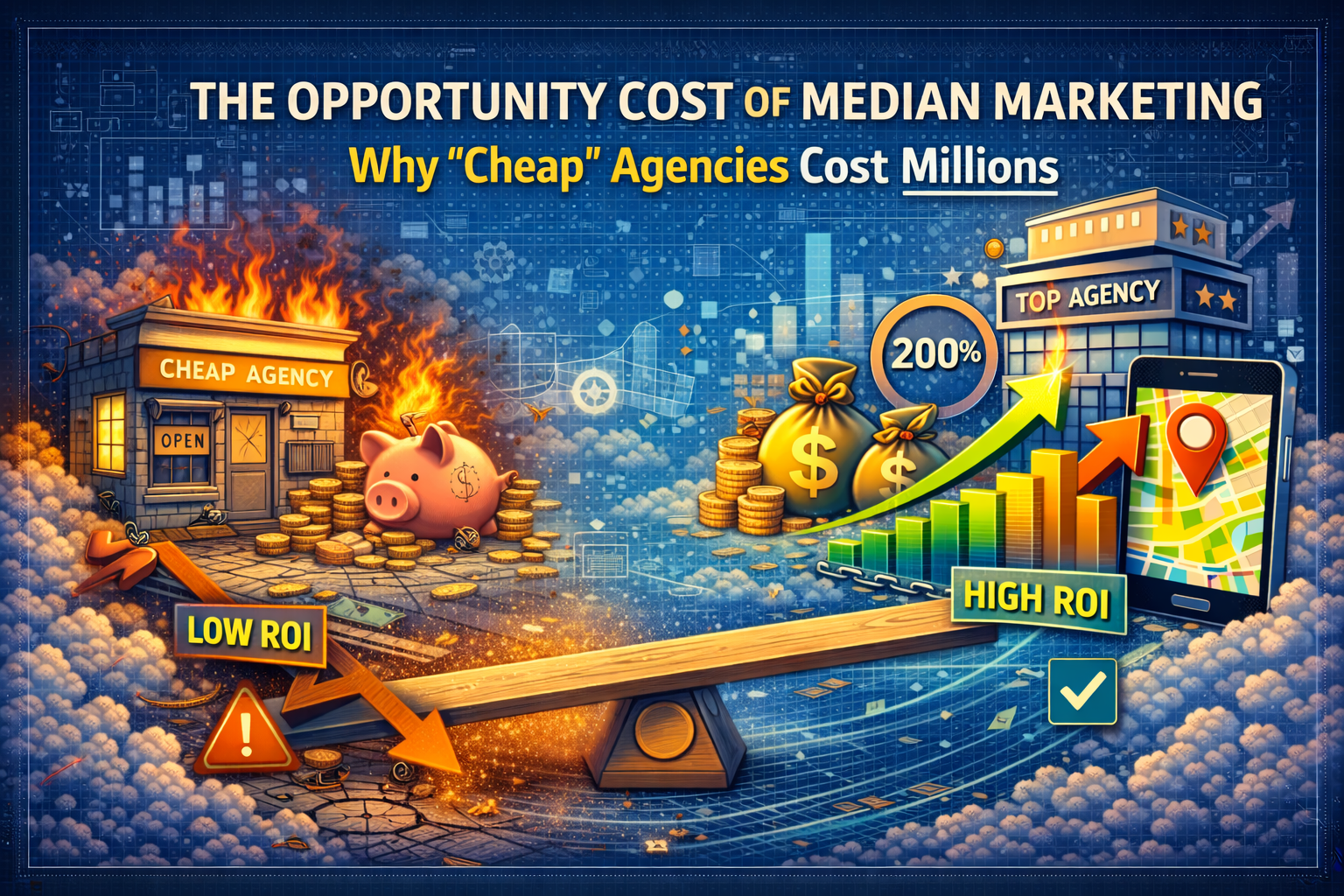
The Opportunity Cost of Median Marketing: Why “Cheap” Agencies Cost Millions
Direct answer: “Cheap” agencies cost millions because they deliver median marketing performance, which slows growth, wastes budget, and sacrifices compounding market share that better systems could capture.
Low prices feel safe at first. However, low prices often hide expensive outcomes. Median marketing creates median performance, and median performance quietly drains revenue. As a result, businesses lose deals, lose visibility, and lose growth momentum while competitors move faster.
Marketing does not fail only when results drop to zero. Instead, marketing fails when it produces “okay” outcomes that never scale. Because of that reality, the biggest cost is not your monthly retainer. Rather, the biggest cost is the opportunity you never captured.
This guide explains the true cost of median marketing in plain terms. Additionally, it gives actionable ways to spot it, measure it, and replace it with a system that drives growth. If you want a scalable local authority strategy that creates compounding returns, start here:
1000 Page Local Authority Lockdown.
Table of Contents
- What “Median Marketing” actually means
- Why cheap agencies cost millions
- How opportunity cost shows up in real numbers
- The biggest red flags of median marketing
- How to fix median marketing without starting over
- Why visibility alone does not equal revenue
- How median PPC wastes spend while better teams lower CAC
- How SEO and GEO create compounding market share
- Why local authority beats “random marketing” every time
- A quick scorecard to evaluate your agency today
- Next steps
- FAQs
What “Median Marketing” actually means
Direct answer: Median marketing is an approach that produces average outcomes because it focuses on tasks, not performance systems.
Median marketing looks busy. However, it rarely feels strategic. Most “cheap” agencies deliver output, yet they fail to build leverage. As a result, you get posts, ads, and reports without a clear growth engine behind them.
In contrast, high-performing marketing teams build systems. They design strategy, align channels, measure performance, and improve execution weekly. Because of that structure, they create results that grow over time rather than results that flatline.
Median marketing also relies on shortcuts. For example, agencies reuse templates, copy competitor messaging, and rotate generic “best practices.” Consequently, your brand blends into the market, while your differentiation disappears.
Why cheap agencies cost millions
Direct answer: Cheap agencies cost millions because they miss growth opportunities that compounding systems capture.
Most business owners evaluate marketing like a monthly expense. However, you should evaluate marketing like a growth investment. When an agency underperforms by even a small margin, the loss compounds every month. As a result, what looks like a “savings” becomes a long-term revenue gap.
Here are the three biggest ways “cheap” agencies create expensive outcomes:
1) They waste your budget with low-quality execution
Direct answer: Cheap agencies waste budget by running campaigns without performance discipline.
Ad spend never guarantees return. Instead, return depends on targeting, creative, landing pages, tracking, and constant iteration. Because cheap agencies often skip those steps, spend leaks into low-intent traffic. Consequently, cost per lead rises while lead quality drops.
If you want performance-driven paid management, IMR supports paid systems through:
PPC Management.
2) They create “activity” instead of revenue
Direct answer: Median marketing produces activity because agencies optimize for deliverables, not outcomes.
Posting content feels like progress. However, content without a conversion system rarely moves revenue. Because cheap agencies focus on output, they miss the core requirement: alignment between intent, message, and offer. As a result, traffic looks decent while sales stay stagnant.
3) They delay your growth timeline
Direct answer: Cheap agencies slow growth by moving too slowly and measuring too loosely.
Speed matters in marketing. If your team needs three weeks to launch a test, you lose market feedback. Meanwhile, competitors run new experiments every week. Because of that difference, your growth curve flattens while theirs accelerates.
How opportunity cost shows up in real numbers
Direct answer: Opportunity cost shows up as revenue you could have earned if your marketing performed at a higher level.
Opportunity cost sounds abstract. However, it becomes obvious when you measure it correctly. Instead of asking, “Did we get leads?” ask, “How many qualified leads should we get with this budget and market demand?”
Use this simple opportunity cost framework:
- Step 1: Estimate monthly demand (search volume + impressions + audience size).
- Step 2: Estimate your conversion rate at a realistic benchmark.
- Step 3: Multiply leads by your close rate.
- Step 4: Multiply deals by your average deal size.
- Step 5: Compare that to your actual results.
Even small gaps matter. For example, if your current agency produces 20 qualified leads per month, yet a stronger system could produce 35, you lose 15 opportunities monthly. As a result, the “cheap” choice quietly costs far more than it saves.
The biggest red flags of median marketing
Direct answer: Median marketing shows clear warning signs, especially in reporting, strategy, and execution quality.
Most agencies do not fail loudly. Instead, they fail slowly. Because of that, you must spot the warning signs early. Therefore, use this checklist to diagnose performance.
Red flag #1: They report clicks and impressions, not revenue metrics
Direct answer: A weak agency hides behind vanity metrics instead of business outcomes.
Clicks matter. However, they do not pay salaries. Because good reporting ties marketing to revenue, you should see numbers like cost per qualified lead, conversion rate by landing page, and pipeline created. Otherwise, the agency cannot prove value.
Google emphasizes proper measurement and user-focused outcomes in its helpful content guidance:
Google Helpful Content Guidance.
Red flag #2: They cannot explain a strategy in one sentence
Direct answer: If an agency cannot state the plan clearly, it likely does not have one.
Strategy should sound simple. For example, “We will capture high-intent demand in your top markets, then expand by city, while improving conversion paths weekly.” That clarity creates accountability. Therefore, if the agency gives vague answers, you should consider moving on.
Red flag #3: They publish content with no internal linking strategy
Direct answer: Content without internal linking stays isolated and underperforms.
Internal linking builds structure. Consequently, it helps search engines understand relationships while guiding users to conversion pages. Google explains internal links clearly here:
Google Internal Links Documentation.
How to fix median marketing without starting over
Direct answer: You fix median marketing by upgrading systems, measurement, and market coverage without throwing away everything you built.
Switching agencies feels stressful. However, you do not need to burn everything down. Instead, you can rebuild the foundation while keeping what still works. Therefore, focus on the following upgrades first.
Upgrade #1: Rebuild tracking and conversion measurement
Direct answer: Better tracking improves decisions because it turns opinions into facts.
You cannot scale what you cannot measure. Consequently, start with conversion events, call tracking, CRM attribution, and lead quality scoring. Once measurement becomes accurate, your next decisions get easier.
Upgrade #2: Align messaging to buying intent
Direct answer: Intent alignment increases conversion because it matches what people want right now.
Many brands speak in brand language. However, buyers search in problem language. Because of that mismatch, conversion drops. Therefore, rewrite landing pages and ads to reflect the exact buyer intent that triggers the search.
Upgrade #3: Build a market-by-market growth plan
Direct answer: Market-by-market planning works because it targets revenue where demand already exists.
National brands often market too broadly. Instead, prioritize top markets first, then expand systematically. That approach reduces waste while increasing compounding returns.
Why visibility alone does not equal revenue
Direct answer: Visibility does not equal revenue because traffic without intent and conversion paths does not produce deals.
Some agencies brag about rankings. However, rankings only matter when they drive qualified demand. Because of that, you must evaluate the full journey: click, landing page, conversion, follow-up, and close.
If you want a unified system across channels, IMR supports that through:
Full Service Digital Marketing.
How median PPC wastes spend while better teams lower CAC
Direct answer: Median PPC wastes spend because it targets too broadly, tests too slowly, and ignores landing page performance.
PPC success is not magic. Instead, it comes from disciplined testing. Great teams improve search terms, refine match types, upgrade creative, and fix landing pages weekly. As a result, cost per acquisition falls while lead quality rises.
If you want IMR to manage performance-driven paid search, start here:
PPC Management.
How SEO and GEO create compounding market share
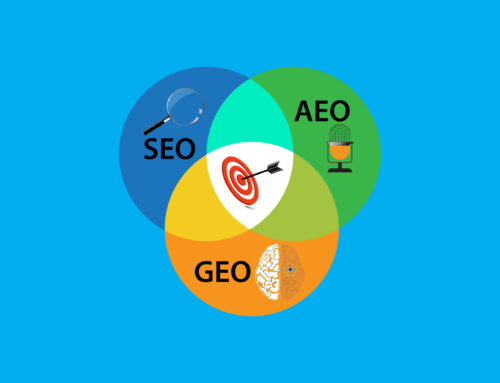
Direct answer: SEO and GEO create compounding market share because high-intent pages build long-term demand capture in every location.
Paid ads stop when spend stops. However, local authority pages keep working. Because SEO and GEO build market coverage, each new city page becomes another demand capture point. Consequently, your growth becomes more stable over time.
AI systems also reward structure. When your content provides direct answers and clear entities, AI platforms can cite you more confidently. For that reason, schema and internal linking matter more than ever.
If you want a system that scales across cities without losing quality, IMR builds that through:
1000 Page Local Authority Lockdown.
Why local authority beats “random marketing” every time
Direct answer: Local authority wins because it turns marketing into a repeatable system that captures intent in every market.
Random marketing feels busy. However, it rarely compounds. Local authority systems do the opposite. They create clear coverage, consistent structure, and measurable expansion. Therefore, you stop guessing and start scaling.
IMR also supports GEO programs directly through:
Generative Engine Optimization (GEO).
A quick scorecard to evaluate your agency today
Direct answer: A scorecard helps you identify median marketing quickly, so you can fix it before it costs more.
Ask these questions today:
- Can they explain the strategy in one sentence?
- Do they report pipeline and revenue metrics?
- Do they improve campaigns weekly, not monthly?
- Do they publish content with internal links?
- Do they build location coverage systematically?
If you answered “no” to most of these, the agency likely delivers median performance. As a result, you should consider a system upgrade quickly.
Next steps
Direct answer: Replace median marketing with a growth system that captures demand, proves ROI, and compounds market share.
Cheap agencies look affordable at first. However, lost market share costs far more than the retainer. Because growth compounds, every month of median performance becomes a missed revenue opportunity.
If you want IMR to build a scalable local growth engine for you, start here:
1000 Page Local Authority Lockdown.
FAQs
How do I know if my agency is “cheap” or just efficient?
Direct answer: Efficient agencies prove results with revenue-based reporting, while cheap agencies hide behind vanity metrics.
Is SEO still worth it if AI summaries reduce clicks?
Direct answer: Yes, because structured SEO + GEO increases citation potential and captures intent when buyers still click to take action.
What is the fastest way to increase marketing ROI?
Direct answer: Improve measurement first, then align messaging to intent, and finally scale market coverage through repeatable systems.
Author
Infinite Media Resources Strategy Team builds measurable marketing systems for businesses that want predictable growth instead of “random acts of marketing.” Our team specializes in Local Authority SEO, GEO, PPC performance, and scalable market expansion strategies designed to capture demand city by city. To deploy a complete enterprise-grade system, explore:
1000 Page Local Authority Lockdown.
About the author : Anthony Paulino