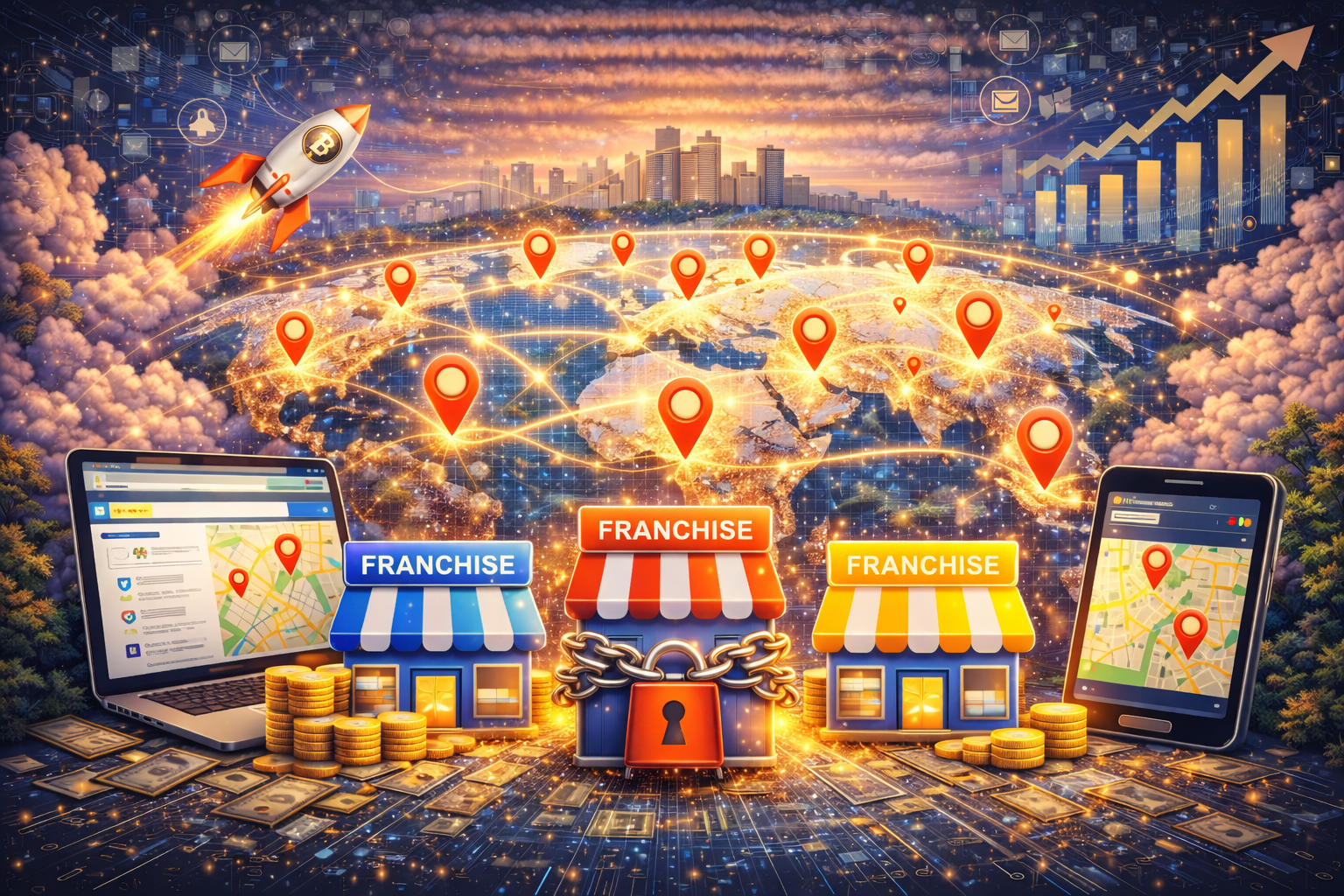
The Franchise Marketer’s Guide to Dominating 1,000+ Local Markets
Direct answer: Dominating 1,000+ Local Markets happens when you map every service to every market with a governed page system, strong internal linking, and consistent entity signals so Google and AI systems trust you in each location.
Franchise brands often win national awareness. However, local revenue rarely follows automatically. Buyers still search by city, neighborhood, and “near me,” so market share leaks when your site fails to match that intent. As a result, small local competitors win calls even when your brand looks bigger.
Search also changes fast. Google still ranks links, yet AI-generated summaries influence decisions earlier in the journey. Because of that shift, franchise marketers must do more than “publish a location page.” Instead, the brand must prove relevance, clarity, and trust in every local market at scale.
This guide gives practical steps you can apply now. Additionally, it shows how to build a repeatable engine for Dominating 1,000+ Local Markets without thin content, cannibalization, or internal chaos. If you want IMR to build the full system for you, start here:
1000 Page Local Authority Lockdown.
Table of Contents
- Why franchises must scale local authority now
- How local intent works across 1,000+ markets
- The page architecture for Dominating 1,000+ Local Markets
- A conversion-first template that stays unique at scale
- Governance rules that prevent cannibalization
- Internal linking that multiplies local authority
- Schema that improves local clarity for AI and search
- Operations: how to produce pages without losing quality
- Reporting: KPIs that prove market-level ROI
- A 45-day rollout plan for franchise teams
- FAQs
- Next steps
Why franchises must scale local authority now
Direct answer: Franchises must scale local authority now because buyers search locally, Google rewards relevance and prominence, and AI systems cite structured sources that prove market coverage.
Franchises operate in many markets, yet many franchise sites behave like single-market sites. Consequently, the brand captures national traffic while it misses high-intent local conversions. Because local modifiers signal urgency, local coverage often drives better leads, not just more clicks.
Google reinforces this behavior through local ranking factors like relevance, distance, and prominence. Therefore, your site should support those factors with strong market signals. You can review Google’s guidance here:
Google: Improve your local ranking.
AI changes the stakes as well. When an AI system summarizes “best option near me,” it needs clear structure, clear entity identity, and clear service coverage. As a result, Dominating 1,000+ Local Markets now depends on both human clarity and machine clarity.
How local intent works across 1,000+ markets
Direct answer: Local intent scales when you match service-and-location queries with pages designed for action, while you also support “near me” and service-area patterns through structure and linking.
Franchise customers rarely search like corporate teams expect. Instead, they search like locals who want quick answers. Because of that pattern, the same service keyword behaves differently in different markets.
Here is a simple example of how intent shifts:
- Research intent: “floor cleaning service”
- Action intent: “floor cleaning service Columbus”
- Urgent intent: “floor cleaning service near me”
Each query deserves a page experience that confirms the match quickly. Therefore, a franchise wins more often when it uses a structured library of market pages rather than one generic location finder. As a result, your program turns “coverage” into conversions.
Helpful content still matters even when you publish at scale. Because Google rewards usefulness over filler, your pages must solve real local questions. Google’s guidance supports that approach here:
Google: Creating helpful, reliable, people-first content.
The page architecture for Dominating 1,000+ Local Markets
Direct answer: The best architecture for Dominating 1,000+ Local Markets maps services to markets using hubs, market clusters, and city pages that connect through internal links and consistent hierarchy.
Architecture prevents chaos. Without structure, a franchise publishes pages that overlap, compete, and confuse both users and crawlers. Therefore, your program should assign one job to each page type. Because “one job per page” prevents cannibalization, your system scales cleanly.
Use this hierarchy as a proven baseline:
- Service hubs: explain each service, outcomes, and the process.
- Market hubs: group states, regions, or multi-city clusters.
- Service + city pages: capture the highest-intent local queries.
- Neighborhood pages: target micro-demand when the data supports it.
- Support content: pricing, FAQs, and objection handling that boosts conversions.
When you connect these pieces, you stop “posting pages.” Instead, you build a system for Dominating 1,000+ Local Markets that grows predictably as you add locations. If you want IMR to implement the full structure, start with:
1000 Page Local Authority Lockdown.
A conversion-first template that stays unique at scale
Direct answer: A franchise template stays unique when it enforces local differentiation blocks, answers real buyer questions, and keeps the conversion path simple in every market.
Templates do not ruin local pages. Weak templates cause that problem. Therefore, you should build a template that forces uniqueness and usefulness. Because the template drives quality, it protects your brand across 1,000+ markets.
What should the above-the-fold section include?
Direct answer: The top section should confirm service + market fit, state the outcome, and reduce risk with clear expectations.
Use a simple structure:
- Headline: service + location + outcome
- Direct answer summary: one or two sentences that match the search intent
- Micro-proof bullets: process clarity, response time expectations, and what happens next
Which local blocks create real uniqueness?
Direct answer: Local uniqueness comes from market-specific constraints, service boundaries, local buyer concerns, and local expectations that help the visitor decide fast.
Add “difference maker” blocks like these:
- Service-area boundaries: where you serve and what you exclude
- Local scheduling realities: peak seasons, lead times, and response windows
- Local buyer concerns: common objections that sales teams hear in that market
- Local process context: what a visit, quote, or booking looks like locally
What proof builds trust in a franchise market page?
Direct answer: Proof converts when it reduces risk, clarifies the process, and confirms brand standards across locations.
Use proof that scales without inventing claims:
- Process transparency: steps, timelines, and expectations
- Brand standards: quality checks, training, or compliance language
- Objection handling: pricing expectations and fit filters
- FAQ clarity: direct answers that remove hesitation
When you pair this template with strong internal linking, you get a strong base for Dominating 1,000+ Local Markets without sacrificing conversion clarity.
Governance rules that prevent cannibalization
Direct answer: Governance prevents cannibalization by assigning one primary intent per URL, enforcing uniqueness requirements, and standardizing linking and schema across the franchise system.
Franchise teams often scale content across regions and vendors. However, multiple teams publishing without rules creates overlap. Because overlap splits relevance, it slows growth and confuses reporting. Therefore, you need governance before you scale.
Use this governance checklist:
- Keyword-to-URL map: one primary intent per page
- Required uniqueness: local blocks that cannot repeat across markets
- Linking rules: hubs must link down, and local pages must link up
- QA workflow: a reviewer checks structure, clarity, and local differentiation
- Refresh cadence: top markets update on a schedule
Governance feels strict at first. However, it makes scaling easier later. As a result, Dominating 1,000+ Local Markets becomes an operating system rather than a one-time campaign.
Internal linking that multiplies local authority
Direct answer: Internal linking multiplies local authority by distributing relevance from hubs to markets, while also helping Google crawl and understand your franchise hierarchy.
Orphan pages fail quietly. Connected pages win together. Therefore, you should treat linking as a system, not as a last-minute add-on. Because links teach relationships, they support both crawl efficiency and topical understanding.
Google explains internal linking value here:
Google: Internal links.
Use these linking rules for Dominating 1,000+ Local Markets:
- Service hubs → priority cities: link to the revenue-driving markets first.
- City pages → service hubs: reinforce the service relationship clearly.
- Market hubs → cities: connect regions to the local pages that sit under them.
- Support content → revenue pages: link educational content into conversion pages naturally.
Because franchises run multi-channel marketing, linking also supports PPC landing relevance. Therefore, SEO and paid can reinforce each other when you align page architecture. If you need that alignment, IMR supports:
PPC Management.
Additionally, teams that want a single growth system can use:
Full Service Digital Marketing.
Schema that improves local clarity for AI and search
Direct answer: Schema improves local clarity by making your identity, services, and hierarchy machine-readable, which supports stronger interpretation for search engines and AI citation systems.
Schema does not replace good writing. Instead, it reduces ambiguity. Therefore, it helps machines trust your business identity across 1,000+ pages. Because franchises need consistent signals, schema becomes a leverage point for scale.
Use these schema elements across your program:
- Organization: consistent phone, email, and address
- WebSite: publisher identity and site entity anchor
- ProfessionalService: service definitions and provider clarity
- WebPage + BlogPosting: content identity and context
- BreadcrumbList: hierarchy reinforcement
- FAQPage: extractable answers that reduce objections
- SpeakableSpecification: voice-ready excerpts for summaries
Google’s structured data overview helps here:
Google: Structured data overview.
Schema.org guidance also helps here:
Schema.org: Getting started.
If you want IMR to align your content for AI visibility alongside local scale, explore:
Generative Engine Optimization (GEO).
Operations: how to produce pages without losing quality
Direct answer: You produce pages at scale by standardizing inputs, enforcing QA, and measuring uniqueness and performance market by market.
Franchise content fails when teams treat it like a writing assignment. However, it succeeds when teams treat it like a production workflow. Because workflow creates consistency, you can scale without burning internal teams.
Use this production model:
- Input library: approved service descriptions, approved brand standards, approved FAQs
- Local data prompts: service boundaries, scheduling realities, and common objections per market
- Template enforcement: fixed structure with required unique blocks
- QA pass: clarity, linking, schema consistency, and conversion path checks
- Publish and link: no orphan pages, no disconnected cities
This model supports Dominating 1,000+ Local Markets because it prevents “random page drift.” As a result, your library stays cohesive and your reporting stays trustworthy.
Reporting: KPIs that prove market-level ROI
Direct answer: Market-level ROI shows up first in indexation, impressions, and leads by city, so franchise reporting must track performance by market, not just by domain.
Corporate dashboards often hide local wins. Therefore, your reporting should break results out by market cluster. Because local intent drives revenue, local reporting reveals the real movement.
Track these KPIs:
- Index coverage: how many local pages index correctly
- Impressions by city: visibility growth at the market level
- Clicks by city: demand capture by location
- Leads by market: calls, forms, bookings by geography
- Conversion rate by city: quality and message match
- Top queries by city: intent patterns that drive wins
Then, use the KPIs to make decisions. For example, a city that converts well deserves faster expansion. Meanwhile, a city that ranks but does not convert needs better local proof and clearer next steps.
A 45-day rollout plan for franchise teams
Direct answer: A 45-day rollout validates the system quickly, while it also protects quality by scaling in phases instead of scaling in panic.
Days 1–10: Build your keyword-to-URL map. Next, select priority markets by revenue and capacity. Then, lock the template and governance rules.
Days 11–20: Build the first set of service hubs and market hubs. After that, finalize internal linking rules and schema identity standards.
Days 21–35: Publish a pilot set of service + city pages across mixed market sizes. Then connect them into hubs through internal links so crawlers and users see the hierarchy.
Days 36–45: Measure indexation, impressions, and lead signals by market. Next, refine the template where conversion lags. After that, expand into the next market tier.
This plan keeps the work realistic for corporate teams. However, many franchises prefer a faster, cleaner path. If you want IMR to deploy the full engine for Dominating 1,000+ Local Markets, start here:
1000 Page Local Authority Lockdown.
FAQs
Do we need a page for every single city?
Direct answer: You should publish pages for markets with real demand first, and then scale systematically using governance so each page stays unique and useful.
Will this strategy help “near me” searches?
Direct answer: Yes, because strong service-location coverage and internal linking support relevance signals that help local intent, including “near me” behavior.
Will AI search change franchise local strategy?
Direct answer: AI raises the bar for clarity and trust, so structured content, consistent schema, and strong entity identity matter more than ever.
How do we avoid thin content at scale?
Direct answer: You avoid thin content by enforcing required local differentiation blocks, mapping one intent per URL, and running QA on every page before publish.
Next steps
Direct answer: To start Dominating 1,000+ Local Markets, map intent to URLs, lock your template and governance, publish a pilot set, and scale only after you validate conversions and linking.
Franchise growth becomes predictable when you build an engine, not a pile of pages. Therefore, treat local authority as infrastructure. Because infrastructure compounds, the work becomes easier as coverage expands. Consequently, your brand converts national reach into local revenue market by market.
If you want IMR to build the full system, including page production, internal linking, and schema consistency, start here:
1000 Page Local Authority Lockdown.
If you also want AI-ready visibility layered into your program, explore:
Generative Engine Optimization (GEO).
Author
Infinite Media Resources Strategy Team builds scalable local authority systems for multi-location brands and franchise networks. Our team combines governed page architecture, internal linking, and structured data so organizations can scale local demand capture without losing quality. For a complete done-for-you rollout, explore:
1000 Page Local Authority Lockdown.
About the author : Anthony Paulino