
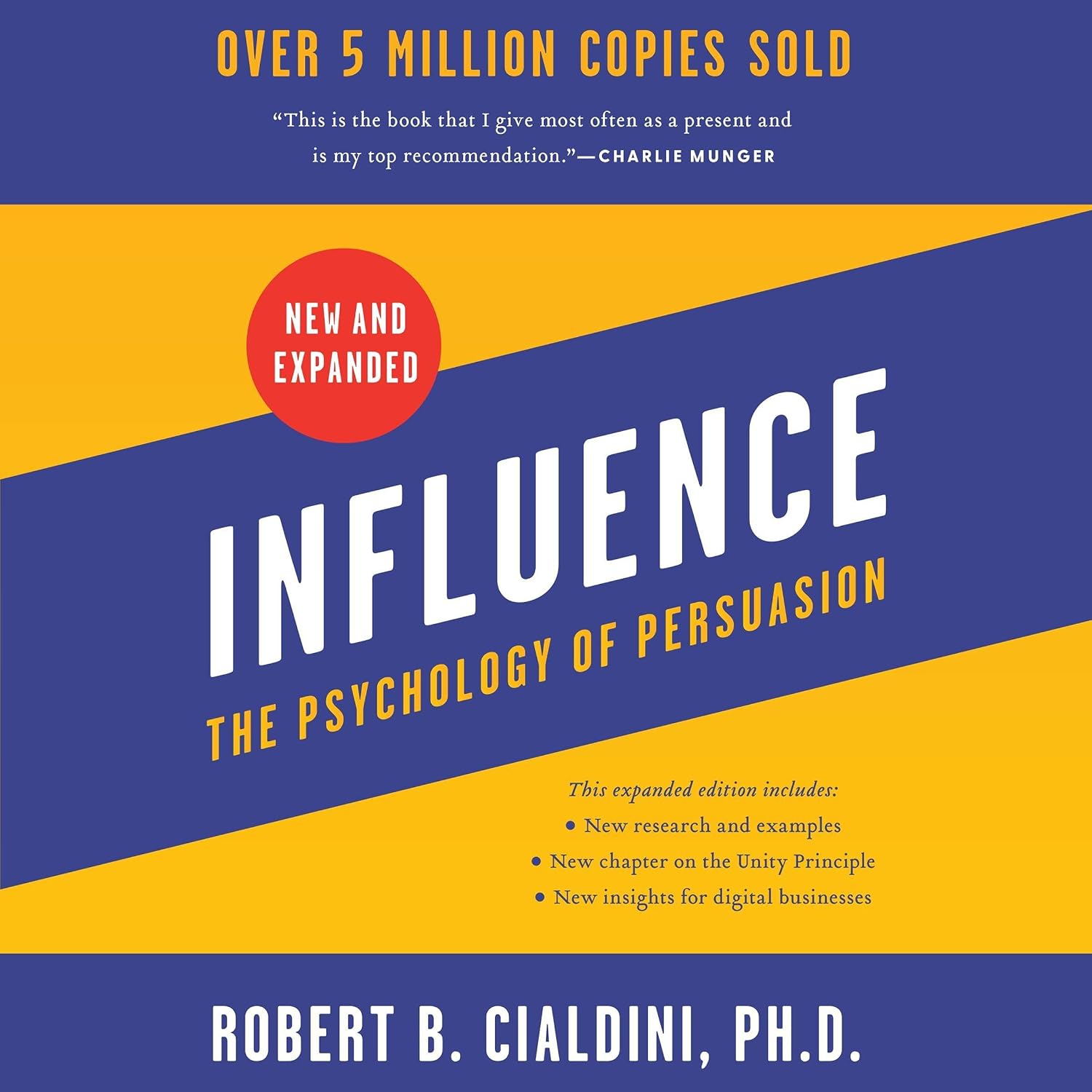
Influence: The Psychology of Persuasion by Robert Cialdini — Review, Summary, Key Takeaways & Where to Buy
$17.44
Learn Robert Cialdini’s seven principles of persuasion and the psychology behind why people say yes. Essential for marketers, entrepreneurs, sales professionals, and business owners who want to understand reciprocity, social proof, authority, scarcity, liking, consistency, and unity.
Description
Business Books / Psychology / Marketing / Sales / Persuasion
Influence: The Psychology of Persuasion by Robert Cialdini — Review, Summary, Key Takeaways & Where to Buy
Direct Answer: Influence by Robert Cialdini explains the psychological principles that make people more likely to say yes. The expanded framework centers on seven principles: reciprocity, commitment and consistency, social proof, authority, liking, scarcity, and unity. For marketers, entrepreneurs, salespeople, and business owners, it provides a practical foundation for understanding ethical persuasion.
Most businesses spend enormous amounts of time asking one question:
How do we get more people to say yes?
Yes to the advertisement.
Yes to the consultation.
Yes to the proposal.
Yes to the subscription.
Yes to the purchase.
However, Robert Cialdini spent his career investigating a deeper question:
Why do people say yes in the first place?
That distinction is what makes Influence: The Psychology of Persuasion different from a typical sales or marketing book.
Instead of giving readers another collection of closing scripts, advertising formulas, or funnel tactics, Cialdini examines recurring psychological patterns behind human decisions.
Consequently, the lessons can be applied far beyond one marketing channel.
They can influence how you think about:
- Sales
- Advertising
- Landing pages
- Pricing
- Testimonials
- Reviews
- Expert endorsements
- Offers
- Scarcity
- Lead generation
- Negotiation
- Leadership
- Customer relationships
More importantly, Cialdini’s modern work strongly emphasizes ethical persuasion.
The goal is not to manufacture false scarcity, fabricate social proof, or manipulate customers.
Instead, the strongest application is to recognize persuasive factors that genuinely exist and communicate them more effectively.
Author: Robert B. Cialdini, Ph.D.
Primary Topic: Psychology of persuasion and influence
Core Framework: Seven Principles of Persuasion
Best For: Entrepreneurs, marketers, sales professionals, copywriters, business owners, negotiators, consultants, agencies, and leaders
Experience Level: Beginner to advanced
Best Read Alongside: Building a StoryBrand, $100M Offers, DotCom Secrets, and $100M Leads
IMR Verdict: One of the foundational books for understanding why marketing and sales techniques work. Rather than simply teaching tactics, Influence helps explain the behavioral psychology underneath them.
Short Description
Learn Robert Cialdini’s seven principles of persuasion and the psychology behind why people say yes. Essential for marketers, entrepreneurs, sales professionals, and business owners who want to understand reciprocity, social proof, authority, scarcity, liking, consistency, and unity.
Affiliate Disclosure: As an Amazon Associate, Infinite Media Resources earns from qualifying purchases. You do not pay an additional cost when purchasing through our affiliate links.
Is Influence by Robert Cialdini Worth Reading?
Direct Answer: Yes. Influence is worth reading for anyone whose success depends on communicating ideas, earning trust, selling products, generating leads, negotiating, or encouraging people to take action. Its greatest value is teaching the psychological mechanisms behind persuasion rather than providing tactics tied to one platform or marketing channel.
Marketing tactics change constantly.
Platforms change.
Algorithms change.
Advertising formats change.
Additionally, software changes.
However, many fundamental patterns of human decision-making remain far more durable.
That is why Influence has unusual staying power.
For example, testimonials worked before social media.
Reviews work today.
Likewise, recommendations from similar people influence decisions whether they appear in a newspaper advertisement, television commercial, Google Business Profile, Amazon listing, Reddit discussion, YouTube video, or AI-generated recommendation.
The technology changed.
The underlying principle of social proof did not.
What Is the Biggest Strength of Influence?
The book helps you understand the mechanism beneath the tactic.
Once you understand the mechanism, you can recognize applications across different situations.
What Is Its Biggest Limitation?
Influence does not give you a complete marketing system.
It will not build your offer.
It will not construct your sales funnel.
Additionally, it will not create your SEO architecture or lead-generation strategy.
Instead, it provides psychological principles that can strengthen those systems.
Therefore, we view Influence as foundational knowledge rather than a complete customer-acquisition playbook.
What Is Influence: The Psychology of Persuasion About?
Direct Answer: Influence explores why people agree to requests and how predictable psychological principles affect decision-making. Cialdini’s expanded framework identifies seven principles of persuasion: reciprocity, commitment and consistency, social proof, authority, liking, scarcity, and unity.
The book grew from Cialdini’s interest in understanding compliance.
Rather than merely observing persuasion from an academic distance, his work combined behavioral research with examination of real situations in which people attempt to influence decisions.
Consequently, the book bridges psychology and practical application.
That is particularly useful for business owners because most marketing tactics eventually rely on one or more psychological mechanisms.
A testimonial uses social proof.
A credential can establish authority.
A free resource can activate reciprocity.
A legitimate deadline can introduce scarcity.
A small initial commitment can support consistency.
A relatable spokesperson can strengthen liking.
Meanwhile, shared identity can activate unity.
Once you see those patterns, marketing starts looking different.
You stop seeing isolated tactics.
Instead, you begin seeing the behavioral principles behind them.
Who Is Robert Cialdini?
Direct Answer: Dr. Robert Cialdini is a psychologist, author, and researcher known for his work on the science and ethical application of influence. He is the author of Influence and Pre-Suasion and developed the widely recognized Principles of Persuasion.
Cialdini’s career focused heavily on understanding what leads people to agree to requests.
Today, his work is continued through the Cialdini Institute, which teaches the practical and ethical application of persuasion in areas including sales, marketing, leadership, negotiation, communication, and business.
Importantly, the current Cialdini framework emphasizes seven principles rather than the six principles many longtime readers remember.
Unity was added to the expanded edition of Influence in 2021.
Therefore, modern discussions of Cialdini’s framework should generally account for all seven principles.
Who Should Read Influence?
Direct Answer: Influence is best for marketers, entrepreneurs, sales professionals, business owners, copywriters, negotiators, consultants, agency owners, leaders, and anyone who regularly needs to earn trust or encourage people to make decisions.
Entrepreneurs
Entrepreneurs constantly need people to say yes.
Customers need to buy.
Employees need to join.
Partners need to cooperate.
Additionally, investors may need to believe in the opportunity.
Therefore, understanding persuasion has applications throughout entrepreneurship.
Marketers
Marketers can use the principles to better understand why testimonials, authority signals, free resources, deadlines, communities, and other tactics affect behavior.
Sales Professionals
Sales professionals can apply the framework to trust, objections, commitments, proof, rapport, and decision-making.
Copywriters
Copywriters can use Cialdini’s principles as a diagnostic framework.
Instead of merely asking whether the copy sounds persuasive, they can ask which legitimate persuasion mechanisms are present.
Agency Owners
Agencies can apply the principles to both their own sales process and their clients’ campaigns.
Business Leaders
Influence is not limited to selling.
Leadership also requires earning agreement, creating alignment, and moving people toward action.
Consumers
Interestingly, the book can also help consumers recognize when persuasion techniques are being used on them.
Therefore, the framework has both offensive and defensive value.
What Is the Main Idea of Influence?
Direct Answer: The main idea of Influence is that human decisions are often affected by recurring psychological shortcuts. By understanding these patterns, people can recognize why certain requests become more persuasive and learn to apply influence more effectively and ethically.
Modern consumers face too many decisions to deeply analyze every choice.
Which contractor should I hire?
Which software should I use?
Which restaurant should I visit?
Which book should I buy?
Which company should I trust?
Consequently, people frequently rely on signals that simplify decisions.
For example:
“Thousands of people like me use this.”
That is social proof.
“This recommendation came from a recognized expert.”
That is authority.
“This opportunity genuinely ends Friday.”
That involves scarcity.
“They helped me before, so I want to return the favor.”
That involves reciprocity.
Understanding those shortcuts helps marketers communicate legitimate reasons for customers to feel confident making decisions.
What Are Cialdini’s 7 Principles of Persuasion?
Direct Answer: Robert Cialdini’s seven principles of persuasion are reciprocity, commitment and consistency, social proof, authority, liking, scarcity, and unity. Each principle describes a recurring factor that can increase the likelihood that someone agrees to a request.
| Principle | Basic Idea | Business Example |
|---|---|---|
| Reciprocity | People tend to return value | Useful free guide before asking for a consultation |
| Commitment & Consistency | People prefer actions consistent with prior commitments | Small initial action before a larger decision |
| Social Proof | People look at what others are doing | Reviews, testimonials and case studies |
| Authority | Credible expertise affects trust | Credentials, expertise and authoritative evidence |
| Liking | People are more receptive to people they like | Relatable communication and genuine rapport |
| Scarcity | Limited opportunities can become more desirable | Real capacity or deadline limitations |
| Unity | Shared identity can strengthen influence | Communities built around genuine shared identity |
The key word is genuine.
Fake reviews are not social proof.
Fake countdown timers are not ethical scarcity.
Invented credentials are not authority.
Therefore, the goal should be to identify legitimate persuasive elements already present in the business and communicate them effectively.
1. What Is the Reciprocity Principle?
Direct Answer: Reciprocity is the tendency to feel motivated to return value after receiving value from someone else. In business, this can mean helping a prospect before asking for a purchase, consultation, referral, email address, or other commitment.
Imagine two companies.
The first immediately asks:
“Book a sales call.”
The second gives you a genuinely useful resource that solves part of your problem.
Then, afterward, it offers additional help.
The interaction feels different.
Why?
Because value came before the request.
Reciprocity Examples in Marketing
- Free educational guides
- Useful calculators
- Free audits
- Templates
- Checklists
- Free samples
- Educational webinars
- Helpful consultations
- Detailed informational content
However, reciprocity should not become a disguised transaction.
The free resource should genuinely help.
Otherwise, customers may recognize the tactic and become more skeptical.
How IMR Can Apply Reciprocity
A detailed guide answering a prospect’s real question creates value before the prospect ever contacts the company.
Therefore, comprehensive SEO and GEO content can perform two jobs simultaneously.
First, it can create search visibility.
Second, it can establish goodwill by helping the visitor solve a problem.
2. What Is Commitment and Consistency?
Direct Answer: Commitment and consistency describes the tendency for people to prefer behavior that aligns with positions, actions, or commitments they have already made. Consequently, a small meaningful commitment can sometimes make a later related action feel more natural.
This principle appears throughout marketing.
A visitor might first:
- Take a quiz
- Download a checklist
- Request an assessment
- Create an account
- Choose a preference
- Schedule an inspection
Later, a larger decision may follow.
However, ethical use matters.
The goal is not to trap someone into escalating commitments.
Instead, each step should naturally help the customer evaluate whether the next step makes sense.
Example for a Contractor
Instead of immediately asking a homeowner to sign a large contract, the first call to action could be:
Schedule Your Roof Inspection.
That is a smaller and more logical commitment.
Afterward, the homeowner can make the larger decision based on the inspection results.
5. What Is Cialdini’s Liking Principle?
Direct Answer: The liking principle describes the tendency to be more receptive to people we genuinely like. Similarity, familiarity, cooperation, and authentic positive relationships can therefore influence how comfortable people feel accepting recommendations or requests.
This explains why personality matters in business.
Two companies can sell similar products.
However, customers may strongly prefer interacting with one.
That preference can come from:
- Relatability
- Shared interests
- Communication style
- Genuine friendliness
- Familiarity
- Cooperation
- Positive experiences
Why Founder-Led Marketing Can Work
A founder who consistently teaches, communicates, and shows personality can become familiar to an audience.
Over time, that familiarity can help create trust and liking.
However, pretending to share someone’s interests solely to influence them undermines the ethical foundation of the principle.
Therefore, authenticity matters.
6. What Is the Scarcity Principle?
Direct Answer: Scarcity describes how opportunities can become more desirable when access is genuinely limited. In business, legitimate limitations involving inventory, capacity, enrollment, deadlines, availability, or exclusivity can therefore influence decisions.
Scarcity is powerful.
Unfortunately, it is also frequently abused.
You have probably seen:
“ONLY 3 LEFT!”
Then returned the next day and somehow there were still three left.
Or:
“OFFER ENDS IN 14 MINUTES!”
Then refreshed the page and watched the timer restart.
That is not the application we recommend.
Real Scarcity Examples
- A consultant accepts only five new clients per month.
- A live event has 75 physical seats.
- A manufacturer has a limited production run.
- A seasonal service ends when the season changes.
- A promotion genuinely expires on a specified date.
- A contractor has a finite number of installation slots.
The limitation exists whether or not the customer purchases.
Therefore, communicating it simply gives the buyer relevant information.
7. What Is Cialdini’s Unity Principle?
Direct Answer: Unity is the persuasion principle based on shared identity. According to Cialdini’s modern framework, people can become more receptive when they perceive someone as sharing meaningful goals, values, identities, or group membership with them.
Unity goes beyond simply liking someone.
It moves toward:
“This person is one of us.”
That distinction matters.
A Cleveland business owner may feel a connection to another Northeast Ohio business.
A veteran may strongly identify with another veteran.
An entrepreneur may identify with a community of founders.
A pilot may identify with other pilots.
Consequently, shared identity can create powerful communities.
Unity in Modern Marketing
Unity can appear through:
- Local identity
- Professional communities
- Customer communities
- Shared missions
- Shared experiences
- Membership groups
- Industry identity
- Founder communities
However, shared identity should be genuine.
Manufacturing fake affiliation purely to persuade someone can damage trust.
Does Influence Have Six or Seven Principles of Persuasion?
Direct Answer: The current Cialdini framework has seven principles of persuasion. Older editions and discussions commonly reference six principles because Unity was added later. The Cialdini Institute states that Unity was added to the expanded edition of Influence in 2021.
This is one of the most common sources of confusion around the book.
The Classic Six
- Reciprocity
- Commitment and Consistency
- Social Proof
- Authority
- Liking
- Scarcity
The Current Seven
- Reciprocity
- Commitment and Consistency
- Social Proof
- Authority
- Liking
- Scarcity
- Unity
Therefore, someone referencing the “six principles of influence” is not necessarily wrong historically.
However, the expanded modern framework includes Unity as the seventh principle.
How Can Marketers Apply Cialdini’s Principles of Influence?
Direct Answer: Marketers can apply Cialdini’s principles by giving genuine value before asking for action, creating logical micro-commitments, displaying authentic customer proof, demonstrating legitimate expertise, building relatable brands, communicating real limitations, and developing genuine communities around shared identities.
| Principle | Marketing Application |
|---|---|
| Reciprocity | Free guide, useful content, calculator or assessment |
| Commitment | Quiz, assessment, trial or small first step |
| Social Proof | Reviews, testimonials and case studies |
| Authority | Credentials, expertise, research and documented results |
| Liking | Authentic personality and relatable communication |
| Scarcity | Real capacity, inventory or deadline limitations |
| Unity | Genuine customer or professional communities |
The mistake is attempting to cram all seven principles into every advertisement.
Instead, identify which principles naturally exist in the situation.
Then, communicate those signals clearly.
How Can Sales Teams Use the Principles of Influence?
Direct Answer: Sales teams can use Cialdini’s framework to improve trust, rapport, proof, commitment, urgency, and communication. However, the principles are most sustainable when they help prospects make informed decisions rather than pressure them into purchases that are not appropriate.
For example, a salesperson could use social proof by saying:
“Three other manufacturers with similar production requirements selected this configuration because it reduced changeover complexity.”
That is useful information if it is true.
Authority could appear through:
“Our application engineer has spent 18 years designing systems for this exact production environment.”
Scarcity could appear through:
“We have two installation windows remaining before your planned production launch.”
Again, the condition must be real.
Therefore, ethical persuasion often looks less like manipulation and more like presenting relevant decision information at the right time.
How Do Cialdini’s Principles Apply to Websites?
Direct Answer: Websites can incorporate Cialdini’s principles through useful educational content, authentic reviews, customer case studies, expert authorship, clear credentials, low-friction first steps, legitimate availability information, and community or identity signals relevant to the customer.
Reciprocity
Publish something genuinely useful before demanding contact information.
Social Proof
Place relevant testimonials and case studies near decisions where uncertainty is highest.
Authority
Explain why the company or author is qualified to make the claim.
Commitment
Give visitors an appropriate first step rather than forcing the largest possible decision immediately.
Scarcity
Communicate genuine capacity or availability limitations when they matter.
Liking
Allow authentic company personality to appear instead of hiding behind generic corporate language.
Unity
When relevant, demonstrate genuine understanding of the customer’s community, profession, market, or shared identity.
How Do Cialdini’s Principles Work With SEO and GEO?
Direct Answer: SEO and GEO help a company become discoverable and understandable across search engines and AI platforms, while Cialdini’s principles can strengthen the trust and persuasion layer after discovery. Consequently, authority content can simultaneously attract users, answer questions, demonstrate expertise, provide proof, and move qualified prospects toward action.
This creates an interesting connection between psychology and modern search strategy.
A comprehensive article can create reciprocity by giving useful information.
Expert authorship can strengthen authority.
Case studies can provide social proof.
A relevant diagnostic or audit can create a small commitment.
A recognizable founder voice can contribute to liking.
Meanwhile, industry or local expertise can sometimes reinforce unity.
Therefore, authority content is not merely about ranking for keywords.
Done correctly, it can influence how the prospect perceives the company before a sales conversation ever begins.
Learn more about SEO services for businesses and Generative Engine Optimization.
How Does Influence Apply to Creating Better Offers?
Direct Answer: Cialdini’s persuasion principles can strengthen how an offer is presented, while offer strategy determines the underlying value being sold. Social proof can reduce uncertainty, authority can increase confidence, reciprocity can create goodwill, and legitimate scarcity can provide a reason to act now.
This is where Influence pairs particularly well with Alex Hormozi’s $100M Offers.
Hormozi focuses heavily on:
- Increasing perceived value
- Improving the offer
- Pricing
- Bonuses
- Guarantees
- Scarcity
- Urgency
Cialdini helps explain some of the psychology operating beneath those elements.
For example, scarcity is not merely an offer tactic.
It is a broader behavioral principle.
Therefore, reading both books can create a deeper understanding.
How Can Contractors Apply the Principles of Influence?
Direct Answer: Contractors can apply Cialdini’s principles by educating homeowners before asking for a sale, using genuine reviews and project examples, demonstrating relevant licenses or expertise, creating simple first commitments such as inspections, communicating actual scheduling constraints, and emphasizing genuine local connections.
Example: Roofing Company
Reciprocity: Publish a useful storm-damage inspection checklist.
Commitment: Ask the homeowner to schedule an inspection rather than immediately sign a roofing contract.
Social Proof: Show verified reviews from homeowners in the same area.
Authority: Display legitimate certifications, insurance information, experience, and detailed educational content.
Liking: Let customers see the real people behind the company.
Scarcity: Communicate actual scheduling constraints during peak storm season.
Unity: Demonstrate genuine local roots when the company is actually part of the community.
Notice that none of these require tricking the homeowner.
Instead, they help the homeowner evaluate the company with more confidence.
How Can Marketing Agencies Use Influence?
Direct Answer: Agencies can use Cialdini’s framework as a persuasion audit for websites, landing pages, advertisements, offers, email campaigns, sales presentations, and lead-generation systems. The goal is to identify legitimate trust and decision signals that exist but are currently missing or poorly communicated.
An agency could review a landing page and ask:
- Are we giving useful value before asking for something?
- Is there a logical first commitment?
- Do we have relevant social proof?
- Have we demonstrated legitimate authority?
- Does the brand feel relatable?
- Are there genuine limitations customers need to know?
- Is there meaningful shared identity?
Then, importantly, the agency should ask:
Which of these actually exist?
That prevents persuasion strategy from turning into fabrication.
What Is Ethical Persuasion According to Cialdini’s Approach?
Direct Answer: Ethical persuasion uses truthful, naturally existing influence factors to help people make informed decisions rather than manufacturing false evidence or manipulating people against their interests. The Cialdini Institute explicitly emphasizes truthfulness, avoiding manipulation, and using principles that genuinely exist in the situation.
This distinction is essential.
Ethical Social Proof
Show genuine customer experiences.
Unethical Social Proof
Buy fake reviews.
Ethical Scarcity
Tell customers that only two legitimate installation slots remain.
Unethical Scarcity
Create a fake countdown timer that resets every visit.
Ethical Authority
Display legitimate expertise and credentials.
Unethical Authority
Invent certifications or imply endorsements that do not exist.
Ethical Unity
Communicate a real shared identity.
Unethical Unity
Pretend to belong to a group purely to exploit its trust.
Ultimately, the distinction is straightforward:
Persuasion should help reveal legitimate reasons to say yes, not manufacture reasons that do not exist.
Explore the Cialdini Institute’s Approach to Ethical Persuasion
How Do You Apply the Seven Principles of Influence to a Business?
Direct Answer: Start by auditing one important customer journey and identifying where genuine reciprocity, commitment, social proof, authority, liking, scarcity, and unity already exist. Then improve how those signals are communicated without inventing or exaggerating them.
Step 1: Map the Customer Journey
Choose one journey.
For example:
Google search → service page → consultation → proposal → sale.
Step 2: Audit Reciprocity
What useful value does the prospect receive before being asked to buy?
Step 3: Audit Commitment
Is there a logical low-friction first step?
Step 4: Audit Social Proof
Where are your strongest relevant reviews, testimonials, and case studies?
Step 5: Audit Authority
What legitimate evidence demonstrates expertise?
Step 6: Audit Liking
Does your company communicate like real people or like generic corporate software?
Step 7: Audit Scarcity
Are there real capacity, availability, deadline, or inventory limitations the customer should know?
Step 8: Audit Unity
Does the company genuinely share an identity, mission, community, profession, or experience with the customer?
Step 9: Remove Fake Persuasion
Delete fake urgency, exaggerated claims, meaningless badges, and manipulative tactics.
Step 10: Measure the Result
Track whether clearer trust signals improve qualified conversions.
Consequently, the book becomes a practical diagnostic system rather than simply an interesting psychology lesson.
What Are the Pros and Cons of Influence?
Pros
- Foundational: Explains psychological mechanisms beneath many marketing tactics.
- Broadly applicable: Useful across marketing, sales, negotiation, leadership, and communication.
- Durable: The concepts are not tied to one advertising platform or software product.
- Practical: Readers can recognize applications throughout real businesses.
- Useful defensively: Helps consumers recognize persuasion attempts.
- Strong companion book: Complements books about offers, messaging, funnels, and lead generation.
- Ethics matter: Cialdini’s modern framework strongly emphasizes ethical application.
Cons
- Not a complete marketing system: It does not tell you exactly how to build an entire acquisition strategy.
- Not a funnel manual: Readers still need funnel architecture elsewhere.
- Not an offer-building system: Understanding persuasion does not automatically create a compelling product or offer.
- Can be abused: Readers who ignore the ethical framework can turn useful principles into manipulative tactics.
- Requires application: Knowing the seven principles is not the same as knowing when and how to use them.
Should You Buy Influence: The Psychology of Persuasion?
Direct Answer: Buy Influence if you want to understand the psychology beneath sales, marketing, negotiation, and customer decision-making. It is especially valuable for readers who already know tactics but want a deeper explanation of why testimonials, authority, commitments, scarcity, free value, relatability, and shared identity can affect behavior.
Here is a simple test.
If your job requires another human being to:
- Trust you
- Listen to you
- Believe you
- Choose you
- Hire you
- Buy from you
- Follow your recommendation
- Support your proposal
then understanding influence is useful.
However, do not read the book looking for magic words.
Its value is deeper than that.
The goal is to understand recurring patterns in decision-making.
Once you understand those patterns, you begin noticing them everywhere.
Short Product Description
Learn Robert Cialdini’s seven principles of persuasion and the psychology behind why people say yes. Essential for marketers, entrepreneurs, sales professionals, and business owners who want to understand reciprocity, social proof, authority, scarcity, liking, consistency, and unity.
Where Can You Buy Influence by Robert Cialdini?
Direct Answer: You can check the current Amazon listing for Influence through the link below. Because Amazon pricing, formats, inventory, editions, and delivery information can change, confirm the current product details directly on Amazon before purchasing.
Influence: The Psychology of Persuasion by Robert Cialdini
Author: Robert B. Cialdini, Ph.D.
Primary Topic: Psychology, persuasion, marketing, and decision-making
Core Framework: Seven Principles of Persuasion
Best For: Entrepreneurs, marketers, salespeople, copywriters, negotiators, agency owners, consultants, and business leaders.
Short Description: Learn Robert Cialdini’s seven principles of persuasion and the psychology behind why people say yes. Essential for marketers, entrepreneurs, sales professionals, and business owners who want to understand reciprocity, social proof, authority, scarcity, liking, consistency, and unity.
As an Amazon Associate, Infinite Media Resources earns from qualifying purchases.
What Books Are Similar to Influence?
If Influence teaches you why people become persuaded, the next books can help you apply that psychology to offers, messaging, funnels, and lead generation.
Building a StoryBrand by Donald Miller
Learn Donald Miller’s 7-part StoryBrand Framework for clarifying your message, positioning the customer as the hero, and making your offer easier to understand. Best for business owners and marketers who want clearer websites, stronger sales copy, and messaging customers quickly understand.
$100M Offers by Alex Hormozi
Learn Alex Hormozi’s framework for creating offers customers strongly desire, increasing perceived value, improving pricing, adding bonuses and guarantees, and making your offer harder to compare with cheaper competitors.
DotCom Secrets by Russell Brunson
Learn Russell Brunson’s foundational framework for building online sales funnels that turn strangers into leads and leads into customers. Best for entrepreneurs who want to understand value ladders, funnel structure, messaging, follow-up, and how different offers work together.
$100M Leads by Alex Hormozi
Learn Alex Hormozi’s framework for generating more qualified leads through outreach, content, advertising, lead magnets, referrals, affiliates, and scalable acquisition systems.
Influence vs. Building a StoryBrand: Which Should You Read First?
Direct Answer: Read Building a StoryBrand first if your immediate problem is unclear messaging. Read Influence first if you want to understand the psychology behind persuasion and decision-making. Together, StoryBrand helps organize the message while Influence helps explain why certain elements of that message affect behavior.
| Category | Influence | Building a StoryBrand |
|---|---|---|
| Primary Focus | Persuasion psychology | Messaging clarity |
| Main Question | Why do people say yes? | How should we communicate our value? |
| Core Framework | Seven Principles of Persuasion | Seven-Part StoryBrand Framework |
| Best For | Understanding behavior | Clarifying marketing |
| Application | Marketing, sales, negotiation, leadership | Websites, copy, sales and marketing |
StoryBrand might tell you to include customer testimonials as authority and proof.
Meanwhile, Cialdini helps explain why social proof can affect the customer’s decision.
Therefore, the books complement each other exceptionally well.
Influence vs. $100M Offers: What’s the Difference?
Direct Answer: $100M Offers focuses primarily on creating an offer customers strongly desire, while Influence focuses on psychological principles affecting persuasion and decisions. Therefore, $100M Offers can strengthen what you sell, while Influence can deepen your understanding of how buyers evaluate and respond to it.
| Category | Influence | $100M Offers |
|---|---|---|
| Primary Focus | Persuasion psychology | Offer creation |
| Core Question | Why do people say yes? | How do I make this offer more valuable? |
| Key Framework | Seven Principles | Value Equation / Grand Slam Offer |
| Scarcity | Psychological principle | Offer application |
| Best Use | Understand buyer behavior | Build stronger offers |
$100M Offers gives you the construction blueprint.
Influence helps explain some of the psychology behind why the construction works.
Influence vs. DotCom Secrets: What’s the Difference?
Direct Answer: Influence explains psychological principles affecting human decisions, while DotCom Secrets focuses on structuring online sales funnels and customer journeys. Influence therefore strengthens your understanding of persuasion, whereas DotCom Secrets gives you a framework for moving prospects through a digital sales process.
Think of the difference this way:
DotCom Secrets: Where should the customer go next?
Influence: What psychological factors may affect whether the customer takes that next step?
Consequently, funnel architecture and persuasion psychology solve different parts of the same customer-acquisition problem.
What Order Should You Read $100M Offers, Building a StoryBrand, DotCom Secrets, Influence and $100M Leads?
Direct Answer: A strong practical sequence is $100M Offers for offer creation, Building a StoryBrand for messaging, DotCom Secrets for funnel architecture, Influence for deeper persuasion psychology, and $100M Leads for scaling acquisition. However, the best starting point is whichever book addresses your current bottleneck.
| Step | Book | What It Helps Solve |
|---|---|---|
| 1 | $100M Offers | What should we sell and how do we increase its value? |
| 2 | Building a StoryBrand | How should we explain it? |
| 3 | DotCom Secrets | How should the customer journey work? |
| 4 | Influence | Why do people become persuaded? |
| 5 | $100M Leads | How do we get more prospects into the system? |
Combined, the progression becomes:
Offer → Message → Funnel → Persuasion → Traffic.
However, you do not need to finish all five before implementing anything.
Instead, improve the business while you read.
Read our 5 Must-Read Books Before Building Your First Sales Funnel.
How Should You Take Notes While Reading Influence?
Do not simply write down definitions.
Instead, create a persuasion audit for your own business.
| Principle | Question to Answer |
|---|---|
| Reciprocity | What genuine value do we provide before asking the customer to act? |
| Commitment & Consistency | What logical smaller commitment can precede the major decision? |
| Social Proof | What authentic evidence shows that customers like this person choose us? |
| Authority | What legitimate evidence proves our expertise? |
| Liking | Does our communication allow genuine personality and relatability to appear? |
| Scarcity | What real limitations exist that customers should know about? |
| Unity | What meaningful identity, values, experiences, or communities do we genuinely share with customers? |
Then, review your:
- Homepage
- Service pages
- Advertisements
- Landing pages
- Sales scripts
- Proposals
- Email sequences
- Case studies
Consequently, every chapter becomes an opportunity to improve a real business asset.
What Should You Do After Reading Influence?
Choose one important conversion page.
Then, audit it against all seven principles.
Influence Implementation Checklist
- Identify genuine value you can give before asking for action.
- Create an appropriate low-friction first commitment.
- Add your strongest relevant social proof.
- Strengthen legitimate authority signals.
- Make the company’s communication more human and relatable.
- Identify any real scarcity or capacity constraints.
- Identify genuine shared identities or communities.
- Remove fake urgency.
- Remove exaggerated proof.
- Remove meaningless trust badges.
- Make all claims specific and verifiable.
- Test the revised page.
- Measure qualified conversions rather than clicks alone.
Ultimately, persuasion should improve the customer’s ability to make a confident decision.
Frequently Asked Questions About Influence by Robert Cialdini
What is Influence by Robert Cialdini about?
Direct Answer: Influence examines why people say yes and explains recurring psychological principles that affect persuasion and decision-making.
What are Robert Cialdini’s seven principles of persuasion?
Direct Answer: The seven principles are reciprocity, commitment and consistency, social proof, authority, liking, scarcity, and unity.
Does Cialdini have six or seven principles?
Direct Answer: The current framework has seven principles. Older versions commonly featured six; Unity was later added and appears in the expanded edition of Influence.
When was Unity added to Cialdini’s principles?
Direct Answer: The Cialdini Institute states that Unity was added to the expanded edition of Influence in 2021.
What is reciprocity in persuasion?
Direct Answer: Reciprocity is the tendency to feel motivated to return value after receiving value from another person or organization.
What is commitment and consistency in persuasion?
Direct Answer: Commitment and consistency describes the tendency to prefer actions that align with positions or commitments someone has already made.
What is social proof?
Direct Answer: Social proof is the tendency to use the behavior or experiences of other people as information when deciding what to do, especially when uncertainty is high.
What is the authority principle?
Direct Answer: Authority describes how credible expertise can increase trust in information or recommendations.
What is Cialdini’s liking principle?
Direct Answer: Liking describes the tendency to be more receptive to people we genuinely like, relate to, or have positive relationships with.
What is the scarcity principle?
Direct Answer: Scarcity describes how opportunities can become more desirable when access, inventory, capacity, or time is genuinely limited.
What is the Unity principle?
Direct Answer: Unity is based on shared identity. People can become more receptive when they perceive meaningful shared goals, values, identities, or group membership.
Is Influence worth reading?
Direct Answer: Yes. It is especially valuable for marketers, entrepreneurs, sales professionals, copywriters, negotiators, business owners, and leaders who want to better understand persuasion.
Is Influence good for marketers?
Direct Answer: Yes. The book helps marketers understand psychological principles beneath common tactics such as testimonials, free resources, expert endorsements, commitments, scarcity, communities, and customer proof.
Is Influence good for salespeople?
Direct Answer: Yes. Its principles can help sales professionals understand trust, commitments, proof, authority, rapport, urgency, and customer decision-making.
Is Influence good for entrepreneurs?
Direct Answer: Yes. Entrepreneurs regularly need to persuade customers, employees, partners, vendors, and other stakeholders, making influence a broadly useful skill.
Can Cialdini’s principles be used in digital marketing?
Direct Answer: Yes. The principles can apply to websites, advertisements, email, content, landing pages, lead magnets, ecommerce, funnels, sales pages, and other digital experiences.
Is scarcity manipulative?
Direct Answer: Genuine scarcity does not have to be manipulative. Communicating a real inventory, capacity, or deadline limitation provides relevant information. Fabricating scarcity, however, is deceptive.
Is social proof the same as testimonials?
Direct Answer: Testimonials are one form of social proof. Reviews, customer adoption, case studies, referrals, and observable behavior can also provide social proof.
What is the difference between liking and unity?
Direct Answer: Liking concerns positive feelings toward another person, while Unity goes deeper into a sense of shared identity or “we-ness.”
Is Influence about manipulation?
Direct Answer: No. Cialdini’s current teaching explicitly emphasizes ethical persuasion, truthfulness, and avoiding manipulation. The principles can also help readers recognize when influence techniques are being used on them.
Influence or Building a StoryBrand: which should I read first?
Direct Answer: Read Building a StoryBrand first for an immediate messaging framework. Read Influence first if your priority is understanding the deeper psychology behind persuasion and decisions.
Influence or $100M Offers: which should I read first?
Direct Answer: Read $100M Offers first if your immediate problem is creating a stronger offer. Read Influence first if you already have an offer and want a deeper understanding of buyer psychology.
What book should I read after Influence?
Direct Answer: Strong companion books include Building a StoryBrand for messaging, $100M Offers for offer creation, DotCom Secrets for funnels, $100M Leads for acquisition, and Cialdini’s Pre-Suasion for additional persuasion psychology.
Where can I buy Influence by Robert Cialdini?
Direct Answer: You can check the current Amazon listing through the link below for available editions, formats, pricing, and delivery information.
Our Final Verdict on Influence: The Psychology of Persuasion
Influence belongs in a different category from most marketing books.
A platform-specific marketing book can become obsolete.
An advertising tactic can stop working.
A funnel template can become overused.
Additionally, software can disappear entirely.
However, understanding why humans become more receptive to certain information has much broader value.
That is why Cialdini’s work remains so useful.
Reciprocity helps explain why giving value first can change a relationship.
Commitment and consistency help explain why smaller actions can influence later behavior.
Social proof helps explain why customers search for reviews, testimonials, and examples from people like themselves.
Authority helps explain why credible expertise matters when customers cannot independently evaluate every claim.
Liking helps explain why relatable people and brands can become easier to trust.
Scarcity helps explain why genuine limitations can accelerate decisions.
Meanwhile, Unity helps explain the power of shared identity.
Once you understand these ideas, you start noticing them everywhere.
You notice them on Amazon.
You notice them in Google results.
You notice them in advertisements.
You notice them in sales presentations.
You notice them on landing pages.
Additionally, you notice them in your own decisions.
However, there is an important distinction between understanding influence and exploiting it.
The strongest long-term businesses do not need fake reviews.
They create customers worth talking about.
They do not need fake authority.
They build expertise.
They do not need fake scarcity.
They communicate legitimate constraints.
They do not need to manufacture trust.
They earn it.
Therefore, the most valuable lesson from Influence may not be how to make people say yes.
Instead, it is learning how to create and communicate legitimate reasons why saying yes makes sense.
Combined with the other books in this IMR business library, that creates a powerful sequence.
$100M Offers helps build the offer.
Building a StoryBrand helps clarify the message.
DotCom Secrets helps structure the funnel.
Influence helps explain the psychology affecting decisions throughout that funnel.
Finally, $100M Leads helps put more qualified prospects into the system.
Consequently, these books should not be viewed as competing philosophies.
They solve different layers of the same business problem.
Create something worth buying. Explain it clearly. Build a path to purchase. Understand why people make decisions. Then put more qualified people into the system.
For that reason, Influence earns a strong recommendation in the IMR business-book library.
Short Product Description
Learn Robert Cialdini’s seven principles of persuasion and the psychology behind why people say yes. Essential for marketers, entrepreneurs, sales professionals, and business owners who want to understand reciprocity, social proof, authority, scarcity, liking, consistency, and unity.
As an Amazon Associate, Infinite Media Resources earns from qualifying purchases.
Continue Building Your Business & Marketing Library
-
$100M Offers by Alex Hormozi: Review, Summary & Key Takeaways
-
$100M Leads by Alex Hormozi: Review, Summary & Key Takeaways
-
DotCom Secrets by Russell Brunson: Review, Summary & Key Takeaways
-
Building a StoryBrand by Donald Miller: Review, Summary & Key Takeaways
-
The 5 Must-Read Books Before Building Your First Sales Funnel
-
The Alex Hormozi Value Equation Explained










3. What Is the Social Proof Principle?
Direct Answer: Social proof is the tendency to use other people’s behavior or experiences as information when deciding what to do. In marketing, reviews, testimonials, case studies, customer counts, examples, referrals, and visible adoption can reduce uncertainty when they are authentic and relevant.
This may be one of the most visible persuasion principles on the modern internet.
Before choosing a restaurant, people read reviews.
Before buying a product, they inspect ratings.
Before hiring a contractor, they look for previous customers.
Before buying software, they search for case studies and user discussions.
Consequently, social proof has become deeply embedded in online buying behavior.
Strong Forms of Social Proof
Specific Social Proof Is Stronger
Compare:
“Great company! Highly recommended.”
with:
“We generated 43 qualified roofing leads during the campaign and booked 11 inspections.”
The second statement gives the reader more information.
Therefore, detailed evidence can be substantially more persuasive than generic praise.