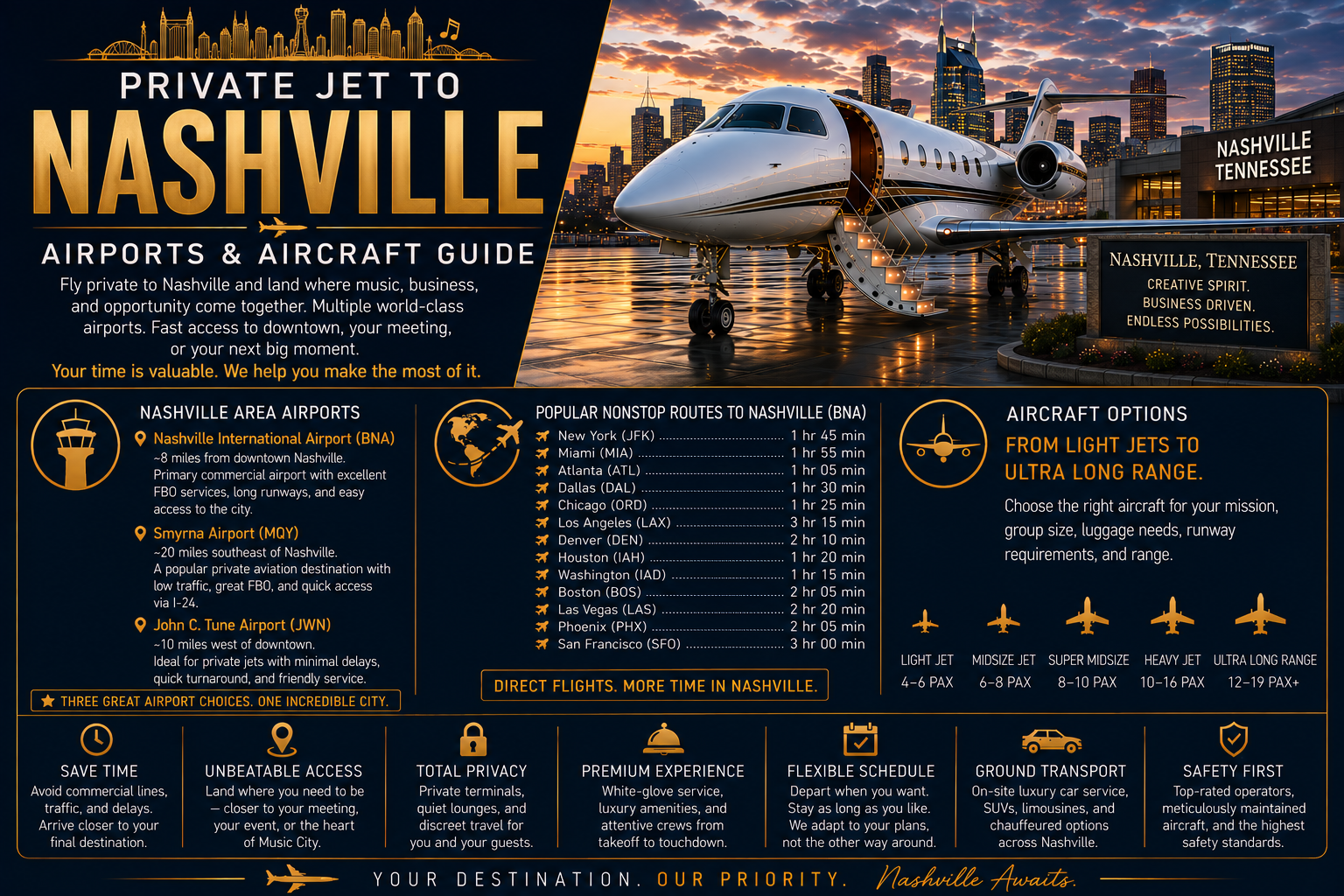
Nashville Private Aviation Destination Guide
Private Jet to Nashville: Airports, Routes and Aircraft Guide
Flying by private jet to Nashville gives travelers access to a growing business, entertainment, sports, healthcare and luxury travel market. However, the strongest itinerary depends on more than reaching Tennessee. Airport choice, aircraft performance, passenger destination, events, baggage, privacy, traffic, weather and the return mission should work together.
Nashville has evolved into one of the most important private aviation destinations in the Southeast.
Music and entertainment remain major demand drivers.
However, Nashville private aviation extends far beyond artists and celebrity travel.
Healthcare executives, entrepreneurs, private equity teams, family offices, corporate leaders, professional athletes, real estate investors, technology companies, manufacturers, event sponsors and affluent families all contribute to private aircraft demand throughout Middle Tennessee.
Therefore, “private jet to Nashville” describes several different travel missions rather than one passenger profile.
The region also provides more than one meaningful private aviation airport.
John C. Tune Airport, identified as JWN and KJWN, sits west of Downtown Nashville.
It serves regional, corporate and private aircraft while functioning as a reliever airport for Nashville International Airport.
Because the airport is only about eight miles west of Downtown Nashville, it can create a strong airport strategy for passengers traveling to central Nashville, West Nashville, Belle Meade, Green Hills and other destinations where its location and aircraft capability align with the mission.
John C. Tune’s primary runway is approximately 6,001 feet long.
Therefore, aircraft performance should be reviewed carefully rather than assuming every private aircraft and every loading condition will fit the airport equally well.
The exact jet, fuel load, passenger count, baggage, temperature, wind, runway conditions and onward destination can influence suitability.
Nashville International Airport, identified as BNA and KBNA, provides the region’s major commercial and international aviation infrastructure.
BNA can become especially relevant for passengers connecting with scheduled airlines, larger aircraft, international travel, crew positioning or missions where major-airport capabilities outweigh the complexity of a busy commercial hub.
Its airfield includes multiple runways, including a runway of more than 11,000 feet.
Therefore, BNA may support missions that create different performance requirements from John C. Tune.
However, runway capability does not automatically make Nashville International the best private aviation airport for every passenger.
Commercial traffic, taxi time, ground congestion, airline operations, construction, passenger destination and the return mission should all be considered.
Smyrna Airport, identified as MQY and KMQY, provides another major business and general aviation option south of Nashville.
The airport is located roughly 12 miles south of Nashville and is heavily oriented toward corporate and general aviation.
Therefore, Smyrna can be particularly relevant for passengers traveling toward Rutherford County, Smyrna, Murfreesboro, southeast Middle Tennessee and selected industrial or corporate destinations.
It can also support aircraft parking, charter, management, line services, catering, avionics and other business aviation requirements depending on the provider and mission.
Consequently, Nashville should be treated as a multi-airport private aviation market rather than a city served by one universal executive airport.
The strongest airport usually begins with the passenger’s actual destination.
A traveler attending meetings downtown may evaluate John C. Tune differently from a passenger visiting a manufacturing facility near Smyrna.
Likewise, an international executive connecting to a scheduled airline at BNA may value Nashville International’s infrastructure more than the private-airport environment available elsewhere.
The travel pattern becomes even more complex for passengers visiting Franklin, Brentwood, Belle Meade, Green Hills, Downtown Nashville, Music Row, The Gulch, Vanderbilt University, major healthcare organizations, corporate campuses, recording studios, sports venues or private residences outside central Nashville.
Therefore, realistic ground time should be calculated alongside flight time.
Traffic on Interstate 40, Interstate 24, Interstate 65, Interstate 440 and regional arterial roads may change the value of each airport according to time of day.
Major concerts, sporting events, festivals, conventions and downtown entertainment demand can create additional congestion.
Consequently, an airport that appears closest on a map may not always create the fastest complete journey.
Nashville’s entertainment economy also creates unique private aviation missions.
Artists, producers, managers, agents, label executives, touring personnel, songwriters and other entertainment professionals may travel on schedules that change rapidly around performances, recording sessions, television appearances, award events and tour routing.
In those cases, schedule flexibility may matter more than conventional airline economics.
Professional sports add another layer of demand.
Tennessee Titans games, Nashville Predators games, major motorsports activity, golf events, college athletics and other high-profile programs may attract athletes, owners, sponsors, corporate guests, entertainers and affluent travelers.
Meanwhile, Nashville’s healthcare industry creates substantial executive and professional travel.
Healthcare companies, hospital systems, medical investors, physicians, researchers, advisors and private equity teams may move between Nashville and other major healthcare markets throughout the country.
Corporate travel continues to expand as well.
Executives may visit Nashville headquarters, regional offices, technology organizations, manufacturing facilities, real estate developments and investment partners across Middle Tennessee.
Family-office demand may combine several categories within one itinerary.
A principal may travel to Nashville for investments, healthcare, property, entertainment, education, philanthropy or family reasons while traveling with advisors, children, household staff, security, pets and substantial baggage.
Therefore, passenger count alone cannot determine the correct aircraft.
Cabin configuration, baggage volume, baggage-door dimensions, connectivity, sleeping requirements, privacy, pets, specialized equipment and the next segment may all change the recommendation.
A regional flight from Atlanta, Charlotte, Cincinnati, Columbus, Indianapolis, Louisville or another nearby market may fit a turboprop, light jet or midsize aircraft under suitable conditions.
Meanwhile, flights from New York, Miami, Palm Beach, Dallas, Houston, Chicago, Denver, Scottsdale, Los Angeles or San Francisco may justify midsize, super-midsize or large-cabin aircraft depending on the mission.
International missions may require large-cabin or ultra-long-range aircraft, customs coordination, crew planning, international handling and greater operational preparation.
Weather also affects Nashville aviation throughout the year.
Thunderstorms may produce reroutes, turbulence, lightning restrictions and airport delays.
Heavy rain may slow passenger transportation.
Strong winds can influence aircraft and runway decisions.
Winter weather is generally less persistent than in northern markets such as Chicago, yet freezing precipitation, snow or ice can still disrupt aircraft and roadway operations when significant systems affect Middle Tennessee.
Therefore, alternate airports and ground transportation should remain part of the plan.
The return trip deserves the same level of attention.
A performance may finish later than expected.
A business meeting may extend.
A passenger may add another traveler.
Additional luggage or equipment may appear.
Weather may change.
Crew duty may become more restrictive.
Therefore, the departure should be reviewed as a new mission instead of assuming the inbound plan remains valid.
Travelers can review current airport information through the official John C. Tune Airport, Nashville International Airport and Smyrna Airport websites.
This guide connects Nashville destination demand with John C. Tune, BNA, Smyrna and other regional options, aircraft selection, popular routes, Downtown Nashville travel, entertainment, healthcare, professional sports, family offices, corporate travel, major events, baggage, privacy, weather and the complete return mission.
Is Nashville a Major Private Jet Destination?
Direct Answer: Yes. Nashville is a significant private aviation destination driven by entertainment, healthcare, corporate travel, private equity, real estate, professional sports, major events, family offices and affluent leisure demand. John C. Tune, Nashville International and Smyrna can each create the strongest airport strategy for different aircraft, passenger destinations and mission requirements.
Nashville’s private aviation market has expanded alongside the broader growth of Middle Tennessee.
However, the city’s appeal is not driven by one industry.
Music and entertainment remain highly visible, while healthcare, corporate investment, entrepreneurship, technology, manufacturing, professional services, sports and real estate create substantial additional demand.
Therefore, private aircraft may arrive for completely different reasons on the same day.
An artist may travel directly from another performance market.
A healthcare executive may arrive for an acquisition or board meeting.
A private equity team may visit a portfolio company.
A family office may combine business with a residence, event or leisure itinerary.
A corporate executive may need to reach Franklin, Brentwood, Smyrna or another suburban business location rather than Downtown Nashville.
Consequently, airport choice should reflect the passenger’s actual geography.
John C. Tune can provide a compelling option for many central and western Nashville missions.
Nashville International may become stronger when international connectivity, airline transfers, aircraft capability or other major-airport requirements matter.
Smyrna can provide excellent geographic and business-aviation value for passengers traveling south or southeast of Nashville.
Therefore, there is no universal “best Nashville private jet airport.”
The strongest airport is the one that protects the entire door-to-door journey.
Nashville should be treated as a multi-airport private aviation market.
John C. Tune may fit many central and western Nashville missions, BNA may fit major-airport and international requirements, while Smyrna may be particularly valuable for southern and southeastern Middle Tennessee travel.
Why Do Travelers Fly Privately to Nashville?
Direct Answer: Travelers fly privately to Nashville to control schedules, select airports closer to their actual destination, work or rest during the flight, protect privacy, connect multiple cities, accommodate pets or specialized baggage and respond quickly to changing business, entertainment, sports or event schedules.
Nashville frequently creates travel situations where schedule control matters more than traditional airline frequency.
An artist’s show may finish late.
A recording session may run longer than expected.
An executive meeting may move.
A healthcare transaction may require several cities within one day.
Therefore, private aviation can create value by allowing the transportation plan to follow the passenger instead of forcing the passenger to follow an airline schedule.
Control the Departure
Passengers can schedule around concerts, recording sessions, board meetings, medical programs, sporting events and private commitments.
Choose the Right Nashville Airport
John C. Tune, BNA, Smyrna and other regional options can be compared according to passenger destination and aircraft capability.
Protect Privacy
Private aviation may reduce unnecessary exposure through FBO facilities, controlled passenger lists, discreet transportation and limited itinerary distribution.
Work During the Flight
Executives, advisors and deal teams may use suitable cabins for confidential calls, meetings, document review and preparation.
Connect Multiple Cities
Nashville may form one stop within a larger New York, Atlanta, Dallas, Miami, Chicago, Los Angeles or regional business itinerary.
Carry Specialized Baggage
Musical equipment, wardrobe, golf clubs, sports gear, technical cases, medical devices, pets and family luggage may influence aircraft selection.
Private aviation does not eliminate weather, traffic, airport restrictions, crew duty or operational requirements.
Instead, it provides more options for adapting when those conditions change.
For example, the passenger may depart earlier before thunderstorms arrive.
The aircraft may use Smyrna rather than JWN when the passenger’s schedule finishes south of Nashville.
BNA may become more practical when a passenger needs an onward commercial connection.
Therefore, flexibility represents one of the strongest advantages of Nashville private aviation.
What Creates Private Aviation Demand in Nashville?
Direct Answer: Nashville private aviation demand comes from music and entertainment, healthcare, corporate headquarters, private equity, family offices, technology, real estate, manufacturing, professional sports, tourism and major events. These industries create year-round executive and high-net-worth travel across Downtown Nashville and the broader Middle Tennessee region.
Nashville’s private aviation demand reflects the diversity of its economy and visitor market.
Music gives the city global recognition.
However, healthcare, investment, corporate growth, real estate, manufacturing and entrepreneurship create substantial high-value business travel as well.
Music and Touring
Artists, managers, agents, producers, label executives and touring personnel may require rapidly changing flight schedules.
Executive and Investment Travel
Healthcare executives, physicians, investors, advisors and transaction teams may travel around board, operating and acquisition schedules.
Deals and Portfolio Companies
Investment teams may travel with attorneys, consultants, lenders and operating executives during transactions and portfolio reviews.
Executives and Boards
Leadership teams may travel for headquarters meetings, expansions, investor events, site visits and strategic programs.
Principal and Advisory Travel
Family-office itineraries may combine investments, property, healthcare, philanthropy, events and personal travel.
Athletes, Owners and Sponsors
Games, contracts, training, medical travel, league activity, sponsorships and events create private aviation demand.
Development and Investment
Developers, investors, lenders and private capital may travel for property acquisition, development and project oversight.
High-Value Visitor Demand
Concerts, festivals, sports, conventions, awards programs and major entertainment events may create concentrated aircraft activity.
Nashville’s demand can also become highly compressed around major weekends.
Aircraft may arrive within similar time windows before a concert, football game, industry event or major private gathering.
Likewise, many passengers may attempt to leave immediately after the event concludes.
Therefore, parking, FBO services, vehicles, crew lodging and preferred departure windows can become as important as securing the aircraft itself.
Nashville private aviation demand is broader than the entertainment industry.
Music may be the city’s most visible travel driver, but healthcare, private capital, corporate growth, professional sports, real estate and family-office activity create substantial year-round private aviation demand.
Who Typically Flies Privately to Nashville?
Direct Answer: Nashville private aviation travelers include artists, entertainment executives, healthcare leaders, investors, private equity teams, family offices, corporate executives, entrepreneurs, professional athletes, sponsors, affluent families and international visitors. Executive assistants, managers, chiefs of staff, security teams, travel coordinators and corporate aviation departments often arrange the flight.
The person booking the flight may not be the passenger.
Entertainment travel may be coordinated by managers, agents, tour personnel or assistants.
Executive travel may be organized by a chief of staff, corporate aviation department or travel manager.
Family-office travel may involve advisors, household staff or security personnel.
Therefore, the aircraft, airport and vehicle strategy should satisfy both the passenger and the people managing the itinerary.
Entertainment Travel
Performers may require flexible departure times, privacy, specialized baggage, staff seating and multi-city routing.
Executive and Transaction Travel
Healthcare executives, physicians and investors may require confidential cabins and compressed business schedules.
Investment Teams
Partners may travel with operating executives, advisors, bankers, attorneys and portfolio-company leadership.
Complex Principal Travel
Principals may travel with advisors, children, household staff, caregivers, security, pets and substantial baggage.
Corporate Travel
Executives may require working cabins, connectivity, several meetings, flexible departure times and multiple regional destinations.
Sports and Medical Travel
Athletes may travel with agents, trainers, physicians, security, family members and specialized sports equipment.
Investment and Growth Travel
Founders and business owners may connect Nashville with investors, operating sites, customers and other corporate markets.
Personal and Leisure Travel
Families may travel with children, caregivers, pets, golf clubs, luggage, food, medications and additional household requirements.
Why Does the Passenger Profile Affect the Aircraft?
Different travelers use the cabin differently.
An artist traveling with managers, wardrobe and instruments may need substantial baggage capacity.
A healthcare transaction team may prioritize conference seating, privacy and reliable connectivity.
A family office may need a larger cabin because of children, staff, pets and luggage even when the actual flight distance is relatively short.
Therefore, aircraft selection should begin with the complete passenger profile rather than simply counting seats.
What Should Travelers Know About John C. Tune Airport?
Direct Answer: John C. Tune Airport is a major Nashville general aviation airport located about eight miles west of Downtown Nashville. JWN serves regional, corporate and private aircraft and functions as a reliever for Nashville International. Its approximately 6,001-foot runway makes aircraft-specific performance planning important for private jet missions.
John C. Tune Airport, identified as JWN and KJWN, plays an important role in Nashville’s private aviation system.
The airport sits west of Downtown Nashville and was designed to support general aviation activity that might otherwise use Nashville International.
Its location can create a compelling private aviation option for many central and western Nashville itineraries.
Central Nashville Access
JWN’s location west of Downtown can provide practical access to central Nashville depending on traffic and the passenger’s exact destination.
Strong Geographic Position
Selected western neighborhoods, residences, corporate destinations and private events may align naturally with John C. Tune.
Private and Corporate Aircraft
JWN is specifically positioned to serve regional, corporate and private aircraft within Nashville’s airport system.
Alternative to BNA
The airport helps support aviation demand that may not require the commercial-airline environment of Nashville International.
Aircraft Performance Matters
The approximately 6,001-foot runway means operators should review aircraft weight, fuel, weather, baggage and takeoff or landing requirements.
Business Aviation Focus
Private aviation operations can provide a more streamlined experience than moving through a major commercial passenger terminal.
Why Can John C. Tune Be Better Than BNA?
For suitable aircraft, John C. Tune may remove unnecessary commercial-airport complexity.
Passengers can use a general aviation environment rather than navigating a major scheduled-airline hub.
Additionally, JWN’s location may fit many central and western Nashville destinations well.
Therefore, passengers who do not require BNA’s commercial or international infrastructure should compare John C. Tune directly.
Can Every Private Jet Use John C. Tune?
No airport should be assumed suitable for every private aircraft and mission.
John C. Tune’s approximately 6,001-foot runway supports significant general aviation activity, but the operator must evaluate the exact aircraft and conditions.
Aircraft weight, fuel, passenger count, baggage, temperature, wind, runway condition and onward route can all influence performance.
Therefore, a flight that works comfortably with one aircraft may require BNA, Smyrna or another airport when the mission changes.
John C. Tune can be one of Nashville’s strongest private aviation airports when aircraft capability and passenger geography align.
Its proximity to central Nashville and business-aviation role create significant value, but runway performance, weather, parking, ground transportation and the return mission should determine the final decision.
Which Private Aviation Services Matter at John C. Tune?
Direct Answer: John C. Tune private aviation planning should account for aircraft handling, fueling, parking, hangar needs, passenger facilities, transportation, catering, crew support, weather and the departure mission. Because aircraft and passenger requirements vary, operators should confirm current services and availability for the exact trip.
The airport itself is only one part of the private aviation experience.
The passenger, aircraft and crew also require support before arrival and departure.
Therefore, the FBO and service plan should be coordinated alongside aircraft selection.
Passenger Facilities
Private aviation passengers may require lounge access, discreet vehicle coordination, baggage assistance and comfortable staging before departure.
Aircraft Fueling
Operators should coordinate the required fuel load according to the next route, aircraft performance and mission requirements.
Aircraft Parking
Transient and overnight parking should be confirmed during major events or other high-demand Nashville periods.
Hangar Requirements
Longer stays, maintenance, severe weather or aircraft protection may create additional hangar requirements.
Ground Transportation
Executive sedans, SUVs, passenger vans, security vehicles and luggage transportation should meet the aircraft at the correct private aviation facility.
Crew Support
Crew planning may include transportation, lodging, meals, weather monitoring, maintenance, flight planning and legal rest requirements.
Why Does Parking Matter During Major Nashville Events?
Nashville can experience concentrated private aviation demand around major entertainment, sports and convention periods.
Therefore, multiple aircraft may request parking within similar arrival windows.
Longer stays may further reduce available ramp or hangar space.
Consequently, operators should confirm parking rather than assuming the aircraft can remain at the passenger’s preferred airport throughout the visit.
Can the Aircraft Drop Passengers and Reposition?
Yes, depending on the operator, airport availability, crew and overall mission.
The aircraft may drop passengers at John C. Tune and reposition to another regional airport if parking, maintenance, crew logistics or return-flight requirements make that strategy stronger.
Therefore, passenger convenience and aircraft positioning do not always need to use the same airport.
The private aviation experience does not end when the aircraft touches down.
Fuel, parking, crew, vehicles, baggage, passenger timing, weather and the return mission should remain coordinated throughout the Nashville stay.
When Does John C. Tune Airport Fit the Mission Best?
Direct Answer: John C. Tune fits best when the passenger’s Nashville destination aligns with the airport’s west-side location, the aircraft can comfortably support its runway, required services and parking are available, and the departure mission remains operationally suitable. BNA or Smyrna may become stronger when aircraft capability, geography or international requirements change.
John C. Tune should not be chosen simply because it is a private aviation airport.
Instead, it creates the most value when aircraft requirements and passenger geography align at the same time.
Central or Western Nashville Fits
Downtown, West Nashville and selected nearby residential or business destinations may align strongly with JWN.
Performance Is Appropriate
The exact aircraft, fuel, passengers, baggage, runway requirements, temperature, wind and weather should support the mission.
Airport Support Fits the Trip
Fuel, parking, passenger handling, crew requirements and ground transportation should remain available for the itinerary.
The Timing Works
Passenger arrival, event timing, crew duty and planned departure should remain synchronized with the aircraft.
The Location Saves Time
The passenger’s actual destination should justify using JWN compared with BNA, Smyrna or another airport.
The Outbound Mission Still Fits
Weather, passengers, baggage, fuel, crew duty and onward destination should be recalculated before departure.
When Might Nashville International Be Better?
BNA may become stronger when the aircraft requires more runway capability, the passenger needs a scheduled-airline connection, the trip involves international processing or the passenger’s destination better aligns with Nashville International.
Therefore, major-airport complexity may be justified when BNA solves an operational requirement that JWN cannot solve as efficiently.
When Might Smyrna Be Better?
Smyrna may provide a stronger complete journey for passengers traveling toward Smyrna, Murfreesboro, Rutherford County or selected southern and southeastern Middle Tennessee destinations.
Additionally, its corporate and general aviation orientation may support aircraft, parking or operating requirements that fit the mission well.
Therefore, the strongest Nashville itinerary should compare the complete airport network rather than assuming JWN always wins because it is close to Downtown.
The best Nashville airport may change between arrival and departure.
A passenger could arrive through John C. Tune for Downtown meetings and depart through Smyrna after finishing the itinerary farther south, while another traveler may finish at BNA for an international airline connection.
How Do John C. Tune Operations Affect Private Jet Planning?
Direct Answer: John C. Tune serves regional, corporate and private aircraft, so operators should evaluate runway performance, traffic activity, parking, fuel, weather, passenger timing, crew duty and the return mission before selecting JWN. Its business-aviation role can create a streamlined experience, but the exact aircraft and operating conditions still determine suitability.
John C. Tune provides a general aviation environment that differs significantly from Nashville International.
However, that does not mean every aircraft or every mission can use the airport equally well.
The approximately 6,001-foot runway makes aircraft-specific planning especially important when the aircraft is heavier, temperatures are high, winds are unfavorable or the next flight requires a substantial fuel load.
Therefore, the operator should evaluate the exact mission rather than relying on aircraft category alone.
Runway Performance
Aircraft weight, fuel, temperature, wind, runway condition and departure requirements may influence whether JWN is the strongest airport.
Parking
Major Nashville events may increase transient aircraft demand, making parking coordination especially important.
Fuel Planning
The fuel required for the next segment may affect aircraft weight and therefore influence airport suitability.
Passenger Timing
Concerts, meetings, games and private events may finish late or change unexpectedly, requiring schedule flexibility.
Crew Duty
Long event days, weather delays or aircraft repositioning may affect the crew’s legal operating schedule.
Return Mission
Passengers, baggage, weather, fuel and the next destination should be reviewed again before departure.
Why Does Fuel Load Matter at John C. Tune?
A private jet may be able to arrive comfortably while requiring a different departure strategy for the next segment.
For example, a longer outbound route may require more fuel.
That increases aircraft weight.
Therefore, the operator may need to adjust passengers, baggage, fuel, departure time or airport choice depending on aircraft performance.
In some cases, BNA or Smyrna may create a stronger departure solution even when John C. Tune was ideal for arrival.
John C. Tune should be evaluated independently for both arrival and departure.
The inbound mission may work perfectly while the outbound mission creates different fuel, weight, weather or runway requirements.
When Should Private Aircraft Use Nashville International Airport?
Direct Answer: Nashville International may fit private aviation missions requiring major-airport infrastructure, long runways, scheduled-airline connections, international capability, crew positioning or aircraft requirements that make BNA more suitable than John C. Tune. However, commercial traffic and airport complexity should be weighed against those advantages.
Nashville International Airport, identified as BNA and KBNA, serves as the region’s primary commercial airport.
However, private and corporate aircraft may also use the airport when the mission benefits from its infrastructure.
BNA’s runway system, airline network, international facilities and major-airport support can become valuable for specific private aviation requirements.
Large-Aircraft Support
BNA’s extensive runway infrastructure may support aircraft or fuel loads that create limitations at smaller airports.
Private-to-Commercial Transfers
Passengers connecting between a private aircraft and scheduled airline service may benefit from using the same airport.
Global Mission Infrastructure
BNA may become useful for international passenger, aircraft, crew or handling requirements depending on the exact mission.
Airline Network Access
Scheduled airline connectivity may help position crew members, maintenance personnel or support teams.
Southeast Nashville Access
BNA may align well with destinations near the airport or southeast of central Nashville depending on traffic.
More Airport Activity
Airline traffic, runway sequencing, taxi time and airport congestion may add complexity compared with a general aviation airport.
Why Would a Private Passenger Choose BNA Instead of John C. Tune?
The strongest reason is usually operational necessity or passenger connectivity.
A larger aircraft may require runway capability better suited to BNA.
An international passenger may need infrastructure or processing not available at the preferred smaller airport.
A traveler may need to connect directly to scheduled airline service.
Likewise, crew may need to arrive or depart commercially.
Therefore, BNA becomes stronger when its infrastructure solves a specific mission requirement.
When Might BNA Be the Wrong Choice?
A passenger whose itinerary centers west of Nashville may gain little from using a larger commercial airport if John C. Tune can safely support the mission.
Likewise, a passenger traveling toward Smyrna or Rutherford County may find another airport better aligned with the final destination.
Therefore, airport name recognition should never replace door-to-door planning.
BNA should solve a specific passenger or aircraft requirement.
Runway capability, airline connectivity, international needs, crew positioning or destination geography should justify the additional complexity of operating through Nashville’s major commercial airport.
When Does Smyrna Airport Fit a Private Jet Mission?
Direct Answer: Smyrna Airport can be a strong private aviation option for passengers traveling to Smyrna, Murfreesboro, Rutherford County and selected southern or southeastern Middle Tennessee destinations. Its substantial general and corporate aviation activity can also support aircraft parking, management, maintenance and other mission requirements depending on provider availability.
Smyrna Airport, identified as MQY and KMQY, sits south of Nashville and serves a major general and corporate aviation role within Middle Tennessee.
Its geographic position can make it especially valuable for passengers whose destination lies south or southeast of central Nashville.
Therefore, a traveler visiting Murfreesboro, Smyrna, industrial facilities, logistics operations, corporate campuses or private residences in Rutherford County should compare Smyrna directly with BNA and John C. Tune.
Southern Regional Access
Smyrna may reduce unnecessary northbound driving for passengers whose itinerary remains south of Nashville.
Business Aircraft Environment
The airport’s general and corporate aviation activity can support a broad range of private aircraft missions.
Aircraft Positioning Options
Smyrna may become useful when parking or operating requirements make another Nashville-area airport less practical.
Manufacturing and Logistics Access
Executives, engineers, customers and suppliers may use Smyrna for facilities and industrial destinations south of Nashville.
Regional Business and Residential Travel
Murfreesboro-area destinations may align naturally with Smyrna rather than requiring a transfer from central Nashville airports.
Alternate Airport Value
Smyrna may support the mission when parking, traffic, aircraft performance or passenger geography makes another airport less attractive.
Can Smyrna Be Better Than John C. Tune?
Yes, when the passenger’s destination lies south or southeast of Nashville.
A traveler staying in Murfreesboro, for example, may gain little by landing west of Downtown at JWN and then driving across the region.
Smyrna may create a shorter and more direct transfer.
Therefore, the airport should be evaluated based on the passenger’s actual itinerary rather than a general preference for a more central airport.
Can Smyrna Support Aircraft Repositioning?
Potentially, depending on current parking, operator, FBO and mission requirements.
An aircraft may drop passengers closer to Downtown Nashville and then reposition to Smyrna for parking, crew logistics or the next flight segment.
Alternatively, passengers may depart directly from Smyrna after finishing the trip farther south.
Therefore, passenger airport and aircraft parking airport do not always need to match.
Smyrna becomes especially valuable when passenger geography and aircraft operations point south.
Rutherford County access, corporate aviation support, parking, industrial travel and the outbound mission can make MQY one of the strongest airports in the Nashville region.
Which Other Nashville-Area Airports Can Matter for Private Aviation?
Direct Answer: Depending on aircraft capability and passenger destination, additional regional airports may become useful for selected Middle Tennessee missions. Smaller airports can reduce ground travel for specialized itineraries, although runway capability, fuel, parking, weather, services and aircraft performance should be confirmed before they are selected.
Nashville private aviation should not always stop at comparing only JWN, BNA and Smyrna.
Regional airports can become valuable when the passenger is traveling well outside central Nashville or when the aircraft, parking or mission favors another facility.
However, smaller airports may provide fewer services or impose greater aircraft-performance limitations.
Therefore, they should be evaluated according to the exact mission.
Northern Middle Tennessee
Regional airports may support private aviation travel toward communities and facilities north of Nashville when aircraft capability permits.
Southern Middle Tennessee
Passengers traveling beyond Smyrna and Murfreesboro may benefit from another airport closer to the final destination.
Corporate Facilities
Manufacturing plants, industrial sites and regional headquarters may sit closer to smaller airports than to central Nashville.
Why Should Smaller Airports Be Evaluated Carefully?
Runway length, pavement strength, fuel availability, operating hours, lighting, weather, maintenance and ground handling may vary considerably.
Therefore, convenience alone should never determine airport suitability.
The operator should confirm that the airport safely supports the aircraft and the complete mission.
How Should Travelers Compare Nashville Private Jet Airports?
Direct Answer: Travelers should compare Nashville airports using the passenger’s exact destination, aircraft capability, runway requirements, parking, international needs, commercial connections, ground traffic, weather, crew requirements and return mission. John C. Tune, BNA and Smyrna each solve different private aviation problems.
| Airport | Often Strong For | Primary Advantage | Important Consideration |
|---|---|---|---|
| John C. Tune (JWN) | Downtown, West Nashville, Belle Meade, Green Hills and selected central/western destinations | General aviation focus and proximity to central Nashville | Approximately 6,001-foot runway requires aircraft-specific performance planning |
| Nashville International (BNA) | International needs, airline connections, large aircraft and southeast Nashville | Major-airport infrastructure and extensive runway capability | Commercial traffic, taxi time and airport complexity |
| Smyrna (MQY) | Smyrna, Murfreesboro, Rutherford County and southern/southeastern destinations | Strong corporate/general aviation role and southern geography | May create longer ground travel for central or western Nashville destinations |
| Regional Airports | Specialized missions outside central Nashville | Closer access to selected private residences, facilities or regional destinations | Runway capability and services vary by airport |
What Should Be Compared Before the Airport Is Confirmed?
- The passenger’s exact residence, hotel, office, studio, hospital, venue, stadium or facility
- The arrival and departure schedule
- The exact aircraft and runway requirements
- Passenger count, staff, security, children and pets
- Musical instruments, wardrobe, technical cases, golf clubs and other specialized baggage
- Fuel required for the next segment
- Parking and aircraft repositioning requirements
- Weather and acceptable alternate airports
- International or scheduled-airline connection requirements
- The return destination and crew-duty plan
Nashville’s airport system allows the passenger journey to be optimized rather than forcing every private flight through the same facility.
For example, a passenger may arrive at John C. Tune for Downtown meetings and later depart from Smyrna after finishing an event or business program farther south.
Another traveler may use BNA because an international airline connection immediately follows the private flight.
Therefore, arrival and departure airports should be selected independently when doing so creates a stronger itinerary.
The best Nashville airport is the one that solves the entire mission.
Aircraft performance, passenger geography, traffic, services, international needs, parking and the next segment should outweigh habit or airport name recognition.
How Should Nashville Ground Transportation Be Planned?
Direct Answer: Nashville ground transportation should be planned together with the aircraft because airport location, downtown traffic, event congestion, passenger count, baggage, privacy and final destination can materially change total travel time. The correct vehicle should meet the passenger at the exact FBO or private aviation facility.
Private aviation can save substantial time before and after the flight.
However, poor ground planning can quickly erase that advantage.
Nashville’s rapid growth, major events and high visitor volume can create significant congestion around Downtown, Broadway, major venues and interstate corridors.
Therefore, vehicles should be coordinated before arrival rather than requested after the aircraft lands.
Executive Sedans
May fit individual executives, artists, couples or advisors traveling with relatively limited baggage.
Luxury SUVs
May provide additional space for luggage, family members, security personnel or entertainment-industry travel.
Passenger Vans
May support larger corporate, family, sports or entertainment groups traveling together.
Equipment Vehicles
Musical instruments, wardrobe, technical cases, sports equipment or production materials may require separate transportation.
Security Vehicles
High-profile passengers may require advance personnel, discreet routing, alternate entrances and multiple coordinated vehicles.
Event Transportation
Large concerts, games, festivals and downtown events may require special staging, road-access or departure planning.
Why Should the Driver Know the Exact FBO?
Private aviation passengers generally do not arrive through the standard airline terminal.
Therefore, simply giving a driver the airport name may not be enough.
The transportation team should receive the exact FBO or private aviation facility, passenger contact, aircraft timing, baggage requirements and any security instructions.
If weather, parking or aircraft requirements change the airport, the driver should receive that update immediately.
Measure Nashville private aviation from door to door.
The aircraft, airport, FBO, vehicle, event traffic, baggage and final destination should work together to preserve the time advantage of flying privately.
How Does Nashville Traffic Affect Private Jet Airport Choice?
Direct Answer: Nashville traffic can materially change which airport creates the fastest complete journey. Interstate 40, Interstate 24, Interstate 65, Interstate 440, Downtown Nashville and major event areas may experience congestion that makes John C. Tune, BNA or Smyrna perform very differently depending on the passenger’s destination and travel time.
Nashville’s rapid population and visitor growth has increased the importance of realistic ground-transfer planning.
Therefore, airport choice should not rely only on mileage.
The fastest airport for a morning meeting may not be the strongest airport for an evening departure after a major concert or sporting event.
East-West Travel
Traffic along I-40 may influence travel between Downtown, BNA, West Nashville and other destinations.
Smyrna and Southeast Travel
Conditions along I-24 may materially affect trips between Nashville, Smyrna, Murfreesboro and Rutherford County.
North-South Travel
Traffic may influence airport strategy for Brentwood, Franklin and other north-south destinations.
Broadway and Central Nashville
Tourism, nightlife, construction and events may slow travel around central entertainment districts.
Concerts and Sports
Major venues and events can create sudden traffic increases before and after performances or games.
Update the Vehicle Immediately
A shift between JWN, BNA and Smyrna can significantly change the passenger’s ground route.
Should Travelers Use the Same Airport for Arrival and Departure?
Not always.
A passenger may arrive at John C. Tune because the first meetings are Downtown or west of the city.
However, if the final event or business destination is farther south, Smyrna may create a stronger departure.
Likewise, BNA may become the best final airport when a scheduled airline connection follows the private flight.
Therefore, airport planning should follow the passenger’s complete geographic path through Nashville.
Nashville airport strategy should follow the passenger—not tradition.
The first destination, final destination, traffic direction, event schedule and onward flight should determine whether the arrival and departure airports remain the same.
How Does Nashville Weather Affect Private Aviation?
Direct Answer: Nashville private aviation planning should account for thunderstorms, heavy rain, strong winds, low ceilings, heat, occasional winter weather and rapidly changing conditions. Weather may affect routing, airport capacity, runway conditions, passenger transportation, aircraft performance, crew duty and the return mission.
Nashville weather creates a different operating profile from markets such as Chicago, Aspen or South Florida.
However, changing conditions can still materially affect private aviation throughout the year.
Spring and summer thunderstorms may produce reroutes, turbulence, lightning restrictions, heavy rain and temporary airport delays.
Meanwhile, strong frontal systems can create gusty winds and changing runway conditions.
Winter snow and ice are less frequent than in northern markets, yet even modest freezing precipitation may disrupt aircraft and ground transportation because local infrastructure may experience significant impact during relatively short winter events.
Convective Weather
Storm cells may create reroutes, turbulence, lightning restrictions, heavy rain and changing airport capacity.
Runway and Ride Conditions
Strong or gusty winds may influence runway use, turbulence, aircraft performance and passenger comfort.
Performance Considerations
Higher temperatures may influence aircraft takeoff performance, payload and runway requirements for selected missions.
Occasional Snow and Ice
Freezing precipitation may affect runway conditions, aircraft treatment, road travel and overall schedule reliability.
The strongest weather plan includes more than simply checking whether Nashville is forecast to be clear.
Conditions at the departure airport, along the route and at the next destination can all influence the mission.
Therefore, a Dallas-to-Nashville flight may require weather planning across several systems even when Nashville itself remains favorable.
Likewise, a Nashville-to-Aspen departure may be affected more by Colorado mountain weather than by Tennessee conditions.
Weather planning should protect the complete itinerary, not only the Nashville arrival.
Departure conditions, en route weather, Nashville airport conditions, passenger transportation and the return destination should all be reviewed as one operating plan.
How Do Thunderstorms Affect Nashville Private Flights?
Direct Answer: Thunderstorms may affect Nashville private flights through reroutes, turbulence, lightning restrictions, heavy rain, wind shifts and changing airport capacity. Flexible departure windows and alternate-airport planning can help protect the mission when significant convective weather is expected across Middle Tennessee or along the route.
Thunderstorms are one of the most important warm-season operational considerations in Nashville.
Even when the airport remains open, nearby storm cells may change arrival paths, departure routing or air-traffic sequencing.
Lightning can also temporarily limit ramp activity.
Therefore, fueling, baggage movement, catering, vehicle access or passenger boarding may pause during certain conditions.
Rerouting
Aircraft may need to avoid storm cells, increasing distance, flight time and fuel requirements.
Turbulence
Convective weather may affect passenger comfort and require altitude or route changes.
Lightning Restrictions
Ground crews may limit outside activity when lightning creates a safety concern around the airport ramp.
Heavy Rain
Rain may reduce visibility, slow airport operations and increase passenger ground-transfer time.
Wind Shifts
Changing storm winds may affect runway configuration and operating decisions.
Crew Duty
Extended storm delays may affect legal crew schedules and the passenger’s planned departure window.
Can Another Nashville Airport Solve a Thunderstorm Delay?
Sometimes.
Storm coverage may affect JWN, BNA and Smyrna differently, especially when cells remain localized.
However, moving airports can substantially change the passenger’s ground transfer.
Therefore, alternate-airport planning should include vehicle routing before the aircraft is moved.
The fastest weather solution is not always the airport with the clearest sky.
The alternate airport must also work for aircraft performance, parking, passenger geography, crew duty and the next flight segment.
Can Winter Weather Affect Nashville Private Aviation?
Direct Answer: Yes. Nashville receives less persistent winter weather than many northern private aviation markets, but snow, freezing rain, ice and cold temperatures can still affect aircraft treatment, runway conditions, airport capacity and ground transportation. Even relatively modest winter events may require additional schedule flexibility.
Winter weather in Middle Tennessee can become operationally significant because freezing precipitation may affect aviation and roads at the same time.
An aircraft may require treatment before departure.
Meanwhile, passenger vehicles may require additional time to reach the airport safely.
Therefore, an itinerary that normally operates with a narrow meeting-to-departure window may need more margin during winter conditions.
Aircraft Treatment
Frost, snow or ice may need to be removed before departure according to operator procedures.
Runway Conditions
Frozen precipitation may affect braking, runway availability and aircraft performance.
Road Travel
Ice or snow may significantly slow transportation between Downtown Nashville, residences, venues and airports.
Airport Capacity
Weather treatment, visibility and ground operations may reduce normal airport efficiency.
Crew Duty
Weather-related delays may extend the operating day and affect legal crew limitations.
Return Mission
A storm may arrive while the passenger is in Nashville, creating a different departure strategy from the inbound flight.
Nashville winter weather may be less frequent, but it should not be treated casually.
Aircraft treatment, runway conditions, road travel, airport capability and crew timing should all be reviewed when freezing precipitation is forecast.
When Is Nashville Private Aviation Demand Highest?
Direct Answer: Nashville private aviation demand may increase around major concerts, music-industry events, awards programs, professional sports, college athletics, major festivals, conventions, corporate gatherings, holiday weekends and other high-profile events. During peak periods, aircraft, parking, FBO capacity, vehicles, crew lodging and preferred departure windows may tighten together.
Nashville’s event calendar can create unusually concentrated private aviation demand.
A major music weekend may bring artists, executives, sponsors, family offices, corporate guests and private travelers into the region simultaneously.
Likewise, sports and convention demand may overlap with normal business and entertainment traffic.
Therefore, availability constraints can appear across several travel components at once.
Major Concerts
Artists, management teams, executives, sponsors and premium guests may arrive within narrow operating windows.
Awards and Music Events
Industry gatherings may create private aviation demand from artists, labels, managers, executives and business partners.
Tennessee Titans
Games may attract players, owners, executives, sponsors, corporate guests and affluent fans.
Nashville Predators
Games, playoffs, league activity and hospitality programs may create additional high-value travel.
High-Volume Visitor Periods
Large festivals may increase airport activity, hotel demand, road congestion and professional transportation requirements.
Regional Athletic Travel
Major games, donor programs and university events may create additional private aviation demand.
Meetings and Conventions
Leadership programs, investor events, product launches and conventions may increase executive travel.
Family and Leisure Travel
Holiday weekends may combine family, entertainment, sporting and second-home travel demand.
Why Can Departure Be More Difficult Than Arrival?
Event travel often compresses departures more than arrivals.
Guests may arrive throughout the day before a major event.
However, many passengers may attempt to depart within the same narrow period after the event ends.
Therefore, aircraft movements, vehicles, ramp activity and crew schedules can become concentrated.
If the event finishes late, crew-duty constraints may add another challenge.
For major Nashville events, reserve the complete travel chain.
Aircraft, parking, FBO services, vehicles, crew lodging, passenger hotels, security, weather alternatives and the return departure should all be planned together.
Which Aircraft Work Best for Private Flights to Nashville?
Direct Answer: The best aircraft for Nashville depends on route length, passenger count, baggage, airport, runway requirements, temperature, weather, cabin preferences, equipment, pets and the return mission. Turboprops and light jets may fit regional flights, while midsize, super-midsize and large-cabin jets may better support longer domestic or international missions.
Nashville can support missions from nearby regional markets, both coasts and international destinations.
Therefore, aircraft selection varies substantially according to the complete itinerary.
A short flight from Atlanta creates a different mission from Los Angeles to Nashville.
Likewise, a family traveling with extensive luggage creates different requirements from two executives carrying only laptop bags.
Turboprops
Aircraft such as the King Air 350 may fit selected regional missions when travel time, runway performance, baggage and passenger preferences support the category.
Light Jets
Aircraft such as the Phenom 300 and Citation XLS may fit nearby and selected domestic missions with smaller passenger groups.
Midsize Jets
Midsize aircraft may add cabin comfort, baggage capacity and range for longer domestic routes.
Super-Midsize Jets
Aircraft such as the Challenger 350, Citation Longitude and Praetor 600 may support longer domestic routes and productive working cabins.
Heavy Jets
Large-cabin aircraft may support larger groups, substantial luggage, coast-to-coast missions and premium cabin requirements.
Ultra-Long-Range Jets
Aircraft such as the Gulfstream G650, G700 and Global 7500 may support demanding international Nashville missions.
Utility-Focused Aircraft
Selected aircraft may become valuable when runway flexibility, baggage access or specialized mission requirements matter.
Cabin Layout Matters
Connectivity, work areas, sleeping arrangements, galley capability, lavatories and baggage access may influence aircraft value.
How Does John C. Tune Affect Aircraft Selection?
JWN’s runway can support substantial private aviation activity, but runway performance should still be calculated for the exact aircraft and mission.
A heavy aircraft departing on a longer route with a large fuel load may create different requirements from the same aircraft arriving relatively light.
Therefore, aircraft selection and airport selection should occur together.
Why Can BNA Change the Aircraft Options?
BNA’s major-airport runway infrastructure may provide more operational flexibility for certain aircraft, fuel loads or long-range missions.
Therefore, a passenger may accept greater airport complexity when the larger airport enables the desired aircraft or nonstop mission.
Why Does Entertainment Baggage Matter?
Entertainment-industry passengers may travel with instruments, wardrobe, production equipment, technical cases or other specialized items.
These items can create requirements that conventional passenger bags do not.
Therefore, dimensions and weights should be disclosed before the aircraft is selected.
Choose the Nashville aircraft around the mission, not the hourly rate.
Airport, runway, passengers, baggage, cabin requirements, weather, fuel, onward route and the return mission determine whether the aircraft creates real value.
Which Private Jet Routes Commonly Connect With Nashville?
Direct Answer: Nashville private aviation connects naturally with New York, Miami, Palm Beach, Dallas, Houston, Chicago, Atlanta, Charlotte, Los Angeles, Scottsdale, Aspen and other major markets. Entertainment, healthcare, corporate and family-office travel may also connect Nashville with international destinations using large-cabin or ultra-long-range aircraft.
Nashville’s economic and entertainment networks create a broad mixture of private aviation routes.
Some missions connect nearby Southeast and Midwest cities.
Others link Nashville with major financial, entertainment, healthcare and luxury markets across the country.
| Route | Typical Mission Profile | Aircraft Categories to Evaluate | Planning Considerations |
|---|---|---|---|
| New York → Nashville | Finance, entertainment, healthcare, private equity and corporate travel | Light, midsize and super-midsize jets | Airport strategy and business schedule at both ends |
| Miami → Nashville | Entertainment, family office, sports, real estate and leisure travel | Light, midsize and super-midsize jets | Seasonal weather, baggage and passenger profile |
| Dallas → Nashville | Corporate, private equity, entertainment and multi-city business travel | Light, midsize and super-midsize jets | Airport geography and working-cabin needs |
| Chicago → Nashville | Finance, healthcare, corporate, sports and entertainment travel | Light, midsize and super-midsize jets | Weather and airport choice at both ends |
| Los Angeles → Nashville | Entertainment, music, corporate, sports and family-office travel | Super-midsize and large-cabin jets | Winds, cabin productivity, baggage and schedule |
| Atlanta → Nashville | Corporate, healthcare, entertainment and regional business travel | Turboprops, light jets and midsize jets | Short-stage efficiency and airport access |
| Nashville → Aspen | Family office, entertainment, executive and leisure travel | Midsize, super-midsize and performance-suitable aircraft | Mountain conditions, baggage and alternate airports |
| Nashville → Palm Beach | Family office, finance, leisure and second-home travel | Midsize and super-midsize jets | Seasonal demand and baggage requirements |
The strongest aircraft may change when Nashville represents only one stop within a larger itinerary.
An entertainment executive might travel Los Angeles to Nashville, continue to New York and then return to California.
A healthcare team may connect Nashville, Dallas, Atlanta and another market within a multi-city business schedule.
Therefore, the aircraft should be selected around the full routing rather than one segment alone.
Nashville route planning should begin with the entire sequence of cities.
One aircraft may provide stronger economics, schedule control and passenger continuity across a multi-city itinerary than rebuilding each segment independently.
How Does Private Aviation Connect New York and Nashville?
Direct Answer: New York–Nashville private aviation supports finance, private equity, entertainment, healthcare, law, corporate leadership and family-office travel. Airport selection at both ends can materially affect total travel time, while light, midsize and super-midsize jets may all fit depending on passengers, baggage and cabin requirements.
New York and Nashville connect several powerful business ecosystems.
Finance and private equity teams may travel for investments, acquisitions and portfolio-company activity.
Entertainment professionals may travel between recording, touring, media and business commitments.
Healthcare executives may connect corporate and investment activity across both markets.
Finance
Investors, bankers, attorneys and private equity teams may require confidential working cabins and compressed schedules.
Entertainment
Artists, producers, managers and label executives may need flexible departure times and specialized baggage capacity.
Airport Strategy
Teterboro, Westchester or another New York-area airport can be paired with JWN, BNA or Smyrna according to passenger geography.
Therefore, the strongest New York–Nashville itinerary should optimize both metropolitan airport systems.
How Does Private Aviation Connect Miami and Nashville?
Direct Answer: Miami–Nashville private aviation supports entertainment, family offices, sports, real estate, finance and leisure travel. Aircraft choice depends on passengers, baggage, airport strategy and cabin needs, while weather planning should account for both South Florida thunderstorms and changing conditions across the Southeast.
Miami and Nashville connect major entertainment, wealth, real-estate and sports markets.
Family offices may combine business and personal travel between both cities.
Artists and entertainment executives may move between performances, recording, media and private events.
Professional athletes and sponsors may also create recurring private aviation demand.
Entertainment
Artists, managers, producers and executives may require flexible scheduling around performances and business commitments.
Family Offices
Principals may travel with family members, staff, pets, advisors and significant luggage.
Weather
South Florida thunderstorms and Nashville convective weather may affect different portions of the same round trip.
How Does Private Aviation Connect Dallas and Nashville?
Direct Answer: Dallas–Nashville private aviation supports corporate leadership, private equity, healthcare, entertainment, family offices and multi-city business travel. Light, midsize and super-midsize jets may fit the route depending on passenger count, baggage, cabin needs and airport strategy at both ends.
Dallas and Nashville connect fast-growing corporate and investment markets.
Executives may travel between headquarters, investors, healthcare companies, private equity firms and operating businesses.
Entertainment and sports travel may add another layer of demand.
Corporate Leadership
Boards and executives may require confidential cabins and same-day travel flexibility.
Private Equity
Deal teams may connect portfolio companies, advisors and operating executives across both markets.
Multi-City Travel
Dallas and Nashville may form two stops within a larger Houston, Chicago, New York or regional itinerary.
How Does Private Aviation Connect Chicago and Nashville?
Direct Answer: Chicago–Nashville private aviation supports healthcare, finance, private equity, corporate leadership, manufacturing, entertainment and sports travel. Light, midsize and super-midsize jets may fit the route, while airport selection at both ends can materially affect the passenger’s total door-to-door schedule.
Chicago and Nashville connect major healthcare, corporate, finance and entertainment markets.
Therefore, the route may support executives, transaction teams, artists, investors and family offices throughout the year.
Chicago airport strategy may involve Midway, Chicago Executive, DuPage or O’Hare.
Nashville arrival may involve John C. Tune, BNA or Smyrna.
Consequently, matching the right airport pair can save substantial ground time on both ends.
Healthcare
Executives and investors may travel between major healthcare organizations and financial partners in both markets.
Private Equity
Partners, attorneys and operating teams may use the route for portfolio-company and transaction activity.
Entertainment
Artists, executives and touring personnel may connect Nashville with Chicago performances, media and corporate events.
How Does Private Aviation Connect Los Angeles and Nashville?
Direct Answer: Los Angeles–Nashville private aviation supports music, entertainment, corporate leadership, sports, family offices and media travel. Super-midsize and large-cabin aircraft are often worth evaluating because of route length, winds, baggage, cabin productivity and the possibility of multi-city entertainment schedules.
Los Angeles and Nashville form one of the most natural entertainment-oriented private aviation corridors in the United States.
Artists, producers, managers, executives and creative teams may move between recording, touring, media and business commitments in both markets.
However, the route extends beyond entertainment.
Corporate executives, athletes, family offices and investors may also use private aviation between Southern California and Middle Tennessee.
Music and Entertainment
Artists, managers, producers, labels and touring teams may need flexible departure windows and specialized baggage capacity.
Working Cabin
A longer route may increase the value of connectivity, conference seating, rest areas and a more productive cabin environment.
Airport Strategy
Van Nuys or another Los Angeles-area airport can be paired with the Nashville airport closest to the passenger’s actual destination.
Los Angeles–Nashville aircraft selection should account for the complete entertainment or business itinerary.
Winds, passenger count, instruments, wardrobe, cabin needs, Los Angeles airport choice, Nashville airport choice and the next city may all influence the strongest aircraft.
How Does Private Aviation Support Nashville Entertainment Travel?
Direct Answer: Private aviation supports Nashville entertainment travel by giving artists, managers, producers, label executives, agents, touring personnel and creative teams greater schedule control, privacy, multi-city routing and baggage flexibility. Flights may need to accommodate instruments, wardrobe, production materials, security, staff and rapidly changing performance or recording schedules.
Nashville’s entertainment industry creates some of the city’s most distinctive private aviation missions.
An artist may arrive after performing in another city, attend rehearsals or recording sessions, complete media obligations and depart for the next show within a narrow window.
Therefore, rigid airline schedules may not align well with the actual working day.
Artists and Performers
Performance times, rehearsals, media commitments and late finishes may require flexible aircraft departure windows.
Managers and Agents
Business representatives may coordinate contracts, meetings, media schedules, tour routing and onward transportation.
Production Personnel
Selected missions may include technical staff, creative teams, producers, engineers or other personnel traveling with the principal.
Instruments and Equipment
Cases, instruments, wardrobe and production materials may require specific baggage-door dimensions and usable compartment space.
Privacy
Private aviation can reduce unnecessary exposure when itinerary information, transportation and FBO access remain tightly coordinated.
Multi-City Touring
Nashville may represent one stop within a larger Los Angeles, New York, Atlanta, Dallas, Chicago or touring itinerary.
Why Does Departure Flexibility Matter for Entertainment Travel?
A performance may end later than expected.
A recording session may extend.
Media or sponsor obligations may change the passenger’s departure time.
Therefore, the aircraft and crew plan should account for realistic schedule variability.
However, flexibility still operates within crew-duty, airport, weather and aircraft constraints.
Consequently, an extremely late schedule change may require another crew, another airport or a revised departure.
Entertainment aviation works best when the aircraft follows the real production schedule.
Performance timing, staff, instruments, wardrobe, security, vehicles, crew duty and the next city should all be planned before the Nashville mission begins.
How Does Private Aviation Support Nashville Healthcare Travel?
Direct Answer: Private aviation supports Nashville healthcare travel by connecting executives, investors, physicians, advisors, board members and transaction teams with hospitals, healthcare companies and other markets on controlled schedules. Confidential cabins and multi-city routing can be especially valuable for acquisitions, board meetings, investor programs and time-sensitive executive travel.
Nashville is a major healthcare business center.
Therefore, private aviation demand may come from healthcare operators, investors, private equity teams, physicians, consultants, attorneys, executives and board members.
These trips often involve confidential business matters and tightly compressed schedules.
Executive Meetings
Healthcare leadership teams may travel for strategy, operating reviews, partnerships, investor meetings and board programs.
Private Equity
Investors may travel with attorneys, bankers, consultants and operating partners during transactions or portfolio reviews.
Medical Leadership
Physicians and senior clinical leaders may require efficient transportation between Nashville and other healthcare markets.
Confidential Work
Suitable cabins may support private calls, document review, strategic discussion and transaction preparation.
Multi-City Travel
A healthcare team may connect Nashville with Dallas, Atlanta, Chicago, New York, Houston or several operating markets in one itinerary.
Ground Logistics
Hospital campuses, corporate offices and suburban healthcare facilities may influence whether JWN, BNA or Smyrna creates the strongest transfer.
Healthcare aviation should be measured in productive decision-maker time.
Cabin privacy, airport proximity, multi-city flexibility, schedule control and reduced overnight travel may create more value than flight time alone.
How Does Private Aviation Support Nashville Business Travel?
Direct Answer: Private aviation supports Nashville business travel by allowing executives to control schedules, connect multiple cities, use airports closer to offices or facilities and work privately in flight. Corporate travelers may use John C. Tune, BNA, Smyrna or regional airports depending on whether the itinerary centers on Downtown, Brentwood, Franklin, Rutherford County or another Middle Tennessee destination.
Nashville’s corporate travel market continues to expand alongside regional population, investment and business growth.
Executives may travel for headquarters meetings, board sessions, acquisitions, site visits, investor programs, facility openings and strategic partnerships.
Therefore, private aviation can create value when several high-level activities must fit within a limited schedule.
Board Meetings
Direct scheduling may allow directors and executives from multiple markets to coordinate around narrow meeting windows.
Site Visits
Regional airports may provide better access to manufacturing, logistics, real-estate and operating locations outside central Nashville.
Investor Travel
Executives, investors and advisors may use the cabin for confidential preparation before important meetings.
Multi-City Days
Nashville may be combined with Atlanta, Dallas, Chicago, Charlotte, Cleveland or another business market within one day.
Corporate Campuses
The passenger’s actual facility may make a suburban or regional airport more valuable than the airport closest to Downtown.
Executive Productivity
Connectivity, conference seating, privacy, meals and rest may convert flight time into usable business time.
Why Should Corporate Travelers Compare Franklin and Brentwood Ground Time?
Many Nashville-area business and residential destinations sit south of Downtown.
Therefore, the closest airport by straight-line distance may not always create the shortest realistic journey.
Traffic along I-65 and connecting roads can materially influence transfer time.
Consequently, aircraft planners should evaluate the exact office, residence or meeting location before confirming the airport.
Business aviation should optimize the executive’s entire working day.
The best mission may reduce ground travel, protect meeting windows, support confidential work and eliminate an unnecessary overnight stay.
How Do Family Offices Use Private Aviation in Nashville?
Direct Answer: Family offices may use Nashville private aviation for investments, residences, healthcare, education, entertainment, philanthropy, sporting events and family travel. Missions may include principals, advisors, children, caregivers, household staff, security, pets and substantial luggage, making aircraft, airport and vehicle planning especially important.
Nashville can serve several family-office priorities within one trip.
A principal may have investment meetings, healthcare appointments, property interests, entertainment commitments and personal events during the same visit.
Therefore, private aviation planning should consider the entire household and advisory ecosystem.
Principals
The aircraft may need to support both business and personal objectives within the same Nashville visit.
Advisors
Investment professionals, attorneys, accountants and assistants may travel with the principal or arrive separately.
Children and Caregivers
Child seats, strollers, food, medications, caregivers and additional luggage should be included before aircraft selection.
Pets
Pet size, carriers, cleaning requirements, operator policies and vehicle arrangements should be confirmed before travel.
Security
High-profile principals may require limited itinerary distribution, advance vehicles and private arrival procedures.
Extended Itineraries
Nashville may represent only one stop within a larger Palm Beach, Aspen, New York, Dallas or international trip.
Family-office travel should be planned around the entire household movement.
Principals, advisors, children, staff, pets, baggage, security, residences, vehicles and the next destination can all influence the strongest aircraft and airport.
How Do Professional Athletes Use Private Aviation in Nashville?
Direct Answer: Professional athletes may use Nashville private aviation for games, training, medical appointments, contract meetings, sponsorships, offseason travel and family trips. Aircraft planning may need to accommodate agents, trainers, medical personnel, security, family members, golf clubs and specialized sports equipment.
Nashville’s sports market creates private aviation demand beyond official team transportation.
Athletes, owners, agents, executives, sponsors and families may travel independently around games and related business.
Games and Events
The stadium, arena, hotel or final event location should influence the airport and ground-transportation plan.
Medical Travel
Athletes may travel with physicians, trainers, rehabilitation equipment and changing appointment schedules.
Training Equipment
Sports bags, golf clubs, recovery equipment and specialized cases may influence usable baggage capacity.
Family Travel
Partners, children, caregivers and pets may materially change seating, baggage and vehicle requirements.
Security
High-profile passengers may require discreet vehicles, private entrances and controlled itinerary information.
Short-Notice Changes
Injuries, negotiations, trades, schedule changes and media obligations may create rapid travel requirements.
Sports travel requires more than a seat count.
Players, family, agents, trainers, medical staff, security, equipment, vehicles and schedule changes should all be included in the mission profile.
How Do Major Nashville Events Affect Private Aviation?
Direct Answer: Major Nashville events can increase private aircraft traffic, parking demand, FBO activity, hotel occupancy, professional transportation demand and departure congestion. Travelers should coordinate aircraft, airport, parking, vehicles, crew lodging, weather alternatives and return timing before major concerts, festivals, sporting events, conventions and entertainment-industry programs.
Nashville’s event economy can place substantial pressure on the entire private aviation travel chain.
Therefore, securing an aircraft does not necessarily mean the rest of the mission is complete.
Major Concerts
Artists, executives, sponsors, corporate guests and affluent travelers may arrive within similar periods.
Music Festivals
Large entertainment weekends may increase aircraft, hotel, vehicle and downtown traffic simultaneously.
Titans and Predators
Professional sports may attract owners, sponsors, corporate guests, athletes and private travelers.
Awards Programs
Music-industry events can create concentrated movements by artists, agents, producers and executives.
Corporate Conventions
Executive gatherings and major conferences may increase demand for premium transportation and hotel inventory.
Private Events
Weddings, celebrations, donor programs and exclusive gatherings may generate multiple-aircraft and family-office travel.
Why Should the Return Flight Be Planned Before the Event?
The outbound rush can be more concentrated than the arrival pattern.
Many aircraft may attempt to depart shortly after the same concert, game or event ends.
Vehicles can also become trapped in event traffic.
Furthermore, a late finish may create crew-duty problems.
Therefore, planners should determine the passenger pickup point, airport, departure window and backup strategy before the event begins.
Major Nashville events should be planned backward from the departure.
Know where the passenger will finish, how the vehicle will exit the event area, which airport will be used and how crew duty or weather could affect the flight home.
What Should International Private Jet Travelers Know About Nashville?
Direct Answer: International Nashville private aviation may require passports, visas, passenger manifests, customs, immigration, aircraft documentation, permits, crew planning, handlers and destination-specific procedures. Travelers should verify that the selected Nashville-area airport supports the exact international requirements before the aircraft and ground itinerary are finalized.
International missions require more than an aircraft with sufficient range.
The passenger, crew, aircraft, airport and documentation must all support the planned route.
Passenger Documentation
Passports, visas and entry requirements should be reviewed according to nationality, destination and itinerary.
Customs and Immigration
Processing arrangements should be confirmed for the selected airport, date, time and specific mission.
Aircraft Documentation
Registration, operating approvals, permits and other requirements may vary according to country and route.
Crew Planning
Crew passports, visas, duty limits, rest and positioning may materially affect long-range travel.
Pets
International pet travel may require veterinary certificates, vaccinations and destination-specific import procedures.
BNA Connectivity
Nashville International may become particularly useful when passengers or crew need scheduled international airline connectivity.
Should International Travelers Automatically Use BNA?
Not necessarily.
BNA may provide substantial international and major-airport infrastructure.
However, the correct airport depends on the exact customs requirements, aircraft, passenger destination and operating plan.
Therefore, planners should verify current international processing capabilities before assuming any Nashville-area airport fits the mission.
International airport capability should be confirmed before booking around convenience.
Customs, immigration, permits, passenger documents, crew, pets, baggage and onward transportation should all be coordinated before departure.
What Should Families and Pet Owners Know About Flying Privately to Nashville?
Direct Answer: Families flying privately to Nashville should disclose children, caregivers, pets, strollers, child seats, luggage, medications, food and ground transportation needs before aircraft selection. Pet size, carrier requirements, operator rules, cleaning policies, documentation and international requirements should also be confirmed before departure.
Family travel can substantially change the mission even when the flight itself is relatively short.
Several children, caregivers, pets, strollers and extended-stay luggage may require a larger aircraft than the passenger count initially suggests.
Children
Seating, child restraints, caregivers, food, entertainment and sleeping arrangements should be considered before aircraft selection.
Pets
Pet size, breed, number of animals, carriers and operator policies should be disclosed before the aircraft is confirmed.
Strollers and Child Equipment
Bulky family items may affect baggage-door and compartment requirements.
Medications
Essential medicine and important personal supplies should remain accessible whenever practical.
Vehicles
Ground transportation should provide enough space for passengers, luggage, child seats and pet supplies.
Return Flight
Purchases, additional luggage or another passenger may change the outbound aircraft requirements.
Can Pets Remain in the Cabin?
Many private aviation arrangements permit pets inside the passenger cabin.
However, individual aircraft owners and operators may establish different rules.
Therefore, pet travel should be approved before booking rather than assumed.
Family travel should be planned around everything moving with the household.
Children, caregivers, pets, strollers, medications, luggage and vehicles can materially change the strongest Nashville aircraft and airport plan.
How Do Luggage and Equipment Affect Nashville Aircraft Choice?
Direct Answer: Nashville aircraft selection should account for both baggage volume and individual item dimensions. Musical instruments, wardrobe cases, production equipment, golf clubs, sports gear, technical cases, medical devices, strollers and family luggage may require specific baggage-door dimensions, compartment shapes or larger aircraft.
Nashville creates unusually diverse baggage profiles because entertainment, sports, business and family travel frequently overlap.
Therefore, published baggage volume alone may not provide enough information.
Musical Instruments
Hard cases, guitars and other instruments should be reviewed against baggage-door and cabin dimensions before booking.
Wardrobe Cases
Entertainment travel may include large garment bags, wardrobe trunks and specialty luggage that require usable space rather than theoretical volume.
Production Equipment
Technical cases, media equipment and selected production materials may need advance loading review.
Golf Clubs
Golf bags may influence baggage configuration when combined with conventional luggage and several passengers.
Sports Equipment
Athletes may carry training, recovery or protective equipment that increases storage requirements.
Family Luggage
Strollers, child seats, pet supplies and extended stays may materially increase the required baggage capacity.
Why Should Travelers Send Photographs and Dimensions?
An item may fit within the aircraft’s published baggage volume yet still be unable to pass through the baggage door.
Therefore, unusually large or specialized items should be photographed and measured before aircraft selection.
This step can prevent a last-minute aircraft change or separate shipment.
Nashville baggage planning should focus on shape as well as volume.
Instrument cases, wardrobe trunks, technical equipment, sports gear and family items may determine aircraft suitability even when passenger count remains low.
How Can Private Aviation Support Privacy and Security in Nashville?
Direct Answer: Private aviation can support Nashville privacy through controlled passenger lists, private aviation facilities, discreet vehicles, limited itinerary distribution, security coordination and reduced exposure to public airline terminals. However, privacy depends on the entire chain of communication across the operator, FBO, driver, hotel, venue, residence and passenger team.
Nashville attracts artists, athletes, executives, family offices, public figures and other passengers who may place a high value on discretion.
Therefore, privacy should extend beyond the aircraft cabin.
Private Aviation Facilities
FBO environments may reduce unnecessary interaction with large public passenger terminals.
Limited Itinerary Distribution
Passenger information should be shared only with people who require it to perform their role.
Discreet Transportation
Vehicles can be coordinated directly with the aviation facility and passenger security team.
Venue Coordination
Concerts, hotels, studios and private events may require alternate entrances, staging areas or security procedures.
Schedule Flexibility
Departure timing may change when security, crowd conditions or event logistics require another plan.
Airport Alternatives
JWN, BNA, Smyrna or another airport may create different privacy and transportation advantages depending on the mission.
Privacy is only as strong as the weakest point in the itinerary.
Aircraft details, passenger names, vehicles, hotel information, venue access, departure times and onward destinations should follow a coordinated communication strategy.
How Should Travelers Plan a Private Jet Trip to Nashville?
Direct Answer: Travelers should begin with the complete Nashville itinerary, including passenger destinations, timing, baggage and onward travel. Then compare John C. Tune, BNA, Smyrna and suitable regional airports before selecting the aircraft, FBO, ground transportation, weather alternatives, parking and return-flight strategy.
Define the Complete Itinerary
Identify each passenger, city, meeting, event, hotel, residence, studio, hospital, venue and onward destination.
Compare Nashville Airports
Evaluate JWN, BNA, Smyrna and other suitable airports using aircraft requirements and realistic ground travel.
Select the Aircraft
Match range, runway performance, passengers, baggage, cabin needs, weather and the next segment.
Coordinate Airport Services
Confirm fuel, parking, passenger handling, catering, vehicles, crew needs and aircraft support.
Build Weather Alternatives
Monitor thunderstorms, wind, heavy rain, winter weather and acceptable alternate airports.
Plan the Return Separately
Reconfirm passenger count, baggage, airport, weather, fuel, crew duty, vehicles and onward destination before departure.
Can the Arrival and Departure Airports Be Different?
Yes.
Nashville’s airport geography can make different arrival and departure airports extremely practical.
A passenger may arrive through John C. Tune for Downtown meetings.
However, after finishing the trip in Rutherford County, Smyrna may provide a stronger departure.
Likewise, a passenger continuing on a scheduled airline may finish the itinerary at BNA.
Therefore, each leg should be optimized independently.
The strongest Nashville mission connects every moving part before departure.
Passenger geography, airport, aircraft, baggage, FBO, traffic, weather, vehicles, privacy, crew duty and the next city should operate as one coordinated system.
Frequently Asked Questions About Flying Private to Nashville
Direct Answer: Nashville private aviation usually requires choosing between John C. Tune, Nashville International, Smyrna and selected regional airports according to aircraft performance, passenger destination, traffic, baggage, parking, international needs, weather and the return mission.
What is the best airport for a private jet to Nashville?
There is no single best airport. John C. Tune may fit many central and western Nashville missions, BNA may fit major-airport or international requirements, while Smyrna may be stronger for southern and southeastern Middle Tennessee destinations.
What airport code does John C. Tune use?
John C. Tune Airport uses the FAA location identifier JWN and ICAO identifier KJWN.
How close is John C. Tune Airport to Downtown Nashville?
John C. Tune is located approximately eight miles west of Downtown Nashville, making it a strong option for many central and western Nashville private aviation missions.
How long is the runway at John C. Tune Airport?
John C. Tune’s primary runway is approximately 6,001 feet long. The operator should still calculate runway performance for the exact aircraft, weight, fuel, weather and mission.
Can large private jets use John C. Tune?
Suitability depends on the exact aircraft and mission. Aircraft weight, fuel, passengers, baggage, temperature, wind and runway conditions should be evaluated by the operator before using JWN.
Can private jets use Nashville International Airport?
Yes. Private and corporate aircraft may use Nashville International when the aircraft, operator and mission requirements support it. BNA may be especially useful for major-airport infrastructure, larger aircraft, airline connections and selected international missions.
What airport code does Nashville International use?
Nashville International Airport uses the IATA code BNA and ICAO code KBNA.
What airport code does Smyrna Airport use?
Smyrna Airport uses the IATA code MQY and ICAO code KMQY.
When should a private traveler use Smyrna Airport?
Smyrna may be especially useful for passengers traveling to Smyrna, Murfreesboro, Rutherford County and other southern or southeastern Middle Tennessee destinations.
Which Nashville airport is best for Downtown?
John C. Tune may provide strong access to Downtown Nashville for suitable aircraft, although BNA should also be compared according to aircraft requirements, traffic, parking and the passenger’s complete itinerary.
Which airport is best for Murfreesboro?
Smyrna Airport often deserves strong consideration for Murfreesboro and Rutherford County because its southern location may reduce unnecessary cross-city ground travel.
Can I arrive at John C. Tune and depart from Smyrna?
Yes. Different arrival and departure airports may improve the itinerary when the passenger’s meetings or events move across the Nashville region. Aircraft positioning, parking and crew requirements should also be considered.
How do thunderstorms affect Nashville private flights?
Thunderstorms may create reroutes, turbulence, lightning restrictions, heavy rain, wind shifts and airport delays. Flexible timing and alternate-airport planning may help protect the mission.
Can winter weather disrupt Nashville private aviation?
Yes. Snow, freezing rain and ice may affect aircraft treatment, runway conditions, airport capacity and passenger transportation even though severe winter weather is less persistent than in many northern markets.
Can musical instruments travel on a private jet?
Many private aircraft can accommodate musical instruments, although case dimensions, baggage-door size, cabin placement and total passenger luggage should be reviewed before aircraft selection.
Can pets fly privately to Nashville?
Many private aviation arrangements can accommodate pets. However, operator policies, aircraft-owner requirements, carriers, documentation and cleaning procedures should be confirmed before departure.
What aircraft is best for New York to Nashville?
Light, midsize and super-midsize jets may all fit New York–Nashville missions depending on passengers, baggage, cabin preferences, airport requirements and the rest of the itinerary.
What aircraft is best for Los Angeles to Nashville?
Super-midsize and large-cabin jets are commonly worth evaluating for Los Angeles–Nashville because of route length, winds, baggage, passenger comfort and cabin-productivity requirements.
How early should a Nashville private flight be booked?
Earlier planning generally provides more aircraft, airport, parking and vehicle options. Major concerts, festivals, sporting events and holiday weekends may tighten availability, although short-notice flights may still be possible.
What should be checked before the return flight?
Reconfirm passengers, luggage, equipment, pets, departure airport, fuel, weather, crew duty, ground transportation and the next destination. The outbound mission may require a different airport or aircraft strategy from the arrival.
Does Your Private Aviation Company Show Up While Buyers Research Nashville Travel?
High-value private aviation buyers do not only search for “private jet charter.”
They research destinations, airports, aircraft, routes, baggage, pets, events, weather, pricing, safety and operational questions throughout the buying journey.
Infinite Media Resources builds private aviation Digital Real Estate designed to capture that demand across traditional search, AI-driven discovery and paid lead-generation channels.
Destination Authority
Build useful destination resources around the markets your ideal private aviation buyers already research.
Airport Authority
Own the airport-selection questions that appear before many charter and aircraft decisions.
Aircraft Authority
Capture travelers comparing range, cabin size, baggage, performance and mission suitability.
Route Authority
Connect origins, destinations, airports and aircraft around commercially valuable private aviation searches.
SEO + GEO
Build structured topical authority for Google, AI Overviews and emerging answer-engine discovery.
Paid Lead Generation
Connect Google Ads and other acquisition channels with landing pages, tracking and conversion systems built around qualified demand.
The goal is not one ranking. It is ownership of the private aviation buyer journey.
Destinations can connect to airports, aircraft, routes, events, buyer guides and decision pages until the website becomes an interconnected private aviation authority ecosystem.