Dallas Private Aviation Destination Guide
Private Jet to Dallas: Love Field, Addison, Airports, Routes and Aircraft Guide
Flying by private jet to Dallas requires more than choosing an aircraft and departure time. The strongest itinerary connects the passenger's final Dallas–Fort Worth destination, airport strategy, aircraft capability, baggage, privacy, weather, heat, thunderstorms, parking, ground transportation, customs, crew needs, acceptable alternates and return mission before departure.
Dallas is one of the largest private aviation markets in the United States because the broader Dallas–Fort Worth region combines corporate headquarters, private equity, family offices, finance, energy, technology, telecommunications, healthcare, real estate, professional sports, aviation, defense, logistics, manufacturing, luxury residences and international business.
However, "private jet to Dallas" does not describe one airport or one passenger journey.
Instead, the Dallas–Fort Worth metroplex includes several important aviation gateways serving Downtown Dallas, Uptown, Highland Park, University Park, Preston Hollow, Addison, Plano, Frisco, Las Colinas, Irving, Fort Worth, Arlington, Southlake, Grapevine and surrounding North Texas communities.
Dallas Love Field, identified as DAL and KDAL, often becomes the first airport evaluated for passengers whose itinerary centers on Dallas itself.
Love Field sits inside the city and supports both scheduled commercial airlines and general aviation.
Therefore, it combines convenient city access with established private aviation infrastructure.
For travelers heading toward Downtown Dallas, Uptown, Highland Park, University Park, Preston Hollow, the Design District, medical facilities, corporate offices or central Dallas hotels, Love Field may provide one of the strongest complete journeys.
Nevertheless, Love Field is not automatically the best private aviation airport for every Dallas mission.
A passenger traveling to Addison, Plano, Frisco, Richardson, North Dallas or the Dallas North Tollway corridor may save substantial ground time by using Addison Airport.
Addison Airport, identified as ADS and KADS, occupies a strategic location north of central Dallas and supports a concentrated business aviation environment.
Therefore, it can provide highly practical access for executives, family offices, corporate travelers and residents whose itinerary centers on North Dallas rather than Downtown.
Dallas Executive Airport, identified as RBD and KRBD, provides another major option.
The City of Dallas positions Dallas Executive as a premier general aviation airport south of Downtown, supporting corporate, charter and other business aviation activity.
Its primary runway extends more than 7,100 feet, while a second runway supports additional airport operations. :contentReference[oaicite:1]
Therefore, Dallas Executive may serve corporate aircraft, charter operators, private owners, training activity, aviation businesses and passengers whose destinations lie south or southwest of central Dallas.
Meanwhile, Dallas Fort Worth International Airport may become relevant when the mission requires international customs, scheduled-airline connections, large-aircraft capability, global crew changes, passenger transfers or access to Irving, Las Colinas, Grapevine, Southlake or the western side of the metroplex.
DFW may also support missions where the aircraft's size, fuel load, runway requirements or international itinerary favors major-airport infrastructure.
However, DFW is primarily a massive commercial airline hub.
Therefore, runway sequencing, taxi time, handling, passenger movement, parking, terminal access and airline traffic can create a very different operating experience from Addison or Dallas Executive.
Fort Worth Meacham International Airport, Fort Worth Alliance Airport, Arlington Municipal Airport, McKinney National Airport and other North Texas airports may also become relevant when Fort Worth, Arlington, Frisco, McKinney, corporate campuses, sports venues, industrial facilities or passenger residences shape the mission.
Therefore, airport selection should begin with the passenger's actual destination rather than simply "Dallas."
A board meeting in Uptown creates a different airport strategy than a corporate campus in Plano, a residence in Frisco, a Cowboys game in Arlington, a meeting in Fort Worth, a technology company in Richardson, an event in Las Colinas or an international airline connection at DFW.
Ground transportation adds another major planning variable.
The Dallas–Fort Worth metroplex covers an enormous geographic area.
Consequently, two airports that appear relatively close on a map may produce substantially different door-to-door travel times.
Traffic along the Dallas North Tollway, Interstate 35E, Interstate 635, Interstate 30, Interstate 20, State Highway 121, President George Bush Turnpike and other major routes can change because of rush hour, construction, accidents, sporting events, weather, road closures or major conventions.
Therefore, the aviation team should compare realistic transfer windows rather than relying on mileage alone.
Aircraft selection also varies significantly by departure market.
A regional mission from Austin, Houston, San Antonio, Oklahoma City, Tulsa, Little Rock, New Orleans or another nearby market may fit a turboprop, light jet or midsize aircraft under suitable conditions.
Meanwhile, a nonstop trip from New York, Miami, Palm Beach, Los Angeles, San Francisco, Seattle, Aspen, Cabo, London, Paris, Dubai, São Paulo or another distant market may require greater range, fuel, cabin space, baggage capacity, crew support and operating flexibility.
Passenger requirements can change the recommendation further.
Corporate executives may require confidential working cabins, connectivity, conference seating, catering, several meetings and a same-day or multi-city schedule.
Family offices may travel with principals, advisors, household staff, children, security, pets, medical supplies and substantial luggage.
Professional athletes may travel with family members, agents, trainers, security personnel, golf clubs, equipment and medical support.
Energy, technology, manufacturing and engineering teams may carry technical cases, samples, tools, prototypes, documents and specialized equipment.
International passengers may require customs coordination, passports, visas, permits, passenger manifests, handlers, crew documentation, catering rules, baggage processing and secure transportation.
Therefore, advertised aircraft range and installed seats cannot identify the strongest aircraft by themselves.
The operator should evaluate passengers, baggage, route distance, winds, fuel, runway requirements, heat, thunderstorms, airport restrictions, parking, customs, alternates, crew duty and the return flight.
Dallas weather creates additional planning considerations.
Summer heat may increase aircraft performance requirements, especially on heavily loaded departures.
Thunderstorms may affect departure routes, arrival sequencing, ramp operations, turbulence, passenger comfort and airport capacity.
Severe weather can include large hail, strong winds, heavy rain and tornado-producing storm systems.
Winter may occasionally bring freezing rain, ice, snow or extremely cold conditions that affect both aviation and North Texas road travel.
Strong surface winds may influence runway use, passenger comfort and helicopter operations.
Therefore, the strongest Dallas itinerary maintains weather flexibility rather than assuming North Texas conditions will remain stable throughout the trip.
Peak demand creates additional pressure.
Major professional sports, Cowboys games, college football, corporate conferences, conventions, energy events, technology gatherings, major concerts, championship programs, political events, holiday travel, large private functions and major aviation gatherings may compress aircraft arrivals and departures into similar periods.
As a result, aircraft availability, parking, FBO capacity, fueling, professional vehicles, security teams, crew lodging, hotels, catering and preferred departure windows may tighten together.
The return mission deserves an independent review as well.
Passengers may add documents, another traveler, golf equipment, purchases, business materials, gifts, pets or a different onward destination during the stay.
Additionally, the departure may occur during much hotter weather, changing thunderstorms, stronger winds or different traffic conditions than the arrival.
Consequently, a suitable inbound Dallas mission does not automatically confirm the outbound flight.
Travelers can review Dallas airport information through the official City of Dallas Department of Aviation, the official Addison Airport website and the official Dallas Executive Airport website.
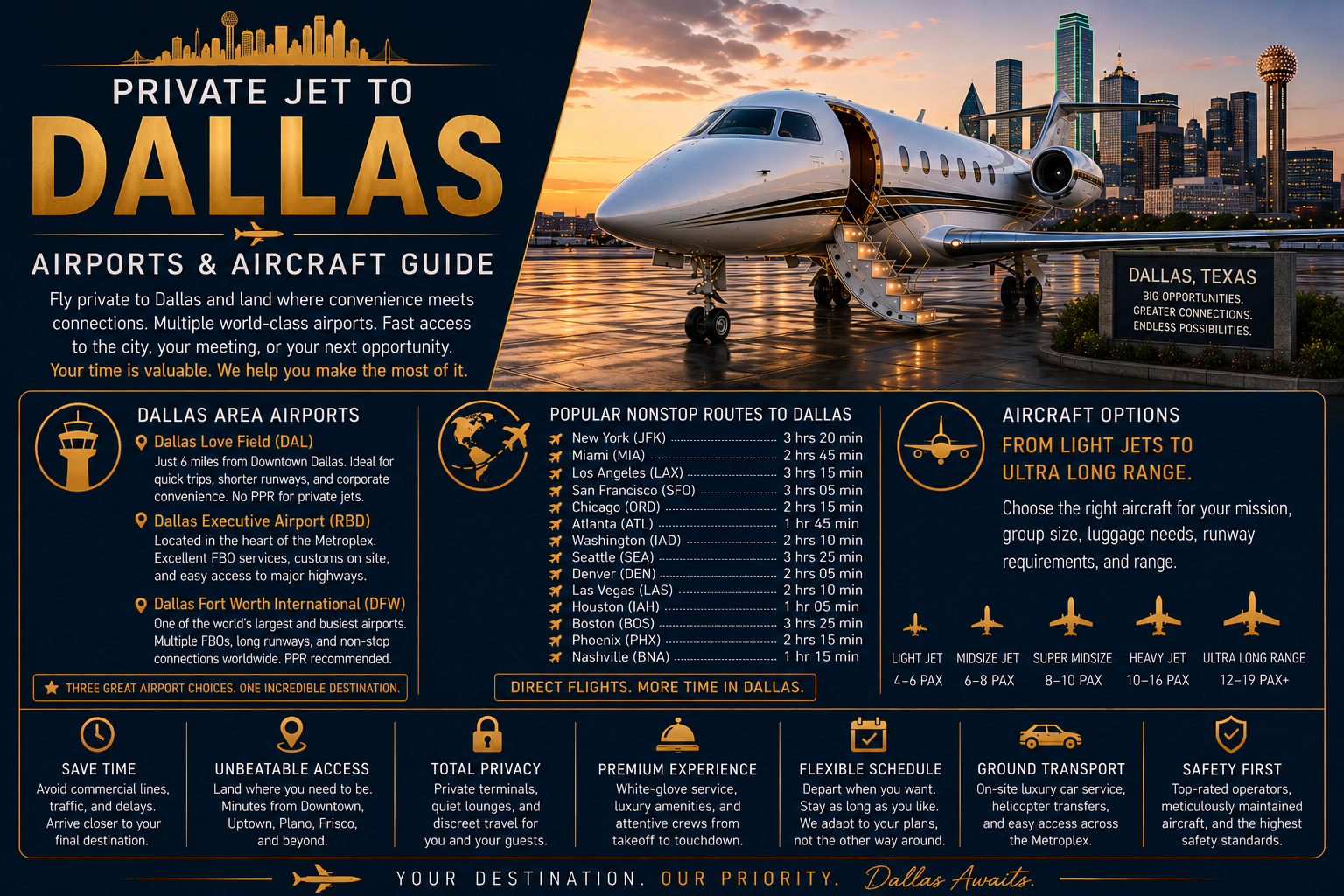
This guide connects Dallas demand with Love Field, Addison, Dallas Executive, DFW, Fort Worth and other regional airports, aircraft selection, popular routes, heat, thunderstorms, business travel, family offices, professional sports, international missions, privacy, baggage, major events and the return journey.
Is Dallas a Major Private Jet Destination?
Direct Answer: Yes. Dallas is one of the largest private aviation markets in the United States because the Dallas–Fort Worth metroplex combines major corporate headquarters, finance, family offices, energy, technology, healthcare, real estate, logistics, professional sports, aviation and concentrated wealth. Love Field, Addison, Dallas Executive, DFW and other regional airports each serve different missions.
Dallas private aviation demand extends across central Dallas, North Dallas, Plano, Frisco, Addison, Irving, Las Colinas, Arlington, Fort Worth, Southlake, Grapevine, McKinney and the broader North Texas region.
Therefore, one Dallas itinerary may involve several realistic airports.
For a meeting in Downtown Dallas, Uptown, Highland Park, University Park or central Dallas, Love Field may provide one of the strongest combinations of airport capability and ground access.
For Addison, North Dallas, Plano, Frisco or the Dallas North Tollway corridor, Addison Airport may reduce total passenger travel time.
For destinations south or southwest of Downtown, Dallas Executive may create a focused general aviation solution.
For international travel, airline connections, large-aircraft missions or destinations closer to Irving, Grapevine and the western side of the metroplex, DFW may become the stronger choice.
Meanwhile, Fort Worth Meacham, Alliance, McKinney, Arlington and other airports may fit when the passenger's itinerary extends beyond Dallas itself.
Consequently, the best airport should be selected around the passenger's exact final destination rather than airport name recognition.
The operator should also evaluate aircraft performance, runway requirements, summer heat, thunderstorms, severe weather, parking, customs, baggage, fuel, crew duty and the return mission.
Dallas should be treated as a multi-airport private aviation market.
Love Field may fit central Dallas, Addison may fit the northern business corridor, Dallas Executive may fit southern Dallas, and DFW or another regional airport may create the strongest solution for a different aircraft, destination or international mission.
Why Do Travelers Fly Privately to Dallas?
Direct Answer: Travelers fly privately to Dallas to control departure times, use regional airports closer to their actual destination, avoid commercial-terminal delays, work during the flight, connect multiple cities, protect privacy, carry specialized equipment, travel with families or pets and reduce time lost crossing the enormous Dallas–Fort Worth metroplex.
Dallas is a market where airport choice can create substantial time savings.
The metroplex stretches across a large geographic area with several major business districts and suburban corporate centers.
Therefore, flying into the airport closest to the passenger's actual meeting, residence or event may be more valuable than simply using the airport closest to Downtown Dallas.
Choose the Right Regional Airport
Travelers can compare Love Field, Addison, Dallas Executive, DFW, Meacham, Alliance, McKinney, Arlington and other North Texas facilities.
Control the Schedule
Passengers can plan around board meetings, investor presentations, games, conferences, property visits, medical appointments and international connections.
Work During the Flight
Executives, investors, advisors and family offices may use the cabin for confidential calls, meetings, document review, dining and preparation.
Connect Multiple Cities
A private aircraft may connect Dallas with Houston, Austin, Midland, New York, Los Angeles, Aspen, Cabo or several markets in one business itinerary.
Carry Specialized Equipment
Golf clubs, technical cases, samples, prototypes, sports equipment, medical devices, pets and extended-stay luggage may influence the aircraft.
Protect Privacy
Private terminals, controlled passenger lists, discreet vehicles, limited itinerary distribution and coordinated security may reduce public exposure.
Nevertheless, private aviation does not eliminate thunderstorms, extreme heat, airport restrictions, traffic, parking limitations, customs, crew duty or passenger delays.
Instead, it provides more options for responding to those conditions.
The airport may change. The departure may move earlier to avoid heat or storms. The aircraft may reposition. Another vehicle route may become stronger. The return flight may depart from another airport closer to the passenger's final meeting.
Therefore, the greatest advantage is the ability to design and adjust the complete itinerary around the passenger's priorities.
What Creates Private Aviation Demand in Dallas?
Direct Answer: Dallas private aviation demand comes from corporate headquarters, private equity, finance, family offices, energy, technology, telecommunications, healthcare, commercial real estate, professional sports, aviation, defense, logistics, manufacturing, construction, major conventions, luxury residences and international business.
Dallas–Fort Worth combines several high-value business and private travel markets within one region.
It serves as a major corporate headquarters market, financial center, logistics hub, professional-sports destination, healthcare market, technology corridor, real-estate center and national transportation hub.
Therefore, private aviation demand remains diverse throughout the year.
Executive and Board Travel
Executives, directors, advisors, attorneys, bankers and corporate teams may travel for strategy, acquisitions, financing, board meetings and investor programs.
Investment and Private Equity
Private equity firms, family offices, banks, lenders, investment managers, advisors and portfolio-company executives create recurring demand.
Oil, Gas and Infrastructure
Executives, investors, engineering teams, operators, advisors and service companies may connect Dallas with Houston, Midland and other energy markets.
Telecommunications and Innovation
Technology, telecommunications, software, data centers, cybersecurity, semiconductors and AI companies support executive travel.
Development and Investment
Developers, investors, lenders, brokers, architects, family offices and construction leaders may travel for projects and transactions.
Athletes, Owners and Sponsors
Games, negotiations, training, medical travel, appearances, championships and corporate hospitality create private aviation demand.
Facilities and Industrial Travel
Executives, engineers, customers, suppliers, investors and technical teams may visit plants, distribution centers and operational facilities.
Principals, Advisors and Private Travel
Family offices may coordinate investments, residences, healthcare, education, events, sports, ranches, leisure travel, staff and security.
Demand may increase further during major sporting events, football weekends, professional playoffs, major concerts, national conventions, corporate conferences, aviation gatherings, energy events, political programs, holidays and large private functions.
Consequently, aircraft, parking, FBO services, vehicles, hotels, crew lodging, catering and preferred departure windows may tighten together.
Dallas private aviation demand is not concentrated in one downtown district.
Corporate offices, residences, sports venues, business campuses and industrial facilities stretch across the entire metroplex, making airport choice one of the most important parts of the mission.
Who Typically Flies Privately to Dallas?
Direct Answer: Dallas private aviation travelers include corporate executives, investors, family offices, energy leaders, technology executives, professional athletes, property owners, healthcare travelers, industrial teams, international visitors and affluent families. Executive assistants, chiefs of staff, travel managers, advisors, security teams and corporate aviation departments often organize the mission.
The person researching a private jet to Dallas may not be the passenger.
An executive assistant, chief of staff, family-office employee, corporate travel manager, aviation department, security specialist, advisor, household manager or event coordinator may organize the itinerary.
Therefore, the mission must satisfy both passenger expectations and operational requirements.
Board and Corporate Travel
Executives may require working cabins, connectivity, privacy, several meetings, multiple airports and same-day or multi-city travel.
Complex Principal Travel
Family offices may coordinate principals, children, advisors, staff, security, pets, residences, ranches, events and onward destinations.
Dallas, Houston and West Texas
Executives, investors, engineers and advisors may connect Dallas with Houston, Midland, Odessa, Tulsa and other energy markets.
Games, Training and Private Travel
Athletes may travel with family, agents, trainers, security, medical personnel, golf clubs and specialized equipment.
Corporate and Investor Travel
Technology leaders may require confidential work, customer meetings, board travel, technical teams and multi-city schedules.
Manufacturing and Logistics
Executives, engineers, suppliers and technical personnel may travel with specialized cases, samples, tools or equipment.
Global Business and Connections
International missions may require customs, permits, handlers, airline transfers, crew planning, secure vehicles and additional documentation.
Children, Pets and Extended Stays
Families may travel with caregivers, pets, strollers, child seats, medication, golf clubs, household items and substantial luggage.
Why Does the Passenger Profile Affect the Airport and Aircraft?
A small executive team may require a larger aircraft because it needs nonstop range, working space, connectivity, substantial luggage and privacy.
Meanwhile, a larger regional group traveling lightly may fit another aircraft category.
Likewise, an athlete may prioritize equipment capacity and security, while a family office may require pets, staff, multiple vehicles and confidential movement.
Therefore, passenger count alone cannot determine the strongest Dallas aircraft or airport.
What Should Travelers Know About Dallas Love Field?
Direct Answer: Dallas Love Field is a centrally located Dallas airport supporting both scheduled airline and general aviation activity. Its location near Downtown Dallas, Uptown, Highland Park, University Park and central business districts makes DAL one of the strongest airport options for many private aviation missions when aircraft, parking, weather and traffic conditions support the trip.
Dallas Love Field, identified as DAL and KDAL, sits within the City of Dallas.
The airport provides practical access to many of the city's most important business, residential, medical, entertainment and hospitality districts.
Therefore, Love Field frequently becomes the first airport evaluated for passengers whose schedule centers on central Dallas.
However, Love Field operates as both a commercial airline airport and a general aviation facility.
Scheduled airline service operates from the airport alongside private, charter, corporate and other aviation activity. :contentReference[oaicite:2]
Consequently, private aircraft operate within an airport environment that includes airline traffic, runway sequencing, passenger-terminal activity and high overall demand.
Central Dallas Access
Love Field may provide practical access to Downtown, Uptown, Highland Park, University Park, Preston Hollow, medical facilities and central Dallas hotels.
Established Business Aviation Activity
Private aircraft, corporate flight departments, charter operators, aircraft owners and general aviation services operate from DAL.
Mixed Airport Environment
Scheduled airline operations share the airport with private aviation and may influence runway demand and airport activity.
Close to Major Dallas Districts
Passengers may reach offices, residences, hotels, medical facilities, restaurants and entertainment districts without crossing the full metroplex.
Broad Mission Support
Many private aircraft categories may operate at Love Field when runway performance, aircraft weight, weather, parking and airport requirements fit.
Road Conditions Still Matter
Central Dallas traffic, construction, events, weather and rush-hour conditions may change the final passenger transfer.
Why Is Love Field Often Preferred for Central Dallas?
Love Field combines airport capability with a location much closer to many central Dallas destinations than DFW.
Therefore, it may reduce ground travel for passengers whose itinerary centers on Downtown, Uptown, Highland Park, University Park, medical facilities or nearby business districts.
Nevertheless, location alone should not determine the airport.
The operator should confirm aircraft suitability, parking, handling, fuel, weather, runway requirements, airport procedures and the departure mission.
Meanwhile, the passenger team should compare the exact destination, traffic, vehicle requirements, baggage, security and return schedule.
When Might Addison Be Better Than Love Field?
Addison may create a stronger complete journey when the passenger's itinerary centers on North Dallas, Addison, Plano, Frisco, Richardson or the Dallas North Tollway corridor.
Therefore, an executive attending several northern corporate meetings may save more ground time through ADS despite Love Field's strong central location.
When Might DFW Be Better Than Love Field?
DFW may provide advantages for international customs, airline connections, selected large aircraft, passenger transfers or destinations in Irving, Las Colinas, Grapevine, Southlake and the western side of the metroplex.
However, the increased commercial-airport complexity should improve the complete itinerary before DFW is selected over a more business-aviation-focused airport.
Love Field is often the strongest central Dallas airport, but the best mission still depends on where the passenger is actually going.
Aircraft capability, parking, commercial traffic, weather, road conditions, baggage, security and the return mission should all support the decision.
Which Private Aviation Services Are Available at Dallas Love Field?
Direct Answer: Dallas Love Field supports an established business aviation environment that may include private passenger facilities, aircraft fueling, ground handling, parking, hangars, maintenance, catering, professional transportation, rental vehicles, crew services, flight planning and concierge support. Availability should be confirmed for the exact aircraft, FBO, date and mission.
Love Field supports both commercial airlines and general aviation, creating a mature airport service environment.
Private aircraft operators may coordinate fuel, passenger handling, baggage, catering, aircraft parking, maintenance, vehicles and crew support through airport aviation businesses.
However, high-demand periods may tighten parking, ramp space, vehicles, catering and preferred arrival or departure windows.
Private Passenger Facilities
FBO environments may support lounges, passenger reception, vehicle access, baggage coordination, conference rooms and concierge services.
Aircraft Fueling
Operators should confirm fuel requirements, uplift timing, aircraft needs, departure plans and peak-demand conditions.
Aircraft Parking
Parking may require advance coordination, hangar arrangements, repositioning, limited stays or another airport during high demand.
Maintenance Support
Aircraft service, inspections, repairs, avionics support, parts and maintenance coordination may be available depending on provider and aircraft type.
Ground Transportation
Professional sedans, SUVs, vans, security vehicles and luggage transportation may support the passenger's complete Dallas itinerary.
Crew Support
Crew planning may include hotels, vehicles, meals, flight planning, weather, rest, maintenance, repositioning and the return mission.
Why Should Parking Be Confirmed Early?
Major sporting events, conferences, holidays, corporate programs and severe-weather disruptions may increase transient aircraft demand.
Therefore, the operator may need to confirm parking early or reposition after passenger drop-off.
The aircraft could potentially reposition to Addison, Dallas Executive, DFW, Fort Worth, McKinney or another airport depending on availability and mission requirements.
Love Field service planning should connect the aircraft with the passenger's complete Dallas schedule.
Parking, fuel, FBO services, vehicles, catering, security, baggage, crew support, weather and the return mission should remain part of one coordinated plan.
When Does Dallas Love Field Fit the Mission Best?
Direct Answer: Dallas Love Field fits best when the passenger's itinerary centers on central Dallas, the aircraft and airport support the mission, parking and handling remain available, weather conditions are suitable and the ground-transfer plan protects the time saved by flying privately.
Love Field creates its greatest value when it supports both the aircraft and the passenger's actual Dallas schedule.
Therefore, DAL should be compared with Addison, Dallas Executive, DFW and other regional airports rather than selected automatically.
The Itinerary Centers on Dallas
Downtown, Uptown, Highland Park, University Park, Preston Hollow and nearby business or residential districts may align well with DAL.
The Exact Mission Is Suitable
The aircraft, weight, fuel, runway requirements, passengers, baggage, temperature, winds, weather and return route must support the mission.
Ramp and Handling Support the Schedule
Parking, fuel, FBO services, maintenance, crew requirements and the desired departure window should remain available.
North Texas Conditions Remain Suitable
Heat, thunderstorms, strong winds, hail, heavy rain, winter ice and severe weather may affect operations.
The Location Protects the Schedule
The driver, route, traffic, luggage, security, meeting time and destination entrance should preserve the airport's central-location advantage.
The Departure Plan Also Works
The outbound passengers, baggage, fuel, temperature, weather, aircraft, crew duty, parking and next destination require another review.
When Might Another Dallas Airport Be Better?
Addison may better serve North Dallas, Plano, Frisco, Addison, Richardson and destinations along the Dallas North Tollway corridor.
Dallas Executive may better serve southern Dallas, industrial areas, selected corporate missions and general aviation operations that benefit from its airport environment.
DFW may support international travel, airline connections, larger aircraft and destinations on the western side of the metroplex.
Fort Worth Meacham may better serve Fort Worth.
McKinney may better serve McKinney, Allen, Frisco and northeastern corporate or residential destinations.
Arlington may better serve Arlington, major stadiums, entertainment districts and nearby business destinations.
The best Dallas itinerary may use a different airport for arrival and departure.
Meetings, passenger destination, aircraft parking, weather, heat, baggage, international requirements, sporting events and the onward route may make one airport ideal inbound and another more practical outbound.
How Do Love Field Operations Affect Private Jet Planning?
Direct Answer: Dallas Love Field combines substantial commercial airline activity with private and corporate aviation. Therefore, operators should account for runway sequencing, traffic volume, parking, FBO coordination, weather, fuel, passenger timing and ground transportation when deciding whether DAL creates the strongest complete itinerary.
Love Field's central location creates significant value for many Dallas passengers.
However, that convenience comes with a more active operating environment than many dedicated general aviation airports.
Scheduled airlines, corporate aircraft, charter flights, privately operated aircraft, training activity and other aviation traffic may all share the airport environment.
Consequently, operators should consider more than the physical distance between Love Field and the passenger's destination.
Runway Sequencing
Commercial and general aviation traffic may influence departure sequencing, arrival timing and taxi operations.
Ramp Availability
High-demand periods may increase pressure on transient parking, hangar space and preferred FBO arrangements.
Passenger Timing
Vehicle arrival, baggage loading, passenger delays and departure readiness should remain coordinated with the aircraft.
Weather
Thunderstorms, wind, heat, heavy rain and winter weather may affect both airport operations and the passenger's ground transfer.
Aircraft Repositioning
An aircraft may occasionally drop passengers at Love Field and reposition elsewhere when parking or operational requirements favor another airport.
Return Planning
The operator should independently review fuel, baggage, temperature, weather, crew duty and airport conditions before the return flight.
Therefore, Love Field should be viewed as part of a complete transportation system rather than simply a runway close to Downtown Dallas.
The strongest mission connects aircraft operations with the passenger's vehicle, destination, meeting schedule, luggage, security and onward travel.
A centrally located airport only saves time when the entire itinerary works.
Aircraft sequencing, parking, FBO coordination, passenger readiness, traffic and the final ground transfer should all protect the convenience gained by using Love Field.
When Should Private Travelers Use Addison Airport?
Direct Answer: Addison Airport can be one of the strongest private aviation choices for passengers traveling to Addison, North Dallas, Plano, Frisco, Richardson and the Dallas North Tollway corridor. Its business-aviation focus and northern location can substantially reduce ground travel when the passenger's itinerary does not center on Downtown Dallas.
Addison Airport, identified as ADS and KADS, sits approximately 9 miles north of central Dallas and serves one of the metroplex's most concentrated corporate and affluent residential corridors.
Unlike Love Field and DFW, Addison does not depend on scheduled airline passenger traffic as its primary aviation role.
Instead, the airport supports general aviation, corporate aircraft, charter operations, aircraft owners, flight departments and aviation businesses.
Therefore, ADS can provide a highly practical environment for private aviation.
Immediate Local Access
Passengers traveling to Addison offices, hotels, restaurants, residences and corporate facilities may significantly reduce ground transportation.
Dallas North Tollway Corridor
ADS may fit passengers traveling north or south along one of the region's most important corporate and residential corridors.
Corporate Campus Access
Plano contains major corporate offices, headquarters, technology operations and executive residential areas that may align well with Addison.
Rapidly Growing Business Market
Frisco's corporate campuses, professional sports facilities, luxury residences and entertainment districts create substantial private aviation demand.
Technology Corridor
Technology, telecommunications and corporate travelers may find Addison practical for Richardson and surrounding business districts.
Private Aviation Environment
The airport's general aviation orientation may create a different passenger and aircraft experience from the region's major commercial airports.
Why Can Addison Beat Love Field for North Dallas?
The answer is ground transportation.
A passenger can save significant time by landing closer to the actual destination instead of flying to the most recognizable Dallas airport.
For example, an executive with meetings in Addison, Plano and Frisco may gain little from Love Field's proximity to Downtown Dallas.
Instead, Addison may place the passenger directly within the northern business corridor.
That advantage becomes even more important during periods of heavy traffic.
However, the operator must still confirm that ADS supports the aircraft, runway requirements, fuel load, weather conditions, passenger load and departure mission.
When Might Addison Not Be the Best Choice?
Another airport may become stronger when the mission requires different runway capability, specialized international handling, airline connections, unusually large aircraft, a destination far west or south of Dallas, or another operational requirement.
Likewise, Love Field may remain better when most passenger activity centers on Uptown, Downtown, Highland Park or central Dallas.
Therefore, airport selection should remain mission-specific.
For North Dallas travelers, Addison deserves to be compared directly with Love Field.
The strongest airport is the one that minimizes the complete door-to-door journey while still satisfying aircraft, runway, weather, parking and operational requirements.
When Does Dallas Executive Airport Fit a Private Jet Mission?
Direct Answer: Dallas Executive Airport can fit private and corporate aviation missions serving southern Dallas, southwest Dallas, industrial areas and passengers who prefer a general aviation airport outside the heavier commercial environments of Love Field or DFW. Its runway infrastructure supports a broad range of business aviation activity, subject to aircraft-specific performance requirements.
Dallas Executive Airport, identified as RBD and KRBD, is owned by the City of Dallas and operates as a general aviation airport.
Its location south of Downtown creates a different geographic advantage from Love Field and Addison.
Therefore, Dallas Executive should be considered when the passenger's meetings, property, facilities or onward transportation lie south or southwest of the central city.
General Aviation Focus
Dallas Executive supports private, corporate, charter, training and other general aviation operations without functioning as a major scheduled passenger hub.
Southern Dallas Access
The airport may reduce ground travel for destinations south of Downtown or along southern transportation corridors.
Corporate Aviation
Business aircraft may use the airport for passenger missions, corporate operations, aircraft services, training and other aviation activity.
Alternative Airport Strategy
RBD may provide another operating option when parking, traffic or mission requirements make another Dallas airport less attractive.
Repositioning
Aircraft serving passengers elsewhere in Dallas may potentially reposition to another regional airport when operationally appropriate.
Mission Planning
Aircraft weight, runway performance, heat, fuel, winds, baggage and the outbound mission should still be evaluated individually.
How Does Dallas Executive Compare With Love Field?
Love Field generally provides stronger geographic access for many central and northern Dallas destinations.
However, Dallas Executive provides a general aviation environment south of Downtown that may align better with another passenger destination or operational requirement.
Therefore, neither airport should automatically be considered superior.
The passenger's destination, aircraft, parking, schedule and ground transportation determine the stronger choice.
Dallas Executive expands the number of workable airport strategies available in Dallas.
That flexibility becomes valuable when passenger location, aircraft parking, operational requirements or the return mission make Love Field or Addison less efficient.
When Should a Private Aircraft Use Dallas Fort Worth International Airport?
Direct Answer: DFW may become the strongest airport when a private aviation mission requires international capabilities, scheduled-airline connections, large-aircraft infrastructure, passenger transfers or access to Irving, Las Colinas, Grapevine and western portions of the metroplex. However, its massive commercial-airline operation can add complexity compared with business-aviation-focused alternatives.
Dallas Fort Worth International Airport is one of the world's largest commercial aviation hubs.
Its extensive runway system, global airline network and international infrastructure create capabilities that smaller regional airports may not match for certain missions.
However, those capabilities do not mean DFW should automatically be selected for private aviation.
Instead, the airport should solve a specific passenger or operational requirement.
Global Mission Support
DFW may fit selected international private aviation missions requiring major-airport infrastructure and coordinated customs procedures.
Private-to-Commercial Transfers
Passengers connecting with scheduled international or domestic airline flights may benefit from using the same airport complex.
Extensive Runway Infrastructure
Long runways and major-airport infrastructure may support missions that require capabilities beyond smaller regional airports.
Western Business Districts
DFW may provide useful access to Irving, Las Colinas, Grapevine and other destinations between Dallas and Fort Worth.
Crew and Passenger Changes
International crews, airline passengers, technical teams and repositioning personnel may benefit from extensive scheduled-airline connectivity.
Commercial Traffic Matters
Taxi time, runway sequencing, handling arrangements and commercial-airport activity should be weighed against DFW's operational capabilities.
Why Would a Passenger Choose DFW Instead of Love Field?
An international passenger may arrive commercially at DFW and transfer directly to a private aircraft for an onward mission.
Likewise, a private passenger may arrive at DFW before connecting to an international airline flight.
A larger aircraft or specialized international mission may also favor DFW's infrastructure.
Additionally, passengers traveling to Las Colinas, Irving, Grapevine or western portions of the metroplex may find the airport geographically practical.
However, passengers traveling directly to Downtown Dallas, Uptown, Highland Park or North Dallas should compare DFW with Love Field and Addison because additional ground travel may offset other advantages.
DFW should solve a mission requirement, not simply win because it is the region's largest airport.
International capability, airline connectivity, aircraft requirements and passenger destination should justify the added complexity of operating within a major global airline hub.
When Does Fort Worth Meacham International Airport Fit?
Direct Answer: Fort Worth Meacham International Airport can be a strong private aviation gateway when the passenger's destination is Fort Worth rather than Dallas. It may serve downtown Fort Worth, corporate offices, cultural districts, residences, medical facilities and other western metroplex destinations while avoiding an unnecessary ground transfer from Dallas.
The Dallas–Fort Worth metroplex contains two major urban centers.
Therefore, treating every private flight as a "Dallas" mission can create unnecessary ground travel.
Passengers whose schedule centers on Fort Worth should evaluate airports on the Fort Worth side of the region.
Meacham International Airport, identified as FTW and KFTW, provides an established general aviation gateway close to Fort Worth.
Downtown Fort Worth
Meacham may reduce ground transportation for meetings, hotels, events and corporate activity centered on Fort Worth.
Business Aviation
The airport supports private, corporate and general aviation activity within the western side of the metroplex.
Cultural District
Passengers traveling to Fort Worth museums, events, hospitality and nearby residences may benefit from a Fort Worth airport strategy.
Corporate Travel
Executives visiting Fort Worth companies, industrial operations or investment interests may avoid crossing the metroplex from Dallas.
Private Residences
Passenger homes, ranch connections and western metroplex destinations may align more naturally with Fort Worth airports.
Airport Comparison
Meacham should be compared with Alliance, DFW and other regional airports according to the exact passenger destination and aircraft.
A passenger spending two days entirely in Fort Worth may gain little by arriving at Love Field simply because the itinerary was described as a trip to Dallas–Fort Worth.
Instead, Meacham may place the passenger significantly closer to the actual destination.
For Fort Worth itineraries, start the airport search in Fort Worth.
The private aviation advantage comes from reducing the complete journey, not from automatically using the best-known airport in the metroplex.
When Should Travelers Consider Fort Worth Alliance Airport?
Direct Answer: Fort Worth Alliance Airport may fit private aviation missions serving North Fort Worth, AllianceTexas, major industrial facilities, logistics operations, corporate campuses and destinations along the northern Fort Worth corridor. It can also become relevant when aircraft capability, passenger location or operational requirements favor its infrastructure.
Alliance serves a different geographic and economic portion of the metroplex from Love Field, Addison or central Fort Worth airports.
The surrounding area contains major logistics, industrial, aviation, distribution and corporate operations.
Therefore, Alliance may create a strong mission for executives, investors, technical teams, aviation companies, industrial personnel and corporate travelers visiting facilities in the area.
North Fort Worth
The airport may reduce ground travel for destinations north of central Fort Worth.
Industrial Travel
Executives, engineers, investors and technical teams may use private aviation to reach industrial and logistics facilities efficiently.
Aviation and Logistics
The surrounding economic corridor creates travel demand connected with aviation, distribution, manufacturing and supply-chain operations.
However, Alliance may be less convenient for passengers whose schedule centers on Downtown Dallas, Highland Park or other eastern metroplex destinations.
Therefore, geographic fit should remain central to the airport decision.
When Does McKinney National Airport Fit a Dallas Private Jet Mission?
Direct Answer: McKinney National Airport may provide a strong private aviation option for passengers traveling to McKinney, Allen, Frisco, Prosper and northeastern portions of the Dallas–Fort Worth metroplex. For these destinations, landing farther north can reduce the ground travel associated with arriving at Love Field, Dallas Executive or DFW.
Population, corporate investment and luxury residential development have expanded substantially across the northern and northeastern metroplex.
Therefore, private aviation demand is no longer concentrated around central Dallas.
McKinney National Airport, identified as TKI and KTKI, can become particularly relevant when the passenger's final destination lies north of Plano or east of the Dallas North Tollway corridor.
Local Business and Residential Access
Corporate offices, private residences, developments and local business activity may align naturally with TKI.
Northeastern Metroplex Access
Passengers visiting Allen and nearby communities may avoid driving north from central Dallas airports.
Northern Growth Corridor
Depending on the exact destination and traffic, McKinney may compete with Addison for northern Dallas-area missions.
Should Travelers Compare McKinney With Addison?
Yes.
For destinations in Frisco, Prosper, Allen and McKinney, both airports may deserve consideration.
The strongest choice depends on the exact street destination, aircraft requirements, runway suitability, parking, traffic and return mission.
When Could Arlington Municipal Airport Support the Mission?
Direct Answer: Arlington Municipal Airport may become relevant for selected private aviation missions serving Arlington and the central portion of the Dallas–Fort Worth metroplex. Its location can be useful for passengers traveling to sports venues, entertainment districts, businesses and nearby destinations, subject to aircraft performance and operational requirements.
Arlington sits between Dallas and Fort Worth and contains some of North Texas's most recognizable sports and entertainment destinations.
Therefore, major games, concerts, corporate hospitality programs and special events may create concentrated private aviation demand in the area.
Arlington Municipal Airport can potentially reduce ground transportation for suitable aircraft and missions.
However, operators should evaluate runway capability, aircraft performance, parking, event restrictions, weather, passenger load and the return flight before selecting the airport.
Major events make airport planning more important, not less.
Parking, aircraft volume, vehicles, road closures, security, departure congestion and passenger timing can all become more difficult when thousands of travelers are moving through the same area.
How Should Travelers Compare Dallas Private Jet Airports?
Direct Answer: Compare Dallas airports using the passenger's exact destination, realistic ground time, aircraft requirements, runway suitability, parking, FBO services, international needs, weather, traffic, security, crew requirements and the return mission. The airport closest to "Dallas" on a map is not necessarily the airport that creates the shortest or strongest complete journey.
| Airport | Often Strong For | Primary Advantage | Important Consideration |
|---|---|---|---|
| Dallas Love Field (DAL) | Downtown, Uptown, Highland Park, University Park and central Dallas | Central location and extensive aviation infrastructure | Commercial traffic, parking and runway sequencing |
| Addison Airport (ADS) | Addison, North Dallas, Plano, Frisco and Richardson | Business aviation access to northern corporate corridors | Aircraft-specific runway and performance requirements |
| Dallas Executive (RBD) | Southern and southwest Dallas | General aviation environment and southern location | Final destination must justify the geographic position |
| DFW International (DFW) | International missions, airline connections, Irving, Las Colinas and Grapevine | Global connectivity and extensive airport infrastructure | Major commercial-airport complexity |
| Fort Worth Meacham (FTW) | Downtown Fort Worth and western metroplex destinations | Convenient Fort Worth access | Less practical for many Dallas-side destinations |
| Fort Worth Alliance (AFW) | North Fort Worth, industrial and logistics destinations | Strong infrastructure and northern Fort Worth access | Location may add ground time for central Dallas |
| McKinney National (TKI) | McKinney, Allen, Frisco, Prosper and northeast metroplex | Reduces travel from central airports to northern destinations | Compare directly with Addison for overlapping markets |
| Arlington Municipal (GKY) | Arlington, sports and entertainment destinations | Strategic mid-metroplex location | Aircraft capability and event demand require review |
Airport comparison becomes even more important when the passenger has several stops.
For example, an itinerary involving a morning meeting in Plano, afternoon meeting in Uptown and evening event in Arlington requires a different airport analysis from a passenger spending the entire trip in Highland Park.
Likewise, the arrival and departure airports do not necessarily need to match.
A passenger could arrive through Addison for North Dallas meetings and depart from Love Field after finishing the trip in central Dallas.
Alternatively, an aircraft may drop passengers at one airport and reposition elsewhere for parking.
Optimize the passenger journey, not airport loyalty.
Dallas has enough viable private aviation airports that planners can build the mission around the actual itinerary rather than forcing every trip through the same facility.
How Should Ground Transportation Be Planned for a Dallas Private Flight?
Direct Answer: Dallas ground transportation should be planned together with the flight. The passenger's exact destination, arrival time, traffic, vehicle size, luggage, security, weather, road construction and event conditions should influence both the airport and vehicle strategy because the Dallas–Fort Worth metroplex covers an enormous geographic area.
A private aircraft can save hours in the air-travel process and then lose much of that advantage if the passenger lands at the wrong side of the metroplex.
Therefore, airport selection and vehicle planning should occur together.
Executive Sedans
May fit individual executives, couples and small parties traveling with limited luggage.
Luxury SUVs
May provide additional passenger space, luggage capacity and flexibility for families, executives and security teams.
Passenger Vans
May fit larger corporate teams, sports groups, families, event parties or passengers traveling with substantial baggage.
Security Vehicles
High-profile passengers may require advance teams, secure routing, additional vehicles or specialized protective transportation.
Luggage Vehicles
Large groups, athletes, families and extended-stay passengers may require separate transportation for baggage or equipment.
Multi-Stop Transportation
Drivers may need to support meetings, hotels, residences, restaurants, events and airport transfers throughout the visit.
The vehicle should also be coordinated with the FBO rather than simply sent to the airport's public passenger terminal.
Driver information, passenger names, aircraft details, arrival updates and FBO instructions should be shared with the appropriate parties.
For high-profile passengers, itinerary distribution should remain limited to personnel who need the information.
How Does Dallas Traffic Affect Private Jet Airport Choice?
Direct Answer: Dallas traffic can materially change which airport provides the fastest complete trip. Rush hour, construction, accidents, sporting events, weather and road closures can affect the Dallas North Tollway, I-35E, I-635, I-30, I-20, SH 121 and other major routes. Airport selection should therefore use realistic travel conditions rather than mileage alone.
The Dallas–Fort Worth metroplex is geographically large, and passenger destinations are widely distributed.
As a result, ground transportation can become one of the largest variables in the complete private aviation journey.
An airport that is technically farther away may sometimes produce a faster transfer because of highway access or current traffic patterns.
Likewise, a seemingly convenient airport may become less attractive during a major accident, construction project, severe storm or stadium event.
Morning Rush
Corporate travelers should compare airport arrival time with morning commuter patterns before finalizing the destination airport.
Evening Rush
Afternoon meetings that end near peak traffic may influence both the departure airport and the planned aircraft departure time.
Sporting Events
Games and concerts can create localized congestion, road restrictions, vehicle staging issues and concentrated airport departures.
Severe Weather
Heavy rain, hail, ice and thunderstorms can slow both aviation operations and highway travel at the same time.
Construction
Long-term road projects may change transfer assumptions even when the airport and destination remain the same.
Multiple Meetings
The strongest airport may depend on where the passenger finishes the day rather than where the first meeting occurs.
Think in door-to-door time.
The strongest Dallas private aviation itinerary minimizes the combined flight, airport and ground journey rather than optimizing each segment independently.
How Does North Texas Weather Affect Private Aviation?
Direct Answer: Dallas private aviation planning should account for summer heat, thunderstorms, severe convective weather, strong winds, heavy rain and occasional winter ice or snow. Weather may affect aircraft performance, runway use, routing, turbulence, ramp operations, passenger transfers, fuel planning, alternates and departure timing.
North Texas weather can change quickly.
Therefore, operators and passenger teams should avoid treating the forecast as a fixed condition several days before the flight.
Instead, weather should remain part of the active mission-planning process.
Extreme Heat
High temperatures may affect aircraft performance, passenger comfort, ramp operations and baggage or fuel planning.
Thunderstorms
Convective weather may create route deviations, turbulence, delays, lightning restrictions and changing airport conditions.
Hail and Strong Winds
Severe storm systems can affect aircraft protection, ramp safety, ground vehicles and airport operations.
Ice and Freezing Rain
Occasional North Texas winter events can affect aircraft deicing, airport surfaces and regional road transportation.
Weather may also influence airport selection.
A storm cell, wind shift or airport restriction affecting one part of the metroplex may leave another regional airport operationally preferable.
Therefore, having multiple suitable airports creates valuable flexibility.
Dallas weather planning should include both the sky and the road.
The same storm affecting aircraft routing may also create flooding, traffic delays, hail, poor visibility or road closures during the passenger's ground transfer.
How Does Summer Heat Affect Private Jet Operations in Dallas?
Direct Answer: High summer temperatures can reduce aircraft performance by decreasing air density. Depending on aircraft type, runway, weight, fuel, passengers, baggage and weather, an operator may need to adjust fuel, payload, departure time or airport strategy. Aircraft-specific calculations should always determine the actual operating limits.
Dallas regularly experiences hot summer conditions.
Therefore, aircraft performance should be evaluated using the expected temperature at the actual departure time rather than a generic aircraft specification.
A brochure may show that an aircraft can fly a particular distance.
However, real-world range depends on aircraft weight, fuel, passengers, luggage, runway, temperature, wind, routing, reserves and other operational requirements.
Departure Time
An earlier departure may sometimes provide cooler conditions than a flight departing during peak afternoon heat.
Fuel
The operator must balance required fuel with aircraft weight, runway performance and the planned destination.
Baggage
Heavy luggage, golf equipment, technical cases or extended-stay baggage can increase total aircraft weight.
Passenger Count
Every passenger contributes to the complete aircraft weight and mission calculation.
Runway
Airport runway characteristics remain part of the aircraft-specific performance calculation.
Aircraft Category
A different aircraft may provide greater payload, runway or range flexibility for a demanding summer mission.
Therefore, travelers should avoid assuming that a flight possible during cool weather will operate identically during a very hot Dallas afternoon.
How Do Thunderstorms Affect Dallas Private Flights?
Direct Answer: Thunderstorms can affect Dallas private flights through route deviations, turbulence, lightning, heavy rain, wind shifts, airport restrictions, ramp closures and delays. Because North Texas has several private aviation airports, operators may have alternate options, but passenger teams should maintain schedule flexibility when significant convective weather is forecast.
Thunderstorms are not simply a passenger-comfort issue.
They can affect the entire aviation system around Dallas.
Aircraft may need to route around convective cells, which can increase flight time and fuel requirements.
Ground crews may temporarily suspend ramp activity when lightning creates unsafe working conditions.
Heavy rain may reduce visibility and slow both aircraft and vehicle movement.
Strong winds may change runway configurations.
Meanwhile, widespread storm systems may affect several airports simultaneously.
Schedule flexibility can be more valuable than forcing the original departure time.
When significant storms are expected, moving the flight earlier, later or to another suitable airport may create a better passenger experience than waiting until the aircraft is already affected.
How Does Severe Weather Affect Dallas Private Aviation?
Direct Answer: Severe North Texas storms can produce large hail, damaging winds, heavy rain, frequent lightning and tornadoes. These conditions may affect aircraft routing, ramp safety, hangar demand, parking, passenger transportation and airport operations. Operators may reposition or protect aircraft when severe weather threatens the Dallas area.
Hail creates a particularly important aircraft-protection consideration.
Therefore, operators may monitor severe-weather forecasts and evaluate hangar availability, repositioning or other protective measures when damaging storms are possible.
Passenger teams should also consider ground transportation.
A flight may technically be able to operate while road conditions, flooding, hail or severe-weather warnings make the passenger transfer undesirable.
Consequently, the safest and most efficient plan may require changing the schedule before the weather reaches the airport.
How Does Winter Weather Affect Dallas Private Aviation?
Direct Answer: Dallas does not experience persistent winter conditions like many northern markets, but freezing rain, ice, sleet, snow and very cold temperatures can occasionally create significant aviation and road disruptions. Private aviation planning may require deicing, additional time, alternate airports, schedule changes and careful ground-transportation coordination.
North Texas winter events can become disruptive because ice may affect a large portion of the regional transportation network.
Therefore, passengers should not evaluate airport conditions separately from the roads connecting the airport with Dallas, Fort Worth and surrounding communities.
An aircraft may be ready while the passenger's driver faces unsafe road conditions.
Likewise, deicing demand may increase across several airports simultaneously.
Aircraft Deicing
Frozen contamination must be handled according to aircraft and operator requirements before departure.
Airport Surfaces
Ice or freezing precipitation may affect taxiways, ramps, runways and ground-service operations.
Road Transportation
Bridges, overpasses and highways may become difficult even when the passenger's aircraft is otherwise operational.
Winter planning should protect the complete Dallas journey.
Aircraft readiness, deicing, airport conditions, vehicle safety, crew duty and the passenger's schedule should be reviewed together.
When Is Dallas Private Aviation Demand Highest?
Direct Answer: Dallas private aviation demand can increase around major professional and college sporting events, large concerts, conventions, corporate meetings, aviation and industry events, holidays, school breaks and major private functions. During peak periods, aircraft availability, parking, FBO capacity, vehicles, catering, crew lodging and preferred departure times may tighten simultaneously.
Dallas is a year-round business destination.
Therefore, demand is not limited to one tourism season.
Instead, specific events and business cycles can create concentrated periods of activity.
Dallas Cowboys
Home games, playoff games, major matchups and corporate hospitality may create concentrated aviation and vehicle demand.
Mavericks and Stars
Regular-season games, playoffs, league events and premium hospitality may increase private travel.
Texas Rangers
Major series, playoffs and championship events can increase travel toward Arlington and the central metroplex.
Football and Major Games
College football, bowl games and neutral-site events may create high-volume arrival and departure periods.
Meetings and Conferences
Major corporate programs may increase executive aircraft, vehicle, hotel and meeting-space demand.
Large Business Events
Industry conferences and trade programs can generate private aviation traffic from multiple domestic markets.
Concerts and Major Events
Performers, production teams, sponsors, executives and high-value guests may create concentrated private aviation demand.
Family and Leisure Travel
Holiday periods may increase outbound and inbound family travel while also tightening aircraft and crew availability nationally.
During these periods, travelers should consider aircraft availability and airport parking together.
Securing an aircraft does not guarantee that the preferred airport can support the complete parking plan.
Likewise, securing an airport slot or parking position does not guarantee preferred vehicles, catering or crew accommodations.
Peak-event planning is a system, not a single reservation.
Aircraft, airport, parking, FBO, vehicle, hotel, crew, catering, security and departure timing should be coordinated before demand compresses the available options.
Which Aircraft Work Best for a Private Jet to Dallas?
Direct Answer: Dallas missions may use turboprops, light jets, midsize jets, super-midsize aircraft, large-cabin jets and ultra-long-range aircraft. The right choice depends on route distance, passengers, baggage, equipment, runway requirements, summer heat, thunderstorms, airport choice, cabin needs, fuel, customs, crew requirements and the return mission.
Dallas supports nearly every category of private aviation mission.
However, the best aircraft depends on much more than the number of passengers.
A short regional trip from Houston, Austin, San Antonio, Oklahoma City or Tulsa may fit a turboprop or light jet under suitable conditions.
Meanwhile, longer domestic routes from New York, Los Angeles, San Francisco, Miami or Seattle may require midsize, super-midsize or larger aircraft depending on baggage, winds, passenger requirements and nonstop expectations.
International missions from London, Paris, Dubai, São Paulo or another distant market may require large-cabin or ultra-long-range aircraft with greater fuel, crew, cabin and operating capabilities.
Regional Texas and Nearby Markets
Turboprops may support shorter missions from Texas, Oklahoma, Louisiana, Arkansas and other nearby markets with useful baggage capacity and operating flexibility.
Short Business and Leisure Missions
Light jets may fit smaller executive groups traveling from Austin, Houston, San Antonio, Oklahoma City, Tulsa, New Orleans or other regional markets.
Domestic Executive Travel
Midsize aircraft may provide additional cabin comfort, baggage capacity, connectivity and range for longer domestic missions.
Coast-to-Coast and High-Value Business Travel
Super-midsize aircraft may support transcontinental missions, several executives, substantial baggage, working cabins and selected international routes.
Family Office and Corporate Leadership
Large-cabin aircraft may support several cabin zones, sleeping, dining, staff, security, significant luggage and international operations.
Global Nonstop Missions
Ultra-long-range aircraft may connect Dallas with Europe, the Middle East, South America, Asia and other distant markets under suitable conditions.
What Aircraft Factors Matter Most?
- The origin airport and route distance
- The selected Dallas-area airport
- Passenger, staff, advisor, security and crew count
- Standard luggage and oversized equipment
- Golf clubs, technical cases, sports gear, pets and medical items
- Working, sleeping, dining, connectivity and privacy requirements
- Runway length, summer heat, wind, storms and aircraft weight
- Fuel requirements, reserves and possible technical stops
- Customs, permits, handlers and international procedures
- Parking, repositioning, crew duty and return-flight needs
The return flight should receive an independent review.
Passengers may add golf clubs, business equipment, documents, gifts, another traveler, staff, pets or additional luggage during the stay.
Additionally, a hot afternoon departure may create different aircraft-performance conditions than a cooler morning arrival.
Therefore, the aircraft may require another fuel strategy, departure time or airport for the outbound mission.
The strongest Dallas aircraft fits the route, passenger, airport, weather, baggage, cabin and return mission together.
Installed seats and advertised range alone cannot confirm the best aircraft for the actual trip.
Which Private Jet Routes Connect With Dallas?
Direct Answer: Popular Dallas private jet routes connect the metroplex with Aspen, Cabo, New York, Los Angeles, Miami, Houston, Austin, Midland, Chicago, Las Vegas, Scottsdale, Palm Beach, London, Mexico City and other major business, energy, residential, sports and leisure markets.
Dallas private aviation demand reflects corporate headquarters, energy, finance, family offices, technology, professional sports, luxury real estate, logistics, international business and leisure travel.
Therefore, the strongest routes connect North Texas with major domestic business centers, energy markets, coastal wealth centers, ski destinations, Mexico and global financial markets.
Route |
Mission Profile |
Common Aircraft Category |
Primary Planning Consideration |
|---|---|---|---|
| Dallas to Aspen | Ski, family, luxury residence, corporate retreat and leisure travel | Light jet, midsize jet or super-midsize jet | Mountain airport performance, weather, baggage, skis and return conditions |
| Dallas to Cabo | Resorts, golf, family travel, yachts, second homes and private events | Light jet, midsize jet or super-midsize jet | Customs, passports, pets, baggage, heat and return procedures |
| New York to Dallas | Finance, corporate, family-office, legal, real estate and board travel | Midsize, super-midsize or large-cabin jet | Winds, airport selection, cabin productivity, baggage and return timing |
| Los Angeles to Dallas | Entertainment, corporate, technology, sports and family-office travel | Midsize or super-midsize jet | Range, winds, baggage, cabin needs, traffic and airport choice |
| Miami to Dallas | Finance, private equity, family offices, sports, luxury residences and business travel | Midsize or super-midsize jet | Weather, baggage, nonstop range, passenger schedule and airport strategy |
| Houston to Dallas | Energy, finance, legal, corporate and same-day executive travel | Turboprop, light jet or midsize jet | Airport proximity, schedule, traffic and same-day return timing |
| Midland to Dallas | Energy executives, investors, engineering teams and corporate leadership | Turboprop, light jet or midsize jet | Equipment, schedule, heat, storms and onward business travel |
| London to Dallas | Finance, corporate headquarters, family offices and international business | Large-cabin or ultra-long-range jet | Customs, crew rest, fuel, baggage, airport handling and onward travel |
Why Should Each Route Direction Be Planned Separately?
The inbound and outbound missions may involve different winds, temperatures, fuel requirements, passengers, baggage, airports, weather, customs, crew duty and final destinations.
Therefore, Dallas-to-Aspen and Aspen-to-Dallas should not be treated as identical missions.
Likewise, the passenger may arrive through Love Field and depart from Addison, DFW, McKinney or another airport when the final meeting or onward destination changes.
How Does Private Aviation Connect Dallas and Aspen?
Direct Answer: Private aviation connects Dallas and Aspen for skiing, luxury residences, family travel, corporate retreats, events and seasonal leisure. Aircraft selection depends on mountain-airport performance, passengers, skis, luggage, weather, temperature, runway conditions, alternates and the return mission.
Dallas and Aspen form a high-value private aviation corridor throughout the winter and summer seasons.
North Texas families, executives, investors and property owners may travel between Dallas and Colorado for skiing, private residences, corporate retreats, golf, festivals and other leisure activities.
However, Aspen requires more operational planning than a typical lower-elevation airport.
Performance Matters
Aircraft capability, runway requirements, elevation, temperature, weather and pilot qualifications should be reviewed carefully.
Skis and Heavy Baggage
Ski equipment, boots, winter clothing, family luggage and pet supplies may materially increase baggage requirements.
Alternate Airport Planning
Snow, wind, visibility and mountain weather may require flexible scheduling or another regional airport.
The return flight may involve more baggage than the outbound trip because of shopping, ski equipment, guests or a changed passenger count.
Therefore, the round trip should be evaluated before the aircraft is confirmed.
Dallas–Aspen missions should be built around the mountain airport first.
The aircraft, crew, baggage, skis, weather, alternates, ground transportation and return schedule should support one complete round-trip plan.
How Does Private Aviation Connect Dallas and Cabo?
Direct Answer: Private aviation connects Dallas and Cabo for resorts, private residences, golf, fishing, yachts, weddings, family travel and luxury leisure. The mission requires customs, passenger documentation, pet rules, baggage planning, airport handling, ground transportation, weather and an independently reviewed return flight.
Dallas and Los Cabos share strong private aviation demand because North Texas residents and families frequently travel to Mexico for resort, golf, second-home and private-event itineraries.
Passengers may carry golf clubs, fishing gear, family luggage, pet supplies, event clothing, gifts and extended-stay items.
Therefore, baggage capacity should be reviewed before selecting the aircraft.
Golf Travel
Golf bags, shoes, additional luggage and several passengers may require more baggage capacity than a standard leisure mission.
Family Travel
Children, caregivers, pets, food, strollers, medication and extended-stay luggage may affect aircraft and vehicle requirements.
International Procedures
Passports, customs, handlers, passenger manifests, pets, catering and departure requirements should be coordinated before departure.
Holiday periods, spring-break travel and major events may tighten aircraft and airport availability.
Therefore, travelers should coordinate both directions rather than waiting until the end of the stay to build the return itinerary.
Dallas–Cabo travel should be planned as an international round trip from the beginning.
Aircraft, customs, passengers, baggage, pets, resort transportation, handlers, crew, weather and return requirements should remain connected.
How Does Private Aviation Connect New York and Dallas?
Direct Answer: Private aviation connects New York and Dallas for finance, private equity, corporate headquarters, family offices, law, real estate, technology, sports and major transactions. Midsize, super-midsize and large-cabin aircraft commonly support the route depending on passengers, baggage, winds, airports, cabin requirements and the return mission.
New York and Dallas connect two major U.S. business, finance and private-capital markets.
Travel may involve board meetings, acquisitions, investor programs, private equity, banking, real estate, legal matters, corporate headquarters and family-office activity.
Passengers may depart through Teterboro, Westchester, Morristown, Newark, JFK or another New York-area airport.
Then, the Dallas arrival may use Love Field, Addison, DFW, Dallas Executive or another North Texas airport based on the passenger's actual destination.
Finance and Private Equity
Investment teams, lenders, attorneys, executives and advisors may require private working cabins and tightly controlled schedules.
Corporate Leadership
Boards, executives, advisors and company teams may use the route for headquarters meetings, acquisitions and strategy sessions.
Airport Strategy
Teterboro and Love Field may fit many missions, although the exact passenger destinations may favor another airport in either market.
Eastbound and westbound flight times may differ because of winds.
Therefore, the return schedule should be planned independently.
How Does Private Aviation Connect Los Angeles and Dallas?
Direct Answer: Private aviation connects Los Angeles and Dallas for entertainment, sports, corporate headquarters, technology, finance, family offices, real estate and major events. Midsize and super-midsize aircraft often fit the mission, while larger cabins may support greater passenger counts, baggage, privacy or working requirements.
Los Angeles and Dallas connect major entertainment, sports, technology, finance, real-estate and corporate markets.
Passengers may depart from Van Nuys, Burbank, Hawthorne, LAX, Long Beach or another Southern California airport.
Meanwhile, Love Field, Addison, DFW, Dallas Executive or another North Texas airport may fit the Dallas arrival.
Artists, Executives and Production
Artists, agents, managers, producers, publicists, security teams and production staff may travel between both markets.
Athletes and Major Events
Players, owners, agents, sponsors, families and corporate hospitality groups create recurring demand.
Corporate Headquarters
Executives, investors, boards, technology teams and advisors may use the route for meetings and transactions.
Airport selection may be as important as aircraft selection.
A passenger beginning in Beverly Hills and ending in Frisco requires a different airport strategy from a passenger traveling from Burbank to Downtown Dallas.
How Does Private Aviation Connect Miami and Dallas?
Direct Answer: Private aviation connects Miami and Dallas for finance, private equity, family offices, luxury real estate, professional sports, international business, healthcare and leisure travel. Aircraft selection depends on passengers, luggage, weather, airport choice, nonstop range, cabin needs and the return schedule.
Miami and Dallas share strong private aviation demand through finance, real estate, private capital, family offices, sports, luxury residences and international business.
Passengers may depart through Opa-locka, Miami International, Fort Lauderdale Executive, Palm Beach or another South Florida airport.
The Dallas arrival may then use Love Field, Addison, DFW, Dallas Executive or another regional airport depending on the final destination.
Finance and Family Offices
Investors, principals, advisors, attorneys, bankers and private-equity teams may travel between both wealth centers.
Professional Sports
Athletes, agents, trainers, owners, sponsors, families and event guests may require flexible private aviation schedules.
Weather at Both Ends
Florida thunderstorms, tropical weather and Dallas severe storms may each influence the mission during different seasons.
How Does Private Aviation Support Dallas Business Travel?
Direct Answer: Private aviation supports Dallas business travel by connecting executives, boards, investors, advisors, legal teams and corporate leadership with regional airports near their actual meetings while protecting schedule control, privacy, productivity, same-day return options and multi-city flexibility.
Dallas business travel extends across corporate headquarters, finance, real estate, technology, healthcare, telecommunications, aviation, logistics, manufacturing, energy and professional services.
Therefore, one executive itinerary may include several business districts spread across the metroplex.
Directors and Leadership Teams
Board members, executives, attorneys, bankers and advisors may travel together while reviewing sensitive materials during the flight.
Several Markets in One Day
A private aircraft may connect Dallas with Houston, Austin, Midland, Oklahoma City or another city within one executive schedule.
Match the Airport to the Office
Love Field, Addison, McKinney, DFW, Alliance or another airport may fit depending on where the company actually operates.
Confidential Productivity
Connectivity, conference seating, power, privacy, catering and document review may affect aircraft selection.
Acquisitions and Financing
Mergers, acquisitions, real estate, lending, restructuring and private-equity transactions may require private and flexible travel.
Meetings Can Run Long
Negotiations, traffic, weather, dinners and corporate events may delay departure and affect crew duty.
The strongest Dallas business itinerary should be planned around the executive's full day.
The aircraft, airport, vehicles, meetings, confidential work, traffic and return mission should function as one coordinated business schedule.
How Do Family Offices Use Private Aviation in Dallas?
Direct Answer: Family offices use Dallas private aviation to coordinate principals, families, advisors, staff, security, investments, residences, ranches, healthcare, education, philanthropy, sporting events and international travel. The mission may involve multiple passengers, vehicles, airports, pets, properties, luggage and confidential requirements.
Dallas has become an important family-office and private-capital market.
Therefore, private aviation may support both business and personal movement for the same family.
Principals
Travel may combine investment meetings, residences, healthcare, events, ranches, sporting programs, education and leisure.
Advisors
Attorneys, accountants, trustees, investment professionals, bankers and family-office staff may travel with or separately from the principal.
Household Staff
Assistants, caregivers, household managers, chefs, drivers and security personnel may require coordinated travel.
Ranch and Property Travel
Private aviation may connect Dallas with ranches, second homes, leisure properties and rural destinations throughout Texas and beyond.
Pets and Family Equipment
Pets, strollers, medical supplies, golf clubs, gifts, household items and extended-stay baggage may affect aircraft selection.
Privacy
Passenger names, residences, investments, aircraft details, vehicles, security and onward destinations may require limited distribution.
Family-office travel should function as a recurring logistics system rather than disconnected flights.
Passenger profiles, airports, aircraft preferences, staff, vehicles, security, pets, baggage, residences and return missions should remain connected.
How Do Professional Athletes Use Private Aviation in Dallas?
Direct Answer: Professional athletes use Dallas private aviation for games, training, medical visits, negotiations, sponsorships, appearances, offseason travel and family movement. Missions may require trainers, medical personnel, security, agents, specialized equipment, flexible schedules and airport access near stadiums, residences or training facilities.
Dallas–Fort Worth supports major professional football, basketball, baseball, hockey, soccer, golf, college athletics and major sporting events.
Therefore, private aviation demand may involve athletes, team executives, owners, agents, sponsors, trainers, medical professionals, families and security teams.
Games and Events
Airport selection may depend on the stadium, team facility, hotel, residence and event timing rather than central Dallas.
Medical Travel
Athletes may travel with trainers, physicians, rehabilitation equipment, mobility needs and private medical schedules.
Sports Equipment
Golf clubs, training gear, protective equipment, medical devices and personal luggage may influence baggage capacity.
Security
Vehicle staging, private terminals, alternate entrances and controlled itinerary sharing may reduce unnecessary public exposure.
Family Travel
Partners, children, caregivers, pets, assistants and extended-stay luggage may travel with the athlete.
Schedule Changes
Overtime, press obligations, medical treatment, sponsor events and traffic may affect the departure time.
How Does Private Aviation Support Energy and Industrial Travel From Dallas?
Direct Answer: Private aviation supports Dallas energy and industrial travel by connecting executives, investors, engineers, advisors and technical teams with Houston, Midland, Odessa, Tulsa, Oklahoma City, field locations, manufacturing facilities and corporate headquarters while reducing time lost to commercial schedules and multi-stop ground travel.
Dallas functions as an important financial and executive center for energy, infrastructure, logistics, manufacturing and industrial businesses.
Therefore, executives may need to travel rapidly between corporate offices and operational locations.
Houston and West Texas
Executives, investors, bankers, attorneys and operators may connect Dallas with Houston, Midland, Odessa and other energy markets.
Plants and Facilities
Private aviation may provide access to facilities far from major commercial airports or support multiple locations in one trip.
Specialized Equipment
Engineers and operational teams may travel with tools, instruments, samples, documentation and technical cases requiring careful baggage planning.
Regional business aviation becomes especially valuable when a team needs to visit several sites in one day.
Instead of returning through commercial airline hubs after every meeting, the aircraft can continue directly to the next suitable airport.
For industrial travel, the closest suitable airport to the facility may be more valuable than the closest commercial airport.
Aircraft capability, runway requirements, technical equipment, weather, vehicles and the next destination should shape the mission.
What Should International Travelers Know Before Flying Privately to Dallas?
Direct Answer: International private flights to Dallas require coordination for passports, visas, customs, immigration, permits, handlers, passenger manifests, crew documents, airport capability, fuel, catering, baggage, pets, agricultural restrictions, secure transportation, airline connections, parking and the return mission.
Dallas connects naturally with Europe, Mexico, Canada, South America, the Middle East and other global markets.
However, international private aviation requires additional planning beyond a domestic charter.
The operator must confirm which airport can support the aircraft, customs process, passenger destination, handling, parking, fuel and return mission.
Passports, Visas and Manifests
Passengers and crew should provide accurate documentation within required timeframes before international departure.
Confirm the Arrival Airport
Customs availability, advance notice, hours, staffing, handlers, fees and passenger processing should be verified.
DFW May Fit Selected Missions
Large-aircraft requirements, international infrastructure, airline connections or passenger location may favor DFW.
Private-to-Commercial Transfers
Passengers connecting with scheduled airline service should coordinate baggage, customs, terminals, security and realistic transfer time.
International Rules May Differ
Pet documentation, food, agricultural items, catering, regulated goods and baggage may require additional procedures.
Recheck Every Requirement
Permits, customs, crew duty, fuel, passengers, baggage, destination rules, weather and airport choice may differ outbound.
An international Dallas flight should be planned from the origin airport through the final passenger destination.
Aircraft capability, customs, handlers, documentation, baggage, airport choice, vehicles, security, airline connections and the return mission should remain connected.
How Do Major Dallas Events Affect Private Aviation?
Direct Answer: Major Dallas events can increase aircraft demand, parking pressure, FBO activity, hotel occupancy, vehicle demand, road congestion, security movements and preferred-time competition. Travelers should coordinate the aircraft, airport, parking, vehicles, lodging, event access, weather alternatives and return plan together.
Professional Football
Major games, playoffs, corporate hospitality, owners, sponsors, media and guests may create concentrated private aviation traffic.
Basketball and Hockey
Games, playoffs, league events, sponsors, executives and premium guests may increase aircraft and vehicle demand.
Baseball
Major series, playoffs, championship games and corporate events may increase activity around Arlington and regional airports.
Corporate Conferences
Executives, investors, customers, speakers, advisors and leadership teams may concentrate arrivals around narrow meeting windows.
Concerts and Entertainment
Artists, production teams, managers, publicists, security, equipment and event guests may require complex schedules.
Private Events
Weddings, charity events, galas, corporate hospitality and family gatherings may increase private aviation demand across the metroplex.
What Should Be Reserved Beyond the Aircraft?
- Airport parking and FBO services
- Professional vehicles and adequate luggage capacity
- Passenger and crew hotels
- Security personnel and alternate routes
- Event credentials and private entrances
- Catering and passenger supplies
- Weather and severe-storm contingencies
- Return aircraft, crew and departure arrangements
Major-event travel should be planned backward from the passenger's required arrival time.
The event entrance, security, traffic, vehicle transfer, airport, FBO, aircraft arrival, weather margin and departure time should support one realistic schedule.
What Should Families and Pet Owners Know Before Flying Privately to Dallas?
Direct Answer: Families should provide accurate information about adults, children, infants, caregivers, pets, luggage, strollers, child seats, food, medication, accessibility, vehicles, final destinations and acceptable alternate airports. Pet travelers should also confirm operator policies, aircraft-owner requirements, documentation, behavior, cleaning procedures, carriers, ground transportation and international rules.
Private aviation can simplify family travel by keeping children, caregivers, pets, food, medication and personal belongings within one coordinated journey.
However, the aircraft and ground plan still depend on complete information.
Family Travel Questions
- How many adults, children, infants, caregivers and staff will travel?
- Will any passenger require accessibility or medical support?
- Are strollers, child seats, mobility devices or refrigerated medications included?
- How many pets will travel inside the cabin?
- What are the pet sizes, breeds, weights and carrier requirements?
- How many standard and oversized bags are included?
- Which Dallas-area airport best serves the residence, hotel, school, event or appointment?
- Can the vehicles carry the complete group and baggage?
- Which alternate airports are acceptable?
- Will the return include shopping, gifts, golf equipment or additional luggage?
Keep Essential Items Accessible
Families should keep identification, medication, food, diapers, child supplies, pet essentials, chargers, documents and important personal items accessible.
Thunderstorms, severe weather, traffic, airport changes or an overnight disruption may separate passengers from baggage transported in another vehicle.
Additionally, the return flight may include more luggage or different passenger needs than the arrival.
Can Pets Travel Inside the Cabin?
Many private aviation arrangements allow pets to remain inside the passenger cabin.
However, the final approval depends on the operator, aircraft owner, aircraft type, pet size, behavior, documentation, cleaning requirements, route and destination.
Therefore, every pet should be disclosed before the aircraft is confirmed.
Family travel should be planned around the complete household movement—not only the seated passenger count.
Children, caregivers, pets, strollers, medical supplies, food, baggage, vehicles, residences, airport changes and the return flight can all affect the mission.
How Do Luggage and Business Equipment Affect Aircraft Choice?
Direct Answer: Golf clubs, technical cases, samples, tools, sports equipment, pet carriers, strollers, artwork, medical devices, gifts and extended-stay luggage can significantly affect aircraft and vehicle selection. Travelers should provide quantities, dimensions, photographs and approximate weights before confirming the aircraft.
Private aircraft baggage compartments vary substantially in size, shape, door dimensions, temperature, accessibility and maximum weight.
Therefore, an item may be light enough for the aircraft while still being too large to fit through the baggage door.
Clubs and Leisure Equipment
Golf bags, shoes, luggage and several passengers may require more baggage capacity than a standard business trip.
Industrial and Engineering Cases
Tools, prototypes, electronics, samples, instruments and hard cases may require exact baggage-door measurements and secure handling.
Training and Medical Equipment
Athletes may travel with training gear, protective equipment, medical devices, golf clubs and oversized luggage.
Strollers and Child Equipment
Strollers, child seats, food, toys, pet supplies, medication and family luggage may exceed expected capacity.
Documents and Presentation Materials
Confidential files, display systems, prototypes, samples and electronics may require controlled loading and access.
Artwork and Sensitive Items
Artwork, jewelry, documents, electronics, gifts and valuables may require specialized packing, insurance, security or handling.
Why Must Ground Transportation Match the Aircraft Load?
The same passengers and baggage must continue from the airport to the residence, hotel, office, stadium, hospital, ranch, event or industrial facility.
Therefore, several SUVs, a passenger van, luggage vehicle, security vehicle or specialized transport may be required.
Likewise, technical cases or sports equipment may require a separate vehicle.
Photographs and dimensions can prevent a last-minute aircraft or vehicle change.
Oversized or unusual baggage should be reviewed against compartment dimensions, baggage-door size, aircraft weight, passenger load, vehicles, security needs and the return mission.
How Can Private Aviation Support Privacy and Security in Dallas?
Direct Answer: Private aviation can support Dallas privacy through controlled passenger lists, executive terminals, limited itinerary distribution, discreet vehicles, coordinated security, private entrances, alternate routes, direct communication, baggage control and reduced public exposure. However, regulated flight, identification, airport, customs and lawful security requirements still apply.
Dallas attracts executives, investors, family offices, athletes, public figures, legal teams, corporate leaders and passengers involved in sensitive business or personal matters.
Therefore, privacy and security may influence every stage of the mission.
Limit Itinerary Distribution
Passenger names, aircraft details, airports, times, residences, hotels, meetings, vehicles and onward destinations should remain limited.
Confirm Driver Identity
Vehicle company, driver name, contact information, license plate, staging location and passenger procedures should be verified.
Prepare the Destination
Offices, residences, stadiums, hospitals, hotels, ranches and event teams may require discreet arrival instructions and private access.
Control Baggage Movement
Documents, prototypes, valuables, equipment, artwork and sensitive materials may require inventory and security procedures.
Use Alternate Routes
Security teams may prepare primary and backup routes based on traffic, severe weather, demonstrations, major events and exposure.
Coordinate Airport Changes
If operations move from Love Field to Addison, DFW, Dallas Executive or another airport, drivers, assistants and security should receive updates immediately.
Private aviation can reduce exposure to large public terminals.
However, it does not eliminate required passenger identification, flight records, customs, airport procedures or lawful security obligations.
Passengers with elevated risk profiles should coordinate with qualified aviation, security, legal and risk-management professionals.
Privacy depends on the complete chain of communication.
The operator, FBO, airport, driver, assistant, security team, hotel, residence, office and return crew should receive only the information each party requires.
How Should Travelers Plan a Private Jet to Dallas?
Direct Answer: Travelers should plan a private jet to Dallas by defining the complete itinerary, final destination, passengers, baggage, aircraft requirements, airport options, customs, heat, thunderstorms, severe weather, parking, ground transportation, privacy, acceptable alternates and return mission before comparing aircraft.
1. Define the Complete Itinerary
Confirm the origin, dates, preferred times, final destination, meetings, events, hotels, residences, sports schedules and return plan.
2. Confirm the Passenger Profile
List adults, children, staff, advisors, caregivers, security, pets, accessibility needs, medical considerations and catering.
3. Document Luggage and Equipment
Provide quantities, photographs, dimensions and weights for golf clubs, technical cases, sports gear, pet carriers, strollers and valuables.
4. Compare Dallas-Area Airports
Review Love Field, Addison, Dallas Executive, DFW, Meacham, Alliance, McKinney, Arlington and other suitable airports.
5. Evaluate the Aircraft
Compare cabin layout, range, baggage, runway requirements, heat, storms, fuel, parking, customs, equipment and return needs.
6. Confirm Airport Services
Coordinate FBO handling, parking, fuel, customs, catering, maintenance, crew support, passenger facilities and peak-period availability.
7. Build the Ground Plan
Arrange vehicles, luggage capacity, security, alternate routes, private entrances, credentials and airport-change procedures.
8. Prepare Weather Alternatives
Monitor heat, thunderstorms, severe weather, strong winds, hail, winter ice, road conditions and alternate airports.
9. Review the Return Flight
Reconfirm passengers, baggage, airport, fuel, temperature, weather, crew duty, customs, parking and onward travel.
10. Centralize Communication
One passenger representative should coordinate the operator, FBO, vehicles, security, hotel, office, event and schedule updates.
Better information creates a more reliable Dallas mission.
Accurate passenger, baggage, airport, aircraft, vehicle, privacy, customs, weather, alternate and return details help prevent avoidable changes.
Frequently Asked Questions About a Private Jet to Dallas
Direct Answer: The best private jet and Dallas-area airport depend on the passenger's exact destination, route, baggage, runway needs, summer heat, thunderstorms, parking, customs, traffic, privacy and return mission. Love Field, Addison, Dallas Executive, DFW and other regional airports may each be the strongest choice for different trips.
Which airport do most private jets use in Dallas?
Dallas Love Field serves many private aviation missions because of its central location and established business aviation infrastructure. However, Addison, Dallas Executive, DFW, Meacham, Alliance, McKinney, Arlington and other airports may better fit selected destinations and aircraft.
What are the airport codes for Dallas Love Field?
Dallas Love Field uses the IATA code DAL and the ICAO code KDAL.
What are the airport codes for Addison Airport?
Addison Airport uses the IATA code ADS and the ICAO code KADS.
Which airport is best for Downtown Dallas?
Dallas Love Field often provides one of the strongest combinations of aircraft capability and ground access for Downtown Dallas and Uptown. However, the exact address, traffic and aircraft requirements should still be reviewed.
Which airport is best for Plano or Frisco?
Addison Airport may provide practical access to Plano, Frisco and North Dallas. McKinney National Airport may also fit selected northern or northeastern destinations.
Which airport is best for Fort Worth?
Fort Worth Meacham International Airport may provide practical access to Downtown Fort Worth and western metroplex destinations, while Alliance or DFW may fit other missions.
Can private jets use DFW Airport?
Yes. DFW may support private aircraft, international missions, airline connections, larger aircraft, crew changes and passenger transfers when the mission justifies operating within a major commercial airport.
Why would a private jet use Addison instead of Love Field?
Addison may significantly reduce ground travel when the passenger's itinerary centers on North Dallas, Plano, Frisco, Richardson, Addison or the Dallas North Tollway corridor.
How does Dallas summer heat affect private jets?
High temperatures may affect runway-performance calculations, aircraft weight, payload, fuel, nonstop range and departure timing. The operator should calculate the exact mission using current conditions.
How do thunderstorms affect Dallas private flights?
Thunderstorms may create reroutes, turbulence, heavy rain, lightning restrictions, ramp delays, changing runway use and air-traffic congestion.
How does hail affect private aircraft?
Severe hail can damage aircraft. Operators may monitor severe-weather forecasts, seek hangar protection, reposition aircraft or adjust schedules when damaging storms threaten the Dallas area.
Does Dallas get winter weather that affects private flights?
Yes. Although less frequent than in northern cities, freezing rain, ice, sleet, snow and very cold temperatures may occasionally affect aircraft deicing, runways, ramps and road travel.
Does Dallas traffic affect airport choice?
Yes. The metroplex covers a large area, while traffic, construction, accidents, events and weather can substantially change the ground-time advantage between airports.
Can pets travel inside the cabin?
Many private aviation arrangements allow cabin pets. Operator policies, aircraft-owner approval, documentation, behavior, cleaning requirements, international rules and vehicle needs should be confirmed before departure.
Can passengers bring golf clubs on a private jet?
Many private aircraft can carry golf clubs. However, travelers should provide the number of golf bags, standard luggage count, dimensions and passenger profile before aircraft selection.
Can the aircraft arrive at one Dallas airport and depart from another?
Yes. Passenger meetings, traffic, parking, weather, aircraft positioning, baggage, international requirements and the outbound route may make different arrival and departure airports practical.
When is Dallas private aviation demand highest?
Demand may increase around major professional and college sports, championship events, concerts, corporate conferences, conventions, aviation events, holidays and large private functions.
Which aircraft are best for Dallas?
Turboprops, light jets, midsize jets, super-midsize aircraft, large-cabin jets and ultra-long-range aircraft may all fit. The route, passengers, baggage, airport, heat, storms, cabin needs, customs and return mission determine the recommendation.
Does flying privately always save time in Dallas?
Private aviation can reduce terminal time and provide better airport choice. However, using the wrong airport, poor traffic planning, weather, baggage delays or inefficient ground transportation may reduce the advantage.
Build the Private Aviation Authority System
Turn Dallas Private Aviation Demand Into a Compounding Digital Asset
IMR builds private aviation authority systems that connect destinations, airports, aircraft, routes, buyer questions, SEO, GEO, Google Ads, conversion paths, CRM tracking and AI search visibility into one owned Digital Real Estate platform.