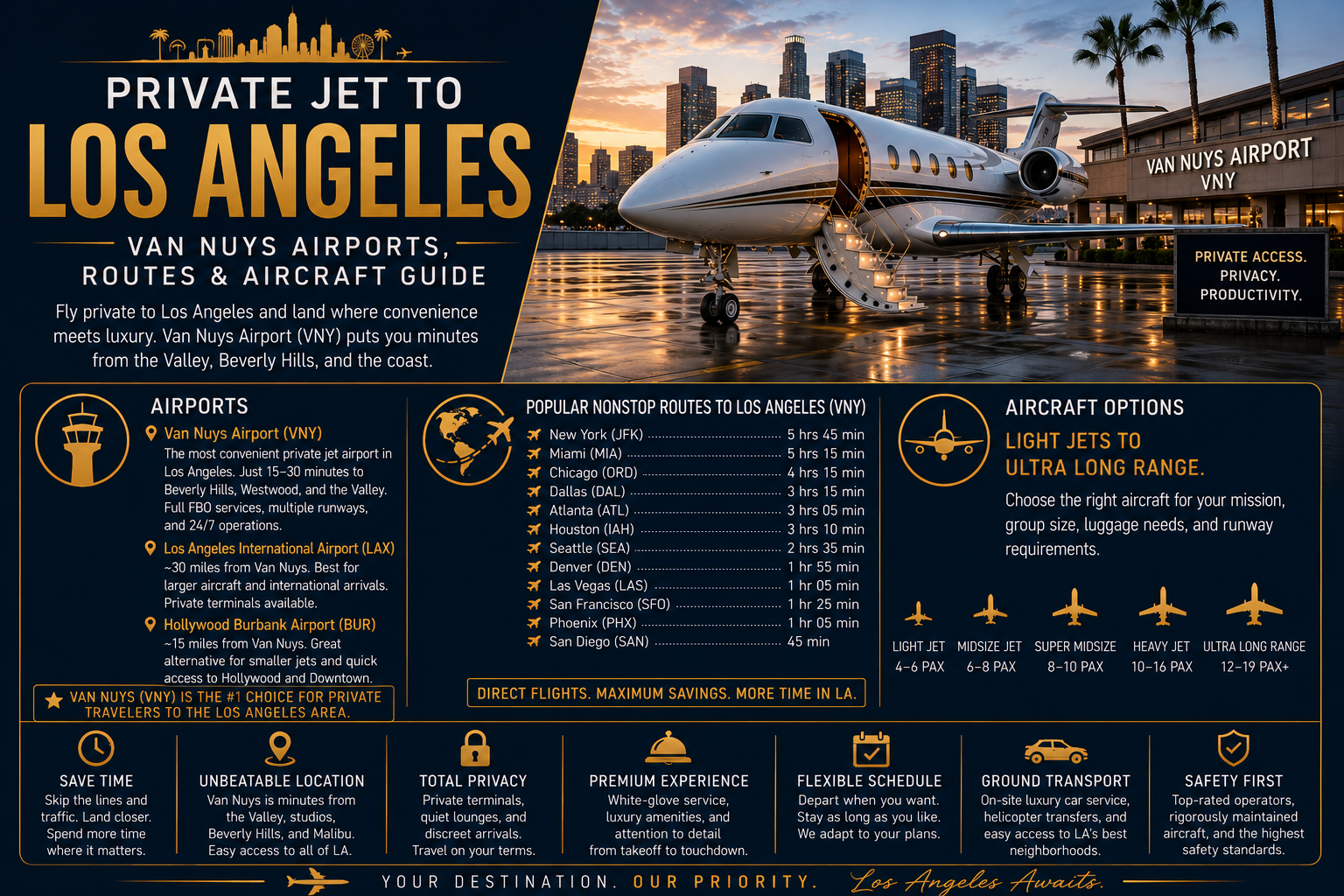
Los Angeles Private Aviation Destination Guide
Private Jet to Los Angeles: Van Nuys Airports, Routes and Aircraft Guide
Flying by private jet to Los Angeles requires more than choosing an aircraft and departure time. The strongest itinerary connects the passenger’s final destination, airport strategy, aircraft capability, baggage, privacy, weather, traffic, wildfire or smoke conditions, ground transportation, parking, crew needs, and return mission before the aircraft leaves its origin.
Los Angeles is one of the world’s largest and most diverse private aviation markets.
The region attracts entertainment executives, artists, producers, professional athletes, technology leaders, investors, family offices, luxury-property owners, corporate travelers, fashion professionals, international visitors, healthcare travelers, event guests, and affluent families throughout the year.
However, “private jet to Los Angeles” does not describe one airport or one passenger journey.
Instead, the Los Angeles metropolitan area includes several private aviation gateways serving the San Fernando Valley, Beverly Hills, West Hollywood, Hollywood, Downtown Los Angeles, Malibu, Santa Monica, Century City, Culver City, the South Bay, Long Beach, Orange County, Pasadena, and surrounding communities.
Most private aviation travelers visiting Beverly Hills, West Hollywood, Bel Air, Brentwood, Calabasas, Encino, Sherman Oaks, Studio City, Malibu, or entertainment destinations begin by evaluating Van Nuys Airport.
Van Nuys Airport, identified as VNY and KVNY, is dedicated to noncommercial aviation and ranks among the world’s busiest general aviation airports.
The airport has two parallel runways, including an approximately 8,000-foot primary runway equipped for instrument operations and a shorter runway used for selected operations and training.
Therefore, Van Nuys supports a broad range of turboprop, light-jet, midsize, super-midsize, large-cabin, corporate, charter, owner-operated, and selected long-range missions.
Additionally, the airport offers an extensive private aviation environment with multiple FBOs, aircraft parking, hangars, fueling, maintenance, catering, crew support, passenger facilities, concierge services, and executive ground transportation.
Nevertheless, Van Nuys is not automatically the strongest airport for every Los Angeles trip.
A passenger visiting Downtown Los Angeles, Pasadena, Burbank, Glendale, a studio in Hollywood, or a production facility in the eastern San Fernando Valley may benefit from Hollywood Burbank Airport.
Meanwhile, Hawthorne Municipal Airport may create a practical path toward the South Bay, Inglewood, SoFi Stadium, Playa Vista, selected Westside destinations, corporate campuses, and entertainment or sports venues.
Long Beach Airport may better support Long Beach, coastal communities, ports, yacht facilities, southern Los Angeles County, and selected Orange County destinations.
Los Angeles International Airport may become relevant when passengers require commercial-airline connections, international operations, customs, large-aircraft capability, crew changes, or direct access to nearby Westside and coastal destinations.
Santa Monica Airport may appear attractive for Santa Monica, Brentwood, Pacific Palisades, Venice, and nearby Westside destinations.
However, its shorter runway, airport procedures, aircraft limitations, local requirements, noise considerations, and scheduled closure plans require mission-specific review.
John Wayne Airport, Ontario International Airport, San Bernardino International Airport, Camarillo Airport, Oxnard Airport, and other Southern California facilities may also support selected Los Angeles-area missions.
Therefore, airport selection should begin with the passenger’s actual destination rather than the words “Los Angeles.”
A meeting at a studio in Burbank creates a different ground strategy than a residence in Malibu, a hotel in Beverly Hills, a technology meeting in Playa Vista, an event at SoFi Stadium, a yacht in Marina del Rey, or a business destination in Orange County.
Traffic creates one of the most important planning variables.
A Los Angeles airport may appear close to the final destination while the actual drive changes dramatically because of rush-hour congestion, freeway incidents, construction, major events, weather, road closures, demonstrations, wildfires, security movements, or coastal traffic.
Consequently, the aviation team should compare realistic transfer windows instead of promising one fixed driving time.
For example, Van Nuys may provide the strongest airport environment for many Beverly Hills or Westside missions.
However, a well-timed arrival at Hawthorne, Burbank, Santa Monica when suitable, LAX, or Long Beach may create a shorter complete journey for another passenger.
Therefore, the aircraft operation and passenger transfer should be evaluated together.
Aircraft selection also changes significantly by departure market.
A regional mission from Las Vegas, San Francisco, San Jose, Scottsdale, Phoenix, Palm Springs, Santa Barbara, Monterey, or Sacramento may fit a turboprop, light jet, or midsize aircraft under suitable conditions.
Meanwhile, a nonstop trip from New York, Miami, Palm Beach, Chicago, Dallas, Houston, Nashville, Cabo, Honolulu, London, Paris, Tokyo, Dubai, Sydney, or another distant market may require greater range, fuel, cabin space, baggage capacity, crew support, and operating flexibility.
Passenger needs can change the recommendation further.
Entertainment travelers may carry wardrobe cases, instruments, cameras, production equipment, assistants, publicists, security personnel, stylists, or specialized baggage.
Professional athletes may travel with family members, trainers, medical personnel, security, golf clubs, training equipment, and substantial luggage.
Executives may require confidential working cabins, connectivity, conference seating, catering, privacy, several same-day meetings, and an efficient return schedule.
Families may carry children, caregivers, pets, strollers, child seats, food, medication, shopping, and extended-stay luggage.
International travelers may require customs coordination, passports, visas, permits, handlers, crew planning, catering rules, baggage processing, onward airline connections, and secure transportation.
Therefore, installed seats and advertised aircraft range cannot identify the correct aircraft by themselves.
The operator should evaluate passengers, baggage, route, winds, fuel, weather, runway requirements, airport procedures, parking, crew duty, customs, alternates, and the return mission.
Los Angeles weather often appears favorable. However, the region still presents meaningful operational considerations.
Coastal fog and low marine layers may affect airports near the Pacific Ocean.
Strong Santa Ana winds may influence aircraft performance, runway use, turbulence, passenger comfort, helicopter operations, wildfire conditions, and ground transportation.
Summer heat may affect aircraft performance, especially on heavily loaded or longer-range departures.
Wildfires and regional smoke may affect visibility, routing, air quality, road access, property travel, and passenger plans.
Winter rain may produce low ceilings, flooding, roadway incidents, mudslides, reduced visibility, and slower ground transfers.
Therefore, Southern California’s generally favorable climate does not remove the need for weather and alternate-airport planning.
Peak demand creates additional pressure.
Awards season, film premieres, major concerts, professional sports, championship events, entertainment productions, fashion programs, technology conferences, private events, holiday travel, summer coastal travel, art programs, political events, and major corporate gatherings may compress demand into similar arrival and departure windows.
As a result, aircraft availability, airport parking, FBO capacity, fueling, catering, professional vehicles, security teams, crew lodging, hotel inventory, and preferred departure times may tighten simultaneously.
Wildfire or severe-weather events can increase pressure further by changing airport use, road access, passenger destinations, aircraft parking, and regional transportation patterns.
The return mission deserves an independent review as well.
Passengers may add wardrobe, shopping, production equipment, documents, another traveler, staff, pets, gifts, golf clubs, or a different onward destination during the stay.
Additionally, the return flight may encounter different winds, fuel needs, temperatures, weather, crew duty, parking, and airport procedures than the inbound mission.
Consequently, a suitable Los Angeles arrival plan does not automatically confirm a suitable departure plan.
Travelers can review official airport information through the Van Nuys Airport website, the Hollywood Burbank Airport website, the Long Beach Airport website, and the Los Angeles International Airport website.
This guide connects Los Angeles destination demand with Van Nuys, Hollywood Burbank, Hawthorne, Santa Monica, Long Beach, LAX, regional alternatives, aircraft selection, popular routes, traffic, weather, wildfire planning, entertainment travel, sports, family offices, business aviation, privacy, baggage, events, and the return journey.
Direct Los Angeles Travel Answer
Is Los Angeles a Major Private Jet Destination?
Direct Answer: Yes. Los Angeles is one of the world’s largest private aviation destinations because it combines entertainment, media, technology, sports, family offices, corporate headquarters, luxury residences, international business, healthcare, fashion, major events, and concentrated wealth. Van Nuys usually serves many private missions, although Burbank, Hawthorne, Long Beach, LAX, Santa Monica, and other airports may better fit selected trips.
Los Angeles private aviation demand extends across the San Fernando Valley, Beverly Hills, West Hollywood, Hollywood, Downtown Los Angeles, Santa Monica, Malibu, Century City, Culver City, Pasadena, the South Bay, Long Beach, Orange County, and surrounding Southern California communities.
Therefore, one Los Angeles itinerary may involve several possible airports and several very different passenger journeys.
For a residence in Beverly Hills, Bel Air, Brentwood, Encino, Sherman Oaks, Calabasas, or the western San Fernando Valley, Van Nuys may provide the strongest private aviation environment.
For a studio, office, venue, or residence in Burbank, Glendale, Pasadena, Hollywood, or the eastern San Fernando Valley, Hollywood Burbank Airport may reduce ground time.
For SoFi Stadium, Inglewood, Playa Vista, El Segundo, Manhattan Beach, selected Westside locations, or the South Bay, Hawthorne may create a more direct journey.
For Long Beach, coastal southern Los Angeles County, ports, yacht facilities, and selected Orange County destinations, Long Beach Airport may provide the stronger complete itinerary.
Meanwhile, international airline connections, customs, large-aircraft needs, passenger location, or operating requirements may make LAX relevant.
Consequently, the best Los Angeles airport is not always the airport with the most private jets or the shortest road distance.
The recommendation should compare aircraft suitability and passenger ground travel together.
Additionally, the operator must evaluate weather, winds, temperatures, runway requirements, airport procedures, parking, fuel, baggage, customs, crew duty, alternates, wildfire conditions, and the return mission.
Los Angeles provides substantial airport choice. However, that choice creates complexity.
Therefore, travelers benefit most when the aircraft, airport, FBO, passenger representative, vehicle, security team, production staff, hotel, residence, studio, venue, event, and return departure operate as one coordinated itinerary.
The best Los Angeles airport is the one that protects both the aircraft operation and the passenger’s complete door-to-door journey.
Van Nuys may provide the strongest general private aviation gateway, while Burbank, Hawthorne, Santa Monica, Long Beach, LAX, John Wayne, Ontario, Camarillo, or another Southern California airport may create a better result for a different destination or mission.
Schedule Control and Regional Airport Choice
Why Do Travelers Fly Privately to Los Angeles?
Direct Answer: Travelers fly privately to Los Angeles to control departure times, access executive airports closer to their destination, avoid commercial-terminal delays, work during the flight, carry production or sports equipment, travel with families and pets, protect privacy, manage changing schedules, and reduce time lost inside a large, traffic-heavy metropolitan region.
Los Angeles is a destination where airport choice and ground planning can create as much value as the aircraft itself.
A private aircraft can depart from an executive airport closer to the passenger’s home, office, event, studio, resort, or connecting destination.
Then, after landing, the traveler can select the Los Angeles-area airport that best supports the final destination.
Choose the Right Regional Airport
Travelers can compare Van Nuys, Burbank, Hawthorne, Santa Monica, Long Beach, LAX, John Wayne, Ontario, and other airports.
Control the Schedule
Passengers can plan around productions, meetings, games, appearances, events, medical appointments, family needs, and international connections.
Carry Specialized Equipment
Wardrobe, instruments, cameras, production cases, golf clubs, sports equipment, pets, artwork, documents, and extended-stay luggage may be accommodated.
Work During the Flight
Executives, producers, artists, advisors, and family offices may use private cabins for calls, meetings, preparation, dining, rest, and confidential work.
Protect Privacy
Private terminals, controlled passenger lists, discreet vehicles, limited itinerary distribution, and coordinated security may reduce public exposure.
Respond to Schedule Changes
Productions, meetings, sporting events, traffic, weather, and appearances may change, requiring a flexible aircraft and airport plan.
Nevertheless, private aviation does not eliminate traffic, weather, wildfire risk, smoke, airport procedures, parking constraints, customs, airspace congestion, crew duty, or passenger delays.
Instead, it provides more options for responding to those conditions.
The departure may move earlier. The aircraft may use another airport. A vehicle route may change. A helicopter may become relevant. The aircraft may reposition. The return flight may use a different airport.
Therefore, the primary advantage is not simply luxury. It is the ability to build and adjust the complete itinerary around the passenger’s priorities.
One of the World’s Largest Private Aviation Markets
What Creates Private Aviation Demand in Los Angeles?
Direct Answer: Los Angeles private aviation demand comes from entertainment, film, television, music, streaming, professional sports, technology, family offices, luxury real estate, finance, fashion, healthcare, international business, production travel, major events, awards season, coastal residences, and frequent movement between Los Angeles and global wealth centers.
Los Angeles combines several high-value travel markets within one metropolitan region.
It functions as a global entertainment center, production market, sports destination, technology hub, luxury residential market, international gateway, healthcare destination, fashion market, and corporate center.
Therefore, private aviation demand remains diverse throughout the year.
Film, Television and Streaming
Actors, producers, directors, executives, production teams, publicists, agents, managers, security, wardrobe, and equipment create complex travel demand.
Artists, Tours and Performances
Performers, executives, managers, musicians, crew, instruments, wardrobe, production cases, and changing schedules may shape the mission.
Athletes, Owners and Teams
Games, negotiations, training, medical visits, sponsorships, appearances, family travel, and offseason activity create demand.
Founders, Investors and Executives
Technology, aerospace, media, gaming, digital platforms, venture capital, private equity, and corporate leadership connect Los Angeles with other innovation markets.
Principals, Advisors and Staff
Family-office missions may involve investments, residences, advisors, healthcare, education, entertainment, events, security, and international travel.
Luxury Residences and Development
Buyers, sellers, developers, architects, designers, brokers, attorneys, lenders, and family offices may travel for high-value property matters.
Specialists and Medical Travel
Patients, families, physicians, medical teams, advisors, caregivers, and support staff may require discreet and flexible travel.
International Business and Leisure
Los Angeles connects naturally with New York, London, Paris, Tokyo, Dubai, Sydney, Mexico, Canada, Hawaii, and major Pacific markets.
Demand may increase further during awards season, major premieres, entertainment productions, professional sports, championship games, technology conferences, concerts, fashion programs, political events, international gatherings, holiday travel, and major private events.
Consequently, aircraft, parking, FBO services, vehicles, crew lodging, catering, security, hotels, and preferred time windows may tighten together.
Travelers with specific aircraft, cabin, parking, privacy, production, security, pet, equipment, or narrow timing requirements should begin planning earlier whenever the trip overlaps a major Los Angeles demand period.
Passenger and Decision-Maker Profiles
Who Typically Flies Privately to Los Angeles?
Direct Answer: Los Angeles private aviation travelers include entertainment executives, artists, producers, professional athletes, corporate leaders, technology founders, investors, family offices, public figures, property owners, international visitors, families, healthcare travelers, security teams, and event guests. Assistants, managers, publicists, producers, travel teams, and security professionals often organize the mission.
The person researching a private jet to Los Angeles may not be the passenger.
Instead, an executive assistant, chief of staff, manager, publicist, producer, family-office professional, travel manager, household employee, concierge, agent, security specialist, or advisor may coordinate the trip.
Therefore, the itinerary must satisfy both the passenger’s experience expectations and the operational requirements of the aircraft, airport, production, event, vehicle, and return schedule.
Studio, Network and Production Travel
Executives may require confidential work, several meetings, studio access, changing schedules, secure vehicles, and same-day or multi-city travel.
Privacy and Complex Baggage
Artists may travel with assistants, managers, publicists, security, wardrobe, instruments, personal items, and changing appearance schedules.
Games, Training and Medical Needs
Athletes may require family travel, trainers, medical staff, security, specialized equipment, privacy, and schedule flexibility.
Complex Principal Travel
Family offices may coordinate principals, children, advisors, staff, security, pets, residences, healthcare, events, and onward destinations.
Founders, Investors and Boards
Technology and investment travelers may require working cabins, several meetings, confidential discussions, and connections with other business centers.
Children, Pets and Extended Stays
Families may travel with caregivers, pets, strollers, child seats, food, medication, shopping, and substantial luggage.
Controlled and Discreet Arrivals
Public figures may require limited itinerary sharing, private vehicles, alternate entrances, secure hotels, route planning, and coordinated departures.
Global Business and Leisure
International missions may require customs, permits, handlers, documents, airline connections, secure transportation, and crew planning.
Why Does the Passenger Profile Affect the Airport and Aircraft?
A small entertainment group may require a larger aircraft because wardrobe, instruments, equipment, assistants, security personnel, and luggage exceed the needs suggested by passenger count.
Meanwhile, a larger executive group traveling regionally with limited baggage may fit another aircraft category.
Additionally, a public figure may prioritize controlled ground access, while a family may prioritize cabin space, pets, child needs, and baggage capacity.
Therefore, passenger count alone cannot determine the airport, aircraft, or ground-transfer plan.
Primary Los Angeles Private Aviation Gateway
What Should Travelers Know About Van Nuys Airport?
Direct Answer: Van Nuys Airport is a dedicated noncommercial general aviation airport in the San Fernando Valley. Its two parallel runways, extensive FBO network, private terminals, maintenance, fueling, parking, and access to Beverly Hills, Hollywood, Malibu, Calabasas, and surrounding communities make it the primary airport for many Los Angeles private aviation missions.
Van Nuys Airport, identified as VNY and KVNY, sits in the San Fernando Valley northwest of central Los Angeles.
Its location provides practical access to Encino, Sherman Oaks, Studio City, Calabasas, Hidden Hills, Bel Air, Beverly Hills, Brentwood, West Hollywood, Hollywood, Malibu, and several entertainment and residential destinations.
Therefore, Van Nuys often becomes the first airport evaluated for private aviation travel to Los Angeles.
Unlike LAX, Burbank, Long Beach, or John Wayne, Van Nuys does not center its operation on scheduled commercial passenger service.
Instead, the airport focuses on general aviation, including business aircraft, corporate flight departments, charter operators, private owners, training, maintenance, helicopters, and other aviation activity.
Van Nuys has two parallel runways.
The primary runway measures approximately 8,000 feet and supports instrument operations, while the shorter parallel runway supports selected aircraft and training activity.
Consequently, the airport can serve a broad range of private aircraft under suitable conditions.
However, runway length alone cannot confirm aircraft suitability.
The operator must evaluate the exact aircraft, weight, fuel, passengers, baggage, temperature, wind, weather, runway condition, procedures, alternate airports, and return mission.
Dedicated Noncommercial Aviation
Van Nuys primarily serves business, charter, corporate, private, training, helicopter, maintenance, and other general aviation missions.
Two Parallel Runways
An approximately 8,000-foot primary runway and shorter parallel runway support varied aircraft operations and training activity.
Extensive Private Aviation Services
Operators may coordinate passenger handling, fueling, parking, hangars, catering, maintenance, vehicles, crew support, and concierge services.
San Fernando Valley Access
The airport may serve Encino, Sherman Oaks, Studio City, Calabasas, Hidden Hills, Beverly Hills, Bel Air, Malibu, and surrounding areas.
Heavy Business Aviation Activity
Peak entertainment, event, sports, holiday, and production periods may affect parking, handling, fuel, vehicles, and preferred times.
Traffic Can Change the Advantage
Freeway congestion, incidents, events, construction, weather, wildfires, and destination access may change the final journey.
Why Is Van Nuys Usually Preferred for Private Aviation?
Van Nuys combines a general aviation focus, substantial runway capability, multiple FBOs, experienced business aviation support, private passenger facilities, maintenance resources, and practical access to many affluent and entertainment-focused destinations.
Therefore, it often provides a smoother private aviation experience than a major commercial airport.
However, the airport should not be selected from reputation alone.
A passenger traveling to Burbank, Pasadena, Downtown Los Angeles, the South Bay, Long Beach, Orange County, or a destination near LAX may receive a stronger complete journey through another airport.
Can Every Private Jet Use Van Nuys?
No airport fits every aircraft in every condition.
The operator must evaluate aircraft performance, runway requirements, weight, fuel, temperature, wind, weather, passenger load, baggage, airport procedures, notices, parking, and the departure route.
Additionally, a long-range aircraft departing Los Angeles with substantial fuel may require different planning than the same aircraft arriving after a shorter domestic mission.
Van Nuys is often the strongest Los Angeles private aviation gateway, but it should still be selected through a complete aircraft, destination, traffic, passenger, weather, and return-flight review.
The best plan confirms that the airport supports the aircraft while also protecting the passenger’s ground transfer, privacy, baggage, schedule, security, and final destination.
Passenger, Aircraft and Crew Support
Which Private Aviation Services Are Available at Van Nuys?
Direct Answer: Van Nuys supports an extensive private aviation service environment that may include passenger lounges, aircraft fueling, ground handling, hangars, parking, maintenance, catering, professional transportation, concierge services, crew facilities, rental vehicles, weather and flight planning, helicopter coordination, and secure passenger transfers.
Van Nuys contains one of the country’s most developed business aviation ecosystems.
The airport supports corporate flight departments, charter operators, aircraft owners, brokers, maintenance companies, international travelers, crews, assistants, security professionals, and passenger representatives.
However, service availability should be confirmed for the exact FBO, aircraft, date, arrival time, parking period, and departure mission.
During peak travel periods, the airport may experience concentrated demand for ramp space, fueling, passenger handling, vehicles, catering, maintenance, crew support, and preferred departure times.
Private Passenger Facilities
FBOs may support passenger reception, lounges, conference rooms, luggage handling, vehicle access, concierge assistance, and crew communication.
Aircraft Fueling
Operators should confirm fuel requirements, uplift timing, aircraft needs, pricing, departure planning, and high-demand conditions.
Aircraft Parking and Hangars
Parking may require advance coordination, hangar arrangements, repositioning, drop-and-go planning, or another airport during busy periods.
Maintenance Support
The airport supports a broad maintenance environment that may help with inspections, repairs, avionics, service, parts, and aircraft support.
Executive Transportation
Professional drivers, security vehicles, SUVs, sedans, vans, luggage vehicles, and coordinated pickups may support the final transfer.
Catering and Concierge
Operators may coordinate catering, dietary needs, hotels, vehicles, production requests, passenger supplies, and other preferences.
Why Should Parking and Ground Transportation Be Confirmed Early?
Van Nuys may experience heavy activity during awards season, major entertainment events, professional sports, concerts, holiday periods, productions, political events, and severe-weather disruptions.
Therefore, aircraft parking and passenger transportation should not be treated as last-minute details.
An operator may need to reposition the aircraft after dropping off passengers.
Meanwhile, the crew may require another airport, hotel, vehicle, rest period, or revised return strategy.
Additionally, a passenger arriving during rush hour or a major event may require another route, earlier departure, additional security, several vehicles, or a different airport.
Van Nuys provides extensive private aviation infrastructure, but Los Angeles demand still rewards early coordination.
Parking, fuel, FBO services, vehicles, baggage, production equipment, security, catering, crew support, weather, and the return mission should be confirmed as one connected plan.
Mission-Specific Airport Suitability
When Does Van Nuys Airport Fit the Mission Best?
Direct Answer: Van Nuys fits best when the passenger’s itinerary centers on the San Fernando Valley, Beverly Hills, Bel Air, West Hollywood, Hollywood, Malibu, Calabasas, or nearby destinations; the aircraft and runway support the mission; parking and handling remain available; and the ground-transfer plan protects the time saved by flying privately.
Van Nuys creates its greatest value when it supports both the aircraft operation and the passenger’s final destination.
Therefore, the airport should be evaluated against the complete round trip rather than selected automatically because it is Los Angeles’ best-known private aviation airport.
The Itinerary Fits Van Nuys Geography
San Fernando Valley, Beverly Hills, Bel Air, West Hollywood, Calabasas, Malibu, Hollywood, and nearby destinations may align well.
The Exact Mission Is Suitable
The aircraft, runway requirement, fuel, weight, passengers, baggage, temperature, weather, and return route must support VNY.
Ramp and Handling Support the Schedule
Parking, hangar space, fuel, FBO services, maintenance, crew requirements, and the desired departure time should remain available.
Traffic Does Not Erase the Advantage
The driver, freeway route, security, luggage, destination entrance, event schedule, and realistic traffic window should support the trip.
Regional Conditions Remain Suitable
Heat, wind, fog, smoke, wildfires, rain, visibility, runway conditions, and turbulence may influence the mission.
The Departure Plan Also Works
The outbound passengers, equipment, baggage, fuel, destination, crew duty, weather, parking, and airport plan require another review.
When Might Another Los Angeles Airport Be Better?
Hollywood Burbank may better serve Burbank, Glendale, Pasadena, Hollywood, Downtown Los Angeles, and selected studio destinations.
Hawthorne may better serve SoFi Stadium, Inglewood, El Segundo, Playa Vista, Manhattan Beach, the South Bay, and selected Westside locations.
Long Beach may better serve Long Beach, ports, coastal southern Los Angeles County, yacht facilities, and selected Orange County destinations.
LAX may support commercial-airline connections, international missions, customs, large aircraft, crew changes, and nearby Westside or coastal destinations.
John Wayne may better serve Newport Beach, Irvine, Costa Mesa, Laguna Beach, and Orange County.
Ontario may better serve the Inland Empire, eastern Los Angeles County, logistics facilities, corporate destinations, larger aircraft, or parking needs.
Therefore, the strongest recommendation compares Van Nuys against realistic alternatives instead of treating every other airport as a backup.
The best Los Angeles itinerary may use a different airport for arrival and departure.
Passenger destinations, productions, traffic, aircraft changes, baggage, weather, parking, international requirements, events, and onward travel may make one airport ideal inbound and another airport more practical outbound.
How Do Van Nuys Airport Operations Affect Private Aviation Planning?
Direct Answer: Van Nuys operations influence aircraft selection, runway performance, parking availability, fueling, weather planning, passenger scheduling, and ground transportation. Travelers should evaluate the complete mission—including aircraft weight, temperatures, winds, baggage, parking, traffic, and the return flight—rather than focusing only on departure time.
Although Van Nuys is one of the world’s busiest general aviation airports, every mission remains unique.
The same aircraft may perform differently depending on passenger count, baggage, fuel load, runway conditions, outside temperature, winds, and the length of the planned flight.
Consequently, operational planning should begin long before passengers arrive at the airport.
Aircraft Performance
Passenger count, fuel, runway length, outside temperature, winds, baggage, and destination all influence aircraft performance calculations.
Parking Availability
Peak entertainment seasons, major sporting events, award shows, and holidays may reduce overnight parking availability and increase repositioning requirements.
Ground Handling
Fueling, baggage handling, catering, towing, maintenance, and passenger services should be coordinated before arrival whenever possible.
Weather Planning
Heat, smoke, marine-layer conditions, Santa Ana winds, and regional weather systems may influence operational decisions.
Traffic Coordination
The departure or arrival schedule should account for freeway congestion, major events, and the passenger’s final destination.
Return Mission
The outbound flight should be planned separately because baggage, passengers, weather, fuel, and airport availability may change during the stay.
Why Is Departure Temperature Important?
Southern California often experiences extremely warm summer afternoons.
Higher temperatures reduce air density, which can affect aircraft performance.
Therefore, some operators may prefer an earlier departure or evaluate different fuel strategies depending on the exact aircraft and mission.
The correct solution depends on certified aircraft performance calculations rather than assumptions.
Every Van Nuys departure should be planned around actual operating conditions—not averages.
Passenger count, baggage, weather, runway conditions, winds, fuel, destination, alternates, and departure temperatures should all be evaluated together.
When Should Travelers Use Hollywood Burbank Airport?
Direct Answer: Hollywood Burbank Airport may provide a stronger itinerary when the passenger’s destination centers on Burbank, Glendale, Pasadena, Universal City, Hollywood studios, Downtown Los Angeles, or the eastern San Fernando Valley. Airport selection should be based on the complete trip rather than airport popularity.
Hollywood Burbank Airport serves both commercial airlines and general aviation.
Its location places travelers closer to several entertainment and production facilities than Van Nuys.
Therefore, selected entertainment, television, media, and corporate travelers may reduce total ground travel by using Burbank.
Destinations That May Favor Burbank
- Burbank studios
- Warner Bros.
- Universal City
- Glendale
- Pasadena
- Downtown Los Angeles
- Hollywood production facilities
- Eastern San Fernando Valley
- Television networks
- Media campuses
Operational Considerations
- Commercial airline activity
- Private aviation facilities
- Passenger destination
- Aircraft compatibility
- Ground transportation
- Traffic conditions
- Parking availability
- Weather
- Return itinerary
- Airport operating procedures
Although Van Nuys remains the preferred airport for many Los Angeles private aviation missions, Burbank should always remain part of the airport comparison process.
Choosing the airport closest to the passenger—not simply the aircraft—often creates the strongest overall experience.
Sometimes the fastest flight is not the fastest trip.
The strongest itinerary minimizes the complete door-to-door travel time by balancing airport location, traffic, aircraft operations, and the passenger’s actual destination.
When Does Hawthorne Municipal Airport Fit a Los Angeles Mission?
Direct Answer: Hawthorne Municipal Airport may provide an efficient option for travelers visiting the South Bay, Inglewood, El Segundo, Playa Vista, Manhattan Beach, aerospace facilities, SoFi Stadium, and selected Westside destinations. The airport should be evaluated against the passenger’s final destination and traffic conditions.
Hawthorne occupies a unique position within the Los Angeles private aviation system.
Rather than serving the San Fernando Valley, the airport supports travelers heading toward coastal business districts, professional sports venues, aerospace companies, and South Bay communities.
SoFi Stadium
Professional football games, concerts, championship events, and entertainment programs frequently generate private aviation demand.
Playa Vista and Aerospace
Technology companies, aerospace firms, research facilities, and innovation centers support significant executive travel.
South Bay Communities
Manhattan Beach, Hermosa Beach, Redondo Beach, El Segundo, and surrounding areas may be more accessible through Hawthorne.
Corporate Meetings
Executives traveling to South Bay offices may reduce driving compared with airports farther north.
Entertainment Venues
Concerts, sporting events, productions, and special events may influence airport selection.
Ground Planning
Southern California traffic remains the deciding factor when comparing Hawthorne with Van Nuys, LAX, or Long Beach.
Passengers attending a sporting event may find Hawthorne advantageous.
However, an executive traveling to Beverly Hills during the same period may still benefit from Van Nuys.
Therefore, airport selection should remain mission specific.
The airport should move the passenger closer to the destination—not simply closer to Los Angeles.
Comparing realistic driving times often changes which airport creates the most efficient overall itinerary.
When Should Travelers Consider Santa Monica Airport?
Direct Answer: Santa Monica Airport may support selected private aviation missions serving Santa Monica, Brentwood, Pacific Palisades, Venice, and nearby Westside destinations. However, runway length, aircraft limitations, airport policies, and long-term operational changes require careful evaluation before planning a mission.
Santa Monica Airport historically served many Westside private aviation travelers.
Its location remains attractive because it sits near several affluent residential and commercial districts.
However, operational limitations differ significantly from Van Nuys.
The airport’s shorter runway, local procedures, and continuing long-term transition plans mean it is not appropriate for every aircraft or every mission.
Potential Advantages
- Santa Monica
- Pacific Palisades
- Brentwood
- Venice
- Marina del Rey
- West Los Angeles
- Short ground transfers
Planning Considerations
- Runway limitations
- Aircraft compatibility
- Airport procedures
- Noise policies
- Future airport changes
- Weather
- Ground transportation
Because airport conditions continue evolving, operators should verify current operating requirements before selecting Santa Monica.
Convenience alone should never determine airport selection.
The airport must also support the aircraft, operating conditions, weather, passenger load, and complete mission profile.
When Does Long Beach Airport Fit a Private Aviation Mission?
Direct Answer: Long Beach Airport may provide an efficient option for passengers traveling to Long Beach, coastal communities, ports, yacht facilities, southern Los Angeles County, and selected Orange County destinations. The strongest choice depends on the final destination and complete transportation plan.
Long Beach Airport combines commercial service with active business aviation operations.
Its southern location often reduces driving for travelers whose destinations lie well below central Los Angeles.
Rather than crossing the metropolitan area after landing, passengers may begin their meetings, events, or leisure activities much sooner.
Ports and Shipping
Executives, logistics professionals, and maritime businesses frequently travel through the Long Beach area.
Yachting
Private yacht owners, crews, and guests may find Long Beach geographically advantageous.
Coastal Communities
Long Beach, Seal Beach, Huntington Beach, and nearby coastal destinations may benefit from southern airport access.
Business Travel
Corporate campuses throughout southern Los Angeles County may reduce transfer time.
Orange County Connections
Some northern Orange County destinations may be reached efficiently from Long Beach.
Flexible Itineraries
Passengers continuing farther south may avoid crossing the entire Los Angeles region.
The correct airport depends on where the traveler finishes—not where the airplane lands.
Evaluating the complete itinerary frequently identifies opportunities to reduce total travel time even when flight time remains unchanged.
When Should a Private Aircraft Use Los Angeles International Airport?
Direct Answer: LAX may support private aircraft when passengers need international customs, scheduled-airline connections, larger-aircraft capability, crew changes, nearby Westside access, or mission requirements that another Los Angeles-area airport cannot accommodate. However, airline congestion, taxi time, handling, parking, cost, passenger movement, and ground traffic require careful coordination.
Los Angeles International Airport, identified as LAX and KLAX, is one of the world’s largest commercial and international aviation gateways.
Although most routine Los Angeles private aviation missions begin by evaluating Van Nuys, LAX may become the correct airport for selected aircraft, international itineraries, passenger connections, or nearby destinations.
For example, a passenger connecting between a private aircraft and a scheduled international flight may benefit from remaining within the LAX airport system rather than transferring between distant airports.
Additionally, selected large, heavy, or long-range aircraft may require the runway, handling, customs, or operating infrastructure available at LAX.
However, using a major commercial airport changes the passenger and aircraft experience.
Airline traffic may affect runway sequencing, taxi time, handling, parking, ramp access, departure clearance, passenger transfers, and operating cost.
Customs and Global Connections
LAX may support international private arrivals, scheduled-airline connections, crew changes, onward travel, and selected diplomatic or corporate missions.
Large and Long-Range Aircraft
The airport may support aircraft, operating weights, runway requirements, or mission profiles that are less suitable for smaller regional airports.
Nearby Coastal Destinations
LAX may align with El Segundo, Playa Vista, Marina del Rey, Venice, selected Westside locations, coastal hotels, and airline connections.
Airline Operations Shape Timing
Private aircraft may encounter runway sequencing, taxi delays, ramp restrictions, handling requirements, and peak commercial demand.
Coordinate the Complete Transfer
Terminal connections, customs, baggage, private handling, security, vehicles, airline schedules, and meeting times should remain connected.
Return Requirements May Differ
The outbound aircraft may require another handler, parking plan, fuel uplift, departure window, runway strategy, or airport.
Is LAX Better Than Van Nuys for Beverly Hills or Hollywood?
Usually not for a routine private aviation mission that fits Van Nuys.
Van Nuys generally provides a more dedicated business aviation environment with private terminals, multiple FBOs, and less exposure to scheduled airline operations.
Nevertheless, LAX may provide the stronger overall solution when the passenger’s destination lies near the airport, the trip includes an airline connection, customs requirements favor LAX, or the aircraft mission requires its broader infrastructure.
What Should Be Confirmed Before Using LAX?
- The private aircraft handler and passenger facility
- Aircraft parking and ramp availability
- Customs and immigration procedures
- Airline connection timing and terminal location
- Baggage transfer responsibilities
- Passenger security and vehicle access
- Expected taxi and sequencing time
- Ground traffic to the final destination
- Fuel, crew, catering, and departure requirements
- The possibility of using another airport for departure
LAX should be selected because its international, aircraft, connection, or location advantages improve the complete mission.
Commercial-airline congestion, passenger movement, handling, parking, customs, ground traffic, and departure timing should all support the decision.
When Could John Wayne Airport Support a Los Angeles Itinerary?
Direct Answer: John Wayne Airport may provide the strongest access for Newport Beach, Irvine, Costa Mesa, Laguna Beach, Corona del Mar, business campuses, coastal residences, resorts, yacht facilities, and Orange County events. However, airport procedures, noise restrictions, runway performance, commercial traffic, aircraft suitability, and passenger destination require careful review.
John Wayne Airport, identified as SNA and KSNA, sits within Orange County south of central Los Angeles.
Therefore, it may eliminate a long drive through Los Angeles traffic for passengers whose actual destination lies in Newport Beach, Irvine, Costa Mesa, Laguna Beach, or surrounding communities.
The airport supports scheduled airlines, private aircraft, corporate aviation, general aviation, and other operations.
However, its runway environment, noise procedures, local restrictions, surrounding development, commercial traffic, and departure requirements require mission-specific planning.
Newport Beach
Private residences, family offices, yacht facilities, clubs, hotels, restaurants, business meetings, and coastal events may align well with SNA.
Irvine and Corporate Campuses
Technology, healthcare, finance, real estate, manufacturing, professional services, and corporate headquarters create executive demand.
Laguna Beach and Coastal Resorts
Luxury hotels, residences, galleries, private events, weddings, and leisure itineraries may benefit from Orange County access.
Noise and Airport Procedures
Operators should review current arrival, departure, noise, runway, scheduling, and operating requirements before confirming the airport.
Aircraft Performance
Runway length, temperature, aircraft weight, fuel, winds, passengers, baggage, and route distance must support the exact mission.
Commercial Airport Activity
Scheduled airline traffic, passenger demand, ramp use, handling, parking, and sequencing may affect private aviation operations.
Should a Passenger Traveling to Orange County Use Van Nuys?
Usually not unless the aircraft, parking, origin, passenger schedule, or another operational factor strongly favors Van Nuys.
Driving from Van Nuys through the Los Angeles region toward Orange County may require substantial time.
Therefore, John Wayne, Long Beach, Fullerton, Ontario, or another regional airport may create a stronger door-to-door itinerary.
Orange County should be treated as its own private aviation destination rather than merely the southern edge of Los Angeles.
The passenger’s exact residence, business, hotel, yacht, event, aircraft, traffic exposure, and return route should determine the airport.
When Does Ontario International Airport Fit a Los Angeles-Area Mission?
Direct Answer: Ontario International Airport may fit travelers visiting the Inland Empire, eastern Los Angeles County, San Bernardino County, logistics centers, corporate facilities, industrial campuses, resorts, major events, or destinations that would require a lengthy eastbound drive from Van Nuys, Hawthorne, Long Beach, or LAX.
Ontario International Airport, identified as ONT and KONT, sits east of central Los Angeles within the Inland Empire.
The airport supports scheduled airlines, cargo, private aviation, corporate aircraft, and other operations.
Therefore, ONT may create substantial ground-time savings for passengers whose itinerary centers on Ontario, Rancho Cucamonga, Pomona, Claremont, Riverside, San Bernardino, or nearby communities.
Logistics and Corporate Travel
Distribution, manufacturing, logistics, healthcare, construction, technology, education, and corporate operations create executive demand.
Eastern Los Angeles and Inland Empire
Ontario may prevent passengers from crossing central Los Angeles before continuing east toward their final destination.
Broader Runway and Parking Options
The airport may support selected larger aircraft, heavier missions, parking, airline connections, cargo, positioning, or operational alternatives.
Mixed Airport Environment
Scheduled airlines, cargo, private aircraft, handling, taxi time, runway sequencing, and parking should be coordinated.
Heat and Wind Planning
Hot temperatures, winds, smoke, thunderstorms, and regional weather may influence aircraft performance and passenger travel.
Regional Operational Flexibility
Ontario may support repositioning, weather alternatives, parking, larger aircraft, or a changed passenger destination.
Ontario generally does not provide the strongest ground access to Beverly Hills, Malibu, Santa Monica, or the western San Fernando Valley.
However, it may create the best complete solution when the passenger’s destination lies east of central Los Angeles.
When Could Camarillo Airport Support a Los Angeles Itinerary?
Direct Answer: Camarillo Airport may support selected private aviation missions involving Ventura County, Camarillo, Thousand Oaks, Westlake Village, Oxnard, agricultural businesses, coastal residences, private events, corporate campuses, and destinations northwest of central Los Angeles.
Camarillo Airport, identified as CMA and KCMA, serves general aviation in Ventura County.
Its location may reduce ground travel for passengers whose destination lies west or northwest of the primary Los Angeles airport network.
A traveler visiting Thousand Oaks, Westlake Village, Camarillo, Oxnard, Ventura, or nearby communities may avoid traveling east toward Van Nuys before returning west by vehicle.
Ventura County Access
The airport may support residences, businesses, events, resorts, schools, agricultural operations, and regional corporate destinations.
Thousand Oaks and Westlake Village
Executives, residents, healthcare travelers, family offices, and private-event guests may benefit from western airport access.
General Aviation Environment
The airport supports private aircraft, corporate aviation, flight training, maintenance, based aircraft, transient operations, and support services.
Aircraft Suitability
The operator should review runway performance, aircraft weight, fuel, passengers, baggage, winds, temperature, weather, and airport procedures.
Coastal Weather
Marine-layer conditions, visibility, wind, smoke, and regional weather may influence the arrival or departure.
Ground Transportation
The vehicle plan should match the destination, traffic, passenger count, luggage, security, event time, and return airport.
Camarillo may not fit every aircraft or Los Angeles destination.
However, it should remain part of the comparison when the passenger’s actual itinerary centers on Ventura County.
A western Los Angeles-area destination may be better served by a western airport.
Comparing Camarillo with Van Nuys, Burbank, Santa Barbara, Oxnard, and other regional facilities may reveal a stronger complete journey.
How Should Travelers Compare Los Angeles Private Aviation Airports?
Direct Answer: Travelers should compare Los Angeles airports by reviewing the final destination, aircraft capability, runway requirements, customs, parking, handling, weather, heat, traffic, wildfire conditions, baggage, passenger privacy, airline connections, crew needs, airport procedures, and the return mission.
No single airport wins every Los Angeles mission.
Van Nuys often provides the strongest overall private aviation environment. However, Burbank, Hawthorne, Santa Monica, Long Beach, LAX, John Wayne, Ontario, Camarillo, and other airports may create better outcomes for different destinations and aircraft.
Airport |
Potential Advantage |
Primary Consideration |
Best Planning Question |
|---|---|---|---|
| Van Nuys Airport | Dedicated private aviation environment with extensive FBO services | Traffic, parking, heat, weather, final destination, and peak demand | Does VNY best support both the aircraft and passenger’s ground journey? |
| Hollywood Burbank Airport | Access to Burbank, studios, Glendale, Pasadena, Hollywood, and Downtown Los Angeles | Commercial traffic, airport procedures, aircraft compatibility, and parking | Is the passenger’s destination east of the strongest Van Nuys travel corridor? |
| Hawthorne Municipal Airport | South Bay, Inglewood, El Segundo, Playa Vista, and SoFi Stadium access | Runway suitability, local weather, parking, airport services, and destination | Does HHR reduce exposure to cross-city traffic? |
| Santa Monica Airport | Close access to Santa Monica, Brentwood, Pacific Palisades, Venice, and the Westside | Shorter runway, aircraft limitations, local procedures, noise, and future closure plans | Can the exact aircraft and mission operate within current airport requirements? |
| Long Beach Airport | Long Beach, ports, yacht facilities, coastal communities, and northern Orange County | Commercial activity, destination distance, airport procedures, and traffic | Does LGB prevent an unnecessary drive across Los Angeles? |
| Los Angeles International Airport | International customs, airline connections, large aircraft, and nearby coastal access | Commercial congestion, taxi time, handling, parking, cost, and passenger movement | Does the international or aircraft mission justify LAX complexity? |
| John Wayne Airport | Newport Beach, Irvine, Costa Mesa, Laguna Beach, and Orange County | Runway performance, noise procedures, commercial activity, and aircraft suitability | Is the passenger’s real destination in Orange County rather than Los Angeles? |
| Ontario International Airport | Inland Empire, eastern Los Angeles County, larger aircraft, parking, and logistics | Long ground journey to western Los Angeles destinations | Does the eastern destination justify using ONT? |
| Camarillo Airport | Ventura County, Thousand Oaks, Westlake Village, Camarillo, and Oxnard | Aircraft suitability, coastal weather, services, and ground destination | Does CMA eliminate unnecessary travel toward central Los Angeles? |
What Information Should Travelers Provide Before Comparing Airports?
- The exact residence, hotel, office, studio, venue, stadium, medical facility, marina, or event destination
- The departure airport and complete route
- The preferred aircraft or cabin requirements
- The passenger, staff, security, caregiver, and pet count
- The complete luggage, wardrobe, instrument, sports, and production-equipment profile
- International customs or airline-connection requirements
- The desired arrival and departure windows
- Overnight parking or drop-and-go needs
- Vehicle, security, privacy, accessibility, and helicopter requirements
- The return-flight destination, passengers, baggage, fuel, and schedule
The Los Angeles airport decision should be made backward from the passenger’s final destination.
Once the destination, schedule, aircraft, luggage, privacy, customs, weather, traffic, and return needs are clear, the strongest airport usually becomes easier to identify.
How Should Ground Transportation Be Planned After Landing in Los Angeles?
Direct Answer: Los Angeles ground transportation should be planned around the arrival airport, exact destination, traffic, freeway exposure, passenger count, luggage, production equipment, security, vehicle size, event timing, hotel or residence access, wildfire conditions, and possible airport changes.
Ground transportation can determine whether a Los Angeles private flight actually saves time.
The metropolitan area covers a large geographic region, while traffic conditions can change quickly.
Therefore, selecting the aircraft without planning the final transfer leaves one of the most important parts of the itinerary unresolved.
Beverly Hills and Bel Air
Van Nuys often provides a strong private aviation gateway. However, traffic through the hills, canyons, freeways, and surface streets may change the transfer.
Hollywood and Burbank
Van Nuys or Hollywood Burbank may fit depending on the studio, residence, venue, hotel, production location, and arrival time.
Santa Monica and Malibu
Van Nuys, Santa Monica when suitable, Hawthorne, LAX, Camarillo, or another airport may create different traffic and aircraft advantages.
Downtown Los Angeles
Burbank, Hawthorne, LAX, Van Nuys, or another airport may fit depending on traffic, aircraft, event schedule, and destination entrance.
South Bay and Inglewood
Hawthorne or LAX may reduce ground travel to SoFi Stadium, El Segundo, Playa Vista, Manhattan Beach, and nearby destinations.
Orange County
John Wayne or Long Beach may create a much stronger journey than crossing the region from Van Nuys or Burbank.
What Should the Transportation Team Receive Before Landing?
- The exact airport and FBO
- The aircraft arrival time and update procedure
- The passenger representative’s contact information
- The complete passenger and luggage count
- Wardrobe, instruments, sports, medical, or production-equipment requirements
- Child seats, pets, accessibility, and mobility needs
- The precise hotel, residence, studio, venue, stadium, office, marina, or event entrance
- Security, credential, loading, elevator, or private-access instructions
- Alternate-airport procedures
- The return pickup and departure schedule
How Many Vehicles Might Be Required?
A large-cabin aircraft may carry several passengers, assistants, security personnel, wardrobe, instruments, production cases, sports equipment, pets, or extended-stay luggage.
Therefore, one passenger SUV may not support the complete group.
The itinerary may require several sedans or SUVs, a passenger van, a separate luggage vehicle, production transport, security vehicles, or specialized equipment handling.
The aircraft saves time only when the airport-to-destination transfer protects that advantage.
Correct vehicles, realistic traffic windows, prepared security, sufficient baggage capacity, accurate access instructions, and a clear alternate-airport plan can prevent the ground transfer from becoming the weakest part of the itinerary.
How Does Los Angeles Traffic Affect Airport Choice?
Direct Answer: Los Angeles traffic can completely change which airport creates the shortest complete journey. Travelers should compare the actual destination, arrival time, freeway routes, major events, construction, wildfire closures, weather, security movements, vehicle size, and alternate routes rather than selecting an airport by mileage alone.
Los Angeles airport selection cannot be separated from roadway conditions.
Van Nuys may provide excellent private aviation infrastructure. However, it may not create the shortest passenger transfer to Long Beach, Orange County, the South Bay, Downtown Los Angeles, or an eastern regional destination.
Likewise, LAX may appear close to Santa Monica or Beverly Hills while airport exit traffic, local congestion, or major freeway delays change the journey.
Therefore, travelers should compare realistic time ranges rather than one fixed driving estimate.
Morning and Evening Congestion
Traffic may affect the 405, 101, 10, 5, 110, 105, 134, 210, 605, and other major routes differently throughout the day.
Stadiums, Concerts and Awards
SoFi Stadium, Crypto.com Arena, Hollywood Bowl, Dodger Stadium, major premieres, award programs, and conventions may affect traffic.
Closures and Emergency Traffic
Wildfires may change road access, evacuation routes, air quality, visibility, passenger destinations, and vehicle plans.
Malibu and Pacific Travel
Coastal roads, canyon routes, weekend beach traffic, weather, construction, and incidents may change Malibu or Pacific Palisades access.
Changing Locations and Call Times
Studios, sets, venues, hotels, press events, and production schedules may move, changing the strongest airport and vehicle route.
Adjust the Transfer Before Landing
Professional transportation teams should monitor traffic, confirm alternate routes, coordinate airport changes, and update the passenger representative.
Should Travelers Choose the Airport Closest to Their Hotel?
Not automatically.
First, the operator must confirm that the aircraft and mission fit the airport.
Then, the passenger representative should compare the actual hotel or residence, arrival time, freeway exposure, security, baggage, weather, event schedule, and return pickup.
For example, Santa Monica Airport may sit close to a Westside hotel. However, the exact aircraft may not fit the runway or current airport requirements.
Meanwhile, Van Nuys, Hawthorne, or LAX may provide a stronger operational solution despite a longer road distance.
Los Angeles airport choice should be based on total door-to-door time and mission reliability.
The aircraft, runway, airport services, vehicles, traffic, destination access, security, event schedule, baggage, weather, and return flight should support one realistic plan.
When Does a Helicopter Transfer Make Sense in Los Angeles?
Direct Answer: A Los Angeles helicopter transfer may make sense when roadway traffic threatens a critical schedule, the passenger and baggage load fit the helicopter, weather and visibility remain suitable, landing access is available, and the jet, FBO, helicopter operator, vehicles, security team, and final destination can be coordinated as one itinerary.
Helicopter transfers may reduce ground exposure for selected executive, entertainment, sports, family-office, medical, and high-security missions.
However, Los Angeles does not provide a simple universal helicopter-transfer network for every destination.
Landing access, airport facilities, destination helipads, local procedures, weather, wildfire restrictions, airspace, baggage, passenger weight, security, and aircraft availability all affect the segment.
Critical Schedules
A helicopter may support live broadcasts, performances, games, board meetings, medical appointments, premieres, productions, and same-day travel.
Traffic Avoidance
Rotorcraft may bypass selected freeway congestion when the origin, destination, landing access, and operating conditions support the mission.
Baggage Limitations
The helicopter may carry less wardrobe, luggage, equipment, golf clubs, production cases, pet supplies, or family gear than the fixed-wing aircraft.
Weather and Visibility
Fog, marine-layer conditions, smoke, winds, rain, turbulence, and wildfire restrictions may affect helicopter operations.
Security Coordination
The FBO, vehicles, security personnel, baggage team, helicopter operator, destination staff, and passenger representative should share one movement plan.
Ground Backup
Professional vehicles should remain available if the helicopter becomes delayed, unsuitable, unavailable, or unable to carry the complete group.
Should All Baggage Travel With the Passenger?
Not necessarily.
A large-cabin jet may carry substantially more luggage and equipment than a helicopter.
Therefore, wardrobe, production cases, instruments, golf clubs, large bags, strollers, or household items may need to continue by vehicle.
The travel team should determine which items must remain with the passenger and which items can arrive separately.
A helicopter transfer works best when it is designed into the original Los Angeles itinerary.
The fixed-wing aircraft, airport, FBO, rotorcraft, baggage, ground vehicles, security, weather, landing site, and final destination should operate as one coordinated movement.
How Does Weather Affect Private Aviation in Los Angeles?
Direct Answer: Los Angeles weather can affect visibility, runway use, aircraft performance, turbulence, airport suitability, helicopter transfers, wildfire conditions, smoke, ground traffic, and passenger destinations. Marine layers, Santa Ana winds, summer heat, rain, thunderstorms, and regional fires require schedule flexibility and approved alternatives.
Southern California often provides favorable flying conditions. However, favorable climate does not mean weather becomes irrelevant.
The Los Angeles region includes coastal airports, inland airports, valleys, mountains, densely populated areas, and several different microclimates.
Therefore, one airport may experience low visibility while another remains suitable.
Coastal Fog and Low Clouds
LAX, Santa Monica, Hawthorne, Long Beach, coastal routes, and helicopter operations may experience low ceilings or reduced visibility.
Strong and Gusty Conditions
Winds may affect turbulence, runway use, aircraft performance, wildfire behavior, passenger comfort, and rotorcraft operations.
Performance and Payload
High temperatures may influence runway-performance calculations, fuel, payload, departure time, passenger load, and nonstop range.
Smoke, Visibility and Access
Fires may affect routing, visibility, air quality, road access, airport activity, passenger residences, and emergency restrictions.
Low Ceilings and Ground Delays
Heavy rain may contribute to visibility limits, flooding, mudslides, roadway incidents, airport delays, and slower transfers.
Regional Airport Flexibility
Van Nuys, Burbank, Hawthorne, LAX, Long Beach, Ontario, Camarillo, John Wayne, and other airports may experience different conditions.
Can Another Los Angeles Airport Remain Suitable When the Preferred Airport Does Not?
Yes.
Marine-layer conditions may affect coastal airports while Van Nuys or Ontario remains suitable.
Meanwhile, Santa Ana winds or wildfire smoke may affect inland or valley airports differently from LAX, Long Beach, or John Wayne.
Therefore, the operator may adjust the airport based on current aircraft, weather, runway, visibility, wind, parking, and passenger conditions.
A Los Angeles weather backup must protect both the flight and the passenger’s ground journey.
Changing airports may solve the aviation problem while creating a new traffic, vehicle, security, baggage, hotel, or event challenge.
How Does the Marine Layer Affect Los Angeles Private Flights?
Direct Answer: The Southern California marine layer can produce low clouds, fog, reduced visibility, delayed visual operations, changing instrument conditions, and helicopter limitations near coastal airports. Conditions may improve later in the day, remain localized, or affect one airport differently from another.
The marine layer commonly develops when cool, moist coastal air becomes trapped beneath warmer air above it.
This pattern may create low clouds and fog along the coast while inland areas remain clear.
Therefore, LAX, Santa Monica, Hawthorne, Long Beach, coastal helicopter routes, and nearby destinations may experience conditions that differ from Van Nuys, Burbank, Ontario, or other inland airports.
Localized Conditions
A coastal airport may report low ceilings while an inland airport remains suitable for the aircraft and passenger itinerary.
Morning Timing
Marine-layer conditions may be more common during morning hours, although the exact timing and clearing pattern vary.
Instrument Operations
The operator should evaluate current approach capability, visibility, runway use, alternate requirements, aircraft equipment, and crew qualifications.
Helicopter Limitations
Low ceilings and visibility may affect rotorcraft routes, landing sites, schedule reliability, and passenger transfers.
Ground Traffic
Fog, drizzle, reduced visibility, and coastal congestion may also slow vehicles after landing.
Airport Alternatives
Van Nuys, Burbank, Ontario, Camarillo, John Wayne, or another airport may support the mission when conditions vary regionally.
Travelers should avoid assuming that a coastal airport will always become suitable by a specific time.
Instead, the operator should monitor actual and forecast conditions while maintaining an approved alternate and ground plan.
How Do Santa Ana Winds Affect Los Angeles Private Aviation?
Direct Answer: Santa Ana winds can create strong gusts, turbulence, changing runway use, difficult crosswinds, wildfire growth, smoke, power disruptions, road closures, helicopter limitations, and passenger discomfort. Operators should evaluate wind direction, gusts, aircraft limits, airport conditions, fire activity, alternates, and ground transportation.
Santa Ana wind events may produce strong, dry offshore winds across Southern California.
These conditions can affect both aviation operations and regional wildfire behavior.
Therefore, the flight team should evaluate more than the reported surface wind at one airport.
Crosswinds and Gusts
Wind direction, runway alignment, aircraft limits, passenger load, fuel, runway condition, and pilot judgment influence suitability.
Passenger Comfort
Mountain waves, mechanical turbulence, gusts, and changing winds may affect ride quality during arrival or departure.
Fast-Changing Regional Conditions
Dry winds may contribute to rapid fire growth, smoke movement, road closures, evacuations, power disruptions, and airport changes.
Rotorcraft Suitability
Strong winds and gusts may affect helicopter availability, route selection, landing access, passenger comfort, and baggage plans.
Road and Destination Changes
Fallen trees, debris, emergency traffic, power outages, fire activity, and closures may affect the passenger’s final journey.
Another Airport May Fit Better
Wind conditions may differ across Van Nuys, Burbank, LAX, Hawthorne, Long Beach, Ontario, Camarillo, and Orange County.
Santa Ana planning should connect wind, aircraft suitability, wildfire conditions, and the passenger’s ground destination.
A safe landing does not complete the itinerary if road closures, smoke, evacuation orders, or destination access prevent the passenger from continuing.
How Do Wildfires and Smoke Affect Private Aviation Travel to Los Angeles?
Direct Answer: Wildfires and smoke may affect visibility, airspace, airport use, helicopter routes, aircraft parking, emergency operations, road access, passenger residences, hotels, events, air quality, and evacuation conditions. Travelers should coordinate with qualified aviation, emergency, security, transportation, property, and local authorities.
Wildfire conditions may change rapidly across Southern California.
A fire may begin far from the preferred airport while still affecting smoke, airspace, roads, passenger destinations, power, hotels, vehicles, crew lodging, and airport demand.
Additionally, emergency aircraft and public-safety operations may receive priority within affected areas.
Visibility and Smoke
Smoke may reduce visibility, obscure terrain, affect approaches, change air quality, and influence passenger or crew decisions.
Temporary Flight Restrictions
Firefighting operations may create restricted airspace, reroutes, helicopter limitations, or changes to regional flight planning.
Airport Demand
Aircraft evacuation, repositioning, emergency operations, passenger changes, and road closures may affect parking and handling.
Passenger Destinations
Residences, hotels, studios, venues, schools, businesses, and events may become inaccessible or unsuitable during an active incident.
Ground Transportation
Drivers should monitor closures, evacuation zones, emergency routes, smoke, traffic, fuel, communication, and destination access.
Return Mission
The aircraft may need to depart earlier, reposition, use another airport, change crew plans, or support a revised passenger destination.
Should a Passenger Fly Into an Area Near an Active Wildfire?
The answer depends on current official guidance, airport conditions, aircraft operations, road access, evacuation orders, air quality, passenger destination, and risk-management decisions.
Travelers should not rely on general assumptions or social-media reports.
Instead, the operator and passenger team should coordinate with current aviation resources, local authorities, emergency officials, property managers, security personnel, and transportation providers.
Wildfire planning must continue beyond the runway.
The airport may remain open while the passenger’s residence, hotel, venue, road route, or community becomes inaccessible or unsafe.
How Does Summer Heat Affect Private Jet Operations in Los Angeles?
Direct Answer: High temperatures reduce air density and may affect takeoff performance, runway requirements, payload, fuel, nonstop range, climb capability, passenger load, and departure timing. Operators may recommend an earlier departure, different aircraft, reduced payload, fuel stop, longer runway, or another airport.
Los Angeles temperatures vary significantly across coastal, valley, and inland airports.
A coastal airport may remain relatively moderate while Van Nuys, Burbank, Ontario, or another inland airport experiences substantially higher temperatures.
Therefore, aircraft-performance planning should use actual airport conditions rather than one general Los Angeles forecast.
Longer Takeoff Distance
Higher temperatures may increase required takeoff distance depending on aircraft, weight, runway, wind, elevation, and conditions.
Passengers and Baggage Matter
Additional passengers, wardrobe, production equipment, golf clubs, pets, and luggage may reduce operating flexibility.
Long-Range Departures
Transcontinental or international flights may require substantial fuel, which increases weight and affects departure performance.
Earlier Departures
Morning temperatures may provide more favorable conditions than a hot afternoon, depending on the exact mission.
Another Runway May Improve Flexibility
LAX, Ontario, Long Beach, or another airport may provide different runway, temperature, fuel, or aircraft advantages.
Protect Payload or Runway Margin
A planned technical stop may allow the aircraft to depart with less fuel while preserving passenger and baggage capacity.
Advertised aircraft range does not guarantee nonstop performance on a hot, heavily loaded Los Angeles departure.
The operator must calculate the exact aircraft, runway, temperature, wind, weight, fuel, passengers, baggage, destination, reserves, and alternates.
When Is Private Aviation Demand Highest in Los Angeles?
Direct Answer: Los Angeles private aviation demand may increase during awards season, major premieres, professional sports, championship games, concerts, fashion programs, entertainment productions, technology conferences, political events, holiday travel, international gatherings, private events, and severe-weather or wildfire disruptions.
Los Angeles generates substantial private aviation demand throughout the year.
However, major entertainment, sports, corporate, cultural, political, and seasonal events may compress aircraft arrivals and departures into specific days and time windows.
Film, Television and Music
Nominees, executives, studios, artists, publicists, fashion teams, security, sponsors, and guests may increase demand.
Entertainment Events
Actors, producers, directors, executives, media, publicists, wardrobe, and security may require complex schedules.
Games and Championships
Athletes, owners, sponsors, executives, media, performers, guests, and corporate hospitality programs may travel privately.
Artists and Touring Teams
Performers, musicians, managers, production personnel, instruments, wardrobe, equipment, and changing show schedules may shape demand.
Conferences and Investor Programs
Founders, investors, boards, executives, advisors, private equity, venture capital, and corporate teams may concentrate travel.
Shows, Campaigns and Productions
Designers, models, buyers, executives, photographers, publicists, wardrobe, and samples may require additional capacity.
Families and Multi-Home Owners
Children, caregivers, pets, household staff, gifts, shopping, and substantial luggage may tighten aircraft and vehicle availability.
Emergency Repositioning
Changing passenger destinations, aircraft evacuation, emergency operations, parking pressure, and road closures may affect availability.
What Should Travelers Reserve Beyond the Aircraft?
- Airport parking and FBO services
- Professional vehicles and sufficient luggage capacity
- Security personnel and backup routes
- Production, wardrobe, instrument, or sports-equipment transport
- Passenger and crew hotels
- Catering and passenger supplies
- Helicopter transfers when suitable
- Studio, venue, stadium, hotel, or private-residence access
- Alternate airports and wildfire contingencies
- The return-aircraft, crew, parking, and departure plan
Peak Los Angeles travel rewards passengers who reserve the complete itinerary—not only the airplane.
Aircraft, parking, FBO services, vehicles, security, hotels, crew support, equipment transport, event access, weather alternatives, and return timing may tighten during the same period.
Which Aircraft Work Best for a Private Jet to Los Angeles?
Direct Answer: Los Angeles missions may use turboprops, light jets, midsize jets, super-midsize aircraft, large-cabin jets, and ultra-long-range aircraft. The correct choice depends on the route, passengers, baggage, production equipment, cabin needs, airport suitability, heat, winds, fuel, customs, parking, crew requirements, and the return mission.
Los Angeles supports nearly every category of private aviation mission.
However, the largest aircraft does not automatically create the strongest itinerary.
A short regional flight from Las Vegas, Scottsdale, San Francisco, Santa Barbara, Palm Springs, or Monterey may fit a turboprop, light jet, or midsize aircraft under suitable conditions.
Meanwhile, a transcontinental or international trip from New York, Miami, London, Paris, Tokyo, Dubai, or Sydney may require a super-midsize, large-cabin, or ultra-long-range aircraft.
Additionally, passengers traveling for entertainment, sports, fashion, or production work may require more baggage capacity than their passenger count suggests.
Therefore, aircraft selection should begin with the complete passenger and equipment profile.
Regional Efficiency
Turboprops may support short California, Nevada, Arizona, and western regional missions with practical baggage capacity and efficient operating economics.
Short Business and Leisure Flights
Light jets may fit smaller groups traveling from Las Vegas, Scottsdale, San Francisco, Monterey, Sacramento, or other regional markets.
Domestic Executive Travel
Midsize aircraft may provide additional cabin comfort, baggage capacity, range, connectivity, and working space for longer domestic missions.
Long Domestic and Selected International Routes
Super-midsize aircraft may support coast-to-coast travel, high-baggage missions, working cabins, and selected international routes.
Executive, Entertainment and Family-Office Travel
Large-cabin aircraft may support several passengers, assistants, security, wardrobe, substantial luggage, sleeping, dining, and international operations.
Global Nonstop Missions
Ultra-long-range aircraft may connect Los Angeles with Europe, Asia, the Middle East, Australia, and other distant markets under suitable conditions.
What Aircraft Factors Matter Most?
- The departure airport and route distance
- The selected Los Angeles-area airport
- Passenger, assistant, staff, security, and crew count
- Standard luggage and oversized equipment
- Wardrobe, instruments, production cases, sports gear, and pets
- Working, dining, sleeping, connectivity, and privacy requirements
- Runway length, temperature, wind, weather, and aircraft weight
- Fuel requirements, alternates, and possible technical stops
- Customs, permits, handlers, and international procedures
- Parking, repositioning, crew duty, and the return mission
The outbound mission should receive a separate review.
Passengers may add wardrobe, production equipment, gifts, shopping, documents, golf clubs, another traveler, staff, or pets during the stay.
Moreover, higher afternoon temperatures may reduce departure flexibility compared with the inbound flight.
Therefore, an aircraft that arrived comfortably may require an earlier departure, reduced payload, fuel stop, longer runway, or different airport for the outbound mission.
The strongest Los Angeles aircraft fits the passenger, equipment, airport, weather, runway, route, cabin, and return mission together.
Advertised range, passenger seats, and aircraft category alone cannot confirm the best operational or passenger solution.
Which Private Jet Routes Connect With Los Angeles?
Direct Answer: Popular Los Angeles private jet routes connect the region with New York, San Francisco, Las Vegas, Scottsdale, Dallas, Chicago, Miami, Cabo, Aspen, London, Paris, Tokyo, Honolulu, Dubai, and other major entertainment, business, residential, and leisure markets.
Los Angeles private aviation demand reflects entertainment, technology, sports, finance, family offices, luxury real estate, international business, healthcare, productions, events, and seasonal travel.
Therefore, the strongest routes connect Los Angeles with major domestic business centers, nearby western markets, coastal destinations, ski resorts, Mexico, Hawaii, Europe, Asia, and the Middle East.
Route |
Mission Profile |
Common Aircraft Category |
Primary Planning Consideration |
|---|---|---|---|
| New York to Los Angeles | Transcontinental executive, entertainment, finance, sports, and family-office travel | Super-midsize, large-cabin, or ultra-long-range jet | Winds, baggage, cabin productivity, airport selection, and return timing |
| San Francisco to Los Angeles | Technology, entertainment, finance, meetings, events, and regional travel | Light jet, midsize jet, or turboprop | Airport convenience, traffic, passenger schedule, and baggage |
| Las Vegas to Los Angeles | Entertainment, sports, gaming, events, business, and weekend travel | Light jet, midsize jet, or turboprop | Event timing, traffic, equipment, and peak-demand availability |
| Scottsdale to Los Angeles | Family offices, luxury residences, golf, entertainment, and business travel | Light jet or midsize jet | Heat, passenger luggage, pets, golf equipment, and airport choice |
| Dallas to Los Angeles | Corporate, finance, sports, entertainment, energy, and family-office travel | Midsize or super-midsize jet | Range, winds, cabin needs, luggage, and return schedule |
| Miami to Los Angeles | Entertainment, finance, fashion, art, sports, luxury residences, and international business | Super-midsize, large-cabin, or ultra-long-range jet | Nonstop range, baggage, weather, fuel, and crew requirements |
| Los Angeles to Cabo | Leisure, family, golf, resorts, yachts, events, and private residences | Light jet, midsize jet, or super-midsize jet | Customs, documentation, pets, baggage, and return procedures |
| London to Los Angeles | Entertainment, finance, fashion, family offices, technology, and international business | Large-cabin or ultra-long-range jet | Customs, crew planning, fuel, sleep, baggage, and airport suitability |
Why Should Each Route Direction Be Planned Separately?
Winds, temperatures, fuel, aircraft weight, passengers, baggage, weather, customs, crew duty, airport conditions, and the final passenger destination may differ in each direction.
Therefore, New York-to-Los Angeles and Los Angeles-to-New York may require different aircraft, departure times, fuel strategies, or airports.
Likewise, a passenger may arrive through Van Nuys and depart through LAX, Long Beach, Ontario, Burbank, Hawthorne, or another airport when the outbound mission changes.
How Does Private Aviation Connect New York and Los Angeles?
Direct Answer: Private aviation connects New York and Los Angeles for entertainment, media, finance, technology, fashion, sports, family offices, executives, productions, and major events. Super-midsize, large-cabin, and ultra-long-range aircraft commonly serve the route depending on passengers, winds, baggage, airport suitability, cabin needs, and the return mission.
New York and Los Angeles create one of the country’s most valuable private aviation corridors.
The route connects entertainment with finance, media with technology, fashion with production, and two of the country’s largest concentrations of corporate and private wealth.
Passengers may depart through Teterboro, Westchester, Morristown, Newark, JFK, or another New York-area airport.
Then, the Los Angeles arrival may use Van Nuys, Burbank, Hawthorne, LAX, Long Beach, or another Southern California facility.
Entertainment and Media
Artists, executives, producers, agents, publicists, production teams, wardrobe, equipment, and security create complex travel requirements.
Finance and Technology
Executives, founders, investors, family offices, advisors, legal teams, and board members may travel on compressed schedules.
Cabin Productivity
Working, dining, sleeping, connectivity, meetings, privacy, and arrival readiness often influence aircraft selection.
Eastbound and westbound flight times may differ because of prevailing winds.
Therefore, the return schedule should not be based only on the inbound flight duration.
Additionally, a heavily loaded or long-range departure may require another Los Angeles-area airport when heat, runway, fuel, passengers, baggage, or aircraft performance reduce flexibility.
How Does Private Aviation Connect Las Vegas and Los Angeles?
Direct Answer: Private aviation connects Las Vegas and Los Angeles for entertainment, sports, gaming, concerts, corporate events, productions, conventions, weekend travel, and private gatherings. The short regional mission may use turboprops, light jets, or midsize aircraft depending on the group, equipment, airport, schedule, and return plan.
Los Angeles and Las Vegas generate frequent private aviation traffic throughout the year.
The route may support artists, executives, athletes, sponsors, production teams, gaming leaders, event guests, private groups, and weekend travelers.
Although the flight is relatively short, the itinerary may still require substantial coordination.
Concerts and Performances
Artists, managers, musicians, publicists, security, wardrobe, instruments, and production schedules may shape the aircraft.
Games and Major Events
Athletes, owners, sponsors, executives, guests, media, security, and equipment may create concentrated demand.
Late-Night Returns
Shows, games, and events may end late, requiring crew-duty, airport-hours, traffic, passenger-delay, and return-aircraft planning.
Peak event periods may tighten aircraft availability, parking, FBO capacity, catering, vehicles, and departure windows in both cities.
Therefore, the complete round trip should be coordinated rather than treating the outbound and return flights as separate last-minute bookings.
How Does Private Aviation Connect San Francisco and Los Angeles?
Direct Answer: Private aviation connects San Francisco and Los Angeles for technology, finance, entertainment, media, venture capital, private equity, family offices, corporate meetings, healthcare, and events. The regional mission may use turboprops, light jets, or midsize aircraft depending on airports, baggage, passenger schedule, weather, and ground traffic.
San Francisco and Los Angeles form one of California’s most important private aviation corridors.
Passengers may depart from San Francisco International Airport, Oakland, San Jose, Hayward, Concord, Napa, or another Northern California facility.
Then, the Los Angeles arrival may use Van Nuys, Burbank, Hawthorne, Long Beach, LAX, Santa Monica when suitable, or another airport.
Therefore, airport selection may save more time than a small difference in flight speed.
Technology and Venture Capital
Founders, investors, boards, advisors, executives, and teams may travel for meetings, financings, partnerships, and acquisitions.
Entertainment and Media
Streaming, production, gaming, digital media, music, film, and advertising connect both metropolitan markets.
Same-Day Travel
Private aviation may support an early departure, several meetings, flexible return, and reduced commercial-terminal time.
Marine-layer conditions may affect airports in both markets.
Therefore, alternate airports and realistic ground-transfer plans should remain part of the itinerary.
How Does Private Aviation Connect Cabo and Los Angeles?
Direct Answer: Private aviation connects Los Angeles and Cabo for resorts, private residences, golf, yachts, family trips, weddings, events, fishing, wellness travel, and luxury leisure. The mission requires customs, passenger documentation, pet rules, baggage planning, airport selection, ground transportation, and an independent return review.
Los Angeles and Los Cabos share strong leisure, resort, residential, yacht, golf, event, and family travel demand.
Passengers may depart from Van Nuys, Hawthorne, Long Beach, LAX, John Wayne, Burbank, or another Southern California airport.
Meanwhile, the Cabo arrival airport depends on the destination, aircraft, customs, parking, and ground-transfer strategy.
Luxury Leisure Travel
Families, couples, groups, property owners, guests, staff, and event travelers may require flexible schedules and substantial luggage.
Oversized Equipment
Golf clubs, fishing equipment, water-sports gear, yacht supplies, pet carriers, and extended-stay luggage may affect aircraft choice.
Customs and Documentation
Passengers should confirm passports, entry requirements, pets, permits, customs, handlers, catering, ground transportation, and departure procedures.
Weather and seasonal demand may also affect the route.
Tropical systems, heat, holiday travel, spring-break periods, major events, and concentrated weekend demand may tighten availability.
A Los Angeles–Cabo itinerary should be planned as an international round trip from the beginning.
Aircraft, airports, customs, passengers, pets, baggage, vehicles, resorts, handlers, weather, crew, and the return departure should remain connected.
How Does Private Aviation Connect London and Los Angeles?
Direct Answer: Private aviation connects London and Los Angeles for entertainment, finance, fashion, music, technology, family offices, luxury travel, productions, and international business. The mission requires suitable long-range aircraft, customs, permits, handlers, fuel, crew planning, baggage, rest, secure transfers, and a separate return review.
London and Los Angeles connect two major global centers for entertainment, finance, fashion, media, music, luxury brands, and international business.
Passengers may use Farnborough, London Luton, Biggin Hill, Stansted, Heathrow when appropriate, or another suitable UK airport.
On arrival in Southern California, the operator may evaluate LAX, Van Nuys, Long Beach, Ontario, or another airport based on aircraft capability, customs, passenger destination, parking, and the return mission.
Aircraft and Crew
Range, fuel, working, sleeping, dining, baggage, crew rest, connectivity, and passenger comfort influence the aircraft recommendation.
Customs and Handling
Passengers, crew, permits, documentation, handlers, catering, customs, baggage, and transportation require advance coordination.
Los Angeles Airport Strategy
LAX may support customs and larger aircraft, while another airport may better serve the passenger after clearance or on departure.
Time-zone changes may affect sleep, working schedules, meals, meetings, hotel access, vehicle timing, and the return flight.
Therefore, the cabin and passenger itinerary should support arrival readiness rather than focusing only on nonstop range.
How Does Private Aviation Support Entertainment Travel in Los Angeles?
Direct Answer: Private aviation supports Los Angeles entertainment travel through flexible schedules, discreet terminals, private cabins, changing departure times, access to regional airports, secure transportation, and additional capacity for artists, executives, producers, assistants, publicists, wardrobe, instruments, production equipment, and security teams.
Entertainment travel frequently involves more complexity than the passenger list reveals.
A performer may travel with assistants, management, publicists, security, stylists, wardrobe, instruments, personal items, and production equipment.
Meanwhile, a studio executive may require confidential working space, several meetings, multiple cities, and a same-day or late-night return.
Changing Call Times
Filming, rehearsals, weather, locations, studio delays, press, and production changes may affect the departure or return schedule.
Large and Fragile Cases
Wardrobe trunks, garment bags, samples, costumes, and styling equipment may require larger baggage doors or separate transport.
Instruments and Touring Equipment
Instrument cases, technical equipment, wardrobe, crew luggage, and performance schedules may influence the aircraft and vehicle plan.
Controlled Passenger Movement
Public figures may require limited itinerary distribution, private vehicles, alternate entrances, secure hotels, and prepared routes.
Match the Studio or Venue
Van Nuys, Burbank, Hawthorne, LAX, Long Beach, or another airport may fit depending on the production location.
Crew Duty and Airport Procedures
Shows, premieres, rehearsals, press events, and production delays may affect crew legality, airport use, and return-aircraft availability.
Entertainment travel should be built around the production schedule and complete equipment profile.
The passenger count, wardrobe, instruments, assistants, security, vehicles, studio access, event timing, crew duty, and return airport can all shape the mission.
How Does Private Aviation Support Business Travel in Los Angeles?
Direct Answer: Private aviation supports Los Angeles business travel by connecting executives, investors, boards, advisors, founders, legal teams, family offices, and corporate leaders with regional airports near their actual destination while protecting schedule control, privacy, productivity, multi-city travel, and same-day return options.
Los Angeles business travel extends beyond the entertainment industry.
The region supports technology, aerospace, finance, real estate, healthcare, logistics, manufacturing, professional services, hospitality, fashion, media, and international commerce.
Therefore, business travelers may need to reach several very different parts of Southern California.
Board and Investor Meetings
Executives, directors, investors, attorneys, advisors, and finance teams may travel together while discussing sensitive matters during the flight.
Multi-City Business Trips
A private aircraft may connect Los Angeles with San Francisco, Las Vegas, Scottsdale, Dallas, New York, Seattle, or another city in one itinerary.
Corporate Campuses
Van Nuys, Burbank, Hawthorne, Long Beach, John Wayne, Ontario, or another airport may fit the actual business destination.
Working Cabin
Connectivity, conference seating, privacy, catering, document review, power, and quiet work time may affect aircraft selection.
Confidential Transactions
Acquisitions, financing, litigation, intellectual property, talent agreements, real estate, and negotiations may require discretion.
Flexible Return
Meetings, traffic, wildfire conditions, event delays, crew duty, and weather may require an adjustable departure plan.
The airport should be selected around the complete meeting schedule.
A technology meeting in Playa Vista may favor Hawthorne, while a studio meeting in Burbank may favor Hollywood Burbank Airport.
Meanwhile, an executive itinerary centered on Beverly Hills, Encino, or Calabasas may align more naturally with Van Nuys.
How Do Professional Athletes Use Private Aviation in Los Angeles?
Direct Answer: Professional athletes use Los Angeles private aviation for games, training, medical visits, negotiations, sponsorships, appearances, family travel, offseason movement, events, and recovery. Missions may require privacy, trainers, medical personnel, security, specialized equipment, flexible schedules, and airport access near the venue or residence.
Los Angeles supports professional football, basketball, baseball, hockey, soccer, golf, combat sports, college athletics, major competitions, and global sporting events.
Therefore, private aviation demand may involve athletes, owners, executives, coaches, agents, sponsors, medical professionals, family members, and security teams.
Venue-Specific Airport Choice
SoFi Stadium may favor Hawthorne, while another venue, hotel, residence, or training facility may favor Van Nuys, Burbank, LAX, or Long Beach.
Specialist Appointments
Athletes may travel with medical personnel, trainers, mobility needs, treatment equipment, privacy requirements, and flexible timing.
Training and Sports Gear
Golf clubs, training equipment, protective gear, medical devices, personal luggage, and team items may affect baggage capacity.
Household Travel
Partners, children, caregivers, pets, security, assistants, and extended-stay luggage may travel with the athlete.
Controlled Arrivals
Private terminals, vehicle staging, limited itinerary sharing, alternate entrances, and security coordination may reduce exposure.
Games and Media Obligations
Overtime, press, medical treatment, team obligations, sponsorship events, and traffic may delay the departure.
How Do Family Offices Use Private Aviation in Los Angeles?
Direct Answer: Family offices use Los Angeles private aviation to coordinate principals, families, advisors, household staff, security, residences, investments, healthcare, education, entertainment, philanthropy, events, and international travel. The mission may involve several passengers, vehicles, properties, airports, schedules, pets, and confidential requirements.
Los Angeles serves family offices through investment activity, luxury real estate, entertainment, technology, healthcare, philanthropy, education, art, professional services, and international connections.
Therefore, one itinerary may combine business, personal, medical, residential, and event-related priorities.
Principals and Families
Travel may combine residences, investments, healthcare, events, schools, family visits, shopping, art, leisure, and onward destinations.
Advisors and Staff
Attorneys, accountants, investment teams, assistants, household managers, caregivers, drivers, and security personnel may require coordination.
Multi-Residence Travel
Los Angeles may connect with New York, Miami, Palm Beach, Scottsdale, Aspen, Las Vegas, Cabo, Hawaii, Europe, and other markets.
Pets and Household Items
Pets, food, gifts, wardrobe, artwork, documents, medical supplies, household items, and extended-stay luggage may affect capacity.
Privacy and Security
Passenger names, residences, vehicles, meetings, aircraft details, hotels, events, and onward destinations may require controlled distribution.
Recurring Travel Profiles
Preferred airports, catering, pets, aircraft preferences, vehicles, security contacts, luggage patterns, and acceptable alternates may be documented.
Family-office travel should function as a recurring logistics system rather than a collection of disconnected flights.
The aircraft, passengers, residences, staff, advisors, security, pets, baggage, vehicles, airports, events, and return missions should remain connected.
What Should International Travelers Know Before Flying Privately to Los Angeles?
Direct Answer: International private flights to Los Angeles require coordination for passports, visas, customs, immigration, permits, handlers, manifests, crew documents, airport approval, fuel, catering, baggage, pets, agricultural restrictions, secure transportation, airline connections, and the return mission.
Los Angeles connects directly with Europe, Asia, the Middle East, Australia, Canada, Mexico, South America, Hawaii, and other global markets.
However, international private aviation requires more planning than a domestic flight.
The operator must confirm which airport supports the aircraft, customs process, passenger destination, parking, handling, fuel, and return mission.
Passports, Visas and Manifests
Passengers and crew should provide accurate documentation and confirm entry eligibility before departure.
Confirm the Arrival Airport
Customs availability, advance notice, hours, staffing, fees, handlers, aircraft details, and passenger processing should be verified.
LAX May Be Required
Selected large-aircraft, customs, airline-connection, passenger, or operating requirements may favor LAX over Van Nuys or another airport.
Food and Agricultural Rules
International catering, food disposal, agricultural restrictions, regulated items, and pet documentation may require additional procedures.
Private-to-Commercial Transfers
Passengers connecting with airline service should coordinate terminals, security, customs, baggage, vehicles, and connection time.
Recheck Every Requirement
Permits, customs, crew duty, fuel, destination requirements, passengers, baggage, weather, and airport choice may differ outbound.
An international Los Angeles flight should be planned from the origin airport through the final passenger destination.
Aircraft capability, permits, customs, handlers, documents, fuel, baggage, pets, catering, airport selection, vehicles, security, connections, and return requirements should remain connected.
How Do Major Los Angeles Events Affect Private Aviation?
Direct Answer: Major Los Angeles events can increase aircraft demand, airport parking pressure, FBO activity, hotel occupancy, vehicle demand, security movements, road closures, production transport, and preferred-time competition. Travelers should coordinate the aircraft, airport, equipment, vehicles, lodging, event access, and return plan together.
Los Angeles regularly hosts entertainment, sports, cultural, political, corporate, fashion, technology, and private events.
These programs may attract private aircraft from across the United States and around the world.
Awards Programs
Nominees, executives, artists, publicists, designers, wardrobe teams, sponsors, security, and guests may increase demand.
Film and Television Premieres
Actors, producers, directors, executives, media, wardrobe, security, and event guests may require complex schedules.
Professional Sports
Athletes, owners, sponsors, executives, media, performers, corporate hospitality groups, and guests may use several airports.
Concerts and Festivals
Artists, musicians, managers, production teams, instruments, wardrobe, equipment, and changing performance schedules may shape demand.
Technology and Business Events
Founders, investors, boards, executives, advisors, private equity, venture capital, and corporate teams may concentrate arrivals.
Private Events and Weddings
Families, guests, planners, performers, vendors, staff, gifts, wardrobe, security, and substantial luggage may require coordination.
What Should Be Reserved Beyond the Aircraft?
- Airport parking, FBO services, fuel, and handling
- Professional vehicles and sufficient luggage capacity
- Security personnel and alternate routes
- Wardrobe, instruments, sports gear, or production transport
- Passenger and crew accommodations
- Catering and onboard supplies
- Event credentials and private entrances
- Wildfire, weather, traffic, and airport contingencies
- Return-aircraft parking, crew, and departure arrangements
An event itinerary should be planned backward from the passenger’s required arrival time.
The event entrance, security, traffic, vehicle transfer, airport, FBO, aircraft arrival, weather margin, and departure time should support one realistic schedule.
What Should Families and Pet Owners Know Before Flying Privately to Los Angeles?
Direct Answer: Families should provide accurate information about adults, children, infants, caregivers, pets, luggage, strollers, child seats, food, medication, accessibility, vehicles, final destinations, and alternate airports. Pet travelers should also confirm operator policies, documentation, carriers, behavior, cleaning requirements, ground transportation, and international rules.
Private aviation can simplify family travel by allowing children, caregivers, pets, food, medication, and personal belongings to remain together.
However, the aircraft and vehicle recommendation still depends on complete information.
Family Travel Questions
- How many adults, children, infants, caregivers, and staff will travel?
- Will any passenger require accessibility or medical support?
- Are child seats, strollers, mobility devices, or refrigerated medications included?
- How many pets will travel inside the cabin?
- What are the pet sizes, breeds, weights, and carrier requirements?
- How many standard and oversized bags are included?
- Which airport best serves the final residence, hotel, school, event, or appointment?
- Can the vehicles carry the complete group and baggage?
- Which alternate airports are acceptable?
- Will the return include shopping, gifts, or additional luggage?
Keep Essential Items Accessible
Families should keep identification, medication, food, diapers, child supplies, pet essentials, chargers, documents, and important personal items accessible.
Weather, wildfires, traffic, airport changes, delayed transportation, or an overnight disruption may separate passengers from luggage transported in another vehicle.
Additionally, a helicopter segment may not accommodate every bag, stroller, pet carrier, or child item carried by the fixed-wing aircraft.
Family travel should be planned around the complete household movement—not only the seated passengers.
Children, caregivers, pets, strollers, medication, food, baggage, vehicles, residences, airport changes, and the return flight can all influence the itinerary.
How Do Luggage and Production Equipment Affect Aircraft Choice?
Direct Answer: Wardrobe cases, instruments, cameras, production equipment, golf clubs, sports gear, pet carriers, strollers, artwork, medical devices, gifts, and extended-stay luggage can significantly affect aircraft and vehicle selection. Travelers should provide quantities, dimensions, photographs, and approximate weights before confirming the mission.
Private aircraft baggage compartments vary in size, shape, baggage-door dimensions, temperature, accessibility, and maximum weight.
Therefore, an item may be light enough for the aircraft while still being too large to fit through the baggage door.
Cases and Garment Transport
Wardrobe trunks, garment bags, samples, costumes, and styling equipment may require a larger compartment or separate vehicle.
Cameras and Technical Equipment
Hard cases, lighting, electronics, cameras, monitors, sound equipment, and production materials may require secure handling.
Instruments and Performance Gear
Instrument cases, audio equipment, stage items, and fragile valuables may require cabin placement or special handling.
Golf and Training Equipment
Golf clubs, training gear, medical devices, bicycles, protective equipment, and hard cases may require specific dimensions.
Strollers and Child Equipment
Strollers, child seats, food, toys, pet supplies, medical items, and family luggage may exceed the expected capacity.
Artwork and Sensitive Items
Artwork, jewelry, documents, prototypes, electronics, gifts, and valuables may require special packing, security, or insurance.
Why Must Ground Transportation Match the Aircraft Load?
The same passengers and baggage must continue from the airport to a residence, hotel, studio, venue, office, stadium, marina, medical facility, or event.
Therefore, several SUVs, a passenger van, a luggage vehicle, production truck, wardrobe transport, or security vehicle may be required.
Additionally, a helicopter may carry only part of the baggage load.
Photographs and measurements can prevent a last-minute aircraft, helicopter, or vehicle change.
Unusual baggage should be reviewed against compartment dimensions, baggage-door size, aircraft weight, passenger load, vehicles, security requirements, and the return mission.
How Can Private Aviation Support Privacy and Security in Los Angeles?
Direct Answer: Private aviation can support Los Angeles privacy through controlled passenger lists, executive terminals, limited itinerary distribution, discreet vehicles, coordinated security, private entrances, alternate routes, direct communication, baggage control, and reduced public exposure. However, regulated flight, identification, customs, airport, and lawful security requirements still apply.
Los Angeles attracts public figures, artists, executives, family offices, athletes, investors, diplomats, legal teams, and passengers involved in sensitive personal or business matters.
Therefore, privacy and security may influence every stage of the mission.
Limit Itinerary Distribution
Passenger names, aircraft details, airports, times, residences, studios, hotels, vehicles, and onward destinations should remain limited.
Confirm Driver Identity
Vehicle company, driver name, contact information, plate number, staging location, and passenger procedures should be verified.
Prepare the Destination
Hotels, residences, studios, venues, medical facilities, offices, and event teams may require discreet arrival instructions.
Use Alternate Routes
Security teams may prepare primary and backup routes based on traffic, demonstrations, events, wildfire conditions, weather, and exposure.
Control Baggage Movement
Wardrobe, instruments, documents, valuables, production equipment, gifts, and personal items may require inventory and security procedures.
Coordinate Airport Changes
If operations change the airport, drivers, security, hotels, assistants, production teams, and destination personnel should receive updates.
Private aviation can reduce public-terminal exposure. However, it does not remove required identification, customs, immigration, airport procedures, regulated flight records, or lawful security obligations.
Passengers with elevated risk profiles should coordinate with qualified aviation, legal, security, and risk-management professionals.
How Should Travelers Plan a Private Jet to Los Angeles?
Direct Answer: Travelers should plan a private jet to Los Angeles by defining the complete itinerary, final destination, passengers, luggage, equipment, aircraft needs, airport options, customs, weather, heat, wildfire risks, parking, vehicles, privacy, event requirements, acceptable alternates, and the return mission before comparing aircraft.
1. Define the Complete Itinerary
Confirm the origin, dates, preferred times, final destination, productions, meetings, events, hotels, residences, and return schedule.
2. Confirm the Passenger Profile
List adults, children, staff, assistants, caregivers, security, pets, accessibility needs, medical considerations, and catering.
3. Document Luggage and Equipment
Provide quantities, photographs, dimensions, weights, wardrobe, instruments, cameras, production cases, golf clubs, strollers, and valuables.
4. Compare Los Angeles Airports
Review Van Nuys, Burbank, Hawthorne, Santa Monica, Long Beach, LAX, John Wayne, Ontario, Camarillo, and other suitable airports.
5. Evaluate the Aircraft
Compare cabin layout, range, baggage, runway needs, temperature, weather, fuel, parking, customs, equipment, and return requirements.
6. Confirm Airport Services
Coordinate FBO handling, parking, fuel, customs, catering, maintenance, crew support, passenger facilities, and peak-period availability.
7. Build the Ground Plan
Arrange vehicles, luggage capacity, production transport, security, alternate routes, private entrances, credentials, and airport-change procedures.
8. Prepare Weather and Wildfire Alternatives
Monitor heat, winds, marine layers, smoke, wildfires, rain, road closures, airport conditions, and destination access.
9. Review the Return Flight
Reconfirm passengers, equipment, luggage, airport, fuel, temperature, weather, crew duty, customs, parking, and onward travel.
10. Centralize Communication
One passenger representative should coordinate the operator, FBO, vehicles, security, production team, hotel, event, and schedule updates.
Better information creates a more reliable Los Angeles mission.
Accurate passenger, baggage, equipment, airport, aircraft, vehicle, privacy, customs, weather, wildfire, alternate, and return details help prevent avoidable changes.
Frequently Asked Questions About a Private Jet to Los Angeles
Direct Answer: The best private jet and airport for Los Angeles depend on the passenger’s final destination, route, baggage, production equipment, weather, heat, runway requirements, parking, customs, traffic, privacy, and return mission. Van Nuys serves many private flights, although other Southern California airports may create a stronger complete journey.
Which airport do most private jets use in Los Angeles?
Van Nuys Airport is the primary private aviation gateway for many Los Angeles missions because it focuses on noncommercial general aviation and offers extensive FBO services. However, Burbank, Hawthorne, LAX, Long Beach, Santa Monica, John Wayne, Ontario, and other airports may better fit selected trips.
What are the airport codes for Van Nuys Airport?
Van Nuys Airport uses the IATA code VNY and the ICAO code KVNY.
Can every private jet use Van Nuys Airport?
No. The operator must evaluate the exact aircraft, weight, runway requirements, fuel, passengers, baggage, temperature, wind, weather, airport procedures, and complete mission.
Which airport is best for Beverly Hills?
Van Nuys often provides a strong private aviation gateway for Beverly Hills. However, traffic, aircraft suitability, the exact destination, arrival time, LAX proximity, Hawthorne, and other airport options should be compared.
Which airport is best for Burbank studios?
Hollywood Burbank Airport may provide practical access to Burbank studios, Glendale, Universal City, Pasadena, Hollywood, and nearby production facilities.
Which airport is best for SoFi Stadium?
Hawthorne Municipal Airport or LAX may provide practical access to SoFi Stadium and Inglewood depending on the aircraft, parking, traffic, event restrictions, and operating conditions.
Which airport is best for Orange County?
John Wayne Airport or Long Beach Airport may provide stronger access to Newport Beach, Irvine, Costa Mesa, Laguna Beach, and surrounding Orange County destinations.
Can private jets use LAX?
Yes. LAX may support selected private aircraft, large-aircraft missions, international arrivals, customs, airline connections, crew changes, and nearby passenger destinations.
Does Los Angeles traffic affect airport choice?
Yes. Freeway congestion, events, construction, wildfire closures, road incidents, security movements, and the passenger’s exact destination can substantially change the strongest airport choice.
Can passengers take a helicopter after landing?
Selected helicopter transfers may be possible when passenger count, baggage, weather, airspace, landing access, aircraft availability, security, and operating conditions support the segment.
How does the marine layer affect private flights?
Coastal fog and low clouds may affect visibility, approaches, airport suitability, helicopter operations, and passenger timing near LAX, Santa Monica, Hawthorne, Long Beach, and coastal destinations.
How do Santa Ana winds affect flights?
Santa Ana winds may create strong gusts, turbulence, crosswinds, changing runway use, wildfire growth, smoke, road closures, and helicopter limitations.
How do wildfires affect private aviation?
Wildfires may affect smoke, visibility, temporary flight restrictions, airport use, emergency operations, parking, road access, residences, hotels, venues, and passenger plans.
Does summer heat affect aircraft performance?
Yes. High temperatures may increase takeoff distance and affect payload, fuel, nonstop range, passenger load, airport choice, and departure timing.
Can pets travel inside the cabin?
Many private aviation arrangements allow cabin pets. However, operator policies, aircraft-owner approval, documentation, behavior, cleaning requirements, international rules, and vehicle needs should be confirmed.
Can travelers bring wardrobe cases or production equipment?
Many aircraft can carry specialized equipment. Travelers should provide photographs, quantities, dimensions, approximate weights, and the standard luggage count before selecting the aircraft.
Can the aircraft arrive at one Los Angeles airport and depart from another?
Yes. Passenger destination, aircraft parking, heat, weather, equipment, customs, production schedules, traffic, and the outbound route may make different arrival and departure airports practical.
When is Los Angeles private aviation demand highest?
Demand may increase during awards season, premieres, concerts, professional sports, championship events, productions, technology conferences, holidays, major private events, and wildfire disruptions.
Which aircraft are best for Los Angeles?
Turboprops, light jets, midsize jets, super-midsize aircraft, large-cabin jets, and ultra-long-range aircraft may all fit. The route, passengers, baggage, equipment, airport, heat, weather, cabin needs, customs, and return mission determine the recommendation.
Does flying privately always save time in Los Angeles?
Private aviation can reduce terminal time and provide better airport choice. However, traffic, airport selection, weather, wildfires, baggage, equipment, and poor ground planning may reduce the advantage.
Turn Los Angeles Private Aviation Demand Into a Compounding Digital Asset
IMR builds private aviation authority systems that connect destinations, airports, aircraft, routes, buyer questions, SEO, GEO, Google Ads, conversion paths, CRM tracking, and AI search visibility into one owned Digital Real Estate platform.