Chicago Private Aviation Destination Guide
Private Jet to Chicago: Executive Airports, Routes and Aircraft Guide
Flying by private jet to Chicago requires more than selecting an aircraft and departure time. The strongest itinerary connects the passenger’s final Chicago-area destination, airport strategy, aircraft capability, baggage, privacy, winter weather, lakefront conditions, parking, customs, ground transportation, crew needs, acceptable alternates and return mission before departure.
Chicago is one of the most important private aviation destinations in the United States because the broader metropolitan region combines finance, private equity, corporate headquarters, family offices, professional services, manufacturing, healthcare, technology, logistics, commodities, commercial real estate, professional sports, conventions, universities and international business.
However, “private jet to Chicago” does not describe one airport or one passenger journey.
Instead, the Chicago metropolitan region offers several airports that can support very different private aviation missions.
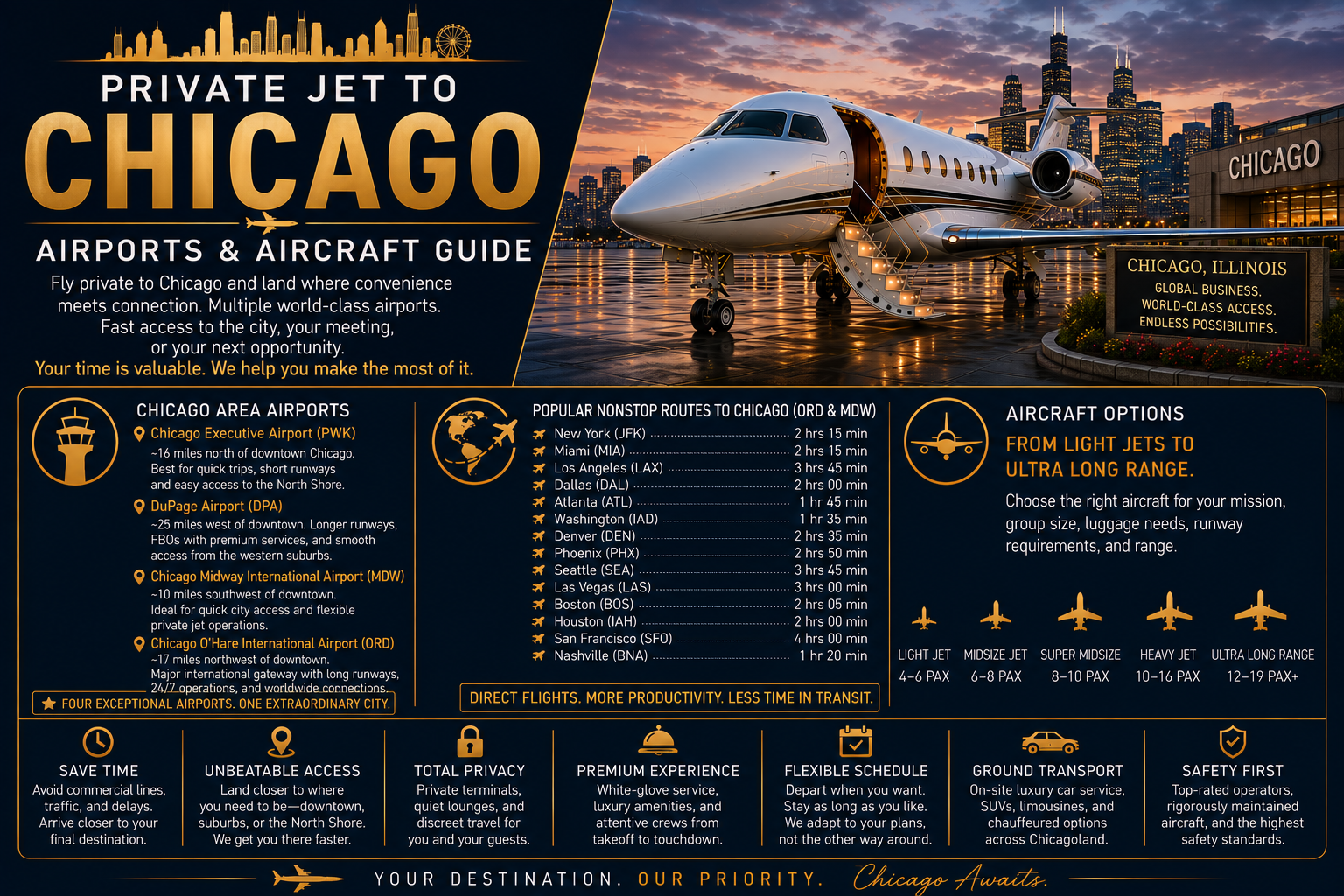
Chicago Executive Airport, identified as PWK and KPWK, is one of the region’s most important business aviation airports.
Located in Wheeling, Chicago Executive can create especially strong access to Chicago’s North Shore, northern suburbs and many affluent residential and corporate communities.
Therefore, passengers traveling to Northbrook, Deerfield, Lake Forest, Highland Park, Glenview, Lincolnshire, Vernon Hills, Wheeling and nearby northern destinations should compare Chicago Executive directly with Chicago’s larger commercial airports.
Chicago Executive supports multiple FBOs and a substantial private aviation ecosystem.
Consequently, it can serve corporate aircraft, charter operations, privately operated aircraft, business travelers and other general aviation missions without requiring the passenger to use a major commercial terminal.
Midway International Airport, identified as MDW and KMDW, provides another major private aviation gateway.
Midway supports both commercial airline operations and private aviation, while dedicated FBO facilities serve corporate and private aircraft.
Its location southwest of Downtown Chicago can make it highly attractive for passengers traveling to the Loop, West Loop, South Loop, McCormick Place, major downtown hotels, financial offices, professional sports, medical facilities and central Chicago destinations.
Therefore, Midway may provide one of the strongest combinations of downtown access and broad aircraft capability.
However, Midway remains a busy commercial airport.
Consequently, private aircraft operate alongside scheduled airline traffic, and runway sequencing, taxi activity, weather, parking, handling and airport congestion may influence the mission.
DuPage Airport, identified as DPA and KDPA, provides another powerful private aviation option west of Chicago.
Located in West Chicago, DuPage operates primarily around general and business aviation rather than scheduled commercial passenger service.
Therefore, it may create a strong aviation experience for passengers traveling to western suburbs, corporate campuses, private residences, industrial facilities and communities throughout DuPage County and surrounding areas.
Passengers traveling to Oak Brook, Naperville, Wheaton, West Chicago, St. Charles, Geneva, Batavia, Aurora and other western destinations should compare DuPage with Midway and O’Hare before committing to an airport.
O’Hare International Airport, identified as ORD and KORD, provides another important option when the mission requires major-airport infrastructure.
Private and corporate aircraft can operate within the O’Hare airport environment while the airport simultaneously serves as one of the world’s major commercial aviation hubs.
Therefore, ORD may become particularly valuable when passengers require scheduled-airline connections, international transfers, crew positioning, large-aircraft capability or direct access to destinations near the airport.
However, O’Hare’s size and airline activity can add operational complexity.
Taxi time, runway sequencing, commercial traffic, handling, passenger transfers, airport procedures and ground congestion may reduce the advantage for a passenger whose itinerary could be served more efficiently through Chicago Executive, Midway or DuPage.
Consequently, O’Hare should solve a specific passenger or aircraft requirement rather than automatically becoming the default because it is Chicago’s best-known airport.
Gary/Chicago International Airport in northwest Indiana may also become relevant for selected Chicago missions.
Its location southeast of the city can support passengers whose destination lies in Northwest Indiana, industrial corridors, southern portions of the Chicago region or selected downtown itineraries when airport and traffic conditions align.
Aurora Municipal Airport may become relevant for selected western suburban and corporate missions as well.
Furthermore, Waukegan National Airport may serve travelers whose destinations lie farther north toward Lake County, northern Illinois or the Wisconsin border.
Therefore, Chicago should be treated as a regional airport ecosystem rather than a destination served by one universal private jet airport.
The strongest airport depends first on where the passenger is actually going.
A meeting in the Loop creates a different airport strategy from a residence in Lake Forest, a corporate campus in Deerfield, an office in Oak Brook, a convention at McCormick Place, a manufacturing facility in the western suburbs or an international connection at O’Hare.
Likewise, a passenger attending a Bears, Bulls, Blackhawks, Cubs or White Sox event may face very different traffic patterns depending on the venue, event time and selected airport.
Ground transportation therefore plays a major role in airport selection.
Chicago traffic can change dramatically along the Kennedy Expressway, Edens Expressway, Eisenhower Expressway, Stevenson Expressway, Dan Ryan Expressway, Tri-State Tollway and other regional corridors.
Rush hour, construction, crashes, major sporting events, concerts, conventions, demonstrations, lakefront events, snow, ice, heavy rain and road closures may materially alter the passenger’s transfer.
As a result, airport selection should use realistic door-to-door travel windows rather than mileage alone.
For example, Chicago Executive may appear farther from Downtown Chicago than Midway.
However, it may be significantly more practical for a passenger whose actual destination is Lake Forest, Deerfield or another North Shore community.
Likewise, DuPage may dramatically outperform Midway or O’Hare for a passenger traveling to a western suburban corporate campus.
Meanwhile, Midway may create a much stronger downtown transfer than an airport positioned farther north or west.
Therefore, the aviation and vehicle strategies should be developed together.
Aircraft selection changes significantly according to the departure market as well.
A regional mission from Detroit, Indianapolis, Cleveland, Cincinnati, St. Louis, Minneapolis or another nearby market may fit a turboprop, light jet or midsize aircraft under suitable conditions.
Meanwhile, flights from Dallas, Houston, Miami, Palm Beach, New York, Los Angeles, San Francisco, Aspen, Scottsdale or other longer domestic markets may benefit from midsize, super-midsize or large-cabin aircraft depending on the mission.
International flights from London, Paris, Zurich, Frankfurt, Dubai, Tokyo, Toronto or other global destinations may require large-cabin or ultra-long-range aircraft, customs coordination, additional crew planning, baggage capacity and international handling.
Passenger requirements can change the aircraft recommendation further.
Financial executives may require confidential working cabins, high-speed connectivity, conference seating and tightly compressed schedules.
Private equity teams may travel with advisors, attorneys, bankers, board members and transaction materials.
Family offices may travel with principals, advisors, children, household staff, caregivers, security, pets and substantial luggage.
Manufacturing and industrial teams may carry samples, tools, technical cases, prototypes, protective equipment and specialized documentation.
Professional athletes may travel with family members, agents, trainers, medical personnel, security and sports equipment.
International travelers may require customs, immigration, manifests, visas, handlers, crew documentation, catering coordination and secure transportation.
Therefore, aircraft selection should never rely on passenger count and advertised range alone.
The operator should evaluate the complete route, aircraft weight, passengers, baggage, fuel, runway requirements, temperature, wind, snow, ice, thunderstorms, customs, parking, alternates, crew duty and return mission.
Chicago weather creates another major operational variable.
Winter snow and ice may require aircraft deicing, runway treatment, longer operating times and additional passenger-transfer planning.
Freezing rain may affect airports and roadways simultaneously.
Strong winter winds may influence runway configuration and passenger comfort.
Lake-influenced snow can create localized differences around the region.
During warmer months, thunderstorms may create reroutes, turbulence, ramp restrictions and air-traffic congestion.
Therefore, the strongest Chicago itinerary includes weather flexibility from the beginning.
An alternate airport should solve both the aviation problem and the passenger transportation problem.
For example, changing from Midway to Chicago Executive may keep the aircraft moving while substantially changing the passenger’s ground route.
Likewise, moving from Chicago Executive to DuPage may protect the flight but place the passenger on another side of the metropolitan area.
Consequently, alternate airports and vehicles should be coordinated together.
Peak demand creates additional pressure.
Major conventions, professional sports, major concerts, financial conferences, corporate meetings, international events, political gatherings, university events, holidays and large private functions may increase aircraft activity throughout the Chicago region.
Therefore, aircraft availability, parking, FBO capacity, professional vehicles, crew lodging, hotels, catering and preferred departure windows may tighten together.
The return flight deserves an independent review as well.
Passengers may add documents, equipment, purchases, golf clubs, another traveler, family members, pets or a different onward destination while in Chicago.
Furthermore, the departure may encounter different winds, snow, ice, thunderstorms, temperatures, traffic, crew-duty limits or airport conditions than the inbound flight.
Therefore, a successful Chicago arrival does not automatically confirm a successful departure.
Travelers can review airport information through the official Chicago Executive Airport website, Chicago Department of Aviation and DuPage Airport Authority.
This guide connects Chicago destination demand with Chicago Executive, Midway, DuPage, O’Hare and other regional airports, aircraft selection, popular routes, downtown travel, North Shore travel, western suburban access, winter weather, deicing, business travel, finance, family offices, manufacturing, professional sports, international missions, privacy, baggage and the return journey.
Is Chicago a Major Private Jet Destination?
Direct Answer: Yes. Chicago is a major private aviation destination because the region combines global finance, corporate headquarters, private equity, family offices, professional services, manufacturing, healthcare, technology, commodities, logistics, professional sports and international business. Chicago Executive, Midway, DuPage, O’Hare and other regional airports can each create the strongest solution for different passengers.
Chicago private aviation demand extends far beyond Downtown Chicago.
The broader market includes the Loop, West Loop, Gold Coast, Streeterville, Lincoln Park, River North, the North Shore, Lake Forest, Highland Park, Deerfield, Northbrook, Oak Brook, Naperville, Schaumburg and surrounding corporate and residential communities.
Therefore, the strongest airport depends heavily on where the passenger will actually spend time.
Chicago Executive may provide exceptional access to the North Shore and northern suburbs.
Midway may create one of the strongest airport strategies for Downtown Chicago, the Loop, McCormick Place and many central-city destinations.
DuPage may significantly reduce ground travel for western suburban corporate, residential and industrial destinations.
Meanwhile, O’Hare may become particularly valuable when international airline connectivity, large-aircraft requirements, crew positioning or passenger transfers justify operating through a major global airport.
Gary/Chicago International, Waukegan National, Aurora Municipal and other regional airports can expand the available options further.
Consequently, Chicago should not be treated as a one-airport private aviation destination.
The strongest recommendation compares the aircraft, airport, weather, ground transportation and passenger schedule as one system.
Winter operations make that comparison even more important.
Snow, freezing rain, deicing, strong winds and localized weather may affect airports differently.
Therefore, an alternate airport should be identified before weather disrupts the original plan whenever conditions justify it.
Ground transportation should remain connected to that alternate strategy.
A change from Midway to Chicago Executive may preserve the flight while creating a very different passenger transfer.
Likewise, DuPage may provide excellent operating conditions but become inefficient for a passenger traveling to a North Shore residence.
Therefore, the correct airport protects the complete journey rather than simply the aircraft operation.
Chicago should be treated as a multi-airport private aviation market.
Chicago Executive may fit the North Shore, Midway may fit central Chicago, DuPage may fit western suburbs, and O’Hare may fit selected international, connection or major-aircraft missions.
Why Do Travelers Fly Privately to Chicago?
Direct Answer: Travelers fly privately to Chicago to control departure times, select airports closer to their actual destination, avoid commercial-terminal delays, work confidentially during the flight, connect several cities, carry specialized baggage, protect privacy and reduce time lost crossing a large metropolitan region affected by traffic, weather and seasonal disruptions.
Chicago is a destination where airport selection may save more time than choosing a marginally faster aircraft.
A passenger traveling to Lake Forest does not have the same airport priorities as an executive attending meetings in the Loop.
Likewise, a family office traveling to a western suburban residence may benefit from an entirely different airport than an international executive connecting through O’Hare.
Choose the Right Chicago Airport
Travelers can compare Chicago Executive, Midway, DuPage, O’Hare and additional regional airports based on the passenger’s actual destination.
Control the Schedule
Passengers can plan around board meetings, investor presentations, conventions, medical appointments, sporting events, private functions and international connections.
Work During the Flight
Executives, investors, advisors and family offices may use private cabins for confidential calls, meetings, document review, dining and preparation.
Connect Multiple Markets
A private aircraft may connect Chicago with New York, Dallas, Detroit, Cleveland, Indianapolis, Minneapolis, Miami or several cities within one business itinerary.
Carry Specialized Equipment
Technical cases, samples, presentation materials, golf clubs, sports equipment, medical devices, pets and extended-stay luggage may influence aircraft selection.
Protect Privacy
Private terminals, controlled passenger lists, discreet vehicles, limited itinerary distribution and coordinated security may reduce unnecessary exposure.
Nevertheless, private aviation does not eliminate Chicago weather, congestion, deicing, runway restrictions, parking limitations, crew duty or passenger delays.
Instead, it creates more flexibility for responding to those conditions.
The departure may move earlier before a winter storm.
The aircraft may use Chicago Executive instead of Midway.
A western suburban trip may shift to DuPage.
An international passenger may use O’Hare because the airline connection outweighs the commercial-airport complexity.
Therefore, the primary advantage is not simply cabin luxury.
Instead, private aviation allows the entire Chicago journey to be designed around the passenger’s priorities.
What Creates Private Aviation Demand in Chicago?
Direct Answer: Chicago private aviation demand comes from finance, private equity, family offices, corporate headquarters, law, consulting, commodities, healthcare, technology, manufacturing, logistics, commercial real estate, professional sports, universities, conventions and international business. These industries generate executive travel across Downtown Chicago, the suburbs, regional business centers and global markets.
Chicago combines several high-value business ecosystems within one metropolitan region.
It serves as a major financial center, corporate headquarters market, professional-services hub, manufacturing center, transportation gateway and international business destination.
Therefore, private aviation demand remains diversified throughout the year.
Investment and Capital Markets
Executives, investors, traders, asset managers, bankers, advisors and corporate leaders generate substantial high-value travel demand.
Deals and Portfolio Travel
Private equity teams, attorneys, lenders, advisors and portfolio-company leadership may travel on compressed schedules.
Executive and Board Travel
Boards, executives, advisors and leadership teams may travel for strategy, transactions, investor programs and corporate meetings.
Law, Consulting and Advisory
Attorneys, consultants, accountants, bankers and specialists may require multi-city and confidential executive transportation.
Industrial and Technical Travel
Executives, engineers, suppliers, customers, investors and technical teams may travel to facilities throughout the Midwest.
Principals and Advisors
Family offices may coordinate investments, residences, healthcare, education, philanthropy, staff, pets, security and international travel.
Athletes, Owners and Sponsors
Games, negotiations, training, medical travel, sponsorships, championships and private events contribute to aviation demand.
Global Corporate Connectivity
Chicago connects naturally with New York, London, Toronto, Frankfurt, Paris, Dubai, Tokyo and other major commercial centers.
Major conventions and trade shows contribute additional demand.
Chicago hosts corporate programs, industry conferences, investor gatherings, healthcare events, technology meetings, manufacturing exhibitions and international delegations throughout the year.
Meanwhile, professional sports and major entertainment events add another recurring travel category.
Consequently, aircraft, parking, FBO services, vehicles, crew lodging, hotels, catering and preferred departure windows may tighten during high-demand periods.
Chicago private aviation demand reflects an interconnected business region rather than one downtown destination.
Finance in the Loop, corporate campuses in the suburbs, North Shore wealth, western industrial markets and international business all create different airport and aircraft requirements.
Who Typically Flies Privately to Chicago?
Direct Answer: Chicago private aviation travelers include executives, investors, private equity teams, family offices, financial professionals, attorneys, consultants, manufacturing leaders, healthcare executives, professional athletes, international visitors and affluent families. Executive assistants, chiefs of staff, corporate aviation departments, advisors, security teams and travel managers frequently organize the mission.
The person researching a private jet to Chicago may not be the traveler.
Instead, an executive assistant, chief of staff, family-office professional, corporate aviation department, travel manager, attorney, advisor, security specialist or household employee may organize the trip.
Therefore, the itinerary must satisfy both passenger expectations and operational requirements.
Corporate and Board Travel
Executives may require working cabins, connectivity, privacy, several meetings, multiple airports and same-day or multi-city travel.
Transaction Teams
Partners may travel with bankers, attorneys, advisors, operating executives and portfolio-company leadership during active transactions.
Complex Principal Travel
Family offices may coordinate principals, children, advisors, caregivers, household staff, security, pets and substantial luggage.
Investment and Market Travel
Asset managers, bankers, investors, traders and advisors may require compressed schedules and confidential cabins.
Facilities and Technical Missions
Executives, engineers, customers and suppliers may travel with samples, technical cases, tools, equipment and presentation materials.
Games, Training and Family Travel
Athletes may travel with agents, trainers, medical personnel, security, family members and specialized sports equipment.
Global Business Missions
International travel may require customs, permits, handlers, crew planning, airline transfers, secure vehicles and additional documentation.
Children, Pets and Extended Stays
Families may travel with caregivers, pets, strollers, child seats, medication, golf clubs, household items and substantial luggage.
Why Does the Passenger Profile Affect the Aircraft?
A small private equity team may require a larger aircraft because the passengers need a productive working cabin, connectivity, privacy and substantial baggage.
Meanwhile, a larger group traveling regionally with limited luggage may fit another aircraft category.
Likewise, a manufacturing team may travel with relatively few people while carrying enough equipment to make baggage capacity a major aircraft-selection factor.
Therefore, passenger count alone cannot determine the strongest Chicago aircraft.
What Should Travelers Know About Chicago Executive Airport?
Direct Answer: Chicago Executive Airport is one of the Chicago region’s most important private and business aviation airports. Located in Wheeling, PWK can provide strong access to the North Shore and northern suburbs while established FBOs support private aircraft, corporate aviation, charter activity, passenger services and other general aviation missions.
Chicago Executive Airport, identified as PWK and KPWK, is located north of central Chicago in Wheeling.
The airport is positioned near many of the northern metropolitan area’s corporate offices, affluent residential communities, hotels, healthcare facilities and private destinations.
Therefore, PWK frequently becomes one of the strongest options for passengers whose itinerary centers north of Downtown Chicago.
The airport supports an established network of FBO and aviation service providers.
Therefore, Chicago Executive operates as a substantial business aviation center rather than simply a small suburban airfield.
Affluent Residential Access
PWK may provide practical access to Highland Park, Lake Forest, Glencoe, Winnetka, Northbrook and nearby northern communities.
Northern Suburban Business
Corporate campuses, headquarters, medical facilities and offices throughout the northern suburbs may align well with Chicago Executive.
Established FBO Support
Passengers and operators can coordinate fueling, passenger services, aircraft handling and other aviation support through airport providers.
Executive Passenger Experience
The airport’s private aviation orientation can reduce dependence on the large public terminal environment associated with major airline airports.
Avoid Downtown-First Routing
Passengers traveling north may avoid an unnecessary trip through central Chicago by selecting an airport closer to the actual destination.
Weather Still Matters
Snow, ice, wind, temperature, runway conditions, aircraft performance and the return mission should be reviewed individually.
Why Can Chicago Executive Be Better Than Midway or O’Hare?
For many northern suburban destinations, the answer is geography.
A passenger traveling to Lake Forest or Highland Park may gain little by landing south of Downtown at Midway.
Likewise, operating through O’Hare may introduce major-commercial-airport complexity without improving the passenger’s final transfer.
Chicago Executive may place the passenger much closer to the actual destination while providing a business-aviation-focused environment.
Therefore, PWK should be evaluated early for North Shore and northern suburban missions.
Can Every Private Jet Use Chicago Executive?
No airport should be assumed suitable for every aircraft and every mission.
The operator must evaluate the exact aircraft, takeoff and landing requirements, passenger count, baggage, fuel, runway conditions, temperature, wind, snow, ice and the next flight segment.
A mission that works comfortably with one aircraft may require another airport when aircraft weight, weather or destination changes.
Chicago Executive is often one of the strongest airport choices for North Shore and northern suburban private aviation.
However, aircraft capability, weather, parking, passenger destination, ground transportation and the return mission should still determine the final airport decision.
Which Private Aviation Services Are Available at Chicago Executive?
Direct Answer: Chicago Executive supports an established business aviation ecosystem. Depending on the provider and mission, services may include aircraft fueling, passenger facilities, ground handling, parking, hangar coordination, catering, professional transportation, maintenance support, crew services, flight planning and charter-related support.
Chicago Executive provides operators with business aviation support for passenger, aircraft and crew needs.
Therefore, providers may be evaluated according to aircraft requirements, parking, passenger preferences, fuel, maintenance needs and departure planning.
Private Passenger Facilities
FBO environments may provide lounges, passenger reception, vehicle access, conference facilities, baggage assistance and concierge support.
Aircraft Fueling
Operators should confirm required uplift, aircraft needs, departure timing, fuel arrangements and high-demand conditions.
Aircraft Parking
Transient and overnight parking should be coordinated according to aircraft size, stay length, weather, events and current availability.
Hangar Coordination
Winter weather, maintenance requirements, aircraft protection and longer stays may make hangar availability especially important.
Ground Transportation
Professional sedans, SUVs, passenger vans, security vehicles and luggage transportation may support the passenger’s Chicago itinerary.
Crew Support
Crew planning may include hotels, vehicles, meals, weather, deicing, flight planning, maintenance, rest and the return mission.
Why Can Hangar Availability Matter More in Chicago?
Winter weather can make aircraft protection more important than it would be during mild conditions.
Snow, freezing precipitation and very cold temperatures may increase the value of hangar arrangements for selected aircraft and missions.
However, hangar availability may tighten during major weather events.
Therefore, operators should coordinate aircraft protection according to current conditions rather than assuming indoor space will remain available.
Why Should Vehicles Be Coordinated With the FBO?
The passenger’s driver should know the exact FBO rather than simply receiving “Chicago Executive Airport” as the pickup location.
Additionally, the driver should receive aircraft timing updates, passenger information, baggage requirements and any security or private-access instructions.
Therefore, the FBO and vehicle team should operate as one passenger-transfer system.
Chicago Executive service planning should connect the aircraft with the passenger’s full North Shore or northern suburban itinerary.
FBO choice, fuel, parking, hangar needs, baggage, vehicles, winter weather, crew requirements and the return mission should remain coordinated.
When Does Chicago Executive Airport Fit the Mission Best?
Direct Answer: Chicago Executive fits best when the passenger’s itinerary centers on the North Shore or northern Chicago suburbs, the exact aircraft can support the airport, FBO and parking arrangements remain suitable, weather conditions support the mission and the ground-transfer plan preserves the time advantage created by landing north of the city.
PWK creates its greatest value when the passenger’s destination and aircraft requirements align.
Therefore, it should be compared with Midway, O’Hare, DuPage and other regional airports rather than selected automatically.
The Itinerary Centers North of Chicago
Northbrook, Deerfield, Highland Park, Lake Forest, Wheeling, Lincolnshire, Glenview and nearby areas may align particularly well with PWK.
The Exact Mission Is Suitable
The aircraft, weight, fuel, runway requirements, passengers, baggage, temperature, wind, snow and return route must support the mission.
Services Support the Schedule
Fuel, passenger facilities, parking, hangar needs, catering, maintenance and crew support should align with the planned itinerary.
Conditions Remain Suitable
Snow, ice, freezing rain, wind, thunderstorms, visibility and runway conditions may influence airport and aircraft suitability.
The Northern Location Saves Time
The passenger’s office, residence, hotel, event or medical destination should justify using PWK instead of a more central airport.
The Departure Plan Also Works
The outbound passengers, baggage, fuel, weather, runway conditions, crew duty and onward route require a separate review.
When Might Midway Be Better?
Midway may provide a stronger complete journey when the passenger’s schedule centers on Downtown Chicago, the Loop, West Loop, South Loop, McCormick Place or other central-city destinations.
Therefore, the ground-time advantage of PWK may disappear when the passenger must drive south into Downtown Chicago.
When Might O’Hare Be Better?
O’Hare may become stronger when the passenger requires a commercial airline connection, major international infrastructure, crew positioning, specific aircraft capability or a final destination located near ORD.
However, those advantages should justify the additional complexity of a major commercial airport.
When Might DuPage Be Better?
DuPage may better serve Oak Brook, Naperville, Wheaton, St. Charles, Geneva, Aurora and many western suburban destinations.
Therefore, a passenger spending the entire visit west of Chicago should compare DPA before accepting a longer transfer from PWK or Midway.
The best Chicago itinerary may use a different airport for arrival and departure.
Meetings, traffic, weather, parking, aircraft positioning, passenger destinations and the onward route may make Chicago Executive ideal inbound while Midway, DuPage, O’Hare or another airport becomes stronger for departure.
How Do Chicago Executive Operations Affect Private Jet Planning?
Direct Answer: Chicago Executive operates as a busy business and general aviation airport serving private, corporate and charter aircraft. Therefore, operators should evaluate runway conditions, traffic volume, FBO coordination, parking, winter weather, deicing, wind, passenger timing and the return mission before deciding whether PWK creates the strongest complete itinerary.
Chicago Executive’s private aviation focus creates a very different operating environment from O’Hare or Midway.
However, that does not mean the airport is free from congestion or operational constraints.
Business aircraft, charter operations, flight training, private aircraft and other general aviation activity may all contribute to airport traffic.
Therefore, operators should review the actual mission rather than assuming a suburban executive airport will always provide the fastest aircraft movement.
Runway Conditions
Snow, ice, standing water, wind and temperature can influence aircraft performance, braking and runway availability.
FBO Coordination
Fuel, passenger handling, hangar arrangements, catering, maintenance and crew support should be coordinated with the selected provider.
Aircraft Parking
Transient and overnight parking may tighten during major events, severe weather, holidays or periods of unusually high business aviation demand.
Deicing
Winter precipitation may require additional ground time before departure and should be included in crew and passenger scheduling.
Passenger Timing
Vehicle arrival, baggage loading, security movements, passenger delays and meeting overruns should remain synchronized with the aircraft.
Return Planning
The departure should receive another review for weather, runway conditions, fuel, passengers, baggage, crew duty and onward destination.
Therefore, the strongest PWK itinerary connects the aircraft operation with the passenger’s North Shore or northern suburban schedule.
A technically efficient airport becomes less useful if the passenger finishes the trip in Downtown Chicago and must cross the metropolitan area before departure.
Chicago Executive works best when the airport and passenger itinerary remain geographically aligned.
Runway conditions, FBO support, parking, winter weather, ground transportation and the final meeting location should all protect the time advantage of using PWK.
When Should Travelers Use Chicago Midway Airport?
Direct Answer: Chicago Midway can be one of the strongest private aviation options for passengers traveling to Downtown Chicago, the Loop, West Loop, South Loop, McCormick Place and central-city hotels, offices or events. Its location can reduce ground time compared with suburban airports, although commercial airline traffic and airport congestion must be considered.
Midway International Airport, identified as MDW and KMDW, sits southwest of Downtown Chicago.
Its geographic position makes it especially relevant for passengers whose itinerary centers on the city rather than the suburbs.
Private aircraft can use dedicated FBO facilities, allowing passengers to avoid the commercial passenger terminal while still benefiting from Midway’s central location.
Strong Central Chicago Access
The Loop, West Loop, South Loop, River North, Streeterville and central hotels may be reached efficiently depending on traffic.
Convention Travel
Major trade shows, corporate conferences and international conventions can create strong private aviation demand through Midway.
Mixed Airport Environment
Scheduled airline traffic shares airport infrastructure with private aviation and may influence runway sequencing and taxi activity.
City Event Access
Downtown and South Side sporting events may align well with Midway depending on venue, event timing and road congestion.
Loop and West Loop Meetings
Finance, private equity, law, consulting, corporate and technology travelers may benefit from a shorter city transfer.
Snow and Deicing Matter
Winter weather may affect runway conditions, aircraft deicing, airport capacity and the passenger’s ground transfer.
Why Can Midway Be Better Than Chicago Executive for Downtown?
The answer is usually ground time.
A passenger whose entire schedule takes place in the Loop may gain little by landing north of the city at PWK and then driving south.
Midway may place the traveler significantly closer to Downtown Chicago.
However, the advantage can vary according to traffic, time of day, winter conditions and the final address.
When Might Chicago Executive Still Be Better?
PWK may remain the stronger option when the passenger spends most of the trip on the North Shore or in northern suburbs.
Therefore, a traveler attending one Downtown meeting before continuing to Lake Forest should compare the complete itinerary rather than selecting Midway based only on the first appointment.
Midway is often one of the strongest airports for central Chicago private aviation.
However, commercial traffic, weather, parking, passenger destination, vehicle timing and the return mission should all support the decision.
When Does DuPage Airport Fit a Private Jet Mission?
Direct Answer: DuPage Airport can be a strong private aviation gateway for passengers traveling to Oak Brook, Naperville, Wheaton, St. Charles, Geneva, Aurora, West Chicago and other western suburban destinations. Its general-aviation focus can reduce ground travel and commercial-airport complexity when the passenger’s itinerary lies west of Chicago.
DuPage Airport, identified as DPA and KDPA, serves a large portion of Chicago’s western suburban business and residential market.
Unlike O’Hare or Midway, DuPage is not centered around scheduled commercial passenger operations.
Therefore, the airport can provide a business-aviation-focused environment for private and corporate travelers.
Oak Brook
Corporate offices, private equity, law, consulting, hotels and executive residences may align well with a western airport strategy.
Naperville
Corporate campuses, healthcare, technology, professional services and private residences may be reached without crossing central Chicago.
St. Charles and Geneva
Private residences, corporate facilities, events and western suburban destinations may benefit from DPA access.
Business Aviation Focus
The airport’s general aviation environment can provide a different passenger and aircraft experience from major commercial airports.
Corporate Aircraft
DuPage may support a broad range of corporate and charter missions when aircraft performance and operating requirements align.
Ground Time
Passengers traveling west may avoid unnecessary driving from Midway, O’Hare or Chicago Executive.
Why Can DuPage Beat O’Hare for Western Suburban Travel?
O’Hare may appear geographically convenient for some western destinations.
However, major-airport traffic, taxi time, handling, commercial activity and ground congestion can add complexity.
DuPage may provide a more business-aviation-focused environment while placing the passenger closer to selected western suburban destinations.
Therefore, DPA should be compared whenever the itinerary centers west of Chicago.
DuPage can protect the time advantage of private aviation for western suburban travelers.
The passenger destination, aircraft requirements, weather, runway conditions, parking, traffic and return mission should determine whether DPA creates the strongest complete journey.
When Should a Private Aircraft Use Chicago O’Hare?
Direct Answer: O’Hare may fit private aviation missions requiring international airline connections, major-airport infrastructure, large-aircraft capability, crew positioning or passenger transfers. However, ORD operates as one of the world’s busiest commercial airline hubs, so taxi time, runway sequencing, handling and airport complexity should be weighed against these capabilities.
O’Hare International Airport, identified as ORD and KORD, plays a central role in Chicago’s global aviation system.
For private aviation, however, its value should be mission-specific.
A passenger connecting directly between a private aircraft and an international commercial flight may benefit significantly from using the same airport complex.
Likewise, a large aircraft, specialized crew movement or international mission may require capabilities that make O’Hare more practical.
International Connections
Passengers transferring between private and commercial international flights may benefit from remaining at ORD.
Large-Aircraft Capability
Extensive runway infrastructure may support demanding aircraft, fuel loads and specialized operating requirements.
Crew Positioning
O’Hare’s airline network can simplify crew changes, maintenance personnel travel and technical repositioning.
International Handling
Global airport infrastructure may support selected customs, passenger-processing and international mission requirements.
Commercial Traffic
Heavy airline activity may increase taxi time, runway sequencing and operational complexity compared with executive-focused airports.
Ground Congestion
Passenger vehicles may face airport-area traffic, construction, terminal congestion and roadway delays.
Why Would a Private Passenger Choose O’Hare Instead of Midway?
O’Hare may provide advantages when the passenger has an international commercial connection, final destination near the airport, large aircraft or specialized operating requirement.
However, a passenger traveling directly to the Loop should compare Midway carefully because the additional commercial-airport complexity at ORD may not improve the complete journey.
Why Would O’Hare Be Better Than Chicago Executive?
O’Hare may better support airline connectivity, certain international requirements, crew positioning or aircraft capability.
However, Chicago Executive may be much stronger for North Shore or northern suburban passengers who do not need O’Hare’s global infrastructure.
O’Hare should solve a specific operational or passenger requirement.
International connections, aircraft capability, crew movement, passenger destination and major-airport infrastructure should justify the added commercial complexity.
When Does Gary/Chicago International Airport Fit a Private Jet Mission?
Direct Answer: Gary/Chicago International Airport may fit selected private aviation missions serving Northwest Indiana, southeast Chicago, industrial corridors and passengers whose final destination lies east or southeast of central Chicago. Its location can reduce unnecessary travel across the metro area when aircraft and passenger geography align.
Gary/Chicago International Airport provides an additional private aviation option southeast of Chicago.
Its value depends largely on the passenger’s actual destination.
Travelers heading toward Northwest Indiana, industrial facilities, logistics operations or selected southern Chicago-area destinations may find Gary practical.
Northwest Indiana
Industrial facilities, corporate operations, private residences and regional business destinations may align well with Gary.
Industrial Travel
Manufacturing, steel, logistics, transportation and infrastructure teams may require airport access near operating facilities.
Southeast Chicago
Selected passenger destinations may be reached without crossing the entire Chicago metropolitan area.
However, Gary may be inefficient for a passenger traveling to the North Shore or far western suburbs.
Therefore, it should be evaluated based on destination geography rather than simply being labeled an alternative Chicago airport.
Gary becomes valuable when the passenger’s destination lies on the southeast side of the Chicago region.
Aircraft capability, weather, traffic, industrial access and the return mission should all support the decision.
When Should Travelers Consider Waukegan National Airport?
Direct Answer: Waukegan National Airport may fit private aviation missions serving Lake County, far northern Chicago suburbs and destinations closer to the Wisconsin border. For suitable aircraft, it may reduce ground travel compared with Midway, DuPage or other airports positioned farther south.
Waukegan National Airport can become relevant when the passenger’s itinerary lies beyond the traditional North Shore corridor.
Lake County includes corporate, residential, healthcare, industrial and private destinations that may sit considerably north of Downtown Chicago.
Therefore, travelers should compare Waukegan with Chicago Executive when the final destination lies far north.
Lake County
Corporate facilities, healthcare, private residences and regional business destinations may align with a far-north airport strategy.
Wisconsin Border
Passengers continuing toward southeastern Wisconsin may reduce ground travel by avoiding central Chicago airports.
Aircraft Suitability
The operator should confirm runway requirements, weight, weather, wind, snow, ice, baggage and return mission.
Should Travelers Compare Waukegan With Chicago Executive?
Yes.
Chicago Executive may fit many North Shore destinations, while Waukegan may become stronger for passengers continuing farther north.
The exact residence, office, facility or event should determine which airport creates the shorter realistic transfer.
When Could Aurora Municipal Airport Support the Mission?
Direct Answer: Aurora Municipal Airport may support selected private aviation missions serving Aurora, far western Chicago suburbs, industrial facilities, corporate campuses and nearby communities. Its value increases when the passenger’s destination lies farther west than DuPage or central Chicago airports would efficiently serve.
Aurora Municipal Airport expands the western side of Chicago’s private aviation network.
It may become relevant for passengers whose destination lies in or around Aurora, farther-west corporate operations, industrial facilities or private residences.
However, aircraft suitability, runway requirements, weather, parking and FBO services should be reviewed before convenience alone determines the airport.
Aurora
Corporate offices, manufacturing, healthcare, private residences and local business destinations may align well with the airport.
Industrial Travel
Executives, engineers, suppliers and customers may use regional airports to reach plants and technical facilities efficiently.
Western Geography
Passengers may avoid unnecessary travel east toward O’Hare, Midway or central Chicago before returning west.
Far-west Chicago missions should be evaluated from the passenger destination backward.
DuPage and Aurora may outperform larger airports when the passenger’s complete schedule remains west of the city.
How Should Travelers Compare Chicago Private Jet Airports?
Direct Answer: Travelers should compare Chicago airports using the passenger’s exact destination, aircraft capability, runway requirements, weather, deicing, parking, international needs, FBO services, ground traffic, security, crew requirements and return mission. Chicago’s airport network allows planners to optimize the complete journey instead of forcing every trip through Midway or O’Hare.
| Airport | Often Strong For | Primary Advantage | Important Consideration |
|---|---|---|---|
| Chicago Executive (PWK) | North Shore, Northbrook, Deerfield, Highland Park, Lake Forest and northern suburbs | Business aviation focus and northern location | Aircraft performance, winter weather and passenger destination |
| Chicago Midway (MDW) | Downtown, Loop, West Loop, South Loop, McCormick Place and central Chicago | Strong city access and broad aircraft capability | Commercial traffic, runway sequencing and winter operations |
| DuPage (DPA) | Oak Brook, Naperville, Wheaton, St. Charles, Geneva and western suburbs | General aviation focus and western suburban access | Ground distance to central Chicago and North Shore destinations |
| O’Hare (ORD) | International connections, large aircraft, crew positioning and nearby destinations | Global connectivity and major-airport infrastructure | Commercial complexity, taxi time and ground congestion |
| Gary/Chicago (GYY) | Northwest Indiana, southeast Chicago and industrial corridors | Strategic southeast regional access | Less efficient for North Shore and western suburban travel |
| Waukegan National (UGN) | Lake County, far northern suburbs and Wisconsin-border travel | Reduces southbound ground travel for northern destinations | Compare directly with PWK based on exact destination |
| Aurora Municipal (ARR) | Aurora and far western suburban destinations | Far-west geographic access | Aircraft suitability, services and destination distance |
What Information Should Be Compared Before Choosing the Airport?
- The exact office, residence, hotel, hospital, convention, stadium, campus, plant or event destination
- The arrival and departure schedule
- The aircraft category and runway requirements
- Passenger, staff, advisor, security, caregiver and pet count
- Standard luggage and specialized equipment
- International customs or airline-connection requirements
- Aircraft parking, hangar and repositioning needs
- Snow, ice, wind, thunderstorms and deicing requirements
- Professional vehicle and security requirements
- The return destination and complete outbound mission
Chicago’s geography makes this comparison especially important.
A passenger traveling exclusively to the North Shore should not automatically use the same airport as a traveler attending meetings in the Loop.
Likewise, a western suburban corporate mission may be much stronger through DuPage than through O’Hare or Midway.
The arrival and departure airports also do not need to match.
A passenger may arrive through Chicago Executive for northern meetings and depart through Midway after finishing the trip Downtown.
Optimize the Chicago passenger journey rather than airport loyalty.
The region provides enough private aviation options to match airports with the actual destination, aircraft, weather and return route.
How Should Chicago Ground Transportation Be Planned?
Direct Answer: Chicago ground transportation should be planned together with the aircraft. Airport, exact destination, traffic, winter weather, event congestion, passenger count, luggage, security and vehicle requirements can all influence whether the private flight actually reduces total door-to-door travel time.
Chicago’s metropolitan layout can create substantial differences between airports and passenger destinations.
Therefore, ground transportation should be treated as part of the aviation decision rather than a service booked after the aircraft is confirmed.
Executive Sedans
May fit individual executives, couples and small business parties traveling with limited baggage.
Luxury SUVs
May provide greater baggage capacity, winter-weather flexibility and space for families, executives or security personnel.
Passenger Vans
May support corporate teams, family groups, athletes, conference travelers or passengers carrying substantial luggage.
Security Vehicles
High-profile passengers may require advance teams, alternate routes, private entrances and multiple coordinated vehicles.
Equipment Vehicles
Industrial or sports missions may require separate transportation for technical cases, golf clubs, equipment or oversized baggage.
Winter-Capable Vehicles
Snow and ice may influence vehicle selection, route timing and the margin required between the passenger destination and aircraft departure.
Why Should the Driver Know the Exact FBO?
The passenger vehicle should arrive at the private aviation facility rather than the commercial passenger terminal.
Therefore, the driver should receive the airport, FBO, aircraft arrival time, passenger representative contact, baggage requirements and staging instructions.
If weather changes the airport, the transportation team should receive the update immediately.
Chicago private aviation should be measured from origin door to destination door.
The aircraft, airport, FBO, vehicle, traffic, winter weather, baggage, security and final destination should all preserve the time advantage of flying privately.
How Does Chicago Traffic Affect Private Jet Airport Choice?
Direct Answer: Chicago traffic can materially change which airport creates the fastest complete journey. The Kennedy, Edens, Eisenhower, Stevenson, Dan Ryan and Tri-State corridors may experience rush-hour congestion, construction, crashes, sporting events, conventions, snow and weather disruptions. Airport selection should therefore use realistic travel conditions rather than mileage alone.
Chicago’s traffic patterns vary substantially according to the passenger’s direction of travel and time of day.
Therefore, one airport may perform extremely well for a morning arrival and poorly for an evening departure.
O’Hare and Downtown
Traffic between O’Hare and central Chicago can change the passenger’s ground-time assumptions significantly.
North Shore Travel
North Shore traffic may influence whether Chicago Executive or another airport creates the stronger transfer.
Western Suburbs
Traffic between Downtown and western suburban areas may make DuPage more attractive for selected itineraries.
Midway and Southwest Travel
Conditions may influence travel between Midway, central Chicago and southwestern suburban destinations.
Sports and Conventions
Games, concerts, conventions and major public events may create localized congestion and vehicle-staging challenges.
Snow and Ice
Weather may increase travel time even when the aircraft remains operational and the airport stays open.
Should the Airport Be Chosen Based Only on the First Meeting?
Not necessarily.
The strongest airport may depend on where the passenger finishes the day.
For example, an executive could arrive through Chicago Executive for North Shore meetings, continue Downtown and then depart from Midway.
Likewise, a western suburban itinerary may begin through DuPage and finish near O’Hare for an international connection.
Chicago airport planning should follow the passenger’s full geographic path.
The first meeting, final meeting, traffic direction, weather, vehicle strategy and departure airport should all be considered before the itinerary is finalized.
How Does Chicago Weather Affect Private Aviation?
Direct Answer: Chicago private aviation planning should account for snow, ice, freezing rain, strong winds, low ceilings, lake-influenced weather, thunderstorms, heavy rain and rapidly changing seasonal conditions. Weather may affect runway conditions, deicing, routing, aircraft performance, airport capacity, passenger transportation, crew duty and the return mission.
Chicago weather can affect private aviation throughout the year.
Winter creates the most recognizable operational challenges, although spring and summer thunderstorms may also produce significant reroutes, delays and airport-capacity changes.
Strong winds can affect runway use and passenger comfort in every season.
Snow and Ice
Frozen precipitation may affect runway conditions, aircraft deicing, airport capacity and road transportation.
Runway and Ride Quality
Strong or gusty winds may influence runway use, crosswind limits, turbulence and passenger comfort.
Localized Conditions
Snow, low clouds and visibility may vary across the metropolitan region and affect airports differently.
Convective Disruptions
Storm cells may create reroutes, turbulence, lightning restrictions, delays and changing airport capacity.
The value of Chicago’s multi-airport system becomes especially clear during changing weather.
One airport may experience more difficult conditions while another remains operationally preferable.
However, moving to another airport can create a completely different ground transfer.
Therefore, alternate airports and passenger transportation should be planned together.
Chicago weather planning should protect both the aircraft and the passenger’s route after landing.
A suitable alternate airport only solves the mission when ground transportation, passenger destination, crew requirements and return timing remain workable.
How Do Snow and Ice Affect Chicago Private Flights?
Direct Answer: Snow and ice can affect Chicago private flights through runway contamination, aircraft deicing, taxi delays, reduced airport capacity, parking complications, crew-duty extensions and slower ground transportation. Travelers should include additional schedule margin and maintain suitable alternate-airport and vehicle plans when winter weather is forecast.
Winter weather can affect several parts of the private aviation system simultaneously.
The aircraft may require snow removal or deicing before departure.
Runway and taxiway conditions may reduce operating efficiency.
Meanwhile, passenger vehicles may move more slowly throughout the region.
Runway Conditions
Snow, slush, ice, braking conditions and wind may influence aircraft performance and operating decisions.
Aircraft Deicing
Frozen contamination may need to be removed before departure according to aircraft and operator procedures.
Airport Capacity
Snow removal, runway treatment and lower visibility may slow arrivals, departures and ground movements.
Vehicle Travel
Snow and ice may increase transfer time between the airport, office, hotel, residence or event.
Crew Duty
Extended delays may affect legal crew schedules and require another crew, a changed departure or an overnight stay.
Return Mission
Conditions may deteriorate while the passenger is in Chicago, requiring an earlier departure or another airport.
Chicago winter travel requires schedule margin.
Deicing, snow removal, road conditions, passenger timing and crew duty can all add time even when the flight ultimately operates.
How Does Aircraft Deicing Affect a Chicago Private Jet Schedule?
Direct Answer: Aircraft deicing can add ground time before a Chicago winter departure because frost, snow or ice must be removed according to aircraft and operator procedures. Weather intensity, aircraft size, deicing demand, fluid requirements, airport operations and timing considerations can all affect the departure schedule.
Passengers should not assume the aircraft can depart immediately after boarding during freezing conditions.
Even relatively small amounts of frozen contamination may require treatment before takeoff.
Therefore, deicing should be included in the planned departure timeline whenever conditions warrant it.
Aircraft Size
Larger aircraft may require more treatment time and fluid than smaller aircraft depending on the conditions.
Weather Intensity
Active snowfall or freezing precipitation may create different timing requirements than light frost on a clear morning.
Airport Demand
Multiple aircraft requesting treatment at the same time may increase wait periods during significant winter events.
Passenger Timing
Travelers should avoid building an unrealistic meeting-to-takeoff schedule during active winter weather.
Crew Duty
Extended deicing or weather delays may contribute to crew-duty limitations later in the itinerary.
Aircraft Protection
Hangar arrangements may reduce exposure to snow or frost before departure, although availability varies.
Therefore, deicing should be treated as a planned part of winter operations rather than an unexpected inconvenience.
Winter departure times should include the possibility of deicing before passengers commit to a tight onward schedule.
Aircraft condition, precipitation, airport demand, passenger timing and crew duty should all be included in the operating plan.
How Can Lake-Influenced Snow Affect Chicago Private Aviation?
Direct Answer: Lake-influenced winter weather can create localized snow, cloud and visibility differences across the Chicago region. As a result, Midway, Chicago Executive, O’Hare, Gary, Waukegan, DuPage and their surrounding road networks may experience different conditions during the same broader weather system.
Chicago’s proximity to Lake Michigan can contribute to meaningful local weather differences.
Therefore, planners should not assume conditions at one airport represent the entire metropolitan area.
The passenger’s route after landing may also experience different snow intensity or road conditions than the airport itself.
Localized Snowfall
Snow intensity may vary across the region, affecting airports and passenger routes differently.
Visibility
Localized snow bands or low clouds may influence approach, departure and passenger-transfer timing.
Ground Routes
A passenger transfer may become slower even when the selected airport continues operating normally.
Chicago weather should be evaluated airport by airport.
Localized conditions may make one airport operationally stronger while changing the passenger’s ground-transportation strategy at the same time.
How Do Thunderstorms Affect Chicago Private Aviation?
Direct Answer: Chicago thunderstorms may affect private flights through reroutes, turbulence, lightning restrictions, heavy rain, wind shifts, airport-capacity changes and air-traffic congestion. Flexible departure times and multiple airport options can help protect the mission when significant convective weather is forecast.
Warm-season storms can affect the Chicago region quickly.
Aircraft may need to route around convective cells rather than following the most direct path.
That can increase flight time and fuel requirements.
Meanwhile, lightning may temporarily restrict ramp activity and delay baggage handling, fueling or passenger movement.
Routing
Storm avoidance may increase distance and flight time on inbound or outbound missions.
Turbulence
Convective weather may affect ride quality and encourage route or altitude changes.
Lightning
Ramp crews may limit outside activity temporarily when lightning threatens personnel safety.
Heavy Rain
Rain may reduce visibility, slow ground handling and affect passenger vehicle travel.
Alternate Airports
Conditions may affect Midway, PWK, DuPage, O’Hare and other airports differently.
Crew Duty
Extended weather delays may affect the legal crew schedule and require another departure plan.
Chicago weather flexibility is often more valuable than forcing the original departure time.
Leaving earlier, waiting for a storm line to pass or selecting another suitable airport may produce a more reliable mission.
How Do Strong Winds Affect Chicago Private Jet Operations?
Direct Answer: Strong Chicago winds may affect runway configuration, crosswind limits, turbulence, aircraft performance, passenger comfort, airport capacity and ground transportation. Operators should evaluate actual wind direction, gusts, runway alignment, aircraft limits, weather and alternate airports rather than relying on a general forecast.
Strong or gusty conditions can influence Chicago aviation operations throughout the year.
Therefore, wind planning should focus on the exact airport and aircraft rather than broad assumptions about the city.
Crosswinds
The operator should compare wind direction and gusts with aircraft and runway limitations.
Turbulence
Strong winds may affect ride quality during arrival and departure.
Runway Configuration
Wind direction may influence runway use, sequencing and airport capacity.
Ground Vehicles
Snow, wind, reduced visibility and slick roads may affect passenger transportation simultaneously.
Aircraft Category
Different aircraft may have different operating limits and ride characteristics in strong winds.
Alternate Airports
Conditions may differ across the region, making another airport operationally preferable.
Wind planning should connect the aircraft, runway, passenger comfort and ground journey.
A technically suitable airport may still create a weaker mission if wind, snow or traffic significantly disrupts the passenger’s complete itinerary.
When Is Chicago Private Aviation Demand Highest?
Direct Answer: Chicago private aviation demand may increase during major conventions, finance and corporate events, professional sports, concerts, university programs, holidays, political gatherings, major trade shows and severe-weather disruption periods. During peak demand, aircraft availability, parking, FBO capacity, professional vehicles, crew lodging and preferred departure times may tighten together.
Chicago remains a year-round private aviation destination because business demand continues in every season.
However, major events can compress aircraft movements into narrow arrival and departure windows.
McCormick Place
Large trade shows, industry gatherings and international events may increase private aviation and hotel demand.
Investor and Corporate Programs
Executives, private equity, bankers, advisors and corporate leadership may concentrate travel around major meetings.
Chicago Bears
Games, major matchups, sponsors, owners, executives and premium guests may increase aircraft activity.
Bulls and Blackhawks
Games, playoffs, league events, athletes, sponsors and corporate guests may create concentrated travel.
Cubs and White Sox
Major series, playoffs, opening days and corporate hospitality may increase private aviation demand.
Entertainment Travel
Artists, production teams, executives, sponsors and high-profile guests may use private aviation and security transportation.
Academic and Donor Travel
Board meetings, commencement, research programs, healthcare events and donor gatherings may create additional demand.
Repositioning and Disruption
Major winter storms or severe weather may tighten hangars, parking, aircraft, crews and alternate-airport availability.
What Should Travelers Reserve Beyond the Aircraft?
- Airport parking and FBO services
- Hangar arrangements when appropriate
- Professional vehicles and adequate luggage capacity
- Passenger and crew hotels
- Security personnel and alternate routes
- Event credentials and private entrances
- Catering and passenger supplies
- Snow, ice, deicing and weather contingencies
- The return aircraft, crew and departure plan
Peak Chicago travel should be planned as a complete logistics system.
The aircraft, airport, parking, FBO, hangar, vehicles, hotel, crew, weather alternatives, event schedule and return mission should all be coordinated before demand compresses available options.
Which Aircraft Work Best for Private Flights to Chicago?
Direct Answer: The best aircraft for Chicago depends on origin, passenger count, baggage, nonstop range, runway requirements, winter weather, deicing, wind, cabin needs, technical equipment, pets, customs and the next flight segment. Turboprops and light jets may fit regional missions, while midsize, super-midsize and large-cabin aircraft often support longer domestic or international routes.
Chicago supports nearly every category of private aviation mission.
However, the strongest aircraft should be selected around the full itinerary rather than a published range figure or the lowest hourly rate.
A regional flight from Detroit, Cleveland, Indianapolis, Cincinnati, St. Louis or Minneapolis creates different requirements from a coast-to-coast or international mission.
Likewise, six financial executives carrying only laptop bags create a very different aircraft requirement from six manufacturing professionals carrying large technical cases.
Turboprops
Aircraft such as the King Air 350 may fit selected regional missions where passenger count, baggage, weather, runway conditions and travel time support the category.
Light Jets
Aircraft such as the Phenom 300 and Citation XLS may fit shorter and selected domestic routes with relatively small passenger groups.
Midsize Jets
Midsize aircraft may provide additional cabin comfort, baggage capacity and range for longer domestic Chicago missions.
Super-Midsize Jets
Aircraft such as the Challenger 350, Citation Longitude and Praetor 600 may provide strong combinations of range, cabin space and nonstop flexibility.
Heavy Jets
Aircraft such as the Gulfstream G550 and Challenger 650 may support larger groups, longer routes, working cabins and substantial baggage.
Ultra-Long-Range Jets
Aircraft such as the Gulfstream G650, Gulfstream G700 and Global 7500 may support demanding transcontinental and intercontinental Chicago missions.
Utility-Focused Aircraft
Aircraft such as the PC-24 may fit selected missions where runway flexibility, baggage or operational versatility creates added value.
Cabin Configuration Matters
Standing room, enclosed lavatories, sleeping arrangements, work areas, connectivity, galley capability and baggage access may matter as much as range.
How Does Chicago Winter Weather Affect Aircraft Selection?
Winter conditions can influence more than departure timing.
Snow, ice, strong winds, temperature and runway conditions may change the suitability of a particular aircraft or airport.
Therefore, an operator may recommend a different aircraft category, airport, fuel plan or departure window when conditions become more demanding.
Why Does Baggage Capacity Matter?
Chicago business travelers may carry much more than conventional luggage.
Manufacturing and industrial teams may travel with samples, prototypes, technical cases, tools and presentation materials.
Professional athletes may carry sports equipment.
Families may travel with strollers, pet supplies, medical devices and extended-stay luggage.
Therefore, baggage-door dimensions and compartment shape should be evaluated in addition to published baggage volume.
Choose the Chicago aircraft around the complete mission—not the cheapest available jet.
Range, payload, cabin, baggage, runway performance, weather, deicing, passenger productivity, airport selection, onward travel and the return flight determine the real mission value.
Which Private Jet Routes Commonly Connect With Chicago?
Direct Answer: Chicago private aviation connects naturally with New York, Dallas, Houston, Miami, Palm Beach, Los Angeles, San Francisco, Aspen, Scottsdale, Cleveland, Detroit, Minneapolis, St. Louis and other major markets. International business may also connect Chicago with London, Toronto, Frankfurt, Paris, Zurich, Dubai, Tokyo and other global cities.
Chicago’s finance, corporate, industrial and international economy creates both short regional missions and long-range global flights.
Therefore, route planning should reflect the passenger’s entire business or personal itinerary rather than treating Chicago as a stand-alone destination.
| Route | Typical Mission Profile | Aircraft Categories to Evaluate | Planning Considerations |
|---|---|---|---|
| New York → Chicago | Finance, private equity, law, corporate and family-office travel | Light, midsize and super-midsize jets | Airport geography at both ends may materially affect total travel time |
| Dallas → Chicago | Corporate, finance, investment and multi-city business travel | Light, midsize and super-midsize jets | Weather and airport choice may influence nonstop efficiency |
| Houston → Chicago | Energy, finance, corporate and transaction travel | Midsize and super-midsize jets | Working cabin, baggage and business schedule may drive aircraft selection |
| Miami → Chicago | Finance, family office, real estate, sports and leisure travel | Midsize, super-midsize and large-cabin jets | Winter weather in Chicago may require additional flexibility |
| Los Angeles → Chicago | Entertainment, corporate, technology, finance and sports travel | Super-midsize and large-cabin jets | Headwinds, baggage, cabin productivity and airport choice should be reviewed |
| Chicago → Aspen | Family office, executive, ski and leisure travel | Midsize, super-midsize and suitable performance-focused aircraft | Mountain airport conditions and ski baggage require careful planning |
| Chicago → Palm Beach | Family office, finance, leisure and second-home travel | Midsize, super-midsize and large-cabin jets | Seasonal demand, baggage and airport choice may affect availability |
| Chicago → London | Finance, corporate leadership and international business | Large-cabin and ultra-long-range jets | Range, crew, customs, weather, permits and international handling matter |
The strongest aircraft may change when Chicago represents only one segment of a larger itinerary.
For example, an executive may fly New York to Chicago, continue to Dallas and then return to New York.
In that case, selecting an aircraft based only on the New York–Chicago leg may create a weaker overall plan.
Chicago route planning should begin with the full sequence of cities.
A multi-city aircraft strategy may reduce repositioning, repeated commercial connections, passenger transfers and schedule risk across finance, corporate and family-office travel.
How Does Private Aviation Connect New York and Chicago?
Direct Answer: New York–Chicago private aviation supports finance, private equity, corporate leadership, law, consulting, family offices and transactions. Airport selection may be as important as aircraft choice because Teterboro, Westchester or other New York-area airports can be paired with Chicago Executive, Midway, DuPage or O’Hare based on the passenger’s actual destination.
New York and Chicago connect two of the country’s largest financial and corporate markets.
Therefore, the route may involve senior executives, investors, bankers, attorneys, advisors, board members and transaction teams.
Confidentiality and in-flight productivity may be especially valuable.
Working Cabin
Passengers may use the flight for confidential calls, transaction preparation, board work and internal meetings.
Airport Choice
Teterboro or another New York-area airport can be paired with the Chicago airport closest to the passenger’s meeting or residence.
Same-Day Travel
Private aviation may allow passengers to complete meetings in both markets without building the day around commercial schedules.
A passenger attending meetings in the Loop may favor Midway.
However, a transaction involving a company in Deerfield, Lake Forest or Oak Brook may justify another airport.
Therefore, the route should be optimized around the meeting geography rather than airport familiarity.
How Does Private Aviation Connect Dallas and Chicago?
Direct Answer: Dallas–Chicago private aviation supports corporate headquarters, finance, private equity, family offices, manufacturing, law and multi-city executive travel. Midsize and super-midsize aircraft often fit the route, while airport selection at both ends can significantly influence total door-to-door time.
Dallas and Chicago connect major corporate, financial and private-capital markets.
Passengers may depart through Love Field, Addison, DFW or another Dallas-area airport and arrive through Chicago Executive, Midway, DuPage or O’Hare depending on the final destination.
Therefore, the best route strategy begins with both ground journeys.
Corporate Headquarters
Boards, executives, advisors and leadership teams may use the route for strategy, transactions and investor meetings.
Private Equity
Investment teams may travel with attorneys, lenders, portfolio executives and advisors on compressed schedules.
Multi-City Travel
Dallas and Chicago may form two stops within a larger New York, Houston, Cleveland or national business itinerary.
How Does Private Aviation Connect Miami and Chicago?
Direct Answer: Miami–Chicago private aviation supports finance, family offices, private equity, commercial real estate, professional sports, second-home travel and leisure. Airport choice at both ends allows passengers to match private aviation facilities with residences, offices or onward destinations while aircraft selection depends on passenger count, baggage, weather and cabin requirements.
Miami and Chicago connect major finance, private-capital, wealth and real-estate markets.
Additionally, seasonal travel can increase between South Florida and Chicago during winter months.
Therefore, aircraft availability and airport demand may tighten around holiday and peak leisure periods.
Family Offices
Principals, advisors, staff, children, pets and substantial luggage may require larger cabins and greater baggage capacity.
Finance
Investors, private equity, bankers, attorneys and corporate teams may travel between both markets for business and transactions.
Seasonal Weather
Florida thunderstorms and Chicago winter weather may each affect different parts of the same round trip.
How Does Private Aviation Connect Los Angeles and Chicago?
Direct Answer: Los Angeles–Chicago private aviation supports entertainment, corporate leadership, technology, finance, sports, family offices and major events. Super-midsize and large-cabin aircraft may fit the route depending on passengers, baggage, winds, cabin needs and airport strategy at both ends.
Los Angeles and Chicago connect major entertainment, business, technology, sports and investment markets.
Passengers may depart from Van Nuys, Burbank, Hawthorne, LAX or another Southern California airport.
Meanwhile, the Chicago arrival may use Chicago Executive, Midway, DuPage or O’Hare depending on the passenger’s final destination.
Entertainment Travel
Artists, agents, managers, producers, executives, sponsors and production teams may travel between both cities.
Professional Sports
Athletes, owners, executives, sponsors, trainers and families may require schedule flexibility and specialized baggage capacity.
Corporate Travel
Executives, investors, boards and advisors may need confidential working cabins and tightly controlled schedules.
Winter conditions in Chicago may influence the aircraft, airport, arrival time and ground transportation even when Southern California weather remains clear.
Therefore, the mission should be planned around conditions and passenger requirements at both ends of the route.
Los Angeles–Chicago travel should be built around both airport systems.
Southern California airport choice, Chicago airport geography, aircraft range, winds, baggage, cabin requirements and the return flight should all support one coordinated itinerary.
How Does Private Aviation Connect Chicago and Aspen?
Direct Answer: Chicago–Aspen private aviation supports skiing, luxury residences, family travel, corporate retreats, events and seasonal leisure. Aircraft selection depends on mountain-airport performance, passengers, skis, luggage, weather, temperature, runway conditions, alternates and the return mission.
Chicago and Aspen form a natural seasonal private aviation corridor.
Families, executives, investors and property owners may travel between the Midwest and Colorado for skiing, luxury residences, festivals, corporate retreats and leisure.
However, Aspen requires more operational planning than a typical lower-elevation airport.
Aircraft Capability Matters
Aircraft performance, runway requirements, elevation, temperature, weather and crew qualifications should be reviewed carefully.
Skis and Heavy Luggage
Skis, boots, winter clothing, family luggage and pet supplies may materially increase baggage requirements.
Conditions at Both Ends
Chicago winter weather and Aspen mountain weather may each influence the same itinerary.
Chicago–Aspen missions should be planned as a complete winter round trip.
The aircraft, crew, skis, baggage, deicing, mountain weather, alternate airports, ground transportation and return schedule should support one coordinated plan.
How Does Private Aviation Support Chicago Finance Travel?
Direct Answer: Private aviation supports Chicago finance travel by connecting investment professionals, private equity teams, bankers, attorneys, family offices, boards and corporate executives with major financial markets on flexible schedules. Confidential working cabins, multi-city routing and airport choice can be especially valuable during transactions, investor meetings and time-sensitive negotiations.
Chicago’s financial ecosystem includes asset management, private equity, banking, commodities, insurance, family offices, law, consulting and corporate finance.
Therefore, private aviation may support travel where timing, confidentiality and decision-making speed matter significantly.
Private Equity
Partners may travel with operating executives, lenders, attorneys, consultants and portfolio-company leadership during active deals.
Banking and Capital Markets
Investment bankers, lenders and executives may need tightly controlled travel around financings, restructurings and transactions.
Family Offices
Principals and advisors may combine investment meetings with healthcare, residences, philanthropy or personal travel.
Board Meetings
Direct aircraft scheduling may allow directors from several cities to coordinate around a narrow meeting window.
Confidential Work
Appropriate cabins may support calls, document review, strategy meetings and post-transaction discussions.
Multi-City Transactions
A deal team may need to move between Chicago, New York, Dallas, Cleveland or another market within one compressed itinerary.
For finance travel, the value of private aviation often comes from protecting high-value decision-maker time.
Airport proximity, confidentiality, cabin productivity, multi-city flexibility and schedule control can matter more than flight time alone.
How Does Private Aviation Support Chicago Business Travel?
Direct Answer: Private aviation can support Chicago business travel by reducing schedule dependence, connecting multiple cities, enabling confidential in-flight work and placing executives closer to downtown offices, North Shore headquarters, western suburban campuses or industrial facilities. The strongest mission measures productive executive time and total door-to-door travel rather than flight time alone.
Chicago corporate travel often extends across more than one business district.
An executive may begin with meetings in the Loop, continue to a North Shore office and finish at a western suburban corporate facility.
Therefore, airport strategy can become as important as aircraft strategy.
Board Meetings
Direct aircraft scheduling may allow directors and executives from several cities to coordinate around a narrow meeting window.
Transactions
Bankers, attorneys, investors and executives may use the cabin for confidential preparation and post-meeting discussion.
Corporate Campuses
Chicago Executive, DuPage or another regional airport may place travelers closer to suburban headquarters than Midway or O’Hare.
Multi-City Days
Chicago may be combined with Detroit, Cleveland, Indianapolis, Minneapolis, Dallas or another market without rebuilding the schedule around airlines.
Executive Productivity
Appropriate cabins may support calls, meetings, presentations, meals, rest and confidential work during travel.
Arrival and Departure Flexibility
The aircraft can arrive through the airport closest to the first meeting and depart through the airport closest to the final appointment.
The business case for private aviation should measure productive executive time.
Airport proximity, schedule control, multi-city access, cabin productivity and reduced overnight stays may matter more than comparing commercial airfare with charter cost alone.
How Do Family Offices Use Private Aviation in Chicago?
Direct Answer: Family offices may use Chicago private aviation for principal travel, investments, board meetings, residences, healthcare, education, philanthropy, family trips and international travel. Missions may involve advisors, children, caregivers, household staff, security, pets and significant baggage, making complete passenger and ground planning especially important.
Chicago’s combination of private capital, healthcare, universities, luxury residential communities and international connectivity creates diverse family-office travel requirements.
Therefore, a single trip may combine both business and personal objectives.
Principal Travel
The aircraft may need to support investments, residences, healthcare, education, events and business meetings within one itinerary.
Advisors and Staff
Attorneys, investment professionals, assistants, household staff and security may increase seating and baggage requirements.
Children and Caregivers
Child seats, strollers, caregivers, food, luggage and scheduling requirements should be included before aircraft selection.
Pets
Pet size, breed, carriers, documentation, cleaning requirements, vehicles and international rules may influence the mission.
Privacy
Passenger lists, itinerary distribution, residences, hotels, vehicles and onward destinations may require controlled communication.
Multiple Destinations
Chicago may represent only one stop within a larger domestic or international family-office itinerary.
Family-office aviation should be planned around the complete household and advisory ecosystem.
Principals, family members, staff, security, pets, baggage, vehicles, residences, privacy and onward destinations should be coordinated before the aircraft is confirmed.
How Does Private Aviation Support Manufacturing and Industrial Travel Around Chicago?
Direct Answer: Private aviation supports Chicago manufacturing and industrial travel by connecting executives, engineers, suppliers, customers, investors and technical teams with plants, distribution centers, corporate offices and regional facilities. Specialized equipment, multiple stops and destinations outside central Chicago can make regional airport selection particularly valuable.
Chicago sits within one of the country’s most important manufacturing, logistics and industrial regions.
Therefore, private aviation may connect corporate leadership with facilities throughout Illinois, Indiana, Wisconsin, Michigan, Ohio and the broader Midwest.
Plant Visits
Executives, engineers, customers and investors may need direct access to facilities located far from major commercial airports.
Technical Teams
Specialists may travel with instruments, prototypes, tools, samples, hard cases and protective equipment.
Supplier Travel
Private aviation may support urgent supplier meetings, inspections, quality issues and operational problem solving.
Multi-Site Missions
A team may visit several plants or facilities in one day rather than returning through commercial hubs after each stop.
Regional Airports
DuPage, Gary, Aurora and other airports may provide useful access to facilities outside the central Chicago business district.
Operational Flexibility
Production issues, inspections, supplier delays or customer requirements may change the schedule with little notice.
Industrial travel should be built around the facility—not the nearest major airline airport.
Regional airport access, equipment capacity, vehicles, weather, plant schedules and the next destination may create far more value than airport name recognition.
How Do Professional Athletes Use Private Aviation in Chicago?
Direct Answer: Professional athletes may use Chicago private aviation for games, training, medical appointments, contract meetings, endorsements, offseason travel and family trips. Aircraft planning may need to accommodate agents, trainers, medical staff, security, family members, sports equipment, golf clubs and substantial baggage.
Chicago’s professional sports market creates private aviation demand beyond official team travel.
Athletes, coaches, owners, agents, executives, sponsors and families may travel independently for business or personal reasons.
Games and Events
Airport selection may depend on the stadium, arena, hotel, residence and event timing rather than central Chicago alone.
Medical Travel
Athletes may travel with physicians, trainers, rehabilitation equipment and flexible medical schedules.
Sports Equipment
Golf clubs, training equipment, protective gear and medical devices may influence baggage capacity.
Family Travel
Partners, children, caregivers and pets may materially change seating, baggage and vehicle requirements.
Security
High-profile passengers may require discreet vehicles, controlled itinerary distribution and private arrival procedures.
Schedule Flexibility
Game schedules, injuries, media commitments, trades and training changes may create short-notice travel requirements.
What Should International Private Jet Travelers Know About Chicago?
Direct Answer: International private jet travel to or from Chicago may require passports, customs, immigration, passenger manifests, aircraft documentation, permits, handlers, crew planning, agricultural procedures and destination-specific requirements. Travelers should confirm that the selected Chicago-area airport supports the required international processing for the exact mission.
Chicago’s role as a global financial and corporate center creates substantial international private aviation demand.
However, international missions require more than sufficient aircraft range.
The passenger, crew, aircraft and airport must all support the applicable requirements.
Passenger Documents
Passports, visas and other entry documentation should be verified according to nationality, destination and itinerary.
Customs
The selected Chicago-area airport must support the required customs process at the planned date and time.
Aircraft Documents
Registration, operating documents, permits and other requirements may vary according to route and jurisdiction.
Crew
Crew passports, visas, duty limits, rest, positioning and international experience may affect long-range missions.
Pets
International pet travel may require health documents, vaccinations, import procedures and return documentation.
Commercial Connections
O’Hare may become especially useful when passengers or crews need to connect directly with scheduled international airline service.
Which Chicago Airport Is Best for International Private Flights?
There is no universal answer.
O’Hare may provide major international infrastructure, airline connectivity and aircraft capability.
However, another airport may better serve the passenger’s destination if the required customs and operating procedures are available.
Therefore, customs and airport capabilities should be confirmed for the exact mission rather than assumed from airport size alone.
International airport capability should be confirmed before the aircraft and ground plan are finalized.
Customs, immigration, manifests, permits, crew documents, pets, catering, agricultural requirements, ground transportation and the return should operate as one coordinated itinerary.
How Do Major Chicago Events Affect Private Aviation?
Direct Answer: Major Chicago events may increase private aircraft demand, FBO traffic, parking pressure, hotel occupancy, professional transportation demand and preferred departure-time competition. Travelers attending major conventions, sporting events, concerts, financial gatherings or corporate programs should coordinate aircraft, parking, vehicles, weather alternatives and return timing as one plan.
Chicago regularly hosts large events that concentrate high-value travel into narrow arrival and departure windows.
Therefore, the aircraft alone should never be the only reservation considered.
McCormick Place
Major trade shows and industry events may increase demand for private aircraft, hotels, vehicles and downtown access.
Professional Sports
Bears, Bulls, Blackhawks, Cubs and White Sox events may attract owners, sponsors, athletes, executives and corporate guests.
Finance Events
Investor conferences, board programs, private equity gatherings and corporate meetings may create concentrated executive travel.
Concerts and Entertainment
Artists, production teams, executives, sponsors and high-profile guests may require private aviation, security and specialized vehicles.
University Programs
Boards, donors, researchers, speakers and families may travel around major academic, medical or commencement events.
Corporate Gatherings
Conferences, leadership meetings, product launches and private functions may create group and multi-aircraft requirements.
Why Is the Departure Often Harder Than the Arrival?
Many event attendees may attempt to leave within the same narrow period after the program ends.
Therefore, aircraft movements, vehicles, FBO activity and passenger timing may become compressed.
A late event finish can also affect crew duty.
During winter, snow or deicing may add another layer of departure complexity.
For major Chicago events, reserve the complete travel chain—not only the aircraft.
Aircraft, airport, parking, FBO, vehicles, hotels, security, event credentials, weather alternatives and the return departure should all be coordinated in advance.
What Should Families and Pet Owners Know About Flying Privately to Chicago?
Direct Answer: Families flying privately to Chicago should plan for children, caregivers, pets, strollers, child seats, luggage, medications, food, ground transportation and the return trip before selecting an aircraft. Pet size, cabin rules, documentation and vehicle requirements should also be confirmed with the operator before departure.
Private aviation can provide families with greater control over the travel environment.
However, family missions often require more planning than a straightforward executive flight.
Children may require child restraints, strollers, specialized food, medications, caregivers and additional luggage.
Meanwhile, pets may require carriers, documentation, supplies and specific ground transportation.
Children
Passenger seating, child restraints, caregivers, food, entertainment and sleeping arrangements may influence the aircraft recommendation.
Pets
Pet size, breed, number of animals, carriers, operator policies, cleaning requirements and documentation should be confirmed before departure.
Baggage
Strollers, child seats, pet supplies, winter clothing and extended-stay luggage may require more baggage capacity than passenger count suggests.
Vehicles
Vehicles should have sufficient passenger and luggage capacity while accommodating any requested child-seat or pet arrangements.
Winter
Cold temperatures, snow and ice may increase clothing, baggage and vehicle requirements during winter travel.
Return Flight
Passenger count, pets, luggage and onward destinations may change while the family is in Chicago.
Family aircraft selection should include everything traveling with the passengers.
Children, caregivers, pets, strollers, child seats, luggage, winter clothing, medications and ground transportation can materially change the strongest aircraft and airport strategy.
How Do Luggage and Business Equipment Affect Aircraft Choice?
Direct Answer: Chicago private jet aircraft selection should account for baggage volume, individual item dimensions and specialized equipment before booking. Golf clubs, skis, technical cases, prototypes, medical devices, presentation materials, sports equipment, strollers and extended-stay luggage may require more usable storage than passenger count alone suggests.
Published baggage capacity can provide useful guidance.
However, total volume does not always determine whether a specific item will fit.
The shape of the compartment and dimensions of the baggage door may matter just as much.
Therefore, unusual or oversized items should be disclosed before the aircraft is selected.
Technical Cases
Manufacturing, engineering and healthcare teams may travel with hard cases, instruments, samples, prototypes and specialized equipment.
Golf Clubs
Golf bags may require longer baggage compartments or specific loading arrangements depending on aircraft type.
Ski Equipment
Chicago passengers continuing to Aspen or another ski destination should confirm skis, boots and winter luggage before aircraft selection.
Sports Equipment
Athletes may travel with training equipment, protective gear, medical devices and oversized bags.
Family Luggage
Strollers, child seats, pet supplies and extended-stay baggage can substantially increase storage requirements.
Return Purchases
The outbound baggage load may increase if passengers acquire equipment, documents, purchases or additional luggage while in Chicago.
Why Should Oversized Items Be Disclosed Before Booking?
An aircraft may technically provide enough total baggage volume while still being unable to accommodate a long, wide or unusually shaped item.
Therefore, the operator should receive dimensions for specialized equipment whenever possible.
This step can prevent a last-minute aircraft substitution, baggage shipment or passenger delay.
How Can Private Aviation Support Privacy and Security in Chicago?
Direct Answer: Private aviation can support Chicago passenger privacy through private terminals, controlled passenger lists, limited itinerary distribution, discreet vehicles, security coordination and reduced exposure to public commercial terminals. However, privacy requires coordinated procedures across the aircraft, FBO, transportation team, hotel, residence, event and passenger staff.
Private aviation can reduce unnecessary public exposure.
However, using a private aircraft does not automatically create a secure itinerary.
Information may still pass through assistants, operators, FBOs, drivers, hotels, venues, security teams and other service providers.
Therefore, sensitive travel should follow a deliberate communication plan.
Private Terminals
FBO facilities may reduce exposure to public passenger terminals and large commercial crowds.
Controlled Itinerary Distribution
Passenger schedules should be distributed only to people who require the information.
Discreet Vehicles
Transportation can be coordinated directly with the FBO to reduce unnecessary waiting or public exposure.
Security Teams
Advance personnel may coordinate routes, entrances, staging locations and alternate transportation plans.
Multiple Airports
Chicago’s regional airport network may provide additional routing options when passenger geography and aircraft requirements support them.
Schedule Changes
Private aviation can provide flexibility when meetings, events or security considerations require a different departure time.
Privacy is an end-to-end process.
The aircraft, FBO, passenger manifest, vehicles, hotel, residence, event venue, staff communication and departure schedule should follow the same privacy strategy.
How Should Travelers Plan a Private Jet Trip to Chicago?
Direct Answer: Start with the passenger’s exact Chicago destination, schedule and complete itinerary. Then compare Chicago Executive, Midway, DuPage, O’Hare and suitable regional airports before selecting an aircraft based on range, passengers, baggage, runway requirements, weather, cabin needs, crew, parking, ground transportation and the return mission.
The strongest Chicago private aviation itinerary begins with the passenger rather than the aircraft.
First, determine where the traveler actually needs to go.
Next, compare airports around that destination.
Then, evaluate aircraft capable of completing the full mission.
Define the Complete Itinerary
Identify every passenger, city, meeting, residence, hotel, event, facility, appointment and onward destination.
Compare Chicago Airports
Evaluate PWK, MDW, DPA, ORD and other suitable airports using realistic ground travel and aircraft requirements.
Choose the Aircraft
Match range, runway performance, passengers, baggage, cabin requirements, weather and the next flight segment.
Coordinate the FBO
Confirm passenger handling, fuel, parking, hangar needs, catering, baggage, vehicles and crew requirements.
Build Weather Alternatives
Review snow, ice, wind, thunderstorms, deicing and alternate airports before conditions become disruptive.
Plan the Return Separately
Recheck passengers, baggage, weather, airport, crew duty, fuel and onward destination before departure.
Should the Arrival and Departure Airports Match?
No.
Chicago’s multi-airport network can make different arrival and departure airports extremely practical.
For example, an executive may arrive through Chicago Executive for meetings in Deerfield and Lake Forest.
Then, after continuing Downtown, the passenger may depart through Midway.
Likewise, a traveler could arrive through DuPage for western suburban meetings before departing through O’Hare for an international connection.
Therefore, airport selection should follow the passenger’s evolving itinerary.
The strongest Chicago mission connects every moving part before departure.
Passenger geography, aircraft, airport, FBO, baggage, weather, deicing, vehicles, security, crew duty and the return route should function as one coordinated system.
Frequently Asked Questions About Flying Private to Chicago
Direct Answer: The best Chicago airport, aircraft and itinerary depend on the passenger’s exact destination, route, baggage, weather, runway requirements, deicing, parking, traffic, customs, privacy and return mission. Chicago Executive, Midway, DuPage, O’Hare and other regional airports may each provide the strongest solution for different trips.
What is the best airport for a private jet to Chicago?
There is no single best Chicago private jet airport. Chicago Executive may fit North Shore and northern suburban travel, Midway may fit Downtown Chicago, DuPage may fit western suburbs, while O’Hare may fit selected international, airline-connection or large-aircraft missions.
Which Chicago airport is best for Downtown?
Midway can be a strong private aviation option for Downtown Chicago because of its location southwest of the city center. However, actual ground time depends on traffic, weather, event congestion and the passenger’s exact destination.
Which airport is best for Chicago’s North Shore?
Chicago Executive Airport is often a strong option for North Shore and northern suburban destinations such as Northbrook, Deerfield, Highland Park and Lake Forest. Waukegan may also deserve consideration for destinations farther north.
Which private airport is best for Chicago’s western suburbs?
DuPage Airport can be a strong option for Oak Brook, Naperville, Wheaton, St. Charles, Geneva and other western suburban destinations. Aurora Municipal may also fit selected far-west missions.
Can private jets use Chicago O’Hare?
Yes. Private aircraft can operate through O’Hare when the aircraft, operator and mission requirements support it. ORD may be especially useful for international airline connections, crew positioning and selected large-aircraft missions.
Can a private jet land at Midway?
Yes. Midway supports private and corporate aviation in addition to scheduled airline operations. Aircraft suitability and current operating conditions should still be confirmed for the specific mission.
Does snow stop private jets from flying to Chicago?
Not automatically. Snow may affect runway conditions, visibility, airport capacity, aircraft deicing, parking and ground transportation. The operator determines whether the aircraft and mission can operate safely under current conditions.
Do private jets need deicing in Chicago?
Deicing may be required when frost, snow, ice or other frozen contamination is present. The operator and crew determine the required treatment based on aircraft condition and weather.
What aircraft is best for New York to Chicago?
Light, midsize and super-midsize jets may all fit New York–Chicago missions depending on passenger count, baggage, airport requirements, cabin preferences, weather and the rest of the itinerary.
What aircraft is best for Los Angeles to Chicago?
Super-midsize and large-cabin aircraft are commonly worth evaluating for Los Angeles–Chicago missions because of route length, passenger comfort, baggage, winds and cabin-productivity requirements.
Can pets fly privately to Chicago?
Many private aviation missions can accommodate pets, although policies vary by aircraft and operator. Pet size, breed, number of animals, carriers, cleaning requirements and documentation should be confirmed before booking.
Can I arrive at one Chicago airport and depart from another?
Yes. Using different arrival and departure airports can improve the itinerary when meetings move across the Chicago region. Aircraft positioning, parking, crew and operational requirements should be considered before confirming the plan.
How early should a Chicago private flight be planned?
Earlier planning generally provides more aircraft, airport, parking, vehicle and schedule options. Major conventions, sporting events, holidays and winter storms may tighten availability, while short-notice flights may still be possible depending on current conditions.
Does Chicago traffic affect which private airport I should use?
Yes. Chicago traffic can materially change total travel time. Airport selection should consider the passenger’s exact destination, time of day, road conditions, construction, events and weather rather than relying only on geographic distance.
What should be planned for the return flight from Chicago?
Reconfirm passengers, baggage, pets, equipment, departure airport, weather, deicing, fuel, crew duty, vehicles and onward destination. The return mission may require a different aircraft or airport strategy from the inbound flight.
Does Your Private Aviation Company Show Up When High-Value Travelers Research Trips Like This?
Private aviation buyers increasingly research destinations, airports, aircraft, routes, pricing, safety, baggage, pets and operational questions before they ever contact an operator or broker.
That creates an opportunity far beyond ranking for a single phrase such as “private jet charter.”
Infinite Media Resources builds interconnected private aviation search ecosystems designed to place aviation companies throughout the buyer’s research journey.
Instead of relying on a small service website, we build destination pages, airport guides, aircraft resources, route pages, buyer guides, decision content and supporting authority pages that connect into a much larger digital footprint.
Additionally, our SEO and GEO strategy is designed around visibility across traditional search and emerging AI-driven discovery environments.
Destination Authority
Build useful resources around the cities and luxury markets your ideal passengers already research.
Airport Authority
Answer airport-selection questions before travelers reach a broker, operator or competing aviation website.
Aircraft Authority
Capture buyers while they compare range, cabins, baggage, performance and mission suitability.
Route Authority
Connect origins, destinations, airports and aircraft around high-commercial-intent private aviation searches.
SEO + GEO
Build structured authority designed for Google search, AI Overviews and the expanding answer-engine ecosystem.
Lead Generation
Connect organic authority with paid acquisition and conversion systems designed to turn qualified demand into conversations.
The goal is not another private aviation website. It is a digital asset that compounds.
Every destination can connect to airports, routes, aircraft, events, buyer questions and decision pages, creating an expanding authority ecosystem around the searches high-value private aviation buyers already make.