Orlando Private Aviation Destination Guide
Private Jet to Orlando: Airports, Routes and Aircraft Guide
Flying by private jet to Orlando requires more than choosing the aircraft closest to the departure airport. The strongest itinerary connects the passenger's Central Florida destination, airport strategy, aircraft capability, family or business requirements, baggage, weather, traffic, privacy, ground transportation, acceptable alternates and return mission before departure.
Orlando is one of the most distinctive private aviation destinations in the United States because several major forms of travel converge within one Central Florida market.
Luxury family vacations create substantial demand.
Theme parks and destination resorts attract high-net-worth travelers from across the United States and internationally.
Corporate conventions bring executives, sponsors, investors and leadership teams into the region.
Professional and youth sports generate additional traffic.
Golf, second-home travel, entertainment, healthcare, technology, aerospace, private equity and family-office activity contribute further demand.
Meanwhile, Central Florida's geographic spread means that the airport closest to "Orlando" may not be the airport closest to the passenger's actual destination.
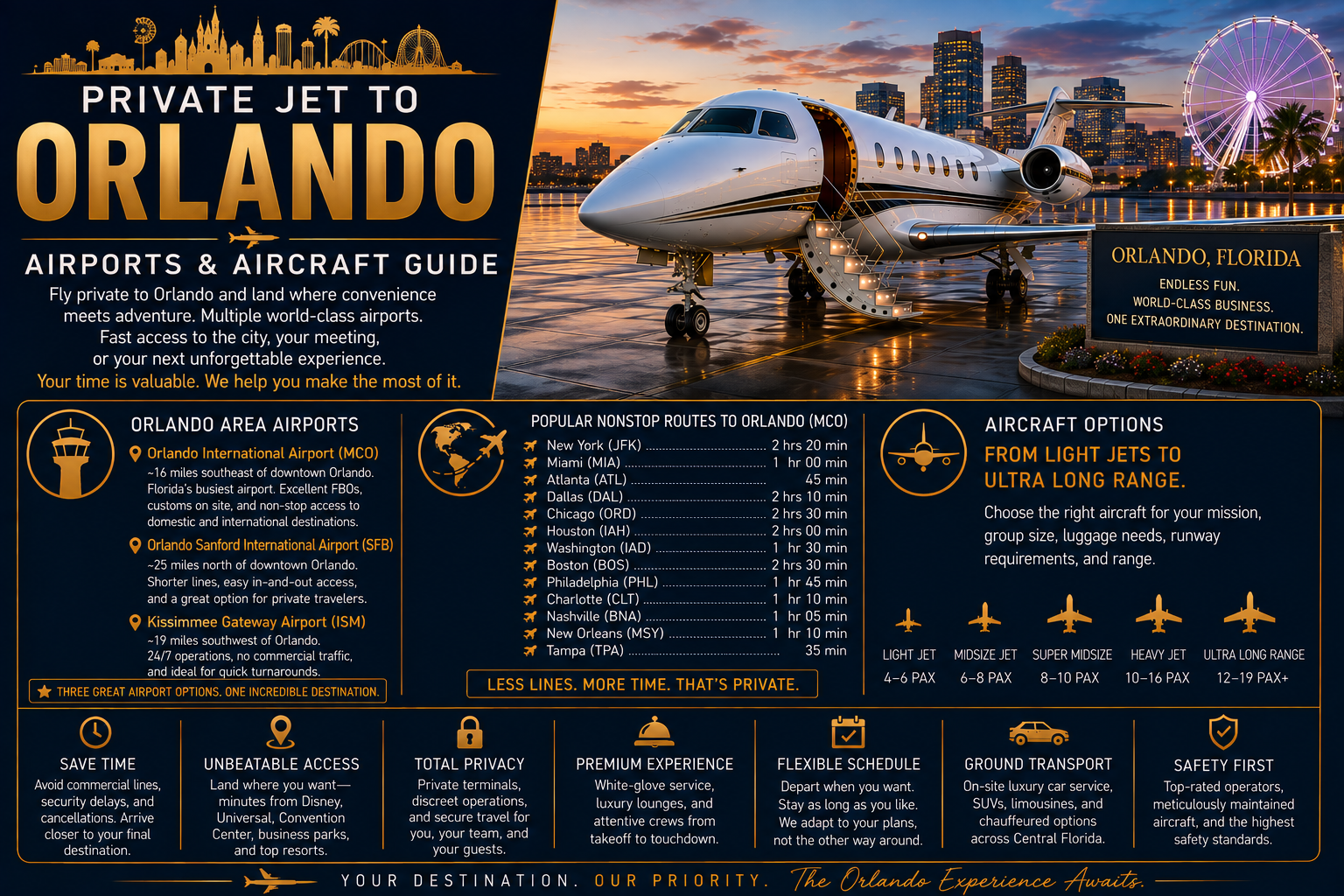
Therefore, Orlando should be treated as a multi-airport private aviation market.
Orlando Executive Airport, identified as ORL and KORL, provides a close-in general and business aviation option near central Orlando.
For passengers traveling to Downtown Orlando, Winter Park, central business districts, healthcare destinations, entertainment venues or nearby residences, Orlando Executive may create a strong combination of private aviation access and ground efficiency.
However, the exact aircraft and mission should still determine airport suitability.
Runway requirements, aircraft weight, fuel, temperature, thunderstorms, passengers, baggage and the next segment all matter.
Orlando International Airport, identified as MCO and KMCO, provides the region's primary commercial and international aviation infrastructure.
Its extensive airport system can become particularly valuable for larger aircraft, international missions, scheduled-airline connections, crew positioning and passengers whose final destination aligns geographically with the airport.
However, MCO also supports extremely heavy commercial passenger activity.
Therefore, airline traffic, taxi time, airport complexity, ground congestion and passenger destination should be weighed against its capabilities.
Kissimmee Gateway Airport, identified as ISM and KISM, provides another important Central Florida aviation option.
Its location in Kissimmee can make it especially relevant for passengers traveling toward Kissimmee, Celebration, resort communities, vacation homes and major attractions southwest of central Orlando.
Kissimmee's principal runway is approximately 6,001 feet long, so aircraft-specific performance planning remains important. :contentReference[oaicite:1]
Additionally, Kissimmee Gateway has been moving toward expanded international aviation capability, including preliminary approval announced by the City of Kissimmee in June 2026 for international passenger processing infrastructure. :contentReference[oaicite:2]
Because those capabilities may continue evolving, international travelers should verify current customs and processing availability for the exact trip rather than assuming a future or proposed capability is already available for every mission.
Orlando Sanford International Airport, identified as SFB and KSFB, expands the airport network farther north.
SFB supports both scheduled passenger service and general/business aviation activity, and the FAA identifies multiple runways within its airfield configuration. :contentReference[oaicite:3]
Therefore, Sanford may become especially useful for passengers traveling toward Sanford, Lake Mary, northern Orlando suburbs, Seminole County, Daytona-area destinations or selected Space Coast itineraries.
The result is an unusually flexible regional airport system.
A family traveling directly to a luxury resort southwest of Orlando may prefer a different airport than an executive attending meetings downtown.
A passenger traveling to Lake Mary may gain little by landing far south near Kissimmee.
Likewise, an international passenger transferring to scheduled airline service may value MCO differently from a domestic traveler seeking a smaller business aviation environment.
Therefore, the best airport begins with the actual door-to-door itinerary.
That distinction becomes even more important because Central Florida traffic can vary dramatically.
Interstate 4 is one of the region's most important travel corridors.
Traffic may increase around Downtown Orlando, major attractions, convention areas, resort districts and growing suburban communities.
Florida's Turnpike, State Road 408, State Road 417, State Road 528 and other major corridors may also influence the final transfer.
Theme park opening and closing periods can change traffic patterns.
Major conventions can create localized congestion.
Professional sporting events, concerts and holiday travel can add pressure.
Meanwhile, afternoon thunderstorms may slow both aviation and ground transportation at the same time.
Therefore, airport selection should use realistic travel conditions rather than simply comparing mileage.
Family travel creates another important planning layer.
Orlando private aviation missions may include parents, children, grandparents, caregivers, household staff, security personnel and pets.
Additionally, passengers may carry strollers, child seats, golf clubs, mobility devices, medical equipment and substantial vacation luggage.
Therefore, the aircraft that appears appropriate from passenger count alone may not provide enough practical baggage capacity.
The compartment shape and baggage-door dimensions may matter as much as published volume.
Luxury resort travel can increase these requirements further.
A family staying in Central Florida for one or two weeks may carry significantly more luggage than an executive completing an overnight business trip.
Likewise, a golf-focused itinerary can add multiple sets of clubs.
Therefore, every unusually large item should be disclosed before aircraft selection.
Business travel creates a different profile.
Orlando hosts major conventions, trade shows and corporate programs throughout the year.
Executives may need conference seating, connectivity, confidential working space and tightly controlled schedules.
Corporate groups may also require several vehicles or larger ground transportation.
Meanwhile, aerospace and technology activity throughout Central Florida can generate technical and executive travel beyond the tourism economy.
The region's proximity to the Space Coast may create additional aviation missions involving executives, engineers, investors, suppliers and government or aerospace personnel.
However, those travelers may ultimately need destinations far east of Orlando.
Therefore, Sanford, MCO or another regional airport may be evaluated differently according to the exact facility or launch-related itinerary.
Aircraft selection changes substantially according to the passenger's origin as well.
Regional flights from Atlanta, Jacksonville, Savannah, Tampa or other nearby markets may fit turboprops, light jets or midsize aircraft depending on the passenger's priorities.
Flights from New York, Chicago, Dallas, Houston, Nashville, Washington, Boston or other longer domestic markets may favor light, midsize or super-midsize jets depending on passenger count, baggage and desired cabin experience.
Flights from Los Angeles, San Francisco, Scottsdale or other western markets may justify super-midsize or large-cabin aircraft.
Meanwhile, transatlantic, Latin American or other international missions may require large-cabin or ultra-long-range aircraft, international handling, customs coordination, crew planning and additional documentation.
Weather represents another major Orlando operating consideration.
Central Florida thunderstorms can develop quickly, particularly during warmer months.
Storm cells may create turbulence, reroutes, lightning restrictions, heavy rain, wind shifts and temporary airport delays.
Lightning may also interrupt ramp activity.
Therefore, fueling, baggage handling and passenger boarding may occasionally pause even when the airport remains technically open.
Hurricane and tropical weather planning adds another seasonal requirement.
When significant tropical systems threaten Florida, aircraft owners and operators may reposition aircraft away from the region before conditions deteriorate.
Airport parking and hangar strategies can therefore change well before landfall.
Passenger schedules may also need to move forward rather than waiting until commercial travel and road conditions become heavily disrupted.
Consequently, hurricane planning should begin with flexibility rather than last-minute reaction.
The return flight deserves an independent review as well.
A family may accumulate additional baggage during the trip.
A child or caregiver may join the passenger group.
A business schedule may shift.
Thunderstorms may develop.
A tropical system may alter the broader travel plan.
Meanwhile, crew-duty limitations can become relevant after a long event or delayed departure.
Therefore, a successful arrival does not automatically mean the original departure plan remains the strongest option.
Travelers can review current aviation information through official airport and government resources, including the Greater Orlando Aviation Authority, Orlando Sanford International Airport, the FAA and the City of Kissimmee.
This guide connects Orlando destination demand with Orlando Executive, Orlando International, Kissimmee Gateway, Orlando Sanford and other Central Florida airport options, aircraft selection, popular routes, family travel, luxury resorts, conventions, sports, golf, weather, tropical systems, ground transportation, privacy, baggage and the complete return journey.
Is Orlando a Major Private Jet Destination?
Direct Answer: Yes. Orlando is a major private aviation destination driven by luxury family travel, theme parks, resorts, conventions, corporate meetings, golf, sports, aerospace, healthcare and international tourism. Orlando Executive, Orlando International, Kissimmee Gateway and Orlando Sanford can each create the strongest airport solution for different passengers and missions.
Orlando private aviation demand extends far beyond traditional vacation travel.
The region attracts families, corporate executives, family offices, investors, athletes, entertainers, convention attendees, golfers and international visitors.
Therefore, aircraft and airport requirements vary dramatically from one passenger to another.
A family traveling to a luxury resort may prioritize cabin space, baggage capacity, child-friendly transportation and proximity to southwest Orlando.
An executive attending meetings downtown may prioritize Orlando Executive and a short ground transfer.
A passenger connecting to scheduled international service may value Orlando International differently.
Meanwhile, a traveler heading toward Sanford, Lake Mary or northern Central Florida may find SFB more practical.
Consequently, Orlando should be treated as a regional airport ecosystem rather than a single-airport market.
The aircraft also needs to fit the complete trip.
A short regional mission may require very different capabilities from a coast-to-coast flight.
Likewise, passenger count alone does not determine the correct cabin.
Vacation luggage, golf clubs, strollers, child seats, pets and mobility devices can dramatically increase the amount of practical storage required.
Weather adds another layer.
Thunderstorms can develop quickly across Central Florida.
Therefore, flexible timing and suitable alternates should be considered before significant convective weather arrives.
Tropical systems require even earlier planning because operators may reposition aircraft and passengers may adjust travel before airports become heavily affected.
Orlando should be treated as a multi-airport private aviation destination.
Orlando Executive may fit central Orlando, MCO may fit major-airport and international requirements, Kissimmee Gateway may fit southwest Orlando and resort travel, while Sanford may fit northern Central Florida.
Why Do Travelers Fly Privately to Orlando?
Direct Answer: Travelers fly privately to Orlando to control schedules, select airports closer to resorts or business destinations, accommodate families and large baggage loads, protect privacy, avoid commercial-terminal friction, connect multiple cities and respond more easily to changing weather, events and vacation plans.
Orlando is a destination where the value of private aviation often extends well beyond the aircraft cabin.
For families, the ability to coordinate children, caregivers, pets and luggage within one controlled travel environment can simplify the entire trip.
For executives, private aviation can turn flight time into productive working time.
For family offices, the aircraft may support principals, staff, security and several generations of travelers at once.
Choose the Right Orlando Airport
Travelers can compare ORL, MCO, Kissimmee and Sanford according to the passenger's actual resort, residence, office or event destination.
Travel With the Entire Family
Children, grandparents, caregivers, household staff and pets can be included within one coordinated mission.
Carry More Specialized Baggage
Strollers, golf clubs, child seats, mobility devices and extended-stay luggage can be considered before the aircraft is chosen.
Control the Schedule
Passengers can plan around resort check-in, theme park schedules, meetings, conventions, sporting events and family obligations.
Protect Privacy
Private aviation may reduce unnecessary public exposure through business aviation facilities, controlled passenger lists and discreet transportation.
Adapt to Weather
Flexible departure times and multiple Central Florida airports can provide additional options when thunderstorms or tropical weather threaten the itinerary.
Private aviation does not eliminate traffic, weather, runway limitations or crew-duty rules.
However, it can provide more options for responding to those constraints.
The aircraft may depart before afternoon thunderstorms build.
The passengers may use Kissimmee instead of an airport farther north when the entire stay centers near southwest Orlando.
A business traveler may use Orlando Executive rather than spending additional time crossing the metropolitan area.
Therefore, the strongest benefit comes from controlling the complete journey rather than simply purchasing a premium seat.
What Creates Private Aviation Demand in Orlando?
Direct Answer: Orlando private aviation demand comes from luxury family travel, destination resorts, theme parks, conventions, corporate programs, professional and youth sports, golf, healthcare, technology, aerospace, real estate, family offices and international tourism. These segments create both leisure and business aviation demand throughout Central Florida.
Orlando is unusual because leisure and business aviation demand exist at substantial scale within the same market.
Family tourism remains one of the strongest drivers.
However, corporate conventions, sporting events, golf, healthcare and Central Florida business growth create a much broader passenger base.
Family Vacations
Affluent families may travel with several generations, caregivers, pets and substantial vacation luggage.
Destination Hospitality
Luxury resorts, vacation homes and extended stays create airport and baggage requirements that differ from conventional business travel.
Corporate Groups
Executives, sponsors, exhibitors and leadership teams may travel for large trade shows and corporate programs.
Principal Travel
Family offices may coordinate principals, advisors, staff, children, security and private leisure or business travel.
Golf Clubs and Group Travel
Golf-focused trips may require multiple sets of clubs, larger baggage compartments and coordinated resort transportation.
Athletes and Events
Professional, amateur and youth sports may generate athletes, families, sponsors, executives and equipment-intensive travel.
Space Coast Connectivity
Executives, engineers, investors, suppliers and government-related travelers may connect Orlando with aerospace activity east of the region.
Global Tourism and Business
International visitors may require customs, larger aircraft, additional baggage, multilingual coordination and extended ground transportation.
Peak demand can become concentrated around school holidays, holiday weekends, major conventions and sporting events.
Therefore, aircraft availability may tighten at the same time as hotels, professional vehicles, airport parking and preferred departure windows.
Major family travel periods may also generate unusually high baggage requirements.
Consequently, the mission should be confirmed as a complete transportation system rather than simply reserving an aircraft.
Orlando private aviation combines leisure and business demand at an unusually large scale.
Luxury family travel, resorts, conventions, sports, golf, aerospace and international tourism create different airport, aircraft and ground-transportation requirements throughout Central Florida.
Who Typically Flies Privately to Orlando?
Direct Answer: Orlando private aviation travelers include affluent families, family offices, executives, entrepreneurs, athletes, entertainers, sponsors, convention attendees, investors, golfers and international visitors. Executive assistants, household staff, travel managers, security teams, family-office personnel and corporate aviation departments often organize the mission.
The passenger purchasing or using private aviation may not be the person researching the trip.
A family-office advisor may organize the aircraft for a principal.
A household employee may coordinate several generations of family travelers.
An executive assistant may schedule the flight around a convention or board meeting.
A sports representative may coordinate athletes, trainers and equipment.
Therefore, the itinerary must provide clear answers for both the passenger and the decision-maker managing the trip.
Multi-Generation Travel
Parents, children, grandparents and caregivers may require larger cabins, extensive baggage and several ground vehicles.
Principal and Staff Travel
Family offices may coordinate principals, advisors, household staff, security, children and pets within one itinerary.
Corporate Travel
Executives may require working cabins, connectivity, multiple meetings and precise convention or event scheduling.
Long-Range Family and Business Travel
International passengers may require customs coordination, large baggage capacity and additional ground logistics.
Sports and Training Travel
Athletes may travel with family, coaches, trainers, medical personnel and specialized sports equipment.
Equipment-Heavy Leisure Travel
Several golf bags combined with standard luggage can materially change the required baggage compartment.
Performers and Production Travel
Artists, executives and production teams may require privacy, schedule flexibility and equipment capacity.
Business and Real Estate Travel
Investors may combine meetings, property visits, hospitality programs and personal travel within the same Orlando trip.
Why Does the Passenger Profile Affect Aircraft Selection?
A family of six with several weeks of vacation luggage may require substantially more aircraft than six executives carrying small overnight bags.
Likewise, four golfers with four full golf bags may need more usable baggage space than a larger group traveling without equipment.
International travelers may value sleeping capability and larger cabins.
Executives may prioritize connectivity and conference seating.
Therefore, aircraft selection should be based on how the passengers actually travel rather than passenger count alone.
What Should Travelers Know About Orlando Executive Airport?
Direct Answer: Orlando Executive Airport is a close-in general and business aviation airport serving central Orlando. ORL can be especially useful for passengers traveling to Downtown Orlando, Winter Park, central business destinations, nearby healthcare facilities and other locations where a smaller aviation-focused airport provides a better door-to-door journey than MCO.
Orlando Executive Airport, identified as ORL and KORL, plays an important role in Central Florida's business and general aviation network.
Its close-in position can provide a significant geographic advantage for passengers whose destination lies near central Orlando.
Therefore, travelers should compare ORL directly with MCO rather than assuming the region's major commercial airport automatically provides the best itinerary.
Central Orlando Access
Passengers traveling to Downtown Orlando may benefit from ORL's close-in location when the aircraft and mission are suitable.
Northern Central Orlando Access
Winter Park and nearby destinations may align naturally with Orlando Executive compared with airports farther south.
Private and Corporate Aircraft
The airport's general aviation focus can provide an environment designed around private, corporate and aviation-specific activity.
Executive Meeting Access
Executives may reduce unnecessary ground travel when meetings and offices are concentrated in central Orlando.
Avoid Unnecessary Cross-City Travel
The correct airport may eliminate a longer transfer from MCO, Kissimmee or Sanford when the passenger remains near the urban core.
Thunderstorms Still Matter
Convective weather, wind, rain, temperature and runway conditions should remain part of every ORL operating decision.
Why Can Orlando Executive Be Better Than MCO?
The primary advantage may be location and airport environment.
A passenger traveling directly to central Orlando may gain little by using a major commercial airport if Orlando Executive safely supports the aircraft and mission.
ORL can also reduce dependence on a large commercial passenger environment.
Therefore, private travelers should compare the complete door-to-door experience rather than simply choosing Orlando's best-known airport.
Can Every Private Jet Use Orlando Executive?
No airport should be assumed suitable for every aircraft or loading condition.
The operator should evaluate runway requirements, aircraft weight, fuel, temperature, wind, passengers, baggage and the next segment.
A mission that works comfortably for one aircraft may require MCO or another Central Florida airport when the aircraft becomes heavier or the route becomes longer.
Orlando Executive can provide a powerful time advantage when central Orlando is the real destination.
Aircraft performance, weather, passenger geography, parking, ground transportation and the outbound mission should determine whether ORL creates the strongest complete journey.
Which Private Aviation Services Matter at Orlando Executive?
Direct Answer: Orlando Executive private aviation planning should account for aircraft fueling, passenger facilities, parking, hangar needs, catering, ground transportation, maintenance support, crew requirements, weather and the return flight. Operators should confirm current provider capabilities and availability for the exact aircraft and itinerary.
The passenger experience depends on more than the runway.
Aircraft support, crew requirements and ground transportation should be coordinated before arrival.
Passenger Facilities
Private aviation passengers may require lounges, discreet arrivals, baggage assistance and coordinated vehicle access.
Aircraft Fueling
Fuel planning should account for aircraft weight, the next destination and any performance considerations affecting departure.
Aircraft Parking
Transient and overnight parking should be coordinated during holiday periods, conventions or unusually high private aviation demand.
Hangar Coordination
Tropical weather, maintenance requirements or longer stays may increase the importance of aircraft-protection planning.
Ground Transportation
Executive sedans, luxury SUVs, passenger vans and luggage vehicles should meet passengers at the correct private aviation facility.
Crew Support
Crew planning may include vehicles, hotels, meals, maintenance, weather monitoring, flight planning and legal rest requirements.
Why Does Aircraft Parking Matter During Peak Orlando Travel?
Orlando demand can increase sharply during holidays, school breaks, conventions and major events.
Therefore, transient and overnight parking may become more valuable during peak periods.
An aircraft may also need to reposition after dropping passengers.
Consequently, passenger airport and aircraft parking airport do not always need to be the same.
Why Can Hangar Planning Matter During Tropical Weather?
Strong tropical systems can create aircraft-protection and repositioning decisions well before the most severe weather reaches Central Florida.
However, hangar availability may tighten quickly when many aircraft owners seek protection simultaneously.
Therefore, operators should make aircraft-protection decisions according to current forecasts and operational requirements rather than assuming hangar space will remain available.
Orlando Executive service planning should connect the passenger, aircraft and crew.
Fuel, parking, hangar strategy, luggage, vehicles, weather, maintenance, crew requirements and the return mission should remain coordinated throughout the Orlando stay.
When Does Orlando Executive Airport Fit the Mission Best?
Direct Answer: Orlando Executive fits best when the passenger's destination is central Orlando or nearby, the exact aircraft comfortably supports the airport, parking and services remain suitable, and the mission does not require infrastructure better provided by MCO or another regional airport. Ground time and the return itinerary should confirm the advantage.
ORL creates the most value when passenger geography and aircraft suitability align.
Therefore, it should be compared with MCO, Kissimmee and Sanford rather than selected automatically.
Central Orlando Fits
Downtown, Winter Park and nearby central destinations may strongly favor Orlando Executive.
Performance Fits
The aircraft, fuel, passengers, baggage, temperature, wind and runway requirements must support the mission.
Airport Support Fits
Fuel, parking, passenger facilities, maintenance and crew requirements should align with the itinerary.
The Location Saves Time
Realistic ground travel should confirm that ORL provides an advantage over MCO or another airport.
Conditions Remain Suitable
Thunderstorms, heavy rain, wind and tropical systems may influence airport and aircraft decisions.
Departure Still Works
The outbound fuel, baggage, passengers, weather, crew duty and next destination should receive a separate review.
When Might MCO Be Better?
Orlando International may become stronger when the passenger requires airline connectivity, selected international capabilities, major-airport infrastructure or aircraft performance that favors the larger airfield.
Therefore, MCO should solve a specific passenger or operational requirement rather than being chosen simply because it is Orlando's primary airline airport.
When Might Kissimmee Be Better?
Kissimmee Gateway may be more geographically efficient when the itinerary centers on Kissimmee, Celebration, southwest Orlando, major resort communities or vacation homes.
Therefore, a family spending the entire trip southwest of Downtown Orlando should compare Kissimmee before accepting a longer ground transfer from ORL.
When Might Sanford Be Better?
Orlando Sanford may become stronger when the passenger travels toward Lake Mary, Sanford, northern Orlando suburbs, Seminole County or selected destinations northeast of central Orlando.
Therefore, the airport network should be evaluated from the passenger's destination backward.
The best Orlando itinerary may use different arrival and departure airports.
A passenger may arrive through Orlando Executive for Downtown meetings but later depart through Kissimmee, Sanford or MCO after the trip shifts to another part of Central Florida.
How Do Orlando Executive Operations Affect Private Jet Planning?
Direct Answer: Orlando Executive serves business, corporate and general aviation close to central Orlando. Therefore, operators should evaluate aircraft performance, runway conditions, temperature, thunderstorms, parking, fuel, passenger timing, crew duty and the return mission before deciding whether ORL creates the strongest complete itinerary.
Orlando Executive can provide a streamlined private aviation environment compared with the region's major commercial airport.
However, that does not mean every private aircraft or every mission fits ORL equally well.
Central Florida heat, aircraft weight, fuel requirements, passenger count and runway performance can all influence whether the airport remains suitable.
Therefore, operators should evaluate the exact arrival and departure separately.
Aircraft Performance
Aircraft weight, fuel, temperature, wind, runway condition and the next flight segment can affect operating margins.
Thunderstorms
Convective weather may create reroutes, lightning restrictions, wind shifts and changing airport capacity.
Aircraft Parking
Parking may tighten during conventions, holiday travel, sporting events or other periods of elevated private aviation demand.
Fuel Planning
A longer outbound mission may require additional fuel and weight that changes the aircraft's departure performance.
Passenger Timing
Meetings, conventions, resort schedules, theme park plans and sporting events may alter the original departure window.
Return Planning
The outbound passengers, baggage, fuel, weather, crew duty and next destination should be reviewed again before departure.
Why Can a Mission Work Inbound but Not Outbound?
An aircraft may arrive at a relatively low landing weight after burning fuel during the inbound flight.
However, the same aircraft may need significantly more fuel before departing Orlando for a longer route.
That additional weight can change takeoff performance.
High temperatures may further reduce performance margins.
Therefore, the operator may recommend another airport, another departure time, a different fuel strategy or another aircraft for the outbound mission.
Orlando Executive should be evaluated twice: once for arrival and again for departure.
A successful inbound mission does not automatically confirm that the same aircraft, fuel load and airport remain optimal for the return flight.
When Should Private Aircraft Use Orlando International Airport?
Direct Answer: Orlando International may fit private aviation missions requiring major-airport runway capability, international infrastructure, scheduled-airline connections, large-aircraft support, crew positioning or passenger destinations that align with MCO. However, commercial traffic, taxi time and airport complexity should be weighed against these advantages.
Orlando International Airport, identified as MCO and KMCO, serves as Central Florida's primary commercial passenger gateway.
Its size and infrastructure can also make it valuable for selected private aviation missions.
Therefore, MCO should be viewed as an operational tool rather than simply the default Orlando airport.
Major Runway Infrastructure
MCO can support aircraft and fuel loads that may create more demanding performance requirements at smaller regional airports.
Global Mission Capability
International passengers may benefit from major-airport infrastructure, customs coordination and long-range aircraft support.
Private-to-Commercial Transfers
Passengers or crew connecting with scheduled airline service may benefit from remaining within the same airport system.
Commercial Connectivity
Scheduled airline access may help position replacement crews, maintenance personnel or support teams.
Southeast Orlando Access
MCO may align well with destinations near the airport or southeast of central Orlando depending on traffic.
More Airport Complexity
Heavy airline traffic, taxi activity, sequencing and ground congestion may add time compared with a smaller business aviation airport.
Why Would a Private Passenger Choose MCO Instead of Orlando Executive?
The strongest reason is usually capability or connectivity.
A larger aircraft may benefit from MCO's runway infrastructure.
An international mission may require services or processing that make the airport more practical.
A passenger may need an immediate scheduled-airline connection.
Likewise, crew members may need direct airline access.
Therefore, MCO becomes strongest when its infrastructure solves a specific problem that ORL does not solve as efficiently.
When Might MCO Be Less Efficient?
A passenger whose entire schedule centers on Downtown Orlando or Winter Park may gain little from operating through a larger commercial airport when ORL safely supports the aircraft.
Likewise, a family traveling directly to Kissimmee or southwest-Orlando resort areas may find another airport more geographically efficient.
Therefore, passenger destination should remain central to the airport decision.
MCO should solve a major-airport requirement—not simply be selected because it is Orlando's best-known airport.
Aircraft capability, international processing, airline connectivity, passenger geography and crew needs should justify the additional commercial complexity.
When Does Kissimmee Gateway Airport Fit a Private Jet Mission?
Direct Answer: Kissimmee Gateway can be a strong private aviation option for passengers traveling to Kissimmee, Celebration, southwest Orlando, resort communities, vacation homes and major attraction areas. Its approximately 6,001-foot primary runway makes aircraft-specific performance planning important, particularly with heavier jets, high temperatures and longer outbound routes.
Kissimmee Gateway Airport, identified as ISM and KISM, occupies an important position within the southwest side of the Orlando private aviation market.
Its location can provide a major ground-transportation advantage for travelers whose entire stay centers around resort and attraction districts southwest of central Orlando.
Therefore, families and leisure travelers should compare Kissimmee directly with ORL and MCO rather than assuming a central airport will always save time.
Local Destination Access
Passengers staying or meeting in Kissimmee may avoid unnecessary northbound travel by using the local airport when aircraft requirements align.
Southwest Orlando Geography
Celebration and nearby communities may align naturally with Kissimmee Gateway.
Luxury Leisure Travel
Large family groups, resort guests and vacation-home travelers may benefit from reducing cross-city ground transportation.
Performance Planning Matters
The approximately 6,001-foot primary runway requires aircraft-specific calculations for weight, fuel, temperature and weather.
Baggage and Group Logistics
Vacation luggage, strollers, child seats, golf clubs and several passengers can materially influence aircraft selection.
International Expansion
International processing capabilities may evolve over time, so current availability should be verified before every international mission.
Why Can Kissimmee Be Better Than Orlando Executive for Resort Travel?
The answer is often passenger geography.
A family traveling directly to a southwest-Orlando resort may gain little by landing closer to Downtown Orlando and then driving back southwest.
Kissimmee Gateway may reduce that transfer significantly.
Therefore, the aviation planner should compare the entire resort journey rather than airport familiarity.
Can Every Private Jet Use Kissimmee Gateway?
No.
Aircraft performance must be evaluated for the exact mission.
High temperatures, passenger and baggage weight, fuel requirements, runway condition and outbound range can all influence suitability.
Therefore, a larger or heavier aircraft may require MCO or another airport even when Kissimmee provides a better ground location.
Kissimmee Gateway can protect the time advantage of private aviation for southwest-Orlando travel.
The airport becomes especially valuable when the passenger's resort, residence or attraction itinerary lies south or southwest of central Orlando and the aircraft comfortably supports the mission.
When Does Orlando Sanford International Airport Fit a Private Jet Mission?
Direct Answer: Orlando Sanford International may fit private aviation missions serving Sanford, Lake Mary, Seminole County, northern Orlando suburbs and selected destinations northeast of Orlando. Its mixed commercial and general aviation role can support private aircraft while providing another geographic option within the Central Florida airport system.
Orlando Sanford International Airport, identified as SFB and KSFB, sits north of central Orlando.
Its location can make it valuable for passengers whose itinerary lies substantially north of Downtown or MCO.
Therefore, Sanford should be compared whenever the passenger's destination falls within Seminole County or northern Central Florida.
Sanford
Local business, residential and leisure destinations may align naturally with SFB.
Lake Mary
Corporate offices and residential destinations in the Lake Mary area may be served more efficiently from the north.
Seminole County
Passengers traveling north of Orlando may avoid unnecessary southbound airport transfers.
General Aviation
The airport's business and general aviation activity can support private aircraft in addition to scheduled passenger operations.
Regional Travel
SFB may also become relevant for selected northeastern Central Florida or Daytona-area itineraries.
Airport Alternatives
Sanford can provide another operating option when weather, parking or passenger geography makes ORL, MCO or Kissimmee less attractive.
When Can Sanford Beat Orlando Executive?
Sanford may create a stronger complete journey when the passenger's destination lies north of Orlando.
A traveler headed to Lake Mary may gain little by landing at an airport farther south and then driving north through metropolitan traffic.
Therefore, geography should determine whether SFB or ORL provides the stronger transfer.
Can Sanford Work for Daytona or Northeast Central Florida?
Potentially.
The answer depends on the exact destination, aircraft and realistic ground-transfer time.
Therefore, SFB may deserve comparison for selected itineraries extending northeast from Orlando.
Sanford becomes valuable when the passenger's destination lies north of the traditional Orlando travel corridor.
Passenger geography, aircraft requirements, traffic, weather and the return mission should determine whether SFB provides the strongest complete itinerary.
How Should Travelers Compare Orlando Private Jet Airports?
Direct Answer: Travelers should compare Orlando airports using the passenger's exact destination, aircraft capability, runway requirements, international needs, parking, weather, resort location, business schedule, ground traffic, crew requirements and return mission. ORL, MCO, Kissimmee and Sanford each solve different private aviation problems.
| Airport | Often Strong For | Primary Advantage | Important Consideration |
|---|---|---|---|
| Orlando Executive (ORL) | Downtown Orlando, Winter Park and central Orlando | Close-in business aviation location | Aircraft-specific runway and performance planning |
| Orlando International (MCO) | International missions, larger aircraft, airline connections and southeast Orlando | Major-airport infrastructure and global connectivity | Commercial traffic, taxi time and airport complexity |
| Kissimmee Gateway (ISM) | Kissimmee, Celebration, southwest Orlando, resorts and vacation homes | Strong southwest geographic position | Approximately 6,001-foot runway requires aircraft-specific planning |
| Orlando Sanford (SFB) | Sanford, Lake Mary, Seminole County and northern Orlando | North-side regional access | May create longer ground travel for southwest Orlando destinations |
| Other Regional Airports | Specialized Central Florida missions | Potentially closer access to specific facilities or residences | Runway, services, fuel and aircraft capability vary by airport |
What Should Be Compared Before Choosing the Airport?
- The exact resort, residence, office, convention center, hospital, stadium, attraction or business destination
- The arrival and departure schedule
- The aircraft category and runway requirements
- Passenger count, children, caregivers, staff, security and pets
- Vacation luggage, golf clubs, strollers, mobility devices and specialized equipment
- International processing or airline-connection requirements
- Aircraft parking, hangar and repositioning requirements
- Thunderstorms, tropical weather, wind and heat
- Ground transportation and realistic traffic conditions
- The return destination, fuel requirements and crew-duty plan
Orlando's geography makes airport selection especially important.
A family spending a week near Kissimmee should not automatically use the same airport as an executive attending meetings in Downtown Orlando.
Likewise, a traveler staying in Lake Mary should evaluate Sanford rather than assuming a central or southern airport provides the best journey.
Arrival and departure airports may also differ.
A passenger may arrive through ORL for business meetings and later depart from Kissimmee after spending several days at a southwest-Orlando resort.
Optimize the Orlando passenger journey instead of building the trip around one familiar airport.
The region provides enough airport options to match passenger geography, aircraft performance, weather and the outbound route much more precisely.
How Should Orlando Ground Transportation Be Planned?
Direct Answer: Orlando ground transportation should be planned together with the aircraft because airport geography, resort location, family size, luggage, traffic, weather and event schedules can materially affect total travel time. The correct vehicle should meet passengers at the exact FBO or private aviation facility and have enough capacity for the entire group and baggage load.
Ground transportation becomes especially important in Orlando because private aviation groups can be unusually large and luggage-heavy.
A family may require multiple SUVs or a passenger van.
Golfers may need space for several sets of clubs.
Household staff or security may travel separately.
Therefore, a standard sedan should never be assumed appropriate without reviewing the actual passenger profile.
Luxury SUVs
May fit families, executives, security personnel and passengers carrying substantial vacation luggage.
Passenger Vans
May support multi-generation families, corporate groups, sports teams or several travelers moving together.
Luggage Vehicles
Large vacation groups may require separate transportation for baggage, golf clubs, strollers or equipment.
Child Seating
Families should coordinate any required or preferred child-seat arrangements before the vehicle reaches the airport.
Security Vehicles
High-profile families, executives or public figures may require advance vehicles and controlled resort or venue access.
Resort Transfers
The vehicle should be selected around the exact resort, vacation residence, hotel or attraction district rather than a general "Orlando" destination.
Why Should the Driver Know the Exact FBO?
Private passengers may use facilities separate from the standard airline passenger terminal.
Therefore, a driver who receives only the airport name may arrive at the wrong part of the airport.
The transportation team should receive the exact FBO or private aviation facility, aircraft timing, passenger representative contact, luggage requirements and any security instructions.
If the airport changes because of weather or aircraft requirements, the vehicle plan should change immediately.
Orlando private aviation should be measured from the passenger's original door to the final resort, residence or meeting.
The aircraft only creates maximum value when the airport, vehicle, baggage capacity, traffic and final destination all work together.
How Does Orlando Traffic Affect Private Jet Airport Choice?
Direct Answer: Orlando traffic can materially change which airport creates the fastest complete journey. Interstate 4, Florida's Turnpike, State Road 408, State Road 417, State Road 528, attraction districts, resort corridors and convention areas may experience congestion that makes ORL, MCO, Kissimmee and Sanford perform differently depending on the passenger's destination and schedule.
Central Florida traffic should be treated as a private aviation planning variable rather than an afterthought.
A geographically close airport may lose its advantage if the passenger must cross a heavily congested corridor.
Likewise, a slightly farther airport may produce a faster trip because it approaches the destination from a better direction.
Core Orlando Corridor
Traffic along Interstate 4 can materially affect travel between Downtown, resort areas, attractions and surrounding communities.
Airport and Convention Access
State Road 528 can influence transfers involving MCO, convention areas and destinations east of Orlando.
Eastern and Southern Routing
This corridor may influence transfers involving MCO, Kissimmee and southeastern Central Florida.
Regional Travel
Florida's Turnpike may affect longer regional transfers and connections to communities outside central Orlando.
Localized Congestion
Opening, closing and peak visitor periods may change traffic around major attraction districts.
Event Traffic
Large trade shows and corporate programs can increase traffic around hotels, convention facilities and major roadways.
Should the Arrival Airport Be Chosen Based Only on the First Stop?
Not necessarily.
A passenger may arrive for a business meeting downtown but spend the remainder of the trip near a southwest-Orlando resort.
In that situation, ORL may be ideal inbound while Kissimmee becomes stronger for departure.
Likewise, a passenger may finish the trip near MCO before connecting internationally.
Therefore, the entire geographic path should determine the airport strategy.
Orlando airport planning should follow the passenger's complete path across Central Florida.
The first destination, final destination, traffic direction, resort schedule, weather and onward flight should all influence the arrival and departure airports.
How Does Orlando Weather Affect Private Aviation?
Direct Answer: Orlando private aviation planning should account for thunderstorms, lightning, heavy rain, strong winds, high temperatures, tropical systems and rapidly changing summer conditions. Weather can affect routing, runway use, airport capacity, ground handling, passenger transportation, aircraft performance, crew duty and the return mission.
Weather is one of the most important operating variables in Central Florida.
Thunderstorms can develop quickly during warm and humid periods.
Therefore, a clear morning does not guarantee an equally clear afternoon departure.
Storm cells may create reroutes, turbulence, wind shifts and temporary restrictions around Orlando-area airports.
Lightning can also interrupt ramp operations, which may delay fueling, baggage handling, catering or passenger boarding.
Convective Weather
Storm cells may create reroutes, turbulence, heavy rain, lightning restrictions and changing airport capacity.
Aircraft Performance
High temperatures can reduce aircraft performance margins and may influence payload, fuel or runway requirements.
Runway and Ride Quality
Strong or shifting winds may influence runway configuration, turbulence and aircraft operating decisions.
Hurricanes and Repositioning
Tropical systems may require aircraft repositioning, earlier departures, parking changes and broader contingency planning.
Weather at the passenger's destination matters just as much as weather at the airport.
Heavy rain can slow ground transportation around resorts, convention districts and attraction areas.
Therefore, the aircraft may land on schedule while the door-to-door journey still takes longer than expected.
Likewise, weather at the next destination may change the departure plan even when Orlando remains clear.
Orlando weather planning should cover the entire itinerary, not just the airport.
Departure weather, en route storms, Orlando conditions, ground transportation and the return destination should all be reviewed before the mission is finalized.
How Do Thunderstorms Affect Orlando Private Flights?
Direct Answer: Thunderstorms can affect Orlando private flights through reroutes, turbulence, lightning restrictions, heavy rain, wind shifts and temporary airport delays. Flexible departure times, accurate passenger timing and alternate-airport planning can help protect the mission during periods of significant convective weather.
Central Florida thunderstorms can form rapidly and move across the region in complex patterns.
Therefore, a flight may need to route around cells rather than follow the most direct path.
That can increase flight time and fuel requirements.
Lightning can temporarily stop ramp activity.
As a result, even an aircraft that has already landed may experience delays in unloading or refueling.
Rerouting
Aircraft may need to avoid active cells, increasing distance, fuel burn and flight time.
Turbulence
Convective activity may create rougher conditions and require altitude or routing changes.
Lightning Restrictions
Ground crews may temporarily stop outside activity when lightning creates a safety risk.
Heavy Rain
Rain may reduce visibility, slow ground operations and increase passenger-transfer time.
Wind Shifts
Thunderstorm outflow can change runway use and aircraft performance conditions quickly.
Crew Duty
Repeated delays may extend the operating day and affect legal crew limitations.
Can Another Orlando Airport Solve a Thunderstorm Delay?
Sometimes.
Localized storms may affect ORL, MCO, Kissimmee and Sanford differently.
However, an airport change can also create a completely different ground transfer.
Therefore, an alternate only creates value when aircraft performance, parking, passenger geography and transportation remain workable.
The clearest airport is not automatically the best alternate.
The aircraft still needs to fit the runway, the passenger still needs to reach the destination and the crew still needs to complete the mission legally.
How Should Hurricane and Tropical Weather Be Planned for Orlando Private Aviation?
Direct Answer: Tropical weather planning should begin well before a storm reaches Central Florida. Operators may reposition aircraft, adjust departure times, change parking or hangar plans and move passengers earlier. Travelers should avoid waiting until roads, airports, hotels and commercial transportation systems become heavily disrupted.
Hurricane planning is different from ordinary thunderstorm planning because the operational impact may begin before severe weather reaches Orlando.
Aircraft owners may reposition jets away from the region to protect them from high winds, debris or extended airport disruptions.
Therefore, an aircraft that was originally expected to remain in Orlando may need to leave before the passenger's planned departure.
Aircraft Repositioning
Operators may move aircraft to another region before conditions deteriorate.
Earlier Departure
Passengers may need to leave before the planned travel date when tropical conditions threaten the region.
Parking and Hangars
Aircraft-protection demand may tighten parking and hangar options before the storm arrives.
Ground Transportation
Heavy rain, evacuation traffic, road closures and flooding may affect travel to or from the airport.
Crew Planning
Weather repositioning and extended delays may require additional crew or different legal rest planning.
Return Flexibility
The passenger's return date may need to change if the storm affects Orlando or the next destination.
Why Is Waiting Until the Last Minute Risky?
As tropical weather approaches, many travelers may attempt to depart at the same time.
Aircraft availability can tighten.
Parking and hangars may become constrained.
Road conditions may worsen.
Commercial flights may begin canceling.
Therefore, early decision-making can create substantially more options than waiting until conditions are already deteriorating.
Tropical weather planning should prioritize optionality.
Earlier departure windows, alternative airports, aircraft repositioning and flexible ground transportation can preserve more choices than reacting after the system reaches Central Florida.
When Is Orlando Private Aviation Demand Highest?
Direct Answer: Orlando private aviation demand may increase during school holidays, spring break, major conventions, holiday weekends, major sporting events, golf tournaments, large family travel periods and other high-volume tourism seasons. During peak demand, aircraft, airport parking, FBO services, vehicles and preferred departure times may tighten together.
Orlando combines some of the country's largest leisure travel periods with major corporate and event demand.
Therefore, private aviation peaks can become extremely concentrated.
Families may travel during the same periods that conventions or sporting events increase corporate and executive demand.
Family Travel Peaks
Holiday periods can increase aircraft demand, resort occupancy, luggage volume and professional transportation requirements.
Multi-Generation Vacations
Families may travel with children, grandparents, caregivers and extended-stay luggage during school vacation periods.
Corporate Demand
Large trade shows and executive programs may create concentrated arrivals and departures around major convention schedules.
Athletes and Events
Professional, amateur and youth sports may generate additional private aviation traffic.
Tournament and Leisure Travel
Golf-focused trips may increase baggage requirements and group transportation needs.
Global Leisure Demand
International family travel can add long-range aircraft, customs and larger baggage requirements.
Storm Repositioning
Tropical systems may tighten aircraft and hangar availability before peak weather reaches Orlando.
Compressed Departure Windows
Large gatherings may cause many aircraft and vehicles to depart within similar periods.
Why Can Orlando Departure Demand Be More Difficult Than Arrival?
Passengers may arrive across several days before a holiday or event.
However, many families or corporate groups may leave within a much narrower window.
That can concentrate aircraft movements, vehicles, FBO activity and crew schedules.
Therefore, the return departure should be planned before the passenger arrives in Orlando.
Peak Orlando travel should be reserved as a complete travel chain.
Aircraft, airport, parking, vehicles, luggage capacity, crew, resort timing, weather alternatives and the return flight should all be coordinated together.
Which Aircraft Work Best for Private Flights to Orlando?
Direct Answer: The best aircraft for Orlando depends on route length, passenger count, baggage, airport, temperature, runway requirements, cabin needs, pets, golf clubs, family equipment and the return mission. Turboprops and light jets may fit regional travel, while midsize, super-midsize and large-cabin aircraft often fit longer domestic and international missions.
Orlando supports nearly every category of private aviation mission.
However, leisure travel can create unusually large baggage requirements compared with a typical executive trip.
Therefore, aircraft selection should consider usable storage as carefully as range.
Turboprops
Aircraft such as the King Air 350 may fit selected regional missions when travel time, baggage and passenger preferences support the category.
Light Jets
Aircraft such as the Phenom 300 and Citation XLS may fit regional and selected domestic routes with smaller groups.
Midsize Jets
Midsize aircraft may add cabin comfort, baggage capacity and range for longer domestic Orlando missions.
Super-Midsize Jets
Aircraft such as the Challenger 350, Citation Longitude and Praetor 600 may provide strong combinations of range, cabin space and baggage flexibility.
Heavy Jets
Large-cabin aircraft may support bigger families, substantial luggage, coast-to-coast missions and premium cabin requirements.
Ultra-Long-Range Jets
Aircraft such as the Gulfstream G650, G700 and Global 7500 may support demanding long-range international Orlando missions.
Cabin Space Matters
Children, caregivers, sleeping arrangements and longer flights may increase the value of a larger cabin.
Usable Storage Matters
Golf clubs, strollers, child seats, mobility equipment and large vacation bags may determine aircraft suitability.
How Does Florida Heat Affect Aircraft Selection?
Higher temperatures can reduce aircraft takeoff performance.
Therefore, a mission that works comfortably during cooler conditions may require additional review on a very hot day.
Aircraft weight, fuel, runway length and temperature should all be evaluated together.
Why Can Family Baggage Change the Aircraft Category?
A family may travel with several large suitcases, strollers, child seats, golf clubs and pet supplies.
Therefore, a cabin with enough passenger seats may still have insufficient practical storage.
The baggage door, compartment shape and usable volume should all be reviewed before booking.
Choose the Orlando aircraft around the complete family or business mission.
Range, airport, heat, runway performance, passenger count, baggage, cabin comfort, pets, golf equipment and the return trip should determine the strongest aircraft.
Which Private Jet Routes Commonly Connect With Orlando?
Direct Answer: Orlando private aviation connects naturally with New York, Chicago, Dallas, Houston, Miami, Palm Beach, Nashville, Atlanta, Boston, Washington, Los Angeles, Scottsdale and other major markets. International family and business travel may also connect Orlando with Europe, Latin America, Canada and other global destinations.
Orlando's route network reflects both major leisure demand and significant corporate travel.
Families may travel from major financial and residential markets throughout the Northeast, Midwest and Texas.
Executives may connect Orlando with corporate centers and convention markets.
International travelers may require large-cabin aircraft and additional customs or handling coordination.
| Route | Typical Mission Profile | Aircraft Categories to Evaluate | Planning Considerations |
|---|---|---|---|
| New York → Orlando | Family, family office, business, convention and leisure travel | Light, midsize and super-midsize jets | Airport geography and vacation baggage at both ends |
| Chicago → Orlando | Family, executive, sports and leisure travel | Midsize and super-midsize jets | Winter weather in Chicago and thunderstorms in Florida |
| Dallas → Orlando | Family, corporate, sports and convention travel | Midsize and super-midsize jets | Baggage, cabin requirements and airport location |
| Houston → Orlando | Family, corporate, healthcare and leisure travel | Midsize and super-midsize jets | Weather and complete ground journey |
| Miami → Orlando | Family, business, entertainment and sports travel | Turboprops, light jets and midsize jets | Short-stage efficiency and airport geography |
| Nashville → Orlando | Family, entertainment, corporate and leisure travel | Light, midsize and super-midsize jets | Passenger profile and resort location |
| Los Angeles → Orlando | Entertainment, family office, business and leisure travel | Super-midsize and large-cabin jets | Winds, cabin productivity and baggage |
| Boston → Orlando | Family, healthcare, business and leisure travel | Midsize and super-midsize jets | Seasonal demand and family baggage requirements |
The strongest aircraft may change when Orlando is only one stop within a larger itinerary.
A family office may fly New York to Orlando, continue to Palm Beach and then travel to another residence.
A corporate executive may connect Orlando with Dallas, Atlanta and Chicago within a multi-city program.
Therefore, aircraft selection should account for the full sequence of cities.
Orlando route planning should begin with the entire itinerary.
The strongest aircraft may create better continuity, baggage handling and schedule control across several cities than selecting each flight independently.
How Does Private Aviation Connect New York and Orlando?
Direct Answer: New York–Orlando private aviation supports affluent families, family offices, finance, corporate travel, conventions and leisure. Airport selection at both ends can materially affect total travel time, while vacation baggage, children, pets and multi-generation groups may influence the aircraft category more than route length alone.
New York and Orlando form one of the most natural private aviation family travel corridors in the country.
However, the route also supports finance, corporate and family-office travel.
Therefore, the aircraft may serve very different passengers depending on the mission.
Family Travel
Children, caregivers, grandparents, pets and vacation luggage can materially influence cabin and baggage requirements.
Family Offices
Principals may combine leisure with investments, residences, business meetings or onward South Florida travel.
Airport Pairing
Teterboro, Westchester or another New York-area airport can be paired with ORL, MCO, Kissimmee or Sanford based on destination geography.
A family traveling directly to a southwest-Orlando resort may prefer Kissimmee over ORL.
Meanwhile, a business traveler heading Downtown may favor Orlando Executive.
Therefore, the route should be optimized around both metropolitan areas rather than airport familiarity.
How Does Private Aviation Connect Chicago and Orlando?
Direct Answer: Chicago–Orlando private aviation supports family vacations, family offices, corporate meetings, conventions, sports and leisure travel. Midsize and super-midsize jets may fit many missions, while weather planning should account for both Chicago winter conditions and Central Florida thunderstorms.
Chicago and Orlando connect two markets with very different seasonal weather patterns.
Therefore, the same round trip may involve snow, ice or deicing in Chicago and thunderstorms or heat in Orlando.
That creates a stronger need for flexible scheduling and aircraft planning.
Family Travel
Multi-generation groups may travel with strollers, child seats, golf clubs and significant vacation luggage.
Business Travel
Executives may connect Chicago finance, healthcare and corporate markets with Orlando conventions and business programs.
Weather at Both Ends
Chicago winter conditions and Orlando thunderstorms may affect different portions of the same itinerary.
How Does Private Aviation Connect Dallas and Orlando?
Direct Answer: Dallas–Orlando private aviation supports family offices, corporate leadership, affluent family travel, conventions, sports and leisure. Midsize and super-midsize aircraft often fit the route, while baggage, cabin requirements and airport selection at both ends can significantly influence the complete journey.
Dallas and Orlando connect major corporate and family travel markets.
Private aviation may support both business and leisure missions throughout the year.
Therefore, the same route may carry an executive team one day and a multi-generation family the next.
Family Offices
Principals may combine Orlando leisure travel with investment, business or onward South Florida destinations.
Corporate Travel
Executives may travel for conventions, headquarters meetings, events and investor programs.
Aircraft Choice
Passenger count, baggage, cabin needs and airport requirements can determine whether midsize or super-midsize aircraft provide the stronger mission.
How Does Private Aviation Connect Miami and Orlando?
Direct Answer: Miami–Orlando private aviation supports family travel, business meetings, entertainment, sports and multi-city Florida itineraries. Because the route is relatively short, turboprops, light jets and midsize aircraft may all be worth evaluating depending on passenger preference, baggage and airport location.
Miami and Orlando can function as two stops within a larger Florida itinerary.
A family office may combine Miami, Palm Beach and Orlando.
An entertainment or sports passenger may move between South Florida and Central Florida events.
Corporate travelers may connect meetings in both markets within the same day.
Short-Stage Efficiency
The shortest flight does not always require the largest or fastest aircraft.
Florida Airport Strategy
Airport geography at both ends may influence total travel time more than a small difference in airborne time.
Weather
Thunderstorms may affect both Central and South Florida during the same travel day.
Miami–Orlando planning should focus on total travel time rather than aircraft prestige.
The right airport pair, baggage capacity, passenger profile and weather strategy may matter more than selecting the fastest available jet.
How Does Private Aviation Connect Los Angeles and Orlando?
Direct Answer: Los Angeles–Orlando private aviation supports entertainment, affluent family travel, family offices, corporate leadership and major events. Super-midsize and large-cabin aircraft are often worth evaluating because of route length, winds, cabin comfort, baggage requirements and the possibility of several travelers or multiple generations.
Los Angeles and Orlando connect major entertainment, tourism and family-office markets.
The route's length increases the value of cabin comfort and productivity.
Therefore, aircraft selection may prioritize standing room, sleeping capability, connectivity, galley service and baggage access in addition to nonstop range.
Entertainment
Artists, executives and production teams may travel between major events, media programs and Central Florida destinations.
Family Offices
Principals may travel with several family members, staff, security and substantial luggage on transcontinental missions.
Cabin Comfort
Longer flight time may increase the value of larger cabins, connectivity, meal service and sleeping arrangements.
Los Angeles airport choice may involve Van Nuys or another suitable private aviation airport.
Meanwhile, the Orlando airport should be matched to the actual Central Florida destination.
Therefore, both airport systems should be optimized together.
Los Angeles–Orlando is a mission where cabin quality and baggage capacity can matter almost as much as range.
The aircraft should support the full transcontinental journey, passenger profile, luggage load and ground strategy at both ends.
How Does Private Aviation Support Orlando Family Travel?
Direct Answer: Private aviation can simplify Orlando family travel by coordinating children, grandparents, caregivers, pets, strollers, child seats, golf clubs, mobility devices and substantial vacation luggage within one controlled itinerary. Aircraft, airport and ground transportation should be selected around the family's complete travel profile rather than passenger count alone.
Orlando is one of the strongest family-oriented private aviation markets in the United States.
However, family travel creates a very different mission from a conventional executive flight.
A multi-generation group may include parents, children, grandparents, caregivers and household staff.
Additionally, the group may carry large suitcases, strollers, child seats, pet supplies, golf clubs, medical equipment and other oversized items.
Therefore, usable cabin and baggage space can become more important than simply having enough passenger seats.
Children
Seating, child restraints, food, entertainment, sleeping arrangements and caregiver requirements should be discussed before aircraft selection.
Grandparents
Mobility, boarding assistance, cabin access, luggage and medical requirements may influence aircraft and vehicle selection.
Caregivers
Nannies, household staff and assistants increase passenger count and may require additional baggage or separate vehicle capacity.
Pets
Pet size, carriers, operator policies, supplies and vehicle requirements should be confirmed before booking.
Vacation Baggage
Longer stays may create substantially more luggage than the same group would carry on a short business trip.
Ground Transportation
Large families may require several SUVs, a passenger van or a separate luggage vehicle.
Why Can a Larger Aircraft Be Better for a Short Flight?
Flight distance is only one part of aircraft selection.
A relatively short route may still require a larger cabin if the family travels with several children, caregivers, pets and substantial luggage.
Therefore, a smaller aircraft may technically have enough seats while creating an impractical baggage or cabin experience.
For Orlando family travel, the aircraft should fit the household—not just the mileage.
Children, grandparents, caregivers, pets, luggage, mobility needs, cabin comfort and ground transportation should all be considered before the aircraft is confirmed.
How Should Luxury Resort Travel Be Planned in Orlando?
Direct Answer: Luxury resort travel should be planned from the final property backward. The strongest Orlando airport depends on the resort, residence or vacation-home location, while aircraft selection should account for family size, luggage, golf clubs, pets and extended-stay requirements. Vehicle capacity and resort arrival procedures should be coordinated before landing.
Orlando's resort market extends across a broad portion of Central Florida.
Therefore, the airport closest to Downtown Orlando may not provide the strongest transfer to the passenger's actual property.
Kissimmee Gateway may become especially attractive for selected southwest-Orlando resort and vacation-home itineraries.
Meanwhile, another airport may perform better when the property lies farther north or east.
Resort Location
The exact resort or residence should determine which Orlando-area airport creates the shortest realistic transfer.
Extended-Stay Baggage
Long vacations may require significantly more luggage than conventional weekend travel.
Golf Equipment
Multiple sets of clubs can materially change baggage-door and compartment requirements.
Vehicle Capacity
Families may require multiple SUVs, vans or dedicated luggage transportation.
Property Access
Private homes, gated communities and luxury resorts may have specific vehicle entrances or security procedures.
Departure Planning
The final day may begin at a different property or attraction, making another airport stronger for the return flight.
Why Should the Resort Address Be Known Before the Airport Is Chosen?
"Orlando resort" can describe properties spread across a large geographic area.
Therefore, airport selection without the exact address can create unnecessary ground travel.
For selected southwest-Orlando destinations, Kissimmee may outperform ORL or MCO.
For central Orlando, ORL may provide a better transfer.
Consequently, airport strategy should always begin with the final property.
Luxury resort travel should be planned backward from the resort entrance.
The property location, passenger group, baggage, vehicles, traffic and return route should determine the airport and aircraft strategy.
How Should Private Aviation Support Orlando Theme Park Trips?
Direct Answer: Orlando theme park private aviation should be planned around the family's resort location, park schedule, airport geography, children, caregivers, baggage, vehicles and departure timing. Southwest-Orlando itineraries may favor Kissimmee Gateway, while central or other regional destinations may make ORL, MCO or Sanford more practical.
Theme park travel creates a unique passenger schedule.
Families may leave the resort early in the morning and return late at night.
Park closing times, dining reservations, special events and transportation logistics can all affect the return flight.
Therefore, the departure should not be scheduled around an unrealistic assumption that the family will leave the park at an exact minute.
Park Schedule
Attraction hours, special events, dining and entertainment may affect the passenger's realistic departure time.
Children
Fatigue, meals, strollers, medications and changing family schedules can create additional timing flexibility.
Resort Geography
The resort may be more important to airport selection than the theme park itself because that is where the passengers begin and end the day.
Vehicle Staging
Drivers should know exact pickup points, resort access procedures and alternative routes during high-volume periods.
Baggage
Strollers, purchases and additional vacation items may increase the return baggage load.
Return Flight
The outbound aircraft and airport should be rechecked if passenger timing or baggage changes during the trip.
Theme park travel should include schedule margin rather than forcing the family around the aircraft.
Park timing, children, vehicles, baggage, weather, airport geography and crew duty should all support a realistic return plan.
How Does Private Aviation Support Orlando Business Travel?
Direct Answer: Private aviation supports Orlando business travel by allowing executives to control schedules, work privately during the flight, select airports closer to meetings and connect multiple cities within one itinerary. Orlando Executive may fit central business travel, while MCO, Sanford, Kissimmee or another airport may better serve specific corporate locations.
Orlando's business travel market includes conventions, hospitality, technology, healthcare, aerospace, real estate, finance and corporate operations.
Therefore, executive travel frequently extends beyond tourism-related business.
Board Meetings
Private aviation can allow directors and executives from several markets to coordinate around narrow meeting windows.
Investor Travel
Private equity, venture, real-estate and corporate investors may require confidential cabin space and tightly controlled schedules.
Site Visits
Regional airport selection may reduce ground time to development projects, healthcare operations, technology facilities or aerospace sites.
Multi-City Travel
Orlando may be combined with Miami, Atlanta, Dallas, Nashville, New York or several Florida cities within one business itinerary.
Executive Productivity
Connectivity, conference seating, privacy and meal service can convert flight time into usable working time.
Flexible Airports
Arrival and departure airports can change as the executive moves across Central Florida.
The strongest Orlando business mission should optimize executive time from meeting to meeting.
Airport location, aircraft productivity, traffic, weather and the next city may matter more than choosing the most familiar airport.
How Does Private Aviation Support Orlando Convention Travel?
Direct Answer: Private aviation can support Orlando conventions by coordinating executives, exhibitors, sponsors, investors and corporate teams around precise event schedules. Aircraft, airport, hotel, convention location, vehicles, baggage and the return departure should be planned together because major events may increase traffic, hotel occupancy and private aircraft demand.
Orlando is one of the country's major convention destinations.
Therefore, large events can produce significant executive and corporate aviation activity.
A company's CEO, sales leadership, investors and major customers may arrive on different aircraft or within different time windows.
Consequently, the transportation plan may involve several vehicles, hotels and arrival schedules.
Executive Groups
Leadership teams may travel together or arrive from several cities around the same convention schedule.
Exhibitors
Trade-show participants may travel with presentation materials, equipment, samples or additional staff.
Sponsors and Guests
Corporate hospitality programs may require premium vehicles, hotels and tightly controlled event access.
Peak Traffic
Large convention arrival and departure periods may increase road and airport congestion.
Baggage and Materials
Exhibit equipment, presentation cases and samples may influence aircraft storage requirements.
Departure Rush
Many corporate travelers may attempt to leave within a narrow period after the event ends.
Why Should the Departure Be Planned Before the Convention Begins?
Convention schedules can change.
Meetings may run late.
Clients may add dinner or hospitality events.
Therefore, the original departure time may become unrealistic.
Furthermore, multiple aircraft may be attempting to depart during the same post-event period.
Consequently, passenger timing and crew duty should be reviewed before the final day.
Orlando convention travel should be planned backward from the final meeting.
Know where the passenger will finish, how long the ground transfer may take, which airport is strongest and whether the crew can legally support a delayed departure.
How Should Golf Travel Be Planned for a Private Jet to Orlando?
Direct Answer: Orlando golf travel should account for the number and dimensions of golf bags before the aircraft is selected. Several sets of clubs combined with standard luggage may require a larger baggage compartment, while resort location, group size, vehicles and the return course or destination should influence airport selection.
Golf travel can create a deceptively demanding baggage mission.
A group of four or six travelers may appear easy to accommodate based on passenger seats.
However, several golf bags combined with conventional luggage can exceed the usable storage of certain aircraft.
Golf Bag Dimensions
Long bags may create baggage-door or compartment-shape limitations even when total baggage volume appears sufficient.
Group Size
Larger golf groups may need midsize or larger aircraft for practical cabin and baggage space.
Resort Location
The golf resort or course location should influence whether ORL, Kissimmee, MCO or another airport creates the strongest transfer.
Ground Vehicles
SUVs or vans should provide enough room for both passengers and multiple golf bags.
Multi-Course Trips
Golf itineraries may involve several resorts or courses across Central Florida, changing the best departure airport.
Return Baggage
Purchases and additional luggage may increase the load before the return flight.
For Orlando golf travel, baggage geometry matters as much as aircraft range.
Golf bags, passenger luggage, airport geography, vehicles and course locations should all be reviewed before booking.
How Does Private Aviation Support Orlando Sports Travel?
Direct Answer: Orlando sports private aviation may support athletes, owners, executives, sponsors, coaches, medical personnel and families traveling for professional, collegiate, amateur or youth events. Sports equipment, training gear, medical devices, passenger groups and event schedules may materially influence aircraft, airport and vehicle selection.
Orlando sports travel includes more than professional athletes.
The region also attracts families and teams for youth tournaments, golf, training programs and other major events.
Therefore, passenger and baggage requirements may vary substantially.
Professional Athletes
Athletes may travel independently with agents, trainers, family members or medical personnel.
Youth Sports Families
Families may travel with several children, uniforms, sports bags and significant vacation luggage.
Training Equipment
Specialized gear, recovery equipment and medical devices may require additional baggage planning.
Sponsors and Executives
Corporate guests and team leadership may travel around major games, events and hospitality programs.
Schedule Changes
Game times, tournament results, weather or injuries may change the passenger's departure schedule.
Ground Logistics
Passenger vans, SUVs or separate equipment vehicles may be required for larger groups.
How Does Private Aviation Support Orlando and Space Coast Travel?
Direct Answer: Private aviation can support aerospace and Space Coast travel by connecting executives, engineers, investors, suppliers and government-related personnel with Central Florida on controlled schedules. However, the strongest airport may depend on whether the passenger's destination lies in Orlando or farther east toward aerospace facilities and coastal operations.
Central Florida's aerospace ecosystem creates travel that can extend well beyond Orlando's tourism and convention market.
Executives, engineers, suppliers, investors and technical teams may travel for facility visits, launches, meetings, inspections and project work.
Therefore, airport selection should reflect the actual facility rather than simply using "Orlando" as the destination.
Executives
Leadership teams may require same-day access, confidential working cabins and precise meeting schedules.
Engineers
Technical personnel may travel with specialized equipment, hard cases and project materials.
Investors
Private capital and corporate partners may travel for facility tours, project reviews or strategic meetings.
Launch Schedules
Operational schedules may change because of weather or technical conditions, requiring flexible departure planning.
Equipment
Technical cases and specialized materials may influence baggage-door and aircraft selection.
Regional Airports
The strongest airport may be east of central Orlando when the destination lies closer to the Space Coast.
Space Coast travel should be planned around the actual aerospace destination, not the Orlando label.
Facility location, technical equipment, launch schedules, vehicles and the next destination may justify an airport strategy different from a conventional Orlando trip.
What Should International Private Jet Travelers Know About Orlando?
Direct Answer: International private aviation to Orlando may require passports, visas, passenger manifests, customs, immigration, aircraft documentation, permits, crew planning, pet documentation and destination-specific procedures. Travelers should verify current international processing capability at the selected airport before confirming the aircraft and passenger itinerary.
Orlando attracts significant international family and business travel.
However, an international mission requires more planning than simply selecting an aircraft with enough range.
The passenger, crew, aircraft and airport must all support the required procedures.
Passenger Documentation
Passports, visas and entry requirements should be confirmed according to nationality and itinerary.
Customs and Immigration
Processing availability should be verified at the selected airport for the planned date and time.
Aircraft Documentation
Registration, operating approvals, permits and international requirements may vary according to route.
Crew Planning
Crew passports, visas, duty limits, rest, positioning and international experience may affect long-range missions.
Pets
International pet travel may require health certificates, vaccinations, import documentation and return requirements.
Baggage
International family groups may carry substantial luggage that increases aircraft and vehicle requirements.
Should International Passengers Automatically Use MCO?
Not necessarily.
MCO provides major international infrastructure and airline connectivity.
However, another airport may eventually support the required processing while providing a better ground journey.
Because airport capabilities can change, planners should verify current customs and immigration arrangements for the exact mission rather than relying on assumptions.
International capability should be confirmed before airport convenience determines the itinerary.
Customs, immigration, passenger documents, crew, pets, aircraft requirements and ground transportation should all be coordinated before departure.
What Should Families and Pet Owners Know About Flying Privately to Orlando?
Direct Answer: Families flying privately to Orlando should disclose children, caregivers, pets, strollers, child seats, mobility devices, medication and luggage before aircraft selection. Pet size, operator policies, carriers, cleaning requirements and international documentation should also be confirmed before departure.
Private aviation can create a more controlled family travel environment.
However, the aircraft still needs to be matched carefully to the household.
Children
Child seating, food, entertainment and sleeping arrangements may influence cabin selection.
Pets
Pet size, carriers and operator policies should be confirmed before booking.
Caregivers
Nannies, assistants and household staff increase seating and baggage requirements.
Mobility Needs
Passengers requiring mobility assistance should discuss boarding, aircraft access and vehicle requirements in advance.
Medication
Important medical supplies should remain accessible throughout the mission whenever practical.
Return Travel
The outbound passenger count, baggage and pet requirements should be confirmed again before leaving Orlando.
Orlando family travel should be planned around the complete household.
Children, caregivers, pets, mobility needs, luggage, vehicles and the final resort can all affect the strongest aircraft and airport.
How Do Luggage and Equipment Affect Orlando Aircraft Choice?
Direct Answer: Orlando aircraft selection should account for baggage volume, individual item dimensions and unusual equipment before booking. Golf clubs, strollers, child seats, wheelchairs, sports gear, medical devices, technical cases and extended-stay luggage may require more usable storage than passenger count suggests.
Orlando leisure missions can create some of the heaviest luggage profiles in domestic private aviation.
Therefore, baggage planning should happen before the aircraft is confirmed.
Vacation Luggage
Extended stays may create several large bags per passenger.
Golf Clubs
Several golf bags may require longer compartments or larger baggage doors.
Strollers
Large strollers may require advance review of baggage-door and compartment dimensions.
Mobility Devices
Wheelchairs and other devices may require aircraft-specific handling or loading arrangements.
Sports Equipment
Training gear, team bags and specialty equipment may materially increase storage requirements.
Return Purchases
Shopping and vacation purchases may increase baggage volume before the return flight.
Why Should Oversized Items Be Measured?
Total baggage volume does not guarantee that a particular item can pass through the baggage door.
Therefore, golf bags, strollers, mobility devices and other large items should be measured whenever possible.
Photographs may also help the operator evaluate practical loading.
Orlando aircraft selection should account for the luggage the family will actually bring home.
Outbound purchases, golf equipment, strollers and other large items may make the return baggage load larger than the inbound load.
How Can Private Aviation Support Privacy and Security in Orlando?
Direct Answer: Private aviation can support Orlando passenger privacy through business aviation facilities, controlled passenger lists, discreet vehicles, limited itinerary distribution and security coordination. However, privacy requires coordination across the aircraft, FBO, resort, driver, residence, attraction, event and passenger staff.
Orlando attracts family offices, athletes, entertainers, executives and other passengers who may require a higher level of discretion.
Therefore, privacy planning should extend beyond the aircraft.
Private Aviation Facilities
FBO environments may reduce exposure to large commercial passenger terminals.
Controlled Itinerary Distribution
Passenger information should be limited to personnel who require it to perform their role.
Discreet Vehicles
Transportation can be coordinated directly between the private aviation facility and resort or residence.
Security Teams
Advance personnel may coordinate entrances, routes, staging locations and alternate transportation.
Resort Access
Luxury properties and gated residences may require specific vehicle or guest-access procedures.
Schedule Changes
Private aviation may provide additional flexibility when security or crowd conditions require another departure time.
Privacy is an end-to-end process.
The passenger manifest, aircraft, airport, vehicles, resort, attraction schedule and return plan should follow the same communication strategy.
How Should Travelers Plan a Private Jet Trip to Orlando?
Direct Answer: Start with the passenger's exact Orlando-area destination, schedule and complete group profile. Then compare ORL, MCO, Kissimmee, Sanford and suitable regional airports before selecting the aircraft based on passengers, baggage, runway performance, heat, weather, cabin needs, parking, ground transportation and the return mission.
Define the Entire Itinerary
Identify each passenger, resort, residence, attraction, meeting, convention, golf course, event and onward destination.
Compare Orlando Airports
Evaluate ORL, MCO, Kissimmee, Sanford and suitable regional options using realistic ground travel and aircraft requirements.
Select the Aircraft
Match range, heat, runway performance, passengers, baggage, cabin requirements and the next segment.
Coordinate Airport Services
Confirm fuel, parking, passenger handling, vehicles, luggage requirements, maintenance and crew needs.
Build Weather Alternatives
Monitor thunderstorms, tropical systems, heavy rain, wind and suitable alternate airports.
Rebuild the Return Mission
Reconfirm passengers, purchases, baggage, airport, fuel, weather, vehicles and crew duty before leaving Orlando.
Can the Arrival and Departure Airports Be Different?
Yes.
Orlando's airport geography makes this particularly useful.
A passenger may arrive through ORL for Downtown business meetings and later spend several days at a resort southwest of the city.
Kissimmee may then become a stronger departure airport.
Likewise, a family may arrive through Kissimmee but depart through MCO because part of the group continues on scheduled airline service.
Therefore, each airport decision should follow the current passenger itinerary.
The strongest Orlando mission connects every moving part before departure.
Passenger geography, family needs, aircraft, baggage, airport, FBO, traffic, weather, vehicles, crew duty and the next destination should function as one coordinated system.
Frequently Asked Questions About Flying Private to Orlando
Direct Answer: Orlando private aviation usually requires choosing among Orlando Executive, Orlando International, Kissimmee Gateway, Orlando Sanford and suitable regional airports according to passenger destination, aircraft performance, luggage, traffic, weather, international needs and the return mission.
What is the best airport for a private jet to Orlando?
There is no single best airport. Orlando Executive may fit central Orlando, MCO may fit international and major-airport requirements, Kissimmee may fit southwest Orlando and resort travel, while Sanford may fit northern Central Florida.
Which airport is best for Downtown Orlando?
Orlando Executive often deserves strong consideration for Downtown Orlando because of its close-in location, although aircraft performance and the complete itinerary should still be reviewed.
Which airport is best for Kissimmee and southwest Orlando?
Kissimmee Gateway may be especially useful for Kissimmee, Celebration, southwest-Orlando resorts and nearby vacation-home destinations when the aircraft comfortably supports the mission.
Which airport is best for Lake Mary or Sanford?
Orlando Sanford International may provide a strong geographic option for Sanford, Lake Mary, Seminole County and other destinations north of central Orlando.
Can private jets use Orlando International Airport?
Yes. Private aircraft may use MCO when the aircraft, operator and mission support it. MCO may be particularly useful for larger aircraft, scheduled airline connections and selected international missions.
Can large private jets use Orlando Executive?
Suitability depends on the exact aircraft, weight, fuel, passengers, baggage, temperature, wind and runway requirements. The operator should calculate the mission before confirming ORL.
How do thunderstorms affect Orlando private flights?
Thunderstorms may create reroutes, turbulence, lightning restrictions, heavy rain, wind shifts and temporary airport delays. Flexible timing and alternate-airport planning may help protect the mission.
Can hurricanes affect Orlando private aviation?
Yes. Tropical systems may cause aircraft repositioning, earlier passenger departures, parking changes, road disruption and changing airport operations well before the strongest conditions reach Central Florida.
Can pets fly privately to Orlando?
Many private aviation arrangements can accommodate pets. However, aircraft-owner rules, operator policies, carriers, cleaning procedures and international documentation should be confirmed before departure.
Can golf clubs travel on a private jet to Orlando?
Yes, on many aircraft. However, several golf bags combined with standard luggage can materially affect aircraft selection, so dimensions and total baggage should be reviewed before booking.
Can strollers and child seats travel on a private jet?
Often, yes. However, large strollers and multiple child seats should be included in baggage planning because compartment shape and baggage-door dimensions vary by aircraft.
What aircraft is best for New York to Orlando?
Light, midsize and super-midsize jets may all fit depending on passenger count, vacation baggage, cabin requirements and airport selection at both ends.
What aircraft is best for Los Angeles to Orlando?
Super-midsize and large-cabin aircraft are often worth evaluating because of route length, winds, passenger comfort, baggage and transcontinental cabin requirements.
Can I arrive at Orlando Executive and depart from Kissimmee?
Yes. Different arrival and departure airports may improve the itinerary when the passenger's trip moves across Central Florida. Aircraft positioning, parking and crew requirements should also be considered.
How early should an Orlando private flight be planned?
Earlier planning generally provides more aircraft, airport, parking and ground-transportation options. Holiday periods, school breaks, conventions and major events may tighten availability significantly.
What should be checked before the return flight from Orlando?
Reconfirm passengers, luggage, purchases, pets, golf clubs, departure airport, fuel, weather, crew duty, vehicles and the next destination. The outbound mission may require a different strategy from the arrival.
Does Your Private Aviation Company Show Up While High-Value Buyers Research Orlando Travel?
Private aviation buyers do not only search for "private jet charter."
They research destinations, airports, aircraft, routes, resorts, baggage, pets, golf travel, family travel, weather and operational questions before contacting an operator or broker.
Infinite Media Resources builds private aviation Digital Real Estate designed to place aviation companies throughout that research journey.
Instead of relying on a small service website, we build interconnected destination pages, airport guides, aircraft resources, route pages, buyer guides, decision content and supporting authority pages.
Additionally, our SEO and GEO strategy is designed around visibility across Google search, AI Overviews and emerging answer-engine discovery.
Destination Authority
Build useful resources around the cities and luxury markets your ideal travelers already research.
Airport Authority
Capture airport-selection searches before travelers contact a broker, operator or competitor.
Aircraft Authority
Reach buyers while they compare range, cabins, baggage, performance and mission suitability.
Route Authority
Connect origins, destinations, airports and aircraft around high-commercial-intent private aviation searches.
SEO + GEO
Build structured topical authority for traditional search and AI-powered discovery.
Lead Generation
Connect organic authority with paid acquisition and conversion systems designed to turn qualified demand into conversations.
The goal is not one Orlando ranking. It is ownership of the private aviation buyer journey.
Every destination can connect to airports, routes, aircraft, events, buyer questions and decision pages until the website becomes an expanding private aviation authority ecosystem.