Ultra-Long-Range Four-Zone Private Jet Guide
Bombardier Global 7500 Private Jet Guide: Range, Cabin, Performance & Mission Fit
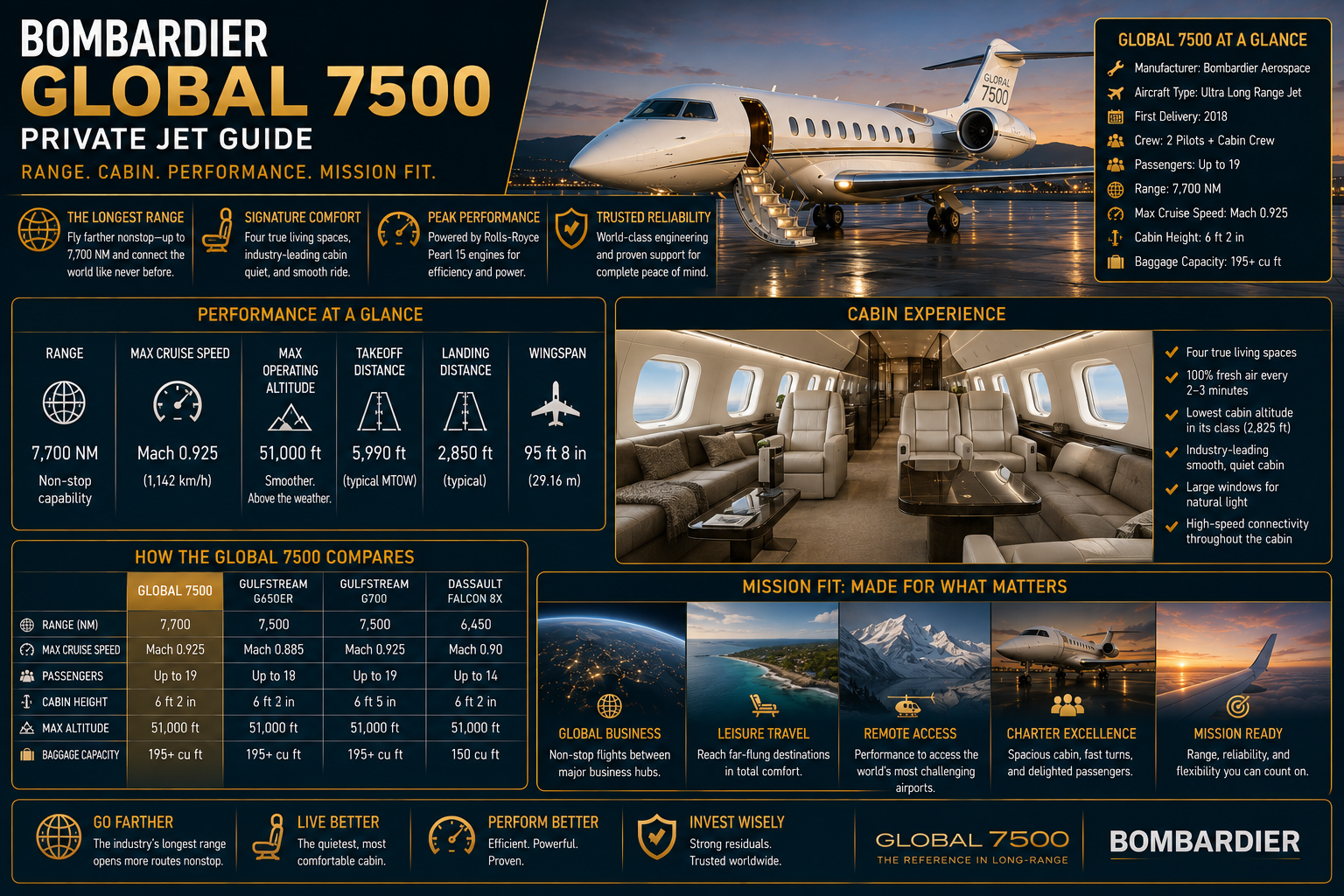
The Bombardier Global 7500 is an ultra-long-range business jet built around approximately 7,700 nautical miles of theoretical range, Mach 0.925 top speed, four full-size living spaces and a cabin designed for intercontinental executive, family-office and private travel. It remains one of the most capable large-cabin business aircraft in the operating fleet.
The Bombardier Global 7500 changed the scale of purpose-built business aviation.
It combined extreme range with a cabin large enough to function as several distinct environments.
Therefore, travelers do not need to choose only between distance and cabin usability.
They can have both.
Bombardier publishes approximately 7,700 nautical miles of theoretical maximum range at Mach 0.85 under defined NBAA IFR assumptions.
Therefore, the Global 7500 can support many of the world’s most demanding intercontinental city pairs when payload, winds, routing and airport conditions permit.
However, theoretical range is not a guaranteed nonstop radius.
Weather matters.
Headwinds matter.
Passenger and baggage weight matter.
Additionally, actual routing and required fuel reserves matter.
Consequently, every mission requires professional flight planning.
The aircraft’s speed further expands its usefulness.
Bombardier publishes a top speed of approximately Mach 0.925.
Therefore, the Global 7500 belongs in the same high-speed ultra-long-range decision set as aircraft such as the Gulfstream G650 family and Gulfstream G700.
However, maximum speed and maximum range do not occur simultaneously.
Flying faster increases fuel consumption.
Therefore, crews balance cruise speed against required range.
Consequently, a mission comfortably inside the aircraft’s range envelope can prioritize speed differently from one approaching its maximum practical distance.
The Global 7500 also climbs to a maximum operating altitude of approximately 51,000 feet.
Therefore, it can operate above much of commercial airline traffic when weight, weather and air traffic control permit.
That high-altitude capability can help crews find favorable winds or avoid portions of lower-altitude weather.
However, maximum altitude is not necessarily the initial cruise altitude after a heavy departure.
A fully fueled aircraft can begin lower.
Then, as fuel burns and weight decreases, the crew can climb.
Consequently, the actual flight profile changes throughout a long mission.
Bombardier’s Smooth Flĕx Wing is central to that performance.
The wing was engineered to combine high-speed efficiency, low-speed performance and ride quality.
Therefore, its role extends beyond range.
It influences airport capability.
It supports the aircraft at high cruise speeds.
Additionally, Bombardier designed it to reduce the effects of turbulence transmitted into the cabin.
Consequently, the wing contributes to both aircraft performance and passenger experience.
Two GE Passport engines power the Global 7500.
Therefore, the propulsion system was designed specifically around the requirements of a very large ultra-long-range business aircraft.
Engine efficiency matters because the aircraft may remain airborne for well over ten hours on demanding missions.
Thrust matters because maximum takeoff weight is approximately 114,850 pounds.
Additionally, engine lifecycle and support matter to owners because propulsion costs represent an important part of long-term aircraft economics.
Consequently, ownership analysis should evaluate engine condition and support-program status as carefully as cabin design.
Airport performance is another major strength.
Bombardier publishes a takeoff distance of approximately 5,760 feet at sea level, standard temperature and maximum takeoff weight.
Therefore, the Global 7500 combines very long range with comparatively strong runway performance for an aircraft of its size.
However, that number is only a reference condition.
A high-elevation airport changes the answer.
Hot weather changes it further.
Runway contamination matters.
Wind matters.
Additionally, aircraft weight can change the result substantially.
Therefore, the operator calculates performance for the exact departure.
This matters on routes involving airports such as Aspen or Centennial.
A large aircraft may have more than enough theoretical range to reach the destination.
However, departure performance from a hot or elevated airport can become the harder problem.
Consequently, range should never be evaluated independently from runway and climb performance.
The Global 7500’s cabin is equally important.
Bombardier designed the aircraft around four full-size living spaces.
Therefore, passengers can create genuine separation between work, dining, entertainment and rest.
That is materially different from simply dividing one long cabin with visual seating groups.
Instead, the Global 7500 was designed around distinct zones from the beginning.
A Club Suite can support individual seating and conversation.
A Conference Suite can support meetings and dining.
An Entertainment Suite can create another social or relaxation environment.
Additionally, a Principal Suite can support sleeping and private use.
Consequently, the aircraft can change functions throughout a long trip without forcing every passenger to do the same thing.
The cabin can also include a dedicated crew suite.
Therefore, augmented crews can rest without consuming the same passenger space that might otherwise be needed on a long overnight mission.
That becomes increasingly important as stage length grows.
A six-hour trip and a fourteen-hour trip create completely different crew requirements.
Consequently, dedicated crew-rest capability supports the aircraft’s extreme-range mission.
Bombardier also designed the aircraft around a large full-size kitchen.
Therefore, catering on a Global 7500 can go beyond basic cold food or reheated meals.
On long flights, passengers may eat several times.
A family may require different meals.
Executives may want dining timed around meetings.
Additionally, international departures can require more substantial provisioning.
Consequently, galley capability becomes a real mission feature rather than a luxury specification.
Passenger capacity reaches up to 19 depending on configuration.
However, maximum seating is not the same as optimal long-range occupancy.
A Global 7500 carrying eight passengers can provide extraordinary individual space.
A larger group can still travel comfortably.
However, sleeping requirements, baggage and cabin privacy become increasingly important as passenger count rises.
Therefore, practical capacity should always be matched to trip duration.
The aircraft’s four-zone layout is especially relevant for family offices.
A principal can occupy one section.
Children or family members can use another.
Staff can continue working.
Security personnel can remain elsewhere.
Additionally, crew can have dedicated rest space.
Consequently, several different passenger roles can coexist without turning the cabin into one shared room.
Executives can use the aircraft similarly.
A conference area can support meetings.
Individual seats can support focused work.
A rear suite can become a private rest area.
Additionally, the cabin can support dining without interrupting every passenger.
Therefore, the aircraft can operate as a mobile office, meeting room, dining room and bedroom during one mission.
Cabin environment becomes particularly important because the Global 7500 can remain airborne long enough to cross several time zones.
Bombardier’s Soleil lighting system is designed around circadian-rhythm considerations.
Therefore, cabin lighting can be adjusted around destination time and planned sleep periods.
That does not eliminate jet lag.
However, it gives passengers another tool for managing a long international trip.
Consequently, lighting becomes part of mission planning rather than simply cabin decoration.
The Global family also uses Bombardier’s Pũr Air system.
The system can provide filtered recirculated air as well as 100% fresh-air operation.
Therefore, passengers have an advanced cabin-air management system designed for long-duration travel.
Additionally, HEPA filtration can remove very small airborne contaminants from recirculated air.
Consequently, cabin air becomes another aspect of the aircraft’s passenger environment.
The Global 7500 also uses Bombardier’s Nuage seating.
Therefore, the passenger experience is not defined only by cabin dimensions.
Seat architecture matters.
The Nuage seat was designed to support a wider range of positions than conventional business-jet seating.
That can be particularly valuable during long flights.
Passengers may sit upright to work.
They may recline to relax.
Additionally, seating may be converted into sleeping arrangements depending on the cabin configuration.
Consequently, long-duration comfort should be evaluated at the seat level as well as the aircraft level.
The aircraft entered service in 2018.
Therefore, the operating fleet is mature enough that charter travelers can encounter different interior configurations and ownership histories.
However, it remains far newer as a platform than aircraft such as the Gulfstream G550.
Consequently, many Global 7500 aircraft retain relatively modern cabin, avionics and connectivity systems.
The Global 8000 introduces the next evolution of the platform.
Therefore, current buyers should understand the relationship between the two aircraft.
The Global 7500 established the four-zone cabin and core airframe architecture.
Meanwhile, the Global 8000 extends the platform’s performance envelope.
Consequently, a Global 7500 should not be evaluated as if it became obsolete when the Global 8000 arrived.
Instead, travelers should ask whether the additional performance of the newer evolution actually matters to the mission.
The Gulfstream G700 creates another natural comparison.
The G700 publishes approximately 7,750 nautical miles of maximum theoretical range.
Therefore, its headline range sits close to the Global 7500’s 7,700-nautical-mile benchmark.
However, the aircraft approach cabin design differently.
The G700 emphasizes Gulfstream’s largest cabin and up to five living areas.
The Global 7500 emphasizes four full-size zones.
Consequently, passenger preference, route, availability and specific cabin layout become more useful comparison factors than a small difference in published maximum range.
The aircraft also competes with the Gulfstream G650 and G650ER in the operating fleet.
Those aircraft provide extremely high speed and substantial range.
Therefore, charter travelers may see all three types quoted for similar missions.
However, positioning can matter more than specifications.
A nearby Global 7500 can provide stronger economics than a G700 requiring a long repositioning leg.
A nearby G650 can do the same.
Consequently, charter selection should compare real aircraft rather than generic brochure models.
Ownership creates another decision layer.
The Global 7500 is a very large and sophisticated business aircraft.
Therefore, operating cost extends well beyond fuel.
Crew salaries matter.
Training matters.
Maintenance matters.
Insurance matters.
Hangar requirements matter.
Connectivity subscriptions matter.
Additionally, engine and component support programs can materially influence lifecycle economics.
Consequently, ownership should be justified by recurring mission demand rather than occasional interest in maximum capability.
The aircraft’s physical size also matters operationally.
A large cabin requires a large airframe.
Therefore, hangar and ramp planning should be considered.
Airport parking can become especially important during major events.
FBO capability matters.
Ground handling matters.
Additionally, international destinations may require advance parking coordination.
Consequently, a Global 7500 mission is not simply a flight-planning exercise.
It is a logistics exercise.
This becomes especially visible in cities such as Las Vegas.
The runway system can support large business aircraft.
However, major events can fill private aviation ramps quickly.
Therefore, parking may become more difficult than runway performance.
Likewise, Teterboro provides excellent access to New York.
However, airport restrictions, runway analysis and slot or traffic conditions can influence the mission.
Consequently, passenger geography and airport operations should be evaluated together.
At Van Nuys, the calculation changes again.
Its Los Angeles location can substantially reduce ground travel for many passengers.
Therefore, it can provide a strong Global 7500 itinerary when performance permits.
Dallas Love Field can also provide useful runway infrastructure and central geography.
Additionally, airports such as Opa-locka can provide strong private aviation access in South Florida.
Consequently, the best airport depends on where the passenger is actually going.
Ultra-long-range travel also changes the meaning of door-to-door efficiency.
The Global 7500 may save a fuel stop on a very long route.
That can save substantial time.
However, choosing a distant airport at either end can give part of that advantage back.
Therefore, the aircraft should be paired with airports that preserve the travel-time benefit.
This is especially important for executive travel.
A CEO does not gain much from saving 45 minutes in the air and then adding 90 minutes of unnecessary ground transportation.
Consequently, itinerary planning should optimize the entire trip.
The Global 7500 becomes particularly compelling when several difficult requirements overlap.
The route is very long.
The passenger group needs multiple cabin zones.
Some passengers need to sleep.
Others need to work.
Substantial baggage must travel.
Additionally, the schedule rewards nonstop capability.
Therefore, the aircraft’s value compounds when it solves several problems simultaneously.
A short domestic trip creates the opposite scenario.
The aircraft can certainly perform it.
However, most of its extreme-range capability remains unused.
Therefore, a smaller large-cabin or super-midsize aircraft can often produce better economics.
Consequently, travelers should not select the Global 7500 simply because it is available.
They should select it because the mission needs it.
This guide evaluates that mission in detail.
It examines range.
It examines speed.
It examines runway performance.
It examines the Smooth Flĕx Wing.
It examines the four-zone cabin.
It examines passenger and sleeping capacity.
Additionally, it examines baggage, international travel, charter, ownership and direct aircraft comparisons.
Most importantly, it answers the decision that should guide every aircraft selection:
Does the Bombardier Global 7500 solve this specific trip better than the other aircraft capable of flying it?
Direct Global 7500 Answer
Is the Bombardier Global 7500 a Good Private Jet?
Direct Answer: Yes. The Bombardier Global 7500 is one of the most capable ultra-long-range business jets in service, combining approximately 7,700 nautical miles of theoretical range at Mach 0.85, Mach 0.925 top speed, four full-size living spaces, seating for up to 19 passengers and a 51,000-foot maximum operating altitude.
The Global 7500 is designed around difficult missions.
Therefore, it becomes most valuable when the trip requires both extreme performance and substantial cabin functionality.
Published Maximum Range
Bombardier publishes approximately 7,700 nautical miles of theoretical range at Mach 0.85 under defined reference assumptions.
Top Speed
The Global 7500 combines ultra-long-range capability with very high business-jet cruise performance.
Full-Size Living Spaces
The cabin can provide four distinct areas for work, dining, entertainment and rest.
Maximum Passenger Seating
Bombardier lists maximum seating capacity of up to 19 passengers depending on configuration.
Maximum Operating Altitude
High-altitude capability supports long-range routing flexibility when conditions permit.
Published Takeoff Benchmark
Bombardier publishes approximately 5,760 feet at sea level, ISA and maximum takeoff weight.
What Is the Global 7500’s Biggest Strength?
The combination of cabin and range.
Some aircraft provide extreme range.
Others provide large cabins.
However, the Global 7500 combines approximately 7,700-nautical-mile-class capability with four full-size living spaces.
Therefore, passengers can use the aircraft as a multi-room environment during very long flights.
What Is Its Biggest Limitation?
The aircraft is substantial.
Therefore, operating economics, ramp space, crew requirements and hangar requirements can be significant.
Additionally, shorter missions can leave much of the aircraft’s capability unused.
Consequently, travelers should not automatically select it for trips that a smaller aircraft can solve efficiently.
Who Benefits Most From the Global 7500?
Family offices can benefit.
Global corporations can benefit.
Principals traveling with staff and security can benefit.
Additionally, travelers who frequently fly overnight intercontinental missions can benefit.
Therefore, the aircraft becomes especially compelling when several cabin zones are used during a long nonstop flight.
The Global 7500 is strongest when the trip is long enough and complex enough to use both its 7,700-nautical-mile-class range and four-zone cabin.
Extreme specifications create the most value when the mission actually needs them.
Global 7500 Platform Context
What Is the Current Bombardier Global 7500 Platform Status?
Direct Answer: The Global 7500 entered service in 2018 and established the four-zone ultra-long-range platform that Bombardier subsequently evolved into the Global 8000. Existing Global 7500 aircraft remain highly relevant in private, corporate and charter aviation, while travelers and buyers should now compare the 7500 with the newer Global 8000 evolution when maximum performance is required.
The arrival of a newer aircraft does not erase the capability of the existing fleet.
Therefore, platform evolution should be separated from mission usefulness.
The Global 7500 already provides extraordinary range.
It already provides four full-size living spaces.
It already provides very high cruise speed.
Additionally, it has an established operating fleet.
Consequently, the aircraft remains a serious charter and ownership platform.
Why Does the Global 8000 Matter to Global 7500 Buyers?
The Global 8000 advances the same broad platform concept.
Therefore, buyers should determine whether its additional performance creates meaningful value.
If recurring missions repeatedly push the Global 7500’s range or speed envelope, the newer evolution can become attractive.
However, if the Global 7500 already solves those missions comfortably, the difference may be less important.
Does Platform Evolution Make the Global 7500 Obsolete?
No.
Aircraft usefulness is determined by mission capability.
Therefore, a Global 7500 that meets the required range, passenger, cabin and airport requirements remains operationally relevant.
Additionally, the aircraft’s established fleet creates charter and pre-owned market opportunities.
Consequently, travelers should compare practical mission value rather than model chronology alone.
Why Does the Operating Fleet Matter?
Fleet maturity creates real aircraft availability.
Therefore, charter travelers can compare aircraft location and exact configuration.
Owners can also evaluate aircraft with established operating histories.
Additionally, maintenance and support networks gain experience as the fleet matures.
Consequently, an established platform can provide advantages that a newly introduced aircraft may not immediately match.
The Global 8000 moves the platform forward, but the Global 7500 remains an extraordinary operating aircraft because its existing capability is already sufficient for many of the world’s longest business-aviation missions.
The mission determines whether the newer evolution matters.
Global 7500 Specifications
What Are the Bombardier Global 7500’s Main Specifications?
Direct Answer: Bombardier publishes approximately 7,700 nautical miles of theoretical maximum range, Mach 0.925 top speed, a 51,000-foot maximum operating altitude, 114,850-pound maximum takeoff weight, up to 19 passenger seats and a 5,760-foot sea-level/ISA/MTOW takeoff-distance benchmark for the Global 7500.
| Specification | Bombardier Global 7500 | Mission Meaning |
|---|---|---|
| Aircraft Category | Ultra-long-range large-cabin business jet | Designed for demanding intercontinental and global private aviation |
| Maximum Published Range | Approximately 7,700 nautical miles at Mach 0.85 | Supports many of the world’s longest business-aviation city pairs under suitable conditions |
| Top Speed | Mach 0.925 | Provides very high cruise performance when maximum range is unnecessary |
| Maximum Operating Altitude | 51,000 feet | Supports high-altitude routing and cruise flexibility |
| Maximum Takeoff Weight | Approximately 114,850 pounds | Makes payload and runway planning important on heavy long-range departures |
| Published Takeoff Distance | Approximately 5,760 feet at sea level, ISA and MTOW | Strong reference performance for an aircraft with this size and range |
| Maximum Passenger Seating | Up to 19 passengers | Actual comfortable capacity depends on cabin configuration and flight duration |
| Standard Accommodation Reference | 17 passengers | Bombardier’s environmental documentation identifies 17-passenger standard accommodation |
| Living Spaces | Four full-size cabin zones | Allows simultaneous work, dining, entertainment and rest |
| Crew Area | Dedicated crew-suite capability | Supports augmented crews on extreme-range missions |
| Kitchen | Full-size kitchen | Supports multiple meal services on long international flights |
| Wing | Bombardier Smooth Flĕx Wing | Supports high-speed performance, short-field capability and ride quality |
| Engines | Two GE Passport turbofan engines | Power the aircraft’s ultra-long-range and high-speed mission profile |
| Cabin Air | Bombardier Pũr Air system | Provides advanced cabin-air management for long-duration flights |
| Cabin Lighting | Bombardier Soleil lighting system | Supports destination-timed and circadian-oriented lighting strategies |
| Primary Seating | Bombardier Nuage seating family | Designed around comfort and multiple seating positions during long missions |
Which Global 7500 Specification Matters Most?
The mission decides.
A global principal can prioritize range.
An executive team can prioritize four-zone cabin separation.
A traveler using more constrained airports can prioritize runway performance.
Additionally, an owner can prioritize operating economics and support.
Therefore, no single specification should determine the aircraft decision.
Why Is Maximum Takeoff Weight Important?
The aircraft can depart at nearly 115,000 pounds.
Therefore, fuel, passengers, baggage and catering all contribute to substantial departure weight.
That matters most at hot, high or runway-constrained airports.
Consequently, a Global 7500’s extraordinary range still depends on the departure environment.
Why Should Published Specifications Be Treated as Reference Conditions?
Because the real world changes them.
Temperature changes.
Wind changes.
Routing changes.
Aircraft options add weight.
Additionally, passenger and baggage loads differ.
Therefore, manufacturer specifications should guide comparison while operator calculations determine the actual flight.
The Global 7500’s headline numbers are extraordinary, but the real value comes from how range, speed, cabin and runway performance work together.
Mission fit should connect the complete specification set.
Global 7500 Range
How Far Can a Bombardier Global 7500 Fly?
Direct Answer: Bombardier publishes approximately 7,700 nautical miles of theoretical maximum range for the Global 7500 at Mach 0.85 with eight passengers, four crew, NBAA IFR reserves and defined standard conditions. Actual nonstop range varies with payload, winds, routing, temperature, weather, airport elevation and aircraft configuration.
Seven thousand seven hundred nautical miles creates enormous geographic reach.
Therefore, many transatlantic missions use only part of the aircraft’s capability.
Long transpacific and U.S.-to-Middle-East missions begin to use much more.
Consequently, the Global 7500 becomes increasingly valuable as stage length grows.
Why Is 7,700 Nautical Miles Significant?
Because it places many distant global business markets within theoretical nonstop reach.
Therefore, travelers can potentially remove technical fuel stops from routes that would challenge shorter-range aircraft.
That can save time.
It can reduce passenger disruption.
Additionally, it can simplify complex itineraries.
Consequently, range can create schedule value beyond the raw distance number.
Does the Global 7500 Always Fly 7,700 Nautical Miles?
No.
The published range uses specific assumptions.
Therefore, real-world conditions change the answer.
A strong headwind can reduce range margin.
Additional payload matters.
Routing around restricted airspace can increase distance.
Additionally, high-elevation departure performance can limit available fuel.
Consequently, the operator determines practical nonstop capability for each mission.
When Is the Global 7500’s Range Excessive?
Many domestic and shorter international flights require only a fraction of its endurance.
Therefore, a smaller large-cabin aircraft may complete those missions more efficiently.
However, cabin requirements can still justify the Global 7500 even when range is not needed.
Consequently, range should be considered alongside passenger and cabin requirements.
The Global 7500’s 7,700-nautical-mile benchmark is most valuable when it removes a stop or creates meaningful schedule margin—not simply because the aircraft can fly that far.
Useful range is the range the passenger actually needs.
Speed vs. Range
How Does Flying Faster Affect Bombardier Global 7500 Range?
Direct Answer: Flying the Global 7500 faster generally reduces maximum range because higher cruise speeds require more fuel. Bombardier’s approximately 7,700-nautical-mile theoretical range is referenced at Mach 0.85, while the aircraft can operate substantially faster when the route provides enough range margin.
Speed creates a tradeoff.
Therefore, maximum range and maximum speed should not be treated as one simultaneous specification.
On a shorter intercontinental mission, the aircraft may have substantial excess fuel margin.
Therefore, crews can prioritize a faster cruise strategy when appropriate.
However, a mission approaching the practical range limit requires more efficient fuel management.
Consequently, long-range cruise strategy becomes part of aircraft optimization.
Why Would Passengers Want to Fly Faster?
Time can have very high value.
Therefore, reducing a long flight by even part of an hour can matter to executives, principals and time-sensitive travelers.
Additionally, faster cruise can improve an arrival schedule.
Consequently, high-speed capability can create economic value even when the aircraft’s maximum range is not being used.
Why Would Crews Stay Near Mach 0.85?
Range margin.
Bombardier uses Mach 0.85 for its published 7,700-nautical-mile theoretical range reference.
Therefore, an extreme-distance mission can require a more efficient cruise strategy.
Consequently, the harder problem determines the strategy: time or distance.
Does a Faster Aircraft Always Produce a Faster Trip?
No.
Aircraft positioning matters.
Airport geography matters.
Ground transportation matters.
Additionally, technical stops can completely change total trip time.
Therefore, a theoretically faster jet can still produce a slower door-to-door itinerary.
The Global 7500 gives operators the ability to trade some range for speed when the mission allows it.
The right cruise strategy depends on whether time or distance is the limiting factor.
Practical Global 7500 Range
Can the Global 7500 Really Fly 7,700 Nautical Miles Nonstop?
Direct Answer: Yes, the Global 7500 is designed around approximately 7,700 nautical miles of theoretical maximum range under Bombardier’s stated reference assumptions. However, a real flight near that distance is highly sensitive to payload, winds, routing, departure performance, weather and reserves, so 7,700 nautical miles should be treated as a performance benchmark rather than a guaranteed nonstop radius.
A brochure range circle is static.
The atmosphere is not.
Therefore, real-world mission capability changes continuously.
Headwinds
Strong winds can increase flight time and fuel consumption, reducing practical range margin.
Payload
Passengers, baggage and catering all contribute to aircraft weight.
Routing
Weather avoidance, airspace restrictions and ATC routing can increase actual distance.
Airport Elevation
High-elevation departures can reduce takeoff performance and influence usable fuel load.
Temperature
Hot conditions can materially affect heavy-aircraft departure performance.
Cruise Strategy
Faster cruise generally trades some maximum-range capability for time.
Why Can Direction Change the Answer?
Prevailing winds can create large differences between opposite directions on the same city pair.
Therefore, one leg can have generous nonstop margin while the return becomes substantially more demanding.
Consequently, both directions should be evaluated separately.
What Happens if the Route Exceeds Practical Range?
A technical fuel stop can be added.
Payload can sometimes be adjusted.
A different airport can occasionally improve departure performance.
Additionally, another aircraft can be selected.
Therefore, the trip remains possible even when the nonstop plan changes.
When Does the Global 8000 Become More Relevant?
When the Global 7500 repeatedly approaches its practical range boundary.
Therefore, additional certified range can create greater nonstop margin on recurring extreme-distance missions.
However, travelers whose routes fit comfortably within Global 7500 capability may gain little from moving up solely for additional range.
The Global 7500 can genuinely perform extreme-distance nonstop missions, but the real answer comes from the day’s aircraft weight, winds, routing and airport conditions.
Published range defines capability. Flight planning defines the mission.
Global 7500 Speed
How Fast Is the Bombardier Global 7500?
Direct Answer: Bombardier publishes a top speed of approximately Mach 0.925 for the Global 7500. Its combination of very high cruise speed and approximately 7,700 nautical miles of theoretical range allows travelers to balance rapid long-distance transportation with exceptional nonstop capability.
Speed matters most when it changes the travel day.
Therefore, raw Mach numbers should be translated into mission value.
A modest speed difference on a short flight may produce little benefit.
However, a difference sustained over many hours can become meaningful.
Consequently, frequent global travelers can value high-speed capability more than occasional passengers.
Is Mach 0.925 the Normal Cruise Speed?
No.
Top speed and normal long-range cruise are different operating points.
Therefore, passengers should not multiply route distance by Mach 0.925 and assume that is the expected flight time.
Actual cruise varies with mission requirements.
How Does Global 7500 Speed Compare With the G700?
Both aircraft operate in the very-high-speed ultra-long-range category.
Therefore, practical differences should be evaluated by the exact route and cruise strategy rather than simply comparing maximum Mach numbers.
Additionally, airport and positioning differences can outweigh small cruise-speed differences.
Why Does High Speed Matter More to Frequent Flyers?
Because small time savings compound.
An owner flying hundreds of hours per year can accumulate substantial schedule value from faster missions.
Therefore, high speed can become part of the ownership business case.
Consequently, utilization matters when assigning economic value to aircraft speed.
Mach 0.925 is impressive, but the Global 7500’s real speed advantage is the ability to combine very high cruise performance with genuine ultra-long-range capability.
Speed matters most when it changes the passenger’s schedule.
GE Passport Propulsion
Which Engines Power the Bombardier Global 7500?
Direct Answer: The Bombardier Global 7500 is powered by two GE Passport turbofan engines. The propulsion system was selected to support the aircraft’s combination of approximately 114,850-pound maximum takeoff weight, 7,700-nautical-mile theoretical range and high-speed intercontinental performance.
The Passport engines are central to the Global 7500 mission.
Therefore, they influence both aircraft performance and ownership economics.
Ultra-long-range flight requires efficiency.
Heavy departures require thrust.
High-speed cruise requires aerodynamic and engine integration.
Additionally, owners need reliable support across a global operating network.
Consequently, propulsion is part of both the performance and lifecycle decision.
Why Does Engine Efficiency Matter So Much?
Because the aircraft can remain airborne for many hours.
Therefore, small efficiency differences accumulate across long missions.
That affects range.
It affects fuel requirements.
Additionally, it influences operating economics.
Consequently, engine efficiency is fundamental to an ultra-long-range aircraft.
Why Should Owners Evaluate Engine Programs?
Engine maintenance can represent significant lifecycle expense.
Therefore, program enrollment, engine history and future maintenance exposure matter.
That becomes particularly important in a pre-owned acquisition.
Consequently, buyers should evaluate propulsion status alongside the rest of the aircraft.
Do Powerful Engines Remove Runway Limitations?
No.
Aircraft weight still matters.
Temperature matters.
Elevation matters.
Runway condition matters.
Additionally, terrain and obstacle requirements can matter.
Therefore, propulsion capability works with the entire aircraft rather than eliminating mission-specific performance limits.
The Global 7500’s GE Passport engines support extreme range and speed, but owners should evaluate them as both performance systems and long-term financial assets.
Engine condition matters to the mission and the balance sheet.
High-Altitude Performance
How High Can a Bombardier Global 7500 Fly?
Direct Answer: Bombardier publishes a maximum operating altitude of approximately 51,000 feet for the Global 7500. Actual cruise altitude depends on aircraft weight, weather, air traffic control and mission strategy, so a heavily fueled aircraft may cruise lower early in a long flight before climbing as fuel burns.
High-altitude capability creates flexibility.
Therefore, crews can sometimes operate above portions of airline traffic and lower-level weather.
However, altitude does not automatically mean faster or smoother.
Atmospheric conditions still vary.
Consequently, the crew chooses altitude based on the actual flight.
Does the Global 7500 Immediately Climb to 51,000 Feet?
Not necessarily.
A heavy aircraft can require lower initial cruise levels.
Therefore, crews may climb in stages as fuel is burned.
This is common on long-range missions.
Consequently, maximum operating altitude should not be confused with standard initial cruise altitude.
Why Can Higher Altitude Help Range?
Jet aircraft can often operate efficiently at higher cruise levels.
Therefore, climbing as weight decreases can support efficient long-range performance.
However, winds and air traffic control can alter the ideal altitude.
Consequently, altitude strategy remains dynamic.
Does Flying at 51,000 Feet Avoid All Turbulence?
No.
Turbulence can occur at many altitudes.
Therefore, maximum altitude does not guarantee a smooth ride.
However, the aircraft’s Smooth Flĕx Wing is designed specifically with ride quality in mind.
Consequently, airframe design and flight-level strategy work together.
The Global 7500’s 51,000-foot ceiling provides operating flexibility, but crews use altitude strategically rather than simply flying as high as possible.
The best flight level changes with the mission.
Global 7500 Airport Performance
How Much Runway Does a Bombardier Global 7500 Need?
Direct Answer: Bombardier publishes an approximately 5,760-foot takeoff distance for the Global 7500 at sea level, standard temperature and maximum takeoff weight. Actual runway requirements vary with aircraft weight, temperature, elevation, wind, runway condition, obstacles and other operating factors.
The published figure is impressive for an aircraft with approximately 7,700 nautical miles of range.
However, it is still a reference benchmark.
Therefore, passengers should never compare 5,760 feet with a runway length and assume the mission is automatically approved.
Weight
Passengers, baggage and fuel determine the mass the aircraft must accelerate and climb with.
Temperature
Hot weather reduces air density and can increase required runway distance.
Elevation
High-elevation airports reduce aircraft performance compared with sea-level reference conditions.
Wind
Headwind and tailwind components affect departure-performance calculations.
Runway Condition
Wet or contaminated pavement can change allowable aircraft performance.
Terrain
Required climb performance after takeoff can matter as much as physical runway length.
Why Is Short-Field Performance Important on an Ultra-Long-Range Jet?
Because passengers choose private aviation partly for airport access.
Therefore, an aircraft that can fly 7,700 nautical miles but requires only the largest international airports would lose some private-aviation flexibility.
The Global 7500’s wing and performance design broaden its usable airport network.
Consequently, runway performance contributes directly to door-to-door value.
Can a Global 7500 Land at an Airport It Cannot Leave Fully Fueled?
Potentially.
The aircraft may arrive much lighter after burning fuel.
Therefore, landing performance can be comfortable.
However, a long-range departure may require a much heavier fuel load.
Consequently, the return mission can create a different runway problem.
Can a Technical Fuel Stop Improve Airport Performance?
Yes.
Departing with less fuel reduces aircraft weight.
Therefore, the aircraft may be able to use a performance-constrained airport more comfortably before refueling elsewhere.
However, that sacrifices nonstop travel.
Consequently, airport access and nonstop range sometimes require a tradeoff.
The Global 7500’s 5,760-foot published benchmark is strong, but the actual runway requirement is calculated from the real aircraft, real weather and real airport.
Reference performance is not mission approval.
Smooth Flĕx Wing
What Is the Bombardier Global 7500 Smooth Flĕx Wing?
Direct Answer: Bombardier’s Smooth Flĕx Wing is the Global 7500’s advanced wing design, engineered to combine high-speed performance, low-speed handling and improved ride characteristics. Its design helps the aircraft achieve extreme range while also supporting comparatively strong runway performance for a business jet of its size.
The wing connects several Global 7500 capabilities.
Therefore, it should not be understood as a passenger-comfort feature alone.
It contributes to high-speed cruise.
It contributes to range.
It contributes to low-speed performance.
Additionally, its flexibility is designed to reduce the transmission of turbulence into the cabin.
Consequently, one aerodynamic system affects several parts of the mission.
Why Does Wing Flex Matter to Passenger Comfort?
A wing can absorb and respond to atmospheric disturbances.
Therefore, Bombardier engineered the Smooth Flĕx Wing with ride quality in mind.
However, no wing can remove all turbulence.
Consequently, passengers should treat improved ride characteristics as a design advantage rather than a guarantee of perfectly smooth air.
How Does the Wing Help Airport Performance?
The wing must perform efficiently at both low and high speeds.
Therefore, its design supports the aircraft during takeoff and landing as well as cruise.
That becomes particularly important for an aircraft exceeding 100,000 pounds at maximum takeoff weight.
Consequently, aerodynamic design helps expand the Global 7500’s usable airport network.
How Does the Wing Help Long-Range Cruise?
Efficient aerodynamics reduce the energy required to maintain flight.
Therefore, wing design contributes directly to fuel efficiency and range.
At the same time, the aircraft must remain capable at very high cruise speeds.
Consequently, the Smooth Flĕx Wing supports the Global 7500’s unusual combination of speed and endurance.
The Smooth Flĕx Wing helps explain why the Global 7500 can combine extreme range, very high speed, strong runway performance and a cabin designed for a smoother ride.
Its value spans both performance and passenger experience.
Global 7500 Airport Compatibility
Which Airports Can a Bombardier Global 7500 Use?
Direct Answer: The Global 7500 can use many major international and executive airports worldwide, although suitability depends on aircraft weight, runway length, temperature, elevation, terrain, ramp space, FBO capability and local operating requirements. The aircraft’s published 5,760-foot sea-level/ISA/MTOW takeoff benchmark provides strong airport flexibility for its size, but every mission still requires exact performance calculations.
Ultra-long-range capability creates a global network.
However, airport suitability remains local.
Therefore, every mission must connect the two.
| Airport Environment | Typical Global 7500 Fit | Primary Planning Issue |
|---|---|---|
| Major International Airport | Generally strong | Traffic, slots, parking, customs and passenger geography |
| Major Business Aviation Airport | Often strong | Runway performance, ramp space and local restrictions |
| Shorter Executive Airport | Mission dependent | Departure weight and runway margin |
| High-Elevation Airport | Mission dependent | Density altitude and fuel load |
| Mountain Airport | Specialized analysis required | Terrain, elevation, weather and runway performance |
| Major Event Airport | Potentially strong | Parking and ramp capacity can become more restrictive than runway length |
Can a Global 7500 Use Teterboro?
Teterboro supports substantial large-cabin and ultra-long-range business aviation activity.
Therefore, it can be an important New York-area Global 7500 gateway when mission performance and current airport conditions permit.
Travelers can review the Teterboro Airport Private Jet Guide.
Can a Global 7500 Use Van Nuys?
Van Nuys provides extensive business aviation infrastructure and strong access to Los Angeles.
Therefore, it can pair naturally with Global 7500 missions when runway-performance calculations support the actual departure.
Review the Van Nuys Airport Private Jet Guide.
Can a Global 7500 Use Dallas Love Field?
Dallas Love Field provides substantial runway infrastructure and favorable geography for central Dallas.
Therefore, it can support many Global 7500 executive and international missions.
Review the Dallas Love Field Private Jet Guide.
What About Centennial Airport?
Centennial provides a long primary runway.
However, its elevation materially changes aircraft performance compared with sea-level conditions.
Therefore, heavy Global 7500 departures require temperature and density-altitude analysis.
Review the Centennial Airport Private Jet Guide.
Can a Global 7500 Use Aspen?
Aspen requires specialized mission planning.
Elevation matters.
Terrain matters.
Weather matters.
Additionally, aircraft weight and operating requirements matter.
Therefore, the Global 7500’s maximum range should never be used to infer automatic Aspen suitability.
Review the Aspen Airport Private Jet Guide.
The Global 7500 creates enormous geographic reach, but the best itinerary still depends on pairing that range with an airport the aircraft can use efficiently at the required mission weight.
Global range and local airport performance must work together.
Global 7500 Cabin
What Makes the Bombardier Global 7500 Cabin Different?
Direct Answer: The Global 7500 cabin is designed around four full-size living spaces rather than a single long seating area. Depending on configuration, passengers can use separate Club, Conference, Entertainment and Principal areas while a full-size kitchen and dedicated crew suite support long-duration international missions.
The four-zone design is one of the aircraft’s defining features.
Therefore, cabin length becomes functional space rather than simply more room between seats.
Club Suite
Designed around individual Nuage seating, conversation and focused passenger use.
Conference Suite
Supports meetings, group work and formal dining during long flights.
Entertainment Suite
Creates a separate area for relaxation, entertainment and social use.
Principal Suite
Can provide private seating, sleeping and personal-space functionality depending on configuration.
Kitchen
Supports extensive catering and multiple meal services on long intercontinental missions.
Crew Suite
Supports crew rest during very long missions without using the primary passenger living spaces.
Why Do Four Full-Size Living Spaces Matter?
Because passengers can use the cabin simultaneously for different purposes.
One group can hold a meeting.
Another passenger can rest.
Someone else can watch entertainment.
Additionally, the principal can have greater privacy.
Consequently, the cabin can function more like a small series of rooms than one aircraft compartment.
Why Does That Matter More on Long Flights?
Because cabin conflicts increase with time.
A passenger who wants to sleep can conflict with another who wants to work.
A family can have different entertainment needs.
Additionally, an executive may need privacy.
Therefore, physical separation becomes increasingly valuable as mission duration increases.
Is Every Global 7500 Cabin Identical?
No.
Bombardier provides configuration flexibility.
Therefore, exact seating, suite arrangements, finishes and sleeping capability can vary.
Additionally, charter aircraft may differ from one another.
Consequently, travelers should review the actual tail number and floor plan before booking.
The Global 7500’s cabin advantage is not simply that it is large. It is that the space can be divided into four genuine living environments that support different passengers at the same time.
That distinction becomes especially valuable on overnight intercontinental travel.
Specification Verification
Where Should Global 7500 Specifications Be Verified?
Direct Answer: Travelers, operators and buyers should verify current Global 7500 aircraft information through Bombardier and the operator responsible for the specific flight. Manufacturer specifications provide aircraft-level benchmarks, while the operator determines actual payload, runway performance, route capability and configuration for the exact aircraft.
Bombardier publishes Global 7500 information through its official aircraft and technical materials.
Therefore, current manufacturer information should remain the primary aircraft-level reference.
However, aircraft specifications are not flight authorization.
The exact tail number has a specific weight.
It has a specific cabin configuration.
It has specific maintenance status.
Additionally, the planned route has specific weather and payload requirements.
Consequently, operator calculations determine the real mission.
The distinction becomes particularly important near maximum range or at challenging airports.
Therefore, travelers should treat published range and runway figures as research benchmarks rather than guarantees.
Likewise, charter travelers should confirm the actual aircraft’s cabin.
Four-zone capability defines the platform.
However, seating, sleeping arrangements and finishes can vary.
Consequently, exact-aircraft review remains essential before a high-value international charter is confirmed.
Bombardier defines the Global 7500’s aircraft-level capability. The operator determines what the exact aircraft can do on the exact day of the exact mission.
Both levels of information matter.
Four-Zone Cabin Architecture
What Are the Four Global 7500 Living Spaces?
Direct Answer: The Bombardier Global 7500 is designed around four true living spaces that can be configured for work, dining, entertainment and rest. Typical layouts include a Club Suite, Conference Suite, Entertainment Suite and Principal Suite, allowing passengers to use different areas simultaneously during long intercontinental missions.
Four living spaces fundamentally change how passengers use a private aircraft.
Therefore, the Global 7500 should not be evaluated only by cabin length.
The more important question is how that length is divided.
A conventional large-cabin jet may provide several seating groups.
However, those areas can still function as one shared environment.
The Global 7500 creates greater separation.
Consequently, passengers can move between different activities throughout the flight.
Club Suite
The forward passenger zone can support individual seating, conversation, work and relaxation using Bombardier’s Nuage seating architecture.
Conference Suite
A conference and dining area can support meetings, collaborative work and formal meal service.
Entertainment Suite
A separate social environment can allow passengers to relax or use entertainment without disrupting work or sleep elsewhere.
Principal Suite
The rear cabin can create a more private environment for sleeping, relaxing or working away from the main passenger group.
Full-Size Kitchen
The kitchen supports substantial catering and multiple meal services during long international missions.
Dedicated Crew Suite
Crew-rest capability can support augmented operations while preserving the four primary passenger living spaces.
Can Passengers Use All Four Areas at the Same Time?
Yes.
That is one of the primary advantages of the design.
Executives can hold a meeting in one section.
A principal can rest in another.
Other passengers can use entertainment elsewhere.
Additionally, staff can continue working without occupying the principal’s private space.
Therefore, the cabin supports simultaneous activities rather than requiring the entire group to follow one schedule.
Why Is Cabin Separation Important Overnight?
Sleep and activity conflict.
Therefore, physical separation becomes valuable.
Passengers who are awake can continue working or talking.
Meanwhile, passengers in another section can rest.
Consequently, a four-zone cabin can improve the usefulness of an overnight mission even when the aircraft’s flight time is identical to a competitor.
Are the Four Zones Always Configured the Same Way?
No.
Individual aircraft can differ.
Therefore, charter travelers should review current cabin photographs and the actual floor plan.
Likewise, buyers can configure or refurbish an aircraft around their own requirements.
Consequently, the four-zone architecture provides a framework rather than one mandatory interior.
The Global 7500’s cabin advantage comes from functional separation: passengers can work, dine, socialize and sleep in different parts of the aircraft during the same flight.
That capability becomes increasingly valuable as flight duration increases.
Passenger Capacity
How Many Passengers Can a Bombardier Global 7500 Carry?
Direct Answer: Bombardier lists the Global 7500 for up to 19 passengers depending on configuration. However, maximum certified seating should not be confused with the ideal passenger count for a long-range mission because cabin layout, sleeping requirements, baggage, privacy and trip duration can make a lower passenger count substantially more comfortable.
Nineteen passengers demonstrates the scale of the aircraft.
However, most buyers should begin with how passengers will use the cabin.
Therefore, a 10-passenger overnight mission can require more planning than a 16-passenger daytime flight.
Sleeping changes the calculation.
Dining changes it.
Baggage changes it.
Additionally, privacy requirements can change it.
Consequently, practical capacity is mission specific.
Is the Global 7500 Comfortable With Eight Passengers?
Extremely.
Eight passengers can distribute themselves across four full-size living spaces.
Therefore, each traveler can have substantial personal space.
Additionally, the aircraft can maintain dedicated areas for meetings, dining and rest.
Consequently, a smaller passenger group can use the Global 7500 almost like a flying residence or executive suite.
Can 15 or More Passengers Travel?
Potentially, depending on the certified seating configuration of the exact aircraft.
However, passenger count should be evaluated with the mission duration.
A two-hour flight and a fourteen-hour flight create very different comfort requirements.
Therefore, the fact that a seat exists does not automatically make it desirable for an overnight intercontinental mission.
What Should Large Groups Verify Before Booking?
Verify every belted seat.
Verify the floor plan.
Verify baggage volume.
Verify baggage weight.
Additionally, verify sleeping expectations.
Consequently, the operator can determine whether the specific aircraft fits the group rather than relying on the model’s maximum passenger number.
The Global 7500 can seat up to 19 passengers, but its strongest use case is not maximum density. It is giving a smaller group extraordinary space and functional separation over very long distances.
Passenger count should be matched to the mission.
Overnight Missions
How Many People Can Sleep on a Bombardier Global 7500?
Direct Answer: Sleeping capacity varies by the exact Global 7500 cabin configuration because seats, divans and the Principal Suite can be arranged differently. Rather than relying on one model-wide berth number, travelers should verify the actual aircraft’s sleeping positions and determine which passengers require beds or lie-flat arrangements before booking an overnight mission.
Sleeping capacity is not the same as passenger capacity.
Therefore, this distinction becomes critical on ultra-long-range flights.
A seat may be certified for takeoff and landing.
However, it may not convert into a comfortable sleeping position.
Likewise, a divan may create several belted seats but a different number of practical sleeping positions.
Consequently, overnight travelers should request a berth plan.
Why Is the Principal Suite Important?
It can create a private sleeping environment separated from the main cabin.
Therefore, a principal may be able to rest while activity continues elsewhere.
Depending on the aircraft, the rear suite can be configured around substantial sleeping functionality.
Consequently, privacy can become as valuable as the sleeping surface itself.
Can Executives Sleep While Staff Continue Working?
Yes, when the aircraft’s layout supports appropriate separation.
Therefore, the Global 7500 can serve multiple schedules simultaneously.
One passenger can sleep.
Others can work.
Another group can dine.
Additionally, crew can rest separately when the aircraft has the appropriate crew-suite configuration.
Consequently, the cabin architecture supports the operational reality of long global travel.
What Should Be Confirmed Before an Overnight Charter?
Ask for the exact floor plan.
Ask how each sleeping surface is created.
Ask whether bedding is provided.
Confirm privacy between zones.
Additionally, determine whether passengers must share divans or other convertible areas.
Therefore, expectations are established before departure.
Do not book an overnight Global 7500 based only on its passenger capacity. Confirm the actual sleeping configuration of the exact aircraft.
A 19-passenger aircraft does not automatically provide 19 beds.
Global 7500 Baggage
How Much Baggage Can a Bombardier Global 7500 Carry?
Direct Answer: The Global 7500 provides substantial baggage capability for long-range travel, including a large baggage compartment designed around the needs of intercontinental passengers. However, practical baggage capacity depends on item dimensions, baggage weight, passenger load, fuel requirements and the exact aircraft configuration, so oversized equipment should always be declared before booking.
Baggage volume is only one part of loading.
Therefore, cubic feet alone cannot determine whether everything fits.
Shape matters.
Weight matters.
Access dimensions matter.
Additionally, fuel requirements matter.
Consequently, travelers should provide an accurate baggage manifest for demanding missions.
Standard Luggage
Suitcases and conventional travel bags generally fit naturally within the aircraft’s long-range mission profile.
Business Equipment
Presentation materials, equipment cases and other professional items should be identified before departure.
Golf Equipment
Golf bags should be counted separately because club length and hard cases can change loading.
Ski Equipment
Skis and snowboards require dimensional verification rather than only volume calculations.
Pet Equipment
Carriers, beds, food and other pet-related items should be included in the manifest.
Long-Stay Luggage
International and multi-week travel can generate far more baggage per passenger than a short business trip.
Why Does Baggage Matter More Near Maximum Range?
Because baggage has weight.
Therefore, a heavily loaded aircraft can have less flexibility for fuel.
On an extreme-range mission, every component of payload becomes more important.
Consequently, a route that is comfortable with eight lightly packed passengers may require different planning with a large group and extensive luggage.
Should Travelers Send Baggage Details Before Charter Confirmation?
Yes.
That is especially important for oversized equipment.
Therefore, golf clubs, skis, musical instruments, large cases and unusual cargo should be disclosed early.
Consequently, the operator can confirm both physical fit and mission weight.
The Global 7500 is built for substantial international baggage, but extreme-range missions still require payload discipline.
Volume, shape and weight all matter.
Cabin Environment
Why Does Global 7500 Cabin Altitude Matter?
Direct Answer: Cabin altitude matters because passengers may spend many hours aboard a Global 7500 while the aircraft cruises at high altitude. Bombardier designed the aircraft’s pressurization and cabin environment for long-duration travel, helping maintain a substantially lower effective cabin altitude than the aircraft’s actual flight altitude.
A Global 7500 can cruise at altitudes approaching 51,000 feet.
However, passengers do not experience the equivalent atmospheric pressure of 51,000 feet.
The aircraft is pressurized.
Therefore, the cabin remains at a much lower effective altitude.
This matters more as flight duration increases.
A short flight creates limited exposure.
However, an overnight intercontinental mission can keep passengers aboard for many hours.
Consequently, cabin environment becomes part of the travel-product decision.
Does Lower Cabin Altitude Eliminate Jet Lag?
No.
Jet lag is strongly influenced by crossing time zones and disrupting circadian rhythms.
Therefore, cabin pressurization cannot remove it.
However, the overall cabin environment can influence how passengers feel during and after a long flight.
Additionally, lighting, sleep quality, hydration and schedule management matter.
Consequently, the Global 7500 combines several cabin systems rather than relying on one comfort feature.
Why Should Charter Travelers Care About Cabin Environment?
Because arrival condition can be more important than flight time.
An executive may need to attend a meeting immediately after landing.
A family may begin a vacation on arrival.
Additionally, athletes or performers may have demanding schedules.
Therefore, cabin comfort can create practical value beyond luxury.
On an ultra-long-range aircraft, cabin environment is part of performance because the passenger’s condition at arrival can matter as much as the aircraft’s arrival time.
Long flights make human factors more important.
Bombardier Pũr Air
How Does the Bombardier Global 7500 Pũr Air System Work?
Direct Answer: Bombardier’s Pũr Air system is designed to manage the Global 7500 cabin environment using advanced air filtration and fresh-air capability. Depending on operating mode, the system can use HEPA-filtered recirculated air or provide 100% fresh-air operation, giving passengers additional cabin-air flexibility during long missions.
Air quality becomes increasingly relevant with flight duration.
Therefore, the Global 7500 treats cabin-air management as part of the long-range passenger environment.
HEPA filtration can remove very small airborne particles from recirculated cabin air.
Meanwhile, fresh-air operation provides another environmental mode.
Consequently, the aircraft provides more sophisticated cabin-air management than simply moving air through the cabin.
Why Does HEPA Filtration Matter?
HEPA filtration is designed to capture very small airborne particles.
Therefore, filtered recirculation can improve cabin-air management.
However, filtration should not be interpreted as eliminating every possible health risk.
Consequently, passengers should view Pũr Air as an advanced environmental system rather than a guarantee against illness.
Why Does Fresh-Air Capability Matter?
It gives the aircraft another way to manage cabin air.
Therefore, the environmental system can support long-duration missions using outside air rather than relying exclusively on recirculation.
Consequently, air management becomes another part of the aircraft’s long-range design.
Does Air Quality Affect Aircraft Selection?
For short trips, it may rank below route or economics.
However, frequent intercontinental travelers can spend hundreds of hours per year aboard the aircraft.
Therefore, environmental systems become more important as utilization increases.
Consequently, cabin-air design can legitimately influence a high-utilization ownership decision.
Pũr Air is part of a larger Global 7500 strategy: design the cabin around what passengers experience during very long flights, not simply around how the aircraft looks on the ground.
Human performance matters on global missions.
Soleil Cabin Lighting
What Is the Bombardier Global 7500 Soleil Lighting System?
Direct Answer: Bombardier’s Soleil lighting system is an advanced cabin-lighting system designed to dynamically manage illumination during flight and support circadian-oriented scheduling. On long missions crossing multiple time zones, lighting can be coordinated around sleep, waking and destination timing to improve the passenger environment.
Lighting has a functional role on ultra-long-range flights.
Therefore, the cabin does not need to remain in one lighting state throughout the trip.
Passengers may work after departure.
They may eat.
They may sleep.
Then, they may prepare for arrival.
Consequently, lighting can support each phase.
Can Soleil Prevent Jet Lag?
No system can guarantee that.
Crossing many time zones still disrupts the body’s internal clock.
However, light is one of the signals that influences circadian rhythm.
Therefore, controlled lighting can become part of a broader strategy involving sleep timing, meals and destination time.
Why Is This More Useful on a Global 7500 Than on a Short-Range Jet?
Mission duration.
A 90-minute flight provides limited time for a staged lighting program.
However, a twelve- or fourteen-hour flight can include work, dinner, sleep and morning preparation.
Therefore, dynamic lighting has more opportunity to influence the passenger environment.
Should Lighting Affect a Charter Decision?
Usually not by itself.
Route capability comes first.
Aircraft condition matters.
Cabin configuration matters.
However, when several ultra-long-range aircraft can solve the same mission, cabin systems can become useful differentiators.
Consequently, Soleil is most relevant when the major operational requirements are already satisfied.
Soleil lighting is valuable because the Global 7500 can stay airborne long enough for passengers to experience several phases of a normal day inside one flight.
The cabin can adapt as the mission progresses.
Bombardier Nuage Seating
What Makes Global 7500 Nuage Seats Different?
Direct Answer: Bombardier’s Nuage seating was developed to provide greater ergonomic flexibility during long flights, including a deep-recline seating architecture and multiple passenger positions. That matters on the Global 7500 because passengers may use the same seat for working, dining, relaxing and resting over many hours.
Seat comfort compounds with time.
Therefore, a small ergonomic difference can become substantial on an intercontinental flight.
Passengers rarely remain in one position for ten hours.
They work.
They eat.
They talk.
They recline.
Additionally, they may attempt to sleep.
Consequently, seat flexibility becomes part of long-range usability.
Why Is the Seat Important When the Cabin Is Already So Large?
Because passengers still spend substantial time seated.
A large cabin cannot compensate for an uncomfortable seat.
Therefore, aircraft comfort should be evaluated from both macro and micro perspectives.
The cabin provides space.
The seat provides the passenger’s immediate environment.
Consequently, both matter.
Are All Seats on Every Global 7500 Identical?
No.
Cabin configuration can vary.
Therefore, travelers should review the exact aircraft.
Additionally, different cabin zones can contain different furniture.
Consequently, a generic Global 7500 floor plan should not replace aircraft-specific review.
A four-zone cabin creates space, but Nuage seating helps make that space usable for the many hours the Global 7500 is capable of remaining airborne.
Long-range comfort is built from multiple systems working together.
Full-Size Kitchen & Dining
How Important Is the Global 7500 Kitchen on Long Flights?
Direct Answer: The Global 7500’s full-size kitchen is an important mission feature because extreme-range flights can require several meal services for passengers and crew. The galley supports more substantial catering, preparation and storage than passengers typically need on shorter private-jet missions.
Food service changes with mission duration.
Therefore, a long intercontinental trip should not be catered like a two-hour regional flight.
Passengers may eat after departure.
They may want snacks during the flight.
They may eat again before arrival.
Additionally, dietary requirements can differ among passengers.
Consequently, galley capacity becomes operationally useful.
Can Passengers Have Formal Dining Service?
Yes, when the cabin configuration and catering support it.
The Conference Suite can function as a dining area.
Therefore, passengers can sit around a common table rather than eating individually at their seats.
Consequently, the aircraft can support business dinners or family meals during flight.
Why Should Catering Be Planned Around the Route?
Because catering availability differs by airport.
International food-handling rules can also matter.
Additionally, very long missions require careful storage and service planning.
Therefore, catering should be coordinated before departure rather than treated as a last-minute add-on.
Does Galley Capability Matter for Family Offices?
Often.
Children can have different food requirements.
Principals may have dietary preferences.
Staff and crew also need meals.
Therefore, the ability to support several meal schedules can simplify complex family travel.
On a Global 7500, the kitchen is not merely an amenity. It supports the logistics of keeping passengers and crew comfortable across an entire intercontinental travel day.
Mission duration turns catering into an operational requirement.
Augmented Crew Operations
Does the Global 7500 Have a Dedicated Crew Suite?
Direct Answer: The Global 7500 can include a dedicated crew suite designed to support crew rest on long-duration missions. This is important because extreme-range operations can require augmented crews, and dedicated crew-rest space helps preserve the aircraft’s primary passenger zones for passenger use.
Crew rest is part of passenger capability.
That connection is easy to miss.
However, an aircraft cannot use extreme range effectively if crew-duty requirements cannot be managed.
Therefore, crew-rest planning becomes increasingly important as flight duration grows.
Why Would a Flight Need More Than Two Pilots?
Very long missions can exceed practical or regulatory duty limits for a basic crew.
Therefore, augmented crews may be used.
Pilots can rotate rest periods during flight.
Consequently, the aircraft can support longer missions while maintaining appropriate crew management.
Why Does Dedicated Crew Space Benefit Passengers?
Without dedicated crew-rest capability, passenger seating may need to be allocated to resting crew members.
Therefore, the cabin can lose some passenger functionality.
A dedicated crew area helps separate those requirements.
Consequently, the four primary living spaces remain more useful to passengers.
Should Crew Planning Be Discussed Before Charter?
Yes, particularly on very long routes.
The operator determines crew requirements.
Therefore, passengers should understand whether augmented crew is included and how the aircraft is configured for the mission.
Consequently, crew logistics become part of the charter plan rather than an invisible operational detail.
The Global 7500’s extreme range is useful only when the people operating the aircraft can safely support the same mission duration.
Crew-rest capability helps turn theoretical range into practical global transportation.
Inflight Productivity
Does the Bombardier Global 7500 Have High-Speed Wi-Fi?
Direct Answer: Global 7500 aircraft can be equipped with high-speed satellite connectivity suitable for business and entertainment use, although the installed system, service plan, coverage and performance can vary by aircraft. Charter travelers should verify the exact connectivity system when reliable inflight internet is mission critical.
Connectivity can determine whether the cabin functions as a real office.
Therefore, “Wi-Fi equipped” is not enough information for some passengers.
Executives may need video conferencing.
Teams may need cloud applications.
Passengers may want streaming.
Additionally, several devices may be connected simultaneously.
Consequently, the actual system and service level matter.
Why Does Connectivity Vary Between Aircraft?
Owners can select different equipment.
Systems can also be upgraded over time.
Therefore, two Global 7500 aircraft may not provide identical connectivity performance.
Additionally, satellite coverage can vary geographically.
Consequently, exact-aircraft verification remains important.
What Should Business Travelers Ask?
Ask which connectivity system is installed.
Ask whether data limitations apply.
Ask about coverage on the planned route.
Additionally, ask whether video conferencing or streaming is supported.
Therefore, the traveler can determine whether the aircraft supports the actual work requirement.
Can Connectivity Affect Aircraft Selection?
Yes.
If two aircraft can fly the route, but only one provides the connectivity required for a critical workday, that difference can determine the better aircraft.
Therefore, cabin technology can become mission critical.
Consequently, aircraft selection should include digital requirements as well as physical ones.
For a global executive, the aircraft is only a true mobile office when its connectivity supports the work that must happen during the flight.
Verify the installed system, not simply the presence of Wi-Fi.
Corporate Aviation
Is the Bombardier Global 7500 Good for Executive Travel?
Direct Answer: Yes. The Global 7500 is particularly well suited to executive travel because it combines ultra-long-range capability with separate spaces for meetings, individual work, dining and rest. For senior leadership teams, that can turn otherwise unproductive travel time into usable business time while reducing the need for intermediate fuel stops.
Executive aviation should be measured in productivity rather than only flight hours.
Therefore, the aircraft’s cabin can have direct business value.
A leadership team can meet privately.
Executives can work individually.
The principal can rest.
Additionally, confidential discussions can continue away from public terminals and airline cabins.
Consequently, the aircraft can become part of the workday.
Why Does Nonstop Range Matter to Executives?
Stops consume time.
Passengers may need to remain onboard during refueling.
Schedules can become less predictable.
Additionally, each stop introduces another operational event.
Therefore, eliminating a technical stop can simplify the itinerary.
Consequently, the Global 7500’s range can create value beyond flight performance.
Why Do Four Cabin Zones Matter to a Leadership Team?
Different work can occur simultaneously.
A small group can hold a meeting.
Another executive can take a private call.
The principal can rest.
Additionally, staff can prepare for arrival.
Therefore, the aircraft supports parallel productivity.
Can the Aircraft Support a Same-Day Business Schedule?
On suitable routes, yes.
However, the greater advantage often appears on overnight international missions.
Passengers can work after departure.
They can sleep during the flight.
Then, they can prepare for meetings before arrival.
Consequently, the aircraft can compress complex global schedules.
The Global 7500’s executive value comes from combining transportation with usable work, meeting and rest environments.
The cabin can preserve productive time rather than simply reducing travel time.
Family-Office Aviation
Why Can the Global 7500 Work Well for Family Offices?
Direct Answer: The Global 7500 can be an excellent family-office aircraft because four living spaces allow principals, family members, staff, security and other travelers to use different parts of the cabin simultaneously. Its range, baggage capability, kitchen, sleeping flexibility and crew-rest capability also support complex multi-generational international travel.
Family travel creates different requirements from corporate travel.
Therefore, cabin separation can become even more valuable.
Children may want entertainment.
Adults may want quiet.
Staff may need to work.
A principal may want privacy.
Additionally, security personnel may travel with the group.
Consequently, one large open cabin is not always enough.
Why Is the Four-Zone Layout Useful for Families?
It allows different schedules.
Children can remain awake.
Adults can sleep.
Staff can work.
Additionally, meals can be served without forcing every passenger into the same activity.
Therefore, the aircraft adapts to the group rather than requiring the group to adapt to one cabin.
Why Does Baggage Capacity Matter More for Family Travel?
Family groups can generate substantial luggage.
Strollers may travel.
Sports equipment may travel.
Pet equipment may travel.
Additionally, longer stays require more clothing.
Consequently, baggage planning can become as important as passenger seating.
Why Can Range Matter for Family Offices?
Family-office itineraries can connect residences, business centers and seasonal destinations across continents.
Therefore, eliminating fuel stops can reduce complexity.
Additionally, fewer stops can simplify travel with children, pets or elderly passengers.
Consequently, ultra-long-range capability can improve the experience even when schedule pressure is lower than on corporate missions.
For family-office travel, the Global 7500’s strongest feature may be its ability to let different people experience the same flight differently.
Four living spaces create flexibility for a complex passenger group.
Global Mission Planning
Is the Bombardier Global 7500 Good for International Travel?
Direct Answer: Yes. International travel is one of the Global 7500’s core missions because its approximately 7,700-nautical-mile theoretical range, four-zone cabin, crew-rest capability, substantial baggage capacity and long-duration passenger systems are designed around intercontinental flight. However, customs, permits, slots, overflight approvals and airport operating requirements still need to be planned for each itinerary.
Range solves only the airborne portion of an international trip.
Therefore, global mission planning must extend beyond the aircraft.
Customs matters.
Immigration matters.
Permits matter.
Parking matters.
Additionally, some airports have operating-hour or slot restrictions.
Consequently, the complete itinerary should be coordinated before departure.
Can Private Aviation Skip Customs?
No.
Private aviation changes the process.
It does not eliminate border requirements.
Therefore, passengers still need appropriate travel documents and must clear immigration and customs where required.
However, private aviation can often use dedicated or more streamlined facilities.
Consequently, airport selection can improve the border-processing experience.
Why Do Overflight Permits Matter?
Long international routes can cross several countries.
Therefore, the operator may need permissions or route planning based on the airspace involved.
Political events can also change available routing.
Consequently, actual flight distance can differ from a simple great-circle line.
Why Can Parking Become a Problem?
The Global 7500 is a large aircraft.
Therefore, not every ramp can accommodate unlimited numbers of similar jets.
Major events can create particularly high demand.
Consequently, parking reservations and repositioning plans may be required even when runway performance is not an issue.
The Global 7500 can make the world feel smaller, but international aviation still depends on borders, permits, airport capacity and route planning.
Extreme range does not remove international logistics.
Pet Travel
Can Pets Fly on a Bombardier Global 7500?
Direct Answer: Pets can often travel in the passenger cabin of a Global 7500 when permitted by the aircraft owner and operator. However, international pet travel can require vaccinations, health certificates, microchips, import permits, quarantine compliance or other destination-specific documentation, so pet requirements should be confirmed well before departure.
Private aviation can substantially improve pet travel.
Therefore, animals may be able to remain with their owners rather than traveling through a commercial cargo process.
However, aircraft access does not override government requirements.
Consequently, international documentation remains essential.
Should the Operator Know About the Pet Before Booking?
Yes.
Owners can have different pet policies.
Therefore, approval should be obtained before charter confirmation.
The operator may also need the animal’s species, breed, size and weight.
Additionally, cleaning requirements can apply.
Consequently, advance disclosure prevents problems later.
Why Is the Global 7500 Cabin Useful With Pets?
The large cabin creates space.
Therefore, passengers can potentially separate pet activity from dining, meetings or sleeping areas.
Additionally, the aircraft’s long range can reduce the need for intermediate stops.
Consequently, complex international pet travel can become simpler.
Do Pets Count Toward Payload?
Yes.
Animals, carriers, food and related equipment all add weight.
Therefore, they become part of aircraft loading.
This is usually straightforward.
However, every pound matters more on an extreme-range mission.
Consequently, pet weight should be included in mission planning.
The Global 7500 can provide an excellent cabin environment for pets, but owner approval and destination-entry rules should be confirmed before the trip is finalized.
Private aviation simplifies pet travel without eliminating international requirements.
Golf Travel
Can a Bombardier Global 7500 Carry Golf Clubs?
Direct Answer: Yes. The Global 7500 can generally accommodate golf clubs as part of its substantial baggage capability. However, groups traveling with multiple golf bags, hard cases and conventional luggage should provide exact quantities before departure because item dimensions, total payload and fuel requirements determine practical loading.
Golf equipment is long.
Therefore, it should not be treated like another suitcase.
Hard cases can make loading more demanding.
Additionally, a large golf group can generate significant total baggage.
Consequently, advance planning remains useful even on a large aircraft.
Can an Entire Golf Group Bring Clubs?
Often, yes.
However, the answer depends on group size and other baggage.
Therefore, eight passengers with eight golf bags and light luggage create a different load from 16 passengers carrying clubs and extensive suitcases.
Consequently, exact quantities should be provided to the operator.
Why Can the Global 7500 Be Strong for International Golf Trips?
Range can connect distant golf destinations without intermediate fuel stops.
The cabin provides space for passengers to rest.
Additionally, baggage capability supports substantial equipment.
Therefore, the aircraft can solve both passenger and equipment requirements.
Golf clubs are rarely the problem by themselves. The complete combination of passengers, clubs, luggage and required fuel determines the mission.
Send the full baggage manifest before departure.
Mountain & Ski Travel
Can a Bombardier Global 7500 Carry Skis and Serve Ski Destinations?
Direct Answer: The Global 7500 can generally carry skis and snowboards when the equipment fits the exact baggage arrangement, but ski-destination missions require more than baggage planning. High airport elevation, terrain, winter weather, runway conditions and departure fuel requirements can determine whether the Global 7500 is the right aircraft for the closest mountain airport.
Ski travel combines two separate problems.
The first is baggage.
The second is airport performance.
Therefore, both should be solved together.
Can the Global 7500 Carry Multiple Ski Bags?
Potentially.
However, long equipment requires dimensional verification.
Therefore, the operator should know the number and approximate size of ski or snowboard bags.
Additionally, conventional luggage must be included.
Consequently, baggage planning should happen before the aircraft is confirmed.
How Do High-Elevation Airports Affect the Global 7500?
Higher elevation reduces air density.
Therefore, takeoff performance changes compared with Bombardier’s sea-level reference conditions.
A heavily fueled Global 7500 can face greater limitations.
Additionally, surrounding terrain may create climb requirements.
Consequently, a mountain departure can require reduced fuel or payload even when the runway appears long enough.
How Does Hot Weather Affect Global 7500 Performance?
Heat further reduces air density.
Therefore, a hot high-elevation airport can create a substantially more demanding departure than the same airport on a cold day.
This matters especially when the aircraft needs enough fuel for an ultra-long-range mission.
Consequently, temperature can influence whether the flight operates nonstop.
Can a Fuel Stop Make More Sense From a Mountain Airport?
Yes.
Departing with less fuel can reduce takeoff weight.
Therefore, the aircraft may leave the mountain airport with stronger performance margins and refuel at a lower-elevation airport.
However, that removes the nonstop advantage.
Consequently, travelers should compare a technical stop with using a different departure airport or aircraft.
Should Aspen Automatically Be Assumed to Work?
No.
Aspen is a specialized operating environment involving elevation, terrain, weather and runway-performance considerations.
Therefore, aircraft suitability must be evaluated for the exact mission.
Travelers can use the Aspen Airport Private Jet Guide to understand the broader airport environment.
A Global 7500 may have enough range to cross an ocean, yet the hardest part of a ski trip can still be departing the mountain airport with the required fuel.
Airport performance can matter more than maximum range.
Cabin Decision Framework
When Does the Global 7500 Cabin Justify Choosing a Larger Aircraft?
Direct Answer: The Global 7500 cabin is most valuable when passengers need several functions simultaneously: private work, meetings, dining, entertainment, sleeping and crew rest. If the group will actually use those spaces during a long mission, the four-zone architecture can justify the aircraft even when a smaller jet has enough range to complete the route.
Range is not always the reason to move into a Global 7500.
Sometimes, the cabin is.
Therefore, two aircraft can both reach the destination while producing very different passenger experiences.
| Passenger Requirement | Global 7500 Cabin Fit | Why It Matters |
|---|---|---|
| Private Executive Work | Excellent | Separate zones can isolate focused work from other passenger activity |
| Board-Level Meetings | Excellent | Conference and dining space supports collaborative work |
| Overnight Rest | Excellent with the right configuration | Principal-suite and convertible sleeping areas can separate rest from activity |
| Family Travel | Excellent | Different generations can use separate areas simultaneously |
| Principal + Staff + Security | Excellent | Cabin separation helps maintain privacy while keeping the group together |
| Multiple Meal Services | Excellent | Full-size kitchen supports long-duration catering requirements |
| Augmented Crew | Strong with appropriate configuration | Dedicated crew-rest capability preserves passenger areas |
| Short Regional Flight | Often excessive | Most of the aircraft’s range and multi-zone capability may remain unused |
| Maximum Passenger Density | Possible, but not the core strength | The cabin creates more value through space and separation than through filling every seat |
When Is a Smaller Aircraft Enough?
When the route is shorter.
When the passenger group is small.
When everyone can comfortably use one or two cabin zones.
Additionally, when overnight sleeping is unnecessary.
Therefore, travelers should not pay for four-zone capability without a reason.
When Does the Global 7500 Become Clearly Stronger?
When several requirements overlap.
The route is long.
Executives need to work.
A principal needs privacy.
Other passengers need entertainment.
People need to sleep.
Additionally, the mission requires substantial baggage and catering.
Consequently, the aircraft’s multiple capabilities begin reinforcing one another.
The Global 7500 becomes more valuable as the passenger group becomes more complex.
Four zones allow one aircraft to solve several cabin requirements simultaneously.
Complete Mission Strategy
Why Should Global 7500 Range and Cabin Be Evaluated Together?
Direct Answer: Global 7500 range and cabin capability should be evaluated together because the aircraft creates its greatest value when a long nonstop flight gives passengers enough time to use multiple cabin zones. Extreme range removes stops, while the four-zone cabin helps passengers remain productive, rested and separated during the additional hours spent continuously onboard.
Long range creates a paradox.
Removing a fuel stop keeps passengers aboard longer.
Therefore, cabin quality becomes more important as nonstop capability increases.
A shorter-range aircraft may require a stop.
That interrupts the flight.
However, passengers also get a break from the cabin.
The Global 7500 can remain airborne much longer.
Consequently, its cabin must support an entire day or night of human activity.
Why Does This Matter on a 12-Hour Flight?
Passengers may perform several activities.
They may work after departure.
They may eat dinner.
They may watch entertainment.
They may sleep.
Then, they may wake, eat and prepare for arrival.
Therefore, the cabin must change function without requiring a physical stop.
Why Can Nonstop Be More Valuable for Families?
Intermediate stops can wake sleeping passengers.
Pets may become unsettled.
Children may need to transition between phases of travel.
Additionally, customs or technical-stop procedures can add complexity.
Therefore, keeping the trip continuous can improve the experience.
Why Can Nonstop Be More Valuable for Executives?
It preserves uninterrupted work and sleep.
Therefore, passengers can structure the flight around the destination schedule.
A technical stop can interrupt that rhythm.
Consequently, range and cabin systems work together to preserve productivity.
When Does the Advantage Disappear?
When the route is short enough that neither extreme range nor multiple cabin zones provide meaningful value.
Therefore, a smaller aircraft can become the better solution.
Consequently, the Global 7500 should be selected because the mission uses its capability rather than because the capability exists.
The Global 7500’s defining advantage is not 7,700 nautical miles or four living spaces independently. It is the ability to combine both on the same mission.
Range keeps the aircraft moving. The cabin keeps the passengers functioning.
Global 7500 Route Examples
Which Routes Can a Bombardier Global 7500 Potentially Fly Nonstop?
Direct Answer: The Global 7500’s approximately 7,700-nautical-mile theoretical range can support many demanding intercontinental routes when payload, winds, routing and airport conditions permit. That includes major transatlantic, transpacific and U.S.-to-Middle-East city pairs, although every mission near the aircraft’s upper range envelope requires day-specific flight planning.
Route examples help translate range into real travel.
However, they should remain examples rather than guarantees.
Therefore, each city pair must be evaluated in both directions.
Winds can change the mission.
Routing can change it.
Payload can change it.
Additionally, airport performance can change it before the aircraft even leaves the ground.
Consequently, theoretical range should be used as a planning benchmark rather than a fixed radius.
New York → London
A relatively comfortable transatlantic mission that uses only part of the Global 7500’s broad range capability.
New York → Dubai
A demanding intercontinental route that better demonstrates the aircraft’s ultra-long-range purpose.
Los Angeles → London
A long mission where the Global 7500’s combination of range, cabin and speed can become highly valuable.
Los Angeles → Tokyo
A major transpacific city pair that fits naturally within the aircraft’s global mission profile under suitable conditions.
Miami → Dubai
An extreme-distance route where payload, winds, routing and reserves require careful analysis.
Dallas → Middle East
A long corporate or family-office mission that can use both the range and cabin capability of the aircraft.
Why Can One Direction Be Easier Than the Other?
Winds differ.
Therefore, the same city pair can produce different flight times depending on direction.
A strong tailwind can create substantial margin.
Meanwhile, a strong headwind can move the same trip closer to the practical limit.
Consequently, eastbound and westbound missions should be planned independently.
Why Is New York-to-Dubai More Demanding Than New York-to-London?
Distance.
The longer route uses much more of the aircraft’s available endurance.
Therefore, additional baggage or stronger-than-expected headwinds matter more.
Routing around restricted airspace can also increase distance.
Consequently, more extreme city pairs require more conservative planning.
Can a Technical Fuel Stop Still Be the Better Decision?
Yes.
A fuel stop can preserve payload.
It can create more weather margin.
Additionally, it can simplify departure performance from a constrained airport.
Therefore, nonstop capability should not be treated as mandatory when a stop creates a stronger operational plan.
The Global 7500 can connect extraordinary city pairs, but every mission still has a real aircraft, real payload, real weather and real route.
Published range defines possibility. Flight planning defines practicality.
Global 7500 Charter
What Should Travelers Know About Bombardier Global 7500 Charter?
Direct Answer: Global 7500 charter is best suited to long-range missions where passengers need exceptional cabin space, multiple living areas, sleeping capability and substantial nonstop reach. Because individual aircraft can differ in layout, connectivity, ownership restrictions and positioning, travelers should verify the exact tail number rather than booking only by aircraft model.
A Global 7500 charter can be expensive relative to smaller aircraft.
Therefore, the aircraft should solve a problem that smaller options cannot solve as effectively.
That problem may be range.
It may be cabin separation.
It may be sleeping capacity.
Additionally, it may be the need to combine all three.
Consequently, charter value comes from matching the aircraft to a difficult mission.
When Does Global 7500 Charter Make the Most Sense?
Long intercontinental missions are a natural fit.
Executive teams can benefit.
Family offices can benefit.
Additionally, high-profile travelers who need privacy, sleeping space and schedule flexibility can benefit.
Therefore, the aircraft becomes more compelling as the itinerary becomes longer and more complex.
Why Does Aircraft Positioning Matter?
A Global 7500 may need to reposition before passenger departure.
Therefore, the aircraft’s starting location affects both schedule and economics.
A nearby aircraft can be substantially more efficient than a theoretically superior jet several hours away.
Consequently, real availability often matters more than model ranking.
Why Should Charter Travelers Request the Tail Number?
Because the exact aircraft determines the real cabin.
It determines connectivity.
It determines the floor plan.
Additionally, it determines the current maintenance and operating status.
Therefore, a tail number turns a generic aircraft category into an actual charter product.
Should Travelers Ask for Current Cabin Photos?
Yes.
Even within a modern fleet, individual interiors vary.
Therefore, current photography can confirm seating, finishes and overall condition.
Additionally, it can help identify whether the aircraft includes the cabin zones expected by the passenger.
Consequently, current visual verification is worthwhile on a high-value charter.
For Global 7500 charter, compare the actual aircraft, not just the aircraft type.
Tail number, position, cabin and mission capability should all be verified before booking.
Global 7500 Ownership
What Should Buyers Know About Bombardier Global 7500 Ownership?
Direct Answer: Global 7500 ownership should be evaluated around recurring ultra-long-range mission demand, annual utilization, crew requirements, hangar access, engine and maintenance programs, connectivity, cabin configuration, insurance, international support and total lifecycle cost. The aircraft offers extraordinary capability, but ownership makes the most sense when that capability is used frequently.
A Global 7500 is not simply a transportation asset.
It is a complex operating platform.
Therefore, the acquisition decision should include the complete annual operating structure.
Fuel matters.
Crew matters.
Training matters.
Maintenance matters.
Insurance matters.
Hangar space matters.
Additionally, connectivity and cabin support matter.
Consequently, acquisition price is only one component of ownership.
Mission Frequency
Frequent long-range missions create a stronger ownership case than occasional extreme-distance travel.
Crew Structure
Ultra-long-range operations may require augmented crews, training and international scheduling.
Hangar Planning
The aircraft’s physical size requires appropriate home-base and destination infrastructure.
Engine Programs
GE Passport engine support and maintenance exposure should be understood before acquisition.
Cabin Systems
Connectivity, lighting, air systems and interior equipment become part of lifecycle management.
Global Support
The aircraft’s mission profile requires maintenance and operational support across multiple regions.
Why Does Annual Utilization Matter?
Ownership carries fixed costs whether the aircraft flies or not.
Therefore, low annual utilization can make each flight economically expensive.
However, frequent travelers can spread those fixed costs across more missions.
Consequently, utilization remains one of the most important ownership variables.
Why Does Crew Planning Matter More on the Global 7500?
Extreme-range missions can require augmented crew strategies.
Therefore, owners may need more than a basic two-pilot staffing model.
Scheduling, training and rest become part of the operating system.
Consequently, crew planning should be designed around the actual mission profile.
Why Is Hangar Access Important?
The Global 7500 is a large business jet.
Therefore, not every business-aviation hangar is suitable.
That matters at the home airport.
It can also matter during long stays away from base.
Consequently, infrastructure compatibility should be evaluated before acquisition.
The Global 7500 makes the strongest ownership case when an owner repeatedly uses its range, cabin and schedule control—not when the aircraft spends most of the year parked.
Recurring mission demand should justify recurring fixed cost.
Pre-Owned Global 7500
Is a Pre-Owned Bombardier Global 7500 Worth Considering?
Direct Answer: A pre-owned Global 7500 can be attractive for buyers who want an established ultra-long-range platform without waiting for a new aircraft production slot. However, aircraft condition, maintenance history, engine status, cabin specification, connectivity, remaining warranty or support coverage and upcoming inspections should be reviewed carefully before acquisition.
The Global 7500 entered service recently enough that the fleet remains comparatively modern.
However, aircraft history still matters.
Therefore, buyers should evaluate each aircraft individually.
One may have high utilization.
Another may have lower hours.
One may have a preferred cabin configuration.
Another may require modification.
Additionally, some aircraft may have different connectivity or avionics packages.
Consequently, pre-owned selection should focus on fit rather than simply availability.
What Makes a Strong Pre-Owned Global 7500?
Complete records matter.
Strong maintenance history matters.
Engine status matters.
Cabin condition matters.
Additionally, current systems and desirable configuration matter.
Therefore, the strongest aircraft is often the one requiring the least near-term modification.
Why Can Cabin Configuration Be More Important Than Aircraft Age?
Because the Global 7500 is purchased partly for its cabin functionality.
Therefore, a layout that does not fit the owner’s mission can reduce the value of the aircraft.
Changing major cabin architecture can be expensive.
Consequently, finding the right configuration from the beginning can matter more than buying the youngest available aircraft.
Why Should Buyers Compare the Global 8000?
Because the newer evolution may provide additional performance that matters to certain missions.
Therefore, buyers should understand whether their recurring routes push beyond Global 7500 capability.
If they do not, the Global 7500 may remain the more rational purchase.
Consequently, the newer aircraft should solve a real problem before it becomes the default answer.
A pre-owned Global 7500 can be compelling when the aircraft already has the right cabin, maintenance position and support structure for the buyer’s recurring missions.
Configuration fit can be as important as purchase timing.
Ultra-Long-Range Comparison
Bombardier Global 7500 vs. Gulfstream G700: Which Is Better?
Direct Answer: The Global 7500 and Gulfstream G700 are both top-tier ultra-long-range aircraft with similar published maximum range, very high cruise speeds and large multi-zone cabins. The better choice depends less on headline specifications and more on cabin philosophy, exact aircraft availability, route, airport access, passenger preference and charter or ownership economics.
These aircraft belong in the same decision set.
Therefore, buyers should compare them directly.
| Decision Factor | Bombardier Global 7500 | Gulfstream G700 |
|---|---|---|
| Published Maximum Range | Approximately 7,700 nautical miles | Approximately 7,750 nautical miles |
| Top Speed | Approximately Mach 0.925 | Approximately Mach 0.935 |
| Cabin Philosophy | Four full-size living spaces | Up to five living areas |
| Passenger Capacity | Up to 19 | Up to 19 |
| Maximum Operating Altitude | 51,000 feet | 51,000 feet |
| Cabin Environment | Pũr Air, Soleil lighting, Nuage seating | Low cabin altitude, panoramic oval windows and Gulfstream cabin systems |
| Cabin Zoning | Designed around four full-size zones | Designed around up to five living areas |
| Best Fit | Travelers prioritizing four-zone separation and Bombardier cabin architecture | Travelers prioritizing Gulfstream’s larger-cabin layout and current-generation platform |
Which Aircraft Has More Range?
The published difference is small.
Therefore, theoretical maximum range should not decide the comparison by itself.
Real-world winds, payload and routing can easily outweigh a small brochure difference.
Consequently, the better aircraft depends on the actual mission.
Which Has the Better Cabin?
That is subjective.
The Global 7500 emphasizes four full-size living spaces.
The G700 emphasizes a very large cabin with up to five living areas.
Therefore, passenger preference and exact layout matter.
Consequently, the strongest comparison uses actual floor plans rather than generic cabin measurements.
Which Is Better for Charter?
Often, the aircraft already near the passenger.
A Global 7500 positioned at the departure airport may produce better economics than a G700 requiring repositioning.
The reverse can also be true.
Therefore, real charter availability can matter more than specification differences.
Global 7500 vs. G700 is less about finding a universal winner and more about choosing the cabin, position and operating profile that best fit the mission.
The specifications are close enough that the real aircraft matters.
Platform Evolution
Bombardier Global 7500 vs. Global 8000: Which Aircraft Fits Better?
Direct Answer: The Global 8000 is the newer evolution of Bombardier’s four-zone ultra-long-range platform and extends the performance envelope beyond the Global 7500. However, the Global 7500 already provides approximately 7,700 nautical miles of range, four full-size living spaces and extreme intercontinental capability, so the newer aircraft creates the most value when its additional performance solves recurring mission limitations.
The comparison begins with the mission.
Therefore, buyers should not assume newer automatically means necessary.
When Does the Global 8000 Make More Sense?
When recurring routes approach the Global 7500’s range boundary.
When additional performance creates schedule value.
Additionally, when a buyer wants the latest evolution of the platform.
Therefore, the Global 8000 becomes more compelling as mission requirements move beyond the Global 7500.
When Does the Global 7500 Still Make More Sense?
When the existing aircraft already solves the mission comfortably.
If the recurring routes sit well inside 7,700 nautical miles, additional certified range may provide little practical value.
Likewise, the four-zone cabin already provides substantial functionality.
Consequently, buyers should avoid paying for capability they rarely use.
Is the Cabin Concept Fundamentally Different?
No.
The Global 7500 established the four-zone architecture that defines the platform.
Therefore, both aircraft share a similar broad cabin philosophy.
Consequently, the comparison is more about performance evolution than a completely different travel concept.
Should Existing Global 7500 Owners Automatically Upgrade?
No.
The stronger question is whether the existing aircraft repeatedly creates limitations.
If range, speed or another performance requirement is becoming restrictive, an upgrade can make sense.
However, if the aircraft already completes the mission well, replacement may create limited operational benefit.
Move from the Global 7500 to the Global 8000 when the newer aircraft solves a recurring mission problem—not simply because the model number is higher.
Additional capability should create additional value.
Operating-Fleet Comparison
Bombardier Global 7500 vs. Gulfstream G650ER: Which Is Better?
Direct Answer: The Global 7500 generally offers more cabin zoning and slightly more published maximum range than the G650ER, while the G650ER remains a very fast, highly proven ultra-long-range aircraft with a large operating fleet. The better choice depends on whether passengers prioritize four-zone cabin separation, Gulfstream cabin characteristics, aircraft position or specific route economics.
The G650ER remains one of the Global 7500’s most relevant operating-fleet competitors.
Therefore, charter travelers may see both aircraft quoted for similar trips.
| Decision Factor | Global 7500 | Gulfstream G650ER |
|---|---|---|
| Published Maximum Range | Approximately 7,700 nautical miles | Approximately 7,500 nautical miles |
| Maximum Operating Mach | Approximately Mach 0.925 | Approximately Mach 0.925 |
| Cabin Concept | Four full-size living spaces | Large multi-zone Gulfstream cabin |
| Passenger Capacity | Up to 19 | Up to approximately 19 depending on configuration |
| Platform Generation | Newer four-zone Bombardier platform | Earlier Gulfstream ultra-long-range generation |
| Charter Fleet | Established but comparatively newer fleet | Large and mature operating fleet |
| Best Fit | Travelers prioritizing zone separation and cabin functionality | Travelers prioritizing a highly proven Gulfstream platform and broad fleet availability |
What Is the Global 7500’s Main Advantage?
The four-zone cabin.
Therefore, passengers needing distinct spaces for work, dining, entertainment and rest can gain meaningful value.
Additionally, the Global 7500 offers slightly more published maximum range.
Consequently, it can be stronger on missions that use those capabilities.
What Is the G650ER’s Main Advantage?
Fleet maturity and proven global operation.
Therefore, charter availability can be excellent in some markets.
Additionally, many travelers strongly prefer Gulfstream’s cabin environment and operating characteristics.
Consequently, the aircraft remains highly competitive.
Which Is Faster?
Both publish maximum operating speeds around Mach 0.925.
Therefore, maximum speed alone does not create a meaningful distinction.
Actual mission cruise strategy and routing matter more.
Consequently, the cabin and aircraft position can become more important comparison factors.
Global 7500 vs. G650ER is a mission-and-cabin decision more than a speed decision.
Both aircraft are extraordinarily capable.
Airport Strategy
How Should Travelers Pair the Global 7500 With the Right Airports?
Direct Answer: Global 7500 airport selection should balance runway performance, departure weight, temperature, elevation, terrain, FBO capability, customs, ramp space and the passenger’s final ground destination. Because ultra-long-range departures can require heavy fuel loads, the closest airport is not always the strongest operational choice.
Private aviation creates value through airport choice.
Therefore, the aircraft should be paired with airports that preserve both performance and passenger convenience.
Why Can Teterboro Be Strong for Global 7500 Missions?
Teterboro provides excellent New York-area business aviation access.
Therefore, it can reduce ground travel for many Manhattan-area passengers.
However, large-aircraft performance, traffic conditions and operational restrictions still matter.
Review the Teterboro Airport Private Jet Guide.
Why Can Van Nuys Be Strong?
Van Nuys provides business-aviation-focused access to Los Angeles.
Therefore, it can preserve the time advantage of private aviation for passengers based in nearby areas.
Review the Van Nuys Airport Private Jet Guide.
Why Can Dallas Love Field Work Well?
Dallas Love Field combines meaningful runway capability with central Dallas geography.
Therefore, it can support many corporate and intercontinental missions.
Review the Dallas Love Field Private Jet Guide.
Why Can Las Vegas Require Advance Ramp Planning?
Major events can create heavy private aviation demand.
Therefore, parking can become more difficult than runway performance.
Additionally, extreme summer heat can affect heavy-aircraft departures.
Review the Las Vegas Private Jet Airport Guide.
Why Do Centennial and Aspen Require More Analysis?
Elevation.
Heat.
Terrain.
Additionally, heavy fuel loads.
Therefore, high-altitude airports can make departure performance more restrictive than the aircraft’s theoretical range.
Review the Centennial Airport Private Jet Guide and Aspen Airport Private Jet Guide.
The best Global 7500 airport preserves both aircraft capability and passenger geography.
Runway performance and ground travel should be optimized together.
Established Platform Value
Why Does the Global 7500 Operating Fleet Matter?
Direct Answer: The established Global 7500 fleet matters because it provides real charter availability, operating history, maintenance experience and a developing pre-owned market. That makes the aircraft easier to evaluate as a real transportation platform rather than only as a new-aircraft specification sheet.
Mature operation creates information.
Therefore, owners and travelers can learn from real aircraft usage.
Operators understand the type.
Maintenance providers gain experience.
Additionally, the charter market becomes more useful as more aircraft enter service.
Consequently, fleet maturity adds practical value.
Why Does Fleet Depth Help Charter Travelers?
It increases the chance of finding a suitable aircraft.
Therefore, travelers can compare positioning and cabin configuration.
Additionally, more aircraft can improve availability across regions.
Consequently, fleet depth can reduce dependence on one operator or one tail number.
Why Does Fleet Experience Help Owners?
Real operating data improves understanding of maintenance patterns and lifecycle issues.
Therefore, buyers can make more informed decisions.
Additionally, experienced crews and maintenance organizations become easier to find.
Consequently, platform maturity reduces some of the uncertainty associated with a newly introduced aircraft.
Does Fleet Growth Make Every Global 7500 the Same?
No.
Aircraft configuration still varies.
Owners make different interior choices.
Connectivity can differ.
Additionally, maintenance and utilization histories can differ.
Therefore, exact-aircraft evaluation remains essential.
The Global 7500 is no longer just a new flagship concept. It is an established ultra-long-range operating platform with a real fleet, real charter availability and real ownership history.
That maturity adds practical value.
Global 7500 Mission Fit
When Should Travelers Choose a Bombardier Global 7500?
Direct Answer: Travelers should choose a Global 7500 when the mission genuinely benefits from approximately 7,700-nautical-mile-class range, four full-size living spaces, high-speed cruise, sleeping capability, substantial baggage capacity and dedicated crew-rest functionality. It becomes less compelling when a smaller aircraft can solve the route and passenger requirements without sacrificing meaningful value.
The Global 7500 should be selected deliberately.
Therefore, the mission should use more than one of its major strengths.
| Mission Requirement | Global 7500 Fit |
|---|---|
| Transatlantic Travel | Excellent, although often more capability than required |
| Long Transpacific Travel | Excellent |
| U.S. to Middle East | Excellent when payload and conditions support the route |
| Family-Office Travel | Excellent |
| Executive Team Travel | Excellent |
| Principal + Staff + Security | Excellent |
| Overnight Intercontinental | Excellent with the right cabin configuration |
| Large Baggage Requirement | Strong with mission-specific loading verification |
| Mountain Airport Departure | Mission dependent |
| Short Regional Mission | Often excessive |
| Maximum Passenger Density | Possible, but not the aircraft’s strongest value proposition |
| Maximum Four-Zone Cabin Use | Excellent |
What Is the Best Reason to Choose a Global 7500?
It solves several difficult requirements at once.
The route is long.
The cabin must support multiple activities.
Passengers need to sleep.
Executives need to work.
Additionally, the group carries substantial baggage.
Therefore, the aircraft’s value increases as mission complexity rises.
What Is the Best Reason Not to Choose It?
The mission does not need it.
A shorter route may be served by a smaller aircraft.
A small passenger group may not use four living spaces.
Additionally, operating economics may become excessive relative to the value created.
Therefore, capability should be purchased only when useful.
Global 7500 or G700?
Choose based on exact cabin preference, aircraft location, mission and economics.
Both offer top-tier capability.
Therefore, the stronger choice often depends on the actual tail number rather than generic specifications.
Global 7500 or Global 8000?
Choose the Global 7500 when its existing range and cabin already solve the mission.
Choose the Global 8000 when the newer platform’s additional performance creates recurring value.
Global 7500 or G650ER?
Choose the Global 7500 when four-zone cabin separation is a major priority.
Choose the G650ER when its cabin, availability or positioning creates the better practical itinerary.
The Global 7500 is at its best when the mission is long enough, complex enough and passenger-intensive enough to use the aircraft’s extraordinary capability.
That is where the aircraft becomes more than a large private jet.
Global 7500 Planning Framework
How Should a Complete Global 7500 Mission Be Planned?
Direct Answer: A complete Global 7500 mission should connect route distance, passenger count, sleeping requirements, baggage, cabin-zone use, connectivity, departure weight, airport performance, customs, international permits, crew requirements, aircraft positioning and ground transportation. The best aircraft decision comes from evaluating the complete door-to-door itinerary.
The aircraft is only one part of the trip.
Therefore, planning should begin with the passenger mission.
| Planning Step | Question to Answer |
|---|---|
| 1. Route | How far is the trip, and how much practical range margin is required? |
| 2. Passengers | How many people are traveling, and what does each passenger need from the cabin? |
| 3. Cabin Zones | Will passengers actually use separate spaces for work, dining, entertainment and sleep? |
| 4. Sleeping | Who needs to sleep, and what are the exact berth arrangements? |
| 5. Baggage | How much luggage and oversized equipment will travel? |
| 6. Connectivity | Does the exact aircraft provide the required inflight digital capability? |
| 7. Airport Pair | Do departure and arrival airports support the actual aircraft weight and operating conditions? |
| 8. Crew | Does the route require augmented crew and dedicated rest? |
| 9. International Requirements | Are customs, permits, slots or overflight approvals required? |
| 10. Positioning | Where is the aircraft before departure, and does repositioning affect economics? |
| 11. Ground Logistics | Which airport creates the best door-to-door itinerary? |
| 12. Alternative Aircraft | Would a G700, Global 8000, G650ER or smaller aircraft solve the mission more efficiently? |
What Should Charter Travelers Verify First?
Tail number.
Aircraft location.
Cabin layout.
Sleeping configuration.
Connectivity.
Additionally, practical route capability.
Therefore, the charter decision becomes aircraft specific.
What Should Buyers Verify First?
Recurring mission fit.
Maintenance history.
Engine and program status.
Cabin configuration.
Crew and hangar requirements.
Additionally, lifecycle cost.
Therefore, ownership analysis should connect technical condition with operational demand.
What Should Never Be Assumed?
Do not assume 7,700 nautical miles is guaranteed.
Do not assume every Global 7500 cabin is identical.
Do not assume the closest airport is always the best airport.
Do not assume the newest aircraft is automatically the best aircraft.
Additionally, do not assume the largest aircraft provides the best economics.
Consequently, every decision should return to the complete mission.
The Global 7500 should be chosen because it solves the entire trip better—not because it wins one specification category.
Mission fit remains the final filter.
Global 7500 Decision Summary
Is the Bombardier Global 7500 Worth Choosing for Private Travel?
Direct Answer: Yes, when the mission uses its capabilities. The Bombardier Global 7500 is especially compelling for ultra-long-range executive, family-office and private travel that benefits from approximately 7,700 nautical miles of theoretical range, four full-size living spaces, high-speed cruise, substantial baggage capability and dedicated crew-rest functionality.
The Global 7500 occupies an unusually high level of business aviation.
However, that does not mean it is automatically the correct aircraft.
The aircraft creates its strongest value when several difficult requirements overlap.
The route is long.
The passengers need separation.
Some passengers need to work.
Others need to sleep.
Substantial baggage needs to travel.
Additionally, avoiding a technical fuel stop creates meaningful schedule value.
Therefore, the Global 7500 should be evaluated as a complete mission platform.
Who Should Seriously Consider the Global 7500?
Travelers regularly flying intercontinental routes should consider it.
Family offices coordinating complex global movements should consider it.
Executive teams requiring productive inflight workspaces should consider it.
Additionally, principals traveling with staff, family members or security can benefit from its four-zone cabin.
Consequently, the aircraft becomes especially useful when passengers have different requirements during the same flight.
Who May Be Better Served by a Smaller Aircraft?
Travelers primarily flying regional or shorter domestic routes should compare smaller aircraft.
The Global 7500 can certainly perform those missions.
However, much of its range, crew-rest architecture and four-zone cabin can remain unused.
Therefore, a smaller large-cabin or super-midsize aircraft may provide stronger economics.
Who Should Compare the Global 8000?
Travelers or buyers whose recurring missions approach the Global 7500’s practical range or performance limits should compare the Global 8000.
Additional capability can create value when it eliminates stops or expands nonstop mission margin.
However, buyers whose routes already fit comfortably within Global 7500 capability may gain less.
Consequently, platform evolution should solve a recurring problem rather than create an automatic upgrade.
Who Should Compare the Gulfstream G700?
Travelers prioritizing Gulfstream’s current-generation cabin architecture, additional living-area flexibility or specific Gulfstream operating preferences should compare the G700.
However, the two aircraft have closely matched ultra-long-range capabilities.
Therefore, exact cabin configuration, aircraft positioning and passenger preference often become more useful decision factors than headline range.
The Global 7500 is most valuable when its range, four-zone cabin and long-duration passenger systems solve several parts of the mission at once.
Extreme capability should create extreme usefulness.
Global 7500 Access Strategy
Should You Charter or Own a Bombardier Global 7500?
Direct Answer: Charter generally provides greater flexibility for travelers who need Global 7500 capability only on selected missions, while ownership provides greater aircraft control, cabin consistency, scheduling authority and customization. The better option depends on annual utilization, mission frequency, aircraft availability, desired control and total lifecycle economics.
Charter and ownership solve different problems.
Therefore, the decision should not begin with a simple hourly-cost comparison.
Charter can provide access without requiring a permanent aircraft commitment.
Ownership provides dedicated capacity.
Charter allows travelers to move between aircraft categories.
Ownership creates a consistent cabin, crew structure and operating environment.
Consequently, the better model depends on how frequently the traveler needs the aircraft’s specific capabilities.
| Decision Factor | Global 7500 Charter | Global 7500 Ownership |
|---|---|---|
| Capital Commitment | No aircraft acquisition required | Substantial acquisition capital required |
| Aircraft Consistency | Can vary by tail number | Dedicated aircraft and familiar configuration |
| Schedule Control | Depends on aircraft and operator availability | Greater control subject to maintenance, crew and operational requirements |
| Aircraft Flexibility | Can select smaller or larger aircraft by mission | Primary aircraft remains fixed |
| Cabin Customization | Limited to available fleet | Cabin can be configured around owner requirements |
| Maintenance Exposure | Generally borne by aircraft owner/operator | Owner assumes direct maintenance and lifecycle responsibility |
| Crew Consistency | Varies by operator | Dedicated crew structure can be developed |
| Positioning | Can materially influence trip economics | Aircraft normally begins from the owner’s operating base |
| Best Fit | Selective or changing mission requirements | Frequent recurring use where control creates meaningful value |
Why Can Charter Be Particularly Attractive?
The Global 7500 is highly specialized.
Therefore, travelers can charter it only for missions that genuinely use its capability.
A shorter flight can use another aircraft.
A complex intercontinental mission can use the Global 7500.
Consequently, charter can prevent a traveler from carrying flagship-aircraft economics across every trip.
Why Can Ownership Still Make Sense?
Control.
The owner can maintain a preferred cabin.
A familiar crew can be developed.
Specific food, supplies and personal items can remain aboard.
Additionally, the aircraft can be configured around recurring passenger requirements.
Therefore, ownership can produce value that cannot be captured through flight-hour calculations alone.
Does High Annual Utilization Automatically Mean Ownership Is Better?
No.
High utilization strengthens the ownership case.
However, mission diversity matters.
A traveler flying frequently but mostly on shorter routes may still benefit from chartering different aircraft types.
Therefore, utilization should be combined with mission consistency.
Charter buys flexibility. Ownership buys control. The stronger Global 7500 strategy depends on which advantage matters more to the travel program.
Frequency alone should not make the entire decision.
Before You Choose the Aircraft
What Should Be Verified Before Booking or Buying a Global 7500?
Direct Answer: Verify the exact aircraft, tail number, cabin configuration, passenger seating, sleeping arrangements, baggage capability, connectivity, aircraft location, route feasibility, airport performance and operator before charter. Buyers should additionally evaluate maintenance history, engine status, support programs, inspection timing, cabin condition and projected lifecycle requirements.
The aircraft model provides the category.
However, the exact tail number provides the actual product.
Therefore, detailed verification matters.
| Item to Verify | Charter Traveler | Buyer |
|---|---|---|
| Tail Number | Yes | Yes |
| Current Cabin Photos | Yes | Yes |
| Floor Plan | Yes | Yes |
| Certified Passenger Count | Yes | Yes |
| Sleeping Configuration | Critical for overnight flights | Match to recurring mission |
| Baggage Capability | Verify for actual load | Verify against recurring travel |
| Connectivity | Verify installed system and route coverage | Evaluate current system and upgrade path |
| Aircraft Position | Can materially affect pricing and schedule | Establish appropriate operating base |
| Maintenance Records | Operator responsibility | Critical acquisition diligence |
| Engine Status | Operator responsibility | Critical lifecycle consideration |
| Support Programs | Normally indirect | Can materially affect ownership economics |
| Airport Performance | Verify for the actual mission | Evaluate recurring airports before acquisition |
| International Capability | Confirm permits, customs and operating requirements | Build into crew and management structure |
Why Is the Exact Cabin So Important?
The Global 7500’s value is heavily tied to cabin functionality.
Therefore, two aircraft with different layouts can solve the same mission differently.
One may provide stronger sleeping arrangements.
Another may prioritize conference capacity.
Additionally, entertainment or principal-suite configurations can differ.
Consequently, the exact layout matters.
Why Should Airport Performance Be Checked Before the Aircraft Is Selected?
Because the intended airport can change aircraft suitability.
A very long runway at sea level creates one environment.
A high-elevation mountain airport creates another.
Therefore, airport performance can become the constraint even when the aircraft has more than enough range.
Why Should Buyers Analyze Recurring Routes Before Acquisition?
Because aircraft ownership is a long-term mission decision.
Therefore, buyers should model the trips they expect to fly repeatedly.
If those missions use the Global 7500’s range and cabin, ownership can make sense.
However, if the majority of missions are materially shorter, another aircraft may create stronger economics.
Buy or charter the actual aircraft for the actual mission—not a brochure specification.
The tail number completes the decision.
Frequently Asked Questions
Bombardier Global 7500 Frequently Asked Questions
What is the Bombardier Global 7500 range?
Direct Answer: Bombardier publishes approximately 7,700 nautical miles of theoretical maximum range for the Global 7500 at Mach 0.85 under defined reference conditions. Actual range varies with payload, winds, routing, weather, temperature, airport elevation, aircraft configuration and required reserves.
How fast is the Bombardier Global 7500?
Direct Answer: The Global 7500 has a published top speed of approximately Mach 0.925. Actual cruise speed depends on route length, fuel strategy, weather, air traffic control and the amount of range margin available.
How many passengers can a Global 7500 carry?
Direct Answer: Bombardier lists the Global 7500 for up to 19 passengers depending on configuration. However, the ideal passenger count can be lower on long missions because sleeping arrangements, baggage and cabin privacy become more important as flight duration increases.
How many living spaces does a Global 7500 have?
Direct Answer: The Global 7500 is designed around four full-size living spaces. Typical configurations can include Club, Conference, Entertainment and Principal areas, allowing passengers to work, dine, relax and sleep in separate parts of the cabin.
How many people can sleep on a Global 7500?
Direct Answer: Sleeping capacity varies by the exact cabin configuration because seats, divans and Principal Suite layouts differ. Travelers should verify the exact tail number and sleeping arrangement rather than assuming passenger capacity equals sleeping capacity.
How high can a Bombardier Global 7500 fly?
Direct Answer: Bombardier publishes a maximum operating altitude of approximately 51,000 feet for the Global 7500. Actual cruise altitude depends on aircraft weight, weather, air traffic control and mission strategy.
How much runway does a Global 7500 need?
Direct Answer: Bombardier publishes an approximately 5,760-foot takeoff-distance benchmark at sea level, standard temperature and maximum takeoff weight. Actual runway requirements vary with weight, elevation, temperature, wind, runway condition, terrain and other operating factors.
Which engines power the Global 7500?
Direct Answer: The Bombardier Global 7500 is powered by two GE Passport turbofan engines designed to support its combination of ultra-long-range capability, heavy-aircraft performance and high-speed cruise.
What is the Global 7500 Smooth Flĕx Wing?
Direct Answer: Bombardier’s Smooth Flĕx Wing is an advanced wing design engineered to combine high-speed efficiency, low-speed performance and improved ride characteristics. It contributes to the Global 7500’s range, runway performance and passenger comfort.
Can a Global 7500 fly from New York to London nonstop?
Direct Answer: Yes. New York-to-London is comfortably within the broad range capability of the Global 7500 under suitable operating conditions. Actual flight planning still depends on payload, weather, routing and airport conditions.
Can a Global 7500 fly from New York to Dubai nonstop?
Direct Answer: A Global 7500 can potentially operate New York-to-Dubai nonstop under suitable conditions. However, the route is substantially more demanding than a transatlantic mission, so winds, payload, routing and required reserves can influence whether a fuel stop is necessary.
Can a Global 7500 fly from Los Angeles to London nonstop?
Direct Answer: Yes, Los Angeles-to-London falls within the broad theoretical capability of the Global 7500 under suitable conditions. However, the operator must evaluate actual payload, weather, winds, routing and departure performance for the specific mission.
Can pets travel on a Bombardier Global 7500?
Direct Answer: Pets can often travel in the passenger cabin when the aircraft owner and operator permit them. International pet travel may also require vaccinations, health certificates, microchips, import permits or other destination-specific documentation.
Can a Global 7500 carry golf clubs?
Direct Answer: Yes. The Global 7500 can generally accommodate golf clubs as part of its substantial baggage capability. Large groups should provide the number and dimensions of golf bags and other luggage before the aircraft is confirmed.
Can a Global 7500 carry skis?
Direct Answer: Yes. Skis and snowboards can generally be carried when they fit the exact baggage arrangement. However, ski trips often involve high-elevation airports, so baggage planning and aircraft-performance planning should occur together.
What is the Bombardier Pũr Air system?
Direct Answer: Bombardier’s Pũr Air system is an advanced cabin-air management system that can use HEPA-filtered recirculated air or provide 100% fresh-air operation, supporting the cabin environment during long-duration missions.
What is Bombardier Soleil cabin lighting?
Direct Answer: Soleil is Bombardier’s advanced cabin-lighting system designed to dynamically manage illumination during long flights and support circadian-oriented scheduling around working, dining, sleeping and destination timing.
What are Bombardier Nuage seats?
Direct Answer: Nuage seats are Bombardier seating systems designed around ergonomic flexibility and long-duration comfort. They allow passengers to use multiple positions for working, dining, relaxing and resting during long Global 7500 missions.
Does the Global 7500 have a crew-rest area?
Direct Answer: The Global 7500 can include a dedicated crew suite that supports crew rest on long-duration missions. This can help augmented crews operate extreme-range flights without consuming the aircraft’s primary passenger living areas.
What is the difference between a Global 7500 and Gulfstream G700?
Direct Answer: The Global 7500 emphasizes four full-size living spaces and approximately 7,700 nautical miles of published maximum range, while the Gulfstream G700 provides up to five living areas and approximately 7,750 nautical miles of published maximum range. The better aircraft depends on cabin preference, availability, route and mission economics.
What is the difference between a Global 7500 and Global 8000?
Direct Answer: The Global 8000 is the newer evolution of Bombardier’s four-zone ultra-long-range platform and extends the performance envelope beyond the Global 7500. The Global 7500 remains highly capable when its approximately 7,700-nautical-mile-class range already solves the recurring mission.
What is the difference between a Global 7500 and Gulfstream G650ER?
Direct Answer: The Global 7500 offers four full-size living spaces and approximately 7,700 nautical miles of published maximum range, while the G650ER provides approximately 7,500 nautical miles of historical published maximum range and a large, mature operating fleet. Both offer maximum operating speeds around Mach 0.925.
Is the Global 7500 good for family-office travel?
Direct Answer: Yes. The Global 7500 can be especially useful for family offices because four separate living spaces allow principals, family members, staff and security to use different parts of the cabin while its range, baggage, kitchen and sleeping capabilities support complex international travel.
Is the Global 7500 good for executive travel?
Direct Answer: Yes. The Global 7500 allows executives to combine intercontinental transportation with separate spaces for meetings, focused work, dining and rest, making the aircraft especially useful when productive travel time and nonstop capability have significant value.
What should I verify before chartering a Global 7500?
Direct Answer: Verify the exact tail number, cabin photographs, floor plan, passenger seating, sleeping arrangements, baggage capability, connectivity, operator, aircraft location and route feasibility. The actual aircraft matters more than generic model specifications.
What should I check before buying a Global 7500?
Direct Answer: Buyers should evaluate recurring mission fit, maintenance history, GE Passport engine status, support programs, inspection timing, cabin configuration, connectivity, crew requirements, hangar compatibility and expected lifecycle costs before purchasing a Global 7500.
Private Aviation Research
Compare the Global 7500 Against the Complete Mission
Direct Answer: The Global 7500 should be selected when the passenger group, route, cabin requirements, baggage, airport pair and schedule collectively justify its extraordinary capability. Compare the exact Global 7500 available with other aircraft capable of completing the same trip before making the final decision.
The Global 7500 can cross enormous distances.
However, range alone does not make an itinerary efficient.
Therefore, compare the departure airport.
Compare the destination airport.
Compare the passenger group.
Compare sleeping requirements.
Additionally, compare aircraft positioning and cabin configuration.
A nearby Global 7500 may be the strongest solution.
A nearby G700 may be stronger.
A G650 may solve the mission efficiently.
Meanwhile, some trips may require substantially less aircraft.
Consequently, mission-specific aircraft selection remains more useful than model ranking.
Compare Aircraft
Research private aircraft by range, cabin, passenger capacity, performance and mission fit.
Compare the Gulfstream G700
Compare another current-generation ultra-long-range aircraft with approximately 7,750 nautical miles of published range and up to five living areas.
Research Airports
Compare executive airports, runway considerations, FBO infrastructure and private aviation access.
The Global 7500 is an extraordinary aircraft, but the best aircraft is still the one that solves the complete trip with the least unnecessary compromise.
Mission fit remains the final decision.