Search Engine Optimization Question-Led Spoke
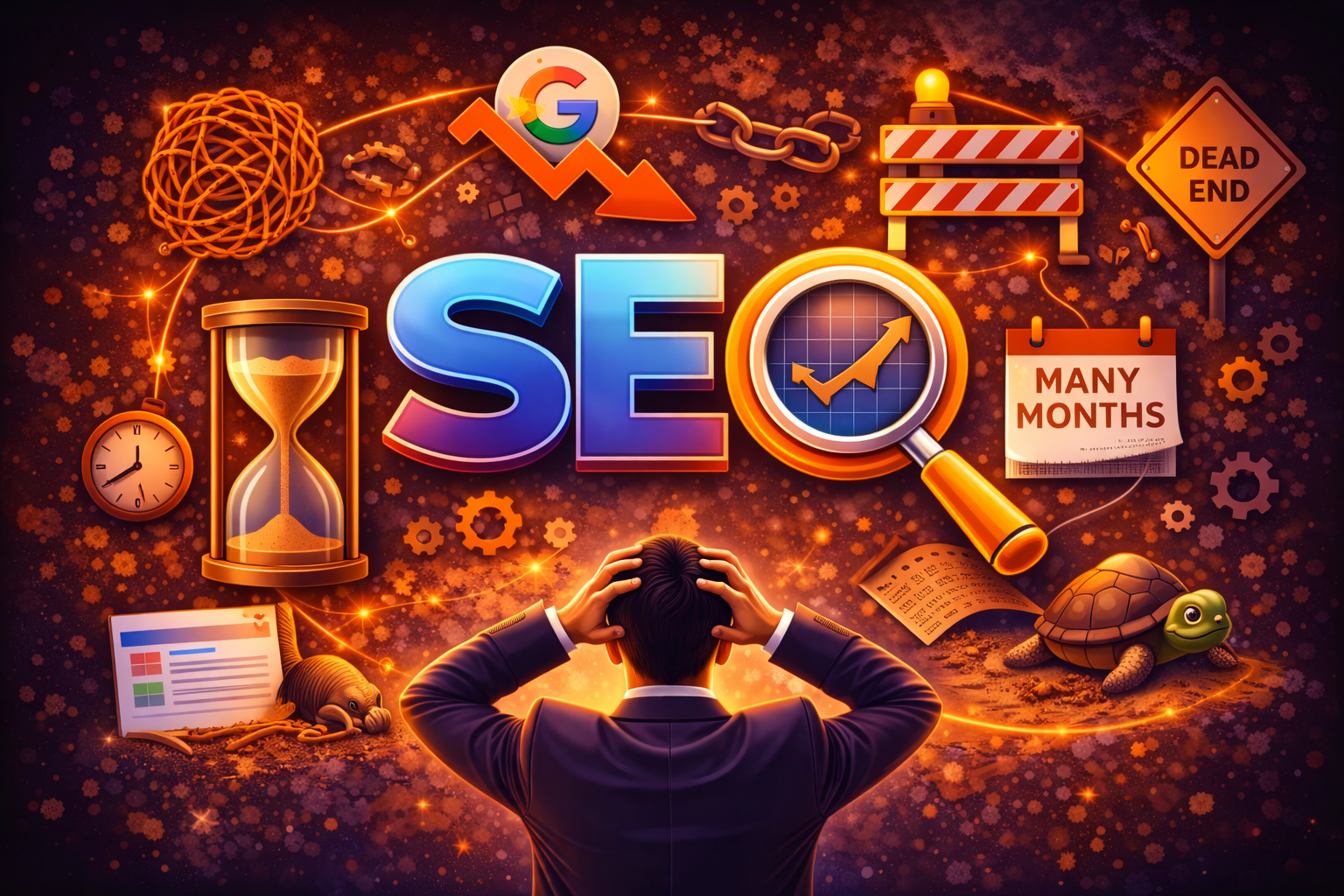
Why Does Search Engine Optimization Take Longer?
Search Engine Optimization takes longer because search engines must discover, crawl, index, interpret, compare, and re-evaluate pages before rankings stabilize. Strong SEO also depends on content quality, site structure, competition, and trust signals that build over time. However, that slower process is exactly what allows SEO to create durable traffic, stronger authority, and long-term lead generation.
Many businesses get frustrated with SEO timelines because they compare Search Engine Optimization to channels that produce immediate activity. Paid ads can deliver clicks today. Social content can create engagement today. Email campaigns can create responses today. However, SEO is not built to create temporary bursts. Instead, it is built to create earned visibility that can keep working after the initial effort is done.
That difference matters because the reason SEO takes longer is also the reason SEO can become so valuable. Search engines do not simply award rankings because a page exists. They need time to crawl the page, understand what it is about, compare it to competing pages, and determine whether it deserves strong visibility for real searches. Therefore, the delay is not random. It is tied directly to how search systems evaluate trust, relevance, usefulness, and structure.
This page explains why Search Engine Optimization takes longer, what processes create that delay, why some pages move faster than others, how businesses accidentally slow SEO down even more, and why the slower timeline often produces stronger long-term business value than faster but rented traffic channels.
The Short Answer
Direct Answer: Search Engine Optimization takes longer because rankings must be earned through crawling, indexing, evaluation, comparison, and trust-building over time. Unlike paid ads, SEO cannot buy instant placement. However, once strong pages gain traction, they can continue producing visibility, traffic, and leads without charging the business for every click.
This short answer matters because it reframes the issue correctly. The delay is not proof that SEO is weak. Instead, the delay is part of the mechanism that makes SEO durable once it works.
Why This Question Matters
Direct Answer: This question matters because timeline expectations shape business decisions. When expectations are unrealistic, businesses often stop too early, measure the wrong things, or assume the channel has failed before it has had enough time to compound.
Many companies begin SEO with a short-term mindset. They want to know how fast rankings will move, how fast leads will appear, and how soon the work will “pay off.” Those are fair questions. However, SEO is not usually a same-month channel. Therefore, understanding the timeline is critical if the business wants to evaluate SEO honestly.
This also matters because businesses often compare SEO to channels solving different problems. Paid ads solve the problem of immediate exposure. SEO solves the problem of long-term organic visibility. Consequently, the slower timeline should be judged in relation to the type of outcome SEO is built to create.
SEO Is an Earned Channel, Not an Instant Placement Channel
Direct Answer: SEO takes longer because it is an earned channel. Search visibility must be earned through relevance, usefulness, structure, and trust, while paid channels can buy placement immediately.
This is one of the most important reasons for the delay. With paid ads, the business can fund visibility instantly. With SEO, the business must persuade search systems that its pages deserve visibility relative to competing pages. Therefore, organic placement depends on evaluation, not purchase.
That distinction changes everything. Since SEO is earned, the page has to prove itself. It has to be crawlable, indexable, relevant, useful, structurally clear, and competitive. As a result, SEO moves more slowly, but it often creates more durable digital value later.
Reason 1: Crawling and Indexing Take Time
Direct Answer: Search engines first need to discover, crawl, and index a page before that page can realistically compete for rankings. That process alone introduces delay, especially on weaker or less organized sites.
Even after a page is published, search engines may not evaluate it immediately. They first need to find it through internal links, sitemaps, or other discovery paths. Then they need to crawl it, process the content, and decide whether it belongs in the index. Therefore, the simple act of publishing a page does not mean the page is instantly ready to rank.
This is why site structure matters so much. A well-organized site helps search engines find and process important pages more efficiently. By contrast, a messy site can slow this stage down considerably. Consequently, crawling and indexing delays are often worse when internal linking and page hierarchy are weak.
Reason 2: Search Engines Need Time to Evaluate Relevance
Direct Answer: After a page is indexed, search engines still need to determine what queries the page actually deserves to rank for and how well it matches those searches compared with other available options.
This matters because search engines do not rank pages based only on a keyword appearing on the page. They interpret the page’s topic, structure, depth, and likely usefulness. Therefore, they need time to compare that page against the existing result set for relevant searches.
If the page strongly matches intent, it may begin moving upward faster. However, if the page is thin, vague, or poorly aligned, search systems may keep it lower until clearer evidence accumulates. As a result, relevance evaluation is one of the biggest reasons SEO takes longer than many businesses hope.
Reason 3: Competition Slows Ranking Movement
Direct Answer: SEO takes longer because rankings exist inside a competitive environment. Your page is not being judged alone. It is being judged against all the other pages targeting the same searches.
If a search term already has strong competitors with useful content, strong internal architecture, and more established authority, your page needs time to compete with them. Therefore, even good SEO work may not create instant top rankings in competitive markets.
This does not mean the work is failing. It means search systems need enough evidence to justify moving a newer or weaker page above older or stronger alternatives. Consequently, the timeline is influenced not just by your own site quality, but also by how hard the search landscape is to break into.
Reason 5: Content Often Needs Time to Mature
Direct Answer: Content performance often improves gradually because pages need time to be interpreted, interacted with, refined, and connected into the larger site structure before they deliver stronger search results.
A page may launch in a decent state, yet it often becomes stronger after updates, better internal support, richer sections, clearer formatting, and expanded context. Therefore, SEO content frequently matures instead of peaking immediately.
This is why some pages begin modestly, then improve steadily. Search systems may need time to see whether the page remains useful, how it fits into the site, and whether it is supported by a broader topic cluster. Consequently, the maturity curve is a natural part of content-led SEO.
Reason 6: Site Structure Strengthens Over Time
Direct Answer: SEO takes longer because site structure improvements usually do not deliver all their value instantly. Internal links, content clusters, page hierarchy, and navigation changes often create stronger impact as more of the site becomes aligned around related topics.
A single strong page can help. However, a connected group of pages often helps much more. Therefore, as service pages, question pages, local pages, and hubs begin supporting one another, the site often becomes easier for search engines to interpret and easier for users to navigate.
This compounding structure takes time to build. As a result, SEO often accelerates only after enough connected assets exist to reinforce the whole topic area.
Reason 7: Search Systems Need More Signals Over Time
Direct Answer: Search systems often need more signals over time before stronger visibility becomes stable. They may observe how pages are structured, how consistently they align with queries, and how users respond to them before stronger rankings settle in.
Search engines do not rely on one static signal. Instead, they process multiple layers of evidence around page quality and fit. Therefore, the system often becomes more confident gradually rather than instantly.
This is one reason rankings can move in steps. A page may first appear weakly, then improve, then stabilize as the system gathers more confidence. Consequently, a slower timeline is often tied to how search engines reduce risk before committing to stronger placement.
Why Some Pages Rank Faster Than Others
Direct Answer: Some pages rank faster because they target lower-competition searches, sit on stronger sites, match intent more clearly, or benefit from better internal support and topical authority from the start.
A well-targeted page on an established site can move relatively quickly when the search term is specific and the page quality is strong. Meanwhile, a broad page in a crowded market may take much longer even if the content is decent. Therefore, page speed in SEO is influenced by multiple context factors, not just by publishing date.
This also explains why businesses should not judge every page by the same timeline. As a result, page-level expectation setting is often more useful than broad promises about “SEO speed” in general.
Why SEO Taking Longer Is Not a Bad Thing
Direct Answer: SEO taking longer is not inherently bad because the slower timeline is closely tied to the creation of more durable visibility. The process is slower because the visibility must be earned, but that same earned visibility can continue producing value over time.
If SEO worked instantly for everyone, it would also be easier to manipulate and easier to lose. However, because search systems evaluate pages more carefully, strong rankings often become more defensible once they are earned. Therefore, the slower timeline is also part of what makes organic results harder for competitors to copy overnight.
This is why businesses that stay consistent often gain a long-term advantage. By the time the system compounds, they may have built a body of pages, links, topic authority, and structural strength that is difficult to replicate quickly. Consequently, the slowness can become one of SEO’s greatest strategic advantages rather than one of its biggest weaknesses.
SEO vs. Paid Ads: Why the Timeline Feels So Different
Direct Answer: Paid ads feel faster because they buy exposure directly, while SEO earns exposure gradually. That makes the two channels useful for different reasons rather than making one universally better than the other.
Ads can generate traffic right away, which is excellent for testing, immediate demand capture, and short-term lead flow. However, once the budget stops, the exposure usually stops too. Therefore, ads behave more like rental media.
SEO, by contrast, asks for patience up front because it is building pages and systems that can keep producing visibility after the original work. As a result, the timeline feels slower early on, but the long-term economics can become much stronger later. This is why many businesses eventually use both: ads for speed and SEO for durable leverage.
Common Mistakes That Make SEO Take Even Longer
Direct Answer: Several common mistakes make SEO slower than it needs to be, including publishing weak pages, targeting the wrong searches, neglecting internal links, ignoring technical issues, and quitting before momentum can build.
Publishing thin or generic content
Pages that barely answer the search often struggle to gain traction. Therefore, thin content can extend timelines significantly.
Targeting unrealistic searches too early
Going after highly competitive terms before the site has enough supporting strength can delay visible wins and make the strategy feel ineffective.
Ignoring internal linking
Important pages often rank slower when the rest of the site does not support them properly. Consequently, weak internal structure reduces the compounding effect.
Overlooking technical barriers
Crawl issues, indexing confusion, and structural problems can quietly slow progress even when content seems strong.
Expecting too much too soon
When businesses stop after a short window, they often cut off the strategy before the strongest gains appear.
What a Realistic SEO Timeline Looks Like
Direct Answer: A realistic SEO timeline usually shows early signals first, then stronger growth later. In many cases, technical clarity, indexing, and early movement happen within the first few months, while more meaningful compounding gains tend to build over 6 to 12 months and beyond.
That timeline varies by competition level, site quality, existing authority, and how strong the execution is. Therefore, no honest SEO timeline should sound identical for every project.
However, a useful pattern often looks like this. Early months focus on setup, page quality, structure, and discovery. Mid-stage months often show clearer movement in impressions, rankings, and traffic quality. Later months often show the strongest compounding effect as the site gains more topical support and visibility. As a result, businesses that evaluate SEO through longer windows usually see the channel more accurately.
How Businesses Should Think About SEO Timelines
Direct Answer: Businesses should think about SEO timelines like asset-building timelines, not like campaign-launch timelines. The right question is not only “How fast will this rank?” but also “What are we building that can continue generating value long after the build phase?”
This mindset helps because it aligns expectations with the real strength of the channel. SEO is often slower at the beginning precisely because it is building something with more staying power. Therefore, the business should judge the channel by both early indicators and long-term leverage, not only by instant activity.
When companies take this perspective, they usually make better choices. They invest in stronger pages, stronger site structure, and more meaningful measurement. Consequently, they are much more likely to stay consistent long enough to reach the compounding phase where SEO becomes far more rewarding.
Implementation Template
Direct Answer: The best way to handle slower SEO timelines is to build around strong fundamentals, realistic expectations, and steady execution instead of chasing shortcuts or judging the channel too early.
- Identify the services, products, and questions most tied to business value.
- Map those topics to the right page types, including service pages, local pages, and answer pages.
- Improve content quality so each page clearly matches search intent and provides real usefulness.
- Strengthen titles, headings, summaries, and internal links so pages are easier to understand and support one another.
- Fix crawlability, indexing, mobile usability, and structural issues that can slow performance.
- Track impressions, rankings, traffic quality, and page-level business outcomes instead of only watching for instant leads.
- Stay consistent long enough for authority, relevance, and compounding site strength to take effect.
This framework works because it respects how search systems actually evaluate pages while still tying the effort directly to business outcomes.
Frequently Asked Questions
Direct Answer: These quick answers clarify the most common follow-up questions businesses ask when they want to understand why SEO takes longer.
Why does SEO take longer than paid ads?
SEO takes longer because rankings must be earned through crawling, indexing, evaluation, and competition, while paid ads buy exposure immediately.
Can SEO be sped up?
Better execution can improve the timeline, but SEO still requires time because search systems need to process and evaluate pages before stronger rankings become stable.
Is slow SEO always a bad sign?
No. Gradual movement is normal in SEO. What matters more is whether the work is improving page quality, structure, visibility, and long-term opportunity.
How long does SEO usually take to show meaningful results?
That depends on competition, site strength, and execution quality, but many businesses begin seeing clearer movement within a few months and stronger gains over 6 to 12 months or longer.
Why do some pages rank faster than others?
Pages often rank faster when they target clearer intent, face lower competition, sit on stronger domains, or receive better internal support from the rest of the site.
Should a business stop SEO if it feels too slow?
Usually no. Stopping too early often prevents the business from reaching the compounding phase where SEO becomes far more valuable.
Hub & Spoke Links
Direct Answer: This spoke should connect to the verified SEO answer pages that help users continue from the timeline question into meaning, importance, benefits, value, and common SEO challenges.
- Search Engine Optimization (SEO) Answers
- What Does Search Engine Optimization Mean?
- What Is Search Engine Optimization?
- What Does Search Engine Optimization Do?
- Is Search Engine Optimization Important?
- Is Search Engine Optimization Important For Business?
- What Are The Benefits Of Search Engine Optimization?
- What Makes Search Engine Optimization So Important?
- What Is the Problem With Search Engine Optimization?
- Is Search Engine Optimization Worth It?
- Is Search Engine Optimization Free?