Search Engine Optimization Question-Led Spoke
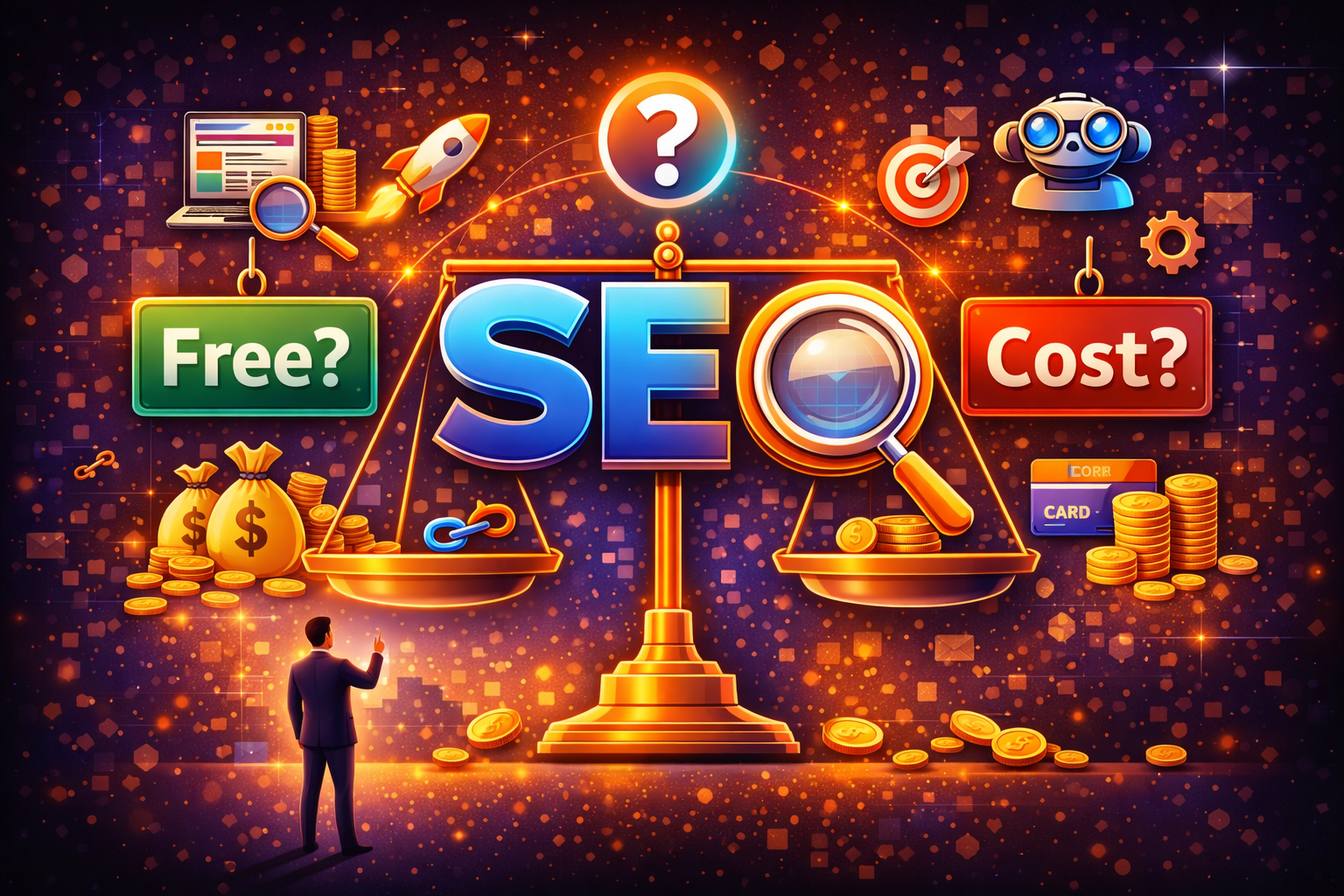
Is Search Engine Optimization Free?
Search Engine Optimization is not truly free because strong SEO requires time, expertise, content, technical work, structure, and ongoing improvement. While you do not pay Google for each organic click, you still invest real resources to earn that visibility. In practice, SEO is better understood as owned search asset building rather than as a no-cost traffic source.
Many business owners hear that SEO brings “free traffic,” and that phrase creates immediate confusion. On one hand, it sounds true because you do not pay the search engine every time someone clicks an organic result. However, on the other hand, anyone who has actually worked on SEO knows that rankings do not appear out of nowhere. Pages still need to be planned, written, structured, improved, supported, and measured.
That is why this question matters so much. If a business thinks SEO is free, it may underestimate the skill and work required to do it well. By contrast, if a business thinks SEO is too expensive simply because it is not instant, it may miss one of the strongest long-term visibility assets available in digital marketing. Therefore, the better way to think about SEO is not “free or paid” in the simplest sense. Instead, it is “What kind of investment is this, and what kind of return can it create over time?”
This page explains what people really mean when they call SEO free, why that phrase is incomplete, what SEO actually costs, how those costs differ from paid ads, and why businesses should think about Search Engine Optimization as a long-term owned growth channel rather than a shortcut to no-cost traffic.
The Short Answer
Direct Answer: No, Search Engine Optimization is not truly free. You may not pay for every click the way you do with ads, but strong SEO still requires investment in time, skill, content, technical improvements, planning, and ongoing work. What makes SEO attractive is not that it is free. What makes it attractive is that the visibility you build can keep producing value over time.
This distinction matters because many businesses confuse “organic traffic” with “no-cost traffic.” However, the click may be unpaid while the work required to earn that click is still very real. Therefore, SEO is better described as a long-term asset-building investment than as a free source of traffic.
Why People Say SEO Is Free
Direct Answer: People often say SEO is free because you do not pay a search engine each time someone clicks your organic listing. In that narrow sense, the traffic does not carry a per-click ad charge. However, that definition ignores the cost of building the visibility in the first place.
The phrase usually comes from comparing SEO to paid search advertising. With ads, you often pay every time someone clicks. With organic rankings, you do not pay Google or another search engine for each visit that comes through a normal search listing. Therefore, once a page ranks well, that traffic can feel free compared with the continuing spend required by ads.
That idea is partly useful because it helps explain why SEO can become so powerful over time. However, it becomes misleading when businesses assume the entire process is costless. Rankings still require planning, execution, and improvement. As a result, the phrase “free traffic” captures one part of the reality while hiding another very important part.
Why SEO Is Not Actually Free
Direct Answer: SEO is not actually free because the work behind it still requires labor, knowledge, tools, time, and strategic effort. Even when a business handles SEO internally, those resources still carry a cost because they could have been used somewhere else.
If someone has to research search intent, write content, improve titles, optimize service pages, handle internal linking, fix site issues, or manage technical structure, that work is not free. It may be done by the owner, a marketer, a freelancer, or an agency, yet in every case it still requires real effort. Therefore, SEO has costs even when there is no advertising invoice attached to each click.
This is one of the most important mindset shifts businesses need to make. SEO is not free in the sense of “no cost.” Instead, it is unpaid at the click level. That difference is huge because it changes how the channel should be evaluated. Consequently, a smarter question than “Is SEO free?” is often “What does SEO cost to build, and what does it produce once it is built?”
What SEO Really Costs
Direct Answer: SEO usually costs time, expertise, content production, technical support, design and UX improvement, tools, and ongoing maintenance. The exact mix depends on the site, the market, and whether the business handles the work internally or externally.
Strategy and planning
Before content gets written, someone has to identify the searches that matter, map pages to search intent, and decide what should be prioritized first. That planning work carries real value.
Content creation
SEO content does not create itself. Strong service pages, local pages, FAQ pages, comparison pages, and hub pages all require writing, editing, and structural refinement.
On-page optimization
Titles, headings, summaries, internal links, and relevance signals all need to be reviewed and improved if the site is going to compete effectively.
Technical improvements
Sites often need technical support around crawlability, indexing, page speed, mobile usability, and structure. Therefore, technical SEO becomes part of the real cost profile too.
Ongoing maintenance
SEO is not always one-and-done. Pages may need updates. Competitors may improve. New content opportunities may appear. As a result, ongoing improvement becomes part of the long-term cost of maintaining organic visibility.
Once businesses see these layers clearly, the word “free” becomes much less accurate. SEO can absolutely be worth the investment, yet that is not the same as saying it comes at no cost.
Why Time Is a Real SEO Cost
Direct Answer: Time is a real SEO cost because every hour spent on SEO could have been used elsewhere in the business. Even if the owner handles the work personally, that time still has value, and it should still be treated as an investment rather than as something free.
This is where many small business owners underestimate SEO. They may think, “I am doing it myself, so it is free.” However, their time still has an opportunity cost. If they spend ten hours per week writing pages, fixing site structure, and researching keywords, those are ten hours not spent on sales, operations, service delivery, or other growth activities.
That does not mean owner-led SEO is a bad idea. In fact, sometimes it makes sense early on. However, it does mean the business should count time honestly. Therefore, a self-managed SEO project is usually lower-cash-cost, not no-cost.
Why Expertise Is a Real SEO Cost
Direct Answer: Expertise is a real SEO cost because effective optimization requires knowledge. A business that lacks SEO knowledge either needs to spend time learning it or spend money hiring it. In either case, the expertise layer carries value.
Good SEO usually requires more than basic content editing. It often involves intent mapping, structure, keyword targeting, internal architecture, technical awareness, and an understanding of what makes pages useful and competitive. Therefore, businesses that want strong results usually need access to that knowledge somewhere.
Sometimes the expertise lives in-house. Sometimes it comes from a consultant, agency, freelancer, or trained employee. However, even when the business already has that expertise internally, it still represents real value. Consequently, SEO should never be evaluated as though knowledge comes without cost simply because it is already available inside the company.
Content and Technical Work Still Cost Money
Direct Answer: Content and technical SEO work still cost money because someone has to create, edit, improve, or implement them. Whether the site needs stronger service pages, local pages, FAQs, schema, or site-speed improvements, the work behind those changes still consumes real resources.
Content is often the most visible cost because businesses can see the pages being written and improved. However, technical work matters too. A site may need better crawlability, mobile performance, URL structure, canonical clarity, or internal organization. Therefore, SEO costs are not only about words on a page. They also include the structure that makes those words perform more effectively.
This is one reason SEO should be treated as a system. If a business only thinks about SEO as content, it may ignore technical weaknesses. If it only thinks about technical fixes, it may neglect page usefulness. As a result, the most realistic way to think about SEO cost is to treat it as a layered investment rather than as one isolated expense line.
SEO vs. Paid Ads Cost Structure
Direct Answer: SEO and paid ads have different cost structures. Paid ads usually charge continuously for visibility and clicks, while SEO usually requires more upfront and ongoing asset-building work that can later produce traffic without a per-click charge. That is why SEO is not free, but it can become cheaper over time.
With ads, the model is easier to understand. You fund the campaign, and the visibility continues as long as the budget continues. Once the budget stops, the visibility usually drops quickly. Therefore, paid search often behaves like rental media.
SEO works differently. The investment often happens through planning, content, optimization, and technical improvements. Then, if the pages rank, the traffic continues without a cost attached to each individual click. Consequently, SEO often feels cheaper later even though it was not free at the beginning.
This is one reason businesses should compare SEO and ads carefully. Ads may be faster. SEO may be more durable. Therefore, the right comparison is not “Which one costs money?” The right comparison is “How does each channel spend money, and what happens after that spend?”
Why Organic Clicks Can Feel Free Later
Direct Answer: Organic clicks can feel free later because, once a page is ranking well, each additional click does not create a new ad charge. That can make SEO appear dramatically cheaper than ads on a marginal-click basis after enough traction has been built.
This is where much of the appeal of SEO comes from. A strong page may continue earning impressions and clicks day after day without billing the business each time someone visits. Therefore, the economics begin to feel very different from paid traffic once the page reaches stable visibility.
However, that later efficiency should not be confused with no-cost acquisition. The page still required work to reach that point, and it may still require updates to hold or improve performance. As a result, the better phrase is often not “free traffic” but “non-metered organic traffic after the asset is built.”
That phrasing may be less catchy, yet it is much more accurate.
When SEO Becomes Cheaper Long Term
Direct Answer: SEO often becomes cheaper long term when strong pages keep producing qualified traffic and leads after the main build work is complete. In those cases, the ongoing cost per lead or per click can become much more attractive than channels that require constant spend to stay active.
This does not happen equally fast for every business. The timeline depends on competition, market demand, site quality, and how well the business converts organic traffic into results. However, once strong pages gain traction, the long-term economics can improve significantly.
That is why SEO is often described as an asset. The page may take work to create. Yet once it performs, it can continue contributing value without forcing the business to rebuy the same exposure every month. Consequently, the channel can become more cost-efficient over time even though it was not free to create.
What This Means for Small Businesses
Direct Answer: For small businesses, the “SEO is free” myth can be especially dangerous because it leads to unrealistic expectations. Small companies should not assume SEO costs nothing. Instead, they should use SEO strategically where focused effort can create long-term visibility around the searches that matter most.
A small business usually does not need to rank for everything. It needs to rank for the services, products, locations, and questions most likely to produce revenue. Therefore, a focused SEO strategy can still be highly worthwhile even when the budget is limited.
This is also why small businesses should be honest about tradeoffs. If the owner handles SEO personally, that may lower cash outlay, yet it still uses time. If the business hires help, that increases direct cost, yet it may improve execution and speed. As a result, the right SEO approach for a small business often depends on whether time, cash, or expertise is the tighter constraint.
Common Mistakes When Evaluating SEO Cost
Direct Answer: The biggest mistakes usually come from evaluating SEO too narrowly. Businesses often mistake unpaid clicks for free growth, ignore time cost, compare SEO only to short-term channels, or forget that traffic still needs to convert into business value.
Ignoring time as a cost
If the owner or team is doing the work, that time still matters. Therefore, a self-managed SEO program should still be treated like an investment.
Comparing only the first 30 days
SEO usually becomes easier to justify over longer periods. Consequently, short time windows can make the channel look weaker than it really is.
Assuming rankings alone equal return
Visibility matters, but the real value comes from qualified traffic, trust, and conversions. Therefore, SEO should be measured through business outcomes, not just ranking screenshots.
Expecting no maintenance
Even strong SEO often needs updates, expansion, and support over time. As a result, businesses should plan for SEO as an ongoing asset-management process, not only as a launch task.
Implementation Template
Direct Answer: The best way to think about whether SEO is “free” is to map the real resource inputs, then compare those inputs against the long-term value the organic visibility could create. That turns the question from a myth-based question into a business decision.
- List the services, products, and questions most important to revenue.
- Identify the pages needed to compete for those searches.
- Estimate the time, content, and technical work required to improve those pages.
- Decide whether the work will be handled internally, externally, or through a hybrid model.
- Measure the opportunity by looking at search intent, lead value, and long-term visibility potential.
- Track the pages that begin creating qualified traffic and business outcomes.
- Compare that long-term organic contribution to the cost of buying the same demand through ads alone.
This framework works because it helps the business stop asking the wrong version of the question. Instead of asking whether SEO costs nothing, it asks whether the investment required is justified by the long-term business value SEO can create.
Frequently Asked Questions
Direct Answer: These quick answers help clarify the most common practical questions businesses ask when they hear that SEO is “free.”
Do I pay Google for SEO traffic?
No. You do not usually pay Google for each click on an organic listing. That is why some people call SEO traffic free.
So is SEO free or not?
No, not really. The clicks may be unpaid, but the work required to earn those clicks still costs time, skill, and resources.
Is SEO cheaper than ads?
Sometimes it becomes cheaper over time, especially once strong pages gain traction. However, the cost structure is different rather than simply lower from day one.
Can I do SEO myself and save money?
Yes, but your time still has value. Doing SEO yourself may reduce direct cash spend, yet it does not make the work costless.
Why do people call SEO free traffic?
They usually mean there is no per-click ad charge after the page is ranking. However, that description is incomplete because it ignores the cost of building the rankings in the first place.
What is the best way to think about SEO instead of calling it free?
It is usually better to think about SEO as a long-term owned search asset that requires investment up front and can create durable value later.
Hub & Spoke Links
Direct Answer: This spoke should connect to the verified SEO answer pages that help users move from the cost question into meaning, business importance, value, and practical implementation.
- Search Engine Optimization (SEO) Answers
- What Does Search Engine Optimization Mean?
- Is Search Engine Optimization Important For Business?
- What Are Some Search Engine Optimization Techniques?
- How Can My Small Business Leverage Search Engine Optimization?
- Is Search Engine Optimization Worth It?
- What Are the Benefits of Search Engine Optimization?
- Why Does Search Engine Optimization Take Longer?