Private Aviation Question-Led Spoke
What Is the Time-Saving Delta for a Private Mission from NYC to London vs. Commercial First Class?
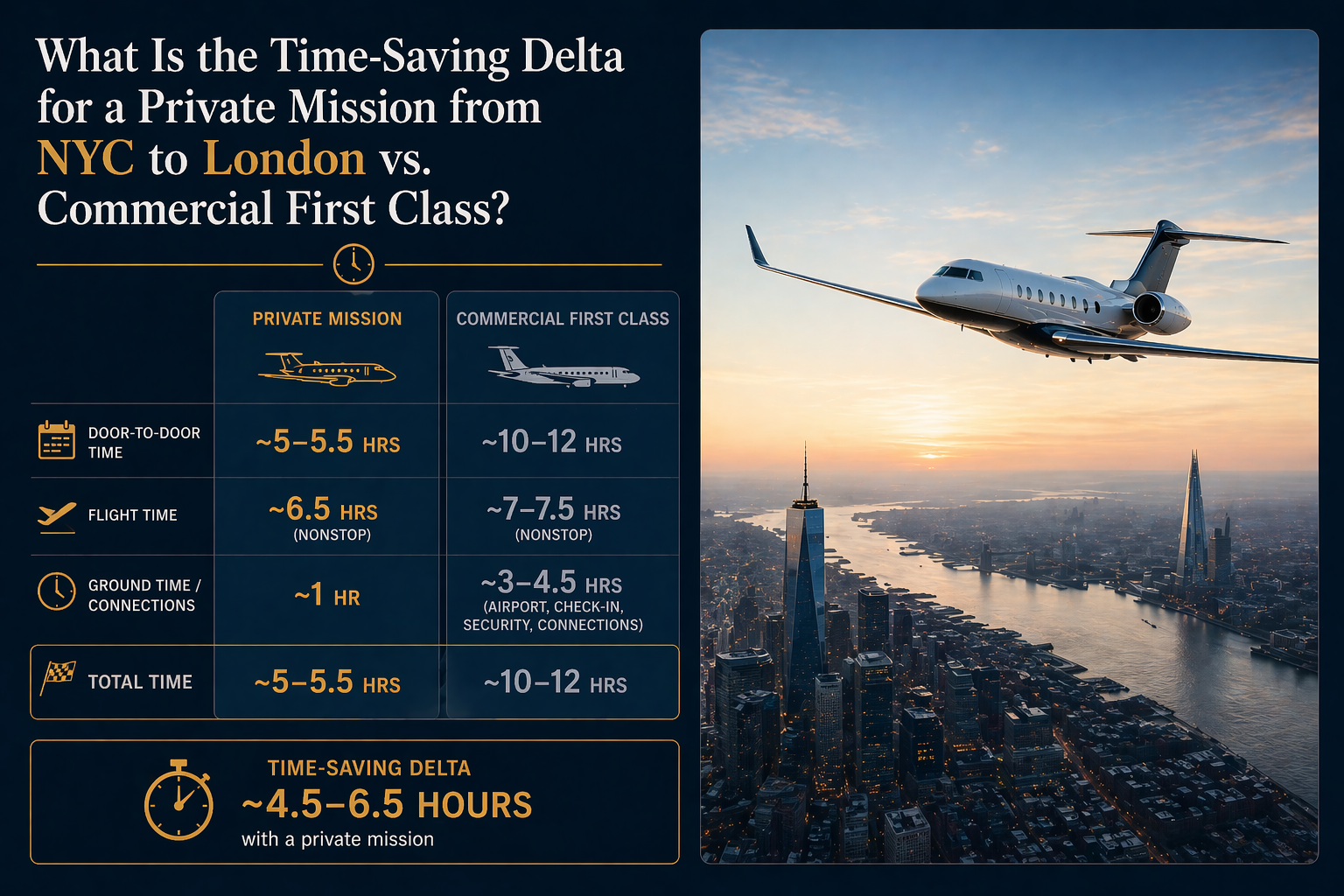
A private mission from NYC to London usually saves more time on the ground than in the air. The flight time can be similar to commercial First Class, often around 6.5 to 8 hours depending on aircraft, winds, and routing. However, private aviation can often save 2 to 5+ hours door-to-door by reducing airport arrival time, security friction, boarding delays, baggage handling, customs flow, and ground-transfer inefficiency.
UHNW buyers rarely compare private aviation against commercial First Class on seat comfort alone. Instead, they compare total mission control. They want to know how much time they save, how much fatigue they avoid, how much privacy they gain, and how quickly they can move from origin to destination.
That makes this question more valuable than a simple flight-time comparison. A commercial First Class seat can be excellent once the passenger sits down. However, the traveler still moves through airline schedules, terminal friction, security processes, boarding windows, baggage systems, and Heathrow-scale arrival flows. Therefore, the real delta usually appears in the full door-to-door mission.
This page explains the realistic time-saving delta for a NYC-to-London private mission, where the time savings actually come from, when private aviation saves less than expected, and how private aviation companies should answer this question to attract serious UHNW buyers.
The Short Answer
Direct Answer: A private mission from NYC to London typically saves about 2 to 5+ hours door-to-door compared with commercial First Class. The in-air flight time may stay similar, but private aviation removes much of the airport friction before departure and after arrival. Therefore, the real value comes from total mission compression, not only faster cruise speed.
For most UHNW travelers, the bigger win is not shaving one hour from the airborne portion. Instead, the bigger win comes from leaving closer to their schedule, arriving closer to the aircraft, boarding faster, clearing private handling more efficiently, and avoiding commercial terminal congestion.
Why This Question Matters
Direct Answer: This question matters because UHNW buyers evaluate private aviation through time, control, privacy, and reduced friction. Therefore, a strong answer must compare the full mission, not only the scheduled flight time.
Commercial First Class can deliver a premium onboard seat. However, it still operates inside a mass-airline system. The passenger must adapt to the airline’s departure time, security process, boarding sequence, baggage system, and arrival flow. As a result, the premium seat solves only part of the journey.
Private aviation changes the operating model. The traveler can often use Teterboro, White Plains, Morristown, or another private-friendly New York-area airport. Then, on the London side, the traveler can often use Farnborough, Luton, Biggin Hill, Stansted, or another business aviation airport. Therefore, the total trip can become much tighter than a JFK-to-Heathrow commercial First Class journey.
Baseline Distance and Flight Time
Direct Answer: The NYC-to-London route is roughly 3,000 nautical miles. Commercial JFK-to-Heathrow flight-time references commonly estimate about 7 hours and 15 to 7 hours and 30 minutes eastbound, while private route references commonly show roughly 6.5 to 8 hours depending on aircraft, airport pair, winds, and routing.
This means private aviation does not always create a dramatic airborne time advantage. A long-range private jet and a commercial widebody both cover the same Atlantic route. Winds, routing, air traffic flow, cruise speed, and airport procedures all affect the actual block time.
Therefore, the cleanest answer is not “private is always much faster in the sky.” The cleanest answer is that private aviation usually saves the most time around the flight. It compresses the total mission from pickup to arrival.
Private vs. Commercial First Class Time Comparison
Direct Answer: The clearest way to compare the time-saving delta is to break the mission into steps. Therefore, the table below shows where private aviation usually creates the biggest advantage.
Mission Stage |
Commercial First Class |
Private Mission |
Typical Time Saved |
|---|---|---|---|
| Departure airport arrival | Usually 2 to 3 hours before international departure | Often 20 to 45 minutes before departure | 1.5 to 2.5 hours |
| Security and boarding | Terminal security, lounge, boarding groups, aircraft door timing | Private terminal, direct aircraft access, faster boarding flow | 30 to 90 minutes |
| Airborne flight time | Often around 7 to 7.5 hours eastbound | Often around 6.5 to 8 hours depending on aircraft and winds | 0 to 60 minutes |
| Arrival and deplaning | Large terminal arrival, immigration flow, baggage timing | Private handling, faster exit, tailored ground transfer | 30 to 90+ minutes |
| Total door-to-door delta | Usually strongest only once onboard | Usually strongest across the whole mission | 2 to 5+ hours |
Where Private Aviation Saves Time
Direct Answer: Private aviation saves time through reduced terminal friction, faster boarding, flexible scheduling, better airport choice, streamlined arrival handling, and more efficient ground transfers. Therefore, the time savings usually come from mission control rather than raw aircraft speed.
The departure process creates the first major savings. A commercial First Class passenger still often arrives hours before an international departure. By contrast, a private passenger can often arrive much closer to departure time. As a result, the traveler saves meaningful time before the aircraft even moves.
The second savings comes from airport selection. A traveler based in Manhattan, Greenwich, Westchester, or northern New Jersey may save time by using Teterboro, Westchester County, or Morristown instead of JFK. Likewise, London-area private airports can reduce arrival-side friction depending on the final destination.
The third savings comes from post-arrival flow. Commercial First Class still feeds into a major international terminal. Private aviation can often move the passenger through a more controlled arrival process. Therefore, the full mission becomes tighter from both ends.
Where Private Aviation Does Not Save Much Time
Direct Answer: Private aviation usually does not save huge time in the airborne portion alone. Therefore, a private jet is not always dramatically faster than a commercial widebody between NYC and London once both aircraft are cruising.
This point matters because buyers deserve an honest answer. Private aviation offers major advantages, but it does not magically remove the Atlantic distance. A G650ER, Global 7500, Falcon 8X, or similar long-range aircraft may offer speed, privacy, and scheduling control. However, winds and routing still matter.
As a result, private aviation should be framed as a door-to-door time advantage, a control advantage, and a productivity advantage. That framing is more accurate and more persuasive than claiming the airplane itself always flies much faster.
Door-to-Door Example
Direct Answer: A realistic door-to-door comparison can show a private mission saving roughly 3 to 4.5 hours versus commercial First Class when airport arrival time, boarding, arrival handling, baggage, and ground movement are included.
Example Trip Component |
Commercial First Class |
Private Mission |
|---|---|---|
| Pre-flight arrival buffer | 2.5 hours | 30 minutes |
| Flight block | 7.3 hours | 7.0 hours |
| Arrival, immigration, baggage, exit | 1.25 to 2 hours | 30 to 60 minutes |
| Total practical mission time | 11 to 12 hours before final ground transfer | 8 to 9 hours before final ground transfer |
| Estimated delta | Baseline | About 3 to 4.5 hours saved |
This example should not be treated as a fixed promise. However, it shows the correct logic. The aircraft may not be dramatically faster in the air, but the mission can still become dramatically tighter overall.
Airport Pairing Matters
Direct Answer: Airport pairing can change the time-saving delta significantly. Therefore, Teterboro-to-Farnborough may produce a different practical result than JFK-to-Heathrow or White Plains-to-Luton.
Commercial First Class usually defaults to major airline hubs such as JFK and Heathrow. Those airports offer connectivity and premium lounges, but they also create terminal scale, congestion, and ground-transfer complexity. Private aviation allows the buyer to choose airports based on final origin and destination.
For a Manhattan-based traveler, Teterboro may reduce departure friction compared with JFK. For a traveler ending west or southwest of London, Farnborough may create a better arrival experience than Heathrow. However, if the traveler’s final destination is very close to Heathrow, the advantage may narrow. Therefore, the route must be analyzed door-to-door, not airport-to-airport only.
Customs and Arrival Flow
Direct Answer: Arrival flow can create a major time delta because commercial passengers move through large terminal systems, while private passengers often use more controlled arrival handling. Therefore, the arrival side can save meaningful time even when the flight time looks similar.
Commercial First Class improves the seat, lounge, and service experience. However, it does not fully remove the arrival scale of a major international airport. A passenger still deplanes with a full aircraft, moves through airport processing, and waits for baggage if checked bags are involved.
Private aviation can often shorten that sequence. The exact process depends on airport, country rules, arrival slot, and handling setup. Still, the traveler usually experiences a more contained and controlled arrival. As a result, the mission feels faster and less draining.
The Productivity Delta
Direct Answer: The productivity delta can be as important as the clock delta because private aviation turns the full aircraft environment into controlled work time. Therefore, the traveler may gain usable hours even when the block time changes only slightly.
A commercial First Class cabin can support work, but it does not offer total privacy. Calls may be limited. Confidential discussion becomes harder. Team collaboration remains constrained. By contrast, a private cabin can support meetings, confidential calls, sleep planning, document review, and aligned team travel.
For UHNW buyers, founders, executives, family offices, and deal teams, that difference can matter more than an extra hour saved. The traveler does not only arrive sooner. They also arrive with more control over the time spent in transit.
The Fatigue and Control Delta
Direct Answer: The fatigue delta matters because private aviation reduces friction before, during, and after the flight. Therefore, the buyer often values the trip because it protects energy, not only because it saves time.
International travel creates fatigue through early arrival buffers, terminal walking, boarding queues, cabin density, baggage wait, immigration timing, and ground-transfer uncertainty. Commercial First Class improves part of that experience, but it does not remove the system.
Private aviation reduces many of those friction points. The passenger can time the departure more precisely, avoid crowded terminals, maintain privacy, control the cabin environment, and move faster after arrival. As a result, the trip can feel shorter even when the airborne time remains similar.
Best Buyer-Facing Conclusion
Direct Answer: The best buyer-facing conclusion is this: private aviation from NYC to London usually saves 2 to 5+ hours door-to-door versus commercial First Class, with the biggest savings coming from airport arrival, boarding, security, arrival flow, baggage, privacy, and ground-transfer control. The flight itself may only be modestly faster, but the total mission can be much more efficient.
That answer works because it avoids overclaiming. It acknowledges that commercial First Class already offers a strong onboard experience. However, it also shows why private aviation remains different. It does not only upgrade the seat. It upgrades the whole mission.
How Private Aviation Companies Should Answer This Question
Direct Answer: A private aviation company should answer this question with door-to-door math, not vague luxury language. Therefore, the page should show where the time is saved and explain why the value goes beyond the airborne segment.
The strongest version usually says something like this: “NYC to London private aviation may not always beat commercial First Class by hours in the air, but it can often save several hours across the full mission.” That answer feels honest because it does not pretend a private jet eliminates transatlantic distance.
Then the page should break down airport arrival time, private terminal handling, boarding, flight time, arrival processing, baggage, and final ground transfer. As a result, the buyer sees the real value clearly.
What This Question Signals About Buyer Intent
Direct Answer: This question signals strong buyer intent because it compares private aviation against the best commercial alternative. Therefore, the user is likely evaluating whether the premium is justified by time, privacy, and control.
A casual user may search for “NYC to London flight time.” A more serious buyer asks how much private aviation saves compared with First Class. That means the user already understands the commercial option and now wants a rational case for private travel.
This makes the topic commercially valuable. It attracts travelers who think in terms of opportunity cost, executive time, schedule control, and arrival quality. Therefore, private aviation companies should treat it as a conversion-support page, not just an informational article.
Implementation Template
Direct Answer: To answer this question well, a private aviation company should compare the full mission timeline, separate airborne time from ground time, and translate the time savings into buyer value. Therefore, the page becomes both credible and persuasive.
- Start with the direct door-to-door time-saving estimate.
- State that airborne time may remain similar.
- Break the journey into departure, flight, arrival, and ground-transfer stages.
- Show a simple comparison table.
- Explain airport-pairing differences.
- Translate the delta into productivity, fatigue, privacy, and control.
- Link back to the parent hub and relevant route, performance, and cabin-comfort spokes.
This structure works because it answers the buyer’s real question: “Does private aviation give me enough real-world value to justify the mission?”
Frequently Asked Questions
Direct Answer: These follow-up answers clarify the most common buyer questions about NYC-to-London private aviation versus commercial First Class.
Is a private jet much faster than commercial First Class from NYC to London?
Not always in the air. The flight time can be similar. However, private aviation often saves several hours door-to-door.
Where does private aviation save the most time?
It usually saves the most time before departure and after arrival through private terminals, faster boarding, reduced waiting, and better ground-transfer control.
How much time can a private mission realistically save?
A realistic estimate is often 2 to 5+ hours door-to-door, depending on airport pairing, traffic, arrival process, luggage, and schedule needs.
Does airport choice affect the time delta?
Yes. Teterboro, Farnborough, Luton, Biggin Hill, White Plains, or Morristown can change the practical door-to-door result significantly.
Is commercial First Class still a strong option?
Yes. Commercial First Class can offer excellent onboard comfort, but it does not provide the same mission control, privacy, or airport flexibility.
What is the most accurate short answer?
The most accurate answer is that private aviation usually saves more time on the ground than in the air, often producing a 2 to 5+ hour door-to-door advantage.
Hub & Spoke Links
Direct Answer: This spoke should link back to the parent private aviation buyer-questions hub and to nearby mission, range, and comfort comparisons so the buyer can continue evaluating real-world value.
- UHNW Private Jet Buyer Questions Hub
- What is the actual nonstop range of a G650ER against a 50-knot headwind?
- Flight time comparison: Mach 0.90 cruise vs. standard long-range cruise for trans-Atlantic routes.
- Comparison of cabin altitude at 45,000 feet: Gulfstream G700 vs. Bombardier Global 7500.
- Which aircraft offers the best Sleep Mode configuration for overnight Asia-to-Europe flights?