
Private Aviation Question-Led Spoke
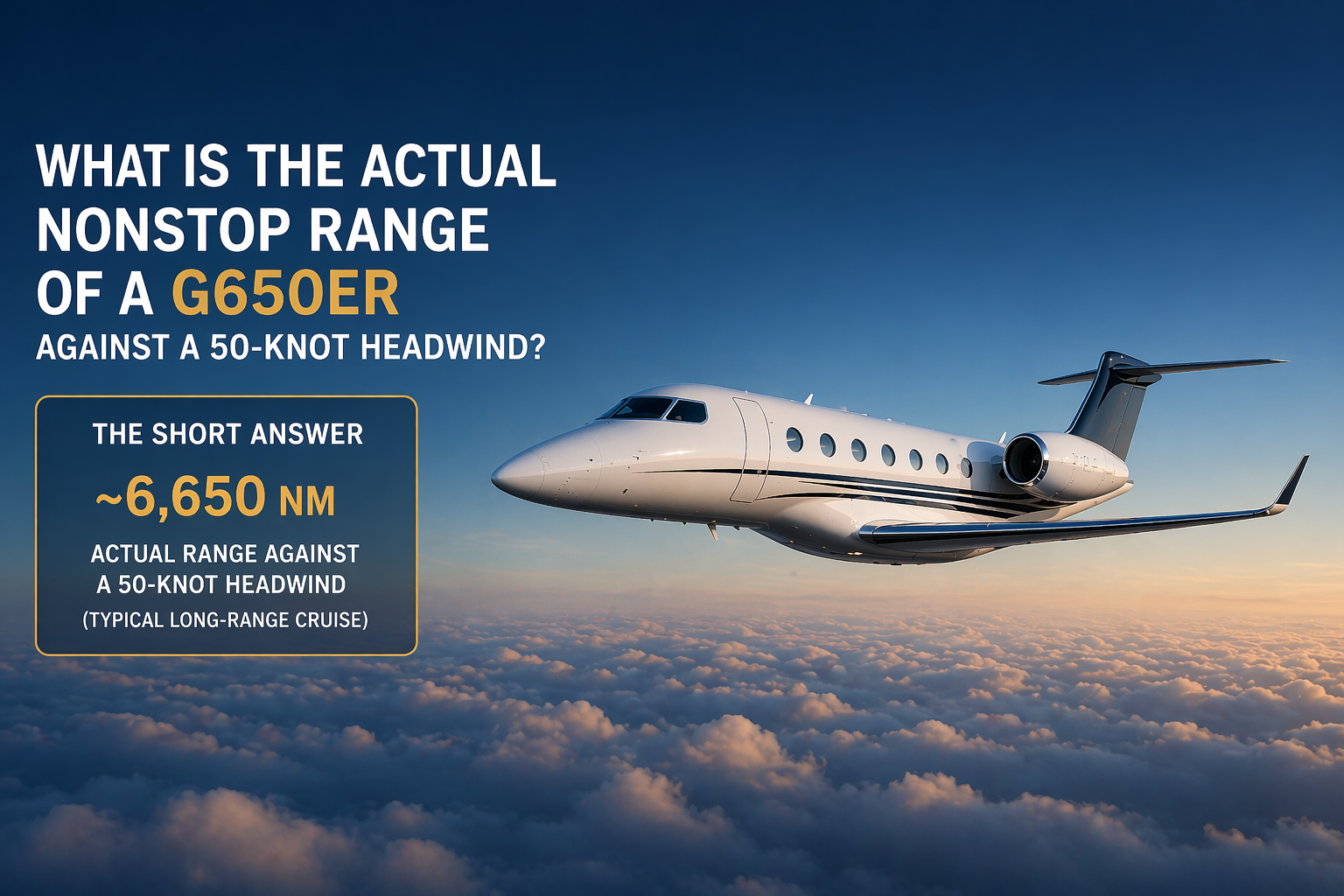
What Is the Actual Nonstop Range of a G650ER Against a 50-Knot Headwind?
A practical buyer answer is that a Gulfstream G650ER’s actual nonstop range against a sustained 50-knot headwind is usually best thought of as lower than its published 7,500 nautical mile range at Mach 0.85, not as one single fixed number. A reasonable planning estimate is often roughly 6,700 to 6,900 nautical miles under a 50-knot headwind, depending on cruise strategy, reserves, payload, and routing. Gulfstream publishes the G650ER at 7,500 nautical miles at Mach 0.85 and 6,400 nautical miles at Mach 0.90, which frames the envelope the estimate sits inside. ([gulfstreamnews.com](https://gulfstreamnews.com/en/news/?id=b1b7ebbe-512c-43cf-b2b0-b207a1f58780&utm_source=chatgpt.com))
This question matters because affluent private aviation buyers do not want brochure range alone. Instead, they want mission realism. A buyer asking about a 50-knot headwind is already thinking beyond marketing language and moving into actual transoceanic feasibility, operational margin, and route confidence. Therefore, this is a high-intent question, not a vanity-spec question. ([gulfstreamnews.com](https://gulfstreamnews.com/en/news/?id=b1b7ebbe-512c-43cf-b2b0-b207a1f58780&utm_source=chatgpt.com))
The key issue is simple. Range numbers are published under defined assumptions. However, real wind changes groundspeed and total time aloft. As a result, the aircraft burns fuel for longer to cover the same ground distance. That means the actual nonstop range shrinks when the mission fights a steady headwind. The exact reduction depends on speed selection, altitude profile, reserves, and weight, so a clean estimate is more honest than a fake exact figure. ([gulfstreamnews.com](https://gulfstreamnews.com/en/news/?id=b1b7ebbe-512c-43cf-b2b0-b207a1f58780&utm_source=chatgpt.com))
This page explains the most useful buyer-facing estimate, why the number changes, how a 50-knot headwind affects a G650ER differently at different cruise profiles, and how a private aviation company should answer this question on its own site without sounding vague or misleading. ([gulfstreamnews.com](https://gulfstreamnews.com/en/news/?id=b1b7ebbe-512c-43cf-b2b0-b207a1f58780&utm_source=chatgpt.com))
The Short Answer
Direct Answer: A realistic nonstop planning range for a G650ER against a sustained 50-knot headwind is often roughly 6,700 to 6,900 nautical miles, not the full published 7,500 nautical miles. Gulfstream states the G650ER can fly 7,500 nautical miles at Mach 0.85 and 6,400 nautical miles at Mach 0.90, so a 50-knot headwind usually pushes the practical answer downward into the high-6,000-nautical-mile range rather than leaving the headline number unchanged. ([gulfstreamnews.com](https://gulfstreamnews.com/en/news/?id=b1b7ebbe-512c-43cf-b2b0-b207a1f58780&utm_source=chatgpt.com))
This estimate is useful because it stays honest. It does not pretend that wind has no cost. At the same time, it also does not pretend the airplane suddenly loses extreme long-range capability. Instead, it acknowledges what long-range operators already know: wind changes the mission, but the G650ER still remains one of the strongest range platforms in the business-jet market. ([gulfstreamnews.com](https://gulfstreamnews.com/en/news/?id=b1b7ebbe-512c-43cf-b2b0-b207a1f58780&utm_source=chatgpt.com))
Why This Question Matters
Direct Answer: This question matters because actual mission planning depends on wind-adjusted range, not only on brochure range. Therefore, a buyer asking this question is usually evaluating real route confidence rather than simply admiring aircraft specifications.
A wealthy charter client, family office, or aircraft owner may care less about the maximum published figure and more about whether the aircraft can still clear a route comfortably when the atmosphere stops cooperating. That is especially true for transatlantic, transpacific, and high-value time-sensitive itineraries. As a result, this question often appears late in the evaluation process when the buyer is already serious.
This is also why private aviation companies should answer questions like this directly. They show operational fluency, not generic sales language. Therefore, they help the brand sound more like a trusted advisor and less like a brochure writer.
Published G650ER Range Baseline
Direct Answer: The published baseline for the G650ER is 7,500 nautical miles at Mach 0.85, with Gulfstream also stating 6,400 nautical miles at Mach 0.90. Therefore, the aircraft’s real headwind-adjusted answer should be interpreted inside that published performance envelope, not outside it. ([gulfstreamnews.com](https://gulfstreamnews.com/en/news/?id=b1b7ebbe-512c-43cf-b2b0-b207a1f58780&utm_source=chatgpt.com))
That baseline matters because the buyer needs a starting point before any headwind penalty is applied. Without it, the discussion becomes vague. With it, the question becomes much clearer: how much of that 7,500-nautical-mile capability remains once the aircraft faces a sustained 50-knot headwind at long-range cruise? ([gulfstreamnews.com](https://gulfstreamnews.com/en/news/?id=b1b7ebbe-512c-43cf-b2b0-b207a1f58780&utm_source=chatgpt.com))
The G650ER remains one of the benchmark ultra-long-range aircraft for exactly this reason. It starts from a very strong published range position. Therefore, even after the mission takes a wind penalty, the aircraft still retains impressive long-range practicality. ([gulfstreamnews.com](https://gulfstreamnews.com/en/news/?id=b1b7ebbe-512c-43cf-b2b0-b207a1f58780&utm_source=chatgpt.com))
Why a Headwind Reduces Range
Direct Answer: A headwind reduces range because it lowers groundspeed while leaving the airplane still burning fuel through time. Therefore, the aircraft spends more time in the air to cover the same ground distance, which reduces how far it can travel nonstop.
This is the key physics point behind the whole question. The aircraft moves through the air mass at roughly the same airspeed, but the ground beneath it moves past more slowly when a headwind pushes back. As a result, the jet covers fewer nautical miles over the earth per hour, even though it continues to burn fuel for each hour flown.
That is why “actual range against a 50-knot headwind” cannot equal still-air range. It must be lower. The only real debate is how much lower, and that answer depends on cruise speed, altitude, reserves, and weight assumptions. Therefore, a range estimate is more honest than a rigid single number.
A Practical Estimate for 50-Knot Headwind Range
Direct Answer: A reasonable buyer-facing estimate is that a G650ER’s practical nonstop range against a sustained 50-knot headwind often falls to about 6,700 to 6,900 nautical miles. Therefore, a 50-knot headwind can reduce the aircraft’s effective ground range by several hundred nautical miles even though the jet remains a true ultra-long-range platform.
This estimate is grounded in simple mission logic. Gulfstream’s 7,500-nautical-mile figure is tied to Mach 0.85. A 50-knot headwind meaningfully lowers groundspeed over long sectors. If the aircraft still flies a long-range profile with normal reserve assumptions, the total ground distance achievable before fuel constraints bite will fall. As a result, the practical answer usually lands well below 7,500 and above the 6,400-nautical-mile high-speed baseline. ([gulfstreamnews.com](https://gulfstreamnews.com/en/news/?id=b1b7ebbe-512c-43cf-b2b0-b207a1f58780&utm_source=chatgpt.com))
The point is not that 6,700 to 6,900 is a magic fixed answer. The point is that it is a credible planning-zone answer for a premium content page. It tells the reader what to expect without pretending to replace real dispatch calculations. Therefore, it works well for both buyer education and SEO/GEO content clarity.
Why There Is No Single Perfect Number
Direct Answer: There is no single perfect number because actual range changes with payload, route structure, weather layers, altitude strategy, reserve policy, and operator preferences. Therefore, two G650ER flights facing a 50-knot headwind can still produce different practical nonstop outcomes.
One mission may carry fewer passengers and lighter baggage. Another may use more conservative alternate fuel assumptions. One route may encounter more favorable step-climb opportunities. Another may face reroutes or stronger headwind bands at key altitudes. As a result, the aircraft’s “actual” range is always contextual, not absolute.
This is exactly why private aviation sites should resist the temptation to invent a falsely precise number such as “6,842 nautical miles.” That sounds authoritative, but it is not operationally honest. Therefore, a rounded planning range is the better answer for public-facing content.
Mach 0.85 vs. Mach 0.90 Matters
Direct Answer: Cruise speed selection matters because the G650ER’s published range changes dramatically between Mach 0.85 and Mach 0.90. Therefore, the wind-adjusted range question must be interpreted relative to the speed profile the mission actually uses. ([gulfstreamnews.com](https://gulfstreamnews.com/en/news/?id=b1b7ebbe-512c-43cf-b2b0-b207a1f58780&utm_source=chatgpt.com))
At Mach 0.85, Gulfstream publishes 7,500 nautical miles. At Mach 0.90, Gulfstream states 6,400 nautical miles. That difference is already 1,100 nautical miles before the wind penalty is even applied. As a result, a buyer asking about a 50-knot headwind is also, indirectly, asking about cruise strategy. ([gulfstreamnews.com](https://gulfstreamnews.com/en/news/?id=b1b7ebbe-512c-43cf-b2b0-b207a1f58780&utm_source=chatgpt.com))
This is why the strongest buyer answer usually assumes the long-range cruise baseline rather than the faster high-speed baseline. A person asking about nonstop range is usually prioritizing mission completion over maximum speed. Therefore, Mach 0.85 is the more useful reference frame for this question.
How Buyers Should Think About the Estimate
Direct Answer: Buyers should treat the estimate as a planning band, not as a guarantee. Therefore, the best way to use the number is to understand route confidence, not to treat it like a dispatch release.
If a route measures well below the high-6,000-nautical-mile range band, then the buyer can usually feel more confident that the G650ER remains a strong nonstop candidate, even with a notable headwind. If the route begins pushing into the upper 6,000s under real payload and reserve constraints, then the mission deserves more careful trip-specific review. As a result, the estimate becomes a powerful screening tool for serious buyers.
That is exactly what premium aviation content should do. It should not replace dispatch. It should help the buyer think more intelligently before that stage.
What Can Change the Answer?
Direct Answer: Passenger count, baggage weight, reserve assumptions, route deviations, altitude strategy, and the exact wind field can all change the answer. Therefore, the final mission release can land above or below the public estimate depending on the real trip inputs.
This matters because not all 50-knot headwinds behave identically. Some missions may face a relatively stable headwind component through the cruise band. Others may face a layered or shifting pattern that changes with altitude. As a result, a dispatcher may optimize the flight differently from one trip to the next.
That is why the best public-facing answer stays transparent: “about 6,700 to 6,900 nautical miles as a practical planning estimate, subject to actual trip release.” Therefore, the reader gets something actionable without being misled.
How Private Aviation Companies Should Answer This Question
Direct Answer: A private aviation company should answer this question by stating the published baseline first, then offering a realistic planning estimate, and then explaining why the estimate changes. Therefore, the page should sound like a useful operator brief instead of a marketing claim.
The cleanest version usually looks like this: “The G650ER is published at 7,500 nautical miles at Mach 0.85, but a sustained 50-knot headwind will reduce actual nonstop range. In practical planning terms, a high-6,000-nautical-mile range estimate is more realistic, subject to mission specifics.” That phrasing works because it is both specific and honest. ([gulfstreamnews.com](https://gulfstreamnews.com/en/news/?id=b1b7ebbe-512c-43cf-b2b0-b207a1f58780&utm_source=chatgpt.com))
Affluent buyers respond well to that style because it respects the real mission. It also avoids the two most common mistakes: pretending wind does not matter or pretending one perfect exact number exists for every case. Therefore, it builds more trust than a brochure rewrite would.
What This Question Signals About Buyer Intent
Direct Answer: This question signals strong buyer intent because it combines aircraft type, route realism, and adverse-condition planning into one search. Therefore, it usually reflects a user who is evaluating actual mission capability rather than casual brand curiosity.
A person asking about the G650ER against a 50-knot headwind is already past generic “best private jet” behavior. That person is likely testing route confidence, comparing operators, or evaluating whether a specific aircraft still clears a premium mission under realistic weather assumptions. As a result, this kind of page often attracts fewer but much more commercially valuable visitors.
This is exactly why private aviation companies should build more spoke pages like this. They attract the questions that real buyers ask after the brochure stage ends.
Implementation Template
Direct Answer: To answer a wind-adjusted range question well, a private aviation company should show the published range baseline, explain the wind penalty clearly, give a realistic planning estimate, and then define the variables that affect final dispatch. Therefore, the page becomes useful, credible, and commercially relevant.
- Start with the direct answer and a planning-range estimate.
- State the aircraft’s official published range baseline clearly.
- Explain why headwinds reduce actual ground range.
- Show why cruise speed selection changes the answer.
- Clarify that the final number depends on payload, reserves, and route specifics.
- Close with a buyer-friendly conclusion that is precise without pretending to be a dispatch release.
- Link back to the parent hub and to nearby mission, performance, and route-fit spokes.
This structure works because it gives the buyer the answer first and then gives the operational logic that makes the answer believable.
Frequently Asked Questions
Direct Answer: These follow-up answers clarify the most common buyer questions tied to wind-adjusted G650ER range.
What is the official published range of the G650ER?
Gulfstream states the G650ER can fly 7,500 nautical miles at Mach 0.85 and 6,400 nautical miles at Mach 0.90. ([gulfstreamnews.com](https://gulfstreamnews.com/en/news/?id=b1b7ebbe-512c-43cf-b2b0-b207a1f58780&utm_source=chatgpt.com))
Does a 50-knot headwind make a major difference?
Yes. Over a very long mission, a sustained 50-knot headwind can reduce practical nonstop ground range by several hundred nautical miles.
Is there one exact range number against a 50-knot headwind?
No. The practical answer depends on speed profile, reserves, payload, altitude, and the exact wind field.
What is a realistic buyer-facing estimate?
A realistic planning estimate is often roughly 6,700 to 6,900 nautical miles, subject to the real trip release.
Why does Mach 0.85 vs. Mach 0.90 matter so much?
Because Gulfstream’s own published range changes from 7,500 nautical miles at Mach 0.85 to 6,400 nautical miles at Mach 0.90 before the wind penalty is even applied. ([gulfstreamnews.com](https://gulfstreamnews.com/en/news/?id=b1b7ebbe-512c-43cf-b2b0-b207a1f58780&utm_source=chatgpt.com))
Why is this a valuable private aviation content topic?
Because it reveals real mission intent. A buyer asking this question is usually evaluating actual route confidence, not casually browsing aircraft names.
Hub & Spoke Links
Direct Answer: This spoke should link back to the parent private aviation buyer-questions hub and to nearby performance, route, and cabin-fit questions so the user can continue evaluating aircraft suitability logically.
- UHNW Private Jet Buyer Questions Hub
- Can a Bombardier Global 8000 fly nonstop from London to the Maldives with 12 passengers?
- Which ultra-long-range jet has the best short-field performance for mountain airports like Aspen?
- Flight time comparison: Mach 0.90 cruise vs. standard long-range cruise for trans-Atlantic routes.
- Comparison of cabin altitude at 45,000 feet: Gulfstream G700 vs. Bombardier Global 7500.
- Which aircraft offers the best Sleep Mode configuration for overnight Asia-to-Europe flights?