Private Aviation Question-Led Spoke
Which Ultra-Long-Range Jet Has the Best Short-Field Performance for Mountain Airports Like Aspen?
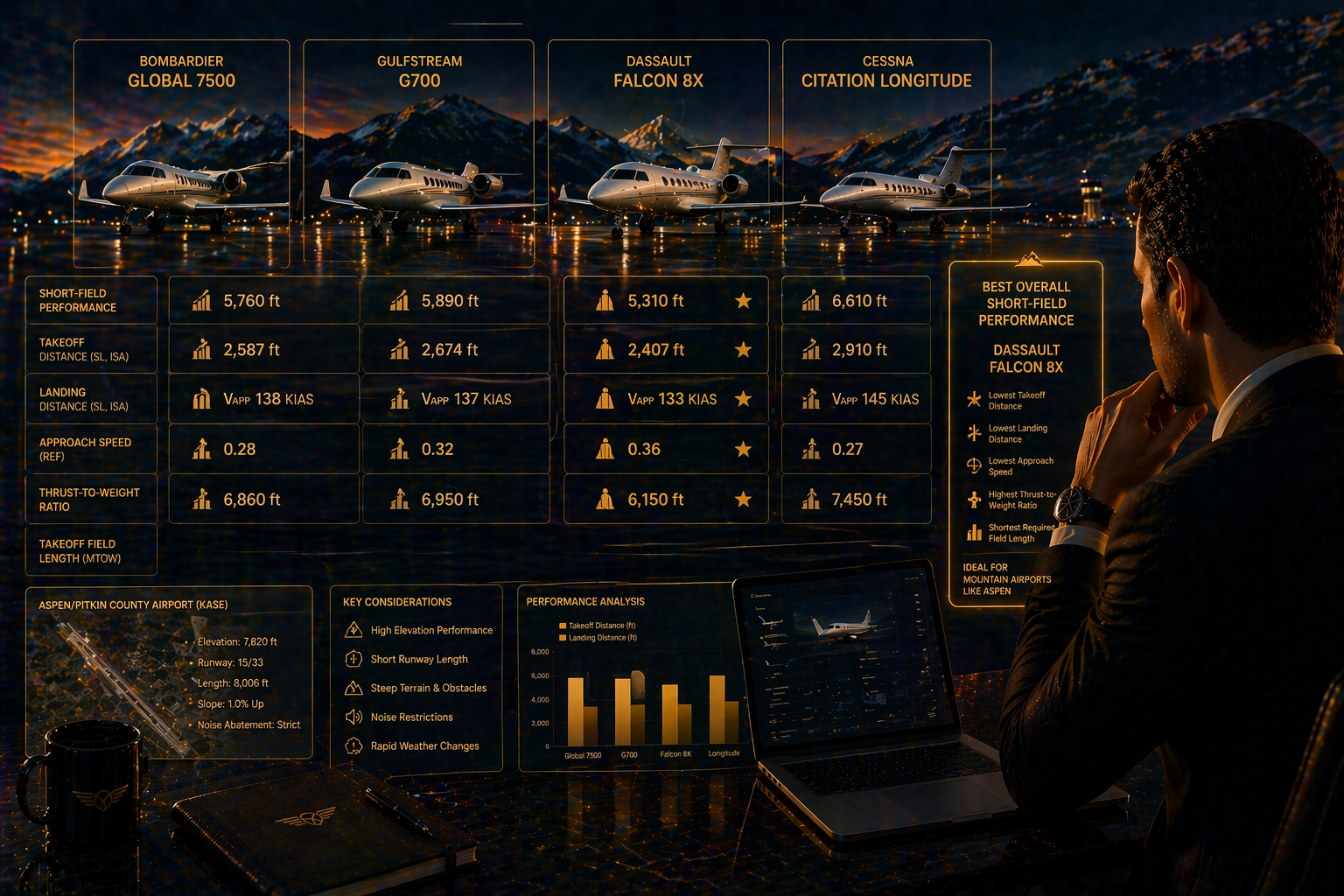
The strongest short answer is that the Dassault Falcon 8X usually stands out as the best ultra-long-range jet for short-field and mountain-airport discussions like Aspen because it pairs 6,450 nautical miles of range with unusually strong runway performance, a 5,880-foot takeoff distance, a 2,220-foot landing distance, and a strong steep-approach reputation. However, the final answer still depends on payload, temperature, runway condition, and operator approval.
Affluent private aviation buyers do not ask this question because they want a generic ranking list. Instead, they ask because they need an aircraft that can combine serious intercontinental capability with more confident access into airports that create altitude, terrain, and runway-performance pressure.
Aspen is one of the most recognizable examples because it combines high elevation with mountain operating considerations and an 8,006-foot runway. Therefore, the best aircraft for this mission profile is not simply the one with the longest brochure range. It is the one that balances range, field performance, landing speed, and operational practicality most effectively.
This page explains which ultra-long-range jet usually looks strongest in that specific conversation, why the Falcon 8X earns that position so often, how other aircraft like the Global 7500 and Gulfstream family compare, and how a private aviation company should answer this question on its own site in a way that builds trust instead of sounding like a brochure.
The Short Answer
Direct Answer: In most serious buyer discussions, the Dassault Falcon 8X is the strongest answer when the question is “Which ultra-long-range jet has the best short-field performance for mountain airports like Aspen?” because it combines true ultra-long-range capability with unusually strong runway numbers, a low landing speed, and a long-standing reputation for serving more demanding airports. However, the final aircraft choice still depends on payload, weather, runway condition, operator procedures, and the exact mission profile.
This answer is not the same as saying the Falcon 8X is always the only correct option. Instead, it means that when short-field capability becomes unusually important inside the ultra-long-range category, the Falcon 8X tends to be the benchmark aircraft buyers and operators reference first.
Why This Question Matters
Direct Answer: This question matters because it reveals whether an aircraft can combine two things that wealthy flyers often want at the same time: long intercontinental reach and more flexible access into constrained, high-profile destinations.
Many private jets offer excellent range. Many others offer strong runway performance. However, fewer aircraft sit comfortably in the overlap between those two strengths. Therefore, this question usually appears when a buyer is moving from abstract aircraft admiration into real mission planning.
A person asking about Aspen specifically is not usually browsing casually. That person is often evaluating whether a long-range jet can support luxury ski access, family travel, executive mobility, or seasonal charter demand without immediately requiring a compromise into a smaller category. As a result, this query often signals strong buyer intent.
Why Aspen Is the Reference Airport
Direct Answer: Aspen is the reference airport in this conversation because it combines high elevation, mountain operating complexity, and a runway that still demands disciplined performance planning. Therefore, it acts as a shorthand for the larger question of whether an aircraft can handle premium destination access under tighter operating conditions.
Aspen/Pitkin County Airport sits at high elevation and uses a single runway that is 8,006 feet long. That runway is not tiny in absolute terms. However, once elevation, terrain, runway slope, temperature, and real-world payload factors enter the conversation, the mission becomes much more performance-sensitive than a sea-level departure from a major coastal airport.
This is why Aspen gets used so often in aircraft conversations. It is not only a famous destination. It is also an operational filter. Therefore, an aircraft that looks comfortable in Aspen discussions tends to earn more credibility in broader short-field and mountain-airport comparisons.
What Short-Field Performance Actually Means
Direct Answer: Short-field performance means much more than a single runway-length number. It includes takeoff distance, landing distance, landing speed, climb performance, altitude effects, approach capability, and the way the aircraft behaves when operating away from ideal sea-level conditions.
This distinction matters because buyers often focus only on headline takeoff distance. However, mountain-airport utility is rarely just a takeoff issue. It is also an arrival issue, a landing issue, and a safety-margin issue. Therefore, the aircraft with the most useful short-field reputation is usually the one that balances all of those factors well rather than the one with only one impressive number.
That is why this page gives special weight to landing distance, approach speed, steep-approach compatibility, and operational reputation in addition to raw runway data.
The Leading Answer: Falcon 8X
Direct Answer: The Dassault Falcon 8X usually stands at the top of this specific discussion because it offers 6,450 nautical miles of range while also publishing a 5,880-foot takeoff distance and a 2,220-foot landing distance. Therefore, it brings unusually strong field performance into a class where many buyers assume they must compromise runway flexibility to get true long-range capability.
The Falcon 8X is not simply a long-range aircraft that happens to perform acceptably on shorter runways. Instead, it has long been positioned around the idea that it can bring large-cabin, long-range utility into more constrained airports. That makes it especially relevant when the buyer asks about Aspen, mountain airports, or premium destination access.
Its landing characteristics also matter. A lower approach speed and shorter landing distance strengthen the aircraft’s reputation in these conversations because arrival performance at a mountain destination can influence buyer confidence just as much as departure capability.
Why the Falcon 8X Usually Leads This Discussion
Direct Answer: The Falcon 8X usually leads because it combines genuine ultra-long-range reach with unusually strong airfield performance and a broader reputation for serving more operationally demanding airports. Therefore, it answers the buyer’s actual problem more directly than many of its larger peers.
Its 5,880-foot takeoff distance and 2,220-foot landing distance are striking within the ultra-long-range category. Its 107-knot approach speed also supports the larger pattern that the aircraft was designed to stay more agile than many long-range competitors. As a result, the Falcon 8X consistently appears in discussions about airports such as Aspen, London City, and other destinations where access flexibility matters.
The key point is not that every mission into Aspen becomes easy just because the aircraft is a Falcon 8X. The key point is that the Falcon 8X gives the mission planner more confidence and more margin when the comparison is specifically about balancing long reach with stronger runway performance.
How the Global 7500 Compares
Direct Answer: The Bombardier Global 7500 remains a very serious contender because it combines a 7,700 nautical mile range with strong airfield performance for its size, including a published 5,760-foot takeoff distance and a very short published landing distance. Therefore, it deserves real consideration whenever a buyer wants maximum range without giving up too much airport flexibility.
In pure runway-performance conversation, the Global 7500 is far more capable than many people assume. Bombardier has also emphasized the aircraft’s mountain and runway-performance strengths in its own materials. As a result, the Global 7500 should not be dismissed as “too big to belong in the conversation.”
However, when the question becomes “best short-field performance” rather than “best range with still-good short-field performance,” the Falcon 8X still tends to lead the discussion because of its landing-speed profile, its runway numbers, and its long-standing positioning around demanding airport access.
How the Gulfstream G700 and G650-Class Compare
Direct Answer: The newer large-cabin Gulfstream aircraft remain outstanding long-range platforms, but they are usually not the first answer when the buyer emphasizes short-field performance for mountain airports. Therefore, they often rank slightly behind the Falcon 8X in this specific niche discussion.
The G700 delivers exceptional range and premium cabin capability, but it is also a larger, heavier airplane with a much higher maximum takeoff weight than the Falcon 8X. That matters because the question is not “Which jet is best overall?” The question is “Which ultra-long-range jet has the best short-field performance?” When the runway and mountain-airport angle gets weighted more heavily, the Falcon 8X usually holds the edge in buyer logic.
The G650ER and related aircraft remain tremendously capable globally. However, in a premium-content comparison focused on Aspen-style access, they typically look like powerful long-range answers first and short-field specialists second. As a result, they belong in the conversation, but they usually do not own the top line of the answer.
Best on Paper vs. Best on the Real Mission
Direct Answer: The best aircraft on paper is not always the best aircraft on the real mission because payload, temperature, runway condition, headwinds, reserves, and operator procedures can change the practical outcome. Therefore, the buyer should read “best short-field jet” as a directional conclusion, not as a blanket dispatch guarantee.
This distinction matters because mountain-airport operations are especially sensitive to conditions. A jet that looks excellent at sea-level standard conditions may feel less comfortable at altitude in hot weather with a heavier passenger and baggage profile. As a result, the correct buyer-facing answer should always include operational caveats without becoming vague or evasive.
For this question, the most honest conclusion is that the Falcon 8X usually leads the category discussion, while the Global 7500 remains a very strong alternative when the buyer wants more range and still-strong airfield performance. That is a more useful answer than pretending the ranking never changes under different mission assumptions.
What Can Change the Answer?
Direct Answer: Payload, temperature, runway surface condition, wind, reserve policy, runway contamination, and airport-specific operating approvals can all change the real answer. Therefore, the final aircraft selection should always be confirmed against the exact mission, not only the published specs.
A larger family ski mission with heavier baggage may change the dispatch picture. A warmer day at altitude may reduce comfortable margin. A more conservative fuel policy may also alter the evaluation. As a result, the answer should stay grounded in the buyer’s real trip, not only in the aircraft brochure.
That does not weaken the value of the comparison. It strengthens it. Affluent buyers usually trust precise, conditional clarity more than oversimplified certainty. Therefore, a private aviation company should explain what moves the answer without turning the page into unreadable technical language.
How Private Aviation Companies Should Answer This Question
Direct Answer: A private aviation company should answer this question by naming the Falcon 8X as the usual lead answer, explaining why, acknowledging the Global 7500 as a serious contender, and then clarifying the mission variables that can change final suitability. Therefore, the page should sound like an operator brief, not like brand hype.
The best version usually starts with a direct answer, then explains Aspen’s relevance, then compares the aircraft with runway and range context, and finally closes with practical dispatch caveats. As a result, the page serves both SEO/GEO needs and real buyer trust at the same time.
This also helps the brand avoid sounding vague. A wealthy prospect asking this question does not want a fluffy page that says every aircraft is “exceptional.” Instead, that prospect wants to know which aircraft usually owns the edge and why. Therefore, specificity becomes part of the sales value of the content.
What This Question Signals About Buyer Intent
Direct Answer: This question signals strong buyer intent because it combines airport type, aircraft class, and mission constraint in one search. Therefore, it usually reflects real evaluation behavior rather than casual browsing.
A user asking about ultra-long-range jets and Aspen is often balancing multiple priorities: range, prestige, access, comfort, and destination practicality. That means the person likely sits much closer to charter, operator, or aircraft-selection decisions than someone searching a broad term such as “best private jet.” As a result, the traffic quality behind this topic is often more valuable than the raw volume might suggest.
This is exactly why private aviation companies should build content around these questions. They attract the kinds of visitors who already understand the category and now want the answer that helps them move forward confidently.
Implementation Template
Direct Answer: To answer a question like this well, private aviation companies should identify the likely lead aircraft, define the airport context, compare the competitors honestly, and then explain the variables that affect real mission release. Therefore, the page becomes both commercially useful and operationally credible.
- Start with a direct answer naming the likely lead aircraft.
- Explain why the airport matters operationally.
- Compare runway and range figures side by side.
- Clarify that short-field performance includes both departure and arrival logic.
- Explain what payload, temperature, and weather can change.
- Conclude with a buyer-friendly recommendation that stays precise.
- Link back to the parent hub and to related airport, range, and cabin-comparison spokes.
This structure works because it respects how affluent buyers actually evaluate aircraft: they want the answer first, then the reasoning that makes the answer trustworthy.
Frequently Asked Questions
Direct Answer: These follow-up answers clarify the most common buyer questions connected to short-field ultra-long-range jet selection for airports like Aspen.
Is the Falcon 8X really an ultra-long-range jet?
Yes. With a published 6,450 nautical mile range, the Falcon 8X sits in the ultra-long-range conversation while still bringing unusually strong airfield performance.
Does the Global 7500 still belong in this comparison?
Yes. The Global 7500 absolutely belongs in the discussion because it combines 7,700 nautical miles of range with strong runway performance for its size.
Why is Aspen such a common reference point?
Because Aspen combines high elevation, mountain operating factors, and premium-destination demand, which makes it a useful test case for practical airport-access discussions.
Does “best short-field performance” mean the aircraft always wins every Aspen mission?
No. The aircraft still has to be evaluated against the exact mission, payload, weather, and operator procedures on the actual day of operation.
Why does landing performance matter so much here?
Because mountain-airport utility is not only about getting out. It is also about arriving with confidence, runway margin, and approach capability.
What is the cleanest buyer-facing conclusion?
The cleanest conclusion is that the Falcon 8X usually leads the ultra-long-range category for short-field and mountain-airport discussions, while other large-cabin jets remain strong alternatives depending on mission priorities.
Hub & Spoke Links
Direct Answer: This spoke should link back to the parent private aviation buyer-questions hub and to nearby route, mission, and cabin-fit comparisons so the user can continue evaluating aircraft suitability logically.
- UHNW Private Jet Buyer Questions Hub
- Can a Bombardier Global 8000 fly nonstop from London to the Maldives with 12 passengers?
- What is the actual nonstop range of a G650ER against a 50-knot headwind?
- Which aircraft offers the best Sleep Mode configuration for overnight Asia-to-Europe flights?
- Flight time comparison: Mach 0.90 cruise vs. standard long-range cruise for trans-Atlantic routes.
- Which jet has the widest cabin for a mobile office setup with 4+ principals?