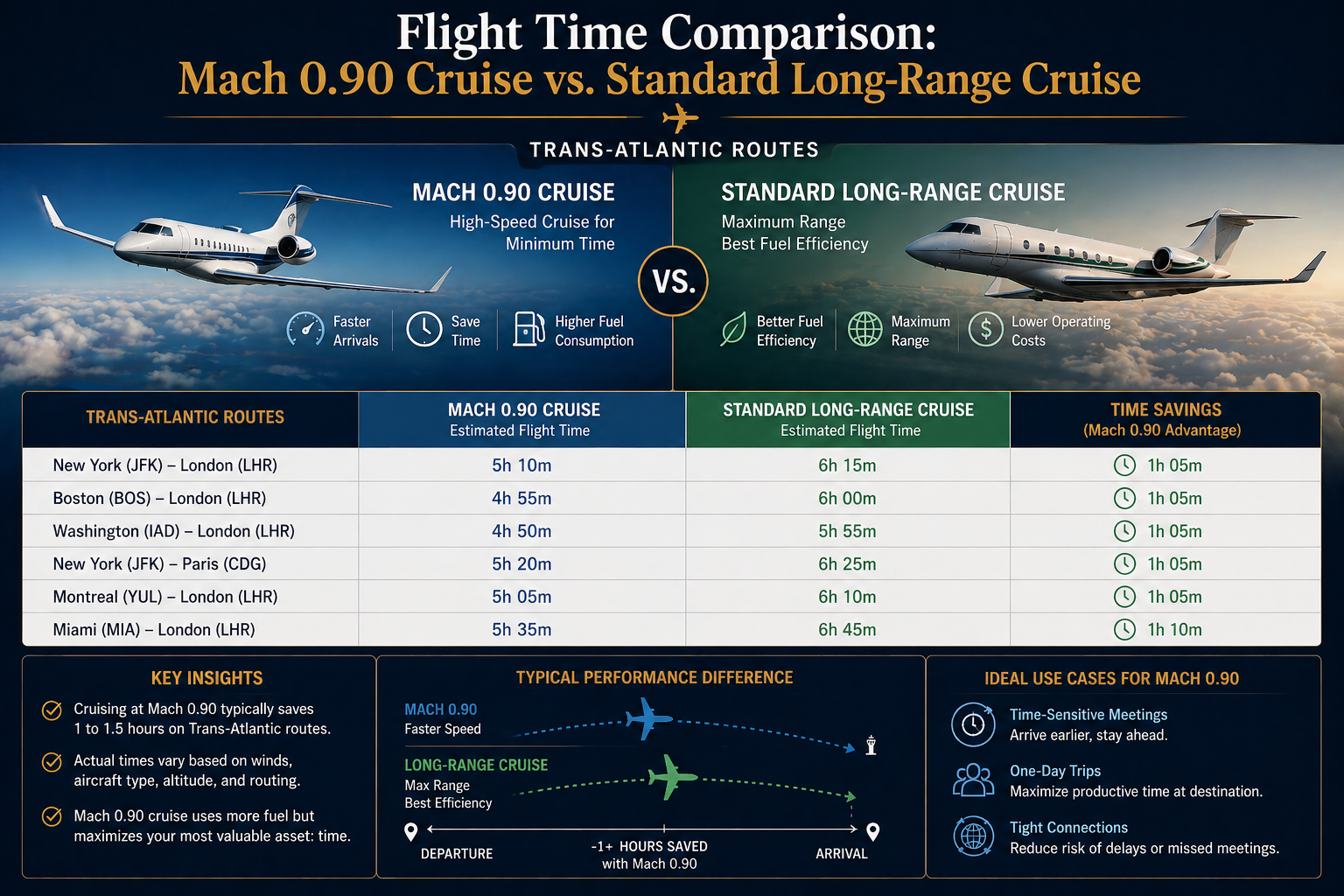
Flight Time Comparison: Mach 0.90 Cruise vs. Standard Long-Range Cruise for Trans-Atlantic Routes
Mach 0.90 cruise can usually save about 20 to 45 minutes on many trans-Atlantic private jet routes compared with a standard long-range cruise around Mach 0.85. However, the exact delta depends on route length, winds, altitude, aircraft type, fuel burn, reserves, and ATC flow. Therefore, high-speed cruise is most valuable when the saved time justifies the fuel and range tradeoff.
For UHNW travelers, this question matters because private aviation is not only about comfort. It is also about time control. However, the fastest cruise setting does not always create the smartest mission. Sometimes, a slightly slower long-range cruise protects nonstop capability, reduces fuel stress, and creates a smoother planning envelope.
Additionally, trans-Atlantic routes vary heavily. New York to London, Teterboro to Paris, Boston to Geneva, Miami to Madrid, and Chicago to Dublin all create different speed and wind dynamics. Consequently, Mach 0.90 can feel highly valuable on one route and less meaningful on another.
This page explains the practical time savings, the fuel-range tradeoff, the best buyer-facing conclusion, and how private aviation companies should answer this question for high-intent buyers.
The Short Answer
Direct Answer: On many trans-Atlantic private jet routes, Mach 0.90 cruise can save roughly 20 to 45 minutes compared with a standard long-range cruise near Mach 0.85. However, that speed usually burns more fuel and reduces range margin. Therefore, Mach 0.90 is best when time matters more than fuel efficiency, while long-range cruise is better when nonstop margin matters more.
In practical buyer terms, the aircraft may not become “hours faster” across the Atlantic. Instead, Mach 0.90 usually trims a meaningful but limited amount of time. Consequently, the best speed setting depends on the route, the winds, and the buyer’s mission priority.
Why This Question Matters
Direct Answer: This question matters because high-speed cruise can save time, but it can also reduce range margin. Therefore, buyers need to understand when speed creates real value and when it creates unnecessary tradeoffs.
UHNW travelers often value time more than fuel cost. However, even wealthy buyers still care about mission reliability. A faster cruise setting means little if it creates a fuel stop, reduces alternate options, or forces a tighter dispatch plan.
Additionally, private aviation buyers often compare aircraft by headline speed. However, the smarter question is operational. The aircraft must fly the route, manage winds, protect reserves, and deliver the passenger rested. Consequently, speed is only one part of the trans-Atlantic value equation.
What Mach 0.90 Cruise Means
Direct Answer: Mach 0.90 means the aircraft cruises at about 90% of the local speed of sound. Therefore, on a high-altitude trans-Atlantic mission, it usually represents a high-speed cruise profile rather than the most fuel-efficient cruise profile.
Several modern ultra-long-range jets publish or promote Mach 0.90 high-speed cruise capability. For example, Gulfstream has published aircraft performance references showing 6,400 nautical miles at Mach 0.90 for aircraft such as the G650ER and G700, while also showing greater range at Mach 0.85.
This matters because Mach 0.90 is fast enough to affect schedule planning. However, it is not free. The aircraft usually burns more fuel per mile at higher cruise speeds. Therefore, the buyer gains time but may lose range margin.
What Standard Long-Range Cruise Means
Direct Answer: Standard long-range cruise usually means a more efficient cruise profile, often around Mach 0.85 on many ultra-long-range business jets. Therefore, it typically protects range, fuel reserves, and nonstop capability better than Mach 0.90.
Long-range cruise is not “slow” in practical terms. It still moves fast enough for intercontinental travel. However, it usually balances speed and fuel efficiency more carefully than high-speed cruise.
For example, Gulfstream has published references showing 7,500 nautical miles at Mach 0.85 for the G650ER and older G700 materials, while showing 6,400 nautical miles at Mach 0.90. That illustrates the core tradeoff: faster cruise can reduce the distance the aircraft can fly nonstop.
Typical Time Savings on Trans-Atlantic Routes
Direct Answer: For common trans-Atlantic sectors, Mach 0.90 often saves about 20 to 45 minutes versus Mach 0.85. Therefore, the time savings can be meaningful, but it usually does not transform a seven-hour trip into a five-hour trip.
The math is straightforward. Mach 0.90 is about 5.9% faster than Mach 0.85 in still-air terms. Therefore, a six-hour flight at Mach 0.85 might save about 20 minutes at Mach 0.90 before real-world factors enter the equation.
However, real flights include climb, descent, routing, oceanic tracks, ATC flow, winds, and altitude restrictions. Consequently, the actual time savings may be smaller or larger than simple cruise math suggests.
Route Comparison Table
Direct Answer: The table below gives a practical buyer-friendly estimate. However, actual flight plans depend on aircraft type, winds, routing, and operating rules.
Route Example |
Approximate Route Type |
Mach 0.85 Long-Range Cruise Estimate |
Mach 0.90 High-Speed Cruise Estimate |
Typical Time Saved |
|---|---|---|---|---|
| New York to London | Shorter core Atlantic route | About 6.5 to 7.5 hours | About 6.2 to 7.1 hours | About 20 to 30 minutes |
| Teterboro to Paris | Moderate Atlantic route | About 7 to 8 hours | About 6.6 to 7.6 hours | About 20 to 35 minutes |
| Boston to Geneva | Moderate Atlantic route | About 7 to 8 hours | About 6.6 to 7.6 hours | About 20 to 35 minutes |
| Miami to Madrid | Longer southern Atlantic route | About 8 to 9 hours | About 7.5 to 8.5 hours | About 25 to 45 minutes |
| Chicago to Dublin | Longer inland-to-Europe route | About 7.5 to 8.5 hours | About 7.1 to 8 hours | About 25 to 40 minutes |
Therefore, Mach 0.90 is most compelling when the route is long enough for the time savings to matter and short enough to preserve nonstop range margin.
Fuel and Range Tradeoff
Direct Answer: Mach 0.90 usually trades range for time. Therefore, buyers should not view high-speed cruise as automatically better than long-range cruise.
Manufacturer examples make this clear. Gulfstream has published G650ER references showing 7,500 nautical miles at Mach 0.85 and 6,400 nautical miles at Mach 0.90. Similarly, older G700 references have shown the same 7,500 nautical mile long-range cruise and 6,400 nautical mile high-speed cruise relationship.
Consequently, faster cruise can reduce range by more than 1,000 nautical miles in some published aircraft examples. That does not matter on shorter Atlantic sectors. However, it can matter on longer routes, heavy-payload flights, adverse-wind missions, or trips requiring more alternate planning.
Why Winds Change the Answer
Direct Answer: Winds change the answer because flight time depends on groundspeed, not only airspeed. Therefore, a 50-knot tailwind or headwind can change the practical value of Mach 0.90.
Eastbound trans-Atlantic flights often benefit from strong tailwinds. In that case, both Mach 0.85 and Mach 0.90 may produce acceptable arrival times. Consequently, the buyer may choose long-range cruise and preserve fuel.
However, westbound flights often face headwinds. In that case, Mach 0.90 may recover some time, but it may also increase fuel burn when range margin is already tighter. Therefore, the operator must balance time savings against fuel reserves and alternate planning.
Aircraft That Make This Question Relevant
Direct Answer: This question is most relevant for ultra-long-range and high-speed business jets that can cruise around Mach 0.90 while still retaining meaningful range. Therefore, aircraft such as the Gulfstream G650ER, G700, G800, Bombardier Global 7500, Global 8000, and similar platforms belong in this discussion.
Some aircraft can technically fly fast but cannot preserve enough range margin for every trans-Atlantic mission. Meanwhile, other aircraft can fly the route comfortably but may not offer the same high-speed cruise value.
Consequently, the buyer should ask three questions together: How fast can the aircraft cruise? How far can it fly at that cruise speed? And how much fuel margin remains on the actual route?
When Mach 0.90 Makes Sense
Direct Answer: Mach 0.90 makes the most sense when the route is well within the aircraft’s high-speed range, the passenger values arrival time highly, and the fuel margin remains comfortable.
For example, a New York-to-London mission in a capable ultra-long-range jet may have enough range cushion to use Mach 0.90 without creating meaningful nonstop risk. Therefore, the passenger can buy time without stressing the mission.
Additionally, Mach 0.90 can matter when the passenger has a meeting, event, airport curfew, crew duty issue, or tight ground schedule. In those cases, 25 or 35 minutes can carry real value.
However, the operator should still review winds, routing, and fuel reserves. Speed is valuable only when the mission remains clean.
When Long-Range Cruise Makes Sense
Direct Answer: Long-range cruise makes the most sense when range margin, nonstop reliability, lower fuel burn, or smoother planning matters more than a modest time savings.
For longer trans-Atlantic sectors, heavy passenger loads, strong headwinds, or winter westbound flights, long-range cruise can become the smarter choice. It may protect fuel reserves and reduce fuel-stop risk.
Additionally, long-range cruise can support a calmer operational plan. If the buyer does not need the faster arrival, the slower profile may create less stress for the aircraft, crew, and dispatch plan. Therefore, it can be the more professional recommendation in many cases.
Best Buyer-Facing Conclusion
Direct Answer: The best buyer-facing conclusion is this: Mach 0.90 cruise can usually save around 20 to 45 minutes on many trans-Atlantic private jet routes, but it can reduce fuel and range margin. Therefore, use Mach 0.90 when time matters and the route fits comfortably inside high-speed range. Use standard long-range cruise when nonstop reliability matters more.
This answer works because it avoids overselling speed. Instead, it shows the buyer how operators think. Consequently, the page builds trust while still making high-speed cruise feel valuable.
How Private Aviation Companies Should Answer This Question
Direct Answer: A private aviation company should answer this question by showing the time savings, then explaining the fuel-range tradeoff. Therefore, the page should compare mission value, not only cruise speed.
The strongest phrasing is simple: “Mach 0.90 may save roughly 20 to 45 minutes on many trans-Atlantic missions, but the best cruise profile depends on route length, winds, fuel reserves, and passenger priority.”
Then, the page should show route examples. Additionally, it should explain when faster cruise makes sense and when long-range cruise protects the mission better. Consequently, the buyer receives a useful operational framework rather than a generic speed claim.
What This Question Signals About Buyer Intent
Direct Answer: This question signals strong buyer intent because it compares speed against real route performance. Therefore, the user likely understands private aviation and wants mission-specific value, not surface-level aircraft hype.
A casual traveler may ask how fast a private jet flies. However, a serious buyer asks whether Mach 0.90 actually saves enough time across the Atlantic to matter. That reveals a more advanced evaluation stage.
Additionally, this question often comes from principals, advisors, or operators who care about schedule compression. Consequently, this topic can attract high-value buyers who already understand the value of time.
Implementation Template
Direct Answer: To answer this flight-time comparison well, a private aviation company should compare time saved, fuel impact, route length, winds, and aircraft capability. Therefore, the page should operate like a speed-versus-range planning brief.
- Start with the direct time-saving estimate.
- Then, define Mach 0.90 and standard long-range cruise.
- Next, show example trans-Atlantic routes in a table.
- Additionally, explain the fuel and range tradeoff.
- Then, explain how winds change the answer.
- Also, identify when high-speed cruise makes sense.
- Finally, link back to the parent hub and related range, comfort, and time-saving spokes.
This structure works because it answers the buyer’s actual question. It does not reduce the decision to “faster is always better.”
Frequently Asked Questions
Direct Answer: These follow-up answers clarify the most common buyer questions about Mach 0.90 versus long-range cruise on trans-Atlantic routes.
How much time does Mach 0.90 save across the Atlantic?
Mach 0.90 often saves about 20 to 45 minutes on many trans-Atlantic private jet routes compared with Mach 0.85 long-range cruise.
Is Mach 0.90 always better?
No. Mach 0.90 can save time, but it usually burns more fuel and reduces range margin. Therefore, it is not always the best mission choice.
What is standard long-range cruise?
Standard long-range cruise is usually a more efficient cruise profile, often around Mach 0.85 on many ultra-long-range business jets.
Does Mach 0.90 affect nonstop range?
Yes. Faster cruise can reduce nonstop range significantly. Therefore, operators must review route length, winds, reserves, and payload.
Which routes benefit most from Mach 0.90?
Routes with enough range cushion and strong schedule pressure benefit most. For example, New York-to-London can be a good candidate on capable aircraft.
What is the most accurate short answer?
Mach 0.90 can save meaningful time, usually measured in minutes rather than hours. However, long-range cruise often protects fuel margin better.
Hub & Spoke Links
Direct Answer: This spoke should link back to the parent private aviation buyer-questions hub and to related route, range, comfort, and time-saving questions.
- UHNW Private Jet Buyer Questions Hub
- What is the actual nonstop range of a G650ER against a 50-knot headwind?
- What is the time-saving delta for a private mission from NYC to London vs. commercial First Class?
- Which aircraft offers the best Sleep Mode configuration for overnight Asia-to-Europe flights?
- Can a Bombardier Global 8000 fly nonstop from London to the Maldives with 12 passengers?