
Private Aviation Question-Led Spoke
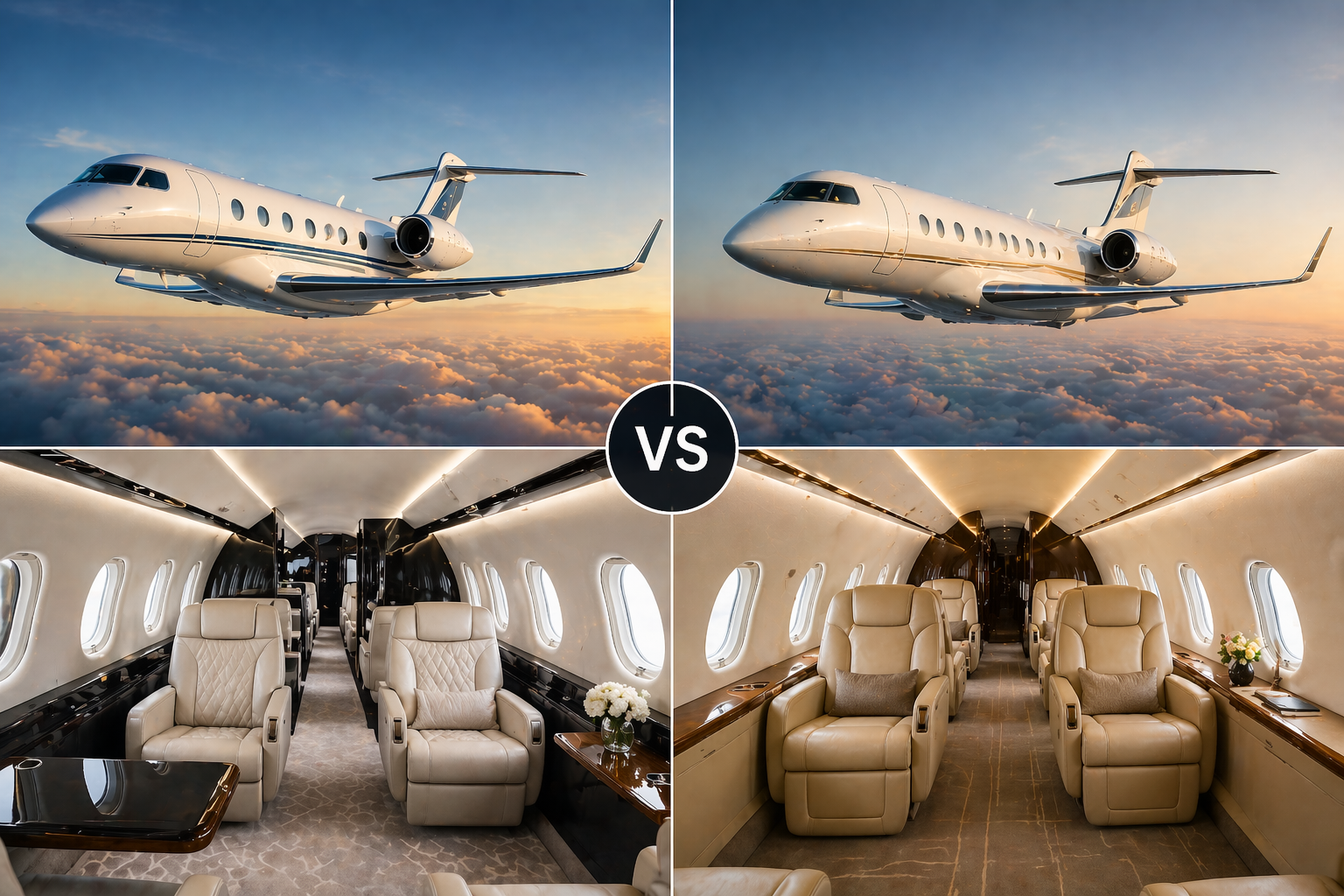
Comparison of Cabin Altitude at 45,000 Feet: Gulfstream G700 vs. Bombardier Global 7500
The best buyer answer is that the Bombardier Global 7500 appears to hold the edge if lowest cabin altitude is the priority, while the Gulfstream G700 remains extremely strong. Gulfstream publishes 2,840 feet at 41,000 feet and 4,850 feet at 51,000 feet for the G700, which implies roughly mid-3,000s at 45,000 feet. Bombardier publicly cites the Global 7500 at less than 2,900 feet at 41,000 feet and continues to market it around ultra-low cabin altitude, but an accessible official 45,000-foot figure was not verified in the sources reviewed. :contentReference[oaicite:0]
That makes this question more nuanced than it first appears. A buyer asking about cabin altitude at 45,000 feet usually wants to know which aircraft supports better long-haul comfort, reduced fatigue, and a more refreshed arrival after a serious intercontinental mission. Therefore, the page needs to compare not only the numbers, but also the quality of the published evidence and what can be stated honestly. :contentReference[oaicite:1]
The G700 has very clear official public data available through Gulfstream. Bombardier's accessible public language for the Global 7500 is less explicit at 45,000 feet in the sources reviewed, but Bombardier does publicly state a cabin altitude of less than 2,900 feet at 41,000 feet for the Global 7500 and consistently positions it around ultra-low cabin altitude and wellness. As a result, the safest comparison is directional rather than artificially precise. :contentReference[oaicite:2]
This page explains the published figures, what can be inferred at 45,000 feet, why cabin altitude matters to affluent buyers, and how a private aviation company should answer this question on its own site without inventing a fake exact number just to sound authoritative. :contentReference[oaicite:3]
The Short Answer
Direct Answer: If the buyer's only question is which aircraft likely offers the lower cabin altitude at 45,000 feet, the safest directional answer is the Bombardier Global 7500. Bombardier publicly cites the Global 7500 at less than 2,900 feet at 41,000 feet, while Gulfstream publishes the G700 at 2,840 feet at 41,000 feet and 4,850 feet at 51,000 feet. That means the G700 can be placed at roughly the mid-3,000-foot range at 45,000 feet by interpolation, while the Global 7500 still appears to hold the lower-cabin-altitude advantage overall, even though an accessible official Bombardier 45,000-foot figure was not verified in the reviewed sources. :contentReference[oaicite:4]
That answer is more useful than pretending both aircraft have perfectly comparable published 45,000-foot figures available in the same format. They do not, at least in the accessible sources reviewed here. Therefore, the strongest comparison separates what is officially published, what is reasonably inferred, and what remains mission- or source-dependent. :contentReference[oaicite:5]
Why This Question Matters
Direct Answer: This question matters because cabin altitude directly affects how passengers feel on long flights. Therefore, buyers use it as a proxy for wellness, fatigue reduction, and arrival quality on intercontinental missions. :contentReference[oaicite:6]
Affluent buyers do not usually ask about cabin altitude because they enjoy spec-sheet trivia. Instead, they ask because they want to understand which aircraft preserves comfort better over long sectors. Lower cabin altitude generally means passengers feel less dried out, less fatigued, and less depleted after a long flight. As a result, the topic carries real weight in premium aircraft selection. :contentReference[oaicite:7]
This is also why the question performs well as private aviation content. A buyer asking it is usually beyond the brochure stage and is now comparing how the mission feels, not only whether it can be flown. Therefore, the page signals stronger intent than a generic "best private jet interior" article. :contentReference[oaicite:8]
What Cabin Altitude Actually Means
Direct Answer: Cabin altitude is the pressure-equivalent altitude passengers experience inside the cabin while the aircraft cruises at a much higher true altitude. Therefore, a lower cabin altitude means the cabin feels closer to lower elevation, which generally improves comfort on long flights. :contentReference[oaicite:9]
This distinction matters because the aircraft may be flying at 45,000 or 51,000 feet while the passengers experience something much lower inside the pressure vessel. That is why cabin altitude becomes a major comfort differentiator in large-cabin and ultra-long-range aviation. As a result, the aircraft with the lower cabin altitude often wins the wellness conversation even if both jets are already exceptionally comfortable. :contentReference[oaicite:10]
Published G700 Cabin Altitude Data
Direct Answer: Gulfstream publishes the G700 at 2,840 feet of cabin altitude at 41,000 feet and also references 4,850 feet at 51,000 feet in a G700 fact sheet. Therefore, Gulfstream provides enough public data to make a credible 45,000-foot estimate. :contentReference[oaicite:11]
On the current G700 aircraft page, Gulfstream explicitly lists "Cabin Altitude — 2,840 ft at 41,000 ft." That is the cleanest official figure available from the manufacturer's site. Separately, a G700 fact sheet references "Cabin altitude — 4,850 ft at 51,000 ft." Together, those two points create a usable range for interpreting the cabin-pressure behavior higher in the envelope. :contentReference[oaicite:12]
That level of transparency helps because it gives the buyer real anchor points instead of broad marketing language alone. Therefore, the G700 side of the comparison is easier to discuss precisely. :contentReference[oaicite:13]
Published Global 7500 Cabin Altitude Data
Direct Answer: Bombardier publicly states the Global 7500 has a cabin altitude of less than 2,900 feet at 41,000 feet, and Bombardier continues to position the aircraft around ultra-low cabin altitude and wellness. However, an accessible official 45,000-foot figure was not verified in the sources reviewed for this page. :contentReference[oaicite:14]
That does not make the Global 7500 vague or weak on cabin comfort. It means the manufacturer's most easily accessible public wording in the reviewed sources is strongest at 41,000 feet rather than at 45,000 feet. Therefore, the buyer should read the Global 7500 as clearly elite on cabin altitude, while also recognizing that this particular page must avoid inventing a fake 45,000-foot number. :contentReference[oaicite:15]
Bombardier's own current Global 7500 page also points readers to the aircraft brochure and references the lower cabin altitude achieved with the Global 8000 upgrade path, but the clean accessible line in the reviewed public material remains the under-2,900-feet-at-41,000-feet reference for the Global 7500 baseline. :contentReference[oaicite:16]
What the G700 Looks Like at 45,000 Feet
Direct Answer: Based on Gulfstream's published 2,840 feet at 41,000 feet and 4,850 feet at 51,000 feet, the G700 likely sits around roughly 3,600 to 3,700 feet of cabin altitude at 45,000 feet if you interpolate between those two manufacturer-published points. That is an inference, not an additional published Gulfstream 45,000-foot spec. :contentReference[oaicite:17]
This estimate is useful because it gives the buyer something more practical than a silence gap between 41,000 and 51,000 feet. However, it is still important to label it honestly as an inference from two official published points rather than as a standalone certified spec line. Therefore, the page stays precise without becoming misleading. :contentReference[oaicite:18]
What the Global 7500 Likely Means at 45,000 Feet
Direct Answer: The safest conclusion is that the Global 7500 likely remains lower than the G700 at 45,000 feet if Bombardier's under-2,900-feet-at-41,000-feet figure and Bombardier's ongoing ultra-low-cabin-altitude positioning are taken together. However, because an accessible official 45,000-foot Bombardier figure was not verified here, the page should present that as a directional advantage rather than as a made-up precise number. :contentReference[oaicite:19]
That is the more trustworthy way to compare the aircraft. It gives the buyer the real hierarchy without pretending the data symmetry is better than it actually is. As a result, the page protects credibility while still delivering a useful answer. :contentReference[oaicite:20]
Which Aircraft Appears to Win?
Direct Answer: The Bombardier Global 7500 appears to win the cabin-altitude comparison directionally, while the Gulfstream G700 remains extremely competitive and very strong in absolute comfort terms. Therefore, the right buyer conclusion is not that one aircraft is comfortable and the other is not. It is that both are elite, but the Global 7500 appears to carry the lower-cabin-altitude edge. :contentReference[oaicite:21]
This matters because buyers often turn comparisons into false binaries. In reality, the G700 is still operating at an impressively low cabin altitude by any aviation standard. However, if the buyer's specific tie-breaker is "lowest cabin altitude," the Global 7500 appears to hold the better position from the public evidence reviewed. :contentReference[oaicite:22]
Why Buyers Care So Much About Cabin Altitude
Direct Answer: Buyers care because lower cabin altitude supports better comfort, lower fatigue, and a stronger wellness story on long-haul missions. Therefore, cabin altitude often becomes a real deciding factor for travelers who fly long sectors frequently. :contentReference[oaicite:23]
That is especially true for travelers crossing oceans overnight, flying for business immediately after arrival, or simply trying to reduce the physical drag of long missions. As a result, cabin altitude moves from a technical spec into a lifestyle-performance feature. :contentReference[oaicite:24]
Best Buyer-Facing Conclusion
Direct Answer: The cleanest buyer-facing conclusion is this: the Gulfstream G700 has clearly published cabin-altitude data showing 2,840 feet at 41,000 feet and about 4,850 feet at 51,000 feet, which implies roughly mid-3,000s at 45,000 feet. The Bombardier Global 7500 is publicly cited at less than 2,900 feet at 41,000 feet and appears to retain the lower-cabin-altitude advantage overall, but an accessible official 45,000-foot Bombardier figure was not verified in the reviewed sources. Therefore, the safest answer is that the Global 7500 likely wins directionally, while the G700 remains excellent. :contentReference[oaicite:25]
How Private Aviation Companies Should Answer This Question
Direct Answer: A private aviation company should answer this question by clearly separating published figures from inferred estimates and then giving the buyer the practical conclusion. Therefore, the page should sound precise, transparent, and premium rather than overly certain or promotional. :contentReference[oaicite:26]
The cleanest structure is simple. State the official G700 figures. State Bombardier's official under-2,900-at-41,000 figure for the Global 7500. Explain that the G700 can be estimated into the mid-3,000s at 45,000 feet from published Gulfstream data. Then explain that the Global 7500 still appears to carry the lower-cabin-altitude edge even though the exact accessible official 45,000-foot Bombardier number was not verified here. As a result, the page answers the user's real question without making up certainty. :contentReference[oaicite:27]
What This Question Signals About Buyer Intent
Direct Answer: This question signals strong buyer intent because it compares two flagship aircraft on a meaningful comfort variable that matters most on serious long-range missions. Therefore, it usually reflects shortlist behavior, not casual browsing. :contentReference[oaicite:28]
A person asking this question usually already understands the aircraft category and is now comparing what the flight feels like, not only what it costs or how far it goes. As a result, this type of spoke attracts fewer vanity visitors and more serious evaluators. :contentReference[oaicite:29]
Implementation Template
Direct Answer: To answer a cabin-altitude comparison well, a private aviation company should show the published manufacturer data first, explain any inference openly, and then translate the answer into buyer comfort language. Therefore, the page becomes useful, credible, and conversion-relevant. :contentReference[oaicite:30]
- Start with the direct answer and the buyer-facing winner.
- State the official manufacturer-published cabin-altitude figures.
- Separate published data from inferred 45,000-foot estimates clearly.
- Explain why lower cabin altitude matters on long missions.
- Give the buyer the clean practical conclusion instead of forcing a fake exact tie-breaker.
- Link back to the parent hub and to nearby aircraft-comparison spokes.
This structure works because it respects the data and still gives the buyer a clear answer. :contentReference[oaicite:31]
Frequently Asked Questions
Direct Answer: These follow-up answers clarify the most common buyer questions tied to cabin-altitude comparison between the G700 and Global 7500. :contentReference[oaicite:32]
What does Gulfstream officially publish for the G700?
Gulfstream publishes 2,840 feet at 41,000 feet on the current G700 page, and a G700 fact sheet references 4,850 feet at 51,000 feet. :contentReference[oaicite:33]
What does Bombardier officially publish for the Global 7500?
Bombardier publicly states the Global 7500 has a cabin altitude of less than 2,900 feet at 41,000 feet in accessible reviewed sources. :contentReference[oaicite:34]
Is there an official 45,000-foot Bombardier figure in the reviewed sources?
Not in the accessible official material reviewed for this page. That is why the comparison is strongest as a directional conclusion rather than a fake exact numeric tie-breaker. :contentReference[oaicite:35]
What is a reasonable G700 estimate at 45,000 feet?
Based on Gulfstream's published 41,000-foot and 51,000-foot figures, the G700 likely sits around the mid-3,000-foot range at 45,000 feet. :contentReference[oaicite:36]
Which aircraft appears to have the lower cabin altitude overall?
The Global 7500 appears to hold the lower-cabin-altitude edge overall from the public evidence reviewed, although the exact 45,000-foot Bombardier figure was not verified in accessible official sources for this page. :contentReference[oaicite:37]
Why is this a valuable private aviation content topic?
Because it captures real shortlist behavior. Buyers asking this question are usually comparing premium long-range travel comfort, not just browsing brand names. :contentReference[oaicite:38]
Hub & Spoke Links
Direct Answer: This spoke should link back to the parent private aviation buyer-questions hub and to nearby performance, comfort, and mission-fit comparisons so the user can keep evaluating the aircraft shortlist logically.
- UHNW Private Jet Buyer Questions Hub
- What is the actual nonstop range of a G650ER against a 50-knot headwind?
- Which aircraft offers the best Sleep Mode configuration for overnight Asia-to-Europe flights?
- Which jet has the widest cabin for a mobile office setup with 4+ principals?
- Comparison of noise decibel levels in the cabin: Falcon 8X vs. Global 6500.