San Francisco Bay Area Private Aviation Destination Guide
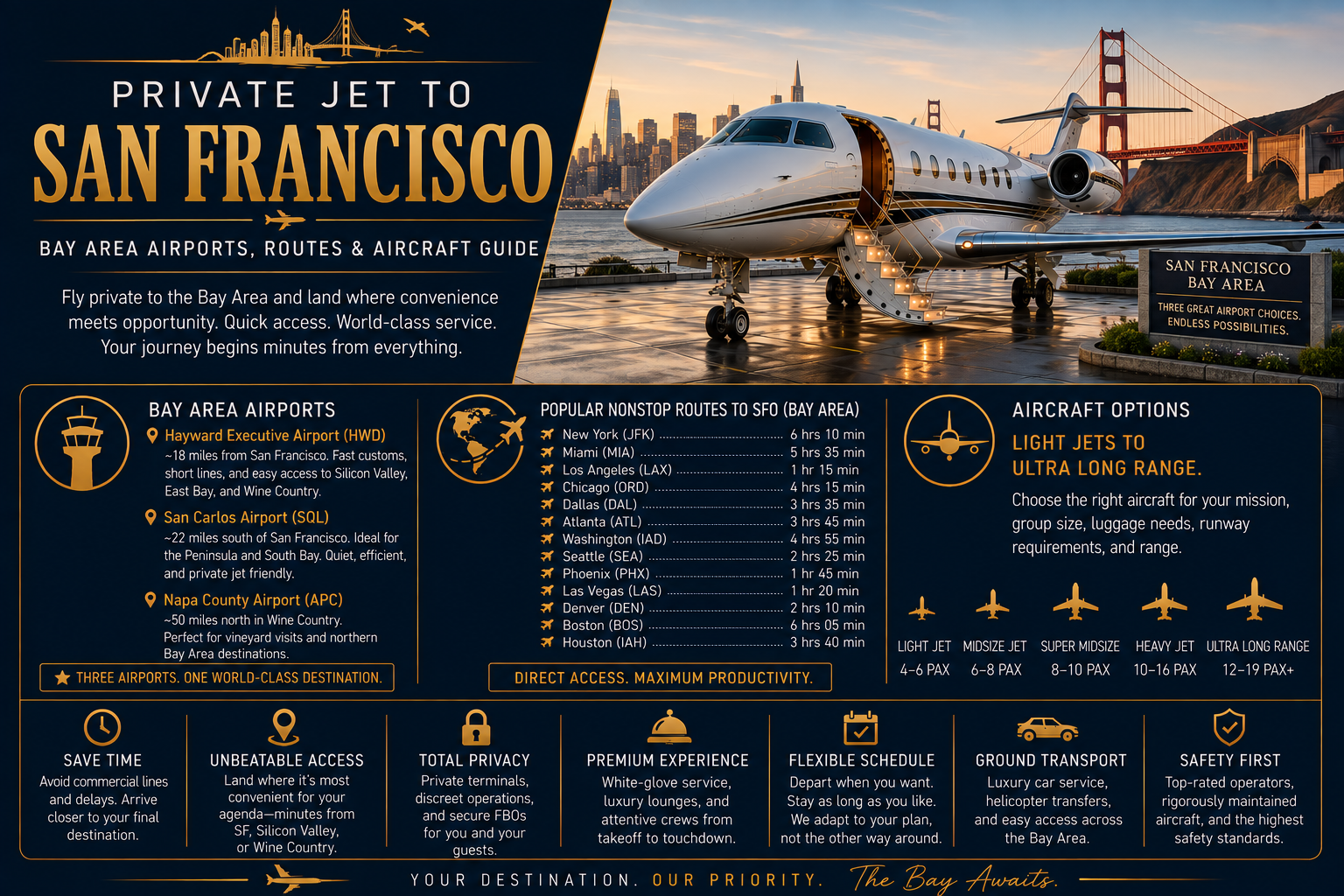
Private Jet to San Francisco: Bay Area Airports, Routes and Aircraft Guide
Flying by private jet to San Francisco requires more than choosing an aircraft and departure time. The strongest itinerary connects the passenger’s final Bay Area destination, airport strategy, aircraft capability, baggage, privacy, coastal weather, fog, traffic, parking, customs, ground transportation, crew needs, acceptable alternates, and return mission before departure.
San Francisco is one of the world’s most important private aviation destinations because the broader Bay Area combines global technology companies, venture capital, private equity, artificial intelligence, finance, biotechnology, healthcare, luxury real estate, family offices, international business, major universities, wine-country travel, professional sports, entertainment, and concentrated wealth.
However, “private jet to San Francisco” does not describe one airport or one passenger journey.
Instead, the Bay Area includes several private aviation gateways serving San Francisco, Silicon Valley, Oakland, Berkeley, Marin County, the Peninsula, Napa Valley, Sonoma County, San Jose, Palo Alto, Atherton, Menlo Park, Hillsborough, Woodside, Los Altos Hills, and surrounding communities.
San Francisco International Airport, identified as SFO and KSFO, provides direct access to the Peninsula, San Francisco, commercial-airline connections, international customs, and selected large-aircraft missions.
Additionally, SFO supports private and general aviation through a dedicated fixed-base operator environment.
Nevertheless, SFO remains one of the region’s primary scheduled-airline airports.
Therefore, airline traffic, runway sequencing, taxi time, handling, parking, weather, costs, passenger transfers, and commercial-airport procedures may affect the private aviation experience.
Oakland Airport, identified as OAK and KOAK, provides another major Bay Area private aviation gateway.
Its general aviation area supports business aircraft, private operators, fueling, hangars, ground handling, maintenance, charter activity, crew services, and passenger transportation.
Consequently, Oakland may create a strong complete journey for passengers traveling to Oakland, Berkeley, the East Bay, Downtown San Francisco, selected Marin destinations, professional sporting events, corporate facilities, and communities east of the bay.
San José Mineta International Airport, identified as SJC and KSJC, often provides the strongest airport strategy for Silicon Valley.
The airport supports multiple fixed-base operators that may provide fuel, transient parking, hangar space, catering, ground transportation, maintenance, passenger services, and crew support.
Therefore, San Jose may reduce total travel time for passengers visiting San Jose, Santa Clara, Cupertino, Sunnyvale, Los Gatos, Campbell, Mountain View, and major technology campuses throughout the southern Bay Area.
Hayward Executive Airport, identified as HWD and KHWD, provides a dedicated general aviation environment in the East Bay.
The airport operates two parallel runways and supports fixed-base operators, passenger facilities, aircraft maintenance, on-demand charter, flight training, fueling, emergency services, and other aviation activity.
Consequently, Hayward may create practical access to Hayward, Fremont, Union City, Castro Valley, Pleasanton, San Ramon, East Bay corporate destinations, and selected Silicon Valley itineraries.
San Carlos Airport and Palo Alto Airport may appear especially attractive for passengers traveling to the Peninsula and Silicon Valley.
However, their shorter runways, aircraft limitations, local procedures, weather exposure, noise considerations, parking, and community operating environments require careful mission-specific review.
These airports may support turboprops, light aircraft, selected light jets, owner-operated aircraft, charter missions, and other general aviation activity when the exact aircraft and conditions fit.
Meanwhile, Napa County Airport, Charles M. Schulz–Sonoma County Airport, Buchanan Field, Livermore Municipal Airport, Monterey Regional Airport, and other Northern California airports may become relevant when wine-country travel, East Bay business, coastal destinations, parking, weather, passenger location, or the return itinerary shapes the mission.
Therefore, airport selection should begin with the passenger’s actual destination rather than the words “San Francisco.”
A meeting in Downtown San Francisco creates a different ground strategy than a technology campus in Cupertino, a residence in Atherton, an investment meeting on Sand Hill Road, a conference in San Jose, a winery in Napa Valley, a resort in Sonoma, or a business facility in the East Bay.
Traffic creates another major planning variable.
The San Francisco Bay, bridges, freeways, Peninsula corridor, Silicon Valley commute patterns, sporting events, construction, accidents, weather, demonstrations, and special events may substantially change the final transfer.
Consequently, an airport that appears geographically close may still create a longer total journey.
For example, SFO may provide the most direct major-airport access to San Francisco and the northern Peninsula.
However, Oakland may create a competitive transfer to Downtown San Francisco while offering a more established business aviation environment for selected missions.
Likewise, San Jose may be substantially more practical for Cupertino, Santa Clara, Sunnyvale, Los Gatos, and southern Silicon Valley than an arrival at SFO or Oakland.
Hayward may reduce ground travel for East Bay and selected Fremont-area destinations, while San Carlos or Palo Alto may place suitable smaller aircraft close to Peninsula technology and residential communities.
Therefore, aircraft capability and passenger ground transportation must be evaluated together.
Aircraft selection also changes significantly by departure market.
A regional flight from Los Angeles, Las Vegas, Scottsdale, San Diego, Seattle, Portland, Lake Tahoe, Monterey, or Santa Barbara may fit a turboprop, light jet, or midsize aircraft under suitable conditions.
Meanwhile, a nonstop mission from New York, Miami, Palm Beach, Dallas, Houston, Chicago, London, Paris, Dubai, Tokyo, Singapore, Sydney, or another distant market may require greater range, cabin space, baggage capacity, fuel, crew support, customs coordination, and operating flexibility.
Passenger requirements may change the aircraft recommendation further.
Technology executives may require confidential working cabins, high-speed connectivity, conference seating, power, privacy, several meetings, and same-day or multi-city schedules.
Investors and family offices may travel with principals, advisors, legal teams, assistants, security, household staff, pets, documents, artwork, or extended-stay baggage.
Wine-country travelers may carry golf clubs, event clothing, gifts, wine cases, pet supplies, and substantial leisure luggage.
Families may travel with children, caregivers, strollers, child seats, food, medical supplies, pets, and personal equipment.
International travelers may require customs, immigration, permits, passenger manifests, handlers, crew documentation, agricultural procedures, catering coordination, baggage processing, and secure transportation.
Therefore, advertised range and installed passenger seats cannot identify the correct aircraft by themselves.
The operator should evaluate the complete route, aircraft weight, passengers, baggage, fuel, winds, runway requirements, weather, alternate airports, customs, parking, handling, crew duty, and the return flight.
Bay Area weather creates additional complexity.
San Francisco’s coastal location can produce fog, marine-layer clouds, low ceilings, strong winds, changing visibility, and localized conditions that affect airports differently.
SFO may experience low ceilings or runway-capacity limitations while Oakland, San Jose, Hayward, Livermore, or another airport reports different conditions.
Likewise, coastal fog may affect San Carlos, Palo Alto, Half Moon Bay, Monterey, or helicopter operations while inland facilities remain suitable.
Winter storms may bring heavy rain, low clouds, wind, flooding, runway contamination, road delays, and reduced visibility.
Summer and autumn may bring wildfire smoke, temporary flight restrictions, air-quality concerns, changing road access, and aircraft repositioning.
Strong winds may affect runway use, turbulence, passenger comfort, approach capability, and ground transportation across bridges.
Therefore, the strongest weather plan must include both an alternate airport and an alternate passenger-transfer strategy.
Peak demand may increase pressure further.
Major technology conferences, artificial-intelligence events, investor meetings, professional sports, international summits, major concerts, corporate gatherings, fleet weeks, holidays, wine-country events, golf tournaments, university programs, and large private functions may compress aircraft arrivals and departures into similar periods.
As a result, aircraft availability, parking, FBO capacity, fueling, professional transportation, hotels, crew lodging, catering, security teams, and preferred departure times may tighten together.
The return mission deserves an independent review as well.
Passengers may add documents, equipment, wine, gifts, another traveler, employees, pets, shopping, golf clubs, or a different onward destination during the stay.
Additionally, the return flight may involve different winds, weather, fuel, airport conditions, crew duty, customs, baggage, parking, and runway requirements than the inbound mission.
Consequently, a suitable San Francisco arrival does not automatically confirm a suitable departure.
Travelers can review private-aircraft information through the official San Francisco International Airport private-aircraft page, general aviation information through the official Oakland Airport general aviation page, FBO information through the official San José Mineta International Airport website, and airport details through the official Hayward Executive Airport website.
This guide connects San Francisco destination demand with SFO, Oakland, San Jose, Hayward, San Carlos, Palo Alto, Napa, Sonoma County, regional alternatives, aircraft selection, popular routes, traffic, fog, weather, wildfire planning, Silicon Valley travel, finance, family offices, wine-country itineraries, international missions, privacy, baggage, events, and the return journey.
Is San Francisco a Major Private Jet Destination?
Direct Answer: Yes. San Francisco is a major private aviation destination because the Bay Area combines global technology, artificial intelligence, venture capital, finance, biotechnology, family offices, luxury residences, professional sports, international business, universities, healthcare, and wine-country travel. SFO, Oakland, San Jose, Hayward, and smaller regional airports may each fit different passenger and aircraft missions.
San Francisco private aviation demand extends across the city, Peninsula, Silicon Valley, East Bay, Marin County, Napa Valley, Sonoma County, San Jose, Oakland, and surrounding Northern California communities.
Therefore, one Bay Area itinerary may involve several possible airports and several very different passenger journeys.
For an international arrival, commercial-airline connection, large aircraft, or destination near San Francisco and the northern Peninsula, SFO may provide the strongest solution.
For Downtown Oakland, Berkeley, the East Bay, selected San Francisco destinations, professional sporting events, or corporate facilities east of the bay, Oakland may create the better complete journey.
For San Jose, Cupertino, Sunnyvale, Santa Clara, Los Gatos, and southern Silicon Valley, San José Mineta International Airport may significantly reduce ground time.
For Fremont, Hayward, Pleasanton, San Ramon, Union City, and selected East Bay or Silicon Valley destinations, Hayward Executive may offer a focused general aviation environment.
For San Carlos, Redwood City, Menlo Park, Palo Alto, Atherton, Woodside, and Peninsula technology campuses, San Carlos or Palo Alto may appear attractive when the aircraft, runway, weather, parking, and local procedures fit.
For Napa or Sonoma wine-country itineraries, a regional airport closer to the final resort, winery, residence, event, or meeting may eliminate a long transfer from San Francisco, Oakland, or San Jose.
Consequently, the best San Francisco airport is not always the airport closest to the city skyline.
The recommendation should compare aircraft suitability, weather resilience, airport services, bridge exposure, traffic, final destination, and the return mission together.
Additionally, the operator must evaluate runway requirements, aircraft weight, fuel, fog, wind, rain, wildfire smoke, customs, parking, passenger baggage, alternate airports, handling, and crew duty.
The Bay Area provides substantial aviation choice. However, its geography creates complexity.
The bay, Peninsula, bridges, coastal hills, Silicon Valley corridor, East Bay, wine country, and dense urban traffic can make two nearby airports produce very different passenger journeys.
Therefore, travelers benefit most when one coordinated plan connects the aircraft, airport, FBO, passenger representative, vehicle, security team, hotel, residence, technology campus, office, event, winery, resort, and return departure.
The best Bay Area airport is the one that protects both the aircraft operation and the passenger’s complete door-to-door journey.
SFO may support international and larger-aircraft missions, while Oakland, San Jose, Hayward, San Carlos, Palo Alto, Napa, Sonoma County, or another regional airport may create a better result for a different passenger destination or aircraft.
Why Do Travelers Fly Privately to San Francisco?
Direct Answer: Travelers fly privately to San Francisco to control departure times, reach executive airports closer to Silicon Valley or other Bay Area destinations, avoid commercial-terminal delays, work confidentially during the flight, connect several cities, carry specialized baggage, protect privacy, travel with families or pets, and reduce time lost to traffic and bridge crossings.
San Francisco is a destination where airport choice can save more time than a small difference in aircraft speed.
A private aircraft can depart from an executive airport closer to the passenger’s origin and land at the Bay Area airport that best supports the final destination.
Therefore, a technology executive traveling to Cupertino may use a different airport than an investor traveling to Downtown San Francisco or a family continuing to Napa Valley.
Choose the Right Bay Area Airport
Travelers can compare SFO, Oakland, San Jose, Hayward, San Carlos, Palo Alto, Napa, Sonoma County, and other regional facilities.
Control the Schedule
Passengers can plan around board meetings, investor presentations, product launches, conferences, private events, healthcare, family needs, and international connections.
Work During the Flight
Executives, founders, investors, advisors, and family offices may use private cabins for confidential calls, meetings, preparation, dining, and rest.
Reduce Bridge and Traffic Exposure
The correct airport may prevent an unnecessary trip across the Bay Bridge, San Mateo Bridge, Dumbarton Bridge, Golden Gate Bridge, or heavily used Peninsula freeways.
Carry Specialized Baggage
Business equipment, prototypes, golf clubs, wine, artwork, pets, medical supplies, presentation materials, and extended-stay luggage may affect the aircraft.
Protect Privacy
Private terminals, limited itinerary sharing, discreet vehicles, controlled passenger lists, and coordinated security may reduce unnecessary exposure.
Nevertheless, private aviation does not eliminate fog, wind, airport congestion, bridge traffic, wildfire smoke, customs, parking, runway limitations, crew duty, or passenger delays.
Instead, it provides more options for responding to those conditions.
The departure may move earlier. The aircraft may use Oakland instead of SFO. A Silicon Valley trip may move to San Jose. A suitable smaller aircraft may use San Carlos or Palo Alto. A wine-country itinerary may use Napa or Sonoma County.
Therefore, the greatest advantage is not simply luxury. It is the ability to design and adjust the complete journey around the passenger’s priorities.
What Creates Private Aviation Demand in the San Francisco Bay Area?
Direct Answer: Bay Area private aviation demand comes from technology, artificial intelligence, venture capital, private equity, finance, biotechnology, healthcare, family offices, major universities, luxury real estate, professional sports, international business, wine-country travel, conferences, product launches, corporate headquarters, and global investment activity.
The San Francisco Bay Area combines several high-value travel markets within one region.
It functions as a global technology center, artificial-intelligence hub, venture-capital market, biotechnology corridor, financial center, corporate headquarters region, international gateway, healthcare destination, university ecosystem, luxury residential market, and launching point for wine-country travel.
Therefore, private aviation demand remains diverse throughout the year.
Global Companies and Founders
Executives, founders, engineers, product leaders, boards, customers, partners, advisors, and employees travel across the Bay Area and global markets.
Investment and Innovation Travel
AI founders, researchers, infrastructure providers, investors, enterprise leaders, advisors, and corporate teams create expanding private travel demand.
Investors and Portfolio Companies
Venture firms, private equity groups, founders, legal teams, lenders, advisors, and portfolio leadership may travel on compressed schedules.
Healthcare and Life Sciences
Executives, researchers, physicians, investors, regulators, patients, and specialists may require flexible and confidential travel.
Principals, Advisors and Staff
Family offices may coordinate investments, residences, philanthropy, healthcare, education, wine-country travel, events, security, and international missions.
Banking and Investment Management
Private banks, asset managers, financial institutions, legal teams, investors, advisors, and corporate leaders generate business aviation demand.
Napa and Sonoma Travel
Property owners, resort guests, wine executives, event travelers, wedding groups, families, chefs, and private clients may use regional airports.
Asia, Europe and International Markets
San Francisco connects naturally with New York, Los Angeles, Seattle, London, Paris, Tokyo, Singapore, Dubai, Sydney, and other global centers.
Demand may increase further around major technology conferences, AI gatherings, investor meetings, product launches, professional sports, golf tournaments, international summits, university events, Fleet Week, wine-country programs, major concerts, political visits, holidays, and private functions.
Consequently, aircraft availability, parking, FBO services, hotels, professional drivers, security, crew lodging, catering, and preferred times may tighten together.
Travelers with specific aircraft, cabin, airport, customs, privacy, pet, baggage, wine-country, or narrow schedule requirements should begin coordination earlier whenever the trip overlaps a major Bay Area demand period.
Who Typically Flies Privately to San Francisco?
Direct Answer: Bay Area private aviation travelers include technology executives, founders, investors, board members, family offices, biotechnology leaders, corporate teams, public figures, professional athletes, international visitors, wine-country travelers, property owners, families, healthcare travelers, security teams, and event guests. Assistants, chiefs of staff, travel managers, and advisors often coordinate the mission.
The person researching a private jet to San Francisco may not be the passenger.
Instead, an executive assistant, chief of staff, family-office professional, corporate travel manager, security specialist, investor-relations leader, household employee, concierge, legal advisor, event planner, or board administrator may organize the trip.
Therefore, the itinerary must satisfy both the passenger’s expectations and the operational needs of the aircraft, airport, ground team, meeting schedule, event, and return mission.
Board, Product and Customer Travel
Executives may require working cabins, connectivity, confidential meetings, several campuses, investor programs, product launches, and same-day travel.
Fundraising and Portfolio Activity
Founders, venture partners, private equity teams, attorneys, advisors, board members, and portfolio executives may travel together.
Complex Principal Travel
Family offices may coordinate principals, children, advisors, staff, security, pets, residences, healthcare, wine country, and international destinations.
Research and Healthcare Travel
Executives, physicians, investors, scientists, patients, caregivers, and specialists may require flexible, private, and time-sensitive missions.
Headquarters and Multi-City Travel
Boards, leadership teams, legal advisors, bankers, customers, partners, and employees may connect several Bay Area locations or cities.
Global Business and Investment
International missions may require customs, permits, handlers, crew planning, airline connections, secure transportation, and multilingual support.
Residences, Resorts and Events
Travelers may carry golf clubs, event clothing, gifts, pets, wine purchases, substantial luggage, and several family members or guests.
Children, Pets and Extended Stays
Families may travel with caregivers, pets, strollers, child seats, food, medication, household staff, and extended-stay luggage.
Why Does the Passenger Profile Affect the Airport and Aircraft?
A small technology team may require a midsize or super-midsize jet because it needs connectivity, confidential working space, several large equipment cases, and a nonstop transcontinental route.
Meanwhile, a larger group traveling regionally with limited baggage may fit another aircraft category.
Additionally, a family traveling to Napa Valley may prioritize baggage, pets, cabin comfort, vehicles, and the closest suitable wine-country airport.
Therefore, passenger count alone cannot determine the aircraft, Bay Area airport, or ground-transfer strategy.
What Should Travelers Know About San Francisco International Airport?
Direct Answer: San Francisco International Airport supports private aircraft, international customs, large and long-range aircraft, airline connections, crew changes, and direct access to San Francisco and the northern Peninsula. However, commercial traffic, fog, runway capacity, taxi time, handling, parking, passenger movement, cost, and ground congestion require careful planning.
San Francisco International Airport, identified as SFO and KSFO, sits south of San Francisco along the Peninsula.
Its location may provide practical access to San Francisco, South San Francisco, Burlingame, Hillsborough, San Mateo, selected Peninsula communities, commercial airline connections, and international destinations.
Additionally, SFO supports private and general aviation through a dedicated fixed-base operator.
Therefore, the airport may serve business aircraft, corporate aviation, international private flights, charter operations, large aircraft, and passenger connections.
However, SFO remains primarily a major commercial-airline airport.
Consequently, private aircraft operate within a complex environment shaped by scheduled airlines, runway configurations, taxi demand, weather, handling, ramp access, parking, customs, and passenger-terminal activity.
Customs and Global Access
SFO may support international private arrivals, airline connections, crew changes, customs processing, and selected long-range missions.
Large and Long-Range Aircraft
The airport may accommodate aircraft, operating weights, fuel loads, and runway requirements unsuitable for smaller Bay Area airports.
San Francisco and Peninsula Access
SFO may serve San Francisco, Burlingame, Hillsborough, San Mateo, South San Francisco, biotech campuses, hotels, and nearby communities.
Airline Operations Shape Timing
Private aircraft may encounter runway sequencing, taxi delays, air-traffic initiatives, handling requirements, and peak airline demand.
Fog and Runway Capacity
Low clouds, visibility, wind, runway configuration, and approach conditions may reduce capacity or affect airport suitability.
Coordinate the Complete Transfer
FBO access, customs, baggage, airline terminals, vehicles, security, traffic, and the final destination should remain connected.
Why Would a Private Aircraft Use SFO Instead of Oakland or San Jose?
SFO may provide the strongest solution when passengers require international customs, commercial-airline connections, large-aircraft capability, nearby Peninsula access, or direct travel to San Francisco.
Additionally, the airport may support an aircraft or fuel load that does not fit San Carlos, Palo Alto, Hayward, or another smaller facility.
However, Oakland or San Jose may create a more dedicated business aviation experience with easier access to the East Bay or Silicon Valley.
Therefore, SFO should be selected because its location or operational capabilities improve the complete mission—not only because it carries the San Francisco name.
Can Every Private Jet Use SFO?
Many aircraft categories can operate at SFO under suitable conditions.
However, the operator must still evaluate the exact aircraft, runway requirements, weight, fuel, passengers, baggage, weather, wind, approach capability, handling, parking, customs, procedures, and departure mission.
Airport suitability must be confirmed for the actual trip rather than assumed from runway length alone.
SFO provides powerful international and aircraft capabilities, but its commercial-airport complexity must improve the complete itinerary.
Customs, airline connections, runway needs, passenger destination, fog, taxi time, handling, parking, vehicles, baggage, and return timing should all support the decision.
Which Private Aviation Services Are Available at SFO?
Direct Answer: SFO supports private and general aviation services that may include aircraft fueling, ground handling, passenger facilities, transient parking, customs coordination, catering, professional transportation, crew services, maintenance support, baggage assistance, international handling, airline transfers, and flight planning.
SFO’s fixed-base operator environment supports private aircraft operating within a major international airport.
That setting may benefit travelers who require global connections, customs, large-aircraft support, technical services, commercial-airline transfers, or direct access to San Francisco and the Peninsula.
However, service availability should be confirmed for the exact aircraft, date, arrival time, parking period, customs requirement, passenger movement, and departure plan.
Aircraft Fueling
Operators should confirm fuel type, required uplift, timing, pricing, aircraft needs, international departure requirements, and peak-period conditions.
Ground Handling
Handling may include marshaling, towing, baggage, passenger movement, aircraft servicing, lavatory service, water, stairs, and ramp coordination.
International Customs
Advance notice, passenger and crew documentation, operating hours, inspection arrangements, handler communication, and agricultural procedures should be confirmed.
Passenger Transportation
Professional vehicles, security teams, luggage capacity, airline-terminal transfers, hotel access, and final-destination transportation may be coordinated.
Aircraft Parking
Parking may require advance approval, towing, repositioning, limited-duration stays, another ramp, or movement to another airport.
Crew Support
Crew planning may include transportation, lodging, rest, duty limits, flight planning, catering, weather, repositioning, and the return mission.
Why Should Airline Connections Be Coordinated Before Departure?
A passenger may assume that landing at SFO automatically creates a simple connection to a scheduled flight.
However, the private aircraft, FBO, customs facility, commercial terminal, airline check-in, security, baggage transfer, vehicle route, and connection time may remain separate.
Therefore, the travel team should confirm who moves the passenger, who handles the baggage, which terminal applies, how customs works, and how much transfer time is realistic.
Can the Aircraft Drop Off at SFO and Reposition Elsewhere?
Yes.
The aircraft may drop off passengers at SFO and reposition to Oakland, San Jose, Hayward, Livermore, Napa, Sonoma County, another regional airport, or its operating base when parking, cost, crew, maintenance, or the return mission supports that strategy.
The passenger should understand where the aircraft will remain and how the departure plan will work.
SFO service planning should connect the private aircraft with the passenger’s international, airline, vehicle, baggage, and departure requirements.
The FBO, handler, customs, terminals, vehicles, security, crew, parking, fuel, and return mission should function as one plan.
When Does San Francisco International Airport Fit the Mission Best?
Direct Answer: SFO fits best when the mission requires international customs, commercial-airline connections, large-aircraft capability, long runways, direct access to San Francisco or the northern Peninsula, or services unavailable at a smaller airport. The benefit must outweigh commercial congestion, fog exposure, handling complexity, taxi time, parking, and cost.
SFO creates its greatest value when its international, aircraft, connection, or geographic advantages support both the flight and the passenger’s final destination.
Therefore, the airport should be evaluated against Oakland, San Jose, Hayward, San Carlos, Palo Alto, and other realistic alternatives.
Customs and Global Travel Are Required
The aircraft, passengers, crew, documentation, permits, handlers, customs, baggage, and onward journey may favor SFO.
The Mission Requires Major-Airport Infrastructure
Aircraft size, weight, fuel, runway needs, international range, handling, or equipment may make SFO more suitable.
San Francisco or the Peninsula Fits the Geography
San Francisco, South San Francisco, Burlingame, Hillsborough, San Mateo, and nearby destinations may align well.
The Passenger Transfers to Scheduled Service
SFO may support a stronger private-to-commercial itinerary when terminals, customs, baggage, security, and timing are coordinated.
Conditions and Capacity Remain Suitable
Fog, ceilings, visibility, wind, runway configuration, traffic management, and alternate requirements must support the mission.
The Departure Plan Also Works
The outbound passengers, baggage, aircraft weight, fuel, customs, runway, crew duty, parking, and destination require another review.
When Might Another Bay Area Airport Be Better?
Oakland may provide stronger access to the East Bay and a dedicated business aviation service environment.
San Jose may better serve Silicon Valley, Cupertino, Santa Clara, Sunnyvale, Los Gatos, and southern Peninsula destinations.
Hayward may better serve Fremont, Hayward, Pleasanton, San Ramon, and selected East Bay communities.
San Carlos or Palo Alto may provide highly convenient Peninsula access when the exact smaller aircraft and mission fit their runway and operating requirements.
Napa or Sonoma County may better support wine-country residences, resorts, wineries, events, and leisure itineraries.
Therefore, the strongest recommendation compares SFO with airports that may reduce both operating complexity and passenger ground time.
The best San Francisco itinerary may use a different airport for arrival and departure.
International requirements, airline connections, aircraft changes, weather, parking, baggage, meetings, wine-country travel, passenger destinations, and the outbound route may make one airport ideal inbound and another more practical outbound.
How Do SFO Operations Affect Private Jet Planning?
Direct Answer: SFO operates as one of the busiest commercial airports in the United States. Airline traffic, runway configuration, marine-layer fog, taxi time, parking availability, customs, gate sequencing, and weather can all influence private aviation operations. Therefore, travelers should evaluate SFO alongside other Bay Area airports rather than assuming it is always the best option.
Many travelers assume the largest airport automatically provides the easiest experience.
However, San Francisco International Airport operates very differently than a dedicated executive airport.
Commercial airline movements dominate runway activity throughout much of the day.
Consequently, private aircraft may experience different operating conditions than they would at Oakland, Hayward, San Jose, or another executive-focused airport.
Airline Movements Influence Timing
High airline activity may affect taxi time, runway sequencing, departure flow, and arrival spacing during busy operating periods.
Fog Can Reduce Capacity
Marine-layer clouds and reduced visibility may decrease runway efficiency while nearby airports experience different weather conditions.
Aircraft Parking Should Be Confirmed
Long-term parking, overnight stays, repositioning requirements, and peak demand should all be reviewed before the trip.
Ground Movement Can Vary
The time spent taxiing may fluctuate depending on runway use, commercial traffic, weather, and airport operating conditions.
Customs Coordination
International arrivals should coordinate customs, passenger documentation, crew paperwork, handlers, and arrival procedures before departure.
Traffic Still Matters
Even after landing, bridge traffic, freeway congestion, sporting events, and construction may determine total travel time.
The fastest flight does not always produce the fastest arrival.
Airport selection, weather, taxi time, parking, vehicles, and Bay Area traffic should be evaluated together before confirming the itinerary.
When Should Travelers Use Oakland International Airport?
Direct Answer: Oakland International Airport often fits travelers visiting the East Bay, Downtown Oakland, Berkeley, Alameda, and many San Francisco destinations. Its established business aviation infrastructure, multiple FBOs, and reduced dependence on commercial-terminal operations make it one of Northern California’s strongest executive aviation airports.
Oakland frequently becomes the preferred airport for private aviation despite receiving less public attention than SFO.
Its business aviation environment often provides a smoother experience for executive travelers.
Additionally, Oakland may significantly reduce travel time for destinations east of San Francisco Bay.
East Bay Access
Oakland, Berkeley, Alameda, Emeryville, Walnut Creek, Pleasant Hill, Concord, and surrounding communities may be reached efficiently.
Business Aviation Focus
Dedicated FBO operations, fueling, maintenance, passenger services, and transient aircraft support make Oakland attractive for executive travel.
Downtown San Francisco
Depending on bridge traffic, Oakland may provide a competitive alternative for Downtown San Francisco business travelers.
Corporate Travel
Technology companies, manufacturing, logistics, healthcare, education, finance, and life sciences create steady executive demand.
Aircraft Flexibility
Oakland supports a broad range of business aircraft while maintaining strong executive aviation infrastructure.
International Operations
Selected international private aviation missions may also utilize Oakland depending on the itinerary and operating requirements.
When Might Oakland Be Better Than SFO?
Oakland may become the stronger option when passengers prioritize executive-airport services, East Bay access, aircraft parking, reduced commercial congestion, or business destinations outside central San Francisco.
However, travelers headed toward the Peninsula or northern San Francisco neighborhoods may find another airport more practical.
Therefore, airport selection should always begin with the passenger’s complete itinerary rather than airport popularity.
Oakland often provides one of the Bay Area’s strongest business aviation experiences.
Its executive infrastructure, East Bay location, and operational flexibility frequently make it an outstanding alternative to SFO.
When Does San José Mineta International Airport Fit Best?
Direct Answer: San José Mineta International Airport is often the strongest airport for Silicon Valley business travel. It provides convenient access to San Jose, Cupertino, Sunnyvale, Santa Clara, Mountain View, Los Gatos, Campbell, and many technology headquarters throughout the southern Bay Area.
Silicon Valley represents one of the world’s highest concentrations of private aviation demand.
Major technology companies, venture-capital firms, artificial-intelligence startups, semiconductor companies, cybersecurity organizations, biotechnology businesses, and research facilities all contribute to year-round executive travel.
Consequently, San Jose frequently becomes the logical airport rather than SFO.
Headquarters Access
Many of Silicon Valley’s largest campuses are substantially closer to San Jose than San Francisco International Airport.
Board Meetings and Investors
Executives, founders, venture-capital firms, investors, and advisors frequently use San Jose for compressed schedules.
Dedicated Executive Support
Multiple FBOs provide passenger facilities, fueling, catering, maintenance, parking, and crew services.
Southern Bay Area
San Jose supports travel throughout Santa Clara County and nearby Peninsula destinations.
Broad Business Aircraft Support
Many corporate aircraft categories regularly operate into San Jose depending on mission requirements.
Technology Events
Major conferences, AI events, earnings meetings, acquisitions, and investor programs create substantial demand.
A traveler visiting Cupertino, Sunnyvale, Santa Clara, or Mountain View may spend considerably less time in a vehicle by selecting San Jose rather than SFO.
Likewise, same-day meetings often become more realistic when airport proximity reduces ground transportation.
For many Silicon Valley missions, airport selection matters more than flight time.
Choosing San Jose instead of SFO may reduce overall travel time while simplifying the executive itinerary.
When Should Travelers Use Hayward Executive Airport?
Direct Answer: Hayward Executive Airport serves many East Bay business travelers, corporate flights, owner-operated aircraft, charter operations, and regional executive missions. Its dedicated general aviation environment may provide efficient access to Fremont, Hayward, Union City, Castro Valley, Pleasanton, San Ramon, and surrounding communities.
Hayward Executive Airport focuses almost entirely on general aviation.
Unlike SFO, it does not operate as a major airline hub.
Consequently, many executive travelers appreciate its specialized aviation environment.
General Aviation Focus
Hayward primarily supports private aviation, business aircraft, charter operators, maintenance providers, and flight services.
East Bay Location
Hayward offers practical access to Fremont, Pleasanton, San Ramon, Livermore, Union City, and many technology employers.
Reduced Airline Congestion
The absence of major commercial-airline operations creates a different operating environment than SFO.
Corporate Missions
Regional executive travel, engineering teams, technology companies, healthcare providers, and manufacturers frequently utilize Hayward.
Flight Training
The airport also supports active general aviation training alongside business aviation activity.
Flexible Operations
Aircraft parking, fueling, maintenance, and executive services may be well suited for selected business missions.
Hayward does not replace SFO or San Jose for every mission.
Instead, it expands the range of airport choices available across Northern California.
Therefore, travelers should compare Hayward whenever the final destination lies in the East Bay or southeastern Bay Area.
Hayward demonstrates why Bay Area airport selection should always begin with the destination—not the city name.
The right executive airport may significantly reduce total travel time while simplifying the overall mission.
When Does San Carlos Airport Fit a Private Aviation Mission?
Direct Answer: San Carlos Airport may be an excellent option for suitable turboprops, piston aircraft, and selected light business jets traveling to the Peninsula. Its location provides efficient access to Redwood City, Menlo Park, Atherton, Belmont, Foster City, Woodside, and nearby technology companies when the aircraft and mission meet airport operating requirements.
San Carlos Airport occupies one of the most desirable locations for executive travel throughout the central Peninsula.
Rather than serving airline passengers, the airport focuses almost entirely on general aviation activity.
Consequently, many owner-operated aircraft, charter operators, business aircraft, and corporate flight departments utilize the airport when aircraft performance and operating requirements align with the mission.
Close to Technology and Finance
San Carlos provides convenient access to Menlo Park, Redwood City, Atherton, Woodside, Foster City, Belmont, and many Peninsula employers.
Reduced Ground Travel
Passengers traveling to central Peninsula destinations may significantly reduce vehicle time compared with larger Bay Area airports.
Dedicated Aviation Environment
Business aircraft, charter activity, maintenance providers, fueling, and executive aviation services support many regional missions.
Mission Specific
Aircraft performance, runway requirements, weight, weather, passenger load, and operating limitations must always be reviewed before selecting San Carlos.
Business Headquarters
Technology executives, investors, advisors, founders, attorneys, and corporate leadership frequently travel throughout this portion of the Peninsula.
Another Bay Area Option
San Carlos expands airport flexibility when larger commercial airports do not create the strongest overall itinerary.
San Carlos demonstrates why Bay Area airport planning should begin with the passenger’s destination rather than the largest airport.
When aircraft capability, weather, runway requirements, baggage, and passenger needs align, San Carlos may substantially improve the complete journey.
When Should Travelers Consider Palo Alto Airport?
Direct Answer: Palo Alto Airport may provide exceptional convenience for suitable smaller aircraft serving Palo Alto, Stanford University, Menlo Park, East Palo Alto, Atherton, Los Altos, Mountain View, and nearby technology companies. However, aircraft suitability must always be confirmed because airport limitations differ from larger regional airports.
Palo Alto Airport occupies one of the most strategic locations within Silicon Valley.
Many technology companies, venture-capital firms, startup founders, university researchers, investors, and executives work only minutes away.
Therefore, travelers often investigate Palo Alto before considering larger airports farther from the Peninsula.
Technology Headquarters
Palo Alto places many Silicon Valley campuses, startup offices, venture firms, and research organizations nearby.
Stanford Access
The airport provides practical access to Stanford University, Stanford Medicine, research facilities, conferences, and academic partnerships.
Venture Capital
Investment firms, portfolio companies, founders, advisors, and board members frequently travel throughout this corridor.
Smaller Aircraft
Mission planning must confirm aircraft size, weight, runway requirements, weather, passenger load, and operating limitations.
Regional Flexibility
Palo Alto expands airport choices for suitable missions while reducing unnecessary Peninsula driving.
Executive Schedules
Compressed board meetings, investor presentations, product launches, and customer visits often benefit from the airport’s location.
Although Palo Alto provides outstanding geographic convenience, it is not appropriate for every aircraft or every passenger mission.
Consequently, operators must review aircraft capability together with weather, runway conditions, baggage, fuel, and passenger requirements.
Airport proximity only creates value when the aircraft can safely and efficiently support the complete mission.
Palo Alto may reduce hours of Bay Area ground transportation for the correct aircraft and passenger profile.
When Does Napa County Airport Fit a Private Aviation Trip?
Direct Answer: Napa County Airport often provides the strongest airport for travelers visiting Napa Valley wineries, luxury resorts, vineyards, private residences, golf clubs, culinary events, weddings, and wine-country estates. Flying directly into Napa may eliminate hours of Bay Area ground transportation.
Many travelers incorrectly assume they should arrive through San Francisco before driving north to Napa Valley.
However, the passenger’s final destination often determines that Napa County Airport creates the better itinerary.
Reducing several hours of highway travel may significantly improve the overall experience.
Luxury Resort Access
Napa County Airport serves many vineyards, wineries, luxury hotels, spas, private residences, and exclusive hospitality destinations.
Weddings and Private Gatherings
Private celebrations, culinary events, wine festivals, charity galas, and executive retreats generate recurring aviation demand.
Families and Groups
Wine-country visitors frequently travel with extended luggage, golf clubs, gifts, pets, and several passengers.
Executive Offsites
Technology companies, investment firms, and corporate leadership often utilize Napa for strategic planning sessions.
Reduce Driving
Choosing Napa rather than SFO may substantially shorten total travel time for many wine-country destinations.
Review Aircraft Suitability
Runway requirements, passenger count, baggage, fuel, weather, and aircraft capability should always be evaluated.
Wine-country travel begins with choosing the correct airport—not simply the closest major city.
For many Napa itineraries, flying directly into wine country creates the strongest overall passenger experience.
When Should Travelers Use Sonoma County Airport?
Direct Answer: Sonoma County Airport may be the preferred option for travelers visiting Sonoma wineries, Healdsburg, Santa Rosa, luxury resorts, vineyards, private estates, corporate retreats, and northern wine-country destinations where minimizing highway travel becomes a priority.
Sonoma County represents another important Northern California luxury destination.
Rather than traveling through San Francisco and driving north, many private aviation passengers choose an airport closer to their final destination.
This approach frequently produces a more efficient overall journey.
Luxury Hospitality
High-end resorts, wineries, culinary experiences, private residences, and vineyards create consistent executive and leisure travel demand.
Corporate Retreats
Leadership teams often utilize Sonoma for executive planning, board meetings, customer events, and relationship development.
Regional Convenience
Choosing Sonoma may significantly reduce vehicle travel compared with larger Bay Area airports.
Wine Tourism
Wine enthusiasts frequently travel with purchases, gifts, extended luggage, golf equipment, and family members.
Seasonal Demand
Harvest season, culinary festivals, weddings, holidays, and private events often increase aircraft activity.
Airport Flexibility
Regional airports provide additional options when major Bay Area airports do not create the strongest itinerary.
Wine-country airport planning should focus on the destination rather than the metropolitan area.
Reducing unnecessary highway travel frequently improves both the passenger experience and the overall mission.
When Could Buchanan Field Support the Mission?
Direct Answer: Buchanan Field may support selected East Bay business aviation missions involving Concord, Walnut Creek, Martinez, Pleasant Hill, Pittsburg, Antioch, and surrounding communities when aircraft capability and airport operating conditions align with the itinerary.
Buchanan Field expands the number of airport options available throughout Northern California.
Instead of forcing every passenger into San Francisco or Oakland, regional airports may significantly reduce overall travel time for specific destinations.
- Concord business travel
- East Bay manufacturing facilities
- Healthcare campuses
- Industrial operations
- Corporate headquarters
- Engineering companies
- Distribution centers
- Regional government travel
Buchanan Field should always be evaluated against Oakland, Hayward, Livermore, Napa, and other nearby airports.
The strongest airport depends on the passenger’s actual destination, aircraft capability, traffic, weather, baggage, and return schedule.
The Bay Area’s strength comes from having multiple airport options—not one airport for every mission.
Regional airports frequently produce shorter total travel times than larger commercial facilities.
When Does Livermore Municipal Airport Fit a Bay Area Mission?
Direct Answer: Livermore Municipal Airport may support selected private aviation missions involving Livermore, Pleasanton, Dublin, San Ramon, the Tri-Valley, East Bay corporate campuses, wineries, laboratories, industrial facilities, and destinations that would require substantial ground travel from SFO, Oakland, or San Jose.
Livermore Municipal Airport provides another general aviation option within the eastern Bay Area.
Its location may reduce ground time for passengers whose itinerary centers on the Tri-Valley rather than San Francisco or Silicon Valley.
Therefore, Livermore should be evaluated alongside Oakland, Hayward, Buchanan Field, San Jose, and other regional airports.
Pleasanton, Dublin and Livermore
Corporate campuses, private residences, hotels, wineries, healthcare facilities, schools, and event venues may align well with LVK.
Technology and Corporate Facilities
Executives, engineers, investors, advisors, vendors, and technical teams may use Livermore for regional business missions.
Laboratories and Scientific Travel
Research, energy, defense, engineering, government, and technical organizations may create time-sensitive aviation demand.
Livermore Valley Wineries
Private events, weddings, executive retreats, resort stays, residences, and wine-country itineraries may benefit from local access.
Review the Exact Mission
The operator should evaluate runway requirements, aircraft weight, fuel, passengers, baggage, heat, wind, weather, and airport procedures.
Avoid Cross-Bay Travel
Passengers traveling east may avoid bridges, Peninsula traffic, Oakland congestion, or an unnecessary journey through central San Francisco.
Livermore generally does not provide the strongest access to Downtown San Francisco, Marin County, or the northern Peninsula.
However, it may create the best complete solution when the passenger’s destination lies within the Tri-Valley or eastern Bay Area.
A Bay Area destination east of the bay may be better served by an eastern airport.
The aircraft, runway, passenger destination, traffic, weather, vehicles, parking, and return mission should determine whether Livermore fits.
How Should Travelers Compare San Francisco Bay Area Airports?
Direct Answer: Travelers should compare Bay Area airports by reviewing the exact destination, aircraft capability, runway requirements, weather, fog, customs, parking, handling, bridge exposure, traffic, passenger privacy, airline connections, baggage, vehicles, crew needs, wine-country plans, and the return mission.
No single Bay Area airport wins every mission.
SFO may provide the strongest solution for international arrivals, airline connections, large aircraft, and selected San Francisco or Peninsula destinations.
However, Oakland, San Jose, Hayward, San Carlos, Palo Alto, Napa, Sonoma County, Buchanan Field, Livermore, and other airports may create stronger door-to-door outcomes for different passengers and aircraft.
Airport |
Potential Advantage |
Primary Consideration |
Best Planning Question |
|---|---|---|---|
| San Francisco International Airport | International customs, airline connections, large aircraft, San Francisco and Peninsula access | Commercial congestion, fog, runway capacity, taxi time, handling, parking, and cost | Does the mission require SFO’s international, aircraft, connection, or geographic advantages? |
| Oakland International Airport | Strong business aviation infrastructure and East Bay access | Bridge traffic, final destination, commercial activity, parking, and weather | Does Oakland reduce operating complexity or passenger ground time compared with SFO? |
| San José Mineta International Airport | Silicon Valley, San Jose, Cupertino, Santa Clara, Sunnyvale, and Los Gatos access | Commercial traffic, airport procedures, passenger destination, parking, and peak demand | Is the itinerary centered on southern Silicon Valley? |
| Hayward Executive Airport | Dedicated general aviation access for Hayward, Fremont, Union City, Pleasanton, and San Ramon | Aircraft suitability, runway requirements, weather, services, and passenger destination | Does HWD avoid an unnecessary bridge or cross-region transfer? |
| San Carlos Airport | Central Peninsula access for Redwood City, Menlo Park, Atherton, Woodside, and San Carlos | Shorter runway, aircraft limitations, weather, local procedures, and parking | Can the exact aircraft and mission safely use SQL? |
| Palo Alto Airport | Stanford, Palo Alto, Menlo Park, Mountain View, Atherton, and venture-capital access | Aircraft limitations, runway requirements, weather, baggage, and local procedures | Does the aircraft fit PAO while preserving the passenger’s schedule? |
| Napa County Airport | Napa Valley wineries, resorts, residences, events, golf, and corporate retreats | Aircraft suitability, weather, parking, vehicles, baggage, and final wine-country destination | Does APC eliminate a long transfer from the central Bay Area? |
| Sonoma County Airport | Santa Rosa, Healdsburg, northern Sonoma, resorts, wineries, and private estates | Seasonal demand, aircraft capability, weather, parking, and ground destination | Is the itinerary focused on northern wine country? |
| Buchanan Field | Concord, Walnut Creek, Pleasant Hill, Martinez, and northeastern East Bay access | Aircraft suitability, runway requirements, services, traffic, and return mission | Does CCR provide a better regional solution than Oakland or Livermore? |
| Livermore Municipal Airport | Tri-Valley, Pleasanton, Dublin, San Ramon, laboratories, wineries, and eastern Bay Area access | Heat, runway performance, aircraft capability, services, and destination distance | Does LVK reduce cross-bay or Peninsula travel? |
What Information Should Travelers Provide Before Comparing Airports?
- The exact office, residence, hotel, campus, hospital, event, winery, resort, stadium, or meeting destination
- The origin airport and complete route
- The preferred aircraft, cabin, and nonstop requirements
- The passenger, staff, advisor, caregiver, security, and pet count
- The complete standard and oversized baggage profile
- International customs or airline-connection requirements
- The desired arrival and departure windows
- Parking, hangar, drop-and-go, or aircraft-repositioning needs
- Vehicle, privacy, security, accessibility, and helicopter requirements
- The return destination, passengers, baggage, fuel, weather, and schedule
The Bay Area airport decision should be made backward from the passenger’s final destination.
Once the destination, aircraft, weather, bridge exposure, customs, baggage, parking, vehicles, and return needs are clear, the strongest airport usually becomes easier to identify.
How Should Ground Transportation Be Planned After Landing?
Direct Answer: Bay Area transportation should be planned around the arrival airport, exact destination, bridges, freeway routes, passenger count, baggage, security, vehicle size, meeting time, hotel or campus access, weather, wildfire conditions, and possible airport changes. Mileage alone cannot predict the complete transfer.
The San Francisco Bay Area contains several distinct travel zones separated by water, bridges, hills, freeways, urban congestion, and long north–south corridors.
Therefore, ground transportation can determine whether the private flight actually saves time.
Downtown San Francisco
SFO or Oakland may provide practical access depending on bridge traffic, weather, FBO location, aircraft, arrival time, and the exact city address.
Silicon Valley
San Jose, Palo Alto, San Carlos, Hayward, or SFO may fit depending on whether the destination lies in Cupertino, Menlo Park, Mountain View, Santa Clara, or another community.
East Bay
Oakland, Hayward, Buchanan Field, or Livermore may reduce bridge exposure for Oakland, Berkeley, Walnut Creek, Fremont, Pleasanton, or San Ramon.
Marin County
SFO, Oakland, Napa, Sonoma County, or another airport may create different bridge and traffic considerations for Sausalito, Mill Valley, Tiburon, or northern destinations.
Napa Valley
Napa County Airport may reduce ground time to wineries, resorts, private residences, golf clubs, weddings, and executive retreats.
Sonoma County
Sonoma County Airport may provide the strongest access to Santa Rosa, Healdsburg, northern wineries, resorts, residences, and private events.
What Should the Transportation Team Receive Before Landing?
- The airport and specific FBO or handling facility
- The aircraft arrival time and live update procedure
- The passenger representative’s contact information
- The complete passenger and luggage count
- Pet, child-seat, accessibility, medical, golf, wine, or equipment requirements
- The exact office, hotel, residence, campus, winery, resort, venue, or event entrance
- Security, credential, loading-zone, elevator, gate, or private-access instructions
- Bridge and alternate-route considerations
- Alternate-airport procedures
- The return pickup and departure schedule
Should Travelers Use One Vehicle for the Complete Group?
Not necessarily.
A larger aircraft may arrive with executives, assistants, security personnel, family members, pets, golf clubs, wine luggage, technical equipment, or extended-stay bags.
Therefore, the transfer may require several SUVs, sedans, a passenger van, a luggage vehicle, secure transport, or specialized handling.
The aircraft saves time only when the airport-to-destination plan protects that advantage.
Correct vehicles, bridge planning, live traffic monitoring, accurate access instructions, sufficient luggage capacity, prepared security, and a clear airport-change procedure can prevent the final transfer from becoming the weakest part of the itinerary.
How Do Bay Area Bridges and Traffic Affect Airport Choice?
Direct Answer: Bay Area bridges and traffic can completely change which airport creates the shortest journey. Travelers should compare the exact destination, arrival time, Bay Bridge, San Mateo Bridge, Dumbarton Bridge, Golden Gate Bridge, freeway congestion, events, construction, weather, wildfire closures, and alternate routes rather than selecting an airport by mileage alone.
Bay Area airport choice cannot be separated from bridge and freeway conditions.
An airport may appear close to the destination while requiring a bridge crossing that introduces substantial delay risk.
Therefore, the passenger representative should evaluate realistic travel windows rather than relying on one ideal driving estimate.
San Francisco and East Bay Travel
Oakland may provide a competitive route into San Francisco. However, Bay Bridge congestion can change the ground-time advantage.
Peninsula and East Bay Connections
SFO, San Carlos, Hayward, and East Bay destinations may depend on conditions across the San Mateo–Hayward Bridge.
Fremont and Silicon Valley
Hayward, Palo Alto, San Jose, Fremont, Menlo Park, and nearby destinations may involve Dumbarton Bridge exposure.
Marin and Northern Travel
San Francisco, Oakland, Napa, Sonoma, and Marin destinations may create different Golden Gate Bridge and northbound route considerations.
Highway 101 and Interstate 280
SFO, San Carlos, Palo Alto, San Jose, technology campuses, and San Francisco travel may depend on north–south commute conditions.
Adjust Before Landing
Professional transportation teams should monitor incidents, bridge conditions, events, construction, weather, closures, and airport changes.
Can Oakland Be Faster Than SFO for Downtown San Francisco?
It can be under selected conditions.
Oakland may provide a more business-aviation-focused airport environment and a competitive ground route across the Bay Bridge.
However, bridge congestion can reduce or eliminate that advantage.
Therefore, SFO and Oakland should be compared using the actual arrival time, weather, airport operation, vehicle plan, city destination, and return itinerary.
Can San Jose Be Faster Than SFO for Silicon Valley?
Frequently, yes.
San Jose may provide much stronger access to Santa Clara, Cupertino, Sunnyvale, Los Gatos, Campbell, and southern Silicon Valley.
However, San Carlos or Palo Alto may place suitable smaller aircraft closer to Menlo Park, Atherton, Stanford, Redwood City, and northern Silicon Valley.
Bay Area airport choice should be based on total door-to-door time and reliability.
The aircraft, runway, weather, airport services, bridge exposure, traffic, destination access, security, baggage, meeting time, and return flight should support one realistic plan.
When Does a Helicopter Transfer Make Sense in the Bay Area?
Direct Answer: A Bay Area helicopter transfer may make sense when bridge or freeway traffic threatens a critical schedule, the passenger and baggage load fit the helicopter, weather and visibility remain suitable, landing access is available, and the jet, FBO, rotorcraft operator, vehicles, security team, and destination can be coordinated as one movement.
Helicopter transfers may support selected executive, technology, medical, family-office, wine-country, sports, and high-security missions.
However, fog, wind, coastal weather, landing access, passenger weight, baggage, aircraft availability, airspace, local procedures, and wildfire restrictions may affect the segment.
Critical Schedules
A helicopter may support board meetings, investor programs, product launches, medical appointments, sports, private events, or same-day travel.
Bridge Avoidance
Rotorcraft may reduce exposure to bridge congestion when the airport, destination, weather, and landing options support the itinerary.
Baggage Limitations
The helicopter may carry less luggage, golf equipment, wine, business cases, pet supplies, or family gear than the fixed-wing aircraft.
Weather and Fog
Low ceilings, coastal fog, wind, rain, smoke, visibility, and wildfire activity may affect rotorcraft reliability.
Passenger Coordination
The FBO, vehicle team, baggage handlers, helicopter operator, security, destination, and passenger representative should share one plan.
Ground Backup
Professional vehicles should remain prepared if the helicopter becomes delayed, unsuitable, unavailable, or unable to carry the complete party.
A helicopter segment should generally be planned before the fixed-wing aircraft departs.
Advance coordination provides more time to verify passenger weights, baggage, weather, landing access, security, vehicles, and the backup plan.
A helicopter transfer works best as part of the original Bay Area itinerary—not as an improvised response to traffic.
The jet, FBO, rotorcraft, baggage, vehicles, security, weather, landing location, destination, and return schedule should operate as one coordinated movement.
How Does Bay Area Weather Affect Private Aviation?
Direct Answer: Bay Area weather can affect visibility, approaches, runway capacity, aircraft performance, airport suitability, turbulence, helicopter transfers, bridge travel, parking, and passenger timing. Fog, marine layers, strong winds, winter rain, flooding, thunderstorms, and wildfire smoke may affect each airport differently.
The Bay Area contains coastal airports, inland airports, valleys, hills, water, bridges, and several distinct microclimates.
Therefore, one airport may report low ceilings or strong winds while another remains suitable.
SFO may experience marine-layer restrictions while Oakland, San Jose, Hayward, Livermore, Napa, or another airport reports different conditions.
Low Ceilings and Visibility
SFO, San Carlos, Palo Alto, coastal routes, and helicopter operations may experience changing marine-layer conditions.
Runway Use and Turbulence
Strong or shifting winds may affect approaches, runway configuration, aircraft performance, ride quality, and rotorcraft operations.
Visibility and Runway Conditions
Heavy rain may affect braking, visibility, airport capacity, ground handling, road travel, flooding, and passenger timing.
Regional Airspace and Access
Smoke may affect visibility, air quality, routing, temporary restrictions, passenger destinations, roads, and airport demand.
Conditions Vary by Airport
SFO, Oakland, San Jose, Hayward, Palo Alto, San Carlos, Livermore, Napa, and Sonoma may experience different conditions simultaneously.
Another Airport May Protect the Mission
The operator may change airports when weather, runway use, aircraft capability, parking, or the passenger destination supports another solution.
Can One Bay Area Airport Remain Suitable While Another Does Not?
Yes.
Localized fog may affect SFO or Peninsula airports while San Jose, Oakland, Livermore, or another inland airport remains usable.
Meanwhile, strong winds, smoke, rain, or runway conditions may affect each facility differently.
Therefore, the weather plan should include approved aircraft alternates and prepared passenger transportation.
A Bay Area weather alternate must solve both the flight problem and the passenger-transfer problem.
Changing airports may protect the aviation mission while creating a different bridge, traffic, vehicle, baggage, security, hotel, or meeting challenge.
How Do Fog and the Marine Layer Affect Bay Area Flights?
Direct Answer: Bay Area fog and marine-layer clouds can reduce visibility, lower ceilings, change runway capacity, delay visual operations, affect instrument approaches, limit helicopters, and create different conditions across nearby airports. SFO may experience restrictions while Oakland, San Jose, Hayward, or an inland airport remains suitable.
San Francisco fog is one of the region’s most recognizable weather features.
However, its aviation impact depends on the exact airport, visibility, ceiling, wind, runway configuration, aircraft equipment, crew qualifications, and air-traffic flow.
SFO Runway Capacity
Low visibility and cloud ceilings may reduce the efficiency of closely spaced runway operations and affect arrival sequencing.
Peninsula Airports
San Carlos and Palo Alto may experience conditions that affect smaller-aircraft approaches, local procedures, and mission suitability.
Inland Alternatives
San Jose, Hayward, Livermore, or another airport may report better conditions while coastal areas remain covered.
Helicopter Reliability
Low ceilings and reduced visibility may affect rotorcraft routes, landing access, schedule reliability, and passenger connections.
Ground Transportation
Fog, drizzle, reduced visibility, bridge conditions, and traffic incidents may slow the passenger after landing.
Schedule Flexibility
An earlier or later arrival, different airport, aircraft change, or revised transfer may produce a stronger complete mission.
Travelers should not assume that fog will clear at one guaranteed time.
Instead, the operator should monitor current conditions and forecasts while maintaining an approved alternate and realistic ground plan.
How Do Strong Winds Affect Bay Area Private Aviation?
Direct Answer: Strong Bay Area winds may affect runway configuration, crosswind limits, turbulence, aircraft performance, passenger comfort, airport capacity, bridge travel, and helicopter suitability. Operators should evaluate actual wind direction, gusts, runway alignment, aircraft limits, weather, terrain, and alternate airports.
Bay Area winds may vary across the coast, bay, Peninsula, East Bay hills, inland valleys, and wine country.
Therefore, one general weather forecast cannot describe conditions at every airport.
Aircraft and Runway Limits
The operator should compare wind direction, gusts, aircraft limitations, runway conditions, weight, and crew judgment.
Passenger Comfort
Terrain, coastal flow, hills, gusts, and wind shear may affect ride quality during arrival, departure, or helicopter operations.
Airport Capacity Can Change
Wind direction may change runway use, arrival flow, taxi patterns, sequencing, and commercial-airport capacity.
Ground Travel May Slow
Strong winds may affect bridge traffic, high-profile vehicles, road incidents, closures, and passenger transportation.
Rotorcraft Operations
Wind and gusts may affect route suitability, landing access, passenger comfort, baggage plans, and schedule reliability.
Conditions Differ Regionally
SFO, Oakland, San Jose, Hayward, Livermore, Napa, and Sonoma may report different winds and runway advantages.
Wind planning should connect the aircraft, airport, passenger comfort, bridge conditions, and final destination.
A technically suitable arrival may still require a different airport or vehicle plan when strong winds affect the complete journey.
How Do Winter Rain and Flooding Affect Bay Area Travel?
Direct Answer: Winter storms may affect visibility, runway braking, airport capacity, ground handling, bridge travel, road flooding, mudslides, power, passenger destinations, crew duty, and departure timing. Travelers should maintain alternate airports, flexible schedules, suitable vehicles, and realistic transfer margins.
Winter rain can affect both aviation operations and the passenger’s ground journey.
Heavy precipitation may reduce visibility, create standing water, affect runway braking, slow ramp activity, and increase delays throughout the region.
Runway Conditions
Standing water, braking reports, wind, visibility, aircraft performance, and runway treatment may affect operating decisions.
Airport Capacity
Low ceilings, visibility, winds, commercial traffic, and air-traffic initiatives may reduce arrival or departure flow.
Flooding
Low-lying roads, ramps, access routes, underpasses, parking areas, and local communities may experience flooding.
Mudslides
Hillside roads, coastal routes, wine-country areas, and selected residential communities may become delayed or inaccessible.
Crew Duty
Extended delays, repositioning, passenger lateness, traffic, and changing airport conditions may affect legal crew schedules.
Return Mission
The outbound flight may require another airport, earlier departure, different vehicle route, more fuel planning, or an overnight crew.
A winter weather plan should protect the flight and every mile after landing.
Runway conditions, airport capacity, bridges, flooding, roads, vehicles, destination access, crew duty, and the return mission can change during the same storm.
How Do Wildfires and Smoke Affect Bay Area Private Aviation?
Direct Answer: Wildfires and smoke may affect visibility, airspace, temporary flight restrictions, airport demand, helicopter routes, air quality, road access, wine-country destinations, passenger residences, hotels, events, and aircraft parking. Travelers should coordinate with qualified aviation, emergency, security, property, and transportation professionals.
Wildfires may affect the Bay Area, Napa Valley, Sonoma County, inland communities, coastal regions, or routes connecting Northern California with other markets.
A fire may remain far from the selected airport while still affecting smoke, airspace, roads, passenger plans, hotels, aircraft parking, and emergency operations.
Smoke and Haze
Smoke may reduce visibility, obscure terrain, affect approaches, create air-quality concerns, and influence passenger decisions.
Temporary Restrictions
Firefighting aircraft and emergency operations may create restricted airspace, reroutes, holds, or changes to local flight planning.
Destination Access May Change
Wineries, resorts, residences, event venues, roads, hotels, and communities may become inaccessible during active incidents.
Repositioning and Emergency Activity
Aircraft movements, emergency services, evacuations, parking demand, fueling, and passenger changes may affect regional airports.
Closures and Evacuation Traffic
Drivers should monitor official closures, emergency routes, smoke, traffic, destination access, fuel, and communication.
Departure May Need to Change
The aircraft may reposition, depart earlier, use another airport, change crews, or support a different passenger destination.
Travelers should rely on current official guidance rather than general assumptions or outdated reports.
The operator and passenger team should coordinate with aviation resources, local authorities, emergency officials, property managers, security personnel, hotels, resorts, and transportation providers.
Wildfire planning must continue beyond the airport.
The runway may remain usable while the passenger’s residence, resort, winery, hotel, road route, or event destination becomes inaccessible or unsafe.
When Is Bay Area Private Aviation Demand Highest?
Direct Answer: Bay Area private aviation demand may increase during technology conferences, AI events, investor meetings, product launches, professional sports, major concerts, international summits, university programs, Fleet Week, wine-country festivals, golf tournaments, holidays, private events, and wildfire or severe-weather disruptions.
Private aviation demand remains strong throughout the year because the Bay Area combines technology, investment, global business, healthcare, universities, wine country, sports, and luxury residences.
However, major events may compress arrivals and departures into narrow windows.
Conferences and Product Launches
Founders, executives, investors, engineers, customers, media, advisors, and corporate teams may increase demand.
Investment and Industry Events
AI companies, researchers, infrastructure firms, enterprise leaders, venture capital, and global partners may concentrate travel.
Board and Investor Programs
Private equity, venture capital, family offices, founders, advisors, attorneys, and boards may travel on compressed schedules.
Games and Championships
Athletes, owners, executives, sponsors, media, performers, guests, and corporate hospitality programs may travel privately.
Harvest and Private Events
Harvest season, weddings, festivals, charity programs, culinary events, corporate retreats, and private gatherings may increase demand.
Public and Private Travel
Aviation activity, events, visitors, security, road closures, harbor activity, and hotel demand may affect the region.
Academic and Research Programs
Board meetings, conferences, donors, researchers, healthcare, commencement, recruiting, and partnerships may create travel demand.
Aircraft Repositioning
Fog, storms, wildfire smoke, road closures, and airport changes may tighten aircraft, parking, vehicles, and crew availability.
What Should Travelers Reserve Beyond the Aircraft?
- FBO handling, aircraft parking, fuel, and hangar arrangements
- Professional vehicles and sufficient luggage capacity
- Passenger and crew hotels
- Security personnel and alternate routes
- Helicopter transfers when operationally suitable
- Conference, campus, event, winery, or private-residence access
- Catering and passenger supplies
- Weather, fog, wildfire, bridge, and airport contingencies
- The return aircraft, crew, customs, parking, and departure plan
Peak Bay Area travel rewards passengers who reserve the complete itinerary—not only the aircraft.
Aircraft, parking, fuel, FBO capacity, drivers, hotels, security, conference access, wine-country transportation, weather alternatives, and return timing may tighten during the same period.
Which Aircraft Work Best for a Private Jet to San Francisco?
Direct Answer: Bay Area missions may use turboprops, light jets, midsize jets, super-midsize aircraft, large-cabin jets, and ultra-long-range aircraft. The correct choice depends on route distance, passengers, baggage, business equipment, cabin needs, airport runway limitations, fog, wind, customs, parking, fuel, crew requirements, and the return mission.
The Bay Area supports nearly every category of private aviation mission.
However, airport choice may narrow the aircraft options.
SFO, Oakland, and San Jose may support a broad range of aircraft, while San Carlos, Palo Alto, and other smaller facilities require more restrictive aircraft-performance review.
Regional and Smaller-Airport Flexibility
Turboprops may support California, Nevada, Oregon, Washington, wine-country, and selected smaller-airport missions with useful baggage capacity.
Western Business Travel
Light jets may fit smaller groups traveling from Los Angeles, Las Vegas, Scottsdale, San Diego, Seattle, Portland, or regional markets.
Domestic Executive Missions
Midsize aircraft may provide stand-up cabin comfort, baggage capacity, connectivity, range, and working space for longer domestic trips.
Transcontinental Travel
Super-midsize aircraft may support coast-to-coast routes, several executives, substantial baggage, working cabins, and selected international missions.
Corporate and Family-Office Travel
Large-cabin aircraft may support multiple cabin zones, sleeping, dining, security, advisors, staff, substantial luggage, and international operations.
Global Nonstop Missions
Ultra-long-range aircraft may connect the Bay Area with Europe, Asia, the Middle East, Australia, and other distant markets under suitable conditions.
What Aircraft Factors Matter Most?
- The origin airport and route distance
- The selected Bay Area arrival airport
- Runway length and aircraft limitations
- Passenger, advisor, staff, caregiver, security, and crew count
- Standard luggage and oversized equipment
- Prototypes, technical cases, golf clubs, wine, artwork, pets, and medical items
- Working, dining, sleeping, connectivity, and privacy requirements
- Fog, wind, rain, smoke, runway conditions, and approved alternates
- Customs, permits, handlers, and international procedures
- Parking, repositioning, crew duty, and the return mission
The return flight requires a separate review.
Passengers may add wine purchases, business equipment, documents, another traveler, staff, gifts, golf clubs, shopping, or pets during the stay.
Moreover, a different airport may create the best departure based on the final meeting, wine-country itinerary, weather, runway needs, fuel, or onward destination.
Therefore, an aircraft may arrive at SFO and depart from Oakland, San Jose, Napa, Sonoma County, or another airport when the mission changes.
The best Bay Area aircraft fits the route, passenger, equipment, runway, airport, weather, cabin, and return mission together.
Aircraft category, installed seats, and advertised range alone cannot confirm the strongest solution.
Which Private Jet Routes Connect With San Francisco?
Direct Answer: Popular Bay Area private jet routes connect San Francisco and Silicon Valley with Los Angeles, New York, Las Vegas, Seattle, Scottsdale, Dallas, Chicago, Miami, Aspen, London, Paris, Tokyo, Singapore, Dubai, Honolulu, and other technology, finance, business, residential, and leisure markets.
Bay Area private aviation demand reflects technology, artificial intelligence, venture capital, finance, biotechnology, family offices, international business, wine country, sports, healthcare, and universities.
Therefore, the strongest routes connect the region with major domestic business centers, West Coast markets, international technology hubs, ski destinations, island markets, and global financial centers.
Route |
Mission Profile |
Common Aircraft Category |
Primary Planning Consideration |
|---|---|---|---|
| Los Angeles to San Francisco | Technology, entertainment, finance, media, healthcare, and same-day business travel | Turboprop, light jet, or midsize jet | Airport location, fog, traffic, bridge exposure, baggage, and return timing |
| New York to San Francisco | Finance, technology, investment, media, family-office, and board travel | Super-midsize, large-cabin, or ultra-long-range jet | Winds, cabin productivity, airport choice, baggage, fuel, and return mission |
| Las Vegas to San Francisco | Technology events, entertainment, sports, gaming, conferences, and weekend travel | Light jet, midsize jet, or turboprop | Event timing, airport demand, fog, traffic, and late departures |
| Seattle to San Francisco | Technology, cloud infrastructure, aerospace, investment, and corporate travel | Light jet or midsize jet | Weather, airport selection, passenger schedule, and same-day return |
| Dallas to San Francisco | Technology, finance, private equity, corporate, real estate, and family-office travel | Midsize or super-midsize jet | Range, winds, cabin needs, traffic, baggage, and airport selection |
| Miami to San Francisco | Finance, technology, family offices, luxury residences, art, and international business | Super-midsize, large-cabin, or ultra-long-range jet | Nonstop range, winds, baggage, crew, weather, and fuel |
| London to San Francisco | Finance, technology, AI, venture capital, family offices, and international business | Large-cabin or ultra-long-range jet | Customs, crew rest, fuel, sleep, airport suitability, and ground transfer |
| Tokyo to San Francisco | Technology, investment, manufacturing, AI, corporate, and international travel | Ultra-long-range jet | Range, permits, customs, crew, baggage, time zones, and airport handling |
Each route direction should be planned independently because winds, fuel, weather, aircraft weight, passengers, baggage, customs, airport availability, and the final destination may differ.
How Does Private Aviation Connect Los Angeles and San Francisco?
Direct Answer: Private aviation connects Los Angeles and the Bay Area for technology, entertainment, venture capital, finance, healthcare, media, family offices, product launches, board meetings, and same-day travel. Turboprops, light jets, and midsize aircraft commonly support the route depending on airports, passengers, baggage, fog, traffic, and the return schedule.
Los Angeles and the Bay Area form one of California’s most important private aviation corridors.
Passengers may depart through Van Nuys, Burbank, Hawthorne, LAX, Long Beach, John Wayne, or another Southern California airport.
Then, the Bay Area arrival may use SFO, Oakland, San Jose, Hayward, San Carlos, Palo Alto, or another airport based on the final destination.
Technology and Media
Streaming, gaming, artificial intelligence, digital platforms, production, advertising, cloud services, and hardware connect both regions.
Investment and Boards
Founders, venture capital, private equity, advisors, attorneys, board members, and corporate leaders may travel on tight schedules.
Same-Day Missions
An early departure, close airport, several meetings, private cabin, and flexible return may create a practical single-day itinerary.
Airport selection often saves more time than selecting a slightly faster aircraft.
A traveler heading to Cupertino may benefit from San Jose, while a passenger traveling to Downtown San Francisco may compare SFO and Oakland.
How Does Private Aviation Connect New York and San Francisco?
Direct Answer: Private aviation connects New York and San Francisco for finance, technology, artificial intelligence, venture capital, media, family offices, corporate leadership, biotechnology, law, and major events. Super-midsize, large-cabin, and ultra-long-range aircraft commonly serve the route depending on passengers, winds, baggage, airport selection, and cabin needs.
New York and the Bay Area connect two of the world’s largest concentrations of finance, technology, investment, media, legal services, and private wealth.
Passengers may use Teterboro, Westchester, Morristown, Newark, JFK, or another New York-area airport.
Meanwhile, the Bay Area airport may depend on whether the passenger is traveling to San Francisco, Silicon Valley, the East Bay, Peninsula, or wine country.
Banks, Funds and Boards
Executives, investors, private equity, venture capital, attorneys, advisors, and boards may require confidential working cabins.
Founders and Corporate Leadership
Product launches, financings, partnerships, acquisitions, customer meetings, AI development, and strategy sessions create demand.
Work, Rest and Arrival Readiness
Connectivity, conference seating, dining, sleep, privacy, baggage, and arrival preparation may influence aircraft selection.
Eastbound and westbound flight times may differ because of prevailing winds.
Therefore, the return schedule and crew plan should not be copied directly from the inbound mission.
How Does Private Aviation Connect Las Vegas and San Francisco?
Direct Answer: Private aviation connects Las Vegas and the Bay Area for technology conferences, entertainment, sports, gaming, investor programs, corporate events, private gatherings, and weekend travel. Light jets, midsize jets, and turboprops may serve the route depending on the group, baggage, airport, weather, event schedule, and return plan.
Las Vegas hosts major technology, consumer-electronics, enterprise, entertainment, sports, gaming, and corporate events.
Therefore, Bay Area executives, founders, investors, engineers, customers, sponsors, artists, and event teams may travel within narrow windows.
Technology Conferences
Executives, founders, engineers, investors, media, customers, and partners may travel for launches, demonstrations, and meetings.
Entertainment and Sports
Artists, athletes, owners, sponsors, executives, equipment, security, and event schedules may influence the aircraft.
Late Returns
Shows, games, dinners, conferences, and events may delay passengers, affecting crew duty, airport procedures, and departure timing.
Peak events may tighten aircraft, parking, fuel, vehicles, catering, crew lodging, and preferred times in both markets.
How Does Private Aviation Connect Seattle and San Francisco?
Direct Answer: Private aviation connects Seattle and the Bay Area for technology, cloud infrastructure, artificial intelligence, aerospace, investment, biotechnology, retail, corporate leadership, and board travel. Light and midsize jets commonly serve the route depending on the airports, weather, passengers, baggage, meetings, and return schedule.
Seattle and the Bay Area connect major technology, cloud, artificial-intelligence, aerospace, retail, and investment markets.
Private aviation may support same-day meetings, product strategy, board travel, acquisitions, partnerships, recruiting, research, and customer programs.
Cloud, AI and Software
Executives, engineers, investors, customers, boards, and partners may require flexible schedules and confidential cabins.
Engineering and Manufacturing
Corporate leaders, technical teams, suppliers, advisors, government representatives, and investors may travel between both regions.
Conditions at Both Ends
Rain, low ceilings, wind, fog, runway conditions, and airspace flow may influence the regional mission.
How Does Private Aviation Connect London and San Francisco?
Direct Answer: Private aviation connects London and the Bay Area for finance, technology, artificial intelligence, venture capital, family offices, biotechnology, media, luxury travel, and international business. The mission requires suitable long-range aircraft, customs, permits, handlers, fuel, crew rest, baggage, sleep planning, vehicles, and a separate return review.
London and the Bay Area connect major global centers for finance, technology, investment, research, media, professional services, and private wealth.
Passengers may use Farnborough, London Luton, Biggin Hill, Stansted, Heathrow when appropriate, or another suitable UK airport.
On arrival, the operator may evaluate SFO, Oakland, San Jose, or another Bay Area airport based on customs, aircraft capability, passenger destination, parking, and the return mission.
Aircraft and Crew
Range, fuel, crew rest, working, sleeping, dining, baggage, connectivity, and passenger comfort influence aircraft selection.
Customs and Handling
Passengers, manifests, crew, permits, handlers, catering, customs, agricultural procedures, baggage, and vehicles require coordination.
Bay Area Airport Strategy
SFO may support customs and large aircraft, while Oakland or San Jose may better serve the passenger after clearance or on departure.
A London–San Francisco mission should be planned as one international door-to-door itinerary.
The aircraft, UK airport, handlers, customs, Bay Area airport, vehicles, security, hotel, office, crew, parking, baggage, and return flight should remain connected.
How Does Private Aviation Support Silicon Valley Travel?
Direct Answer: Private aviation supports Silicon Valley travel by connecting founders, executives, investors, board members, engineers, customers, advisors, and corporate teams with airports near their actual campuses while protecting confidentiality, productivity, schedule flexibility, multi-city travel, equipment capacity, and same-day return options.
Silicon Valley travel may involve product launches, fundraising, board meetings, acquisitions, partnerships, recruiting, research, customer programs, strategy sessions, and confidential technical work.
Therefore, the aircraft and airport should support the complete business schedule rather than one general Bay Area destination.
Fundraising and Strategy
Founders may travel with executives, advisors, attorneys, investors, board members, assistants, technical teams, and confidential materials.
Portfolio and Board Travel
Venture capital, private equity, family offices, lenders, advisors, and directors may visit several companies in one itinerary.
Prototypes and Equipment
Hardware, demonstration units, electronics, secure cases, presentation equipment, and confidential materials may affect baggage planning.
Match the Campus
San Jose, Palo Alto, San Carlos, Hayward, Oakland, or SFO may fit depending on the company, meeting, residence, and aircraft.
Confidential Productivity
Connectivity, power, conference seating, privacy, document review, calls, dining, and arrival preparation may influence aircraft selection.
Connect Several Markets
A private aircraft may connect Silicon Valley with Los Angeles, Seattle, Las Vegas, New York, Austin, London, or another market.
The strongest Silicon Valley itinerary connects the right aircraft with the airport closest to the real business objective.
Flight time, runway suitability, traffic, bridge exposure, confidential work, equipment, meeting locations, and return timing should remain connected.
How Does Private Aviation Support Bay Area Business Travel?
Direct Answer: Private aviation supports Bay Area business travel by connecting executives, boards, investors, legal teams, founders, healthcare leaders, scientists, advisors, and corporate teams with regional airports near their destinations while protecting schedule control, privacy, productivity, multi-city flexibility, and same-day return options.
Bay Area business travel extends across technology, finance, biotechnology, healthcare, research, professional services, manufacturing, logistics, universities, real estate, energy, and international commerce.
Therefore, one business itinerary may include several geographically separated offices, campuses, laboratories, investors, or events.
Board and Investor Meetings
Executives, directors, investors, attorneys, bankers, advisors, and leadership teams may travel together while reviewing sensitive materials.
Multi-City Business Trips
A private aircraft may connect the Bay Area with Los Angeles, Seattle, Las Vegas, New York, Dallas, Chicago, or another business center.
Corporate Campuses
SFO, Oakland, San Jose, Hayward, San Carlos, Palo Alto, Livermore, or another airport may fit the actual company location.
Working Cabin
Connectivity, privacy, conference seating, catering, document review, power, and quiet work time may affect the aircraft.
Confidential Transactions
Acquisitions, financings, intellectual property, research, litigation, partnerships, and executive changes may require discretion.
Flexible Return
Meetings, traffic, weather, investor discussions, airport changes, crew duty, and passenger delays may affect departure timing.
How Do Family Offices Use Bay Area Private Aviation?
Direct Answer: Family offices use Bay Area private aviation to coordinate principals, families, investment teams, advisors, household staff, security, residences, healthcare, education, philanthropy, technology investments, wine-country travel, events, and international missions. The itinerary may involve several passengers, airports, vehicles, properties, pets, and confidential requirements.
The Bay Area serves family offices through technology investment, private equity, real estate, healthcare, education, philanthropy, art, wine country, professional services, and global business.
Therefore, one trip may combine personal, investment, residential, medical, academic, and event-related priorities.
Business and Personal Travel
Principals may combine investment meetings, residences, healthcare, education, philanthropy, private events, art, and wine-country travel.
Legal, Tax and Investment Teams
Attorneys, accountants, trustees, bankers, investment professionals, family-office staff, and advisors may travel with the principal.
Residence and Family Support
Assistants, caregivers, household managers, chefs, security personnel, drivers, and other staff may require coordinated travel.
Residences and Private Events
Napa and Sonoma travel may involve resorts, wineries, residences, private gatherings, golf, pets, gifts, and substantial luggage.
Controlled Information Sharing
Passenger names, investments, residences, vehicles, aircraft, events, security, and onward destinations may require limited distribution.
Repeat Travel Coordination
Preferred airports, aircraft, catering, pets, baggage, vehicles, security contacts, and acceptable alternates may be documented.
Family-office travel should function as a recurring logistics system rather than disconnected flights.
The aircraft, passengers, advisors, residences, wine country, staff, pets, security, vehicles, events, airports, and return missions should remain connected.
How Should Napa and Sonoma Private Aviation Travel Be Planned?
Direct Answer: Napa and Sonoma travel should be planned around the exact winery, resort, residence, event, airport, aircraft, passengers, luggage, wine transport, pets, vehicles, weather, wildfire conditions, parking, and return route. Napa County or Sonoma County airports may eliminate hours of ground travel from the central Bay Area.
Wine-country travel often involves more than a leisure passenger and a few standard bags.
Travelers may carry event clothing, golf clubs, gifts, pets, wine purchases, household staff, chefs, security, medical supplies, and extended-stay luggage.
Napa Valley
Napa County Airport may provide practical access to Napa, Yountville, St. Helena, resorts, wineries, residences, golf, and private events.
Sonoma County
Sonoma County Airport may serve Santa Rosa, Healdsburg, northern wineries, private estates, resorts, corporate retreats, and weddings.
Wine Purchases
Cases of wine affect aircraft weight, baggage volume, packaging, temperature, handling, vehicles, customs, and return planning.
Events and Weddings
Guests, planners, vendors, wardrobe, gifts, staff, security, hotels, vehicles, and narrow event times may require advance coordination.
Wildfire Planning
Smoke, road closures, evacuation conditions, hotel changes, airport demand, and destination access may affect the mission.
Return Flight
The outbound baggage load may be significantly larger because of wine, gifts, purchases, event items, or additional passengers.
Should Wine Be Counted as Baggage?
Yes.
Wine cases contribute weight and require physical baggage space.
Therefore, travelers should provide the estimated number of cases, packaging dimensions, approximate weight, and transportation plan before the aircraft is confirmed.
Wine-country travel should be planned around the destination and the return baggage load.
The aircraft, regional airport, wineries, hotels, vehicles, wine purchases, weather, wildfire conditions, parking, and departure mission should remain connected.
What Should International Travelers Know Before Flying Privately to San Francisco?
Direct Answer: International private flights to the Bay Area require coordination for passports, visas, customs, immigration, permits, handlers, manifests, crew documents, airport approval, fuel, catering, baggage, pets, agricultural restrictions, secure vehicles, airline connections, parking, and the return mission.
The Bay Area connects directly with Europe, Asia, the Middle East, Australia, Canada, Mexico, South America, and other global markets.
However, international missions require the operator to confirm which airport supports the aircraft, customs process, passenger destination, parking, handling, fuel, and return plan.
Passports, Visas and Manifests
Passengers and crew should provide accurate information within required timeframes and confirm entry eligibility before departure.
Confirm the Arrival Airport
Customs availability, advance notice, hours, staffing, fees, handlers, agricultural procedures, and passenger processing should be verified.
SFO May Be the Strongest Gateway
Selected international, airline-connection, large-aircraft, fuel, customs, or passenger-location needs may favor SFO.
Oakland or San Jose May Fit
Depending on current customs and operational capability, another airport may better support the aircraft or passenger destination.
Food, Pets and Regulated Items
International catering, food disposal, pets, plants, agricultural products, wine, and regulated items may require additional procedures.
Recheck Every Requirement
Permits, customs, crew duty, fuel, passengers, baggage, destination rules, weather, parking, and airport choice may differ outbound.
An international Bay Area flight should be planned from the origin airport through the passenger’s final destination.
Aircraft capability, permits, customs, handlers, documents, baggage, pets, airport selection, vehicles, security, airline connections, and the return mission should remain connected.
How Do Major Bay Area Events Affect Private Aviation?
Direct Answer: Major Bay Area events can increase aircraft demand, airport parking pressure, FBO activity, hotel occupancy, vehicle demand, bridge congestion, security movements, road closures, wine-country transportation, and preferred-time competition. Travelers should coordinate the aircraft, airport, vehicles, lodging, event access, weather alternatives, and return plan together.
Technology and AI Conferences
Founders, executives, investors, researchers, engineers, media, customers, and partners may concentrate arrivals around narrow windows.
Product Launches
Corporate teams, boards, media, customers, advisors, equipment, demonstrations, security, and production schedules may affect demand.
Professional Sports
Athletes, owners, sponsors, executives, performers, media, guests, and corporate hospitality groups may use several airports.
Fleet Week and Public Events
Aviation activity, visitors, road restrictions, waterfront traffic, hotels, vehicles, and public safety may affect the region.
Wine-Country Events
Harvest programs, weddings, festivals, charity events, culinary gatherings, and executive retreats may tighten regional airport demand.
University Programs
Commencement, research conferences, board meetings, donor programs, healthcare, recruiting, and partnerships may increase travel.
An event itinerary should be planned backward from the passenger’s required arrival time.
The event entrance, security, bridge or freeway route, vehicle transfer, airport, FBO, aircraft arrival, weather margin, and departure time should support one realistic schedule.
What Should Families and Pet Owners Know Before Flying Privately to San Francisco?
Direct Answer: Families should provide accurate information about adults, children, infants, caregivers, pets, luggage, strollers, child seats, food, medication, accessibility, vehicles, final destinations, and alternate airports. Pet travelers should confirm operator policies, documentation, behavior, carriers, cleaning requirements, ground transportation, and international rules.
Family Travel Questions
- How many adults, children, infants, caregivers, and staff will travel?
- Will any passenger require accessibility or medical support?
- Are child seats, strollers, mobility devices, or refrigerated medications included?
- How many pets will travel in the cabin?
- What are the pet sizes, breeds, weights, and carrier requirements?
- How many standard and oversized bags are included?
- Which airport best serves the final residence, hotel, school, event, winery, or appointment?
- Can the vehicles carry the entire group and baggage?
- Which alternate airports are acceptable?
- Will the return include wine, shopping, gifts, or additional luggage?
Keep Essential Items Accessible
Families should keep identification, medication, food, diapers, child supplies, pet essentials, chargers, documents, and important personal items accessible.
Weather, fog, traffic, bridge delays, airport changes, wildfires, or an overnight disruption may separate passengers from luggage transported separately.
Additionally, a helicopter may not accommodate every bag, stroller, pet carrier, or child item carried by the fixed-wing aircraft.
Family travel should be planned around the complete household movement—not only the seated passengers.
Children, caregivers, pets, strollers, medicine, food, baggage, vehicles, residences, airport changes, wine-country travel, and the return flight can all influence the itinerary.
How Do Luggage and Business Equipment Affect Aircraft Choice?
Direct Answer: Prototypes, technical cases, presentation equipment, golf clubs, wine, artwork, pet carriers, strollers, medical devices, gifts, and extended-stay luggage can significantly affect aircraft and vehicle selection. Travelers should provide quantities, photographs, dimensions, and approximate weights before confirming the mission.
Prototypes and Demonstration Equipment
Hardware, electronics, secure cases, display systems, technical equipment, and confidential materials may require controlled handling.
Cases and Purchases
Wine cases contribute weight, volume, temperature concerns, packaging needs, vehicle requirements, and return-flight planning.
Documents and Presentation Materials
Confidential files, displays, samples, electronics, prototypes, and meeting materials may require secure loading and access.
Golf and Outdoor Equipment
Golf clubs, bicycles, training equipment, medical devices, and hard cases may require specific baggage-door dimensions.
Strollers and Child Equipment
Strollers, child seats, food, toys, pet supplies, medicine, and family luggage may exceed expected capacity.
Artwork and Sensitive Items
Artwork, jewelry, documents, electronics, gifts, and valuables may require special packing, security, insurance, or handling.
Photographs and measurements can prevent a last-minute aircraft, helicopter, or vehicle change.
Unusual baggage should be reviewed against compartment dimensions, baggage-door size, aircraft weight, passenger load, vehicles, security, and the return mission.
How Can Private Aviation Support Privacy and Security in the Bay Area?
Direct Answer: Private aviation can support Bay Area privacy through controlled passenger lists, executive terminals, limited itinerary distribution, discreet vehicles, coordinated security, private entrances, alternate routes, direct communication, baggage control, and reduced public exposure. However, regulated flight, identification, customs, airport, and lawful security requirements still apply.
Limit Itinerary Distribution
Passenger names, aircraft details, airports, times, residences, campuses, hotels, wineries, vehicles, and onward destinations should remain limited.
Confirm Driver Identity
Vehicle company, driver name, contact information, plate number, staging location, and passenger procedures should be verified.
Prepare the Destination
Offices, campuses, hotels, residences, medical facilities, resorts, wineries, and event teams may require discreet access instructions.
Control Business Materials
Prototypes, documents, devices, data, artwork, valuables, and confidential equipment may require inventory and security procedures.
Plan Alternate Routes
Security teams may prepare bridge, freeway, weather, wildfire, demonstration, event, and exposure alternatives.
Coordinate Airport Changes
If operations change the airport, drivers, security, assistants, hotels, campuses, wineries, and destination teams should receive updates.
Private aviation can reduce public-terminal exposure. However, it does not remove required identification, customs, immigration, airport procedures, flight records, or lawful security obligations.
How Should Travelers Plan a Private Jet to San Francisco?
Direct Answer: Travelers should plan a private jet to the Bay Area by defining the complete itinerary, final destination, passengers, luggage, equipment, aircraft needs, airport options, customs, fog, weather, bridge exposure, wildfire risks, parking, vehicles, privacy, acceptable alternates, and the return mission before comparing aircraft.
1. Define the Complete Itinerary
Confirm the origin, dates, preferred times, final destination, meetings, campuses, events, hotels, residences, wine-country travel, and return schedule.
2. Confirm the Passenger Profile
List adults, children, staff, advisors, caregivers, security, pets, accessibility needs, medical considerations, and catering.
3. Document Luggage and Equipment
Provide quantities, photographs, dimensions, weights, prototypes, technical cases, golf clubs, wine, strollers, artwork, and valuables.
4. Compare Bay Area Airports
Review SFO, Oakland, San Jose, Hayward, San Carlos, Palo Alto, Napa, Sonoma County, Buchanan Field, Livermore, and other suitable airports.
5. Evaluate the Aircraft
Compare cabin layout, range, baggage, runway requirements, fog, wind, weather, fuel, parking, customs, equipment, and return needs.
6. Confirm Airport Services
Coordinate FBO handling, parking, fuel, customs, catering, maintenance, crew support, passenger facilities, and peak-period availability.
7. Build the Ground Plan
Arrange vehicles, baggage capacity, bridge routes, security, private entrances, credentials, helicopter options, and airport-change procedures.
8. Prepare Weather and Wildfire Alternatives
Monitor fog, wind, rain, flooding, smoke, wildfires, road closures, airport conditions, bridges, and destination access.
9. Review the Return Flight
Reconfirm passengers, equipment, wine, luggage, airport, fuel, weather, crew duty, customs, parking, and onward travel.
10. Centralize Communication
One passenger representative should coordinate the operator, FBO, vehicles, security, campus, hotel, winery, event, and schedule updates.
Better information creates a more reliable Bay Area mission.
Accurate passenger, baggage, equipment, airport, aircraft, vehicle, privacy, customs, weather, bridge, wildfire, alternate, and return details help prevent avoidable changes.
Frequently Asked Questions About a Private Jet to San Francisco
Direct Answer: The best aircraft and Bay Area airport depend on the passenger’s final destination, route, luggage, equipment, runway needs, fog, wind, customs, parking, traffic, bridge exposure, privacy, and return mission. SFO, Oakland, San Jose, Hayward, and smaller regional airports may each create the strongest result for different trips.
Which airport do private jets use for San Francisco?
Private aircraft may use SFO, Oakland, San Jose, Hayward, San Carlos, Palo Alto, Napa, Sonoma County, Buchanan Field, Livermore, or another suitable airport depending on the aircraft and passenger destination.
Can private jets use San Francisco International Airport?
Yes. SFO supports private aircraft, international customs, airline connections, large-aircraft operations, fueling, handling, and selected passenger missions.
Is Oakland better than SFO for private aviation?
Oakland may offer a stronger business aviation environment and better East Bay access. SFO may be stronger for international customs, airline connections, large aircraft, San Francisco, or Peninsula destinations.
Which airport is best for Silicon Valley?
San Jose often fits southern Silicon Valley, while Palo Alto or San Carlos may serve suitable smaller-aircraft missions closer to Menlo Park, Stanford, Atherton, Redwood City, and nearby destinations.
Which airport is best for Napa Valley?
Napa County Airport may provide the strongest access to Napa Valley wineries, resorts, residences, golf clubs, weddings, and private events when the aircraft fits.
Which airport is best for Sonoma County?
Charles M. Schulz–Sonoma County Airport may provide practical access to Santa Rosa, Healdsburg, northern wineries, resorts, residences, and private events.
How does San Francisco fog affect private flights?
Fog and marine-layer clouds may reduce visibility, lower ceilings, change runway capacity, affect approaches, delay operations, and make another Bay Area airport more practical.
Can one Bay Area airport be clear while another is foggy?
Yes. Bay Area microclimates can produce different visibility, ceilings, winds, and runway conditions at nearby coastal, Peninsula, East Bay, South Bay, and inland airports.
Does bridge traffic affect airport choice?
Yes. Bay Bridge, San Mateo Bridge, Dumbarton Bridge, Golden Gate Bridge, Highway 101, Interstate 280, and other routes may substantially change total travel time.
Can travelers use a helicopter after landing?
Selected helicopter transfers may be possible when the passenger count, baggage, weather, visibility, airspace, landing access, security, and aircraft availability support the segment.
How do wildfires affect Bay Area private aviation?
Wildfires may affect smoke, visibility, temporary flight restrictions, airport demand, road access, wine-country destinations, hotels, events, and passenger plans.
Can pets travel in the cabin?
Many private aviation arrangements allow cabin pets. Operator policies, aircraft-owner approval, documentation, behavior, cleaning requirements, international rules, and vehicle needs should be confirmed.
Can travelers bring wine on a private jet?
Wine may be carried when operator, aircraft, packaging, weight, baggage, legal, customs, and handling requirements are satisfied. Wine cases should be disclosed before aircraft confirmation.
Can passengers bring prototypes or technical equipment?
Many aircraft can carry business equipment. Travelers should provide quantities, photographs, dimensions, approximate weights, security needs, and the standard luggage count before aircraft selection.
Can the aircraft arrive at one Bay Area airport and depart from another?
Yes. Meetings, weather, parking, passenger destination, wine-country travel, aircraft changes, baggage, customs, and the outbound route may make different arrival and departure airports practical.
When is Bay Area private aviation demand highest?
Demand may increase during major technology and AI conferences, investor events, product launches, professional sports, Fleet Week, university programs, wine-country events, holidays, and wildfire disruptions.
Which aircraft are best for San Francisco?
Turboprops, light jets, midsize jets, super-midsize aircraft, large-cabin jets, and ultra-long-range aircraft may all fit. The route, passengers, baggage, runway, airport, weather, cabin, customs, and return mission determine the recommendation.
Does flying privately always save time in the Bay Area?
Private aviation can reduce terminal time and provide better airport choice. However, selecting the wrong airport, bridge delays, fog, weather, parking, baggage, and poor ground planning may reduce the advantage.
Build the Private Aviation Authority System
Turn Bay Area Private Aviation Demand Into a Compounding Digital Asset
IMR builds private aviation authority systems that connect destinations, airports, aircraft, routes, buyer questions, SEO, GEO, Google Ads, conversion paths, CRM tracking, and AI search visibility into one owned Digital Real Estate platform.