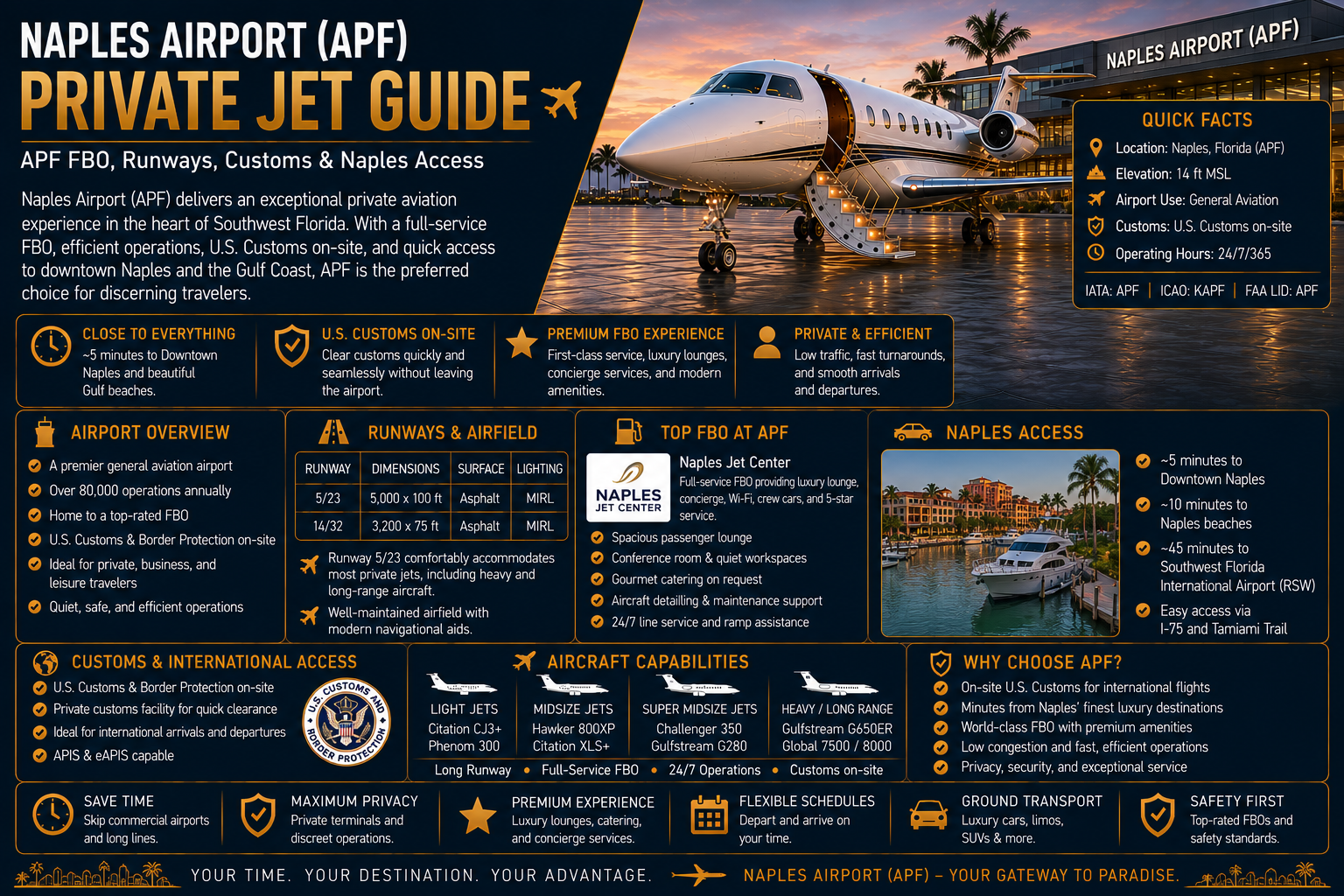
Florida Gulf Coast Private Aviation Airport Guide
Naples Airport Private Jet Guide: APF FBO, Runways, Customs & Naples Access
Naples Airport is one of Southwest Florida’s most important private aviation gateways, combining a 6,600-foot primary runway, dedicated business aviation infrastructure, on-airport U.S. Customs processing and direct access to Naples and Florida’s Paradise Coast. For private travelers whose destination is Naples itself, APF can create a substantially stronger door-to-door itinerary than automatically using a larger commercial airport farther from the destination.
Naples Airport uses the airport identifier APF and ICAO identifier KAPF.
However, its importance to private aviation extends far beyond the airport code.
The airport sits directly inside the Naples market rather than on the outer edge of Southwest Florida.
Therefore, ground geography can become one of APF’s strongest private aviation advantages.
A traveler heading to Downtown Naples, Old Naples, Port Royal, Aqualane Shores, Pelican Bay or nearby golf and residential communities can benefit from landing close to the actual destination.
Consequently, APF should be evaluated as a door-to-door airport rather than simply as an alternative to a larger commercial facility.
Naples Airport primarily serves general aviation.
The Naples Airport Authority states that APF accommodates more than 100,000 general aviation takeoffs and landings each year.
Therefore, private and business aircraft represent a central part of the airport’s operating environment.
That distinction matters.
Private passengers do not need to move through the traditional airline-terminal process.
Instead, they can use dedicated business aviation facilities.
Consequently, the airport experience can remain focused on the aircraft, passengers, crew and ground-transportation mission.
Naples Airport’s runway system provides meaningful business aviation capability.
FAA airport data lists Runway 5/23 at 6,600 feet long and 150 feet wide.
Runway 14/32 measures 5,001 feet long and 100 feet wide.
Therefore, APF can support a broad spectrum of private aircraft.
However, runway length alone does not determine whether every aircraft can complete every mission.
Aircraft weight matters.
Fuel load matters.
Temperature matters.
Wind matters.
Runway condition matters.
Additionally, long-range departures can require substantially more fuel than shorter domestic missions.
Consequently, aircraft performance should always be evaluated for the exact route, aircraft model, passenger load and operating conditions.
This distinction becomes particularly important for large-cabin and ultra-long-range aircraft.
A heavy jet arriving in Naples may have already burned a significant amount of fuel.
Therefore, its arrival weight can be substantially lower than its potential departure weight.
However, that same aircraft departing APF with fuel for a long nonstop mission may operate at a much higher weight.
Consequently, a jet that can comfortably arrive at Naples may require a different fuel, payload or routing strategy when departing on a much longer mission.
Private aviation planning should therefore connect the airport to the exact aircraft and route.
Naples Airport also maintains a dedicated business aviation infrastructure.
Naples Aviation serves private aircraft, passengers and flight crews at APF.
Therefore, the FBO becomes the operational connection between the aircraft and the passenger’s Naples itinerary.
Aircraft handling matters.
Fueling matters.
Passenger transportation matters.
Crew support matters.
Additionally, parking and ground logistics can influence how efficiently the complete mission operates.
Consequently, the FBO should be treated as part of the flight plan rather than simply as a passenger lounge.
Naples Airport also operates within a highly noise-sensitive community environment.
The airport maintains a voluntary nighttime curfew between 10:00 p.m. and 7:00 a.m.
Therefore, scheduling matters at APF in a way that extends beyond aircraft performance.
Private aviation buyers should consider not only whether the aircraft can physically complete the mission but also whether the planned operating window aligns with Naples Airport’s community noise program.
That becomes especially important for late-night arrivals.
It also matters for early-morning departures.
Consequently, a flight that appears operationally simple from a runway standpoint can still benefit from a different schedule.
Naples Airport also supports qualifying international general aviation arrivals.
U.S. Customs and Border Protection operates at Naples as a general aviation landing-rights and user-fee airport.
Current Naples Airport information lists inspection service from 11:00 a.m. to 6:30 p.m. seven days a week.
Therefore, APF can support direct international arrivals when the operator satisfies current CBP requirements.
However, customs capability does not mean an aircraft can arrive internationally without advance planning.
Permission to land procedures apply.
Passenger and crew information must be handled correctly.
Additionally, arrival timing must remain coordinated with CBP.
Consequently, international passengers should confirm the complete customs plan before the aircraft departs its foreign origin.
This capability can materially increase APF’s value.
Naples sits within practical private aircraft range of numerous Bahamas and Caribbean destinations.
Therefore, qualifying travelers can potentially return directly to Naples rather than automatically clearing customs at another Florida airport and then repositioning.
However, the operator should verify current customs availability and procedures for every trip.
Seasonality also plays a major role in Naples private aviation.
Southwest Florida attracts substantial winter and spring travel.
Seasonal residents return.
Vacation traffic increases.
Golf travel increases.
Additionally, private aircraft demand can concentrate around holidays and premium travel weekends.
Therefore, aircraft availability, parking, ground transportation and preferred departure times can become more important during high season.
That seasonal pattern also affects charter planning.
An aircraft that is readily available during a lower-demand period may become harder to source during a major winter weekend.
Consequently, travelers with fixed Naples dates can benefit from planning earlier.
Ground access remains one of APF’s strongest advantages.
The airport directly serves Naples and the surrounding Paradise Coast market.
However, private aviation buyers should evaluate airport geography based on the passenger’s exact address.
A traveler heading to Port Royal can gain significant value from landing at APF.
The same principle applies to Old Naples.
Aqualane Shores creates another strong geographic fit.
Pelican Bay can also align well with Naples Airport.
Additionally, the region’s golf communities create recurring private aviation demand.
Therefore, APF can function as a repeat gateway for seasonal homeowners, executives and family offices.
That repeat use creates operational value.
A principal who travels to Naples frequently can standardize the airport process.
Preferred ground transportation can be documented.
Passenger pickup procedures can be established.
Aircraft requirements can be recorded.
Additionally, a family office or charter advisor can establish clear rules for when APF should be used and when another Southwest Florida airport may better support the mission.
Consequently, airport selection becomes part of a repeatable travel system rather than an isolated decision.
Marco Island creates another important APF use case.
Travelers heading south toward Marco Island can evaluate Naples Airport because APF provides substantial business aviation infrastructure while keeping the passenger within the Southwest Florida destination market.
However, exact ground geography still matters.
Therefore, the strongest airport should be selected around the passenger’s final address and aircraft requirements.
Southwest Florida International Airport creates the most obvious regional comparison.
RSW provides major commercial-airport infrastructure and significantly longer runway capability.
However, airport size does not automatically produce the strongest private aviation itinerary.
A passenger whose final destination is Naples may gain little from landing farther north when APF can safely and efficiently support the mission.
Therefore, APF versus RSW should be evaluated through total mission time.
Aircraft performance matters.
Ground driving time matters.
FBO requirements matter.
International procedures matter.
Additionally, APF’s voluntary nighttime curfew matters.
Consequently, the correct airport should emerge from the mission rather than airport size.
Naples Airport can support a broad mix of private aircraft.
Turboprops can be highly efficient for short regional missions.
Light jets can support Florida and Southeast routes.
Midsize aircraft can add cabin space, baggage capacity and longer range.
Super-midsize jets can provide a strong combination of stand-up cabin comfort and domestic nonstop capability.
Large-cabin aircraft can support premium long-range travel when mission-specific runway performance permits.
Additionally, some ultra-long-range aircraft can operate at APF when exact weight and conditions support the mission.
Therefore, Naples Airport does not belong to one aircraft category.
Instead, aircraft selection should change with the trip.
A Naples-to-Atlanta mission requires one type of aircraft analysis.
Naples-to-New York creates another.
Naples-to-Chicago increases the value of cabin comfort and nonstop range.
Naples-to-Dallas introduces different distance and payload considerations.
Meanwhile, Naples-to-the-Bahamas introduces international customs requirements.
Consequently, route planning and airport planning should work together.
Weather also deserves attention.
Southwest Florida heat can affect aircraft performance.
Thunderstorms can affect regional airspace.
Heavy rain can influence runway and ground conditions.
Additionally, tropical weather can materially alter private aviation throughout hurricane season.
Therefore, Naples private aviation planning should account for regional weather rather than examining only the airport runway.
Ground transportation should also be coordinated carefully.
The driver needs the correct private aviation arrival location.
Passenger contact procedures should be clear.
Additionally, the vehicle should be positioned around the actual aircraft arrival rather than a generic airport-terminal estimate.
Therefore, the ground vehicle becomes part of the aviation mission.
This principle becomes especially important for executive and family-office travel.
Private aviation is often purchased specifically to reduce friction.
Consequently, a poorly coordinated vehicle can erase part of the airport’s geographic advantage.
Naples Airport is therefore more than a runway and FBO specification page.
It represents a complete private aviation decision system.
Runway capability matters.
Aircraft weight matters.
FBO coordination matters.
Customs matters.
Passenger geography matters.
Seasonal demand matters.
Weather matters.
Noise procedures matter.
Ground transportation matters.
Therefore, the correct APF mission should coordinate all of those variables together.
This guide examines that complete system.
It covers Naples Airport runways, aircraft capability, FBO operations, international customs, nighttime operating considerations, seasonal traffic, Naples and Marco Island ground access, aircraft selection, weather, private jet routes, family-office travel and regional airport comparisons.
Most importantly, it explains when Naples Airport should be selected instead of Southwest Florida International Airport or another Southwest Florida aviation option.
Direct APF Airport Answer
Is Naples Airport Good for Private Jets?
Direct Answer: Yes. Naples Airport is one of Southwest Florida’s strongest private aviation airports, combining a 6,600-foot primary runway, dedicated business aviation infrastructure, on-airport customs and direct access to Naples. APF becomes particularly valuable for travelers whose final destination lies in Naples, Port Royal, Old Naples, Pelican Bay or nearby Gulf Coast communities.
Naples Airport works especially well when the passenger’s actual destination is Naples itself.
Therefore, airport selection should begin with ground geography rather than airport size.
A traveler heading directly into Naples may gain little from landing farther away simply because another airport has a longer runway.
Consequently, APF can preserve more of private aviation’s door-to-door time advantage.
Primary Runway
Runway 5/23 provides 6,600 feet of paved runway and serves as APF’s primary operating surface.
Crosswind Runway
Runway 14/32 provides 5,001 feet of additional paved runway capability and useful operational flexibility.
Business Aviation Infrastructure
Dedicated FBO services support aircraft, passengers and flight crews at Naples Airport.
General Aviation Customs
APF supports qualifying international arrivals through an on-airport U.S. Customs and Border Protection operation.
Direct Destination Access
APF places private travelers inside the Naples market rather than requiring a longer regional ground transfer.
Annual GA Operations
Naples Airport accommodates more than 100,000 general aviation takeoffs and landings each year.
What Is Naples Airport’s Biggest Private Aviation Advantage?
Its strongest advantage is the combination of destination proximity and business aviation capability.
APF provides meaningful runway infrastructure.
Additionally, it provides dedicated private aviation support and international-arrival capability.
However, those features become especially valuable because the airport sits directly in Naples.
Therefore, the passenger can combine capable aircraft operations with reduced ground transportation.
Is APF Only Useful for Small Private Jets?
No.
Naples Airport can support a broad spectrum of business aviation aircraft.
However, every aircraft mission should still be evaluated by exact model, weight, weather, fuel load and required runway performance.
Consequently, the question should not simply be whether a “large jet” can use APF.
The better question is whether the exact aircraft can efficiently complete the specific mission.
Naples Airport combines dedicated business aviation infrastructure with direct access to one of Southwest Florida’s most important private travel markets.
That combination makes APF particularly powerful when passenger geography and aircraft performance align with the airport.
Naples Private Aviation
Why Do Private Jet Travelers Use Naples Airport?
Direct Answer: Private jet travelers use Naples Airport because APF combines direct Naples access with a general aviation-focused environment, business aviation services and international customs capability. It can be especially valuable for seasonal residents, family offices, executives, golfers and leisure travelers heading to Naples, Port Royal, Old Naples, Pelican Bay and nearby Gulf Coast communities.
Naples is a destination where the final ground portion of a trip can materially affect the entire itinerary.
Therefore, choosing an airport close to the passenger’s home, resort, meeting or community can create substantial value.
APF becomes particularly strong because the airport sits directly inside the Naples market.
Old Naples
APF can provide direct private aviation geography for passengers heading toward Downtown Naples, Fifth Avenue South and surrounding destinations.
Port Royal
Private residents and visitors can evaluate APF as a recurring aviation gateway with limited regional ground travel.
Pelican Bay
Naples Airport can support premium residential and leisure travel into communities north of central Naples.
Golf Travel
Naples-area golf communities create recurring seasonal private aviation demand for passengers traveling with clubs and larger baggage loads.
Seasonal Residents
Repeat winter travel can make APF part of a standardized household or family-office aviation process.
Marco Island
APF can also provide a capable business aviation gateway for travelers continuing south toward Marco Island.
Why Not Automatically Use RSW?
Southwest Florida International Airport provides major commercial-airport infrastructure.
However, airport size does not automatically improve a private passenger itinerary.
Therefore, travelers whose final destination is Naples should compare total ground time.
APF can place the passenger closer to Naples itself.
Why Does APF Matter So Much for Seasonal Travelers?
Seasonal travel creates repetition.
Therefore, the same passenger may fly into Naples many times over multiple years.
That repetition creates an opportunity to standardize airport, FBO, ground vehicle and aircraft procedures.
Consequently, APF can become part of a repeatable private travel system rather than a one-time airport choice.
Naples private aviation should be planned around where the passenger is actually going.
APF becomes especially valuable when that destination sits in Naples or the surrounding Gulf Coast market.
Southwest Florida Business Aviation
What Role Does Naples Airport Play in Private Aviation?
Direct Answer: Naples Airport functions primarily as a general aviation airport and accommodates more than 100,000 general aviation takeoffs and landings each year. Its business aviation infrastructure, customs capability and direct Naples access make APF a major private aviation gateway for Southwest Florida residents, visitors, executives, aircraft owners and seasonal travelers.
APF differs from a large commercial airport because general aviation sits at the center of its operating environment.
Therefore, private aircraft do not represent a small secondary use of the airport.
Instead, business and general aviation form a major part of the field’s daily activity.
Private Jet Operations
Naples supports substantial charter, corporate and privately operated business aircraft activity.
GA-Focused Airport
APF’s airport environment is centered primarily on general aviation rather than a major scheduled-airline terminal operation.
Private Aviation Services
Dedicated FBO infrastructure supports private passengers, aircraft and flight crews.
Customs Capability
Qualifying international general aviation arrivals can clear customs at APF under current CBP procedures.
Winter Aviation Demand
Seasonal residents and visitors can increase private aviation demand substantially during Southwest Florida’s high season.
Private Wealth Travel
APF can serve principals and families with recurring homes, investments, businesses or leisure travel throughout Naples.
Does the General Aviation Focus Increase APF’s Private Aviation Value?
It can.
Private travelers use an airport environment heavily oriented toward general aviation.
Therefore, passengers avoid much of the conventional airline-terminal process.
However, APF still handles substantial aircraft activity.
Consequently, a general aviation focus does not mean the airport is always quiet.
Instead, it means the airport’s infrastructure and passenger process align closely with private aircraft operations.
Naples Airport is a general aviation airport with a major private and business aviation role.
Private travelers gain direct Naples access while using an airport environment built primarily around non-airline aviation.
APF Quick Reference
What Should Private Jet Travelers Know About Naples Airport?
Direct Answer: Naples Airport uses the identifiers APF and KAPF and operates two primary paved runways. Runway 5/23 measures 6,600 feet by 150 feet, while Runway 14/32 measures 5,001 feet by 100 feet. APF also provides business aviation services, international general aviation customs processing and direct access to Naples and surrounding Gulf Coast communities.
| Airport Detail | Naples Airport Information | Why It Matters |
|---|---|---|
| Airport | Naples Airport | Major general and business aviation gateway for Southwest Florida |
| Airport Identifier | APF | Primary domestic airport identifier |
| ICAO Identifier | KAPF | Used in operational flight planning |
| Primary Runway | Runway 5/23 — 6,600 × 150 feet | Provides meaningful capability for a broad range of business aviation aircraft |
| Crosswind Runway | Runway 14/32 — 5,001 × 100 feet | Adds useful runway and wind-direction flexibility |
| Airport Type | General aviation | Private and business aircraft form a central part of the airport environment |
| Annual GA Activity | More than 100,000 takeoffs and landings | Demonstrates substantial general aviation demand |
| Private Aviation Facilities | Dedicated FBO infrastructure | Supports aircraft, passenger, crew and ground-service requirements |
| International GA Customs | Available under current CBP procedures | Supports qualifying international private aviation arrivals |
| Published Customs Inspection Hours | 11:00 a.m.–6:30 p.m., seven days a week | International missions require advance coordination |
| Nighttime Consideration | Voluntary 10:00 p.m.–7:00 a.m. curfew | Late-night and early-morning scheduling should account for community noise procedures |
| Primary Private Aviation Advantage | Direct Naples access | Can substantially reduce ground transportation for Naples-bound travelers |
Which APF Specification Matters Most?
There is no single answer.
The runway system establishes meaningful aircraft capability.
However, the general aviation environment supports the private passenger process.
Meanwhile, the airport’s Naples location creates the door-to-door advantage.
Additionally, customs capability expands the range of missions APF can support.
Therefore, Naples Airport becomes strongest when all of those factors support the same trip.
Naples Airport’s specifications make APF capable. Its location makes it strategically valuable.
For many Naples-bound private travelers, that combination differentiates APF from the broader Southwest Florida airport network.
APF Runway System
How Long Are the Runways at Naples Airport?
Direct Answer: Naples Airport’s primary Runway 5/23 measures 6,600 feet long and 150 feet wide. Crosswind Runway 14/32 measures 5,001 feet long and 100 feet wide. Therefore, APF provides meaningful business aviation capability, although heavier and longer-range aircraft require exact performance analysis based on weight, fuel, weather and runway conditions.
APF’s primary runway creates substantial flexibility for business aviation.
However, its runway system is shorter than those at many major commercial airports.
Therefore, aircraft performance deserves greater attention as aircraft weight and mission range increase.
6,600 Feet
Runway 5/23 measures 6,600 feet long and 150 feet wide.
5,001 Feet
Runway 14/32 measures 5,001 feet long and 100 feet wide.
Operational Flexibility
Two paved runway orientations provide additional airfield flexibility compared with a similar single-runway airport.
Does a 6,600-Foot Runway Mean Any Private Jet Can Use APF?
No.
Runway length represents only one part of aircraft compatibility.
Temperature matters.
Aircraft weight matters.
Wind matters.
Runway condition matters.
Additionally, the required fuel load affects takeoff weight.
Therefore, operators must evaluate the exact aircraft and mission.
Why Can Departure Performance Matter More Than Arrival Performance?
An arriving aircraft may have already burned substantial fuel.
Therefore, it can reach Naples at a considerably lower weight.
However, the same aircraft departing on a long nonstop mission may require a much larger fuel load.
Consequently, departure runway requirements can become more restrictive than arrival requirements.
Can a Fuel Stop Solve a Naples Runway Limitation?
Potentially.
An aircraft can sometimes depart APF with less fuel and stop elsewhere before continuing the longer mission.
However, that strategy adds time and complexity.
Therefore, travelers should compare the value of landing directly in Naples against the value of preserving a nonstop long-range itinerary from an airport with greater runway capability.
APF has meaningful business-jet runway capability—but aircraft performance belongs to the exact mission.
Airport capability and aircraft capability should always be evaluated together.
APF Aircraft Strategy
Which Types of Private Jets Can Use Naples Airport?
Direct Answer: Naples Airport can support a broad private aviation fleet, including turboprops, light jets, midsize jets, super-midsize aircraft and many large-cabin business jets. Some ultra-long-range aircraft can also use APF when exact operating weight and conditions permit, although heavy long-range departures require particularly careful runway-performance analysis.
Naples Airport gives private aviation buyers meaningful aircraft flexibility.
Therefore, travelers can choose aircraft around passenger requirements rather than being confined to only small jets.
However, the largest aircraft is not automatically the best aircraft.
Turboprops
Turboprops can provide efficient short-range Florida and Southeast missions while offering strong runway flexibility.
Short Domestic Missions
Light jets can efficiently connect Naples with Florida, the Southeast and selected regional markets.
Cabin + Range
Midsize aircraft can add passenger comfort, baggage capability and useful nonstop range for longer domestic missions.
Longer Domestic Travel
Super-midsize jets can combine stand-up cabin comfort with strong nonstop capability across much of the United States.
Premium Long-Range Travel
Large business jets can support premium domestic and international missions when actual APF runway performance permits.
Ultra-Long-Range Aircraft
Ultra-long-range jets require mission-specific review because substantial fuel loads can materially increase departure weight.
Why Does Southwest Florida Heat Matter?
Higher temperatures can reduce aircraft performance.
Therefore, hot conditions may change available takeoff margins compared with cooler days.
This becomes increasingly important as aircraft weight rises.
Consequently, heavy departures carrying substantial fuel deserve aircraft-specific analysis.
Does That Mean Large Jets Cannot Use Naples Airport?
No.
Many large business aircraft can use APF under appropriate conditions.
However, safe aircraft operation should never be reduced to one runway dimension or aircraft category.
Therefore, the exact aircraft, weight, weather and route remain the final determinants.
Naples Airport gives private aviation buyers a broad aircraft menu.
The mission should determine which aircraft to choose from that menu.
APF Private Aviation Infrastructure
Which FBO Serves Private Jets at Naples Airport?
Direct Answer: Naples Airport supports private aircraft through its dedicated business aviation FBO infrastructure. The facility connects aircraft handling with passenger arrival, crew support, fueling and ground transportation. Therefore, FBO coordination plays an important role in creating an efficient APF mission from touchdown through the passenger’s final Naples destination.
FBO planning plays a central role in Naples private aviation.
The facility handles the aircraft on the ground.
Additionally, it provides the connection point for passengers and ground transportation.
Therefore, the FBO influences both operational efficiency and passenger experience.
Aircraft Handling
The operator should coordinate aircraft-specific ground requirements before arrival.
Ramp Planning
Parking becomes particularly important when an aircraft remains at APF during high-season demand.
Passenger Transfer
The FBO should support an efficient transition between the aircraft and the passenger’s ground vehicle.
Fuel Coordination
Aircraft fuel requirements should align with the next planned mission and available runway performance.
Crew Support
Crew transportation, rest, catering and other logistical requirements can affect the ground plan.
Ground Transportation
The driver should receive the exact private aviation arrival instructions rather than simply being sent to “Naples Airport.”
Why Does FBO Coordination Matter at APF?
The FBO affects aircraft handling.
Parking availability matters.
Fuel planning matters.
Additionally, passenger vehicles need the correct arrival point.
Therefore, the FBO affects both the aircraft and passenger sides of the mission.
Should Ground Transportation Be Planned Before Landing?
Yes.
Private aviation buyers should coordinate the vehicle before arrival.
The driver should know the correct private aviation pickup location.
Additionally, the passenger contact plan should already be established.
Therefore, ground transportation becomes part of the aviation mission rather than an afterthought.
At APF, the strongest FBO plan supports the aircraft, crew, passenger and ground-transportation mission together.
Private aviation works best when the entire ground process has been coordinated before touchdown.
International General Aviation
Can International Private Jets Clear Customs at Naples Airport?
Direct Answer: Yes. Naples Airport supports qualifying international general aviation arrivals through U.S. Customs and Border Protection. Naples operates as a general aviation landing-rights and user-fee airport, while current airport information lists inspection service from 11:00 a.m. to 6:30 p.m. seven days a week. International arrivals require advance coordination and applicable permission-to-land procedures.
International capability can materially strengthen APF for Naples residents and visitors.
The Bahamas are geographically close.
Caribbean destinations can also fit naturally within Naples private aviation patterns.
Therefore, direct customs capability can eliminate an unnecessary intermediate arrival at another Florida airport.
However, customs service should never be assumed from airport capability alone.
Naples operates as a general aviation landing-rights and user-fee airport.
Additionally, published inspection service currently runs from 11:00 a.m. until 6:30 p.m. seven days a week.
Therefore, international arrival procedures must be coordinated before the aircraft departs.
| International Requirement | Current APF Planning Consideration |
|---|---|
| Airport Status | General aviation landing-rights / user-fee airport |
| Published Inspection Service | 11:00 a.m.–6:30 p.m., seven days a week |
| Advance Coordination | Required for qualifying international general aviation arrivals |
| Permission to Land | Operators must follow current CBP permission-to-land procedures |
| Passenger Documentation | Passengers and crew must satisfy applicable U.S. entry requirements |
| Arrival Timing | Schedule changes should remain coordinated with CBP |
Can a Private Jet Fly Directly From the Bahamas to Naples?
Potentially, yes.
Naples Airport’s customs capability can support qualifying international general aviation arrivals.
However, the operator must satisfy current CBP procedures before departure.
Therefore, passengers should not assume that every Bahamas flight can simply arrive at APF without advance coordination.
Why Is Direct Naples Customs Valuable?
Every additional stop introduces time.
It also introduces another landing, ground process and departure.
Therefore, clearing customs directly at APF can preserve more of private aviation’s efficiency when the mission qualifies.
APF supports international general aviation—but customs is a coordinated service, not an unrestricted arrival feature.
Verify current inspection hours, permission requirements and operating procedures before every international mission.
Operational Accuracy
Where Should Current Naples Airport Private Aviation Information Be Verified?
Airport procedures, runway conditions, FBO services, customs availability, NOTAMs, weather and operating conditions can change.
Therefore, this guide supports airport research rather than replacing operational flight-planning resources.
For current airport information, travelers and operators should verify requirements through the Naples Airport Authority.
Additionally, current runway and airport data should be verified through the Federal Aviation Administration Airport Data and Information Portal.
International operators should also verify current procedures through U.S. Customs and Border Protection’s Naples KAPF general aviation guidance.
APF FBO Strategy
How Should Private Jet Travelers Plan Their FBO Experience at Naples Airport?
The key point: The strongest APF FBO plan connects aircraft handling, parking, fuel, passenger transportation, crew requirements and the final Naples destination before the aircraft arrives. Because Naples Airport serves substantial seasonal private aviation demand, advance coordination can become particularly valuable when aircraft activity increases.
FBO planning can appear to be a minor detail.
However, it affects several components of a private aviation mission simultaneously.
The FBO handles the aircraft on the ground.
Additionally, it connects passengers with their vehicles.
Therefore, the facility becomes the bridge between the flight itself and the passenger’s Naples itinerary.
Aircraft Handling
The operator should coordinate fueling, ramp requirements and aircraft-specific ground services before arrival.
Ramp Availability
Parking becomes increasingly important when an aircraft will remain at Naples through a high-demand weekend or extended seasonal stay.
Passenger Transfer
The passenger experience should create a direct transition from aircraft to ground transportation without unnecessary terminal movement.
Departure Fuel Planning
Fuel requirements should align with the next route while preserving appropriate APF runway-performance margins.
Crew Logistics
Crew transportation, lodging, catering and duty-time requirements can influence the complete Naples operating plan.
Ground Transportation
Drivers should receive the exact private aviation pickup location and passenger contact procedure before the flight lands.
Why Does Seasonal Demand Matter to FBO Planning?
Naples attracts substantial winter and spring private aviation traffic.
Therefore, several aircraft may compete for ramp space, fuel service and preferred departure windows during high-demand periods.
Additionally, aircraft that remain in Naples for several days can consume parking capacity.
Consequently, operators should coordinate longer stays earlier whenever possible.
Should the Passenger or Operator Control the FBO Plan?
The passenger can communicate preferences.
However, the aircraft operator remains responsible for many operational requirements.
Therefore, passenger preferences should work together with parking, fuel, crew and aircraft-handling needs.
The APF FBO plan should solve the complete mission rather than one isolated service requirement.
Aircraft handling, passenger movement, crew logistics and ground transportation should operate as one coordinated system.
Naples Ground Strategy
How Should Ground Transportation Be Planned at Naples Airport?
Direct Answer: Naples Airport ground transportation should be coordinated around the private aviation facility, aircraft arrival time and passenger’s exact destination. APF’s location creates much of its value by reducing ground travel, so vehicle planning should protect that advantage instead of introducing unnecessary waiting or confusion after landing.
Private aviation should be measured door to door.
Therefore, the mission does not end when the aircraft lands.
A poorly coordinated vehicle can create unnecessary waiting even at an airport located close to the passenger’s destination.
Consequently, ground transportation belongs inside the flight-planning process.
Exact Pickup Point
The driver should receive private aviation pickup instructions rather than a generic Naples Airport destination.
Arrival Monitoring
Ground transportation should follow the aircraft’s actual arrival rather than relying only on the original scheduled time.
Passenger Contact
The driver and passenger team should have a clear contact process in case arrival timing or vehicle positioning changes.
Baggage Requirements
Golf clubs, family luggage and larger travel parties may require more vehicle capacity than a standard executive sedan.
Multiple Vehicles
Family-office or executive missions can require separate principal, security, staff and baggage vehicles.
Return Coordination
The outbound ground plan should include a realistic airport arrival window based on the aircraft and departure requirements.
Why Does Ground Transportation Matter More at an Airport Like APF?
APF’s location can create a major time advantage.
Therefore, ground transportation should preserve that advantage.
If passengers land only minutes from their Naples destination but wait unnecessarily for a vehicle, some of the private aviation value disappears.
Consequently, ground logistics deserve the same attention as aircraft scheduling.
APF saves time because it puts the aircraft close to Naples. The vehicle plan should protect every minute of that geographic advantage.
For repeat travelers, standardized transportation procedures can make the arrival process even more consistent.
APF Ramp Planning
How Does Private Jet Parking Work at Naples Airport?
Direct Answer: Private aircraft parking at Naples Airport should be coordinated with the FBO before the mission, particularly during Southwest Florida’s busiest seasonal periods. Availability can affect whether an aircraft remains at APF, repositions after dropping passengers or returns later for pickup, so parking should be treated as part of the itinerary rather than an assumption.
Parking matters differently depending on the mission.
A quick drop-and-go flight creates one requirement.
An aircraft remaining for several hours creates another.
Meanwhile, a multi-day stay can require a completely different ramp strategy.
Therefore, operators should identify the aircraft’s expected ground time before arrival.
Short Ground Time
The aircraft can potentially unload passengers and reposition when parking demand or the next mission makes that strategy preferable.
Day Trip Parking
Business and leisure missions may require the aircraft to remain available for a same-day passenger return.
Extended Stay
Overnight and multi-day aircraft stays should be coordinated early during Naples high season.
Peak Demand
Winter and holiday traffic can increase competition for preferred ramp arrangements.
Aircraft Repositioning
An operator may move the aircraft to another airport if remaining at APF does not support the broader mission efficiently.
Pickup Strategy
If an aircraft repositions, the operator must coordinate its return early enough to protect the passenger’s desired departure schedule.
Why Would a Private Jet Reposition After Dropping Passengers in Naples?
Aircraft parking consumes ramp space.
Additionally, operators may have another mission to complete.
Therefore, keeping the aircraft at APF may not always be the strongest operating decision.
Repositioning can also help the operator manage parking availability.
However, it adds another aircraft movement.
Consequently, the return-flight plan should account for the repositioning requirement before the passenger decides when to depart Naples.
Does Repositioning Affect Charter Cost?
Potentially.
Aircraft movement requires crew time, fuel and operating expense.
Therefore, parking and repositioning decisions can influence the economics of a charter mission.
Consequently, travelers should compare the complete itinerary rather than assuming that leaving the aircraft at Naples is always cheaper or more efficient.
Parking is an operational variable, not a guaranteed feature of the itinerary.
The strongest mission decides whether the aircraft should remain at APF, reposition or return later for pickup.
Aircraft Storage Strategy
Are Private Jet Hangars Important at Naples Airport?
Direct Answer: Hangar access can matter for private aircraft staying in Naples because enclosed storage can protect aircraft from intense sun, thunderstorms and other Southwest Florida weather. However, hangar availability depends on aircraft dimensions, operator relationships and current airport capacity, so crews should coordinate storage requirements in advance.
Not every visiting aircraft requires hangar storage.
However, longer stays can make hangar access increasingly valuable.
Southwest Florida receives intense sun.
Thunderstorms can develop rapidly.
Additionally, severe weather can affect exposed aircraft.
Therefore, owners and operators may prefer enclosed storage when the mission and availability support it.
Does Aircraft Size Affect Hangar Availability?
Yes.
A light jet requires less physical space than a large-cabin aircraft.
Therefore, a hangar that works for one aircraft may not accommodate another.
Tail height matters.
Wingspan matters.
Aircraft length matters.
Consequently, the operator should provide the exact aircraft model rather than simply requesting “private jet hangar space.”
Why Can Hangar Planning Become More Important During Hurricane Season?
Tropical weather can create much more serious risk than an ordinary summer thunderstorm.
Therefore, aircraft owners and operators may need to move aircraft out of Southwest Florida entirely when a major tropical system threatens the region.
Consequently, hangar storage should not replace a broader hurricane evacuation or repositioning plan.
Hangar space can protect an aircraft from routine exposure, but severe tropical weather may require repositioning rather than storage.
Aircraft owners should connect hangar planning with the broader seasonal operating strategy.
Direct Naples Access
Why Is Naples Airport Valuable for Private Jet Travel Into Naples?
Direct Answer: Naples Airport’s biggest passenger advantage is geography. APF sits directly within Naples, allowing private travelers to reach central Naples, Old Naples, Port Royal, Aqualane Shores, Pelican Bay and surrounding residential or resort destinations without beginning the ground trip from a more distant regional airport.
Private aviation creates value by removing friction.
Therefore, airport selection should minimize the ground portion of the trip whenever aircraft requirements allow.
Naples Airport becomes especially compelling because many high-value Naples destinations sit relatively close to the field.
Downtown Naples
APF can provide efficient access to central Naples business, dining, shopping and hospitality destinations.
Fifth Avenue South
Private travelers can land near one of Naples’ central luxury retail, restaurant and hospitality districts.
Old Naples
The airport provides strong geography for residences and destinations throughout the historic coastal core.
Port Royal
APF can function as a repeat private aviation gateway for principals and families with residences in Port Royal.
Pelican Bay
Northern Naples destinations can remain practical while preserving APF’s private aviation infrastructure advantages.
Golf Communities
Naples’ extensive golf market creates recurring private travel involving passengers, clubs and seasonal residences.
Why Can Airport Geography Matter More Than Aircraft Speed?
On many domestic private flights, the time difference between two suitable jet categories can be relatively modest.
However, choosing an airport farther from the final destination can add substantial driving time.
Therefore, airport geography can sometimes save more door-to-door time than selecting a faster aircraft.
Who Gains the Most From APF’s Location?
Frequent Naples travelers can gain particularly strong value.
A seasonal resident may make the same trip repeatedly.
Family offices can also repeat the same destination pattern.
Therefore, even modest time savings can compound across dozens of annual or multi-year missions.
The strongest Naples airport decision is not about landing closest to Florida—it is about landing closest to the passenger’s actual destination.
For many Naples-bound private travelers, that makes APF difficult to ignore.
Naples Private Wealth Access
Is Naples Airport a Strong Private Jet Airport for Port Royal and Old Naples?
Direct Answer: Yes. Naples Airport provides particularly strong private aviation geography for Port Royal, Old Naples, Aqualane Shores and nearby central Naples communities. For residents, family offices and visitors traveling repeatedly to these areas, APF can reduce ground travel while supporting a repeatable FBO, vehicle and aircraft operating process.
Private wealth travel frequently involves recurring routes.
Therefore, airport geography becomes increasingly valuable over time.
A principal who uses APF repeatedly can establish a preferred operating process.
Ground vehicles can be standardized.
Passenger preferences can be documented.
Additionally, recurring aircraft requirements can be communicated before each trip.
Port Royal
APF provides strong private aviation geography for one of Naples’ most prominent waterfront residential markets.
Old Naples
Travelers can reach central Naples residences and hospitality destinations without a long regional transfer.
Aqualane Shores
APF can support repeat private travel into another major luxury residential area near the Naples core.
Family Office
Recurring travel allows assistants and flight teams to standardize vehicles, timing and passenger requirements.
Seasonal Residence
Winter homeowners can establish APF as the default arrival airport when aircraft performance supports the mission.
Guest Travel
Residents can also coordinate visiting family members, business associates or guests through the same private aviation process.
Why Does Repeat Travel Favor a Standard Airport Process?
Because small inefficiencies compound.
Therefore, maintaining preferred vehicle providers, aircraft requirements and passenger procedures can improve consistency across repeated missions.
Family offices can benefit particularly strongly from that standardization.
Should APF Always Be the Default for a Port Royal Resident?
Not automatically.
Aircraft performance may favor another airport on a particular mission.
International timing may also affect the decision.
Additionally, severe weather or parking constraints can change the best strategy.
Therefore, APF can serve as the preferred airport without becoming an inflexible rule.
For recurring Naples private travel, APF can become part of the household’s operating system.
The value comes from combining airport geography with repeatable aircraft and ground procedures.
Southwest Florida Destination Access
Is Naples Airport a Good Private Jet Gateway for Marco Island?
Direct Answer: Naples Airport can be a strong private jet gateway for Marco Island because APF combines substantial business aviation capability with a location that keeps passengers within the Naples–Marco Island destination region. The best choice depends on the exact aircraft, passenger address, ground transportation and any international-arrival requirements.
Marco Island creates a different geographic question from central Naples.
Therefore, the airport decision should not simply copy the strategy used for Port Royal or Old Naples.
However, APF provides strong business aviation infrastructure.
Additionally, it can support aircraft categories and international arrivals that require a more capable operating environment.
Consequently, Naples Airport deserves consideration for many Marco Island missions.
What Should a Marco Island Traveler Compare?
Aircraft capability comes first.
Ground travel comes next.
International-arrival requirements can also matter.
Additionally, the passenger should consider whether the aircraft will remain in Southwest Florida or reposition.
Therefore, the strongest airport emerges from the complete trip rather than one geographic measurement.
Can APF Still Make Sense Even With a Ground Transfer to Marco Island?
Yes.
A private aircraft mission can still create substantial time savings when the airport supports the aircraft efficiently and places the passenger within the same destination region.
However, travelers should compare the total itinerary rather than assuming APF wins every Marco Island trip.
For Marco Island, APF should be evaluated as a capable regional private aviation gateway rather than simply as “the Naples airport.”
Aircraft requirements and final-address geography should determine the decision.
Naples High-Season Aviation
How Does Naples High Season Affect Private Jet Operations?
Direct Answer: Naples’ winter and spring high season can increase private jet demand, aircraft parking pressure, charter pricing, FBO activity and competition for preferred arrival or departure times. Travelers with fixed holiday, weekend or event schedules should therefore plan aircraft, parking and ground transportation earlier than they might during lower-demand periods.
Seasonality shapes the Naples private aviation market.
Residents return for the winter.
Visitors arrive for holidays.
Golf travel increases.
Additionally, social and business activity rises during the same general period.
Therefore, several forms of private aviation demand can increase simultaneously.
Aircraft Availability
Charter aircraft can become harder to source when several travelers want similar departure windows.
Charter Pricing
Higher aircraft demand and repositioning requirements can influence the complete charter price.
Ramp Activity
More private aircraft movements can increase operational activity around the FBO and parking areas.
Ground Vehicles
Premium transportation providers can also experience increased demand during the same travel periods.
Holiday Windows
Thanksgiving, Christmas, New Year and other premium travel periods can compress demand into narrow time windows.
Return Flights
Several travelers may attempt to leave Naples at similar times after major weekends or holidays.
Should Naples Charter Travelers Book Earlier During High Season?
Earlier planning generally creates more options.
Therefore, passengers who know their travel dates can improve aircraft and schedule choice by arranging the mission before demand tightens.
However, private aviation can still accommodate many last-minute flights.
The tradeoff is reduced flexibility.
Consequently, a late booking may require a different aircraft, departure time or repositioning strategy.
Why Does the Return Flight Need Equal Attention?
The arrival receives most of the passenger’s attention.
However, several aircraft may leave Naples during the same peak period.
Therefore, the outbound mission can face just as much scheduling pressure as the inbound trip.
Consequently, travelers should plan both ends of the stay together.
Naples high season rewards early coordination more than rigid planning.
The objective is to preserve aircraft, airport and schedule flexibility before demand reduces the available choices.
APF Noise + Schedule Strategy
How Should Naples Airport’s Nighttime Curfew Affect Private Jet Planning?
Direct Answer: Naples Airport maintains a voluntary nighttime noise curfew that strongly discourages most operations between 10:00 p.m. and 7:00 a.m. Therefore, travelers should plan arrivals and departures around the airport’s noise-sensitive community environment rather than treating APF as an unrestricted late-night private aviation airport.
The curfew changes the scheduling conversation.
An aircraft may be physically capable of arriving late.
However, airport capability and community operating practices are different questions.
Therefore, the preferred mission should respect the airport’s noise-management environment.
What Happens if a Meeting or Event Runs Late?
The private aviation team should evaluate the schedule before the passenger becomes committed to a late departure.
Alternative timing may preserve APF.
Another regional airport may provide a different operating solution.
Additionally, the passenger may choose to remain overnight and depart after the preferred morning operating window begins.
Therefore, late-night contingency planning should happen before the event starts.
Does the Curfew Make APF a Poor Business Aviation Airport?
No.
The airport’s location and business aviation infrastructure remain highly valuable.
However, private aviation buyers should understand the operating environment.
Consequently, APF works best when mission scheduling aligns with both passenger requirements and community procedures.
At Naples Airport, schedule flexibility is part of airport compatibility.
The best mission considers runway performance, passenger timing and the community noise environment together.
Florida Aircraft Performance
How Does Southwest Florida Heat Affect Private Jets at Naples Airport?
Direct Answer: High temperatures can reduce aircraft takeoff performance because warmer air is less dense. At Naples Airport, that effect becomes increasingly important for heavier aircraft departing with substantial fuel, particularly because APF’s primary runway is 6,600 feet rather than the much longer runway environment available at some major commercial airports.
Heat does not affect every Naples mission equally.
A light aircraft making a short regional flight may have substantial performance margin.
However, a large-cabin jet departing with fuel for a long mission operates under a different set of conditions.
Therefore, aircraft weight and temperature should be evaluated together.
Why Does a Hot Day Matter More for a Heavy Jet?
A heavier aircraft requires more performance.
Meanwhile, higher temperature can reduce available performance.
Therefore, the two factors can compound.
Additionally, a long nonstop route may require more fuel and increase takeoff weight further.
Consequently, long-range departures deserve particular attention during hot conditions.
Can Departing Earlier in the Day Help?
Potentially.
Morning conditions can be cooler than afternoon conditions.
Therefore, departure timing can sometimes improve performance margins.
However, exact aircraft calculations belong to the operator.
Consequently, passengers should treat timing flexibility as a planning tool rather than a guaranteed performance solution.
The same jet can have a different APF performance answer on a cool morning and a hot, heavily fueled afternoon departure.
Aircraft selection must account for real operating conditions rather than brochure capability alone.
Southwest Florida Weather
How Can Weather Affect Private Jet Operations at Naples Airport?
Direct Answer: Naples private aviation can be affected by thunderstorms, heavy rain, wind, regional airspace disruptions and tropical weather. Operators therefore evaluate more than the conditions directly over APF, because weather along the route, around South Florida and near the destination can influence departure timing, routing, fuel requirements and passenger schedules.
Florida weather can change quickly.
Thunderstorms can develop during the day.
Therefore, a clear morning does not guarantee identical afternoon conditions.
Regional convective weather can also affect air traffic routing.
Consequently, a flight may experience delays even when the runway at Naples remains usable.
Thunderstorms
Convective weather can affect departure timing, routing and air traffic flow throughout Florida.
Heavy Rain
Rain can affect visibility, runway condition and ground transportation.
Wind
Wind direction and velocity can influence runway selection and aircraft performance.
Heat
High temperature can reduce aircraft performance, particularly on heavier departures.
Regional Airspace
Weather elsewhere in Florida can affect routing even when conditions at APF remain acceptable.
Tropical Systems
Hurricanes and tropical storms can require major itinerary changes or aircraft repositioning.
Why Should Passengers Care About Weather Beyond Naples?
A flight uses an entire route.
Therefore, conditions hundreds of miles away can influence the mission.
Air traffic control may reroute aircraft.
The destination may experience severe weather.
Additionally, alternate-airport requirements can affect required fuel.
Consequently, weather planning should consider the complete flight rather than only the departure airport.
Private aviation provides schedule flexibility, but weather still controls the physical operating environment.
The strongest Naples mission uses that flexibility to adapt early rather than reacting after conditions deteriorate.
Tropical Weather Strategy
How Does Hurricane Season Affect Naples Private Aviation?
Direct Answer: Hurricane season can materially affect Naples private aviation because tropical systems may disrupt airport operations, regional airspace, ground transportation and aircraft parking. Aircraft owners and operators may reposition airplanes away from Southwest Florida before a storm arrives, while passengers may need to advance, delay or reroute planned travel.
Tropical-weather planning should begin before the airport experiences severe conditions.
Aircraft mobility creates an advantage.
Therefore, owners and operators can reposition valuable aircraft away from the threatened area.
However, many operators may attempt to move aircraft during similar windows.
Consequently, early decisions can preserve more options.
Why Might a Based Aircraft Leave Naples Before a Hurricane?
Aircraft are mobile assets.
Therefore, relocating the airplane can reduce exposure to wind, debris, flooding and extended airport disruption.
Additionally, moving early can position the aircraft somewhere useful for the owner’s next trip.
Consequently, evacuation planning can support both asset protection and travel continuity.
How Should Passengers Plan Around a Potential Storm?
Flexibility becomes critical.
A departure may move earlier.
An arrival may shift to another airport.
Additionally, a traveler may postpone the trip entirely.
Therefore, private aviation’s scheduling flexibility becomes particularly valuable when weather creates uncertainty.
During tropical weather, the best Naples aviation strategy may be to move before the airport itself becomes the problem.
Aircraft positioning, passenger timing and destination flexibility should be planned together.
Southwest Florida Airport Strategy
Naples Airport vs. RSW: Which Is Better for Private Jets?
Direct Answer: Naples Airport can be stronger for travelers whose destination is Naples because APF provides direct city access and a general aviation-focused environment. Southwest Florida International Airport can become stronger when runway requirements, airline connectivity, late-night scheduling or other mission-specific operational factors outweigh APF’s ground-location advantage.
APF and RSW solve different aviation problems.
Therefore, the comparison should not begin with which airport is larger.
RSW clearly provides more major-airport infrastructure.
However, private aviation buyers often care more about total mission efficiency than airport size.
| Decision Factor | Naples Airport (APF) | Southwest Florida International (RSW) |
|---|---|---|
| Naples Access | Strong geographic advantage | Requires a longer ground transfer for many Naples destinations |
| Airport Environment | General aviation focused | Major commercial airline airport |
| Runway Strategy | 6,600-foot primary runway requires more mission-specific analysis for heavy departures | Major-airport runway capability can provide greater flexibility for selected heavy missions |
| Private Passenger Experience | Dedicated business aviation environment | Private aviation operates within a larger commercial-airport system |
| Late-Night Mission | Voluntary nighttime noise curfew should be considered | May offer a different scheduling environment depending on the mission |
| Airline Connection | Not the primary airport role | Strong airline connectivity |
| Best Use Case | When APF safely supports the aircraft and minimizes Naples ground travel | When aircraft, scheduling, airline or operational requirements favor the larger airport |
When Is APF Usually the Stronger Choice?
APF becomes particularly attractive when the passenger is actually going to Naples and the aircraft can complete the mission efficiently.
Therefore, Old Naples, Port Royal and other Naples destinations can create a strong geographic case for APF.
Additionally, passengers who do not require airline connectivity may gain little from automatically choosing a larger commercial airport.
When Can RSW Become the Better Choice?
Aircraft performance can be one reason.
Late-night scheduling can be another.
Airline connectivity may matter for mixed private-commercial itineraries.
Additionally, a specific aircraft or operational requirement can favor RSW.
Therefore, APF should not be forced into every Southwest Florida mission.
Do not ask which Southwest Florida airport is bigger. Ask which airport produces the better complete mission.
For many travelers heading into Naples itself, APF’s geographic advantage can be substantial.
APF Aircraft Selection
Which Private Jet Is Best for Naples Airport?
Direct Answer: The best private jet for Naples Airport depends on passenger count, baggage, route length, nonstop preference, cabin expectations and APF runway performance. Light and midsize jets can work well for shorter domestic missions, while super-midsize and large-cabin aircraft can add range and comfort when their operating weight fits the mission.
Aircraft selection should begin with the actual trip.
Therefore, the correct aircraft is not simply the largest airplane that can use APF.
A short Florida mission can require very little range.
Meanwhile, a nonstop flight to the Northeast, Midwest or West creates different requirements.
Additionally, golf clubs, family luggage, pets and passenger count can materially change aircraft fit.
Passenger Count
The aircraft must provide enough legal seating while also preserving the cabin layout and comfort the group expects.
Luggage + Golf Clubs
Naples leisure travel can involve substantial baggage, so baggage-volume requirements should be evaluated before selecting the jet.
Nonstop Requirement
Longer routes may justify a larger aircraft when the passenger values avoiding a fuel stop.
Cabin Comfort
Longer missions can increase the value of a stand-up cabin, larger seats, enclosed lavatory and more usable workspace.
APF Performance
The selected aircraft must satisfy runway requirements for the actual temperature, weight, fuel load and conditions.
Complete Trip Fit
The strongest aircraft solves the whole itinerary rather than only matching passenger count.
Why Is the Largest Available Jet Not Automatically the Best Choice?
Larger aircraft cost more to operate.
They can also require more runway.
Additionally, the additional cabin and range may provide little benefit on a short mission.
Therefore, aircraft size should follow passenger needs rather than status.
Why Can a Smaller Jet Sometimes Create the Better Naples Mission?
A smaller aircraft can reduce charter cost.
It may also provide stronger runway flexibility.
Therefore, a smaller jet can be more efficient when the passenger group, baggage and route remain within its capability.
However, choosing too small can create a different problem.
Consequently, buyers should balance efficiency against comfort, range and baggage requirements.
The best APF aircraft is the smallest aircraft that fully solves the mission without compromising the passenger’s actual requirements.
Aircraft selection should optimize the trip rather than maximize aircraft size.
Light Jet Missions
When Do Light Jets Make Sense at Naples Airport?
Direct Answer: Light jets can make strong sense at Naples Airport for smaller passenger groups flying shorter domestic routes. They can offer lower operating cost, useful speed and strong runway flexibility while still supporting efficient private travel throughout Florida, the Southeast and many selected regional markets.
Light jets can be highly efficient when the mission does not require a larger cabin or extensive nonstop range.
Therefore, they can work particularly well for two to six passengers traveling relatively short distances.
Naples-to-Atlanta is one example.
Florida intrastate travel can create another.
Additionally, selected Southeast and regional missions can fit the category well.
What Can Make a Light Jet a Poor Fit?
Baggage can become a limitation.
Golf clubs can matter.
Passenger count can also exceed the practical comfort of a smaller cabin.
Additionally, longer routes may require a fuel stop.
Therefore, buyers should evaluate the complete payload rather than only the number of seats.
Why Can Light Jets Work Well With APF’s Runway?
Many light jets require substantially less runway than heavier business aircraft.
Therefore, they can provide useful performance margin at Naples.
However, operators still need exact calculations for the day of operation.
Consequently, aircraft category improves flexibility but never eliminates flight-planning requirements.
Light jets can be one of the most efficient ways to use APF when the trip is short, the group is small and the baggage fits.
The aircraft should remain comfortably inside the mission rather than operating at the edge of its practical capability.
Midsize Jet Missions
When Do Midsize Jets Make Sense at Naples Airport?
Direct Answer: Midsize jets can provide a strong balance of range, baggage space and cabin comfort for Naples Airport missions. They become particularly useful when passengers need more room than a light jet provides but do not require the cost, range or cabin volume of a super-midsize or large-cabin aircraft.
Midsize aircraft can solve a broad portion of the domestic Naples market.
They can increase cabin comfort.
Baggage capacity can improve.
Additionally, nonstop capability can extend farther than many light jets.
Therefore, the category can fit executive and leisure missions particularly well.
More Cabin Space
Midsize aircraft can provide more usable seating and working room for longer domestic trips.
Better Baggage Fit
Larger baggage compartments can improve suitability for golf, family or extended-stay travel.
Domestic Range
Midsize aircraft can support many longer domestic missions without automatically moving into a much larger category.
Are Midsize Jets Better Than Light Jets for Naples-to-New York?
Often, they can be.
The additional range and cabin comfort can become more valuable on a longer mission.
However, the exact aircraft model matters.
Therefore, buyers should compare specific aircraft rather than assuming every midsize jet offers the same nonstop capability.
Why Might a Midsize Jet Still Be Better Than a Larger Aircraft?
The aircraft can provide sufficient range without unnecessary size.
Therefore, the buyer may preserve cabin comfort while avoiding some of the operating cost and runway demands of a heavier jet.
Consequently, midsize aircraft can occupy an attractive middle ground for many Naples missions.
Midsize jets often fit Naples travelers who want more comfort and range without overbuying the aircraft.
The category becomes strongest when the route exceeds light-jet comfort but does not require large-cabin capability.
Super-Midsize Strategy
When Do Super-Midsize Jets Make Sense at Naples Airport?
Direct Answer: Super-midsize jets can be an excellent fit for Naples Airport when passengers need a stand-up cabin, substantial baggage capacity and longer nonstop domestic range without moving into a full large-cabin aircraft. They can be especially attractive for Northeast, Midwest and longer business or leisure missions when APF performance supports the exact departure weight.
Super-midsize aircraft can provide one of the strongest balance points in private aviation.
The cabins are larger.
Range improves.
Baggage capability can also increase.
Therefore, the category can serve both executives and families particularly well.
Why Can Super-Midsize Aircraft Be Attractive for Naples High-Season Travel?
Seasonal travelers may carry more luggage.
Golf clubs are common.
Family groups can also require additional cabin space.
Therefore, a super-midsize aircraft can solve payload and comfort requirements that a smaller jet may struggle to handle.
Does APF’s Runway Require Extra Attention With Super-Midsize Jets?
Yes.
The category is heavier than light and midsize aircraft.
Therefore, fuel load and temperature can become more important.
However, many missions remain practical.
Consequently, operators should evaluate the exact model and planned route rather than treating the entire category the same.
Super-midsize jets can provide a powerful APF combination: large-cabin-style comfort without the full weight and operating cost of the largest aircraft.
The exact mission still determines whether that balance is optimal.
Large-Cabin Aircraft
Can Large-Cabin Private Jets Use Naples Airport?
Direct Answer: Many large-cabin business jets can use Naples Airport when aircraft weight, temperature, runway condition and fuel requirements remain within safe operating limits. However, APF’s 6,600-foot primary runway makes exact performance analysis increasingly important for heavy departures, especially when the aircraft carries fuel for a long nonstop mission.
Large-cabin aircraft can provide substantial comfort.
They can also carry more passengers and baggage.
Additionally, their range can support long domestic and international missions.
However, those benefits come with higher operating weight.
Therefore, APF runway performance must be evaluated more carefully.
Why Can a Large-Cabin Jet Land Easily but Face a More Restrictive Departure?
The aircraft may arrive after burning several thousand pounds of fuel.
Therefore, the landing weight can be significantly lower.
However, a long outbound mission may require a substantial fuel load.
Consequently, takeoff weight can increase enough to change the performance calculation.
Can Passengers Still Use APF if a Heavy Departure Becomes Restrictive?
Potentially.
The aircraft can reduce fuel.
A fuel stop can be added.
Another airport can also be used for the outbound leg.
Therefore, the passenger can preserve direct Naples arrival while using a different departure strategy when necessary.
Large-cabin capability at APF is a mission question, not a yes-or-no aircraft-category question.
Arrival weight, departure fuel and route length can change the answer for the same aircraft.
Ultra-Long-Range Strategy
Can Ultra-Long-Range Private Jets Use Naples Airport?
Direct Answer: Some ultra-long-range private jets can use Naples Airport under suitable conditions, but APF’s 6,600-foot primary runway makes heavy departure planning especially important. Aircraft such as Gulfstream, Global and Falcon models must be evaluated by exact operating weight, fuel load, weather and route rather than by aircraft category alone.
Ultra-long-range aircraft can offer extraordinary range.
However, that range requires fuel.
Fuel adds weight.
Therefore, the very capability that makes an aircraft attractive for long nonstop missions can also increase runway requirements.
Can an Ultra-Long-Range Jet Fly Nonstop From Naples to Europe?
Potentially, but the answer depends on the exact aircraft and conditions.
The route requires significant fuel.
Therefore, takeoff weight can become the central issue.
Additionally, temperature and payload can affect available performance.
Consequently, the operator must calculate the exact mission rather than relying on brochure range.
What If APF Cannot Support the Desired Nonstop Departure?
Several strategies can remain available.
The aircraft can depart with less fuel and make a technical stop.
The passenger can reposition to an airport with more runway.
Additionally, the operator can adjust timing if cooler conditions improve performance.
Therefore, a runway limitation does not necessarily eliminate the trip.
It changes the mission design.
An ultra-long-range aircraft does not automatically create an ultra-long-range APF departure.
Aircraft capability, runway capability and mission fuel must all align.
Naples Private Jet Routes
Which Private Jet Routes Commonly Make Sense From Naples Airport?
Direct Answer: Naples Airport can support private jet missions throughout Florida, the Southeast, Northeast, Midwest, Texas and selected international markets. The strongest aircraft category changes with route length, passenger count, baggage and APF departure performance, so the airport should be paired with the specific route rather than treated as a one-size-fits-all departure point.
Naples private aviation demand connects a leisure and residential destination with major business centers throughout the country.
Therefore, the route mix can vary substantially.
Short Florida missions can favor smaller aircraft.
Northeast routes can favor midsize or super-midsize cabins.
Meanwhile, longer western or international missions can increase the value of large-cabin aircraft.
New York
A major seasonal and business route connecting Naples with one of the country’s largest private aviation markets.
Chicago
A strong Midwest connection for seasonal residents, business travelers and family travel.
Dallas
A longer domestic mission where cabin comfort, range and payload can become increasingly important.
Atlanta
A shorter Southeast route that can work efficiently with several aircraft categories.
Bahamas
A nearby international market where APF customs capability can add substantial mission value.
Caribbean
Selected Caribbean routes can support direct leisure or second-home travel when aircraft range and customs planning align.
Why Should the Destination Airport Influence Aircraft Choice Too?
The aircraft must work at both ends of the trip.
Therefore, selecting an aircraft only around APF can create problems at the destination.
Mountain airports provide an obvious example.
Short runways create another.
Consequently, the complete route should determine aircraft fit.
The strongest Naples aircraft is not merely capable of leaving APF—it must efficiently solve the entire route.
Departure airport, destination airport, payload and passenger requirements should all be evaluated together.
Naples → New York
What Should Travelers Know About Private Jet Flights From Naples to New York?
Direct Answer: Naples-to-New York is a major private aviation mission that can favor midsize, super-midsize and large-cabin jets depending on passenger count, baggage, destination airport and nonstop preference. The New York airport choice can influence the trip as much as aircraft selection because Teterboro, Westchester and other airports serve different passenger geography.
The route is long enough for cabin comfort to matter.
Therefore, a passenger may value more space than on a shorter Florida mission.
Additionally, seasonal travelers can carry substantial luggage.
Consequently, baggage capacity should receive real attention.
Which New York Airport Should Naples Travelers Use?
There is no universal answer.
Teterboro can be strong for Manhattan and northern New Jersey access.
Westchester can better serve parts of Westchester County, Connecticut and surrounding areas.
Therefore, destination geography should determine the airport.
Passengers can review IMR’s Teterboro Airport private jet guide and Westchester County Airport private jet guide when comparing New York-area options.
Why Can Super-Midsize Aircraft Work Well on Naples-to-New York?
The route can justify increased cabin space.
It can also benefit from strong nonstop range.
Therefore, super-midsize aircraft can provide an attractive balance between comfort and operating efficiency.
However, exact aircraft selection still depends on passenger and baggage requirements.
Naples-to-New York should be planned as an airport-pair decision, not simply a city-pair flight.
APF solves the Naples end while the correct New York airport determines the ground efficiency at the other end.
Naples → Chicago
What Should Travelers Know About Private Jet Flights From Naples to Chicago?
Direct Answer: Naples-to-Chicago is a substantial Midwest private aviation route that can work well with midsize, super-midsize and larger aircraft depending on passenger count, baggage and airport choice. Chicago-area airport geography matters because private travelers may benefit from using an executive airport closer to the final destination rather than automatically choosing a major commercial airport.
Chicago creates a longer domestic mission than many Southeast routes.
Therefore, cabin comfort becomes more important.
Seasonal luggage can also increase payload requirements.
Additionally, winter weather at the Chicago end can affect departure and arrival planning.
Consequently, the route should be planned around both climate and airport geography.
Can Chicago Executive Airport Be a Strong Destination From Naples?
Potentially.
Chicago Executive serves a major business aviation market north of central Chicago.
Therefore, it can create stronger geography for some northern Chicago-area destinations than a major airline hub.
However, the passenger’s exact address should determine the choice.
Why Does Winter Weather Matter on This Route?
Naples may have warm and clear conditions while Chicago experiences snow, ice or deicing requirements.
Therefore, the weather profile at the destination can be completely different from the departure airport.
Consequently, operators should evaluate the complete route rather than assuming Southwest Florida conditions define the mission.
Naples-to-Chicago connects two very different operating environments.
Aircraft, destination airport and winter-weather capability should be planned together.
Naples → Dallas
What Should Travelers Know About Private Jet Flights From Naples to Dallas?
Direct Answer: Naples-to-Dallas is a longer domestic private aviation mission that can increase the value of midsize, super-midsize and large-cabin aircraft. Dallas airport selection matters because Love Field and Addison serve different passenger geography, so the strongest itinerary should match the aircraft with the passenger’s exact Dallas-area destination.
The route can support both leisure and business travel.
Therefore, aircraft requirements can vary widely.
A couple traveling light creates one mission.
An executive team creates another.
A family carrying substantial luggage creates another still.
Consequently, passenger profile should determine the aircraft.
Should Naples Travelers Use Dallas Love Field or Addison?
The answer depends primarily on destination geography.
Dallas Love Field can provide strong access to central Dallas.
Addison can provide stronger geography for parts of North Dallas.
Therefore, the passenger should choose the airport that minimizes the total ground trip.
For additional planning, travelers can review IMR’s Dallas Love Field private jet guide.
Why Can Super-Midsize Jets Be Attractive on This Route?
The route is long enough for cabin comfort to matter.
However, it does not necessarily require a full large-cabin aircraft.
Therefore, super-midsize jets can provide a strong balance of range, cabin space and operating efficiency.
Naples-to-Dallas works best when both airport geography and aircraft category support the passenger’s exact destination.
The city-pair label alone does not identify the best mission.
Naples → Bahamas
What Should Travelers Know About Private Jet Flights Between Naples and the Bahamas?
Direct Answer: Naples and the Bahamas can form an efficient short international private aviation market because many Bahamian destinations sit relatively close to Southwest Florida. However, international procedures still apply. Travelers returning to APF must coordinate customs and permission-to-land requirements even when the flight itself is short.
Geographic proximity can make the mission feel simple.
However, the flight crosses an international border.
Therefore, passenger documentation and customs procedures remain essential.
Additionally, the operator must coordinate the U.S. arrival before departure from the Bahamas.
Can a Smaller Aircraft Work Well Between Naples and the Bahamas?
Yes.
Short distance can make turboprops and light jets highly efficient.
Therefore, travelers do not automatically need a large aircraft for this route.
However, passenger count, baggage, overwater requirements and weather still matter.
Why Does APF Customs Capability Matter So Much on This Route?
A direct APF customs arrival can eliminate the need to land elsewhere in Florida solely for entry processing.
Therefore, the passenger can potentially preserve a direct Naples itinerary.
However, CBP arrangements must be confirmed before departure.
Consequently, customs planning is part of the route rather than an administrative detail after landing.
The Bahamas may be close to Naples, but international compliance still shapes the mission.
A short flight requires the same disciplined customs planning as a much longer international arrival.
Family Office Aviation
How Can Family Offices Use Naples Airport More Efficiently?
Direct Answer: Family offices can use Naples Airport as a standardized private aviation gateway by documenting preferred aircraft categories, APF handling procedures, ground transportation, passenger requirements, seasonal scheduling rules and alternate-airport strategies. Repeated travel to a Naples residence can then become a repeatable operating system instead of a new planning exercise for every trip.
Family-office travel benefits from consistency.
Therefore, recurring Naples missions should become easier over time.
Passenger preferences can be documented.
Ground providers can be standardized.
Additionally, aircraft requirements can be established by route.
Preferred Airport
APF can serve as the default Naples arrival when aircraft performance and timing support the mission.
Aircraft Rules
Different route lengths can have predetermined aircraft-category guidelines.
Vehicle Standards
Preferred drivers, SUVs, security vehicles and luggage capacity can be documented in advance.
Passenger Preferences
Catering, pets, golf clubs, children and other repeat requirements can become part of the standard profile.
High-Season Planning
Known winter travel patterns can be coordinated earlier to protect aircraft and schedule options.
Alternate Strategy
RSW or another airport can be predetermined for missions that do not fit APF operationally.
Why Does Standardization Matter?
Small decisions consume time.
Therefore, eliminating unnecessary repeat decisions improves efficiency.
Additionally, standardized procedures reduce the chance of missing important preferences.
Consequently, the family office can focus on exceptions rather than rebuilding the entire trip every time.
Should the Family Office Use APF for Every Naples Trip?
No.
A standard process should still allow exceptions.
Aircraft performance can change the airport choice.
Late-night scheduling can also matter.
Additionally, severe weather can require an alternate airport.
Therefore, the strongest system defines both the preferred plan and the conditions that trigger another one.
The goal is not to force every trip through APF. The goal is to know exactly when APF is the right answer.
That distinction turns airport selection into a repeatable family-office operating system.
Naples Executive Aviation
How Do Executives Use Naples Airport for Business Travel?
Direct Answer: Executives can use Naples Airport to combine direct city access with schedule control, private cabin productivity and efficient regional or national travel. APF can be especially useful for executives living in Naples, visiting local businesses or combining Naples with additional cities in the same trip.
Business aviation creates value through productive time.
Therefore, the strongest itinerary reduces nonproductive airport and ground delays.
APF can support that strategy by placing the aircraft close to Naples itself.
Additionally, private aircraft can support complex schedules that commercial airlines may handle poorly.
Can APF Support Same-Day Business Trips?
Yes, depending on the destination.
Regional and shorter domestic markets can create particularly efficient same-day missions.
Therefore, an executive can depart Naples in the morning, complete meetings and return without relying on airline schedules.
However, crew duty time and airport operating considerations still apply.
Why Can the Cabin Matter to Executive Travel?
The cabin can serve as productive workspace.
Executives can prepare for meetings.
Teams can collaborate.
Additionally, sensitive conversations can occur with greater privacy.
Therefore, the value of the aircraft extends beyond transportation time alone.
For Naples executives, private aviation can turn travel time into controlled business time.
APF strengthens that value when its geography minimizes the ground portion of the trip.
Outbound Mission Planning
How Should the Return Flight From Naples Be Planned?
Direct Answer: The return flight should be planned at the same time as the arrival because aircraft parking, repositioning, high-season demand, APF’s voluntary nighttime curfew, passenger schedule changes and outbound runway performance can all affect the departure strategy. A strong Naples itinerary protects flexibility on both ends of the stay.
Passengers naturally focus on the arrival.
However, departure logistics can be equally important.
The aircraft may remain at APF.
It may reposition elsewhere.
Additionally, the passenger’s schedule may change.
Therefore, the return mission should not be treated as an afterthought.
What If the Passenger Wants to Leave Earlier?
The answer depends on aircraft position.
If the aircraft remains at APF, the change may be relatively simple.
However, if the aircraft repositioned, additional time may be required to return it.
Therefore, travelers should understand the repositioning plan before relying on complete schedule flexibility.
What If the Passenger Wants to Leave Later?
The voluntary nighttime curfew can become increasingly relevant.
Therefore, a substantial delay may create a different airport or overnight strategy.
Additionally, crew duty limitations can affect the flight.
Consequently, the operator should be informed of schedule changes as early as possible.
Private aviation provides flexibility, but flexibility depends on aircraft position, crew availability and airport operating conditions.
The return flight should be designed to preserve options rather than assume unlimited schedule changes.
Complete APF Mission Strategy
How Should a Complete Naples Airport Private Jet Mission Be Planned?
Direct Answer: A complete Naples Airport mission should connect passenger destination, aircraft selection, APF runway performance, FBO coordination, parking, ground transportation, customs when applicable, seasonal demand, weather and return-flight timing. The strongest itinerary solves those factors together rather than treating the flight, airport and ground plan as separate decisions.
The mission begins with the passenger.
Where are they going?
How many people are traveling?
How much baggage are they carrying?
What schedule matters?
Additionally, do they require a nonstop flight?
Those questions determine the aircraft requirement.
The aircraft then determines runway and operating considerations.
APF suitability can be evaluated.
FBO and parking requirements can follow.
Ground transportation can then connect the airport with the passenger’s exact Naples destination.
International missions add customs.
Seasonal travel adds demand considerations.
Weather adds another layer.
Finally, the return flight completes the itinerary.
Define the Passenger Mission
Identify passenger count, baggage, destination, schedule and comfort expectations.
Select the Aircraft
Match cabin, range and baggage capability to the actual route.
Verify APF Performance
Confirm runway compatibility using exact aircraft weight, fuel, temperature and conditions.
Coordinate Ground Operations
Confirm FBO handling, parking, passenger transfer and crew requirements.
Build the Passenger Ground Plan
Coordinate the correct vehicle, baggage capacity and exact Naples destination.
Protect the Return Flight
Account for aircraft position, curfew timing, weather and possible passenger schedule changes.
What Is the Biggest Mistake in Naples Private Jet Planning?
Choosing the aircraft first without defining the mission.
That approach can create unnecessary cost.
It can also create runway or baggage problems.
Therefore, the passenger requirements should drive the aircraft decision.
What Is the Second Biggest Mistake?
Treating APF as only a runway.
The airport’s real value comes from geography.
However, that value depends on ground coordination, schedule and operational fit.
Therefore, the airport must be evaluated as part of the entire journey.
The strongest Naples private aviation mission connects passenger, aircraft, airport and ground transportation into one system.
APF becomes most valuable when every component supports the same door-to-door objective.