
New York Private Aviation Airport Guide
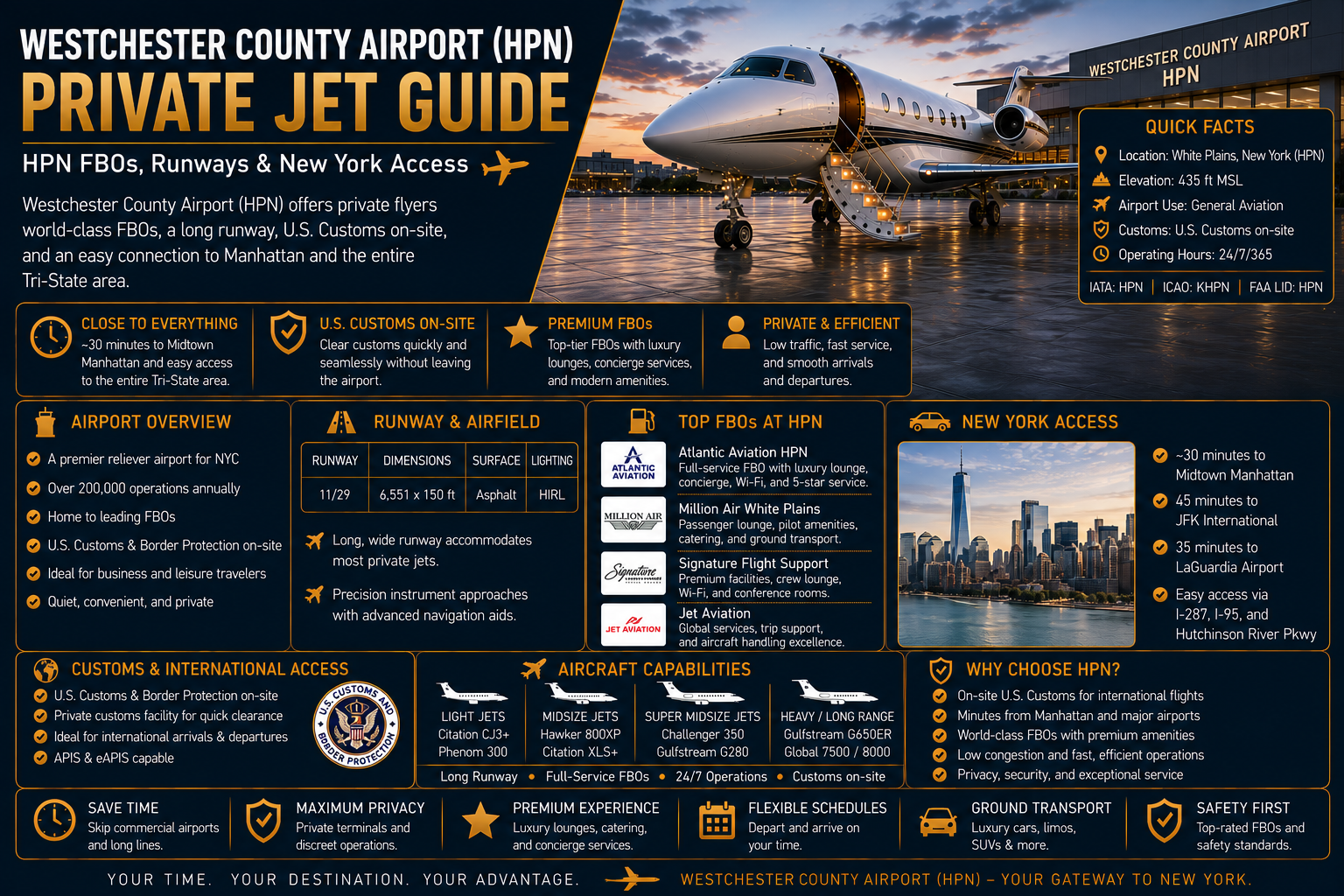
Westchester County Airport Private Jet Guide: HPN FBOs, Runways & New York Access
Westchester County Airport is one of the New York metropolitan area’s most strategically positioned private and business aviation airports, combining two runways, substantial FBO infrastructure and exceptional access to White Plains, Purchase, Greenwich, Stamford and southwestern Connecticut. For many travelers north and east of New York City, HPN can provide a stronger door-to-door itinerary than automatically using Teterboro.
Westchester County Airport uses the airport identifier HPN and the ICAO identifier KHPN.
However, the real importance of HPN is not its airport code.
Instead, its value comes from geography.
The New York metropolitan area contains several important private aviation airports.
Yet those airports sit on very different sides of one of the most congested urban regions in the United States.
Therefore, the airport that works best for Manhattan does not automatically work best for Greenwich.
Likewise, the airport that works best for northern New Jersey does not automatically work best for Westchester County.
Consequently, private aviation airport selection should begin with the passenger’s exact ground destination.
HPN sits in White Plains, New York, immediately beside the Connecticut border.
Therefore, the airport occupies a particularly strong position for Westchester County and southwestern Connecticut.
Greenwich is one of the clearest examples.
Although Greenwich sits within the broader New York economic ecosystem, geographically it lies northeast of Manhattan.
Consequently, flying a Greenwich-bound passenger to an airport west of Manhattan can create unnecessary ground travel.
HPN places the aircraft on the same side of the metropolitan area as the passenger’s destination.
Therefore, ground geography can create a substantial time advantage.
That same principle applies to Stamford.
Stamford is a major corporate and financial center in Fairfield County.
Therefore, executives traveling there should evaluate HPN rather than assuming that the New York private aviation decision begins and ends with Teterboro.
White Plains and Purchase create another important HPN demand profile.
Westchester County contains major corporations, investment firms, professional-service companies and affluent residential communities.
Consequently, business aviation at HPN serves both visiting executives and locally based private aircraft users.
Family offices represent another major traveler category.
A principal living in Greenwich, Bedford, Rye or another surrounding community may use private aviation frequently.
Therefore, airport proximity can compound across dozens of annual missions.
Saving ground time once may be useful.
Saving it repeatedly throughout the year can become a meaningful productivity advantage.
HPN can also serve Manhattan travelers.
However, that decision requires more nuance.
Teterboro remains one of the most important business aviation airports serving New York City.
Its position in northern New Jersey often provides strong access to Manhattan.
Therefore, HPN should not simply be presented as universally better.
Instead, the passenger’s exact address should determine which airport provides the stronger ground itinerary.
A traveler heading to northern Manhattan or continuing into Westchester may find HPN increasingly attractive.
Meanwhile, another traveler heading directly to Midtown may prefer Teterboro.
Consequently, HPN versus Teterboro is a door-to-door comparison rather than an airport-ranking contest.
The same principle applies on departure.
A traveler may arrive through one New York-area airport and leave through another.
For example, the passenger could arrive for meetings in Greenwich and later finish the trip in Manhattan.
Therefore, the airport closest to the final meeting may provide the strongest departure plan.
Private aviation allows each leg to be optimized independently.
This flexibility becomes especially valuable in New York because ground congestion can vary dramatically.
Westchester County Airport itself is a multi-use airport.
Therefore, private aviation shares the airport with commercial passenger and other general aviation activity.
However, HPN maintains a substantial business aviation ecosystem.
Private passengers can use FBO facilities rather than relying on the commercial terminal experience.
Consequently, a private jet mission can remain distinct from the scheduled-airline passenger process even though both use the same airport.
The airport currently operates two paved runways.
Runway 16/34 is the primary longer runway and measures approximately 6,549 feet.
Runway 11/29 is substantially shorter.
Therefore, the two runways should not be treated as operationally identical.
The primary runway can support a broad business aviation fleet.
However, aircraft capability always depends on the exact aircraft and mission.
For example, a large-cabin jet departing HPN for a short regional flight may carry relatively little fuel.
The same aircraft departing for a long-range mission may require substantially more fuel.
Fuel adds weight.
Therefore, route distance changes the aircraft-performance problem.
Consequently, saying that an aircraft type “uses HPN” does not establish that every mission works identically.
Light jets can naturally fit many HPN missions.
Midsize aircraft can add cabin and range capability.
Super-midsize jets can provide stand-up cabin comfort for longer domestic trips.
Meanwhile, many large-cabin business aircraft can use HPN when actual performance and airport requirements support the mission.
Therefore, HPN can serve a broad spectrum of private aviation travelers.
Aircraft selection should still begin with the actual passenger mission.
A two-person executive trip to Washington requires very different capability from a family-office flight to South Florida.
Likewise, a transcontinental mission to Los Angeles creates different fuel and cabin requirements.
Consequently, HPN aircraft planning should scale with route, passengers and baggage rather than status or aircraft size alone.
The FBO environment strengthens HPN’s private aviation role further.
Multiple business aviation facilities operate at the airport.
Signature Aviation maintains both East and West operations at Westchester County Airport.
Million Air also operates a major HPN facility.
Therefore, operators have multiple private aviation handling options within the airport.
That matters because FBO selection affects more than lounge appearance.
Fuel relationships can influence the operator’s preferred facility.
Parking can matter.
Hangar requirements can matter.
Passenger transportation can matter.
Additionally, aircraft handling and crew services can influence the decision.
Consequently, the best FBO is the one that supports the complete aircraft and passenger mission.
Westchester’s proximity to New York airspace also creates an important operational consideration.
The FAA describes HPN as a medium-sized multi-use airport within the broader New York metropolitan airspace environment.
Therefore, private aircraft remain connected to regional ATC flows even though passengers avoid major commercial terminals.
Weather or traffic-management initiatives can influence routing and timing.
Consequently, private aviation should not be confused with complete immunity from metropolitan airspace congestion.
However, airport selection can still remove substantial passenger friction.
A Greenwich traveler landing at HPN avoids an unnecessary trip across the metropolitan region.
That advantage exists even when both candidate airports experience similar airborne traffic conditions.
Therefore, ground geography remains one of the most controllable parts of the itinerary.
Noise is another important HPN topic.
Westchester County Airport operates within a developed residential environment.
Therefore, community noise has long been an important airport issue.
Private aviation users should follow current airport procedures and noise-abatement guidance.
Additionally, operators should verify current restrictions before planning late-night or noise-sensitive operations.
This becomes particularly important for family-office travelers who value schedule flexibility.
The aircraft may be able to fly at the preferred time.
However, airport-specific operating procedures can still affect the mission.
Consequently, return-flight timing should be planned before the trip begins.
Aircraft parking can also affect flexibility.
HPN has substantial private aviation infrastructure.
However, peak travel periods can still create ramp and hangar pressure.
Therefore, an aircraft may not always remain exactly where passengers expect.
A charter aircraft can also continue to another mission after dropping passengers.
Consequently, travelers should understand whether their aircraft will remain at HPN.
This matters most when schedules can change.
A principal who wants to depart several hours early may expect the aircraft to be immediately available.
However, a repositioned aircraft may need time to return.
Crew duty can also become a factor.
Therefore, aircraft position and crew availability should be part of the return-flight discussion.
Winter operations introduce another consideration.
Westchester does not create Aspen-style mountain performance problems.
However, Northeast winter weather can still affect private aviation.
Snow, ice and freezing precipitation can require deicing.
Runway conditions can change.
Additionally, weather across the broader New York airspace can create delays.
Consequently, winter HPN missions should preserve appropriate time and operational flexibility.
South Florida travel represents one of HPN’s strongest leisure and seasonal mission profiles.
Westchester, Greenwich and Fairfield County contain large concentrations of households that regularly travel to Palm Beach, Boca Raton, Naples and South Florida.
Therefore, HPN can become the northern endpoint of a recurring private aviation corridor.
The correct Florida airport then becomes another geography decision.
A passenger going to Palm Beach should evaluate Palm Beach-area airports.
A Boca Raton traveler should evaluate Boca Raton access.
Meanwhile, a Miami traveler may prefer Opa-locka or another appropriate South Florida airport.
Consequently, the same door-to-door methodology should be applied at both ends of the flight.
Washington, Boston and other Northeast markets create shorter executive missions.
Therefore, light and midsize aircraft can become highly efficient.
On these routes, airport access often matters more than extreme aircraft range.
Meanwhile, Los Angeles and other transcontinental markets place more emphasis on cabin comfort and fuel.
Consequently, aircraft selection should change with mission length.
HPN also creates valuable airport-comparison content for the broader private aviation hub.
Teterboro represents the Manhattan and northern New Jersey business aviation comparison.
Westchester represents the Westchester and Connecticut side of the New York market.
Van Nuys provides a comparable lesson in Los Angeles, where airport geography can outperform reliance on a major commercial airport.
Scottsdale demonstrates a destination-driven executive aviation market.
Aspen demonstrates how runway, elevation and terrain can alter aircraft choice.
Therefore, the airport hub increasingly becomes a private aviation decision system rather than a simple directory.
That structure is important for SEO and AI-search authority.
A private aviation buyer may not initially search for a charter company.
Instead, the buyer may ask which airport is closest to Greenwich.
Another may ask whether HPN or Teterboro is better for Manhattan.
Another may ask which jets can use Westchester County Airport.
Consequently, airport-intelligence content reaches the traveler earlier in the decision process.
The HPN page should therefore answer the entire airport question.
It should explain runway capability, FBO choices, geography, aircraft planning, parking, noise, weather, ground transportation, popular routes and airport comparisons.
Additionally, it should connect those facts to actual passenger decisions.
Therefore, the page becomes useful to charter buyers, aircraft owners, family offices, executives and aviation operators rather than simply repeating airport specifications.
This guide examines that complete Westchester private aviation system.
It covers HPN runways, private aviation facilities, aircraft selection, Greenwich access, Stamford access, Manhattan strategy, Teterboro comparisons, parking, noise, winter operations, ground transportation, popular routes and family-office travel.
Most importantly, it explains why New York private aviation airport selection should begin with the passenger’s actual destination rather than the airport with the most familiar name.
Direct HPN Airport Answer
Is Westchester County Airport Good for Private Jets?
Direct Answer: Yes. Westchester County Airport is one of the New York region’s most important business aviation airports, combining two runways, multiple private aviation facilities and exceptional access to Westchester County and southwestern Connecticut. HPN is particularly strong for Greenwich, White Plains, Purchase and Stamford travelers who want to minimize ground travel.
Westchester County Airport solves a geography problem that is easy to miss when travelers think only in terms of New York City.
The New York metropolitan area extends far beyond Manhattan.
Therefore, a private aviation traveler should not automatically use the airport most closely associated with Manhattan.
Instead, the final ground destination should determine the airport comparison.
Airport Flexibility
HPN operates a primary business aviation runway plus a shorter secondary runway, providing more airfield flexibility than a single-runway airport.
Connecticut Access
The airport sits directly beside the Connecticut border, making HPN especially valuable for Greenwich travelers.
Westchester Business Access
HPN provides direct access to White Plains, Purchase and surrounding Westchester corporate markets.
Financial + Corporate Travel
Southwestern Connecticut executives can use HPN without routing through Manhattan or northern New Jersey.
Business Aviation Infrastructure
Multiple private aviation facilities support aircraft, passengers and crews at HPN.
New York Alternative
HPN can also serve Manhattan travelers when northern geography, traffic or the broader itinerary favors Westchester.
What Is HPN’s Biggest Private Aviation Advantage?
Its strongest advantage is location.
Private aviation creates value by reducing total travel friction.
Therefore, placing the aircraft near the passenger’s actual destination can be more valuable than selecting the region’s most recognized business aviation airport.
For Greenwich and much of Westchester, that geography strongly favors HPN.
What Is the Biggest HPN Planning Mistake?
The biggest mistake is treating HPN as simply a secondary Manhattan airport.
It serves a much broader regional market.
Therefore, the airport should be evaluated on its own strengths for Westchester and Connecticut rather than only against Teterboro.
HPN’s biggest advantage appears after the aircraft lands.
For Greenwich, White Plains, Purchase, Stamford and nearby communities, Westchester County Airport can put the passenger on the correct side of the New York metropolitan area from the beginning.
Westchester Private Aviation
Why Do Private Jet Travelers Use Westchester County Airport?
Direct Answer: Private jet travelers use HPN because it combines substantial business aviation infrastructure with direct access to Westchester County, Greenwich, Stamford and southwestern Connecticut. It can also serve New York City. Therefore, HPN is particularly valuable when the passenger’s destination lies north or east of Manhattan rather than in northern New Jersey.
Airport selection should follow passenger geography.
Therefore, HPN becomes particularly strong when the destination lies within its natural ground-access market.
Greenwich
HPN provides exceptionally direct airport geography for one of the country’s most concentrated private-wealth markets.
White Plains
Executives can access Westchester’s major corporate center without first traveling through New York City.
Purchase
Corporate campuses and affluent residential areas sit close to the airport.
Stamford
HPN can efficiently serve Stamford’s finance, corporate and executive market.
Family Offices
Principals based throughout Westchester and Fairfield County can use HPN as a recurring private aviation gateway.
Manhattan
HPN remains a viable New York City airport when the passenger’s exact ground itinerary supports a northern approach.
Why Not Automatically Use Teterboro?
Teterboro is an exceptional business aviation airport.
However, it sits in northern New Jersey.
Therefore, passengers heading east or northeast of Manhattan can create substantial additional ground travel by using it automatically.
Consequently, HPN and Teterboro should be compared around the actual passenger address.
Why Is This Especially Important for Frequent Private Flyers?
A single inefficient ground transfer may only cost a traveler part of an hour.
However, frequent flyers repeat that cost throughout the year.
Therefore, airport optimization can create substantial cumulative time savings for executives, family offices and aircraft owners.
The airport nearest Manhattan is not automatically the airport nearest the passenger.
HPN becomes especially powerful when the destination is Westchester County or southwestern Connecticut.
New York Business Aviation
What Role Does Westchester County Airport Play in New York Private Aviation?
Direct Answer: Westchester County Airport is a multi-use airport supporting commercial passenger service, general aviation and substantial business aviation activity. For private travelers, HPN functions as the major executive aviation gateway for Westchester County and southwestern Connecticut while also providing another practical access point to the broader New York metropolitan market.
HPN differs from airports focused almost entirely on private and general aviation.
Commercial airline traffic also uses the field.
However, private aircraft operate through dedicated business aviation facilities.
Therefore, private passengers can maintain an FBO-based travel experience rather than relying on the commercial passenger terminal.
Private Jet Activity
Corporate, charter and privately operated aircraft form a major component of HPN’s aviation environment.
Airline Service
Scheduled commercial passenger operations share the airport with general and business aviation.
Westchester Business Market
HPN supports executives traveling to companies throughout White Plains, Purchase and surrounding communities.
Fairfield County Gateway
The airport’s eastern position gives it direct relevance to Greenwich and Stamford.
Private Wealth Travel
HPN provides a natural aviation gateway for affluent residential markets surrounding the airport.
Regional Alternative
The airport can complement Teterboro and other New York-area airports depending on passenger geography.
Does Commercial Airline Service Reduce HPN’s Private Aviation Value?
Not necessarily.
The two passenger systems operate differently.
Private aircraft passengers typically use FBO facilities rather than the commercial airline terminal.
Therefore, HPN can support both scheduled airline service and a substantial private aviation market.
Why Does the Airport’s Mixed Role Matter?
Because runway and airspace resources are shared.
Therefore, private aircraft still operate within the broader airport traffic environment.
However, the passenger experience remains far more streamlined through an FBO.
HPN combines commercial-airport connectivity with a mature business aviation ecosystem.
That allows private travelers to use dedicated FBO infrastructure while remaining inside a major regional airport system.
HPN Quick Reference
What Should Private Jet Travelers Know About Westchester County Airport?
Direct Answer: Westchester County Airport uses the identifiers HPN and KHPN, sits near White Plains at approximately 399 feet above sea level and operates two paved runways. Runway 16/34 is the primary longer runway at approximately 6,549 feet, while Runway 11/29 provides a shorter secondary runway for applicable aircraft and conditions.
| Airport Detail | Westchester County Airport Information | Why It Matters |
|---|---|---|
| Airport | Westchester County Airport | Major regional commercial, general and business aviation airport |
| Airport Identifier | HPN | Primary domestic airport identifier |
| ICAO Identifier | KHPN | Used in operational flight planning |
| Location | White Plains / Westchester County, New York | Provides direct access to Westchester and southwestern Connecticut |
| Field Elevation | Approximately 399 feet MSL | Low-elevation environment compared with mountain airports such as Aspen |
| Primary Runway | Runway 16/34 | Main runway supporting substantial business aviation activity |
| Primary Runway Length | Approximately 6,549 feet | Supports a broad range of business aircraft when mission conditions allow |
| Secondary Runway | Runway 11/29 | Provides a second runway orientation for applicable aircraft |
| Airport Type | Multi-use airport | Private aviation shares the airport with commercial passenger operations |
| Private Aviation Facilities | Multiple FBO operations | Provides aircraft owners, charter operators and passengers with handling choices |
| Core Private Aviation Market | Westchester County + southwestern Connecticut | HPN’s strongest advantage is ground geography |
| Major Comparison Airport | Teterboro Airport | The stronger airport changes according to the passenger’s exact New York-area destination |
What Is the Most Important HPN Fact for a Private Jet Traveler?
The location.
Runway capability and FBO infrastructure matter operationally.
However, the passenger usually experiences the greatest benefit through reduced ground transportation.
Therefore, HPN should be evaluated first as a destination-access airport.
HPN’s specifications make the airport capable. Its geography makes the airport strategically important.
For Westchester and southwestern Connecticut, the runway can put private passengers much closer to where they actually need to be.
HPN Airfield
What Runways Does Westchester County Airport Have?
Direct Answer: HPN operates two paved runways. Runway 16/34 is the primary longer runway at approximately 6,549 feet, while Runway 11/29 is substantially shorter. Therefore, the airport has valuable multi-runway flexibility, but the two runways do not provide identical capability for every private aircraft.
Two runways give HPN a different operating profile from airports that depend on a single runway.
However, runway count alone can be misleading.
The runways have different lengths.
Therefore, aircraft compatibility changes according to which runway is available and appropriate.
Primary Runway
Runway 16/34 provides approximately 6,549 feet of runway and serves as HPN’s principal business aviation runway.
Secondary Runway
The shorter secondary runway provides another orientation for applicable aircraft and operating conditions.
Operational Flexibility
Multiple runway orientations can provide additional options as wind and airport conditions change.
Is 6,549 Feet Enough for Large Private Jets?
Many large business aircraft can use HPN’s primary runway under suitable conditions.
However, aircraft category alone cannot establish the answer.
The exact aircraft model matters.
Operating weight matters.
Weather and runway condition matter.
Additionally, route distance affects required fuel.
Consequently, operators must calculate the actual mission.
Why Is the Secondary Runway Useful?
A second runway provides another orientation.
Therefore, it can add flexibility when wind or operational conditions support its use.
However, its shorter length means some aircraft may require the primary runway.
Consequently, two-runway flexibility should not be confused with identical runway capability.
HPN has two runways, but private jet capability still depends heavily on Runway 16/34.
The aircraft, weight, weather and mission determine how much of HPN’s runway system is actually useful for a specific flight.
HPN Aircraft Strategy
Which Types of Private Jets Can Use Westchester County Airport?
Direct Answer: HPN supports a broad private aviation fleet, including turboprops, light jets, midsize jets, super-midsize aircraft and many large-cabin business jets. However, the exact aircraft, operating weight, runway, weather and route determine mission suitability. Therefore, the specific jet should always be evaluated rather than relying only on aircraft category.
Westchester’s primary runway gives the airport significant business aviation capability.
Therefore, travelers can select from a wide range of aircraft categories.
However, the ideal aircraft should solve the passenger mission without adding unnecessary size or cost.
Turboprops
Efficient turboprops can serve short Northeast missions when passenger requirements support the category.
Short Domestic Missions
Light jets can efficiently connect HPN with many East Coast and regional destinations.
Cabin + Range
Midsize aircraft add cabin comfort and longer domestic capability while remaining efficient for moderate groups.
Longer Domestic Travel
Super-midsize aircraft can provide stand-up cabins and strong range for transcontinental and longer domestic missions.
Premium Long-Range Missions
Many large business aircraft can operate at HPN when runway performance and operating requirements support the mission.
Heavy Aircraft
Heavier aircraft require aircraft-specific evaluation and may involve additional airport coordination depending on current requirements.
Why Does Route Distance Affect HPN Aircraft Capability?
Longer routes usually require more fuel.
Fuel adds weight.
Therefore, the same aircraft can create a different runway-performance problem depending on destination.
A short flight to Washington can require much less fuel than a transcontinental departure to Los Angeles.
Consequently, aircraft capability should always be evaluated against the route.
Should Travelers Automatically Choose a Large-Cabin Aircraft?
No.
A larger cabin can provide more comfort and baggage capacity.
However, the aircraft may also cost more and require greater runway performance.
Therefore, additional size should solve an actual passenger requirement.
The best HPN aircraft is the one that solves the passenger mission with the right balance of cabin, range, baggage and runway performance.
Aircraft size should follow the trip rather than define it.
HPN Private Aviation Infrastructure
Which FBOs Serve Private Jets at Westchester County Airport?
Direct Answer: Westchester County Airport has multiple business aviation handling options. Current private aviation facilities include Signature Aviation operations on both the East and West sides of HPN and Million Air White Plains. Therefore, operators can compare handling, parking, fuel, passenger services and aircraft requirements within the same airport.
Multiple FBO options strengthen HPN’s role as a major business aviation airport.
However, FBO choice should be mission-driven.
Signature Aviation East
Signature operates private and general aviation ground handling and aircraft fueling from its East HPN facility.
Signature Aviation West
Signature also maintains a West terminal operation, creating another handling option within the airport.
Million Air White Plains
Million Air operates a full-service private aviation facility at Westchester County Airport.
Why Does Having Multiple FBOs Matter?
Aircraft operators can have existing fuel and handling relationships.
Parking availability can differ.
Passenger service preferences can differ.
Additionally, crew requirements can influence facility choice.
Therefore, FBO selection affects the complete mission rather than merely the terminal interior.
Should the Passenger Pick the FBO?
Not necessarily.
The operator may already have a preferred facility.
However, passengers should communicate unusual transportation, security, privacy or baggage requirements before arrival.
Consequently, the selected FBO can prepare for the actual mission.
At HPN, airport choice gets the passenger close to the destination. FBO choice determines how smoothly the final airport transition happens.
Both decisions should support the same door-to-door itinerary.
Greenwich Private Aviation
Is HPN the Best Private Jet Airport for Greenwich, Connecticut?
Direct Answer: HPN is generally one of the strongest private jet airport choices for Greenwich because Westchester County Airport sits immediately west of the Connecticut border. That geography can produce a substantially shorter ground journey than using an airport across the New York metropolitan region, especially for Greenwich residences, family offices and financial firms.
Greenwich should be treated as its own private aviation destination.
Although the community is economically connected to New York City, its physical geography is different.
Therefore, a Manhattan-oriented airport strategy can create unnecessary travel for a Greenwich passenger.
Private Residences
HPN provides convenient aviation access for Greenwich households and their guests.
Family Offices
Principals can connect Greenwich directly with business and leisure destinations without first traveling toward Manhattan.
Investment Firms
Greenwich’s financial market creates substantial executive aviation demand.
South Florida Travel
HPN can support recurring seasonal travel between Greenwich and major Florida wealth markets.
Business Travel
Executives can arrive near Greenwich without routing through New York City first.
Weekend Missions
Private aircraft can connect Greenwich with leisure destinations while avoiding commercial airport friction.
Why Can HPN Beat Teterboro for Greenwich?
The airport is already on the correct side of the metropolitan area.
Therefore, passengers can avoid traveling from northern New Jersey across the region after landing.
The exact time advantage changes with traffic and the destination address.
However, the underlying geography strongly favors HPN for many Greenwich trips.
For Greenwich private aviation, HPN should usually be evaluated before the aircraft is even selected.
The airport’s geographic advantage can shape the entire aircraft, ground-transportation and scheduling strategy.
Stamford Corporate Aviation
Is Westchester County Airport Good for Private Jet Travel to Stamford?
Direct Answer: Yes. HPN is a strong private aviation airport for Stamford because the airport sits just west of Fairfield County and avoids forcing passengers through Manhattan or northern New Jersey. Therefore, executives, investors and corporate travelers can use Westchester County Airport as a practical aviation gateway to Stamford.
Stamford is one of the Northeast’s major corporate centers.
Therefore, private aviation demand includes both locally based executives and visiting business travelers.
Financial Services
HPN provides a practical airport for executives traveling to Stamford’s finance and investment sector.
Corporate Headquarters
Business aviation can connect executives directly with Stamford-area companies.
Multi-Meeting Trips
Travelers can combine Greenwich, Stamford and Westchester meetings within one regional ground itinerary.
Why Can HPN Be Better Than Flying Into New York City First?
Because Stamford is already northeast of New York City.
Therefore, routing through a Manhattan-oriented airport can add unnecessary ground movement.
HPN allows the passenger to arrive much closer to the business market being visited.
Consequently, total productive time can improve even when flight time remains virtually unchanged.
Southwestern Connecticut
How Does HPN Serve Fairfield County Private Jet Travelers?
Direct Answer: HPN provides strong private aviation access to southwestern Fairfield County, particularly Greenwich and Stamford. It can also serve New Canaan, Darien, Norwalk and other nearby communities. However, the farther northeast the passenger travels, the more important it becomes to compare HPN with other regional airport options.
Airport advantage is not binary.
Instead, it changes as the passenger moves across the map.
| Fairfield County Market | HPN Fit | Primary Planning Consideration |
|---|---|---|
| Greenwich | Exceptionally strong | Immediate proximity to the Connecticut border |
| Stamford | Strong | Corporate and residential ground access |
| New Canaan | Strong regional option | Exact destination and traffic |
| Darien | Practical regional option | Compare total road time |
| Norwalk | Useful | Broader regional comparison increasingly matters |
| Farther Northeast | Mission dependent | Compare HPN with other practical Connecticut airports |
Why Should the Comparison Change Farther Into Connecticut?
The geographic advantage of HPN decreases as the passenger travels farther away from the airport.
Therefore, another regional airport can eventually create a better ground itinerary.
Consequently, private aviation airport selection should remain destination-specific rather than relying on one preferred field for an entire state.
New York City Access
Can Private Jet Travelers Use HPN for Manhattan?
Direct Answer: Yes. Westchester County Airport can serve Manhattan private jet travelers, particularly when the passenger’s destination lies in northern Manhattan or the broader itinerary includes Westchester or Connecticut. However, Teterboro frequently provides stronger Midtown geography, so the exact address, traffic period and trip sequence should determine the airport.
Manhattan should not automatically be treated as one ground destination.
Different neighborhoods can create different airport decisions.
Therefore, a blanket HPN-versus-Teterboro rule loses useful precision.
When Does HPN Become More Attractive?
HPN becomes increasingly relevant when the traveler is heading north.
Additionally, a trip involving Westchester or Connecticut can favor HPN even when Manhattan appears elsewhere on the itinerary.
Therefore, the full sequence of meetings and destinations should be considered.
Can Arrival and Departure Use Different Airports?
Yes.
Private aviation does not require both legs to use the same airport.
Therefore, a passenger could arrive through HPN for meetings in Greenwich and later depart through Teterboro after finishing in Manhattan.
Consequently, each leg can be optimized independently.
In New York private aviation, the best arrival airport and the best departure airport do not always have to be the same airport.
Optimize each leg around where the passenger actually is.
New York Airport Strategy
Westchester County Airport vs. Teterboro: Which Is Better for Private Jets?
Direct Answer: HPN is generally stronger for Westchester County, Greenwich, Stamford and southwestern Connecticut, while Teterboro often provides better geography for Midtown Manhattan and northern New Jersey. However, traffic, aircraft requirements, parking and the passenger’s exact destination can change the answer. Therefore, compare total door-to-door travel time.
| Destination | HPN | Teterboro |
|---|---|---|
| Greenwich | Strong geographic advantage | Substantially farther west |
| Stamford | Strong option | Generally less direct |
| White Plains | Natural airport choice | Requires additional regional ground travel |
| Purchase | Natural airport choice | Less direct |
| Northern Westchester | Strong advantage | Generally creates more ground distance |
| Midtown Manhattan | Viable depending on itinerary | Frequently stronger geography |
| Northern New Jersey | Generally weaker geography | Strong advantage |
| Southwestern Connecticut | Strong advantage | Generally less direct |
Which Airport Should a Greenwich Family Office Use?
HPN should generally receive very strong consideration because of geography.
However, the exact aircraft, schedule and broader itinerary still matter.
Therefore, the decision should not become an absolute rule.
Which Airport Should a Midtown Executive Use?
Teterboro may provide stronger ground geography for many Midtown missions.
However, traffic can vary significantly.
Additionally, the passenger may have other meetings outside Manhattan.
Consequently, the complete day should determine the airport rather than the first appointment alone.
HPN vs. Teterboro is not about which airport is better. It is about which side of New York the passenger needs to be on.
That geographic distinction can save more door-to-door time than changing aircraft categories.
Operational Verification
Where Should Current HPN Airport Information Be Verified?
Airport procedures, runway conditions, FBO services, aircraft restrictions, NOTAMs and New York airspace conditions can change.
Therefore, this guide should support private aviation research rather than replace operational flight-planning resources.
The FAA maintains current Westchester County Airport flight-deck and airport information for HPN.
Additionally, individual FBO operators publish current facility and handling information for their Westchester locations.
Next: HPN Ground + Operational Planning
What Else Should Private Jet Travelers Know Before Using Westchester County Airport?
Direct Answer: Part 2 examines the operational side of HPN, including detailed FBO strategy, ground transportation, aircraft parking, hangars, nighttime operations, noise procedures, New York airspace, peak-demand periods, winter weather and deicing. These factors determine how efficiently Westchester County Airport works after the airport itself has been selected.
HPN’s location can solve the passenger geography problem.
However, the aircraft still needs an operational plan.
Therefore, Part 2 moves from airport selection into the details that determine aircraft and passenger execution.
HPN Private Terminal Strategy
How Should Private Jet Travelers Choose an FBO at Westchester County Airport?
Direct Answer: The best HPN FBO depends on aircraft handling requirements, parking availability, fuel arrangements, operator relationships, passenger preferences and ground transportation. Therefore, travelers should not choose an FBO based only on the passenger lounge. The strongest choice is the facility that supports the complete aircraft and passenger mission.
Private passengers often experience the FBO as the airport.
However, the aircraft operator sees a much larger operational system.
Therefore, the facility that appears most attractive to a passenger is not automatically the facility that makes the most sense for the aircraft.
Fuel arrangements can influence the decision.
Additionally, parking and hangar availability can matter.
Ground transportation requirements can also change the preferred location.
Meanwhile, operators may maintain established relationships with specific handling providers.
Consequently, FBO selection should combine passenger experience with aircraft logistics.
Terminal Experience
Private lounges, vehicle coordination, baggage handling and discreet passenger movement shape the traveler experience.
Ramp Handling
The operator must consider aircraft servicing, ramp space and handling requirements rather than passenger amenities alone.
Fuel Arrangements
Contract fuel programs and operator relationships can influence both cost and preferred handling location.
Aircraft Position
Parking availability can determine whether the aircraft remains at HPN or repositions after dropping passengers.
Vehicle Coordination
The FBO can coordinate passenger vehicles around the exact Greenwich, Westchester, Connecticut or New York City itinerary.
Flight Department Support
Crew transportation, rest requirements and aircraft servicing can influence the operator’s facility choice.
Should Charter Buyers Request a Specific HPN FBO?
They can.
However, passengers should understand why the operator recommends another facility before insisting on a change.
For example, the operator may have a fuel agreement at one FBO.
Likewise, aircraft parking may be available at one facility but constrained at another.
Therefore, the operator’s recommendation may improve the overall mission.
Choose the FBO around the mission, not the lobby.
The best private terminal is the one that keeps the aircraft, passengers, vehicles and crew moving efficiently together.
HPN FBO
What Should Travelers Know About Signature Aviation East at HPN?
Direct Answer: Signature Aviation operates an East facility at Westchester County Airport that supports private and general aviation aircraft with passenger, fueling and ground-handling services. For a specific trip, however, operators should verify current services, parking and handling requirements directly with the facility before arrival.
Signature Aviation’s presence gives HPN users access to a major global business aviation service network.
Therefore, flight departments that already work with Signature at other airports may have established operating relationships that extend to Westchester.
However, brand familiarity should not replace mission planning.
Parking demand can change.
Additionally, aircraft requirements can vary considerably.
Consequently, the operator should coordinate the exact arrival before departure.
Passenger Arrival
Private passengers can transition from aircraft to ground transportation through an FBO environment rather than the commercial airline terminal.
Aircraft Services
Flight crews can coordinate fueling and other ground-handling requirements around the mission.
Ground Transportation
Passenger vehicles can be coordinated for destinations throughout Westchester, Connecticut and New York City.
Who Should Decide Whether Signature East Fits the Mission?
The operator should generally lead the operational decision.
However, passengers should communicate any unusual privacy, vehicle, security or baggage requirements.
Therefore, both sides contribute to the final facility plan.
HPN FBO
What Should Travelers Know About Signature Aviation West at HPN?
Direct Answer: Signature Aviation also operates a West facility at Westchester County Airport, giving business aviation operators another Signature handling option at HPN. Therefore, aircraft operators can evaluate the East and West operations according to current parking, servicing, passenger and operational requirements.
Having more than one facility from the same FBO network creates additional operational choices.
However, passengers should not assume that East and West are interchangeable for every mission.
The aircraft’s handling plan matters.
Parking matters.
Additionally, vehicle positioning and operator preference can matter.
Therefore, the final location should be confirmed before passengers or drivers head to the airport.
Why Should Ground Drivers Know the Exact HPN Facility?
Because “Westchester County Airport” alone does not identify the passenger pickup point.
Private aircraft use dedicated aviation facilities.
Therefore, the driver needs the exact FBO and location.
Otherwise, a passenger can save time by flying privately and then lose part of that advantage through an avoidable ground-transportation mistake.
Never send a private-car driver only the airport code HPN.
Provide the exact FBO, arrival information and passenger contact protocol before the aircraft lands.
HPN FBO
What Should Travelers Know About Million Air White Plains?
Direct Answer: Million Air White Plains provides another full-service business aviation option at Westchester County Airport. Therefore, private aircraft operators and passengers can compare Million Air with HPN’s other facilities according to aircraft handling, parking, passenger-service and ground-transportation requirements.
Competition among FBO providers can benefit private aviation users because operators have more than one facility to evaluate.
However, the best option can change from one trip to another.
For example, parking may be more important on a multi-day stay.
Meanwhile, another mission may prioritize rapid passenger transfer and immediate aircraft departure.
Therefore, the FBO decision should reflect what happens after arrival.
Drop-and-Go Mission
The aircraft may unload passengers and continue elsewhere rather than remain at HPN.
Multi-Day Stay
Parking, hangar requirements and crew planning become more important when the aircraft remains in the region.
Flexible Departure
Passengers who may change departure time should understand where the aircraft and crew will be positioned.
Should FBO Choice Be Finalized Before the Flight?
Yes.
The crew needs a defined handling destination.
Additionally, passenger transportation should be routed to the same facility.
Therefore, confirming the FBO before departure reduces unnecessary coordination after landing.
HPN Facility Comparison
How Should HPN FBO Options Be Compared?
Direct Answer: Compare HPN FBOs by current aircraft parking, hangar availability, fuel arrangements, handling capability, operator preference, passenger requirements and vehicle coordination. Because availability and services can change, the strongest facility for one flight may not be the strongest facility for another.
| Decision Factor | Why It Matters | What to Confirm |
|---|---|---|
| Aircraft Handling | Aircraft size and mission requirements can affect facility suitability. | Confirm the FBO can support the exact aircraft and operation. |
| Parking | Ramp availability can become constrained during high-demand periods. | Determine whether the aircraft can remain at HPN. |
| Hangar | Weather or owner preference may make indoor storage valuable. | Verify current hangar availability rather than assuming space exists. |
| Fuel | Operator fuel programs can influence cost and facility choice. | Review the operator’s existing fuel arrangement. |
| Passenger Services | Privacy, baggage and special requests can affect the arrival experience. | Communicate unusual requirements before arrival. |
| Ground Transportation | A vehicle arriving at the wrong facility creates unnecessary delay. | Give the driver the exact FBO rather than only “HPN.” |
| Crew Requirements | Crew rest and transportation affect return-flight flexibility. | Understand where the crew will remain during the passenger stay. |
There is no universally best HPN FBO.
The best facility is the one that supports the aircraft, passenger and return-flight plan for that specific mission.
Door-to-Door Planning
How Should Ground Transportation Be Planned at Westchester County Airport?
Direct Answer: HPN ground transportation should be coordinated around the exact FBO, passenger destination, arrival time and expected regional traffic. Because the airport’s greatest advantage is its location, travelers should protect that advantage by positioning the vehicle correctly before arrival rather than arranging transportation only after landing.
Private aviation compresses airport time.
Therefore, ground transportation should be ready to continue that efficiency.
A passenger should not land at HPN and then begin solving the vehicle problem.
Instead, the car should already be integrated into the itinerary.
Confirm the FBO
The vehicle provider should know the exact private aviation facility rather than only the airport name.
Confirm the Address
The passenger’s exact final address determines whether HPN provides the strongest airport geography.
Account for Traffic
Regional road conditions can change the ground-time advantage throughout the day.
Coordinate the Driver
The driver should have the passenger name, FBO and appropriate arrival information before touchdown.
Protect Privacy
Family offices and executive teams can establish passenger-contact and vehicle protocols in advance.
Plan the Return
The return vehicle should be coordinated around the departure FBO and aircraft schedule.
Why Is Ground Transportation Part of Private Jet Planning?
Because passengers experience one journey rather than separate aviation and automotive trips.
Therefore, optimizing only the flight leaves part of the mission unfinished.
The strongest private aviation itinerary minimizes friction from the passenger’s starting point through the final destination.
HPN → Greenwich
How Should Ground Transportation From HPN to Greenwich Be Planned?
Direct Answer: HPN’s proximity to Greenwich makes prearranged private-car transportation particularly effective. The vehicle should be assigned to the exact FBO before touchdown and routed to the passenger’s specific Greenwich address. Because local traffic still varies, planners should use live road conditions rather than relying on one fixed transfer-time estimate.
Greenwich is close enough to HPN that the airport can create a powerful door-to-door advantage.
However, Greenwich itself contains multiple neighborhoods and destination patterns.
Therefore, planners should use the actual address rather than a generic city-center estimate.
Should the Driver Wait Before the Aircraft Lands?
For time-sensitive private aviation missions, pre-positioning can reduce passenger delay.
However, vehicle access and waiting procedures depend on the facility and current arrangements.
Therefore, the transportation provider should coordinate directly with the FBO when necessary.
Why Does This Matter for Family Offices?
Principals may value predictability as much as raw speed.
Therefore, a repeatable process can be more valuable than improvising each trip.
A family office can maintain preferred vehicle providers, passenger protocols and destination information for recurring HPN missions.
HPN → Manhattan
How Should Ground Transportation From HPN to Manhattan Be Planned?
Direct Answer: Manhattan-bound HPN travelers should compare expected road conditions, the exact Manhattan destination and alternative New York-area airports before finalizing the flight. HPN can work well for selected Manhattan missions, but Teterboro may provide better ground geography for others. Therefore, the airport decision should happen before the vehicle is booked.
Ground time into Manhattan can vary substantially.
Therefore, a fixed drive-time estimate can create false precision.
The time of day matters.
The Manhattan neighborhood matters.
Weather and road incidents can matter as well.
Consequently, travelers should compare likely ground conditions around the actual arrival period.
When Can HPN Still Make Sense for Manhattan?
HPN can become more attractive when the passenger is traveling to northern Manhattan.
Additionally, it can make sense when the broader itinerary includes Westchester or Connecticut.
Therefore, airport selection should optimize the entire trip rather than one isolated transfer.
For Manhattan missions, compare HPN and Teterboro before booking the aircraft—not after landing.
The passenger’s exact address and arrival period should drive the decision.
HPN Aircraft Logistics
How Does Private Jet Parking Work at Westchester County Airport?
Direct Answer: Private aircraft parking at HPN depends on current ramp capacity, aircraft size, FBO arrangements, length of stay and demand. Therefore, travelers should not assume the aircraft will remain at Westchester after drop-off. During constrained periods, an operator may need to reposition the aircraft and return later for departure.
Aircraft parking can directly affect passenger flexibility.
For example, a passenger may expect the jet to remain available throughout a two-day visit.
However, the aircraft may reposition if parking is constrained or another operational reason makes repositioning preferable.
Therefore, passengers who value schedule flexibility should ask where the aircraft will remain.
Same-FBO Parking
The aircraft remains positioned at the arrival facility when parking and operational conditions allow.
Airport Repositioning
The aircraft may move elsewhere on the field depending on handling and parking arrangements.
Off-Airport Repositioning
An aircraft may leave HPN after passenger drop-off and return before the scheduled departure.
Why Does Repositioning Matter to the Passenger?
Because an early departure request may no longer be immediate.
The aircraft may need to return to HPN first.
Additionally, crew duty and weather can affect the repositioning plan.
Therefore, travelers who expect schedule changes should discuss flexibility before booking.
“The aircraft is waiting for you” and “the aircraft can return for you” are not the same service condition.
Ask where the jet will be positioned if departure flexibility matters.
Aircraft Protection
Are Private Jet Hangars Available at Westchester County Airport?
Direct Answer: HPN has substantial business aviation infrastructure that includes hangar facilities, but availability depends on aircraft size, provider capacity, existing commitments and current demand. Therefore, operators that require indoor storage should arrange it in advance rather than assuming hangar space will be available upon arrival.
Hangar availability becomes especially valuable during severe or freezing weather.
Additionally, some aircraft owners prefer indoor storage for protection and security.
However, hangar capacity is finite.
Therefore, aircraft size can become a major consideration.
A facility may have available space without having appropriate space for every aircraft.
When Should Hangar Space Be Requested?
As early as practical when it is important to the mission.
Peak demand and weather can increase requests.
Therefore, waiting until arrival can reduce the available options.
Departure Planning
How Flexible Can an HPN Private Jet Return Flight Be?
Direct Answer: Return-flight flexibility depends on aircraft position, crew duty limits, airport procedures, weather, airspace conditions and the operator’s schedule. Therefore, travelers who expect their meeting or event to end early or late should communicate that possibility before booking so the operator can structure the mission around flexibility.
Private aviation provides schedule control.
However, it does not eliminate operational constraints.
The aircraft may be at HPN.
Alternatively, it may have repositioned.
The crew may also be approaching duty limitations.
Therefore, a large schedule change can create more complexity than a passenger expects.
Aircraft Position
An aircraft already at HPN can usually respond more quickly than one that must reposition back to Westchester.
Crew Duty
Pilot duty and rest requirements can limit how far a departure moves from the original schedule.
Airport + Airspace
Weather, airport conditions and New York traffic management can affect the revised departure.
How Should a Family Office Protect Departure Flexibility?
The planner should communicate the realistic schedule window before the mission is structured.
Therefore, the operator can consider aircraft position and crew planning from the beginning.
That approach is more effective than requesting a major change only after the original departure time has been established.
Community + Airport Operations
What Noise Considerations Affect Private Jets at Westchester County Airport?
Direct Answer: Noise is an important operating consideration at HPN because the airport is surrounded by developed communities and maintains noise-abatement programs and procedures. Therefore, private aircraft operators should review current airport guidance, applicable procedures and any time-sensitive restrictions before planning operations, particularly during nighttime periods.
HPN operates within a densely populated suburban environment.
Therefore, aircraft noise has a direct relationship with surrounding communities.
Noise-abatement procedures can influence how operators plan arrivals and departures.
Additionally, airport rules and voluntary procedures can evolve.
Consequently, current operational information should always override generalized planning assumptions.
Why Does Noise Matter to a Charter Buyer?
The passenger does not fly the aircraft.
However, noise-related procedures can still affect available scheduling and operating options.
Therefore, travelers planning very late or very early movements should confirm feasibility before structuring the rest of the itinerary.
Should Travelers Rely on an Old HPN Noise Rule They Have Heard Before?
No.
Airport procedures and operating requirements can change.
Therefore, the operator should verify current HPN information for the actual date of travel.
Schedule flexibility should be verified, not assumed.
For late-night or early-morning HPN missions, current airport procedures should be checked before the passenger commits to the itinerary.
Late-Night Flight Planning
Can Private Jets Operate at Westchester County Airport at Night?
Direct Answer: Nighttime HPN missions require careful review of current airport rules, noise procedures, aircraft requirements and operator planning. Travelers should not assume that a preferred late-night arrival or departure will operate exactly like a daytime flight. Therefore, the operator should verify the proposed schedule before the trip is finalized.
Private aviation is often purchased partly for schedule flexibility.
However, airport-specific requirements still apply.
Therefore, a passenger leaving a dinner, sporting event or late business meeting should communicate the expected timing in advance.
That allows the operator to evaluate HPN rather than discovering a schedule issue late in the mission.
What If the Passenger Expects a Very Late Return?
The operator should know that before departure on the outbound leg.
Additionally, an alternate New York-area airport may sometimes need consideration depending on current conditions and operating requirements.
Therefore, late-night flexibility should be built into the airport strategy rather than treated as an afterthought.
New York Metropolitan Airspace
How Does New York Airspace Affect Private Jet Flights at HPN?
Direct Answer: HPN operates within the complex New York metropolitan airspace system. Therefore, private aircraft can still encounter air traffic management, routing changes and weather-related delays even though passengers avoid commercial airline terminals. Private aviation reduces passenger-process friction, but it does not remove the aircraft from regional air traffic control.
This distinction is important.
Private aviation can eliminate airline check-in lines, large-terminal connections and fixed commercial schedules.
However, every aircraft still operates within controlled airspace.
Therefore, regional congestion can affect private and commercial flights alike.
Air Traffic Volume
The New York region contains several major commercial and business aviation airports operating within the same broader airspace system.
Weather
Thunderstorms, low ceilings, wind and winter systems can reduce regional capacity or alter routing.
Traffic Management
ATC initiatives can affect departure timing and routing during constrained periods.
Does This Eliminate the Advantage of Flying Privately?
No.
The passenger still gains control over airport choice, aircraft selection, departure scheduling and ground access.
Additionally, the passenger avoids much of the commercial-terminal process.
Therefore, private aviation retains substantial door-to-door advantages even when both aircraft operate within the same regional airspace.
High-Demand HPN Travel
When Can Private Aviation Demand Increase at HPN?
Direct Answer: HPN demand can increase around major holidays, seasonal travel periods, significant New York-area events and high-volume business travel days. During these periods, aircraft parking, crew logistics, charter availability and regional airspace congestion can become more important. Therefore, travelers should plan high-demand missions earlier than routine trips.
Demand affects more than charter price.
It can affect the entire operating environment.
Aircraft parking may tighten.
Preferred aircraft can become less available.
Crew resources can become more constrained.
Additionally, road and air traffic may increase simultaneously.
Consequently, peak-period planning should begin earlier.
Major Holidays
Thanksgiving, Christmas, New Year’s and other holiday periods can increase private travel demand.
South Florida Season
Seasonal travel between the Northeast and Florida can create recurring private aviation demand.
Major Events
Large New York-area business, sporting and cultural events can increase aircraft and ground-transportation demand.
What Should Travelers Secure First?
The aircraft and airport strategy should be established early.
Then, parking and ground transportation should be coordinated around that plan.
Therefore, the trip becomes one integrated system rather than several independent reservations.
HPN Weather Planning
How Can Weather Affect Private Jet Operations at Westchester County Airport?
Direct Answer: HPN operations can be affected by thunderstorms, low ceilings, wind, snow, freezing precipitation and broader New York-area weather systems. Therefore, weather can influence runway conditions, aircraft performance, deicing requirements and regional air traffic flow even when conditions at Westchester itself remain manageable.
Weather should be evaluated as a regional system rather than only at the departure runway.
A thunderstorm line elsewhere around New York can affect routing.
Likewise, winter weather can reduce capacity across multiple airports.
Therefore, HPN travelers should preserve flexibility when significant weather affects the region.
Thunderstorms
Convective weather can alter routing and reduce available airspace capacity.
Snow + Ice
Frozen precipitation can affect runway conditions and create aircraft deicing requirements.
Low Ceilings + Wind
Changing weather can affect runway selection, approach planning and airport capacity.
Should Travelers Build More Schedule Margin During Major Weather?
Yes.
A tightly constrained schedule provides fewer recovery options when regional weather changes.
Therefore, preserving flexibility can make the mission more resilient.
Cold-Weather Private Aviation
How Does Winter Weather Affect Private Jet Flights at HPN?
Direct Answer: Winter weather can affect HPN through snow, ice, freezing precipitation, contaminated runway conditions, aircraft deicing and broader New York-area traffic constraints. Therefore, winter private jet missions should allow additional operational margin and account for the possibility that aircraft preparation will take longer than during clear-weather operations.
Westchester does not create the same altitude and terrain challenges as a mountain airport.
However, winter still changes the mission.
Aircraft surfaces must be safe for departure.
Runway conditions must support the aircraft’s required performance.
Additionally, regional weather can affect routing and traffic flow.
Consequently, winter planning extends beyond simply checking whether snow is falling at HPN.
Why Can a Hangar Become More Valuable in Winter?
Indoor aircraft storage can protect the aircraft from direct exposure to precipitation and freezing conditions.
However, hangar availability cannot be assumed.
Therefore, operators that strongly prefer hangar storage should request it early.
Can Winter Weather Affect the Ground Trip Too?
Yes.
Road conditions can extend travel time between HPN and Westchester or Connecticut destinations.
Therefore, winter door-to-door planning should include both the aircraft and the vehicle.
Aircraft Winter Preparation
When Do Private Jets Need Deicing at Westchester County Airport?
Direct Answer: A private aircraft may require deicing when frost, snow, ice or freezing precipitation contaminates critical aircraft surfaces before departure. The flight crew determines whether deicing is required under the actual conditions. Therefore, passengers should expect additional preparation time during winter weather rather than pressuring the crew to accelerate a safety-critical process.
Clean aircraft surfaces are fundamental to safe flight.
Therefore, deicing is an operational requirement rather than an optional passenger service when conditions demand it.
The exact process depends on weather and aircraft condition.
Additionally, continued precipitation can create time-sensitive considerations after treatment.
Consequently, crews coordinate departure timing carefully.
Frost
Visible frost on critical surfaces can require treatment even when significant snow is not falling.
Snow
Snow accumulation can require aircraft treatment and additional ground preparation before departure.
Freezing Precipitation
Active freezing conditions can create more complex aircraft and departure-timing requirements.
How Should Passengers Plan Around Deicing?
Allow additional time.
More importantly, avoid structuring an itinerary around an unrealistically precise winter departure expectation.
Therefore, ground transportation and destination schedules should preserve some flexibility when freezing conditions are expected.
Private aviation can reduce waiting, but it cannot safely eliminate necessary aircraft preparation.
During winter operations, the fastest mission is the one planned realistically around weather from the beginning.
HPN Mission Intelligence
What Operational Questions Should Be Answered Before an HPN Private Jet Flight?
Direct Answer: Before an HPN mission, confirm the exact FBO, aircraft parking plan, ground transportation, passenger destination, return-flight flexibility, crew position, weather, airport procedures and current operational restrictions. These questions turn a basic aircraft booking into a complete door-to-door private aviation plan.
| Question | Why It Matters | Best Planning Response |
|---|---|---|
| Which FBO? | Determines aircraft handling and passenger pickup location. | Confirm the exact facility before departure. |
| Where will the aircraft park? | Affects return-flight flexibility. | Determine whether the aircraft remains at HPN or repositions. |
| Where is the passenger going? | Determines whether HPN is actually the best airport. | Compare the exact address against regional airport alternatives. |
| Who is meeting the aircraft? | Ground delays can erase part of the private aviation advantage. | Pre-position transportation at the correct FBO. |
| Could departure time change? | Aircraft position and crew duty can limit flexibility. | Communicate the realistic schedule window before booking. |
| Is late-night operation expected? | Current airport and noise procedures may affect the plan. | Verify the proposed timing with the operator. |
| Is significant weather expected? | Weather can affect runway conditions and regional airspace. | Preserve schedule and airport flexibility. |
| Could deicing be required? | Aircraft preparation can add time before departure. | Build realistic winter margin into the itinerary. |
What Is the Most Important Planning Principle?
Plan the mission as one continuous journey.
The aircraft, airport, FBO, vehicle, passenger schedule and return flight are interconnected.
Therefore, optimizing them separately can create avoidable friction.
Instead, each decision should support the passenger’s total door-to-door objective.
The goal is not simply to land at HPN.
The goal is to move the passenger from origin to final destination with the least practical friction while preserving the aircraft’s operational requirements.
Next: HPN Aircraft + Route Strategy
Which Aircraft and Routes Make the Most Sense From Westchester County Airport?
Direct Answer: Part 3 moves from airport operations into aircraft and mission selection. It compares light, midsize, super-midsize and large-cabin jets for HPN missions and examines major Westchester private aviation routes including South Florida, Washington, Boston, Chicago, Aspen and Los Angeles.
Once airport logistics are solved, the next decision is matching the aircraft to the route.
Therefore, Part 3 evaluates where additional range, cabin size and baggage capacity create real passenger value—and where they simply add unnecessary aircraft.
HPN Aircraft Strategy
Which Private Jet Is Best for Westchester County Airport?
Direct Answer: The best private jet for an HPN flight depends on route distance, passenger count, baggage, cabin expectations and aircraft performance rather than one universally superior aircraft type. Light and midsize jets can efficiently handle many regional missions, while super-midsize and large-cabin aircraft become more valuable for longer domestic and premium travel.
Private jet buyers sometimes begin with the aircraft.
However, the mission should come first.
Therefore, the first question should not be, “Which jet is best?”
Instead, travelers should ask what the aircraft needs to accomplish.
A two-passenger flight from Westchester to Washington creates one mission.
A family of eight flying from Greenwich to Naples creates another.
Meanwhile, a transcontinental executive flight to Los Angeles creates a substantially different cabin and range requirement.
Consequently, those missions should not automatically use the same aircraft category.
How Many People Are Flying?
Passenger count affects seating requirements, cabin comfort and the range of practical aircraft choices.
How Far Is the Mission?
Route length influences fuel requirements and determines how much aircraft range creates meaningful value.
What Is Traveling With Them?
Golf clubs, skis, large luggage loads and family travel can make baggage capacity a primary aircraft-selection factor.
How Much Cabin Comfort Is Needed?
Longer missions make stand-up cabins, larger seats, work areas and enclosed lavatories increasingly valuable.
Can the Aircraft Efficiently Use HPN?
The aircraft’s actual operating weight, weather and route determine required runway performance.
Does More Aircraft Solve a Problem?
A larger jet creates value when its additional capability improves the mission rather than simply increasing aircraft size.
Should Travelers Always Choose the Smallest Aircraft That Can Fly the Route?
No.
Range alone does not define mission suitability.
A smaller aircraft may technically complete a route while providing insufficient baggage space or cabin comfort.
Likewise, passenger count can make a larger aircraft significantly more practical.
Therefore, aircraft efficiency should include passenger experience rather than fuel and hourly cost alone.
Should Travelers Always Choose the Largest Aircraft They Can Afford?
No.
Additional aircraft only creates value when the mission uses its capability.
Therefore, a large-cabin jet can be excessive for a short two-passenger regional flight.
Meanwhile, that same aircraft category can become highly appropriate for a long transcontinental mission with several passengers.
The best HPN aircraft is not the biggest aircraft or the cheapest aircraft.
It is the aircraft that provides the required range, cabin, baggage capacity and operational capability with the least unnecessary excess.
Regional Efficiency
When Does a Turboprop Make Sense From Westchester County Airport?
Direct Answer: Turboprops can make sense for shorter HPN missions where efficiency, useful cabin space and regional airport access matter more than jet speed. They can work particularly well for relatively short Northeast trips. However, travelers who prioritize maximum speed or a jet cabin experience may prefer a light jet instead.
Turboprops are sometimes overlooked by travelers who equate private aviation exclusively with jets.
However, aircraft selection should follow mission economics and passenger needs.
Therefore, a turboprop can be a highly rational aircraft for the right route.
On short flights, the absolute time difference between a turboprop and a jet can remain relatively limited.
Meanwhile, some turboprops provide substantial cabin and baggage utility.
Consequently, they deserve consideration for regional HPN missions.
Short Regional Routes
Turboprops can efficiently handle relatively short missions where extreme cruise speed provides limited door-to-door benefit.
Baggage Utility
Selected turboprops can provide useful baggage capability for families, equipment and regional leisure trips.
Operating Efficiency
A turboprop can reduce unnecessary aircraft capability when the route does not require longer-range jet performance.
When Should a Traveler Move Up to a Jet?
Speed becomes increasingly valuable as route distance grows.
Additionally, passengers may prefer a quieter or more traditional business-jet cabin experience.
Therefore, light jets can become more attractive as mission length and passenger expectations increase.
Efficient HPN Jet Travel
When Does a Light Jet Make Sense From Westchester County Airport?
Direct Answer: Light jets are strong HPN choices for small groups flying shorter and medium-distance domestic routes. They can efficiently serve destinations such as Washington, Boston and many East Coast markets while providing private-jet speed without requiring the cost or cabin capacity of a larger aircraft.
Light jets can provide one of the strongest combinations of speed and efficiency for regional private aviation.
Therefore, they fit many business missions originating in Westchester and Greenwich.
A small executive group may not need a stand-up cabin or long-range fuel capacity.
Instead, the priority may be moving quickly between meetings.
Consequently, a light jet can provide sufficient capability without adding unnecessary aircraft.
Washington
A light jet can efficiently support executive travel between HPN and the Washington region.
Boston
Short Northeast missions can make light jets particularly efficient when passenger time is the primary concern.
Regional Business Travel
Small executive teams can access numerous regional markets without buying unused large-cabin capability.
What Can Make a Light Jet Too Small?
Baggage can become the limiting factor before seating does.
For example, six passengers may technically fit aboard a particular aircraft.
However, six passengers carrying large luggage can create a different mission.
Therefore, usable baggage capacity should be verified alongside passenger seating.
Cabin comfort also becomes more important as flight time increases.
Consequently, travelers should not evaluate a light jet only by whether it can technically reach the destination.
Cabin + Range Balance
When Does a Midsize Jet Make Sense From HPN?
Direct Answer: Midsize jets make sense when HPN travelers need more cabin room, baggage capacity or range than a light jet provides but do not require a super-midsize or large-cabin aircraft. They can be especially useful for longer domestic trips, family travel and missions where passenger comfort matters more than on short regional flights.
Midsize jets occupy an important middle ground.
Therefore, they can solve missions that expose the limitations of a light jet without moving directly into a much larger aircraft category.
Additional cabin volume can improve passenger comfort.
Likewise, increased baggage capability can make family and leisure trips easier.
Consequently, midsize aircraft can provide strong value on missions where a light jet begins to feel constrained.
More Cabin Space
Additional cabin volume can make longer flights more comfortable for passengers who want to work or relax.
More Baggage Flexibility
Midsize aircraft can provide additional luggage capability for family and leisure missions.
Longer Domestic Missions
Greater range can expand nonstop possibilities while maintaining a more moderate aircraft footprint than larger categories.
When Should Travelers Move Beyond Midsize?
Longer nonstop requirements can make super-midsize aircraft more attractive.
Additionally, travelers may want a larger stand-up cabin or more substantial baggage capacity.
Therefore, the transition should happen when passenger requirements justify it rather than because a larger aircraft sounds more prestigious.
Longer Domestic Missions
When Does a Super-Midsize Jet Make Sense From HPN?
Direct Answer: Super-midsize jets become particularly attractive for HPN travelers who want a stand-up cabin, strong baggage capability and longer nonstop range without automatically moving into a large-cabin aircraft. They can provide an effective balance for South Florida, longer domestic and selected transcontinental missions.
Super-midsize aircraft can represent a major step up in passenger experience.
However, they can remain more efficient than larger long-range jets when the mission does not require maximum aircraft capability.
Therefore, this category often works well for private travelers who value cabin comfort but still want disciplined aircraft selection.
Stand-Up Comfort
Many super-midsize aircraft provide a stand-up cabin that can materially improve longer-flight comfort.
Long Domestic Capability
The category can support many longer domestic missions without automatically requiring a heavy or ultra-long-range jet.
Family + Executive Utility
Additional baggage capacity can make the category useful for groups traveling with substantial luggage or equipment.
Is Super-Midsize the Sweet Spot for Many HPN Missions?
It can be.
The category provides a meaningful cabin upgrade while retaining strong domestic efficiency.
Therefore, super-midsize aircraft can fit family-office and corporate travel where passengers value comfort but do not require the largest available cabin.
Premium Private Aviation
Can Large-Cabin Private Jets Use Westchester County Airport?
Direct Answer: Many large-cabin business jets can operate at HPN when the specific aircraft, weight, weather, runway conditions and route support the mission. However, travelers should not assume every large jet can perform every HPN mission identically. The operator must calculate aircraft-specific runway and weight requirements for the actual flight.
Large-cabin jets can provide substantially more passenger space.
Therefore, they can be attractive for family offices, larger executive teams and longer missions.
However, greater aircraft size can also increase operating weight.
Additionally, long-range missions require more fuel.
Consequently, runway performance should be evaluated against the actual departure rather than the aircraft name alone.
Large Cabin
More interior volume supports meetings, dining, relaxation and greater passenger separation.
Baggage
Larger aircraft can provide substantially more luggage capability for longer trips and larger groups.
Long-Range Missions
Large-cabin aircraft can support longer domestic and international missions when HPN performance conditions permit.
Why Does Fuel Matter So Much?
Fuel adds aircraft weight.
Therefore, the same aircraft can have substantially different departure requirements depending on destination.
A shorter domestic mission may require far less fuel than a long-range international flight.
Consequently, successful operation of an aircraft type at HPN does not prove that every possible mission works under every condition.
Global Mission Planning
Can Ultra-Long-Range Private Jets Operate From HPN?
Direct Answer: Ultra-long-range business aircraft may operate at HPN when aircraft-specific performance, weight, runway conditions and airport requirements support the mission. However, a very long route can require substantial fuel, which increases takeoff weight. Therefore, nonstop capability must be evaluated for the exact aircraft and destination rather than assumed from published range alone.
Published aircraft range describes aircraft capability under defined assumptions.
However, it does not guarantee that every airport can support departure at the weight needed to achieve that range.
Therefore, airport runway capability and aircraft range must be evaluated together.
Passenger count matters.
Baggage matters.
Weather matters.
Fuel matters.
Consequently, long-range HPN missions require aircraft-specific performance planning.
Could a Fuel Stop Ever Be Better Than Forcing a Nonstop Mission?
Yes.
A technical stop can sometimes allow the aircraft to depart at a lower initial weight.
However, the stop adds travel time and complexity.
Therefore, planners should compare the complete itinerary rather than treating nonstop operation as automatically superior.
Published range answers what the aircraft can theoretically cover. Airport performance determines what the aircraft can actually depart with.
Both sides of the equation matter for long-range HPN missions.
HPN Aircraft Decision Matrix
How Do Private Aircraft Categories Compare for HPN Missions?
Direct Answer: HPN supports aircraft choices across multiple private aviation categories. Smaller aircraft generally provide greater efficiency for short missions, while larger aircraft add cabin volume, baggage capability and range. Therefore, travelers should move into a larger category only when the additional capability creates meaningful value for the specific trip.
| Aircraft Category | Strong HPN Use Case | Primary Advantage | Primary Consideration |
|---|---|---|---|
| Turboprop | Short regional missions | Efficiency + utility | Slower cruise than jets |
| Light Jet | Small-group regional business travel | Jet speed + efficiency | Cabin and baggage limits |
| Midsize Jet | Longer domestic and family travel | Cabin/range balance | More aircraft than short missions may require |
| Super-Midsize | Long domestic and selected transcontinental missions | Stand-up cabin + range | Higher cost than smaller categories |
| Large Cabin | Premium long-distance travel | Space + baggage + capability | Aircraft-specific HPN performance |
| Ultra-Long-Range | Long-haul and global missions | Maximum range + premium cabin | Fuel weight and runway performance |
What Is the Most Common Aircraft-Selection Mistake?
Choosing based on category prestige rather than mission requirements.
A larger aircraft can be better.
However, it is only better when passengers use the additional capability.
Therefore, aircraft selection should remain mission-specific.
Westchester Private Jet Routes
Which Private Jet Routes Make Sense From Westchester County Airport?
Direct Answer: HPN supports private aviation throughout the United States and beyond, but particularly logical mission profiles include South Florida, Washington, Boston, Chicago and transcontinental markets such as Los Angeles. Seasonal leisure destinations, including Aspen, also create important missions where aircraft and airport performance deserve additional attention.
HPN’s surrounding market combines corporate travel with substantial private wealth.
Therefore, its route profile naturally includes both business and leisure missions.
Short Northeast flights prioritize speed and airport access.
Meanwhile, longer routes place more emphasis on cabin comfort, baggage and nonstop capability.
Consequently, the ideal aircraft changes substantially across HPN’s route network.
HPN → South Florida
Why Is South Florida an Important Private Jet Market From Westchester?
Direct Answer: South Florida is a natural private aviation market from HPN because Westchester and southwestern Connecticut contain substantial concentrations of executives, investors, family offices and affluent households with business, residential and leisure ties to Florida. Palm Beach, Boca Raton, Naples and Miami-area airports can each serve different final destinations.
South Florida should not be treated as one airport market.
Instead, the final destination should determine the arrival airport.
Therefore, a Palm Beach passenger and a Miami passenger can require different airport strategies even when both depart from HPN.
Palm Beach
A major private wealth and seasonal destination for Northeast travelers.
Boca Raton
Local airport access can substantially reduce ground travel for Boca-area passengers.
Naples
Southwest Florida creates a distinct leisure, residential and family-office market.
Miami / Opa-locka
Miami-area private aviation offers multiple airport strategies depending on the passenger’s destination.
Seasonal Travel
Winter migration between the Northeast and Florida can create recurring private aviation missions.
Family Office Travel
Repeat travel makes airport and aircraft optimization increasingly valuable over time.
Westchester → Palm Beach
What Type of Private Jet Works for HPN to Palm Beach?
Direct Answer: HPN-to-Palm Beach missions can be served by multiple jet categories depending on passenger count, baggage and cabin preferences. Midsize and super-midsize aircraft can provide strong combinations of range and comfort, while smaller or larger categories may make sense when the passenger profile changes.
The route is long enough for cabin comfort to matter.
However, it does not automatically require a large-cabin aircraft.
Therefore, the group size and luggage profile should drive the aircraft decision.
A couple traveling lightly creates one requirement.
Meanwhile, a larger family carrying extensive luggage, golf equipment or other items creates another.
Consequently, baggage should be evaluated early.
Why Does the Arrival Airport Matter?
Private aviation creates the greatest value when the aircraft lands near the final destination.
Therefore, Palm Beach-area travelers should compare airports based on their exact residence, hotel or meeting location.
The same airport-selection logic used at HPN should be repeated in Florida.
Westchester → Boca Raton
Why Should HPN Travelers Consider Boca Raton Airport for Boca Trips?
Direct Answer: Boca Raton Airport can be valuable for HPN travelers whose final destination is Boca Raton because private aviation works best when both airports minimize ground transportation. Therefore, travelers should compare Boca Raton directly with larger surrounding South Florida airports instead of automatically selecting the most familiar airport name.
The principle mirrors the HPN decision itself.
Airport geography matters.
Therefore, landing closer to the passenger’s destination can save more time than selecting an airport simply because it handles more traffic.
This becomes particularly valuable for repeat travelers.
A family office making the same Northeast-to-Florida trip throughout the season can accumulate substantial ground-time savings.
Optimize both ends of the flight.
HPN can reduce ground time in the Northeast, while the correct South Florida airport can reduce it again after arrival.
Westchester → Southwest Florida
What Should Travelers Consider for HPN to Naples Private Jet Flights?
Direct Answer: HPN-to-Naples missions should be planned around passenger count, luggage, seasonal travel needs and desired cabin comfort. Because Naples serves a significant residential and leisure market, baggage requirements can become especially important for longer stays. Midsize, super-midsize and larger aircraft may each fit different passenger profiles.
Naples trips can involve more luggage than a short business mission.
Therefore, baggage volume should be evaluated alongside passenger count.
Golf equipment can add another requirement.
Likewise, extended seasonal stays can increase luggage significantly.
Consequently, an aircraft that seats the passengers may still be too restrictive for the complete trip.
Why Is Seasonal Planning Important?
Demand can rise during peak Florida travel periods.
Therefore, preferred aircraft and departure times may become less flexible.
Planning earlier can preserve more options.
Westchester → Miami
Should HPN Private Jet Travelers Consider Opa-locka for Miami?
Direct Answer: Opa-locka Executive Airport can be a strong private aviation option for many Miami-area HPN missions because it supports substantial business aviation activity outside the primary commercial passenger-airport environment. However, the best Miami-area airport still depends on the passenger’s exact destination, ground traffic and aircraft requirements.
Miami creates the same geographic decision problem as New York.
Therefore, “Miami” alone is not enough information to select the best airport.
Miami Beach creates one ground itinerary.
Downtown Miami creates another.
Meanwhile, destinations farther north can shift the comparison again.
Consequently, the exact address should determine the airport shortlist.
Why Is This Important for HPN Travelers?
The traveler has already chosen HPN partly to improve ground geography in the Northeast.
Therefore, using the wrong airport in South Florida would surrender part of that advantage.
The strongest private aviation plan optimizes both endpoints.
HPN → Washington
What Type of Private Jet Makes Sense From HPN to Washington?
Direct Answer: HPN-to-Washington is a relatively short private aviation mission, so turboprops and light jets can often provide strong efficiency for small groups. Larger aircraft may still make sense for passenger-count, cabin or positioning reasons, but extreme range capability generally provides little additional value on such a short route.
Short routes demonstrate why aircraft matching matters.
A large-cabin aircraft can certainly provide more space.
However, much of its long-range capability remains unused.
Therefore, smaller aircraft can often produce a more efficient mission.
What Matters More Than Range on This Route?
Airport selection and ground access can matter more.
Therefore, planners should determine where the passenger is going in the Washington region before selecting the destination airport.
Private aviation’s value comes from reducing total travel time rather than maximizing aircraft size.
HPN → Boston
What Type of Private Aircraft Makes Sense From HPN to Boston?
Direct Answer: HPN-to-Boston is another short regional mission where turboprops and light jets can provide strong efficiency for small groups. Because the flight itself is relatively short, airport access, passenger schedule and ground transportation can influence total trip time more than moving into a significantly larger aircraft category.
Private aviation can be especially powerful on short business routes because it compresses the airport process.
Therefore, the value proposition extends beyond airborne time.
Passengers can choose airports closer to their actual meetings.
Additionally, they can avoid commercial airline schedules.
Consequently, a short regional flight can create substantial door-to-door productivity gains.
HPN → Chicago
Which Private Jet Category Makes Sense From Westchester to Chicago?
Direct Answer: HPN-to-Chicago can fit light, midsize and larger aircraft depending on passenger count, baggage and cabin expectations. Because the route remains a moderate domestic mission, travelers should usually prioritize efficient aircraft sizing and destination-airport geography rather than paying primarily for extreme range capability.
Chicago also illustrates why destination-airport selection matters.
The broader metropolitan area contains multiple aviation options.
Therefore, the passenger’s exact Chicago-area destination should influence the arrival airport.
Meanwhile, the aircraft should be sized around the passenger group and desired cabin.
Consequently, both ends of the mission remain customizable.
HPN → Aspen
What Makes a Westchester-to-Aspen Private Jet Mission Different?
Direct Answer: HPN-to-Aspen requires more specialized planning because Aspen introduces high elevation, surrounding terrain, weather and aircraft-performance considerations that do not exist to the same degree at Westchester. Therefore, aircraft selection should account for both the distance from HPN and the operating requirements at Aspen rather than range alone.
Aspen demonstrates why both airports must be considered when choosing an aircraft.
HPN presents one runway environment.
Aspen presents another.
Therefore, an aircraft that easily departs Westchester must still satisfy the destination’s operating requirements.
Seasonal weather can add further complexity.
Likewise, passenger and baggage loads can affect performance.
Consequently, Aspen missions require aircraft-specific planning.
Does a Larger Jet Automatically Make Aspen Easier?
No.
Aircraft performance matters more than simple size.
Therefore, planners should evaluate the specific aircraft model and mission conditions rather than assuming a larger category is automatically more capable for a mountain airport.
For HPN-to-Aspen missions, choose the aircraft around both airports.
Westchester determines departure performance, while Aspen adds elevation, terrain and destination-specific operating considerations.
HPN → Los Angeles
Which Private Jet Is Best From Westchester to Los Angeles?
Direct Answer: Super-midsize and large-cabin aircraft are often strong categories to evaluate for HPN-to-Los Angeles missions because the route makes nonstop range, cabin comfort and baggage capacity increasingly important. However, the exact aircraft should be selected around passengers, winds, payload and the preferred Los Angeles-area airport.
Transcontinental travel changes the aircraft-selection equation.
Passengers spend substantially more time in the cabin.
Therefore, standing room, seating comfort, work space and lavatory configuration become more valuable.
Range also matters more.
Additionally, winds can affect westbound and eastbound missions differently.
Consequently, published range should not be treated as a guaranteed mission outcome.
Super-Midsize
The category can provide a strong balance of cabin comfort and transcontinental capability for suitable missions.
Large Cabin
Larger aircraft can provide additional passenger space, baggage capability and mission flexibility.
Los Angeles Airport Choice
Van Nuys and other regional airports should be compared according to the passenger’s final Southern California destination.
Why Can Van Nuys Be Important?
Los Angeles ground geography can be as important as New York ground geography.
Therefore, travelers heading toward the San Fernando Valley, Beverly Hills or surrounding markets should compare private aviation airports according to actual road access.
Again, the objective is total door-to-door efficiency.
HPN Aircraft Decision System
How Should Travelers Match an Aircraft to an HPN Mission?
Direct Answer: Start with the route, passenger count and baggage. Then define the required cabin experience and schedule. Finally, verify that the specific aircraft can perform the HPN mission under expected weight, runway and weather conditions. This process prevents travelers from choosing an aircraft category before understanding what the trip actually requires.
| Mission Profile | Aircraft Category to Evaluate | Primary Reason |
|---|---|---|
| 2–4 passengers / short Northeast trip | Turboprop or light jet | Regional efficiency |
| Small executive team / short business trip | Light jet | Speed without unnecessary aircraft |
| Family / moderate domestic trip | Midsize or super-midsize | Cabin and baggage flexibility |
| Greenwich → South Florida | Midsize through large cabin | Depends heavily on passengers and luggage |
| Westchester → Chicago | Light through super-midsize | Multiple efficient categories can fit the route |
| Westchester → Aspen | Aircraft-specific evaluation | Destination performance changes the mission |
| Westchester → Los Angeles | Super-midsize or large cabin | Longer range and cabin comfort become more valuable |
| Long-haul international mission | Large cabin or ultra-long-range | Range, cabin and payload requirements |
What Information Should Be Given to the Charter Provider?
Provide the real passenger count.
Additionally, describe the baggage accurately.
Include golf clubs, skis, pets or unusually large items.
Then, explain whether passengers prioritize cabin size, nonstop range, cost efficiency or another specific requirement.
Therefore, the provider can evaluate aircraft around the actual mission rather than a generic request for a “private jet.”
Why Should Exact Aircraft Models Still Be Compared?
Aircraft within the same category can differ substantially.
Cabin dimensions can differ.
Baggage capacity can differ.
Range can differ.
Additionally, runway performance can differ.
Therefore, category-level comparison should narrow the search rather than end it.
Aircraft category gets you into the right neighborhood. The exact aircraft determines whether the mission truly fits.
For HPN, evaluate the specific aircraft against the passengers, baggage, route, runway and operating conditions before finalizing the flight.
Private Aviation Optimization
How Should an HPN Private Jet Route Be Optimized Door to Door?
Direct Answer: Optimize an HPN mission by starting with the passenger’s exact origin and destination rather than the airport. Then select the departure airport, arrival airport, aircraft and ground transportation that minimize total friction. This approach can create greater time savings than optimizing flight time alone.
Private aviation’s most important advantage is customization.
Therefore, planners should not copy commercial airline thinking into a private aircraft itinerary.
The nearest major airport is not automatically the best airport.
The fastest aircraft is not automatically the best aircraft.
Likewise, nonstop flight is not automatically the best solution under every condition.
Instead, the entire passenger journey should be optimized.
Start With the Passenger
Identify the exact origin, final destination, schedule and travel priorities.
Choose Both Airports
Select departure and arrival airports according to total ground geography.
Select the Aircraft
Match cabin, range, baggage and performance to the actual route.
Coordinate the FBOs
Confirm aircraft handling and passenger pickup locations at both ends.
Position the Vehicles
Ground transportation should be ready before passengers arrive.
Protect the Return
Account for aircraft position, crew duty and possible schedule changes before the trip begins.
Why Is This Especially Important at HPN?
Because geography is one of HPN’s greatest advantages.
Therefore, the airport becomes most valuable when it forms part of a larger door-to-door strategy.
A Greenwich passenger can save ground time by using HPN.
Then, the passenger can save additional time by choosing the correct destination airport.
Consequently, the advantages compound across the itinerary.
Next: HPN Traveler Intelligence
What Should Executives, Family Offices and Charter Buyers Know Before Using HPN?
Direct Answer: Part 4 completes the Westchester County Airport guide with executive and family-office travel strategy, passenger privacy, pets, baggage, charter planning, aircraft ownership considerations, HPN trip checklists, airport comparisons, frequently asked questions and the complete structured-data schema for the page.
The airport and aircraft create the foundation of the mission.
However, the final planning layer depends on the traveler.
Therefore, Part 4 focuses on how different private aviation users should structure HPN missions around their actual priorities.
Family Office Aviation Strategy
Why Can Westchester County Airport Work Well for Family Office Travel?
Direct Answer: Westchester County Airport can work particularly well for family offices managing travel from Westchester County and southwestern Connecticut because HPN can reduce ground transportation while supporting private aircraft, dedicated FBOs and flexible mission planning. However, the strongest strategy coordinates the aircraft, FBO, vehicle, crew and return schedule as one complete system.
Family office aviation rarely involves only one flight.
Instead, principals may travel repeatedly between residences, offices, vacation properties and investment destinations.
Therefore, consistency can become as important as individual-trip optimization.
A family office can establish preferred aircraft categories.
Additionally, it can maintain preferred FBO procedures, transportation providers and passenger requirements.
Consequently, each future mission requires less coordination.
Preferred Airport Logic
Establish when HPN should serve as the default departure point and when another New York-area airport provides better mission geography.
Mission-Based Fleet Preferences
Create preferred aircraft categories for regional, South Florida, transcontinental and international travel.
Vehicle Protocol
Maintain approved transportation providers and clear FBO pickup procedures for recurring passenger movements.
Traveler Profiles
Record recurring baggage, catering, pet and cabin requirements so operators can plan accurately.
Information Control
Share itinerary information only with the parties who require it to execute the mission.
Schedule Flexibility
Communicate realistic departure windows before the mission so aircraft and crew positioning can support likely changes.
Why Does Repeat Travel Change the Economics of Planning?
Small inefficiencies compound across repeated missions.
Therefore, saving ground time on one HPN trip may appear modest, while saving that time across dozens of annual movements can become significant.
The same principle applies to aircraft selection.
Using more aircraft than necessary on repeated short missions can create substantial unnecessary cost.
Meanwhile, consistently choosing too little aircraft can create repeated passenger and baggage constraints.
Consequently, family offices benefit from building a repeatable aviation decision system rather than starting from zero for every flight.
Corporate Aviation
How Can Executives Use HPN to Reduce Business Travel Friction?
Direct Answer: Executives based in Westchester and nearby Connecticut can use HPN to reduce ground travel, avoid large commercial terminals and build flights around business schedules. The greatest productivity advantage appears when the departure airport, destination airport, aircraft and ground transportation are selected around the executive’s actual meetings rather than around conventional airline routes.
Business aviation creates value through schedule control.
However, aircraft speed represents only one part of that value.
Airport access can save time before departure.
Additionally, selecting an airport near the destination meeting can reduce time after arrival.
Therefore, executives should evaluate the entire working day.
Same-Day Missions
Private aviation can make selected same-day business trips practical when commercial schedules would require an overnight stay.
Multiple Travelers
Executive teams can travel together while using flight time for private discussion and preparation.
Schedule Control
Departure times can be structured around meetings rather than predetermined airline schedules.
Should an Executive Always Fly From HPN?
No.
HPN should win because it creates the best itinerary, not because it is the habitual choice.
For example, another airport may provide better positioning for a particular passenger or aircraft.
Therefore, repeat business travelers should compare the total mission whenever the itinerary changes materially.
Private Wealth + UHNW Travel
Why Is HPN Important for Private Wealth Travel?
Direct Answer: HPN is strategically located for private travelers in affluent Westchester County and southwestern Connecticut communities. Therefore, it can support recurring residential, business and leisure travel while reducing dependence on larger New York-area airports. Its value becomes especially strong when the passenger’s home or office lies close to Westchester’s airport geography.
High-net-worth travel patterns often differ from conventional business travel.
Passengers may move between multiple residences.
Additionally, they may travel with family members, pets, staff or substantial baggage.
Therefore, the aircraft and airport should support the passenger’s lifestyle rather than merely connect two cities.
Why Does Ground Geography Matter So Much?
Private aviation is often purchased to regain time.
Consequently, adding unnecessary ground transportation undermines part of the value proposition.
A traveler based near Greenwich or Westchester may gain substantial convenience by starting at HPN.
Likewise, selecting the correct private airport near a second residence can create another time advantage after landing.
Private aviation should optimize a lifestyle network, not merely a flight network.
For recurring travelers, the best airport strategy connects homes, offices, resorts and other frequent destinations with the least practical friction.
Private Jet Charter Planning
What Should Charter Buyers Ask Before Booking a Flight From HPN?
Direct Answer: HPN charter buyers should ask which aircraft will operate the mission, whether it fits the passengers and baggage, which FBO will be used, where the aircraft will remain, how schedule changes work and whether any operational conditions could affect the trip. Comparing complete mission quality is more useful than comparing charter price alone.
A charter quote can appear simple.
However, the mission behind the quote contains many variables.
Therefore, two quotes for the same route may not represent equivalent products.
One may use a larger aircraft.
Another may include a different positioning strategy.
Meanwhile, cancellation terms and schedule-change policies can differ.
Consequently, buyers should compare the complete trip.
| Question | Why Ask It? |
|---|---|
| What exact aircraft is being proposed? | Aircraft within the same broad category can have different cabins, baggage capacity and performance. |
| Is the aircraft appropriate for our baggage? | Seat count does not guarantee that all passenger luggage will fit. |
| Which HPN FBO will we use? | Passengers and drivers need the correct private terminal. |
| Will the aircraft remain at HPN? | Aircraft position can affect return-flight flexibility. |
| How flexible is our departure time? | Crew duty, aircraft position and airport conditions can affect schedule changes. |
| Are pets or unusual baggage involved? | Special requirements should be addressed before aircraft confirmation. |
| What happens if weather changes the mission? | Understanding contingency procedures improves planning. |
| What are the cancellation and change terms? | Price alone does not reveal the financial flexibility of the booking. |
Is the Lowest Charter Quote Usually the Best Value?
Not necessarily.
A lower quote can represent an excellent mission.
However, it can also reflect a different aircraft, operating structure or set of terms.
Therefore, buyers should compare like-for-like whenever possible.
The objective is not simply to buy the cheapest flight.
Instead, the objective is to buy the right aircraft and operating plan at a competitive value.
Owner + Flight Department Planning
What Should Aircraft Owners Consider When Using HPN?
Direct Answer: Aircraft owners using HPN should consider aircraft-specific runway performance, FBO relationships, parking or hangar needs, fuel arrangements, crew logistics, noise procedures and recurring mission patterns. For owners who frequently travel from Westchester or southwestern Connecticut, HPN can become an important operating base or recurring destination when its geography supports the mission.
Aircraft ownership changes the decision framework.
The passenger no longer selects among available charter aircraft for every mission.
Instead, the flight department determines whether the owned aircraft fits the route.
Therefore, operational planning becomes particularly important when mission length, passenger load or weather changes.
Why Should Owners Review Their Recurring Mission Profile?
An aircraft should fit the trips the owner actually flies.
Therefore, repeated HPN-to-Florida, transcontinental or international missions can reveal whether the aircraft’s cabin, baggage and performance align with real usage.
That analysis can also inform future aircraft acquisition decisions.
Private Jet Pet Travel
Can Pets Fly on Private Jets From Westchester County Airport?
Direct Answer: Pets can travel on many private charter flights from HPN, subject to the operator’s policies, aircraft limitations and destination requirements. Therefore, passengers should disclose every pet before booking, including species, size and number of animals, so the operator can confirm the aircraft and itinerary are appropriate.
Pet travel is one reason families choose private aviation.
However, passengers should never assume every aircraft or operator follows identical policies.
Therefore, pets should be included in the original trip request.
Tell the Operator Early
Provide the number, type and approximate size of pets before the aircraft is confirmed.
Consider Cabin Space
Large dogs can materially change usable passenger space on smaller aircraft.
Check Destination Rules
International and certain other trips can involve additional animal-entry documentation or requirements.
Can a Pet Change Which Aircraft Makes Sense?
Yes.
A large dog occupies meaningful cabin space.
Additionally, multiple pets can change the practical cabin requirement.
Therefore, the correct aircraft should account for animals as part of the passenger mission rather than treating them as an afterthought.
Private Jet Baggage Planning
How Much Baggage Can Passengers Bring on an HPN Private Jet?
Direct Answer: Private jet baggage capacity depends on the exact aircraft rather than HPN itself. Therefore, passengers should provide the number and approximate size of bags before booking. Golf clubs, skis, strollers, oversized luggage and other unusual items should also be disclosed because an aircraft can have enough seats while lacking sufficient usable baggage space.
Baggage is one of the most overlooked aircraft-selection variables.
Therefore, passenger count should never be evaluated alone.
Six seats do not automatically mean six passengers can bring any amount of luggage.
Aircraft baggage compartments differ substantially.
Additionally, compartment shape can matter as much as total volume.
Consequently, unusual items should be discussed explicitly.
Golf Clubs
Long equipment can create fit issues even when total baggage volume appears sufficient.
Skis
Ski trips should account for both equipment dimensions and additional winter luggage.
Extended-Stay Luggage
Seasonal Florida and vacation trips can involve substantially more baggage than short business missions.
What Is the Safest Way to Avoid a Baggage Problem?
Provide an accurate baggage list before the aircraft is confirmed.
Photos or dimensions can also help when unusual items are involved.
Therefore, the operator can verify fit instead of discovering a problem on the ramp.
Discreet Private Aviation
How Should Privacy and Security Be Planned for HPN Private Jet Travel?
Direct Answer: HPN passengers with elevated privacy or security requirements should coordinate those needs before arrival with the operator, FBO and authorized ground-transportation team. Private aviation can reduce exposure to large public terminals, but effective privacy still requires disciplined itinerary sharing, passenger coordination and vehicle planning.
Privacy does not happen automatically because a passenger uses a private aircraft.
Instead, privacy depends on how information and passenger movements are managed.
Therefore, the travel team should limit unnecessary distribution of itinerary details.
Likewise, drivers should receive the information they need without creating avoidable confusion.
What Should Be Coordinated in Advance?
The exact FBO should be confirmed.
Additionally, the authorized vehicle and passenger-contact procedure should be established.
Security teams should communicate any special requirements through appropriate operational channels.
Therefore, the arrival process can remain controlled without creating last-minute improvisation.
Privacy is an operating process, not merely an airport feature.
The aircraft, FBO, vehicle and travel team should follow one coordinated passenger-movement plan.
Complex Itinerary Planning
How Should Multi-City Private Jet Trips From HPN Be Planned?
Direct Answer: Multi-city HPN trips should be planned as one connected mission rather than a series of unrelated flights. The operator should evaluate each airport, aircraft range, passenger schedule, crew duty, fuel requirements and overnight positioning together. This approach can preserve the flexibility that makes private aviation valuable while reducing avoidable repositioning and scheduling conflicts.
Multi-city missions can unlock some of private aviation’s greatest productivity advantages.
For example, an executive team may visit several cities in a single day or across a short trip.
However, each additional leg adds operational dependencies.
Therefore, the entire sequence should be evaluated before the first departure.
Airport Sequence
Select each airport according to the passenger’s actual destination rather than simply using the largest airport in each city.
Crew Duty
Long multi-leg days can create crew-duty considerations that should be identified during planning.
Aircraft Position
The aircraft should remain aligned with the passenger itinerary rather than requiring unnecessary repositioning whenever possible.
Why Can Private Aviation Be Particularly Valuable for Multi-City Business Travel?
Commercial airline schedules often force the traveler to organize meetings around available flights.
Private aviation can reverse that relationship.
Therefore, the aircraft can move around the meeting schedule instead.
That flexibility can convert several travel days into a significantly tighter itinerary.
Schedule Flexibility
What Should Travelers Confirm About Their Return Flight Before Leaving HPN?
Direct Answer: Before the outbound flight leaves HPN, travelers should understand where the aircraft and crew will remain, how much the return time can move, what happens if the trip extends and whether a major schedule change could trigger repositioning or crew limitations. This information defines the real flexibility of the private aviation mission.
Passengers often focus heavily on departure.
However, the return plan can be equally important.
A meeting may run late.
A sporting event may go longer than expected.
Alternatively, the passenger may want to return several hours early.
Therefore, flexibility should be discussed before the outbound aircraft departs.
What Does “Flexible Departure” Actually Mean?
It depends on the mission.
If the aircraft and crew remain nearby, moderate changes may be easier to accommodate.
However, a repositioned aircraft can require additional lead time.
Likewise, crew duty can constrain significant schedule extensions.
Therefore, travelers should ask for the realistic flexibility window rather than assuming unlimited changes.
New York Private Airport Comparison
HPN vs. Teterboro: Which Airport Is Better for Private Jets?
Direct Answer: HPN is often more convenient for Westchester County and southwestern Connecticut, while Teterboro can provide stronger ground geography for many Manhattan and northern New Jersey missions. Neither airport is universally better. The correct choice depends on passenger origin, final destination, aircraft requirements, operating conditions and expected road traffic.
| Decision Factor | HPN | Teterboro |
|---|---|---|
| Greenwich / Southwest Connecticut | Often geographically strong | Usually requires more ground travel |
| Westchester County | Strong local geography | Depends on exact origin |
| Manhattan | Can work depending on destination and traffic | Often geographically attractive for many Manhattan trips |
| Northern New Jersey | Generally less direct | Strong geography |
| Business Aviation Infrastructure | Established private aviation activity | Major business aviation airport |
| Best Choice | Mission-specific | Mission-specific |
Why Should Greenwich Travelers Compare HPN First?
Ground geography strongly favors evaluating Westchester for many Greenwich departures.
Therefore, driving farther toward another New York-area airport should create a meaningful operational advantage before it becomes worthwhile.
However, aircraft positioning or other mission requirements can still change the final decision.
Why Can Teterboro Win for Manhattan?
Its location can provide better road access for many Manhattan itineraries.
However, traffic conditions vary substantially.
Therefore, planners should compare the exact Manhattan address and travel period rather than relying on generalized airport assumptions.
Regional Airport Strategy
How Does HPN Compare With Other New York-Area Airports for Private Aviation?
Direct Answer: HPN should be compared with other New York-area airports according to the passenger’s exact origin or destination rather than airport size alone. Westchester is particularly relevant for northern New York suburbs and southwestern Connecticut, while other airports can provide better geography for Manhattan, New Jersey, Long Island or other parts of the metropolitan region.
The New York region does not have one universally optimal private aviation airport.
Therefore, travelers should treat the region as an airport network.
Each mission should begin with ground geography.
Then, aircraft and operating requirements can narrow the available options.
Westchester + Greenwich
HPN deserves strong consideration because of its location relative to these markets.
Manhattan
Teterboro and other regional strategies may compete more strongly depending on the exact address and traffic.
Long Island
Different airports can become more logical when the passenger’s destination lies east of New York City.
Choose the New York airport after choosing the passenger’s destination—not before.
The airport should serve the itinerary. The itinerary should not be forced to serve the airport.
HPN Mission Checklist
What Should Be Confirmed Before Every HPN Private Jet Flight?
Direct Answer: Before an HPN private flight, confirm the exact aircraft, passenger list, baggage, pets, departure FBO, destination airport, arrival FBO, ground transportation, aircraft parking, crew plan, return flexibility, weather and current airport requirements. Confirming these items before departure reduces the risk of avoidable friction during the mission.
| Planning Item | Confirm Before Flight |
|---|---|
| Aircraft | Exact model or confirmed equivalent appropriate for the mission |
| Passengers | Accurate passenger count and required traveler information |
| Baggage | Number, approximate size and unusual items |
| Pets | Species, size, number and operator approval |
| HPN FBO | Exact departure facility and driver instructions |
| Destination Airport | Best airport for the actual final destination |
| Arrival FBO | Exact facility for passenger pickup |
| Ground Transportation | Vehicle positioned at the correct facility |
| Aircraft Parking | Whether the aircraft remains or repositions |
| Crew | Return-flight implications and duty considerations |
| Schedule Flexibility | Realistic early/late departure window |
| Weather | Departure, destination and regional weather risks |
| Airport Procedures | Current operational and noise-related requirements |
What Should Be Reconfirmed on the Day of Travel?
Weather should be reviewed again.
Additionally, transportation should be reconfirmed.
The passenger team should verify the correct FBO.
Meanwhile, the operator handles aircraft-specific operational planning.
Therefore, the final check should ensure the passenger and aircraft plans remain synchronized.
Westchester County Airport Guide
What Are the Most Important Things to Know About Private Aviation at HPN?
Direct Answer: HPN’s greatest private aviation advantage is its geography for Westchester County and southwestern Connecticut. However, the best mission requires more than choosing the airport. Travelers should match the aircraft to the route, choose the correct FBO, coordinate ground transportation and plan the return flight around real operational requirements.
Start With Geography
HPN creates the most value when it reduces ground transportation for the passenger’s actual origin or destination.
Match the Aircraft
Select the aircraft around route, passengers, baggage, cabin expectations and performance.
Confirm the FBO
The exact private aviation facility matters for both aircraft handling and passenger transportation.
Plan Both Airports
Optimize the arrival airport with the same discipline used to select HPN.
Protect Flexibility
Understand aircraft position, crew planning and return-flight constraints before the trip begins.
Think Door to Door
The strongest private aviation itinerary minimizes total passenger friction rather than flight time alone.
The real HPN advantage is not simply private aviation. It is location + aircraft + airport + ground transportation working together.
When those decisions support one another, Westchester County Airport can become a highly effective private aviation gateway for Westchester, Greenwich and the surrounding region.
HPN Private Aviation FAQ
Frequently Asked Questions About Private Jets at Westchester County Airport
Direct Answer: The most common HPN private aviation questions involve airport location, Greenwich access, FBOs, aircraft size, parking, baggage, pets, nighttime operations and comparisons with Teterboro. The answers below provide quick planning guidance, while aircraft-specific operational decisions should always be confirmed for the actual flight.
What is the airport code for Westchester County Airport?
Direct Answer: The IATA airport code for Westchester County Airport is HPN. Its ICAO identifier is KHPN.
Is HPN used by private jets?
Direct Answer: Yes. Westchester County Airport supports substantial business and general aviation activity in addition to commercial airline service.
Is HPN a good private jet airport for Greenwich?
Direct Answer: HPN can be particularly convenient for many Greenwich and southwestern Connecticut travelers because of its regional geography. However, the exact passenger address, road conditions and aircraft requirements should still guide the final airport decision.
Is HPN better than Teterboro?
Direct Answer: Neither airport is universally better. HPN can provide stronger geography for Westchester and southwestern Connecticut, while Teterboro can be more convenient for many Manhattan and northern New Jersey trips.
Which FBOs serve private aviation at HPN?
Direct Answer: HPN has multiple business aviation facilities. Because providers, services and operating arrangements can change, travelers and operators should verify the current FBO options directly when planning the flight.
Can large private jets use HPN?
Direct Answer: Many large business aircraft can operate at HPN when aircraft-specific weight, runway, weather and mission requirements allow. Operators must calculate performance for the actual aircraft and flight.
Can ultra-long-range jets fly from HPN?
Direct Answer: Ultra-long-range aircraft may operate from HPN when runway performance and mission weight permit. However, very long flights require substantial fuel, so nonstop capability should be verified for the specific aircraft and destination.
Can private aircraft stay overnight at HPN?
Direct Answer: Aircraft may remain at HPN when parking arrangements and current capacity allow. However, operators should confirm parking in advance because availability can vary with aircraft size and demand.
Are hangars available at Westchester County Airport?
Direct Answer: HPN has hangar infrastructure, but available space depends on aircraft size, provider capacity and current demand. Therefore, required hangar space should be arranged in advance.
Can pets fly privately from HPN?
Direct Answer: Many private operators permit pets, subject to operator policies, aircraft suitability and destination requirements. Travelers should disclose pets before booking.
How much baggage can I bring on a private jet from HPN?
Direct Answer: Baggage capacity depends on the exact aircraft. Passengers should provide the number and approximate size of bags and disclose golf clubs, skis, strollers or other oversized items before aircraft confirmation.
Can private jets operate from HPN at night?
Direct Answer: Nighttime missions require review of current HPN operating and noise procedures. Therefore, passengers planning very late or early flights should have the operator verify the proposed schedule before finalizing the itinerary.
Does HPN have deicing for private aircraft?
Direct Answer: Winter private aviation operations at HPN can require deicing when aircraft surfaces become contaminated by frost, snow or ice. The operator and flight crew coordinate the required aircraft treatment for the actual conditions.
What aircraft is best from HPN to Florida?
Direct Answer: The best category depends on passenger count, baggage and cabin preference. Midsize and super-midsize jets can fit many South Florida missions, while smaller or larger aircraft can make sense for different passenger profiles.
What aircraft is best from HPN to Los Angeles?
Direct Answer: Super-midsize and large-cabin aircraft are often logical categories to evaluate because transcontinental missions place greater value on range, cabin comfort and baggage capacity. The exact aircraft should still be verified against passengers, payload, winds and runway performance.
Private Aviation Airport Intelligence
Explore More Private Aviation Airport Guides
Direct Answer: Westchester County Airport is one part of a broader private aviation airport network. Comparing airports by passenger geography, aircraft capability, ground transportation and mission requirements helps travelers identify which airport creates the strongest door-to-door itinerary for each trip.
Private travelers should avoid treating airports as interchangeable.
Instead, each airport should be evaluated according to the passenger and mission.
Therefore, airport-level research can improve both charter planning and aircraft operations.
Compare Private Aviation Airports
Explore airport-specific private aviation intelligence covering aircraft access, FBO strategy, ground transportation, route planning and mission considerations.
Private Aviation Growth Intelligence
Does Your Private Aviation Company Show Up When Buyers Research HPN?
Private aviation buyers increasingly research airports, aircraft, routes, operators and charter options before making direct contact.
Therefore, companies that answer those questions across traditional search and AI-driven discovery can build visibility earlier in the buying journey.
Infinite Media Resources builds SEO and generative engine optimization systems designed to create that visibility across high-intent private aviation research.
Build Private Aviation Search Authority
Position your company across the questions private aviation buyers ask before they choose an operator, broker, aircraft or service provider.