
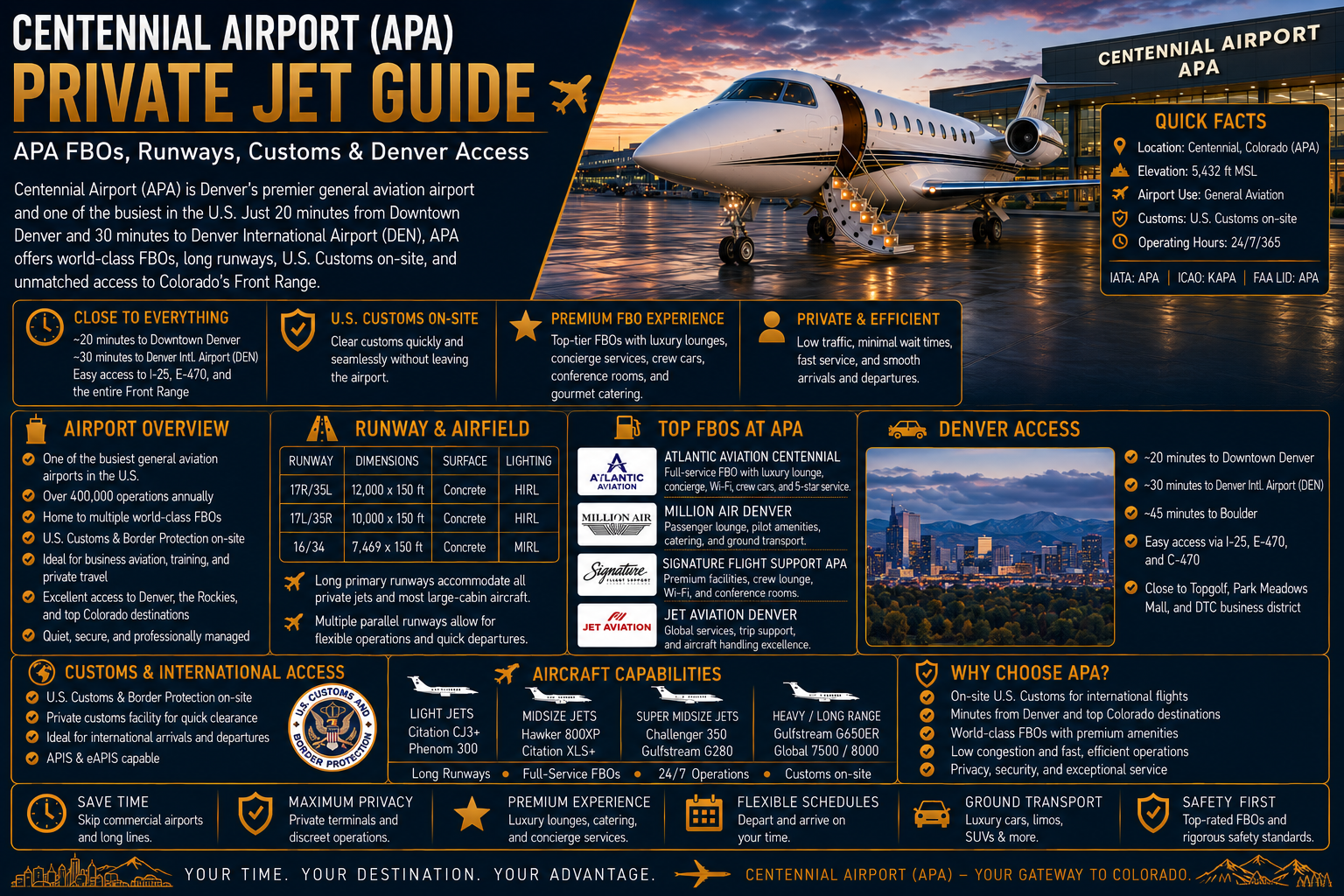
Denver Private Aviation Airport Guide
Centennial Airport Private Jet Guide: APA FBOs, Runways, Customs & Denver Access
Centennial Airport is one of the world's busiest general aviation airports and one of the most important private aviation gateways in Colorado. APA combines a 10,001-foot primary runway, multiple full-service FBO options, on-demand U.S. Customs and direct access to Denver's southern business and residential markets, making it especially valuable for executives, family offices and private travelers whose destinations align with the Denver Tech Center, Greenwood Village, Cherry Creek, Parker or surrounding communities.
Centennial Airport uses the airport identifier APA and ICAO identifier KAPA.
However, its significance to private aviation extends far beyond the airport code.
Centennial is a dedicated general aviation airport rather than a scheduled commercial airline hub.
Therefore, business aviation sits at the center of its operating environment.
The airport supports corporate aircraft.
It supports charter operations.
It supports medevac and air ambulance activity.
Additionally, it supports flight schools, cargo, aerospace research, military operations and other general aviation users.
Consequently, APA functions as a sophisticated aviation ecosystem rather than a small suburban airfield.
Centennial Airport describes itself as one of the busiest general aviation airports in the world.
Additionally, the airport reports more than 125 businesses operating on the field.
Therefore, private aviation travelers gain access to a mature support environment.
Aircraft maintenance can matter.
Hangar availability can matter.
FBO choice can matter.
Crew services can matter.
Additionally, aviation businesses throughout the airport can support more complex aircraft ownership and operational requirements.
Consequently, APA has substantial value for both transient private jet travelers and locally based aircraft owners.
Passenger geography creates another major advantage.
Centennial sits south of central Denver.
Therefore, the airport can provide particularly strong access to the Denver Tech Center, Greenwood Village, Centennial, Parker, Lone Tree, Englewood and other southern Denver markets.
That geography matters because Denver International Airport sits much farther northeast.
Consequently, a traveler heading to South Metro Denver can potentially avoid substantial unnecessary ground travel by using APA.
Private aviation should be measured door to door.
Therefore, airport geography can matter as much as aircraft speed.
A passenger can save significant time in the air.
However, landing at the wrong Denver-area airport can return some of that time to the road.
Consequently, Centennial should be evaluated around the passenger's actual final address rather than simply as an alternative to Denver International.
Denver International Airport remains one of the country's major commercial hubs.
It provides enormous runway capability.
It provides global airline connectivity.
Additionally, it can support aircraft and missions requiring major-airport infrastructure.
However, many private travelers do not need those features.
Therefore, APA can create a cleaner business aviation experience when the passenger does not require an airline connection.
The aircraft can arrive at a general aviation-focused airport.
The passenger can transition through an FBO.
Ground transportation can meet the aircraft-side arrival process.
Consequently, Centennial can preserve more of the private aviation experience from touchdown through final destination.
Centennial Airport operates 24 hours a day.
Its Operations Department is staffed around the clock.
Additionally, the airport's air traffic control tower operates continuously.
Therefore, APA provides substantial scheduling flexibility for private aviation.
That can matter for executive travel.
It can matter for late-arriving charter flights.
It can also matter for repositioning and aircraft-management activity.
However, airport operation and every individual service should not be treated as identical.
FBO service hours can differ.
Customs scheduling follows its own process.
Additionally, individual providers can maintain different overnight procedures.
Consequently, operators should confirm each mission requirement even though the airfield itself operates continuously.
APA has three paved runways.
Runway 17L/35R measures 10,001 feet long and 100 feet wide.
Runway 17R/35L measures 7,001 feet long and 75 feet wide.
Runway 10/28 measures 4,800 feet long and 75 feet wide.
Therefore, Centennial provides a substantial runway environment for a general aviation airport. :contentReference[oaicite:1]
The 10,001-foot primary runway gives the airport particularly strong business aviation capability.
Light jets can use APA.
Midsize jets can use APA.
Super-midsize aircraft can use APA.
Additionally, many large-cabin business aircraft can operate at Centennial when exact aircraft weight and mission conditions support the flight.
Consequently, the runway system provides far greater aircraft flexibility than many smaller executive airports.
However, Colorado elevation changes the performance equation.
Centennial Airport sits at approximately 5,885 feet above mean sea level. :contentReference[oaicite:2]
Therefore, aircraft operate at a substantially higher field elevation than airports near sea level.
That matters because higher elevation reduces air density.
Summer heat reduces air density further.
Consequently, density altitude can become a major performance consideration.
A large aircraft departing on a cool winter morning creates one performance profile.
The same aircraft departing heavily fueled on a hot summer afternoon creates another.
Therefore, APA's long primary runway should not be interpreted as unlimited aircraft performance.
The 10,001-foot runway provides significant capability.
However, elevation and temperature still matter.
Aircraft weight matters.
Fuel matters.
Wind matters.
Runway condition matters.
Additionally, destination requirements matter.
Consequently, private aviation operators should calculate each mission around the actual conditions rather than relying on brochure range or generic aircraft-category assumptions.
The airport's second parallel runway also adds operational flexibility.
Runway 17R/35L measures 7,001 feet long.
Therefore, APA can distribute traffic across parallel north-south runways.
However, the runway spacing creates operational considerations.
The FAA specifically warns pilots to remain aware of the parallel runway system and to avoid drifting into the adjacent departure corridor.
Additionally, the FAA notes that pilots cleared for the smaller Runway 17R/35L have occasionally lined up with the larger Runway 17L/35R.
Therefore, runway identification and situational awareness remain particularly important.
The third runway, Runway 10/28, provides crosswind flexibility.
It measures 4,800 feet long.
Additionally, the FAA notes that the Runway 10 threshold is displaced by 400 feet. :contentReference[oaicite:3]
Therefore, aircraft operators need to use current declared distances rather than assuming the complete physical runway length applies identically to every operation.
That principle becomes increasingly important as aircraft performance margins tighten.
Centennial's airspace adds another layer.
The airport sits beneath Denver International's Class B airspace.
The FAA notes that the Class B floor above Centennial is 8,000 feet.
Therefore, aircraft operating around APA must remain outside Denver Class B unless specifically cleared into it. :contentReference[oaicite:4]
That surrounding airspace creates a highly developed metropolitan aviation environment.
APA has its own tower and operating procedures.
However, aircraft still function within the broader Denver airspace system.
Consequently, private aviation travelers can gain a general aviation-focused passenger experience without eliminating air traffic control complexity.
Buckley Space Force Base also sits northeast of Centennial.
Therefore, regional military aviation forms another part of the operating environment.
Additionally, helicopter traffic can operate near portions of the airport.
Consequently, experienced crews rely on current FAA guidance, airport diagrams and air traffic instructions rather than treating APA like an isolated general aviation field.
Centennial Airport currently lists several FBO facilities.
jetCenters of Colorado operates at APA.
Modern Aviation operates at APA.
Signature Aviation operates both North and South facilities.
Therefore, aircraft operators can compare several handling options within the same airport. :contentReference[oaicite:5]
That choice can materially affect a mission.
Fuel agreements can differ.
Ramp availability can differ.
Hangar capacity can differ.
Crew amenities can differ.
Additionally, ground transportation procedures can differ by facility.
Consequently, the strongest FBO is not automatically the largest or most recognizable facility.
Instead, the best FBO is the one that supports the aircraft, passengers, crew and return-flight plan together.
Centennial also lists a vertiport among its airport services.
Therefore, the broader airport infrastructure continues to evolve beyond traditional fixed-wing operations.
However, the core private aviation decision remains centered on aircraft performance, FBO choice and passenger geography.
Centennial Airport also offers international arrival capability.
The airport currently states that it provides on-demand, 24/7 U.S. Customs services for international arrivals. :contentReference[oaicite:6]
That capability can materially improve private aviation missions.
A qualifying aircraft returning from Canada can potentially clear directly at APA.
Mexico can create another international mission.
Additionally, longer-range private aircraft can return from other foreign destinations when customs and aircraft capability support the trip.
Consequently, private travelers can preserve Centennial's South Denver geographic advantage even on international arrivals.
However, customs should still be coordinated in advance.
Centennial publishes a user-fee customs structure based on aircraft maximum gross takeoff weight.
Additionally, clearances outside normal service windows can incur higher charges.
The airport also publishes rotating customs staffing schedules while maintaining on-demand availability.
Therefore, international operators should verify current timing and charges before departure.
The ability to request customs around the clock does not eliminate advance coordination.
Consequently, customs should be built into the flight plan rather than treated as an after-landing detail.
International arrival capability can be especially valuable for family offices and corporate flight departments based south of Denver.
Instead of clearing through Denver International solely because a trip originates outside the United States, a qualifying aircraft may be able to return directly to Centennial.
Therefore, the passenger can preserve a more consistent airport and ground transportation process.
That consistency can become valuable over repeated travel.
Preferred FBO procedures can be documented.
Preferred vehicles can be staged.
Aircraft requirements can be standardized.
Additionally, customs coordination can become part of the international travel checklist.
Consequently, Centennial can function as more than a convenient airport.
It can become part of a repeatable private aviation operating system.
The airport's hangar environment also continues to expand.
In 2025, Centennial announced the opening of a new private hangar campus adding more than 127,000 square feet of hangar and customizable suite space. :contentReference[oaicite:7]
Therefore, the airport continues to invest in based-aircraft infrastructure.
That matters for aircraft owners.
A private jet based close to its owner can reduce departure-day ground time.
It can also improve consistency around maintenance, fueling and crew logistics.
Consequently, hangar strategy can influence the long-term value of Centennial for Denver-area owners.
However, hangar availability remains aircraft and facility specific.
Wingspan matters.
Tail height matters.
Aircraft length matters.
Additionally, lease availability can change.
Therefore, owners should evaluate exact space rather than assuming the airport's overall hangar inventory guarantees a suitable home.
Colorado weather creates another major consideration.
Winter can bring snow and ice.
Therefore, aircraft deicing can become part of the departure process.
Runway treatment can matter.
Ground transportation can slow.
Additionally, destination weather can differ dramatically.
A passenger may leave Denver in clear conditions while arriving into a mountain airport with snowfall and limited visibility.
Consequently, private aviation planning should evaluate both ends of the mission.
Summer creates a different problem.
Higher temperatures combine with Centennial's 5,885-foot field elevation.
Therefore, density altitude can become increasingly important.
This matters most for heavier departures.
A long-range aircraft may require substantial fuel.
Passengers add weight.
Baggage adds more.
Consequently, hot-weather performance should be evaluated before confirming a heavy nonstop departure.
Centennial's proximity to Colorado mountain destinations also creates an important private aviation role.
Aspen is one obvious destination.
Vail travel often uses Eagle County or other regional airports depending on the mission.
Steamboat Springs creates another mountain aviation market.
Additionally, Telluride and other high-elevation airports can introduce substantial performance considerations.
Therefore, a Denver-based aircraft may use Centennial as the origin airport for mountain travel.
However, aircraft selection must solve both APA and the mountain destination.
Range alone is rarely the issue.
Elevation is.
Runway length is.
Terrain is.
Weather is.
Therefore, mountain missions should be planned around complete airport-pair performance.
Aspen creates a particularly important example.
Centennial itself sits at high elevation.
Aspen sits even higher and operates inside a mountain environment.
Therefore, aircraft must perform adequately at both airports.
A larger aircraft can provide more cabin space.
However, more weight can complicate mountain performance.
Consequently, the largest aircraft is not automatically the strongest choice.
The best aircraft is the one that solves both airports with appropriate margin.
Centennial also supports significant business aviation demand from Denver's southern corporate market.
The Denver Tech Center creates one important demand source.
Greenwood Village creates another.
Lone Tree continues to grow as a business and residential market.
Additionally, companies throughout South Metro Denver can use APA for executive travel.
Therefore, corporate aircraft can connect leaders directly with national and regional business markets without forcing the itinerary through Denver International.
Same-day business travel can be particularly valuable.
Salt Lake City creates one regional mission.
Phoenix creates another.
Dallas creates another.
Scottsdale creates another.
Additionally, destinations throughout the Mountain West can fit smaller business aircraft efficiently.
Consequently, turboprops, light jets and midsize aircraft can all become effective tools from APA.
Longer domestic routes change the aircraft decision.
New York can increase cabin and range requirements.
South Florida can create another long domestic mission.
Los Angeles remains manageable across several categories.
Seattle creates another substantial western route.
Therefore, aircraft category should scale with passenger and route requirements.
Family-office travel creates another important use case.
Denver-area principals can use Centennial for leisure travel.
They can use it for business.
They can use it for ski travel.
Additionally, they can use it for international missions.
Therefore, repeat procedures can provide significant value.
Ground transportation can be standardized.
FBO preferences can be documented.
Aircraft categories can be mapped to common routes.
International customs requirements can be added to standard checklists.
Consequently, the airport can become a repeatable operating platform rather than a one-trip decision.
Centennial's noise environment also deserves attention.
The FAA lists active noise-abatement procedures for multiple runway patterns. :contentReference[oaicite:8]
Therefore, pilots should follow current noise procedures whenever they remain consistent with safe operations.
That matters because APA sits within a developed metropolitan environment.
Residential communities surround parts of the airport.
Consequently, professional airport use involves both aircraft safety and community awareness.
The airport's continued value depends partly on maintaining a sustainable relationship with surrounding communities.
Therefore, noise procedures matter not only to one flight but also to long-term business aviation access.
Centennial Airport therefore represents far more than a Denver alternative airport.
It is a major general aviation center with substantial runway capability, multiple FBO choices, international customs and strategic South Denver geography.
However, its high elevation changes aircraft performance.
Denver Class B airspace adds operating complexity.
Parallel runways require disciplined awareness.
Colorado weather affects the mission.
Additionally, mountain destinations can add another layer of aircraft-performance requirements.
Consequently, the strongest APA mission coordinates every variable.
This guide examines that complete system.
It covers Centennial Airport runways, aircraft capability, FBOs, customs, Denver access, Denver Tech Center travel, aircraft parking, hangars, Colorado weather, density altitude, mountain missions, airport comparisons, private jet routes, family-office travel and executive aviation.
Most importantly, it explains when Centennial Airport should be selected instead of Denver International or another Denver-area aviation option.
Direct APA Airport Answer
Is Centennial Airport Good for Private Jets?
Direct Answer: Yes. Centennial Airport is one of Colorado's strongest private aviation airports, combining a 10,001-foot primary runway, multiple full-service FBO facilities, on-demand international customs, 24-hour airport operations and strategic access to South Denver. APA is particularly valuable for travelers heading toward the Denver Tech Center, Greenwood Village, Centennial, Lone Tree and surrounding markets.
Centennial offers a combination that few general aviation airports can match.
It has long runway capability.
It has several FBO choices.
Additionally, the airport operates around the clock.
Therefore, business aviation can use APA across a wide range of mission profiles.
Primary Runway
Runway 17L/35R provides substantial business aviation capability for a broad aircraft fleet.
Operational Flexibility
APA combines two parallel north-south runways with a shorter east-west runway.
Private Aviation Infrastructure
jetCenters of Colorado, Modern Aviation and Signature Aviation facilities currently serve the airport.
Airport Operations
Centennial's Operations Department and air traffic control environment operate continuously.
U.S. Customs
APA provides on-demand customs processing for qualifying international private aviation arrivals.
High-Elevation Airport
Centennial's elevation makes density-altitude and hot-weather performance important parts of aircraft planning.
What Is Centennial Airport's Biggest Private Aviation Advantage?
Its strongest advantage is the combination of serious business aviation infrastructure and South Denver geography.
APA can handle substantial aircraft.
However, it also places travelers close to major southern Denver business and residential markets.
Therefore, the passenger can gain both aircraft capability and ground efficiency.
What Is APA's Biggest Operational Consideration?
Elevation.
Centennial sits at approximately 5,885 feet.
Therefore, aircraft performance differs materially from a sea-level airport.
Summer heat can increase density altitude further.
Consequently, heavier departures require aircraft-specific analysis even with a 10,001-foot runway.
Centennial combines long-runway business aviation capability with direct South Denver access.
However, its Colorado elevation means aircraft performance should always be evaluated for the exact mission.
Denver Private Aviation
Why Do Private Jet Travelers Use Centennial Airport?
Direct Answer: Private jet travelers use Centennial Airport because APA combines a dedicated general aviation environment with a 10,001-foot runway, multiple FBOs, international customs and strong access to South Denver. It can be particularly valuable for executives, aircraft owners and family offices whose destinations lie near the Denver Tech Center, Greenwood Village, Lone Tree or Centennial.
Denver is geographically large.
Therefore, airport selection can materially change the ground portion of a private aviation trip.
Centennial serves the southern metropolitan market particularly well.
Denver Tech Center
APA provides strong geography for one of the Denver region's most important corporate and business districts.
Greenwood Village
Private travelers can use Centennial for direct access to nearby business and residential destinations.
Lone Tree
The airport can support business, medical and residential travel throughout the growing southern Denver corridor.
Centennial
Local residents and businesses can use an airport situated directly within their broader community.
Mountain Travel
APA can serve as a launch point for private aviation missions toward Colorado mountain destinations.
Aircraft Owners
Substantial hangar, maintenance and aviation-business infrastructure supports locally based private aircraft.
Why Not Automatically Use Denver International Airport?
Denver International provides enormous runway and airline infrastructure.
However, many private travelers do not need an airline connection.
Therefore, landing farther northeast can create unnecessary ground transportation for South Denver passengers.
Consequently, APA can produce the stronger complete itinerary.
Why Does a Dedicated General Aviation Environment Matter?
Private aircraft form a core part of Centennial's airport mission.
Therefore, FBOs, hangars and aviation businesses are built around non-airline users.
That can simplify aircraft and passenger handling.
Consequently, APA offers a different experience from operating inside a major scheduled-airline hub.
Centennial is valuable because it combines Denver-area airport capability with a business aviation-focused environment.
South Denver geography strengthens that advantage further.
Colorado General Aviation Hub
What Role Does Centennial Airport Play in Denver Private Aviation?
Direct Answer: Centennial Airport is a major public-use general aviation airport serving corporate aircraft, charter operations, medevac flights, military activity, flight schools, cargo and aerospace businesses. With more than 125 on-airport businesses and significant regional economic activity, APA functions as a full aviation ecosystem rather than simply a private jet landing field.
Centennial's scale matters.
Private aircraft need more than pavement.
They need maintenance.
They need fuel.
They need storage.
Crew support matters.
Additionally, operators may need aircraft management and other aviation services.
Therefore, a mature airport ecosystem can create long-term value.
Corporate Aircraft
APA supports substantial executive, charter and privately operated business jet activity.
Diverse Airport Users
Flight schools, cargo, medevac and other users create a broad general aviation environment.
Aviation Ecosystem
A large on-airport business community supports aircraft owners, crews and operators.
Continuous Operations
Centennial maintains around-the-clock airport operations and tower service.
Customs Capability
On-demand U.S. Customs expands APA's role beyond domestic general aviation.
Executive Gateway
The airport serves major southern Denver business and residential markets.
Is Centennial a Commercial Airline Airport?
No scheduled airline terminal defines the airport's primary role.
Instead, Centennial focuses on general aviation users.
Therefore, private travelers operate through FBO facilities rather than conventional airline passenger terminals.
Why Is Centennial So Busy?
Several aviation segments use the airport simultaneously.
Business jets operate there.
Flight training operates there.
Corporate aircraft are based there.
Additionally, medevac, research and other aviation users contribute traffic.
Therefore, APA combines high activity with a general aviation focus.
Centennial is not merely a convenient Denver airport—it is one of the country's major general aviation ecosystems.
That scale supports both transient private jet travelers and long-term aircraft owners.
APA Quick Reference
What Should Private Jet Travelers Know About Centennial Airport?
Direct Answer: Centennial Airport uses the identifiers APA and KAPA, sits at approximately 5,885 feet elevation and operates three paved runways. Its principal Runway 17L/35R measures 10,001 by 100 feet, while APA also provides multiple FBO facilities, 24-hour operations and on-demand U.S. Customs for qualifying international arrivals.
| Airport Detail | Centennial Airport Information | Why It Matters |
|---|---|---|
| Airport | Centennial Airport | Major Denver-area general and business aviation airport |
| Airport Identifier | APA | Primary domestic airport identifier |
| ICAO Identifier | KAPA | Used in international and operational flight planning |
| Field Elevation | Approximately 5,885 feet MSL | Makes density-altitude planning important |
| Primary Runway | 17L/35R — 10,001 × 100 feet | Provides substantial business aviation capability |
| Parallel Runway | 17R/35L — 7,001 × 75 feet | Adds significant north-south operating flexibility |
| Crosswind Runway | 10/28 — 4,800 × 75 feet | Provides an additional operating direction |
| Current FBO Options | jetCenters of Colorado, Modern Aviation, Signature North and Signature South | Provides several aircraft handling and passenger-service options |
| Airport Operations | 24/7 | Supports flexible business aviation scheduling |
| Air Traffic Control Tower | 24/7 | Maintains continuous controlled-airport operations |
| International Customs | On-demand service available | Supports qualifying international private aircraft arrivals |
| Primary Passenger Advantage | South Denver access | Can reduce ground travel for southern Denver destinations |
Which APA Specification Matters Most?
The answer depends on the mission.
Large aircraft can value the 10,001-foot runway.
International travelers can value customs.
Executives can value South Denver geography.
Meanwhile, locally based aircraft owners can value the airport's large aviation-business and hangar ecosystem.
Therefore, Centennial becomes strongest when several of those factors support the same trip.
Centennial's specifications make APA capable, but its South Denver geography makes it strategically valuable.
The best private aviation mission uses both advantages together.
APA Runway System
How Long Are the Runways at Centennial Airport?
Direct Answer: Centennial Airport operates three paved runways. Runway 17L/35R measures 10,001 feet by 100 feet, Runway 17R/35L measures 7,001 feet by 75 feet and Runway 10/28 measures 4,800 feet by 75 feet. The system provides substantial private aviation capability, although APA's 5,885-foot elevation makes exact aircraft performance especially important.
Centennial's runway system gives the airport significant flexibility.
The two parallel runways support the primary north-south operating flow.
Meanwhile, Runway 10/28 provides another runway orientation.
Therefore, APA can support a wide range of general aviation traffic.
10,001 × 100 Feet
The primary runway provides substantial capability for business and private aircraft.
7,001 × 75 Feet
The parallel runway adds useful capacity and operational flexibility.
4,800 × 75 Feet
The shorter east-west runway adds crosswind capability, while Runway 10 has a displaced threshold.
Does a 10,001-Foot Runway Mean Every Private Jet Can Use Centennial Easily?
No.
APA's elevation changes the performance calculation.
Therefore, aircraft weight and temperature remain important even with substantial runway length.
A lightly loaded midsize jet can create one performance profile.
A heavily fueled large-cabin aircraft creates another.
Consequently, exact aircraft calculations remain necessary.
Why Are the Parallel Runways Important?
Parallel runways can increase operating flexibility and traffic capacity.
However, they also require disciplined runway identification.
The FAA specifically cautions pilots about confusing the larger and smaller parallel runways.
Therefore, crews should positively identify the assigned runway and maintain situational awareness.
APA's runway system provides strong business aviation capability, but Colorado elevation means runway length and aircraft performance must always be evaluated together.
The 10,001-foot primary runway creates significant flexibility without eliminating density-altitude effects.
APA Aircraft Strategy
Which Types of Private Jets Can Use Centennial Airport?
Direct Answer: Centennial Airport can support a broad private aviation fleet, including turboprops, light jets, midsize jets, super-midsize aircraft and many large-cabin business jets. However, APA's 5,885-foot field elevation makes aircraft weight, temperature, fuel and density altitude particularly important, especially for heavy long-range departures during warmer conditions.
APA provides substantial runway capability.
Therefore, travelers can choose from a broad aircraft range.
However, the airport sits much higher than a coastal executive field.
Consequently, aircraft selection should account for both runway length and atmospheric conditions.
Turboprops
Turboprops can efficiently support regional and selected mountain missions when aircraft performance fits the destination.
Regional Business Travel
Light jets can connect APA efficiently with Western and central U.S. markets.
Cabin + Range
Midsize aircraft can provide additional cabin comfort and useful domestic nonstop capability.
Long Domestic Missions
Super-midsize aircraft can support premium longer-range missions when APA performance supports the exact departure.
Long-Range Business Aviation
Selected large-cabin business jets can use Centennial when weight, weather, fuel and runway performance align.
Performance Discipline
Aircraft capability should be evaluated around density altitude rather than runway length alone.
Why Does High Elevation Matter Even With a Long Runway?
Higher elevation means thinner air.
Therefore, aircraft engines and wings can produce different performance than at sea level.
High temperatures can increase the effect.
Consequently, a long runway gives the operator more room but does not eliminate performance limits.
Which Flights Need the Most Performance Attention?
Heavy departures deserve particular attention.
Long-range missions require more fuel.
More passengers and baggage increase weight further.
Therefore, a large aircraft departing APA on a hot afternoon can require much more detailed planning than a smaller regional aircraft.
Centennial supports a broad private aviation fleet, but high-elevation performance should remain part of every aircraft decision.
The strongest aircraft is the one that solves both the passenger mission and APA's atmospheric environment.
APA Private Aviation Infrastructure
Which FBOs Serve Private Jets at Centennial Airport?
Direct Answer: Centennial Airport currently lists jetCenters of Colorado, Modern Aviation, Signature Aviation North and Signature Aviation South among its fixed-base operator facilities. This gives private aircraft operators several options for fuel, handling, passenger services, parking, crew requirements and other business aviation support within the same airport.
Multiple FBO options strengthen Centennial's private aviation ecosystem.
However, the passenger should not choose a facility based only on the lounge.
Aircraft requirements matter.
Fuel arrangements matter.
Parking matters.
Additionally, crew and transportation requirements can matter.
Therefore, the FBO should fit the complete mission.
jetCenters of Colorado
jetCenters of Colorado currently provides FBO services at Centennial Airport.
Modern Aviation APA
Modern Aviation currently operates one of Centennial's business aviation FBO facilities.
Signature Aviation North
Signature operates a northern facility serving Centennial private and general aviation traffic.
Signature Aviation South
A second Signature facility provides another handling option on the airport.
Why Does Centennial Have Multiple FBO Options?
APA supports significant general and business aviation activity.
Therefore, multiple providers serve different aircraft and operator relationships.
That competition can create useful flexibility.
Consequently, operators can compare facility fit rather than being limited to one handling provider.
Should Passengers Always Use the Same FBO?
Not necessarily.
Repeat travelers may prefer consistency.
However, aircraft parking, fuel agreements or hangar availability can favor another facility on a particular mission.
Therefore, a preferred FBO should remain a preference rather than an inflexible rule.
Centennial's multiple FBO environment creates useful flexibility for private aviation.
The strongest facility is the one that supports the aircraft, passenger, crew and return-flight plan together.
International General Aviation
Can International Private Jets Clear Customs at Centennial Airport?
Direct Answer: Yes. Centennial Airport offers on-demand U.S. Customs services for qualifying international arrivals, allowing private aircraft to clear directly at APA when current procedures are satisfied. The airport publishes rotating staffing hours and a weight-based user-fee system, while service outside normal hours can carry higher fees.
Customs capability materially expands Centennial's usefulness.
A South Denver traveler returning from Canada may not need to land at Denver International solely for U.S. entry.
Mexico creates another important market.
Additionally, longer-range international missions can use APA when the aircraft and customs arrangements support the trip.
Therefore, international capability can preserve the airport's geographic advantage.
Is Centennial Customs Really Available 24/7?
The airport states that on-demand customs services are available around the clock.
However, it also publishes rotating normal service windows.
Therefore, after-hours processing can require additional coordination and higher charges.
Consequently, 24/7 availability should not be interpreted as walk-in service without planning.
How Are Centennial Customs Fees Determined?
The airport uses a user-fee structure based on aircraft maximum gross takeoff weight.
Therefore, larger aircraft can fall into higher fee categories.
Additionally, after-hours clearances are billed at a higher rate.
Consequently, international mission economics should include customs costs before departure.
Why Can Direct APA Customs Matter to Family Offices?
Repeat travelers can preserve a consistent airport process.
The aircraft can return directly to Centennial.
The preferred FBO can support the arrival.
Additionally, the usual ground transportation process can remain intact.
Therefore, international travel does not necessarily require abandoning the household's normal Denver airport strategy.
Centennial's on-demand customs capability can preserve the South Denver private aviation advantage on international arrivals.
However, advance coordination, current staffing and applicable user fees should be confirmed before every mission.
Operational Accuracy
Where Should Current Centennial Airport Private Aviation Information Be Verified?
Runway status, customs hours, FBO services, airport procedures, weather, NOTAMs and operating conditions can change.
Therefore, this guide supports airport research rather than replacing current operational flight-planning resources.
Travelers and operators should verify current airport information through the official Centennial Airport website.
Current runway and airfield information should also be checked through the Federal Aviation Administration's Centennial Airport guidance.
International operators should verify current customs staffing, user fees and advance-arrangement procedures through Centennial Airport's official customs information before departure.
APA FBO Strategy
How Should Private Jet Travelers Choose an FBO at Centennial Airport?
Direct Answer: The best Centennial Airport FBO depends on aircraft handling, fuel arrangements, ramp or hangar availability, passenger transportation, crew requirements and the return-flight plan. Because APA offers several business aviation facilities, operators can compare jetCenters of Colorado, Modern Aviation and Signature Aviation locations around the requirements of the specific mission.
Centennial's multiple FBO environment creates useful choice.
However, more choice also means the facility should be selected deliberately.
A passenger lounge can matter.
Yet aircraft requirements usually matter more.
Fuel contracts can change the economics.
Parking can change the operating plan.
Additionally, hangar availability can matter during Colorado weather.
Therefore, the best facility should support the complete aircraft and passenger mission.
Aircraft
Handling Requirements
Aircraft size, towing requirements, ground power and other handling needs can influence facility selection.
Fuel
Fuel Agreements
Operator fuel contracts and negotiated programs can make one APA FBO more efficient for a specific aircraft.
Parking
Ramp Availability
Transient aircraft parking should be confirmed when the jet will remain at Centennial for an extended stay.
Hangar
Weather Protection
Hangar space can become particularly valuable during snow, hail, strong winds or other Colorado weather.
Passenger
Ground Transportation
The selected facility should support a smooth transfer between the aircraft and the passenger's waiting vehicle.
Crew
Crew Logistics
Transportation, lodging, rest requirements and aircraft servicing can affect the strongest FBO choice.
Should Repeat Travelers Use the Same APA FBO Every Time?
Consistency can create value.
A family office can standardize passenger preferences.
A corporate flight department can build familiar procedures.
Additionally, ground transportation providers can learn the normal pickup process.
However, operational conditions can change.
Therefore, a preferred facility should not become an inflexible rule.
Another FBO may offer better parking for one trip.
Hangar availability may favor another.
Fuel arrangements can also shift the economics.
Consequently, repeat travelers should define both a preferred FBO and the conditions that justify an alternative.
Does FBO Location Within Centennial Matter?
It can.
Centennial is a substantial airport.
Therefore, passengers should give drivers the exact facility rather than simply saying "Centennial Airport."
Additionally, operators should coordinate transportation with the selected FBO before arrival.
That prevents the ground vehicle from waiting at the wrong facility.
Centennial's multiple FBOs create flexibility, but the strongest choice should be driven by the aircraft mission rather than the lounge.
Fuel, parking, hangar availability, passenger transfer and crew requirements should work together.
APA International Arrival Strategy
How Should International Private Jet Arrivals at Centennial Airport Be Planned?
Direct Answer: International private jet arrivals at Centennial should be coordinated before departure from the foreign origin. The operator should confirm current customs availability, submit required passenger and crew information, verify applicable user fees and coordinate the selected APA FBO so customs, aircraft handling and passenger transportation operate as one arrival plan.
Centennial's customs capability can preserve the airport's South Denver advantage for international travelers.
However, that advantage depends on advance planning.
International private aviation follows specific entry procedures.
Therefore, customs should never be treated as an after-landing task.
Why Should Customs Be Confirmed Before the Aircraft Leaves?
Staffing arrangements matter.
Arrival timing matters.
Passenger and crew information must also be handled correctly.
Additionally, user fees can depend on aircraft size and service timing.
Therefore, the international arrival should be confirmed before departure.
Can Schedule Changes Affect an APA International Arrival?
Yes.
Private aviation schedules can change.
However, a significant timing change can also affect the customs arrangement.
Therefore, operators should communicate schedule changes through the required channels rather than assuming the original clearance window automatically moves with the aircraft.
Why Can Direct Customs at APA Save Time?
Consider a passenger whose final destination is Greenwood Village.
Clearing at another airport can add a separate ground-travel segment.
However, a qualifying direct arrival into Centennial keeps the aircraft close to the passenger's final destination.
Therefore, customs capability can preserve more of private aviation's door-to-door advantage.
International capability makes Centennial more than a domestic executive airport.
Advance customs coordination can allow qualifying travelers to preserve APA's South Denver geography after an international flight.
South Denver Private Aviation
Why Is Centennial Airport Valuable for South Denver Private Jet Travel?
Direct Answer: Centennial Airport's greatest passenger advantage is its location within the southern Denver metropolitan area. APA can provide strong private aviation access to the Denver Tech Center, Greenwood Village, Centennial, Lone Tree, Parker and nearby communities, allowing many travelers to avoid the longer ground transfer associated with airports positioned farther from South Denver.
Airport geography directly affects private aviation value.
The jet may save hours compared with an airline itinerary.
However, unnecessary ground travel can return part of that time.
Therefore, the strongest airport should match the passenger's final address.
Denver Tech Center
APA can provide excellent geography for executives traveling into the Denver region's major southern business district.
Greenwood Village
The airport sits close to important corporate, residential and hospitality destinations in Greenwood Village.
Lone Tree
APA can support executive, medical, residential and leisure travel throughout the growing Lone Tree corridor.
Centennial
Local passengers gain access to a major general aviation airport within the same broader community.
Parker
Southeastern Denver-area travelers can gain favorable airport geography through Centennial.
South Metro Denver
APA can reduce unnecessary north-south ground travel for many southern metropolitan destinations.
Why Should the Final Address Determine the Airport?
Denver covers a large geographic area.
Therefore, "Denver" alone does not identify the strongest private aviation airport.
A passenger traveling to the Denver Tech Center has different ground requirements from a traveler heading far north of the city.
Consequently, airport selection should begin with the street-level destination whenever possible.
Can APA Reduce Door-to-Door Travel Time?
For many South Denver missions, yes.
The aircraft lands closer to the destination.
The passenger transfers through an FBO rather than an airline terminal.
Additionally, a prearranged vehicle can continue directly toward the final address.
Therefore, several smaller time savings can compound into a materially more efficient itinerary.
Centennial's strongest passenger advantage is not simply that it serves Denver—it serves the right side of Denver for many private travelers.
South Metro geography can materially improve the complete door-to-door mission.
Denver Tech Center Aviation
Is Centennial Airport Good for Private Jet Travel to the Denver Tech Center?
Direct Answer: Yes. Centennial Airport is particularly well positioned for private travelers heading to the Denver Tech Center because APA sits within South Metro Denver and supports a dedicated general aviation environment. For executives whose meetings, hotels or offices are concentrated around the DTC, Centennial can provide a strong airport-to-destination advantage.
The Denver Tech Center is one of the region's major business districts.
Therefore, executive travel creates a natural private aviation use case.
A traveler may arrive for one meeting.
Another group may stay several days.
Additionally, corporate teams may combine Denver with another city on the same day.
Consequently, schedule control can be particularly valuable.
Why Can APA Work Well for Same-Day Business Travel?
Private aviation can reduce terminal time.
Centennial can also reduce the ground segment for DTC-bound passengers.
Therefore, a traveler may be able to complete a meeting and return home without an overnight stay.
That can change the economics of the entire business trip.
Does Aircraft Size Matter for DTC Travel?
The business district does not determine the aircraft.
The route does.
A short regional mission can work efficiently with a light jet.
Meanwhile, New York or South Florida can justify more range and cabin space.
Therefore, the passenger destination determines the airport while the route helps determine the aircraft.
Centennial and the Denver Tech Center form a natural private aviation pairing.
APA's South Denver location can preserve more of the time advantage executives expect from private flight.
South Metro Denver Access
Is Centennial Airport Good for Greenwood Village and Lone Tree Private Jet Travel?
Direct Answer: Yes. Centennial Airport can provide excellent private aviation geography for Greenwood Village, Lone Tree and nearby South Metro Denver destinations. Travelers can combine a general aviation-focused airport experience with a relatively direct ground transfer, making APA particularly useful for executives, family offices, medical travelers and residents based south of central Denver.
Private aviation becomes more valuable when the airport sits close to where the passenger actually needs to be.
Therefore, nearby communities can create some of Centennial's strongest use cases.
Why Does Greenwood Village Fit APA So Well?
Greenwood Village sits within Centennial's core South Denver market.
Therefore, the airport can provide direct access to businesses, residences, hotels and the broader DTC area.
Consequently, travelers can avoid selecting an airport based solely on the word "Denver."
Why Can Lone Tree Travelers Benefit?
Lone Tree continues to support corporate, residential, healthcare and hospitality activity.
Therefore, private aviation demand can come from several traveler types.
Centennial's geography can keep the airport portion close to those destinations.
What About Parker and Southeastern Denver?
APA can also be highly relevant.
The airport's position favors many southeastern metropolitan destinations.
Therefore, passenger geography should be compared before automatically selecting a larger airport farther away.
For Greenwood Village, Lone Tree, Centennial and Parker, APA can convert private aviation speed into real ground-level time savings.
The final address should remain the deciding factor.
Downtown Denver Access
Is Centennial Airport Practical for Downtown Denver Private Jet Travel?
Direct Answer: Yes. Centennial Airport can serve Downtown Denver private jet travelers, although its strongest geographic advantage lies south of the urban core. Downtown passengers should compare APA with other Denver-area options based on actual road conditions, aircraft requirements, FBO preference and the rest of the itinerary rather than assuming one airport always provides the shortest trip.
Centennial remains a capable Downtown Denver option.
However, this mission deserves more comparison than a trip to Greenwood Village or the Denver Tech Center.
Therefore, the complete ground route should be considered.
When Can Centennial Still Be Strong for Downtown?
A traveler may prefer the airport's general aviation environment.
The aircraft may already be based at APA.
Additionally, the trip may combine Downtown Denver with South Metro meetings.
Therefore, Centennial can still create the strongest complete itinerary.
Why Should Traffic Conditions Matter?
Road travel changes by time of day.
Therefore, theoretical mileage does not always predict actual transfer time.
A private aviation itinerary should consider the expected arrival window.
Consequently, the airport comparison should reflect the passenger's actual schedule rather than a generic drive estimate.
Centennial can work well for Downtown Denver, but its clearest geographic advantage remains South Denver.
Downtown travelers should compare the complete airport-to-address trip.
Denver Airport Comparison
Centennial Airport vs. Denver International: Which Is Better for Private Jets?
Direct Answer: Centennial can be stronger for South Denver private aviation because it provides a general aviation-focused environment close to the Denver Tech Center, Greenwood Village, Centennial and Lone Tree. Denver International can be stronger when airline connectivity, major-airport infrastructure or mission-specific requirements outweigh APA's geographic and business aviation advantages.
APA and DEN solve different problems.
Therefore, the comparison should not focus on which airport is "better" overall.
Instead, travelers should ask which airport removes more friction from the specific mission.
| Decision Factor | Centennial Airport — APA | Denver International — DEN |
|---|---|---|
| Primary Environment | General and business aviation focused | Major commercial airline hub |
| South Denver Access | Strong geographic advantage | Longer ground transfer for many southern destinations |
| Denver Tech Center | Particularly strong fit | Less direct geography |
| Private Passenger Process | FBO-focused general aviation environment | Private operations within a major commercial airport system |
| Runway Capability | 10,001-foot primary runway with high-elevation considerations | Extensive major-airport runway infrastructure |
| Airline Connections | No scheduled airline hub advantage | Major domestic and international airline connectivity |
| International Private Arrivals | On-demand customs available for qualifying missions | Major international gateway infrastructure |
| Best Use Case | South Denver business and private aviation | Airline connections or missions favoring major-hub infrastructure |
When Is Centennial Usually Stronger?
South Denver destinations create the clearest case.
A passenger heading to the DTC may gain little from landing at a much larger airport if that choice adds ground travel.
Additionally, passengers who do not require an airline connection can benefit from APA's general aviation focus.
Therefore, Centennial can create a cleaner private aviation itinerary.
When Can Denver International Be Stronger?
Airline connections can change the answer.
Mission-specific aircraft requirements can also change it.
Additionally, some passenger destinations may align better with DEN.
Therefore, Denver International remains an important private aviation option when its infrastructure provides actual mission value.
Does DEN's Longer Runway Automatically Make It Better for Large Jets?
No.
Runway length is only one variable.
Centennial's 10,001-foot primary runway provides substantial business aviation capability.
However, APA's elevation requires careful performance calculations.
Therefore, the exact aircraft, weight, temperature and mission should determine whether Centennial or DEN provides the stronger operating environment.
APA vs. DEN is a door-to-door mission comparison—not a contest over which airport is larger.
For South Denver passengers, Centennial's geography and general aviation environment can provide a powerful advantage.
APA Ground Transportation
How Should Ground Transportation Be Planned at Centennial Airport?
Direct Answer: Centennial Airport ground transportation should be coordinated with the exact FBO, aircraft arrival time, passenger destination, baggage requirements and weather conditions. Because APA's primary value comes partly from South Denver geography, a waiting vehicle that tracks the flight and meets the passenger at the correct facility helps preserve the airport's door-to-door time advantage.
The ground vehicle completes the private aviation mission.
Therefore, transportation should not be booked as an unrelated service.
The driver should know the FBO.
The vehicle provider should monitor the flight.
Additionally, the vehicle should fit the passenger group and luggage.
Exact FBO
The driver should receive the selected Centennial facility rather than a generic airport address.
Flight Monitoring
The transportation provider should follow the actual aircraft arrival rather than the original schedule alone.
Weather
Snow and other Colorado conditions can change road travel even when the aircraft arrives normally.
Baggage
Ski equipment, golf bags and extended-stay luggage can require additional vehicle capacity.
Security
Family offices and high-profile passengers can coordinate principal and security vehicles with the FBO.
Mountain Transfer
Travelers continuing toward mountain destinations should plan road conditions and vehicle suitability around the season.
Why Does Winter Change the Ground Plan?
Snow can affect road speed.
Mountain travel can become even more sensitive.
Therefore, transportation providers should account for current conditions rather than relying on normal drive times.
Additionally, a suitable vehicle can matter when passengers continue toward higher-elevation destinations.
Why Should the Driver Monitor the Aircraft?
Private flight schedules change.
Weather can alter arrival time.
Air traffic can also affect timing.
Therefore, a driver who follows the actual aircraft can remain synchronized with the passenger.
Centennial's geography saves time only when the ground vehicle is ready to capture that advantage.
The correct FBO, vehicle and real-time arrival information should operate as one transfer plan.
APA Aircraft Parking
How Does Private Jet Parking Work at Centennial Airport?
Direct Answer: Private jet parking at Centennial is coordinated through the selected FBO and depends on aircraft size, ground time, current ramp capacity and hangar requirements. Short transient stays may use ramp parking, while longer visits or severe Colorado weather can make advance parking and hangar planning more important.
Aircraft parking affects passenger flexibility.
Therefore, it should be discussed before arrival.
A same-day business trip creates one requirement.
A weekend stay creates another.
A locally based aircraft creates another still.
Quick Turn
A short stop may require little more than passenger handling, fuel and aircraft servicing.
Same-Day Stay
The aircraft may remain available locally while passengers complete meetings or other activities.
Overnight Parking
Longer stays should be coordinated with the FBO, particularly when weather or demand increases parking requirements.
Large-Cabin Aircraft
Larger jets consume more ramp space and can require more deliberate parking coordination.
Hangar Request
Weather protection should be requested early because suitable enclosed space depends on aircraft dimensions and availability.
Return Flight
Aircraft location should remain aligned with the passenger's desired departure flexibility.
Why Should the Passenger Care About Aircraft Parking?
Because aircraft location affects departure flexibility.
If the airplane remains available at Centennial, schedule changes may be easier.
However, another operational assignment can change that situation.
Therefore, travelers should understand the aircraft plan rather than assuming the jet will remain waiting indefinitely.
Aircraft parking is part of the passenger schedule.
The stronger APA mission plans where the jet will stay before the passenger leaves the airport.
Centennial Aircraft Storage
Are Private Jet Hangars Available at Centennial Airport?
Direct Answer: Yes. Centennial supports substantial aircraft hangar infrastructure for based and transient business aviation, although actual space depends on the FBO or facility, aircraft dimensions and current availability. Hangar protection can be particularly valuable in Colorado because snow, ice, hail, wind and temperature changes can affect exposed aircraft.
Centennial has a substantial based-aircraft environment.
Therefore, hangars form an important part of the airport's aviation infrastructure.
However, not every available building can accommodate every aircraft.
What Determines Whether a Private Jet Fits?
Wingspan matters.
Tail height matters.
Aircraft length matters.
Additionally, hangar door dimensions matter.
Therefore, operators should request storage using the exact aircraft model rather than simply asking for "jet hangar space."
Why Can Colorado Weather Increase Hangar Value?
Winter can bring snow and ice.
Severe weather can also include hail.
Additionally, strong sun and temperature swings can affect exposed aircraft.
Therefore, enclosed storage can protect the aircraft while simplifying passenger departure preparation.
Does Centennial's Large Hangar Market Guarantee Transient Space?
No.
Based-aircraft demand can consume much of the available inventory.
Therefore, transient hangar availability should be confirmed rather than assumed.
Centennial has substantial aircraft-storage infrastructure, but the exact aircraft dimensions and current availability determine whether a hangar solution exists.
Weather-sensitive missions benefit from early coordination.
High-Elevation Aircraft Performance
How Does Centennial Airport's Elevation Affect Private Jets?
Direct Answer: Centennial Airport's approximately 5,885-foot field elevation reduces air density compared with sea-level airports. As density altitude rises, aircraft can require more runway and experience reduced takeoff and climb performance. Temperature, aircraft weight, fuel, wind and atmospheric pressure therefore become especially important when planning heavy private jet departures from APA.
Elevation is one of the most important concepts on this page.
Centennial has a 10,001-foot primary runway.
That number looks extremely capable.
However, runway length does not tell the complete performance story.
Air density matters.
At higher elevations, the atmosphere is thinner.
Therefore, wings and engines operate in a different environment from a sea-level airport.
Temperature can amplify the effect.
Consequently, a hot summer afternoon can create a substantially higher density altitude than the airport's physical elevation alone suggests.
Elevation
5,885 Feet MSL
APA begins with a much higher field elevation than coastal private aviation airports.
Temperature
Hotter Air
Higher temperatures can increase density altitude and reduce aircraft performance margins.
Weight
Heavy Aircraft
Passengers, baggage and fuel increase the takeoff weight that the aircraft must accelerate and lift.
Fuel
Long-Range Missions
More fuel can increase weight, making long nonstop departures more performance sensitive.
Runway
10,001 Feet Helps
The primary runway provides substantial operating margin compared with shorter high-elevation airports.
Calculation
Mission Specific
Operators calculate performance using the exact aircraft and current operating conditions.
Why Does Density Altitude Matter More for Heavy Departures?
A long-range aircraft may carry significant fuel.
A larger passenger group adds weight.
Baggage adds more.
Therefore, the aircraft may need greater takeoff performance at the same time the thin air reduces performance.
Consequently, operators may adjust fuel, payload or departure timing when necessary.
Does Density Altitude Mean Large Jets Cannot Use Centennial?
No.
Many substantial business aircraft can operate at APA.
The airport's long runway is one reason.
However, capability must be calculated rather than assumed.
Therefore, the question is not simply whether an aircraft model can use Centennial.
The better question is whether that exact aircraft can complete that exact mission under those exact conditions.
At Centennial, runway length provides capability while density altitude determines how much of that capability the aircraft can use.
High-elevation performance is mission specific.
APA Hot-Weather Operations
How Does Summer Heat Affect Private Jets at Centennial Airport?
Direct Answer: Summer heat can increase density altitude at Centennial and reduce takeoff and climb performance. The effect becomes more important for heavily fueled aircraft, larger passenger loads and long-range departures. APA's 10,001-foot primary runway provides valuable operating flexibility, but operators still calculate each departure around temperature, weight, wind and aircraft performance.
Centennial already begins at high elevation.
Therefore, summer heat compounds an existing performance factor.
This does not make the airport unsuitable for private jets.
Instead, it makes disciplined performance planning more important.
Which Flights Are Most Sensitive to Summer Heat?
Heavy missions deserve particular attention.
A large-cabin jet preparing for a long nonstop flight may carry substantial fuel.
Therefore, takeoff weight can be high.
A short regional flight may require far less fuel.
Consequently, two aircraft of similar size can face very different performance requirements.
Can an Earlier Departure Help?
Potentially.
Morning temperatures can be lower than afternoon temperatures.
Therefore, density altitude can improve.
However, the operator must calculate actual conditions rather than assume that morning automatically solves the problem.
Can Passengers Be Asked to Reduce Baggage or Payload?
Potentially, when performance requires it.
Fuel planning can also change.
A technical fuel stop may become another option on a particularly demanding mission.
Therefore, the strongest solution depends on the passenger's priorities and the aircraft's calculated limits.
Summer heat does not erase Centennial's runway advantage, but it can change how a heavy aircraft uses it.
Temperature, elevation and takeoff weight must be evaluated together.
Colorado Winter Aviation
How Does Denver Winter Weather Affect Private Jet Operations at Centennial Airport?
Direct Answer: Winter weather can affect Centennial through snow, ice, freezing conditions, wind, runway contamination, aircraft deicing and slower ground transportation. Private aviation can preserve substantial schedule flexibility, but operators still need to evaluate current runway conditions, aircraft contamination, weather trends and destination conditions before every winter departure.
Colorado winter weather can change quickly.
Therefore, the aircraft and passenger plan should remain connected.
Snow at Centennial can affect the airplane.
Snow on local roads can affect the passenger.
Additionally, severe conditions at a mountain destination can affect the entire route.
Consequently, winter planning extends beyond APA itself.
Snow
Runway and taxiway conditions can affect aircraft performance and airport movement.
Ice
Aircraft contamination must be addressed before departure.
Deicing
Aircraft may require treatment before takeoff when conditions warrant it.
Wind
Strong winds can affect aircraft operations and ground handling.
Road Conditions
The passenger's trip to or from APA can slow even when the airport remains operational.
Mountain Weather
A destination such as Aspen can have very different conditions from Centennial.
Can Private Jets Still Operate During Snow?
Often, yes.
However, the answer depends on runway conditions, visibility, wind, aircraft capability and other operational factors.
Therefore, passengers should avoid assuming that either snowfall automatically cancels the trip or private aviation automatically defeats the weather.
Why Does Destination Weather Matter So Much in Colorado?
Mountain airports can experience conditions that differ dramatically from Denver.
Therefore, a clear departure from APA does not guarantee a straightforward arrival elsewhere in Colorado.
Consequently, alternates and changing weather should remain part of the mission strategy.
Winter private aviation at Centennial is an aircraft, runway, road and destination-weather problem at the same time.
The complete mission should remain flexible as conditions change.
APA Cold-Weather Preparation
Does Centennial Airport Support Private Jet Deicing?
Direct Answer: Centennial's business aviation environment supports winter aircraft servicing, including deicing arrangements through airport service providers when required. Operators should coordinate the exact aircraft and FBO before departure because weather, fluid requirements, service demand and timing can affect how quickly a jet can be prepared for safe winter operations.
Aircraft cannot depart with prohibited contamination on critical surfaces.
Therefore, frost, snow or ice may require treatment.
The process takes time.
Additionally, active precipitation can create timing considerations between treatment and takeoff.
Consequently, winter departures may require more schedule margin than clear-weather flights.
Should Passengers Arrive Earlier When Deicing Is Expected?
The operator may recommend additional schedule margin.
However, passengers should coordinate with the flight team rather than simply arriving arbitrarily early.
The aircraft may need servicing before boarding.
Therefore, communication provides more value than guessing.
Can Hangar Storage Reduce Deicing Needs?
It can reduce exposure before departure.
However, weather conditions after the aircraft leaves the hangar can still matter.
Therefore, enclosed storage can help without replacing current contamination checks.
Deicing is a safety procedure, not merely a winter inconvenience.
The best APA departure plan builds enough time for the aircraft to be prepared correctly.
Denver Metropolitan Airspace
How Does Denver Class B Airspace Affect Private Jet Operations at Centennial?
Direct Answer: Centennial operates beneath portions of Denver International's Class B airspace while maintaining its own controlled airport environment. Private jets therefore gain a general aviation-focused passenger experience at APA, but crews still operate within a complex metropolitan airspace system and follow current air traffic control clearances, departure procedures and routing requirements.
The passenger experience can feel simple.
The aircraft operation is more complex.
Therefore, those two ideas should not be confused.
Centennial's FBO environment can make arrival easy for the traveler.
However, the crew still works within Denver's larger aviation system.
Does APA Have Its Own Air Traffic Control Tower?
Yes.
Centennial maintains controlled airport operations.
Therefore, arriving and departing aircraft communicate with air traffic control around the airport.
Additionally, the surrounding Denver airspace can affect routing beyond APA.
Can Denver International Traffic Affect Centennial Flights?
The two airports operate within the same broader metropolitan airspace environment.
Therefore, regional traffic management can influence routing and sequencing.
However, exact effects vary by conditions and traffic flow.
Consequently, crews follow current ATC instructions rather than relying on a fixed expectation.
Why Should Passengers Care?
Because private aviation controls many schedule variables but cannot eliminate the national air traffic system.
Therefore, occasional routing or sequencing changes remain possible.
The passenger still gains private-terminal convenience and flexible scheduling.
However, aircraft operations remain subject to air traffic control.
Centennial provides a private aviation-focused ground experience inside a sophisticated Denver airspace environment.
Passenger convenience and aircraft complexity can exist at the same time.
APA Runway Awareness
What Should Crews Know About Centennial Airport's Parallel Runways?
Direct Answer: Centennial operates parallel Runways 17L/35R and 17R/35L, and crews should positively identify the assigned runway before landing or departure. The runways differ substantially in length and width, so disciplined runway awareness remains important within APA's busy general aviation environment.
Parallel runways improve airport flexibility.
However, visual similarity can create human-factor risk.
Therefore, crews use current airport diagrams and ATC instructions to confirm runway assignment.
The larger runway measures 10,001 feet.
The smaller parallel runway measures 7,001 feet.
Consequently, confusing them can materially change the available pavement.
Why Is Positive Runway Identification Important?
Aircraft performance calculations use a specific runway.
Therefore, lining up with another runway can invalidate the assumptions behind the departure or arrival plan.
Additionally, parallel operations can place other aircraft nearby.
Consequently, runway awareness is a fundamental safety requirement.
Does This Make Centennial Unsafe?
No.
Parallel runways exist at many busy airports.
However, the configuration deserves attention.
Therefore, professional crews use airport diagrams, markings, lighting and ATC instructions to maintain situational awareness.
Centennial's parallel runways add useful capacity, while disciplined runway identification protects that operational advantage.
The assigned runway should always be positively confirmed.
APA Community Operations
What Noise Considerations Affect Private Jet Operations at Centennial Airport?
Direct Answer: Centennial Airport operates within a developed metropolitan area and maintains noise-abatement procedures intended to reduce unnecessary aircraft noise over surrounding communities when safe and operationally practical. Private jet crews should review and follow current airport and FAA guidance while recognizing that safety and air traffic instructions remain the primary operational priorities.
Business aviation airports depend on surrounding communities.
Therefore, responsible aircraft operation matters beyond one individual flight.
Centennial sits near established residential and commercial areas.
Consequently, the airport maintains procedures intended to reduce avoidable noise impacts.
Do Noise Procedures Override Safety?
No.
Safety remains the priority.
Air traffic control instructions also remain operationally important.
Therefore, noise-abatement procedures apply within the limits of safe aircraft operation and current clearances.
Why Should Private Aviation Travelers Care About Noise Procedures?
Airport access is a long-term community issue.
Therefore, responsible operations help support the relationship between the airport and surrounding neighborhoods.
That relationship matters to based aircraft owners.
It matters to operators.
Additionally, it matters to passengers who rely on Centennial for future access.
Centennial's long-term private aviation value depends on both operational capability and responsible community integration.
Professional crews should follow current noise-abatement guidance whenever conditions safely permit.
APA Aircraft Selection
Which Private Jet Is Best for Centennial Airport?
Direct Answer: The best private jet for Centennial Airport depends on passenger count, baggage, route length, cabin expectations and high-elevation performance. APA can support a broad aircraft range, but the strongest choice is the aircraft that solves the passenger mission while maintaining appropriate performance margin at Centennial's approximately 5,885-foot field elevation.
Aircraft selection at APA should begin with the mission.
Therefore, travelers should not start by asking for the largest aircraft available.
Passenger count matters.
Baggage matters.
Range matters.
Cabin comfort matters.
Additionally, Centennial's elevation matters.
Passengers
Passenger Count
The aircraft should provide enough legal seating while still giving the group the cabin space required for the trip.
Baggage
Luggage Requirements
Ski gear, golf clubs, family luggage and extended-stay bags can materially change aircraft fit.
Range
Nonstop Capability
Longer missions can justify greater fuel capacity and aircraft range when avoiding a fuel stop creates meaningful value.
Cabin
Passenger Comfort
Longer flights can increase the value of a stand-up cabin, workspace, larger seats and more baggage volume.
Elevation
APA Performance
The aircraft must perform safely at Centennial's high field elevation under the actual temperature, weight and fuel conditions.
Airport Pair
Destination Compatibility
The aircraft must also fit the performance environment at the destination airport.
Why Is the Largest Aircraft Not Automatically the Best APA Aircraft?
Larger aircraft can provide more cabin and range.
However, they also carry more weight.
Therefore, high-elevation performance can become more demanding.
Additionally, a short regional trip may not require the extra capability.
Consequently, aircraft size should follow the mission rather than prestige.
What Is the Better Aircraft-Selection Question?
Ask which aircraft solves the passenger mission with adequate performance margin at both airports.
That question connects passenger needs with operational reality.
Therefore, it produces a stronger Centennial mission than choosing by aircraft category alone.
The best APA aircraft is the one that balances cabin, range, baggage and high-elevation performance for the exact mission.
Centennial's runway capability provides flexibility, but aircraft choice should still be disciplined.
APA Light Jet Strategy
When Do Light Jets Make Sense at Centennial Airport?
Direct Answer: Light jets can be a strong fit at Centennial for smaller passenger groups traveling on regional and shorter domestic routes. They can provide efficient private travel from South Denver while avoiding the operating cost of larger aircraft, although high-elevation performance, passenger load and baggage still need to be evaluated for each mission.
Centennial sits within practical range of many Western and central U.S. markets.
Therefore, light jets can be particularly efficient.
Scottsdale creates one example.
Salt Lake City creates another.
Selected Texas and Midwest destinations can also fit depending on the aircraft.
Why Can a Light Jet Be Efficient From APA?
A small executive team may not need a large cabin.
Therefore, paying for unused seats and range can reduce mission efficiency.
A light jet still provides privacy.
It still provides schedule control.
Additionally, it can operate through business aviation airports at both ends.
Consequently, the smaller aircraft can create the stronger value equation.
What Can Make a Light Jet Too Small?
Passenger count can become limiting.
Baggage can become limiting.
Additionally, longer routes can require a fuel stop.
Therefore, travelers should compare usable cabin and baggage capability rather than advertised seat count alone.
Light jets can be highly efficient at Centennial when the passenger group is small and the route remains comfortably inside the aircraft's real operating capability.
High-elevation performance should remain part of the selection process.
APA Midsize Missions
When Do Midsize Jets Make Sense at Centennial Airport?
Direct Answer: Midsize jets can provide a strong balance of range, cabin space and baggage capacity for many Centennial Airport missions. They become particularly attractive when travelers need more comfort than a light jet provides but do not require the weight, cost or long-range capability of a super-midsize or large-cabin aircraft.
Midsize aircraft can solve a broad portion of Denver private aviation demand.
The cabin becomes more comfortable.
Baggage capability can improve.
Additionally, nonstop range can increase.
Therefore, the category can work well for both executives and families.
Why Can Midsize Jets Fit Longer Domestic Missions?
Longer flights increase the value of cabin space.
Therefore, passengers can benefit from more usable seating and baggage room.
At the same time, a midsize aircraft can avoid some of the weight and operating cost of a larger jet.
Consequently, the category can create an efficient middle ground.
Why Does APA Elevation Still Matter?
Midsize jets are heavier than many light aircraft.
Therefore, high temperature and greater payload can increase performance requirements.
Consequently, the exact aircraft should still be evaluated rather than assuming the category automatically works identically in every condition.
Midsize jets can fit Centennial travelers who need more cabin and range without overbuying the aircraft.
The strongest mission balances passenger comfort with high-elevation operating efficiency.
APA Super-Midsize Strategy
When Do Super-Midsize Jets Make Sense at Centennial Airport?
Direct Answer: Super-midsize jets can make strong sense at Centennial when travelers need a stand-up cabin, substantial baggage capacity and longer domestic range. However, higher operating weight makes APA density-altitude performance especially important, particularly during hot-weather departures or missions requiring substantial fuel.
Super-midsize aircraft can provide a powerful combination.
Cabin comfort increases.
Range increases.
Baggage capability can improve.
Therefore, the category can fit family-office, executive and longer domestic missions.
Why Can Super-Midsize Jets Work Well for New York or South Florida?
Longer flight times increase the value of a larger cabin.
Nonstop capability also becomes more important.
Therefore, a super-midsize aircraft can provide an attractive combination of range and comfort.
Why Does Centennial Require More Care With This Category?
The aircraft is heavier.
Longer routes often require more fuel.
Therefore, high field elevation and summer heat can become more important.
Consequently, operators should evaluate the exact aircraft and conditions.
Super-midsize jets can be one of Centennial's strongest premium domestic aircraft categories when high-elevation performance supports the mission.
Cabin comfort and aircraft performance should remain part of the same decision.
APA Large-Cabin Operations
Can Large-Cabin Private Jets Use Centennial Airport?
Direct Answer: Selected large-cabin business jets can use Centennial Airport when aircraft weight, fuel, temperature, wind and runway conditions support the mission. APA's 10,001-foot primary runway provides substantial capability, but the airport's high elevation makes exact performance calculations particularly important for heavy long-range departures.
Large-cabin aircraft can provide substantial passenger comfort.
They can also provide long nonstop range.
However, both features generally come with more aircraft weight.
Therefore, larger APA missions require disciplined performance analysis.
Why Can Arrival Be Easier Than Departure?
A long-range aircraft can arrive after burning substantial fuel.
Therefore, landing weight can be lower.
However, the same aircraft may need to depart with a large fuel load for the next mission.
Consequently, takeoff performance can become more restrictive than landing performance.
What If the Preferred Large Jet Cannot Depart Nonstop?
Several options can remain available.
The aircraft can carry less fuel.
A technical fuel stop can be added.
Another Denver-area airport can be considered.
Additionally, another aircraft category can be selected.
Therefore, performance limits change the mission design rather than eliminating private aviation.
Large-cabin capability at Centennial is mission specific.
The 10,001-foot runway provides strong flexibility, while elevation, heat, payload and fuel determine the final answer.
Colorado Mountain Aviation
How Does Centennial Airport Work for Colorado Mountain Private Jet Travel?
Direct Answer: Centennial can be a strong origin or staging airport for Colorado mountain private aviation, but the aircraft must be selected around the destination airport's elevation, terrain, runway, weather and operating procedures. Aspen, Eagle County, Telluride and other mountain airports can impose very different requirements from APA, so aircraft selection must solve both ends.
Colorado mountain missions are not ordinary short domestic flights.
Distance can be short.
However, performance complexity can be high.
Therefore, range alone provides little insight into the strongest aircraft.
Aspen
High elevation, mountain terrain, weather and airport procedures make ASE a mission-specific operating environment.
Vail / Eagle County
Private travelers may use Eagle County Regional Airport depending on aircraft, weather and final destination.
Telluride
Higher-elevation mountain-airport operations can require significant aircraft-specific planning.
Ski Equipment
Skis, boots and winter luggage can materially affect baggage requirements.
Weather
Mountain conditions can change independently from weather at Centennial.
Alternate Airports
A mission should include practical alternate-airport logic when conditions at the preferred mountain airport become unsuitable.
Why Can a Short Mountain Flight Require More Planning Than a Longer Domestic Flight?
Mountain airports introduce elevation and terrain.
Weather can change rapidly.
Additionally, runway capability can be more restrictive.
Therefore, operational complexity does not correlate directly with distance.
Consequently, a 30- or 40-minute mountain flight can require more specialized planning than a much longer trip to a lower-elevation airport.
Why Can a Larger Aircraft Be the Wrong Choice?
More cabin space can be attractive.
However, additional weight can reduce mountain-airport flexibility.
Therefore, the strongest aircraft may be a smaller platform with better performance for the route and airport pair.
Colorado mountain travel is an airport-performance mission first and a distance mission second.
The aircraft should solve Centennial and the destination with appropriate margin.
APA Private Jet Routes
Which Private Jet Routes Commonly Make Sense From Centennial Airport?
Direct Answer: Centennial can support private aviation missions throughout the Mountain West, Southwest, Texas, Midwest and Northeast. Short regional routes can favor turboprops and light jets, while longer domestic trips can increase the value of midsize, super-midsize and large-cabin aircraft. Mountain destinations require additional airport-performance planning.
Denver's central western geography creates a broad route network.
Therefore, aircraft requirements can vary significantly.
Aspen is short but operationally demanding.
Scottsdale is a straightforward regional mission.
Dallas extends the range.
New York increases cabin and nonstop requirements further.
Consequently, route characteristics should shape aircraft choice.
Aspen
A short mountain mission where airport performance matters more than range.
Scottsdale
A regional Southwest route that can work efficiently with smaller business aircraft.
Dallas
A longer domestic mission where midsize and super-midsize aircraft can become attractive.
New York
A major transcontinental business aviation route where range and cabin comfort matter more.
Los Angeles
A substantial Western route with broad aircraft options depending on group and cabin requirements.
Mountain West
Regional missions can make smaller aircraft especially efficient when airport performance supports the route.
Why Should Destination Airport Choice Matter?
The aircraft must work at both ends.
Therefore, an aircraft that performs comfortably at Centennial can face different requirements at Aspen or another mountain airport.
Consequently, airport-pair compatibility should drive aircraft selection.
The strongest Centennial aircraft is not simply capable of leaving APA—it must solve the destination airport too.
Private aviation should be planned as an airport-pair mission.
Centennial → Aspen
What Should Travelers Know About Private Jet Flights From Centennial to Aspen?
Direct Answer: Centennial-to-Aspen is a short flight but a specialized mountain aviation mission. Aircraft selection must account for APA's high elevation and Aspen's higher-elevation mountain environment, terrain, runway, weather and operational procedures. Therefore, the best aircraft is determined by performance and flexibility rather than simply by cabin size.
This route illustrates why distance alone does not determine mission complexity.
The flight is short.
However, both airports operate at high elevation.
Aspen adds mountainous terrain.
Weather can also change quickly.
Therefore, the route deserves disciplined planning.
Why Can Aspen Weather Change the Mission?
Mountain weather can deteriorate independently from Denver.
Therefore, an aircraft may depart Centennial under good conditions while encountering a very different environment near Aspen.
Consequently, operators maintain alternate plans.
Why Can Aircraft Size Matter So Much?
A larger aircraft can provide more cabin and baggage space.
However, weight can reduce performance flexibility.
Therefore, aircraft selection should prioritize the exact operating environment.
Travelers can review IMR's Aspen Airport Private Jet Guide for ASE-specific runway and mountain-operation considerations.
Centennial-to-Aspen is a performance mission first.
The short distance does not remove the importance of elevation, terrain, weather and airport-specific operating requirements.
Centennial → Scottsdale
What Should Travelers Know About Private Jet Flights From Centennial to Scottsdale?
Direct Answer: Centennial-to-Scottsdale is a practical regional private aviation mission that can work efficiently with light, midsize and other business jets depending on passenger count and baggage. Both markets have strong business and leisure demand, while airport geography can create a highly efficient South Denver-to-Scottsdale door-to-door itinerary.
The route connects two major western private aviation markets.
Business travel can drive demand.
Golf can drive demand.
Seasonal leisure travel can also drive demand.
Therefore, aircraft selection can vary by passenger profile.
Why Can Smaller Jets Make Sense?
The route does not require ultra-long-range capability.
Therefore, a smaller aircraft can provide sufficient range while reducing unnecessary cost.
However, golf bags and larger passenger groups can change the cabin requirement.
Consequently, baggage should be considered alongside seating.
Why Does Scottsdale Airport Pair Well With Centennial?
Both airports are heavily oriented toward general and business aviation.
Therefore, passengers can use FBO environments at both ends.
Travelers can review IMR's Scottsdale Airport Private Jet Guide for SDL-specific planning.
Centennial-to-Scottsdale can be an efficient private aviation pairing when the aircraft is sized around the passenger group rather than unnecessary range.
Airport geography strengthens the mission at both ends.
Centennial → Dallas
What Should Travelers Know About Private Jet Flights From Centennial to Dallas?
Direct Answer: Centennial-to-Dallas is a substantial domestic business aviation route where light, midsize and super-midsize aircraft can make sense depending on passenger count, baggage and cabin expectations. Dallas airport selection also matters because Love Field and Addison serve different parts of the metro area.
Dallas is another geographically large market.
Therefore, choosing the destination airport correctly can materially affect door-to-door time.
A central Dallas passenger can have one airport preference.
A North Dallas traveler can have another.
Consequently, the route should be planned as an airport pair rather than simply Denver-to-Dallas.
When Does Dallas Love Field Make Sense?
Central Dallas destinations can favor Love Field.
Therefore, travelers heading toward Downtown, Uptown or nearby areas can evaluate DAL carefully.
IMR's Dallas Love Field Private Jet Guide provides additional airport-specific planning.
When Can Addison Make More Sense?
North Dallas, Addison and some Plano-area destinations can favor ADS.
Therefore, passenger geography should determine the destination airport.
Travelers can also review IMR's Addison Airport Private Jet Guide.
Centennial-to-Dallas should be planned around the correct Dallas airport before the aircraft category is finalized.
Ground geography and cabin requirements work together to determine mission efficiency.
Centennial → New York
What Should Travelers Know About Private Jet Flights From Centennial to New York?
Direct Answer: Centennial-to-New York is a long domestic business aviation mission where midsize, super-midsize and large-cabin aircraft can provide meaningful nonstop range and cabin comfort. The New York-area airport should also match the passenger's final destination, with Teterboro and Westchester serving different geographic markets.
The route is long enough for cabin comfort to matter.
Therefore, passengers may value more workspace.
They may value additional seat comfort.
Baggage capacity can also become more important.
Consequently, aircraft category should reflect several hours of passenger use rather than range alone.
When Does Teterboro Make Sense?
Teterboro can provide strong geography for Manhattan and northern New Jersey.
Therefore, it remains one of the region's primary business aviation airports.
Travelers can review IMR's Teterboro Airport Private Jet Guide.
When Can Westchester Make More Sense?
Westchester can provide better geography for parts of Westchester County and Connecticut.
Therefore, the passenger's final address should determine the airport.
Travelers can review IMR's Westchester County Airport Private Jet Guide.
Why Can High-Elevation Departure Performance Matter on This Route?
A nonstop New York flight can require substantial fuel.
Therefore, aircraft weight may be higher.
Centennial's elevation adds another performance consideration.
Consequently, the selected aircraft should have both the necessary range and appropriate departure performance.
Centennial-to-New York requires both cabin planning and high-elevation departure planning.
The strongest aircraft should solve several hours of passenger comfort without compromising APA performance.
Denver Family Office Aviation
How Can Family Offices Use Centennial Airport More Efficiently?
Direct Answer: Family offices can use Centennial as a standardized South Denver aviation gateway by documenting preferred FBOs, aircraft categories, drivers, customs procedures, mountain-airport rules, weather contingencies and alternate-airport logic. Repeated travel can then become a repeatable operating system rather than a new airport-planning exercise for every mission.
Family-office travel often repeats.
The same residences appear.
The same destinations appear.
Additionally, the same passenger preferences recur.
Therefore, standardized procedures can reduce unnecessary decision-making.
Preferred FBO
The family office can document a primary APA facility while preserving operational flexibility when another FBO better supports the aircraft.
Aircraft Rules
Common routes can have preferred aircraft categories based on range, baggage and APA performance.
Vehicle Standards
Preferred drivers, SUVs, security vehicles and luggage capacity can be defined before travel.
Mountain Rules
Aspen and other mountain missions can have predefined aircraft and weather decision criteria.
International Procedures
Customs coordination can become part of the standard international-travel checklist.
Alternate Airports
Another Denver-area airport can be predefined for missions that do not fit APA optimally.
Why Does Standardization Matter?
Small travel decisions consume time.
Therefore, repeat procedures improve consistency.
Additionally, assistants and travel teams can focus on unusual requirements rather than rebuilding the trip from scratch.
Consequently, the family office can respond more quickly when weather or passenger schedules change.
Should Centennial Be Used for Every Denver Mission?
No.
A strong travel system should allow exceptions.
Aircraft performance can change the answer.
Passenger geography can change the answer.
Additionally, airline connections or other mission requirements can favor another airport.
Therefore, APA should be the preferred tool when the mission fits rather than an inflexible rule.
The goal is not to force every Denver mission through Centennial. The goal is to know exactly when APA is the strongest answer.
That distinction creates a scalable family-office aviation process.
South Denver Executive Aviation
How Do Executives Use Centennial Airport for Business Travel?
Direct Answer: Executives can use Centennial Airport to combine private-cabin productivity with direct access to South Denver's major business districts. APA can be particularly effective for same-day regional travel, executive teams, multi-city missions, corporate flight departments and travelers whose offices or meetings sit near the Denver Tech Center, Greenwood Village, Centennial or Lone Tree.
Corporate aviation creates value through productive time.
Therefore, the strongest itinerary minimizes nonproductive airport and road delays.
APA can support that objective.
Same-Day Travel
Regional routes can create business days that would be difficult to reproduce through airline schedules.
Executive Teams
Teams can travel together and use the cabin for private collaboration or preparation.
Multi-City Missions
Private aircraft can connect several business stops without forcing the itinerary around airline hubs.
Schedule Control
Departure timing can follow the business agenda more closely than scheduled commercial service.
DTC Access
Executives can land near one of Denver's major business districts rather than starting farther away.
Cabin Productivity
The aircraft can function as a private workspace before and after meetings.
Why Can APA Be Strong for Regional Business Travel?
Denver sits within practical private aviation range of several important Western and central U.S. markets.
Therefore, smaller aircraft can connect those cities efficiently.
Consequently, companies can match aircraft size to the mission instead of using one large jet for every trip.
Why Does Airport Geography Matter to Executive Productivity?
Executive time remains valuable after the aircraft lands.
Therefore, landing closer to the meeting can increase the value of the entire private flight.
Consequently, Centennial can outperform a larger airport when South Denver geography fits the itinerary.
For South Denver executives, Centennial can turn airport geography into productive business time.
The aircraft, FBO and ground plan should all protect that advantage.
APA Return Strategy
How Should a Private Jet Return Flight From Centennial Airport Be Planned?
Direct Answer: A Centennial return flight should be planned before the arriving passengers leave the FBO. The operator should confirm whether the aircraft will remain at APA, where it will park, whether hangar or deicing services may be needed, how the crew will handle the stay and whether weather, payload or fuel requirements could affect the departure.
The return flight is part of the original mission.
Therefore, travelers should not treat it as a separate problem.
Aircraft location matters.
Crew availability matters.
Weather matters.
Additionally, the next destination can materially change the departure requirements.
Aircraft
Will the Jet Remain at APA?
Confirm whether the aircraft will wait at Centennial, reposition elsewhere or complete another mission while the passengers remain in Denver.
Parking
Where Will It Stay?
Ramp or hangar arrangements should reflect aircraft size, length of stay and expected Colorado weather.
Crew
Crew Duty Requirements
Crew rest and duty limitations can affect departure flexibility, especially after long or changing travel days.
Weather
Departure Conditions
Snow, wind, heat and changing atmospheric conditions can affect the return mission.
Fuel
Next-Destination Range
A longer return flight may require more fuel and therefore create a different takeoff-performance profile.
Ground
Passenger Pickup
The return vehicle should deliver passengers to the correct FBO and remain synchronized with the actual departure plan.
Why Does Aircraft Repositioning Matter?
Charter aircraft do not always remain at the destination.
The operator may reposition the jet.
Another aircraft may also complete the return trip.
Therefore, passengers who require maximum schedule flexibility should understand the aircraft plan before booking.
Why Can the Return Flight Require Different Performance Planning?
The destination changes the fuel requirement.
Temperature can change throughout the day.
Passenger and baggage loads can also change.
Therefore, the return departure can produce a different performance calculation from the original arrival.
A morning departure to a nearby regional airport creates one profile.
A heavily fueled afternoon departure toward the East Coast creates another.
Consequently, each leg requires its own performance analysis.
Should Mountain Travelers Build More Flexibility Into the Return?
Yes.
Weather at Aspen or another mountain airport can affect the itinerary before the aircraft ever reaches Centennial.
Road conditions can also affect passengers returning to APA by vehicle.
Therefore, Colorado itineraries should preserve enough flexibility to respond to changing conditions.
The strongest Centennial itinerary plans the return flight at the same time as the arrival.
Aircraft location, crew, parking, weather and departure performance should never become last-minute surprises.
APA Mission Planning
How Should a Complete Centennial Airport Private Jet Mission Be Planned?
Direct Answer: A complete Centennial private jet mission should connect passenger geography, aircraft performance, FBO selection, customs when required, ground transportation, weather, parking and the return flight. APA is especially powerful when its South Denver location improves the passenger itinerary while the selected aircraft comfortably handles Centennial's high-elevation operating environment.
Private aviation works best as one connected system.
Therefore, the aircraft should not be selected independently from the airport.
The airport should not be selected independently from the final address.
Additionally, the arrival should not be planned independently from the return flight.
| Planning Step | Question to Answer | Why It Matters at Centennial |
|---|---|---|
| 1. Final Destination | Where is the passenger actually going? | South Denver geography can make APA especially valuable. |
| 2. Airport Selection | Does Centennial create the strongest door-to-door itinerary? | APA should be compared with other Denver-area options when geography or mission requirements justify it. |
| 3. Aircraft | Which aircraft fits the passengers, baggage and route? | High-elevation performance must be considered alongside cabin and range. |
| 4. Performance | Can the aircraft complete the mission under expected conditions? | Temperature, weight and density altitude can materially affect APA departures. |
| 5. FBO | Which Centennial facility best supports the mission? | Fuel, parking, hangar, passenger and crew requirements can differ. |
| 6. Customs | Is the aircraft arriving internationally? | Qualifying arrivals require advance customs coordination. |
| 7. Ground Transportation | Who meets the aircraft and where? | The vehicle should arrive at the exact FBO and track the flight. |
| 8. Parking | Will the aircraft remain at APA? | Ramp and hangar requirements should be confirmed before arrival. |
| 9. Weather | Could heat, snow, wind or mountain conditions affect the mission? | Colorado weather can influence both aircraft and ground transportation. |
| 10. Return Flight | What changes on the departure leg? | Fuel, temperature, crew status and aircraft location can create a different operating profile. |
What Should Be Decided First?
Start with the passenger's final destination.
That establishes whether Centennial's geography creates an advantage.
Then evaluate the route.
That helps determine the appropriate aircraft category.
Next, confirm aircraft performance.
After that, the operator can coordinate the FBO, parking, customs and ground transportation.
Therefore, the planning sequence moves from passenger need toward operational execution.
What Should Never Be Assumed?
Do not assume the largest jet is best.
Do not assume the longest runway solves every performance issue.
Do not assume customs requires no advance coordination.
Do not assume a hangar will be available.
Additionally, do not assume the aircraft will remain at APA for the return trip.
Consequently, confirmation matters throughout the mission.
Centennial creates its greatest value when every part of the trip supports the same objective: reducing total passenger friction.
Airport geography, aircraft capability and ground logistics should function as one system.
Centennial Airport Decision
When Should Private Jet Travelers Choose Centennial Airport?
Direct Answer: Private travelers should strongly consider Centennial Airport when their final destination lies in South Denver, the Denver Tech Center, Greenwood Village, Centennial, Lone Tree, Parker or nearby communities and their aircraft can comfortably meet APA's high-elevation performance requirements. The airport can also be valuable for international arrivals, corporate flight departments and locally based aircraft owners.
Centennial is not automatically the correct Denver airport.
However, it solves a particularly valuable set of missions.
Strong Fit
South Denver
APA should receive serious consideration when the passenger's destination lies south of central Denver.
Strong Fit
Denver Tech Center
The airport's geography makes it particularly useful for DTC-focused executive travel.
Strong Fit
Family Offices
Repeat procedures around FBOs, drivers, aircraft and customs can make APA a highly efficient home-market airport.
Strong Fit
Corporate Aircraft
Centennial's general aviation ecosystem supports sophisticated business aviation operations.
Evaluate
Heavy Long-Range Departures
Large fuel loads, summer temperatures and APA elevation can require additional performance analysis.
Compare
Other Denver Destinations
Travelers outside South Denver should compare the complete ground and aircraft mission before selecting APA.
What Is the Core Centennial Airport Decision?
Ask whether APA reduces total travel friction.
If the airport places the passenger closer to the destination and the aircraft comfortably handles the mission, Centennial can be extremely strong.
However, another airport may provide more value when passenger geography or aircraft requirements change.
Therefore, airport selection should remain mission specific.
What Makes Centennial Different From a Small Executive Airport?
Scale.
APA combines a substantial runway system with multiple FBO facilities, international customs, around-the-clock airport operations and a large aviation-business ecosystem.
Therefore, travelers gain executive-airport geography without sacrificing many of the capabilities expected from a major business aviation center.
Centennial is strongest when South Denver geography and aircraft capability point to the same airport.
That combination can preserve more of private aviation's door-to-door advantage.
Continue Your Airport Research
Compare Centennial With Other Private Aviation Airports
Centennial is one airport within a much larger private aviation network.
Therefore, travelers should compare airports around the actual destination, aircraft and mission.
Denver passengers can benefit from understanding when APA provides the strongest geography.
Meanwhile, multi-city travelers can use airport-specific planning to improve every stop on the itinerary.
Frequently Asked Questions
Centennial Airport Private Jet FAQs
Is Centennial Airport a private airport?
Direct Answer: No. Centennial Airport is a public-use general aviation airport that supports private jets, corporate aircraft, charter operations, flight training and other aviation activity.
What airport code does Centennial Airport use?
Direct Answer: Centennial Airport uses APA as its primary airport identifier and KAPA as its ICAO identifier.
How long is the main runway at Centennial Airport?
Direct Answer: Centennial's Runway 17L/35R measures 10,001 feet long and 100 feet wide, providing substantial capability for private and business aviation.
How many runways does Centennial Airport have?
Direct Answer: Centennial has three paved runways: 17L/35R at 10,001 feet, 17R/35L at 7,001 feet and 10/28 at 4,800 feet.
Which FBOs are at Centennial Airport?
Direct Answer: Centennial currently lists jetCenters of Colorado, Modern Aviation, Signature Aviation North and Signature Aviation South among its FBO facilities.
Can private jets clear customs at Centennial Airport?
Direct Answer: Yes. Centennial provides on-demand U.S. Customs services for qualifying international private aviation arrivals, although advance coordination and current entry procedures still apply.
Is Centennial Airport open 24 hours?
Direct Answer: Centennial Airport operates around the clock, although individual FBO, customs and aviation-service availability should still be confirmed for the specific mission.
Is Centennial better than Denver International for private jets?
Direct Answer: Centennial can be better for South Denver private travelers because of its geography and general aviation focus. Denver International can be stronger when airline connectivity or mission-specific major-airport infrastructure provides greater value.
Is Centennial Airport good for the Denver Tech Center?
Direct Answer: Yes. The Denver Tech Center is one of Centennial Airport's strongest private aviation use cases because APA provides favorable South Denver geography for executive travel.
Is Centennial Airport good for Greenwood Village?
Direct Answer: Yes. APA provides strong access to Greenwood Village and can reduce unnecessary ground travel for private passengers heading into that part of South Metro Denver.
Can Gulfstream private jets use Centennial Airport?
Direct Answer: Many Gulfstream business jets can operate at Centennial when the exact aircraft weight, temperature, fuel, wind and mission meet required performance limits.
Can large-cabin private jets use APA?
Direct Answer: Yes. Selected large-cabin business jets can use Centennial's 10,001-foot primary runway, although APA's high elevation makes aircraft-specific performance calculations especially important.
Why does Centennial Airport's elevation matter?
Direct Answer: Centennial sits at approximately 5,885 feet above sea level, so thinner air can reduce aircraft takeoff and climb performance compared with lower-elevation airports.
Does summer heat affect private jets at Centennial?
Direct Answer: Yes. Higher temperatures can increase density altitude and reduce aircraft performance, particularly for heavily fueled jets carrying larger passenger and baggage loads.
Can private jets stay overnight at Centennial Airport?
Direct Answer: Yes, when appropriate parking is available through the selected FBO. Operators should confirm ramp or hangar capacity for the aircraft and planned length of stay.
Are private jet hangars available at Centennial?
Direct Answer: Centennial has substantial hangar infrastructure, although availability depends on the aircraft's dimensions, selected facility, current occupancy and length of stay.
Can private jets fly from Centennial to Aspen?
Direct Answer: Yes. However, Centennial-to-Aspen is a specialized high-elevation mountain mission, so aircraft performance, weather, terrain and Aspen operating requirements must all be considered.
Can private jets fly from Centennial to Scottsdale?
Direct Answer: Yes. Centennial-to-Scottsdale is a practical regional private aviation route that can work with several aircraft categories depending on passenger count, baggage and operating conditions.
Can private jets fly internationally from Centennial?
Direct Answer: Yes. Aircraft can operate international missions from APA, while qualifying inbound international arrivals can use Centennial's customs capability when current procedures and advance arrangements are satisfied.
What is Centennial Airport's biggest advantage for private aviation?
Direct Answer: Centennial combines substantial business aviation capability with excellent South Denver geography, allowing many travelers to preserve more of private aviation's door-to-door time advantage.
Final APA Planning Note
Plan Centennial Around the Complete Private Aviation Mission
Centennial Airport can provide an exceptional private aviation solution for Denver.
However, its value comes from more than its runway.
APA combines substantial business aviation infrastructure with South Denver geography.
Multiple FBOs provide handling choices.
International customs expands mission capability.
Additionally, a 10,001-foot primary runway supports a broad aircraft fleet.
Yet Centennial's approximately 5,885-foot elevation remains central to aircraft planning.
Therefore, temperature, aircraft weight, fuel and density altitude should always remain part of the performance calculation.
The same mission-first logic applies beyond the aircraft.
The passenger's final address should determine whether Centennial provides the strongest Denver airport.
The FBO should match aircraft and passenger requirements.
Ground transportation should meet the aircraft at the correct facility.
Additionally, parking and the return flight should be planned before arrival.
Consequently, the best Centennial mission connects every part of the trip.
For South Denver, the Denver Tech Center, Greenwood Village, Centennial, Lone Tree and surrounding communities, APA can provide a particularly strong combination of airport capability and passenger geography.