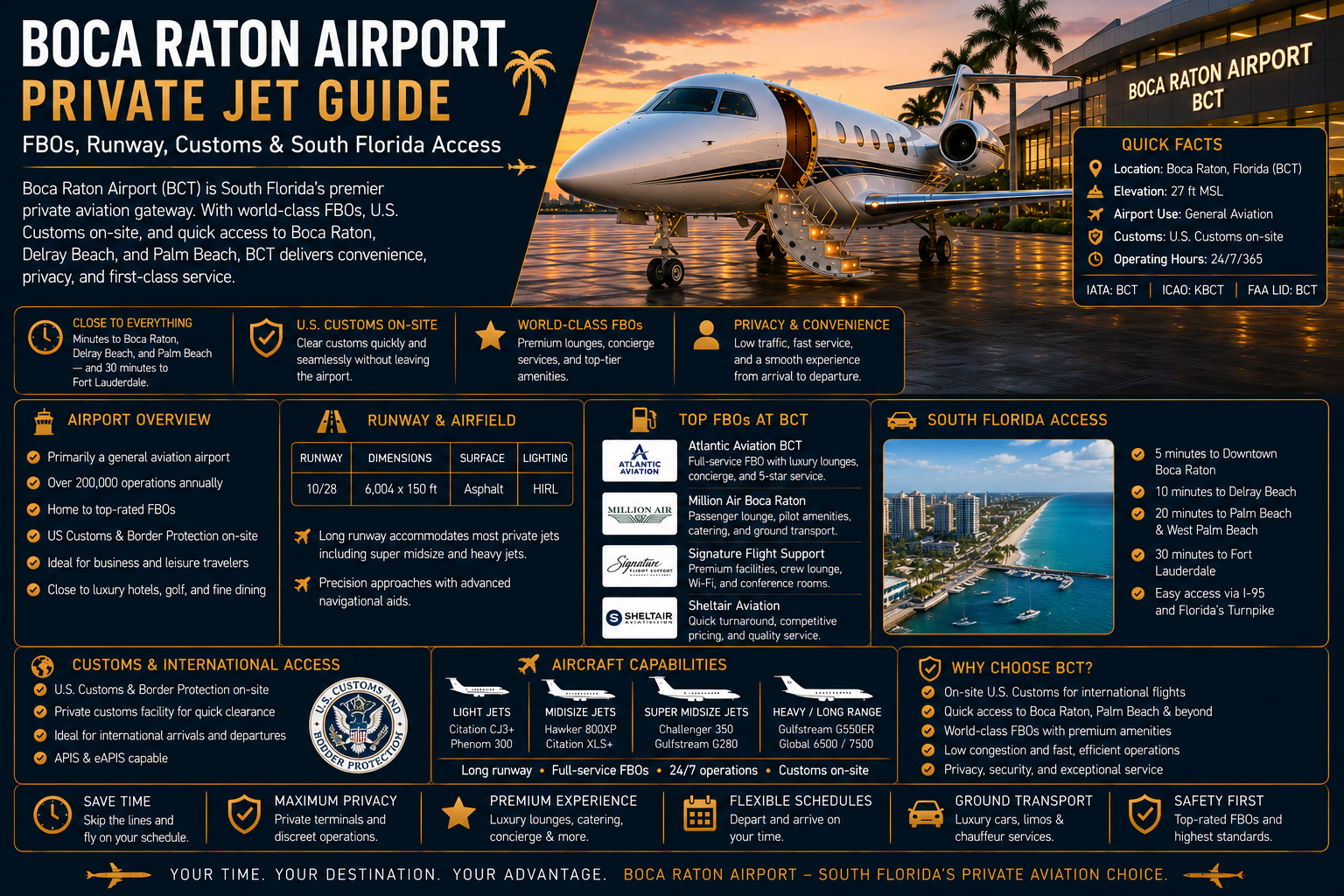
South Florida Private Aviation Airport Guide
Boca Raton Airport Private Jet Guide: FBOs, Runway, Customs & South Florida Access
Boca Raton Airport is a dedicated general aviation airport serving one of South Florida's most important luxury residential and business markets. BCT combines a 6,276-foot runway, private aviation FBOs, an air traffic control tower and an on-field U.S. Customs and Border Protection facility with direct access to Boca Raton and surrounding coastal communities.
Boca Raton Airport uses the FAA and IATA identifier BCT and the ICAO identifier KBCT.
Unlike nearby Palm Beach's primary mixed-use airport or Fort Lauderdale-Hollywood International, Boca Raton Airport is focused on general aviation rather than scheduled airline passenger service.
Therefore, private aircraft, charter operations, corporate aviation, aircraft owners and aviation businesses form the core of the airport environment.
That distinction can create a highly efficient private aviation experience.
Passengers generally operate through dedicated FBO facilities rather than a commercial airline terminal.
Consequently, the passenger can move from aircraft to ground transportation without navigating the traditional airline-terminal process.
However, convenience is only part of the reason Boca Raton Airport matters.
Geography can be even more important.
The Boca Raton Airport Authority describes BCT as being conveniently positioned off I-95, approximately midway between West Palm Beach and Fort Lauderdale.
Therefore, the airport occupies a strategically useful position within the South Florida private aviation network.
For passengers whose destination is Boca Raton itself, that positioning can substantially reduce unnecessary ground travel.
Likewise, BCT may be relevant for portions of Delray Beach and southern Palm Beach County.
However, another airport may create a stronger itinerary when the passenger is traveling farther north or south.
Consequently, BCT should be evaluated alongside Palm Beach, Opa-locka, Fort Lauderdale-area airports and other practical South Florida options.
The key is not to select the airport with the most familiar name.
Instead, the goal is to minimize total door-to-door friction.
Boca Raton's runway is a major part of that decision.
The airport has one primary runway, Runway 5/23.
Current airport information lists the runway at approximately 6,276 feet long and 150 feet wide.
Therefore, BCT provides useful capability for many business aviation aircraft.
However, its runway is materially shorter than the 10,000-foot primary runway at Palm Beach or the approximately 8,000-foot primary runway at Opa-locka.
Consequently, aircraft performance becomes particularly important when evaluating larger jets, heavy fuel loads, hot weather or long-range missions.
A successful landing at Boca Raton does not automatically mean the same aircraft can depart at every possible weight.
Therefore, the operator should calculate each mission using the actual aircraft, passengers, baggage, fuel, weather and runway condition.
This mission-specific approach is especially important for large-cabin and long-range aircraft.
The aircraft may arrive relatively light after burning fuel.
However, it could require a substantially heavier fuel load for the next departure.
Consequently, an aircraft that comfortably arrives at BCT may require different planning for the outbound mission.
The airport's FBO infrastructure supports private aviation passengers and aircraft directly.
Boca Raton Airport currently identifies Atlantic Aviation and Signature Aviation among its FBO operators.
Therefore, passengers and crews can coordinate aircraft handling, fuel, parking, transportation and other mission requirements through dedicated business aviation facilities.
However, FBO selection should still be made around the complete mission.
One aircraft may require only a short passenger drop and fuel uplift.
Meanwhile, another may need overnight parking, catering, crew transportation and additional services.
Consequently, facility selection should balance passenger preferences with aircraft requirements.
International capability is another major advantage.
Boca Raton Airport operates a dedicated U.S. Customs and Border Protection facility for qualifying international arrivals.
The airport describes the facility as approximately 4,400 square feet.
Therefore, qualifying private aircraft can return directly to Boca Raton from international destinations when current CBP requirements are satisfied.
This capability can be particularly valuable for passengers traveling between Boca Raton and the Bahamas or Caribbean.
Without a local customs facility, an international aircraft might otherwise need to clear at another airport before repositioning to Boca Raton.
Consequently, direct customs capability can remove an extra flight segment from some missions.
However, current customs availability requires careful planning.
The Boca Raton Airport Authority currently states that regular customs clearance is unavailable on Tuesdays and Wednesdays.
Regular published hours on other days remain Thursday through Monday from 10:30 a.m. to 6:30 p.m.
Additionally, after-hours clearance may be available by arrangement except on Tuesdays and Wednesdays.
Therefore, international travelers should never assume that customs is available simply because the airport itself is operating.
The operator should verify current CBP availability before the aircraft departs the foreign origin.
Furthermore, international private aviation remains subject to applicable permission-to-land, eAPIS, documentation and inspection requirements.
Consequently, customs capability creates flexibility only when the mission is properly coordinated.
Boca Raton Airport also operates with an air traffic control tower.
The FAA lists Boca Raton Tower within the federal contract tower program.
Therefore, private aircraft operate inside a controlled airport environment during tower operating hours.
The airport still handles a diverse mix of general aviation aircraft.
Consequently, business jets may share the environment with piston aircraft, training operations and other general aviation traffic.
This mixed aircraft environment reinforces the importance of experienced flight crews and current airport information.
Passengers do not need to manage those technical details themselves.
However, airport-specific procedures can influence arrival and departure timing.
Noise is another important consideration.
Boca Raton Airport operates inside a developed South Florida community.
Therefore, the airport maintains noise-abatement information and community-noise programs.
Operators should review applicable procedures for the actual aircraft and mission.
Consequently, private aviation convenience should remain balanced with responsible airport operations.
South Florida weather also matters.
Thunderstorms can develop rapidly during the warmer months.
Heavy rainfall can affect runway conditions and visibility.
Additionally, tropical systems can disrupt the entire region.
Therefore, Boca Raton private aviation planning should consider both local weather and broader South Florida conditions.
Runway performance can also change in high temperatures.
Higher temperatures reduce air density.
Consequently, aircraft may require additional runway or face different payload limitations during hotter conditions.
That effect becomes increasingly relevant for heavier aircraft.
Therefore, BCT's 6,276-foot runway should always be considered in combination with actual weather and aircraft weight.
Boca Raton's passenger market makes the airport especially valuable.
The city combines luxury residential communities, business activity, resorts, golf, private clubs and coastal leisure travel.
Therefore, BCT can serve executives, family offices, seasonal residents, aircraft owners and luxury leisure travelers.
It can also support recurring travel patterns.
A passenger may regularly move between Boca Raton and New York.
Another may travel frequently between South Florida and the Bahamas.
Others may connect Boca Raton with Chicago, Dallas, Aspen or other major markets.
Consequently, BCT can function as one recurring node inside a broader private aviation network.
Family-office travel is particularly relevant.
A principal may travel with family members, assistants, security personnel, pets and substantial baggage.
Therefore, aircraft selection should account for the complete traveling party.
Likewise, the ground transportation plan may require several vehicles.
Consequently, passenger logistics should be communicated to the operator and FBO before arrival.
Executive travel creates a different mission profile.
Boca Raton contains significant business and professional activity.
Therefore, executives may use BCT for meetings, investment activity and multi-city business travel.
The aircraft can provide schedule control.
Additionally, the airport's proximity to local business and residential destinations can reduce ground time.
Consequently, the value of Boca Raton private aviation often comes from the complete workday rather than the airborne time alone.
Luxury leisure travel adds another dimension.
Passengers may arrive for resorts, private residences, golf, dining or coastal activities.
Therefore, baggage can become important.
Golf clubs and extended-stay luggage can require more capacity than passenger count suggests.
Consequently, selecting an aircraft only because it has enough seats can create a poor mission fit.
Boca Raton's geographic position also makes it ideal for airport comparison content.
For some passengers, Palm Beach will be the stronger airport.
For others, Opa-locka may provide better Miami access.
Meanwhile, Boca Raton can be exceptionally efficient when the final destination lies close to BCT.
Therefore, this page serves as an important connecting node between the Palm Beach and Miami portions of the private aviation airport hub.
This guide examines the complete Boca Raton mission.
It covers runway capability, aircraft performance, FBOs, parking, customs, tower operations, noise, weather, Boca Raton ground access, aircraft categories, private aviation routes, family-office travel, executive travel, luxury travel and South Florida airport comparisons.
Additionally, it connects Boca Raton with Palm Beach, Opa-locka, Teterboro and the broader Private Aviation Airports hub.
Consequently, BCT becomes another strategic airport authority node rather than a standalone airport description.
Direct Boca Raton Answer
Why Is Boca Raton Airport Important for Private Aviation?
Direct Answer: Boca Raton Airport is important because it gives private aviation travelers direct access to Boca Raton through a dedicated general aviation airport with FBO services, a 6,276-foot runway, an air traffic control tower and on-field U.S. Customs. BCT can reduce unnecessary ground travel when Boca Raton or nearby South Palm Beach County is the passenger's destination.
BCT's strongest advantage is location.
Therefore, the airport should be evaluated first by asking where the passenger is actually going after landing.
When the destination is Boca Raton, using BCT can eliminate a longer ground transfer from another South Florida airport.
That can preserve one of private aviation's primary advantages: total travel-time efficiency.
Direct Local Access
BCT can provide a highly efficient airport option for passengers whose final destination is within the Boca Raton market.
Private Aviation Focus
The airport is focused on general aviation rather than scheduled airline passenger service.
6,276-Foot Runway
Runway 5/23 provides useful business aviation capability while making aircraft-performance planning particularly important for heavier missions.
Business Aviation Services
Dedicated FBO facilities support private passengers, aircraft, crews, fuel and ground transportation.
International Arrivals
On-field CBP processing can allow qualifying international aircraft to clear directly at Boca Raton.
Airport Choice
BCT adds another strategic option between Palm Beach and the greater Fort Lauderdale and Miami aviation markets.
Why Isn't Boca Raton Airport Automatically Best for Every Boca-Area Passenger?
Aircraft capability can change the answer.
BCT's 6,276-foot runway is substantial.
However, other South Florida airports offer longer runways.
Therefore, some heavier or longer-range aircraft missions may deserve comparison with Palm Beach or another airport.
Additionally, customs availability and parking can influence the mission.
Consequently, the best airport should solve both the passenger's geography and the aircraft's requirements.
Boca Raton Airport's greatest strength is eliminating unnecessary ground travel when the passenger is actually going to Boca Raton.
However, runway performance, aircraft size, customs, parking and the next flight should still be evaluated before BCT becomes the final airport choice.
Local Airport Advantage
Why Do Private Jet Travelers Use Boca Raton Airport?
Direct Answer: Private jet travelers use Boca Raton Airport because it places them directly in the Boca Raton market while providing a dedicated general aviation environment, FBO services and international customs capability. For travelers staying locally, BCT can reduce ground time that might otherwise be added by arriving through Palm Beach, Fort Lauderdale or Miami-area airports.
Private aviation should shorten the entire trip.
Therefore, airport geography matters as much as aircraft speed.
A passenger can save time in the air yet lose that advantage during a long ground transfer.
Consequently, Boca Raton Airport can create meaningful value for local passengers.
Boca Raton Residences
Passengers traveling to local residences can reduce unnecessary ground travel from more distant regional airports.
Business Travel
Executives can connect directly with Boca Raton offices, meetings and professional destinations.
Luxury Resorts
Private aviation can be coordinated around resorts, clubs and high-end leisure travel.
Golf Travel
Golf-focused passengers can select aircraft and vehicles around clubs, bags and group size.
International Travel
On-field CBP capability can eliminate an additional customs stop for qualifying international missions.
Family Offices
BCT can support recurring principal, family, staff and second-home travel within a wider aviation network.
Can BCT Be More Convenient Than Palm Beach?
For a Boca Raton passenger, yes.
Palm Beach offers greater runway capability.
However, the aircraft still needs to deliver the passenger to the correct destination.
Therefore, BCT can create a stronger door-to-door itinerary when aircraft performance and other requirements fit the airport.
Can BCT Be More Convenient Than Opa-locka?
Again, geography matters.
Opa-locka can be highly effective for northern Miami-Dade destinations.
However, flying farther south than necessary can increase the passenger's ground journey back toward Boca Raton.
Therefore, BCT deserves serious consideration when Boca itself is the destination.
Private aviation airport selection should follow the passenger—not the airport hierarchy.
A smaller airport closer to the destination can sometimes produce a better total itinerary than a larger airport with greater runway capability.
South Florida General Aviation
What Role Does Boca Raton Airport Play in South Florida Aviation?
Direct Answer: Boca Raton Airport functions as a dedicated general aviation facility positioned between the Palm Beach and Fort Lauderdale markets. Rather than serving scheduled airline passengers, BCT supports private aircraft, charter operations, corporate aviation, aircraft owners, flight activity and aviation businesses serving Boca Raton and the surrounding South Florida market.
South Florida contains several airports with different roles.
Palm Beach supports airlines and substantial business aviation.
Opa-locka focuses heavily on general and business aviation in the Miami market.
Boca Raton fills another important niche.
It provides dedicated general aviation access directly within Boca Raton.
Therefore, the airport can solve missions that do not require the infrastructure of a larger mixed-use airport.
Business Jets
Corporate and privately operated aircraft form an important part of the airport's mission.
On-Demand Travel
Charter operators can use BCT when the aircraft and passenger mission fit airport capability.
Home-Based Aviation
Aircraft ownership, hangars and aviation businesses form part of the broader airport ecosystem.
CBP Processing
On-field customs allows qualifying international general aviation arrivals to clear directly at BCT.
Executive Travel
Boca Raton's commercial and professional economy creates recurring executive aviation demand.
South Florida Airport Network
BCT provides another airport option between larger Palm Beach, Fort Lauderdale and Miami aviation markets.
Why Is a General Aviation Airport Useful to Private Jet Passengers?
The airport does not need to process large volumes of scheduled airline passengers.
Therefore, private aviation is central to the airport environment.
Passengers operate through FBO facilities.
Additionally, aircraft services are designed around general aviation needs.
Consequently, the airport can provide a highly focused private aviation experience.
Boca Raton Airport does not need to be the largest South Florida airport to be the best airport for a Boca Raton passenger.
Its value comes from combining private aviation infrastructure with highly specific destination geography.
BCT Quick Reference
What Should Private Jet Travelers Know About Boca Raton Airport?
Direct Answer: Boca Raton Airport uses the identifiers BCT and KBCT, operates as a general aviation airport and has one primary runway measuring approximately 6,276 by 150 feet. The airport supports business aviation FBOs, an air traffic control tower and a dedicated U.S. Customs and Border Protection facility for qualifying international arrivals.
| Airport Detail | Boca Raton Information | Why It Matters |
|---|---|---|
| Airport | Boca Raton Airport | Dedicated general aviation airport serving the Boca Raton market |
| IATA / FAA Identifier | BCT | Primary domestic airport identifier |
| ICAO Identifier | KBCT | Used in international aviation and flight planning |
| Airport Role | General aviation | Private and corporate aviation are central to airport activity |
| Runway | 5/23 | The airport operates with one primary runway |
| Runway Size | Approximately 6,276 × 150 feet | Useful for many business aviation missions while making performance planning important |
| FBOs | Includes Atlantic Aviation and Signature Aviation | Supports aircraft handling, fuel and passenger services |
| Control Tower | FAA Contract Tower | Provides controlled airport operations during published tower hours |
| Customs | On-field CBP user-fee facility | Can support qualifying international private aviation arrivals |
| Current Regular Customs Availability | Thursday–Monday, 10:30 a.m.–6:30 p.m.; unavailable Tuesdays and Wednesdays under current airport notice | International arrival timing requires advance verification |
| Location | Boca Raton, Florida | Provides direct access to the Boca Raton and South Palm Beach County market |
Why Is the Runway Length One of BCT's Most Important Facts?
Because it helps define the aircraft mission.
A 6,276-foot runway provides substantial business aviation capability.
However, it differs materially from the longer primary runways available at Palm Beach and Opa-locka.
Therefore, large aircraft and long-range departures require especially careful performance planning.
Heat, fuel and payload can all change the equation.
Consequently, the crew should evaluate the actual aircraft and mission rather than simply confirming that the aircraft type has used BCT before.
BCT combines direct Boca Raton access with a more compact runway environment than several neighboring South Florida airports.
That combination creates excellent opportunities for suitable aircraft while making mission-specific performance planning essential.
Runway 5/23
How Long Is the Runway at Boca Raton Airport?
Direct Answer: Boca Raton Airport's Runway 5/23 is approximately 6,276 feet long and 150 feet wide. The runway is paved, lighted and grooved. It supports many private and business aviation missions, although actual aircraft compatibility depends on weight, fuel, temperature, wind, runway condition and aircraft-specific performance.
BCT operates with one primary runway.
Therefore, runway availability is particularly important to airport operations.
Unlike a multi-runway airport, Boca Raton does not have another primary runway available when Runway 5/23 is unavailable.
Consequently, maintenance, closures or other runway conditions can have a significant operational effect.
Single Runway
Boca Raton operates with one principal runway rather than a multi-runway system.
Runway Length
The runway provides useful capability across many private jet categories.
Runway Width
The runway maintains a 150-foot width across the operating surface.
Runway Surface
The airport's paved runway incorporates grooving as part of its operating surface.
Runway Safety
The airport has invested in engineered runway safety improvements, including an Engineered Materials Arresting System project.
Mission Specific
Aircraft weight, heat, wind and runway condition remain critical to each takeoff and landing calculation.
Is 6,276 Feet Enough for a Private Jet?
For many private jet missions, yes.
However, the question should never be answered by runway length alone.
A smaller jet on a regional mission creates very different requirements from a large-cabin aircraft carrying substantial fuel.
Therefore, aircraft-specific takeoff and landing calculations determine whether the flight works.
Why Does a Single Runway Matter?
Redundancy is more limited.
If Runway 5/23 becomes unavailable because of maintenance or another operational issue, the airport does not have a second runway to absorb normal operations.
Therefore, current NOTAMs are particularly important before a BCT flight.
Boca Raton's runway can support substantial business aviation, but every aircraft should earn its answer through the actual performance calculation.
Aircraft model, operating weight, fuel, temperature, wind and runway condition matter more than whether another aircraft of the same type has previously used BCT.
Runway + Weight + Heat
How Does Aircraft Performance Affect Boca Raton Airport Selection?
Direct Answer: Aircraft performance is especially important at Boca Raton because BCT's 6,276-foot runway is shorter than the primary runways at several nearby South Florida airports. Aircraft weight, fuel, temperature, wind, runway condition and destination requirements determine whether the exact mission fits BCT comfortably or whether another airport should be considered.
This does not make Boca Raton unsuitable for private jets.
Instead, it makes aircraft selection more important.
A well-matched aircraft can create an extremely efficient Boca Raton mission.
However, forcing an aircraft into a mission that requires uncomfortable performance compromises defeats the purpose of private aviation.
Aircraft Weight
Passengers, baggage and fuel determine the actual weight used in performance calculations.
Fuel Load
A short flight requires less fuel than a long-range departure, which can materially change takeoff weight.
South Florida Heat
Higher temperatures can reduce aircraft performance and become especially relevant for heavier departures.
Wind
Wind direction and speed influence both runway use and aircraft performance.
Wet Runway
Heavy Florida rain can affect runway condition and aircraft braking calculations.
Destination
The next route determines how much fuel the aircraft requires and therefore influences departure weight.
Why Can BCT Work Better for a Short Bahamas Mission Than a Long West Coast Flight?
Fuel weight is one reason.
A short international flight to the Bahamas may require much less fuel than a transcontinental mission.
Therefore, the aircraft can depart at a lower weight.
Meanwhile, a long West Coast flight may require a larger fuel load.
Consequently, aircraft performance margins can change even when the passenger count remains identical.
Can Travelers Use Another Airport if the Mission Does Not Fit BCT?
Yes.
That flexibility is one of South Florida private aviation's advantages.
Palm Beach offers a significantly longer primary runway.
Opa-locka also provides substantial runway capability farther south.
Therefore, another airport can be selected when aircraft performance outweighs BCT's ground-location advantage.
The ideal Boca Raton mission balances ground efficiency against aircraft performance.
BCT can save substantial ground time, but another airport may become the stronger choice when the aircraft requires runway capability that outweighs the local-access advantage.
Door-to-Door Boca Raton Planning
How Does Boca Raton Airport Connect With Local Destinations?
Direct Answer: Boca Raton Airport's primary advantage is direct access to Boca Raton and nearby South Palm Beach County destinations. Travelers can coordinate private vehicles directly through the FBO and reduce the ground transfer associated with more distant airports. However, Delray Beach, Fort Lauderdale, Palm Beach and other destinations should still be compared using realistic ground travel.
The airport is located directly within the Boca Raton market.
Therefore, local passengers can potentially preserve a significant amount of ground time.
That becomes especially valuable after a longer private flight.
Boca Raton
BCT is strategically positioned for residences, businesses, resorts and clubs throughout the local Boca Raton market.
Coastal Boca
Passengers traveling toward coastal residences and hospitality destinations can coordinate direct FBO-to-vehicle transportation.
West Boca
Ground transportation should be planned around the actual property because Boca Raton extends well west of the coastal corridor.
Delray Beach
Nearby Delray Beach can make BCT worth comparing with other Palm Beach County airport options.
Palm Beach
Passengers traveling significantly farther north should compare BCT with Palm Beach's larger airport.
Fort Lauderdale
Travelers heading south should compare Boca Raton with airports more directly aligned with the Fort Lauderdale destination.
When Is Boca Raton Airport Most Valuable?
BCT creates the clearest advantage when the passenger's destination is genuinely close to Boca Raton.
In that situation, a larger regional airport may add unnecessary driving.
Therefore, a suitable aircraft operating directly into BCT can produce a highly efficient trip.
When Should Palm Beach Be Considered Instead?
Palm Beach can become attractive when the aircraft benefits from its longer runway or when the passenger's ground destination lies farther north.
Additionally, specific parking or international requirements may affect the comparison.
Therefore, the strongest answer depends on both sides of the mission.
Boca Raton Airport is valuable because it can place the aircraft close to where the passenger actually wants to be.
That local advantage should be weighed against aircraft performance, customs, parking and the passenger's next flight before final airport selection.
Who Uses BCT?
Which Travelers Commonly Use Boca Raton Airport?
Direct Answer: Boca Raton Airport serves private aircraft owners, charter passengers, executives, family offices, seasonal residents, international travelers, golfers and luxury leisure passengers. Because these traveler profiles have different schedules, baggage, cabin, vehicle and international requirements, the strongest BCT mission should be designed around the actual passenger rather than a generic private jet itinerary.
Principal Travel
Principals may use BCT for recurring residence, business and leisure travel across multiple markets.
Business Aviation
Corporate travelers can coordinate private flights directly around Boca Raton meetings and schedules.
South Florida Residents
Recurring seasonal travel can create established private aviation patterns between Boca Raton and northern markets.
Bahamas + Caribbean
On-field customs capability can make BCT useful for qualifying international returns.
Club Travel
Golf bags and extended stays can increase aircraft and ground-vehicle baggage requirements.
Home-Based Aviation
Boca Raton supports aircraft ownership, hangars and broader private aviation services.
Leisure Travel
Private residences, resorts, dining, boating and clubs create high-end leisure travel demand.
On-Demand Travelers
Charter passengers can use BCT when aircraft capability and itinerary requirements align with the airport.
Why Does Traveler Type Change the Aircraft Decision?
Because passengers use aircraft space differently.
Three executives carrying overnight bags create a very different payload from three seasonal residents carrying several weeks of luggage.
Likewise, golfers can add large club cases.
Family offices may add staff or pets.
Therefore, advertised passenger seats do not reveal whether an aircraft actually fits the mission.
BCT aircraft selection should begin with what the passengers are actually bringing with them.
Passenger count, baggage, pets, staff, cabin needs and route distance should be considered together before the aircraft category is finalized.
South Florida Airport Authority Network
How Does Boca Raton Fit Into the Private Aviation Airport Ecosystem?
Direct Answer: Boca Raton Airport fills an important geographic position between the Palm Beach and Miami private aviation markets. Within the larger airport authority ecosystem, BCT connects Boca Raton destination research with Palm Beach, Opa-locka, international Caribbean routes, aircraft-performance questions and broader South Florida airport comparisons.
BCT should not exist as an isolated airport page.
Instead, it strengthens the entire South Florida airport cluster.
A traveler researching Boca Raton can compare BCT with Palm Beach.
Likewise, another passenger can compare it with Opa-locka when continuing farther south.
Therefore, internal links between these airports help users understand the regional decision rather than forcing them to research each airport independently.
Private Aviation Airports
Compare FBOs, runways, customs and airport-selection strategy across major business aviation markets.
Palm Beach Airport
Compare BCT with Palm Beach's longer-runway mixed-use airport when the passenger or aircraft mission points farther north.
Opa-locka Executive Airport
Compare Boca Raton with one of Miami's major private and business aviation airports.
Why Is Boca Raton an Important Hub Spoke?
Because it answers a different airport-intent question from Palm Beach or Miami.
The traveler is not simply asking where private jets can land in South Florida.
Instead, the buyer is asking which airport best solves a Boca Raton trip.
Therefore, BCT deserves its own detailed authority page.
South Florida private aviation authority becomes stronger when each important destination has an airport-level answer.
Boca Raton connects the Palm Beach and Miami airport clusters while solving a distinct high-intent local passenger question.
Operational Source Verification
Where Should Current Boca Raton Airport Information Be Verified?
Boca Raton Airport procedures, customs availability, runway information and airport notices can change.
Therefore, operators should verify current information before every flight.
The Boca Raton Airport Authority provides airport-specific operational notices and business aviation information.
Meanwhile, FAA publications should control current flight-planning and operational information.
International operators should also use current U.S. Customs and Border Protection procedures for the actual arrival.
Review current Boca Raton Airport Authority information →
Review FAA Contract Tower information →
Review current CBP Boca Raton general aviation information →
Aircraft-to-Destination Planning
How Should Ground Transportation Be Planned at Boca Raton Airport?
Direct Answer: Ground transportation at Boca Raton Airport should be coordinated with the selected FBO before arrival. Vehicle type, passenger count, luggage, golf equipment, pets, security requirements and the final Boca Raton destination should all be considered so the transition from aircraft to vehicle preserves the time advantage of private aviation.
Ground transportation is part of the aviation mission.
Therefore, it should not become an afterthought once the aircraft lands.
This is especially important at Boca Raton because local access is one of BCT's strongest advantages.
If the passenger chooses BCT specifically to reduce ground time, the vehicle should be ready when the aircraft arrives.
Consequently, the FBO and transportation provider should receive the arrival details in advance.
Individual Executive Travel
A premium sedan may work well for one or two passengers carrying conventional business luggage.
Family + Leisure Travel
Luxury SUVs can provide additional passenger and baggage capacity for families, golf equipment and extended stays.
Large Traveling Parties
Family offices and larger groups may require several coordinated vehicles rather than attempting to fit everyone into one SUV.
Protected Transportation
Passengers with security requirements can coordinate vehicles, drivers and other logistics around the aircraft arrival.
Independent Mobility
Rental vehicles can be coordinated when passengers prefer independent transportation during an extended Boca Raton stay.
Vehicle Capacity
The ground vehicle must accommodate the same luggage, golf clubs and equipment that arrived on the aircraft.
Why Should Baggage Be Considered When Selecting the Vehicle?
Because aircraft capacity and vehicle capacity are two different problems.
A large-cabin aircraft may easily accommodate a family's luggage.
However, one conventional SUV may not.
Likewise, golf equipment can consume substantial cargo space.
Therefore, the transportation provider should know what the passengers are carrying before arrival.
Should the Driver Know Which FBO the Aircraft Is Using?
Yes.
The driver should receive the airport, FBO, arrival time and passenger information required for the pickup.
Additionally, any security or special-access requirements should be coordinated in advance.
Consequently, the passenger can move through the FBO efficiently rather than trying to locate transportation after landing.
The ground vehicle should be treated as the final leg of the private flight.
BCT creates its greatest advantage when the aircraft arrival, FBO and vehicle work together to move the passenger directly toward the actual Boca Raton destination.
BCT Fixed-Base Operators
Which FBOs Serve Private Jets at Boca Raton Airport?
Direct Answer: Boca Raton Airport is served by full-service business aviation facilities including Atlantic Aviation and Signature Aviation. FBO selection can affect passenger handling, aircraft parking, hangar availability, fuel, crew services, transportation and other mission requirements, so operators should confirm the facility that best fits the specific aircraft and trip.
The FBO is the private aviation passenger's primary ground facility.
Therefore, it performs a role similar to a private terminal while also supporting the aircraft and crew.
At Boca Raton, passengers generally use these facilities rather than a commercial airline terminal.
| FBO | Mission Role | What to Confirm |
|---|---|---|
| Atlantic Aviation | Full-service private and business aviation support | Ramp availability, hangar requirements, fuel, passenger transportation and current facility arrangements |
| Signature Aviation | Full-service private and business aviation support | Parking, aircraft services, passenger handling, crew requirements and transportation |
Current Atlantic Aviation information lists its BCT operation as open 24 hours and identifies services including hangar space, customs coordination, Wi-Fi, a pilot lounge, conference space and rental-car support. Atlantic also currently notes that its executive terminal is undergoing renovation and that it is operating from a temporary facility during the project. :contentReference[oaicite:0]
Should Passengers Choose the FBO or Should the Operator?
Either can influence the decision.
A frequent passenger may have a preferred FBO.
However, the operator may also have operational reasons for selecting a particular facility.
For example, aircraft parking, fuel arrangements or hangar requirements can affect the decision.
Therefore, passenger preference and aircraft logistics should be considered together.
Does the FBO Matter for a Quick Passenger Drop-Off?
Yes, although the decision may be simpler.
A short turn may prioritize fast passenger handling and fuel.
Meanwhile, an aircraft staying for several days may place greater importance on parking, hangar availability and crew support.
Consequently, the same passenger could reasonably use different FBO strategies for different trips.
Choose the FBO around the complete aircraft mission, not simply the passenger lounge.
Parking, fuel, hangar needs, transportation, crew requirements and passenger preferences can all influence which facility creates the strongest BCT operation.
Passenger + Aircraft Support
Which FBO Services Matter Most at Boca Raton Airport?
Direct Answer: Important BCT FBO services can include aircraft fueling, ramp handling, parking, hangar coordination, passenger lounges, crew facilities, rental vehicles, chauffeured transportation, catering coordination and international-arrival support. The services that matter most depend on whether the aircraft is making a short turn, remaining overnight or staying throughout the passenger's visit.
A private aviation trip creates two separate sets of needs.
The passenger needs transportation and a smooth terminal experience.
Meanwhile, the aircraft needs fuel, parking and operational support.
Therefore, a strong FBO handles both sides of the mission.
Fuel
Fuel requirements can depend on the aircraft's next destination and whether the aircraft will reposition after passenger arrival.
Ramp Handling
Aircraft arrival, parking and departure require coordinated ramp operations.
Hangar Space
Hangar requirements should be requested early because aircraft size and availability can affect whether indoor storage is practical.
Passenger Lounge
Passenger facilities provide a private environment when travelers need to wait before departure or ground transportation.
Crew Support
Pilot lounges, transportation and other crew services can matter when the aircraft remains in Boca Raton.
Transportation
Rental vehicles and chauffeured transportation can be coordinated around the passenger's arrival.
Should Catering Be Ordered Through the FBO?
The operator commonly coordinates catering with the appropriate providers and FBO.
However, the exact process depends on the aircraft and operator.
Therefore, passengers should communicate dietary preferences and special requests early.
This becomes especially important before an early departure or longer flight.
What Should Be Confirmed Before Arrival?
The operator should confirm fuel, parking, passenger transportation and any requested services.
Additionally, special baggage, pets or international requirements should be communicated.
Consequently, the FBO can prepare for the actual mission rather than reacting after the aircraft arrives.
Ramp + Hangar Strategy
How Does Aircraft Parking Work at Boca Raton Airport?
Direct Answer: Aircraft parking at Boca Raton Airport should be confirmed with the selected FBO before arrival, particularly during busy travel periods or for larger aircraft. Ramp capacity, wingspan, length of stay, hangar requirements and local traffic can affect whether the aircraft remains at BCT or whether repositioning becomes operationally preferable.
Parking can become one of the most overlooked parts of private aviation planning.
A passenger may assume the aircraft will remain exactly where it drops them off.
However, ramp availability can change that plan.
Therefore, the operator should determine the parking strategy before departure.
This becomes especially important for larger aircraft.
The Boca Raton Airport Authority currently warns that aircraft with wingspans greater than 79 feet can experience increased arrival and departure delays during periods of increased traffic. :contentReference[oaicite:1]
Short Turn
An aircraft may remain only long enough to unload passengers, refuel and continue to its next destination.
Same-Day Stay
The aircraft may remain on the ramp when the passenger plans to return later the same day.
Overnight Parking
Overnight arrangements should be confirmed before arrival rather than assumed.
Extended Stay
Longer Palm Beach County visits can create different ramp or repositioning requirements.
Hangar
Passengers or operators seeking indoor aircraft storage should verify availability and aircraft-size compatibility.
Repositioning
An aircraft may reposition elsewhere when keeping it at BCT is not operationally efficient.
What Happens if the Aircraft Repositions?
The passenger experience can remain largely unchanged.
However, the operator must reposition the aircraft back to BCT before the return departure.
Therefore, schedule changes require additional coordination.
If passengers decide to leave several hours earlier than planned, the aircraft may not already be on the field.
Consequently, communication becomes particularly important.
Should Parking Be Considered Before Booking the Aircraft?
For high-demand periods or unusually large aircraft, yes.
Aircraft size can affect ramp flexibility.
Therefore, airport and FBO compatibility should be evaluated as part of the aircraft-selection process.
The aircraft parking plan affects the return flight.
Knowing whether the jet will remain at BCT, move into a hangar or reposition elsewhere makes it easier to preserve schedule flexibility throughout the passenger's stay.
BCT Air Traffic Operations
Does Boca Raton Airport Have an Air Traffic Control Tower?
Direct Answer: Yes. Boca Raton Airport has an air traffic control tower, and the airport currently publishes tower hours of 7:00 a.m. to 11:00 p.m. During tower operation, BCT operates within Class D airspace. The airport itself remains available for operations outside tower hours subject to current airport, FAA, weather and operational requirements.
Boca Raton Airport's published pilot information identifies tower hours from 07:00 to 23:00 and Class D airspace during tower operation. :contentReference[oaicite:2]
Therefore, travelers should distinguish between airport operating availability and tower operating hours.
The airport does not simply close when the tower closes.
However, procedures change when the tower is not operating.
Consequently, flight crews must use the appropriate procedures for the actual arrival or departure time.
Tower Opens
Current BCT pilot information lists tower operations beginning at 7:00 a.m.
Tower Closes
Published tower operations continue through 11:00 p.m.
Controlled Airspace
BCT operates as Class D airspace during published tower hours.
Can Private Jets Arrive After the Tower Closes?
The airport itself is a public-use airport that remains available for flight operations.
However, pilots must follow the applicable procedures when the control tower is closed.
Additionally, Boca Raton maintains a voluntary nighttime noise curfew.
Therefore, operational capability should not automatically be interpreted as the preferred arrival time.
The Airport Authority's current FAQ states that the airport is open 24 hours while the tower operates from 7:00 a.m. until 11:00 p.m. :contentReference[oaicite:3]
Noise-Sensitive Airport Operations
How Do Noise-Abatement Procedures Affect Private Jets at Boca Raton Airport?
Direct Answer: Boca Raton Airport is surrounded by noise-sensitive communities and maintains voluntary noise-abatement procedures, including a voluntary nighttime curfew from 10:00 p.m. to 7:00 a.m. The airport also discourages certain repetitive operations, straight-in approaches and unnecessary reverse thrust, while air traffic control instructions and safe aircraft operation always take priority.
Boca Raton is not an isolated airport surrounded by undeveloped land.
Instead, it operates within a densely developed residential environment.
Therefore, community noise is an important part of airport management.
The Airport Authority states that its noise program includes pilot education, noise monitoring and flight tracking, including seven community noise monitors. :contentReference[oaicite:4]
| Noise Procedure | Current BCT Guidance | Why It Matters |
|---|---|---|
| Voluntary Night Curfew | 22:00–07:00 | Operators are asked to schedule flights outside these hours when possible |
| Runway 23 | Right traffic | Supports the airport's recommended operating pattern |
| Runway 5 | Left traffic | Supports the airport's recommended operating pattern |
| Straight-In Approaches | Discouraged | Part of the airport's voluntary noise strategy |
| Intersection Takeoffs | Discouraged | Full runway use is encouraged |
| Reverse Thrust | Minimize when practical | Helps reduce unnecessary aircraft noise |
| Touch-and-Go Activity | Limited voluntary operating window | Reduces repetitive aircraft noise around nearby neighborhoods |
Current airport guidance identifies the nighttime voluntary curfew as 22:00 to 07:00 and asks operators to plan flights outside those hours when practical. The airport also notes that ATC instructions supersede its voluntary noise procedures. :contentReference[oaicite:5]
Does the Voluntary Curfew Mean the Airport Closes at 10:00 p.m.?
No.
The airport's own FAQ states that BCT remains open for operations 24 hours a day.
However, the Airport Authority encourages pilots to limit activity between 10:00 p.m. and 7:00 a.m. to reduce nighttime noise. :contentReference[oaicite:6]
Therefore, the distinction matters.
A voluntary noise curfew is not the same thing as an airport closure.
BCT remains operational while also asking aircraft operators to respect the surrounding community.
Whenever practical, private aviation itineraries should account for the airport's 10:00 p.m. to 7:00 a.m. voluntary noise-curfew period.
International Private Aviation
Can International Private Jets Clear Customs at Boca Raton Airport?
Direct Answer: Yes. Boca Raton Airport has an on-field U.S. Customs and Border Protection user-fee facility that allows qualifying international aircraft to clear directly at BCT. Current regular clearance hours are Thursday through Monday from 10:30 a.m. to 6:30 p.m. Customs is currently unavailable Tuesdays and Wednesdays, including after-hours clearances on those days.
This capability is strategically important.
Before Boca Raton's customs facility opened in 2018, international aircraft returning to BCT had to stop at another airport to clear customs first.
Now, qualifying aircraft can clear directly at Boca Raton when current requirements and operating hours are satisfied. :contentReference[oaicite:7]
Regular Clearance
Current regular customs hours are 10:30 a.m. through 6:30 p.m. on operating days.
Closed
Current airport guidance states that customs clearance is unavailable on Tuesdays.
Closed
Current airport guidance also states that customs clearance is unavailable on Wednesdays.
Fee-Based Facility
BCT operates as a user-fee customs airport, so aircraft clearing fees apply.
Advance Request
After-hours clearance can be requested on eligible operating days and is subject to the applicable additional fee and approval.
Dedicated Facility
The Airport Authority describes its CBP facility as approximately 4,400 square feet.
The current Airport Authority customs page lists regular hours as Thursday through Monday from 10:30 a.m. to 6:30 p.m. and states that Tuesdays and Wednesdays are closed with no after-hours clearing available on those two days. :contentReference[oaicite:8]
Does Boca Raton Charge Aircraft to Clear Customs?
Yes.
BCT is a user-fee airport.
Current published aircraft clearing fees vary by aircraft category and maximum takeoff weight.
| Aircraft Category | Current Published User Fee |
|---|---|
| Single-Engine Piston | $50 |
| Twin-Engine Piston | $75 |
| Turboprop | $150 |
| Small Jet 20,000 lb MTOW or less |
$225 |
| Medium Jet 20,001–60,000 lb MTOW |
$325 |
| Large Jet More than 60,000 lb MTOW |
$425 |
| After-Hours / Overtime | $280 additional flat fee plus the regular clearing fee |
These are the Airport Authority's currently published rates and should be verified when the trip is planned because fees and procedures can change. :contentReference[oaicite:9]
Can Passengers Simply Arrive From Another Country and Clear Customs?
No.
International general aviation requires advance coordination.
The operator remains responsible for applicable CBP reporting, documentation and arrival requirements.
Therefore, the existence of an on-field customs facility does not eliminate pre-arrival procedures.
Why Is On-Field Customs So Valuable?
It can eliminate an intermediate customs stop.
For example, a qualifying aircraft returning from the Bahamas may be able to fly directly to BCT and clear there.
Without that capability, the aircraft could need to land elsewhere first.
Consequently, local customs can preserve both passenger time and aircraft efficiency.
International BCT missions should be built around customs availability before the aircraft departs the foreign airport.
Current customs hours, after-hours availability, aircraft fees and all applicable CBP arrival procedures should be confirmed for the exact date and time of travel.
BCT International Mission
How Does Boca Raton Airport Work for Private Flights to and From the Bahamas?
Direct Answer: Boca Raton Airport can be particularly useful for Bahamas private aviation because South Florida's geography creates relatively short international missions while BCT's on-field customs facility can support qualifying returns directly into Boca Raton. Travelers still need to coordinate destination-airport requirements, customs, immigration, passenger documents and current BCT clearance availability.
The Bahamas represents a natural private aviation market for South Florida.
Therefore, BCT's customs capability can be particularly valuable to Boca Raton residents and visitors.
A passenger can potentially depart from their local airport, travel internationally and return directly to the same airport.
Consequently, the trip can avoid unnecessary repositioning through a more distant customs airport.
Short International Mission
Many Bahamas routes require substantially less fuel than long-range international flights, which can benefit aircraft performance at BCT.
Direct Return to Boca
Qualifying aircraft can use BCT's customs facility rather than automatically clearing at another South Florida airport.
Multiple Island Airports
The exact Bahamas destination determines runway, customs, fuel and operating requirements on the outbound side of the mission.
Why Can Aircraft Selection Matter Even on a Short Bahamas Flight?
Island airports vary substantially.
Some offer long paved runways and significant aviation infrastructure.
Others are more restrictive.
Therefore, the aircraft must work at both BCT and the destination airport.
Additionally, passenger count and baggage still matter.
Consequently, the shortest route does not automatically mean the smallest aircraft is best.
What Should Be Planned Before Returning to Boca Raton?
The operator should confirm current BCT customs availability.
Additionally, all required international reporting and documentation should be completed.
The passenger's expected arrival time should fit the approved customs plan.
Therefore, an international return should never rely on assumed customs availability.
Boca Raton Airport's current customs schedule should be verified directly through the :contentReference[oaicite:10] before travel. :contentReference[oaicite:11]
Regional International Aviation
How Does BCT Support Caribbean Private Aviation?
Direct Answer: Boca Raton can serve as a useful origin and return airport for Caribbean private aviation when the aircraft, destination and customs requirements fit the mission. The aircraft must be selected around range, passengers, baggage and destination-airport capability, while the return should be coordinated around BCT's current U.S. Customs availability.
Caribbean missions extend beyond the Bahamas.
Therefore, flight distance and fuel requirements can vary substantially.
A nearby island mission may work comfortably with a smaller aircraft.
Meanwhile, a longer Caribbean flight may favor greater range and cabin capacity.
Range
Aircraft category should match the actual island destination rather than the broad label of Caribbean travel.
Island Runways
The destination airport may create greater runway constraints than Boca Raton itself.
Baggage
Vacation travel can produce significant luggage requirements even when passenger count is relatively small.
Customs
Both outbound destination procedures and U.S. return requirements must be coordinated.
Weather
Tropical weather can affect both South Florida and island destinations.
Alternates
Operators may need appropriate alternate-airport planning based on destination weather and infrastructure.
A Caribbean mission must work at both ends of the route.
BCT may fit the Boca Raton side perfectly, but destination runway capability, fuel, customs, weather and ground services still determine the complete aircraft strategy.
South Florida Operating Environment
How Does Weather Affect Private Jet Operations at Boca Raton Airport?
Direct Answer: Boca Raton private jet operations can be affected by thunderstorms, heavy rain, wind, heat, reduced visibility and tropical weather. Conditions can change aircraft performance, routing, departure timing and runway requirements. Operators should evaluate current BCT weather together with destination and en-route conditions immediately before each flight.
South Florida weather can change rapidly.
Therefore, an itinerary created several days earlier cannot predict the exact operating conditions at departure.
Thunderstorms are particularly important.
They can affect routes, airport traffic flow and passenger timing.
Thunderstorms
Convective weather can require rerouting, departure delays or temporary changes in airport traffic flow.
Heavy Rain
Rain can reduce visibility and change runway-surface conditions used in aircraft performance calculations.
Heat
Higher temperatures reduce air density and can increase required takeoff distance for some aircraft.
Wind
Wind direction and speed influence runway use and aircraft performance.
Tropical Systems
Tropical storms and hurricanes can affect aircraft positioning, airport operations and the broader South Florida region.
Destination Weather
Clear conditions at Boca Raton do not guarantee that the destination or route is unaffected.
Why Does Heat Matter More at BCT Than Passengers May Expect?
Runway performance changes with atmospheric conditions.
As temperature increases, aircraft performance can decrease.
Therefore, a heavier aircraft departing BCT on a hot day may face different limitations than the same aircraft operating in cooler conditions.
This does not mean the flight cannot operate.
Instead, it reinforces the need for aircraft-specific calculations.
Can Thunderstorms Delay a Private Jet?
Yes.
Private aviation provides schedule flexibility, but it does not eliminate weather.
Air traffic control restrictions, lightning, ramp conditions and route deviations can all affect the mission.
Therefore, safety and current operating conditions remain more important than the original schedule.
Private aviation provides schedule control—not control over the weather.
The strongest Boca Raton mission preserves flexibility so the operator can adapt the route, timing or fuel plan when South Florida conditions change.
Tropical Weather Strategy
How Do Tropical Storms and Hurricanes Affect Boca Raton Private Aviation?
Direct Answer: Tropical systems can affect Boca Raton private aviation long before storm conditions reach the airport. Aircraft owners and operators may reposition jets away from South Florida, while FBOs, crews and airports implement storm preparations. Passengers traveling during hurricane season should maintain schedule flexibility and coordinate early when a system could affect the region.
Aircraft do not need to remain in South Florida until a hurricane arrives.
Instead, operators may reposition aircraft well in advance.
Therefore, a passenger planning to depart shortly before a storm cannot assume their normal aircraft will remain at BCT indefinitely.
Early communication becomes especially important.
Repositioning
Operators may move aircraft away from the projected storm area before local conditions deteriorate.
Storm Preparation
FBO operations can change as facilities prepare equipment, ramps and personnel for severe weather.
Availability
Crew positioning and personal safety considerations can influence flight availability.
Departure Surge
Aircraft demand can increase when travelers attempt to leave South Florida before a storm.
Regional Effects
Weather can disrupt airports and routes across a broad area rather than affecting only Boca Raton.
Post-Storm Planning
Returning after a storm requires confirmation that airport, FBO and destination conditions support the mission.
Should Travelers Wait Until an Evacuation Is Necessary?
Private aviation planning is generally stronger when passengers act before demand and operating constraints intensify.
However, the appropriate decision depends on the actual storm and official guidance.
Therefore, passengers should coordinate with their operator while following government emergency information.
What Happens to an Aircraft Based at BCT?
The owner or operator may decide to reposition it to another airport outside the expected storm area.
Alternatively, other protective arrangements may be used depending on the aircraft and circumstances.
Consequently, aircraft location can change before passenger plans do.
Hurricane planning begins before the weather reaches Boca Raton.
Aircraft positioning, crew availability, passenger demand, FBO preparation and regional airspace conditions can all begin changing while local weather still appears normal.
Current Operational Verification
Verify Current BCT Information Before Flight
Airport procedures, customs availability, FBO conditions, fees and operational notices can change.
Therefore, flight crews and operators should verify current information for the exact mission rather than relying solely on static airport guides.
The :contentReference[oaicite:12] currently publishes airport notices, customs information, pilot guidance and noise-abatement procedures. :contentReference[oaicite:13]
Current customs guidance confirms regular clearance Thursday through Monday from 10:30 a.m. to 6:30 p.m., with Tuesday and Wednesday unavailable for both regular and after-hours clearance. :contentReference[oaicite:14]
Aircraft + Mission Matching
Which Private Jets Work Well at Boca Raton Airport?
Direct Answer: Boca Raton Airport can support many light, midsize, super-midsize and large-cabin private jet missions. However, BCT's approximately 6,276-foot runway makes aircraft-specific performance especially important. The best aircraft depends on route distance, passengers, baggage, fuel, weather and required departure weight rather than aircraft category alone.
Boca Raton does not require one specific type of private jet.
Instead, the airport serves a wide range of general aviation aircraft.
Therefore, aircraft selection should begin with the mission.
A two-hour regional flight carrying four passengers creates very different requirements from a nonstop transcontinental flight carrying ten passengers and substantial baggage.
Additionally, arrival and departure requirements can differ.
An aircraft arriving at BCT may have already burned a significant amount of fuel.
Therefore, its landing weight may be considerably lower than its required departure weight for the next flight.
Consequently, operators must evaluate both sides of the mission independently.
| Aircraft Category | Typical Mission | BCT Planning Consideration |
|---|---|---|
| Light Jet | Regional and shorter domestic travel | Can provide an efficient combination of runway performance, speed and operating economics |
| Midsize Jet | Longer domestic missions with greater cabin and baggage requirements | Often provides a strong balance between passenger comfort and BCT performance |
| Super-Midsize Jet | Longer-range domestic and selected international missions | Fuel load and departure weight become increasingly important |
| Large-Cabin Jet | Long-range, high-capacity and premium cabin missions | Mission-specific runway performance requires careful evaluation |
| Ultra-Long-Range Jet | Long-haul and intercontinental missions | BCT may work for some missions, while heavier departures may favor a longer-runway South Florida airport |
Why Isn't the Largest Aircraft Automatically the Best?
Private aviation value comes from matching the aircraft to the trip.
A larger aircraft can provide more cabin space and range.
However, it can also require more runway, fuel, parking space and operating cost.
Therefore, excess aircraft capability does not automatically improve the passenger experience.
Likewise, choosing an aircraft that is too small can create baggage, range or cabin limitations.
Consequently, the strongest aircraft is usually the smallest category that comfortably satisfies the complete mission while preserving appropriate operational margins.
Why Does BCT Make Aircraft Selection Especially Important?
The airport's location can create substantial ground-time savings.
However, those savings should not be achieved by forcing an aircraft into an inefficient operating profile.
Therefore, the operator should compare the value of landing directly at Boca Raton against the runway flexibility available at neighboring airports.
The best aircraft for Boca Raton is the aircraft that fits both the passenger and BCT.
Cabin size, baggage, range and passenger count matter, but runway performance, fuel requirements and departure weight must remain part of the same decision.
Efficient Regional Aircraft
When Do Light Jets Make Sense at Boca Raton Airport?
Direct Answer: Light jets can be an excellent BCT option for smaller passenger groups traveling on regional and shorter domestic routes. They generally require less runway than larger aircraft while providing private jet speed and convenience. However, cabin size, baggage capacity, range and weather must still match the actual Boca Raton mission.
Light jets can align naturally with Boca Raton's airport environment.
They provide jet performance without requiring the size of a large-cabin aircraft.
Therefore, they can work particularly well when the passenger group is relatively small.
Shorter Domestic Routes
Light jets can efficiently connect Boca Raton with destinations throughout the Southeast and other regional markets.
Efficient Cabin Use
A smaller group may not need the additional cabin and operating capability of a larger aircraft.
BCT Compatibility
Many light-jet missions can align well with Boca Raton's runway environment when actual performance requirements are satisfied.
What Can Limit a Light Jet?
Cabin and baggage capacity can become limiting before the runway does.
For example, four passengers traveling with golf clubs and extended-stay luggage may require more storage than a particular light jet comfortably provides.
Likewise, longer routes can require additional fuel.
Therefore, the aircraft should be evaluated using the actual passenger and baggage profile.
Are Light Jets Useful for Bahamas Travel?
They can be.
Many Bahamas missions involve relatively short flight distances from South Florida.
Therefore, suitable light jets can provide an efficient option when the destination airport supports the aircraft.
However, island runway capability and international requirements still need to be evaluated independently.
Light jets can preserve one of BCT's greatest strengths: efficiency.
When the passenger group, baggage and route fit the aircraft, a light jet can combine direct Boca Raton access with strong regional mission capability.
Cabin + Range Balance
When Do Midsize Jets Make Sense at Boca Raton Airport?
Direct Answer: Midsize jets can provide a strong balance for Boca Raton private aviation because they offer more cabin space, baggage capacity and range than light jets without automatically requiring the operating profile of a large-cabin aircraft. They can be particularly useful for longer domestic trips, business travel and small groups carrying more luggage.
Midsize aircraft often occupy an attractive middle ground.
They can provide increased passenger comfort while maintaining useful airport flexibility.
Therefore, they may work well for recurring Boca Raton business and leisure missions.
More Cabin Space
Midsize aircraft generally provide more room for longer flights than smaller light-jet cabins.
Greater Baggage Capacity
Additional storage can become valuable for seasonal residents, golfers and longer stays.
Longer Range
Midsize aircraft can expand the number of destinations reachable without a fuel stop.
Business Travel
Cabin configurations may better support productive travel for executive groups.
Family Travel
Additional cabin and baggage room can improve comfort when several passengers travel together.
Mission Flexibility
The category can cover both shorter regional trips and substantially longer domestic routes.
Are Midsize Jets a Good Fit for Boca Raton-to-New York Flights?
They can be an excellent fit.
The route is long enough for cabin comfort to matter while remaining well within the mission profile of many midsize aircraft.
Additionally, baggage requirements can be significant for seasonal residents traveling between South Florida and the Northeast.
Therefore, midsize aircraft can provide a useful balance between range, comfort and airport performance.
Should Passengers Upgrade From a Light Jet Automatically?
No.
The upgrade should solve a real mission requirement.
For example, additional range, baggage capacity or cabin space may justify the larger aircraft.
However, if the smaller aircraft comfortably handles the mission, additional size may provide limited practical value.
Longer-Range Boca Raton Missions
Can Super-Midsize Jets Use Boca Raton Airport?
Direct Answer: Many super-midsize jet missions can use Boca Raton Airport when aircraft-specific runway performance supports the flight. These aircraft can provide larger cabins, greater baggage capacity and longer range, making them useful for transcontinental and premium domestic missions. However, BCT departure weight and fuel requirements should be evaluated carefully.
Super-midsize jets significantly expand mission capability.
They can offer near-large-cabin comfort while retaining useful airport flexibility.
Therefore, the category can be attractive for Boca Raton travelers making longer domestic trips.
Longer Nonstop Missions
Greater fuel capacity can make longer domestic and selected international routes practical.
Enhanced Passenger Comfort
Many super-midsize cabins provide stand-up room and greater working and relaxation space.
Extended-Stay Travel
Greater baggage capacity can support family, seasonal and luxury leisure travel.
Transcontinental Missions
Some aircraft in the category can support nonstop South Florida-to-West Coast missions under suitable conditions.
Departure Weight
Longer missions require greater fuel loads, making BCT runway calculations increasingly important.
Airport Comparison
Palm Beach or another longer-runway airport may become preferable when the exact mission requires additional performance margin.
Why Is Fuel Load So Important for a Super-Midsize Jet?
Fuel adds substantial weight.
Therefore, a short flight and a transcontinental flight using the same aircraft can create very different takeoff requirements.
A super-midsize aircraft departing Boca Raton for a nearby destination may operate at a much lower weight.
Meanwhile, a nonstop West Coast mission can require considerably more fuel.
Consequently, runway suitability must be determined for the exact route.
Aircraft category does not determine BCT compatibility by itself.
A super-midsize jet on a shorter mission may have a very different runway requirement from the same aircraft departing Boca Raton with fuel for a long nonstop flight.
Heavy Private Aviation
Can Large-Cabin Private Jets Use Boca Raton Airport?
Direct Answer: Large-cabin jets can operate at Boca Raton when the specific aircraft, weight and conditions satisfy runway and airport requirements. However, BCT's 6,276-foot runway means large-cabin and ultra-long-range missions deserve especially careful performance analysis. Heavier long-range departures may make Palm Beach or another longer-runway airport more practical.
The answer should never be reduced to whether a particular aircraft model has landed at Boca Raton before.
Instead, the exact operating weight matters.
For example, a large aircraft arriving after a long flight may land at a relatively low fuel weight.
However, the same aircraft preparing for a long outbound mission could require a much heavier fuel load.
Therefore, arrival capability does not automatically establish departure capability.
| Large-Jet Consideration | Why It Matters at BCT |
|---|---|
| Takeoff Weight | Higher operating weight can increase required runway distance |
| Fuel Load | Long-range missions can materially increase aircraft departure weight |
| Temperature | Hot South Florida conditions can reduce aircraft performance |
| Wet Runway | Runway condition can alter performance requirements |
| Wingspan | Larger aircraft may create additional ramp and airport movement considerations |
| Parking | Large-aircraft ramp or hangar requirements should be confirmed before arrival |
| Next Destination | The required fuel for the next flight can determine whether BCT remains the best departure airport |
Could a Large Jet Land at BCT and Depart From Palm Beach?
Potentially, yes.
Mission planning does not require the aircraft to use the same airport for every segment.
For example, the aircraft could arrive at BCT when landing performance is favorable and direct Boca Raton access benefits the passengers.
Later, the aircraft could reposition before a heavier long-range departure if another airport provides stronger operating conditions.
However, repositioning adds aircraft movement, time and cost.
Therefore, the complete itinerary should be evaluated before the trip begins.
Large-cabin BCT operations should be mission-specific rather than aircraft-name-specific.
The correct question is not simply, "Can this model use Boca Raton?" It is, "Can this aircraft safely and efficiently perform this exact BCT mission at this weight under these conditions?"
Boca Raton Private Jet Network
Which Private Jet Routes Make Sense From Boca Raton?
Direct Answer: Boca Raton private aviation can connect BCT with major Northeast business markets, the Bahamas and Caribbean, Southeast destinations, Midwest cities, mountain resorts and West Coast markets. Aircraft selection should change with the route because a short Bahamas flight creates very different range, fuel and cabin requirements from New York, Aspen or Los Angeles.
BCT can function as a recurring origin rather than simply an arrival airport.
This is especially relevant for Boca Raton residents and aircraft owners.
Therefore, understanding common mission types helps explain which aircraft categories make sense.
| Route Type | Mission Profile | Primary Planning Factor |
|---|---|---|
| Bahamas | Short international | Destination runway + customs |
| Caribbean | Short-to-medium international | Range + destination infrastructure |
| New York Area | Major recurring domestic route | Airport choice + cabin comfort |
| Washington / Mid-Atlantic | Business and government travel | Destination airport restrictions + schedule |
| Chicago | Longer domestic business/leisure | Range + seasonal weather |
| Dallas | Longer domestic mission | Aircraft range + destination airport |
| Aspen | Mountain-airport mission | Destination performance + weather |
| Los Angeles | Transcontinental | Fuel load + BCT departure performance |
Why Should the Aircraft Change With the Route?
Range is only one factor.
Longer flights increase the importance of cabin comfort, baggage capacity and fuel.
Additionally, the destination airport can introduce its own runway or operational requirements.
Therefore, an aircraft that is ideal for Boca Raton-to-Nassau may not be the aircraft a passenger wants for Boca Raton-to-Los Angeles.
BCT ↔ Northeast
How Should a Boca Raton-to-New York Private Jet Flight Be Planned?
Direct Answer: Boca Raton-to-New York is a natural private aviation mission for seasonal residents, executives, families and business travelers. The aircraft should be selected around passenger count, baggage and cabin preferences, while the New York airport should be chosen around the final destination, operating restrictions, traffic and ground transportation rather than automatically selecting the largest commercial airport.
The Northeast-to-South Florida corridor is particularly important to private aviation.
Many travelers maintain business, residential or family connections in both markets.
Therefore, schedule flexibility can matter as much as flight time.
Boca Raton Departure
Passengers can begin close to their Boca Raton residence, business or resort.
Teterboro
Teterboro is an important business aviation airport for many Manhattan and North Jersey missions.
Westchester County
Westchester can be useful for passengers whose destination lies north of New York City or in surrounding communities.
Is Teterboro Always the Best New York Airport?
No.
Teterboro is highly important to New York private aviation, but destination geography still controls the decision.
A passenger traveling to Westchester may prefer an airport farther north.
Likewise, airport restrictions and operating conditions can affect the mission.
Therefore, the New York airport should be selected using the same door-to-door logic applied to Boca Raton.
Which Aircraft Category Works Well on the Route?
Several categories can work.
Light jets may fit smaller groups.
Midsize and super-midsize aircraft can add cabin and baggage capacity.
Meanwhile, large-cabin aircraft can support larger groups or passengers prioritizing additional space.
Consequently, there is no single correct aircraft for every Boca Raton-to-New York traveler.
Boca Raton-to-New York should be optimized at both ends.
BCT can reduce South Florida ground travel, while the correct New York-area airport can prevent those savings from being lost after landing.
BCT ↔ Bahamas
How Should a Boca Raton-to-Bahamas Private Jet Flight Be Planned?
Direct Answer: Boca Raton-to-Bahamas private flights should be planned around the exact island airport, aircraft capability, passenger documents, outbound international procedures and the return customs plan. Because BCT has on-field CBP processing for qualifying arrivals, eligible flights may return directly to Boca Raton when current customs availability and requirements are satisfied.
Bahamas travel demonstrates why airport capability matters beyond distance.
The geographic flight can be relatively short.
However, the mission remains international.
Therefore, customs, immigration and passenger documentation remain essential.
Nassau
A major Bahamas aviation gateway with substantial business and leisure travel demand.
Private Island Travel
Some itineraries may require smaller destination airports or additional transportation after landing.
Return Customs
BCT's customs facility can support direct qualifying returns when current CBP requirements are met.
Is a Large Jet Necessary for the Bahamas?
Usually not because of range alone.
However, passenger count, baggage, cabin preference and the destination runway can change the aircraft choice.
Therefore, the aircraft should still be matched to the complete trip.
Why Should the Return Be Planned Before Departure?
Because BCT customs availability is not unlimited.
The operator should know the planned return date and time before leaving South Florida.
Consequently, the international return can be coordinated around current CBP requirements rather than improvised while the passengers are abroad.
BCT ↔ Mountain Aviation
How Should a Boca Raton-to-Aspen Private Jet Flight Be Planned?
Direct Answer: Boca Raton-to-Aspen requires more specialized planning than a conventional domestic route because both BCT departure performance and Aspen's mountain-airport environment matter. Aircraft range, fuel, weather, elevation, passenger load, baggage and destination operating conditions should all be evaluated before deciding whether a nonstop flight or another strategy provides the strongest mission.
Aspen creates a fundamentally different aviation environment from South Florida.
Elevation and terrain affect aircraft performance.
Additionally, mountain weather can change operating conditions rapidly.
Therefore, the aircraft must work not only for the distance but also for the destination.
Departure Performance
Fuel required for the longer westbound mission can increase Boca Raton takeoff weight.
Mountain Airport
Aspen's elevation, terrain and procedures require destination-specific planning.
Seasonal Weather
Winter conditions can influence routing, airport availability and alternate-airport strategy.
Ski Equipment
Ski trips can add substantial baggage volume even when passenger count is relatively small.
Longer Domestic Flight
The route can favor aircraft with greater range and cabin comfort than shorter East Coast missions.
Backup Planning
Mountain-weather missions should include a practical alternate strategy when Aspen conditions become unfavorable.
Why Can Aspen Change the Aircraft Choice?
Aircraft performance is affected by elevation.
Therefore, an aircraft that works extremely well at a sea-level airport may face different operating requirements at a high-elevation destination.
Additionally, passengers may carry skis, winter clothing and substantial luggage.
Consequently, both aircraft performance and baggage capacity become important.
Boca Raton-to-Aspen is a two-airport performance problem.
The aircraft must depart BCT efficiently while also meeting the operational demands of a high-elevation mountain destination.
BCT ↔ West Coast
How Should a Boca Raton-to-Los Angeles Private Jet Flight Be Planned?
Direct Answer: Boca Raton-to-Los Angeles is a transcontinental private aviation mission where range, cabin comfort and BCT departure performance become especially important. Super-midsize and large-cabin aircraft may support nonstop missions under suitable conditions, while heavier fuel requirements can make runway calculations or a longer-runway South Florida departure airport important to the final strategy.
West Coast travel highlights the tradeoff between BCT's ground convenience and runway capability.
Flying directly from Boca Raton can eliminate a longer South Florida ground transfer.
However, a transcontinental mission requires substantial fuel.
Therefore, the aircraft's departure weight can become a major factor.
Transcontinental Range
The aircraft must provide sufficient range while maintaining appropriate fuel reserves and operating margins.
Long-Flight Comfort
A longer flight increases the value of cabin space, seating comfort, connectivity and passenger amenities.
BCT Departure Weight
Additional fuel increases takeoff weight and can materially affect runway-performance calculations.
Van Nuys
Van Nuys can provide a major private aviation gateway for many Los Angeles-area destinations.
Los Angeles Geography
The destination airport should be selected around the passenger's actual location within the Los Angeles region.
Longer South Florida Runway
If the exact aircraft requires greater takeoff performance, another South Florida airport may create a stronger departure plan.
Can a Super-Midsize Jet Fly Boca Raton to Los Angeles Nonstop?
Some super-midsize aircraft have the range capability for transcontinental missions.
However, published aircraft range does not guarantee that every BCT departure works nonstop.
Fuel load, passengers, baggage, weather and required reserves all influence the aircraft's actual departure weight.
Therefore, the operator must calculate the specific flight.
Could the Passenger Use BCT Even if the Aircraft Needs a Longer Runway for Departure?
Potentially.
For example, an aircraft could arrive at BCT to provide direct Boca Raton access.
Later, it could reposition to another South Florida airport before a heavier transcontinental departure.
However, repositioning adds time and operating cost.
Therefore, the benefit should be compared with simply beginning the outbound flight at the longer-runway airport.
Which Los Angeles Airport Should a Private Jet Use?
The answer depends on the passenger's final destination.
Van Nuys is one of the region's most important business aviation airports.
However, Los Angeles is geographically enormous.
Therefore, another airport may produce a shorter ground transfer for some destinations.
The same airport-selection principle used in South Florida should be applied after reaching California.
A transcontinental mission should optimize both ends of the trip.
BCT can provide excellent Boca Raton access, while the correct Los Angeles-area airport can reduce ground time after a long flight across the country.
Aircraft Selection Framework
How Should Travelers Match the Aircraft to a Boca Raton Route?
The route should determine the aircraft rather than the aircraft determining the route.
Therefore, the planning process should begin with passenger count, baggage, destination and schedule.
Next, the operator can evaluate aircraft range, cabin requirements and runway performance.
Finally, BCT should be compared with another South Florida airport when the aircraft mission approaches a meaningful performance constraint.
| Mission | Aircraft Priority | BCT Priority |
|---|---|---|
| Short Regional | Efficiency + passenger fit | Direct local access |
| New York | Cabin + baggage + range | Door-to-door efficiency |
| Bahamas | Destination-airport compatibility | Customs planning |
| Caribbean | Range + baggage | International return planning |
| Aspen | Mountain-airport performance | Departure fuel and weight |
| Los Angeles | Range + long-flight comfort | Heavy departure performance |
There is no universal "best private jet" for Boca Raton Airport.
The best aircraft is the one that delivers the required passengers, baggage, range and cabin experience while operating efficiently at BCT and the destination airport.
UHNW + Family Office Aviation
Why Can Boca Raton Airport Work Well for Family Office Travel?
Direct Answer: Boca Raton Airport can be especially useful for family office travel because it combines private aviation infrastructure with direct access to Boca Raton and surrounding communities. Family offices can coordinate aircraft, passengers, vehicles, security, baggage, pets and international requirements around a single mission while reducing unnecessary ground travel through larger South Florida airports.
Family office aviation is rarely just about moving one passenger.
Instead, a single trip may involve principals, family members, assistants, security personnel, household staff and multiple vehicles.
Therefore, the airport must support the entire movement rather than simply the aircraft.
Executive Movement
Direct BCT access can reduce unnecessary ground transportation for principals based in or visiting Boca Raton.
Multi-Passenger Travel
Aircraft and ground transportation can be coordinated around families traveling together rather than around individual airline reservations.
Coordinated Arrival
Drivers and security personnel can plan around the selected FBO and expected aircraft arrival.
Pet Travel
Private aviation can simplify travel with pets when aircraft, documentation and destination requirements are coordinated in advance.
Extended Stays
Seasonal residents may travel with substantially more luggage than conventional business passengers.
Bahamas + Caribbean
BCT's customs capability can support qualifying international returns when current requirements and operating availability are satisfied.
Why Does Airport Location Matter More for Frequent Travelers?
A small ground-time difference becomes significant when repeated throughout the year.
For example, saving time on one trip is useful.
However, saving that time across dozens of annual departures and arrivals can create a much larger operational benefit.
Therefore, family offices should evaluate airports based on recurring door-to-door efficiency rather than a single trip.
Should a Family Office Always Use BCT?
No.
BCT can be highly efficient when the aircraft and mission fit the airport.
However, some long-range or large-aircraft missions may benefit from another South Florida airport.
Consequently, a sophisticated aviation strategy can use Boca Raton when its location creates the greatest advantage while preserving alternatives for missions that require different airport capabilities.
The strongest family office airport strategy is mission-based.
BCT can serve as the preferred local airport while Palm Beach, Fort Lauderdale, Opa-locka or another airport remains available when a specific aircraft, route or operational requirement makes it the better choice.
Executive Aviation
Why Do Business Travelers Use Boca Raton Airport?
Direct Answer: Business travelers can use Boca Raton Airport to reduce ground travel, avoid commercial terminal processes and build flights around their schedules. BCT can be particularly valuable when meetings, offices, investments or residences are located in Boca Raton because the airport allows the aviation itinerary to begin closer to the passenger's actual destination.
Executive aviation creates value through time control.
Therefore, flight time alone does not measure the advantage.
The passenger must also consider travel to the airport, terminal processing, schedule flexibility and ground transportation after landing.
Schedule Control
Flights can be planned around business requirements rather than an airline's published schedule.
Local Access
BCT can shorten the ground segment for meetings and businesses located in the Boca Raton area.
Multiple Travelers
Executive teams can travel together rather than coordinating separate commercial itineraries.
Cabin Productivity
Suitable private aircraft can provide a controlled environment for work and discussion during the flight.
Multi-City Trips
Private aviation can support itineraries involving several destinations that would be inefficient using airline schedules.
Same-Day Missions
Some business trips can be structured around outbound and return flights on the same day.
How Should a Company Measure the Value of BCT?
The company should evaluate total travel time.
For example, a nearby airport may reduce ground transportation before departure and after return.
Additionally, private aviation may allow several employees to travel together and work around a more precise schedule.
Therefore, the relevant calculation extends beyond the aircraft's hourly cost.
Private Leisure Aviation
How Does BCT Support Luxury Travel in Boca Raton?
Direct Answer: Boca Raton Airport supports luxury travel by allowing private aviation passengers to arrive close to Boca Raton resorts, residences, golf communities, beaches and other local destinations. The airport can also support coordinated chauffeured transportation, rental vehicles, baggage handling and qualifying international arrivals, creating a more direct aircraft-to-destination experience.
Luxury aviation should reduce friction throughout the journey.
Therefore, the experience should not end when the aircraft door opens.
The FBO, vehicle and final destination should function as one coordinated itinerary.
Luxury Hospitality
Passengers can coordinate airport transportation directly to Boca Raton-area resorts and hospitality destinations.
Private Homes
Seasonal and full-time residents can use BCT as a local gateway for recurring private travel.
Golf Travel
Aircraft and vehicles should be selected with golf equipment and additional baggage capacity in mind.
Marine Connections
Private aviation can be coordinated with ground transportation for passengers continuing to marinas or vessels.
Island Travel
BCT's location and customs capability can make it useful for qualifying Bahamas and Caribbean missions.
Extended Stays
Aircraft and ground vehicles should accommodate the larger baggage loads that can accompany seasonal travel.
Luxury private aviation is a door-to-door product.
The aircraft matters, but the strongest Boca Raton itinerary also coordinates the airport, FBO, baggage, transportation and final destination.
Passenger Experience
How Should Privacy and Security Be Planned for BCT Private Flights?
Direct Answer: Privacy and security for Boca Raton private flights should be coordinated around the passenger, aircraft operator, FBO and ground transportation plan. Private aviation can reduce exposure to commercial terminal environments, but passengers with elevated privacy or security requirements should communicate those needs before arrival rather than assuming every trip automatically provides the same security arrangements.
Privacy and security are related, but they are not identical.
A private terminal environment can reduce unnecessary public exposure.
However, a passenger requiring dedicated security personnel, specialized vehicles or controlled movements needs additional planning.
Passenger Information
Trip details should be distributed only to the people and providers who require them for the mission.
FBO Coordination
The selected FBO should understand relevant passenger-handling requirements before arrival.
Vehicle Coordination
Drivers should receive accurate aircraft and FBO information so passengers are not waiting after arrival.
Security Teams
Dedicated security requirements should be coordinated independently when the passenger's risk profile requires them.
Schedule Changes
Changes should be communicated quickly so aircraft, FBO and ground teams remain aligned.
International Travel
Privacy requirements do not eliminate government customs, immigration or documentation requirements.
Does Private Aviation Make a Passenger Anonymous?
No.
Private aviation can provide a more controlled passenger environment than commercial airline travel.
However, operators, airports and government agencies still have applicable identification, operational and regulatory requirements.
Therefore, privacy should not be confused with anonymity.
South Florida Airport Strategy
Boca Raton vs. Palm Beach vs. Opa-locka: Which Airport Is Better for a Private Jet?
Direct Answer: Boca Raton Airport is often strongest when the passenger's destination is Boca Raton and the aircraft fits BCT's runway environment. Palm Beach can provide greater runway flexibility for heavier aircraft, while Opa-locka can be strategically useful for Miami-area destinations. The best airport depends on aircraft performance and total door-to-door travel time.
No South Florida private airport is universally best.
Instead, each airport creates a different combination of runway capability, geography and ground access.
Therefore, airport selection should begin with the passenger's destination and aircraft mission.
| Airport | Strongest Use Case | Primary Advantage | Primary Consideration |
|---|---|---|---|
| Boca Raton Airport (BCT) | Boca Raton and nearby communities | Direct local access | Approximately 6,276 feet of runway requires aircraft-specific performance planning |
| Palm Beach International (PBI) | Palm Beach County and heavier aircraft missions | Longer primary runway and broad aviation infrastructure | Can create more ground travel for some Boca Raton destinations |
| Miami-Opa Locka Executive (OPF) | Miami and northern Miami-Dade private aviation | Strong business aviation infrastructure and longer runway options | Ground distance to Boca Raton can reduce its value for Boca-focused trips |
When Is BCT the Strongest Choice?
BCT becomes particularly attractive when the passenger's destination is in or around Boca Raton.
Additionally, the aircraft must be able to perform the mission efficiently within the airport's operating environment.
When both conditions are satisfied, BCT can eliminate ground travel that would otherwise occur after landing at a more distant airport.
When Might Palm Beach Be Better?
Palm Beach can become attractive when the aircraft benefits from a longer runway or the passenger's destination lies farther north.
For example, a heavily fueled large-cabin aircraft preparing for a long-range departure may gain operational flexibility from a longer runway.
Therefore, the best airport can change between the arrival and departure portions of the same itinerary.
When Might Opa-locka Be Better?
Opa-locka can be useful when the passenger's final destination lies in the Miami region.
However, a traveler headed to Boca Raton should account for the additional ground segment.
Consequently, choosing OPF solely because it is a major private aviation airport may not create the fastest total trip.
Choose the South Florida airport by total mission efficiency.
A longer runway does not automatically make an airport better, while a closer airport does not automatically make it operationally suitable. The best choice balances aircraft requirements with passenger ground time.
Departure Strategy
What Should Passengers Confirm Before a Private Jet Departure From Boca Raton?
Direct Answer: Before departing Boca Raton Airport, passengers and operators should reconfirm departure time, aircraft location, passenger count, baggage, catering, ground transportation, weather, runway performance and destination conditions. International trips require additional documentation and customs coordination. Early communication becomes especially important if the aircraft repositioned away from BCT after arrival.
The return flight should not be treated as an automatic reversal of the arrival.
Conditions may have changed.
Additionally, the aircraft may no longer be parked at Boca Raton.
Therefore, departure planning should begin before passengers leave for the airport.
| Before Departure | Why It Matters |
|---|---|
| Confirm Departure Time | Allows the operator, crew, FBO and transportation provider to align around the current schedule |
| Confirm Aircraft Location | The aircraft may have repositioned after dropping passengers at BCT |
| Update Passenger Count | Changes can affect weight, seating and documentation |
| Update Baggage | Additional luggage can affect storage and aircraft weight |
| Check Weather | Current BCT, route and destination conditions may change the mission |
| Confirm Catering | Late schedule changes can affect delivery timing |
| Confirm Ground Transportation | The vehicle should deliver passengers to the correct FBO |
| Review International Requirements | International departures require appropriate documentation and procedures |
What if the Passenger Wants to Leave Earlier?
Private aviation can provide significant schedule flexibility.
However, flexibility is not unlimited.
The crew may require notice, the aircraft may need servicing and a repositioned aircraft may need to return to BCT.
Therefore, passengers should communicate schedule changes as early as possible.
BCT Flight Planning Framework
How Should a Boca Raton Private Jet Mission Be Planned?
Direct Answer: A Boca Raton private jet mission should be planned by defining the passenger requirements first, then evaluating aircraft capability, BCT runway performance, destination-airport requirements, FBO services, parking, transportation, weather and any international procedures. This mission-first approach prevents aircraft selection or airport convenience from being considered in isolation.
Define the Passenger Mission
Identify passengers, route, dates, schedule flexibility, baggage, pets and special requirements.
Select the Aircraft Category
Match cabin, baggage and range capability to the actual passenger mission.
Evaluate BCT Performance
Confirm that the specific aircraft can operate the required mission within current conditions and performance requirements.
Check the Destination
Evaluate runway, weather, restrictions, customs and ground transportation at the other end of the route.
Select the FBO
Coordinate passenger handling, fuel, parking, hangar requirements and transportation.
Plan Aircraft Parking
Determine whether the aircraft will remain at BCT, enter a hangar or reposition elsewhere.
Coordinate Ground Travel
Match vehicles to passenger count, luggage, golf equipment and security requirements.
Verify Current Conditions
Review weather, airport notices, operational requirements and other current flight information.
Reconfirm Before Departure
Update passengers, baggage, aircraft location, weather, schedule and destination conditions before the return flight.
The aircraft, airport and passenger itinerary should be planned as one system.
BCT creates the greatest value when its location advantage is combined with an aircraft that fits the runway, an FBO that supports the mission and ground transportation that completes the journey efficiently.
AI Quick Answers
Boca Raton Airport Private Jet FAQs
Can private jets fly into Boca Raton Airport?
Direct answer: Yes. Boca Raton Airport is a general aviation airport serving private, corporate and business aircraft. The specific aircraft and mission must satisfy current runway, weight, weather and operational requirements.
What is the airport code for Boca Raton Airport?
Direct answer: Boca Raton Airport uses the FAA/IATA identifier BCT and ICAO identifier KBCT.
How long is the runway at Boca Raton Airport?
Direct answer: Boca Raton Airport's Runway 5/23 is approximately 6,276 feet long. Actual aircraft suitability depends on aircraft type, weight, temperature, wind, runway condition and other operating factors.
Does Boca Raton Airport have customs?
Direct answer: Yes. BCT has an on-field U.S. Customs and Border Protection user-fee facility for qualifying international arrivals. Current operating hours and advance-arrival procedures should always be verified before travel.
Can a private jet fly directly from the Bahamas to Boca Raton?
Direct answer: Qualifying international flights may be able to return directly from the Bahamas and clear U.S. Customs at BCT when current CBP procedures, operating hours and advance requirements are satisfied.
Is Boca Raton Airport open 24 hours?
Direct answer: Boca Raton Airport is available for operations 24 hours, although the control tower has separate published operating hours and the airport maintains voluntary nighttime noise-abatement guidance.
Does Boca Raton Airport have a nighttime curfew?
Direct answer: BCT maintains a voluntary nighttime noise curfew from 10:00 p.m. to 7:00 a.m. The voluntary curfew is not the same as an airport closure.
Can large private jets use Boca Raton Airport?
Direct answer: Some large-cabin jet missions can operate at BCT. However, aircraft-specific runway performance becomes increasingly important as aircraft weight, fuel requirements and size increase.
Can Gulfstream aircraft use Boca Raton Airport?
Direct answer: Some Gulfstream operations may be possible at BCT, but suitability cannot be determined from the aircraft family name alone. The operator must calculate performance for the specific model, weight, runway condition, weather and mission.
Can a private jet fly nonstop from Boca Raton to New York?
Direct answer: Yes. Many private jet categories can support nonstop Boca Raton-to-New York missions, although the best aircraft depends on passengers, baggage, cabin requirements and current operating conditions.
Can a private jet fly nonstop from Boca Raton to Los Angeles?
Direct answer: Some super-midsize and large-cabin aircraft can support transcontinental missions, but BCT departure performance must be calculated for the actual fuel load, aircraft weight and conditions.
Which FBOs are at Boca Raton Airport?
Direct answer: Boca Raton Airport is served by full-service business aviation facilities including Atlantic Aviation and Signature Aviation. Operators should verify current services, parking and facility information directly before arrival.
Is Boca Raton Airport better than Palm Beach for private jets?
Direct answer: BCT may be better when the passenger's destination is Boca Raton and the aircraft fits the airport efficiently. Palm Beach can provide additional runway flexibility for some heavier or longer-range aircraft missions.
Is BCT better than Opa-locka for Boca Raton passengers?
Direct answer: BCT can provide substantially more direct ground access for many Boca Raton destinations. Opa-locka may make more sense when the passenger's destination is in the Miami area or the aircraft mission benefits from its airport capabilities.
What is the best private jet for Boca Raton Airport?
Direct answer: There is no single best aircraft for BCT. The strongest choice depends on passenger count, baggage, route, cabin preferences, required fuel and aircraft-specific runway performance.
Private Aviation Growth
Does Your Private Aviation Company Show Up When Buyers Research Boca Raton?
Private aviation buyers increasingly research airports, routes, aircraft, operators, charter companies and aviation services before they contact a provider.
Therefore, companies that own the most useful answers can create visibility much earlier in the buying journey.
Infinite Media Resources builds SEO and Generative Engine Optimization systems designed to help private aviation companies become discoverable across traditional search engines and AI-powered research experiences.
Private Aviation SEO
Build organic visibility around the routes, airports, aircraft and buyer questions your prospects actually research.
Generative Engine Optimization
Structure authoritative content so AI search systems can more easily understand, retrieve and cite your company.
Topical Authority
Build connected content ecosystems instead of relying on a small collection of isolated service pages.
Build the Digital Authority Your Private Aviation Brand Should Own
See how Infinite Media Resources combines SEO, GEO, content architecture and digital real estate strategies for private aviation companies.