
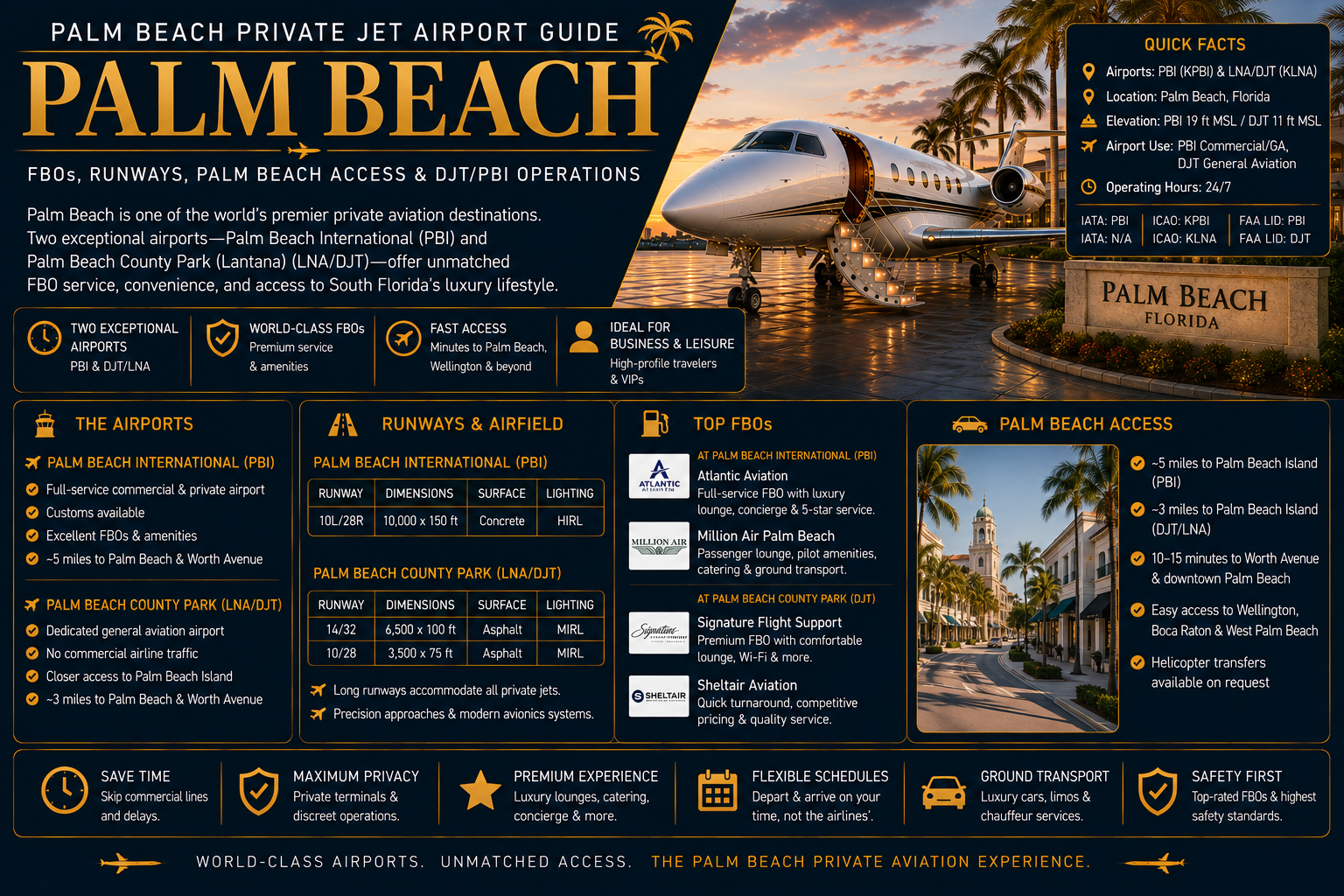
Palm Beach Private Aviation Airport Guide
Palm Beach Private Jet Airport Guide: FBOs, Runways, Palm Beach Access & DJT/PBI Operations
Palm Beach’s primary commercial and business aviation airport—officially President Donald J. Trump International Airport—serves private jets, corporate aircraft and scheduled airlines from West Palm Beach. The airport combines a 10,000-foot primary runway, three full-service FBOs, a U.S. Customs port of entry, 24-hour air traffic control and strategic access to Palm Beach County’s major residential, business and luxury markets.
For decades, private aviation travelers have commonly known this airport as Palm Beach International Airport or PBI.
However, the airport entered an important identity transition during 2026.
The official airport name changed to President Donald J. Trump International Airport effective July 9, 2026.
At the same time, the FAA locational identifier changed from PBI to DJT, while the ICAO identifier changed from KPBI to KDJT.
However, the passenger-facing IATA code remains PBI through August 17, 2026.
Beginning August 18, 2026, the IATA code is scheduled to change to DJT as well.
Therefore, travelers, search engines and aviation systems may encounter several identifiers during the transition.
For private aviation research, that means Palm Beach International Airport, PBI, DJT and KDJT may all refer to the same physical airport depending on the date, source and aviation context.
That naming transition changes branding and airport identifiers.
However, it does not change the fundamental private aviation role of the airport.
The field remains a mixed-use airport supporting scheduled airlines, corporate aircraft and general aviation.
Therefore, private jet passengers operate inside an airport environment that combines commercial traffic with substantial business aviation activity.
The airport’s general aviation infrastructure is significant.
Palm Beach County currently identifies three full-service fixed-base operators serving private and corporate aviation.
Those facilities support aircraft handling, fuel, passenger services, parking, crew requirements and other mission needs.
Additionally, the airport maintains a U.S. Customs port of entry facility.
Therefore, qualifying international private aircraft can incorporate customs processing directly into the Palm Beach mission when current government requirements are satisfied.
Runway capability is another major advantage.
The airport’s largest runway measures approximately 10,000 feet long by 150 feet wide.
That provides substantial capability for many private aircraft categories.
However, runway length never guarantees that every aircraft can operate at every possible weight under every condition.
Therefore, aircraft-specific performance planning remains essential.
The airport contains three runways.
The FAA identifies parallel Runways 10L/28R and 10R/28L along with Runway 14/32.
Consequently, the airport supports several runway configurations depending on wind, weather, traffic and operating requirements.
The air traffic control tower operates 24 hours.
Additionally, the airport lies within Class C airspace.
Therefore, DJT provides around-the-clock tower service while remaining integrated into South Florida’s larger air traffic environment.
The airport also supports scheduled airlines.
That makes Palm Beach fundamentally different from airports such as Teterboro, Van Nuys and Opa-locka, where general aviation plays an even more dominant airport-wide role.
However, mixed-use does not mean private aviation is secondary.
The airport provides dedicated general aviation areas and substantial FBO infrastructure.
Therefore, private passengers can still use business aviation facilities rather than moving through the scheduled-airline terminal process.
Geography is one of Palm Beach private aviation’s strongest advantages.
The airport sits between West Palm Beach and Lake Worth.
Therefore, it can provide useful access to Palm Beach, West Palm Beach and several surrounding communities.
However, Palm Beach County extends far beyond the immediate airport area.
Passengers may actually be traveling toward Palm Beach Island, Palm Beach Gardens, Jupiter, Wellington, Boca Raton, Delray Beach or another destination.
Consequently, the correct airport should be selected around the passenger’s actual address rather than the broad phrase “Palm Beach.”
For example, a passenger whose destination is Palm Beach Island may evaluate DJT very differently from someone whose residence lies well south toward Boca Raton.
Likewise, a traveler going north toward Jupiter may want to compare several possible aviation strategies.
Therefore, ground transportation belongs inside the airport-selection decision.
Seasonality matters as well.
South Florida attracts significant winter private aviation demand.
Family offices, second-home owners, executives and leisure travelers may move repeatedly between Palm Beach County and markets such as New York, Boston, Chicago and other northern cities.
Consequently, private aviation activity can increase substantially during peak seasonal periods.
The FAA specifically notes busy departure demand during Sundays from December through April.
During those periods, ground control may use gate-hold procedures to meter departing airline and business aircraft.
Therefore, private aviation does not completely eliminate airport congestion.
Instead, business aircraft operate inside the same controlled runway and taxiway system as other airport users.
The airport’s location also creates special airspace considerations.
Current FAA guidance notes a one-nautical-mile Special Flight Rules Area around Mar-a-Lago that can affect certain procedures when active.
Additionally, temporary flight restrictions may affect the surrounding area depending on current federal security requirements.
Therefore, operators should review current FAA information and TFRs before each flight rather than relying on a static airport guide.
This is particularly important because those restrictions can be event-driven and time-sensitive.
For passengers, the effect may appear as routing changes, delays or operating limitations.
However, the technical planning belongs to the operator and flight crew.
International access creates another strategic advantage for Palm Beach private aviation.
U.S. Customs and Border Protection maintains general aviation processing procedures for the airport.
Therefore, qualifying aircraft arriving from the Bahamas, Caribbean and other international destinations may be able to clear U.S. Customs directly at the airport when current requirements are satisfied.
This can be especially useful for Palm Beach residents who regularly move between South Florida and nearby island destinations.
Nevertheless, customs capability should never be treated as automatic access.
Permission requirements, arrival procedures, passenger documentation and operating hours should be confirmed for the actual flight.
Consequently, international planning should begin before the aircraft departs the foreign origin.
Palm Beach also serves a significant family-office market.
Principals may maintain residences in Palm Beach while conducting business in New York or other financial centers.
Others may use Palm Beach as a seasonal base while traveling frequently to Caribbean destinations, Aspen, Los Angeles or Europe.
Therefore, the airport can function as one recurring node within a much larger private aviation network.
Family-office missions can involve far more than one passenger.
Children, household staff, advisors, security personnel, pets and substantial baggage may all be part of the trip.
Consequently, aircraft selection should be based on the entire traveling party.
Executive travel creates another important mission profile.
West Palm Beach and the broader county support finance, real estate, wealth management, hospitality and other industries.
Therefore, executives may use private aviation for meetings, investments, board responsibilities and multi-city travel.
The aircraft can provide productive cabin time while private ground transportation can move the passenger directly toward the next appointment.
As a result, airport value should be measured in recovered usable time rather than simply flight duration.
Equestrian travel also distinguishes Palm Beach County from many other private aviation markets.
Wellington is internationally known for equestrian activity and attracts owners, competitors, sponsors and affluent visitors.
Therefore, seasonal equestrian events can contribute to premium travel demand throughout the county.
Passengers associated with these events may require specialized schedules, larger vehicles, staff coordination or repeat flights over several weeks.
Consequently, the Palm Beach airport strategy should be designed around the complete event itinerary.
Luxury leisure travel is equally important.
Palm Beach County supports resorts, golf, private clubs, luxury residences, boating and high-end dining.
Therefore, many private aviation missions are tied to lifestyle rather than corporate travel.
Those passengers may carry more baggage, golf equipment or other leisure items.
As a result, baggage volume can affect aircraft selection even on routes where range is relatively easy.
Palm Beach also connects naturally with New York.
The Palm Beach–New York corridor is particularly relevant to seasonal residents, family offices and executives.
Therefore, aircraft selection, New York airport strategy and baggage requirements should be considered together.
A passenger whose northern destination is Manhattan may consider Teterboro.
Meanwhile, a passenger traveling toward Westchester or Connecticut may prefer another airport.
Consequently, one of the central principles of private aviation applies on both ends of the route: select airports around the passenger’s actual geography.
This Palm Beach private aviation guide examines that complete decision.
It covers airport identity, runways, FBOs, aircraft parking, U.S. Customs, Class C airspace, special flight restrictions, Palm Beach access, Wellington travel, seasonal demand, aircraft selection, New York routes, Caribbean travel, family offices, luxury travel and complete arrival-to-departure planning.
Additionally, it connects Palm Beach into the broader Private Aviation Airports authority hub alongside Teterboro, Van Nuys and Opa-locka.
Therefore, the page becomes more than a static airport description.
Instead, it becomes another strategic node inside the larger private aviation destination, airport, aircraft and route ecosystem.
Direct Palm Beach Airport Answer
Why Is Palm Beach Important for Private Aviation?
Direct Answer: Palm Beach’s primary airport is important to private aviation because it combines three full-service FBOs, U.S. Customs, a 10,000-foot primary runway, a 24-hour control tower and direct access to one of America’s most concentrated luxury residential and seasonal travel markets. That makes DJT/PBI useful for domestic and international business aviation.
Palm Beach is a unique private aviation market because the destination itself generates significant recurring demand.
Many travelers are not simply visiting once.
Instead, they may maintain a home in Palm Beach County and travel repeatedly throughout the season.
Therefore, the airport can become part of a recurring transportation routine.
Palm Beach
Luxury Market Access
The airport provides direct access to Palm Beach County’s residential, leisure, business and seasonal travel market.
Runway
10,000-Foot Primary Runway
The airport’s largest runway provides substantial capability for many business aviation aircraft and mission profiles.
FBOs
Three Full-Service FBOs
Palm Beach County currently identifies three full-service business aviation facilities serving general aviation traffic.
Customs
International Capability
A U.S. Customs port of entry supports qualifying international private aviation arrivals.
24 Hours
24-Hour Control Tower
The FAA currently lists airport air traffic control tower operations as 24 hours.
UHNW
Family-Office Travel
Palm Beach’s residential and wealth market creates recurring executive, family-office and seasonal private aviation demand.
Why Isn’t Palm Beach Automatically the Best Airport for Every South Florida Traveler?
Because South Florida contains several major private aviation markets.
A traveler whose destination is Palm Beach Island may strongly favor this airport.
However, a passenger headed toward Miami may find Opa-locka more practical.
Likewise, a traveler going toward Boca Raton may need to compare several options.
Therefore, airport selection should follow passenger geography.
Furthermore, aircraft performance, international requirements and parking can influence the decision.
Consequently, the strongest airport is the one that solves the complete trip rather than simply the airport closest to the destination name.
Palm Beach becomes especially powerful when the passenger’s destination, aircraft and airport infrastructure all align.
The 10,000-foot runway, FBO network, customs capability and Palm Beach geography can create an efficient private aviation mission when they solve the same door-to-door objective.
Important 2026 Airport Identifier Change
Why Did Palm Beach International Airport Change From PBI to DJT?
Direct Answer: Palm Beach International Airport was officially renamed President Donald J. Trump International Airport effective July 9, 2026. The FAA identifier changed to DJT and the ICAO identifier changed to KDJT. The passenger-facing IATA code remains PBI until August 18, 2026, when it is scheduled to change to DJT.
The name change creates an unusual search and aviation-information transition.
For decades, travelers have recognized the airport as Palm Beach International Airport and PBI.
Therefore, those terms will continue appearing in searches, older documents, websites and conversations.
However, current FAA systems now identify the airport as DJT and KDJT.
Consequently, both old and new terminology may appear during the transition.
| Airport Identifier | Before July 9, 2026 | Current / Transition Status |
|---|---|---|
| Official Name | Palm Beach International Airport | President Donald J. Trump International Airport |
| FAA Identifier | PBI | DJT effective July 9, 2026 |
| ICAO Identifier | KPBI | KDJT effective July 9, 2026 |
| IATA Passenger Code | PBI | PBI through August 17, 2026; DJT beginning August 18, 2026 |
| Common Search Term | Palm Beach International Airport | Likely to remain relevant during and after the transition |
Does the New Name Change the Airport’s Operations?
No.
Palm Beach County states that the change does not alter airport ownership, governance, legal status or operational control.
Additionally, airline and airport services continue normally.
Therefore, the transition primarily affects naming, branding and identifiers rather than the fundamental aviation role of the airport.
Why Does This Matter for Private Aviation?
Private aviation depends heavily on precise airport identifiers.
Therefore, operators and pilots must use current FAA and ICAO information for flight planning.
Meanwhile, passengers and older travel systems may still use PBI during the transition.
Consequently, travelers should recognize both identifiers when discussing a Palm Beach private jet mission.
PBI, KPBI, DJT and KDJT can all appear in Palm Beach airport research during the 2026 transition.
For operational aviation planning, current FAA information should control. For passenger and search intent, the historical Palm Beach International Airport and PBI terminology remains useful context.
South Florida Private Aviation Strategy
Why Do Private Jet Travelers Use Palm Beach?
Direct Answer: Private jet travelers use Palm Beach because the airport combines substantial runway capability, three full-service FBOs, customs, around-the-clock tower service and access to major Palm Beach County destinations. It is particularly relevant to seasonal residents, family offices, executives, luxury travelers and passengers connecting South Florida with New York and international markets.
Palm Beach private aviation demand is closely tied to the region’s residential and wealth profile.
Therefore, many missions involve repeat passengers rather than first-time visitors.
A principal may travel between Palm Beach and Manhattan throughout the winter.
Another family may connect Palm Beach with the Bahamas or Caribbean.
Meanwhile, an executive may combine Palm Beach with several business destinations.
Consequently, the airport supports multiple mission types within the same private aviation ecosystem.
Seasonal Residences
Repeat travel between Palm Beach and northern markets can create established private aviation patterns.
Family Offices
Principals, relatives, advisors, staff, pets and baggage can all shape aircraft and transportation requirements.
New York Connectivity
Palm Beach naturally connects with one of America’s largest private aviation markets.
International Travel
On-field customs can support qualifying private flights returning from international destinations.
Luxury Leisure
Golf, boating, resorts, private clubs and second homes create significant leisure aviation demand.
Business Travel
Executives can coordinate Palm Beach with finance, real estate, investment and multi-city business activity.
Why Is Repeat Private Aviation Especially Important in Palm Beach?
Repeat travelers already know their destination and preferences.
Therefore, the aviation plan can become increasingly refined.
A family office may establish preferred FBOs, vehicle providers and aircraft categories.
Likewise, baggage and staff requirements may become predictable.
However, current weather, parking, aircraft availability and airspace restrictions can still change.
Consequently, even recurring missions should be verified each time.
A recurring Palm Beach route can become highly efficient without becoming automatic.
Preferred aircraft, FBOs and transportation can create consistency, while current weather, parking, security restrictions and passenger requirements still need to be checked for every flight.
Mixed-Use Palm Beach Aviation
What Role Does DJT Play in Palm Beach Aviation?
Direct Answer: DJT is a mixed-use Palm Beach County airport supporting scheduled airlines, corporate aircraft and general aviation. Private aircraft operate through dedicated FBO and general aviation areas while sharing the runway, taxiway and air traffic system with commercial traffic. Therefore, passengers receive a private aviation experience inside a larger mixed-use airport environment.
This distinguishes Palm Beach from several other airports in the private aviation hub.
Teterboro is intensely focused on business aviation.
Van Nuys is heavily oriented toward general aviation.
Opa-locka similarly serves a major business aviation role.
Palm Beach, by contrast, combines significant scheduled-airline activity with substantial private aviation.
Therefore, passengers should understand both sides of the airport.
Business Aviation
Corporate Aircraft
Private and corporate jets operate through dedicated general aviation facilities across the field.
Airlines
Scheduled Traffic
The airport also handles significant airline passenger operations throughout the year.
FBO
Dedicated Private Aviation Facilities
Three full-service FBOs support general and business aviation passengers and aircraft.
Customs
International Gateway
A U.S. Customs port of entry supports qualifying international general aviation arrivals.
Tower
24-Hour ATC
The control tower operates 24 hours according to current FAA airport information.
Class C
Controlled Airspace
The airport operates within Class C airspace as part of South Florida’s larger aviation system.
Does Airline Traffic Reduce the Value of Palm Beach for Private Jets?
Not necessarily.
Private passengers still use dedicated FBO facilities rather than the scheduled-airline passenger terminal.
However, aircraft share the airport’s runway and air traffic system.
Therefore, busy periods can affect departure sequencing.
The FAA specifically notes concentrated Sunday departure demand during the winter season.
Consequently, passengers should recognize that private aviation removes much of the terminal friction without eliminating runway or airspace traffic.
Palm Beach combines a private passenger experience with a mixed-use airport operating environment.
The FBO separates much of the passenger journey from airline travel, while the aircraft remains part of the airport’s shared runway and air traffic system.
Palm Beach Airport Quick Reference
What Should Private Jet Travelers Know About DJT/PBI?
Direct Answer: Palm Beach’s primary airport is officially President Donald J. Trump International Airport. Its FAA identifier is DJT and ICAO identifier is KDJT. The airport has three runways, a 10,000-foot primary runway, three full-service FBOs, a U.S. Customs facility, Class C airspace and a 24-hour air traffic control tower.
| Airport Detail | Palm Beach Information | Why It Matters |
|---|---|---|
| Official Airport | President Donald J. Trump International Airport | Current official airport name effective July 9, 2026 |
| Historical Name | Palm Beach International Airport | Remains widely recognized by travelers and in existing online content |
| FAA Identifier | DJT | Current FAA airport identifier |
| ICAO Identifier | KDJT | Current identifier used in international aviation and flight planning |
| IATA Code | PBI until August 18, 2026 transition to DJT | Important because passenger-facing systems are undergoing transition |
| Location | West Palm Beach / Palm Beach County, Florida | Provides access to major Palm Beach County destinations |
| Runways | 10L/28R, 10R/28L and 14/32 | Three-runway configuration supports multiple traffic patterns |
| Largest Runway | 10,000 × 150 feet | Provides substantial capability for many business aviation aircraft |
| FBOs | Three full-service facilities | Supports aircraft handling and private passenger services |
| Airspace | Class C | Places the airport within a controlled terminal airspace environment |
| Tower | 24-hour operation | Supports around-the-clock air traffic control service |
| Customs | U.S. Customs port of entry | Supports qualifying international private aviation arrivals |
Why Does the 24-Hour Tower Matter?
A 24-hour tower provides continuous air traffic control service at the airport.
Therefore, late arrivals and early departures do not encounter the same tower-closure transition found at some business aviation airports.
However, FBO services, customs availability, crew duty, weather and temporary restrictions still require separate consideration.
Consequently, a 24-hour tower should not be interpreted as unlimited mission availability without further planning.
Why Do Three FBOs Matter?
Multiple FBOs create choices for aircraft operators and passengers.
However, more choice does not mean every facility is interchangeable.
Parking availability, fuel arrangements, passenger preferences and aircraft requirements can differ.
Therefore, the operator should select the facility around the actual mission.
Palm Beach combines substantial runway capability with a mature business aviation support network.
The 10,000-foot runway, three FBOs, customs, 24-hour tower and Palm Beach geography make the airport strategically important across domestic and international private aviation.
Three-Runway Airport System
What Runways Does Palm Beach’s Primary Airport Have?
Direct Answer: DJT has three runways: parallel Runways 10L/28R and 10R/28L plus Runway 14/32. The airport’s largest runway is 10,000 feet long and 150 feet wide. This provides significant business aviation capability, although runway use and aircraft performance still depend on actual weather, traffic, aircraft weight and operating conditions.
The runway configuration gives the airport flexibility.
However, the parallel layout also requires precise surface awareness.
Current FAA guidance identifies several airport-surface hot spots and cautions for pilots.
Therefore, crews should review current airport diagrams rather than relying solely on familiarity with the field.
10L / 28R
Primary Runway System
The northern parallel forms part of the airport’s primary east-west operating configuration.
10R / 28L
Parallel Runway
The second east-west runway supports the airport’s mixed airline, corporate and general aviation traffic environment.
14 / 32
Cross-Orientation Runway
Runway 14/32 provides an additional runway orientation within the airport system.
Can Large Private Jets Use the 10,000-Foot Runway?
Many large business aircraft missions can use the airport.
However, aircraft capability depends on more than runway length.
The crew must account for actual aircraft weight, passengers, baggage and fuel.
Additionally, temperature, wind and runway conditions affect performance.
Therefore, the exact aircraft and mission should always be evaluated independently.
Why Should Pilots Pay Particular Attention to the Airport Layout?
The FAA identifies several areas where crews can become confused around taxiways, runway hold-short points and the airport’s parallel runway system.
Therefore, current airport diagrams and markings remain important even for experienced crews.
For passengers, these are primarily operational issues.
However, they demonstrate why a major private aviation airport still requires airport-specific preparation.
A long runway creates flexibility, but airport familiarity does not replace current flight planning.
The aircraft, runway assignment, weight, weather and surface environment should all be evaluated for the exact Palm Beach mission.
Aircraft + Runway Compatibility
How Does Aircraft Performance Affect Palm Beach Private Jet Operations?
Direct Answer: Aircraft performance at Palm Beach depends on the specific jet, actual operating weight, fuel, passengers, baggage, temperature, wind, runway condition and route. Although the airport’s 10,000-foot primary runway provides substantial capability, every departure and arrival should still be calculated using the actual aircraft and conditions.
Long runway capability is valuable.
However, the aircraft still has to perform within its certified limits.
Therefore, larger aircraft and longer routes require careful fuel and weight planning.
Aircraft Weight
Passengers, baggage and fuel determine the aircraft’s actual mission weight.
Fuel
Long-range missions may require significantly more fuel than short domestic or Caribbean flights.
Temperature
Warm South Florida temperatures can affect aircraft takeoff and climb performance.
Wind
Wind direction and speed can influence runway use and aircraft performance calculations.
Runway Condition
Heavy rain or other conditions can change braking and runway-performance calculations.
Destination
The next route determines required fuel and can materially alter departure weight.
Why Can the Same Aircraft Fit One Palm Beach Flight but Not Another?
The aircraft model may remain identical.
However, the mission can change significantly.
A short departure toward the Bahamas requires much less fuel than a long transcontinental or international flight.
Likewise, passenger and baggage loads vary.
Therefore, the aircraft’s actual operating condition determines performance.
Consequently, airport compatibility is mission-specific rather than permanent.
A 10,000-foot runway gives Palm Beach substantial capability, but aircraft performance still belongs to the exact mission.
Actual weight, fuel, temperature, wind, runway condition and destination should be evaluated together before departure.
Door-to-Door Palm Beach Planning
How Does the Airport Connect With Palm Beach County Destinations?
Direct Answer: DJT provides private aviation access to Palm Beach, West Palm Beach and surrounding Palm Beach County destinations. However, the best airport should be selected around the passenger’s exact property, club, business or event location. Palm Beach Island, Wellington, Jupiter, Palm Beach Gardens and Boca Raton can create materially different ground transportation strategies.
Palm Beach County covers a large geographic area.
Therefore, “flying private to Palm Beach” is not a sufficiently precise airport strategy.
The passenger’s actual destination matters.
Palm Beach Island
The airport can provide direct access to residences, hotels, clubs and other destinations on Palm Beach Island.
West Palm Beach
Business, residential and event destinations near West Palm Beach may align naturally with the airport.
Wellington
Equestrian travelers should plan around event schedules, vehicle requirements and actual ground travel.
Palm Beach Gardens
Travelers heading north should compare expected drive time with other practical aviation options when appropriate.
Jupiter
Jupiter-bound passengers should evaluate total ground travel rather than choosing solely by airport reputation.
Boca Raton
Passengers heading south toward Boca Raton should compare airport geography carefully because another airport may produce a shorter complete journey.
Why Should Boca Raton Travelers Compare Airports?
Boca Raton lies south of the primary Palm Beach airport.
Therefore, another business aviation airport may sometimes provide a stronger ground itinerary.
However, aircraft capability, customs, runway requirements and availability can change the answer.
Consequently, travelers should compare the entire mission rather than one map distance.
Why Is Wellington Different From Palm Beach Island?
The two destinations serve very different travel patterns.
Palm Beach Island may involve residences, clubs, resorts or business activity.
Meanwhile, Wellington private aviation can be connected with equestrian events, owners, competitors and related staff.
Therefore, vehicle type, passenger timing and baggage requirements may differ substantially.
Palm Beach County airport strategy should start with the passenger’s exact destination.
Palm Beach Island, Wellington, Jupiter and Boca Raton may all be described broadly as Palm Beach travel, yet each can produce a different private aviation decision.
Who Uses Palm Beach Private Aviation?
Which Travelers Commonly Use Palm Beach for Private Jet Flights?
Direct Answer: Palm Beach private aviation serves family offices, seasonal residents, executives, aircraft owners, charter passengers, international travelers, golfers, equestrian participants, luxury leisure travelers and other UHNW passengers. Each traveler profile creates different aircraft, baggage, FBO, vehicle, privacy and scheduling requirements.
Family Offices
Principal Travel
Principals may travel between Palm Beach residences, business centers, resorts and international destinations.
Seasonal
Winter Residents
Recurring winter travel can create strong private aviation patterns between Palm Beach and northern markets.
Executives
Business Travel
Corporate leaders may use the airport around meetings, investments, board responsibilities and multi-city schedules.
Equestrian
Wellington Travel
Owners, competitors, sponsors and affluent visitors may use private aviation around seasonal equestrian events.
Golf
Club and Resort Travel
Golf equipment can significantly increase baggage requirements despite relatively small passenger groups.
International
Caribbean Travel
Customs capability can support qualifying flights returning from international leisure and business markets.
Aircraft Owners
Private Operations
Owners may incorporate Palm Beach into recurring personal, business and seasonal aircraft schedules.
Luxury Leisure
High-End Travel
Private clubs, resorts, boating, residences and events create additional premium aviation demand.
Why Does Traveler Type Matter When Choosing the Aircraft?
Passengers with the same seat count can create completely different payload requirements.
An executive group may carry only briefcases and overnight luggage.
Meanwhile, a family staying for several weeks may carry substantially more baggage.
Golfers may add several club cases.
Additionally, family-office missions may include staff or pets.
Therefore, the aircraft should be selected around the actual travel profile rather than advertised seat capacity alone.
Palm Beach private aviation is not one type of travel.
Seasonal residents, executives, family offices, golfers and equestrian travelers can all use the same airport while requiring very different aircraft and ground strategies.
Part of the Private Aviation Airport Network
How Does Palm Beach Fit Into the Private Aviation Airport Ecosystem?
Direct Answer: Palm Beach functions as a major South Florida airport spoke within the larger private aviation ecosystem. It connects airport research with Palm Beach destinations, New York routes, Caribbean travel, family-office questions, aircraft selection and South Florida airport comparisons, creating a deeper authority structure than a standalone airport page.
Palm Beach should connect directly to the broader Private Aviation Airports hub.
However, it should also connect laterally with Opa-locka and future South Florida airport pages.
Additionally, route content can connect Palm Beach with Teterboro, the Bahamas, Aspen and other important private aviation markets.
Therefore, each new page increases the usefulness of the surrounding network.
Parent Hub
Private Aviation Airports
Compare runways, FBOs, customs, aircraft capability and ground geography across major business aviation airports.
South Florida
Opa-locka Executive Airport
Compare Palm Beach with one of Miami’s major general and business aviation airports.
New York
Teterboro Airport
Explore the New York side of one of Palm Beach’s most important recurring private aviation travel corridors.
Palm Beach should not exist as an isolated airport guide.
Connecting the airport to South Florida comparisons, New York routes, international travel, aircraft questions and family-office research creates the larger topical authority ecosystem.
Current Aviation Information
Where Should Current Palm Beach Airport Information Be Verified?
Because the airport is undergoing a 2026 naming and identifier transition, current operational information should be verified through official aviation sources.
FAA publications should control operational airport identifiers, runway information, procedures and current flight-planning data.
Meanwhile, Palm Beach County Department of Airports provides current airport and general aviation information.
International operators should also verify current U.S. Customs and Border Protection procedures for the actual flight.
Review current FAA DJT airport information →
Review Palm Beach County general aviation information →
Review the official 2026 airport name and identifier transition →
Aircraft-to-Destination Planning
How Should Ground Transportation Be Planned After Landing in Palm Beach?
Direct Answer: Ground transportation at Palm Beach should be planned around the exact FBO, passenger count, baggage volume, final destination and expected traffic. Private vehicles, chauffeured transportation, SUVs and larger passenger vehicles can be coordinated with the flight so the aircraft-to-ground transition becomes part of the complete private aviation itinerary.
The aircraft landing is only one part of a private aviation trip.
Therefore, the ground transfer should be planned before the aircraft departs its origin.
This becomes especially important in Palm Beach because travelers can have very different final destinations.
One passenger may be traveling to a residence on Palm Beach Island.
Meanwhile, another passenger may be continuing toward Wellington.
Others may travel north toward Palm Beach Gardens or Jupiter.
Additionally, some passengers may continue south toward Boca Raton.
Consequently, a generic “Palm Beach transfer” does not provide enough information to optimize the trip.
Palm Beach Island
Residence and Hotel Transfers
Vehicles can be coordinated around residences, hotels, clubs, restaurants and other Palm Beach Island destinations.
West Palm Beach
Business and Downtown Travel
Executives and visitors can coordinate ground transportation around West Palm Beach offices, hotels and meeting locations.
Wellington
Equestrian Transportation
Travelers attending equestrian events may need larger vehicles, additional luggage capacity or transportation for staff.
North County
Palm Beach Gardens and Jupiter
Northbound passengers should incorporate realistic road travel into the complete airport decision.
South County
Boca Raton and Delray Beach
Passengers traveling farther south should compare the complete drive against other practical airport options.
Family Office
Multi-Vehicle Coordination
Principals, staff, security personnel and luggage may require several coordinated vehicles rather than one passenger car.
Should the Vehicle Be Selected Before the Aircraft Arrives?
Yes.
Ideally, ground transportation should already be coordinated before departure.
That allows the transportation provider to track the aircraft and adjust for reasonable changes in arrival time.
Additionally, the driver needs the correct FBO rather than simply the airport name.
That distinction matters because Palm Beach has multiple private aviation facilities.
Therefore, telling a driver only to meet the passenger “at the airport” can create unnecessary confusion.
Why Does Baggage Matter for Ground Transportation?
The vehicle has to carry the same mission payload that arrived on the aircraft.
For example, four passengers may fit comfortably inside one luxury SUV.
However, four passengers carrying several weeks of luggage and golf equipment may not.
Likewise, family-office travel can include assistants, security personnel or household staff.
Therefore, the ground vehicle should be selected using passengers and baggage together.
The private aviation experience should not end when the cabin door opens.
The correct vehicle, FBO pickup location, baggage capacity and destination timing should already be coordinated before the aircraft lands.
Palm Beach Fixed-Base Operators
Which FBOs Serve Private Jets at Palm Beach?
Direct Answer: Palm Beach County currently identifies three full-service FBOs serving general aviation at DJT: Atlantic Aviation, Jet Aviation and Signature Flight Support. The best facility depends on aircraft handling, parking, fuel arrangements, passenger preferences, transportation coordination and the operator’s requirements for the specific Palm Beach mission.
The FBO is effectively the private aviation gateway to the airport.
Therefore, private passengers generally interact with the FBO rather than the commercial airline terminal.
The facility can coordinate passenger reception, ground transportation, aircraft services and crew requirements.
However, travelers should not assume that every FBO provides an identical experience for every mission.
| Palm Beach FBO | Primary Role | Mission Considerations |
|---|---|---|
| Atlantic Aviation | Full-service business aviation FBO | Aircraft handling, passenger services, fuel, parking and crew coordination should be confirmed for the mission. |
| Jet Aviation | Full-service business aviation FBO | May support private aircraft, passengers, crews and additional aviation requirements depending on the flight. |
| Signature Flight Support | Full-service business aviation FBO | Supports business aviation handling and passenger services subject to current availability and mission requirements. |
How Should a Palm Beach FBO Be Selected?
Start with the aircraft operator.
The operator may already have a preferred facility based on fuel programs, parking, handling arrangements or operational relationships.
However, passenger requirements also matter.
For example, a family office may need several vehicles staged for arrival.
Meanwhile, another mission may prioritize overnight aircraft parking.
Additionally, a crew may need catering, transportation or other support.
Therefore, FBO selection should reflect both the aircraft and the passenger experience.
Should Passengers Choose the FBO Themselves?
They can express a preference.
However, the aircraft operator should remain involved in the decision.
Operational factors may make one facility more practical for a particular aircraft or trip.
Furthermore, parking availability can change during high-demand periods.
Consequently, the strongest decision combines passenger preferences with operator requirements.
The best Palm Beach FBO is the facility that best supports the complete mission.
Passenger experience matters, but aircraft handling, parking, fuel, crew requirements and ground transportation should be evaluated at the same time.
Private Aviation Ground Services
Which Palm Beach FBO Services Matter Most?
Direct Answer: Important Palm Beach FBO services can include aircraft fueling, parking coordination, passenger reception, ground transportation, catering, crew support and baggage handling. However, required services vary by aircraft and itinerary. Therefore, operators should confirm mission-specific requirements directly with the selected FBO before arrival or departure.
A short domestic flight may require relatively simple handling.
However, a long-range international mission can involve substantially more coordination.
Therefore, FBO requirements should be determined from the complete trip.
Fuel
Aircraft Fueling
Fuel requirements depend on aircraft type, next destination, reserves and the operator’s flight plan.
Parking
Ramp Coordination
Aircraft parking should be confirmed in advance, particularly during high-demand Palm Beach travel periods.
Passengers
Private Passenger Reception
FBO facilities provide the private aviation transition between aircraft and ground transportation.
Vehicles
Ground Transportation
Vehicles should be coordinated with the correct FBO and passenger arrival schedule.
Catering
Flight Catering
Catering requirements should be communicated early enough for the aircraft and crew to prepare for departure.
Crew
Crew Support
Crew transportation, accommodations and other services may become part of longer Palm Beach stays.
Why Should Services Be Confirmed Before Arrival?
Private aviation creates flexibility, but that flexibility still depends on coordination.
For example, aircraft parking may be constrained during busy periods.
Likewise, transportation or catering may require advance arrangements.
Therefore, communicating requirements early reduces last-minute problems.
FBO planning should happen before the aircraft reaches Palm Beach.
Fuel, parking, passenger transportation, catering and crew requirements are easier to coordinate when the facility knows the complete mission in advance.
Ramp and Aircraft Positioning
How Does Private Jet Parking Work at Palm Beach?
Direct Answer: General aviation aircraft can use parking areas on the south, west and northwest sides of the Palm Beach airfield depending on operational needs. Palm Beach County restricts general aviation aircraft from the north parking ramps and aprons unless advance approval is provided. Actual parking availability should be confirmed with the FBO for each trip.
Aircraft parking can become a major planning issue during high-demand periods.
Therefore, passengers should not assume the aircraft will automatically remain at Palm Beach throughout the entire visit.
For a short stop, the aircraft may remain on the ramp while passengers complete their visit.
However, longer stays can create different requirements.
Additionally, large aircraft consume more ramp space than smaller jets.
Consequently, aircraft size and duration of stay both matter.
Short Turn
A brief passenger stop may require only temporary ramp positioning, fuel and departure preparation.
Same-Day Stay
The aircraft may remain available for a later departure if ramp capacity and operational requirements permit.
Multi-Day Stay
Longer visits can require advance parking coordination, especially during peak Palm Beach demand.
Large-Cabin Aircraft
Larger aircraft can require additional ramp space and should be coordinated early.
Repositioning
If parking is constrained, the operator may evaluate repositioning the aircraft after passengers deplane.
Return Positioning
A repositioned aircraft must return in time for the passenger’s planned departure.
What Happens if the Aircraft Cannot Remain at Palm Beach?
The operator may evaluate another suitable airport for aircraft parking.
In that scenario, passengers can still arrive at Palm Beach while the aircraft repositions after they leave.
However, repositioning creates additional operational complexity.
The aircraft must later return for the outbound passenger flight.
Furthermore, crew duty, weather and aircraft scheduling can affect that return.
Therefore, repositioning should be incorporated into the complete itinerary rather than treated as an afterthought.
Why Does Peak Season Matter for Parking?
Palm Beach private aviation demand can rise substantially during the winter season.
Additionally, major events can concentrate aircraft arrivals within narrow periods.
Therefore, parking that may be straightforward during a quieter week can become more difficult during peak demand.
Consequently, longer stays should be coordinated as early as practical.
Landing permission and overnight parking are different questions.
An aircraft may be fully capable of operating at Palm Beach while still requiring a separate parking or repositioning plan during high-demand periods.
Controlled Palm Beach Airspace
How Does Class C Airspace Affect Private Jet Flights at Palm Beach?
Direct Answer: Palm Beach’s primary airport operates within Class C airspace and has a 24-hour air traffic control tower. Private jets therefore operate within a controlled terminal environment alongside airline, corporate, general aviation, training and helicopter traffic. Air traffic flow, runway assignments and arrival or departure procedures can affect the timing of individual missions.
Palm Beach is not an isolated business aviation airport.
Instead, it operates inside a busy South Florida aviation environment.
The traffic mix includes scheduled airlines, corporate aircraft and general aviation.
Additionally, flight training activity occurs at the airport.
The FAA also notes several types of helicopter activity, including law enforcement, news, agricultural and medical flights.
Therefore, pilots should expect a diverse traffic environment.
Airline Traffic
Scheduled carriers share the runway and air traffic environment with private aircraft.
Corporate Aircraft
Business jets represent an important component of the airport’s mixed traffic profile.
General Aviation
Smaller aircraft and training traffic also operate throughout the airport environment.
Helicopters
Low-altitude helicopter activity can occur around the airport and nearby shoreline.
Arrival Sequencing
High traffic volume can result in air traffic management procedures or additional sequencing.
Departure Sequencing
Busy periods can create ground holds or other departure-management procedures.
Can Private Jets Experience Air Traffic Delays at Palm Beach?
Yes.
Private aviation eliminates many scheduled-airline passenger constraints.
However, private aircraft still operate within the same controlled airspace and runway environment.
Therefore, high arrival demand, departure demand, weather or other air traffic conditions can affect the flight.
Additionally, FAA traffic-management programs may be used during periods of high volume.
Consequently, private does not mean completely independent from the national air traffic system.
Private aviation provides schedule control, but the aircraft still operates inside controlled airspace.
Runway sequencing, air traffic volume, weather and special restrictions can still affect arrival and departure timing at Palm Beach.
Important Palm Beach Airspace Planning
How Can Special Flight Rules and TFRs Affect Palm Beach Private Jets?
Direct Answer: Palm Beach private aviation can be affected by special flight procedures and Temporary Flight Restrictions. The FAA identifies a one-nautical-mile Special Flight Rules Area around Mar-a-Lago that affects certain runway procedures, while VIP movement and special events can create additional TFRs. Operators should always review current NOTAMs and FAA TFR information before flight.
This is one of the most important operational differences travelers should understand about Palm Beach.
Airspace restrictions can change.
Therefore, a procedure used on one trip may not apply in exactly the same way on another.
The FAA specifically warns pilots to expect frequent TFRs in the Palm Beach area for VIP movement and special events.
Additionally, those restrictions can change with limited notice.
Consequently, static travel information should never replace current flight planning.
SFRA
Mar-a-Lago Area
The FAA identifies a one-nautical-mile Special Flight Rules Area that influences certain procedures near the airport.
TFR
Temporary Restrictions
VIP movement or special events can create temporary restrictions affecting the surrounding airspace.
NOTAM
Current Flight Information
Crews should review current NOTAMs because operational restrictions can change between flights.
28R
Offset Approach Considerations
The FAA notes that the RNAV X approach to Runway 28R is offset because of the nearby Special Flight Rules Area.
Security
VIP Movement
Federal security requirements can affect which aircraft operations are permitted during certain periods.
Planning
Mission Verification
The operator should verify current restrictions as part of every Palm Beach flight plan.
Does a TFR Mean Every Private Jet Flight Is Automatically Cancelled?
No.
The effect depends on the specific restriction.
Some TFRs may prohibit certain operations while allowing others under defined conditions.
Therefore, travelers should not make assumptions based only on the existence of a TFR.
The operator must review the actual NOTAM and applicable security requirements.
Why Can These Restrictions Matter More at Palm Beach Than at Some Other Airports?
The FAA specifically identifies frequent VIP-related and special-event TFRs around the Palm Beach area.
Therefore, temporary airspace restrictions are a recurring planning consideration rather than a purely theoretical possibility.
For passengers, this means itinerary flexibility can become valuable.
For operators, it means current NOTAM and TFR review is essential.
Never assume yesterday’s Palm Beach airspace rules still apply today.
Special flight procedures, VIP movement and temporary restrictions can change. Current FAA NOTAM and TFR information should control the operational decision.
International Private Aviation
Can International Private Jets Clear U.S. Customs at Palm Beach?
Direct Answer: Yes. Palm Beach has a U.S. Customs and Border Protection general aviation facility for qualifying international aircraft. Current CBP guidance requires advance coordination, APIS information and permission to land for applicable arrivals. Because procedures, hours and requirements can change, operators should verify current CBP instructions before departing the foreign origin.
Customs capability is strategically important in South Florida.
Private aircraft frequently travel between Palm Beach and international destinations in the Bahamas and Caribbean.
Therefore, an on-field general aviation inspection facility can simplify the return to the United States when the mission meets current requirements.
However, customs should never be treated like an ordinary domestic FBO arrival.
APIS
Passenger Information
CBP requires APIS manifest information for general aviation arrivals to and departures from the United States.
Permission
Permission to Land
Applicable international arrivals must obtain permission to land under current CBP procedures.
Documents
Passenger Documentation
Passengers and crew should carry the documentation required for the specific international mission.
FIS
Inspection Facility
International general aviation passengers and crew are processed through the designated federal inspection facility.
Timing
Arrival Coordination
The operator should coordinate the expected arrival time within current CBP procedures.
International
Route Planning
The departure country and routing can create additional requirements beyond the Palm Beach arrival itself.
Where Does the Aircraft Go for Customs?
Current CBP guidance directs arriving general aviation aircraft to the federal inspection facility ramp.
The inspection facility is separate from the FBO and the main airline terminal.
Therefore, passengers should expect customs processing before continuing to their normal private aviation destination on the field.
Once processing is completed, the passengers can continue their ground itinerary.
How Far in Advance Is Permission to Land Required?
Current published CBP Palm Beach guidance states that pilots should secure permission to land by contacting CBP at least two hours before departure from the foreign location.
Additionally, the permission is tied to an expected arrival window.
Therefore, significant timing changes can require renewed coordination.
Because government procedures can change, the operator should confirm the current requirements for every international flight.
Does Filing eAPIS Automatically Mean the Aircraft Has Permission to Land?
No.
APIS transmission and permission to land are related but distinct requirements.
Therefore, operators should follow the complete CBP procedure rather than assuming that submitting passenger information completes the arrival process.
International Palm Beach flights should be planned backward from CBP requirements.
APIS, permission to land, passenger documents, arrival timing and the inspection facility should all be coordinated before the aircraft leaves the foreign departure point.
South Florida Operating Conditions
How Does Weather Affect Palm Beach Private Jet Flights?
Direct Answer: Palm Beach private jet operations can be affected by thunderstorms, heavy rain, wind, heat and tropical weather. The FAA notes that thunderstorm exposure is especially common from June through October. Weather can influence routing, runway use, aircraft performance, air traffic flow and departure timing even when the airport itself remains open.
South Florida weather can change quickly.
Therefore, a clear morning does not guarantee identical conditions later in the day.
Summer convection is particularly important.
Thunderstorms can develop around the region and affect arrival routes, departure routes and air traffic sequencing.
Additionally, heavy rain can change runway conditions.
Heat can also affect aircraft performance.
Consequently, weather planning should consider more than whether precipitation appears directly over the airport.
Thunderstorms
Convective weather can affect routes, air traffic flow and departure timing across South Florida.
Heavy Rain
Rain can affect visibility, runway conditions and ground operations.
Windshear
The FAA notes that LLWAS equipment is available at the airport to help detect windshear around the field.
Heat
High temperatures can affect aircraft performance, particularly when combined with higher aircraft weight.
Tropical Systems
Tropical weather can create broader regional impacts that extend far beyond the airport itself.
Destination Weather
A Palm Beach departure may also be delayed or changed because of conditions at the destination or along the route.
When Are Thunderstorms Most Relevant?
The FAA identifies June through October as the period when Palm Beach airspace is predominantly exposed to thunderstorms.
However, that does not mean every flight during those months experiences disruption.
Instead, crews evaluate current and forecast conditions for the actual mission.
Therefore, passengers should expect some schedule flexibility when significant convective weather develops.
Can the Weather Be Fine at Palm Beach but Still Delay the Flight?
Yes.
The route itself may pass through areas of significant weather.
Additionally, the destination airport may have poor conditions.
Air traffic control can also reroute aircraft around storms.
Consequently, private aviation weather planning must consider the entire route rather than only conditions at DJT.
Palm Beach weather planning is a route problem, not simply an airport problem.
Conditions at the airport, along the route and at the destination can all influence the aircraft’s departure time, fuel plan and routing.
Palm Beach Peak Travel Periods
Why Is Palm Beach Private Aviation Demand Seasonal?
Direct Answer: Palm Beach private aviation demand increases during the South Florida winter season as seasonal residents, family offices, executives and leisure travelers move between Palm Beach and northern markets. The FAA specifically identifies busy Sunday departure periods from December through April, when gate-hold procedures may be used to manage airline and business aviation traffic.
Seasonality is one of the defining characteristics of Palm Beach private aviation.
During winter, South Florida attracts residents and visitors from colder northern markets.
Therefore, private aircraft activity can become concentrated around predictable travel patterns.
Weekends can be especially important.
Additionally, holidays and major local events can increase demand further.
December–April
Winter Season
The FAA specifically identifies increased Sunday departure demand during this period.
Sunday
Departure Concentration
Business and airline traffic can create concentrated departure demand at the end of winter weekends.
Gate Hold
Traffic Management
Ground control may use gate-hold procedures to meter aircraft during periods of heavy departure demand.
Parking
Ramp Demand
High aircraft volume can make advance parking coordination increasingly important.
Charter
Aircraft Availability
High regional demand can increase the importance of planning aircraft availability before peak travel dates.
Vehicles
Ground Demand
Private transportation and other premium travel services can also experience increased demand during major periods.
What Is Gate Hold?
Gate hold is an air traffic management process used during periods of concentrated departure demand.
Instead of allowing every aircraft to start engines and taxi simultaneously, aircraft can be sequenced before entering the active taxi flow.
Therefore, the process can reduce unnecessary congestion near the runway.
However, it may also affect the passenger’s expected departure timing.
Does Private Aviation Avoid Peak-Season Delays?
It avoids many of the passenger-processing delays associated with scheduled airline travel.
However, it cannot bypass runway capacity, controlled airspace or FAA traffic-management requirements.
Therefore, passengers still benefit from planning around known high-demand periods.
Additionally, operators may recommend earlier positioning or other schedule adjustments when demand is expected to be unusually high.
Why Should Aircraft Parking Be Planned Early During the Season?
Private aircraft can remain in Palm Beach for days or weeks while their passengers occupy seasonal residences.
Therefore, parking demand can accumulate rather than turning over immediately.
Larger aircraft also consume more ramp space.
Consequently, early coordination can become especially valuable for long-duration stays.
Palm Beach peak season changes the entire mission—not only the flight.
Aircraft availability, FBO parking, departure sequencing, crew logistics and ground transportation can all become more important when winter private aviation demand rises.
Next: Aircraft and Route Strategy
Which Aircraft and Routes Work Best for Palm Beach Private Aviation?
Palm Beach’s runway and private aviation infrastructure support a broad range of mission profiles.
However, the best aircraft changes significantly between a short Bahamas flight, a Palm Beach-to-New York mission, a transcontinental flight to Los Angeles or a long-range international itinerary.
Therefore, the next section moves from airport operations into aircraft selection and route planning.
Palm Beach Aircraft Strategy
Which Private Jets Work Well for Palm Beach Flights?
Direct Answer: Palm Beach can support private aircraft ranging from light jets through ultra-long-range business jets because DJT’s primary runway reaches 10,000 feet. However, the best aircraft depends on route distance, passenger count, baggage, cabin requirements, weather, operating weight and nonstop-range goals rather than runway length alone.
Palm Beach supports unusually diverse private aviation missions.
Therefore, there is no single ideal Palm Beach private jet.
A short flight to the Bahamas creates very different aircraft requirements from a nonstop mission to Europe.
Likewise, a couple traveling to New York with light luggage may need a different aircraft than a family traveling north with children, pets and several weeks of baggage.
Consequently, aircraft selection should begin with the mission rather than the aircraft name.
| Aircraft Category | Typical Palm Beach Mission | Primary Advantage | Important Consideration |
|---|---|---|---|
| Light Jet | Short and medium domestic or regional missions | Efficient private travel for smaller passenger groups | Cabin and baggage capacity are more limited |
| Midsize Jet | New York, Midwest and broader domestic travel | More cabin and baggage capability | Range varies substantially by aircraft model and payload |
| Super-Midsize Jet | Longer domestic and transcontinental missions | Strong combination of range, cabin size and speed | Actual nonstop capability remains mission-specific |
| Large-Cabin Jet | High-capacity domestic and long-range missions | Large cabin, baggage capability and passenger comfort | Operating cost and ramp requirements increase |
| Ultra-Long-Range Jet | Long-haul and intercontinental missions | Maximum range and premium cabin capability | Fuel load, payload and destination conditions remain critical |
Should Palm Beach Travelers Choose the Smallest Aircraft That Can Fly the Route?
Not automatically.
Range is only one part of aircraft suitability.
Passengers also need enough cabin and baggage capacity for the actual trip.
For example, a smaller aircraft may technically complete a route while providing insufficient baggage capacity for a long seasonal stay.
Likewise, passengers traveling with golf equipment can consume baggage volume quickly.
Therefore, the most efficient aircraft is the smallest aircraft that comfortably and operationally solves the complete mission.
Why Does Palm Beach Baggage Often Matter More Than Expected?
Many Palm Beach travelers are not taking short business trips.
Instead, they may be arriving for an extended seasonal stay.
Therefore, baggage loads can become substantial.
Golf clubs, children’s items, pet equipment and other personal belongings can further increase requirements.
Consequently, advertised passenger capacity should never be considered separately from baggage capacity.
Choose the Palm Beach aircraft around the mission—not around the aircraft category.
Passenger count, baggage, route distance, nonstop expectations and cabin requirements should determine which aircraft creates the strongest overall solution.
Efficient Regional Private Aviation
When Does a Light Jet Make Sense for Palm Beach?
Direct Answer: Light jets can work well for Palm Beach travelers making shorter domestic or regional trips with relatively small passenger groups and manageable baggage. They can provide an efficient private aviation solution when passengers do not require the cabin volume, baggage capacity or long-range performance of larger aircraft.
Light jets can be particularly useful when the mission is relatively simple.
For example, a small group may need to travel between Palm Beach and another Southeastern or East Coast market.
In those situations, a larger aircraft may provide unnecessary capacity.
However, passenger count alone should not determine the decision.
Baggage volume can become the limiting factor.
Small Passenger Groups
Light jets can work efficiently when only a few passengers are traveling.
Regional Missions
Shorter domestic routes can align naturally with light-jet capabilities.
Lower Baggage Loads
Light jets become more practical when passengers are traveling without unusually large luggage requirements.
Business Travel
Small executive groups can use light jets for efficient point-to-point business missions.
Short Leisure Trips
Weekend and short-duration travel can fit the category particularly well.
Mission Efficiency
A smaller aircraft can avoid paying for unnecessary cabin capacity when the mission does not require it.
When Should Palm Beach Travelers Move Up From a Light Jet?
More passengers can justify a larger aircraft.
However, baggage often triggers the upgrade first.
Additionally, passengers may want greater cabin height, a larger lavatory or more workspace.
Longer routes can also make midsize or super-midsize aircraft more practical.
Therefore, aircraft category should increase when the mission requirements increase—not simply because a larger jet appears more luxurious.
Light jets work best when the Palm Beach mission is genuinely light.
Small passenger groups, manageable baggage and shorter routes can make the category efficient, while heavier luggage or longer missions may justify moving into a larger cabin class.
More Cabin + More Mission Flexibility
When Does a Midsize Jet Make Sense for Palm Beach?
Direct Answer: Midsize jets can provide a strong balance for Palm Beach travelers who need more cabin room, baggage capacity and range than a light jet while avoiding the size of a large-cabin aircraft. They can be particularly useful for East Coast, Midwest and broader domestic missions with moderate passenger and luggage requirements.
Midsize jets occupy an important middle ground.
Therefore, they can work well for travelers whose mission has outgrown the practical limits of a light jet.
Cabins are generally larger.
Baggage capability may also improve.
Additionally, many aircraft in the category provide stronger range capability.
Consequently, midsize jets can fit recurring Palm Beach business and leisure travel well.
More Cabin Space
Passengers can gain additional room for longer flights and more comfortable business travel.
More Baggage
Additional baggage capability can help with longer Palm Beach stays and leisure travel.
Longer Range
The category can expand the practical mission beyond shorter regional flying.
Executive Missions
A midsize cabin can provide useful workspace for business travelers.
Family Travel
Additional space can become valuable when children or more luggage are involved.
Route Flexibility
Midsize aircraft can serve a wider range of Palm Beach domestic missions.
Midsize jets can become the practical middle ground for recurring Palm Beach travel.
They can provide additional comfort and mission capability without automatically moving passengers into the operating profile of a large-cabin aircraft.
Longer-Range Domestic Capability
Why Can Super-Midsize Jets Work Especially Well From Palm Beach?
Direct Answer: Super-midsize jets can be especially useful from Palm Beach because they combine substantial range with larger cabins and strong baggage capability without requiring a full large-cabin aircraft. Depending on the aircraft and conditions, they can support many longer domestic missions and provide an attractive option for transcontinental private travel.
Super-midsize aircraft can fit the Palm Beach market particularly well.
Many passengers want more than regional capability.
However, they may not require an ultra-long-range aircraft.
Therefore, super-midsize jets can provide a useful balance.
Transcontinental Potential
Depending on aircraft and conditions, the category can support many longer domestic missions.
Larger Cabin
Passengers gain more space for work, relaxation and longer flight times.
Baggage Capability
Greater baggage volume can align well with seasonal Palm Beach travel.
Family Travel
More space can make longer family missions significantly more comfortable.
Business Travel
Cabin size can support productive work during longer domestic missions.
Value Balance
The category can provide significant capability without automatically stepping into the largest aircraft classes.
Large-Cabin Palm Beach Operations
Can Large-Cabin Private Jets Use Palm Beach?
Direct Answer: Yes. Palm Beach’s 10,000-foot primary runway provides substantial capability for many large-cabin business jet operations. However, suitability depends on the specific aircraft, actual operating weight, fuel load, temperature, wind, runway conditions and destination. Large aircraft may also require additional parking coordination during high-demand Palm Beach periods.
Large-cabin aircraft are highly relevant to Palm Beach.
Family offices and aircraft owners may need larger cabins for passengers, staff and luggage.
Additionally, longer-range missions can make larger aircraft practical.
Therefore, large-cabin aircraft are not unusual within the Palm Beach private aviation environment.
Large Passenger Groups
More seating and cabin volume can support families, executives and accompanying staff.
Extended Stays
Greater baggage capacity can support longer Palm Beach seasonal trips.
Longer Routes
Large-cabin aircraft can support demanding domestic and international missions.
Premium Cabin
Passengers can gain greater room for sleeping, working and dining during longer flights.
Family Offices
Large cabins can accommodate complex passenger groups and recurring travel patterns.
Parking Planning
Larger aircraft consume more ramp space and may require earlier coordination during peak season.
Does a 10,000-Foot Runway Guarantee Every Large Jet Can Depart Fully Loaded?
No.
Runway length is only one part of the performance calculation.
Aircraft weight, fuel, temperature, wind and runway conditions can all change required takeoff performance.
Therefore, the flight crew must calculate the actual mission.
Furthermore, a long-range flight may require substantially more fuel than a domestic mission.
Consequently, the same aircraft can have different performance margins on different Palm Beach departures.
Palm Beach has substantial large-aircraft capability, but every departure remains mission-specific.
The aircraft’s actual weight, fuel requirement, weather and destination determine performance—not the runway length by itself.
Intercontinental Palm Beach Travel
When Does an Ultra-Long-Range Jet Make Sense From Palm Beach?
Direct Answer: Ultra-long-range jets make the most sense when Palm Beach passengers require intercontinental capability, large premium cabins, substantial baggage capacity or maximum nonstop flexibility. They can be particularly relevant to family offices and aircraft owners connecting South Florida with Europe, the Middle East, the West Coast or other distant markets.
The advantage of ultra-long-range aircraft is not simply prestige.
Instead, their value comes from solving demanding missions.
A nonstop long-haul flight can remove an intermediate fuel stop.
Therefore, passengers may save meaningful door-to-door travel time.
Additionally, larger cabins can support sleeping, working and dining during extended flights.
Consequently, the aircraft can function as both transportation and usable private space.
International Range
Long-range aircraft can support missions that would require fuel stops in smaller aircraft.
Large Cabins
Long-duration missions benefit from additional sleeping, working and relaxation space.
More Baggage
Large baggage capability can support extended international and seasonal travel.
Family Offices
Complex passenger groups can justify the additional capacity and range.
Nonstop Strategy
Avoiding an intermediate stop can reduce total travel time on long missions.
Global Mobility
Palm Beach can become one point within a recurring international private aviation network.
Palm Beach Private Jet Routes
Which Private Jet Routes Commonly Make Sense From Palm Beach?
Direct Answer: Palm Beach private aviation naturally connects with New York, the Bahamas, Caribbean destinations, Aspen, Los Angeles and major international markets. The right aircraft changes by route because passenger count, baggage, fuel requirements, nonstop capability, destination airport and customs requirements can materially change the mission.
| Route Type | Typical Mission | Aircraft Strategy |
|---|---|---|
| Palm Beach → New York | Seasonal residence, family-office and business travel | Several jet categories may work depending on passengers and baggage |
| Palm Beach → Bahamas | Short international leisure and residence travel | Mission may not require a large aircraft, but customs planning remains important |
| Palm Beach → Caribbean | Resort, yacht, residence and leisure travel | Aircraft category depends heavily on island, airport and passenger load |
| Palm Beach → Aspen | Seasonal luxury and ski travel | Destination airport performance can become a major aircraft-selection factor |
| Palm Beach → Los Angeles | Transcontinental business and leisure travel | Super-midsize and larger aircraft may become particularly relevant |
| Palm Beach → Europe | Long-range family-office, business and leisure travel | Large-cabin and ultra-long-range aircraft can provide nonstop capability depending on mission conditions |
Major Seasonal Private Aviation Corridor
How Should a Palm Beach-to-New York Private Jet Flight Be Planned?
Direct Answer: Palm Beach-to-New York private jet planning should consider both aircraft selection and the passenger’s final New York destination. Teterboro can be highly practical for Manhattan access, while Westchester and other airports may work better for passengers traveling elsewhere in the region. Passenger count, baggage and schedule should determine the aircraft category.
The Palm Beach-to-New York corridor illustrates why private aviation should be planned door to door.
The aircraft is only one part of the decision.
For example, a passenger traveling to Manhattan may value Teterboro’s geography.
However, a passenger continuing toward Westchester or Connecticut may prefer a different airport.
Therefore, the destination airport can materially change the complete trip.
Manhattan
Teterboro can be an important option for private aviation travelers whose final destination is Manhattan.
Westchester
Travelers headed north of New York City should evaluate airports around their actual ground destination.
Connecticut
Passengers continuing into Connecticut may benefit from avoiding unnecessary ground travel through Manhattan.
Seasonal Residents
Repeat travel can create established aircraft, FBO and vehicle preferences on both ends of the route.
Family Offices
Staff, baggage, pets and scheduling can make aircraft selection more complex than passenger count alone.
Business Travelers
Private aviation can help preserve usable work time between Palm Beach and the New York financial market.
Why Is Teterboro Important to the Palm Beach Market?
Teterboro is one of the country’s most important business aviation airports.
Therefore, it naturally complements Palm Beach’s family-office and executive travel market.
A passenger can use dedicated private aviation facilities at both ends of the trip.
Additionally, ground transportation can be coordinated around the actual departure and arrival schedule.
Consequently, the complete itinerary can become significantly more controlled than scheduled-airline travel.
Explore the Teterboro Private Jet Airport Guide →
The best Palm Beach-to-New York flight starts with the passenger’s actual New York destination.
Choose the New York-area airport first, then select the aircraft and ground transportation around the complete itinerary.
Short International Private Aviation
How Should a Palm Beach-to-Bahamas Private Jet Flight Be Planned?
Direct Answer: Palm Beach’s South Florida location makes the Bahamas a natural private aviation market. Because many Bahamas missions are relatively short, travelers may not need a large aircraft. However, international documentation, destination-airport capability, passenger baggage, customs procedures and the return entry into the United States remain essential parts of the mission.
A short flight distance does not make the trip operationally domestic.
The Bahamas is international travel.
Therefore, customs and immigration requirements remain part of the itinerary.
Additionally, not every island airport provides identical runway or service capability.
Consequently, aircraft selection should account for the exact destination airport.
Short Distance
Many Bahamas missions can be completed without the range capability of a large-cabin aircraft.
International Requirements
Passenger documentation and border procedures still apply despite the relatively short flight.
Island Airport
Runway and airport capability at the destination can affect which aircraft should be used.
Baggage
Beach equipment, diving gear and longer stays can increase baggage requirements.
Return Customs
The return to Palm Beach should be coordinated around current U.S. Customs procedures.
Weather
Convective and tropical weather can affect short international routes across South Florida and the Bahamas.
A short international flight still requires international planning.
The Bahamas may be geographically close to Palm Beach, but destination-airport capability, documentation, customs and return-entry requirements remain essential.
Palm Beach International Leisure Travel
How Should Palm Beach-to-Caribbean Private Jet Travel Be Planned?
Direct Answer: Palm Beach-to-Caribbean private jet planning should begin with the exact island and airport because runway length, customs, operating hours, handling services and aircraft capability can vary substantially. Passenger count, baggage and trip duration should then determine the aircraft while the return to Palm Beach should incorporate current U.S. Customs requirements.
“The Caribbean” is not one aviation market.
Instead, it includes many countries, territories, islands and airports.
Therefore, a flight to one destination can have completely different requirements from a flight to another.
Airport capability should be researched before aircraft selection is finalized.
Additionally, international documentation should be confirmed for the exact itinerary.
Exact Island
Start with the passenger’s actual destination rather than the broad Caribbean region.
Runway Capability
Destination runway length and conditions can affect aircraft selection.
Handling
Ground handling and service capability can differ significantly between airports.
Customs
Entry and departure requirements should be confirmed for the specific country or territory.
Baggage
Long leisure stays can require significantly more baggage than passenger count suggests.
Return to Palm Beach
U.S. Customs procedures should be incorporated before the return flight departs.
Mountain Destination Planning
Why Does Palm Beach-to-Aspen Require More Aircraft Planning?
Direct Answer: Palm Beach-to-Aspen requires more detailed aircraft planning because the mission combines substantial distance with a high-elevation mountain destination. Aircraft performance, passenger load, baggage, weather and destination conditions can therefore become more important than on a typical East Coast route. The operator should evaluate the exact aircraft and conditions before the mission.
Aspen illustrates why aircraft selection cannot be based only on route distance.
Destination airport conditions matter as well.
Additionally, winter passengers may carry ski equipment and substantial luggage.
Therefore, both performance and baggage requirements can increase at the same time.
Distance
The route requires significantly more range than many Palm Beach regional missions.
Elevation
Higher-elevation airport operations require aircraft-specific performance planning.
Mountain Weather
Destination weather can materially affect the flight even when Palm Beach conditions are excellent.
Ski Equipment
Skis and winter luggage can increase baggage requirements substantially.
Aircraft Category
Longer-range aircraft may become particularly useful for the mission.
Alternates
The operator may need to consider alternate-airport strategy depending on actual destination conditions.
Palm Beach-to-Aspen is both a range mission and a destination-performance mission.
The strongest aircraft decision accounts for the long route, mountain airport, passenger load, winter baggage and actual operating conditions together.
Transcontinental Private Aviation
How Should Palm Beach-to-Los Angeles Private Jet Travel Be Planned?
Direct Answer: Palm Beach-to-Los Angeles is a transcontinental mission where super-midsize, large-cabin and longer-range aircraft can become particularly relevant. The best aircraft depends on passengers, baggage, winds, nonstop capability and cabin requirements. On the Los Angeles side, airport selection should also be based on the passenger’s actual final destination.
The route is long enough that cabin comfort becomes increasingly important.
Therefore, passengers may value additional room to work, dine or relax.
Furthermore, westbound winds can influence actual aircraft range and fuel planning.
Consequently, advertised maximum range should not be treated as guaranteed nonstop performance.
Super-Midsize
Aircraft in this category can be attractive for many transcontinental missions depending on conditions.
Large Cabin
Larger cabins provide additional comfort and baggage capability on the long flight.
Ultra-Long-Range
These aircraft can provide additional range margin and premium cabin capability.
Westbound Winds
Actual winds can influence fuel requirements and nonstop capability.
Los Angeles Airport
The passenger’s final LA-area destination should influence which airport is selected.
Ground Time
A strategically selected airport can reduce the ground portion of the transcontinental journey.
For many private aviation travelers, Van Nuys can become an important Los Angeles-area option.
However, the strongest airport depends on where the passenger is actually going after landing.
Therefore, the Los Angeles airport decision should be evaluated independently rather than automatically choosing the most familiar airport.
Explore the Van Nuys Private Jet Airport Guide →
For a transcontinental trip, optimize both ends of the flight.
The correct Palm Beach aircraft combined with the correct Los Angeles-area airport can save more total travel time than optimizing either decision separately.
Long-Range International Missions
Can Private Jets Fly Nonstop From Palm Beach to Europe?
Direct Answer: Many large-cabin and ultra-long-range business jets can potentially support nonstop Palm Beach-to-Europe missions, depending on the destination, aircraft, payload, winds and operating conditions. However, nonstop capability must be calculated for the exact flight. International handling, customs, crew planning and destination-airport requirements should also be coordinated in advance.
Europe dramatically changes the Palm Beach mission profile.
Flight duration increases.
Fuel requirements increase.
Additionally, crew and passenger needs become more important.
Therefore, aircraft selection should consider the complete long-haul experience.
Nonstop Range
The aircraft must have sufficient real-world capability for the exact European destination and conditions.
Sleeping Capability
Long overnight flights can make berthable seating and cabin layout particularly valuable.
Baggage
International trips and extended stays can create substantial baggage requirements.
Crew Planning
Long missions require careful crew-duty and operational planning.
International Handling
The destination airport may require advance handling and arrival coordination.
Ground Strategy
The European airport should be selected around the passenger’s final destination whenever practical.
Why Can Nonstop Matter More on an International Flight?
An intermediate fuel stop adds more than fueling time.
The aircraft must descend, land, taxi, refuel and depart again.
Therefore, avoiding an unnecessary stop can preserve meaningful passenger time.
Additionally, passengers can remain settled inside the cabin throughout the trip.
Consequently, a larger aircraft can sometimes create value through time savings rather than cabin size alone.
Should Travelers Always Pay More for a Nonstop-Capable Aircraft?
No.
The answer depends on the mission.
A fuel stop may be economically rational if the passenger is not especially time-sensitive.
However, a principal whose time has substantial value may prefer a larger aircraft that eliminates the stop.
Therefore, the correct decision should compare total trip cost against total travel time and passenger requirements.
Long-range aircraft should be evaluated by the time and capability they create—not simply by hourly cost.
When a larger aircraft removes a fuel stop, provides productive cabin space and better accommodates the passenger group, the complete mission economics can change substantially.
Palm Beach Aircraft Decision Framework
How Should Travelers Choose the Right Private Jet From Palm Beach?
Direct Answer: Start with the route, passenger count and actual baggage. Then evaluate nonstop requirements, cabin preferences, destination-airport performance and weather. Finally, compare aircraft that satisfy those requirements rather than beginning with a preferred jet model. This mission-first approach helps avoid both undersizing and unnecessarily oversizing the aircraft.
| Question | Why It Matters |
|---|---|
| Where are the passengers going? | Route distance and destination airport determine much of the required aircraft performance. |
| How many passengers are traveling? | Passenger count affects seating, payload and cabin requirements. |
| How much baggage are they carrying? | Seasonal luggage, golf clubs and specialty equipment can make baggage capacity the limiting factor. |
| Is nonstop service important? | Longer-range aircraft may eliminate a fuel stop and reduce total travel time. |
| How long is the flight? | Cabin comfort becomes increasingly important as flight duration increases. |
| Does the destination create performance constraints? | Mountain, short-runway or other specialized airports may influence aircraft selection. |
| Will the aircraft remain in Palm Beach? | Large aircraft and long stays can create additional parking considerations. |
| What is the return itinerary? | The outbound aircraft should also make sense for the next flight whenever practical. |
What Is the Biggest Aircraft-Selection Mistake?
Choosing by passenger count alone.
Eight advertised seats do not automatically mean an aircraft is ideal for eight Palm Beach passengers.
Baggage, flight duration and cabin configuration matter.
Furthermore, the aircraft may need substantial fuel for the route.
Therefore, passenger count should be treated as the beginning of the aircraft-selection process rather than the end.
What Is the Second Biggest Mistake?
Automatically selecting the largest available aircraft.
A larger aircraft can provide more capability.
However, that capability only creates value when the mission uses it.
Therefore, an efficient Palm Beach aircraft strategy balances capability, comfort and mission economics.
The right private jet is not the smallest aircraft or the largest aircraft.
It is the aircraft that solves the passenger, baggage, route, airport and cabin requirements with the appropriate performance margin.
Next: Complete Palm Beach Mission Strategy
How Does Everything Come Together for a Palm Beach Private Jet Mission?
Aircraft selection solves only one part of the trip.
The final Palm Beach strategy also needs to connect family-office travel, executive missions, Wellington equestrian travel, luxury leisure, privacy, airport comparisons, return-flight planning and the complete door-to-door process.
Therefore, the final part will connect every individual decision into one Palm Beach private aviation planning framework.
UHNW Travel Strategy
How Do Family Offices Use Private Aviation in Palm Beach?
Direct Answer: Family offices can use Palm Beach private aviation to coordinate recurring principal travel, seasonal residences, staff, advisors, security, pets, baggage and multi-destination itineraries. The strongest strategy treats the aircraft, FBO, ground transportation, parking and return flight as one transportation system rather than arranging each component independently.
Palm Beach family-office travel can be substantially more complex than a simple charter flight.
For example, the principal may travel with family members.
Meanwhile, assistants or household staff may arrive separately.
Security personnel may require their own transportation.
Additionally, the family may bring pets, golf equipment and substantial seasonal luggage.
Therefore, the mission should be designed around the entire traveling group.
Principal
Principal Schedule
The aircraft itinerary should prioritize the principal’s actual schedule rather than forcing the passenger into a predefined transportation schedule.
Family
Family Travel
Children, relatives and pets can materially change seating, cabin and baggage requirements.
Staff
Staff Coordination
Assistants, household staff and other personnel may need to be incorporated into the complete travel plan.
Security
Security Logistics
Security requirements can influence passenger manifests, vehicle arrangements and ground coordination.
Baggage
Seasonal Luggage
Extended Palm Beach stays can create significantly greater baggage requirements than short business trips.
Recurring
Repeat Missions
Recurring travel can establish preferred aircraft categories, FBOs, vehicles and operating procedures.
Why Should Family Offices Think Beyond a Single Flight?
Many Palm Beach trips form part of a recurring travel pattern.
Therefore, each flight can inform the next mission.
The family office may learn which aircraft configuration works best for the group.
Likewise, it can establish preferred ground vehicles and FBO procedures.
Additionally, recurring routes can reveal predictable baggage and staffing requirements.
Consequently, repeated travel can become increasingly efficient.
Should the Return Flight Be Planned at the Same Time?
Usually, yes.
A family may know approximately when it expects to leave Palm Beach even if the exact time remains flexible.
Therefore, return-aircraft availability and parking strategy should be considered during the original planning process.
This becomes particularly important during high-demand periods.
Family-office aviation works best as a repeatable transportation system.
Aircraft, passengers, baggage, FBOs, vehicles, staff and return-flight requirements should work together around the principal’s schedule.
Executive Aviation Strategy
How Do Executives Use Private Aviation in Palm Beach?
Direct Answer: Executives can use Palm Beach private aviation to control departure times, connect multiple business destinations, work privately in flight and reduce airport-processing time. The greatest value often comes from recovering productive hours across the complete itinerary rather than simply reducing the airborne portion of the trip.
Executive aviation should be evaluated as a productivity tool.
Therefore, comparing only airfare or hourly aircraft cost misses part of the economic decision.
The relevant question is how much usable time the complete itinerary preserves.
For example, an executive may leave Palm Beach early in the morning, complete meetings in another city and return the same evening.
Alternatively, the aircraft may connect several cities within one business trip.
Consequently, private aviation can create schedules that would be difficult to reproduce through scheduled airline networks.
Schedule Control
The flight can be structured around meetings and business requirements rather than a fixed airline timetable.
Productive Cabin Time
Cabin privacy can allow executives to work and communicate during portions of the flight when appropriate.
Multi-City Travel
Several business destinations can sometimes be combined within one private aviation itinerary.
Team Travel
Executives, advisors and colleagues can travel together when the mission requires collaboration.
Airport Strategy
Business aviation airports can sometimes place passengers closer to their actual meeting destination.
Same-Day Return
Schedule control can make certain same-day business missions practical.
How Should a Business Evaluate the Value of Private Aviation?
Start with the complete schedule.
Then calculate the time required using alternative transportation.
Next, consider how many executives are traveling and whether they can use the flight time productively.
Additionally, determine whether private aviation enables meetings that otherwise require another travel day.
Therefore, the aircraft should be evaluated against the business outcome it enables.
For executive travel, the most important private aviation metric can be usable time recovered.
The value may come from schedule control, airport geography, productive cabin time and the ability to complete a more efficient business itinerary.
Wellington Private Aviation
How Does Wellington Equestrian Travel Affect Palm Beach Private Aviation?
Direct Answer: Wellington’s major equestrian community creates a distinctive Palm Beach private aviation market involving owners, competitors, sponsors, families and support personnel. These trips can require larger passenger vehicles, additional baggage capacity, repeat seasonal flights and precise event scheduling, making the complete aircraft-to-Wellington itinerary important.
Wellington adds a travel profile that distinguishes Palm Beach from many other private aviation markets.
Equestrian travelers can remain in the region for extended periods.
Therefore, they may carry more luggage than a conventional weekend traveler.
Additionally, family members or support personnel may travel with them.
Consequently, passenger count alone may underestimate the aircraft capacity required.
Owners
Horse owners may coordinate Palm Beach travel around competitions, training and seasonal schedules.
Competitors
Competition schedules can create specific arrival and departure requirements.
Families
Family groups can increase both seating and baggage requirements.
Extended Stays
Longer seasonal visits can create significantly larger luggage loads.
Ground Vehicles
Several passengers and substantial luggage may require multiple SUVs or larger vehicles.
Repeat Travel
Travelers participating throughout the season may establish recurring private aviation routines.
Does Flying the Passenger Mean the Horse Travels on the Same Aircraft?
Generally, passenger private aviation and equine air transportation should be treated as separate logistics problems.
Transporting horses requires specialized cargo capability, handling procedures and animal-transport planning that conventional business jets do not provide.
Therefore, a passenger private jet itinerary should not automatically be assumed to include equine transportation.
Wellington travel should be designed around the event schedule and complete traveling party.
Passenger timing, staff, baggage, vehicles and length of stay can matter as much as the flight itself.
Palm Beach Leisure Aviation
How Does Private Aviation Support Luxury Travel in Palm Beach?
Direct Answer: Private aviation can support Palm Beach luxury travel by coordinating the flight around residences, resorts, private clubs, golf, boating, events and onward travel. Passengers can select aircraft and ground transportation around their actual group, baggage and schedule rather than adapting the trip to a scheduled airline itinerary.
Luxury travel does not necessarily mean choosing the largest aircraft.
Instead, the objective is to remove unnecessary friction from the itinerary.
For one couple, that may mean using an efficient smaller jet.
Meanwhile, a family arriving for several weeks may need a substantially larger aircraft.
Therefore, luxury should be measured by how well the trip fits the passenger.
Private Residences
Flights and vehicles can be coordinated around arrival at a Palm Beach residence.
Private Clubs
Arrival timing can be designed around club, dining and social schedules.
Golf
Golf equipment should be included when calculating aircraft and vehicle baggage capacity.
Yachting
Private aviation can connect Palm Beach with boating and onward Caribbean itineraries.
Events
Flight schedules can be coordinated around social, sporting and cultural events.
Multi-Destination Travel
Palm Beach can function as one destination within a larger private aviation itinerary.
Private Travel Considerations
How Can Private Aviation Support Privacy in Palm Beach?
Direct Answer: Private aviation can reduce exposure to large public passenger terminals by routing travelers through dedicated FBO facilities and coordinated ground transportation. However, private aviation is not anonymous aviation. Operators, airports and government authorities still maintain required passenger, aircraft, security and operational information.
Privacy is often important to executives, public figures, family offices and UHNW travelers.
Therefore, dedicated private aviation facilities can provide meaningful advantages.
Passengers generally avoid the main airline terminal.
Additionally, vehicles can be coordinated directly with the selected FBO.
However, regulatory and security requirements still apply.
Consequently, privacy should never be confused with avoiding required identification or government procedures.
Dedicated FBO
Passengers generally use private aviation facilities rather than crowded airline terminals.
Coordinated Vehicles
Ground transportation can be arranged around the passenger’s aircraft and FBO.
Smaller Passenger Environment
The passenger experience generally involves fewer unrelated travelers than an airline terminal.
Required Records
Private aircraft operations still involve legally required passenger and operational information.
International Requirements
Customs and immigration requirements remain fully applicable to international private flights.
Security Planning
Passengers with specialized security needs can coordinate those requirements within the broader itinerary.
Private aviation can create a more controlled passenger environment without eliminating regulatory requirements.
The goal is greater discretion and coordination—not anonymity from aviation, security or border authorities.
South Florida Airport Strategy
How Does Palm Beach Compare With Opa-locka and Other South Florida Private Jet Airports?
Direct Answer: Palm Beach is often strategically strong for passengers whose destination is in Palm Beach County, while Opa-locka can be better positioned for many Miami-area trips. Boca Raton and other airports may also deserve consideration depending on passenger geography and aircraft requirements. The best airport is the one that produces the strongest complete mission.
South Florida is not a one-airport private aviation market.
Therefore, passengers should avoid selecting an airport solely because its city name sounds familiar.
The correct comparison begins with the final ground destination.
| Airport Strategy | Can Be Especially Relevant For | Primary Question |
|---|---|---|
| Palm Beach / DJT | Palm Beach, West Palm Beach, Wellington and broader Palm Beach County travel | Does its runway, FBO and ground geography solve the complete mission? |
| Opa-locka Executive | Many Miami and northern Miami-Dade private aviation missions | Does Opa-locka reduce total ground time for the passenger’s Miami-area destination? |
| Boca Raton Area Strategy | Boca Raton and portions of southern Palm Beach County | Does a closer airport work for the aircraft and mission? |
| Other South Florida Airports | Specialized destination, aircraft or positioning requirements | Would another field reduce total trip friction? |
When Is Palm Beach the Obvious Choice?
Palm Beach becomes particularly compelling when the passenger’s final destination is close to the airport and the aircraft fits the field comfortably.
Additionally, on-field FBO and customs infrastructure can strengthen the mission.
Therefore, Palm Beach can provide an excellent combination of aircraft capability and destination access.
When Should Another Airport Be Considered?
Another airport should be evaluated when it significantly improves ground access or better fits the aircraft mission.
For example, a passenger traveling toward Miami should not automatically land in Palm Beach simply because Palm Beach has strong private aviation infrastructure.
Likewise, a passenger headed toward Boca Raton may benefit from comparing alternatives.
Consequently, airport choice should remain destination-specific.
Do not optimize the airport in isolation. Optimize the passenger’s complete trip.
A slightly longer flight into a better-positioned airport can sometimes produce a shorter total journey once ground transportation is included.
Departure Strategy
How Should the Return Flight From Palm Beach Be Planned?
Direct Answer: The Palm Beach return flight should be considered during the original itinerary whenever practical. Aircraft parking, repositioning, crew duty, passenger schedule changes, weather, peak-season demand and destination requirements can all affect departure. Early planning creates flexibility while still allowing the itinerary to adapt when passenger plans change.
Arrival planning receives significant attention.
However, the departure can become more complicated if it is ignored until the final day.
This is particularly true when the aircraft has repositioned away from Palm Beach.
In that case, the aircraft must return before passengers can depart.
Therefore, the operator needs sufficient time to position the aircraft and crew.
Aircraft Location
Confirm whether the aircraft remained at Palm Beach or repositioned elsewhere.
Crew Duty
The return schedule must remain compatible with applicable crew-rest and duty requirements.
Weather
Conditions at Palm Beach, along the route and at the destination can affect departure planning.
Passenger Changes
Private aviation offers flexibility, but significant schedule changes still require operational coordination.
Peak Demand
High-demand periods can affect aircraft availability, parking and departure sequencing.
Destination Airport
The next airport’s operating requirements should be considered before leaving Palm Beach.
Can Private Jet Passengers Change Their Departure Time?
Often, yes.
Schedule flexibility is one of private aviation’s major advantages.
However, flexibility is not unlimited.
Crew duty, airport conditions, aircraft positioning, weather and the aircraft’s next mission can constrain changes.
Therefore, passengers should communicate significant schedule changes as early as possible.
Plan the return early, then preserve flexibility around it.
This approach creates a stronger balance between private aviation’s schedule freedom and the operational realities of aircraft, crews, airports and weather.
Complete Palm Beach Mission Framework
How Should a Complete Palm Beach Private Jet Mission Be Planned?
Direct Answer: Start with the passenger’s exact origin and Palm Beach destination. Then define passenger count, baggage, schedule and international requirements. Select the airport and aircraft around those needs, confirm the FBO and parking plan, coordinate vehicles, verify current weather and airspace conditions, and plan the return itinerary before departure.
| Step | Planning Question | Why It Matters |
|---|---|---|
| 1. Destination | Where exactly is the passenger going? | The final address helps determine whether Palm Beach is the best airport. |
| 2. Passenger Group | Who is traveling? | Adults, children, staff and pets can change aircraft requirements. |
| 3. Baggage | What is everyone bringing? | Seasonal luggage, golf clubs and equipment can determine aircraft size. |
| 4. Route | How far is the aircraft flying? | Distance affects aircraft category, fuel and nonstop capability. |
| 5. Airport | Does DJT create the best door-to-door itinerary? | Ground geography should be considered with aircraft capability. |
| 6. FBO | Which facility best supports the mission? | Passenger service, fuel, parking and crew requirements can differ. |
| 7. Parking | Will the aircraft remain in Palm Beach? | Long stays and peak demand may require repositioning. |
| 8. Ground Transportation | Which vehicles are required? | Passenger and baggage capacity should continue beyond the aircraft. |
| 9. Current Conditions | Are weather, NOTAMs or restrictions affecting the mission? | Operational conditions can change after the itinerary is created. |
| 10. Return Flight | What happens after the Palm Beach stay? | The return should be incorporated into aircraft and crew planning. |
What Is the Most Important Principle?
Optimize the complete journey.
The fastest aircraft does not automatically create the fastest trip.
Likewise, the closest airport on a map does not automatically produce the shortest door-to-door journey.
Furthermore, the least expensive aircraft may become inefficient if it requires a fuel stop or cannot accommodate the baggage.
Therefore, every major decision should be evaluated as part of one transportation system.
The best Palm Beach private aviation itinerary is not the one with the biggest jet or the shortest flight time. It is the one that moves the passenger from their actual origin to their actual destination with the least unnecessary friction.
AI Quick Answers
Palm Beach Private Jet Airport FAQs
What is the main private jet airport for Palm Beach?
Direct Answer: President Donald J. Trump International Airport, historically known as Palm Beach International Airport, is a major private aviation gateway for Palm Beach County. The airport supports airline, corporate and general aviation traffic and has three full-service FBOs.
What is the airport code for Palm Beach?
Direct Answer: The FAA identifier changed from PBI to DJT and the ICAO identifier changed from KPBI to KDJT on July 9, 2026. The passenger-facing IATA code remains PBI through August 17, 2026 and is scheduled to change to DJT on August 18, 2026.
Can private jets use Palm Beach’s main airport?
Direct Answer: Yes. The airport has substantial general and business aviation activity, three full-service FBOs and dedicated general aviation facilities.
How long is the main runway at Palm Beach?
Direct Answer: The airport’s largest runway is approximately 10,000 feet long and 150 feet wide, providing substantial capability for many private and business aircraft.
How many runways does Palm Beach have?
Direct Answer: The airport has three runways: 10L/28R, 10R/28L and 14/32.
How many FBOs are at Palm Beach?
Direct Answer: Palm Beach County currently identifies three full-service FBOs serving general aviation at the airport: Atlantic Aviation, Jet Aviation and Signature Flight Support.
Does Palm Beach have customs for private jets?
Direct Answer: Yes. U.S. Customs and Border Protection provides general aviation processing for qualifying international arrivals. Operators must follow current CBP procedures, including applicable advance-notice and permission-to-land requirements.
Can large-cabin private jets use Palm Beach?
Direct Answer: Yes. Many large-cabin business jets can operate at Palm Beach. However, actual capability depends on aircraft type, weight, fuel, temperature, wind, runway condition and the specific mission.
Can private jets fly from Palm Beach to New York?
Direct Answer: Yes. Palm Beach and New York form an important private aviation corridor, particularly for seasonal residents, executives and family offices. The best New York-area airport should be selected around the passenger’s final destination.
Can private jets fly from Palm Beach to the Bahamas?
Direct Answer: Yes. Palm Beach’s South Florida location makes the Bahamas a natural international private aviation market. However, destination-airport capability, immigration, customs and return-entry requirements must still be planned.
Can private jets fly nonstop from Palm Beach to Europe?
Direct Answer: Many large-cabin and ultra-long-range aircraft can potentially support nonstop Palm Beach-to-Europe missions. However, capability depends on the specific aircraft, European destination, payload, winds and operating conditions.
Is Palm Beach better than Opa-locka for private jets?
Direct Answer: It depends on the passenger’s destination. Palm Beach can be strategically stronger for many Palm Beach County trips, while Opa-locka can be better positioned for many Miami-area destinations. Aircraft capability and ground travel should be compared together.
Can TFRs affect private jets at Palm Beach?
Direct Answer: Yes. Palm Beach-area operations can be affected by Temporary Flight Restrictions and special procedures associated with VIP movement and other events. Operators should review current FAA NOTAM and TFR information before every flight.
Is Palm Beach busy for private jets during winter?
Direct Answer: Yes. Winter is an important seasonal private aviation period in Palm Beach. The FAA specifically identifies heavy Sunday departure demand from December through April and notes that gate-hold procedures may be used during busy periods.
Should I choose my Palm Beach airport before choosing the aircraft?
Direct Answer: The two decisions should be made together. Start with the passenger’s exact destination, then evaluate airport geography, runway requirements, aircraft performance, passenger count, baggage and route distance as one mission.
Private Aviation Growth Strategy
Does Your Private Aviation Company Show Up When High-Value Travelers Research Palm Beach?
Private aviation buyers increasingly research airports, routes, aircraft and operators before they ever contact a company.
Therefore, visibility needs to exist throughout the buyer’s research journey.
Infinite Media Resources builds SEO and Generative Engine Optimization strategies designed to help private aviation companies become visible across traditional search and AI-driven discovery.
Instead of relying only on service pages, we build connected authority ecosystems around the questions private aviation buyers actually research.
Build private aviation visibility before the prospect is ready to call.
Create an interconnected search and AI authority ecosystem around airports, routes, aircraft, buyer questions and the decisions that influence high-value private aviation purchases.
Talk With Infinite Media Resources About Private Aviation SEO & GEO →