
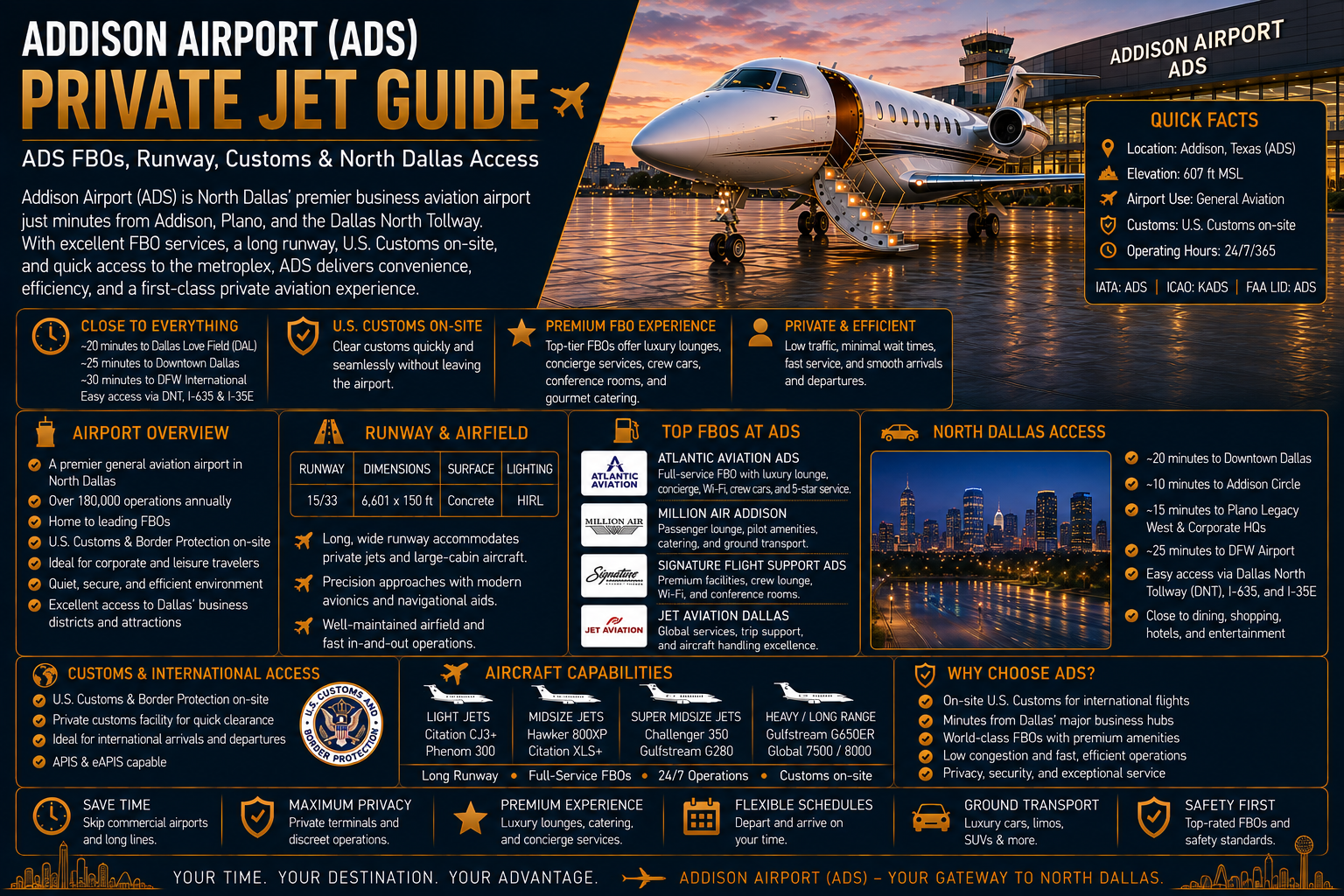
North Dallas Private Aviation Airport Guide
Addison Airport Private Jet Guide: ADS FBOs, Runway, Customs & North Dallas Access
Addison Airport is one of North Texas’s most important business aviation airports, combining a 7,203-foot runway, three full-service FBO options, on-airport U.S. Customs and a location in the heart of the North Dallas Business District. For executives, family offices and private travelers heading to Addison, North Dallas, Plano, Frisco or nearby business corridors, ADS can create a stronger door-to-door itinerary than automatically using a larger Dallas-area airport.
Addison Airport uses the airport identifier ADS and ICAO identifier KADS.
However, its importance to private aviation extends far beyond the airport code.
The airport sits directly inside the North Dallas business market.
Therefore, passenger geography can become one of its strongest advantages.
A traveler heading toward Addison, North Dallas, Plano, Frisco, Richardson, Farmers Branch or nearby corporate districts can often benefit from landing closer to the actual destination.
Consequently, ADS should be evaluated as a door-to-door airport rather than simply as another airport in the Dallas-Fort Worth region.
The official Addison Airport describes its location as being in the heart of the North Dallas Business District.
That geographic position matters.
Dallas-Fort Worth is an enormous metropolitan area.
Therefore, choosing the wrong airport can create substantial unnecessary road travel.
Dallas Love Field can be highly effective for central Dallas.
DFW International provides enormous commercial and international airport infrastructure.
Meanwhile, Addison solves a different geographic problem.
Consequently, airport selection should begin with the passenger’s final address rather than the fame or size of the airport.
Addison Airport has focused on business aviation for decades.
The airport’s official history identifies business aviation as a central part of its mission.
Additionally, the Federal Aviation Administration describes ADS as a single-runway, multi-use airport that provides a convenient alternative for corporate and business aviation.
Therefore, private aircraft are not an afterthought at Addison.
They form a major part of the airport’s operating environment.
The airport also supports flight schools and other general aviation activity.
Consequently, ADS combines substantial business aviation traffic with a broader general aviation ecosystem.
That distinction matters operationally.
Private passengers can use dedicated FBO facilities instead of moving through a conventional airline terminal.
Aircraft operators can coordinate fueling, parking and handling directly through business aviation providers.
Additionally, ground transportation can connect directly with the private aviation side of the airport.
Therefore, the passenger experience remains fundamentally different from commercial travel.
Addison currently has three major FBO operators.
The official Addison Airport business directory lists Atlantic Aviation.
It also lists Galaxy FBO.
Additionally, Million Air operates at ADS.
Therefore, private aircraft operators can compare multiple handling options within the same airport.
That choice can matter.
One FBO may align with an operator’s preferred fuel agreement.
Another may offer stronger hangar or ramp availability for the specific aircraft.
Passenger transportation can influence the decision.
Crew requirements can also matter.
Consequently, the strongest FBO is not automatically the facility with the most attractive lounge.
It is the facility that best supports the complete aircraft and passenger mission.
Addison Airport operates one primary runway.
Runway 16/34 measures 7,203 feet long and 100 feet wide.
Therefore, ADS provides substantial runway capability for a dedicated business aviation airport.
However, the runway includes displaced thresholds.
Consequently, published physical runway length and available landing distance are not identical in every direction.
That distinction matters.
Aircraft weight matters.
Temperature matters.
Wind matters.
Runway condition matters.
Fuel load matters.
Additionally, available takeoff and landing distances can differ depending on runway direction and current airport configuration.
Therefore, private aviation operators should evaluate the exact aircraft and mission rather than relying only on the 7,203-foot headline number.
A light jet making a Texas regional mission creates one performance profile.
A midsize aircraft flying to the Northeast creates another.
A super-midsize jet carrying several passengers and substantial baggage creates another.
Meanwhile, a large-cabin aircraft preparing for a longer nonstop departure can require significantly more performance analysis.
Consequently, ADS aircraft compatibility should always be mission specific.
The runway also includes important safety and operating features.
The FAA identifies an Engineered Material Arresting System at Runway 16.
Additionally, the runway has displaced thresholds.
Therefore, ADS incorporates specific airfield features that reflect its developed urban operating environment.
However, airport infrastructure does not eliminate the need for current flight planning.
Crews should always review current airport diagrams.
NOTAMs matter.
Construction notices matter.
Additionally, current runway conditions matter.
Consequently, this guide should support airport research rather than replace operational preflight resources.
Addison Airport operates within complex Dallas-area airspace.
The airport maintains Class D airspace while the tower is operating.
However, ADS lies beneath Dallas-Fort Worth Class B airspace.
Additionally, Dallas Love Field sits only several miles south.
Therefore, Addison operates inside one of the country’s busiest metropolitan aviation systems.
That creates strategic value.
However, it also creates operational complexity.
The FAA specifically notes that arriving at ADS can be complicated because of surrounding airspace requirements and adjacent airports.
Consequently, business aviation passengers can avoid many commercial-airport passenger processes without removing air traffic control complexity from the aircraft side of the mission.
The airport’s ground configuration deserves attention as well.
A full-length parallel Taxiway A runs east of the runway.
Additionally, most current airport businesses and FBOs sit on the east side of the field.
Therefore, the private aviation infrastructure remains concentrated around a clear operating corridor.
However, the FAA identifies nine airport hot spots connected primarily to the distance between Runway 16/34 and Taxiway A.
Consequently, crews must pay close attention to ground control instructions.
The FAA also warns about potential wrong-surface confusion between the runway and parallel taxiway.
Therefore, current airport diagrams and situational awareness remain particularly important.
ADS also has a wrong-airport risk.
The FAA notes that pilots arriving from the north have occasionally confused nearby Air Park-Dallas Airport with Addison because both airports use similar Runway 16/34 orientations.
Therefore, ADS represents a good example of why professional flight planning requires more than simply entering an airport identifier into a navigation system.
Local airport familiarity matters.
Airspace awareness matters.
Airport lighting and visual identification matter.
Consequently, crews should use all current operational resources when arriving in North Dallas.
Addison’s air traffic control tower currently operates daily from 6:00 a.m. until 10:00 p.m. local time according to current FAA guidance.
Therefore, tower availability should be considered separately from whether the airport itself can support a planned operation.
Late-night and early-morning missions can occur in a different airspace environment.
Consequently, travelers and operators should verify current tower and airport procedures when planning operations outside normal tower hours.
Noise also matters.
Addison sits inside a developed suburban and business environment.
The FAA identifies noise-sensitive areas surrounding the airport and requests use of NBAA standard noise procedures.
Therefore, private aviation operators should treat community impact as part of professional airport use.
That principle becomes particularly relevant for recurring based-aircraft activity.
The airport’s long-term viability depends on operating successfully within the surrounding community.
Consequently, noise awareness supports both immediate operations and the broader business aviation ecosystem.
Addison Airport also supports qualifying international general aviation arrivals.
U.S. Customs and Border Protection operates an on-airport customs facility.
Therefore, qualifying international private flights can potentially clear directly at ADS instead of automatically entering the United States through DFW or another airport.
That capability can materially improve North Dallas private aviation.
Mexico creates one obvious international market.
Caribbean travel can create another.
Canada creates another.
Additionally, longer international missions can use ADS when aircraft performance and customs procedures support the flight.
Consequently, customs capability expands Addison beyond domestic business aviation.
However, international arrival service requires coordination.
The official Addison Airport U.S. Customs guidance currently lists normal service from 10:00 a.m. until 7:00 p.m. Monday through Friday.
Appointments are required.
After-hours service requires advance coordination.
Additionally, weekend and holiday customs must currently be arranged before 4:30 p.m. on Friday.
Therefore, customs should never be treated as an unrestricted arrival feature.
The passenger’s schedule matters.
The aircraft schedule matters.
CBP coordination matters.
Consequently, international missions should be designed around the complete entry process before departure from the foreign origin.
Addison also publishes a weight-based customs user fee structure.
Aircraft up to 12,500 pounds currently fall into the lowest published tier.
Larger aircraft move into higher fee tiers.
Aircraft over 75,000 pounds currently fall into the highest listed base tier.
Additionally, after-hours processing can add a separate fee.
Therefore, aircraft size and arrival timing can influence international mission cost.
That does not mean customs fees should determine aircraft selection by themselves.
However, they belong in the complete mission economics.
Consequently, buyers should compare total cost rather than only the aircraft’s hourly charter rate.
Addison’s customs infrastructure has become an increasingly important part of the airport.
The facility supports international business aviation within the North Dallas market.
Therefore, passengers can potentially preserve the airport’s geographic advantage even when returning from outside the United States.
However, aircraft capability must still align with the route.
A heavy aircraft returning internationally may arrive at a lower fuel weight.
The same aircraft departing ADS on a long international trip may require substantially more fuel.
Consequently, arrival capability and long-range departure capability can produce different answers.
That distinction becomes especially important for larger business jets.
Addison’s runway can accommodate a broad general aviation fleet.
However, no airport runway should be reduced to a generic aircraft-category claim.
Some Gulfstream missions can work.
Some Bombardier Challenger missions can work.
Some Dassault Falcon missions can work.
Additionally, many Citation, Embraer and other business jet models fit the airport well.
However, the exact model matters.
Aircraft weight matters.
Fuel requirement matters.
Temperature matters.
Consequently, buyers should ask whether the specific aircraft can complete the specific mission rather than asking only whether “large jets use Addison.”
Texas heat makes that distinction even more important.
Summer temperatures can reduce aircraft performance.
Therefore, a heavily fueled departure on a hot afternoon can create a different runway requirement from a lighter morning flight.
This becomes more significant as aircraft weight increases.
Consequently, long-range departures deserve careful performance review.
Private aviation planning should never assume that brochure range automatically equals practical nonstop range from every airport under every condition.
Weather introduces additional variables.
North Texas thunderstorms can affect the airport and wider Dallas airspace.
Strong winds can influence runway use.
Severe weather can affect ground transportation.
Additionally, hail can create significant aircraft-protection concerns.
Therefore, Addison private aviation planning should consider regional weather rather than only conditions directly over the runway.
Winter weather occurs less frequently than in northern markets.
However, freezing rain, ice and occasional winter storms can still disrupt Dallas-area aviation.
Consequently, aircraft owners and operators should maintain a cold-weather strategy even in Texas.
Hangar access can become valuable during severe weather.
Aircraft repositioning can also become appropriate when major storms threaten the region.
Therefore, aircraft storage and weather planning should work together.
Addison Airport has substantial hangar infrastructure.
The airport’s official website maintains a dedicated hangar request process.
Additionally, the current airport business environment includes significant private aircraft storage and support infrastructure.
Therefore, ADS can serve both transient aircraft and based aircraft owners.
However, hangar availability should never be assumed.
Aircraft dimensions matter.
Lease availability matters.
Operator relationships matter.
Consequently, exact aircraft-storage needs should be coordinated before the mission.
Galaxy FBO provides another example of Addison’s expanding business aviation infrastructure.
Its Addison operation includes substantial ramp and hangar space.
Therefore, ADS continues to support sophisticated private aviation users rather than functioning only as a small local airport.
Million Air also provides extensive business aviation services.
Atlantic Aviation adds another major network FBO option.
Consequently, Addison offers a mature private aviation ecosystem within a relatively compact airport.
Ground transportation remains one of ADS’s strongest passenger advantages.
A North Dallas executive can land near the business district rather than beginning the ground trip at the far edge of the metropolitan region.
Therefore, airport geography can preserve more of the time saved by flying privately.
Addison itself is an important business destination.
Plano creates another.
Frisco creates another.
Richardson creates another.
Additionally, corporate headquarters and office corridors throughout North Dallas make ADS particularly relevant for executive travel.
Consequently, the airport can support inbound business travelers as well as locally based aircraft owners.
Family offices can benefit for the same reason.
A principal with a residence or business interest in North Dallas can use ADS as a repeat gateway.
Therefore, airport selection can become part of a standardized travel system.
Preferred FBO procedures can be documented.
Preferred vehicle providers can be established.
Aircraft categories can be mapped to common routes.
Additionally, alternate airports can be defined for missions that exceed ADS’s optimal performance or schedule profile.
Consequently, repeat use increases the value of process standardization.
Dallas Love Field creates the most obvious comparison.
DAL provides two substantial runways.
It also sits closer to central Dallas.
Therefore, travelers heading to Downtown, Uptown, Highland Park or University Park may find Love Field particularly attractive.
However, North Dallas passengers can create a different ground-geography problem.
Consequently, ADS versus DAL should be evaluated by final address.
A passenger heading to Addison or Plano may gain little from landing farther south if ADS can support the mission efficiently.
Therefore, neither airport should be treated as the universal Dallas winner.
DFW International creates another comparison.
DFW offers enormous runway capability.
It provides global airline connectivity.
Additionally, it supports the infrastructure expected from one of the world’s largest commercial airports.
However, many private aviation travelers do not require those features.
Therefore, using DFW can add unnecessary airport and ground complexity when ADS better aligns with the passenger’s destination.
However, a heavy aircraft mission, airline connection or other operational requirement can still favor DFW.
Consequently, airport choice should emerge from the mission.
Dallas Executive and Fort Worth-area airports create additional options.
However, those airports solve different geographic problems.
Therefore, Dallas private aviation should be planned as a network rather than as one universally preferred airport.
ADS becomes strongest when North Dallas geography, aircraft performance and business aviation infrastructure all align.
That alignment creates a particularly valuable executive-travel system.
Business travelers can use ADS for regional Texas missions.
Houston creates one route.
Austin creates another.
San Antonio creates another.
Therefore, turboprops and light jets can become efficient tools for short business missions.
Longer routes create different requirements.
New York can increase the value of midsize or super-midsize aircraft.
South Florida creates another longer domestic mission.
Los Angeles requires additional range and cabin consideration.
Aspen introduces mountain-airport performance requirements.
Consequently, aircraft category should change with the route.
International routes create another layer.
Mexico is geographically natural from Dallas.
However, U.S. return customs must be coordinated.
Therefore, the international mission should connect aircraft capability, border procedures and airport operating hours.
The same principle applies to larger groups.
Customs capability does not automatically mean every party size and aircraft mission fits the facility equally well.
Consequently, operators should coordinate exact mission details before confirming ADS as the entry airport.
Addison Airport is therefore more than a runway specification.
It represents a complete North Dallas private aviation decision system.
Runway capability matters.
Displaced thresholds matter.
Aircraft weight matters.
FBO selection matters.
Customs matters.
Airspace matters.
Ground hot spots matter.
Passenger geography matters.
Texas weather matters.
Hangar availability matters.
Ground transportation matters.
Therefore, the strongest ADS mission coordinates all of those variables together.
This guide examines that complete system.
It covers Addison Airport runway capability, FBOs, customs, North Dallas access, aircraft selection, DFW-area airspace, Texas heat, severe weather, hangars, private jet routes, family-office travel and regional airport comparisons.
Most importantly, it explains when Addison Airport should be selected instead of Dallas Love Field, DFW International or another North Texas airport.
Direct ADS Airport Answer
Is Addison Airport Good for Private Jets?
Direct Answer: Yes. Addison Airport is one of North Texas’s strongest business aviation airports, combining a 7,203-foot runway, three major FBOs, on-airport U.S. Customs and direct access to the North Dallas Business District. ADS can be particularly valuable for travelers heading to Addison, North Dallas, Plano, Frisco, Richardson and nearby corporate or residential destinations.
Addison Airport works especially well when the passenger’s actual destination lies north of central Dallas.
Therefore, airport selection should begin with ground geography.
A traveler heading to North Dallas may gain little from using a more distant airport simply because that airport is larger.
Consequently, ADS can preserve more of private aviation’s door-to-door time advantage.
Single Runway
Runway 16/34 measures 7,203 feet long and 100 feet wide, providing substantial business aviation capability.
Multiple Private Terminals
Atlantic Aviation, Galaxy FBO and Million Air currently provide full-service FBO options at Addison Airport.
U.S. Customs
ADS supports qualifying international general aviation arrivals through its on-airport customs facility.
Business District Access
Addison sits directly in the North Dallas Business District, creating strong geography for executive travel.
Controlled Airport
ADS operates within Class D airspace during tower hours beneath Dallas-Fort Worth Class B airspace.
Corporate Airport Role
The airport has maintained a long-standing focus on serving corporate and business aviation.
What Is Addison Airport’s Biggest Private Aviation Advantage?
Its strongest advantage is the combination of runway capability and North Dallas geography.
ADS provides a 7,203-foot runway.
It provides three FBO options.
Additionally, it supports international customs.
However, those features become especially valuable because the airport sits inside the North Dallas business market.
Therefore, passengers can combine serious business aviation infrastructure with reduced ground transportation.
Is ADS Only Useful for Small Business Jets?
No.
Addison supports aircraft ranging from small general aviation airplanes through substantial corporate jets.
However, every aircraft mission should still be evaluated by exact model, weight, weather, fuel and available runway performance.
Consequently, the question should not simply be whether a “large jet” can use ADS.
The better question is whether the exact aircraft can efficiently complete the specific mission.
Addison Airport combines serious business aviation capability with direct access to North Dallas.
That combination makes ADS particularly powerful when passenger geography and aircraft performance align with the airport.
North Dallas Private Aviation
Why Do Private Jet Travelers Use Addison Airport?
Direct Answer: Private jet travelers use Addison Airport because ADS combines a 7,203-foot runway, multiple FBOs, customs capability and direct access to the North Dallas business market. It can be especially valuable for executives, family offices and private travelers heading toward Addison, Plano, Frisco, Richardson and northern Dallas communities.
Dallas-Fort Worth covers an enormous geographic area.
Therefore, selecting the wrong airport can add substantial unnecessary ground travel.
ADS becomes particularly valuable when the passenger’s destination lies north of central Dallas.
Addison
The airport sits directly inside the local business district, creating exceptionally strong geography for Addison destinations.
North Dallas
ADS can reduce ground travel for executives and residents throughout northern Dallas.
Plano
Private travelers heading farther north can evaluate Addison as a practical business aviation gateway.
Frisco
ADS can support private aviation access toward one of North Texas’s fastest-growing business and residential markets.
Richardson
Corporate and technology travel can align with Addison’s North Dallas geography.
Corporate Travel
ADS can connect North Dallas executives with regional, national and international markets around their schedules.
Why Not Automatically Use Dallas Love Field?
Love Field provides excellent central Dallas access.
However, central Dallas and North Dallas create different passenger geography.
Therefore, travelers heading toward Addison, Plano or Frisco should compare actual road time.
ADS can place the aircraft closer to the northern destination.
Why Not Automatically Use DFW?
DFW provides enormous airport infrastructure.
However, airport size does not automatically improve a private aviation itinerary.
Therefore, passengers without an airline-connection or major-airport requirement should compare the complete trip.
ADS can provide a more direct private aviation experience for many North Dallas missions.
North Texas private aviation should be planned around where the passenger is actually going.
Addison becomes especially powerful when that destination lies north of central Dallas.
North Dallas Business Aviation
What Role Does Addison Airport Play in Dallas Private Aviation?
Direct Answer: Addison Airport is a single-runway, multi-use airport with a long-standing business aviation focus. ADS supports corporate jets, charter aircraft, privately operated aircraft, flight schools, maintenance providers, aircraft management companies and multiple FBOs, making it one of the most developed general aviation ecosystems in the North Dallas market.
ADS differs from DFW because airline service does not define the airport.
Instead, general and business aviation form the core operating environment.
Therefore, private travelers use infrastructure centered on non-airline aircraft activity.
Corporate Jet Operations
Addison supports substantial corporate, charter and privately operated aircraft activity.
Multi-Use Airport
ADS also supports flight training and other general aviation activity.
Private Aviation Infrastructure
Atlantic Aviation, Galaxy FBO and Million Air provide multiple business aviation handling options.
Customs Capability
Qualifying international general aviation arrivals can clear U.S. Customs directly at Addison.
Towered Operations
The airport operates within controlled Class D airspace during current tower hours beneath the DFW Class B system.
Executive Gateway
ADS provides strategic access to major northern Dallas business and residential markets.
Does Flight Training Reduce Addison’s Business Aviation Value?
Not necessarily.
Flight schools form part of the airport’s mixed general aviation environment.
However, ADS also supports substantial business jet activity.
Therefore, private aviation remains a central airport function.
The aircraft and crew simply operate within a diverse traffic environment.
Does Addison Have an Airline Terminal?
No conventional airline passenger terminal defines the airport experience.
Therefore, private passengers use FBO facilities rather than commercial airline check-in and security processes.
Consequently, ADS can deliver a dedicated business aviation passenger experience while operating inside the larger Dallas airspace system.
Addison Airport is not merely near North Dallas—it is built around the business aviation market that North Dallas creates.
That role makes ADS a major executive aviation gateway within the DFW region.
ADS Quick Reference
What Should Private Jet Travelers Know About Addison Airport?
Direct Answer: Addison Airport uses the identifiers ADS and KADS and operates a single 7,203-foot by 100-foot runway. The airport currently supports three major FBOs, on-field U.S. Customs, controlled tower operations and a large business aviation ecosystem while providing direct access to the North Dallas Business District.
| Airport Detail | Addison Airport Information | Why It Matters |
|---|---|---|
| Airport | Addison Airport | Major North Dallas business and general aviation airport |
| Airport Identifier | ADS | Primary domestic airport identifier |
| ICAO Identifier | KADS | Used in operational flight planning |
| Location | Addison, Texas | Places the airport inside the North Dallas Business District |
| Runway | Runway 16/34 — 7,203 × 100 feet | Provides substantial capability for a broad business aviation fleet |
| Runway Configuration | Single runway with displaced thresholds | Available landing and takeoff distances require mission-specific review |
| Current FBOs | Atlantic Aviation, Galaxy FBO and Million Air | Provides multiple handling, fuel and passenger-service options |
| International Customs | Available under current procedures | Supports qualifying international general aviation arrivals |
| Normal Customs Hours | Monday–Friday, 10:00 a.m.–7:00 p.m. | After-hours, weekend and holiday service requires advance arrangements |
| Airspace | Class D beneath DFW Class B | Dallas regional airspace affects arrivals and departures |
| FAA Tower Hours | 6:00 a.m.–10:00 p.m. daily | Operations outside tower hours use a different airspace environment |
| Primary Passenger Advantage | North Dallas access | Can reduce total ground transportation for northern Dallas destinations |
Which Addison Airport Specification Matters Most?
There is no single answer.
The 7,203-foot runway creates significant aircraft capability.
However, the three-FBO ecosystem strengthens passenger and aircraft handling.
Customs expands international usefulness.
Meanwhile, North Dallas geography creates the door-to-door advantage.
Therefore, ADS becomes strongest when all four factors support the same mission.
Addison Airport’s runway makes ADS capable. Its North Dallas location makes it strategically valuable.
For many northern Dallas travelers, that combination distinguishes Addison from the wider regional airport network.
ADS Runway System
How Long Is the Runway at Addison Airport?
Direct Answer: Addison Airport has one paved runway, Runway 16/34, measuring 7,203 feet long and 100 feet wide. That length provides substantial capability for business aviation, although displaced thresholds, aircraft weight, fuel, temperature, wind and runway conditions determine the usable performance for each individual arrival or departure.
A 7,203-foot runway gives Addison meaningful business aviation capability.
Therefore, the airport can support much more than small general aviation aircraft.
However, published runway length is only the starting point.
7,203 Feet
Addison’s single paved runway measures 7,203 feet long and 100 feet wide.
One Primary Operating Surface
All fixed-wing runway operations ultimately depend on the availability and condition of Runway 16/34.
Runway 16 Safety System
The FAA identifies an Engineered Material Arresting System at the Runway 16 end.
Does a 7,203-Foot Runway Mean Any Private Jet Can Use Addison?
No.
Runway length is only one performance variable.
Aircraft weight matters.
Temperature matters.
Wind matters.
Runway condition matters.
Additionally, the required fuel load can materially change takeoff performance.
Therefore, operators must calculate the exact aircraft and mission.
Why Does a Single Runway Matter?
A single-runway airport has less runway redundancy than a multi-runway airport.
Therefore, runway closures or construction can have greater operational significance.
Wind direction also cannot be solved by simply moving to a crosswind runway.
Consequently, current runway status becomes particularly important at ADS.
Addison’s 7,203-foot runway provides serious business aviation capability, but every ADS mission still belongs to the exact aircraft and conditions.
Runway length should start the analysis rather than end it.
ADS Runway Performance
How Do Addison Airport’s Displaced Thresholds Affect Private Jet Operations?
Direct Answer: Runway 16/34 has displaced thresholds, which means the full 7,203-foot physical pavement length does not equal the available landing distance in each direction. Therefore, private jet crews must use current declared distances and aircraft-specific performance data rather than assuming the entire published runway length is available for every landing.
This distinction matters because takeoff and landing are different performance problems.
A displaced threshold can leave pavement available for certain takeoff or rollout purposes while reducing landing distance from that runway direction.
Therefore, operators must use the correct declared distance for the planned operation.
Why Does This Matter for Larger Business Jets?
Heavier aircraft can require more landing distance.
Therefore, available runway beyond the landing threshold becomes particularly important.
Weather can also increase required distance.
Additionally, runway contamination or other conditions can alter performance.
Consequently, large-aircraft compatibility should never be based solely on the airport’s total physical runway length.
Should Passengers Worry About Displaced Thresholds?
Passengers do not need to calculate them.
However, they should understand why an operator may approve one aircraft or mission while recommending a different plan for another.
Therefore, performance limitations can reflect real runway geometry rather than aircraft availability alone.
At ADS, “7,203 feet of runway” is not the same as “7,203 feet available for every landing.”
Professional flight planning uses the exact declared distances for the exact operation.
ADS Aircraft Strategy
Which Types of Private Jets Can Use Addison Airport?
Direct Answer: Addison Airport can support a broad private aviation fleet, including turboprops, light jets, midsize jets, super-midsize aircraft and many larger business jets. However, ADS’s single-runway configuration, displaced thresholds and Texas operating conditions mean larger and heavier aircraft require exact mission-specific performance analysis.
Addison gives private aviation buyers broad aircraft flexibility.
Therefore, travelers can choose aircraft around passenger requirements rather than being restricted to one small category.
However, aircraft size should increase only when the mission requires it.
Turboprops
Turboprops can provide efficient short-range Texas and regional travel with strong runway flexibility.
Short Business Missions
Light jets can efficiently connect North Dallas with Texas and nearby domestic markets.
Cabin + Range
Midsize aircraft can add passenger comfort and baggage capability for longer domestic missions.
Long Domestic Missions
Super-midsize jets can provide stand-up cabin comfort and substantial nonstop capability when ADS performance permits.
Premium Long-Range Travel
Selected large business jets can use ADS when exact aircraft weight, available runway and conditions support the mission.
Heavy Departures
Long-range fuel requirements can make departure performance significantly more restrictive for heavier aircraft.
Why Does Texas Heat Matter at Addison?
High temperatures can reduce aircraft performance.
Therefore, summer conditions can change available takeoff margin compared with cooler weather.
This becomes increasingly important as aircraft weight rises.
Consequently, heavy departures carrying substantial fuel deserve detailed performance analysis.
Does That Mean Large Jets Struggle at Addison?
Not automatically.
The airport provides significant runway capability.
However, safe aircraft operation should never be reduced to one runway dimension.
Therefore, the exact aircraft, route, weight and conditions remain the final determinants.
Addison gives private aviation buyers a broad aircraft menu.
The mission should determine which aircraft to choose from that menu.
ADS Private Aviation Infrastructure
Which FBOs Serve Private Jets at Addison Airport?
Direct Answer: Addison Airport currently lists three major fixed-base operators: Atlantic Aviation, Galaxy FBO and Million Air. Therefore, private aircraft operators can compare handling, fuel arrangements, ramp space, hangar availability, passenger amenities, crew support and operator relationships while remaining within the same ADS airport environment.
Multiple FBOs strengthen Addison’s business aviation ecosystem.
However, travelers should not automatically select a facility based only on brand preference.
The aircraft requirements matter.
Parking matters.
Fuel arrangements matter.
Additionally, passenger transportation and crew requirements can affect the decision.
Atlantic Aviation ADS
Atlantic Aviation provides full-service business aviation handling at Addison Airport.
Galaxy FBO
Galaxy operates a substantial Addison facility with private terminal, ramp and hangar infrastructure.
Million Air Dallas
Million Air operates at Addison with FBO, charter, aircraft management and other business aviation services.
Why Does FBO Choice Matter at ADS?
The FBO affects aircraft handling.
Parking availability can differ.
Fuel agreements can differ.
Additionally, passenger vehicles need the correct facility.
Therefore, the FBO decision affects both the aircraft and passenger sides of the mission.
Should Passengers Choose the FBO?
They can express preferences.
However, the aircraft operator may have strong operational reasons for recommending one facility.
Therefore, passenger preference should be coordinated with aircraft requirements rather than imposed independently.
At ADS, three major FBOs create choice—but choice should be used strategically.
The best facility is the one that supports the aircraft, crew, passenger and ground-transportation plan together.
International General Aviation
Can International Private Jets Clear Customs at Addison Airport?
Direct Answer: Yes. Addison Airport supports qualifying international general aviation arrivals through its on-airport U.S. Customs facility. Normal service is currently published from 10:00 a.m. to 7:00 p.m. Monday through Friday, while after-hours, weekend and holiday arrivals require advance appointment arrangements.
International capability can make ADS particularly valuable for North Dallas residents and businesses.
Mexico is geographically natural from Dallas.
Canada creates another international market.
Caribbean missions can also be relevant.
Therefore, direct customs capability can preserve Addison’s North Dallas geographic advantage.
However, customs service should never be assumed.
Appointments are required.
After-hours service requires advance coordination.
Additionally, weekend and holiday service must be arranged ahead of time.
Therefore, international arrival planning must begin before the aircraft departs its foreign origin.
| International Requirement | Current ADS Planning Consideration |
|---|---|
| Airport Status | Active U.S. Customs user-fee airport for qualifying general aviation arrivals |
| Normal Service Hours | Monday–Friday, 10:00 a.m.–7:00 p.m. |
| Appointment | Required for customs processing |
| After-Hours Service | Must be arranged in advance during weekday business hours |
| Weekend / Holiday Service | Current airport guidance requires scheduling before 4:30 p.m. Friday |
| User Fees | Weight-based fee schedule applies |
| After-Hours Fee | Additional published surcharge applies when applicable |
Can a Private Jet Return From Mexico Directly to Addison?
Potentially, yes.
ADS can process qualifying international general aviation arrivals.
However, the operator must satisfy current CBP requirements.
Therefore, customs coordination should be completed before the flight departs Mexico.
Why Is Direct ADS Customs Valuable?
An intermediate customs stop adds another landing.
It adds another ground process.
It also adds another departure.
Therefore, clearing directly at Addison can preserve more of private aviation’s door-to-door efficiency when the mission qualifies.
ADS supports international general aviation—but customs is a coordinated service, not an unrestricted arrival feature.
Verify current appointment requirements, service hours and fees before every international mission.
Operational Accuracy
Where Should Current Addison Airport Private Aviation Information Be Verified?
Airport procedures, runway conditions, FBO services, customs availability, tower hours, NOTAMs and operating conditions can change.
Therefore, this guide supports airport research rather than replacing operational flight-planning resources.
For current airport information, travelers and operators should verify requirements through the official Addison Airport.
Additionally, crews should use the Federal Aviation Administration’s current ADS airport guidance for airfield-specific cautions, tower information and operational planning.
International operators should also verify current procedures through Addison Airport’s official U.S. Customs guidance and U.S. Customs and Border Protection before departure.
ADS International Mission Costs
What Should Private Jet Travelers Know About Addison Airport Customs Fees?
Direct Answer: Addison Airport uses a weight-based customs user-fee structure for international general aviation arrivals. Therefore, the applicable airport customs charge can change with aircraft weight, while after-hours processing can add another fee. International travelers should confirm the current schedule and appointment requirements before departure rather than treating customs as a fixed-cost service.
Customs fees represent a relatively small part of most private jet missions.
However, they still belong in the complete trip calculation.
Aircraft size affects the applicable tier.
Arrival timing can also affect the total.
Additionally, after-hours processing can create another charge.
Therefore, international trip planning should include customs costs before the itinerary is finalized.
Why Does Aircraft Weight Affect the Fee?
Addison publishes customs charges by aircraft weight category.
Therefore, a light business jet can fall into a different fee tier from a large-cabin aircraft.
That distinction becomes relevant when comparing aircraft for international missions.
However, travelers should not choose an aircraft simply to reduce a customs fee.
Range, passenger requirements, baggage and aircraft performance remain much more important.
Consequently, the customs charge should be treated as one component of total mission economics.
Can After-Hours Customs Increase the Cost?
Yes.
Addison currently publishes an additional after-hours customs charge.
Therefore, an arrival outside normal service hours can cost more than an arrival during the regular operating window.
More importantly, after-hours processing requires advance coordination.
Consequently, travelers should solve both availability and cost before departure.
Should International Charter Quotes Include These Costs?
Travelers should confirm exactly what the quoted price includes.
Some charter structures can incorporate international handling and airport expenses.
Others may identify certain charges separately.
Therefore, buyers should compare the complete trip price rather than only the aircraft’s hourly rate.
International private aviation pricing should include the entire airport process—not simply aircraft flight time.
Customs, handling, parking, international fees and after-hours requirements can all affect the final ADS mission cost.
North Dallas Ground Strategy
Why Is Addison Airport Valuable for North Dallas Private Jet Travelers?
Direct Answer: Addison Airport’s greatest passenger advantage is its location inside the North Dallas Business District. For travelers whose homes, offices, meetings, hotels or corporate destinations lie north of central Dallas, ADS can reduce unnecessary ground travel and preserve more of the time advantage created by flying privately.
Private aviation saves time in the air.
However, the complete trip includes the road journey before departure and after arrival.
Therefore, airport geography matters.
Dallas-Fort Worth makes that principle particularly important because the metropolitan region covers a vast area.
Landing at the wrong airport can transfer saved flight time directly into highway time.
Consequently, travelers should compare airports using door-to-door travel rather than flight time alone.
Immediate Local Access
ADS sits directly inside Addison and the surrounding North Dallas business environment.
Northern Business Corridors
The airport can provide strong access to corporate districts north of central Dallas.
Corporate Headquarters
Plano’s substantial corporate market makes Addison relevant for executive and business aviation missions.
Growing Business Market
Frisco’s expanding corporate, sports and residential market creates significant private aviation demand north of Dallas.
Technology Corridor
ADS can provide practical access for travelers heading toward Richardson and nearby technology businesses.
Residential Access
North Dallas households and family offices can use ADS as a repeat private aviation gateway.
Why Does Ground Geography Matter More for Private Aviation?
Private aviation eliminates many commercial-airline constraints.
Therefore, wasting an hour on unnecessary ground transportation undermines part of that advantage.
The aircraft may save significant travel time.
However, a poorly selected airport can give some of it back.
Consequently, airport selection should optimize the entire passenger journey.
Should Every North Dallas Traveler Use Addison?
No.
Aircraft requirements can favor another airport.
A passenger may also need an airline connection.
Additionally, the final destination may sit closer to another airport.
Therefore, ADS should win because it creates the strongest complete itinerary rather than because it carries the Addison name.
Private aviation does not end when the aircraft door opens.
For North Dallas travelers, Addison’s value comes from connecting the flight directly with where the passenger actually needs to go.
North Dallas Private Jet Access
Is Addison Airport Good for Private Jet Travel to Plano and Frisco?
Direct Answer: Addison Airport can be a strong private aviation gateway for Plano and Frisco because ADS sits north of central Dallas and provides substantial business jet infrastructure. However, exact ground advantage depends on the passenger’s final address, traffic conditions and competing airport options, so the itinerary should be compared door to door.
Plano and Frisco have become major business destinations in their own right.
Therefore, Dallas private aviation should not automatically be planned around Downtown Dallas.
Corporate headquarters have expanded north.
Professional sports facilities have expanded north.
Luxury residential development has also expanded north.
Consequently, airport demand has moved with the region.
Why Can ADS Work Well for Plano?
Plano lies north and east of Addison.
Therefore, ADS can provide practical access without forcing passengers to begin farther south.
Corporate travelers can land at Addison and continue toward Plano’s business corridors.
Additionally, executive transportation can be staged directly at the FBO.
Consequently, the aircraft-to-office transfer can remain relatively simple.
Why Can ADS Work for Frisco?
Frisco lies farther north.
Therefore, airport comparison becomes even more important.
Addison can still provide a strong business aviation option.
However, the exact destination within Frisco can influence whether ADS or another North Texas airport creates the shortest complete itinerary.
Consequently, passengers should compare actual road geography rather than using a generic Dallas airport recommendation.
What About Sports and Entertainment Travel?
Frisco has become a major professional sports and entertainment market.
Therefore, team executives, athletes, sponsors and private travelers can generate significant premium aviation demand.
ADS can support those missions when aircraft requirements and passenger geography align.
Additionally, private ground transportation can be coordinated before arrival.
Consequently, the airport can become part of a tightly controlled executive or VIP travel plan.
Plano and Frisco reinforce why “Dallas private jet airport” is not a single-airport question.
The correct airport depends on which part of the Dallas-Fort Worth region the passenger actually needs to reach.
Executive Aviation
How Does Addison Airport Serve North Dallas Business Travel?
Direct Answer: Addison Airport can function as a dedicated executive aviation gateway for the North Dallas corporate market. Its business aviation infrastructure, multiple FBOs, 7,203-foot runway and location near major northern business corridors can support same-day trips, executive teams, multi-city missions, corporate flight departments and recurring company travel.
Corporate aviation creates value when it increases productive time.
Therefore, aircraft speed represents only one component.
Airport processing matters.
Ground transportation matters.
Schedule control matters.
Additionally, cabin productivity matters.
ADS can support all four.
Same-Day Texas Trips
Executives can connect North Dallas with Houston, Austin, San Antonio and other regional markets around business schedules.
Executive Teams
Teams can travel together while using the cabin for private meetings and preparation.
Multi-City Missions
Private aviation can connect multiple meetings or facilities without relying on airline schedules.
Corporate Flight Departments
Based or recurring aircraft operations can use Addison’s broader business aviation ecosystem.
Client Travel
Companies can coordinate private aircraft, FBO handling and ground transportation for important visitors.
International Business
On-airport customs can support qualifying international arrivals directly into North Dallas.
Why Can ADS Be Valuable for Same-Day Business Travel?
Texas contains several major business centers within relatively short flying distance.
Therefore, a private aircraft can leave Addison in the morning, complete meetings elsewhere and return the same day.
That can reduce hotel nights.
It can also preserve executive availability.
Consequently, regional aviation can create value even when the flight itself is short.
Why Can Smaller Aircraft Be Powerful for Corporate ADS Missions?
Not every executive mission requires a large cabin.
A small team flying within Texas may gain little from paying for unused long-range capability.
Therefore, light jets and turboprops can become valuable corporate tools.
Meanwhile, longer routes can justify midsize or super-midsize aircraft.
Consequently, a strong flight department matches aircraft size to mission requirements.
Addison’s business aviation value comes from connecting North Dallas executives directly with the markets their businesses require.
Aircraft selection should then scale with each mission rather than remaining fixed around one category.
ADS vs. DAL
Is Addison Airport or Dallas Love Field Better for Private Jets?
Direct Answer: Addison Airport can be stronger for North Dallas, Addison, Plano and some Frisco-area missions, while Dallas Love Field can provide better geography for Downtown Dallas, Uptown, Highland Park and other central destinations. The best airport depends on passenger address, aircraft requirements, traffic, runway needs and the complete ground itinerary.
ADS and DAL are both important Dallas private aviation airports.
However, they solve different problems.
Therefore, travelers should avoid treating them as interchangeable.
| Decision Factor | Addison Airport — ADS | Dallas Love Field — DAL |
|---|---|---|
| Primary Geography | North Dallas and Addison | Central Dallas |
| Airport Environment | Business and general aviation focused | Commercial airline and business aviation mix |
| Runway Environment | Single 7,203-foot runway | Multiple-runway airport environment |
| Downtown Dallas | Can require additional southbound ground travel | Generally stronger geography |
| Addison / North Dallas | Generally stronger geography | Can require additional northbound ground travel |
| Plano | Strong airport candidate | Requires comparison against additional road travel |
| Private Aviation Experience | Airport environment centered heavily on general and business aviation | Strong FBO infrastructure within an airline airport environment |
| Best Choice | Whichever airport produces the stronger aircraft and door-to-door passenger mission | |
When Is Addison Usually the Stronger Starting Point?
ADS becomes especially compelling when the passenger starts in North Dallas.
Therefore, an Addison, Plano or nearby northern origin can favor ADS.
Additionally, travelers who value a business-aviation-focused airport environment may prefer Addison when aircraft performance fits.
When Can Love Field Be Stronger?
Central Dallas geography can favor DAL.
Therefore, passengers originating in Downtown, Uptown, Highland Park or nearby districts should compare Love Field carefully.
Additionally, some aircraft missions can benefit from DAL’s larger airport infrastructure.
Consequently, airport selection should remain mission specific.
Why Is This Comparison More Important Than Flight Time?
A private jet can cover the airborne distance from either airport efficiently.
However, Dallas road travel can vary materially.
Therefore, choosing the airport closest to the passenger’s actual geography can save more time than minor differences in aircraft cruise speed.
Travelers evaluating central Dallas operations can also review IMR’s Dallas Love Field Private Jet Guide.
ADS versus DAL is primarily a geography-and-mission decision—not a contest over which airport is universally better.
North Dallas can favor Addison. Central Dallas can favor Love Field.
ADS vs. DFW
Is Addison Airport or DFW Better for Private Jet Travel?
Direct Answer: Addison Airport can provide a more direct business aviation experience for many North Dallas private jet missions, while DFW International offers significantly greater runway capacity, airline connectivity and major-airport infrastructure. Travelers should favor ADS when geography and aircraft performance fit, while DFW can become stronger for missions requiring its larger operational ecosystem.
DFW and Addison serve fundamentally different aviation roles.
Therefore, airport size alone provides a poor comparison.
DFW is one of the world’s major airline hubs.
Addison is centered heavily on general and business aviation.
Consequently, the passenger experience and airport mission differ substantially.
When Does ADS Have the Advantage?
A North Dallas passenger without an airline connection can benefit from Addison’s geography.
The private aviation environment can also simplify passenger movement.
Additionally, FBO-based ground transportation can connect directly with the final destination.
Therefore, ADS can provide a cleaner private aviation itinerary.
When Can DFW Be the Better Airport?
Some missions require greater runway capability.
Others connect with airline passengers.
Additionally, certain international or operational requirements can favor a major international airport.
Therefore, DFW should remain part of the regional airport strategy.
Does DFW’s Size Automatically Make It Safer or Better?
No.
Both airports operate within professional aviation systems.
However, they provide different infrastructure and capabilities.
Therefore, the decision should be based on aircraft requirements and passenger objectives rather than assumptions created by airport size.
Use DFW when the mission needs DFW. Use Addison when the passenger and aircraft benefit from Addison.
The best private aviation airport is the one that eliminates unnecessary complexity without sacrificing operational capability.
ADS Door-to-Door Planning
How Should Ground Transportation Be Planned at Addison Airport?
Direct Answer: Ground transportation at Addison Airport should be coordinated with the exact FBO before the aircraft arrives. Private vehicles, chauffeured SUVs, executive cars, rental vehicles and security transportation can be staged around passenger requirements, while Dallas traffic and the final destination should determine pickup timing and route planning.
Ground transportation should not be treated as an afterthought.
It completes the private aviation itinerary.
Therefore, the vehicle should be planned at the same time as the aircraft.
Why Does the FBO Matter?
The driver needs the correct arrival location.
Addison has multiple FBOs.
Therefore, telling a driver only to go to “Addison Airport” creates unnecessary ambiguity.
The operator or passenger team should provide the exact FBO.
Consequently, the vehicle can be positioned before the passenger exits the aircraft.
What Type of Vehicle Should Be Used?
Passenger count matters.
Baggage matters.
Security requirements matter.
Additionally, the length and purpose of the ground trip can influence vehicle choice.
A single executive may require only a sedan.
A family with substantial luggage may require a large SUV.
A corporate team may require multiple vehicles.
Consequently, ground transportation should be matched to the same passenger profile used to select the aircraft.
How Should Dallas Traffic Affect Planning?
Traffic can materially change road time.
Therefore, meetings should not be scheduled around an idealized map estimate.
Time of day matters.
Weather matters.
Construction can also matter.
Consequently, professional trip planning should build realistic ground buffers around important appointments.
The private aviation time advantage is only complete when the vehicle is waiting at the correct ADS FBO.
Aircraft and ground transportation should function as one itinerary.
ADS Aircraft Handling
How Does Private Jet Parking Work at Addison Airport?
Direct Answer: Private jet parking at Addison Airport is coordinated through the aircraft’s FBO or operator based on aircraft size, expected stay, ramp availability, hangar requirements and current airport activity. Travelers should not assume long-term ramp or hangar availability, particularly for larger aircraft or during periods of significant North Dallas demand.
Aircraft parking can influence the complete mission.
Therefore, operators should solve it before arrival when the aircraft will remain in Dallas.
The aircraft may stay on the ramp.
It may enter a hangar.
Alternatively, it may reposition.
Consequently, the passenger should understand the plan if schedule flexibility matters.
Why Would an Aircraft Reposition?
Parking availability can influence the decision.
Crew requirements can also matter.
Additionally, another aircraft assignment may require repositioning.
Therefore, the aircraft that drops off the passenger does not always remain at ADS.
Why Does Repositioning Matter to the Passenger?
An early return departure becomes easier when the aircraft remains nearby.
However, a repositioned aircraft may require additional lead time.
Consequently, passengers who expect schedule changes should discuss aircraft positioning with the operator before arrival.
Can Severe Weather Affect Parking Strategy?
Yes.
North Texas thunderstorms and hail can create aircraft-protection concerns.
Therefore, hangar space can become particularly valuable during threatening weather.
However, hangar capacity is finite.
Consequently, operators may need to secure space early or reposition aircraft away from severe weather.
Where the aircraft goes after passenger drop-off can determine how flexible the return flight remains.
Parking strategy belongs in the original ADS itinerary.
ADS Aircraft Storage
Are Private Jet Hangars Available at Addison Airport?
Direct Answer: Addison Airport has extensive hangar infrastructure supporting based and transient aircraft, while individual FBOs and aviation businesses provide additional storage options. However, actual hangar availability depends on aircraft dimensions, lease inventory, transient demand and current facility capacity, so operators should coordinate exact requirements directly.
Hangar access can provide several benefits.
It protects the aircraft from sun.
It protects the cabin from heat.
Additionally, it can reduce exposure to hail and severe weather.
Therefore, hangar availability can become particularly valuable in North Texas.
Why Is Hangar Protection Important in Dallas?
Texas heat can raise cabin and surface temperatures significantly.
Severe thunderstorms can also produce hail.
Therefore, enclosed storage can protect both aircraft condition and passenger comfort.
However, not every aircraft can fit every hangar.
Consequently, wingspan, tail height and aircraft length matter.
Can Aircraft Owners Base a Jet at Addison?
ADS supports a substantial based-aircraft community.
Therefore, owners can investigate long-term hangar and operating arrangements.
However, available inventory can change.
Consequently, owners should work directly with the airport, FBOs or hangar providers when evaluating permanent basing.
Why Can Basing at ADS Make Sense for North Dallas Owners?
The aircraft can be positioned near the owner’s residence or business.
Therefore, departure-day ground travel can decrease.
Additionally, recurring FBO and maintenance relationships can become standardized.
Consequently, the airport can become part of a repeatable private aviation operating system.
For North Dallas aircraft owners, hangar location can influence every trip before the engines ever start.
Basing strategy should optimize owner geography, aircraft support and long-term operating requirements together.
DFW Regional Airspace
How Does Dallas-Fort Worth Airspace Affect Addison Airport Private Jets?
Direct Answer: Addison Airport operates within Class D airspace during tower hours and beneath the larger Dallas-Fort Worth Class B system. Nearby Dallas Love Field and extensive DFW-area traffic create a complex metropolitan airspace environment, so ADS arrivals and departures depend on coordinated air traffic control procedures rather than operating independently from the surrounding region.
Addison provides a focused business aviation airport.
However, the aircraft still operates inside a major metropolitan airspace system.
Therefore, private-terminal convenience should not be confused with simple airspace.
The FAA specifically highlights surrounding airspace complexity for ADS arrivals.
Consequently, crews must maintain precise awareness of clearances, routing and neighboring airports.
Does DFW Traffic Delay Addison Private Jets?
It can influence operations.
Regional traffic volume, weather and air traffic management can affect routing.
However, the exact impact changes by day and time.
Therefore, passengers should avoid assuming either that ADS is immune from DFW traffic or that major delays are inevitable.
Why Does Dallas Love Field Matter?
Love Field lies relatively close to Addison.
Therefore, its traffic forms part of the surrounding aviation environment.
Additionally, the DFW Class B structure sits above and around regional operations.
Consequently, ADS crews operate within a tightly managed system.
Does Private Aviation Still Save Time?
Yes, because passenger processing and schedule flexibility remain fundamentally different.
However, air traffic control constraints can still affect aircraft movement.
Therefore, private aviation removes many airline passenger constraints without removing the realities of metropolitan airspace.
ADS provides a private aviation-focused ground experience inside a highly complex Dallas-Fort Worth airspace system.
Passenger convenience and aircraft operating complexity can exist at the same time.
ADS Ground Operations
What Should Private Jet Crews Know About Addison Airport Hot Spots?
Direct Answer: FAA guidance identifies multiple hot spots at Addison Airport, largely associated with the close spacing between Runway 16/34 and parallel Taxiway A. Crews should use current airport diagrams, follow ground-control instructions carefully and maintain strong situational awareness during taxi, runway crossings and departure preparation.
Airport hot spots identify areas requiring increased attention.
Therefore, they should not be interpreted as evidence that the airport is unsuitable.
Instead, they highlight where crews should apply additional awareness.
Addison’s parallel taxiway configuration creates several of these areas.
Consequently, ground operations deserve the same disciplined planning as the flight itself.
Why Can Runway and Taxiway Spacing Matter?
The runway and parallel taxiway sit relatively close together.
Therefore, crews must identify the correct surface precisely.
The FAA also warns about potential wrong-surface confusion.
Consequently, visual identification, signage and ground-control instructions remain critical.
Is There a Wrong-Airport Risk Near Addison?
Yes.
FAA guidance warns that pilots approaching from the north have occasionally confused nearby Air Park-Dallas with Addison because of similar runway orientation.
Therefore, crews should positively identify ADS before continuing the approach.
Does This Affect Passengers?
These are primarily pilot and operator considerations.
However, they demonstrate why local airport knowledge matters.
Therefore, passengers should value professional operators who use current airport information rather than treating every general aviation airport as operationally identical.
Addison’s ground environment rewards disciplined airport awareness.
Current diagrams, clear taxi instructions and positive runway identification remain essential parts of professional ADS operations.
Summer ADS Operations
How Does Texas Heat Affect Private Jet Operations at Addison Airport?
Direct Answer: High North Texas temperatures can reduce aircraft takeoff performance at Addison Airport, particularly for heavier jets carrying substantial fuel, passengers and baggage. Therefore, a mission that works comfortably during cooler conditions can require different weight, fuel or timing decisions during extreme summer heat.
Aircraft performance changes with atmospheric conditions.
Hot air is less dense.
Therefore, aircraft can require more runway or reduced operating weight.
That principle matters at every airport.
However, Texas summer heat makes it particularly relevant at ADS.
Which Flights Are Most Sensitive to Heat?
Heavy departures deserve the most attention.
A long-range flight can require substantial fuel.
A full passenger cabin adds weight.
Baggage adds more.
Therefore, a large aircraft preparing for a long nonstop mission can face a different performance problem from a lightly loaded regional jet.
Can Departing Earlier Help?
Potentially.
Morning temperatures can be lower than afternoon temperatures.
Therefore, an operator may recommend a cooler departure window when performance margin matters.
However, timing alone does not guarantee feasibility.
Consequently, exact aircraft calculations remain necessary.
Could a Fuel Stop Make Sense?
Yes.
An aircraft can sometimes depart with less fuel and stop elsewhere to refuel.
That adds another landing and departure.
However, it can improve takeoff performance at the original airport.
Therefore, a technical fuel stop can sometimes preserve the preferred aircraft when a heavy nonstop departure is less practical.
Summer range from ADS is not simply the aircraft’s brochure range.
Temperature, payload, fuel and runway performance determine what the aircraft can actually do on the day of departure.
North Texas Aviation Weather
How Does Weather Affect Private Jet Operations at Addison Airport?
Direct Answer: North Texas weather can affect Addison Airport through thunderstorms, strong winds, hail, heavy rain, extreme heat and occasional winter icing. Because ADS operates within the larger Dallas-Fort Worth airspace system, regional storms can influence routes and traffic flow even when conditions directly over Addison remain temporarily usable.
Texas weather can change rapidly.
Therefore, private aviation planning should consider the entire region rather than only the airport.
Thunderstorms can build along departure routes.
They can affect arrival corridors.
Additionally, they can alter DFW-area air traffic flow.
Consequently, weather several miles away can still affect an ADS mission.
Thunderstorms
Convective weather can affect routing, departure timing and the broader Dallas airspace system.
Hail
Severe storms can create aircraft-protection concerns and increase the value of hangar planning.
Extreme Heat
High temperatures can reduce aircraft takeoff performance, particularly on heavy departures.
Strong Winds
Wind direction and velocity can affect runway performance at a single-runway airport.
Heavy Rain
Rain can influence runway conditions, visibility and regional traffic flow.
Winter Weather
Occasional ice, freezing rain and winter storms can disrupt North Texas aviation despite their lower frequency.
Why Is Hail Particularly Important for Private Aircraft?
Hail can damage aircraft surfaces.
Therefore, operators may prioritize hangar protection or aircraft repositioning when severe storms threaten.
However, regional hangar demand can rise rapidly before major weather.
Consequently, proactive planning becomes important.
Can Weather Affect Ground Transportation Too?
Yes.
Severe storms can slow Dallas-area road traffic.
Flooding can also affect routes.
Therefore, the ground plan should adjust with the aviation plan.
Consequently, a complete ADS itinerary should consider weather from aircraft departure through final passenger arrival.
North Texas weather can affect the aircraft, the Dallas airspace system and the passenger’s ground journey simultaneously.
The strongest ADS weather plan accounts for all three.
Responsible Business Aviation
What Noise Considerations Affect Private Jet Operations at Addison Airport?
Direct Answer: Addison Airport sits within a developed suburban and business environment, so aircraft operators should follow published noise-abatement guidance and remain aware of surrounding noise-sensitive areas. FAA guidance requests use of NBAA standard noise procedures, making community-conscious operation an important part of long-term business aviation activity at ADS.
Urban business aviation airports exist alongside surrounding communities.
Therefore, noise management matters.
Addison’s value depends partly on maintaining a sustainable relationship between airport users and nearby residents.
Consequently, responsible operating procedures support the airport’s long-term usefulness.
Do Noise Procedures Prevent Private Jet Operations?
No.
Noise-abatement procedures guide how aircraft should operate when safely and operationally appropriate.
Therefore, they should be treated as part of professional airport use rather than as a barrier to business aviation.
Why Should Aircraft Owners Care?
Based aircraft operate repeatedly from the same airport.
Therefore, their cumulative community impact matters.
Following appropriate procedures supports responsible aircraft ownership.
Additionally, it helps preserve the airport environment that makes North Dallas private aviation possible.
Business aviation airports remain valuable when aviation access and surrounding communities can successfully coexist.
Professional ADS operations should treat noise awareness as part of good airport citizenship.
ADS Aircraft Selection
Which Private Jet Is Best for Addison Airport?
Direct Answer: The best private jet for Addison Airport depends on passenger count, baggage, route length, cabin expectations and the aircraft’s performance on ADS Runway 16/34. Light and midsize jets can work particularly well for regional and domestic missions, while super-midsize and selected large-cabin aircraft can support longer trips when weight, fuel and conditions fit the mission.
Aircraft selection should begin with the passenger mission.
Therefore, travelers should not begin by asking for the largest aircraft available.
Passenger count matters.
Baggage matters.
Range matters.
Cabin requirements matter.
Additionally, the destination airport can materially influence aircraft choice.
Passenger Count
The aircraft should provide enough legal seating while also giving the group sufficient usable cabin space.
Luggage Requirements
Business luggage, golf clubs, family bags and extended-stay travel can materially change the aircraft requirement.
Nonstop Capability
Longer missions can justify additional aircraft range when avoiding a fuel stop creates meaningful passenger value.
Passenger Comfort
Long flights can increase the value of a stand-up cabin, workspace, enclosed lavatory and greater seat spacing.
ADS Performance
The selected aircraft must fit Addison’s actual runway environment under the weight, temperature and fuel conditions of the mission.
Destination Compatibility
The aircraft should satisfy runway and operating requirements at both Addison and the destination airport.
Why Is the Largest Aircraft Not Automatically the Best Addison Aircraft?
Larger jets can provide more range and cabin space.
However, they also weigh more.
Therefore, they can require more runway.
Additionally, the extra capability may provide little value on a short Texas business trip.
Consequently, aircraft size should follow mission requirements rather than prestige.
What Is the Better Aircraft-Selection Question?
Ask which aircraft fully solves the passenger mission while remaining comfortably within airport and route requirements.
That question connects passenger experience with operational reality.
Therefore, it produces a stronger ADS mission than simply selecting by aircraft category.
The strongest Addison aircraft is the aircraft that solves the complete passenger mission without creating unnecessary runway, cost or cabin compromises.
Aircraft selection should optimize the trip rather than maximize aircraft size.
ADS Light Jet Strategy
When Do Light Jets Make Sense at Addison Airport?
Direct Answer: Light jets can be an excellent fit at Addison Airport for smaller passenger groups traveling on Texas, Southeast and shorter domestic routes. Their lower operating weight and efficient cabin size can pair well with ADS while providing private schedule control, useful speed and lower trip cost than larger aircraft when the mission remains within their range and baggage limits.
Addison sits close to several major Texas business markets.
Therefore, light jets can become particularly efficient.
Houston creates one obvious mission.
Austin creates another.
San Antonio creates another.
Additionally, nearby regional destinations can fit the category well.
Why Can a Light Jet Be the Best Corporate Aircraft?
A small executive team may not need a large cabin.
Therefore, paying for unused seats and unused range can reduce efficiency.
A light jet can still provide privacy.
It can still provide schedule control.
Additionally, it can move passengers directly between business aviation airports.
Consequently, the smaller aircraft can create the stronger business case.
What Can Make a Light Jet Too Small?
Passenger count can become limiting.
Baggage can also become limiting.
Additionally, longer nonstop missions can exceed the aircraft’s practical range.
Therefore, buyers should evaluate usable cabin, baggage volume and route capability rather than simply counting seats.
Light jets can be among the most efficient ADS aircraft when the mission is regional, the passenger group is small and the baggage fits comfortably.
The aircraft should remain well inside its practical capability rather than operating at the edge of the mission.
ADS Midsize Missions
When Do Midsize Jets Make Sense at Addison Airport?
Direct Answer: Midsize jets can provide a strong balance of range, cabin space, baggage capacity and ADS runway compatibility for many domestic missions. They become particularly attractive when travelers need more comfort than a light jet provides but do not require the operating cost, weight or long-range capability of larger aircraft.
Midsize aircraft can solve a broad portion of the North Dallas private aviation market.
The cabin becomes more comfortable.
Baggage capability can improve.
Additionally, nonstop range can increase.
Therefore, the category can work well for both executives and families.
Why Can Midsize Jets Work Well for Longer Domestic Travel?
Longer flights make passenger comfort more important.
Therefore, additional seating room and baggage capacity can create real value.
At the same time, a midsize aircraft can avoid some of the added weight and operating expense of a larger jet.
Consequently, the category can create an efficient middle ground.
When Might a Midsize Jet Be Better Than a Super-Midsize Jet?
The route may not require the extra range.
The passengers may not need a stand-up cabin.
Additionally, the smaller aircraft can provide stronger operating efficiency.
Therefore, the midsize category can be the better choice even when a larger aircraft is technically available.
Midsize jets can fit Addison travelers who want more cabin and range than a light jet without overbuying the mission.
The best aircraft remains the one that solves the actual passenger requirements.
ADS Super-Midsize Strategy
When Do Super-Midsize Jets Make Sense at Addison Airport?
Direct Answer: Super-midsize jets can make strong sense at Addison Airport when travelers need a stand-up cabin, substantial baggage capacity and longer nonstop domestic range. However, higher operating weight makes exact ADS runway analysis increasingly important, particularly during hot Texas conditions and on departures requiring substantial fuel.
Super-midsize aircraft can provide a powerful combination.
Cabin comfort increases.
Range increases.
Baggage capability can also improve substantially.
Therefore, the category can fit North Dallas family offices, corporate teams and longer domestic missions particularly well.
Why Can Super-Midsize Jets Be Attractive for Addison-to-New York?
The route is long enough for cabin comfort to matter.
Additionally, nonstop capability becomes valuable.
Therefore, a super-midsize jet can combine passenger comfort with efficient domestic range.
However, exact aircraft performance still matters at ADS.
Consequently, the operator should evaluate the specific model rather than the category label alone.
Why Does Texas Heat Matter More as Aircraft Size Increases?
Larger aircraft weigh more.
Longer missions also require more fuel.
Therefore, high temperature and high takeoff weight can combine to reduce performance margin.
Consequently, departure timing or fuel strategy can become part of the mission design.
Super-midsize aircraft can give ADS travelers large-cabin-style comfort without always requiring the largest aircraft category.
Runway performance and passenger requirements should determine whether that balance is optimal.
ADS Large-Cabin Operations
Can Large-Cabin Private Jets Use Addison Airport?
Direct Answer: Selected large-cabin business jets can use Addison Airport when aircraft weight, fuel, temperature, runway conditions and declared distances support the mission. ADS’s 7,203-foot physical runway provides substantial capability, but displaced thresholds and heavy departure weights make exact aircraft-specific performance analysis essential for larger long-range jets.
Large-cabin aircraft can provide substantial passenger comfort.
They can also provide long nonstop range.
However, both features generally come with greater aircraft weight.
Therefore, larger ADS missions require more detailed analysis.
Why Can Arrival Be Easier Than Departure?
A long-range aircraft can arrive after burning substantial fuel.
Therefore, its landing weight can be significantly lower.
However, the aircraft may need to depart with a large fuel load for the next long mission.
Consequently, the same airplane can face a more restrictive departure calculation than arrival calculation.
What If the Preferred Aircraft Cannot Depart Addison With the Required Fuel?
Several options can remain available.
The aircraft can carry less fuel.
A technical fuel stop can be added.
The passenger can use another Dallas-area airport.
Additionally, another aircraft can be selected.
Therefore, private aviation planning can adapt without forcing an unsuitable mission.
Large-cabin capability at ADS should be evaluated by exact aircraft, exact fuel load and exact conditions.
Airport compatibility is a mission calculation rather than a category assumption.
Addison Private Jet Routes
Which Private Jet Routes Commonly Make Sense From Addison Airport?
Direct Answer: Addison Airport can support private aviation missions throughout Texas, the Southeast, Northeast, Mountain West and Mexico. Aircraft choice should change with route distance, passenger count, baggage, nonstop preference and destination-airport performance, so the strongest ADS mission connects the specific aircraft with the complete airport pair.
North Dallas creates both regional and long-range travel demand.
Therefore, ADS missions can vary dramatically.
A short Houston business flight creates one aircraft requirement.
New York creates another.
Aspen introduces mountain-airport considerations.
Mexico introduces international procedures.
Consequently, route planning should determine aircraft selection.
Houston
A major Texas business route that can work efficiently with turboprops, light jets and other regional aircraft.
New York
A longer executive route where cabin comfort and nonstop range become increasingly valuable.
South Florida
Private travel to Palm Beach, Naples and other Florida markets can create longer domestic missions.
Aspen
A mountain mission requiring aircraft selection around both ADS and Aspen operating conditions.
Mexico
An important international business and leisure market where ADS customs capability can add substantial value on the return.
Texas Regional
Austin, San Antonio and other Texas cities can support highly efficient same-day private aviation missions.
Why Should the Destination Airport Influence Aircraft Choice?
The aircraft must work at both ends of the route.
Therefore, an aircraft that operates comfortably at Addison may face different constraints at a mountain or shorter-runway destination.
Consequently, selecting an aircraft only around ADS can create a poor overall mission.
The strongest Addison aircraft is not simply capable of leaving ADS—it must solve the destination airport too.
Private aviation should be planned as an airport-pair mission.
Addison → Houston
What Should Travelers Know About Private Jet Flights From Addison to Houston?
Direct Answer: Addison-to-Houston is a short Texas business aviation mission that can work efficiently with turboprops, light jets and other smaller business aircraft. Because the airborne portion is relatively short, airport geography and ground transportation at both ends can have an outsized effect on total door-to-door travel time.
This route demonstrates why private aviation does not always require a large jet.
The mission is relatively short.
Therefore, a smaller aircraft can provide sufficient range.
It can also reduce operating cost.
Additionally, it can preserve schedule flexibility.
Consequently, aircraft efficiency can matter more than cabin size.
Why Can Same-Day Houston Travel Be Valuable?
Executives can depart North Dallas in the morning.
They can complete meetings in Houston.
Then they can return the same day.
Therefore, private aviation can eliminate a hotel night while protecting executive time.
Why Does the Houston Airport Matter?
Houston also spans a large metropolitan area.
Therefore, selecting the destination airport by final address can materially improve the trip.
Consequently, airport geography should be optimized at both ends rather than treating “Houston” as one airport.
Addison-to-Houston is a strong example of private aviation efficiency without unnecessary aircraft size.
Short regional missions can create major business value when airport geography and schedule control align.
Addison → New York
What Should Travelers Know About Private Jet Flights From Addison to New York?
Direct Answer: Addison-to-New York is a substantial domestic business aviation mission where midsize, super-midsize and larger aircraft can become attractive depending on passenger count, luggage and nonstop preference. New York-area airport selection matters just as much because Teterboro and Westchester serve different passenger destinations.
The route is long enough for passenger comfort to matter.
Therefore, buyers may value additional cabin space.
Nonstop range also becomes more important.
Additionally, business travelers may want a cabin suitable for working during the flight.
Consequently, aircraft category should reflect both distance and passenger expectations.
When Does Teterboro Make Sense?
Teterboro can provide strong geography for Manhattan and northern New Jersey.
Therefore, it frequently serves executive and business aviation demand.
Travelers can review IMR’s Teterboro Airport Private Jet Guide when evaluating that airport.
When Can Westchester Make More Sense?
Westchester can provide stronger geography for parts of Westchester County and Connecticut.
Therefore, the final New York-area destination should determine the airport.
Travelers can also review IMR’s Westchester County Airport Private Jet Guide.
Addison-to-New York should be planned as ADS-to-the-correct-New-York-airport rather than simply Dallas-to-New-York.
Airport geography can materially influence total travel time at both ends.
Addison → South Florida
What Should Travelers Know About Private Jet Flights From Addison to South Florida?
Direct Answer: Addison-to-South Florida is a longer domestic private aviation mission where midsize, super-midsize and larger aircraft can provide useful nonstop capability. However, South Florida contains multiple private aviation markets, so Palm Beach, Naples, Miami-area and other airport choices should follow the passenger’s exact destination rather than a generic Florida recommendation.
South Florida private aviation requires airport selection.
Palm Beach solves one geographic problem.
Naples solves another.
Miami-area airports solve another.
Therefore, the correct aircraft is only half of the mission.
When Does Palm Beach Make Sense?
Palm Beach-area passengers should evaluate the airport closest to their exact destination.
Therefore, residents and visitors along the southeastern Florida coast can prioritize ground geography.
When Does Naples Make Sense?
Naples Airport can provide strong direct access to Southwest Florida.
Therefore, passengers heading to Naples itself may gain significant door-to-door value.
Travelers can review IMR’s Naples Airport Private Jet Guide for APF-specific planning.
Why Can Super-Midsize Jets Be Attractive?
The route is long enough for cabin comfort to matter.
Additionally, luggage can increase for leisure and seasonal trips.
Therefore, super-midsize aircraft can offer a strong combination of range, baggage capability and passenger comfort.
“South Florida” is not one airport market.
The strongest ADS mission pairs the aircraft with the airport closest to the passenger’s real destination.
Addison → Aspen
What Should Travelers Know About Private Jet Flights From Addison to Aspen?
Direct Answer: Addison-to-Aspen requires aircraft selection around two very different airports. ADS provides a long North Texas runway but can face hot-weather performance considerations, while Aspen introduces high elevation, mountain terrain, weather and destination-specific operating limits. Therefore, the aircraft must solve both airports rather than simply have enough range.
Mountain-airport travel changes the aircraft-selection problem.
Range alone is not enough.
Aircraft climb performance matters.
Destination runway requirements matter.
Additionally, weather can alter the mission quickly.
Therefore, Aspen trips deserve more operational flexibility.
Why Can a Larger Jet Be the Wrong Choice?
A larger aircraft can provide more cabin space.
However, it also carries more weight.
That can increase performance demands at both ADS and Aspen.
Therefore, the strongest aircraft may be a carefully selected super-midsize or other capable model rather than the largest jet available.
Why Should Travelers Build Flexibility Into Aspen Trips?
Mountain weather can change.
Operational restrictions can also change.
Therefore, a diversion or alternate departure time can occasionally become necessary.
Consequently, private aviation buyers should treat operational flexibility as part of the mission design.
Addison-to-Aspen is an airport-performance mission first and a range mission second.
The aircraft must comfortably solve both ends of the trip.
Addison → Mexico
What Should Travelers Know About Private Jet Flights Between Addison and Mexico?
Direct Answer: Mexico is a natural international private aviation market from North Dallas because many destinations fall within practical business jet range. However, international procedures apply in both directions, and travelers returning to Addison must coordinate U.S. Customs before departure from Mexico. Aircraft range, passenger documentation and arrival timing should be planned together.
Geographic proximity can make Mexico missions appear straightforward.
However, the aircraft crosses an international border.
Therefore, customs and immigration requirements remain central to the itinerary.
The operator must coordinate the return.
Passengers must carry appropriate documentation.
Additionally, ADS customs timing must support the planned arrival.
Consequently, international planning begins before the aircraft leaves the United States.
Why Is ADS Customs Valuable for Mexico Travel?
Direct processing can preserve the North Dallas airport advantage.
Therefore, the passenger can potentially return directly to Addison instead of entering through a larger airport solely for customs.
That can reduce ground travel.
It can also reduce unnecessary aircraft movements.
Consequently, the customs facility can materially improve the complete itinerary.
Should Customs Hours Influence the Departure From Mexico?
Yes.
The aircraft needs to arrive within an approved processing window or under an approved after-hours arrangement.
Therefore, the foreign departure time should be built backward from the U.S. arrival requirement.
Consequently, customs timing becomes part of flight scheduling rather than a step handled after landing.
ADS customs can make Mexico-to-North-Dallas travel highly efficient when the international arrival is planned before departure.
Border procedures and airport geography should support the same itinerary.
North Dallas Family Office Aviation
How Can Family Offices Use Addison Airport More Efficiently?
Direct Answer: Family offices can use Addison Airport as a standardized North Dallas aviation gateway by documenting preferred FBOs, vehicle providers, aircraft categories, passenger requirements, customs procedures and alternate-airport rules. Repeated travel can then become a repeatable operating system instead of a new planning exercise for every mission.
Family-office aviation benefits from consistency.
Therefore, repeated ADS missions should become easier over time.
Passenger preferences can be documented.
Preferred ground providers can be established.
Aircraft-category rules can be mapped to common routes.
Additionally, alternate airport triggers can be established in advance.
Preferred FBO
The family office can document a preferred ADS facility while preserving operational flexibility when another FBO better fits the aircraft.
Aircraft Rules
Common routes can have preferred aircraft categories based on range, cabin needs and ADS performance.
Vehicle Standards
Preferred drivers, SUVs, security vehicles and luggage capacity can be documented before each trip.
International Procedures
Customs deadlines and passenger-document requirements can be incorporated into the family travel checklist.
Weather Rules
Heat, severe weather and hail contingencies can be defined before conditions become disruptive.
Alternate Airports
Dallas Love Field, DFW or another airport can be predefined for missions that do not fit ADS optimally.
Why Does Standardization Matter?
Small recurring decisions consume time.
Therefore, eliminating unnecessary repeat decisions improves consistency.
Additionally, documented passenger preferences reduce the chance of avoidable mistakes.
Consequently, the family office can focus on exceptions rather than rebuilding every itinerary from scratch.
Should Addison Be Used for Every North Dallas Mission?
No.
A strong standard operating process should allow exceptions.
Aircraft performance can change the airport choice.
Customs timing can also matter.
Additionally, weather or destination geography can favor another airport.
Therefore, the strongest system defines both the preferred airport and the conditions that trigger an alternate.
The goal is not to force every mission through ADS. The goal is to know exactly when Addison is the strongest answer.
That distinction turns airport choice into a repeatable family-office operating system.
North Dallas Executive Aviation
How Do Executives Use Addison Airport for Business Travel?
Direct Answer: Executives can use Addison Airport to combine private-cabin productivity with direct North Dallas access and schedule control. ADS can be especially effective for same-day Texas trips, executive teams, multi-city business travel, corporate flight departments and travelers whose offices or meetings sit near Addison, Plano, Frisco or North Dallas.
Corporate aviation creates value through productive time.
Therefore, the strongest itinerary minimizes nonproductive airport and road delays.
ADS can support that objective.
Same-Day Travel
Short Texas routes can create business days that would be difficult to reproduce through airline schedules.
Executive Teams
Teams can travel together and use the cabin for private collaboration or meeting preparation.
Multi-City Missions
Private aircraft can connect several business stops without forcing the itinerary around airline hubs.
Schedule Control
Departure timing can follow the business agenda more closely than scheduled commercial service.
North Dallas Access
Executives can land closer to major northern business districts and corporate campuses.
Cabin Productivity
The aircraft can function as a private workspace before and after meetings.
Why Can ADS Be Particularly Strong for Texas Business Travel?
Several major Texas markets sit within relatively short flying distance.
Therefore, a smaller aircraft can connect multiple cities efficiently.
Consequently, companies can match aircraft size to mission requirements rather than using one large jet for every trip.
Why Does Airport Geography Matter to Executive Productivity?
Executive time does not stop being valuable when the aircraft lands.
Therefore, landing closer to the business destination can increase the value of the private flight.
Consequently, ADS can outperform a larger airport when North Dallas geography fits the itinerary.
For North Dallas executives, Addison can convert airport geography into productive business time.
The aircraft, FBO and ground plan should all protect that advantage.
Outbound ADS Planning
How Should the Return Flight From Addison Airport Be Planned?
Direct Answer: The return flight should be planned alongside the arrival because aircraft parking, repositioning, passenger schedule changes, North Texas weather, Dallas traffic and crew duty limits can all affect departure timing. A strong ADS itinerary protects flexibility on both ends instead of assuming the aircraft will remain immediately available throughout the stay.
Passengers naturally focus on the arrival.
However, departure logistics can become equally important.
The aircraft may remain at Addison.
It may enter a hangar.
Alternatively, it may reposition.
Therefore, the passenger should understand the aircraft plan before relying on complete schedule flexibility.
What If the Passenger Wants to Leave Earlier?
Aircraft position becomes critical.
If the aircraft remains at ADS, the change can be relatively simple.
However, a repositioned aircraft requires additional lead time.
Therefore, travelers should understand whether the airplane will remain local.
What If the Passenger Wants to Leave Later?
Crew duty time can matter.
Weather can change.
Additionally, tower or customs considerations may matter depending on the mission.
Therefore, schedule changes should be communicated as early as possible.
Why Should Ground Transportation Be Planned Around the Return Too?
Dallas traffic can vary materially by time of day.
Therefore, the return vehicle should leave enough time for FBO arrival and aircraft departure procedures.
Consequently, the passenger’s final meeting should not be scheduled against an unrealistic airport-drive assumption.
Private aviation provides flexibility, but flexibility depends on aircraft position, crew availability, weather and ground timing.
The return flight should preserve options rather than assume unlimited change.
Complete ADS Mission Strategy
How Should a Complete Addison Airport Private Jet Mission Be Planned?
Direct Answer: A complete Addison Airport mission should connect passenger destination, aircraft selection, ADS runway performance, FBO choice, parking, customs when applicable, Dallas airspace, weather, ground transportation and return-flight strategy. ADS becomes most valuable when those variables support the same door-to-door objective rather than being planned as separate pieces.
The mission begins with the passenger.
Where are they going?
How many people are traveling?
What baggage are they carrying?
What schedule matters?
Additionally, do they require a nonstop flight?
Those questions shape aircraft selection.
The aircraft then determines runway requirements.
ADS compatibility can be evaluated.
FBO and parking requirements follow.
Ground transportation connects the airport with the final North Dallas destination.
International missions add customs.
Weather adds another layer.
Finally, the return flight completes the trip.
Define the Passenger Mission
Identify passenger count, baggage, final address, timing and cabin expectations.
Select the Aircraft
Match range, cabin, baggage and runway requirements to the route.
Verify ADS Performance
Confirm aircraft suitability using actual weight, fuel, temperature and runway conditions.
Choose the FBO
Coordinate handling, parking, fuel, crew and passenger requirements.
Build the Ground Plan
Connect the correct FBO with the exact North Dallas destination and realistic traffic conditions.
Protect the Return Flight
Account for aircraft position, weather, crew limits and passenger schedule flexibility.
What Is the Biggest Mistake in Addison Private Jet Planning?
Choosing ADS simply because the destination is broadly labeled Dallas.
The airport needs to fit the passenger’s exact geography.
Additionally, the aircraft must fit the runway environment.
Therefore, city name alone should never determine the airport.
What Is the Better Decision Framework?
Start with the final passenger address.
Then evaluate aircraft performance.
Next, compare FBO and international requirements.
Finally, compare ADS with Dallas Love Field, DFW and other regional alternatives.
Consequently, the airport decision emerges from the complete mission.
The strongest Addison mission connects passenger, aircraft, airport and ground transportation into one system.
ADS becomes most valuable when every component supports the same North Dallas door-to-door objective.
Frequently Asked Questions
Addison Airport Private Jet FAQs
Is Addison Airport a private airport?
Direct Answer: No. Addison Airport is a public general aviation airport with a major business aviation role, supporting corporate jets, charter aircraft, flight training and other non-airline aviation activity.
What airport code does Addison Airport use?
Direct Answer: Addison Airport uses ADS as its primary airport identifier and KADS as its ICAO identifier.
How long is the runway at Addison Airport?
Direct Answer: Addison Airport’s Runway 16/34 measures 7,203 feet long and 100 feet wide. However, displaced thresholds mean available landing distance differs from the full physical runway length.
Does Addison Airport have more than one runway?
Direct Answer: No. Addison Airport operates a single paved runway, Runway 16/34, so current runway condition and availability are especially important for every fixed-wing mission.
Which FBOs are at Addison Airport?
Direct Answer: Addison Airport currently has major business aviation operations from Atlantic Aviation, Galaxy FBO and Million Air.
Can private jets clear customs at Addison Airport?
Direct Answer: Yes. ADS supports qualifying international general aviation arrivals through its on-airport U.S. Customs facility, although appointments and advance-arrangement requirements apply.
Can private jets fly directly from Mexico to Addison Airport?
Direct Answer: Yes, when the operator satisfies current U.S. Customs and Border Protection procedures and arranges the ADS customs arrival before departing Mexico.
Is Addison Airport better than Dallas Love Field for private jets?
Direct Answer: Addison can be stronger for North Dallas, Addison, Plano and some northern destinations, while Dallas Love Field can provide better geography for Downtown Dallas, Uptown and other central Dallas areas.
Is Addison Airport better than DFW for private jets?
Direct Answer: ADS can provide a more focused business aviation experience for many North Dallas trips, while DFW can become stronger when airline connectivity, major-airport runway capability or other mission-specific requirements matter more.
Can a Gulfstream use Addison Airport?
Direct Answer: Selected Gulfstream missions can operate at ADS when the exact model, aircraft weight, fuel load, temperature, runway condition and declared distances satisfy required performance limits.
Can super-midsize jets use Addison Airport?
Direct Answer: Yes. Super-midsize jets can be a strong fit for ADS when the specific aircraft and mission meet runway-performance requirements, particularly for longer domestic trips requiring more cabin and baggage capacity.
Can large-cabin private jets use Addison Airport?
Direct Answer: Selected large-cabin business jets can use ADS when aircraft weight, fuel, temperature, runway conditions and available declared distances support the operation.
Is Addison Airport good for private flights to Plano?
Direct Answer: Yes. Addison can provide strong private aviation geography for Plano because ADS sits north of central Dallas, although exact ground time depends on the passenger’s final address and traffic.
Is Addison Airport good for private flights to Frisco?
Direct Answer: Yes. ADS can be a strong airport candidate for Frisco, although travelers should compare the exact destination with other suitable North Texas airports.
Can private jets stay overnight at Addison Airport?
Direct Answer: Yes, when appropriate ramp or hangar space is available through the selected FBO. Operators should confirm parking before arrival, especially for larger aircraft or longer stays.
Can private jets be hangared at Addison Airport?
Direct Answer: Yes. Addison has substantial hangar infrastructure for based and transient aircraft, although actual availability depends on aircraft dimensions, current demand and individual facility capacity.
How does Dallas summer heat affect private jets at Addison?
Direct Answer: High temperatures can reduce aircraft takeoff performance, especially when a jet departs with substantial fuel, passengers and baggage.
Is ADS good for private flights to Aspen?
Direct Answer: Yes, but aircraft selection must account for both Addison’s operating conditions and Aspen’s high-elevation mountain environment, runway requirements and changing weather.
Is ADS good for private flights to New York?
Direct Answer: Yes. Midsize, super-midsize and larger aircraft can make sense depending on passengers and baggage, while the New York destination airport should be selected around the final address.
What is the biggest advantage of Addison Airport for private aviation?
Direct Answer: Addison combines substantial business aviation capability with direct North Dallas geography, allowing many travelers to preserve more of private aviation’s door-to-door time advantage.
ADS Airport Decision
When Should Private Jet Travelers Choose Addison Airport?
Direct Answer: Private jet travelers should strongly consider Addison Airport when their destination lies in Addison, North Dallas, Plano, Richardson, Frisco or nearby northern markets and the aircraft can comfortably operate within ADS requirements. The strongest decision compares total door-to-door travel, aircraft performance, FBO logistics and competing Dallas-area airports.
Addison should not win simply because it is a business aviation airport.
Instead, it should win because it produces the strongest complete mission.
Therefore, the decision begins with passenger geography.
If the traveler needs North Dallas, ADS can immediately become attractive.
However, aircraft performance comes next.
A light regional mission creates one operating profile.
A super-midsize transcontinental mission creates another.
Meanwhile, a heavily fueled large-cabin departure creates another.
Consequently, aircraft capability must support the airport choice.
| Mission Requirement | How ADS Fits | Planning Priority |
|---|---|---|
| Addison Destination | Excellent geographic alignment | Compare exact FBO-to-destination ground time |
| North Dallas Destination | Often highly competitive | Compare ADS against DAL using door-to-door time |
| Plano Destination | Strong candidate | Evaluate actual address and traffic |
| Frisco Destination | Potentially strong candidate | Compare northern airport alternatives |
| Downtown Dallas | Usable, but not automatically optimal | Compare Dallas Love Field |
| Regional Texas Flight | Strong business aviation use case | Optimize aircraft size and operating cost |
| Long Domestic Flight | Potentially strong | Verify fuel and runway performance |
| Heavy Long-Range Departure | Mission dependent | Analyze exact aircraft, temperature, fuel and declared distances |
| International Arrival | Customs can create significant value | Coordinate CBP appointment and arrival timing |
| Airline Connection | Usually less compelling | Compare DFW when commercial connectivity matters |
When Is Addison Airport Most Compelling?
ADS becomes particularly compelling when four conditions align.
The passenger needs North Dallas.
The aircraft fits the runway comfortably.
The FBO can support the mission.
Finally, ground transportation can move the passenger quickly to the final destination.
Therefore, Addison can preserve private aviation’s time advantage from aircraft departure through final passenger arrival.
When Should Travelers Consider Another Dallas Airport?
Another airport can become stronger when the passenger needs central Dallas.
A larger runway environment can also matter for certain aircraft missions.
Additionally, commercial airline connections or other operational requirements can favor DFW.
Therefore, choosing another airport does not mean ADS failed.
It means the mission required a different tool.
Addison Airport is strongest when North Dallas geography and business aviation capability solve the same problem.
The correct airport decision minimizes total travel friction rather than simply minimizing airborne distance.
Dallas Private Aviation Strategy
How Does Addison Fit Into the Dallas Private Aviation Airport Network?
Direct Answer: Addison Airport should be viewed as one specialized node within the broader Dallas-Fort Worth private aviation network. ADS is particularly valuable for North Dallas, while Dallas Love Field can favor central Dallas and DFW can solve missions requiring major-airport infrastructure. Sophisticated travelers therefore select among airports instead of defaulting to one.
Large metropolitan regions reward airport flexibility.
Dallas provides a clear example.
Therefore, repeat private aviation travelers can benefit from building an airport hierarchy.
ADS can become the preferred North Dallas option.
Love Field can become a central Dallas alternative.
DFW can remain available for missions requiring its infrastructure.
Other regional airports can solve additional geographic requirements.
Consequently, the passenger gains an airport network rather than one rigid default.
Why Is an Airport Network Better Than a Favorite Airport?
Missions change.
Passenger destinations change.
Aircraft change.
Weather changes.
Additionally, runway requirements change with payload and fuel.
Therefore, no airport wins every trip.
A network strategy preserves flexibility.
How Should Repeat North Dallas Travelers Build Their Airport Strategy?
First, define the preferred airport for the most common mission.
For many North Dallas travelers, that may be ADS.
Then, define the strongest alternates.
Next, identify the conditions that trigger each alternative.
Consequently, airport selection becomes faster and more consistent.
Sophisticated private aviation planning does not ask, “What is my airport?” It asks, “Which airport is best for this mission?”
Addison can become a powerful primary node within that larger Dallas strategy.
Addison Airport Private Jet Guide
The Bottom Line on Private Aviation at Addison Airport
Addison Airport combines a 7,203-foot runway, multiple full-service FBOs, international customs capability and direct North Dallas geography.
Therefore, ADS can be one of the strongest private aviation choices for travelers whose homes, offices or meetings sit north of central Dallas.
However, the airport should never be evaluated from runway length alone.
Displaced thresholds matter.
Aircraft weight matters.
Texas heat matters.
Weather matters.
Airspace matters.
FBO availability matters.
Additionally, the final passenger destination matters.
Consequently, the strongest Addison mission connects aircraft performance with passenger geography.
Regional Texas missions can favor efficient turboprops and light jets.
Longer domestic flights can increase the value of midsize and super-midsize aircraft.
Selected large-cabin aircraft can also operate at ADS when exact performance supports the mission.
Meanwhile, international arrivals can benefit from on-airport customs when procedures and timing are coordinated correctly.
Therefore, Addison’s real advantage comes from flexibility.
It can support executive travel.
It can support family-office travel.
It can support based aircraft.
It can support regional business trips.
Additionally, it can support longer domestic and qualifying international missions.
Most importantly, ADS places that capability directly inside the North Dallas market.
For the right passenger and the right aircraft, Addison Airport can turn North Dallas geography into a meaningful private aviation advantage.
Evaluate the complete mission—aircraft, runway, FBO, customs, weather, ground transportation and final destination—before deciding whether ADS is the strongest Dallas-area airport.