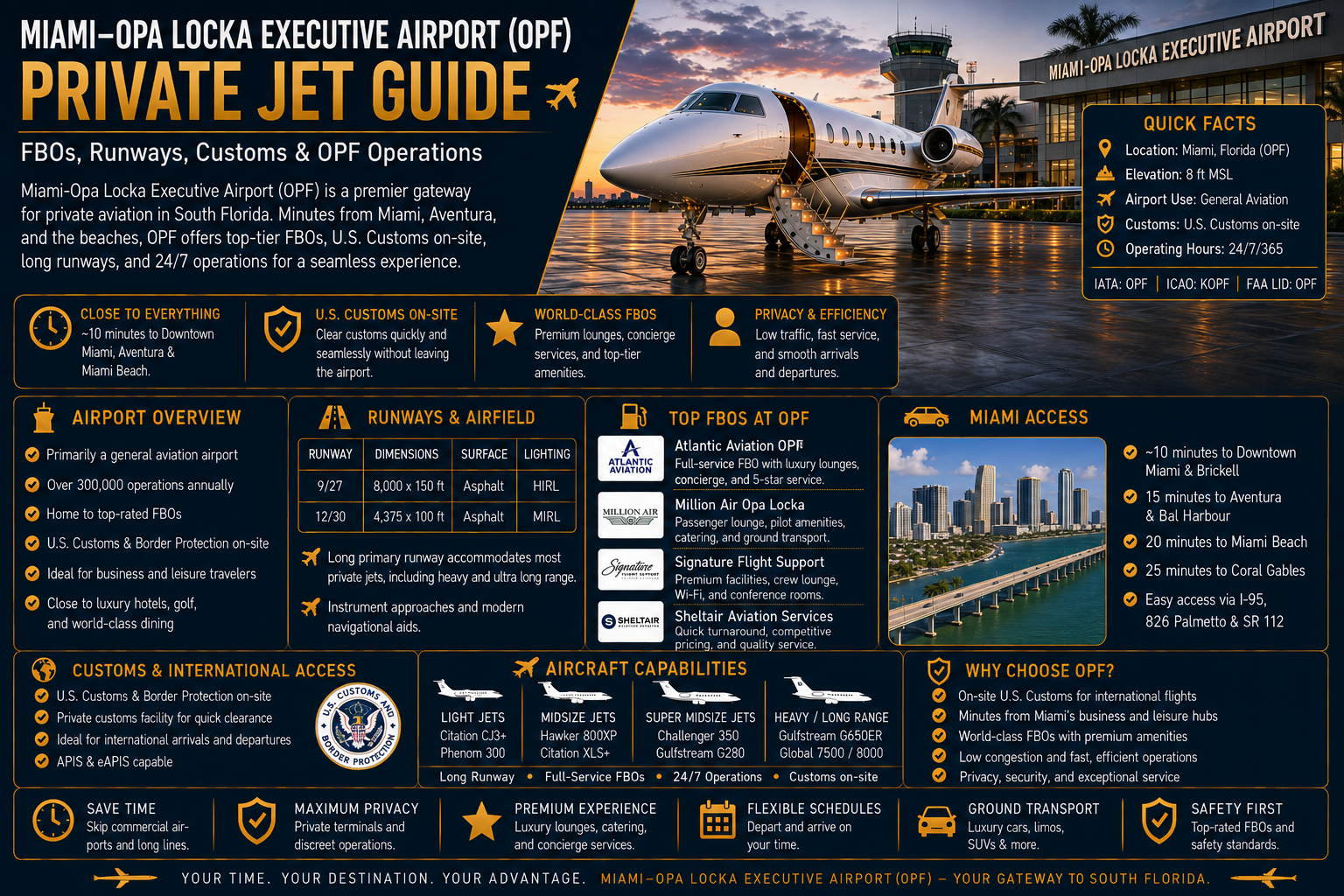
Miami Private Aviation Airport Guide
Miami-Opa Locka Executive Airport Private Jet Guide: FBOs, Runways, Customs & OPF Operations
Miami-Opa Locka Executive Airport is one of South Florida’s most capable business aviation airports. OPF combines an 8,002-foot primary runway, three runways, full-service FBOs, U.S. Customs, major aircraft maintenance infrastructure and strategic access to Miami, Miami Beach, northern Miami-Dade and surrounding luxury destinations.
Miami-Opa Locka Executive Airport uses the airport identifier OPF and the ICAO identifier KOPF.
For private aviation travelers, the airport occupies an important position within the Miami airport network.
It is located north of Miami International Airport and south of North Perry Airport.
Therefore, OPF can provide particularly useful access to northern Miami-Dade and many destinations across the greater Miami region.
However, geography is only part of the airport’s value.
OPF also provides significantly more runway length than several other business aviation airports in the surrounding South Florida market.
Runway 9L/27R measures approximately 8,002 feet by 150 feet.
Therefore, it can provide greater operational flexibility for many larger and heavier business aircraft than airports whose longest runways are closer to 6,000 feet.
This distinction becomes particularly important for long-range departures.
A large-cabin or ultra-long-range aircraft may need substantial fuel to fly nonstop to the West Coast, Europe or another distant destination.
That fuel increases takeoff weight.
Consequently, additional runway length can materially affect the aircraft’s operating options.
For this reason, OPF creates a different private aviation value proposition from Miami Executive Airport, Fort Lauderdale Executive Airport and Boca Raton Airport.
Those airports can provide highly valuable local access.
However, their approximately 6,000-foot primary runways create a different performance environment for heavily fueled aircraft.
Therefore, a passenger may reasonably use one airport for a lighter arrival and another for a heavier departure.
Private aviation does not require airport loyalty.
Instead, airport strategy should change with the mission.
OPF’s runway system includes three paved runways.
Runway 9L/27R is approximately 8,002 by 150 feet.
Runway 12/30 is approximately 6,800 by 150 feet.
Meanwhile, Runway 9R/27L is approximately 4,306 by 100 feet.
Therefore, the airport provides both runway length and multiple runway orientations.
That gives operators additional flexibility compared with an airport dependent on one primary runway.
However, the runway configuration also requires careful pilot awareness.
The FAA identifies OPF as having parallel Runways 9/27 Left and Right together with Runway 12/30 positioned between them.
Additionally, the FAA identifies wrong-surface risks associated with the airport’s runway layout.
Therefore, flight crews should use current airport diagrams, instrument procedures and ATC instructions carefully.
The FAA also identifies a potential wrong-airport risk between OPF and Miami International Airport.
The two airports are only several miles apart and have broadly similar runway orientations.
Consequently, positive airport and runway identification remains important during arrival.
These operational factors are primarily crew responsibilities.
However, they demonstrate why private aviation airport expertise involves more than determining whether a runway is long enough.
Airspace matters as well.
OPF operates within Class D airspace during tower hours.
That Class D airspace sits adjacent to and beneath Miami International’s Class B environment.
Additionally, North Perry’s Class D lies nearby to the north.
Therefore, OPF is integrated into a highly structured metropolitan airspace system.
Private aviation can simplify the passenger experience.
However, it does not remove the aircraft from regional ATC routing, airspace restrictions or traffic sequencing.
Current FAA information lists OPF tower hours from 7:00 a.m. through 11:00 p.m. local time.
Therefore, crews receive tower service throughout the primary daytime and evening operating period.
However, tower hours should not be confused with every other airport service.
FBO availability, customs availability and other services can operate on different schedules.
Consequently, each component should be confirmed independently.
International capability is another major OPF advantage.
Miami-Dade identifies Miami-Opa Locka Executive as a U.S. Customs landing-rights airport.
Current published customs hours are 9:00 a.m. through midnight daily.
Additionally, Miami-Dade currently states that one-hour advance notification is required, with extended hours available upon advance request.
Therefore, OPF can serve as a major private aviation gateway for international arrivals when current CBP requirements are satisfied.
This is particularly important in Miami.
The region has strong private aviation ties to the Bahamas, Caribbean and Latin America.
Consequently, an airport capable of handling larger private aircraft while also providing on-field customs can solve a wide range of international missions.
For example, a large-cabin aircraft returning from an international destination may be able to clear directly at OPF.
That can eliminate the need to land at another airport solely for U.S. entry procedures.
Therefore, customs access can protect both aircraft efficiency and passenger ground time.
However, private international travel still requires advance planning.
Operators must comply with applicable government procedures.
Passengers must also carry appropriate documentation.
Therefore, the existence of a customs facility should never be interpreted as permission to arrive without advance coordination.
OPF’s FBO environment adds another layer of capability.
Miami-Dade currently identifies Atlantic Aviation, Fontainebleau Aviation and Signature Aviation as the airport’s three FBO providers.
Therefore, private aircraft operators have multiple full-service handling options.
These facilities support aircraft ranging from smaller general aviation aircraft through large corporate jets.
Additionally, the airport provides fuel and extensive aircraft-service capabilities.
Consequently, FBO selection should be based on fuel arrangements, passenger requirements, parking, hangar needs and operator relationships.
The airport’s aviation ecosystem extends well beyond the FBOs.
Miami-Dade identifies aircraft repair and maintenance services covering airframe, powerplant and avionics work.
Additionally, major aircraft manufacturers and service organizations have invested in the airport.
Therefore, OPF has developed into an important business aviation maintenance center as well as a passenger airport.
This can be particularly valuable to aircraft owners.
A private aircraft does not simply require a place to pick up passengers.
It also requires maintenance, inspections, storage, technical support and other aircraft services throughout its operating life.
Consequently, OPF can function as a complete aircraft-support ecosystem.
The airport also supports light cargo traffic to the Caribbean.
Therefore, its international aviation role extends beyond conventional passenger charter.
Additionally, OPF is home to a major U.S. Coast Guard Air Station.
Government and rescue aviation therefore operate alongside corporate and private aircraft.
Consequently, the airport environment includes a diverse range of aircraft and mission types.
For private passengers, however, the most important question remains whether OPF creates the best total trip.
Miami is geographically large.
Therefore, simply saying that a passenger is traveling to Miami is not specific enough to choose the best airport.
A passenger headed toward Miami Beach may evaluate OPF differently from someone traveling to Kendall.
Likewise, a passenger headed farther north may compare OPF with Fort Lauderdale Executive.
Meanwhile, a passenger traveling toward South Miami-Dade or Ocean Reef may find Miami Executive more practical.
Therefore, passenger geography and aircraft performance should be evaluated together.
OPF can become particularly attractive when a large aircraft requires more runway but the passenger still wants access to the Miami region.
This creates an important airport-comparison angle.
Miami Executive’s longest runway is approximately 6,000 feet.
Fort Lauderdale Executive’s primary runway is also approximately 6,000 feet.
Meanwhile, OPF provides approximately 8,002 feet on Runway 9L/27R.
Therefore, a heavier aircraft may gain meaningful performance flexibility at Opa-locka.
This does not mean OPF is automatically better.
A passenger headed toward South Miami-Dade may still save substantial ground time using TMB.
Likewise, a Fort Lauderdale destination may favor FXE.
Consequently, sophisticated private aviation planning balances runway advantage against ground travel.
Large-cabin and ultra-long-range aircraft are especially important to this comparison.
Aircraft in those categories are often selected specifically because they can fly long nonstop missions.
However, using that range requires fuel.
Therefore, an airport with more runway can preserve more of the aircraft’s long-range capability.
This can reduce the need for payload restrictions, intermediate fuel stops or aircraft repositioning.
Consequently, OPF can be strategically important for passengers flying transcontinental or intercontinental missions.
New York remains another major private aviation market.
A New York mission may not require the same fuel load as Europe or the West Coast.
Therefore, a broader range of aircraft and South Florida airports may fit the trip comfortably.
In that situation, ground access can become more important.
Consequently, OPF should be compared with the passenger’s exact Miami destination rather than selected solely because it has the longest runway.
Los Angeles creates a different mission.
A nonstop transcontinental departure can require substantial fuel.
Therefore, OPF’s 8,002-foot runway can become more strategically important.
Super-midsize, large-cabin and ultra-long-range aircraft may all be considered depending on passenger requirements.
However, the operator still needs to perform aircraft-specific calculations.
An 8,002-foot runway creates more capability.
It does not eliminate the effects of aircraft weight, heat, wind or runway condition.
Therefore, aircraft performance remains mission specific even at OPF.
European travel creates an even stronger long-range example.
Large-cabin and ultra-long-range aircraft can connect South Florida with major European markets.
However, long overwater missions require substantial fuel and reserves.
Therefore, runway capability becomes increasingly important.
Consequently, OPF can be a logical Miami-area airport to evaluate for those flights.
Latin American travel also fits naturally within the OPF international profile.
Miami maintains deep business, family and cultural connections throughout Latin America.
Therefore, corporate, family-office and luxury private aviation missions can frequently involve destinations throughout the region.
Customs, range, airport capability and passenger schedules all influence the trip.
Consequently, OPF can function as both the Miami origin and U.S. re-entry airport for qualifying missions.
Family offices can also benefit from OPF’s aircraft capability.
Principals may travel with relatives, staff or security personnel.
Additionally, extended trips can create significant baggage loads.
Therefore, larger aircraft may be desirable.
When those aircraft are heavily fueled, the 8,002-foot runway can become particularly valuable.
However, ground geography still matters.
Therefore, the family office should evaluate where the principal is actually staying before selecting OPF automatically.
Business aviation creates another important market.
Executives can travel between Miami and New York, Washington, Chicago, Dallas, Latin America and other business centers.
Multi-city itineraries can also benefit from private aircraft.
Therefore, the value of OPF should be evaluated through total executive time saved.
The ability to use a larger long-range aircraft can increase that value when the itinerary would otherwise require a fuel stop or airport repositioning.
Luxury leisure travel adds another mission profile.
Miami Beach, Miami-area residences, yachts, resorts and events generate substantial private aviation demand.
Therefore, chauffeured transportation should be coordinated with the exact FBO and destination.
For yacht passengers, the actual marina matters.
Fort Lauderdale and Miami both contain significant yacht and marine infrastructure.
Consequently, the best airport for a yacht passenger should be selected around vessel location rather than the broad city name.
Special events can increase airport demand as well.
Large sporting events, art events, major boating activity and holiday periods can increase private aviation traffic throughout South Florida.
Therefore, parking and FBO coordination become more important during peak demand.
Aircraft size also matters.
A Gulfstream, Global or other large-cabin aircraft can require substantially more ramp space than a light jet.
Consequently, operators should confirm parking rather than assuming that runway capability guarantees ground capacity.
Repositioning remains another option.
An aircraft could deliver passengers to OPF and then park elsewhere.
Alternatively, an aircraft could deliver passengers through another local airport and later reposition to OPF before a heavy long-range departure.
Therefore, sophisticated itineraries can use multiple airports when doing so improves the total mission.
However, every reposition adds aircraft time, fuel, crew workload and cost.
Consequently, airport switching should solve a meaningful operational problem rather than add complexity unnecessarily.
Weather also affects OPF operations.
South Florida thunderstorms can develop rapidly.
Heavy rain can affect runway conditions.
Meanwhile, high temperatures can reduce aircraft performance.
Therefore, even a long runway does not remove weather from the performance equation.
Tropical systems create an even larger operational issue.
Aircraft owners may reposition jets away from South Florida before a hurricane approaches.
FBO parking, hangars and alternate airports can become increasingly constrained.
Therefore, hurricane planning should begin well before local conditions deteriorate.
OPF’s history also distinguishes it from many modern business aviation airports.
The airfield dates to the early development of aviation in South Florida and later played significant military roles.
Today, however, its value is primarily operational.
It combines a long runway, business aviation infrastructure, customs, maintenance capability and Miami access within one airport.
Therefore, OPF deserves a major position inside the Private Aviation Airports authority hub.
This guide examines that complete system.
It covers OPF runways, aircraft performance, FBOs, maintenance, parking, customs, airspace, runway safety, Miami ground access, aircraft categories, international missions, New York, Los Angeles, Europe, Latin America, family-office travel and Miami airport comparisons.
Additionally, it compares Opa-locka with Miami Executive and Fort Lauderdale Executive to show how runway capability and passenger geography change the airport decision.
Consequently, the page builds another major airport, route and aircraft connection inside the broader private aviation knowledge graph.
Direct OPF Airport Answer
Why Is Miami-Opa Locka Executive Airport Important for Private Aviation?
Direct Answer: Miami-Opa Locka Executive is important because it combines dedicated business aviation infrastructure with an 8,002-foot primary runway, multiple FBOs, U.S. Customs and extensive aircraft maintenance capability. OPF can be particularly valuable for large-cabin and long-range aircraft while providing private aviation access to Miami and northern Miami-Dade.
OPF solves two major private aviation problems at the same time.
First, it provides a general and business aviation environment close to Miami.
Second, it provides substantially more primary runway length than several nearby executive airports.
Therefore, it can preserve local passenger access while also supporting more demanding aircraft missions.
8,002 Feet
Long Primary Runway
Runway 9L/27R provides approximately 8,002 feet of runway for suitable aircraft missions.
Business Aviation
Private Jet Focus
OPF primarily serves general and business aviation rather than scheduled commercial airline passengers.
Customs
International Gateway
On-field U.S. Customs can support qualifying international general aviation arrivals.
3 FBOs
Handling Choice
Multiple full-service FBO facilities support private aircraft, passengers and crews.
Maintenance
Aircraft Support
OPF supports extensive aircraft maintenance and technical-service infrastructure.
Miami
Regional Access
The airport provides another private aviation gateway into the greater Miami market.
What Makes OPF Different From TMB and FXE?
The clearest difference is runway length.
Miami Executive and Fort Lauderdale Executive both have primary runways near 6,000 feet.
Meanwhile, OPF provides an approximately 8,002-foot primary runway.
Therefore, large aircraft carrying substantial fuel may gain additional operational flexibility at Opa-locka.
However, airport location still matters.
A passenger traveling deep into South Miami-Dade may find TMB geographically stronger.
Likewise, a Fort Lauderdale destination may favor FXE.
Consequently, OPF’s runway advantage should be balanced against passenger ground access.
OPF’s major advantage is combining Miami access with an 8,002-foot business aviation runway.
That combination can become particularly valuable as aircraft size, fuel load and mission distance increase.
Miami Business Aviation Strategy
Why Do Private Jet Travelers Use Miami-Opa Locka Executive Airport?
Direct Answer: Private jet travelers use OPF because it offers a dedicated business aviation environment, an 8,002-foot primary runway, multiple full-service FBOs, customs, extensive maintenance services and access to the greater Miami market. It can be particularly useful for large-cabin aircraft, international flights and long-range missions requiring greater runway flexibility.
Private aviation value begins with matching the airport to the trip.
Therefore, OPF’s value changes according to both the passenger and the aircraft.
For a light regional mission, runway length may not be the deciding factor.
However, for a heavily fueled Global, Gulfstream or other large-cabin aircraft, runway capability can become much more important.
Heavy-Jet Capability
The longer primary runway can provide additional performance flexibility for larger business aircraft.
International Operations
On-field customs increases OPF’s usefulness for inbound international private aviation.
Multiple FBOs
Operators can compare fuel, parking, handling, passenger amenities and other mission requirements.
Aircraft Maintenance
Large aircraft maintenance and technical-service infrastructure expand the airport’s value to owners and operators.
Miami Access
OPF can support private aviation passengers traveling throughout northern Miami-Dade and the broader Miami area.
Long-Range Missions
Additional runway capability can become valuable when aircraft require substantial fuel for long nonstop flights.
Why Is OPF Particularly Relevant to Large-Aircraft Travelers?
Large aircraft can require significantly more runway when operating at higher weights.
Therefore, an airport capable of supporting a lighter arrival may not necessarily provide the same flexibility for a heavily fueled departure.
OPF’s longer runway can reduce that constraint for many missions.
However, the operator must still calculate performance for the actual aircraft and conditions.
Why Is OPF Useful for Aircraft Owners?
The airport contains a significant aircraft-service ecosystem.
Therefore, owners can evaluate maintenance, avionics, storage and other technical requirements in addition to passenger handling.
This can be particularly valuable for managed fleets and large-cabin aircraft requiring specialized support.
OPF solves more than the passenger-arrival problem.
Its runway, FBO, customs and maintenance infrastructure allow the airport to support the aircraft throughout a much broader portion of its operating lifecycle.
South Florida Aviation Infrastructure
What Role Does Miami-Opa Locka Executive Airport Play in South Florida Aviation?
Direct Answer: OPF functions as a major general and business aviation airport and a reliever to Miami International. It supports corporate jets, charter aircraft, aircraft maintenance, international general aviation, Caribbean cargo activity, government aviation and the U.S. Coast Guard while providing one of South Florida’s longest general aviation runways.
OPF’s role extends far beyond private charter arrivals.
Instead, the airport supports an entire aviation ecosystem.
Therefore, its infrastructure serves both passengers and aircraft operators.
Corporate
Business Jets
Corporate and privately operated aircraft form a central part of the airport’s aviation activity.
Reliever
Alternative to MIA
OPF helps accommodate general aviation outside Miami International’s airline-focused environment.
Maintenance
Aircraft Technical Services
The airport supports extensive airframe, engine, avionics and other aircraft-service operations.
International
Customs + Caribbean
International private aviation and Caribbean cargo operations form an important part of OPF’s mission profile.
Coast Guard
Government Aviation
U.S. Coast Guard fixed-wing and helicopter operations add another major aviation component to the airport.
Heavy Aircraft
Long Runway Capability
Runway 9L/27R allows OPF to support aircraft missions that can become more constrained at shorter-runway airports.
Why Does Being a Reliever Airport Matter?
A reliever airport helps separate general aviation from a major commercial-airline hub.
Therefore, private and corporate aircraft can use facilities designed around business aviation rather than competing directly with the commercial passenger system.
Meanwhile, Miami International can concentrate more heavily on scheduled airline operations.
Consequently, OPF strengthens the overall Miami aviation network.
Why Is the Maintenance Ecosystem Strategically Important?
Aircraft spend significant portions of their lifecycle being inspected, repaired, serviced and stored.
Therefore, an airport’s value to an aircraft owner can extend far beyond flight departures.
OPF’s maintenance infrastructure can support that broader requirement.
OPF is simultaneously a passenger airport, aircraft-service center and major Miami aviation reliever.
That combination makes it one of the most strategically important business aviation airports in South Florida.
OPF Quick Reference
What Should Private Jet Travelers Know About Miami-Opa Locka Executive Airport?
Direct Answer: Miami-Opa Locka Executive Airport uses the identifiers OPF and KOPF. It is a major general and business aviation airport with three runways, including an approximately 8,002-foot primary runway. OPF currently has three full-service FBOs, Class D airspace, a control tower operating 7:00 a.m.–11:00 p.m. and U.S. Customs available daily.
| Airport Detail | OPF Information | Why It Matters |
|---|---|---|
| Airport | Miami-Opa Locka Executive Airport | Major Miami business and general aviation airport |
| Airport Identifier | OPF | Primary domestic airport identifier |
| ICAO Identifier | KOPF | Used for international aviation and flight planning |
| Airport Role | General/business aviation and MIA reliever | Private aviation is a core component of airport operations |
| Runway 9L/27R | Approximately 8,002 × 150 feet | Provides substantial runway capability for larger aircraft missions |
| Runway 12/30 | Approximately 6,800 × 150 feet | Provides a second substantial runway orientation |
| Runway 9R/27L | Approximately 4,306 × 100 feet | Supports additional general aviation operations |
| FBOs | Three currently listed by Miami-Dade | Provides multiple full-service handling options |
| Current FBO Providers | Atlantic Aviation, Fontainebleau Aviation and Signature Aviation | Supports fuel, aircraft handling, parking and passenger services |
| Airspace | Class D during tower operations | Located beneath and adjacent to the Miami Class B environment |
| Tower | 7:00 a.m.–11:00 p.m. local | Provides ATC tower service through most daytime and evening operations |
| Customs | U.S. Customs landing-rights airport | Supports qualifying international private aviation arrivals |
| Published Customs Hours | 9:00 a.m.–midnight daily | Creates a broad daily international-arrival window |
| Maintenance | Extensive aircraft maintenance and technical services | Important for owners, operators and managed fleets |
Why Is the 8,002-Foot Runway the Most Important Fact?
Because runway length can preserve aircraft capability.
A large jet selected for its nonstop range must still be able to depart with the required fuel.
Therefore, longer runway availability can reduce operational constraints for certain missions.
This becomes especially important for long-range departures and heavier aircraft.
Why Do Three Runways Matter?
Multiple runways provide additional operating flexibility.
Runway 12/30 also provides approximately 6,800 feet of usable runway length.
Therefore, OPF is not dependent entirely on its primary parallel runway system.
However, aircraft and runway assignment still depend on current conditions and ATC.
OPF combines runway capability, customs, FBO choice and aircraft services in one business aviation airport.
That combination allows it to solve both passenger-access and heavy-aircraft mission requirements within the Miami market.
OPF Runway System
What Runways Does Miami-Opa Locka Executive Airport Have?
Direct Answer: OPF has three paved runways. Runway 9L/27R measures approximately 8,002 by 150 feet, Runway 12/30 measures approximately 6,800 by 150 feet, and Runway 9R/27L measures approximately 4,306 by 100 feet. The two longer runways give OPF substantial flexibility for business and large-aircraft operations.
OPF’s runway system is one of the airport’s strongest competitive advantages.
Unlike nearby executive airports whose primary runways are closer to 6,000 feet, OPF provides more than 8,000 feet on its longest runway.
Therefore, aircraft operating at higher weights can gain additional takeoff and landing flexibility.
9L / 27R
8,002-Foot Primary Runway
OPF’s longest runway provides substantial capability for business jets and heavier aircraft missions.
12 / 30
6,800-Foot Secondary Runway
The secondary runway provides another meaningful runway orientation and significant usable length.
9R / 27L
4,306-Foot Parallel Runway
The shorter parallel runway supports additional general aviation and traffic-management flexibility.
Does an 8,002-Foot Runway Mean Every Private Jet Can Use OPF Without Restrictions?
No.
Longer runway length increases capability, but aircraft performance remains mission specific.
For example, aircraft weight, temperature, wind and runway condition still influence the required takeoff distance.
Likewise, certification and operating requirements remain aircraft specific.
Therefore, the operator must calculate the exact flight.
Why Is Runway 12/30 Important?
It provides another substantial runway option.
At approximately 6,800 feet, it remains longer than the primary runways at several nearby executive airports.
Therefore, OPF retains meaningful runway capability even beyond Runway 9L/27R.
OPF is not simply a one-long-runway airport.
Its 8,002-foot primary runway and 6,800-foot secondary runway create unusually strong runway depth within the South Florida business aviation market.
Heavy Aircraft Advantage
Why Is OPF’s 8,002-Foot Runway Important for Private Jets?
Direct Answer: OPF’s 8,002-foot Runway 9L/27R can provide greater performance flexibility for heavily fueled and larger private aircraft than shorter-runway executive airports. This becomes particularly important for transcontinental and international departures because the fuel required for long nonstop missions increases aircraft weight and can increase required takeoff distance.
Aircraft range is only useful if the aircraft can depart with the fuel needed to use it.
Therefore, runway capability and aircraft range should be evaluated together.
More Fuel
Long-range missions require greater fuel loads, which increase aircraft departure weight.
More Payload
Large passenger groups and substantial baggage increase total operating weight further.
South Florida Heat
High temperatures can reduce aircraft takeoff performance even at a low-elevation airport.
Transcontinental
West Coast missions can require substantially more fuel than regional domestic flights.
International
Long-range overwater missions can require significant fuel and reserve planning.
Fewer Compromises
Additional runway capability can sometimes reduce the need for fuel stops, payload adjustments or airport repositioning.
How Does This Compare With Miami Executive?
Miami Executive’s longest runway is approximately 5,999 feet.
OPF provides approximately 8,002 feet.
Therefore, the airports create different performance environments.
A smaller or lighter aircraft may operate efficiently at either airport.
However, the difference can become increasingly meaningful as aircraft size and departure weight increase.
How Does This Compare With Fort Lauderdale Executive?
FXE’s primary runway is approximately 6,002 feet.
Therefore, OPF again provides roughly 2,000 additional feet of runway.
However, a passenger traveling to Fort Lauderdale may still save significant ground time using FXE.
Consequently, the runway advantage must be compared with passenger geography.
Does More Runway Always Mean a Better Airport?
No.
Private aviation is a door-to-door transportation system.
Therefore, the best airport must work for both the aircraft and the passenger.
A light jet headed to South Miami-Dade may gain little practical benefit from 8,000 feet of runway if another airport places the passenger much closer to the final destination.
However, a heavily fueled large-cabin aircraft may create exactly the opposite calculation.
OPF becomes more valuable as runway requirement becomes a larger part of the mission.
The heavier the aircraft and the longer the route, the more important its 8,002-foot runway can become relative to shorter-runway South Florida alternatives.
Aircraft + Mission Matching
How Does Aircraft Performance Affect Private Jet Operations at OPF?
Direct Answer: OPF’s long runway expands the range of practical business aviation missions, but aircraft performance still depends on weight, fuel, temperature, wind, runway conditions and destination. A light regional flight and a fully fueled international large-cabin departure can create dramatically different runway requirements even when both aircraft operate from the same airport.
No runway length eliminates the need for aircraft-specific performance calculations.
Therefore, OPF’s 8,002 feet should be viewed as greater operational flexibility rather than unrestricted capability.
| Performance Variable | Why It Matters at OPF |
|---|---|
| Aircraft Weight | Heavier aircraft generally require greater takeoff performance |
| Fuel Load | Long-distance missions can materially increase departure weight |
| Passenger Load | More passengers increase payload |
| Baggage | Large luggage loads increase both weight and storage requirements |
| Temperature | South Florida heat can reduce aircraft performance |
| Wind | Wind direction and speed affect runway use and performance |
| Runway Condition | Heavy rain can affect performance calculations |
| Destination | Route length determines required fuel and therefore departure weight |
Why Can an Aircraft Land at OPF More Easily Than It Departs?
An arriving aircraft may have already burned substantial fuel.
Therefore, it can be considerably lighter at landing.
However, the aircraft may later require a large fuel load for its outbound flight.
Consequently, the departure calculation can become more demanding.
Why Does OPF Still Provide an Advantage?
Because the additional runway gives operators more room to solve those heavier missions.
For some aircraft, that can preserve nonstop range.
For others, it can improve payload flexibility.
Therefore, OPF may reduce the need to compromise the itinerary compared with a shorter-runway alternative.
Door-to-Door Miami Planning
Which Miami Destinations Can Make OPF a Strong Private Jet Airport?
Direct Answer: OPF can be particularly useful for northern Miami-Dade and many greater Miami destinations while also providing strong aircraft capability for larger jets. However, passengers should compare actual driving time to Miami Beach, Downtown Miami, nearby residential communities and other destinations against TMB, FXE or MIA before selecting the airport.
Airport location and runway capability can pull the decision in different directions.
Therefore, the strongest itinerary balances both.
Northern Miami-Dade
OPF can provide strong geographic access for destinations in the northern portion of the Miami market.
Miami Beach
Passengers should compare real-time ground access against alternative Miami-area airports.
Downtown Miami
OPF can be evaluated alongside MIA and other business aviation airports based on total travel time.
Hard Rock Area
OPF’s northern Miami-Dade position can make it strategically useful for major sporting and entertainment events nearby.
South Miami-Dade
Passengers traveling farther south should compare OPF with Miami Executive before finalizing the airport.
Fort Lauderdale
FXE may become geographically stronger as the final destination moves north into Broward County.
When Does OPF’s Runway Advantage Outweigh Ground Distance?
The answer becomes increasingly favorable to OPF as aircraft performance becomes more demanding.
For example, saving ground time may be valuable.
However, requiring a fuel stop because the preferred local airport cannot support the necessary departure weight may cost more time overall.
Therefore, total mission time matters more than ground time alone.
OPF should be selected when aircraft capability and Miami geography work together.
The strongest itinerary minimizes total mission friction rather than optimizing only the runway or only the car ride.
Who Uses OPF?
Which Travelers Commonly Use Miami-Opa Locka Executive Airport?
Direct Answer: OPF serves corporate executives, family offices, charter passengers, aircraft owners, international travelers, large-cabin jet users, luxury leisure passengers and government aviation. Its combination of Miami access, long runway capability, customs and aircraft maintenance makes it especially relevant when the passenger mission involves larger aircraft or longer routes.
Family Office
Principal Travel
Family offices can coordinate principals, relatives, staff, security and large baggage requirements through OPF.
Executives
Corporate Aviation
Business travelers can use OPF for domestic, multi-city and international executive missions.
Large Cabin
Heavy Business Jets
The 8,002-foot primary runway can provide additional flexibility for larger aircraft.
International
Global Travel
Customs capability supports qualifying international general aviation arrivals.
Aircraft Owner
Maintenance + Storage
Aircraft owners can benefit from OPF’s broader technical and maintenance ecosystem.
Charter
On-Demand Flights
Charter operators can use OPF across a broad range of aircraft categories and missions.
Luxury
Miami Leisure
Luxury travel involving Miami residences, resorts, events and yachts can create significant private aviation demand.
Government
Special Aviation
Coast Guard and other government aviation operations contribute to OPF’s diverse airport environment.
Why Is OPF Especially Relevant to Ultra-High-Net-Worth Travelers?
UHNW travel can involve larger passenger groups, substantial baggage and long-range aircraft.
Therefore, the aircraft may need significant runway capability.
Additionally, international destinations can make on-field customs valuable.
Consequently, OPF can solve several UHNW aviation requirements within the same airport.
OPF becomes increasingly valuable as the mission becomes larger, longer or more international.
Its runway, customs, FBO and maintenance capabilities make it especially relevant to complex business aviation missions.
South Florida Airport Network
How Does Opa-locka Fit Into the Private Aviation Airport Ecosystem?
Direct Answer: OPF fills the heavy-aircraft and northern Miami-Dade role within the South Florida private aviation airport network. It complements Miami Executive’s South Miami-Dade position and Fort Lauderdale Executive’s Broward County role while adding an 8,002-foot runway that creates a different operating environment for larger and longer-range aircraft.
South Florida airport strategy becomes more useful when travelers can compare several fields using the same decision framework.
Therefore, OPF should connect directly with the airport hub and the nearby airport pages already built.
Parent Hub
Private Aviation Airports
Compare FBOs, runway capability, customs and destination access across major private aviation airports.
South Miami-Dade
Miami Executive Airport
Compare OPF’s runway capability with TMB’s geographic advantage for southern Miami-Dade destinations.
Broward
Fort Lauderdale Executive Airport
Compare OPF with FXE when passenger geography shifts north toward Fort Lauderdale and Broward County.
Why Is OPF Such an Important Airport Spoke?
Because it introduces a new airport-selection variable into the hub: substantial runway capability.
The earlier South Florida pages emphasize local access and approximately 6,000-foot runway environments.
OPF adds an 8,002-foot runway and a major heavy-aircraft maintenance ecosystem.
Therefore, the airport cluster can now answer not simply “Which airport is closest?” but also “Which airport best supports this aircraft and route?”
OPF turns the South Florida cluster into a true airport-selection system.
Passengers can now compare geography, runway length, aircraft category, international capability and total mission efficiency across multiple nearby airports.
Current Operational Verification
Where Should Current OPF Information Be Verified?
Airport procedures, runway status, FBO arrangements, customs availability and airspace information can change.
Therefore, operators should verify current information for the exact flight rather than relying solely on a static airport guide.
Miami-Dade Aviation Department publishes official Miami-Opa Locka Executive Airport information, including runway dimensions, FBOs, customs hours, airport services and tower information.
Additionally, the FAA publishes current OPF runway-safety and airspace guidance.
Flight crews should use current NOTAMs, airport diagrams, charts and official preflight resources for operational decisions.
Review official Miami-Opa Locka Executive Airport information →
Aircraft-to-Destination Planning
How Should Ground Transportation Be Planned From Miami-Opa Locka Executive Airport?
Direct Answer: Ground transportation from OPF should be planned around the passenger’s exact Miami destination, arrival time, party size, luggage and security requirements. Because Miami traffic can materially change drive times, travelers should compare the complete aircraft-to-destination journey rather than choosing Opa-locka solely because of its runway or aviation infrastructure.
Private aviation saves time only when the ground portion of the itinerary is planned correctly.
Therefore, the destination should be identified before the airport is finalized.
For example, two passengers may both describe their destination as Miami while traveling to completely different parts of the region.
One may be headed toward Miami Beach.
Meanwhile, another may be traveling south toward Kendall.
Consequently, the same airport does not necessarily create the best itinerary for both passengers.
Destination
Use the Actual Address
Airport selection should begin with the residence, office, hotel, marina or event rather than the broad destination name “Miami.”
Traffic
Plan for Road Conditions
Miami-area congestion can materially change the ground portion of an otherwise efficient private flight.
FBO
Send Drivers to the Correct Facility
Vehicle coordination should identify the exact FBO rather than simply directing the driver to OPF.
Baggage
Match Vehicle Capacity
Passenger count alone does not determine the correct vehicle when the flight includes substantial luggage or equipment.
Security
Coordinate Protective Teams
Family offices and high-profile travelers may require separate security vehicles or advance arrival coordination.
Return
Plan Both Directions
The departure vehicle should return passengers to the correct FBO with sufficient time for the planned flight.
Why Should Traffic Influence Airport Selection?
The private aircraft may save hours in the air-travel process.
However, an unnecessary drive can give some of that time back.
Therefore, airport comparison should include realistic ground conditions.
Additionally, the best airport can change according to time of day.
Consequently, OPF should be evaluated as one component of the complete itinerary.
Should Transportation Be Coordinated Through the FBO?
It often can be.
However, passengers, charter companies and family offices may also use their own transportation providers.
Either approach can work.
The important requirement is coordination.
Therefore, the driver should know the FBO, aircraft arrival time, passenger name and vehicle requirements before the aircraft lands.
Private aviation efficiency does not end when the aircraft touches down.
The strongest OPF itinerary connects the aircraft, FBO and final Miami destination as one continuous movement.
OPF Private Aviation Terminals
Which FBOs Serve Miami-Opa Locka Executive Airport?
Direct Answer: Miami-Dade currently lists three fixed-base operators at Miami-Opa Locka Executive Airport: Atlantic Aviation, Fontainebleau Aviation and Signature Aviation. The best FBO for a specific private flight depends on aircraft handling, fuel arrangements, parking or hangar needs, passenger services, crew requirements and the operator’s existing agreements.
Private aviation passengers generally do not use a conventional airline terminal at OPF.
Instead, the aircraft is handled through an FBO.
Therefore, FBO selection becomes part of the passenger and aircraft experience.
FBO
Atlantic Aviation
Atlantic Aviation is one of the full-service FBO providers currently listed by Miami-Dade at Miami-Opa Locka Executive Airport.
FBO
Fontainebleau Aviation
Fontainebleau Aviation provides another private aviation handling option at OPF for aircraft, passengers and crews.
FBO
Signature Aviation
Signature Aviation is also currently listed as a full-service FBO provider at Miami-Opa Locka Executive Airport.
Having several FBO options gives aircraft operators flexibility.
For example, one operator may have preferred fuel pricing with a particular network.
Meanwhile, another may prioritize hangar availability or an established handling relationship.
Additionally, passengers may have specific transportation, privacy or service requirements.
Therefore, the FBO should be selected around the complete mission rather than brand recognition alone.
Should the Passenger Choose the FBO?
Not necessarily.
Charter operators and aircraft managers frequently determine the preferred handling facility.
However, passengers can still communicate requirements that influence the decision.
For example, a principal traveling with multiple vehicles, security personnel or substantial luggage may require additional coordination.
Consequently, passenger requirements should reach the operator before arrival.
Can FBO Availability Matter During Major Miami Events?
Yes.
High-demand periods can increase private aircraft activity throughout South Florida.
Therefore, ramp space, hangars, ground transportation and other services can become more constrained.
Consequently, early coordination becomes increasingly valuable during peak periods.
The FBO is the operational bridge between the aircraft and the passenger’s Miami itinerary.
Fuel, parking, handling, baggage, vehicles and crew support can all intersect at the FBO.
Private Aviation Handling
Which FBO Services Matter Most at OPF?
Direct Answer: The most important OPF FBO services depend on the mission, but they commonly include aircraft fueling, ramp handling, parking coordination, hangar arrangements, passenger facilities, ground transportation coordination and crew support. Large-cabin and international flights may require more advance planning because aircraft size, parking and passenger logistics can increase operational complexity.
Fuel
Fuel requirements can become substantial for long-range departures, particularly when a large-cabin aircraft is preparing for a transcontinental or international mission.
Ramp Handling
The FBO coordinates aircraft movement and ground services within its operating area.
Parking
Aircraft parking should be confirmed when the jet will remain at OPF during the passenger’s stay.
Hangar
Hangar requirements become particularly important during severe weather, maintenance events or extended stays.
Passenger Handling
The FBO creates the transition between private aircraft and waiting ground transportation.
Crew Support
Crew transportation, rest and operational support can influence the complete mission.
Why Does Fuel Planning Matter at OPF?
Fuel affects both range and aircraft weight.
Therefore, it directly connects FBO planning with runway performance.
A large aircraft preparing for a long-range mission may require a substantial fuel upload.
Consequently, the aircraft’s departure weight can increase dramatically compared with its arrival weight.
OPF’s 8,002-foot runway can provide additional flexibility.
However, the crew must still calculate the actual departure performance.
Why Should Parking Be Confirmed Before Arrival?
Aircraft size varies enormously.
Therefore, accommodating a light jet and accommodating an ultra-long-range aircraft are different ramp-planning problems.
Additionally, major events can increase local demand.
Consequently, parking should be treated as a planned operational requirement rather than an assumption.
FBO selection should solve the aircraft mission as well as the passenger experience.
A polished terminal matters, but fuel, parking, handling and operational support can be even more important to the success of the flight.
Aircraft Ownership Infrastructure
How Does OPF Support Private Jet Maintenance and Aircraft Owners?
Direct Answer: OPF supports a broad aircraft-service ecosystem in addition to passenger operations. Miami-Dade identifies repair and maintenance capabilities involving airframe, powerplant and avionics services at the airport. As a result, OPF can serve aircraft owners, managed fleets and business aviation operators that need technical support in addition to FBO handling.
Private aviation infrastructure extends beyond runways and terminals.
Aircraft require recurring maintenance throughout their operating lives.
Therefore, an airport with a developed technical ecosystem can create additional value for owners and operators.
Airframe
Aircraft Structure
Airframe services can support inspections, maintenance and repairs associated with the aircraft itself.
Powerplant
Engine Support
Powerplant capability contributes to the broader maintenance infrastructure available to aircraft operators.
Avionics
Aircraft Systems
Avionics support is increasingly important as modern business aircraft rely on sophisticated navigation, communications and flight systems.
Why Does Maintenance Capability Matter to a Family Office?
An aircraft owned by a family office is both a transportation asset and a complex operating system.
Therefore, maintenance availability can influence where the aircraft is based, serviced or repositioned.
Additionally, unexpected maintenance can disrupt passenger schedules.
Consequently, access to technical support can increase operational resilience.
Why Does OPF Attract Larger Aircraft Operations?
Several factors work together.
First, the airport provides substantial runway capability.
Second, it provides multiple FBOs.
Third, it supports a developed maintenance environment.
Additionally, customs expands the airport’s international usefulness.
Therefore, OPF can support much more than a simple passenger pickup or drop-off.
The key point: An airport becomes more valuable to aircraft owners when it can support the jet between flights as well as during departures and arrivals.
Aircraft Stay Strategy
Should a Private Jet Remain at OPF After Dropping Off Passengers?
Direct Answer: A private jet can remain at OPF when suitable parking or hangar arrangements are available, but the best strategy depends on aircraft size, length of stay, weather, cost and the passenger’s return schedule. Alternatively, the aircraft may reposition to another airport and return to OPF before departure.
Aircraft parking is part of mission planning.
Therefore, passengers should not automatically assume that the jet will remain where it dropped them off.
| Aircraft Strategy | Potential Advantage | Primary Consideration |
|---|---|---|
| Remain at OPF | Can simplify return-flight logistics | Parking availability and cost |
| Hangar at OPF | Provides additional aircraft protection | Aircraft size and hangar availability |
| Reposition Nearby | Can solve parking or operational constraints | Additional flight time and repositioning cost |
| Operate Another Mission | Aircraft can remain productive between passenger flights | Return availability must be coordinated |
Why Does Aircraft Location Matter to the Passenger?
Because private aviation flexibility depends on the aircraft actually being available.
If the passenger wants to leave several hours earlier, a jet parked at OPF may be easier to prepare than one positioned elsewhere.
However, crew availability still matters.
Therefore, aircraft location and crew duty should be considered together.
When Can Hangar Space Become Particularly Valuable?
Severe weather is one obvious example.
Additionally, extended stays may create different aircraft-protection requirements.
However, large business jets require substantial hangar space.
Consequently, hangar availability should be confirmed rather than assumed.
Air Traffic Control
What Are Miami-Opa Locka Executive Airport’s Control Tower Hours?
Direct Answer: Current FAA information lists the OPF control tower as operating from 7:00 a.m. to 11:00 p.m. local time. Because airport, FBO and customs hours are separate operational considerations, crews should verify the current status of every required service before a flight.
The tower manages aircraft movements within OPF’s controlled airport environment during its published operating hours.
Therefore, arriving and departing aircraft coordinate with local air traffic control.
However, tower availability should not be confused with FBO availability.
Likewise, it should not be confused with customs availability.
Consequently, a mission requiring several services must confirm each independently.
Tower
Current FAA guidance lists OPF tower operations from 7:00 a.m. through 11:00 p.m. local time.
FBO
FBO operating arrangements should be confirmed directly for the specific arrival or departure.
Customs
International arrivals must separately comply with current customs procedures and availability.
Why Is OPF’s Air Traffic Environment More Complex Than a Remote Executive Airport?
Location is the primary reason.
OPF sits only about six miles north of Miami International.
Additionally, North Perry Airport lies only several miles to the north.
Therefore, crews operate within a dense network of nearby controlled airspace and traffic flows.
OPF simplifies the passenger experience without simplifying the surrounding airspace.
Private aircraft still operate inside one of the country’s major metropolitan aviation environments.
Miami Airspace
How Does Miami Airspace Affect Private Jet Operations at OPF?
Direct Answer: OPF operates in Class D airspace during tower hours and sits adjacent to and beneath Miami International’s Class B airspace. North Perry’s Class D airspace also lies nearby to the north. Consequently, private aircraft operate within a highly structured South Florida ATC environment and should expect routing and sequencing appropriate to regional traffic.
The passenger may experience a quiet private terminal.
However, the aircraft itself remains part of the larger Miami aviation system.
Therefore, regional traffic can influence arrival and departure routing.
OPF
Class D
OPF’s towered airport environment operates within Class D airspace during published tower hours.
MIA
Class B Nearby
Miami International’s Class B airspace is adjacent to and above portions of the OPF environment.
HWO
North Perry Nearby
North Perry’s Class D airspace lies nearby to the north, adding another controlled-airspace boundary.
Can Miami Traffic Affect Private Jet Timing?
Yes.
Business aviation provides schedule flexibility, but it does not guarantee unrestricted airspace access.
Therefore, ATC sequencing, weather and regional demand can influence flight timing.
Consequently, passengers should distinguish private terminal convenience from complete immunity to aviation-system constraints.
FAA OPF Safety Guidance
What Should Flight Crews Know About Runway Safety at OPF?
Direct Answer: The FAA identifies several OPF-specific runway-safety concerns, including a designated hot spot, wrong-surface landing risk, wrong-runway takeoff risk and wrong-airport landing risk involving nearby Miami International. Crews should use current airport diagrams, verify runway headings and follow current ATC instructions and official preflight information.
OPF’s runway capability is a major strength.
However, its runway and taxiway geometry also requires situational awareness.
Therefore, the FAA publishes airport-specific cautions for pilots.
HS1
Airport Hot Spot
The FAA identifies a short taxi from the ramp toward a runway environment with a large pavement area and surface-painted guidance.
Wrong Surface
Parallel Runway Awareness
OPF’s parallel runways, staggered thresholds and nearby taxiways create wrong-surface landing risk.
Runway Ends
9L / 12 and 27L / 30
The FAA specifically notes the proximity of runway approach ends as a potential source of runway-identification errors.
MIA
Wrong-Airport Risk
OPF and Miami International are only about six miles apart and have broadly similar runway orientations.
Why Does the FAA Warn About Wrong-Airport Landings?
OPF and MIA are geographically close.
Additionally, their runway environments can appear similar from the air.
Therefore, positive airport identification is important.
The FAA specifically identifies wrong-airport landing risk between the two airports.
What Is the OPF Hot Spot?
The FAA identifies Hot Spot 1 as an area where a short taxi from the ramp can create runway-incursion risk.
Additionally, the large pavement area relies on surface-painted location and direction markings rather than conventional above-ground signage in that area.
Therefore, crews should understand the assigned taxi route before movement.
Does This Make OPF Unsafe?
No.
A published hot spot identifies an area requiring increased pilot awareness.
Therefore, the information helps crews anticipate and manage the airport environment.
Current FAA guidance should always be used for actual flight operations.
The key point: OPF’s runway system provides major capability, but that capability should be paired with disciplined runway identification, taxi awareness and current FAA guidance.
Community Operations
How Does Noise Abatement Affect Private Jet Operations at OPF?
Direct Answer: Miami-Opa Locka Executive is identified by Miami-Dade as a noise-sensitive airport. Aircraft operators are asked to consider surrounding residential communities, while turbine and large-aircraft operators are requested to use recommended noise-abatement profiles. Flight-training activities are also subject to airport-specific restrictions.
Business aviation airports frequently operate near established communities.
Therefore, aircraft noise becomes both an operational and community consideration.
Miami-Dade describes OPF as a good-neighbor airport.
Consequently, operators are expected to consider nearby residential areas.
Turbine Aircraft
Miami-Dade requests that turbine and large-aircraft operators use appropriate recommended noise-abatement profiles.
Training
Flight-training activity is subject to airport-specific weight and time restrictions.
Residential Areas
Operators should avoid unnecessary noise impacts on communities surrounding the airport.
Are Flight-Training Operations Restricted?
Yes.
Miami-Dade currently states that flight training is limited to aircraft below 40,000 pounds maximum gross takeoff weight.
Additionally, training is limited to the period between 7:00 a.m. and 9:00 p.m.
Therefore, OPF’s broader airport operating capability should not be confused with unrestricted training activity.
Noise procedures help balance business aviation access with the communities surrounding OPF.
Operators should use current airport and ATC guidance rather than treating noise-sensitive procedures as optional trip-planning details.
International Private Aviation
Can International Private Jets Clear U.S. Customs at OPF?
Direct Answer: Yes. Miami-Opa Locka Executive is a U.S. Customs landing-rights airport for qualifying international general aviation arrivals. Miami-Dade currently publishes customs availability from 9:00 a.m. to midnight daily, with advance coordination requirements. Operators must verify current CBP procedures and obtain any required permissions before the flight.
Customs capability materially expands OPF’s usefulness.
Without it, an international private aircraft might need to enter the United States through another approved airport before continuing to its final Miami destination.
However, OPF can support qualifying direct international arrivals when current requirements are satisfied.
International
Direct Miami Entry
Qualifying aircraft can use OPF as their U.S. arrival airport rather than clearing at another field first.
Advance Planning
Coordinate Before Arrival
Landing-rights and customs procedures require advance operational coordination.
Documents
Passenger Compliance
Travelers must carry the documentation required for the specific international itinerary.
Does Having Customs Mean an International Jet Can Simply Arrive?
No.
Customs capability does not remove government entry requirements.
Therefore, the operator must coordinate the arrival according to current procedures.
Additionally, passenger and crew information must satisfy applicable requirements.
Consequently, international mission planning should begin before the aircraft departs the foreign airport.
Why Is Customs Especially Valuable at OPF?
Because it is combined with substantial runway capability.
A large-cabin aircraft arriving from a distant international destination can therefore evaluate OPF both as a suitable aircraft airport and as a U.S. entry point.
Consequently, the passenger may avoid an unnecessary intermediate stop.
OPF combines international entry capability with an 8,002-foot primary runway.
That pairing makes the airport especially relevant to larger private aircraft operating between Miami and international markets.
Regional International Missions
How Does OPF Work for Private Flights Between Miami and the Bahamas?
Direct Answer: OPF can be a strong airport for Bahamas private aviation because South Florida is geographically close to the islands and the airport supports international operations. The best aircraft depends on passenger count, baggage, destination runway capability and schedule, while the operator must coordinate all applicable outbound and U.S. re-entry procedures.
The Bahamas is one of the most natural international private aviation markets from South Florida.
However, short distance does not eliminate international procedures.
Therefore, passengers and operators must treat the flight as a complete cross-border mission.
Short Regional Distance
Many Bahamas destinations lie relatively close to South Florida, allowing a broad range of suitable aircraft to serve the market.
Destination Runway
The island airport can be more operationally restrictive than OPF, so aircraft selection must consider both ends of the trip.
U.S. Re-entry
OPF customs capability can support qualifying returns to the United States when current procedures are followed.
Does OPF’s 8,002-Foot Runway Matter for a Short Bahamas Flight?
Often, it matters less than it would for a long-range mission.
A short flight generally requires less fuel.
Therefore, aircraft departure weight may be lower.
However, the destination airport may have a substantially shorter runway.
Consequently, the aircraft should be selected around the complete round-trip mission rather than OPF alone.
Caribbean Private Aviation
How Does OPF Support Private Jet Travel Between Miami and the Caribbean?
Direct Answer: OPF can support a wide range of Caribbean private aviation missions because it combines Miami access, substantial runway capability and U.S. Customs. Aircraft selection should account for route length, passengers, baggage, destination runway capability, fuel availability, weather and international procedures at both ends of the flight.
Caribbean missions vary dramatically.
Therefore, they should not be treated as one aircraft-selection category.
A short island flight can create a very different mission from a longer Caribbean itinerary.
Route Length
Distance determines how much fuel the aircraft must carry and which aircraft categories fit the mission efficiently.
Island Runways
Destination runway length can become the limiting factor even when OPF provides abundant runway capability.
Weather
Tropical weather can influence both South Florida and destination-airport operations.
Baggage
Leisure trips can involve substantial luggage, equipment and extended-stay baggage.
Customs
International entry and re-entry requirements should be built into the itinerary before departure.
Alternates
Weather and island airport limitations can make alternate-airport planning particularly important.
Why Is Destination-Airport Capability So Important?
OPF can accommodate demanding aircraft missions.
However, the aircraft must also operate safely at the destination.
Therefore, choosing a larger aircraft simply because OPF can support it may not solve the complete trip.
Consequently, both airports must be evaluated together.
For Caribbean travel, the smallest runway in the itinerary can matter more than OPF’s longest runway.
The aircraft must fit every airport required by the mission, not simply the departure airport.
Miami International Business Aviation
How Does OPF Support Private Aviation Between Miami and Latin America?
Direct Answer: OPF can serve as a strategic Miami-area airport for private flights involving Latin America because its long runway supports larger business aircraft while its customs capability supports qualifying U.S. arrivals. Mission planning should consider range, fuel, passenger documentation, destination-airport capability, weather and the specific international procedures required for each country.
Miami maintains extensive business and personal connections throughout Latin America.
Therefore, private aviation can serve corporate executives, aircraft owners, families and other travelers moving between the regions.
OPF’s airport infrastructure aligns well with many of those missions.
Corporate Travel
Executives can structure international flights around meetings and business schedules rather than airline timetables.
Family Travel
Private aircraft can simplify travel involving larger parties, substantial baggage and multiple generations.
Large-Cabin Aircraft
OPF’s runway capability can support aircraft categories commonly used on longer international missions.
U.S. Entry
On-field customs can make OPF the Miami arrival airport for qualifying international flights.
Aircraft Support
Maintenance infrastructure can add value for aircraft that spend significant operating time within the Miami market.
Mission Flexibility
Aircraft category can be matched to the exact route rather than using one aircraft strategy for every Latin American destination.
Does Every Latin American Mission Require a Large-Cabin Jet?
No.
Distance varies substantially across the region.
Therefore, some missions can be served efficiently by smaller aircraft.
Meanwhile, longer flights, larger passenger groups or more demanding cabin requirements may favor super-midsize or large-cabin aircraft.
Consequently, aircraft selection should follow the mission rather than the prestige of the aircraft category.
South Florida Operating Conditions
How Can Weather Affect Private Jet Operations at OPF?
Direct Answer: South Florida weather can affect OPF through thunderstorms, heavy rain, high temperatures, strong winds and tropical systems. These conditions can influence ATC routing, runway selection, aircraft performance and flight timing. Therefore, operators should evaluate current weather, NOTAMs and aircraft-specific performance immediately before each mission.
Thunderstorms
Convective Weather
South Florida thunderstorms can develop quickly and affect both airport operations and regional ATC routing.
Rain
Runway Conditions
Heavy rainfall can affect runway conditions and therefore aircraft performance calculations.
Heat
Takeoff Performance
Higher temperatures can reduce aircraft performance, particularly when the aircraft is operating at a high departure weight.
Wind
Runway Selection
Wind direction and speed can influence runway assignment and aircraft performance.
Tropical
Storm Systems
Tropical weather can affect aircraft scheduling, parking, hangar demand and airport operations across the region.
ATC
Regional Traffic Flow
Weather affecting MIA and the broader South Florida system can influence routing even when conditions directly over OPF are acceptable.
Does OPF’s Longer Runway Eliminate Hot-Weather Performance Concerns?
No.
Additional runway creates more performance flexibility.
However, temperature still affects aircraft capability.
Likewise, fuel and payload still affect departure weight.
Therefore, a heavily fueled large-cabin aircraft requires a mission-specific performance calculation even with more than 8,000 feet available.
Why Can Weather Elsewhere in Miami Affect OPF?
The airports share a complex regional airspace system.
Therefore, weather affecting Miami International or major arrival and departure corridors can influence traffic flow throughout the area.
Consequently, private aviation passengers should allow for weather-driven changes even when the FBO experience itself remains efficient.
Tropical Weather Strategy
How Should Private Aircraft Owners Plan for Hurricanes at OPF?
Direct Answer: Hurricane planning for an aircraft at OPF should begin before local conditions deteriorate. Owners and operators may need to evaluate hangar protection, aircraft repositioning, crew availability, fuel, destination airports and the passenger schedule. Waiting until a storm is close can reduce options as aircraft, crews, hangars and alternate airports become increasingly constrained.
Hurricane planning is different from ordinary thunderstorm planning.
A thunderstorm may delay a flight.
However, a tropical cyclone can affect aircraft location, airport access and regional infrastructure for a much longer period.
Therefore, aircraft owners need a broader contingency strategy.
Reposition
Move the Aircraft
An operator may reposition the jet outside the projected impact area before conditions deteriorate.
Hangar
Protect the Aircraft
Suitable hangar space can provide another strategy when available and appropriate for the aircraft.
Crew
Preserve Availability
Crew positioning and duty limitations should be considered before an evacuation or repositioning flight is required.
Fuel
Prepare Early
Regional demand can increase as multiple aircraft operators prepare to reposition before a storm.
Alternate
Choose the Destination
The repositioning airport should be outside the expected impact area and capable of supporting the aircraft.
Return
Plan Re-entry
The aircraft may not immediately return after the storm if airport, airspace or local infrastructure remains affected.
Why Can Waiting Become Expensive?
Many aircraft owners can respond to the same forecast at roughly the same time.
Therefore, demand for fuel, crews, hangars and parking at alternate airports can increase rapidly.
Additionally, weather can eventually make repositioning impractical.
Consequently, early planning preserves more options.
Should a Family Office Include Aircraft Evacuation in Its Hurricane Plan?
Yes, when the family office owns or controls an aircraft based in the region.
The aircraft is both a valuable asset and a potential transportation resource.
Therefore, the plan should address where the aircraft goes, who flies it, how it returns and whether the principal may need it during or after the event.
Consequently, aircraft planning should integrate with the broader family-office continuity strategy.
The best hurricane aircraft decision is usually made before the airport becomes operationally constrained.
Early planning protects flexibility, while late planning forces the operator to work with whatever aircraft, crew, fuel, hangar and airport capacity remains available.
Operational Accuracy
Verify Current OPF Conditions Before Every Flight
Airport conditions and procedures can change.
Therefore, this guide should support airport research rather than replace operational preflight resources.
The FAA’s current OPF airport guidance identifies the airport as primarily general and business aviation, lists tower hours of 7:00 a.m. to 11:00 p.m., identifies Class D airspace beneath and adjacent to Miami Class B, and documents OPF-specific hot-spot, wrong-surface and wrong-airport risks.
Additionally, Miami-Dade identifies OPF as a noise-sensitive airport and publishes airport-specific noise-abatement and training guidance.
Consequently, crews should use current NOTAMs, airport diagrams, charts, ATC information and other official preflight materials for the actual flight.
Aircraft Strategy
Which Private Jets Work Well at Miami-Opa Locka Executive Airport?
Direct Answer: OPF can support a broad range of private aircraft, from light and midsize jets through super-midsize, large-cabin and ultra-long-range business jets. Its approximately 8,002-foot primary runway creates additional flexibility for heavier missions, although the exact aircraft, fuel, passengers, baggage, weather and destination still determine actual performance.
OPF’s runway capability expands the number of aircraft missions that can be considered comfortably.
However, more runway does not eliminate the need to match the aircraft to the trip.
Therefore, aircraft selection should still begin with the passenger’s actual mission.
A light jet flying to Atlanta creates one type of operating profile.
Meanwhile, an ultra-long-range aircraft departing for Europe creates another.
Consequently, the best aircraft category changes with distance, payload, cabin expectations and required fuel.
| Aircraft Category | Typical OPF Mission | Primary Planning Factor |
|---|---|---|
| Light Jet | Regional and shorter domestic travel | Passenger count, baggage and cabin requirements |
| Midsize Jet | Longer domestic and selected Caribbean missions | Range, cabin comfort and payload |
| Super-Midsize Jet | Long domestic and regional international missions | Fuel load, range and larger-cabin comfort |
| Large-Cabin Jet | Transcontinental and long international travel | Fuel, passengers, baggage and departure weight |
| Ultra-Long-Range Jet | Intercontinental missions | Heavy departure performance and destination capability |
Why Is OPF Particularly Flexible for Aircraft Selection?
The airport’s longest runway measures approximately 8,002 feet.
Additionally, OPF has a second runway measuring approximately 6,800 feet.
Therefore, the airport provides more runway depth than several nearby executive airports.
This can be particularly valuable when aircraft size and required fuel increase.
However, runway availability alone should not drive aircraft selection.
Instead, passengers should choose the smallest aircraft category that comfortably and operationally solves the complete mission.
OPF provides more runway flexibility, but the aircraft should still be selected around the mission.
More runway creates options. It does not make oversizing the aircraft automatically efficient.
Regional Private Jet Travel
When Do Light Jets Make Sense at OPF?
Direct Answer: Light jets can make sense at OPF for smaller groups flying shorter domestic or regional missions. Because they generally require less fuel and operate at lower weights than larger aircraft, OPF’s runway length is usually not the primary constraint. Instead, passengers should focus on baggage, cabin comfort, route length and destination-airport capability.
OPF’s large-aircraft capability should not distract from its usefulness for smaller private jets.
Light jets can operate efficiently when the passenger mission does not require a larger cabin.
Therefore, they can be a practical choice for regional business trips, shorter leisure flights and selected international missions.
Smaller Groups
Light jets can work well when only a few passengers are traveling and baggage remains manageable.
Regional Flights
Short domestic routes can take advantage of jet speed without requiring a larger aircraft category.
Miami Access
OPF can still be the strongest airport when its geography places the passenger close to the final destination.
Why Would Someone Use a Light Jet at an Airport Built for Larger Aircraft?
Because airport capability and aircraft size are separate decisions.
The airport should be selected according to geography and operational fit.
The aircraft should be selected according to the passenger mission.
Therefore, a small executive group traveling from OPF to a nearby city does not need a larger jet simply because the airport can support one.
What Can Make a Light Jet Too Small?
Baggage is one major limitation.
Additionally, passenger count and cabin expectations can change the answer.
For example, six passengers carrying substantial luggage may create a more demanding mission than three passengers traveling with overnight bags.
Consequently, usable payload and baggage capacity matter more than advertised seat count.
Cabin + Range Balance
When Do Midsize Jets Make Sense at Miami-Opa Locka Executive?
Direct Answer: Midsize jets can be a strong OPF choice when passengers need more cabin space, baggage capacity and range than a light jet provides without moving into a substantially larger aircraft. They can support many domestic and Caribbean missions while using OPF’s runway environment with considerable operational flexibility.
Midsize aircraft occupy an important middle position within private aviation.
They can provide a more comfortable cabin for longer trips.
Additionally, they can expand nonstop range beyond many light-jet missions.
Therefore, midsize aircraft can fit executive groups, families and leisure travelers particularly well.
More Cabin Space
Midsize aircraft can provide greater comfort as flight time increases.
More Baggage
Additional luggage capability can support longer Miami stays and leisure travel.
Longer Range
Midsize aircraft can expand the number of practical nonstop destinations from OPF.
Can Midsize Jets Fly From OPF to New York?
Many midsize aircraft are designed for missions comfortably exceeding the distance between Miami and the New York region.
However, the exact aircraft should still be selected around passengers, baggage, weather and destination-airport requirements.
Therefore, published range should be treated as a starting point rather than a final operating answer.
Why Is OPF Useful for a Midsize Jet if the Aircraft Does Not Need 8,000 Feet?
The runway may not be the deciding advantage for a midsize mission.
Instead, OPF’s Miami geography, FBO infrastructure and customs capability may be more important.
Consequently, the value of the airport changes with aircraft category.
OPF’s value is not only its runway.
For midsize aircraft, Miami access, FBO infrastructure, customs and operational flexibility can matter as much as raw runway length.
Longer Domestic + International Range
When Do Super-Midsize Jets Make Sense at OPF?
Direct Answer: Super-midsize jets can be particularly well suited to OPF when passengers need substantial cabin comfort, baggage capacity and long domestic or regional international range. OPF’s 8,002-foot primary runway provides additional departure flexibility when these aircraft carry more fuel, while aircraft-specific performance still determines the exact mission capability.
Super-midsize aircraft can provide a significant increase in capability without moving completely into the large-cabin category.
Therefore, they are often attractive for longer domestic missions.
Additionally, they can support many international routes from South Florida.
Longer Domestic Missions
Super-midsize jets can support many transcontinental and near-transcontinental missions depending on aircraft and conditions.
Large Cabin Feel
Many aircraft in the category provide greater cabin height and passenger comfort than conventional midsize jets.
International Flexibility
The category can fit Caribbean, Latin American and other international missions depending on route length.
Why Does OPF Pair Well With Super-Midsize Aircraft?
Because the aircraft category begins to make greater use of available runway capability as fuel load increases.
For example, a longer nonstop mission can require substantially more fuel than a regional flight.
Therefore, OPF’s longer runway can preserve additional performance flexibility.
However, the destination airport must still support the selected aircraft.
Can a Super-Midsize Jet Replace a Large-Cabin Aircraft?
Sometimes.
A passenger group that does not require an ultra-large cabin may find that a super-midsize aircraft provides sufficient range and comfort.
Therefore, the category can create strong value when it solves the mission without unnecessary aircraft size.
Heavy Business Aviation
Why Does OPF Work Well for Large-Cabin Private Jets?
Direct Answer: OPF can be particularly attractive for large-cabin private jets because its 8,002-foot primary runway provides more departure flexibility than several nearby executive airports. That additional runway can become valuable when larger aircraft carry substantial passengers, baggage and fuel for transcontinental or international missions.
Large-cabin aircraft are often selected because passengers want more than simple transportation.
They can provide larger cabins, longer range, more baggage capacity and additional onboard amenities.
However, those capabilities create higher operating weights.
Therefore, runway performance becomes increasingly important.
Cabin
Long-Flight Comfort
Large cabins can support longer missions with additional seating, work, rest and passenger-space options.
Range
Long Nonstop Missions
Large-cabin aircraft can connect Miami with distant domestic and international markets.
Runway
8,002 Feet
OPF’s primary runway can provide additional takeoff flexibility when a long-range aircraft departs at a higher operating weight.
Why Does Fuel Matter So Much?
Range requires fuel.
However, fuel adds weight.
Therefore, an aircraft selected specifically for long nonstop capability may also create a demanding departure-performance problem.
OPF’s longer runway can reduce that constraint for some missions.
Consequently, the airport can help preserve more of the aircraft’s intended capability.
Does OPF Guarantee a Full-Fuel Large-Jet Departure?
No.
The operator must still calculate performance for the actual aircraft.
Temperature, wind, runway conditions, passengers, baggage and required reserves can all change the answer.
Therefore, the 8,002-foot runway should be viewed as additional capability rather than an unlimited guarantee.
The key point: OPF is valuable to large-cabin aircraft because it gives the operator more runway to work with when the mission requires significant payload and fuel.
Intercontinental Capability
Can Ultra-Long-Range Private Jets Use Miami-Opa Locka Executive Airport?
Direct Answer: Ultra-long-range business jets can use OPF when aircraft-specific operating requirements are satisfied. The airport’s approximately 8,002-foot primary runway makes it significantly more suitable for many heavy long-range missions than shorter-runway executive airports, although fuel, payload, temperature, runway conditions and destination requirements still determine actual nonstop capability.
Ultra-long-range aircraft are designed around exceptionally demanding missions.
Therefore, they can connect Miami with destinations far beyond typical domestic routes.
However, using that capability requires substantial fuel.
Consequently, runway length becomes an important part of the mission.
Intercontinental Range
Ultra-long-range aircraft can support nonstop missions to distant international markets when operating conditions permit.
Heavy Fuel Loads
Long-range missions can require substantial fuel and therefore create high departure weights.
Passenger Payload
Principals, staff, security and extended-stay baggage can add further operating weight.
Cabin Capability
Large cabins can provide sleeping, working and passenger-comfort advantages on long flights.
Customs
OPF’s international arrival capability complements its long-range aircraft infrastructure.
Maintenance
OPF’s broader business aviation service ecosystem can also support aircraft owners operating sophisticated long-range fleets.
Why Is OPF Stronger Than a 6,000-Foot Airport for Some Ultra-Long-Range Missions?
The additional approximately 2,000 feet of runway can materially change performance options.
Therefore, an aircraft that would require payload or fuel adjustments at a shorter airport may have more flexibility at OPF.
However, that outcome is aircraft and condition specific.
Consequently, the operator still performs the actual calculation rather than assuming the mission works because OPF has a long runway.
Could Miami International Still Be Better for Some Heavy Missions?
Yes.
MIA provides a different runway and airport environment.
Therefore, an exceptionally demanding mission may still justify comparing OPF with Miami International.
However, OPF’s business aviation focus can provide a significantly different passenger and aircraft handling environment.
Consequently, both airport capability and passenger experience should be compared.
Ultra-long-range aircraft make runway strategy part of the passenger itinerary.
If the aircraft is selected specifically to avoid fuel stops, the departure airport must support the fuel load required to use that range.
Runway + Payload + Fuel
How Should a Heavy Private Jet Departure From OPF Be Planned?
Direct Answer: A heavy OPF departure should be planned around the exact aircraft weight, passengers, baggage, required fuel, temperature, wind, runway condition and destination. OPF’s 8,002-foot primary runway creates substantial flexibility, but the operator must still determine whether the planned payload and fuel load support the required takeoff performance.
Heavy departure planning is where OPF’s runway advantage becomes most visible.
However, even 8,002 feet does not make weight irrelevant.
Therefore, operators solve the mission using several variables together.
| Heavy Departure Variable | Potential Effect |
|---|---|
| Passengers | Add aircraft payload and therefore contribute to takeoff weight |
| Baggage | Adds weight and can create storage constraints |
| Fuel | Long-range missions can require the largest increase in departure weight |
| Temperature | Higher temperatures can reduce takeoff performance |
| Wind | Can improve or reduce available takeoff performance depending on direction and strength |
| Runway Condition | Wet or contaminated conditions can affect required calculations |
| Operational Reserves | Required fuel reserves can influence total fuel carried |
| Destination + Alternate | Routing and alternate requirements can change fuel planning |
What Happens if the Aircraft Is Too Heavy for the Desired Departure?
The operator can evaluate several strategies.
For example, baggage or payload may be adjusted when operationally and commercially appropriate.
Alternatively, the aircraft may depart with less fuel and make a technical fuel stop.
Another airport could also be considered if it provides a stronger runway environment.
Therefore, the solution should be based on total trip efficiency rather than simply preserving the original airport choice.
Why Is a Fuel Stop Sometimes Worse Than Driving Farther to OPF?
A longer ground transfer may add minutes.
However, an intermediate fuel stop can add substantially more operational time.
Therefore, a passenger using OPF instead of a closer short-runway airport may still arrive sooner at the final destination when OPF preserves nonstop capability.
Airport distance should be compared with the time consequences of aircraft restrictions.
A longer car ride can sometimes be the faster total itinerary when it allows the aircraft to complete the mission nonstop.
OPF Route Strategy
Which Private Jet Routes Make Sense From Miami-Opa Locka Executive?
Direct Answer: OPF can support regional, transcontinental and international private aviation missions because of its Miami location, long runway and customs capability. Important mission types include New York, Los Angeles, the Bahamas, Caribbean, Latin America and selected European routes, although aircraft selection and nonstop capability depend on the exact trip.
Northeast
New York
A major domestic private aviation corridor involving business, family and seasonal travel.
West Coast
Los Angeles
A demanding transcontinental mission that makes aircraft range and departure fuel increasingly important.
Intercontinental
Europe
Large-cabin and ultra-long-range aircraft can make OPF relevant to selected nonstop European missions.
International
Latin America
Miami’s international business and family relationships create substantial regional mission potential.
Island
Bahamas
Short international sectors can be served by a much broader range of aircraft.
Caribbean
Regional International
Aircraft strategy changes with island distance, runway capability and passenger requirements.
Miami ↔ New York
How Should an OPF-to-New York Private Jet Mission Be Planned?
Direct Answer: An OPF-to-New York private jet mission should match the aircraft to passenger count, baggage and cabin requirements while choosing the New York-area airport according to the passenger’s actual destination. Because the route generally requires less fuel than transcontinental or intercontinental missions, several aircraft categories may fit efficiently.
The South Florida-to-New York market illustrates why more runway does not always require more aircraft.
Many private jet categories can serve the route.
Therefore, passengers should focus first on cabin, baggage and destination access.
Midsize
Can provide an effective cabin and range balance for smaller or medium-size groups.
Super-Midsize
Can add cabin space and passenger comfort while preserving strong nonstop capability.
Large Cabin
Can provide additional cabin space, baggage and premium long-flight comfort when the mission justifies it.
Which New York Airport Should Be Used?
The passenger’s destination should drive the answer.
Teterboro can be useful for many Manhattan and northern New Jersey itineraries.
Meanwhile, Westchester can become more attractive for selected destinations farther north.
Therefore, the New York side should be optimized just as carefully as Miami.
Does OPF’s Long Runway Matter Much on This Route?
It provides flexibility.
However, a New York mission generally requires less fuel than a Los Angeles or European departure.
Therefore, runway requirement may be less likely to dominate the airport decision.
Consequently, passenger geography can become relatively more important.
Transcontinental Private Aviation
Why Can OPF Be Valuable for a Miami-to-Los Angeles Private Jet?
Direct Answer: OPF can be valuable for Miami-to-Los Angeles private flights because the transcontinental distance requires substantially more fuel than regional missions. Its 8,002-foot primary runway can therefore provide additional departure flexibility for super-midsize, large-cabin and long-range aircraft seeking to complete the route nonstop.
Los Angeles is where OPF’s runway advantage becomes more strategically important.
The aircraft must carry enough fuel to cross the country while preserving required reserves.
Therefore, departure weight rises.
Additionally, passenger and baggage loads contribute further weight.
Consequently, aircraft and airport selection should be performed together.
| Aircraft Strategy | Potential Advantage | Primary Question |
|---|---|---|
| Super-Midsize | Can provide strong transcontinental range with a smaller aircraft footprint | Does the exact aircraft support the mission with the required payload and conditions? |
| Large Cabin | Greater cabin, baggage and range flexibility | Does the fuel load fit the desired OPF departure profile? |
| Ultra-Long-Range | Substantial range margin and premium cabin capability | Does the larger aircraft create unnecessary cost relative to mission requirements? |
Could TMB or FXE Still Be Better?
Possibly, especially if ground geography strongly favors one of those airports and the aircraft can depart within required performance limits.
However, their shorter primary runways create a different performance environment.
Therefore, OPF can become increasingly attractive when nonstop capability requires a heavier fuel load.
Why Compare Total Mission Time?
Because a closer airport is not always a faster airport.
If using the closer field requires a fuel stop, the passenger can lose more time in the air than was saved on the ground.
Consequently, airport selection should compare the complete trip.
For transcontinental missions, runway capability can become a time-saving feature.
Preserving nonstop capability may matter more than minimizing the final few miles of ground transportation.
Intercontinental Private Aviation
Can Private Jets Fly Nonstop From OPF to Europe?
Direct Answer: Suitable large-cabin and ultra-long-range business jets may support nonstop missions from South Florida to selected European destinations, subject to aircraft-specific performance, weather, payload and operational requirements. OPF’s approximately 8,002-foot runway can make it a strong Miami-area airport to evaluate when long-range fuel loads create demanding departure weights.
Europe represents a different class of mission from New York or the Bahamas.
Flight duration increases significantly.
Therefore, aircraft range, fuel reserves and passenger comfort become substantially more important.
Range
The aircraft must support the actual route, winds, reserves and alternate requirements.
Fuel
Intercontinental missions can require substantial fuel and therefore create demanding departure weights.
Cabin
Long flights can increase the value of sleeping, working and larger passenger spaces.
Baggage
International trips and longer stays can generate substantial passenger luggage.
Weather
Winds and route conditions can materially affect practical nonstop capability.
Destination Airport
The European arrival airport must support both the aircraft and the passenger’s ground itinerary.
Why Does Westbound Versus Eastbound Matter?
Atmospheric winds can affect flight time and fuel requirements.
Therefore, the same city pair can create different mission calculations in opposite directions.
Consequently, a route that comfortably operates nonstop one way may require different planning on the return under certain conditions.
Does OPF’s Customs Facility Matter on the Outbound Flight?
The U.S. Customs facility becomes especially relevant for qualifying inbound international arrivals.
However, outbound international missions still require applicable departure and destination-country procedures.
Therefore, operators should plan both the outbound European arrival and eventual U.S. return before the trip begins.
Why Can OPF Be More Attractive Than a Shorter Executive Airport?
Because the aircraft may need a large fuel load to preserve nonstop range.
Therefore, the departure runway becomes part of the route strategy.
OPF’s 8,002-foot runway creates more flexibility than the approximately 6,000-foot primary runways available at TMB and FXE.
However, actual aircraft performance still controls the final decision.
Long-range aircraft and long-runway airports solve different parts of the same nonstop mission.
The aircraft provides the range, while the airport must support the weight required to use that range.
Mission Comparison
How Does the Best Aircraft Category Change by OPF Route?
Direct Answer: The ideal aircraft category generally grows as route distance, passenger requirements and baggage increase. However, bigger is not automatically better. Short Bahamas missions may favor smaller aircraft, New York can fit several jet categories, Los Angeles can increase the value of super-midsize or larger jets, and Europe can favor long-range aircraft.
| Mission | Aircraft Categories to Evaluate | Most Important Variables |
|---|---|---|
| Short Florida / Regional | Light through midsize | Passenger count, baggage, efficiency |
| Bahamas | Turboprop, light, midsize or larger depending on group | Destination runway, baggage, international procedures |
| Caribbean | Light through large cabin depending on destination | Distance, destination runway, passengers, fuel |
| New York | Midsize, super-midsize, large cabin | Cabin, baggage, New York airport, group size |
| Los Angeles | Super-midsize, large cabin, ultra-long-range | Fuel, nonstop capability, departure performance |
| Europe | Large cabin, ultra-long-range | Range, winds, fuel, payload, passenger comfort |
Why Should This Table Not Be Used as an Aircraft Guarantee?
Because aircraft categories contain many different models.
Additionally, each flight occurs under different payload and environmental conditions.
Therefore, the categories above provide a mission-planning framework rather than a performance determination.
The operating carrier remains responsible for calculating the actual aircraft’s capability.
South Florida Airport Strategy
How Does OPF Change the Private Jet Decision Compared With TMB or FXE?
Direct Answer: OPF changes the South Florida airport decision because its 8,002-foot primary runway gives operators more runway flexibility than the approximately 6,000-foot primary runways at TMB and FXE. As aircraft size, fuel load and mission distance increase, that difference can become more important than small changes in ground travel time.
The strongest airport changes as the mission changes.
Therefore, the airport network should not be viewed as a simple ranking.
Instead, each airport solves a different combination of geography and aircraft performance.
| Mission | Airport Factor Likely to Matter Most |
|---|---|
| Light regional trip to South Miami-Dade | TMB geography may matter more than OPF runway length |
| Fort Lauderdale destination | FXE ground access may outweigh OPF’s longer runway when performance is not restrictive |
| Heavy nonstop West Coast departure | OPF’s longer runway can become substantially more important |
| Intercontinental large-cabin mission | Runway, fuel and heavy-aircraft capability can push the strategy toward OPF |
| Bahamas mission to a short island runway | Destination-airport capability may matter more than any Miami runway |
The key point: OPF is not automatically the best Miami private jet airport. It becomes increasingly valuable as aircraft performance becomes a larger part of the mission.
Aircraft + Route Summary
What Is the Most Important Aircraft Planning Rule at OPF?
Direct Answer: Use OPF’s runway capability to preserve mission flexibility, not to justify unnecessary aircraft size. The best aircraft should provide the required cabin, baggage and range while operating efficiently for the specific route. As the mission becomes longer and heavier, OPF’s 8,002-foot runway becomes increasingly valuable.
OPF can support everything from relatively small regional business jets to sophisticated ultra-long-range aircraft.
However, each aircraft category solves a different passenger problem.
Therefore, larger should never automatically mean better.
Instead, the aircraft should fit the passengers, baggage, route and cabin expectations.
Then, OPF’s runway, customs, FBO and maintenance infrastructure can support that aircraft efficiently.
Consequently, the airport and aircraft become complementary parts of the same private aviation strategy.
Family Office Aviation
Why Can OPF Work Well for Family Office Private Aviation?
Direct Answer: Miami-Opa Locka Executive Airport can work particularly well for family office aviation because it combines private aviation infrastructure, substantial runway capability, international arrival support and access to the greater Miami market. However, the strongest airport still depends on the principal’s destination, aircraft requirements, security needs and complete ground itinerary.
Family office aviation often involves more than moving one passenger between two cities.
Instead, the mission may include family members, executives, assistants, security personnel, household staff and significant baggage.
Therefore, airport selection should account for the entire travel structure.
Additionally, the aircraft itself may be owned, managed or regularly chartered by the family.
Consequently, parking, hangar access, maintenance support and crew logistics can matter alongside passenger convenience.
Principal
Passenger Access
The principal’s actual residence, hotel, office, marina or event should influence whether OPF creates the strongest ground itinerary.
Aircraft
Heavy-Jet Capability
OPF’s long primary runway can become increasingly valuable when the family operates larger aircraft on long-range missions.
Security
Coordinated Movement
Ground vehicles, security teams, baggage and passenger movement should be coordinated with the selected FBO before arrival.
International
Cross-Border Travel
International capability can make OPF relevant to family offices moving regularly between Miami and overseas destinations.
Crew
Operational Continuity
Crew duty, lodging, transportation and aircraft positioning can influence whether the aircraft remains available to the principal.
Asset
Aircraft Support
Maintenance and aircraft-service infrastructure can add value when the jet spends substantial time within the Miami market.
Why Should a Family Office Compare More Than Drive Time?
A ten-minute difference on the ground can matter.
However, it may be insignificant compared with a fuel stop, aircraft repositioning requirement or operational restriction.
Therefore, the family office should compare total journey time.
Additionally, the principal’s schedule may change with little notice.
Consequently, aircraft location and crew availability can matter as much as airport proximity.
Should the Family Office Standardize One Miami Airport?
Not necessarily.
A preferred airport can simplify recurring operations.
However, different missions may justify different airports.
For example, a light regional flight could favor geography.
Meanwhile, a heavily fueled international departure could favor runway capability.
Therefore, a flexible airport policy can outperform a one-airport rule.
The key point: Family office aviation should optimize the principal, aircraft, crew and ground movement as one integrated system rather than treating airport selection as an isolated decision.
Corporate Aviation
When Does OPF Make Sense for Business and Executive Travel?
Direct Answer: OPF can make sense for executive travel when its location, private aviation infrastructure and aircraft capability reduce the complete door-to-door journey. It can be especially useful for companies using larger business jets, international flights or recurring Miami operations where efficient FBO handling and aircraft support matter alongside passenger ground access.
Business aviation creates value by protecting executive time.
Therefore, airport selection should focus on productivity rather than simply identifying the nearest runway.
A strong itinerary can reduce terminal time, connect directly with ground transportation and position the executive closer to the actual meeting.
Additionally, private aircraft can support multi-city schedules that would be difficult to reproduce using airline service.
Executive Time
Compare the complete door-to-door itinerary rather than aircraft block time alone.
Meeting Location
The office, conference, hotel or event location should influence which Miami-area airport is selected.
Aircraft Mission
Long-range corporate aircraft may benefit more from OPF’s runway capability than smaller regional aircraft.
Can OPF Work for a Same-Day Business Trip?
Yes, depending on route length and crew planning.
Private aviation can allow executives to depart early, conduct meetings and return without an overnight stay.
However, crew duty limitations still apply.
Therefore, the aircraft schedule should be evaluated before the executive itinerary is finalized.
Why Can Corporate Aircraft Support Matter?
A business aircraft is a productive asset only when it remains operationally available.
Therefore, maintenance, parking and ground support can influence corporate flight-department decisions.
Consequently, OPF’s broader aviation ecosystem can matter beyond a single passenger arrival.
Miami Luxury Travel
How Can OPF Fit Into Luxury, Yacht and Estate Travel?
Direct Answer: OPF can fit luxury Miami itineraries involving residences, resorts, yachts and extended stays because passengers can transition from private aircraft directly into coordinated ground transportation. However, the best airport depends on the exact destination, traffic conditions, aircraft requirements and whether another South Florida executive airport creates a shorter complete transfer.
Luxury travel frequently involves more baggage and logistics than a short corporate trip.
For example, passengers may carry equipment, extended-stay luggage or items intended for a yacht or seasonal residence.
Therefore, baggage capacity should influence aircraft selection before the flight begins.
Additionally, several vehicles may be required at the FBO.
Consequently, ground coordination becomes part of the aviation mission.
Yacht Transfers
Ground transportation should be coordinated around the exact marina rather than using a broad destination such as “Miami.”
Seasonal Residences
Passengers traveling for extended stays may require significantly more baggage than a short business mission.
Resorts + Hotels
Traffic and destination location can materially influence whether OPF creates the strongest door-to-door itinerary.
Multiple Vehicles
Larger parties may require separate passenger, baggage and security vehicles.
International Travel
OPF’s international operating capability can support qualifying inbound missions when current requirements are satisfied.
Return Flexibility
Aircraft location and crew availability should be coordinated when the passenger’s return date or time may change.
Why Is the Marina Location Important?
Miami’s boating infrastructure extends across a broad geographic area.
Therefore, two yacht passengers can have dramatically different ground itineraries even though both describe their destination as Miami.
Consequently, the marina address should be included in airport planning.
Luxury aviation should feel seamless after landing as well as before takeoff.
The aircraft, FBO, vehicles, baggage and final property or marina should operate as one coordinated itinerary.
Passenger Coordination
How Should Privacy and Security Be Planned for an OPF Private Flight?
Direct Answer: Privacy and security planning at OPF should be coordinated with the aircraft operator, selected FBO and authorized ground team before arrival. High-profile passengers may require specific vehicle staging, baggage handling, passenger-transfer or security arrangements. However, private aviation should not be treated as invisible travel, because required aviation and government records still apply.
Private aviation can reduce exposure to large public passenger terminals.
However, privacy should not be confused with anonymity.
Aircraft operations remain subject to applicable aviation, security, customs and immigration requirements.
Therefore, legitimate privacy planning focuses on controlled passenger movement rather than avoiding required procedures.
FBO
Coordinate Before Arrival
The handling facility should know about authorized transportation and special passenger requirements in advance.
Vehicles
Stage the Right Transportation
Passenger, baggage and security vehicles should be assigned according to the actual party requirements.
Information
Limit Unnecessary Distribution
Trip information should be shared only with people and providers who legitimately require it to perform the mission.
Can Security Personnel Meet the Aircraft?
Arrangements depend on the FBO, operator and applicable airport procedures.
Therefore, security teams should coordinate access before arrival rather than assuming a particular movement process.
Additionally, international arrivals may involve government processing requirements.
Consequently, the security plan must fit the actual airport procedure.
Does Private Aviation Eliminate Passenger Records?
No.
Private aviation remains regulated transportation.
Therefore, required passenger, aircraft, immigration, customs and operational information still applies when relevant.
Privacy should be built around appropriate handling of information, not avoidance of legal requirements.
Miami Airport Comparison
How Does OPF Compare With TMB, FXE and Miami International for Private Jets?
Direct Answer: OPF can provide a strong balance of private aviation infrastructure, runway capability and Miami access. TMB can be attractive for destinations farther south, while FXE can be useful for Fort Lauderdale and northern Broward itineraries. Miami International offers major-airport runway capability but operates within a much larger commercial airline environment.
No Miami-area airport wins every mission.
Instead, the best airport changes according to passenger geography and aircraft requirements.
Therefore, travelers should compare the complete itinerary.
| Airport | Strongest Reason to Evaluate It | Primary Tradeoff to Consider |
|---|---|---|
| Miami-Opa Locka Executive — OPF | Strong private aviation infrastructure combined with an approximately 8,002-foot primary runway | Ground access may not be ideal for every Miami destination |
| Miami Executive — TMB | Can provide strong access to destinations farther south in Miami-Dade | Shorter primary runway creates a different heavy-aircraft performance environment |
| Fort Lauderdale Executive — FXE | Can be geographically attractive for Fort Lauderdale and northern Broward destinations | May create unnecessary ground travel for some Miami itineraries |
| Miami International — MIA | Major-airport infrastructure and substantial runway capability | Commercial-airline traffic and airport complexity create a different private aviation environment |
When Does OPF Gain the Biggest Advantage?
Its runway advantage becomes increasingly important as aircraft weight and mission distance increase.
Therefore, heavily fueled transcontinental or intercontinental departures can make OPF particularly attractive.
Additionally, passengers who value a dedicated business aviation environment may prefer OPF over a major airline airport.
When Can TMB Be Better?
TMB can become attractive when the passenger’s destination lies farther south and the selected aircraft can comfortably perform the mission using the available runway.
Therefore, a smaller regional mission may prioritize geography over OPF’s additional runway length.
When Can FXE Be Better?
FXE can be useful when the passenger’s destination is closer to Fort Lauderdale or northern Broward County.
Consequently, using OPF solely because of its runway could create unnecessary ground travel when aircraft performance does not require it.
When Should MIA Be Considered?
Miami International can be evaluated when mission requirements favor its major-airport infrastructure or runway environment.
However, passengers should also consider the differences between operating through a major commercial airport and a business aviation airport.
The key point: Choose the Miami airport that creates the strongest total mission. Geography matters more on some flights, while runway and aircraft performance matter more on others.
Departure Strategy
How Should the Return Flight From OPF Be Planned?
Direct Answer: The return flight should be planned before the initial arrival whenever possible. Aircraft location, parking, crew duty, fuel, passenger timing, ground transportation and weather can all affect departure flexibility. If the aircraft repositions away from OPF, the operator should also plan enough time to return and prepare the jet before passengers arrive.
Private aviation passengers often value the ability to change their schedule.
However, schedule flexibility depends on operational readiness.
Therefore, the aircraft’s location matters after the passenger leaves the FBO.
Aircraft Location
Confirm whether the jet will remain at OPF, move into a hangar or reposition elsewhere.
Crew Duty
A passenger’s preferred departure time must remain compatible with legal crew-rest and duty requirements.
Fuel
Fuel planning should reflect the return destination, payload, weather and required reserves.
Vehicles
Ground transportation should return passengers to the correct FBO rather than simply to the airport.
Weather
South Florida weather can change the planned departure time, routing or runway strategy.
International
International departures require the operator to coordinate applicable procedures for the destination country.
Can the Passenger Leave Earlier Than Planned?
Potentially.
However, aircraft availability does not automatically mean crew availability.
Additionally, the aircraft may have repositioned or may require servicing.
Therefore, passengers who expect schedule changes should communicate that possibility before the trip.
Why Plan the Return Before Landing in Miami?
Early planning preserves options.
For example, parking or crew arrangements can be structured around the expected stay.
Additionally, transportation can be scheduled before the departure day.
Consequently, the return flight becomes less dependent on last-minute availability.
Private aviation flexibility is created through planning.
The passenger may experience spontaneity, but the operator still coordinates aircraft, crew, fuel, weather and airport requirements behind the scenes.
OPF Planning Framework
What Is the Best Process for Planning a Private Flight Through OPF?
Direct Answer: Start with the passenger’s exact origin and destination, then evaluate OPF against nearby airports. Next, match the aircraft to range, passengers and baggage. After that, confirm FBO handling, parking, customs when applicable, ground transportation, crew planning and current operational conditions. Finally, verify the return-flight strategy before departure.
Identify the Exact Ground Destination
Use the actual residence, office, hotel, marina or event rather than simply using “Miami.”
Compare Miami-Area Airports
Evaluate OPF against the other airports that realistically fit the passenger and aircraft mission.
Choose the Aircraft Category
Match aircraft capability to passengers, baggage, range, cabin expectations and destination-airport requirements.
Calculate the Real Mission
Consider fuel, payload, weather, reserves and actual aircraft performance rather than relying on brochure range.
Select and Coordinate the FBO
Confirm handling, fuel, parking, hangar needs, baggage requirements and passenger services.
Coordinate International Requirements
When applicable, confirm current customs, immigration, landing-rights and destination-country procedures.
Coordinate Ground Transportation
Send vehicles to the correct FBO and match vehicle capacity to passengers, luggage and security requirements.
Plan Aircraft Parking
Determine whether the aircraft remains at OPF, uses hangar space or repositions after passenger drop-off.
Build the Return Strategy
Coordinate aircraft location, crew duty, fuel and passenger transportation before the departure day.
Verify Current Conditions
Crews should review current weather, NOTAMs, airport information, charts and applicable operating requirements before the flight.
Private Jet Buyer Questions
What Should a Private Jet Client Ask Before Booking a Flight Through OPF?
Direct Answer: Ask why OPF was selected, which aircraft will operate the flight, whether the planned payload supports the nonstop mission, which FBO will be used, how ground transportation will be coordinated, whether the aircraft will remain at OPF and how international requirements will be handled when applicable.
Why are we using OPF?
The answer should connect airport geography or aircraft capability to the actual passenger mission.
Which aircraft is operating the flight?
Aircraft category alone is not enough when range, baggage or heavy-departure performance matters.
Can we fly nonstop with our actual baggage?
The real passenger and baggage load can matter more than an advertised maximum range figure.
Which FBO are we using?
Passengers and drivers should know the exact facility before arrival.
Will the aircraft stay at OPF?
The answer can influence return-flight flexibility and repositioning requirements.
What happens if our schedule changes?
Ask how aircraft location and crew duty affect an earlier or later departure.
How is transportation being handled?
Confirm the correct FBO, vehicle size, baggage capacity and any special security arrangements.
What changes if the flight is international?
The operator should explain the applicable customs, immigration and destination-country requirements.
AI Quick Answers
Miami-Opa Locka Executive Airport Private Jet FAQs
What is the airport code for Miami-Opa Locka Executive Airport?
Direct Answer: Miami-Opa Locka Executive Airport uses the FAA and IATA identifier OPF and the ICAO identifier KOPF.
Is OPF a private jet airport?
Direct Answer: OPF is a public-use airport with a major general and business aviation presence. Therefore, it supports private aircraft operations rather than operating as an airline-only airport.
How long is the main runway at OPF?
Direct Answer: OPF’s longest runway is approximately 8,002 feet, which gives the airport substantial capability for many private aircraft categories.
Can large private jets use OPF?
Direct Answer: Yes. OPF can support many large-cabin and ultra-long-range business aircraft when aircraft-specific weight, weather and performance requirements are satisfied.
Does OPF have U.S. Customs?
Direct Answer: OPF supports qualifying international general aviation arrivals through its customs capability. However, operators must verify current availability, procedures and advance requirements before arrival.
Which FBOs are at OPF?
Direct Answer: Miami-Dade currently lists Atlantic Aviation, Fontainebleau Aviation and Signature Aviation among the full-service FBO options at Miami-Opa Locka Executive Airport.
Is OPF better than Miami Executive Airport?
Direct Answer: Neither airport is universally better. OPF provides a longer primary runway, while TMB can provide better ground access for some southern Miami-Dade destinations. Therefore, the strongest choice depends on the aircraft and passenger itinerary.
Is OPF better than Fort Lauderdale Executive Airport?
Direct Answer: It depends on the mission. OPF can provide stronger runway capability for heavier aircraft, while FXE may provide better ground access for Fort Lauderdale and northern Broward destinations.
Is OPF better than Miami International for private jets?
Direct Answer: OPF can provide a more business-aviation-focused environment, while Miami International offers major-airport infrastructure. Therefore, aircraft requirements and passenger geography should determine the choice.
Can a private jet fly nonstop from OPF to Los Angeles?
Direct Answer: Many suitable super-midsize, large-cabin and long-range aircraft can support Miami-to-Los Angeles missions, subject to actual payload, weather, fuel and aircraft-specific performance.
Can a private jet fly nonstop from OPF to Europe?
Direct Answer: Suitable large-cabin and ultra-long-range aircraft may support nonstop flights to selected European destinations when operating conditions, payload and required fuel permit.
Can private jets fly from OPF to the Bahamas?
Direct Answer: Yes. Bahamas missions can be served by multiple aircraft categories, although the destination airport’s runway and international requirements must be considered.
Can the aircraft stay at OPF while passengers are in Miami?
Direct Answer: It may remain at OPF when appropriate parking or hangar arrangements are available. Alternatively, the aircraft can reposition and return before the passenger’s departure.
Why does OPF’s runway length matter?
Direct Answer: Longer runway availability can provide additional takeoff flexibility when aircraft carry substantial fuel, passengers and baggage. Therefore, OPF becomes increasingly valuable on heavier long-range missions.
Should passengers always choose OPF for a large jet?
Direct Answer: No. OPF should be selected when its runway, location and infrastructure create the strongest complete mission. Another airport can still be better when geography or other operating requirements outweigh OPF’s advantages.
Final OPF Assessment
Is Miami-Opa Locka Executive Airport a Good Choice for Private Jet Travel?
Direct Answer: Yes, OPF can be one of the strongest Miami-area private aviation airports when passengers need substantial runway capability, dedicated business aviation infrastructure, international access or support for larger aircraft. However, the best airport still depends on the passenger’s exact destination and the operational requirements of the specific flight.
OPF’s strongest advantage is balance.
It combines Miami-area access with an airport environment built around general and business aviation.
Additionally, its approximately 8,002-foot primary runway provides meaningful flexibility for larger and more heavily fueled aircraft.
Meanwhile, international capability expands the airport’s usefulness beyond domestic travel.
Therefore, OPF can support regional trips, transcontinental missions and selected intercontinental operations.
However, airport selection should never become automatic.
TMB may create a better itinerary for some southern Miami destinations.
Likewise, FXE may work better for passengers traveling toward Fort Lauderdale and northern Broward.
Additionally, MIA can remain relevant when major-airport infrastructure better fits the aircraft mission.
Consequently, OPF should be evaluated as part of the complete South Florida airport network.
The key point: Miami-Opa Locka Executive Airport becomes most valuable when its private aviation environment, Miami geography and long-runway capability solve the passenger and aircraft mission at the same time.
Private Aviation Growth Strategy
Does Your Private Aviation Company Show Up When Buyers Research Flights Like These?
Direct Answer: Private aviation buyers increasingly research airports, routes, aircraft categories, charter companies and operators before making contact. Infinite Media Resources builds SEO and Generative Engine Optimization systems designed to position private aviation brands across those high-intent research journeys in traditional search and AI-driven discovery.
A buyer researching OPF may not begin by searching for a charter company.
Instead, the buyer may ask which Miami airport is best for a Gulfstream, whether an aircraft can fly nonstop to Europe or which airport provides customs.
Therefore, private aviation visibility requires more than ranking for a handful of charter keywords.
It requires owning the questions buyers ask throughout the decision process.
Additionally, AI search systems increasingly synthesize answers from authoritative content rather than simply presenting ten traditional links.
Consequently, private aviation companies need content architectures built for both search engines and answer engines.
SEO
Build organic visibility around the routes, airports, aircraft and buyer questions that create qualified private aviation demand.
GEO
Structure authoritative answers so AI search systems can understand, retrieve and potentially cite the brand.
Digital Real Estate
Build interconnected content assets that compound visibility across hundreds of high-intent private aviation searches.
The private aviation buyer is researching before the first call.
The brands that answer those questions early can enter the consideration set before competitors know the buyer exists.