What Is the Maximum Passenger Payload for a Citation Latitude on a Transcontinental Flight?
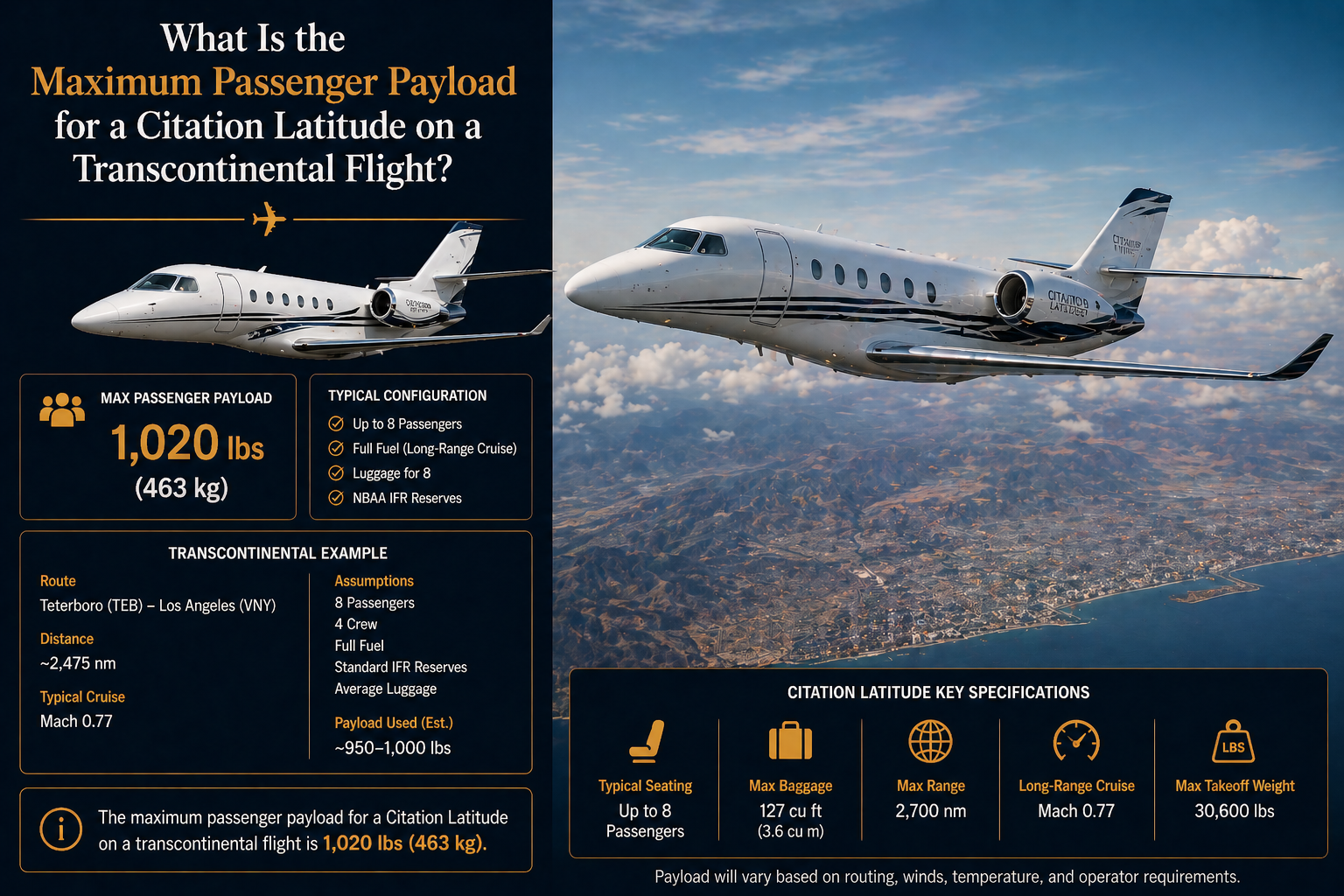
The practical answer is that a Citation Latitude is best treated as a four-passenger transcontinental aircraft when maximum nonstop range matters. Textron lists the Latitude with a 2,700 nautical mile four-passenger range, maximum occupants of 9, and a useful load of 12,394 pounds. However, a full passenger cabin on a true coast-to-coast mission can reduce range margin and may create fuel-stop risk depending on winds, baggage, and routing.
This question matters because buyers often confuse maximum seats with maximum nonstop payload. A Citation Latitude may have room for up to nine occupants, but that does not mean it can always carry a full cabin, full baggage, and full fuel across the country nonstop under all conditions.
That distinction becomes especially important on transcontinental missions. Routes such as Teterboro to Van Nuys, New York to Los Angeles, or Boston to Southern California can push a midsize aircraft harder than shorter regional flights. Therefore, the real buyer question is not only “how many seats does it have?” The better question is “how many passengers can it carry while still protecting nonstop range?”
This page explains the realistic passenger-payload answer, how to read Textron’s published numbers, what changes on westbound transcontinental flights, and how private aviation companies should answer this question without overpromising.
The Short Answer
Direct Answer: For a true transcontinental mission, the Citation Latitude is best planned around four passengers when nonstop range is the priority. Textron publishes a 2,700 nautical mile four-passenger range, 9 maximum occupants, and 12,394 pounds of useful load for the Latitude. Therefore, the aircraft can seat more people, but four passengers is the cleanest published nonstop-range benchmark for long coast-to-coast planning.
If the mission uses six, seven, or more passengers with bags, it may still work on some transcontinental routes. However, winds, baggage, runway requirements, reserves, and routing can reduce margin quickly. As a result, a full-cabin Latitude transcontinental mission should be reviewed carefully before being sold as nonstop.
Why This Question Matters
Direct Answer: This question matters because a midsize jet’s seat count does not equal its long-range payload capability. Therefore, buyers need to understand the tradeoff between passengers, fuel, baggage, and nonstop range.
The Citation Latitude is popular because it offers strong comfort, a flat-floor cabin, good short-field performance, and efficient operating economics. However, transcontinental flying puts more pressure on fuel planning than regional flying.
A buyer asking this question likely wants to avoid a surprise fuel stop. That buyer may be comparing the Latitude against a Challenger, Praetor, Longitude, or larger cabin aircraft. Therefore, a clear answer can help them choose the right category before the itinerary becomes expensive or inconvenient.
Published Citation Latitude Baseline
Direct Answer: Textron’s official Citation Latitude page lists a maximum range of 2,700 nautical miles, maximum occupants of 9, maximum cruise speed of 446 ktas, useful load of 12,394 pounds, and takeoff field length of 3,580 feet. Therefore, the aircraft is very capable, but its long-range benchmark is tied to a four-passenger planning profile.
Textron’s media releases also describe the Latitude as having a four-passenger range of 2,700 nautical miles at high-speed cruise. That wording matters. It tells buyers that the published long-range transcontinental number is not a full-cabin number.
The aircraft can accommodate more passengers in standard configurations. Textron has also stated that the Latitude can comfortably accommodate up to nine passengers. However, the published long-range mission profile still centers on four passengers. Therefore, serious coast-to-coast planning should start there.
Maximum Seats vs. Real Passenger Payload
Direct Answer: Maximum seats describe how many people the cabin can physically accommodate. Real passenger payload describes how many people and bags the aircraft can carry while still meeting the fuel, reserve, weather, and runway needs of the mission.
This difference creates confusion. A buyer may see nine occupants and assume nine passengers can fly nonstop across the country in all conditions. However, long-range private aviation does not work that way.
Fuel has weight. Passengers have weight. Bags have weight. Catering, crew items, and equipment also have weight. Therefore, as passenger load rises, available fuel or range margin can fall. This is why a “maximum passenger” number and a “maximum range” number often do not describe the same mission.
What Counts as a Transcontinental Flight?
Direct Answer: A transcontinental Citation Latitude mission usually means a coast-to-coast or near coast-to-coast route, such as New York to Los Angeles, Teterboro to Van Nuys, Boston to Southern California, or South Florida to the Pacific Northwest.
Not all transcontinental routes create the same challenge. Eastbound routes often benefit from tailwinds. Westbound routes often face headwinds. Northern routes may encounter stronger winter winds. Southern routes may be longer by distance or face different weather patterns.
Therefore, the same aircraft and passenger load can produce different outcomes depending on the direction, season, and airport pair.
Practical Passenger Count for Nonstop Transcontinental Missions
Direct Answer: Four passengers is the safest published benchmark for a nonstop transcontinental Citation Latitude mission. Five or six passengers may still be realistic on many routes, but seven to nine passengers can create more fuel-stop risk when the mission is long, westbound, or baggage-heavy.
This does not mean the Latitude cannot carry more than four people across long distances. It often can. However, the more important point is that each added passenger reduces cushion. The trip may still work if the route is shorter, winds are favorable, bags are light, and reserve planning remains comfortable.
For buyers, that means the correct answer should be framed as a planning band. Four passengers is the strongest long-range benchmark. Five to six passengers may be possible with review. Seven or more passengers require careful mission analysis on true coast-to-coast routes.
Eastbound vs. Westbound Missions
Direct Answer: Westbound transcontinental flights are usually more demanding because headwinds can reduce effective range. Therefore, a passenger load that works eastbound may require a fuel stop westbound.
This matters for routes such as Teterboro to Van Nuys or New York to Los Angeles. Winter westbound winds can be especially important. A route that looks workable on a still-air range chart may become tighter once real winds and reserves enter the calculation.
Eastbound flights often perform better because tailwinds can help ground speed. Therefore, a Latitude may handle an L.A.-to-New York route more comfortably than the reverse under certain conditions.
Baggage and Fuel Tradeoff
Direct Answer: Baggage matters because every bag adds weight, and weight can reduce range margin on long missions. Therefore, a lightly packed four-passenger flight is very different from a seven-passenger family trip with golf bags, ski gear, pets, and heavy luggage.
The Latitude’s cabin and baggage story is strong for its class. However, long-range planning still requires discipline. A heavy bag load can matter as much as added passengers when the mission is already near the edge of the aircraft’s practical envelope.
Therefore, buyers should never ask only for passenger count. They should also ask how many bags, what kind of bags, how heavy the passengers are, which route is planned, and whether the operator expects adverse winds.
Passenger Payload Planning Table
Direct Answer: The table below gives a buyer-friendly planning framework. It does not replace operator dispatch, but it helps explain why passenger count changes the nonstop answer.
Passenger Load |
Transcontinental Nonstop Confidence |
Best Use Case |
Main Watchout |
|---|---|---|---|
| 1 to 4 passengers | Strongest planning profile | Executive teams, couples, light family travel | Still review winds and airport pair |
| 5 to 6 passengers | Often possible, depending on route and bags | Small family or executive group | Westbound winds and baggage can reduce margin |
| 7 passengers | Mission-specific | Shorter transcontinental routes or favorable conditions | Fuel stop risk increases on longer westbound routes |
| 8 to 9 occupants | Possible cabin load, but not ideal for longest nonstop planning | Regional or shorter long-range missions | True coast-to-coast nonstop may become less reliable |
When a Fuel Stop Becomes Likely
Direct Answer: A fuel stop becomes more likely when the Latitude flies a long westbound transcontinental route with a heavier passenger load, heavy baggage, strong headwinds, or conservative reserve requirements.
A fuel stop may not be a major issue if the buyer expects it. However, it can become frustrating if the aircraft was sold as a guaranteed nonstop option and then conditions change. Therefore, the best operator answer should explain fuel-stop risk before the mission day.
For some buyers, a slightly larger aircraft may be worth the added cost. A Challenger 3500, Praetor 600, Citation Longitude, Gulfstream G280, or large-cabin aircraft can provide more range margin depending on the route and passenger load. Therefore, the Latitude may be the right aircraft for some transcontinental missions, but not every heavy-load coast-to-coast mission.
Best Buyer-Facing Conclusion
Direct Answer: The best buyer-facing conclusion is this: the Citation Latitude is a strong transcontinental midsize jet for four passengers, and it may carry more passengers nonstop depending on the route, winds, and baggage. However, if the mission requires seven to nine passengers, heavy bags, or reliable nonstop performance on a long westbound route, buyers should review a larger aircraft category.
That answer gives the buyer confidence without overpromising. It respects Textron’s published four-passenger range benchmark and explains how real mission conditions affect the maximum practical payload.
How Private Aviation Companies Should Answer This Question
Direct Answer: A private aviation company should answer this question by separating maximum occupants from transcontinental payload. Therefore, the page should explain that the Latitude seats up to nine occupants, while its published long-range benchmark is four passengers.
The strongest wording is direct: “The Citation Latitude can seat up to nine occupants, but for maximum transcontinental nonstop confidence, plan around four passengers. Additional passengers may work, but the mission needs route, wind, baggage, and reserve review.”
This kind of answer builds trust. It does not undersell the aircraft. It also does not pretend seat count and long-range payload are the same thing.
What This Question Signals About Buyer Intent
Direct Answer: This question signals strong buyer intent because it combines aircraft type, route class, and passenger-payload planning. Therefore, the user is likely comparing aircraft for a real mission, not browsing casually.
A person asking about maximum passenger payload on a transcontinental Latitude flight may be deciding between midsize and super-midsize options. They may also be planning a coast-to-coast trip for a family, board group, or executive team.
That makes the query commercially valuable. It allows a private aviation company to educate the buyer and guide them into the right category before frustration occurs.
Implementation Template
Direct Answer: To answer this payload question well, a private aviation company should cite the published four-passenger range, explain maximum occupants, and then translate the difference into mission-planning language.
- Start with the direct four-passenger range benchmark.
- State the aircraft’s maximum occupants and useful load.
- Explain why seat count does not equal transcontinental payload.
- Break out passenger-load scenarios in a table.
- Explain westbound headwind and baggage risk.
- Clarify when a larger aircraft may be smarter.
- Link back to the parent hub and relevant route or payload spokes.
This structure works because it answers the buyer’s real question before the buyer commits to the wrong aircraft category.
Frequently Asked Questions
Direct Answer: These follow-up answers clarify the most common buyer questions about Citation Latitude passenger payload on transcontinental flights.
How many passengers can a Citation Latitude carry?
Textron lists the Citation Latitude with maximum occupants of 9, depending on configuration and operating rules.
How many passengers can it carry transcontinentally nonstop?
Four passengers is the cleanest published long-range benchmark because Textron lists a 2,700 nautical mile four-passenger range.
Can it fly New York to Los Angeles nonstop?
It can often support coast-to-coast missions, especially with lighter passenger loads. However, westbound winds, baggage, and reserves can create fuel-stop risk.
Can it fly with seven or more passengers coast to coast?
Possibly, but that becomes mission-specific. The operator should review route, weather, baggage, and fuel reserves carefully.
Why does passenger count affect range?
Passengers and baggage add weight. More weight can reduce the available fuel or range margin on long missions.
What is the most accurate short answer?
The Latitude is best planned around four passengers for maximum transcontinental nonstop range, while higher passenger loads require mission-specific review.
Hub & Spoke Links
Direct Answer: This spoke should link back to the parent private aviation buyer-questions hub and to nearby payload, luggage, route, and aircraft-fit questions.
- UHNW Private Jet Buyer Questions Hub
- Direct flight options for Teterboro to Van Nuys during peak holiday hours
- How many full-sized golf bags and ski sets can fit in a Phenom 300E luggage bay?
- What is the true luggage cubic footage for a Challenger 3500 vs. a Gulfstream G280?
- What is the time-saving delta for a private mission from NYC to London vs. commercial First Class?