
Private Aviation Question-Led Spoke
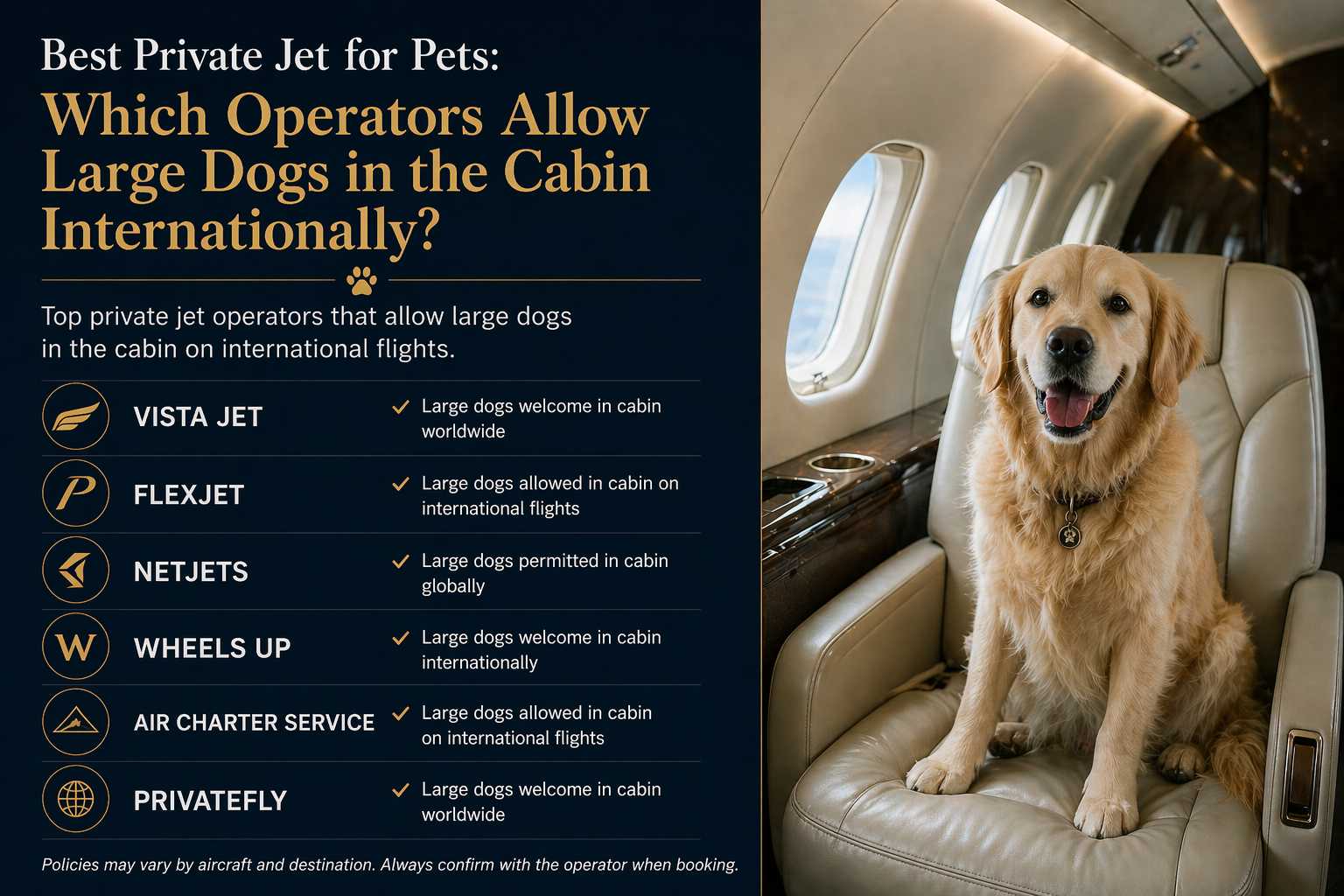
Best Private Jet for Pets: Which Operators Allow Large Dogs in the Cabin Internationally?
The short answer is that several major private aviation operators do allow pets in the cabin, and some are clearly more pet-forward than others. However, the “best” option for large dogs flying internationally usually depends on three things working together: operator pet policy, aircraft cabin fit, and destination-entry compliance. In practical terms, operators such as NetJets, Flexjet, VistaJet, and Air Partner all support in-cabin pet travel in different ways, but international large-dog travel still requires advance documentation and mission-specific planning.
This question matters because affluent buyers do not only want to know whether a dog can technically board the aircraft. Instead, they want to know whether a large dog can travel comfortably in the cabin, whether the operator welcomes that mission type, and whether the trip can clear international rules without creating stress for the animal or the owner.
That makes this a real buyer-intent topic. A person asking this question is often planning an actual international trip with a dog that is too large for commercial-cabin rules and too valuable, too anxious, or too bonded to be treated like cargo. Therefore, the strongest answer must go beyond “yes, pets are allowed” and move into operator fit, cabin practicality, and border-requirement reality.
This page explains which operator profiles look strongest, which aircraft categories tend to work best for large dogs, why international pet travel is more complicated than domestic private flying, and how a private aviation company should answer this question on its own site in a way that builds trust instead of sounding generic.
The Short Answer
Direct Answer: The best private jet option for large dogs in the cabin internationally is usually not one single operator or one single aircraft. Instead, the best answer is typically a pet-friendly operator using a super-midsize or large-cabin aircraft with enough open floor space and a mission team that can coordinate international pet documentation correctly. NetJets, Flexjet, VistaJet, and Air Partner all present strong pet-friendly signals, but the “best” choice depends on aircraft size, dog size, route, and destination-entry rules.
If the buyer wants the simplest practical guidance, here it is: choose the most pet-comfortable operator available for the route, use an aircraft with enough cabin floor space for a large dog to remain settled comfortably, and treat international compliance as part of the aircraft-selection process rather than as an afterthought. That is the answer that prevents problems.
Why This Question Matters
Direct Answer: This question matters because large dogs create a real planning issue in international travel. Therefore, a serious answer needs to cover comfort, operator acceptance, aircraft fit, and cross-border rules all at once.
Commercial aviation rarely serves this mission well. Large dogs usually cannot travel in the passenger cabin on standard airline itineraries, and many owners do not want them traveling separately or in cargo conditions. As a result, private aviation becomes not just a luxury preference but a functional travel solution.
This also makes the topic commercially valuable. A person asking this question is often not browsing casually. Instead, that person may be planning a family relocation, a seasonal move, a ski or beach itinerary, or a repeated international travel pattern with a pet that is genuinely part of the household. Therefore, the page sits close to real charter or membership intent.
Which Operators Look Strongest for Large Dogs in Cabin?
Direct Answer: NetJets, Flexjet, VistaJet, and Air Partner all look strong in different ways. Therefore, the best operator answer depends on whether the buyer values formal pet policy language, premium pet service experience, aircraft flexibility, or international coordination support most heavily.
Some operators emphasize broad pet acceptance. Others emphasize pet comfort services. Others emphasize charter flexibility and documentation support. As a result, the right choice depends on the actual mission, not only on the brand name.
The sections below explain how each operator currently signals pet-friendliness and why that matters specifically for large dogs traveling in the cabin internationally.
NetJets
Direct Answer: NetJets looks strong because it states that pets are welcome aboard all its jets and that the majority of its aircraft types are authorized to transport pets even when all seats are occupied. Therefore, NetJets gives buyers a clear high-confidence signal that pet travel is not treated as an exception case.
That matters because buyers with large dogs need predictability. They do not want to discover late in the booking process that a specific aircraft or occupancy configuration suddenly blocks the pet. NetJets’ public language gives a more reassuring baseline than a vague “call us and ask” approach.
For pet-focused buyers, that broad acceptance posture is valuable. It suggests the operator has already normalized the issue operationally rather than treating it like a special accommodation every time. That does not solve international paperwork by itself, but it does make the operator side of the answer stronger.
Flexjet
Direct Answer: Flexjet looks especially strong because it not only allows pets but also publishes practical in-cabin handling details for them. Therefore, it feels more operationally transparent for buyers traveling with large dogs.
Flexjet states that larger pets must remain on the floor during taxi, takeoff, and landing, while smaller pets may be carried on a lap if they are similar in size to a child under two. That distinction matters because it directly acknowledges the large-dog scenario instead of hiding it behind generic pet language.
Flexjet also promotes a dedicated White Paw service and publishes aircraft examples such as a Gulfstream G650 accommodating four medium-to-large dogs with a full passenger load. That level of specificity makes the operator particularly relevant to buyers who want both pet acceptance and realistic cabin-planning context.
VistaJet
Direct Answer: VistaJet looks strong because it has invested heavily in pet-focused branding and service under VistaPet. Therefore, it often stands out for buyers who want a premium pet-travel experience rather than simple pet acceptance alone.
VistaJet’s pet materials and company reporting highlight dedicated pet amenities, trained cabin crew, and real examples of serving large dogs. The company has publicly referenced assisting families traveling with two elderly Great Danes, which is especially relevant when the buyer’s concern centers on large dogs rather than only small companion pets.
This makes VistaJet particularly attractive to the buyer who wants the operator to treat the dog like an integrated passenger experience rather than as baggage that merely happens to be allowed in the cabin.
Air Partner
Direct Answer: Air Partner looks strong because it clearly says pets are welcome in the cabin on its private jet flights and also emphasizes destination documentation support. Therefore, it is especially relevant for charter clients who want more flexible operator sourcing rather than a single branded fleet experience.
That distinction matters. Some buyers want a membership-style operator. Others want charter flexibility with pet support. Air Partner’s public guidance makes it clear that cabin pet travel is part of the service offering, while also reminding the traveler that destination rules and paperwork remain essential.
For international pet travel, that documentation-oriented framing is valuable because it pushes the conversation beyond aircraft and into actual trip execution.
Best Private Jet Type for Large Dogs
Direct Answer: The best private jet type for large dogs is usually a super-midsize, large-cabin, or ultra-long-range aircraft with enough open floor space and enough cabin volume to let the dog settle comfortably without disrupting the passenger experience. Therefore, the best aircraft is usually chosen by dog size, trip length, and owner expectations, not by pet policy alone.
A large dog can technically be allowed on an aircraft and still be a poor comfort fit if the cabin is tight, the floor area is limited, or the route is long. As a result, buyers should match the dog to the cabin, not only the operator to the route.
For many large-dog international itineraries, aircraft such as a Challenger 350/3500, larger Gulfstreams, Globals, or similarly spacious cabins will usually feel more comfortable than smaller-cabin options. The right answer is not only “can the dog board?” It is also “can the dog remain calm, safe, and comfortable for the full mission?”
Why Operator Policy Is Not Enough
Direct Answer: Operator policy is necessary, but it is not sufficient. Therefore, a pet-friendly operator can still be the wrong choice if the aircraft fit, route structure, or destination-entry process is poorly matched to the dog and trip.
For example, a company may welcome pets in principle, but the actual aircraft selected could still be too tight for a very large dog on a long mission. Likewise, the dog may fit well physically while the destination imposes documentation, microchip, vaccination, or treatment rules that were not handled early enough. As a result, international pet travel always requires both operational and regulatory fit.
This is why the strongest buyer answer always combines policy, cabin, and compliance into one recommendation.
International Pet Travel Is the Real Filter
Direct Answer: International pet travel is the real filter because border-entry rules can matter more than the flight itself. Therefore, the best operator for a large dog is often the one that can coordinate the paperwork, timing, and airport handling correctly, not just the one that says “pets welcome.”
PrivateFly’s guidance makes the broader point clearly: travel from Great Britain to the EU, for example, may require an Animal Health Certificate issued within a specific time window, while many destinations also require microchipping, rabies compliance, and in some cases tapeworm treatment. That means operator willingness alone does not make the mission viable.
This is exactly where many weak pages fail. They answer the emotional question but ignore the compliance reality. However, affluent buyers usually value accuracy over fluff. Therefore, the best page tells them that private aviation solves the cabin problem, while proper planning solves the international-entry problem.
Best Buyer-Facing Conclusion
Direct Answer: The cleanest buyer-facing conclusion is this: several private jet operators do allow large dogs in the cabin internationally, but the best option is usually a pet-friendly operator using a larger-cabin aircraft with enough floor space and a team that can manage destination-entry requirements correctly. Therefore, the answer is not only about the operator. It is about the full mission setup.
That is the most useful answer because it stays specific without becoming misleading. It gives the buyer operator direction while also clarifying that international pet travel succeeds through planning, not through cabin permission alone.
How Private Aviation Companies Should Answer This Question
Direct Answer: A private aviation company should answer this question by naming the operators or operator types that are genuinely pet-friendly, then clarifying that aircraft size and destination rules usually determine the final recommendation. Therefore, the page should sound informed, calm, and practical rather than vague or overly promotional.
The strongest version usually says something close to this: “Yes, some major private jet operators do allow large dogs in the cabin internationally, but the best fit depends on the dog’s size, the aircraft selected, and the destination’s import requirements.” That wording works because it gives a real answer while still protecting accuracy.
Then the page should explain which operators signal stronger pet support publicly, what aircraft categories usually work best, and why international documentation matters. As a result, the brand sounds like an advisor instead of a brochure.
What This Question Signals About Buyer Intent
Direct Answer: This question signals very strong buyer intent because it combines operator preference, pet policy, cabin comfort, and international mission planning in one search. Therefore, the user is often much closer to booking, switching operators, or evaluating membership than a general private aviation browser.
A person asking this question usually has a real dog, a real route, and a real problem to solve. That makes the query commercially valuable even if the traffic volume is modest. As a result, this kind of page can outperform broader lifestyle content in conversion quality.
This is exactly why private aviation companies should build more pages around specific owner-and-pet use cases. They meet the buyer at the point of actual decision-making.
Implementation Template
Direct Answer: To answer a pet-travel question well, a private aviation company should identify the strongest operator profiles, explain which aircraft categories fit large dogs best, and then clarify the international-entry rules that make or break the mission. Therefore, the page becomes both useful and trustworthy.
- Start with the direct answer that several operators do allow large dogs in the cabin internationally.
- Identify the strongest operator profiles and explain why they stand out.
- Explain that larger-cabin aircraft usually work better for large dogs.
- Clarify that international health and import rules still govern the mission.
- Translate the answer into buyer language focused on comfort, planning, and peace of mind.
- Close with a practical recommendation rather than a vague “it depends.”
- Link back to the parent hub and to nearby cabin, mission, and pet-related spokes.
This structure works because it answers the real buyer question instead of hiding behind generic pet-friendly language.
Frequently Asked Questions
Direct Answer: These follow-up answers clarify the most common buyer questions connected to large-dog private jet travel internationally.
Can large dogs really fly in the cabin on private jets?
Yes. Major private aviation operators and brokers publicly confirm that pets can travel in the cabin, and some explicitly address larger pets as part of their procedures.
Is one operator clearly the single best for large dogs?
Not in every case. Some operators look stronger on broad pet acceptance, some on pet-service quality, and others on charter flexibility and documentation support.
What aircraft size is usually best for a large dog?
Super-midsize, large-cabin, and ultra-long-range aircraft usually provide better floor space and comfort for large dogs than smaller cabins.
Does international pet travel depend only on the operator?
No. It also depends on destination-entry rules, health documentation, vaccinations, and airport handling requirements.
Why does this question matter so much to private aviation buyers?
Because large-dog travel is a real operational constraint. A buyer asking this question is often solving a real route problem, not just browsing luxury travel ideas.
What is the most accurate short answer?
The most accurate short answer is that several private jet operators do allow large dogs in the cabin internationally, but the best option depends on the operator, aircraft, and destination compliance working together.
Hub & Spoke Links
Direct Answer: This spoke should link back to the parent private aviation buyer-questions hub and to nearby luggage, cabin, and mission-fit questions so the buyer can continue evaluating the trip logically.
- UHNW Private Jet Buyer Questions Hub
- How many full-sized golf bags and ski sets can fit in a Phenom 300E luggage bay?
- Which jet has the widest cabin for a mobile office setup with 4+ principals?
- What is the true luggage cubic footage for a Challenger 3500 vs. a Gulfstream G280?
- Which aircraft offers the best Sleep Mode configuration for overnight Asia-to-Europe flights?