Free MedTech Marketing SOP Guide
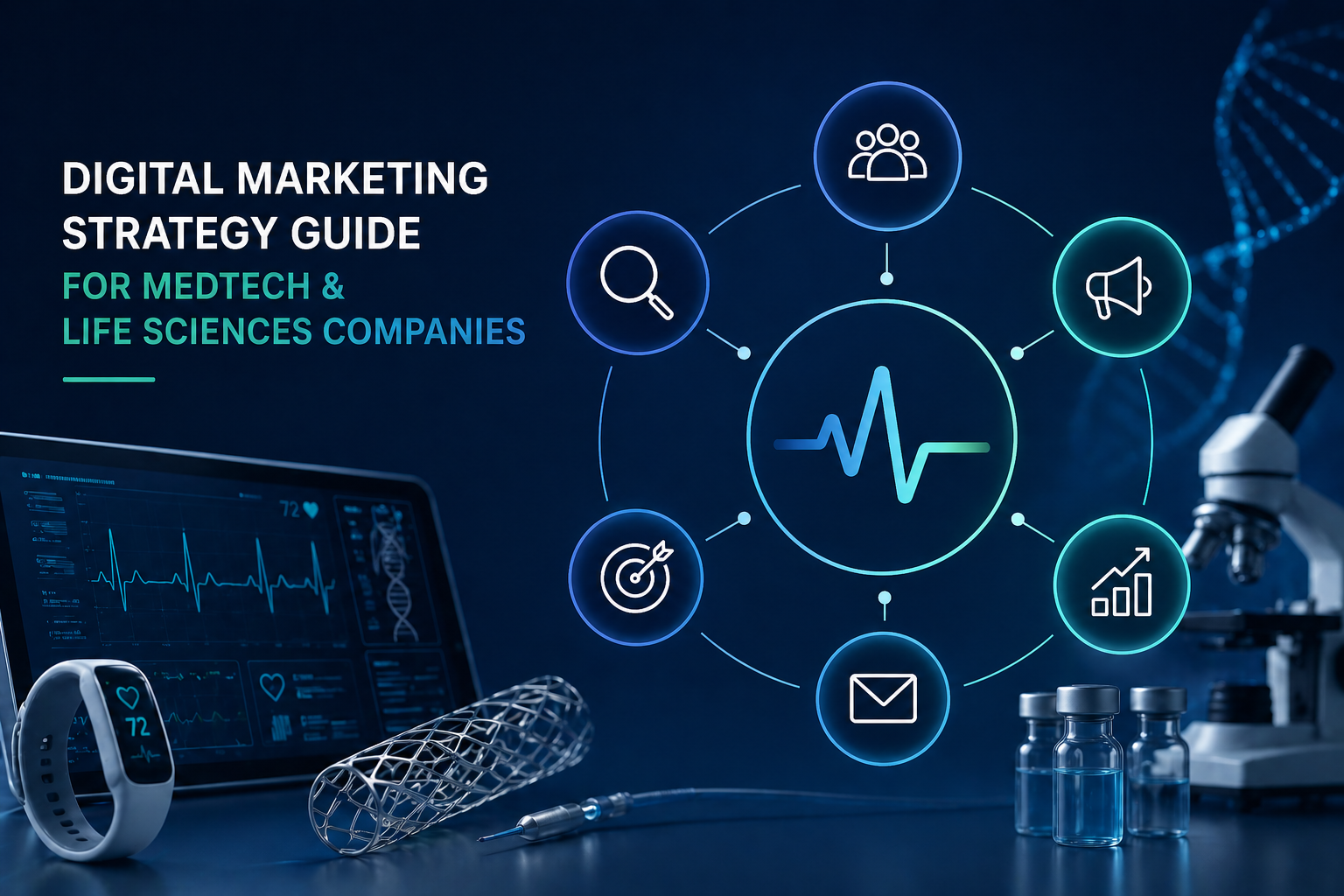
Digital Marketing Strategy Guide For MedTech & Life Sciences Companies
Digital Marketing Strategy Guide For MedTech & Life Sciences Companies helps medical device brands, diagnostics companies, biotech platforms, lab technology providers, clinical software firms, contract research partners, and life sciences service companies build stronger SEO, GEO, AI-search visibility, paid traffic, trust signals, and qualified lead generation systems.
Digital Marketing Strategy Guide For MedTech & Life Sciences Companies starts with one major truth. Buyers in this market do not make quick decisions. Instead, they compare clinical value, compliance risk, technical fit, procurement needs, validation, evidence, integrations, reimbursement, and provider credibility. Therefore, the website must educate, prove, and convert together.
However, many MedTech and life sciences websites stay too thin. They often explain the product but ignore buyer questions. Consequently, search engines, AI systems, and procurement teams may not understand the full value. Therefore, this guide turns digital marketing into a structured authority system.
MedTech And Life Sciences Digital Marketing
MedTech and life sciences buyers often need deep education before they inquire. For example, they may research clinical workflow fit, lab automation, FDA pathways, validation needs, integration issues, or vendor selection. Therefore, every page should answer real questions with clarity.
Because this industry includes science, healthcare, technology, compliance, and revenue risk, vague marketing fails quickly. Instead, strong pages must explain who the solution helps, how it works, why it matters, and what happens next. As a result, the site becomes a sales-support and authority asset.
What This Guide Is Designed To Do
Direct Answer: This guide helps MedTech and life sciences companies build a digital authority system that attracts qualified buyers, explains complex solutions clearly, supports AI visibility, and turns search demand into stronger conversations.
Many medical technology and life sciences websites rely on product claims, investor language, or technical feature lists. However, buyers need more than features. They need proof, context, implementation guidance, validation, compliance clarity, workflow fit, and risk reduction. Therefore, the website must support both education and sales.
This guide turns that need into a repeatable structure. First, it explains how buyers search. Then, it maps demand into keyword research, service pages, hubs, city pages, AI-search content, schema, Google Ads, Meta Ads, and scalable authority systems. Finally, it connects every asset to lead quality.
As a result, the website becomes more than a brochure. Instead, it becomes a decision-support platform. That platform helps clinicians, lab directors, procurement leaders, operations teams, researchers, executives, and investors evaluate the company with more confidence.
Why MedTech Needs A Different Digital Strategy
MedTech buyers often balance clinical value, patient impact, regulatory risk, and operational fit. Therefore, they need content that explains practical outcomes and scientific credibility. In addition, they need clear proof that the company understands healthcare workflows.
Life sciences buyers often evaluate technical capabilities, research support, data quality, equipment compatibility, sample workflows, and vendor reliability. Consequently, pages must explain the service or product with precision. However, they must still remain easy to read.
Because of this, every page needs one clear job. Service pages should convert. Hubs should educate. Spokes should answer specific questions. Case-style pages should prove trust. Paid landing pages should match intent. Therefore, structure controls performance.
How MedTech And Life Sciences Buyers Search
Direct Answer: MedTech and life sciences buyers search by product category, clinical use case, workflow problem, compliance need, research application, integration requirement, vendor comparison, and procurement stage.
Clinical And Workflow Intent
Clinicians and healthcare operators often search around workflow pain. For example, they may research faster diagnostics, remote monitoring, surgical devices, patient engagement, or clinical decision support. Therefore, content should explain how the solution fits real care delivery.
Technical And Scientific Intent
Researchers, lab teams, and technical buyers often search around specifications, methods, validation, performance, and compatibility. Consequently, pages should define use cases, workflows, and technical requirements clearly.
Compliance And Risk Intent
Healthcare and life sciences buyers often care about compliance. Therefore, content may need to explain FDA pathways, HIPAA considerations, data security, quality systems, validation, and documentation. However, pages should avoid legal advice claims.
Procurement And Vendor Intent
Late-stage buyers often search for companies, vendors, providers, platforms, demos, comparisons, and implementation support. Therefore, service and solution pages must give strong next steps.
AI And Long-Question Intent
AI-search users often ask complete questions. For example, they may ask how to choose a diagnostic platform or how digital therapeutics differ from remote monitoring. Consequently, question-led spokes become highly valuable.
MedTech And Life Sciences Buyer Segments
Direct Answer: MedTech and life sciences marketing works better when each buyer group gets content that reflects its clinical, technical, financial, regulatory, and operational concerns.
Clinicians And Care Teams
Clinicians care about patient outcomes, workflow burden, usability, clinical evidence, and adoption. Therefore, pages should explain how the solution supports care delivery. In addition, they should avoid feature-heavy language without context.
Hospital And Health System Leaders
Executives often care about efficiency, cost, compliance, patient experience, and implementation risk. Consequently, content should explain business impact and operational fit. Moreover, it should support internal stakeholder review.
Lab Directors And Research Teams
Lab and research buyers need technical clarity. They often compare accuracy, throughput, sample handling, platform compatibility, validation, and service reliability. Therefore, pages should include detailed but readable explanations.
Procurement And Legal Teams
Procurement teams need vendor clarity, contract readiness, support details, and risk reduction. Therefore, content should explain process, security, compliance considerations, and implementation steps.
Investors And Strategic Partners
Investors and partners often review market position, differentiation, evidence, and scalability. Consequently, the website should show authority, not just product claims. In addition, it should explain market fit clearly.
Phase 1: Keyword Research
Direct Answer: Keyword research for MedTech and life sciences companies should organize search demand by buyer type, clinical use case, product category, research application, compliance topic, workflow need, and decision stage.
Core Keyword Buckets
- Medical device keywords
- Diagnostic technology keywords
- Digital health platform keywords
- Remote patient monitoring keywords
- Clinical software keywords
- Lab automation keywords
- Life sciences services keywords
- Biotech platform keywords
- Regulatory and compliance keywords
- Vendor and comparison keywords
Why Intent Mapping Matters
A researcher searching for assay development has different needs than a hospital buyer searching for patient monitoring software. Likewise, a procurement leader needs different information than a clinician. Therefore, keyword groups should map to buyer role and decision stage.
How To Prioritize Keywords
Start with commercial value and buyer fit. Then, layer in search volume, difficulty, regulatory sensitivity, and sales alignment. Consequently, the first pages should target demand that can become real pipeline.
Keyword Mapping Rules
Each keyword group should map to one page type. For example, clinical workflow terms may need service pages. However, education terms may need spokes. Therefore, search intent should control the page plan.
Phase 2: Service Page Architecture
Direct Answer: Service pages should explain one MedTech or life sciences solution clearly, define buyer fit, show value, answer risk questions, explain implementation, and guide users toward a demo, consultation, quote, or assessment.
Core Service And Solution Pages
- Medical Device Marketing
- Diagnostic Technology Marketing
- Digital Health Platform Marketing
- Remote Patient Monitoring Marketing
- Clinical Software Marketing
- Lab Automation Marketing
- Life Sciences Lead Generation
- Biotech Platform Marketing
What Each Service Page Needs
Each page should start with a clear summary. Then, it should explain the buyer problem, solution fit, audience, proof, implementation path, compliance considerations, FAQs, and next step. Therefore, the page supports trust before conversion.
Why Dedicated Pages Matter
One broad page cannot explain every MedTech or life sciences solution well. Instead, each service needs focused messaging. As a result, users, search engines, and AI systems understand the offer faster.
Conversion Path
These pages should offer demos, consultations, discovery calls, strategy sessions, technical reviews, or quote requests. However, the CTA should match buyer readiness. Therefore, high-risk buyers do not feel rushed.
Phase 3: Hub And Spoke Content
Direct Answer: Hub and spoke content helps MedTech and life sciences companies explain complex decisions through broad authority hubs and focused answer pages.
Strong Hub Ideas
- Medical Device Marketing Guide
- Digital Health Marketing Guide
- Life Sciences SEO Guide
- Clinical Software Buyer Education Guide
- Diagnostic Technology Marketing Guide
- Lab Automation Content Strategy Guide
Strong Spoke Ideas
- How do MedTech buyers evaluate vendors?
- What content builds trust for medical device companies?
- How should digital health companies explain clinical workflow fit?
- How do life sciences brands generate qualified leads?
- What pages should diagnostic companies build first?
- How can MedTech companies improve AI-search visibility?
Why Clusters Matter
Buyers rarely convert after one page. Instead, they research technical, clinical, regulatory, and business questions. Therefore, clusters help the website support the full decision path.
How Hubs Should Work
A hub should explain the broad topic clearly. Then, it should introduce major subtopics. Finally, it should link to focused spokes. Consequently, the hub becomes educational and navigational.
Phase 4: City Page Strategy
Direct Answer: City pages help MedTech and life sciences companies capture local demand when geography affects buyer searches, regional ecosystems, healthcare markets, research hubs, events, hiring, or service delivery.
When City Pages Make Sense
City pages can work well for regional life sciences clusters, healthcare markets, and local service providers. For example, Boston, San Diego, Raleigh-Durham, Cleveland, Houston, and San Francisco may support strong local relevance. Therefore, location pages should reflect real market context.
When City Pages Do Not Fit
Some MedTech or SaaS companies sell nationally or globally. Therefore, city pages may not always help. Instead, industry pages, buyer-role pages, and product-category pages may fit better.
What City Pages Should Include
- Local market summary
- Healthcare or research ecosystem context
- Relevant buyer segments
- Service or solution fit
- Related service links
- FAQs for local buyers
Why Local Specificity Matters
Thin city pages can weaken trust. Therefore, each page should include real local relevance. In addition, it should link to useful service and hub pages.
Phase 5: AI Search Optimization
Direct Answer: AI Search Optimization helps MedTech and life sciences companies structure content so answer engines can understand solutions, use cases, buyer questions, trust signals, compliance topics, and evidence clearly.
Use Direct Answers
Each major section should answer the question first. Then, it should explain details. Therefore, users and AI systems understand the topic faster.
Define Technical Terms Early
MedTech and life sciences pages often include complex terms. Therefore, pages should define clinical, regulatory, technical, and scientific terms early. As a result, content becomes more accessible.
Build Question-Led Spokes
AI users ask full questions. Consequently, each high-value buyer question should become a focused spoke page. Moreover, each spoke should link back to its parent hub.
Use Stable Service Names
Consistent naming helps AI systems understand entities. Therefore, service names should stay consistent across headings, schema, internal links, and summaries.
Connect Evidence And Trust
AI systems need reliable context. Therefore, pages should explain proof, process, compliance considerations, and external authority sources where appropriate.
Phase 6: Schema And E-E-A-T
Direct Answer: Schema and E-E-A-T help MedTech and life sciences companies prove identity, expertise, service relevance, trust, and authority through visible content and structured markup.
Visible Trust Signals
- Leadership details
- Scientific or clinical expertise
- Process explanations
- Compliance-aware language
- Technical documentation support
- Detailed FAQs
- Use-case explanations
- Trusted external references
Recommended Schema Types
- Organization
- WebSite
- ProfessionalService
- WebPage
- Article
- FAQPage
- HowTo
- BreadcrumbList
- SpeakableSpecification
Why E-E-A-T Matters Here
MedTech and life sciences buyers need credible guidance. Therefore, pages should avoid vague innovation claims. Instead, they should explain evidence, process, buyer fit, and implementation risk.
Phase 7: Google Ads
Direct Answer: Google Ads for MedTech and life sciences companies should capture high-intent searches around products, services, clinical use cases, research applications, vendor comparisons, demos, and consultations.
Strong Campaign Groups
- Medical device campaigns
- Diagnostic technology campaigns
- Digital health software campaigns
- Remote patient monitoring campaigns
- Clinical software campaigns
- Lab automation campaigns
- Life sciences service campaigns
- Vendor comparison campaigns
Landing Page Rules
Each campaign should land on the most relevant page. Therefore, clinical software terms should not land on a generic homepage. Likewise, diagnostic terms need focused landing pages.
Measurement Rules
Track demo requests, consultation bookings, quote requests, form fills, calls, technical reviews, and qualified meetings separately. Consequently, campaign decisions reflect lead quality, not volume alone.
Negative Keyword Rules
Negative keywords should block jobs, education-only searches, free templates, unrelated academic terms, and low-fit traffic. Therefore, search-term reviews must happen often.
Phase 8: Facebook / Meta Ads
Direct Answer: Meta Ads help MedTech and life sciences companies educate buyers, promote thought leadership, retarget warm visitors, support event campaigns, and bring prospects back to high-value content.
Best Meta Use Cases
- Retargeting service page visitors
- Promoting clinical workflow guides
- Promoting event or conference content
- Educating buyers on complex solutions
- Retargeting demo page visitors
- Sharing proof and process content
Creative Strategy
Creative should explain one idea clearly. For example, it can show a workflow problem, implementation benefit, research use case, or buyer question. Therefore, the message should stay specific.
Lead Quality Rules
Meta leads should include qualifying questions. Otherwise, sales teams may receive weak inquiries. Consequently, CRM feedback should shape targeting, forms, and creative.
Conversion Paths And Lead Quality
Direct Answer: MedTech and life sciences websites need multiple conversion paths because buyers may need education, technical review, stakeholder alignment, or compliance confidence before a sales conversation.
High-Intent Conversion Paths
- Request a demo
- Book a consultation
- Request a technical review
- Schedule a discovery call
- Request pricing
- Talk to a specialist
Mid-Funnel Conversion Paths
- Download a buyer checklist
- Read a workflow guide
- Compare solution types
- Review implementation steps
- Explore FAQs
CRM And Attribution
Every conversion should pass source, page path, campaign, service interest, and buyer role into the CRM. Therefore, marketing can optimize for qualified opportunities. Moreover, sales teams can prioritize stronger leads.
Phase 9: The 1000 Page Model
Direct Answer: The 1000 Page Model helps MedTech and life sciences companies scale authority across solutions, use cases, buyer roles, industries, questions, comparisons, compliance topics, and local ecosystems.
Recommended Page Mix
- 18% service and solution pages
- 15% use-case and application pages
- 14% hub and spoke educational pages
- 12% FAQ and comparison pages
- 10% buyer-role pages
- 10% industry and vertical pages
- 8% city and ecosystem pages
- 8% trust and process pages
- 5% event and conference support pages
Why This Model Fits MedTech
MedTech decisions involve many stakeholders. Therefore, large structured coverage helps the company answer more demand. Moreover, it creates stronger AI and search authority over time.
How To Scale Safely
Start with the strongest commercial pages. Then, build hubs, buyer-role pages, use-case pages, and comparison content. After that, expand into city, event, and trust pages. Consequently, growth stays structured.
Implementation Example
Direct Answer: A MedTech or life sciences company can apply this system by building core solution pages first, then expanding into use-case pages, buyer-role pages, hubs, comparisons, and retargeting campaigns.
Example Company: Clinical Software Platform
Core Pages
- Clinical Workflow Software
- Patient Engagement Platform
- Healthcare Data Integration
- Remote Monitoring Solution
Priority Page Families
/solutions/clinical-workflow-software//solutions/patient-engagement-platform//solutions/healthcare-data-integration//digital-health-marketing-guide//clinical-software-buyer-questions/
Expansion Pages
- Clinical Software For Hospitals
- Clinical Software For Specialty Practices
- How To Evaluate Clinical Workflow Software
- What Questions Should Procurement Ask?
This structure gives the company commercial clarity first. Then, it adds education, buyer-role context, and trust. As a result, the website can support both search visibility and sales conversations.
90-Day Implementation Plan
Direct Answer: A 90-day MedTech and life sciences plan should build the commercial foundation first, then add authority content, paid campaigns, schema, and CRM measurement.
Days 1-30: Foundation
First, define core solutions, buyer roles, priority verticals, and conversion goals. Then, build the keyword map and page map. Therefore, the website plan starts with structure.
Days 31-60: Core Pages
Next, build the main service pages, solution pages, and first buyer-role pages. Additionally, add direct-answer sections and full schema. Consequently, the site becomes stronger for SEO, GEO, and AI search.
Days 61-90: Traffic And Expansion
Finally, launch Google Ads, Meta retargeting, and first hub pages. Then, review CRM lead quality. As a result, the strategy improves from real data.
Implementation Checklist
Direct Answer: Use this checklist to build a MedTech and life sciences marketing system that supports search, AI visibility, paid traffic, trust, and qualified lead generation.
- Define core products, services, and buyer roles.
- Build keyword groups by intent and solution.
- Create dedicated service and solution pages.
- Add use-case and buyer-role pages.
- Create compliance-aware FAQ content.
- Build authority hubs and focused spokes.
- Add direct answers to major sections.
- Add schema to every major page.
- Create Google Ads campaigns by intent.
- Use Meta retargeting for longer sales cycles.
- Track qualified leads in CRM.
- Review performance quarterly.
FAQs
What is digital marketing for MedTech and life sciences companies?
Direct Answer: It is a structured strategy that uses SEO, GEO, AI search, paid ads, service pages, trust content, and CRM tracking to attract qualified buyers.
Why do MedTech companies need detailed service pages?
Direct Answer: They need detailed pages because buyers compare clinical value, workflow fit, evidence, implementation risk, compliance, and vendor credibility before they inquire.
Do life sciences companies need SEO and GEO content?
Direct Answer: Yes. Life sciences buyers search technical, research, vendor, and application questions. Therefore, strong content improves discovery, trust, and AI-search visibility.
Should MedTech companies build city pages?
Direct Answer: Sometimes. City pages work when local healthcare markets, research hubs, events, or service delivery justify location-specific content.
How do Google Ads help MedTech companies?
Direct Answer: Google Ads capture active demand for solutions, vendors, demos, comparisons, clinical use cases, and qualified consultations while organic authority grows.
How do Meta Ads help life sciences brands?
Direct Answer: Meta Ads help by educating buyers, retargeting warm visitors, promoting guides, supporting events, and bringing prospects back to high-value pages.
What pages should a MedTech website build first?
Direct Answer: It should build core solution pages first, then buyer-role pages, use-case pages, hubs, spokes, comparison pages, and trust pages.
How does AI search affect MedTech marketing?
Direct Answer: AI search rewards clear answers, structured content, entity clarity, trust signals, and deep topic coverage around real buyer questions.
Hub & Spoke Links
Direct Answer: This hub should connect to focused implementation spokes so each major MedTech and life sciences marketing topic can support deeper search, AI, and conversion strategy.
Main SOP Hub
Recommended Spokes
- Keyword Research For MedTech & Life Sciences Companies
- Service Page Architecture For MedTech & Life Sciences Companies
- Hub And Spoke Content For MedTech & Life Sciences Companies
- City Page Strategy For MedTech & Life Sciences Companies
- AI Search Optimization For MedTech & Life Sciences Companies
- Schema And E-E-A-T For MedTech & Life Sciences Companies
- Google Ads For MedTech & Life Sciences Companies
- Facebook / Meta Ads For MedTech & Life Sciences Companies
- The 1000 Page Model For MedTech & Life Sciences Companies