Conversion Strategy Resources
Conversion Strategy Resources give business owners, founders, marketing teams, and sales leaders a focused place to learn how to turn traffic into qualified opportunities. Instead of chasing more visitors, these resources focus on landing page structure, offer clarity, trust signals, CTAs, form strategy, follow-up, buyer psychology, SEO, GEO, paid media, and sales alignment.
Start with the featured resource carousel below. Each resource gives you a practical way to improve how users move from search, ads, AI answers, and content into real sales conversations. Then, continue into the deeper framework below to see how Conversion Strategy Resources support a larger Digital Fortress system.
Direct Answer: Conversion Strategy Resources help businesses turn traffic, clicks, AI visibility, paid ads, and organic search demand into qualified leads and sales opportunities. The strongest resources improve offer clarity, page structure, trust, CTA alignment, form friction, follow-up speed, and buyer confidence so more visitors take the right next step.

Why Your Lead Form is Failing: The 3-Step “Straight Line” Friction Test for Jet Charter Leads
Why Your Lead Form Is Failing: The 3-Step “Straight Line”

Mobile-First Local SEO: Ensuring Your 1,000 Geo-Pages Convert on the Go
Mobile-First Local SEO: Ensuring Your 1,000 Geo-Pages Convert on the
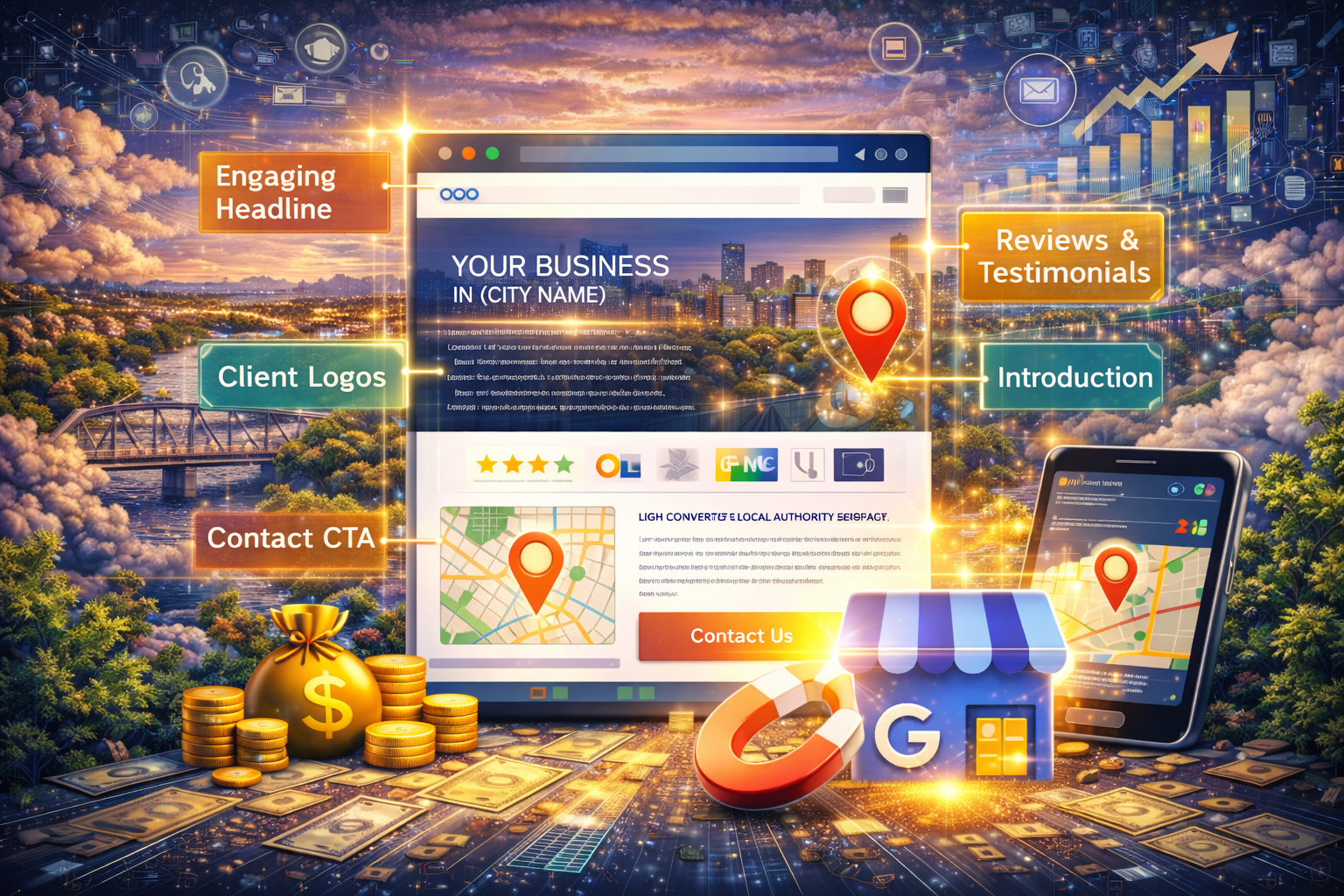
The Anatomy of a High-Converting Local Authority Page
The Anatomy of a High-Converting Local Authority Page Direct answer:
What Conversion Strategy Resources Are
Direct Answer: Conversion Strategy Resources are guides, frameworks, FAQs, service assets, and case studies that help businesses turn attention into action. They explain how offers, landing pages, CTAs, trust signals, forms, analytics, follow-up, and sales process design work together to create qualified leads and revenue.
These resources should not read like generic CRO advice. Instead, they should function like revenue improvement playbooks. Therefore, each resource must explain one specific conversion problem clearly. That problem may involve weak landing pages, unclear offers, poor CTA alignment, low form completion, slow follow-up, low-quality leads, or broken sales handoff.
Furthermore, Conversion Strategy Resources must connect marketing and sales. A page can attract the right visitor and still fail if the next step feels unclear. Because of that, every resource should explain how user intent, message clarity, trust, friction, and follow-up affect revenue.
Why Conversion Resources Should Work Like Revenue Infrastructure
A weak conversion resource says, “Improve your website.” However, a strong resource explains why visitors hesitate, what proof they need, how the CTA should match intent, and what happens after the lead submits. Additionally, it shows why conversion strategy depends on the full journey, not just button colors.
Because of that, the best Conversion Strategy Resources act like revenue infrastructure. They improve every traffic source. They strengthen paid ads. They raise SEO value. Additionally, they allow IMR to connect landing pages, lead generation, high ticket sales, GEO, paid media, and follow-up into one measurable growth system.
Why Conversion Strategy Resources Must Connect Traffic to Revenue
Direct Answer: Conversion Strategy Resources must connect traffic to revenue because clicks do not pay the business. A strong conversion system turns the right visitors into qualified leads, booked calls, quote requests, consultations, or sales opportunities while filtering out poor-fit traffic before it wastes sales time.
Many businesses diagnose the wrong problem. They think they need more traffic when they actually need a better path from traffic to action. Therefore, conversion strategy must look at the full journey. The headline, offer, proof, CTA, form, thank-you page, and follow-up all matter.
This matters because each traffic source brings different intent. Google Ads visitors may want speed. SEO visitors may need trust. Meta Ads visitors may need more education. AI search users may already trust a cited answer. As a result, conversion strategy must match the visitor’s level of awareness.
How Revenue-Focused Conversion Strategy Changes the Goal
Revenue-focused conversion strategy does not celebrate every form fill equally. Instead, it evaluates the quality of the opportunity. A smaller number of qualified leads can outperform a larger number of weak leads. Therefore, the page should attract the right prospect and repel poor-fit inquiries.
Strong revenue-focused conversion signals include:
- Clear alignment between traffic source and page message.
- A specific offer that matches buyer intent.
- Trust signals that reduce hesitation.
- Forms that collect enough useful context.
- CTAs that explain the next step.
- Tracking that connects leads to outcomes.
- Follow-up that moves quickly and professionally.
Ultimately, conversion strategy should improve profit, not vanity metrics. Therefore, every page should support a measurable business outcome.
Offer Clarity and Buyer Motivation
Direct Answer: Offer clarity tells visitors exactly what they get, why it matters, who it helps, and what happens next. Strong Conversion Strategy Resources show how clear offers increase action because buyers move faster when the value feels specific, relevant, low-risk, and aligned with their current problem.
A conversion problem often starts with a weak offer. If users do not understand the value, they will not act. Therefore, businesses must make the offer specific. A vague “contact us” CTA usually underperforms a clear consultation, audit, quote, estimate, inspection, or strategy session.
However, clarity does not mean adding more words. Instead, it means removing confusion. The visitor should understand the outcome within seconds. Additionally, the offer should match the visitor’s level of intent.
What Makes an Offer Easier to Act On
A strong offer creates a bridge between pain and action. It should explain the buyer’s problem, the value of the next step, and the reason the visitor should not delay.
Strong offer clarity includes:
- A specific problem the visitor already feels.
- A clear outcome or benefit.
- A low-friction next step.
- A reason to act now.
- Proof or logical validation.
- Risk reduction when appropriate.
- Language that matches the buyer’s intent.
As a result, offer clarity improves conversion before design changes happen. When people understand the value, they move with less resistance.
Landing Page Structure and Conversion Flow
Direct Answer: Landing page structure guides visitors from problem recognition to action. Strong Conversion Strategy Resources explain how headlines, direct answers, proof, service clarity, FAQs, CTAs, and form placement should work together so users understand the offer and feel confident taking the next step.
A landing page should create momentum. The top section should answer the visitor’s core question quickly. Then, the page should build trust, explain the process, handle objections, and present the CTA at the right moments. Therefore, structure matters more than decoration.
Many pages fail because they bury the point. A visitor should not need to hunt for the offer. Additionally, they should not need to guess what happens after they submit a form. Every section should reduce uncertainty.
How Strong Page Flow Reduces Friction
Strong page flow matches the buyer’s thought process. First, the visitor asks, “Am I in the right place?” Then, they ask, “Can this solve my problem?” Next, they ask, “Can I trust this company?” Finally, they ask, “What happens if I take action?”
A strong conversion page includes:
- A clear headline tied to the main problem.
- A direct answer summary near the top.
- A specific offer or next step.
- Proof, process, or credibility signals.
- Benefit-focused sections.
- FAQs that answer objections.
- Repeated CTAs placed naturally.
- A form that matches the offer.
Because of that, landing page structure should never feel random. Every section should move the visitor closer to a confident decision.
Trust Signals and Risk Reduction
Direct Answer: Trust signals reduce perceived risk by showing visitors that the business understands the problem, has a credible process, and can deliver the promised outcome. Strong Conversion Strategy Resources explain how proof, expertise, reviews, process clarity, guarantees, FAQs, and authority content increase buyer confidence.
People hesitate when they feel uncertain. They may doubt the company, the offer, the process, the price, or their own decision. Therefore, conversion strategy must reduce risk before asking for action.
Trust signals work best when they match the buyer’s concern. A homeowner may need proof of workmanship. A B2B buyer may need case studies. A luxury buyer may need discretion. A high ticket buyer may need process clarity. As a result, proof must fit the audience.
How to Build Trust Without Adding Fluff
Trust-building content should be specific. Vague claims like “best service” or “top quality” do not carry much weight. Instead, the page should show why the company can help.
Strong trust signals include:
- Relevant case studies or examples.
- Clear process steps.
- Reviews or testimonials when available.
- Author and business identity signals.
- Direct answers to common objections.
- External authority links where useful.
- Risk-free or low-risk entry points.
Ultimately, trust improves conversion because it makes action feel safer. Therefore, every important page should include enough proof to support the ask.
CTA and Form Strategy
Direct Answer: CTA and form strategy determines whether visitors understand the next step and feel enough confidence to take it. Strong Conversion Strategy Resources explain how CTA wording, button placement, form length, required fields, microcopy, and post-submit expectations affect lead quality and conversion rate.
A CTA should not feel like an afterthought. It should match the page’s promise. If the page teaches a strategy, the CTA may invite a strategy session. If the page offers a service, the CTA may invite a consultation. If the page captures urgent demand, the CTA may focus on speed.
Forms also matter. A short form may increase volume. However, a longer form may improve qualification. Therefore, form strategy should match the business goal. High ticket offers often need more context than low-ticket inquiries.
How CTAs and Forms Improve Lead Quality
Better CTA wording helps the visitor understand value. Better form design helps the business collect useful information without creating unnecessary friction.
Strong CTA and form strategy includes:
- CTA language that matches the page keyword.
- Clear microcopy under buttons.
- Form fields tied to qualification needs.
- Mobile-friendly form design.
- Expectation-setting after submission.
- Alternative contact options when useful.
- Tracking for source and conversion quality.
As a result, the page does not just convert more visitors. It converts better visitors.
Follow-Up Speed and Sales Alignment
Direct Answer: Follow-up speed and sales alignment turn conversions into revenue by making sure every lead gets contacted quickly, qualified correctly, and guided toward the right next step. Conversion strategy fails when marketing creates leads that sales does not respond to, track, or close effectively.
A form fill is not a sale. It is an opportunity. Therefore, the post-submit process matters. If the business responds slowly, the lead may contact a competitor. If the team lacks a clear process, the lead may fall through the cracks.
Follow-up should start immediately. This may include automated confirmation, appointment booking, SMS, email, phone calls, CRM routing, and reminders. Additionally, sales should know the lead source and context.
How Sales Alignment Protects Conversion Investment
Sales alignment protects the money spent on SEO, paid ads, landing pages, and content. If marketing brings in qualified leads but sales does not act fast, the system leaks revenue.
Strong follow-up systems include:
- Instant lead notifications.
- CRM source tracking.
- Fast first response.
- Clear qualification steps.
- Appointment booking workflows.
- No-show recovery sequences.
- Sales feedback by lead source.
Because of that, conversion strategy must include what happens after the form. The best landing page still fails if follow-up is weak.
SEO, GEO, Paid Media, and Conversion Strategy
Direct Answer: SEO, GEO, and paid media create attention, while conversion strategy turns that attention into qualified action. Strong Conversion Strategy Resources show how organic search, AI citations, Google Ads, Meta Ads, landing pages, retargeting, and follow-up systems work together instead of operating as disconnected channels.
Each traffic source needs a conversion path. SEO traffic often needs trust and education. Paid search traffic often needs relevance and speed. Meta traffic often needs stronger offer framing. AI search traffic may already have context from an answer. Therefore, conversion strategy must adapt.
Generative Engine Optimization also changes the buyer journey. If AI systems cite a brand before the click, the visitor may arrive with more trust. Therefore, pages should reinforce the same direct answers that helped create the citation.
How Channel Alignment Improves Conversion
Channel alignment improves conversion because the visitor sees a consistent message. The ad, search result, AI answer, page headline, offer, and CTA should all support the same idea.
Strong channel-to-conversion alignment includes:
- SEO pages matched to search intent.
- GEO summaries matched to AI answers.
- Google Ads landing pages matched to keywords.
- Meta Ads landing pages matched to offer awareness.
- Retargeting that reinforces trust.
- CRM tracking by source and outcome.
- Conversion reporting beyond form fills.
As a result, every channel becomes easier to measure. The business can improve what actually creates qualified pipeline.
How Conversion Strategy Resources Strengthen the Digital Fortress
Direct Answer: Conversion Strategy Resources strengthen the Digital Fortress by turning every landing page guide, CTA framework, trust-building resource, case study, service page, and follow-up article into a connected authority node. Each resource supports one conversion problem while the hub organizes those assets into a system that compounds revenue authority.
A single conversion resource can help. However, a connected resource ecosystem compounds. Therefore, each resource page should act as a hub that organizes related content. Then, every related blog, guide, and service page should link back to the resource page. Additionally, the resource page should link to relevant hubs, services, and case studies.
This structure matters because buyers and AI engines both evaluate authority signals. If one website publishes scattered content with weak internal links, expertise stays fragmented. However, if the website connects conversion strategy resources, lead generation pages, case studies, and service pages, the topic becomes easier to trust.
Why the Hub Structure Matters for Revenue Growth
For IMR, the Conversion Strategy Resources page should support the 1,000-page Digital Fortress architecture. It should connect broad conversion education to tactical articles. Then, those tactical articles should connect to lead generation resources, high ticket sales resources, paid ads pages, GEO hubs, and case studies. Consequently, the website builds both trust and conversion depth.
This architecture also supports sales teams. Paid ads can create fast demand. However, conversion strategy helps turn that demand into action. Therefore, every resource, hub, service page, and case study should work together instead of competing for attention.
Best Conversion Strategy Resources
Direct Answer: The best Conversion Strategy Resources help businesses improve landing pages, offer clarity, CTA performance, lead quality, trust signals, follow-up systems, and revenue tracking. Each resource should connect back to this hub so conversion authority compounds across the website.
- Lead Generation Resources — This hub explains how businesses attract qualified prospects, improve conversions, and build stronger sales pipelines.
- High Ticket Sales Resources — This resource explains how premium offers, trust, qualification, and follow-up support stronger close rates.
- Google Ads Management Services — This service page explains how paid search can capture high-intent demand and turn search traffic into qualified leads.
- Facebook Ads Management Services — This resource explains how Meta Ads can create demand, test offers, and drive lead generation at scale.
- Generative Engine Optimization Services — This page explains how AI citations and answer visibility can support trust before prospects convert.
- Multi-Offer Home Exterior Lead Generation Case Study — This case study shows how offer testing and Meta lead generation can create measurable demand.
- 7-Day Optimization Results — This follow-up resource shows how campaign optimization can improve performance after launch.
Common Conversion Strategy Mistakes
Direct Answer: The biggest conversion strategy mistake is optimizing surface-level elements before fixing message clarity, offer fit, trust, lead quality, and follow-up. Businesses lose revenue when they change button colors but ignore the buyer’s real hesitation, the CTA promise, and the sales process after submission.
Many companies treat conversion strategy like design cleanup. However, conversion problems usually run deeper. The visitor may not understand the offer. They may not trust the company. They may not see urgency. Or they may submit and never receive a strong follow-up.
- Chasing more traffic before fixing conversion paths.
- Using vague offers like “contact us.”
- Sending paid traffic to generic pages.
- Adding too many CTAs with different goals.
- Using forms that do not match buyer intent.
- Skipping trust signals and proof.
- Failing to track lead quality after conversion.
Instead, each conversion asset should support one clear action. It should answer one buyer hesitation, clarify one offer, or move one type of visitor toward the next step.
FAQ Authority Stack
What makes Conversion Strategy Resources valuable for businesses?
Conversion Strategy Resources become valuable when they explain how to turn traffic into qualified leads, booked calls, quote requests, consultations, or sales opportunities. Strong resources help businesses improve offer clarity, trust, CTA alignment, landing page flow, follow-up speed, and revenue tracking.
How should a company choose conversion strategy topics?
A company should choose topics based on funnel friction, buyer objections, landing page performance, lead quality, and sales follow-up gaps. Strong topics include offers, CTAs, forms, trust signals, landing page structure, paid ad conversion, SEO conversion, GEO visibility, and CRM tracking.
Why does conversion strategy matter more than traffic volume?
Conversion strategy matters because traffic without action does not create revenue. More visitors can help, but only if the page turns the right people into qualified opportunities. Therefore, businesses should improve offer clarity, trust, and follow-up before scaling traffic aggressively.
How do resource pages support the Digital Fortress strategy?
Resource pages support the Digital Fortress strategy by organizing related blogs, guides, FAQs, services, case studies, and conversion insights into one authority hub. Each related asset links back to the resource page, and the resource page links to relevant services and hubs. Therefore, authority compounds across the website.
Should conversion strategy focus more on landing pages or follow-up?
Conversion strategy should focus on both. Landing pages create the first action, while follow-up turns that action into revenue. The strongest system connects offer clarity, landing page structure, forms, CRM tracking, speed to lead, and sales alignment.
Business Identity and Expert Signature
Anthony Paulino — COO
Infinite Media Resources
1896 Coventry Dr
Brunswick, OH 44212
Next Steps
Direct Answer: The next step is to turn conversion strategy content into a connected revenue system. Build the resource hub, link every related article back to it, connect the hub to verified lead generation and service pages, and use authority content, direct answers, schema, and follow-up strategy to improve qualified conversions.
Conversion improves when every part of the journey supports the same goal. Therefore, your content, ads, landing pages, offers, forms, tracking, and sales process must work together. If your company wants more qualified opportunities from the traffic it already has, your conversion strategy resource system must become a structured asset instead of a random publishing calendar.