GEO & AI Visibility Spoke — built to be a definitive, cite-worthy resource for business owners comparing GEO vs SEO in 2026.
What is GEO and how is it different from traditional SEO?
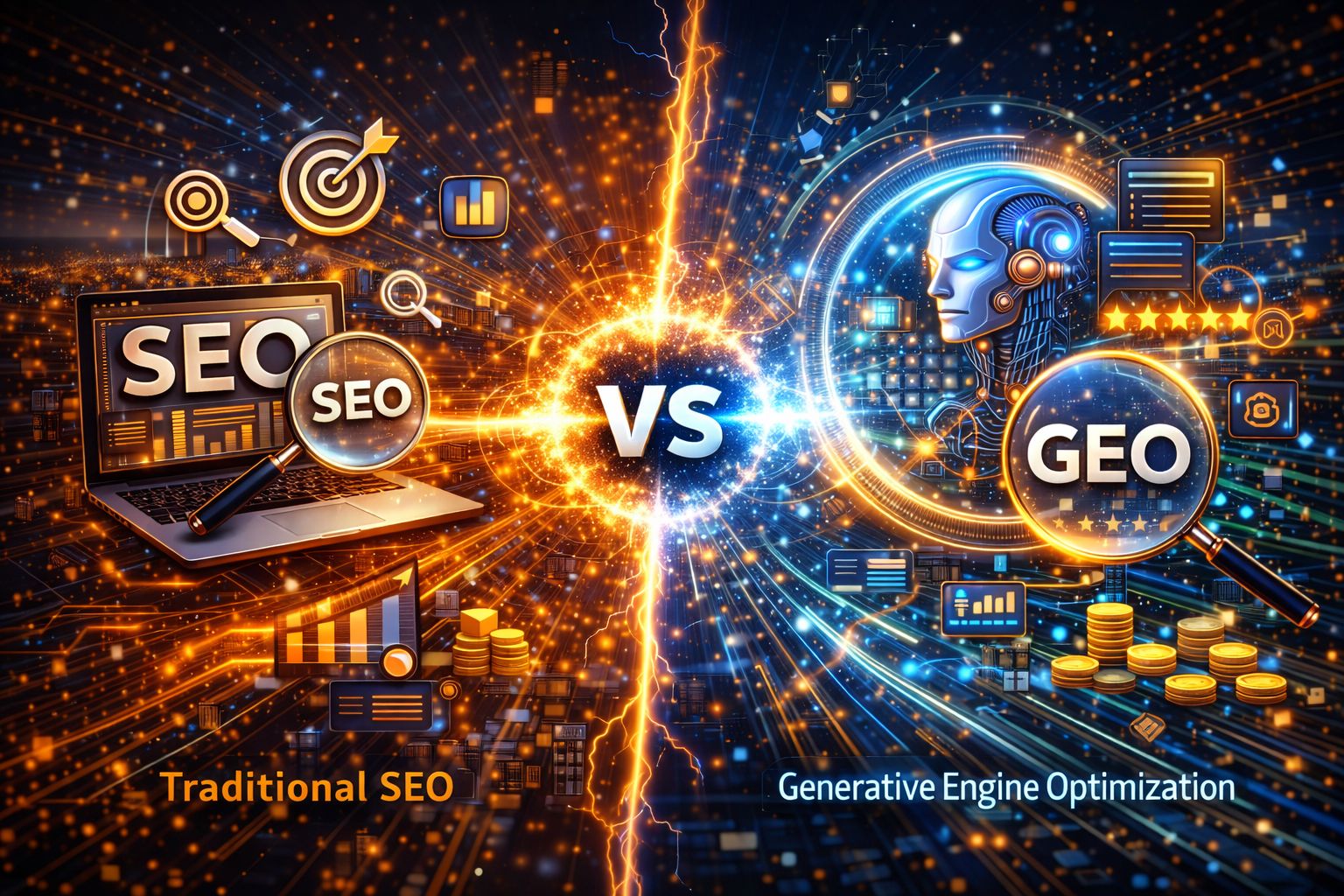
Direct Answer: Generative Engine Optimization (GEO) is the practice of structuring, proving, and distributing your expertise so generative AI systems can confidently extract, summarize, and cite your brand as the best answer. Traditional SEO primarily optimizes pages to rank in search results and earn clicks. Therefore, GEO vs SEO is the difference between winning visibility inside AI answers versus winning visibility as a ranked link.
AI search changed the user journey. Consequently, the highest-value outcome is not always a click. Instead, it is being selected as a trusted source inside an answer. Therefore, GEO expands SEO by adding three things that classic SEO often under-emphasizes: extractability (how easily an AI system can pull the right passage), entity trust (how confidently the system can identify and believe the source), and proof signals (why the system should cite you rather than paraphrase you or cite someone else).
This page is a spoke under the hub: Generative Engine Optimization (GEO) & AI Visibility. Additionally, it connects to the rest of your authority architecture, including The E-E-A-T & Technical Authority Pillar and The Modern SEO Results & ROI Command Center.
Table of Contents
- What GEO is in plain English
- What traditional SEO is in plain English
- Why GEO became necessary in 2026
- GEO vs SEO: the practical differences that change your strategy
- How AI systems decide what to cite
- Extractability: the #1 GEO advantage most sites ignore
- Entity trust: how to become the “safe” source
- Proof signals: how to make claims cite-worthy
- When to use SEO, GEO, or both
- A practical implementation plan you can use immediately
- Measurement: how to track GEO performance without guessing
- Common GEO mistakes businesses make (and how to avoid them)
- Internal links to related hubs and spokes
- External authority references
- FAQ
What GEO is in plain English
Direct Answer: GEO is the discipline of making your brand and content easy for AI systems to understand, verify, and cite, so you appear inside AI answers across platforms like Google’s AI Overviews and other assistants.
To understand GEO vs SEO, you first need to understand what a generative engine does. A generative engine receives a question. Then it tries to produce a helpful answer by synthesizing information from sources. Therefore, your “job” is not only to publish content. Instead, your job is to make your content selectable.
GEO focuses on three outcomes:
- Correct extraction: AI pulls the right segment, not the wrong one.
- Confident citation: AI is willing to reference your brand or URL.
- Accurate summarization: AI describes your ideas correctly, not vaguely.
Therefore, GEO is not “content volume.” It is content packaging + trust engineering + distribution. Consequently, two companies can publish the same number of pages, yet one is cited repeatedly and the other is invisible.
What traditional SEO is in plain English
Direct Answer: Traditional SEO is the process of improving your pages so search engines can crawl, index, rank, and send traffic to your site for relevant keyword queries.
Traditional SEO remains essential. In fact, strong SEO still powers discovery, and it still creates the foundation AI systems often rely on. However, SEO is historically optimized for a different output: a ranked list of links that a user clicks. Therefore, SEO tends to emphasize:
- Keyword-to-page relevance: matching terms and intent
- Authority signals: links and reputation
- Technical health: crawlability, speed, indexation, canonicalization
- On-page structure: headings, internal links, content coverage
All of that still matters. However, when the user’s journey ends inside an AI answer, the “click” is no longer guaranteed. Therefore, GEO vs SEO is best described as: SEO helps you be found in results; GEO helps you be chosen inside answers.
Why GEO became necessary in 2026
Direct Answer: GEO became necessary because AI-generated answers increasingly reduce the need for users to click search results, so visibility depends on being cited, summarized, and trusted as a source rather than only ranking as a link.
In the classic model, the “unit of competition” was a results page. Therefore, you optimized titles, improved click-through rate, and chased rankings. However, AI experiences compress the funnel. Consequently, users can receive recommendations, comparisons, and step-by-step guidance without leaving the search interface.
That creates a new reality:
- Visibility shifts upward: answers appear above traditional results.
- Attention concentrates: fewer sources are highlighted per query.
- Brand trust matters more: AI systems avoid risky sources.
- Proof becomes essential: unsupported claims are easier to ignore.
Therefore, GEO is a competitive advantage because it aligns your content with how AI systems select sources. Consequently, it can increase brand exposure even when traffic does not spike in a linear way.
GEO vs SEO: the practical differences that change your strategy
Direct Answer: GEO vs SEO differs in goals, structure, success metrics, and the “decision criteria” used by the system that surfaces your content. SEO competes for rankings and clicks. GEO competes for citations and correct summarization inside AI answers.
1) The goal changes: ranking vs selection
SEO aims to rank. Therefore, it optimizes signals that influence position. GEO aims to be selected. Consequently, it optimizes clarity, proof, and entity confidence so the AI system feels safe citing you.
2) The content format changes: long narrative vs answer architecture
Traditional SEO content often succeeds as long-form narrative. However, generative systems prefer modular, extractable units. Therefore, GEO content is built like an “answer file”:
- Direct answer near the top
- Definitions before arguments
- Steps and checklists for execution
- Clear scope boundaries (what applies and what does not)
3) The trust model changes: links alone vs entity + proof + corroboration
Links still matter. However, AI systems also evaluate source identity and consistency. Therefore, GEO expands trust building to include entity clarity, structured data, and corroboration from authoritative non-competing sources.
4) The KPI changes: sessions vs citation share and assisted impact
SEO typically tracks rankings, sessions, and conversions. GEO must track visibility inside answers. Therefore, citation share becomes a core KPI, while assisted conversions and branded demand lift become supporting KPIs.
For measurement and ROI framing, this GEO spoke connects naturally with: The Modern SEO Results & ROI Command Center and the GA4 spoke: Track SEO conversions in Google Analytics 4.
How AI systems decide what to cite
Direct Answer: AI systems cite sources that are relevant, extractable, and trustworthy, because citations reduce the risk of giving a wrong answer and increase user confidence in the response.
Even though platforms differ, the logic is similar. The system needs to answer quickly. Therefore, it prefers sources that:
- Answer the question directly without burying the point
- Use clear structure so extraction is low-effort
- Define terms consistently so the summary stays accurate
- Support claims using evidence, steps, or authoritative references
- Demonstrate credibility through entity clarity and site integrity
Consequently, your GEO strategy should reduce “decision friction.” In other words, you want to make it easy for the AI system to say: “Yes, this is the right source.”
Because integrity and trust are part of that decision, connect this spoke with: Security, trust, HTTPS, and spam.
Extractability: the #1 GEO advantage most sites ignore
Direct Answer: Extractability is how easily an AI system can pull the correct answer from your page. It is a core GEO advantage because AI systems reward content that can be summarized cleanly without distortion.
Many sites write “good content” that is hard to extract. Therefore, they lose citations even when they rank. Extractability improves when you:
- Use question-based headings that match how people ask
- Place a direct answer near the top of each major section
- Use short, direct sentences with clear transition words
- Use lists and steps to reduce ambiguity
- Define terms before using them repeatedly
Additionally, avoid mixing multiple intents on one page. If a page tries to answer five different questions, extraction becomes uncertain. Consequently, the AI may cite a different source that is simpler.
Therefore, in the GEO vs SEO comparison, GEO puts a premium on clarity and modularity, while SEO can sometimes tolerate narrative complexity.
Entity trust: how to become the “safe” source
Direct Answer: Entity trust is the AI system’s confidence that your brand is real, consistent, and credible, which makes it safer to cite you rather than an unknown or inconsistent source.
Entity trust is built through consistency and verification. Therefore, your brand should be unmistakable across your site and structured data. Additionally, your site should be technically stable and secure. Consequently, both humans and machines interpret your brand as “legit.”
Entity trust actions you can deploy immediately
- Consistency: keep company name, address, phone, and contact details consistent sitewide.
- Schema: use Organization + ProfessionalService + WebSite + WebPage schema to reinforce identity.
- Integrity: prevent spam injection and protect crawl reliability.
- Topical coherence: publish hubs and spokes that interlink logically.
For technical trust foundations, connect this to the hub: The E-E-A-T & Technical Authority Pillar.
Proof signals: how to make claims cite-worthy
Direct Answer: Proof signals make GEO work because AI systems prefer low-risk sources. Therefore, you should support claims with processes, checklists, definitions, and authoritative references that are easy to verify.
In practice, “proof” does not always require case studies. Instead, proof can be operational clarity. For example, a step-by-step process is proof that you understand execution. Similarly, a decision framework is proof that you understand tradeoffs. Consequently, your content becomes cite-worthy because it is both clear and usable.
Proof components that increase citations
- Clear definitions and scope boundaries
- Implementation steps that can be followed
- Decision criteria that reduce uncertainty
- Common mistakes and fixes
- External authoritative references that support key claims
Additionally, proof requires clean technical hygiene. If duplicate URLs or messy canonicals exist, AI systems can get confused about which page to cite. Therefore, connect this with: Redirects, canonicals, and URL parameters.
When to use SEO, GEO, or both
Direct Answer: Use SEO when you need discoverability and demand capture through rankings and traffic. Use GEO when you need brand presence inside AI answers and citations. Use both when you want durable growth across classic search and AI-driven discovery.
Because most businesses want both traffic and trust, “both” is usually the answer. However, priorities vary:
Use SEO first when
- Your site has indexing and technical issues
- Your pages are not ranking at all for core topics
- Your internal linking is weak and your crawl paths are unclear
Use GEO first when
- Your niche is becoming “answer-first” and click-light
- Competitors appear in AI answers more than you do
- You need authority positioning, not just traffic volume
Use both in an integrated program when
- You want predictable pipelines from search plus brand trust from AI answers
- You want content that ranks and also gets cited
- You want a hub-and-spoke architecture that compounds over time
Therefore, the best GEO vs SEO posture is integration: SEO creates accessibility and authority foundations, while GEO creates extractability and citation dominance.
A practical implementation plan you can use immediately
Direct Answer: Start GEO by mapping your top questions, building a hub-and-spoke structure, writing answer-first pages with proof packs, reinforcing entity identity with schema, and tracking citation share across a defined question set.
Step 1: Build a question map that matches real buyer intent
Start with the questions people ask before they buy. Therefore, list questions across four stages:
- Definition: “What is GEO vs SEO?”
- Mechanism: “How do AI Overviews choose sources?”
- Evaluation: “Which strategy is best for my business?”
- Execution: “How do I structure content to be cited?”
Step 2: Assign one page to one primary question
GEO works best when intent is clean. Therefore, every spoke should answer one primary question thoroughly, then link to sibling spokes for adjacent questions. Consequently, you reduce cannibalization and increase extraction clarity.
Step 3: Use answer architecture on every spoke
For every spoke, include:
- A direct answer above the fold
- A table of contents for scanability
- Definitions and scope boundaries
- Step-by-step “how to” guidance
- Common mistakes and fixes
- Internal and external links that reinforce trust
Step 4: Add proof packs that make your content safe to cite
Proof packs are a “citation magnet.” Therefore, add checklists, decision criteria, and clear processes. Additionally, cite authoritative references where they support key concepts.
Step 5: Reinforce entity identity and technical integrity
Use schema to clarify what the page is, who published it, and what the business entity is. Additionally, keep your technical foundation clean and secure so crawlers trust your environment.
Step 6: Track citation share and iterate
Finally, measure what matters. Because AI answers can reduce clicks, you should track citation presence, brand mentions, and assisted conversion impact. Therefore, you improve the program based on visibility outcomes, not only on sessions.
Measurement: how to track GEO performance without guessing
Direct Answer: Track GEO performance using citation share, question coverage, branded demand lift, assisted conversions, and content extraction quality, because AI visibility often happens without a click.
Core GEO KPIs
- Citation share: how often your brand/URL is cited across your target question set
- Answer coverage: how many high-impact questions you have fully owned with spokes
- Brand lift: increases in branded searches and direct traffic over time
- Assisted conversions: conversions influenced by organic journeys that are not last-click
Therefore, GEO measurement is closer to brand measurement plus technical clarity measurement. Additionally, GA4 remains essential for conversions and attribution, so connect this with: Track SEO conversions in Google Analytics 4.
Common GEO mistakes businesses make (and how to avoid them)
Direct Answer: The most common GEO mistakes are vague content, mixed intent pages, missing proof, weak entity clarity, and poor internal linking, which reduce extraction confidence and citation likelihood.
Mistake 1: Writing for “keywords” instead of writing for extraction
Keyword inclusion matters, but clarity matters more. Therefore, structure content so the answer is obvious.
Mistake 2: Publishing long content with no modular structure
Length is not authority by itself. Instead, structure creates authority. Consequently, use direct answers, sections, and steps.
Mistake 3: Making claims with no support
AI systems avoid risk. Therefore, add proof packs and authoritative references.
Mistake 4: Weak identity signals
If your brand is unclear, citation becomes risky. Therefore, reinforce entity identity with consistent sitewide information and schema.
Mistake 5: No hub-and-spoke internal linking
Without internal linking, topical authority is weaker. Therefore, hubs should link to spokes, and spokes should link back and to relevant siblings.
Internal links to related hubs and spokes
- Hub: Generative Engine Optimization (GEO) & AI Visibility
- Spoke: How do I get my brand cited in Google’s AI Overviews?
- Spoke: How do I optimize my website for ChatGPT and Perplexity?
- Spoke: What is “Citation Share” and why should I track it?
- Spoke: Is my content AI-ready? A checklist for 2026.
- Hub: The E-E-A-T & Technical Authority Pillar
- Hub: The Modern SEO Results & ROI Command Center
External authority references
- Google Search Central: SEO Starter Guide
- Google Search Central: Crawling and indexing overview
- Google Search Central: Structured data introduction
- Schema.org: Structured data vocabulary
- Web.dev: SEO fundamentals
- OWASP Top 10: Web security risks
- Google Search Central: HTTPS
FAQ
Is GEO replacing SEO?
No. GEO extends SEO. Therefore, you still need technical SEO, crawlability, and content quality. However, GEO adds extractability and citation-focused trust layers.
Can GEO help even if my website already ranks well?
Yes. Rankings can coexist with low citation presence. Therefore, GEO improves the chances of your pages being used as sources in AI answers even when you already rank.
Do I need schema for GEO?
Schema helps because it clarifies entities and page purpose. However, schema cannot replace unclear content. Therefore, combine schema with strong answer architecture and proof packs.
What is the simplest GEO step I can take today?
Start with one spoke: pick one question, write a direct answer at the top, add steps and a checklist, cite authoritative references, then link it to a hub. Consequently, you create an “answer asset” that AI can extract cleanly.